

Fiction / Hybrid / Nonfiction / Poetry / SF/F
Báyò Akómoláfé : Selah
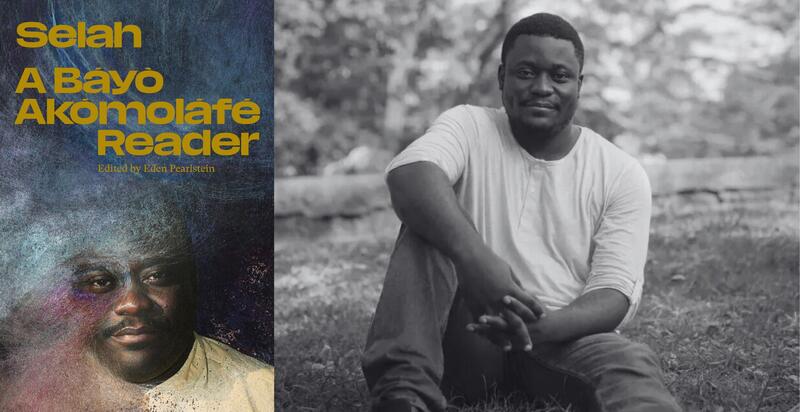
What if we were to take seriously that we, as humans, aren’t the sole authors of our world, that there are other intelligences at play, that we are only one of many agents of change and transformation, and that “we” aren’t even entirely ourselves given that “we” are composed of many “others,” many strangers that nevertheless make up what we call a “self”—what would a philosophy and politics emerging from this look like, one where we weren’t the center or central agent of the story? And what would we do if we discovered that the way we’ve been responding to the things we want to change—colonialism, racism, fascism, environmental devastation, and more—what if something about the way we oppose these forces actually reinscribes them, where the very way we are responding to the crisis becomes part of the crisis? We explore these animating philosophical questions of Báyò Akómoláfé today and take them also into the realm of words— from what it means when Báyò says “poetry precedes language” to how to tell stories while recognizing, in their remarkable power, their danger and limitations. We talk koans and tricksters, monsters and fugitives, shifting shape, following cracks, making sanctuary and much more.
If you enjoy today’s conversation consider transforming yourself from a listener to a listener-supporter by joining the Between the Covers community. Find out more about all the potential benefits and rewards of doing so at the show’s Patreon page.
Finally the BookShop for today.
Transcript
David Naimon: Today's episode is brought to you by award-winning poet Michael Kleber-Diggs' Worldly Things. Winner of the Max Ritvo Poetry Prize, Kleber Diggs documents the many ways America systemically fails those who call it home. The book simultaneously documents the wrenching grief of being black in America with moments of familial love, delight, and hope. Tracy K. Smith calls these poems knife-like in their concision and oracular at their core. Worldly Things offers needed guidance on ways forward, toward radical kindness and a socially responsible poetics. Published by Milkweed Editions, Worldly Things is available wherever books are sold. I want to take a moment before we start today's conversation to speak to the recent passing of Michael Silverblatt, the host of Bookworm. Maybe eight or nine years ago, I was interviewed a couple times about being an interviewer, and I mentioned Michael as a pole star, not only because of how deeply he prepared, but also how deeply he cared about writing and writers. Shortly after this, I received a message on my answering machine. I say on my answering machine because, yes, I still have a physical answering machine sitting next to my abacus and my butter churn. That message on the machine was from Michael to me. I've saved it all those years. It sits as message number one. I'm just going to play a little bit of it here now: "Hi, David. This is Michael Silverblatt. I'm sorry to call late. I thought you might be like me, up late reading. I'm glad that I expressed my admiration to the right person. I've been listening to your show for several weeks now. I'm very pleased to discover it. Of course, it makes me happy to know that someone else is doing this kind of work. I'm very excited and pleased. So I hope you'll give me a call as soon as you have time. I'm going to be pretty much at home, and I'd love to talk to you. Thank you, David." Needless to say, I called him back, unprepared for the generous, warm ramble of a conversation where he held court on his experiences interviewing everyone from Susan Sontag to Toni Morrison, but largely he spent his time offering advice to me as a public literary interviewer. It was a stream of generosity. I could hardly get a word in edgewise other than to excuse myself to run to the kitchen to turn the flame off under the sauce that was reducing on the stove, but I hardly minded because those several hours were a transmission coming from care and respect, much like the way he reflected back an author's book to them on his show. It was his show and Rachel Zucker's poetry podcast, Commonplace, that I felt most a family among. I mention them because they both allowed who they were and how they thought to shape the form of their shows, rather than conforming to the normal, formal expectations of most interview shows. They both showed up for their guests in incredibly generous ways. I like to think of Between the Covers aspiring for this too, that no one would mistake Rachel or Michael or my show for each other's shows, but that we shared something in regards to bending things toward our own sensibilities and how we prepared, how we asked questions, how we held the space for the literary encounter, and more. So with Rachel's show on hiatus and Michael no longer with us, even though, of course, there are a lot of other shows I listen to and love, I do feel like this small community, weird, book nerd, form-defined podcasters that felt like my tribe is no more. I wanted to simply say thank you to Michael Silverblatt for paving the way. Speaking of defiance of form, or the breaking of form, today's guest, Bayo Akomolafe, is the ultimate form defier, the supreme shapeshifter, whose challenges to the forms we presume are foundational to the world and how we see it can make you, or I should speak for myself, they make me, in their trickster koan style, often exclaim, hell yeah. But even when I notice resistance, even when I don't say, hell yeah, but instead, "What the hell?" I feel what makes his work so valuable is that it is super generative either way. It dislodges thought. It forces one to examine structures and strategies that might have seemed self-evidently unimpeachable. Suddenly there seem to be more possibilities as a result, more than yes and no, more pathways than hell yeah and what the hell too. Because of the fugitive, elusive nature of his philosophy and poetics, I suspect this will be one of those episodes people listen to more than once. I say this with more confidence than usual because in my second listen to the show during my audio edit, I found myself discovering and making new connections that I didn't register while the conversation was happening. As just one example, at one point I present a quote of Fred Moten and place Bayo's thought in relationship to Moten's, which is not a strange thing to do as Bayo not infrequently quotes Moten and weaves in his thinking. My quote of Moten's, however, about fugitivity, which talked about playing on the outside of, the quote itself wasn't my question, but the very beginning of one of my long essay, associative non-questions. I say many things after it before Bayo speaks. But when he does speak, he remembers not the question at the end, but the quote at the beginning, and differentiates his own thoughts on fugitivity as not being on the outside of. In fact, this question of being outside of, or instead within the seams or cracks within, repeats and reverberates for the rest of the interview. I didn't realize the first time that this was likely a Moten, Akomolafe call and response happening in real time around this. All in all, I'm really excited to present this conversation today so you too can have your mind bent to new shapes and to see what new conversations result and what new connections you yourself make as part of all of this. Lastly, I'll just say that one place you can have these conversations and engage more deeply with the work of our guests is by shapeshifting from a listener to a listener-supporter by joining the Between the Covers community, where you'll get a robust resource email with each episode and can choose from many other things too, from the Milkweed Early Reader subscription to access to the ever-growing, immense bonus audio archive. You can check it all out at patreon.com/betweenthecovers. Now for today's episode with Bayo Akomolafe.
[Intro]
David Naimon: Good morning and welcome to Between the Covers. I'm David Naimon, your host. Today's guest, philosopher, poet, psychologist, essayist, teacher, and public intellectual, Bayo Akomolafe, has a PhD in clinical psychology from Covenant University in Nigeria, is the author of two books, the co-written, co-edited We Will Tell Our Own Story: The Lions of Africa Speak, and These Wilds Beyond Our Fences: Letters to My Daughter on Humanity's Search for Home. He's the founder and executive director of The Emergence Network, a fugitive underground network of social artists seeking to both create new openings to age-old problems and to disrupt dominant modes of perception, engagement, and responsiveness in a time of crisis by disturbing modern notions of justice, power, and human agency. He's the recipient of an honorary doctorate from the California Institute of Integral Studies, the New Thought Leadership Award, and the Excellence in Ethnocultural Psychotherapy Award by the African Mental Health Summit. He has taught at Covenant University, Simon Fraser University in Canada, Schumacher College in the UK. He's been a visiting professor at Middlebury College. He lectures at Pacifica Graduate Institute and the University of Vermont, Burlington. He was recently named the Hubert Humphrey Distinguished Professor of American Studies at Macalester College in Minnesota, where, among other things, he will teach a course called Parapolitics and Blackness. Akomolafe has been featured in several documentary films, including the award-winning Regenerar: Possible Paths on a Damaged Planet. He's been a board member of many organizations, including Science and Non-Duality in the U.S., and Ancient Futures in Australia. He was the inaugural Global Senior Fellow at UC Berkeley's Othering and Belonging Institute, the inaugural W. E. B. Du Bois Scholar-in-Residence for Transpublic Intellectualism at the Schumacher Center for New Economics, and the inaugural Distinguished Philosopher-in-Residence at the John Randle Center for Yoruba Culture and History in Lagos, Nigeria, to name only a few of his accolades. So it's with much joy and anticipation that we have Bayo Akomolafe here today to talk about his new book, out from Ayin Press, called Selah: A Báyò Akómoláfé Reader. Past Between the Covers guest Adrienne Marie Brown says of Selah, “Báyò Akómoláfé is a philosopher who is pushing us to think outside of every narrative we take for granted. In this text, he guides us to reconsider how we relate to the world—and to internalize the fact that earth and all of nature are alive, relating to us. Selah is an ancient Indigenous orientation, poured through Báyò’s trickster poetry to make for a fresh agitation.” Nora Bateson adds, “Selah is a thousand branching pathways, like the winding veins of rivers, blood, roots, and roads. As travelers we are invited to ride upside-down, to tilt and sway, to giggle and loosen the tyranny of expectation, tickling the familiar. As ossified ideas crumble in these pages, there is the possibility of ooze, and the ooze of possibility. Be ready to swallow your words, trip on your own feet, and forget your name. This book is important, it is a portal, a port from which to impart a new lostness.” Finally, Sophie Strand says, “Like the carpenter ant sporulating cordyceps mushrooms from its forehead, one has the sense that Báyò Akómoláfé’s insights might be dangerous to channel—that we are reading the final, perhaps fatal, fungal flourish of entities simultaneously too microscopic and too macrocosmic for our human organism to ever comprehend. These blessings do not offer protection. They offer divine infection—with mystery, with microbial anarchy, with revelry, and, most importantly, with a widened capacity for gardening in the ecotones of paradox. In a moment where there are no easy answers and no right side, Akómoláfé shows us how to play in the fertile interstices between species, and how to pray in the fertile compost heap between sterile ideologies.” Welcome to Between the Covers, Bayo Akomolafe.
Bayo Akomolafe: Ooh! Thank you, brother. Thank you. Glad to be here. [laughter]
DN: I wanted to begin by talking about the terrain and circumstance of this book's emergence, which has many unusual elements, most prominently perhaps that Eden Pearlstein, Ayin Press' editor, envisioned that this Bayo Akomolafe reader isn't a collection of your long-form pieces, but instead he lifts segments out of your long-form pieces and places them in what he calls a series of ecstatic eruptions, collaging them with other passages from other essays and posts of yours over time into a book-length meditation. He said he was guided in this editorial process by the thinking on aphorisms by Walter Benjamin and also by the Lebanese-Palestinian thinker Jalal Toufic. Eden quotes Benjamin as saying, "Work on good writing has three steps: a musical phase when it is composed, an architectural phase when it is built, and a textile phase when it is woven." Toufic says, "An aphoristic book requires from its author the perforation of walls for the reception of aphorism and demands from its reader quantum tunneling between the consecutive aphorisms." So I'd love to start here. A project that seems to interrupt the continuity of thought of a long-form essay or blog post, to fragment and then reconstellate the fragments across lines of inquiry. It seems like a strange project in most contexts. But in many ways, it feels like the perfect mode of relation with your particular way of thinking in the world. So talk to us about your thoughts on the aphorism and the aphoristic in relation to your thinking and writing, and on Eden's disruption of thought as perhaps another form of thinking.
BA: Thank you, brother. Yes, I think that at some stage in the emergence of this text, I felt this would really succeed if it were considered an archive of uneasy conjunctives. It's not full sentences, things partially showing up, never fully contrived. It's almost, as you say, an offering, or as you might think, an offering to radical incompleteness. So the aphoristic shows up here, never fully fleshed-out wisdoms, always hesitant, tentative, and stuttering. Maybe that's why the book is called Selah. I called into that ethnomusicological concept from the Hebraic scriptures, the notation of which is yet to be fully designated. The theorists are still out. The jury is still out on this one. What does it mean, Selah? Does it mean turn it up? Does it mean increase the volume? It was a concept used together with music and the musicians in the court of the palace. But no one really knows what it means. It appears seventy-something times in the text, and no one knows what it really means. I loved that. When something strays away from easy signification or strays away from easy conceptualization, falls off the cliff of textuality and misbehaves. So this book, a reader of sorts, is supposed to be a disabling force, a lyrical, generative incapacitation. That is how I think of the aphorism here, the aphoristic. It's always effervescent, evaporating, and never fully showing up.
DN: Well, what's interesting about this project is that the short-form writings of yours are, in a sense, constructed by another from your longer-form work. I do think it's entirely successful in this way. What Eden has done flows, and there is an accumulation of meaning, a gathering of momentum as one reads Selah. The fact that another has achieved this in the spirit of your work feels like it honors something about your work, because your work, I think, destabilizes the notion of the individual. I might want to say that this is interactive in spirit, but I suspect you would say intra-active, a term that comes from the work of the physicist and feminist theorist and philosopher Karen Barad. It's clear you've read a lot of her work and metabolized it. For instance, when Barad says, "To be entangled is not simply to be intertwined with another, as in the joining of separate entities, but to lack an independent, self-contained existence. Existence is not an individual affair. Individuals do not preexist their interactions; rather, individuals emerge through and as part of their entangled intra-relating." I'm likely misapplying intra-action when I think of how Eden has represented you via Jalal Toufic and Walter Benjamin, or how Barad finds themselves again in your work. But talk to us a little bit about not presuming that things preexist relationship, not presuming individuals preexist their interactions, or about intra versus inter, or really about anything that this sparks for you in this regard.
BA: Karen is a dear, dear sibling and an elder. My first book, These Wilds Beyond Our Fences, was deeply influenced by Karen's work and thought. It was almost like Karen stood at the threshold, ushering me into a beautiful, carnivalesque world of post-humanist considerations that ultimately refused to center the human at the anchorage point of agency, that we can no longer afford to do that. I think as we move into politically dire times, inflamed times, when our understandings of the world are being called into question, there's something poetically vibrant and potent about intra-action, for instance, or post-humanism, or eco-feminism, or my parapolitics and post-activisms and onto fugitivity and onto amnesia that represents a different cosmo-poetry of things. It doesn't guarantee a solution, but invites a different kind of posturing in a world that is surprisingly alive. Maybe that's where to start off here. Intra-action, for instance, is a counter-narrative to the enlightenment notion of the individual that comes or shows up ahistorically, apolitically. As Karen would put it once in her book, Meeting the Universe Halfway, if we begin with the self or the individual, (I'm paraphrasing), that just shows up in the world, we're already too late, because we've cut out, not we per se, but the assemblage, this is Deleuzian thinking as well, has already cut out the processes that led to that moment, that seminal moment that the individual shows up with confetti. So we're having to deal with process instead of product. That is where we are now in a world that is suddenly upset by AI insurgencies. We're now having to ask ourselves the questions, the metaphysically uncomfortable question. We thought we were the owners of cognition or intelligence. Turns out it belongs to the planet. The planet will enlist whosoever it will in this carnival of intelligence that we have rudely claimed for ourselves. So I think that's where we are now. It's one way to respond to your question, I guess.
DN: Well, when I think of the aphorism, I'd like to take it farther and say there's something like the koan in your work insofar as it bedevils the possibility of arrival. When I look at what others have said about your writing, I think I see them gesturing to something similar. For instance, one of the founders of The Dark Mountain Project, Dougald Hine, says, “There’s a story about Borges, the great mischievous Argentinian writer, reading several books of Martin Buber and then discovering to his surprise that Buber was a philosopher. Why the surprise? Because Buber didn’t make arguments. ‘Arguments convince nobody,’ Borges explained. ‘But when something is merely said or—better still—hinted at, there is a kind of hospitality in our imagination.’” Then Hine goes on to describe your work as eluding cognitive capture. I compare that to the Aboriginal thinker Tyson Yunkaporta saying about you, "Bayo sweeps..."
BA: That rascal. [laughter]
DN: I can sense the mutual love between the two of you. It's really wonderful. "Báyò sweeps away the panicked grief of the Anthropocene with delight at the ‘wondrous meanwhile’ in which the world turns itself inside out and our edges migrate to the center of things." He then goes on to compare your logic to a Möbius strip. They both use words like mischief and trickster when they talk about this aspect of your work. Then quoting you back to yourself now, you say, "When you meet something fierce, too strong to overcome, too high to climb, too eminent to sidestep, too dark to enlighten, don’t take it too personally – you have merely met an antibody, whose sacred task is to challenge you, discombobulate you, disfigure you, and introduce ‘you’ to the strange vastness of your family. A larger commonwealth of becoming." It feels to me like you are embodying this antibody in many ways. For instance, it isn't surprising that Eden arranges the book's opening so that our entryway into the book is about doors and doorways, because it demonstrates your subversion of even this, of even his curation, with the opening lines, "If you can get a handle on it, it's probably a door. I'm wary of doors. And doorways. Doors allow us to shuffle within the already-known. Doors 'behave.'" I know I'm maybe connecting things that aren't the same, the koan, the trickster, the antibody, but talk to us about this mischievous conundrum element to your work.
BA: [Laughs] The koan maybe plays and dances with this. I don't know if I would take for myself the prestige of authoring koans. I'll probably say that I'm playing with monsters, little monsters. In my book, These Wilds Beyond Our Fences, I wrote into being this idea of little hushes that disturb completeness. I call them hushes, but I wrote them in such a way as to actually confuse people as to their actual existence. So I got lots of letters, people saying to me, "I cannot find this creature you speak of that is a hush, this insectoid, black obsidian thing that you're calling a hush." In many senses, the genius of this text, of this book, is Eden's and the hushes. The origins of these texts are very humble. They came from my experimentations with social media. Sometimes I'll just leave a text or two and it would take on this viral load by the next time I look at it. So what Eden did was to look through years of my writing and just put it together and orchestrate it. It's his genius, really. In many senses, Eden writes this book, and to marshal these things into this lyrical festival where they're collapsing upon each other, tumbling down into mangle holds of different mangle holds, and then doing something that I couldn't have anticipated when I wrote them individually. So, yes, I guess that's what I want to say about that. [laughs]
DN: Well, it seems like the genius isn't with you or with Eden, but between the two of you.
BA: No. It's between. It's a betweening. It's a wind that blows of some kind. Yes.
DN: Any thoughts you might speak to around the trickster aspect of the koan or the trickster aspect of what these other writers are pointing out about your work, turning things inside out in a way that sort of, I mean koan also does this, it confounds you. I don't know if there's a humor, but sometimes there is a humor. It's like trying to get you jolted out of something. There's a playful trickster component to it, I think.
BA: Well, I would just say that my rascal brother Tyson, I think he may have stolen that phrase from me, "the wondrous meanwhile." He doesn't speak that way. That's me. That's me.
DN: He has it in quotes in that quote.
BA: There you go.
DN: So he actually honors you in "the wondrous meanwhile." [laughs]
BA: I knew that. I'll take a look at the text again and see, yes, I heard that. I was like, "Tyson doesn't speak that way." But I digress. I'm kidding, of course. I really appreciate my siblings supporting the text in this way. I do draw deeply from the cosmopoetics of Eshu, the lyrical trickster at the heart of the crossroads in Yoruba cosmology. Eshu is the unbridled figure that travels the Atlantic during the transatlantic slave trade, upsets the colonial presumption of mastery, proliferates fungal technologies like Candomblé, Santería, Rastafari, Rastafarianism, samba, and all of these things in the so-called New World under the nose of the master. There's something about Eshu's presence, which is also hyphenated as an absence, a duplicity of some kind, that teaches me the gift of non-completion. That's where the trickster finds its power. The warning to never confide so deeply in our desperate, anxious need for signification. Meaning can only go so far, but meaning is indebted to a deeper chaos. There are some times, and this is where my parapolitics draws from, when meaning, morality, and the architectures of experience become so asphyxiating. We become so trapped in our nobilities, in our notions of agency, in our ideas of justice, in language, that we need the crack, the agency of the crack, to split it open so that new forms of care or new forms of agency or new forms of presence and embodiment can emerge. That's a trickster's gift. It's not that the trickster introduces trouble, it's that the trickster reminds us that we are trouble pretending to be order. And that is how I tend to write. I write from the shifting tectonic plates of modernity, not from the secure ground of justification, but the tecto-poetics between the continental shifts and plates of a world that is radically dynamic and constantly migrating. That's where we meet the trickster in these times of penury and poverty and pain and genocide and loss and inflammation.
DN: Well, your book is the second book on the Jewish Press, Ayin Press's new imprint called Aora, which aims to explore thought and culture beyond borders, disciplines, and traditions. Their first book in the imprint, called Surviva: A Future Ancestral Field Guide, is part graphic novel and part art book, conjuring a postcolonial Indigenous future. Then there is your book, and following yours will be a collection by a Palestinian essayist. When you were in conversation on their website with Rabbi Nate DeGroot, you said, "I read Zionism as the concatenation of the desire to be settled, to be gathered, to arrive in a way that might feel stable for all time, eternalizing settlement and inadvertently pathologizing diaspora and movement. But this is a time when it seems difficult to think about the world apart from movement. If we’re to start to think about the refusal to pathologize diasporic movements, and displacement, then we must open up a different kind of politics that is yet to come." In that same conversation, not related to Zionism per se, but I connect it to it, you say, "An emancipatory politics will not emerge from arriving at a final destination. It’ll come through us creating branching alliances with the things that we’ve otherized for so long." I'm not speaking for Ayin when I say this, but when I look at their books and this new imprint in relationship to their main imprint, it does feel like they are trying to enact these branching alliances, to walk Jewish thought back into an unsettled relationality with the world. I bring this up because, as you've already spoken to, the title of this book from the Hebrew Bible, Selah—
BA: Is deeply unsettling.
DN: Yes. You've said it's mentioned seventy-four times in the Bible, mostly in Psalms. Nobody knows what it means. Is it an exclamatory affirmation? Is it a musical notation? Maybe it is even both of those things, but it's surely more than those things. Is part of what Selah is, is also being against the settlement within linguistics, within the idea that the word is a place to arrive at, that the word itself, Selah, seems to suggest maybe the limitations of words, but also directing us away from itself as much as it's directing us to it?
BA: Yes. I think Selah is less anti-settlement and more para-settlement. You can be anti-something, you can be resolutely against something and still repeat its logic. Just like anti-capitalism, for me, is the genius of capitalism. [laughter] It's like capitalism is rubbing its hands with glee, subsidizing anti-capitalist movements, because the logic, the frame, is sustained by negation. So I wouldn't say that I'm anti-settlement. It's a different move that's made here. To be anti-settlement is to be outside of settlement in some way, but to be positioned that way is to reinforce the logic of that which you're against. It's like leaning on a wall and pushing against it. But the more you push against it, the more you take on the attributes of that which you push against. I would locate the tension within settlement, that settlement proposes a totalizing presence, that it is complete. Again, we're back to radical non-completeness, the fugitive within. It's that right there, the hairs are turning in different ways. There's a minor gesture within settlement. Its own logic meets its limitation. There's something about settlement that produces its own counter-narrative, its own counter-politics from within. That's the para. That's the minor gesture. That's the counter-logic within the logic. It's just like a cell in the body. It's supposed to support life. Then suddenly it starts this process of apoptosis, where it kills itself. Not because of an external threat, but because it seems life meets its own limitations and decides, "You know what? I think death is how I want to live." So it's there that I locate the Selah. That Selah is writ large when we think about the Westphalian global order and how the vicissitudes of Enlightenment philosophy led to the settlement of citizen-subjects in identitarian boxes. We think about how that precipitated the Anthropocene, the Anthropocene and its disjunctures and its ruptures and the fissure lines and the fractures and the cracks. There's something about that that beckons on the nomad that says, "You are so settled and you're trying to address these critical events from the vantage point of settlement, and you're only going to repeat the logic of settlement." There is something beautiful about migration, about movement that precedes settlement. For instance, in the United States, there's a whole lot of conversation about keeping America safe. "Let's build walls that keep America safe." From the logic of the establishment, that's excellent. But movement precedes walls. Even walls migrate. When you think about all the things that have had to happen for a sense of identity to develop, we've always moved. We've always moved. Geometry's shifting, geology's shifting, bodies moving, and that's how we come to a non-stable notion of safety. I think the world is arching its back and resisting the continuity of so-called settlement and inviting something else to take root or maybe to become fugitive. That is where Selah shows up. Selah shows up at the tecto-poetic threshold where settlement can no longer continue unbridled. Yes.
DN: I want to ask you more about fugitivity. But before I do, I did want to stay a moment longer with this distinction you make, this correction you make of me around anti-settlement versus para-settlement, which is crucial to your work. I feel like if we return to Karen Barad's intra-activity, that the individual doesn't precede the relation, and how you're employing this in the realm of the political around questions of collective action, whether that be around climate or colonialism or racialized extractive capitalism, all of which you care about, but where you put forth a counterintuitive, provocative set of questions of how to orient ourselves in relationship to them in a way that's different than an anti-capitalism, an anti—so I was hoping to begin that exploration. You would read a page for us from Selah that we could then use as a preface to some questions that follow.
BA: Yes, yes.
[Bayo Akomolafe reads from Selah: A Báyò Akómoláfé Reader]
I have to take a quick pause here and say this is Karen's influence, right? A social production. She distinguishes from a social construction, right? It brings it home to a new materialist frame by making it a social production, but I digress.
[Bayo Akomolafe reads from Selah: A Báyò Akómoláfé Reader]
DN: We've been listening to Bayo Akomolafe read from Selah: A Báyò Akómoláfé Reader.
BA: [Laughter] Nice one. I think you set all of that up to give that, to drop that mic.
DN: I love that looping back. Even that itself is this strange troubling of self, I think.
BA: It is, it is.
DN: Yeah. What much of interactivity rejects the individual preceding the relation. Here you're warning that to treat white modernity as a thing, to be opposed or dismantled as a thing, that our opposition to it becomes part of preserving, even potentially reifying it as a thing. This feels extremely central to your approach around any number of issues that we face. You say, “Problems are how we become creative. Solutions are how arrangements often fortify themselves.” Or as Karen Barad said, “There are no solutions. There is only the ongoing practice of being open and alive to each meeting, each interaction, so that we might use our ability to respond, our responsibility, to help awaken, to breathe life into ever new possibilities for living justly. The world and its possibilities for becoming are remade in each meeting.” I wanted to add another lineage of thought that you've alluded to already into our discussion, which I think is a big part of this dynamic too, which is Fred Moten and his thoughts on fugitivity. Moten says, “Fugitivity is a desire for and a spirit of escape and transgression of the proper and the proposed. It's a desire for the outside, for a playing or being outside, an outlaw edge proper to the now, always already in proper voice or instrument.” You add, “The fugitive cannot afford to speak truth to power. Marronage, the act of removing oneself from the control of the slave plantation, wasn't preceded by honesty or truth-telling, but creative deception and a refusal of the epistemological imperatives of the master.” I see this in your refusal to oppose the things that we want to oppose by opposing them, that you oppose this opposing. One example is you don't oppose this opposing. That's the koan, right? [laughs]
BA: That's the koan.
DN: You don't oppose the opposing. But you do. [laughs] One example is when you say, “The politics of emancipation is an extension of Enlightenment politics, a doubling down on the parameters of the human.” This conundrum seems to me to have at least two aspects. On the one hand, we have to find another way in relation to the things that we wish we could vanquish or solve, because we aren't going to vote or recycle our way out of our problems. You described the good citizen approach as like fighting to install solar panels on slave ships.
BA: Yeah.
DN: On the other hand, you also say, "We can't proceed by fighting the system in the ways we most often conceive of doing so." So I was hoping we could stay just a moment longer with questions of fugitivity or this question that you ask over and over again: “What if our response to the crisis is part of the crisis in relationship to fugitivity?”
BA: Again, we ought not to start speaking about fugitivity as if one body were simply extricating itself from an environment. Again, we're starting with independent things, right? We want to see things relationally, processually. I think of fugitivity as the weirdness of the plantation, that the plantation almost rhizomatically desires to be other than itself, right? Because the slave, the enslaved body—I play with either term. There are times when the tension leans on the language of enslavement, and there are times when it feels more powerful to do the work of staying with the idea, the term slave, right? I want to use slave now. The slave does not merely exit the plantation. It doesn't have some pure identity that exits the plantation. The slave is the machination, the mechanism, the inner working of the plantation. In many respects, the plantation's desires and viruses and burdens and ancestralities are invested in the slave's body, so that in the act of fugitivity, the slave is carrying the plantation as well, right? This is the reason why a lot of activism today proposes that we can exit capitalism. “Oh, let's extricate ourselves from harm or anything that spells harm or any structure, then let's start afresh somewhere,” right? You don't need to be a sci-fi fan to know that that is impossible, right? I mentioned sci-fi because there's this one series that I used to watch. It's called Predator. I think it's Ridley Scott. No, that's Alien. There was one where they came together to sell toys, obviously, Alien vs. Predator. I know that at the end of it, the Predators won. They killed the aliens, the xenomorphs, right? Famously, the xenomorph was played by a Nigerian in the first iteration of that filmic series. In the very last scene, as the body of the Predator, which died, was carried away in the spaceship, an alien fetus bursts out of the belly, as if to say, “Of course, there will be a sequel. So buy our toys.” But even deeper still and more critically, to say, “Be suspicious of your claims to victory, because your victory may just be the outer working of the thing that you're trying to exit from.” So I don't think that it's possible to just merely remove ourselves from the things that haunt us. This is where fugitivity plays a role. The plantation is exploring rhizomatically, in some rooted way, what it means to be more than a plantation. That's where we find ourselves. We're not dealing with purity. We have never dealt with purity. We're dealing with systems in their asystemicity. We're dealing with how systems themselves paragogically learn how to be more than themselves. This is why it will never be up to us to unlearn white supremacy, no matter how many times you learn pronouns or you go to a workshop. It's not left to the individual to carry the day. It's the world in its paragogic undoing of itself. But I've digressed. What were we supposed to stay with?
DN: No, you're staying with it. This idea of our response to the crisis is part of the crisis.
BA: It is, right? And there are so many examples of this. The African independence movements. What did we learn? We learned it the hard way. We chased away the colonizers. We removed their flags. We lowered their flags and we put up our own. But that was the point. Immediately we won, we turned and looked at ourselves in the mirror and we found out we had become the very thing we chased away, right? It repeats itself over and over again. To defeat a pandemic, we take on the virulence and the violence of the pandemic. It's almost like creating a vaccine with an attenuated version of the virus. It's that we always become the thing that we chase away. I think that is how logics maintain themselves. I've started to develop, for a new book I'm writing, the concept of a carousel. I travel like an exercise demon, so I often stand in many airports waiting for my bags to arrive. I noticed once, while I stood somewhere, some nameless airport I cannot remember, that each bag that was spat out by this hidden dragon from beneath the depths of the airport, each bag was different, colorful, different shapes. But each bag was indebted to the machine of the carousel. It always went round. No matter how diverse it was, it went round. It's interesting that carousel comes from “ carosello,” which means little war.
DN: Wow.
BA: [Laughs] Right? The very thing that has been domesticated as a machine to give us our bags signals war, right? It's like little war. Of course, it comes from the—we don't have this in Nigeria. I didn't go to this in Nigeria growing up—but the merry-go-round with the horses. That was the carousel, right? And they were designed to mimic little wars. That's why it's called little war, right? With your horses and to fight in the carnival. So I think we are in little wars that proliferate the logic of the very things we're trying to upset or move out against. This is the reason why I theorize cracks not as the place where the light gets in, but as the place where the fugitive meets the threshold of the system and where we might slowly, slowly develop—and not develop, rather, I must take that back vehemently. It's not development. It's a slow generative incapacitation, where we are made aware of other kinds of senses, other sensorialities. The work of transformation or transmutation is really sensorial apostasy, not developing new capacities, not becoming a leader, not, as some people say, reconnecting with nature as if we're ever disconnected from nature. It is about becoming transmutationally available to the sensorial vortices that spin in the cracks of modernity.
DN: Well, I'm going to connect a whole bunch of things that perhaps are only connected in my mind. I'm not sure. I'm going to present them less as a question and more as a field of associations just to see how you respond to them.
BA: Okay.
DN: Because one thing that helped me better to orient myself to this circular trap we are in, where everything we want—justice, peace, healing, liberation—where the way these things are being pursued might be upholding the very things preventing them from coming into being, it was when you were talking to Rabbi DeGroot and you brought up the myth of Prometheus and how, after he gifted to us fire, to humanity, he was punished by Zeus by being shackled to the cliffs of Caucasia, literally enslaved on Mount Whiteness.
BA: Mount Whiteness. [laughter] That was my little joke.
DN: Yes. Where every morning his liver would be plucked out by an eagle, but at night his liver would regenerate for him to be again eviscerated in the morning at dawn for eternity.
BA: Wolverine style.
DN: Yes. That if we were to go to the cliff above Prometheus and proclaim down to him that we support his healing, that not only does nothing, but it's complicit in supporting his torture. His newly healed liver would be yet again ready to be plucked out again. This conversation happens as part of a column on Ayin Press's website called Teiku, which is an ancient Aramaic acronym from the Talmud. Teiku is described in the intro to your conversation as, “When a debate can't be solved, when multiple sides have presented their viewpoints, and there's no resolution, that's called a teiku, meaning let it stand.” That teku is a praxis of answerless inquiry that with deeper knowing, the answer isn't the point. Then the rabbi connects this to the Nigerian practice of Mbari. In the little that I've gathered about Mbari houses—and you'll have to correct me if I get this all wrong—they were made over weeks to months to appease the earth goddess, Ala. Ritual statues were placed inside.
BA: Yes.
DN: Ornate drawings are made on the outside. But when the house is made and finished, or so-called finished, it is not to be entered or even visited again. Not only that, they're made from the clay from anthills and termite mounds so that they naturally decay into the ground as a gesture of respect to the earth goddess. So when I think of answerless inquiry and non-arrival and teiku and Mbari houses, it makes me think of other things. I think also of this line from Eduardo Galeano when he says, “Utopia is on the horizon. When I take two steps, it takes two steps back. I walk ten steps, and it is ten steps further away. What is utopia for? It is for this, for walking.” [laughter] It almost feels messianic, its power derived from its non-arrival rather than its arrival. Like when you saym, "One does not approach the sacred, the approach is sacred. The way to heaven is where heaven is," or when Ursula Le Guin says, “You cannot make the revolution. You can only be the revolution. It is in your spirit or it is nowhere,” where nowhere is actually the literal translation of utopia. But when I think of these Mbari houses of termite clay, I think again to the opening of Selah and your distrust of doors, where you say not only that doors allow us to shuffle within the already known and that doors behave, but also that cracks don't behave, that architects don't design or anticipate them. You talk about how cracks are really showing up everywhere—in human exclusivity, in settlement, in the legitimacy of nation states, in neurotypicality, in time, in being—and that this loss of stability, this falling to the earth, invites us into what you call a geophilosophy of following the cracks, of following the cracks where they themselves lead. Perhaps that is Galeano's walking or letting the termites lead us, or where the messianic or the revolutionary enters the world is through the cracks. I don't know. Not a question, but maybe this sparks some more thoughts for you.
BA: [Laughs] I watched a cartoon last year called, I think, Common Side Effects. I think it's called Common Side Effects.
DN: Oh, yeah. I watched that too.
BA: Really? You have?
DN: Yes.
BA: There you go. There you go.
DN: It's the one about the mushroom, right?
BA: It is about the mushroom.
DN: About the magical mushroom.
BA: I've been wondering if there will be a season two of it, because I really would like to say more about this. But yes, if you remember how it goes—and I'll give a summary, because I understand spilling secrets or telling people about stuff they haven't watched is a cardinal sin in the West, so I'll just do a summary—it's about a mushroom that has this profound healing power. Squeeze a little bit of the mushroom in the mouth of a dead pigeon, and the pigeon will come back to life. So, of course, the cartoon does not shy away from the pharmaceutical, political implications of having such a mushroom. It investigates it. They try to kill the guy, the dude with access to these mushrooms. [laughs] That's a whole story. But then this guy is also urgently trying to proliferate. He has just a few items of this mushroom left, so he's trying to grow more, teach people how to grow it so that they can help themselves. He has no qualms with teaching people. He doesn't want to make a dime out of this. He just wants to give it to the world. But he doesn't know how to grow it. He doesn't know where it comes from. It was given to him, or he stumbled upon it somehow. He finds in one of the episodes, if I recall correctly, that the mushroom grows from the runoff, the chemical spillage, the toxic runoff of the giant industries. It's just genius writing that the mushroom comes as a very consequence of the very thing that the mushroom upsets. That is what I call a weird fidelity, a minor gesture, which is to say the mushroom is not outside of industry. It's not outside of the pharmaceutical industrial complex. It literally is the pharmaceutical industrial complex in its own inability to be completely totalizing in its toxicity. That is where the weird fidelity comes from. That is where the walking comes from. That is a crack. That is the monstrosity that is the center of that beautiful cartoon. Maybe that is what I think about as parapolitics, that the political is this stage of the legible. It has legible actors. It has voting lines. It has institutions. There comes a time when the political field becomes exhausted, loses its elasticity, and is no longer capable of holding the burden and weight of our aspirations as a species, right? The other dimension of the political that I play with in my work is the infrapolitical. I forget the name of the author who writes about infrapolitics. The infrapolitical is an attempt to address the political from the subaltern, right? It's how the subterranean speaks and resists the political. So you think about how minorities stake their claims to legibility, say we want a seat at the table or we will speak truth to power, right? But sometimes, and it is very often the case, that in speaking truth to power we become ecological ventriloquists or we become aspects of the power that we're trying to drag to our attention. It's like in the very attempt to say we want a seat at that table, we are also coinciding with the political in its framing of power. We're thinking along with it and accepting its understandings of privilege. That's why the infrapolitical and the political might be distant cousins, but they're doing the same thing. That's why I theorize the parapolitical, which is not about legibility, which is not about readily identifiable objectives and goals and manifestos, but it's about sensing where the weird is showing up, where the mushroom wants to be born, where a new god wants to be born, where the fugitive is playing, where the autistic is playing. That's where the parapolitical dwells. So in a nutshell, the political is the spotlight. The infrapolitical is the searchlight. The parapolitical is the ghost light.
DN: That's great. [laughter] I want to take all of this philosophy back into language for a little while. You are a storyteller, and I think a great storyteller, whether bringing us stories from Greek myth or from Yoruba cosmologies or from the Bible, or storifying the physics and metaphysics that you encounter. Yet you also say, “By investing too heavily in promises of language and narrative, we reinforce a logocentric universe that conveniently situates us in the centre of all things.” You also say, “Giving story too much power blinds us to the actions of the world around us and how we are shaped by things without name or plot.” One more: “We will not unilaterally story a new world into being. The world is not just story, it is silence.” So I was hoping you could talk to us about how to be a storyteller aware of the harms of story, the harm stories can cause. How to tell stories that recognize the dangers and limitations of stories.
BA: Beautiful. The social constructivist might reduce everything to story. There was once a time I followed this postmodernist impulse to think of the world as story, right? It softens things a little bit from its hard-edged materialism to say the world is story. But there is a risk to saying that. Because immediately we say the world is a story, we enthrone or we reify or reinforce the anthropocentrism that is critically at the heart of our troubles today. Because we say the world is story, then we mean that the storyteller is us. Then we can snap our fingers like Thanos and reinvent a new story. Then we can say, let's gather geniuses in a room somewhere near the Swiss Alps and think of a new story of capitalism. These are not hypotheticals I'm talking about. I'm talking about real efforts in the world today that I've been part of. Like, what comes next after capitalism? Let's think up a new system. No, you didn't think of capitalism in the first place. It's not like a group of people came together and said, “So folks, we're going to call it capitalism.” No, there wasn't a committee. It's always post-human. So I refuse the idea that the world is story. I think that the world is more than story. The world includes story, of course, but the world is more than story. The world, as I said in that passage, includes the things that cannot be storied, the places where we just have to gasp, where there's want of language. Language is part of the world. Language does not enfold the entire universe. It's speciated. It's partial. It's stuttered. It's stuttering. It cannot be everything that there is. You know, you then find yourself in a paradoxical place to be a person who is in love with words, yet reminding people about the limitation of words. I think this is why I frame my tecto-poetics. It is speaking from the edges of one's mouth. The Yoruba elders, where I come from, say that wisdom comes from the edge, the cheeks, not from the frontality of speaking, but from the peripherality of noticing that everything we speak is oblique. Not a straight line, neither horizontal nor vertical, but oblique, diagonal, coming from elsewhere, like the spirit line of those Native American art forms that runs through the embroidery of the fabric. It comes from elsewhere and it's proceeding elsewhere. That diagonality is humiliating and humbling at the same time because it says we are not the owners of the craft. The sentence that we wield precedes and exceeds the wielder. In fact, we are not the wielders of the sentence. The sentence enlists us. I think all the writers I respect, all of them that I respect, from Dostoevsky to Édouard Glissant to Gilbert Simondon to Deleuze, to Karen Barad to Erin Manning, none of them claim authorship in a final way. In fact, in the opening text of Karen's work, I think Karen takes pains to say that I'm not the author, the individual here. I think it's just the dedication to her parents. Never start from the I that writes. Always start from the writing that precedes the I that writes, the self that presumes to be the author. So I think there is a practice or a series, a field of practice, a field of humility that invites us to respect, to ritualize our respect for this oblique vocation, this traveling migratude of the fugitive, the trickster that crosses the binary and upsets it and reminds us that we are not the authors. I'm doing that, brother, just to end this part, I'm doing that practically with how I meet AI and how AI is teaching me humility about who the author is. [laughter]
DN: Well, I want to go there. Do you want to go there?
BA: You want to go there? Yeah, I mean, I've told this story many times about, I think, two years. I don't write with AI, right? Writing is my spirituality, but I'm in a process of lamentation now because I'm finding out the hidden conceit of my claims to excellent writing. I considered myself, and it didn't really bubble up to the realm of consciousness. It was somewhere hidden and private and intense, but I considered myself one of the best writers that I know. I loved it. I like my punctuation. I love good sentences. I love my punctuation to be perfect. I never had friends growing up. My sociality was limited to me and the creatures that I created in my writing. So it kind of protected me from a world that was too scary. Oh, the world that had taken away my father, the world that I couldn't quite understand, but I was desperately trying to wrap my head around. But then here comes AI and everyone is using it. All of a sudden, everyone is writing with perfect punctuation. I'm angry about it because it used to be mine. I used to be the owner of the M hyphen, the em dash. [laughter] I was the only one to use the em dash, in my opinion. [laughter] Like no one else. Then suddenly it's democratized. It's like my cookie, my cookie box, everyone's eating from my cookie box. So that was the thing for me. So I lamented that. Then I had a period of staying with it that, wait a minute, this is teaching me that the gift was never mine in the first place. It belonged to the world, to artifice, to political conventions, to shapes of society, to the algorithms. It's not that I own it. There's this movie, I think it's by Dustin Hoffman, about a choir. He's a choir master. It's all centered on this boy who has the voice of an angel. But the boy is also a truant and is a troubling Dennis the Menace figure. So it's just about Dustin Hoffman trying to coach this boy to fit in, right? But I'm skipping the whole story and going right to the end, the final scene, what Dustin Hoffman tells these boys, young boys, before they face the Pope and start to sing. He looks at them and says to them that this gift you have is not yours. It belongs to the world. In a few years, your voices will crack and you will lose this soprano effect that you're singing so gracefully with. It will go the way of the world. So for the time being, don't worry about whether you succeed or not. Just host this gift beautifully. That's the same thing, the same intensity and insight I came to with meeting AI. With people telling AI to write like Bayo Akómoláfé, people have written letters to me. Like, “Write this like Bayo Akómoláfé.” It produces text that I cannot differentiate from mine. I'm like, my goodness, someone just told an AI, “Write about post-activism or write a letter like Bayo Akómoláfé would,” and it produces pitch-perfect text. Then I'm like, "So what's the use of me? Where do I go now?" It's terrifying. It's threatening, but at a deeper level, more than just being a threat or a technology, it's a trickster. It reminds us that the gift was never ours in the first place.
DN: Well, to stay with this idea of the trickster crossing the binary, because I do want to stay with questions of story and narrative also a little longer, there are many things in your work that remind me or feel like they have a kindred relationship to the Jewish orientation to story.
BA: Indeed.
DN: When you warn us of the dangers of investing too much in the promises of language, I might think of when Daniel Mendelsohn, the classicist, was on the show. He was talking about the differences between the Greek mode in relation to language and the Hebrew mode in relationship to language and story. The Greek mode having faith in the power of language to describe and capture, that if you used enough words, you could succeed at capturing what you seek to capture.
BA: Yes.
DN: But the Hebrew mode is where the world is made not just of story, but of silence, with so much left unsaid in the stories. But the thing I wanted to bring up the most is the non-binary nature of the Hebrew Bible storytelling. Because you've talked about growing up in a Christian household, and with it, with a binary sense of good and evil. This is something that I think makes Christianity not the fulfillment of Judaism, but utterly different from it in this regard. The Christian decoupling of body and spirit, the elevation of the spirit, the flight from the body, but also an all-loving God and an all-demonic opponent, Satan. With the Reformation, a heightening of the will over the body. But what I find compelling in the Hebrew Bible, which is often why it's denigrated when we think about, “Oh, the angry God of the Old Testament and the loving God of the New Testament,” is that there are no all-good figures, including God. The so-called heroes do incredible things, and they do monstrous things. God himself is loving, angry, petty, mystifying, benevolent, cruel.
BA: Yes, vengeful.
DN: Yeah. Just like the humans who are supposedly made in God's image. There's really no way to separate good and evil out. One's relationship to God isn't submission or only submission. It is sometimes opposition or pushing back. It is this weird, volatile dance. Sometimes you've talked a little bit about the book of Job, but an example of where the human is in that dance, the "good" person, and God is the "evil" person. But God feels more like a weather god in a way. In one moment, for what might seem like no reason at all, the clouds part and a sunbeam graces your face. Another moment, again, without any reason, a plague of locusts destroys the food you are going to rely on for the year to come. It feels like it places these stories perhaps much closer to the stories of its Babylonian or Sumerian neighbors than those of Christianity in this specific regard. But I say all of this around the impossibility of separating the material and the spirit, the monster and the hero, even within God. Because in Selah, you critique Joseph Campbell's hero's journey as a story shape, much as we've done on this show most deeply when we did an episode on The Carrier Bag Theory of Fiction with Lidia Yuknavitch. You say you are interested in the hero's journey, but instead from the monster's point of view. In fact, you say also the following, "Modernity's adamant proliferation of binaries often leaves us thinking there are only two ways to think about justice and activism. Either we are in or we are out. I'm convinced there is another way possible. It involves cannibalizing these noxious dualisms and touching the worlds that have been socialized out of you by human centrism. It involves becoming a monster. Monsters are neither in nor out. They are an enactment of an exteriority within." So this is my long way—you've already touched on monsters today—but maybe talk more about monsters in this light, in this light of a non-binary or other than binary or a troubling of the binary that the trickster does? What is the monster in this realm of cannibalizing noxious dualisms?
BA: Let me start from God. I started to notice slowly that I'd grown up in a Christian south of Nigeria. The underlying frame of my religious and moral outlook was that God was good. God is good. God is good. God is good. It was repeated to me so many times that it became the architecture, the structure of my experience, right? Until I started to realize slowly, subconsciously, molecularly in morsels of despair, that if God was good, then God was small. Because I was already getting a sense of what I now have the language to call paramoralities, right? We often think about morality as a layer on top of ontology or epistemology. I think of morality as the geometry of experience, the shape of ontology, the hidden permissions, the invisible ley lines that make bodies possible. So it's not after the fact. Morality is the shape of identity. Morality is the accommodation field that makes a flower pink or yellow. It has nothing to do with humans centrally. Morality is how worlds become legible. Yet morality can become an asphyxiating force. In its effort to accommodate and coddle and hold, it squeezes life out of. And again, this is why I theorize cracks. Cracks birth monsters. In fact, cracks and monsters are almost doing the same thing. It begins forming from this immanent field that I call the immanent impossible or the monstrous or blackness. Blackness is not an identity or color. It's more like a voidal cajon, right? It's a cajonic field. It's a powerful thing that upsets language, so beyond language. It sends emissaries into every accommodation, every presumption of form. Those are the cracks. Cracks are reminders that the form you have taken is indebted to something else. They're like tax collectors here to stay with the debts that you can never pay. The work of modernity is to keep on filling up those cracks, to keep the worship of its God alive. So God fits on cracks is how I see that. Capitalism is more scandalized by the cracks than it is scandalized by anti-capitalism, right? In fact, it's in league with anti-capitalism. So cracks show up, and cracks are the upsetting of the taxonomy of Eden. Let me put that in context. Growing up, of course, I heard in the church over and over again, God made man. All he made was very good. He made the sun and the stars. Then he made this beautiful Garden of Eden. Then he made the animals. He made the animals before he made humans, right? At least in one particular reading of a dispensation of creation. Now, I always imagine those animals having a great time. They're having parties. They're having fun. They're like, "Hey, you." "Hey, hey." "Hey, I see you. I see you. Friday, right?" "Yep." [laughter] So they're making plans. All of a sudden, this dude comes from somewhere and comes to them and says, "You will be elephant. You will be lion." How rude. You just arrived and you've already given names, because that's exactly what the Bible says, that Adam came and started naming the animals. He didn't name the aquatic creatures. They were too slippery, which is the reason why I also theorize about the ocean as a place of transformation where the Leviathan stays. But I digress. So he's naming all the animals, and all the animals were probably offended by that, right? It's like the colonial march into a territory and then the presumption that you have the taxonomic imperative to put everything in the legibility of your dictionary. There's something so terrifying about that that continues to this day. From its mythopoetic origins, we are constantly putting the world into legible boxes. I'm not saying this is wrong. I'm saying this is how we live. This is how life operates. But the monster is emancipatory in that it disrupts legibility. It uses the very resource of legibility and turns it on its head. It's not anti-legibility. It's para-legibility. So it upsets the ways we make sense of the world. Why is that emancipatory? Because it allows us to be with the vast expanse of the universe in different ways. So the monster—this is the reason why Deleuze spoke about the schizzing lines of the monster or the departing lines, the wandering lines. I think those words were derived from Fernand Deligny, the autistic thinker and poet who worked with autistic kids in the south of France in the '60s. It's those departing, wandering lines that signal the arrival of the monster. A politics that knows how to stay with the monster without pathologizing it, flattening it, or including it is a politics that knows how to transform itself.
DN: Well, this notion of paralegibility I want to stay with. This book opens with an epigraph from the poet Paul Celan, who himself was writing within and yet also at the same time at cross purposes with the language of his oppressor. The line goes, "A revolt of . . . geologies, of scriptural things, of the heart.—But no commentaries!" Celan exclaims, "Poetry first!" Eden describes his construction of your short passages as prose poems. You have a lot of interesting things to say about poetry within Selah that I want to connect to something that you may or may not connect it to. You say words are not disclosed by their definitions. That definitions themselves can often obscure what words are doing. You also say, in contrast, "Poetry precedes words, precedes language. Poetry is not a type of expression. It is expression's condition of expressivity." That poetry is the language of the apocalypse. This may be a leap, but I find myself wanting to connect this to some of what you write about your son, who is neurodivergent, who is autistic.
BA: It's no leap at all. You're making the right connection.
DN: Okay, good. [laughter] When your wife says that even when he is silent, he is singing worlds. For instance, when you're talking about the problems with taking a big picture view of analysis, where the risk of a human taking a big picture view is that our positionality gets placed outside of the analysis. We aren't implicated in the analysis. You speak of learning from your son the "animism of peripheral vision," about how to "look away at." I feel like you share something with Ursula Le Guin insofar as she didn't see child consciousness as a step in development toward something else, but rather with unique aspects and elements worth celebrating on their own terms. When you talk about looking away at, I think of when you say, "Poetry is a response to the hidden tensions in expression itself." I wonder if perhaps at its best, poetry is a looking away at too. But whether you see a poetry-neurodivergence connection or a poetry-child consciousness connection, talk to us about what you're exploring here with poetry and poetry potentially preceding words.
BA: Oh, I love that, that poetry is looking away at. Poetry is autistic. It's periferal, pheral spelled with an F, right? It's wild. It's where the processuality of the world is glimpsed. It's where things lose their hard edges and bleed into a world of becomeings instead of a world of being, a world of becomeings, ghostly and ghastly and fluid and deliquescent. When I speak about poetry as preceding language, I was actually thinking about autistic writers and autistic poets. I think I quote one there. It's by Ralph Savarese. It's "I'm almost tempted to say that the fragments of poetry are prose becoming autistic." This is page 104 in the copy that I have. There are worlds of significance in this remark, I say. Maybe what I mean there, what I was sensing through, I was actively thinking about wolves howling at night and how the howl of the wolves, the fungal activisms, the microbial tensions, the ancestralities buried deep in space-time, decreases in the land and geologies and evolutionary pressures creating membranes and cells and all of that, how all of that is language. That language did not emerge ahistorically. The effort is to try to bring language down to earth, a world of form and becoming and tension and danger and trouble, instead of giving it its pride of place on a perch and allowing it to analyze the world outside of it, right? Which is binarizing. So in my sense of things, words are indebted to poetry. I'm now thinking of poetry as this ecology, this parliamentary ecology of beings and becomeings that precedes the words themselves. That's what I mean by poetry preceding words and language.
DN: This idea of looking away at, which maybe we could relate to speaking from the edges of our mouths too, I wonder. I think of the word ayin in Ayin Press. Ayin is both a letter in Hebrew and Arabic and other languages, but in Hebrew, ayin is also a word. And when the word ayin begins with the letter ayin, it means eye and also natural fountain of water. But when the word ayin begins with the letter aleph, it means nothingness. So this eye, nothingness, in turn reminds me of your talking about the blind spot, something that has come up on the show actually multiple times with Elisa Gabbert and with Teju Cole, this blind spot.
BA: Teju has been on the show?
DN: Yeah.
BA: Oh my goodness, brother, brother, brother. Okay, go ahead.
DN: Yeah. The blind spot where the optic nerve passes through the retina is actually quite large. Our brain extrapolates from what we do see nearby to fill it in with something we actually don't see. You say of this, "The eye is not fully committed to image identification. We have a blind spot. The blind spot means we can't see everything. But without the blind spot, we can't see anything. To see is to leave something out." I love this so much. This is an exclamation. This is a Selah moment for me. I don't have a question, except that maybe the eye is suggesting a way to be. I wonder if the eye is telling us something about not being fully committed to image identification.
BA: Yes, yes. It's what I said about the ghost light, pays homage to what you're saying about the eye and its non-commitments, its hidden play and its hidden careers. The ghost light comes from the history of theater. I don't know if you've heard about the ghost light, but it was mounted in the dark, cavernous depths of the theatre after the lights had been turned off and the audiences left, for many reasons that we're not quite sure about. Some authors suggest that the ghost light was put up to signal that there are ghosts in the theatre and to invite them to play, right? Some say exactly the opposite is true, that the ghost light is put up to ward off and chase away the ghosts. A very humorous piece of history is that a robber came into a theater somewhere in Europe and was pilfering and stealing stuff. Then, because there was no light at all, hurt himself, fell down, tumbled down the stairs, hurt himself. He sued the theater for a lack of light. [laughs] So that's where the ghost light came from. So the ghost light almost becomes like a paraluminous exemplification of the word or term selah, where light is misbehaving. It's not searching for stuff. It's not illuminating stuff. It's doing other kinds of work, almost like it's playing and disrupting the idea of luminosity. It's that Bereshit, that idea of the eye and its minor gesture, that visuality turns upon the minor gesture, that it's not about the spectacle of vision. It's the tininess of the optical nerve snaking its way through our cranial, cavernous systems and doing something there, that visuality is indebted to that. That makes me gasp, just like you. It makes me feel that we're too committed to spectacular things where we should be focusing on a minor gesture, the weird fidelity. [laughter]
DN: Well, I want to ask a couple of questions about what a philosophy such as yours means on the ground. My first one is about whether there are particular risks to a philosophy that has no arrival or no end goal with regards to being captured by people who might be attracted to it for the opposite reasons you are. You have an incredibly broad range of people engaging with your work. You are in dialogue with Indigenous thinkers, with Black and South Asian thinkers, with rabbis, with scientists—
BA: With presidents and prime ministers of late.
DN: Really?
BA: Yes.
DN: And with environmentalists and psychologists and more. You also attract some white followers that, at least on first glance, seem to me, for a lack of a better word—and I'll just use this word as a shorthand—new agey. I say this as a person myself who was for 22 years a naturopathic physician, herbalist, and acupuncturist, who knew many peers in my profession who engaged with spirituality in a way that some of these people you've been in conversation with remind me of. I struggled with naturopathic medicine because of its inherited frame and cultural frame, even though within that frame there were therapies that I believed in and I cared about. But the medicine comes from the Puritan tradition in England and Germany, and it enshrined individualized medicine, which has many upsides, undoubtedly, but would always choose the individual and the maximization of individual health over the health of the collective, of the community, perhaps most notably when it comes to vaccines, but in many other ways. Many of the therapies were encoded with the notion of the will over the body and the language of cleansing and cleanliness and the removal of toxins and purification, and also the profession-wide lack of accountability to Native communities when using their herbal knowledge and much more. I struggled with all of this. Watching many interviews with you with very different interviewers, and given the slipperiness of your philosophy by design, I wonder how different the takeaway is with different people. If for some, your notion of post-activism is a means to justify not doing anything, to re-inscribe a sense of their own individual well-being rather than to trouble it into a collective beholdenness. I know it's happened to you around race because you've written a long post, which isn't in the book, but on Facebook called We Are Not One With No Apologies, where you've pushed back against people who listen to you about entanglement and non-duality and come away with the idea that we are all the same, all part of one fabric. This is the move that I saw often with my natural medicine colleagues, a refusal to engage with the structural or the historical. You push back against this oneness in your piece, but I imagine it must happen to you in various realms around various things. I wondered if this is true, and if so, in what ways?
BA: Yes, brother. Thank you so much. This is the question. This is the question. It requires just as much a dignified vulnerability in responding to it. Yes, what I do and think about and write about is fraught with risks. It's because the monster is amenable for inclusion. The monstrous can be co-interpreted in ways that serve different functions. Because I refuse to standardize, to productivize this, it usually happens that way too. People talk to me about cracks. My theorization of cracks is very, very specific. When I speak about cracks, I don't think about cracks as letting the light in at all. Cracks don't let the light in. Cracks dispute the meaning of illumination. Still, many people think about cracks as invitations to meditation, and they would consider post-activism as permission to do nothing. But it's really nuanced. It's really nuanced, the turn, the ways that these philosophies turn and invite. For instance, post-activism is not a permission to do nothing. It's an invitation to consider that doing exceeds the doer. Doing does not start or originate from the magisterial sovereignty of the doer who proceeds to act upon the world, right? Bending frames is what my cosmo-poetry is about, but there is usually the persistence to instrumentalize this in ways that serve usual discourses and familiar patterns of thought and narratives. I remember standing in Rwanda and speaking to, I think the prime minister was there. It wasn't AI. It was long before AI. It was some kind of youth conference at a huge tech—I think this building actually inspired some of the architecture in the Black Panther series in Wakanda. It's just an impressive building. I was to give the closing talk. Everyone was agog. They were speaking glowingly about thinking outside the box. I got up on stage and said a whole lot of things, but I think the mic drop moment was where I said, "Thinking outside the box is exactly how boxes think."
DN: [Laughs] I love that.
BA: I got off the stage and I remember the emcee of the event, quizzical, looking from side to side, got up on stage and in that moment just refashioned everything I said and basically said, "So you heard our speaker, he said we should think outside the box. We should go even deeper to think outside the box." I did not say that. But it served a moment to just flatten the trouble and get along with the program. I remember doing this, saying I did not say that, but I've stopped doing that. I understand that to speak with the lilt and with the lyricism of the poetic trickster, to address the world from a different point that resists instrumentality and yet is not divorced from those kinds of optimizing gestures, is to risk being used or abused differently. But that's beyond my calling or my capacity to deal with. Where I can, I will address, but yes, you're right to say that there are so many risks involved with speaking this way. Yes.
DN: Well, I'm going to ask the same question again, but in a different way, just so we can stay with this, because I feel like this is really crucial, this question of your philosophy in an embodied context. When Trump first came to power the first time, Ursula Le Guin wrote a blog post that she titled The Election, Lao Tzu, and a Cup of Water that feels very Bayo Akomolafian in spirit, where she says, "I'm looking for a place to stand or a way to go where the behavior of those I oppose will not control my behavior." Then she looks to both Lao Tzu and water. You yourself also explore the wisdom in water when you say, "Something about becoming river, about becoming water, meets the logical impasses of these times." Also, "It does not perform intelligibly within the scaffolding of what counts as 'response.' It is not reform. It is erosion." And, "Becoming water is not an act. It is an undoing." Le Guin sees both the ways that water seems to yield and also the way water seeks a low place. Lao Tzu's notion of wu-wei, of doing by not doing, what she calls the way of the river rather than the way of the warrior. She sees this way as her way. But what's so interesting about this is that water is always seeming to yield, and yet really, over time, water is really always getting its way. It creates and shapes the canyons and ravines that it seems to be yielding to in any moment. So the way of water could be seen as a legitimate way towards transformational change of some sort. Similarly, Lao Tzu was often, like you, talking about power and about authoritarian and rigid power structures. So wu wei, or doing by not doing, is not the same as simply not doing. But it might look like that in a given moment, perhaps the way water looks like it's yielding in a given moment. Yet I could imagine some people thinking Taoism is really just an elaborate way to pacify a population. Similarly, when you say in trying to escape the prison, the prison gains its form, that some people might take away from that that all that matters is finding some inner peace or balance or inner freedom from within your prison cell. To hell with the actual prison, which for that individual won't be a prison anymore, even if it is for everyone else. Whereas I might say instead, maybe tear down the prison and then worry about our inner prisons once we've done that. This tension makes me think of the Palestinian novelist Adania Shibli warning her students about how they resist occupation. She takes them to an Israeli watchtower in the West Bank and warns them of the dangers of getting up inside that tower, even in a moment of victory, that looking from that vantage point, regardless of who you are, creates a certain type of looking. It becomes a certain type of relationship to the land and the people. Even if you're a revolutionary up there rather than an Israeli soldier, that the form of the watchtower creates a politic. I love Adania's thinking here, but I shared this with a Palestinian poet who was simply outraged by this suggestion, bristling at the notion that Palestinians should be expected to be the only people not to aim for liberation by any means at their disposal. Of course, they would seize the watchtower, he would say. I might also add, to extend this sentiment, because I think there's something compelling about, okay, you seize the watchtower and then figure out the inner watchtower later that you have to decolonize out of yourself. I might also think of the story of Moses and the escape from Egypt, because one midrash about why the Israelites had to wander for 40 years in the desert before crossing into the promised land is that a whole generation of people who had internalized the slave mentality had to die off before they could cross the river and build their kingdom. So they broke out of prison in Egypt first and then figured out how to remove the prison inside afterwards. When you say in trying to escape the prison, the prison gains its form, I don't think you're suggesting one just meditates toward enlightenment in their prison cell, but that perhaps escape won't look like what we think it will look like. I'm curious whether your philosophy or your cosmology presupposes that we actually want to decolonize the world, that we want liberation, that we want connection. Because if, as you say, we aren't in charge of the story, if we are one small part of an ever-moving world and not the author of it, and we aren't entirely even ourselves, but composed of many species with their own agendas, could one argue that it's just the same to hoard what we can while we're here, to maximize pleasure for ourselves, to see how much power and wealth we can accumulate, that in the end it doesn't matter which we choose? Or to put it another way, how do we know we are doing by not doing versus simply not doing? [laughter]
BA: Okay, okay, okay. Let's answer that.
DN: Back to the koan.
BA: Let's dance with it. A professor comes to mind. When I was a graduate assistant, I decided that I wanted to explore qualitative research methodologies. This was my first dance in the academic world. I'd graduated. I finished with a first-class degree. I was riding on top of the world. I felt the university I finished in invited me back to do a master's and a PhD. So I was like, this is the beginning of my career. I want to mark it with something unusual. The world I come from is statistics and SPSS and numbers. I want to do something. I want to listen to people's stories, especially as a clinical psychologist. I remember starting to explore grounded theory and starting to explore what that could mean for my work. I got a call from this professor who was the head of department. He said to me, "Bayo, I'm hearing what you want to do. I don't think you should do this. This is suicide. This is career suicide. You shouldn't embrace this." I said, "But I want to do something different. I really want to chart a new course. I don't just want to do what academics in Nigeria do all the time, which is basically do statistics that mean nothing. This goes to sit on a shelf. I have a title to my name." Then he said, "You want to become a professor soon. The thing to do is to do what everyone says is the right thing to do, get the PhD quickly, become a professor, and then you can find the freedom to do anything you want." I remember looking at him and saying, "At some point in your own career, you wanted to do something like this, right? And someone also told you to become a professor first and earn that virtue as value. Now you're telling me to do the same thing. By the time I'm professor, it wouldn't be worth it any longer." He winked at me and said, "Yes, I agree." It was one of those moments. It was one of those moments. [laughs] I say that now because I feel that a lot of our attempts to fix our challenges, to address the problems that face us, you create this tension by saying, what does it even mean to seek emancipation or liberation? My sense of it is we don't even know what liberation looks like if it hit us in the face. From the writings of Fyodor Dostoevsky in The Brothers Karamazov, the Messiah returns, and they lock him up because the church has its own thing. It's almost like what the professor said to me. They tell the Messiah, they say, "Why did you come now?" And the Messiah basically says, "Well, I thought that was in the script. It's written, right? I'm supposed to come back. Isn't that the thing here, folks?" And the church is like, "But we have this thing going on. We have Tuesday, taco Tuesday and whatever," right? The church basically says, "We have a thing going on and you're getting in the way of that." If grace were to walk into a room, we would lock it away. We would lock it down. Our narratives, our discourses, our stories cannot hold the weight of the moments that we call on or we desperately pray about. I sometimes wonder about a pandemic, that if that wasn't what we prayed for, that, "Oh, we want to shut down the oil industry. We want..." and then it came as a wild God, and it came with pain and death and a blood-curdled path. But yet it might have been exactly what we're looking for but we don't know how to deal with. We did not know how to host this wild God. So we chased it away quickly and got back to normal, right? My sense is we don't know. We don't know. We cannot carry the next. We don't know exactly what we seek. That is why I speak about post-activism and cultivating the sensorial weird fidelity to travel with the moment in radical accompaniment or in radical dedication to our disfigurement instead of seeking a reliable, stable guarantee. What people might hear when they hear that is, well, we need to escape the prison. We need to do all we can to fight the powers that be. It's just that we have a lot of historical resources to teach us that every time we win, we have played into the game and we've been imprisoned by a larger pattern-making system. I don't know if you know this part of the Bible that says our fight is not against flesh and blood, but against principalities and powers in high places. It's one of my favorite parts in the New Testament, right? Because what it says is that you're not looking at the pattern. You're focusing on the individual moment. You could win. You could storm the Bastille and dethrone the elite structure. But you will almost inadvertently leave the throne intact. When you leave the throne intact, the champion that led you in your storming of the Bastille will become the new emperor. I'm speaking, of course, about Napoleon Bonaparte. So history is replete with examples of logics that replenished and reinvented and reinforced themselves, especially in the moment when we thought the tide was turning in our way. I gave the example of African independence movements, and all our attempts to chase away the colonizer reinforced the colonizer's logic. So I listen. I don't know her name, this Palestinian writer that you invoke.
DN: Adania Shibli.
BA: I would like to get that author. I'd like to get them. If you can spell it out for me, I would love that, to read her text. The invitation to consider that looking from a particular vantage point is dangerous is a rare thing to say. I can understand pushing back against that and people suggesting that that's dormancy or that's indifference. But I think the political calculation that swings between dormancy and accountability is to impoverish the calculation. We need a new geometry that notices that action is stranger than we think, that the world proliferates what I think of as paramoralities. These paramoralities become material effects that we do not anticipate. That is not part of the dull way of design, but it's just as powerful. Our chins are what Stephen Gould might call a spandrel, or what does he call them? I don't know if you know this word. Chins serve no evolutionary function. They're just there, right? They almost feel vestigial, but they have strong material effects today. We judge male chins by how strong they look. I would never pass for a good Batman, for instance. It's not just a good color. I don't have a strong chin. I don't have a good masculine strong chin. But Ben Affleck's chin is the right one for the task. It has economic value. It has all of those things. So I think we are in such a situation where we're noticing the inadequacy of our responsivities and that new species of responsivity must emerge from noticing that what is at stake is not victory or loss, is sensorial unto fugitivity. It's a new way of positioning ourselves with the world in just the same way that this Palestinian writer warns us about assuming the posture of the colonizer.
DN: Well, as a final non-question to you, which is really just going to be a field of evidence of me being with these last two impossible questions I've asked you and wondering for myself how to bring your philosophical cosmology into my own living in the world. The first thing I think of is a long footnote in Selah, a quote of Karen Barad's talking about the first words of the Torah. She says in that footnote, The great medieval Torah commentator Rashi warns: Do not read the opening line of Genesis as 'In the beginning God created the heavens and the earth ... ' because this is not what the Hebrew says. In fact, the grammatical construction of the opening sentence of Torah doesn't make sense. 'B'reishit' the first word, is in 'construct fom,' meanlng that it should be the first of two nouns in a row, that would be translated: [the first noun] of [the second noun]. 'B'reishit' thus means 'in [a/the] beginning of...' and there is no noun that directly follows. In fact, Rashi writes: 'This verse says nothing but darsheini—'Expound me!' That is, according to Rashi, the opening word of the Torah is just that: an opening—an invitation to interpret; it is in effect an injunction against the very possibility of literal interpretations of the Bible. The opening is nothing but an emphasis on the text's ongoing openness: on the lack of determinacy. Creation is an indeterminate matter. And the first word of the Torah, what seems to start out as the articulation of a beginning, uses the word beginning in such a way that it interrupts itself to question the very possibility of origin, linear temporality, determinism, and determinacy." I love that you on that page call our physical blind spot in the eye the B'reishit of the eye, or perhaps the crack in our vision. Thinking of this beginning-not-beginning invitation to interpret, I want to mention where this leaves me as an answer to which is maybe the wrong question: “How do we do this?” I think of how you've said that the word demise comes from the word for transfer of property and how it feels to me like we so desperately need a transfer, both within humans but also away from humans at the same time. I think of you saying the individual is already at crossroads. I think of Tyson Yunkaporta saying in a talk with you that we should think of boundaries as a place of kin-making rather than kin-breaking. I think also of how you talk of sanctuary as a pedagogy of kinship, that sanctuaries are the places where we gain different shapes, where we lose shape, where we compost, that in older times sanctuaries always had a monster at the door on the knocker. Finally, your words from Selah before we hear your final words: “In these fluid times, the soul has changed location: it is neither within…where our religious traditions mostly situated it nor without, among the wondrous and presumably determined order of the material world, where the natural philosophers hid it. It is between - in ecologies of weird bodies and howling sounds and throbbing membranes and secreting liquids and alien hues and nightly migrancies. The hallowed interior is broken; the mute exterior breached. The soul is at large, off the record, beside itself, always-to-come. And all we are left with is a gasp.” So as a way to end, talk to us about any of this, about sanctuary, which to me is a way for me to orient myself to all of this, is seeking and creating sanctuary, but also about beginnings that interrogate the very notion of beginnings or about kin-making at borders, at the very site where we think we are breaking kinship, to look for and create kinship at borders and boundaries. Anything that comes to mind?
BA: I was in Karen's house, 2016 or 2015. I was in Hopland, California. I was giving a keynote on permaculture. I know nothing about permaculture, but I was invited to give a keynote on permaculture. Karen heard I was in the area, which was many miles away from where she actually lived, and said, “I heard you're in the area. Would you come over?” And I said, “Absolutely.” So someone drove me down. I had not a dime in my pocket, but someone drove me all the way, my first publisher actually, drove me all the way to Karen's house. Karen was in a wheelchair, came out to meet me at the front door, and we had a lively conversation and lunch. Then, in a moment of solemn power, she looked at me and said, “The door is closing. I wonder if you have a question for me.” I said to her, “What is the most important moment?” Something along those lines. What is the most important moment in the world? The question was in the genre of that articulation. She paused, she chuckled for a while, looked up to the left or to the right, if I remember correctly, looked at me again, and said, “This moment. This moment is the most important moment because it's connected to all other moments.” Then she began to wax poetic about what she called the divine stuffer; I'm making it up to be the divine stuffer; she called it diving laughter, the echoes of which ring through all of creation. I now think about that divine laughter as a minor gesture, the B'reishit, the indeterminacy around which everything turns. I'm so inspired by that opening within an opening. You would think that creation would be a decree of eloquent articulation. “Let there be light.” Yeah, let there be this, let there be darkness, let there be this body to rule the day and this body to rule the night. It has to be eloquent. This is a speech to make all other speeches possible. Yet B'reishit reminds us that it was less austere. If you stay with the mythopoetic integrity of that telling, it's less austere and less dignified than we think, because indeterminacy has a teenage awkwardness to it. And maybe that is what we find so upsetting because of the moral policing of the orthogonality of pragmatism, because we've been coached and habituated into patterns of acting against and acting with so that when indeterminacy steals in, it feels pathological. We prosecute it. We want to beat it into shape. I was in Brazil filming a documentary two years ago called Three Black Men. It's going to be released this year, I think on Netflix or something. We're in Bahia. I was with two other brothers. It's right there in the name, Three Black Men. We traveled retracing the steps, retracing the routes and the choreography of the slave ships that came from Africa to the New World. We're in Bahia in Brazil, and we're taken to this giant boulder called Pedra de Xangô, Xangô's Rock, something like that. The story told was that when the slaves were practicing fugitivity, they ran through a crack in the rock towards freedom. It almost became a rite of passage to pass through the rock, the boulder, and once you came out on the other side, you're free. Now, the priest told us this story. When three of us, me and my brothers, got back to our privacy, I raised that story up. Orland Bishop, who was one of the Three Black Men, said, “Bayo, I don't think they were running to freedom, because freedom is still a logic of the plantation. I think they were running into indeterminacy,” right? Because freedom presupposes you know where you're going, but that certitude is a function of the plantation. The plantation is a GPS system. More than just a defined location, the plantation is a posture in the world. The plantation did not cease to exist when slavery was abolished. It persisted in our postures, in the ways that we think about power, in the ways that we think about freedom. So freedom is still an imaginary of the plantation. It's indeterminacy that they ran towards. It's not knowing where they were going, but knowing they had to run. That's much more upsetting to the vicissitudes and the vocations and the machinations of the plantation. That's why post-activism or parapolitics or onto fugitivity or Nahum Chandler's fugitivity and paraontology is upsetting, because we don't know what to do with it. We want to productivize it. We want to optimize the cracks. We want a map. We want to say, “Get from point A to point B,” because that's how our bodies are embodied within modernity. We're not outside of modernity theorizing modernity. We're how modernity thinks about itself. We're the embodied agents of modernity. So it is upsetting. So the difficult thing to do then is not to reconnect. It's not a list away from emancipation. It is to stay with the cracks. What that looks like for me is sanctuary, the work I call making sanctuary. Making sanctuary is not making safe. It's not keeping each other safe. I know there's a term. I know there's a sense of safety that emerges from our invocation of sanctuary. I think of sanctuary as the place of a melting away, the monstrous encounter from the Middle Ages when you had to hold the tongue of the [inaudible] of the monster and scream, “I claim sanctuary,” in order to find a place of refuge. That is the sense that I'm speaking about sanctuary today, that it's the place of encountering the crack. It's a place where we speculate about how it moves and how, without guarantees, we touch the crack. Does this guarantee a salvation? No. Does this mean that we will topple Trumpian orange regimes? No. Does it mean that we'll defeat fascism and authoritarianism? No. But it shifts the field ever so slightly. It echoes and pushes out rings of new permission structures within the field of experience, because our focus is not changing individuals or getting people to remove their MAGA hats. Our focus is on the mycelial field that makes experience possible in the first place. Once we begin to know how to touch and engage with these mycelial agents, then something begins to ring true, truer than solution, truer than victory. That's where I'll stop.
DN: Thank you so much, Bayo. This book and this conversation I know is going to be reverberating for me for years. Thank you for being here today.
BA: This was so insightful. It was beautiful. I'd love a part two if we can make it happen. I'd love it. Thank you, brother. Thank you, brother.
DN: We were talking today with Bayo Akomolafe about his latest book, Selah. You've been listening to Between the Covers. I'm David Naimon, your host. Today's program was recorded at the volunteer-powered, non-commercial, listener-sponsored, full-strength, makeshift home office of me, David Naimon. You can find more of Bayo's work at bayoakomolafe.net. If you enjoyed today's conversation, consider transforming yourself from a listener to a listener-supporter by joining the Between the Covers community. Every supporter can join our brainstorm of future guests. Every listener-supporter receives the supplementary resources with each and every conversation; of things I discovered while preparing, things referenced during it, and places to explore once you're done listening. In addition, you can choose from a wide variety of other things, including the Bonus Audio Archive with contributions from past guests, whether Canisia Lubrin reading Dionne Brand and Christina Sharpe, Natalie Diaz reading Borges, or Teju Cole reading John Berger, and then from Etel Adnan's insights on prehistoric cave paintings and cave painters, and ending with a letter Teju pens to John Berger himself. You can check it all out at patreon.com/betweenthecovers. Or if you prefer a one-time donation, you can do so by PayPal at milkweed.org/podcastsupport. Today's episode is brought to you in part by A Darker Wilderness: Black Nature Writing from Soil to Stars, edited by Erin Sharkey. What are the politics of nature? Who owns it? Where is it? What role does it play in our lives? A Darker Wilderness sheds light on these questions from a constellation of luminary writers who reflect on the significance of nature in their lived experience and in the lives of Black folks in the United States. Ross Gay, author of A Book of Delights, writes that, “I'm so glad, so grateful to have A Darker Wilderness as guide and friend. I'm so glad we get to ask those questions together.” From authors such as Carolyn Finney, Katie Robinson, and Lauret Savoy, this collection is a scrapbook, a family chest, a quilt brimming with abundance and insight. A Darker Wilderness, published by Milkweed Editions, is available wherever books are sold. I'd like to thank the Milkweed team, particularly Craig Popelars and Claire Barnes, for everything they're doing to make this partnership a reality. Finally, I'd like to thank past Between the Covers guest, poet, musician, composer, performer, and much more, Alicia Jo Rabins, for making the intro and the outro for the show. You can find out more about her work, her writing, her music, her film, her teaching at aliciajo.com.