

Fiction / SF/F
China Miéville : The Rouse
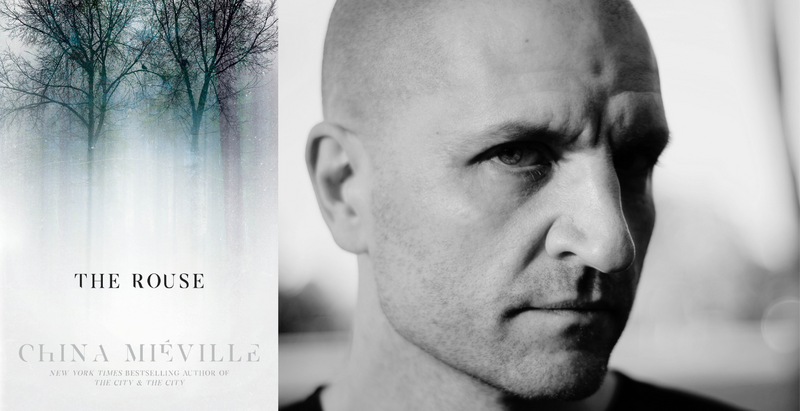
China Miéville’s much-anticipated new book The Rouse is twenty-one years in the making. He was writing it when he wrote The City & The City and Embassytown. He was writing it when he wrote October: The Story of the Russian Revolution and A Spectre Haunting: On the Communist Manifesto. He was writing it when he wrote children’s books, comics and his latest collaborative novel with Keanu Reeves. In other words, this novel is not only itself about epochs, and the end of them, but also itself spans many eras and iterations of China’s own life and writing life. Together we look at his many interests over the past two decades—Marxism and monsters, apophatic theology and the nature of consciousness, the failure of language, the power of it, the eerie and spooky, the terror and the horror of all that goes bump in the night—in relation to The Rouse itself.
As part of writing his 1200-page-plus new novel, China read many other big books for inspiration—from Gravity’s Rainbow to Mosquito. For the bonus audio archive China discusses one of his favorite’s: Miss MacIntosh, My Darling by Marguerite Young and reads an excerpt for us. This joins bonus material from many past guests including Ted Chiang, N.K. Jemisin, Carmen Maria Machado, Vajra Chandrasekera, and adrienne maree brown, to name a few. You can find out more about subscribing to the bonus material and about all the other potential benefits and rewards of joining the Between the Covers community as a listener-supporter, at the show’s Patreon page.
Finally, don’t miss the BTC BookShop corresponding to today’s conversation, brimming over with all the books China references and discusses today. And while you are at it, for your general book needs, be sure to browse the Milkweed Bookstore BookShop as well.
Transcript
David Naimon: Today's episode is brought to you by celebrated author Erica Meitner's seventh collection of poems, Assembled Audience. In this collection, Meitner explores what it means to be human in an increasingly precarious world. "What does it mean to gather together," asks this fervent frank collection. In these poems, people come together—over meals, at the beach, in protest and prayer and celebration, through vital acts of witness and collective mourning. With Erica Meitner's signature virtuosic electricity and wit, Assembled Audience reminds us that forced optimism and bland platitudes won't save us—but luck and wonder might. Dubbed by Maggie Smith as serious and playful, alchemizing and liberating, published by Milkweed Editions, Assembled Audience is available wherever books are sold. I'm very excited to welcome China Miéville back to the show for his latest book, The Rouse. Early in today's conversation, the question of spoilers comes up because China declares himself as a reader to prefer to go in completely unaware when he reads. Obviously, if you're tuning into a nearly three-hour conversation today about his new book, you likely aren't exactly such a reader. But nevertheless, I do set up rules and parameters around this, and I wanted to share them with you here. Basically, I allow roughly the first fifth of the book is fair game. So we discuss the structure that he sets up over the opening sections of the book and who are the characters as we encounter them at the beginning. But we largely leave the following 900 or 950 pages untouched in regards to what happens. Also, as you might imagine, because The Rouse is over 1,200 pages long, as part of writing this book, China read many other big books, maximalist books, to see what they could do that shorter books couldn't do. One of the highlights for him was Marguerite Young's Miss MacIntosh, My Darling. For the Bonus Audio Archive, China discusses it and reads an excerpt from it for us. This joins many contributions from past guests, from Ted Chiang reading an essay of his on what is behind Silicon Valley's fear of super intelligent AI, to perhaps the most outside-the-box contribution, something Johanna Hedva created just for us, recording their moans, groans, screams, and written texts, city to city while on book tour, and then mixing and layering them with the universe's own voices, the sonifications of a black hole and of the helix nebula, raw audio of the sun, a field recording of the aurora borealis. This is an experience only Hedva could have created, and they called it The Saddest Thing of All Is When a Lone Astronaut Falls in Her Suit—Who Is There to Help Her Up. These join many others, from N.K. Jemisin to Daniel José Older to Carmen Maria Machado to Naomi Klein. You can find out about how to subscribe to the Bonus Audio and about the many other potential benefits and rewards of transforming yourself from a listener to a listener-supporter by joining the Between the Covers community at the show's Patreon page. Not to mention that every supporter at every level gets the resource-rich email with each and every episode, with this one brimming over with some of the strangest, weirdest things that I either discovered while preparing for today or that we referenced during the conversation, giving you plenty of eerie rabbit holes to dive into once you're done listening. So check it all out at patreon.com/betweenthecovers. Now for today's conversation with none other than China Miéville.
[Music]
David Naimon: Good morning and welcome to Between the Covers. I'm David Naimon, your host. Today's guest, China Miéville, studied social anthropology at Clare College, Cambridge, gained both a master's and PhD in international relations from the London School of Economics, where ultimately his doctoral thesis entitled Between Equal Rights, a Marxist Theory of International Law was published both in the UK and in the US. Miéville also stood for the House of Commons in the 2001 general election as a candidate for the Socialist Alliance and was one of the founding signatories of Left Unity, a new party in Britain at the time that was socialist, environmentalist, and feminist in aim. China Miéville is likely best known, however, as a science fiction and fantasy writer, as the most recognizable face of what had been called the New Weird, whether his Arthur C. Clarke and British Fantasy Award-winning book from 2000, Perdido Street Station or his 2010 Locus Award winner for Best Fantasy Novel, Kraken. Miéville once said he planned to write a novel in every genre, and to that end, he has troubled the tropes of the American Western in Iron Council, the sea quest in The Scar, and the detective genre in The City & the City. He's written children's books, short story collections, novellas, and comics. He co-wrote with Keanu Reeves the novel The Book of Elsewhere, set within Reeves' berserker comics universe. Miéville was first on the show for one of my all-time favorite science fiction novels, a deep dive into questions of linguistics and communication, Embassytown. Ursula K. Le Guin, who I should say as an aside, has written some truly terrifying, if also terrifyingly smart and incredibly educational, critical takedowns of the writings of others, she said in her glowing review of this book—something she didn't say lightly, that Embassytown was a fully achieved work of art. Speaking of Embassytown elsewhere, when discussing how genre fiction is siloed and looked down upon, Le Guin said, "When he wins the Booker, the whole silly hierarchy will collapse and literature will be much the better for it." For the last decade, however, China has mostly been writing and publishing nonfiction. He's one of the founding editors of the Journal of Revolutionary Arts and Letters, Salvage. He's the author of October: The Story of the Russian Revolution, followed by A Spectre, Haunting: On the Communist Manifesto, of which Tony Kushner said, "China Miéville makes a case for the Manifesto as a locus of politically engaged analysis and argument for nearly two centuries. Miéville adjudicates and synthesizes with unfailing clarity, wit, courage, decency, and passion, writing brilliantly about nationalism, race, gender, literary style, and—my particular favorite section—about the perils and necessity of hate. He gives us a Manifesto that is simultaneously a central artifact of our species and a means for understanding our present, hazardous moment, a historical work that remains absolutely, ferociously alive." So it's with great anticipation to welcome China Miéville back to discuss his first standalone single-author novel since 2012, a book people have been wondering about and discussing the rumors around for years now, a book that comes in at a cool 1,264 pages, The Rouse. Jordy Rosenberg says of The Rouse, "At once the most poetic horror and the most fearsome historical novel in contemporary letters . . . There is simply no equivalent to Miéville’s achievement." Michael Moorcock adds, "The Rouse is a classic of modern weird literature and goes beyond genre to put Miéville in the forefront of modern British novelists." Finally, Francis Spufford declares, "A monster of a book in every sense: a showing of the ghosts that haunt our real history and of the power of the fantastic to explore with tender horror the twilight borderland where dogs turn into wolves, and back again." Welcome back to Between the Covers, China Miéville.
China Miéville: Oh, thank you so much for having me. It's really lovely to be here.
DN: So this is the year for some reason that people I haven't spoke to for a long time are finally returning—so Valeria Luiselli after 11 years, Claudia Rankine after 12 years. I love it personally because it feels freighted with extra meaning for me. Yet nearly no one can beat the span of time between our two conversations, China. You were the fourth person I ever interviewed over 15 years ago now, and I barely knew what I was doing. The conversation, like all of those early ones, was a mere 28 minutes long. I was all curiosity and no knowledge, completely mesmerized by your thinking, but with, I think, little to bring to the table myself. Yet our encounter holds great meaning for me as sort of an initiation, I think, one that pointed out many horizons and possibilities and future directions for the show. It would be many years before I would meet Ursula Le Guin for the first time, but you, more than anyone, I think, paved the way for it. Your and my conversation remains in my heart's Mount Olympus of podcast conversations. So as we experience perhaps a shared vertigo now, looking back across the span of 15 years, I'm just going to say welcome back again.
CM: Well, that's extremely generous. I'm tempted to troll you by saying, "Oh, yeah, you were terrible. It was an awful experience." [laughs] But honestly, I am as shocked as any middle-aged man is whenever reminded of how long ago something was. But I remember that interview very well, actually. Because 28 minutes is—it may not sound that long, but compared to most literary podcasts and interviews, even that is longer than most. The only problem is now I have intense performance anxiety about letting you down for this one. [laughs] But we'll see how we go. We'll see how we go.
DN: All right. Well, this first question is surely one you'll be getting a lot. So hopefully I'm catching you early enough that it isn't yet fossilized and inert, because I do think it's still of great interest. This is the question of length, and by extension, the relation of time to the act of writing, particularly when a book becomes both decoupled from time, and yet also encompasses an incredible span of time. With length, we have the length since you first began this book, two decades. We have the length since your last novel, 14 years. We have the length of the book itself. If we think of William Vollmann's standards, with his latest book arriving at 3,096 pages, yours is only a mere 1,200 or so pages. It's not like you had writer's block all this time. You've written countless books and essays since beginning this one. But unlike all these other books, The Rouse endured across time differently, whether being continually worked on or hidden in a bottom drawer for long spans of time, I don't know. But either way, surely across 20 years, your sensibilities must have changed, whether that is in regards to your relationship to the sentence or your relationship to the geopolitical world. I was curious how you kept a continuity across two decades of working on the same thing. What does the process look like of returning to work that contains writing of yours from different eras, like a literary core sample? What was the original idea? Did it survive in a recognizable way in the final book? And why do you think this book among your books needed to haunt you for so long to arrive to this day?
CM: I mean, that's a very perspicacious question, particularly your point about a changing relationship, both to the sentence on one hand, all the way up to geopolitics on the other. That is precisely what happened. Also, I would add to oneself, when I started this book, I was a young man and I'm now not a young man. When I started this book, midway through the writing of this, my mother died, and that was enormously impactful. Over the course of writing this, we've been through various different political dispensations. My own writing career has changed a great deal, et cetera, et cetera. I mean, as I think probably with a lot of so many of these things, there is a kernel, there's a surplus to which I simply can't open the black box of the why. Why it was this project, I can explain so far, but then there's always a little "and yet, and yet," you know. So one very straight answer is I don't quite know why it was this particular project. When I started, in many ways, the actual, if you like, the elevator pitch of the book remains completely unchanged, completely unchanged, and has sustained throughout the whole writing process, which is technically 21 years. But what happened is that when I initially started writing it, for various reasons, there was a decision to do something else first and work on this in the background. Then over the course of that, it became freighted, increasingly freighted with a whole variety of things, particularly, like, as I say, these, I think maybe, the changes in my own life and my family life and so on, but then also very much political changes as well. What happened was that the book started to become about more and more and more until it was about everything. As I've said elsewhere, you can't write a book about everything. Well, you certainly can't succeed in it. There was a sense in which when I was working on this book, because I worked on it all the time, working on other things as well, but it wasn't a question of like putting it in a drawer for five years and leaving it. It was always, to some extent, there. I mean, it sounds very melodramatic and I can only apologize for that, but I think I went a bit mad for a while. There was a certain derangement. When I look back on certain aspects of this, it was not always a happy time writing it. It was very, very difficult for a whole variety of reasons, you know, and the book was at various points completely uncontrolled and drafts were much, much longer. I mean, believe it or not, you know, almost not quite twice as long, but nearly twice as long. The process was one of continually adding and then continually winnowing down and adding and winnowing and adding and winnowing. At a certain point, I would say probably, I would guess probably a third of the way in, maybe five or six years in, it became clear to me that for some reason, in some way, this book had to emerge, that it was inextricable to what I was doing. It was inextricable to me. I knew that I had to give it its time and I knew that it was changing into something bigger. I didn't really know what. Normally I'm a very rigorous planner and I have a very clear idea of the outlines of a book. That's not to say I haven't planned and outlined this book. I planned and outlined it many, many times. But it kept growing and it was more unruly than most of them. Then about halfway through, 10 or 12 years in or something, it became a sense that, like it or not, this is the book of my life. I don't mean to say it's the book. I don't mean to say it's autobiographical. I mean, like, this is the defining thing. This is the book that, for whatever reasons, has become the book about everything. This is not a register in which I normally talk about the stuff I'm writing. It didn't feel like a choice. It felt like I had to do this, I had to honor this. For a very long time, it simply felt impossible to finish. It felt as if I was just always going to be doing it. I didn't think that with any particular pleasure. It was more with a sense of yearning. Then unbelievably, life changes, the world changes, the book changes, and it emerged. What I was trying to do was, as I gained control over it, was instrumentalize those exact things you're talking about, was relate to this book as, I love your idea of a core sample. It is precisely that. It is a sedimented set of layers. I can see the stuff that's 20 years old. I can see the stuff that's a year and a half old and try to make that work. Except, this is a maximalist project. This is not a book like the other books I've done. It is itself and it's going to stand and fall on those particularities. So the idea was rather than saying, "Well, let's try and turn it into something that I know is like The City & the City or The Scar or whatever, how do I have fidelity to what this has become?" And that's very difficult because you are talking about something that's very, very long. So you are asking the reader for a certain amount of patience and a certain amount of trust. At a line level, quite a lot of it is quite knotted. So you're asking people to stick with you. It's not always going to be the easiest read. The idea is that the wager is that that's worth it in the long run and so on and so forth. Finally, I think it was a sense that this is a book that started out being one thing written by a young man and ended up being something very, very different, even as you could still see the soul, by someone very different in a very, very different world. Rather than seeing that as epiphenomenal, somehow trying to make that part of what the book is. So to me, this is a very long-winded way of answering the question, among various other things. To me, the book is about epochs and about epochal change. What might have otherwise been a kind of relatively dry idea became also part of the form, because it's a book about epochal change that was written over a period of, to me at least, epochal change.
DN: Well, the first 200 pages or so of The Rouse reads like social realism. We are in the early '70s, England, with Maur, a poor, single, motherless young woman who has to leave visual arts school when she gets pregnant. A good part of this opening dramatizes what usually isn't dramatized in novels: the maintenance labor of child-rearing, of cleaning house, the immense fatigue of raising a child, and the impossibility of doing so absent family, let alone community support. The way this woman's life has to, by definition, I think, in a capitalist society, take an entirely different trajectory because she's become pregnant. About 100 pages in, we encounter the words, "The End." The following 1,000 pages plus is the epilogue. Quite quickly, the book establishes a structural rhythm between the white pages of the book, the gray pages of the book, and the much rarer dark gray pages of the book. The book mainly alternates between the white pages of Maur's story and the light gray story of a military man, Trooper Allardyce, which is at first set a decade or two earlier in Malaysia. I'm hoping you could introduce us a little more to Maur and her child as we first encounter them in the opening, as well as to the trooper and his situation as we begin the book. Perhaps as part of that, you could speak more broadly about your considerations around setting the book as you did in the time and place roughly of your own childhood.
CM: My obligatory pusillanimous caveat here is I like the idea of going in personally, going into a book knowing very, very little. Now, that doesn't mean that I mind talking about stuff that's in the book. I just think this is the point at which I would want to flag a spoiler warning TM in the sense that it's impossible to discuss it without getting into stuff. So if people want to go in completely blind, then maybe come back to this discussion after you've read it, if you read it or something.
DN: Sure. I'll just say to that point in terms of plot, I took the first, let's say 15% of the book is fair game for us to discuss and 85% of the book to be off limits in terms of spoilers. So this is like...
CM: But that's the best 85%.
DN: Exactly. But I did feel like we needed to discuss the terms that are established at the beginning of the book.
CM: Of course, yes. I have my own mishigas about this, but I completely get that and agree. It's interesting you say that you don't think these aspects are written about very much of maternity. I suspect that's probably true, although I do also think it's worth acknowledging both that there has always been a very important stream of motherlit. Indeed, I drew on a great deal of that for this book. Also, I think that to some extent, we may be in a bit of a new bit of maternity literature. I grew up with a single mother. So I'm very resistant to narrow and reductive autobiographizing, if that's the word. But at the same time, I don't want to be coy about it. Of course, inevitably, the accidents of biography have an impact on what interests you and your concerns. There's no question that I've always been deeply fascinated by the question of motherhood. If you like, also fascinated by the question of fatherhood, but in a negative sense, or in a sense of it's much more of an abstraction for me. For me, my interest in motherhood is quite specifically and particularly, I should say, around the question of single motherhood. I wanted very much to, again, because of people's mania for biographizing, this is where I have to say that Maur in the book is not my mother. I am not Ewan in the book either. But there are rhymes of structure and life. It is absolutely no coincidence that we're talking about a very young single mother in a working-class area of northwest London in the early '70s. That is true. That is how I grew up. I was really, really interested in the incredible specificity of that. Rather than trying to evoke a sort of, if you like, a generic nostalgia, I wanted to think about the really particular questions of texture and feeling that were the way I experienced that life world and the way by empathy and extension, I think people in similar situations and young mothers and so on experienced that life world. Partly, that's probably just the question of the kind of the sort of solipsism of you think your own life is more interesting than everyone else's. Although honestly, I really don't, I don't think my life is more interesting. [laughs] But I also have this hunch, which is, I'm shy to say this because I do think like there's nothing more boring and predictable than an older person talking about how things were different in their day and so on. So I take all of that as read, take a huge pinch of salt. At the same time, there is to me, when I try to talk about that era now, it feels to me like there's something almost unbelievable and strange about it relative to a lot of stuff since. I talk about it as a quotidian Gothic. When I talk to my younger friends, Gen Z or whatever, and it's like it can be really difficult to explain and describe aspects of just everyday life that sound insane to them, like they sound mad. [laughs] And I realized through talking about it that, and I'm not doing a kind of, "Oh, you know, we were tough, we walked to school," and so on, although we were and we did, but that's not my point. [laughs] I'm not trying to say. But because there's a complicated combination of an elegiac sense and a sense of wincing and of trauma. It feels to me, certainly London at that period, the areas I knew to be saturated with violence just underneath the surface. I'm not naive. I'm not suggesting everything is great and hunky-dory now, God knows. But there was a specific texture that I wanted to talk about. I think that this is, I know we're talking vibes here, but I do think as you would expect someone with my politics to say, I always think that underlying vibes are certain political-economic realities. It doesn't mean one's more real than the other, but they're interrelated. The experimental musician Delia Derbyshire, who was in her, I think, 20s or early 30s in the 1970s, she talked about something going out of tune with itself in 1973, '72, '74, like that moment. There's a moment of decoupling. That particular moment crops up a lot in literature and in sociology as like a moment when something fractures, something breaks, something changes. Of course, there's a whole body of theory as to what that is, and we won't get into that now. But having lived it, having lived that sense, I wanted to try to express that absolute specificity and to do so as far as possible with neither condescension nor nostalgia de la boue nor sentimentality, with a kind of loving, remorseless realism. Then once you get into that, if you are interested in epochal shifts and the book tries to constantly do, not a balancing act, but an interrelation between the personal and the domestic and the geopolitical, then that life world of the '70s, you need to look back to the generations that wrought it. That's partly where the second strand comes in, where you have Trooper Allardyce at the end of the '50s, which is almost camply what one's talking about here is, again, this is hardly new ground. The sort of, the ebbing of the empire people talk in terms of post-imperial melancholy as a kind of culturing, a culture of Britain from the '50s through to now. There's a snarky and not untrue counter to that, which is not nearly post-fucking imperial enough, [laughs] but there is nonetheless a cultural shift and that sense of like the ebbing of the world powerness and the ebbing of that relationship. To me, to that extent, this book is, although it is, I think, a highly British book about Britain, to me, I think of it very much as a book about Britain and America, Britain and the States, I should say. The States is the absent father or the absent son or something. So I think of it very much as about that. To your point about the beginning, there are two purposes, I suppose, to that extended period, of that extended section of, if you like, domestic realism and mimetic writing. One is honestly, and I say this lovingly and with gratitude, was a desire to tease my readers, at least the readers that have read my stuff before, because I love speculative fiction in all its forms, what John Clute calls Fantastika. Anyone who has read any of my stuff and liked it will expect quite understandably, they'll be like waiting for the monster or waiting for the alien or what, as they should, as they should. [laughs] But there was a little part of me that wanted to sort of, and I think I've been very lucky with readers. I think people that stick with my work over the years have been really generous about letting me try different things. One of the things I wanted to do was to sort of see how long I could get away with, literally how long in the book, of it being like a mainstream mimetic novel. So the beginning of the book is, it's a short novel, but it's a novel's length of mimetic realism. Then it ends, as you say, it says "The End." So it's partly a little game, but it was also, it was very important to me as part of that project of honoring that specificity and that kind of quotidian, and I don't mean quotidian as a denigration; that aspect of life, that is the story. Everything else, all the other stuff, the monsters and so on, yes, it's not like it's not important. It's not like that's not the fireworks that you're there for. But I really wanted somehow to structurally say this is all the epiphenomenon to this absolutely important story of this one person's life and this one person and her family, and not to have that feel like a sort of an adjunct to the real stuff. So it was a way of trying to earn that and maybe along the way, have someone who's like in it for the whiz-bang think, to my own surprise, I really, I enjoyed, was moved, was interested by this story of one person in London in the 1970s and 1980s.
DN: Yeah. I was completely compelled by the realist part.
CM: Oh, I'm really glad. I'm really glad.
DN: Well, because so many books have occurred between the time you started this book and today, I found myself trying to see the evidence of other books within this book. The notion of a subterranean London goes back to your debut novel, King Rat, but also the ways in which this book deals with the paranormal made me think of The City & the City with two cities superimposed upon each other and the notion of the breach between them. Because you could say The Rouse lives in the breach between the living and the dead, but also the notion of unseeing in The City & the City, that to inhabit one of the cities in a coherent way without the other city interjecting required an unseeing. This book, I think, while metaphysically and ontologically different than The City & the City, is also about perception and what exists beyond perception. Then, of course, I wondered about your decade of nonfiction with regards to this book as well. I have a thesis of one thing I think this book is doing. But before I propose it, I want to give the stage to another to ask a really brilliant question on its own right. But it's also a question which I think can serve as an umbrella or an entryway for a series of my own questions afterwards. This question is from the writer and recent guest on the show, Jordy Rosenberg, who is a writer like you who employs the fantastic on behalf of revolutionary aims. Sam Sacks calls Night Night Fawn, Jordy's most recent book and the one that we discussed for the show, an urgent intervention in the contemporary Jewish letters and the ways in which settler colonialism and gendered violence reproduce inside our families. And Melissa Febos adds, "I have simply never read anything like it—exactly the queer, marxist, yenta-narrated tour de force that we need right now, an instant classic." So here's a question for you from Jordy.
Jordy Rosenberg: Hi, China. Hi, David. It's Jordy Rosenberg. Thank you so much for inviting me to ask a question, David. I'm consumed with envy, frankly, that you get to ask China questions for hours about his work and about this novel. It was just such an astonishing reading experience that I never wanted to let end, and I have so many questions about it. So it was very hard to winnow it down to just one, but one of the things I was thinking about reading it was that a lot of people, it seems obvious to say, are going to talk about this book as being massive—which it is—and monumental in terms of length. But what I wanted to ask about was that one of the things that I found most, let's say, monumental about it was the line work. I mean, first of all, it seems clear that every single sentence is the product of an immense amount of painstaking worrying over how to make each, literally each sentence function to its utmost in the novel. I don't mean at all that any of them are precious. There's not a single precious moment in this novel, but almost all of the lines are incredibly terrifying. A lot of the way that they're terrifying has to do with what, China, you're doing formally, which at times verges into a kind of what seems to be like actual poetics, maybe are very adjacent to it. Lines just start breaking and they start arranging themselves on the page in a way that is not usual for a novel. There's line breaks in surprising places. There's at one point even scansion. At one point I had said to you, actually, China, I texted to you that I thought you'd really thrown a gauntlet down and made it clear that there's really no way or no better way to tell a story of Britain's 20th century without tearing the throat out of language. But I really think you've done that here. I'm just really curious about your formal choices and how you did it. I've read a great deal of your work, maybe almost all of it. It's really important to me, not even primarily as a writer, but just as a person who loves to read and think about stuff. I can't think of anything you've written where you use this particular kind of line work. In a way, it recalls some of the themes that thread through a lot of your work as well about language, the kind of pathos of language and the terror that is constitutive of the gaps in referentiality, the gaps between the word and the thing. That's often something that you, yeah, I will say that you put your characters through that, you make them experience and most notably, let's say, in Embassytown, where characters are really made to experience the terror of language. I'm also thinking of This Census-Taker, and not just that, but it's almost like with this book, because of what you're doing formally at the level of the line, and there are so many lines beyond the poetics I was just describing, but there are so many lines just in the course of narration that just end in so many truncated or surprising ways. Readers will have to experience for themselves the way in which what you're doing formally is just absolutely ratchets up and so intensifies the terror of this ghost story. But that, I think, the reader is made to experience something like or something related to things you've made your characters experience around this question of the terror of language. So that's my question. It's really what was some of the thought process around the form of this novel, but not just genre, but I mean the lines, the sentences. Congratulations on this incredible book, and I can't wait to hear what you have to say about it in the whole interview. Thank you.
CM: I mean, that means so much to me. As you say, I mean, Jordy's a fantastic writer and I'm still scandalised because Night Night Fawn has not been published in the UK. To anyone listening who has power over such things, what the fuck are you doing? Get on with it. [laughs] It is such a fabulous, brutal book. I mean, talk about maternity literature of a very different type. [laughs] But not wholly unrelated. Well, anyway, it's a beautiful, beautiful book, and Jordy's very brilliant, and I'm very moved by this, and I'm particularly moved because that is something I wanted to do. I do insist on acknowledging that writers are not the sole repositories of wisdom about their stuff. They don't always know what they're doing, et cetera, et cetera. But nonetheless, there is something very moving when you really had an idea that you were trying to do and someone says, "I think you're doing this," and in this case, it is quite true that one of the many reasons that it took 20 years is because I have never worked so hard on each individual sentence. And not to say I'd sort of knock out the sentences in anything. I worry a lot, but it became really, really intense for this, in ways that, as I've hinted at, were not always good for me. But I wanted to try and achieve that exact kind of, I'm tempted to campily say dialectic, that dialectic of the particularity that you recognize with a complete estrangement from normal modes within the language. To some extent, particularly in Trooper Allardyce's formulations, but not always. It goes into the other chapters as well. There's several things occurring to me. So forgive me if I riff a little bit. But one of the things is when Jordy talks about the violence, he puts me in mind of the writing of Dambudzo Marechera, the Zimbabwean writer who is very, very important to me. A very interesting, strange writer who chose to write in English, in his own words, because it was such a racist language. He talks about having a panga, it's like a machete. He talks about having panga duels with English to make it do what he wants. There's something about this notion of the embedded violence of the language, rather than trying to do work on and about and ruminating on violence only in the content, but actually doing it at the line level of form as well. There were certainly points that I was trying very much to do that exact thing. It is a book very much about violence, about local specific familial violence, but also obviously massively so about geopolitical and particularly, "counterinsurgency violence." It felt to me, I think sometimes, particularly recently, I get frustrated with a certain type of approach to fiction, which I will say I think is particularly represented among some on the left, which is obviously my natural constituency, which focuses on the contents, the exclusion of the form and talks about, discerns the politics of a book or whatever in a rather reductive way about the things it is describing rather than the ways in which it is trying to describe them. Obviously these two work at once. So there was absolutely an attempt to revivify language in certain ways to make language estranged from itself and from its normal reference, which is also because of what the book is about. The book is in part about precisely, I mean, what is a ghost, but the estrangement of the original reference. It sounds very woo-woo, but it's a book about haunting. I wanted to try to write it with a haunted language, a language which doesn't pretend, as Orwell so leadenly does, that language can be a clear glass mirror through which you do things. Now, I don't want to make a self-parody of myself here. Whatever my haters might say, I am a big fan of a lot of what you could call quite terse, quite the kind of Roald Dahl or the kind of Celia Dale type writing. I'm not saying that that can't be done brilliantly. What I am saying is the idea that au fond language is a clear glass. Then sometimes people who've been infested with modernism and such like foreign ideas get the idea that it's stained glass. Of course it isn't. So I wanted to try and lean into that, but jaggedly, really jaggedly. I fully acknowledge, by the way, that that does mean sometimes it's not always at the line level, like it's quite dense. It's quite a book that try and do that. Ask a lot. As a reader, I certainly don't always want to read that kind of book. It's effort. So you are asking and you're making a wager and you're saying, I'm asking you to stick with this because my hunch is that it will be worth it in the end. Also to me, a lot of this is, again, as Jordy exactly pointed out, to do with that constant struggle with language, which is to express the inexpressible. Again, it's not as if this is not an old thing that writers have struggled with for a long time. But it's a theme and a philosophy and an aesthetics that have become increasingly important to me. They've always been there, but they've really become increasingly important in the last decade to me. So over the course of writing this book, those traditions of what are called apophatic philosophy, the philosophy of what can't be said, or apophatic theology, the definitions of, in most cases, God or the numinous by what it is not, the limits of language have become really important to me. Unlike some, I don't think that it is just a question of a kind of Rococo aesthetic technique. Not that there's anything wrong with that, but I just don't think it's only that. I think it is also an important way of thinking about thinking and thinking about consciousness and ontology and so on. So one of the things you're doing when you try and fracture language in certain ways is an attempt, which you know you're going to fail at, definitionally you're going to fail, to express that which can't be expressed. So the only question is, is how interesting can you make your failure? How well can you fail? How honorably can you fail? And I have increasingly become much, much more interested, moved, affected and impacted by what I think of artistically as honorable, yearning failures than drab, rote successes.
DN: Well, let me hold that space open a little bit. I already started to answer my subordinated question to Jordy's, but I want to ask it and just see if we can take it even further. Because I also think of when you described your relationship to this book as a black box and "I don't know" and "yet, and yet" is related to this as well. Because the reason why I wanted to put Jordy's question here is because my thesis about one thing The Rouse is about is something that his question and your answer touches on. So again, in the opening fifth of the book, the part of the book that I'm granting us the permission to speak about. [laughs] So quite early, relative to its full length, we learn that the British military is having encounters with something beyond the veil, beyond life and death. They aren't quite sure what it is, but they're interested in not simply knowing more, but manufacturing further encounters. I suspect knowing the military, assessing not only the dangers of this, but the potential opportunities. The way this connects to Maur's narrative, at least at the beginning, is that the military narrative around her soldier son's suicide seems less than satisfying. There are some narratives around other possibilities. Her and other mothers who've lost military children are doing their own sleuthing that brings them into this borderlands around life and death. The possibility that these ghosts or spirits might at least in part be their own children motivates them to investigate. But what is remarkable, I think, is that you hold us, the reader, pretty much for the entire book in a place of not knowing. I've seen basic summaries of what the book's plot is in reviews, summaries that seem to assert these plot details as truths, that are completely contradictory assessments of what the book is about on a basic level. I was like, "Wow, that person thought that?" Which I love, but it's clear that the characters themselves are groping for meaning. Yet, what they are experiencing seems beyond the capacity of the human to comprehend, or at least comprehend fully or comfortably. This is continually nodded to within the story. One example is the phenomenon of apports, which in the paranormal world, independent of your book, can mean the sudden appearance of an object from another unknown location. It's usually brought to us by the power of a medium, sometimes in a séance. Here they discover these objects, and there are these discussions of how to determine if a given object is or is not an apport, whether earrings are simply earrings or earrings in scare quotes. In one discussion, one person declares that apports are objects that belong to the physical plane. Then another person responds, "It depends what one means by physical, by plane, and by object." I agree with Jordy that encounters like this with whatever this unknown force is or forces, they rip the throat out of language. I like that phrase. But the end result in your book feels like the opposite. In a way, I feel like in being unable to name or to have words reflect in any functional way what they're trying to describe, the world of this book does not go silent, but instead it seems to generate more and more words. These amassing words, decoupled from any effective relationship to what they are meant to refer to, become a monstrous force in their own right. Because as we read, the book slowly accumulates specialized languages. For one, we have the accumulation of military acronyms, which we get slowly over time. It's not like we just open the book and are full of acronyms, but it becomes part of the language of the book. But also, and probably more relevant, the vocabulary of the paranormal world, whether apports, apotropaic magic, les brise, revenants, they all get folded into the substrata of the world as we know it. But what also happens is that everyone encountering these forces or beings, they keep throwing up language to try to capture what it is. The language is all over the place. Sometimes it's from non-Western cosmologies or ancient Western ones, whether using the word gidim from the Sumerian spirits of the dead, or the word gru from medieval Scottish. Sometimes it comes from science, like teleplasm exudation. But they're all trying to describe the same thing. They're all failing, and they're all existing simultaneously on top of each other and no shared agreement because I think they're all unsatisfying. So what results is not comprehension, but a linguistic exudation instead. I think of when I had the classicist Daniel Mendelsohn on, and he compared and contrasted the Hebrew and the Greek sensibilities in relationship to the power of language. He called the Greek's orientation to languages optimistic, that if you could use enough words, you could succeed at describing the thing. So he gives an example like a history of Persia and there would be just this giant section on the history of Egypt that would go on and on because you can't describe the history of Persia without first describing everything you know about Egypt. But the Hebrew he describes as pessimistic, where there are large unspoken, un-narrativized gaps, gaps that produce, in the end, paradoxically, endless interpretation. So you have the maximalist Talmud coming from the gaps of the Torah. The Rouse feels like it's Hebraic in spirit in this formulation, but it feels like it's using the monster created by the flailing and failing Greek mode to demonstrate this Hebraic mode in a weird way. Or perhaps another way to look at it might be that the word epilogue, which comes around page 100, it comes from the Greek notion of a short speech, given at the conclusion of a play. But your epilogue is almost the entire book. We might think of it not as a concluding speech, but the conclusion of speech, that perhaps this book is, among other things, really a book about language. I know you've already touched on all of this, but I was hoping maybe this would provoke some more thought in this realm.
CM: I love that. I love the formula. I mean, I'm transfixed by the formulations you've proposed, particularly the Hebraic formulation. I mean, I completely agree. I hadn't heard that interview, but I'm going to go and chase it because I absolutely have a pessimistic relationship to language, which I say with gladness, and an epistemologically pessimistic relationship to language, which relates very directly to what I was saying about apophatic theology and apophatic philosophy, which, of course, a great deal of which is precisely Talmudic and then early Christian and so on, although there are similar theologies in lots of different traditions, but there are very strong, rich traditions therein. I mean, yes, I think to me, one of the possibly, possibly this is just like almost too obvious to say, or possibly it's going to sound very left field. But this also relates very directly to the weird fiction tradition that I come out of, the pulp, where we've talked a lot about the modernist or experimental bit. I also, for me, at least as important as a reading bedrock, and I think in terms of influence and so on, is the pop tradition of weird fiction. You take the classic and most notorious writer of the weird fiction tradition, H.P. Lovecraft. He is regularly mocked and teased, not without reason, for the trope of saying it is indescribable of one of his monsters, and then proceeding at very great length to describe it. Yet at the end of the description, it still doesn't quite make sense. That is precisely the conundrum you're talking about. Whereas if you look at like Ambrose Bierce, who is an earlier version of an indescribability manga, when he describes the indescribable, he basically, broadly speaking, he'll say something like, "It was indescribable," and then move on. Whereas Lovecraft creates a bad dialectic of the indescribable by rendering it formally, literally non-described through a surfeit of description, this endless piling up of adjectives. I think that that is to kind of, at its best, because of course it can be done very ham-fistedly, but at its best, it embeds in a form a rather different kind of linguistic collapse than simply saying, "Language can't do this," you know? And for me, it's a much more interesting linguistic, not an end point, but a piling up of rubble. I find that much more fecund. It makes sense to me about the way we conceive of the world. There's also a piling up of asymptotic attempts at understanding that then become fossils and we trip over them and so on and so forth. So it is also not coincidence that the first part of the book, Maur's story with her son. I mean, it's certainly, I worked very, very hard at the language of that first hundred some pages. But I think it's also true that the language becomes more freighted and more knotted and troubled and jagged after that point. There's also a certain kind of piling up of language, the maximalism starts to expand beyond that point. And so to your point about an epilogue being a short thing, the structural irony of the glossolalia really beginning to ramp up in what should be a short coda is precisely, to your point, I suppose, one of the, I keep using this word, and I hope people will forgive me, one of the wagers, because all of this is aspirational. I'm incredibly nervous about the response to this novel. It's not for me to say whether or not it succeeds. I worked very hard on it, but I really hope that it offers something to some people. But aspirationally, the wager is that this is worth it, that this glossolalia does something distinct, and that simply saying there is no more to say or language will fail here cannot do, and that you're playing like that. I mean, this also goes back to something that Jordy was talking about where there are certain places where the typography becomes a bit fractured and experimental and so on. I would want to sound a very cautious note here in the sense that these are not new techniques. I mean, these have been going on since literally the 18th century, like Tristram Shandy and so on. In the context of a book that you could describe as a horror book, also Danielewski's House of Leaves is a big presence here, where one of the things that I love about that book is that it doesn't just do certain kind of typographic shenanigans, much more so than I do, incidentally, but it does it in a way that the form impacts the story itself so that, for example, when the language becomes chopped up on the page, you are literally turning the pages more quickly. He creates a page-turner. Very elegant, simple little games like that. So that was also an inspiration. But this is all to say that that project you're describing and discerning I think is absolutely accurate. This is absolutely about the limits of language and the hope that you can do something that is a perversely honourable and interesting and artistically exciting failure in piling up language that will not achieve what it is attempting to achieve.
DN: Perhaps like the characters of the book, I too found myself looking for an organizing principle or for a sturdy scaffolding from which to stabilize myself as a reader, just as they're looking for, grasping for words or orientation to what they're experiencing and encountering. Knowing that you've been writing extensively about Marxism over the past decade, I found myself wanting to look for allegory, despite knowing your aversion to allegory. But knowing that your book on the Communist Manifesto is called A Spectre, Haunting, I wondered, given that we are largely with the military and military families and with dubious military excursions in Malaysia and Oman and Guyana and other places, if the specter roused in this book would be a revenge upon the military. I think of the lines in your essay, "Silence In Debris," that goes, "When Marx insists that communism is not 'an ideal to which reality will have to conform itself' but ‘the real movement which abolishes the present condition’, it is precisely the immanence of a radical alterity that precludes its being spoken," I might think when I hear that of the unspeakable force in The Rouse. Likewise, when you talk about socialist infernalism, where you say, "like the souls of the damned, language perishes in hell," I also can imagine this infernal language. I mean, because when you talk about it's not satisfying to say language will fail here, I agree because I feel like by you amassing the words, I feel like we watch language fail here. Instead of declaring it, there's a way in which this Lovecraftian model you're linking yourself to in relation to the indescribable is a dramatization of language failing, I think. I've long loved your lectures, which I will point people to, on the potential for a Gothic Marxism or a Marxist surreal. But I think in contrast of another essay of yours, Death Cults of East Anglia, where you say, "In capitalism all signs are reversible. There are Gothic Fascisms as well as Gothic Marxisms, and Weird Fascisms too, and if the Left decides it will ‘learn the lessons’ of the Eerie, so too can our enemies." I read this as a caution or a pushback against my own desire to read this as some sort of reductive, this represents this, this represents that. Because it feels like we are more with weird fascisms here, or at best a battle about who will learn the lessons of the eerie and to what end. So I'm skeptical of my own search for allegory, even as I know that you love some great allegorical literature like Gulliver's Travels, which has stories within it of people trying to get rid of language by carrying around enough things that they could refer to the things without having to speak the words that refer to the things. But putting that aside, what I'd like to hear more about is the notion of apophatic Marxism or the Red - Via Negativa, which comes from theology, as you nod to, from the via negativa. Your essay on apophatic Marxism begins with an epigraph, which feels pertinent to The Rouse or the feeling of The Rouse by Ann Quin that goes, "Once there had been the subterranean language with the underground forces. If speech at all then it was the spaces between words, and the echoes the words left, or what might be really meant under the surface." But the idea in your essays that made me think of your latest book the most, and also this paradox between employing maximalism to suggest the inability of something is from the physicist John Wheeler. You propose something from him where Wheeler argues against the notion that the universe is essentially knowable, against the idea that the limits to knowledge are only provisional limits. In paraphrasing Wheeler from your essay, he says, "Imagine we live on an island surrounded by a sea of ignorance. As our island of knowledge grows, so does the shore of our ignorance. The more we know, the more we know we don't know. The more of which we can speak, the more of which we cannot." Which is very much the feeling as I travel through The Rouse, as it progresses, that I'm experiencing an ever-expanding shoreline of ignorance. You portray Marx himself as largely apophatic, his vision largely unspoken in positive terms. I would love to hear how you explore in this essay the idea that the capacity to be surprised is a condition of analysis, which feels super important that we can't spell it out in advance of moving forward. I feel like that's something that's also happening in the book. Everything seems provisional in The Rouse to me. Every stepping stone along the way ends up being an unstable rock.
CM: I'm just trying to scribble a couple of notes because you've said so many interesting things. I also want to not apologize, but let the listeners know that my cat has joined us. So if they suddenly hear purring, she's cuddling up to the microphone.
DN: We hope to hear purring.
CM: Okay. [chuckles] So you're right. I don't like allegory. It's one of the relatively few things I agree with Tolkien about, largely because I tend to think it's a bit pointless. I don't quite understand. If you want to make an argument, make an argument. If you want to produce a work of art, be it fiction, music, whatever, then it has to have a surplus that isn't reducible to that argument for it to justify its own existence. Now, what that obviously doesn't mean at all is suggesting that there are not going to be cognates and that things are not going to throw up ideas. This to me is why the key distinction is between allegory and metaphor. I'm a huge fan of metaphor. Part of the point about metaphor is that it's always unruly. It always exceeds the bounds that might seem logically at its edges. Because you can't control, the moment you've made this magic spell of saying X is Y, you don't control the connotations of X or Y in the minds of the reader or anything like that. It's going to spin off loads of new ideas that are going to escape any allegoric reductionism. To the extent that I do enjoy works that think of themselves as allegorical, generally it's to the extent that they escape their own bounds. So I love Gulliver's Travels, but largely because I think it is an unruly book that is considerably more interesting than maybe it thinks it is. Maybe one of the things I want to do is have it both ways. Because when you talk about the politics and talk about, you bring up the idea of the "Spectre, Haunting," and what I've just said isn't to say, "No, that's wrong." It would be utterly facile in this day and age to suggest that the idea of the hauntological, to use a trendy theory term, aspects of Marx are not going to haunt a text that is about haunting, especially if the writer is someone who is interested in Marx and a socialist. Like, how could that possibly be the case? So I'm not saying that's not, but what I am saying is I adamantly put my foot down about it being an allegory because the point is it has to do more than that and it has to be able to do contradictory things. There's a phrase that Fredric Jameson uses in parsing somewhere where he talks about a text being constitutively ambiguous and he doesn't really dwell on it, but to me that is like such an important point that is so often missed in a lot of these discussions. When people are trying to clarify what "really happened" in a text, and/or what did it "really mean." A lot of the time, to me, the interesting thing is, well, it's constitutively ambiguous. That doesn't mean that what you want it to be about isn't part of the cluster of stuff that's happening. But if that's all that's happening, what's the point of it as a piece of fiction? It's got to be more unruly than that. So it's not only true that there are elements of the book that do indeed riff on this idea of the spectre of rupture. The book itself, I mean, there are various points where it almost makes that fairly clear. There are references to certain potential post-fanatic conspiracies that are not subtle about this point. But I very much want to resist the idea that that is the true and singular and secret heart of the book, not just because I don't want to suggest I'm the only person that knows, but because I want to suggest that any book worth its salt is doing more than one thing at once, you know. This is where I think your point about, I'm very moved and glad that you bring in Death Cults of East Anglia, a piece I'm very proud of, means a lot to me. You're quite right, in my opinion, to pick out that section. I think sometimes, particularly on the left, we've been so beaten down and we've lost so many times that we're so desperate for a win that we will interpret things tendentiously as like on our side in all kinds of very unpersuasive ways. At its most, to me, uninteresting and degraded, this is where you get these unbelievably lengthy and furious fan arguments about how "subversive" this or that Marvel movie is. Which again, to be clear, just to reiterate the point, is not to say that you are not going to perfectly, reasonably find those threads within it. That's not the argument. The argument is that to therefore suggest that this is what that film is doing or is about is incredibly reductive. Fascists and others are just as capable of doing that as we are. I think that seeking an intrinsic political motion to various aesthetic phenomena is actually a sign of weakness and a sign of "I would like us to be strong enough to be rather more resilient about that sort of thing." At the structural level of a book like this, I know that it can be very tiresome. Ambiguity can be frustrating and it can be a narrative cop-out. I accept that and I don't want to fall into that trap. The approach, the aims, the hope, the aspiration is to try to deploy uncertainty in a way that you are actually honoring the narrative and the story rather than like refusing to commit. It's not a question of like shit or get off the pot. It's a question of saying because where necessary absolutely one should commit to something in the narrative. But when you're dealing with something as massive and as powerful and important as the unsayable, then reducing it, I think, would be to disrespect what the book itself is trying to do, especially because all things can be made to mean all kinds of different things. You know, nothing is about what it's about. So in the case, particularly of the ultimate rupture between life and what is after, if anything, it feels to me that the only way to proceed, to take that seriously as an aesthetic project to investigate, is refuse to give yourself or the reader or anything the comfort of a simple allegory or a simple analogy. Does that make any sense?
DN: No, it totally makes sense.
CM: Then the trick is to try to nonetheless provide some sense of, because I actually take things like closure, I mean, terrible word, but whatever, some sense of narrative arc. I take that very seriously. You know, I come out of pulp. It's not a book by sort of Pierre Guillotard or whatever. It's like it has a shape and I want it to have a shape. So I take the idea of an emotional arc or whatever, a narrative arc, very, very seriously. So it's not about not providing some sense that this is the last page for a reason and you have started somewhere and now you are somewhere different. But I would rather try to do that in ways that don't offer a pat, and "What have we learned, Dorothy?"
DN: Well, before we move to another question from someone else, I want to pull on one other aspect of Jordy's question, because as he notes, your language is incredibly labored over and attended to, and one has to meet the attention to read it. It demands of us an attention and return on the level of sentence and syntax. But there's one notable way you don't articulate, where you don't reach for language, I think, and that is with regards to setting and location. This book is constantly traveling all over the world to many continents and cultures and climates. Yet, when we're in the Arabian Peninsula or post-Lumumba Congo or Caribbean South America, it's not like you describe the weather or the fauna and flora or the way the houses look different or the way people dress or changes in speech. It's almost as if we're in a mind space and maybe a mind space that's reflecting something about how these people view place, especially since we're looking through a military lens, rather than a body space in this regard. I'm not sure if this relates, but I thought of another line in Death Cults in East Anglia: "Our fidelity is not to primality, to any imagined deep-time depth. Landscape must be something that we do, in fidelity to liberation." But regardless, the notable absence of language devoted to orienting us to location as we shift location made me think this must be something intentional, that there's a reason behind the maximalist articulation in most spheres, particularly in the psychic and psychological sphere, I think, but less so when we're not in London. I do think you do this articulation to a great degree when we're in London, but particularly when we're in the military in, I don't know, maybe 10 different locales, doesn't leap out to us the textures of Oman versus the textures of Guiana.
CM: That's really interesting. I think I have thought about that a bit, but it wasn't as conscious during the initial writing process as it later became. My sense is that actually when Allardyce first goes abroad and goes to Malaya as was, Malaysia now, Malaya as was, there is quite a lot of specificity about the jungle and about the physicality there. But it is also quite feverish. It's like the moment he leaves London, he's in a kind of fever dream, and then from there, although I certainly try and throw in a few points to somewhat distinguish the physical arena, I think, if I'm understanding you correctly, there is a sense in which it's always an internal landscape for him and it becomes more so the more established he gets. So he's much more at sea in the dreamscape of Malaya, as it were, than he is later on once he's in Amman and then particularly after that, once he's really established. It's difficult to get deeply into this without getting deeply into the specific character of Allardyce. But for me, I'm really fascinated by the kind of consciousness that I think Allardyce has, which is, for the purposes of the book, it's exaggerated from the everyday. I mean, he's a very dramatic character, hyper-competent, extremely capable of extreme violence, very, very smart, and interested in a lot of things, and a reader, which is a side point about all your questions about language, the book, I think, talks a lot about books and literature and reading and the limits of language and the specifics of language and so on. It's quite self-conscious about those things, and Allardyce himself is quite self-conscious about them. But he's also someone who I think has a deeply ambivalent, even up to a denial, about his own agency. I think this is a mental type that one experiences quite often, is someone who has a lot of active agency in the world but is very uncomfortable about that fact. And it doesn't mean that they don't do things in the world. Often they do far too fucking much in the world. But there's a strange abdication of a self-consciousness about it. And in my telling, at least, of this version of this person in this character, what that means is a kind of, he's always exercising a certain care, like cautious. He's a clamping down on himself. This, I think for me, comes very much from Jane Eyre. There is something about the sense of control all the way through Jane Eyre, where the main character, who's very totally different from Allardyce, but who has this sense of she must not lose control. So she'll be in these very, very strange, very weird, very bleak, very gothic circumstances, and her language and her sense of herself and her description of herself to herself are tremendously controlled. And the difference is that she will talk in terms of what she's choosing to do and so on, which Allardyce largely avoids doing. But there is something about that, like tremendous desire to like simply be flatly, affectlessly in himself, which I think maybe spills out increasingly to his relationship to the specifics of where he is. It's a paradox because I really don't want to suggest that he's not interested in where he is. One of the things that is really interesting to me, because I did a truly ridiculous amount of research for this book, and so I read quite a lot of military memoirs and soldiers' testimonials and so on, and special forces soldiers often, I mean, we're all, let's generalize, but often like very, very sharp, very, very good linguists, very smart, very serious readers, and very, very interested in a lot of the places that they're going. My hunch is that I would like to think of it as a liberal alibi rather than a leftist alibi to think of the soldier as this kind of brute who doesn't think at all and just does what he's told or what she's told. And the thing is, you can do what you're told, but that doesn't mean that you don't think about things necessarily, and so I want to be serious and non-condescending and thoughtful about the people who I don't admire as much as the people I do. Allardyce is a figure who's coagulated out of a lot of the memoirs and reportage and so I've read. So it isn't a question of him not being interested.
DN: Well, and he's definitely interested in the cosmologies and the language. I mean, I think that's where we see him looking into what are the practices that are going on and what are the artifacts related to those practices in various cultures?
CM: It actually gets to something you were saying about surprise, because I think there is a sense in which Allardyce really doesn't like being surprised. So it's like whether he's in the snow or the desert or the jungle or diving or whatever, you know that thing people say, wherever you go, there you are?
DN: Yeah.
CM: Like, often that's a rueful thing about the limits of, like to Allardyce, Allardyce clings to that. "There I am. There I am. There I am." So that's more important or more organizing than the where he happens to be sort of thing.
DN: Well, I confess I was worried a little bit about our 28-minute conversation from last time, 15 years ago, how it would feel inviting you for my maximalist two and a half hour recording times. But then I came across multiple, many hour-long conversations that you've had recently with a philosopher and theologian, which put me at ease that you welcomed creating a different relationship to time in conversation than the one we had 15 years ago. I bring this up because our next question from another mentions your interest in this philosopher's work, which I would love to hear about. This question is from the author Tariq Goddard. He's the founder and publisher of both Zero Books and Repeater Books, and is the author of many books himself, from Homage to a Firing Squad, to The Picture of Contented New Wealth: A Metaphysical Horror. His upcoming nonfiction book, coming next year from Duke University Press, is called Publishing, and Meredith Graves says this about it. "Publishing is really three invaluable books in a sharply-tailored trenchcoat; a fascinating memoir that conceals within itself both a handbook for the inner workings of a notoriously occulted industry, as well as an emergency survival guide for writers and artists wondering how and why to keep creating from the heart in the age of algorithms and LLMs. I only put it down when I could no longer resist the urge to write." So here's a question for you from Tariq.
Tariq Goddard: Hello, China. I wonder whether the mystery at the source and heart of your wonderful new novel, The Rouse, reflects recent developments in your metaphysical thinking, particularly in regard to your articles on consciousness and your friendship with the thinker. I'll call him a thinker and not a theologian, as I know he would prefer thinker, the thinker David Bentley Hart. I also thought as I was finishing the book about a discussion we had had about a similarly long novel with a peak subject matter, Denis Johnson's The Tree of Smoke, where you told me that you got to the end, breathed what you thought was a sigh of satisfaction as you put it down, before thinking, "What the hell was that?" Do you think you ran a similar risk in the writing of The Rouse?
CM: He's quite right. David Bentley Hart is a writer and thinker whose work has become extremely important to me over the last decade. It is absolutely true that he had a very profound impact on my consciousness and my thinking. Let me just say, in terms of the relationship to the novel, because of what the novel is, everything that I was growing interested in and so on became part of the novel in some way at some point. So the fairly dramatic changes in my own way of thinking about metaphysics, for example, were absolutely reflected in it. But what that means is not the interjection of something completely new. It means a re-wrestling with the stuff that was already there. In many ways, I think, I'm a fairly classic nerd in the sense that I think I've had six interests my whole life, and the same six since I was about four. All that happens is they jostle and change a bit along. But one has complete fidelity to those interests: politics, monsters, whatever it might be. That is the case with this. So it isn't about coming across the writing of David Bentley Hart and it adding an entirely new arena for me to think about. It was about rethinking stuff that was already there and was already very dramatically part of The Rouse. So I think the last third of the writing of The Rouse, the last six or seven years, have definitely been in some parts impacted by and shaped by that encounter. But it's a question of honing the stuff that was already there. What Tariq is talking about is I wrote an essay fairly recently called Beyond Folk Marxism, which is about a growing disenchantment with the philosophical position of metaphysical materialism. Essentially, the idea that all there is in the universe is, in its crudest form, physical stuff, or in its more sophisticated form, waveforms and particles and so on and so forth. Please, people who are well read in this, don't shout at me down the line. It goes into more depth in the article. It's not quite as crude as I'm saying. To cut a long story short, I was politically came of age in a tradition whereby if you were compelled by Marxist historical materialism, it was largely taken as read that historical materialism is a subset of metaphysical materialism. The physical stuff of the universe throws up the stuff that is us, that throws up society. Then you get the Marxist theories of oppression and economics and so on and so forth. What David Bentley Hart, I'd been reading theology for years. In retrospect, as with so many things, I think one of the things that happens is you realize that what you encounter as a kind of Damascene moment, you've actually been preparing yourself for for a long time. You've been working on something, you've been gnawing at a problem, you've been worrying at it, and to various degrees allowing yourself to be aware of it. Then at a certain point, the stars align, you read the right thing, you are ready in some way, and you experience it as the either epiphany or rupture or crisis or whatever that it deserves to be. It feels like it comes out of nowhere, but actually you can later reconstruct your own path. So I'd been reading theology and getting a lot out of it for a long time, especially the theologies of Catherine Keller, who writes a lot about apophatic theology. She was one of the first people I read on this. But reading David Bentley Hart, his book, The Experience of God, among other things, what it does is it is, to my mind, an absolutely devastating critique of the idea that human consciousness can be thrown up by a metaphysically material universe, a physicalist universe. This is an old, old, old, old philosophical problem. Today, people normally talk about it as the hard problem, which is a term that David Chalmers came up with, but it goes way back beyond that. It's one of those weird things whereby it is actually a complete cliché. It's a very old established issue, and it's not as if it was new to me, but I think with a lot of these major philosophical sort of questions, you encounter them differently at different times. So I'd been aware of the hard problem for a long time, but reading David Hart's forensic discussion of it, I came to a shattering conclusion, which was that I had been essentially hedging my own thinking for a long time. I don't like doing that. If I'm hedging, I want to be honest about that with myself and saying, "Well, I'm going to shelve that. That's pending." But if I think I'm figuring something out, I want to be as rigorous as possible. To cut a long story short, because I could talk about this for three hours very easily, [laughs] but to cut a long story short, I ended up doing an enormous amount of research and working very closely with my very good friend and comrade, Richard Seymour, who's also a brilliant writer, mostly of nonfiction. We both experienced this together. I ended up writing this essay, which a certain number of people on the left really strongly disagree with. I've seen it called my "Dear John" letter to Marxism and stuff, which really pisses me off. Not because people disagree with it, but the border guarding really fucking irritates me. But the essay essentially makes a set of negative claims. It doesn't really make many positive claims. What it says is that old idea that metaphysical materialism is necessarily the basis of Marxism is not true. Essentially, there are plenty of Marxists who just don't concern themselves with metaphysics. You don't have to. It's not obligatory. You can also make a very strong argument that in the writings of Marx and so on, even when he uses what seem like those kinds of terminology, he's not actually talking about that, that historical materialism is not ipso facto and automatically derived from metaphysical materialism. Secondly, that metaphysical materialism cannot explain the origins of human consciousness. Just can't do it. Then from there, there's a whole load of other things, like you can start getting into the weeds about animal consciousness, you can start getting into the weeds about, let alone the positive arguments, "Well, if not that, then what?" I'm bracketing all that. All I'm saying is I reached this sort of strange moment where I realized that the story that we, on my section of the left, had tended to tell each other for a long time, which is something, something, emergence. Emergence is the magic word, by the way, by which this leap is supposed to be achieved, and I just don't buy it anymore. I've read a lot of defenses and so on, and I did things, and I just don't buy it. So what Tariq is talking about is much less to do with—and here we get into the kind of the apophatic way—is much less a question of saying, "Here is now what I believe about the ontology of the universe." It is about saying, "What I thought I had believed, I now do not accept. It makes no sense to me." What's happened instead is the opening up of a door to a variety of possibilities. Now, I'm not going to be disingenuous with you. Some are more congenial to me than others. Some I feel myself yearning towards, which is not an intellectual argument, but is also information, et cetera, et cetera. But I am not, I don't think, ready to declare myself for a particular positive ontology. But I'm also not going to bullshit. I'm not going to deny that what this has done is has left me, let us say, much more theism-curious than I have ever been before. My detractors on the left can do what they want with this, but I will say that to me, this does not merely not chafe against my Marxism. I feel a redoubled sense of political urgency and philosophical intent around these questions. So I feel more committed to my politics and my Marxism than I ever have. I think on a more interesting and curious and, to our earlier discussion, surprised grounds than I ever have been. What all that means for this book is that the metaphysical stakes of a lot of these questions, to my own great surprise in the middle ages of my life, became much more open, much more scary in both good and bad ways, and much stranger than I had imagined they would be. To me, that is aesthetically, and I would say philosophically, an unalloyed good. This is a function of thinking more rigorously, more seriously, and with more of a questioning sense. I think the book, I think the novel is better for it. I also think my nonfiction is better for it. But that is what Tariq is getting at. So I would say—and thank you, Tariq, and thank you for listening—to the extent that what Tariq is suggesting is that whole new rafts of things were brought in because of this encounter with what I playfully call the "heart event," no. But to the extent that the stakes of the kind of things I was already thinking about and the particular articulation of a certain type of political and metaphysical melancholy that I have felt for years became more intense, more meaningful, more important, absolutely 100% yes. A hundred percent yes. He also asked about Tree of Smoke. Tree of Smoke is a funny one. Denis Johnson is someone who I have really loved some of his work. I sent him a fan letter before he died, particularly for Train Dreams, actually. Tree of Smoke is a book that does loom for me for The Rouse. Because when I was writing The Rouse, at the point at which I realized that The Rouse was going to be long, I went out of my way to read a lot of really long books, to see what, at their best, they can do in a way that shorter books can't do. To be clear, shorter books can do things that longer books can't do, but what is the specific things? And there are the books that to me are the canon of beautiful and brilliant long books that achieve something no short book ever could. You know, "Miss MacIntosh, My Darling," "Gravity's Rainbow," "Mosquito" by Gayl Jones. Tree of Smoke is an interesting one because on paper, it's obviously much more like The Rouse. You know, it's a military thriller. It's very long. It's very Byzantine. It's very not and so on. I feel in a really complicated ambivalence about Tree of Smoke because, to Tariq's point, it seems to me that if you have a book that is about, let alone explicitly in part about the maze of mirrors, to use the Angleton phrase, about the CIA, the secret state, that sort of stuff, I think it's inevitable that at the end of a book like that, a long book like that, there's going to be part of you that's going to be like, "Wait, what just happened?" I don't think that's automatically a demerit at all. I think that can be incredibly enriching. When I read Gravity's Rainbow, one of the first things when I finally managed to read, I love it, but I found it a lot of effort to read. When I finished it, I was like, "What the fuck was that? What just happened?" And that was part of the experience. I wouldn't have it any other way. But there can also be a sense where you're like, "Wait, was that just sound and fury? Did that actually do something?" And the honest truth with Tree of Smoke is I have this tremendous uncertainty, this tremendous ambivalence about it. I simply cannot come down fully, whether that was a fruitful or an ultimately unsatisfying, "What was that?" for me. In a sense, I have to just throw up my hands. You know, maybe I think I would really like to stage a debate with someone who absolutely adores that book and someone who really, really hates it. Because I've read articles from both sides and I basically agree with whoever I last read. So I'm not a Denis Johnson hater, but that book I am troubled by in ways that I can't quite express. Do you have an opinion about it? May I ask?
DN: I haven't read it.
CM: Okay, well, if you do, tell me what you think.
DN: I will tell you.
CM: Because I really respect your close reading. It's also some years since I've read it, so I don't need to go back.
DN: Yeah. My favorite essay of yours is Beyond Folk Marxism. You've sort of answered my questions that I'm going to ask about it, but I'm still going to, at one point, I think, share what I gleaned from it and just see if that sparks more thoughts for you. But as an intermediary step, I want to ask you something. It's almost like an inverted question, because it's the opposite of Beyond Folk Marxism in some ways. But I want to ask you something that I'm curious about, maybe as a thought experiment around the paranormal, since this book is living in many ways in the realm of the paranormal. Because to me, regarding the paranormal, even if the world is ontologically materialist, and I'm not saying that it is, that there's nothing but matter. There's no spirit. Consciousness could somehow be explained fully by the actions of known material things. Let's just say that even in that scenario, I still think there would be a paranormal, particularly if we think of paranormal as the word itself suggests, as that which lives alongside or to the side of the normal. Of course, in our everyday lives, the normative, able-bodied person experiences what they perceive as if what they perceive is what there is to be perceived. We don't experience the limitations of our own sensory organs. Just to use the eye as an example, the rectangular pupils of the goat, which allows them to see almost panoramic vision, 320 degrees. We wouldn't say that what we can't as humans see behind our shoulders is paranormal because we can simply turn around and see it, if less elegantly than a goat can see it. But with the mantis shrimp, which has three times as many color photoreceptors as we do, even putting aside the debates about what this means for their own subjective perception of color, because that is being debated, it is true that they see wavelengths of light that are entirely invisible to us. There's no turning to see the lights that the mantis shrimp can see. Yet we don't really move through the world experiencing the limitation we have around this. But I think part of why we don't experience the limits of ourselves as perceptive instruments is because we don't simply receive perceptions. We construct perceptions. So one example is that light and sound arrive to us at different speeds, but our brain will hold one without us experiencing it until the other arrives and then packages them together as one experience. Similarly, we have a blind spot where the optic nerve passes through the retina, a place in our eye that therefore has no photoreceptors, and it's quite large, but our brain extrapolates from nearby vision and fills in the blind spot like Photoshop would. It seems to me that certain ecstatic experiences and extreme situations can make us aware and even make us experience both the limitations of and even the constructive artifice of what we experience. To become aware of a beyond the normal, of what is always there alongside the normal but just out of grasp, just over the shoulder, at the corner of the eye. I wonder if things like the Loch Ness Monster or Bigfoot or videos of UFOs, which are always by default blurry, out of focus, never definitive, and of course, putting aside that you would want them to be blurry and out of focus and not definitive to pull off a hoax, but perhaps the blurriness or the glimmer that may or may not be there also evokes something about our own sense of life beyond our capacity to know or experience or measure it, where we almost know that we can't, but we don't quite know that we can't. There are lines in The Rouse like, "And of the leaves behind her, over her shoulder, swaying in some breeze as if to slow down music, the night made a columnar figure, an unclear face observing." Or, "We call it crepitus, the feeling you had, the world out of joint." And, "All of you, I suspect, know more than you know you know. At least you apperceive it. You can it, as the Scots say." And, "That expression, 'What you look like if you see what can't be thought.'" All this to say that, for me, the paranormal exists independent of the question, and Beyond Folk Marxism, of how one answers the metaphysical questions around the spirit and spirits. But I wondered if it provoked thought for you. As we live in this, we're living in a world where people are looking for methodologies in The Rouse to create experiences, to capture experiences, not just with language, but technique, essentially, too. I think about we are an apparatus. We are a barometer. The human, we don't perceive ourselves as an instrument, or that this instrument that we are is hiding itself as an instrument from us.
CM: It feels to me that there are several slightly overlapping topics there, which I want to see if I can tease apart. One is the question of the paranormal. Let's take it in its conventional sense, like the ghosts and goblins and whatnot. There's an old debate about whether believers or unbelievers make the best horror writers, which I always find really fun and interesting. I mean, partly because it's a pointless debate, but sometimes that's fun. Broadly speaking, I have never been a believer in the paranormal traditionally conceived. Now, I will say my recent turn has, I'm, let's say, somewhat more agnostic on some things than I might once have been. But broadly speaking, I'm not someone who believes in ghosts or the Loch Ness Monster. Great tragedy of my life that I don't believe there's a Loch Ness Monster or whatever. I never really did. And I always adored supernatural fiction. That to me, to some extent, was as a kind of curio. Christopher Caudwell, St. John Sprigg, who was a great Marxist theorist who also collected uncanny tales—in fact, he's mentioned in The Rouse—he has a lovely foreword to a collection of uncanny tales where he talks about the perfect reader of such things being, and I would say probably writer, being like an ordinary rational man with chinks in his armour. So at this point in my life, I am cheerfully unfussed about the reality of the paranormal in that traditional sense. It just seems to me like in the broader sense that you're talking about, it's just uncontroversially true. It's just like, absolutely, how could one possibly deny it? And I think that there is a deflationary tendency in a lot of metaphysically materialist science that will take these obvious facts and act as if, well, that's all there is to say about them. You know, the mantis shrimp sees on different wavelengths, et cetera, et cetera. Like, fine, if that's what you want to do. But it feels to me that that sense that you've extracted from the quotes in The Rouse, to me, I'm not saying you can draw rigorous philosophical conclusions from it, but I am saying a couple of things. I'm saying, one, it is to me, as I think it was Aristotle who said, like, the start of all philosophy, amazement. Also, it raises really interesting questions about the nature of human consciousness that I think are too often glossed over. So you've talked about these moments where the hair stands up on the back of your neck or whatever, which we've all experienced. No, I'm not so foolish as to say, "Well, therefore ghosts are real." Of course not. But something's happening. I would say that, in a way, you can get to even a much more quotidian—there's that word again—example, that raises completely fascinating philosophical questions that I very rarely see engaged with, which is why do we think it is beautiful to look at a sunset? I'm not saying I'm the first or only person to have said this, but if, for example, you read a lot of the theory around the sublime, the sublime is a category that's very important to me, the sort of that sense of awe and beauty with a tinge of fear and horror that classically looking out over amazing mountains or crashing seas, Caspar Friedrich, what's his face? And the classics of the sublime, the Burkean sublime. There's, of course, a huge body of philosophy and theory and aesthetic about how to map the sublime, what the sublime is, where it comes from, sort of its genealogy in art, et cetera, et cetera, et cetera. But there is very, very, very little literature that I have ever come across that says, "Okay, why do such vistas raise such feelings in a human being? Why?" And if you are an absolutely ruthless materialist, metaphysically speaking, there is no evolutionary or logical sense to which that sense of awe is in any way functional. So you have to essentially say it's evolutionary noise. It's just, like, fritz and fuzz. Now, maybe that's true. If it's true, it strikes me as pretty fucking amazing anyway. But also, it does feel like a hostage to fortune to suggest that, you used the word ecstasy earlier, that sense of the ecstatic, let alone the sense of the numinous, the philosopher Rudolf Otto, very important to me, the sense of the numinous, whether it's the bad numinous or the good numinous, the sense of awe and beauty at an incredible vista. The idea that those things which you cannot map, which don't gain you physical safety or food or the replication of species, that those extraordinarily powerful feelings are simply evolutionary static is quite an amazing claim. Seems to me, if nothing else, staggeringly incurious. I would like to be a bit more curious than that. So I can't derive a rigorous logical position. I'm not pretending to. But I can say that it seems to me to be both deeply unpoetic and deeply unpersuasive that that would simply be the static on a television between channels.
DN: It makes me think of the epigraph to The Rouse by Mary Butts, where it goes, "A worm slipped under the arch of her neck, a red tube for the excretion of earth, tolerable as a machine. But it was not a machine, and further distressed her." I mean, it's not just about awe and ecstasy, but these other feelings that someone might call surplus or static feelings.
CM: Absolutely.
DN: Like this feeling that's so unnerving that the worm isn't a machine.
CM: Yeah, it's a beauty. I mean, I'm glad you read that. Mary Butts is such an extraordinary writer. Lots of her book, Ashe of Rings, is all like that. I was quite sniffy for a long time about Lovecraft's, well, there's lots to be sniffy about with Lovecraft, of course. We don't need to rehearse all the obvious things. But he talks about dread and the centrality of dread in human consciousness. For quite a long time, I was a bit sniffy about that. But I'm actually much more open to it again now. I've come all the way back round. I think the simple fact of dread in humans, not fear, certainly not fear of specific things, but existential dread is absolutely remarkable. Like, why? What? I am a resolute opponent of common sense on all basis, not to say that occasionally a common-sense view can be correct, but you still have to earn it. It's not correct just because it's common sense. So I don't want to do a commonsensical thing of saying, "Oh, dread is so amazing. There must be more to life. There has to be a spiritual force." No, okay, I'm not saying that. What I am saying as a very, very bare minimum is that dread is like, dread and awe and those things are, as you say, even in the smallest measure, absolutely extraordinary human facilities. If nothing else, they allow one to play games with them that extend ultimately into writing 1,200-page ghost novels. But my increasing temptation is to think that they are more central to human experience, and that means human politics as well as everything else, than that.
DN: Well, I found Beyond Folk Marxism entirely persuasive.
CM: Thank you. I'm really glad.
DN: So I'm going to place myself under the thrall of this argument because I'm convinced by the argument, but I want to just deliver back what I gleaned from it, both to see, to verify that I understand it. But also I think because a lot of listeners, and I'll put myself closer to the listeners than to you in this regard, a lot of the terminology, like historical materialism, isn't going to be automatically definable by them.
CM: Yeah, sure.
DN: But if you'll indulge me just to reflect back a little bit of Beyond Folk Marxism back to you, I just found it really impressive and deeply thought through. But it also navigates some pretty incredible hurdles, one of which is that throughout time, different people are debating each other. Kind of like in this book with all this excess language, they're debating each other, but not using stable, agreed-upon definitions for certain words, most notably materialism itself. Sometimes they're introducing words, like you mentioned earlier with emergence, that aren't defined at all. They're introduced into the debate, but they're introduced as a black box placeholder potentially for thinking, or at least in your argument, it seems that way. But what animates the essay is the question of why there is consciousness at all, and also the consequences of the left generally, but also Marxist thought more specifically, ignoring or sidestepping the question. What are the consequences of this? So if I try to summarize what I think you say, and I'm completely happy to be corrected, but from my understanding, folk Marxists, everyday Marxists, of which you included yourself until recently, largely took Marx's notion of historical materialism, as you've already said today, to mean ontological or metaphysical materialism, that everything in the world is material, and there is nothing that couldn't be explained by it. But you argue that despite being trained in philosophy, Marx wasn't particularly interested in this question of materialist ontology or metaphysical materialism. That historical materialism was not an assertion about the nature of reality as it was about the nature of social practices, and that folk Marxists have basically long conflated the two. Here are some of the people you quote in this regard. The Marxist literary theorist, Terry Eagleton, says perhaps most directly, "Historical materialism is not an ontological affair. It does not assert that everything is made out of matter." But he also says, "It is worth noting that historical materialists need not be atheists, though many of them seem curiously ignorant of that fact." Similarly, Frederic Bender, Marx's historical materialism contains certain basic assumptions about man, society, labor, production, and nature, but is predicated on a social-historical rather than a philosophical sense of the term materialism. Alison Assister, Marx's model is not about the abstract nature of matter, but the concrete nature of social practice. It is an empirical theory about human beings in history. In other words, we could say that there is a specter haunting materialism, not just the specter of communism haunting Europe, as Marx says, but it feels like there's a specter haunting materialism. The possibility of an unexplainable surplus to what we can understand, I feel like that helps me understand what I've long known you've been interested in, the Marxist surreal, a gothic Marxism, a spooky materialism better, or what you call the warm stream of Marxism versus the cold stream of Marxism. As you've already alluded to, you say near the end of this essay, "As soon as you become interested in consciousness, then things tend to go bump in the night." This book is a bump-in-the-night book. I know that you're not drawing a one-to-one with The Rouse and what brought you to Beyond Folk Marxism, which feels like, I mean, you say that The Rouse is the book of your life, but this essay, I don't know if you'd consider this essay the essay of your life, but in a way it feels like they're twinned in some way to me. I guess I want to just give you the opportunity to both correct me around anything that I just brought up, but also if it brings up any more thoughts about this question of being dedicated to Marxist analysis of social practices within history, and also busting the doors open around everything else when it comes to metaphysics.
CM: You're making me think about things and in terms that I haven't thought before, so I'm really grateful to you. You're making connections I hadn't made. I think your gloss is great. If anyone is interested, this essay is available online. There's also an exchange with a couple of interlocutors, which takes it one step further between Richard and me and a couple of interlocutors. So anyone who's interested can read it for the full thing. I think I would want to be careful about conflating certain things. So I think it would be too far to say that the interest in the warm stream of Marxism, which is not my term, I think it's Lunacharsky originally, but doesn't automatically push you down this direction. But some of the other stuff you talk about, the Gothic Marxism and so on, I'm not speaking for others and they can all do what they need to with their own theorizing, but I think what I find very persuasive is your model of me having reached this point. [laughs] So I think we've made good progress this session.
DN: Okay. [laughs]
CM: You'll have to bill me. I said earlier, there's a sense in which you can retrospectively track your own motion up to a point. I think you are absolutely right to say, although I wasn't aware of it at the time, that my lifelong interest in the supernatural and my lifelong politics, certainly since I was about 10, not only are connected, but then the later connections with the traditions of Gothic Marxism and surrealism, and then the later fascinations long before I had had this metaphysical turn with theology and so reading theology with an ongoing sense of tremendous yearning for something that I would find it very difficult to express now, my fascination with the numinous, my fascination with the sublime, which is to go full circle also related to my fascination with SF and pulp SF and so on, do now feel to me, I think you're absolutely right in my case at least, however inevitably for others, but for me do feel very much like the path that got me here and to that extent, I had not thought about that essay being the essay of my life, but I need to take that under consideration. Just for clarity, I want to add one thing, which is breaking from metaphysical materialism does not automatically—I mean, I know you know this from the essay, but for people who aren't familiar with these debates—doesn't automatically mean that you have to become a theist. There are traditions of metaphysical idealism that are not around God at all. I very carefully, in that essay, do not take a position—it is, as you say, it's a via negativa—I don't take a positive position on what the truth is. So that is left open for discussion. Although, as I've also said, I don't pretend I don't have my own fascinations. But it does force you to be radically surprised and open-minded about certain things that were foreclosed to you. The main thrust of the essay, as you know, is to make a claim about the possibility of constructing a theory of consciousness on certain tenets. But there is a second important stream, which is to say, and importantly to say, whatever Marx may or may not have thought he was doing, which is very important because I'm not interested in appeals to intent or appeals. It's just not an interesting way of arguing. But whatever they may have thought they were doing, there is an established tradition of writers from within Marxism who either explicitly or implicitly do not collapse metaphysical materialism and historical materialism. I mean, some people have responded to the essay wonderfully, including from within the left. I don't want to suggest it's all been negative at all, but there have been some very splenetic responses. I think there are, of course, perfectly reasonable philosophical debates. But I do also think there is a kind of anguish of authority, the anxiety of authority, which is this sense of like, "That's not allowed." That, to me, is the folk Marxist position. So a subsidiary strand in the essay is just to say, even if you think I'm completely full of shit, let me just prove to you with the following quotes that here, these very well-known authorities and Marxists who you respect absolutely agree with me that this is not an equation. You either do not have to be or cannot be a metaphysical materialist and a Marxist. So just as a matter of authority, the terror of being a heretic haunts a lot of movements, both on the left or the right or so on. Of course, it would be nice if we all had the courage to be heretics when it was necessary. But even if one doesn't, a subsidiary strand of the essay is to say, you are not alone. This is an established tradition. It's just that a lot of what I cheekily and rudely call folk Marxist either doesn't know about that tradition or misunderstands it. So I hope you do agree. But even if you don't, there are honorable precedents to this. It honestly hadn't occurred to me to see this as a, I knew it was a very important essay for me. I hadn't thought about it as a culmination. But to me, the common, like, apophatic Marxism, which was a precursor essay, was the one that felt like opening a door. Maybe this is walking through the door.
DN: Yeah. I love both of them. Silence In Debris is great also. Well, thinking of Mary Butts' tolerable machine and the intolerable more than machine.
CM: Tolerable machine. That sounds like a hipster band that I went to see in a Brooklyn basement somewhere. [laughs]
DN: Probably. The language of the book doesn't just amass words into a force beyond the mechanical function of words, but as Adam Roberts points out, at the beginning, the syntax and sentence structure, using my words, are more utilitarian, with sentences like, "Everything was very still, and her heartbeat slowed, and she looked around." But by the end, the prose becomes quite Baroque, with lines like, "Stallo had grown attuned to the oozing around within the brainpan of qualia not his own." But another way the book's language is freighted is with innumerable cultural illusions, but not ones that we necessarily share in a broad sense. For instance, Mark Bould in the Boston Review points out that rather than evoking the 2000 AD comic, you go for the Ron Embleton cover for the sixth issue of Starlord, which was a short-lived British sci-fi anthology comic that eventually merges with 2000 AD. You talk about how these very exact concrete glints, to borrow your words, perform powerful dream work for you and hopefully for the book. So this next quick question from Paul Tremblay pulls on one of these very specific niche threads, I think. At least I'm curious to see what this produces for you. Paul's a critically acclaimed writer of horror and crime novels, including The Cabin at the End of the World and A Head Full of Ghosts. His latest book, out earlier this summer, is Dead But Dreaming of Electric Sheep, and Library Journal in its Starred Review says of it, "Tremblay throws down the gauntlet for AI horror. This masterpiece of storytelling is injected with a squirming worm of fear that forces readers to take a critical look at AI's encroachment, a not-to-miss experience for fans of a wide range of chilling, humorous, existentially terrifying titles." So here's a question for you from Paul.
Paul Tremblay: Hi, China. This is your conscience speaking. Or maybe it's Paul Tremblay. I do like to keep things ambiguous. Anyway, I was wondering if you could speak to why or how an obscure British comic, who has become sort of like an internet demon in recent years, found his way into The Rouse, which again, congratulations. It's a freaking brilliant novel.
CM: Paul, of whom I'm a great fan, has been incredibly generous about the book, and I'm very grateful to him. I will answer this, but first let me just say something about references because you're quite right, that the book is also maximalist in its references, and this for me, I mean, this won't come as any great surprise, but I think Pynchon is a big figure here, where he has this phrase in Gravity's Rainbow about cute correspondences, and it always reminds me of Walter Benjamin's Angel of History, which is this kind of piling up of stuff, of references, which then cutely correspond with each other and throw, you know, it's back to our thing about metaphor, they throw up these ideas and so on. There is something about trying for a kind of maximalist encyclopedic novel where you want to put everything in. You want to make a map of the territory, which is one-to-one. So if you're writing a book about the '70s, you have to put everything about the '70s into it. Now, of course, you can't, and of course you shouldn't. The trick, which again, it's up to the reader to decide, but the trick is to put in so much that you can create that sense of breathlessness, of that being amid the buffeted by the river of the specificity of time, of stuff, of the tchotchkes of history, without it becoming either boring or simply a drab recitation of a list. Not to say that lists can't be a kind of magic. I remember reading Hari Kunzru talking really interestingly about how the question of research and stuff, the stuff that you find out, has radically changed in the era of the internet, in the sense that when you read Pynchon from the '70s, one of the, I mean, there's many things that are great about it, one of the things is the awe at the erudition of the stuff that the hours and hours and hours of work that he's put into finding these things and not carelessly, but as if carelessly, sort of tossing them in here and there and so on. Whereas nowadays, you know that an awful lot of this stuff you can just find in 10 seconds from a Google search if you can be bothered. If you're a nerd, that's the kind of rabbit hole you go down all the time. Which Hari wasn't coming to any particular conclusions about this, but he was saying that this has to change our relationship to the encyclopedic novel. I think he's quite right about that. I was concerned about that, which is why I was trying to create this dream work of texture. For me, these references, all of which are highly specific, and a lot of which, if anyone actually chases up the references of really, really obscure, like the names of missions in Malaya in 1959 and so on, they're all accurate. It's all assiduously researched. A lot of it, I would like to add, could not be found on Google. I had to go deeper than that. [laughs] But I'm not going to pretend that some of it couldn't. For me, one of the few things that, like, a piece of Hollywood parlance that I rather like is the Easter egg. Because the thing about the Easter egg is you don't have to eat it. It can be that you eat two Easter eggs in a row. That's quite a lot. Then maybe you want to stop for a little bit. What I really like about that as a model for references is that they're optional. They're not the price of entry, you know. I'm not particularly interested, for me, in books that are like puzzle boxes. It's like you have to work out. Like, if you understand who this is and who this is and who this is and what this is, these references to 1970s or 1980s things, and you put them together, then you will figure out the truth. I don't want to play that kind of game. So for me, a lot of these references, you can either, broadly speaking, pick up contextually enough to get what you need or simply the cadence is chosen to create a certain type of poetic effect. If you do happen to get them, or if you do happen to want to make the effort to chase them up, then hopefully you get something extra. You get the chocolate egg. So this is what I mean about it being optional. These are not tests. It's not a test. It's like it's there if you want it, and it's fun if you want it. But if you don't, it's okay. To the specific of Paul's wonderful question, this is one of those things I'm ruefully both amused and pissed off about, which is there is a figure who looms very, very large in the book, who is a British comedian from the 1970s and early 1980s. I want it on record, he was a major figure in the book from the very early years. He had been there the whole way through. Superstitiously, I won't name him. It's very easy to find out who he is. But he had a very, very strange act that was not very good, but was absolutely mesmeric and impossible to forget. He becomes very, very important in this book. About a year, no, not even, about eight months after I finished the fucking draft of the book, having no one in the world having spoken about him for 30 years, he became an internet meme after I'd already handed it in to the editors and stuff. [laughs] Then there's been articles about him. He's dead now. I mean, he had a career up until the 2000s, but he disappeared from television. I exaggerate. There's always been a few people talking about him online, but he was a super marginal figure. Then in the last year, there was an article about him, and I think it might have been Wired or something, because he's a very, very strange figure. The joke that Paul is referring to is that young American Gen Zers, apparently, came across footage of him online, straightforwardly did not believe that anything so weird and terrifying and bizarre could possibly have been real. That therefore either it was a really complicated, sophisticated AI joke or he's a demon. [laughs] There is an online theory that he is a demon that has been conjured. He's a tulpa that has been created by the internet. [laughs] I find all this amusing and I'm delighted that he's a fascinating figure. I'm mildly piqued that people are going to think that I just glommed onto this bandwagon, which is especially as time goes on, like 10 years from now, everyone's going to be like, “Oh, sure, it's that guy China was writing about, that guy that everyone knew about.” I'm like, “No, he was my obsession. I had to work really hard to find out all the details of his life until some fucker put them up online six months after I'd handed the book in.” So I just thank you, Paul and David, for the opportunity to get that off my chest. I'm glad we're all into him now. [laughs] But I was there before he was cool. I liked his first album, et cetera, et cetera.
DN: I think you must have roused him.
CM: I think he is a tulpa and it was me.
DN: I think you roused him.
CM: I roused him. You're welcome, world.
DN: [laughs] Okay.
CM: The thing is, I mean, I remember when I was writing it, it was very important to me to be very accurate about aspects of his act and so on. At one point I did wonder, “This is going to sound so ridiculous. No one's going to believe that I'm, they're going to think like, why is he intruding on this book that is otherwise rigorously realistic about the ’70s with this clearly preposterous imagined figure?” So the good part of this is now people will know that I'm not exaggerating. It really was that strange.
DN: In your nonfiction book, A Spectre, Haunting, you quote Patnaik, who says, “The colonized and subjugated peoples remained shadowy, hardly visible ghosts on the periphery of the brilliantly lit European stage.” You talk in that book about reds of an esoteric bent, of a spooky left, of leftist theosophists and emancipating abolitionist spiritualists who are communist adjacent and more. I bring this up just wanting to hear for a moment about the left within The Rouse, because we are with and inside the consciousness of, for lack of the better word, the right within this book. Gilgamesh comes up and the spirit of the forest, Humbaba, from Gilgamesh comes up. There's this line that I think typifies the vantage point we are in: "We're Gilgamesh and company saying, 'Fuck off, Humbaba. This is our forest now.'” Our main exposure to the left is through Trooper Allardyce, who's dating a woman who's a poet and a writer. He's going to her poetry readings, which are populated by people who are protesting the Vietnam War and they're doing tarot readings, but it's all under a condescending, mildly bewildered gaze. I didn't know if these people, these people in The Rouse, were of a piece with the people in A Spectre, Haunting or entirely of a different type. But I was curious, partially because it feels like the people we do encounter don't seem to be a serious movement, but it also is coming through the eyes of someone who wouldn't see it as serious. But to be fair, I would argue that the military seems entirely adrift in this book as well. So it's like there's a lot of, if not, maybe seriousness isn't the right answer, but the one thing or things that seem to have a sense of authority and power are the things on the other side of the veil, none of the spectrum on this side. But it does feel like we're at end times, and it feels like there is some sort of struggle at the rupture, even just a struggle with regards to our side of the rupture. This isn't really related to The Rouse, because The Rouse isn't a manifesto, but when you're discussing the genre of manifestos, you quote Julian Hanna, who says, “A manifesto is a magical spell, a performative speech act that attempts to bring a new reality into existence.” That makes me think of the tree in Crater Lake in my state, Oregon, that drifts erect in the lake. It's called the Old Man of the Lake, and you reference it, where you say, in The Rouse, “In the abyss, where its rootless roots go, and from where they draw up, what they draw, from where, dead, the tree grows, towards the light, breaching.” Your book feels like it's breaching through an end of an age, as you were talking about, this is about epics or eras, into something else. Much as the language feels like it's breaching into something else, the way you've written about speech that unspeaks itself. For instance, when you quote Lispector from The Passion of G.H., “But to reach muteness, what a great effort of voice.” So I wonder maybe if you could just touch on your portrayal of the human progressives. But I also wonder maybe if you, and I don't know if this is related, maybe this will feel like a disjunction to you, but I wonder if thinking of end times, I wonder if you could also talk about your notion of salvage, the name of your magazine, and Salvage Communism, because it feels like salvage and this notion of debris and this notion of maybe what's going to happen next in the world is out of our control from left to right. What does salvage mean in that context? But talk to us about any of this from my only semi-coherent set of half questions.
CM: So the portrayal of the left, I mean, the left gets portrayed in a reasonable number of my books. It's generally in passing, probably more in this book than in a lot of others. Partly that's with the exasperated affection-come-rage of, it's like a description of a family. I mean, this is my family, and nothing pisses you off as much as family does, even though it's also part of what gives you your identity and so on. Part of the reason that the passage you quoted about the theosophists and the spectral abolitionists and so on, there is an interesting convergence, which is that particularly early on in spiritualism, there is a genuine convergence of sections of the left and sections of spiritualism and mediumistic behavior and so on. That is just a history that I find fascinating. It's just an interesting byway of history to me, this sense of the necessity of liberation that extends beyond the veil and sometimes is deemed to be coming back from beyond the veil to now. So partly it's just an acknowledgement that, a little bit like with the comedian that we were talking about, like the strangest sounding stuff, like the idea of a convergence between early Marxists and early spiritualists. No, that's absolutely true. That was there. So partly it's just like that's interesting texture for a book that is about all these things. There is also an attempt to kind of, I've said more than once now, an attempt to write something that tries to avoid condescension and sentimentality and spite. Even though there's no question that I have the rueful eye roll of the insider with some of this stuff, for example, in the depictions of the autonomista in Italy, these are also serious, honorable young people, I hope. Now you're right that we're seeing them through the eyes of someone who does not share their agenda and for whom, indeed, they are a target, you know. Even I, who are much closer to them, can allow myself an eye roll at some of the stuff. But the intention is, broadly speaking, not to render people as clowns. Now, there are a couple of exceptions because there are clowns in every movement. You know, that's fine. I wanted to be quite serious about the stakes of this and getting involved, again, not so that you have to understand all the ins and outs, but the distinctions between the various wings of the movement and who's allied to whom and who is against whom and so on. Because although it's very easy to laugh, and sometimes it's reasonable to laugh, and we've all heard the Judean front, people's front of Judea jokes, yahaha, sometimes those splits were necessary and matters of life and death and matters of freedom or unfreedom. I wanted to rescue that sense of seriousness. I'm a big fan of seriousness. [laughs] I know that's going to make me sound really boring, but I find it very moving when people care about stuff and leftists, unfortunately, a lot of right-wingers care about stuff. But the leftists, including leftists who I don't agree with, generally speaking, the fact of how important it is, I find that quite powerful and important and moving. I wanted to represent that. Even Allardyce himself, you might remember, he has a grudging respect for these people, for their seriousness precisely over this stuff, even if he doesn't agree with the word of it. So it was partly a kind of, I was really fascinated by these convergences. So you get to see the left who are just the left, and then you get to see the left who are converging with the spiritualist realm and so on, because they were there. There are still versions of that. I find that very interesting. Whether or not I agree, I tend to find it quite moving. There is a notion in some aspects of the left of liberating the dead, not necessarily literally in terms of ghosts, but just as a slogan, I find that very powerful, you know? And then there's nerdy learning about a philosopher, Gerda Walther, who was, at one point, a really serious militant who then became fascinated by and spent her life working on the phenomenology of parapsychology and so on. That's just fascinating to me. To your point about end times, I mean, is there anyone serious who doesn't feel like we're in end times at the moment?
DN: I don't think so.
CM: I said earlier that one is aware that all boring middle-aged men think their own past was uniquely special and so on. I'm also aware that all boring middle-aged people think that it's end times. And you can do a wry history of proclamations of the end of days. So let's take all those caveats in. But I have been alive for 54 years in three days' time, and I have been politically active and watching the world as closely as I can for more than four decades. I'm really fucking scared, and it feels worse than it's ever felt. It has been feeling more and more that way for some time. One of the many overlaying layers, one of the leaves that went into this book was that over the course of writing it, things felt worse and worse and worse. Of course, I see all the reasons for hope and I am glad of them. But nonetheless, let's not kid ourselves. It's not as if this was an eruption of a completely new badness. This is one of the things that's very important. This is the continued metastasization of tendencies that have been there for a long time and that The Rouse was already about 21 years ago, but that during the course of writing it, not only did my relation to how to understand it, in my opinion, get sharper and change and so on, but also it got worse and worse and worse and worse, and it was already a book about epochs and about the sense of finality and about the sense of the slip from one dispensation into another. So for that to be happening during the writing of it, if I infer from your question that there is an end-time sense to this book, I would say that there always was, but my God, it got so much stronger over the writing of it. I think you're right. I recognize that very much myself. My hope is that in a very much better tomorrow, maybe someone might read this book and go, "Oh, this is quite moving. They were obviously really scared. They were obviously really concerned. I wish they were still alive and I could tell them that it all turned out okay in the end." That would be the best-case scenario for that sense of end-times anxiety. But yes, absolutely. No, it doesn't mean giving up and no, quite the opposite. It makes me feel more urgent than ever, but I am really fucking scared.
DN: And does Salvage and the notion of salvage connect to this for you?
CM: Absolutely. I mean, the Salvage, the journal, is itself, I mean, it's over 10 years old now, but it is the culmination of another trajectory, and the name that we chose is very deliberate. We all come out of the left. We wanted to proceed with a sense of radical surprise, to your point from earlier, a sense of radical open-mindedness, but without dispensing with our commitment to rupture and to betterness and to liberation and using the tools that we had, but getting rid of all of our common sense about them. This is where something like Beyond Folk Marxism is indeed very much a culmination. We sort of, in a way, again, it's that kind of Benjamin, Paul Klee sense of a field of rubble and the rubble being these politics that we've tried and tried and tried and tried and we keep not winning and picking them up, not getting rid of them, not changing, not changing our minds, not dispensing with the project, but trying to salvage them, trying to do new things with them, try to use them in new and creative ways. And this gets to the thing that you said about surprise, which you quoting us, which I think is increasingly important, and I think about this often. One of the things that I have really, really become completely not just immune to, I find disgusting and I find so fucking boring and unconvincing and politically derelict is the know-it-all left, is the left that has its nostrums and pulls them out. You can see the algorithm whirring. You can see input says this, this, this. I'll just check off against my checklist of opinions. Here comes the output. I've almost avoided being accused of Trump derangement syndrome. But I'm now going to jinx myself by mentioning him. But only for one reason, only for one reason, which is I vividly remember we must not allow to be stricken from the leftist record that in the run-up to 2016, when he became the candidate, it wasn't just the liberals who were howling and cavorting with delight because he was unelectable. Loads of really smart, really serious, and I don't mean this cynically, people I hugely admire, left intellectuals, Marxist theorists, sociologists, sophologists, people who'd been working on this for years and who I've learned loads and loads from, were coming out with these pieces that were saying, "Listen, everyone relax. It is literally impossible that he will be chosen as the candidate for the following reasons." The reasons were normally something to do with the needs of capital and so on and so forth, all of which, qua criteria for analysis, I agree with. But it was like, I've done the checklist, capital in general, the needs, blah, blah, blah. Can't happen. Then fast forward a few months and it's like, "Well, let me explain to you why Donald Trump is just the continuation of a Republican." I'm like, "Shut the fuck up." At some point, someone has to express surprise. Someone has to go, "Holy fucking shit! Our analysis was completely wrong." You know, if you do that and you go back to first principles, I'm all ears. You know what I mean? But let's not forget that we on the left have been radically wrong-footed by history, I mean, throughout history, but particularly in the last 15 years. Things are different now. No, I'm not saying it's completely different. I'm not saying, like, "Oh my God." Of course I think there are continuities because people are such heresy hunters on this, but I think the idea that our analyses do not work in the way that they used to. And we know that because we keep being wrong, and that's fine. That's how science progresses. But the first thing you have to do is admit that you're surprised because it didn't fucking work. You know what I mean? And that is the project of Salvage because we remain totally committed to this. We remain committed to this project. It's deeply important to us. Therefore, we're not getting rid of the tools, but we're saying they haven't worked in the way that they should. So, we need to reconfigure them. We need to work out how new to do them. The metaphor of salvage is one that I find not just useful heuristically, but given the shit of the world, given how bad things are, and the necessity of salvaging a livable life world before we even get anywhere near liberation, to be frank, it is a metaphor that I find unendingly, mournfully inspiring. It devastates me, but I can't think of anything better.
DN: Yeah. Well, as a way to end, I wanted to return to the beginning and the massiveness of your undertaking, something you referred to as your white whale, your Matterhorn, your albatross. Back in 2017, you were in conversation with Jordy Rosenberg for a Lannan Foundation event. At the time, you had two new novellas out. Jordy asked you about novellas as a form. You said that you looked at your big books prior to these two new novellas as the writings of a younger writer. That perhaps novellas characterized your middle period. That you were compelled by how the best novellas are always going to be better than the best novels. So here you are almost a decade after this, returning to fiction again, but also returning to big books. Now it has spit you out the other side. I wonder what the horizon looks like now, the breach on the other side or the rupture on the other side of The Rouse, the period after your middle period, perhaps, or perhaps now you look back and that wasn't your middle period, this is your middle period, the epilogue to your massive epilogue?
CM: One of the lovely things about this is that I truly don't know. For so long, one of the key aspects of me was that I was writing this book, this book that became everything. I was writing it during the writing of these other books and I was writing it during the writing of the nonfiction and I was writing it during the writing of the fiction, and when I handed it in, overwhelming, there was just a sense of disbelief. I am currently working on some nonfiction largely because it's somewhat time-sensitive. So there's a slight exception in the sense that this is something that I need, I want to do quickly. But more broadly, I don't know who I am anymore because I am no longer writing this book. I don't say that with horror. I say it with excitement. I am really looking forward to finding out what I want to write next. I'm going to make an analogy, and it's an analogy that risks sounding hyperbolic. So I want to say it carefully, which is, in my own experience, there are certain moments where there haven't been many, but there have been a couple of moments where I don't know who I am anymore. One of them was the death of my mother. One of them was the fact that this book is coming out. I'm sorry if some people think that sounds tasteless. I don't mean it anything of the sort. I mean, in fact, frankly, the two feel very related to me, but this has nothing to do with minimizing one over the other. But in terms of carrying a load, being defined by something, and then it coming to an end, it does feel almost comparable. Not quite comparable, but it's one of the only other things that I can think has made me think, "I don't know who I am anymore." Unlike when I felt that way when my mother died, this feels overwhelmingly positive. It's not without fear and it's not without anxiety, but it is also with a great deal of excitement. So I have some thoughts of things I'd like to try, but I'm really happy to report to you that I don't know the answer, if that makes sense. The one thing I will say is, I will never write another book like this again. I don't just mean a book this long, and I don't just mean a book that took this long. But I mean, I am so happy and so glad and so proud of this book and so happy that it's coming out. It means more to me than I can possibly, possibly say. But it was not fun writing it. Quite apart from anything else, it would be quite nice to have some fun writing for a bit. So without making any predictions and glorying in the fact that I don't know the answer, that is a direction I'm interested in at least experimenting with.
DN: It makes me think of when you're writing in nonfiction about a politics of the unsayable, or you quoted someone at one point about ignorance being the result of knowledge or maybe not knowing, you've arrived at a not knowing and at a not knowing through knowledge. In that meditation, you talk about someone putting forth to incomplete something as a verb, and in a way it feels like you've been incompleted by completing the book, to incomplete as a verb...
CM: Ah, that's wonderful.
DN: To complete the book has undone you in the best way. I mean, these are all freighted in such a negative way, ought to be undone or to be ignorant, but claiming these things again, claiming not knowing in a positive sense or being undone in a positive sense or to incomplete China Miéville through the completion of The Rouse. I don't know.
CM: No, I love that. That's beautiful. I think that's Balibar talking about Marx, Marx working very hard to incomplete Capital because it was about everything. You just gave me goosebumps. I find that terribly moving, the idea that the book has incompleted me. Yeah, I mean, I'm still reeling at the fact that I don't have to think about it when I wake up in the morning and so on. So maybe I'm just going to phone it in from here on in.
DN: You've earned it. [laughs]
CM: Fuck it. Yeah. But I really look forward to finding out. And I hope it's, well, for one thing, I hope it won't be another 15 years till we do this.
DN: Yeah, I hope so too.
CM: Maybe the next time it'll be something that, you know, whatever else it is, was less long and more fun to write. And I don't want to sound negative about the book. The book means the world to me, but it was really fucking hard.
DN: Well, it's an honor to not only have spent this time together, again, China, after so long, but also to play a little role in announcing with Between the Covers trumpets the arrival of The Rouse into the world.
CM: I don't want to sound like I'm blowing smoke up your ass, David, but honestly, the rigor and the perspicacity and the depth of your questions is like nothing else. It's so impressive and it means so much, the care with which you approach this.
DN: Thank you.
CM: Please don't think I take it for granted. It's such an honor that you go to this for this stuff.
DN: It's an honor for me too.
CM: Thank you so much. I hope I haven't rambled too crazily, but this has been wonderful. Thank you.
DN: We've been talking today to China Miéville about his latest book, The Rouse. You've been listening to Between the Covers. I'm David Naimon, your host. Today's program was recorded at the volunteer-powered, non-commercial, listener-sponsored, full-strength, makeshift, home office of me, David Naimon. If you enjoyed today's conversation, consider transforming yourself from a listener to a listener-supporter by joining the Between the Covers community. Every supporter can join our brainstorm of future guests, and every listener-supporter receives supplementary resources with each and every conversation: of things I discovered while preparing, things we referenced during the conversation, and places to explore once you're done listening. In addition, you can choose from a variety of other things as well, including the Bonus Audio Archive, with contributions from past guests, whether China Miéville discussing and reading from Miss MacIntosh, My Darling, Johanna Hedva's cosmic soundscape, The Saddest Thing of All Is When a Lone Astronaut Falls in Her Suit—Who Is There to Help Her Up?, long-form translator conversations, such as the ones with Megan McDowell talking about translating Mariana Enriquez and Alejandro Zambra, craft talks by Marlon James and Jeannie Vanasco, songs by Adrienne Maree Brown, and much more. Or perhaps you want to subscribe as a Milkweed early reader, receiving 12 books over the course of a year before they're available to the general public. You can check it all out, these options and much more, at patreon.com/betweenthecovers. Or if you prefer a one-time donation, you can do so by PayPal at milkweed.org/podcastsupport. Today's episode is brought to you in part by Low Flying Planes by Hajjar Baban. Selected by Jake Skeets for the National Poetry Series, this collection is a reverent and revelatory debut examining language, memory, and identity. "Full of superb artistry," writes Diane Seuss, Hajjar wields a breakable and cautious syntax, writing with precision that highlights the complexity of interiority under surveillance and the tension between safety and yearning. Named by Mizna as best books to read this year, Low Flying Planes is available now from milkweed.org. I'd like to thank the Milkweed team, particularly Claire Barnes and Craig Popelars, for everything they're doing to make this partnership a reality. Finally, I'd like to thank past Between the Covers guest, poet, musician, composer, performer, and much more, Alicia Jo Rabins, for making the intro and outro for the show. You can find out more about her work, her teaching, her writing, her music, her film at aliciajo.com.