


Fiction / Hybrid / Nonfiction / Poetry
Claudia Rankine : Triage
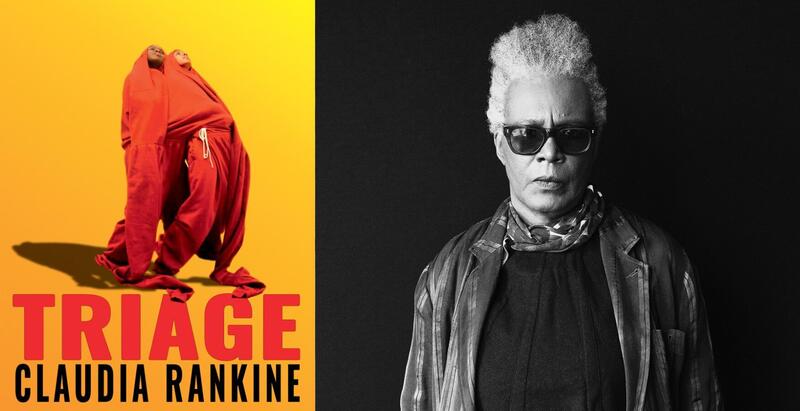
Claudia Rankine first appeared on Between the Covers in 2014 to discuss Citizen: An American Lyric. Our first encounter back then was before January 6th or October 7th, before Trump 1.0 or Trump 2.0, before the public murder of George Floyd or the live-streamed genocide, before the fall of Roe v Wade or the massive worldwide fires felling our forests each summer. Not only do we account for the time since we last talked, Claudia’s powerful new book Triage does this very thing as well. Triage follows the lifelong contentious friendship between The Narrator and The Theorist, a Black woman and nonbinary Palestinian, who have invented a ritual of collapse, falling to the ground each time they see each other. “Collapse was an antidote to an unbearable but borne disturbance we glimpsed in the face of each other,” the narrator says. And “maybe collapsing simply was the easiest way to keep from breaking apart.” Join us as we explore Triage together, and the possibilities of becoming someone else in the face of catastrophic change.
If you enjoyed today’s program consider joining the Between the Covers community as a listener-supporter. Find out about all the potential benefits and rewards of doing so—from the Milkweed Early Reader Subscription to access to bonus contributions from everyone from Dionne Brand to Nikky Finney, Isabella Hammad to Omar El Akkad— at the show’s Patreon page.
Finally, to explore the books discussed and referenced in today’s conversation check out the Between the Covers BookShop specific for today’s episode. And don’t miss Milkweed BookShop bookstore as well.
Transcript
David Naimon: Today's episode of Between the Covers is brought to you in part by the nonprofit press Fonograf Editions. This year, Fonograf celebrates its 10th anniversary. Since their first releases in 2016 by Eileen Myles and Rae Armantrout, the press has put out over 55 projects spanning genres and mediums: LPs, EPs, and cassettes, alongside chapbooks, broadsides, and full-length books. To help carry the press into its next 10 years, Fonograf is raising $20,000. And thanks to a generous donor, every gift made in 2026 will be matched up to $10,000, doubling your impact on independent publishing. Give at the Friend level and you'll receive a year of membership, your name printed in the colophon of every 2027 Fonograf Editions release. Higher tiers include back-catalog selections, broadsides featuring poems by Eileen Myles, Brandon Shimoda, Mark Leidner, and Alice Notley, and even help fund an entirely new book or record. If you believe in publishing that moves between the page and the record player, head to fonografeditions.com/support and make a tax-deductible donation today. Today's episode is also brought to you by Helen Whybrow's The Salt Stones. Dubbed "revelatory and magical" by The Washington Post, the Salt Stones is a profoundly moving memoir on raising a family, tending sheep, and living close to the land. Rooted in the Green Mountains of Vermont, where she shepherds a 200-acre organic farm, the book offers an intimate and profoundly moving story of what it means to care for a flock and truly inhabit a piece of land. Out in paperback now, this Vermont Book Award winner explores the interdependence of animals, as well as of the earth and ourselves. The Salt Stones has been celebrated by NPR's Fresh Air and named a New Yorker Best Book of the Year. Learn more at milkweed.org. I'm particularly excited for today's conversation. I speak at length within the conversation itself about how important my first encounter with Claudia Rankine was in 2014 when we talked about Citizen: An American Lyric. Little did I know at the time just how important that conversation would be for beginning to develop a politics for the show and more, let alone how it affected my own writing and simply my own thinking as a person. So it's with great pleasure to welcome back Claudia Rankine today to discuss her latest book, Triage. I didn't think any of her books, honestly, could unseat Don't Let Me Be Lonely as my favorite of her works, but this one definitely has, and I can't wait to hear what everyone thinks as this book and this conversation enter the world. Before we begin, whether you're a new listener or a longtime one, consider transforming yourself into a listener-supporter by joining the Between the Covers community. Regardless of your level of support, you will receive resources with each and every conversation of what I discovered while preparing, things we referenced during the conversation, and suggestions of where to go once you're done listening. There are a ton of other things to choose from, whether the Milkweed Early Reader subscription or access to the Bonus Audio Archive with contributions from past guests, whether Dionne Brand reading Christina Sharpe and Canisia Lubrin, Nikky Finney reading from the diaries of Lorraine Hansberry, Omar El Akkad reading Jorie Graham, Isabella Hammad reading from the prison writings of Walid Daqqa, and much more. You can check it all out at patreon.com/betweenthecovers. Now for today's conversation with none other than Claudia Rankine.
[Music]
David Naimon: Good morning, and welcome to Between the Covers. I'm David Naimon, your host. Today's guest, poet, essayist, and playwright Claudia Rankine, first came on the show a few weeks after the publication of her now-landmark book Citizen: An American Lyric. Little did we know at the time what the future held for this book and also the world it reflected. Yes, ultimately it was a finalist for the National Book Award, winner of the National Book Critics Circle Award, the Hurston/Wright Legacy Award, and more. But it was not only, or even mainly, critically acclaimed, but broke out into the public cultural consciousness in a way few books do, let alone books of poetry or books that refuse genre like this one does. Named by Kirkus, The New York Times Book Review, The Atlantic, and the Los Angeles Times as one of the best books of the 21st century, I suspect it's also one of the most-read poetry books of this century, too, with hundreds of thousands of readers, and with each of its innumerable reprintings, more names of Black men murdered by the state added to page 134, which in my copy way back then had only "In memory of Jordan Russell Davis" on that page. But by the time we talked, its second printing had the name of Michael Brown. The book became a visible part of the Black Lives Matter movement, becoming an embodied, on-the-street movement and activist network following Brown's death in Ferguson, Missouri. In 2015, during a Trump pre-debate rally, 23-year-old Johari Osayi Idusuyi was sitting in the VIP section behind Trump's podium, where the audience is visible to the world, as Trump spoke, where any of the few minority attendees were shunted into this area to make the audience seem not overwhelmingly white. She was captured reading during his speech, her face obscured by the held-up copy of her book, continuing to read despite the anger of the people near her, a reading that lit up the late-night talk show circuit and the media sphere at large, with that book being Citizen: An American Lyric. The following year, Rankine won the MacArthur Genius Grant and co-founded The Racial Imaginary Institute, an interdisciplinary cultural laboratory where, because no sphere of life is untouched by race, the institute gathered, and gathers, an interdisciplinary range of artists, writers, scholars, and activists to engage, read, counter, contextualize, and demystify the racial imaginaries of our world. She's the author of three plays, including The White Card and Help. She co-produced the video series The Situation with John Lucas and is the author of Just Us: An American Conversation. Claudia Rankine returns to Between the Covers today to talk about her latest book, Triage, of which Saidiya Hartman says, “Triage is a stunning book. In this blend of essay, memoir, fabulation, and criticism, the intimate encounters between the narrator and the theorist offer an extended meditation on the collective devastation of the present. The body bears the weight of this brutality and violence and collapses under the burden of all that we are forced to carry. To yield, to break down is a self-interruption and a letting go, a gesture of survival. The collapse is the embodiment of our shared desolation, an act of dwelling with the tombless and the unwept, a recognition of our destitution. The beauty of Rankine’s dense, elliptical sentences guides us through this ruination.” Homi Bhabha adds, “Claudia Rankine has a poetic voice like no other. Her lines, freighted with political urgency and psychic acuity, profoundly question the validity and viability of ‘these truths,’ whether spoken in faith or twisted out of shape. Rankine’s body poetic refuses the compromises and consolations of the body politic. If Citizen was Rankine’s American lyric, Triage is her elegiac anti-memoir of ‘these times.’” Finally, Jamaica Kincaid says, “Claudia Rankine’s remarkable, outstanding odyssey—an account of our present, which is also our past, which is always our future—is beautifully rendered in a kaleidoscope of images and sensations. This book rewards the reader with the sense that life, as we encounter it day in, day out, often leaves us with the certainty that words are only the beginning and maybe they might never be enough. Triage is exquisite and, frankly, it is at this moment important—for this moment is always right now.” Welcome back to Between the Covers, Claudia Rankine.
Claudia Rankine: Oh, thank you for having me.
DN: The first time we talked was 12 years ago. When we met, it was long before the pandemic, before Trump's first and now second term, before the hearings of Brett Kavanaugh and the court becoming more and more a rubber stamp for the executive, before the fall of Roe v. Wade, before January 6th, and before October 7th, with Israel's decimation of Gaza still happening now, three years later. Back then, in that other era, I reached out to you. You weren't on tour for Citizen, or not yet. It wasn't yet what it became. You were in California, I believe, and you said there was university money allocated for just such a thing from your faculty department budget to fly up to Portland, have a conversation at the radio station, which you did. At the time, I was meeting your work with great interest, but also not really bringing much foreknowledge, engaging with your ideas, I think, from a relatively naive place. I say this because I feel like the show has developed a politics over the last 12 years through encounter, through talking with Viet Thanh Nguyen, Solmaz Sharif, Nikky Finney, Natalie Diaz, Dionne Brand, Adania Shibli, among others. But this journey of learning through conversation starts in a deep way, I think, with ours, and also perhaps my first conversation with the poet Morgan Parker. It even informed who I invited for years, the questions that you activated when we talked, prompting me to invite others to hear their answers to those questions. So I both wanted to acknowledge, I think, a debt to you and your thinking, but also as a way to welcome you back on the show.
CR: I think, as a writer, you couldn't have given me a greater gift than to say that the work allowed a widening of your own curiosity and imagination.
DN: Well, this book, Triage, brings up so much for me, and I think it contains so many possible ways in that I debated how best to start. I decided, in the end, to start with something not by you at all, the striking cover, partly because your books often foreground and center remarkable contemporary art from beginning to end, but more because I think this image encapsulates so much about the book that it's almost incredible to believe that it wasn't made specifically for the book. So maybe we could start with you talking about Autumn Knight's Querelle Des Monstres, what this work means for you on its own terms, but also why you wanted it as our first encounter of Triage. Perhaps, as part of that, you could describe it to listeners who haven't seen it yet as you speak about it.
CR: Yes. I watched Autumn Knight perform at the Venice Biennale, not the current one but the previous one. I found her engagement both with race and gender enlightening, I guess. So I follow her work. When I saw this image associated with the piece that you mentioned, it immediately, for me, brought forward a kind of Greek sensibility. Triage is a book that, maybe not for the reader but for me, sits right on top of Sophocles' Antigone. This image of these two women connected by this red garment that symbolically brought the blood up from the landscape, in a sense, the redness, also climate change and the sun. I look at a lot of visual art, and when I see something that meets the work, even if the artist did not intend that, it imprints on me. So if Autumn had said, "No, you cannot use this," I would have felt crippled because I don't think I would have encountered another image that so closely mapped itself to what I felt was inside the book.
DN: I mean, it really is perfectly a conjoined twin with the book, the image, which is so great.
CR: Exactly.
DN: In Knight's own description of the work, she calls it an interdisciplinary performance examining duality, where she uses both the phenomenon of conjoined twins and also mythologies around twins as these two performers physically work through the "inseparable nature of intimate relationships." These performers are put through a series of collaborative tests: eating, putting on shoes, sleeping. This feels like it could be a description of Triage, in a sense, of two psychically conjoined main characters in the book, the theorist and the narrator. Also because Querelle Des Monstres is in English, argument of monsters as well, because this intimate connection is also one deeply of contention. The subtitle of Citizen was An American Lyric, and the subtitle of Just Us was An American Conversation. In one conversation about Just Us with Douglas Kearney, he asks you the difference between the conversation and the lyric. You say, "The conversation keeps you in the room all the time. As in you and me, the encounter is at the center of a conversation. The lyric can exist with me only. I wanted a form that insisted on the encounter." But Triage feels distinct from either of these forms. If I were to have a subtitle or imagine a subtitle, I might call it Triage: An American Dialectic, but an entangled one, a conjoined one. It makes me think of the Jewish notion of hevruta, which is an Aramaic word that could be translated literally as friendship or companion. But what it means within the culture is more complicated, as it's a rabbinic method of studying Jewish texts predicated on the idea that to confront them alone and silently is insufficient, that reading, questioning, debating, and analyzing with another is vital. There are lines about the importance of this within the Babylonian Talmud from millennia ago, such as, "Just as fire does not ignite in a lone stick of wood but in a pile of kindling, so too, matters of Torah are not retained and understood properly by a lone scholar." And I also think of a quote of Fred Moten that you had saved on your phone, and perhaps you still have it saved on your phone: "I don't need your help. I just need you to recognize that this shit is killing you too, however much more softly, you stupid motherfucker, you know?" But whether you yourself see this as a move from lyric to conversation to conjoined dialectical pair or not, introduce us to the theorist and the narrator and their relationship with each other.
CR: Obviously everything you say is true. It is the performance, the enactment of a conversation that goes back and forth throughout. The organization of the book was really a series of conversations, starting with a lecture and then ending, continuing back and forth between the two of them meeting, meeting again, and then meeting finally. Every time Jeff Shotts, who is my publisher at Graywolf, comes to me, he says, "What is this?" [laughter]
DN: I love that. [laughter]
CR: And the question of memoir came up. The question of fiction came up. I had initially called it a fiction. He said, "Well, it's not wholly fiction." I said, "Nothing is ever wholly fiction." So in the end, we did nothing. We just said, "We'll just leave the title as is." But were I to put something under that title, it would have to be around the essential nature of the dialectical, of the exploring of questions together. Because I feel that what is going on for us, not just in the U.S., but in many countries in Europe and other places, is a kind of strain on the ability to have conversation, the ability to sit with another and hear their position, to allow them to tell you what they know. I don't mean know as in knowledge. I mean know as in experience, as what they have lived, where they're coming from. This idea that you must meet them exactly where you are in order to have that conversation is tragic to me. So I wanted it to play itself out while never forgetting that we are in a moment of intense, unbearable grief that, in many places, we are being told we cannot acknowledge. We cannot speak up. We have students on campuses in the U.S. being penalized, being thrown out for expressing their grief. So in the writing of this, I really wanted to sit back and come up with both the simplest way to enact this and also the most profound for me.
DN: Do you think that the difference also with the conversations in Just Us and the conversation here is, as contentious as the conversation here is in Triage, it's between two people who see themselves on the same side, in a sense? They're in a movement with great disagreement versus in Just Us, you're reaching even to the side of the opposition, essentially.
CR: Yeah, here these are two characters. I don't want to say women because they're composite characters, but two characters who have carried each other throughout their lives as people who are important to them. It matters to them what the other does and feels and thinks and experiences. This brought me back to Ismene and Antigone, where you have that twinning experience, where you have these two women. Often, I think when we think of Antigone, we think of Antigone. We don't think of Ismene. We don't bring her forward as an equal position in terms of her own thinking and feeling. So I wanted to pull that Ismene position so that it was set up against the very articulated position of Antigone, but in a contemporary situation.
DN: We have a question for you from another, but before we hear it, I was hoping we could hear the opening two pages of Triage.
[Claudia Rankine reads from Triage]
DN: So as this section alludes to, from the days of college, the theorist and the narrator develop a ritual or serious game where, each time they see each other, they collapse to the ground. Their relationship over the decades isn't close in the sense that they aren't in each other's lives in a regular way. Their lives aren't enmeshed day to day. But on the other hand, they are very close because of this pact. The absences between the last time they see each other seem like generative absences. When they check in, as in these opening pages, with years having passed, they evaluate and challenge how each other's lives have unfolded, I think simply by the presence of the other in their lives. They are mirrors and provocations for each other. Much of the book circles this question of collapse, what it is, what it might mean, and not mean. By beginning from this place of collapse, not just for the characters but for the reader, there's a certain relief, I think, to acknowledge this place we are at, even if we are all at it in varying ways, versus the discourse of hope, which often, at least for me, feels like it can become tyrannical, that one must will oneself beyond reason to a marshaled optimism. I'm thinking of lines like, "We stayed vigilant to our falling as our way of apprehending life and all its crimes, every cry taken in with each breath," and "Collapse was an antidote to an unbearable but borne disturbance we glimpsed in the face of each other." And "Maybe collapsing simply was the easiest way to keep from breaking apart." This question I'm going to play from another asks you to place Triage in relationship to your past works. But I'd like to add to it that I'm also curious about collapse in relationship to this question. This question that's just about strategies, and I'm wondering if collapse itself is a new strategy and form of address, or is it something one does when there are no more strategies? Is it a rupture from one's past trajectory? Or another way of putting it, I think of how Saul Williams, when he was on the show earlier this year, talked about how he used to say, "Not in my name," but he now says, "Over my dead body." Or Isabella Hammad's book, Recognizing the Stranger, the Edward Said memorial speech given a month before October 7th, where in her afterword to the book, written post-October 7th, the afterword sits at a disjuncture from the book itself and also with her former self. But here's our question that is larger than this question of collapse, but I think also contains it. It's from the writer and scholar Kevin Quashie, teacher and scholar of Black cultural and literary studies. Jayna Brown's description of his book, Black Aliveness, or A Poetics of Being, makes me think of this question of collapse and also collapse's meanings too when she says, "I found great relief in Quashie’s formulation of the concept of 'oneness,' which he insists is 'not akin to individualism.' Quashie’s book has shifted decades of denial, distancing, and suppression for me, not by rescuing the I, but by giving me one, the becoming, the relational. In dealing with my ontological anxieties, I have dreamed of dissolution, a release into the elements of the universe of which we are all made. But even if we mingle with the stars we are still left with particles and forms of relation between these particles. What an aha! moment for me, reading Quashie. How freeing and wonderful. To relate, to mingle, is not a dissolve but a proliferation." So here's a question for you from Kevin.
Kevin Quashie: Hey, Claudia. Hey, David. This is Kevin Quashie. Congratulations, Claudia, on this book. It might seem odd to take you back to Just Us, your 2020 book, but there's an endnote there, I think it's the final one, that I think is so marvelous. It's something like an ars aesthetica or ars vitalia, a kind of statement on how to art, how to live, or at least how you art and how you try to live, at least in the voice of the speaker. So I wonder if you might say something about this endnote, which I will read to you, in relationship to Triage or just in general to your understanding of yourself as a writer and a thinker. The endnote reads: "A friend finished reading the final pages of Just Us and said flatly, 'There's no strategy here.' 'No?' I asked. Her impatience had to do with a desire for a certain type of action. How to tell her? Response is my strategy. Endless responses and study and adjustments and compromises become a life. What I didn't say to her, but what I should have said, is that it's the not-newness of white supremacy and the not-newness of my inquiry that returns me to the page to re-engage. Our silence, our refusal of discomfort, our woeful blindness, the shut-down feeling that refuses engagement, the rage that cancels complexity or response, are also strategies. So is the need for answers and new strategies. The call for a strategy is a strategy, and I both respect and understand the necessity of that call. For some of us, and I include myself here, remaining in the quotidian of disturbance is our way of staying honest until another strategy offers a new pathway, an as-yet-unimagined pathway that allows existing structures to stop replicating. Until then, to forfeit the ability to attempt again, to converse again, to speak with, to question, and to listen to is to be complicit with the violence of an unchanging structure contending with the aliveness and constant movement of all of us. In this way, I remind myself of the faithful who signed up for the long game. The civil rights folks with religious perspective are perhaps the most admirable. People like Ruby Sales, who remains committed to engage in what she names the culture of whiteness, always have my undying respect. In 1965, when a white man, Jonathan Daniels, knocked her down, thus taking a shotgun blast meant for her, fired by another white man, Tom Coleman, she says she stood between the best and the worst our democracy has to offer. The murkiness as we exist alongside each other calls us forward. I don't want to forget that I am here. At any given moment, we are, each of us, next to any other, capable of both the best and the worst our democracy has to offer." I know that's a long passage, and maybe I'm being indulgent in offering it back to you. But just thank you. Thank you for your work, your thinking, your writing.
CR: I'm going to cry. That man's voice makes me want to cry. I love him so much.
DN: I love him. [laughter]
CR: He is one of the finest human beings. I have learned so much from his writing and also his generosity, his curiosity. He is like a branch that reaches out every time, every time. So it's very moving for me to just hear him. Yeah. So thank you for that.
DN: Yeah.
CR: I think, in a way, every book picks up where the last book ends and, in a kind of way, maybe for me. He's right, that's a perfect bridge into Triage, this notion that we can't give up on each other. There is so much to learn, the willingness to continue to find the layers, to continue to understand what we are capable of as individuals, as people, and not to flatten it. By it, I mean this existence, this possibility, the human possibility. With rhetoric, with words like strategy or redundancy, I think people rush ideas into commerce in a way. It has to give you something. It has to. I think how we get is unknowable. How we interact, what a person gets from just glancing off of another person. You never know. You just don't know. You can't anticipate it. Sometimes, in moments when you think, "Why bother? Why bother working on me?" [laughs] then you're crossing the street and somebody comes up to you and says, "Your work has changed my life, has made X thing possible for me or Y thing." This is somebody in the street who just spots you on Seventh Avenue and comes running for it. Sometimes my initial thing is like, "What's happening?" [laughter] And then you realize all that's happening is a recognition. That is the most that can happen. The most that can happen. The most we can ask. This loss of recognition of other people's humanity is really what has devastated us in the last few years. Some things we can say, the trajectory of our political situation is not surprising. You can say it didn't begin now. It began with Reagan. No matter what Johnson did, Reagan came and we were on its trajectory. We had the FBI putting out reports saying that white supremacy was the biggest threat to democracy in the United States. So it was being said and said and said again and again, and people were seeing it. If you were paying attention to these people, you are not exactly surprised by this moment. But I try to think of myself as a realist, but in my most real moments, I didn't expect this, the level of this, the asking us to sit with genocide, to sit with deportations, to sit with the separation of children from their families, and to call this a life, a livable life. That has really floored me.
DN: I wanted to ask you about collapse in relationship to agency, but also how collapse might differ for the theorist and the narrator, especially when you say, "I'm mostly a realist," because I think there is this tension between the theorist and the narrator, between the visionary and the realist. That's an oversimplification, but there is a sense for the theorist that liberation is not a site of arrival now, but a practice. They're annoyed by people who only want action if it's tied to success. The end of things is, for the theorist, the new freedom dream. It makes me think of something you said in a talk several years ago, prior to the last presidential election, where your students were telling you, or some of them were telling you, that they weren't going to vote. You resisted assuming the role of the scolding elder who cajoled them or tried to convince them or counterargue with them. You didn't say, you bit your tongue, "Don't you want to stop fascism from coming if you can?" And you remarked that one repeated sentiment among the students was the notion, "Let it all fall. Let it all fall," and you wondered what that meant or would entail. Of course, this book is about this, this question, "Let it all fall." For one, it seems to me to let it all fall would mean losing control of knowing what it would entail, which I think this book is also engaged with. But either way, it feels close to the theorist's position. I can relate to this position because, to me, it feels like if we were to step back from a specific nation, the greatest threat to the globe is what the European project created over the last half millennia, a project now helmed by the United States and our defense of sort of an extractive neocolonial relationship that continues today, that has us hurtling toward climate disaster, but also which keeps large parts of the Global South in a deeply subordinated place with, as I talked with Saul Williams about, huge swaths of Africa with people in wage slavery to produce the minerals for our phones and our laptops and more. Because if I imagine a world without Republicans for the next half century, again extending this side of the theorist, if I were to imagine no Republicans, where every presidency were Democrats like Obama or Biden or Hillary Clinton or Kamala, one after the next, when it came to defending our access to these resources, to fighting for our supremacy over them in relation to other people, they're very eager to do this. While we might hurtle toward climate collapse at a slower rate, we'd be hurtling none the same. I also think he was saying in one talk about climate collapse that maybe the heat is the solution, that maybe, after all the carbon we've put in the atmosphere over centuries, what has arrived is the solution, but it's not one by us. The Aboriginal writer Alexis Wright, when we talked on the show, in her latest novel, the extreme weather events were themselves the ancestors in Australia. Lastly, I think of something the Nigerian trickster philosopher Bayo Akomolafe said when he was on. He was talking about visiting Xangô's Rock in Brazil, where, according to the guide, slaves practiced fugitivity. They would run through this crack in the rock toward freedom, that once you were on the other side, you were free. And how afterwards, one of his traveling companions said, "I don't think they were running toward freedom, but toward indeterminacy." Bayo said to me about this, "Freedom presupposes you know where you're going, but that certitude is a function of the plantation. The plantation is a GPS system. More than just a defined location, the plantation is a posture in the world. The plantation did not cease to exist when slavery was abolished. It persisted in our postures, in the ways that we think about power, in the ways that we think about freedom. So freedom is still an imaginary of the plantation. It's indeterminacy that they ran towards. It's not knowing where they were going, but knowing they had to run. That's much more upsetting to the vicissitudes and the vocations and the machinations of the plantation, that we must stay with the cracks." It reminds me of the lines in Triage: "The collapse is within the life within. There remains no real antidote to the collapse except to collapse without coming apart while coming apart. The heart aches before another step. Absorb the texture of whatever is touched when one touches down. The heart breaks." This is my long way to ask you to speak about non-arrival, perhaps the theorist's critique of maybe what I'd call solutionism. But also I would love for you to flesh out the narrator in contrast, especially since you say you wanted to draw out the Ismene component of Antigone, her sister, because the narrator is more guarded. She's more circumspect. She's more conflicted. I wonder if you could talk about how the narrator sees collapse, which isn't this way, though she's compelled, I think, by this way. It's not that she's completely saying no to this formulation, but she has a different formulation.
CR: Yes. I think that the idea was that there is a solutionist, that they both understand that the trajectory is one toward collapse, if you keep in mind all that is happening, and they're both aware of all that is happening. It's not optimism versus pessimism. It's both in a situation where they understand what is happening. The theorist, for me, is someone who understands and then feels compelled to address and understands that, to address, one needs everyone, needs community, sort of like Minnesota. [laughs] You need the neighbors who bring the food. You need the neighbors who help people. I think they even switched apartments with people who they felt were targeted, certain families. They alerted when people were in neighborhoods. So it was a group effort to keep certain people safe. The theorist works from that position, that if we work together, we cannot prevent it, but we can reach out that bridge to the next, the other, as much as possible. I think, for the narrator, the piece that the narrator, or the Ismene model, brings in is a recognition of the trauma they themselves have endured, which by its very nature limits what they can do. I think for Black people in this country, we've had these narratives of "My feet are tired, but my will will carry us on," [laughs] This Bridge Called My Back, just whatever. I feel like, no, we've been through a lot. I was in Berlin, and we curated a show where we asked people to create a book where they brought us a life, anybody's life. Your mom, Antigone, anybody's life. It was one book that you made yourself. You could Xerox it, and we asked everybody and anybody. So we had famous artists, William Kentridge, Theaster Gates. Then we asked some lady I happened to sit next to on the train, who was a doctor or who worked with children or whatever. One of these people was a Palestinian woman. The show was up. It was opening day. We hadn't received her book. She came the night of the opening with the book. She had black eyes from where police had punched her in a rally that had happened earlier that afternoon. Her ribs were bruised from where they had thrown her down. I said to her, "Why did you come?" She said, "Because I said I was going to bring the book." And I was like, "No, that's too much. It's too much." So I feel like I wanted that narrator to also embody that, to embody those people, the people who are being asked to carry too much but are still working in a model that belongs to the theorist, that you show up. [laughs] Sometimes, no, it's going to be imbalanced. There are going to be limits to how and what we can do, and somebody else is going to have to pick up that slack. I almost feel that way about African Americans right now, about the Latinx community right now. White Americans are really going to have to pick up the slack because there is a war on Black and brown people in the United States. You know, when you get numbers like 800,000 African Americans out of work, losing their jobs in the course of two years, what does that even mean to the generation, the families, the kids, the school tuitions, the mortgages, health care, etc.? The ramifications of that going forward. So we're going to have to have a kind of repositioning that allows those people to understand the too-muchness that they're under now. Never mind Ukraine, Gaza, Palestinians, people in Sudan, and different places where they are asked to give up everything. Just today, I went to an artist's studio, another Palestinian, and I just said to him, "How long have you been here?" And he said, "Two years." And he said, "Well, once we left Gaza, it's like you have no sense of where you're going to live, who's going to give you a visa." Everybody has a different passport now, even within families. So you can go to one country, somebody else can't. So already we're seeing this kind of nomadic existence, and people are being asked to negotiate that. I'm standing here thinking what to do, but I don't know. I don't know. I wanted the narrator to be embodied by the "I" so that we would have a sense of this confusion around realities that we didn't even know we had to imagine as ways of living coming into our homes at this point.
DN: Well, this twinning, or conjoined lifelong argument of monsters, between the theorist and the narrator, between a nonbinary Palestinian and a Black woman, is also echoed throughout, as you've already mentioned, in Triage's engagement with the play Antigone. The theorist overtly calls the narrator Ismene at one point in the book, Ismene, the rule-abiding young sister to Antigone, who is the defiant and rebellious one. Kevin Quashie sent me two questions and said, "Just choose which one worked best." But perhaps selfishly, as not only do I enjoy his insights, but like you, I'm so enamored with his voice and delivery, I'm going to play both. So here's the second question from Kevin, which touches on the Antigone substrata of the book and expands on it.
Kevin Quashie: Hey, Claudia. Hey, David. I'm so seduced by your overture to Antigone, to the idea, as you name it, of "tombless and unwept," to the crime that grieving can be depending on who is being grieved or who's trying to do the grieving. So I wonder if you might say something about why Antigone, what about her, compels you? Of course, with you, I'm always greedy, so embedded in that question is a second one about drama. Not the common-sense meaning of the word, as in to be dramatic necessarily or gratuitously, but more your own interest in the genre, drama. Your lyrics, your prose all lean toward what I think of as a dramatic form of speech or thought, or even thought on thought. You've written for stage and for screen. So I wonder if you would also say something about drama and language and your work, about what drama does for you as a writer, as a thinker.
CR: There he goes again. [laughter] I just have his voice in my entryway going. Every time I enter my house, there he is. Well, I'm going to answer the second question first. Why drama? The writer Barbara Browning, she wrote The Gift and others, and she's written this essay about writing as performance. I love that essay because I feel like I'm also interested in how genres ask the reader to perform the text, and to embody how you embody an idea. At what moments do you actually say things out loud? Sometimes I'm reading a book and, because the writing does X or Y thing, I'm literally moved to articulate it aloud, even though I'm the only one in the room. So for me, the interest in drama has something to do with language embodied, as spoken, as interactive. I know there are monologues that are also plays, but also just the interactive nature of drama, the fact that others are being negotiated on the stage, and the way that you can use one genre to activate another so that the lyric meets the narrative, which meets the conversation, which meets... So there are moments when the poetry, at least for me in the writing, became places where I was able to go internal, inside. As a reader, I was hoping that you would see the shift between the descriptive language of narrative writing and fiction, and then the poetic language that is asking another thing in terms of how you take it in and what those lines do to you in your mouth if you try and speak them. So that's why drama. That's why. As to why Antigone, when I was in college, there was a philosopher, Samuel Assefa, Ethiopian, who's now in the government. He left teaching, I think, and is now part of the government. But he taught Hegel. Hegel uses Antigone in the Phenomenology to think about how justice works and the role of the state versus the role of the individual or the family. So Antigone represents, according to Hegel, the family, and Creon represents the state. Then Tiresias comes and says one cannot erase the other. Then Judith Butler has come in and told us why Hegel's reading is limited. So there are many who have engaged that text for many different reasons. So I wrote about that in college. It is the one paper I kept for 40 years. [laughs] Because that question of who was responsible to whom activated a kind of curiosity for me at 19 years old. I have been waiting my entire life to re-engage it, but as Antigone and Ismene, not just theoretically. Suddenly, with the present moment where you have the unthinkable happening and people literally dead on the ground, in Gaza but also in other places, and then post-pandemic, or in the pandemic where people were dying in hospitals and families couldn't get to them, I thought, "If you're down on the ground, that's really the only place where you're going to be eye level with the dead. So we've got to get down there." I know this sounds simplistic, but that is how it was forming as a structure in my head. The thing that was preventing us from getting down there with them and understanding their humanity, the loss of humanity, the brutality of what was going on, was the couch because it is from the couch that we were watching it on the television, and it somehow was mediating our basic grief. So when I had that thought, it brought me right back to Antigone. That's when I thought, "Okay, this is it. This is your chance to write into this now and maybe figure out why it's useful to you."
DN: Well, preparing for today, your book sent me down a rabbit hole of explorations on the history of adaptations of Antigone. Maybe as a way to extend Kevin's question, I'm just going to share some of what I unearthed for myself and see whether this field of information sparks any further thoughts for you about the play or your interest in it. Obviously, as you alluded to, the engagement with power and authority, whether a child versus the head of the household who is also the head of the state, a young girl against a powerful man, or how, since the French Revolution, where questions of divine versus human law within the play get transformed into questions of minority dissent against state tyranny, this has become one of the most performed and adapted plays of all time. As you said, it's a big interest of Hegel's. Anne Carson, in her adaptation Antigonick, has a funny exchange between Antigone and Ismene that is partially a play on the meaning of the name Antigone, which means against birth or against reproduction or instead of being born, which is possibly partly relating to the bad omen of being a daughter of Oedipus. Carson's sisterly exchange goes: "Antigone: We begin in the dark and birth is the death of us. Ismene: Who said that? Antigone: Hegel. Ismene: Sounds more like Beckett. Antigone: He was paraphrasing Hegel. Ismene: I don't think so." But you also have a famous Brecht adaptation where Antigone has a door strapped to her back throughout the play, which certainly evokes this sense of non-arrival that your book does too, I think. There are adaptations by Black Caribbean writers Patrick Chamoiseau and Kamau Brathwaite. As you mentioned Judith Butler, another feminist theorist whose centering of Antigone feels like a corrective of Freud's centering of Oedipus. You also have this remarkable adaptation by the Nez Perce writer Beth Piatote, Antíkoni, where Creon is a museum director and his niece Antíkoni wants to repatriate the remains of two 19th-century Indigenous brothers. They actually perform this play in the Hearst Museum that, to many Native Americans, is the scene of the crime, performing literally above the bodies of Indigenous people that have been interred as artifacts in the building. It makes me think of how the crime of Creon in the time of the mythic gods was that he inverted the cosmos by leaving the dead unburied above ground, which has grave consequences for their souls in this cosmology, but then imprisoning Antigone alive underground, putting the living below and the dead above. But perhaps I think most of how, during Mandela's imprisonment on Robben Island, the prisoners were allowed once a year to put on a play for their guards and peers, and they chose to do a 15-minute scene from Antigone. Mandela was at the time in solitary confinement, but it inspired him later to also put on a reading of the play in prison, where he chose, I think interestingly, to play Creon, creating yet another subversion in the dialectic. I just wondered if any of this brings out another layer for you around the play.
CR: Well, I did read and go back and look at many of them. I didn't know about the Mandela, but I didn't dwell on them because always the play, the dynamic, was a shell to step into, a structure to step into in order to look to the future. The question of "What do we do now?" moves a step beyond Antigone. Triage accepts Antigone as the dead are here. They should be buried. They should be grieved. We are grieving. So there it is. But then it is not going to stop. There will be more. They are coming. By that I mean we can think of the fascist regimes and what they're doing, but we can also think of climate change, which I think covers everything, which means that people will be forced to move. Geopolitics are going to have to shift. Some places will be uninhabitable. So then what would be asked of us? And what will we do? There are two directions you can go in. You can be Norway and shut the borders and say, "We got our oil. We're good. You stay where you are. [laughs] We will survive on our own with our stuff as long as we can." You can be in the United States and say, "We're going to get you out. In fact, we're just going to destroy the place and go find a bunker somewhere. You're on your own, the rest of you. The other ones we don't kill, the rest of you, you're on your own." Or we do Minnesota. We show up for each other in ways we never imagined, that are in many ways anti-American, anti-European, against notions of privacy, notions of ownership, notions of family, like this idea of the nuclear family. Forget about it. We really are moving, I think, into a time when we are going to have to start thinking more humanistically around who needs what and what can we do. That will be a shift that is necessary in terms of... it's beyond democracy. It's beyond anything we know. It's no longer about questions of education, forget about, "Can we get our kids into X school or Y school?" Obviously we will keep doing this. There's a Berkeley theorist. She wrote the book, you might have read it, Billie's Bent Elbow. She talks about this living as if. Living as if means that, right now, I feel like this is where we are. We're living as if everything is normal. We're going about our days. We're going to the farmer's market. But all you have to do is peek at the news and you see there's flooding here. There are fires there. There's smoke coming down from Canada, and they're going to be penalized for that. [laughter] So "as if" means, and she makes the judgment that Black people have always lived as if, as if they were actually recognized as humans or as belonging. And they have moved forward with the knowledge that those government jobs that they took, thinking it was safer than the private sector, would last forever, and then have them ripped out. So that's different from double consciousness, which is where you behave one way one place and another way another place. This is not that. This is having in your head both positions. "This is not going to last, but I'm going to keep going as if it will until I'm forced to change." She uses jazz and improvisational behavior as a model for that, that you're going to have to shift based on what else is coming in. So for me right now, she's an important thinker in my own thinking. So this is why I say that the Antigone, though it was a structure for me to begin in, the book, I hope, pushes into the vulnerabilities and precarity that many are already experiencing. Those of us who don't yet feel it have a responsibility in every way to those people. The people who are targeted right now, we have let them down mightily. That has been heartbreaking. So, anyway.
DN: Well, before we hear another question from another, I was hoping we could have another reading. There's a letter from the narrator to the theorist on pages 58 and 59, where she picks up a copy of Antigone and then writes a letter.
[Claudia Rankine reads from Triage]
DN: We've been listening to Claudia Rankine read from Triage. One of the main ways you incorporate visual art in Triage is with periodic artistic engagements or images of artistic engagements with couches, from sculpture to painting. Our narrator says various things about couches, such as a couch being "an intermediary space between collapse and living," "to fall into the pause before the return of more," but also a place of defeat when she says, "I wrote about couches because what else is there once one's fallen away from faith in each other, confidence in the good, trust in ourselves?" The theorist often sees the narrator as on the couch, so to speak, in a negative way. For instance, the narrator says, "The power in powerlessness came not in falling, but in letting myself fall, controlling when, how, getting up." But the theorist completes the thought and the sentence in her trenchant way by saying, "In order to look around and do nothing." But what is more clear outside of words, in the images of the couches, is most of these couches aren't even really serving their couch-specific purposes as a reprieve, as a place to recharge, as a place to tune out. The couches are often mutilated or even made of concrete. They've rejected their own function, in a sense. Our next question for you is in part about couches. This question is from the writer and thinker Sarah Dowling. Sarah has a book called Here Is a Figure: Grounding Literary Form. It's a book that engages with the lying-down figure, whether the protester or the prostitute or the depressive. As you might imagine, it also engages, like Triage, with Antigone. Carmen Faye Mathes says of her book that Dowling "contests dominant figurations of uprightness." In six chapters, Here Is a Figure draws out relations between figures and grounds, readers and art, and it argues for material reorientations, for getting down on your stomach on the hot, dry grass or the tacky asphalt, for going to the places where corpses lie concealed, by spending time with artworks that handle these bodies directly. So here's a question for you from Sarah.
Sarah Dowling: Hi, Claudia. My name is Sarah Dowling, and I wanted to congratulate you on the publication of your incredible book, Triage. I'm not sure if you will recognize my voice or remember me. We've met one or two times over the past few decades, most memorably for me when you came to Temple University, when I was a master's student, to speak to my workshop class that I was part of about your book Don't Let Me Be Lonely, which our teacher, Jena Osman, had assigned to us. I remember being struck then, and continuing to be very struck over the intervening decades, by the recurrence of lying-down figures in your writing. In Don't Let Me Be Lonely, the speaker describes herself at one point as being in death's position. Then, of course, your book Citizen: An American Lyric begins in bed. Later, your play The White Card has its really crucial climactic moment when Charlotte, one of the characters, suddenly drops to the ground in the middle of the stage and lies there while all the other characters argue around her, totally oblivious to what has happened to her or why. Why is she suddenly lying on the ground when they're all standing up? I've always found this a very provocative and exciting image in your writing, such a powerful way of making certain ideas about exhaustion and the structural forces that exhaust us really concrete and palpable, showing exactly how that feels in our bodies, in different people's bodies in different ways. So I was absolutely blown away reading Triage to see how that lying-down figure had really come to the center of the text. I loved how literally it came to the center of the text, not only in the narrator and the theorist's lying-down game, but also in the location of Jennifer Packer's painting Blessed Are Those Who Mourn (Breonna! Breonna!), of a man lying down on his couch, right at the absolute center of the novel, perfectly midway through it. I guess one of the things that I wanted to ask you about that was, one, if you could speak to the way that this perhaps more incidental or somewhat marginal figure of the lying-down person has really stepped into the central position in Triage. But then the other thing that I noticed about that that I found so fascinating was that the narrator character in Triage herself seems to be quite preoccupied with the possibility of lying down. She has this visual studies project where she's studying couches in contemporary art. But the ones that fascinate her the most, as I understand it, are the ones that don't actually have a person lying down on them, and the ones that maybe signal the possibility that a body could be held in a restful way, but then at the same time push back against that or make it impossible because of the way they're constructed, that we couldn't actually lie down on those couches. They seem to hold out the promise of rest and then to pull it back or refuse it in some way. So what I would be very interested in hearing you speak about, if you're willing, is how you would trace the history or recurrence of these lying-down figures across these many decades of your work, but also how you would compare the narrator's interest in those figures with your own and how maybe you think about her interests or her ideas as they're distinct from yours, and perhaps what the absence of the real human bodies in her project tells us about her limitations or who she is as a character. Thank you again, Claudia, for this book. It was such a provocation to read it. I know I'll return to it again and again. It's so, so interesting and so beautiful. Thank you.
CR: Thank you, Sarah. I love questions that are maps, that track time, and you're so right. I think that the lying down, the metaphor of falling, collapsing, lying down, has always functioned for me as a way to articulate, and this is not the right word, but inarticulateness, like babble, like when language ceases to function as useful and the body has to step in and do something else, [laughs] drop down, fall. Sometimes in art pieces you'll see somebody just scream. That scream is supposed to be the moment when language fails you. For me, the falling in bed, the falling down, the collapsing, is the best metaphor for the limits of relationality, communication, all of it. Over the scream, I like the falling down because you have to take the body with you. You cannot evacuate it. If you're following the person who has come to the end, you have to go with them down. You end up down there with them. So that's my understanding of that. Like Sarah, Jennifer Packer's work, when I first saw it at the Whitney, I felt like, "Oh my God, she knows that. [laughs] She understands something that I understand. We know something together." It was really fascinating because, as I was walking through that show, I came to a painting, and it had a line from one of my poems. I thought, "What a coincidence that she put these words together just like I put them together." [laughs] Then I later found out it was actually a quote from the poem. So it is that sense when grief is beyond language. It is beyond communication. But you can find it. You can find the recognition in another. To find it, that other person has to be down there with you. Sometimes I'm sad when people say to me, "I was with you the whole way in X or Y book," because I feel like I don't want that understanding shared in a way. I mean, it's good because I feel like the language is doing what I have worked so hard to have it do. But on the other hand, it's a kind of recognition you don't want. It's like when you see somebody you don't know and you feel the pain of them, but you also have no relationship to them, so you have no way to communicate the understanding of that pain. I was once in an elevator when I taught at Columbia. I lived in the same building as Edward Said, and I was in the elevator and I was upset about something, so my eyes were glassy and teary. He came into the elevator. I'd never spoken to him, but obviously I knew who he was. He was so... I mean, I felt seen, but not just seen, not like, "Oh, she's crying." I could feel that he wanted to do something. You could feel almost like an energy field being given to you or moving towards you. It's one of the few times that a complete stranger is just trying to help without helping you, without invading your privacy. But that's why the falling down. So thank you, Sarah, for that question.
DN: This is a perfect segue for my question because I think your interest in the lying-down figure goes back even further than Sarah's remarkable timeline through your work. When you were recently doing an event for your book Plot, published 20 years ago in the U.S., a book that explored your apprehensions about becoming an artist and becoming a parent, it engaged with Virginia Woolf's To the Lighthouse. As you say in this event, the language of it often ends at the river, at a drowning of sorts. This idea of thinking of language ending at the river makes me want to ask you about the limits of language in relation to some of these questions in your book. For one, I think there's a tension between the epigraph by Ula Lucas and the book's dedication, just as there's a tension, even an anxiety, about questions of words versus actions in the book too. The epigraph goes, "Any attempts to name and describe our lives will always seem unstable because all language is a form of triage," and the dedication is, "For all the students who risk everything for everyone." The epigraph suggests all language is a form of triage when it comes to its power of description, but it feels like the notion of triage in your book moves far beyond this, perhaps related to how saying or writing something can fool us into thinking we've done something. There are questions within Triage that remind me of Layli Long Soldier's Whereas, which is engaging with apologies in relation to both realities and real change. The main "apology" that is dissected is from Obama, but another is from a girl who writes to Layli an apology for what America did to the Native Americans. Layli reflects on the limits of apology by reflecting on the limitations of the dental care that she's able to receive when she says, "I went to Indian Health Services to fix a tooth, a complicated pain[. . . .] The solution offered: Pull it. Under pliers masks and clinical lights, a tooth that could’ve been saved was placed in my palm to hold after sequestration. Dear girl, I honor your response and action, I do. Yet the root of reparation is repair. My tooth will not grow back. The root, gone." I think of this when I think of some of the ways you describe collapse. For instance, when you say, "We fall because we have already fallen," when I hear that, it makes my own experience of the world feel seen. Maybe this is a recognition you aren't seeking because I know it's seen but in variable positions as readers. But nonetheless, "We fall because we have already fallen," I feel seen, and somatically I feel I'm able to breathe better reading words like this. But I think the book is asking what that is worth, that experience that I'm having. What are the limitations of producing that effect in me? For instance, I think of when the narrator, listening to the theorist giving a talk, describes the following during the talk: "Yet the audience's applause, resounding as it was, recalled my own reaction to Omar El Akkad's description of a team of makeshift orderlies moving in unison to lift their patient, a woman, from the rubble of genocide. The woman, already resigned to the cemetery, asked if they were taking her there. The question was her tracheotomy. The airway was open. The diaphragm contracted. The ribs raised. Air has reached the lungs. I stopped holding my breath. But was the second, minute, hour, any safer?" This feels like the fulcrum of the book to me somehow. But I was hoping you could talk about triage the word and triage the action in relation to language and action, why it's the title of the work, and to what end is Triage the title of the work?
CR: Great question. I mean, for me, because it's time to think about that. [laughter] One of the reasons I loved Ula's quote was because I feel like we are constantly shifting. Always language is putting in the first position the thing that we think needs addressing, needs the most urgency. But that word, whatever it is, that phrase is just for that moment. Then we know more, and that thing slips away, another thing comes. Then we need another word, and we need another word because we need another action, and we need another action. So this idea that all language is constantly just prioritizing what we see to be the thing that is most urgent at the very moment, which doesn't work against the idea that the actions of those students who risk graduation, risk their lives, everything, to make the world a better place for others or to recognize the devastation that's happening in others' lives. In those moments, that is the most important thing. So that is what needs to happen. That's the triage for that moment. It might shift. They might shift. Their sense of what is needed will shift. So I love triage for its instability and its blindness because, really, you don't know. You see and you do and you say what you think needs to happen. It's going to have to move. It's going to have to shift. You're going to learn more. That thing that was in position number one might be position number two, might be position number three. So that was the idea, and that's why the title. I also am very aware for myself of the fact that you cannot separate the refugees from those who are subject to genocide to those who are being deported. There is no ranking system when it comes to human lives. Then there are all the things that are happening that we have no idea about. That's something that often I find crippling, that I try to be informed, but there are limits to what even I have access to. I feel like I know how to navigate certain information. Then also now you don't trust anything. So you don't know what's true, what's not true. So the title is a kind of, "We do the best we can." [laughs] But we got to do the best we can. We got to do the best we can.
DN: Well, in Autumn Knight's Querelle Des Monstres performance piece, the conjoined twins work together and attempt various tasks until one of the twins dies. In the last moments before that twin dies, the other twin engages with the audience. She erects a Yorùbá sculpture called an Ibeji, the sculpture one creates when a twin or both twins die. The living twin then reflects on her life and also on the universality of separation. I mention this because, in one event you did years ago now where you read from Triage in progress, in the passage you read, the theorist had died, and the story is continuing with the narrator now alongside the theorist's absence. It made me wonder about the deliberation around whether to have them endure together versus having the death of one's collapsing partner as part of the collapse.
CR: Yeah, that was a big switch that I made because there are lots of reasons. One was the theorist being a composite character. It put too much emphasis on one of those characters, and that was never the point. Because the theorist had to have an origin point, and the point was Ramallah, it was an insistence on the life that will continue. Not that the situations, the pressures, the vulnerabilities will change, but the life will continue. Because when you think about all of the women who, in my mind, contributed to the making of the theorist, why choose that origin point, that life? It was because I wanted to normalize that which was being erased. I wanted to bring it into the day-to-dayness of our own lives as a regular thing. So once I stepped back and I looked at the arc of the book, I thought, "No, no, no, no, that's wrong." So I moved back to move forward.
DN: We have a series of questions for you from Sarah Schulman. Sarah is the author of many books, including Israel/Palestine and the Queer International, Conflict Is Not Abuse, and Let the Record Show: A Political History of ACT UP. The most recent book appears within the narrative of Triage itself, where the theorist says, "It's not that I don't get the frustration, but there are no quick fixes, no repair. We need the imagination of a bureaucrat," said the theorist, "someone to build steps as we go down." The narrator responds, "I think I know what you mean," I said. "Our present government has systemically stripped away the mechanisms put in place to combat a moment like this. It's crippling to see what's happening and have the knowledge be met with shush. It's like living in a state of non sequitur where the logic exists in the brutal illogic world-making of supremacy within a lying structure," I said. "How can a situation remain this alarming for years? There are no inviolable rights anymore. It's impossible. Everything feels impossible. Even as I'm not in despair all day long, then the lack of despair causes despair." "A line structure. That's exactly right," the theorist said. "Where's that from?" "Sarah Schulman's book on solidarity, The Fantasy and Necessity of Solidarity," replies the narrator. Here are some questions for you from Sarah.
Sarah Schulman: Hey, Claudia, it's Sarah. I'm here in New York, and we miss you. Come home. I have so many questions I want to ask you, so I'll throw out a few of them and you pick what you want to respond to. One is that a lot of writers, when they become really successful and end up flying around a lot and meeting a lot of other successful people and all of that, they never, ever write about that. They're constantly rehashing their childhoods or periods of time before they had those kinds of experiences. But you're not like that. With Just Us, you wrote about flying first class as a Black woman and what your experiences were. In your new book, Triage, you're also much more truthful about what your life is like now. It's a character who goes to lots of countries, who meets lots of artists, who looks at art. I'm just wondering why you think so many other people are afraid to describe the realities of how they're living once they reach a certain point. So that's one question. Second question is, you made the friend in this book Palestinian. I was wondering why you did that and how you grounded the character's Palestinian-ness, even though it's not realism. The third thing is that you are someone who really wants out of the U.S. at this point in your life. Right now you're in Europe. You're still teaching at NYU. What is the reason for leaving America, which a number of people who have the opportunity to do are doing? And what would be a reason to stay in Mamdani's New York? Okay, those are my questions. Come home. Okay, bye.
CR: Okay. Hi, Sarah. [laughs] Sarah and I talk a lot. In many ways, we have had a long relationship over the years where it's a crucial one because we are both committed to thinking through these issues but are very different in our positioning, our activities, our relationship to other people, et cetera. Obviously she's beloved by me and a dear friend. So to address the issue of writing about my life, I don't know why other people do what they do. I can't account for that. I have nothing to say to that. I can only say I live where I live, and wherever that is, that's the position from which I'm writing. If I look and what I see is a Pellegrino bottle, then I'm going to say. [laughs] Maybe it's because I am limited in paying resources in terms of imagining. For a long time, it did irritate me that some writers only wrote about slavery. I'm like, "No, what's happening right now is really important. [laughs] Write about what's happening right now." But they do what they need to do. I do what I need to do. As I said before, the positioning of the theorist as Palestinian was a way of normalizing that presence inside the book. I will not be party to the erasure of a population of people. In this small way, I can say, "No, look. See? There's a person. They come from this place. This place exists. They have family there. They have roots there. They have lived there. If you decide there's no right to return, take their house, it doesn't matter. They were here. And they are here." In terms of why I now split my life in two places, it's true that Mamdani is a force in New York that is, for me, unexpected. This is the thing about the United States. You never know what will happen. [laughs] You just don't. Because there's so many people, and so much is possible, and people are reactive in certain ways. So that is fantastic. But New York is not the United States. New York is New York, and it's New York City, not New York State. [laughs] Maybe, as Sarah is a white woman, she's Jewish, she's queer, there are many reasons why she is not positioned in the power dynamic of many. But still, I'm not sure she knows the kind of dismissiveness and brutality that Black people are subject to day in and day out. So when I'm in New York, as privileged as I am by virtue of location, for one, in New York City, and also occupation, it doesn't stop anything. I came into Newark, New Jersey. I was sitting waiting for my luggage. One of the new TSA police, I don't know if it's technically ICE or just police in the airport, came over to me. Suddenly I'm reading, I'm on my phone, and I see a dog sniffing me. This was the first time it happened, so I reacted. I was like, "What? What's happening?" And this guy with his dog went to every Black person. Nothing happened. Then I got my luggage and I left. I came back again. But this time I expected it. The dog came and sniffed, and I didn't look up because I thought, "He just wants me to react." So I just stayed looking at my phone. Because he got no reaction, he asked the dog to get on the seat next to me and get in my face.
DN: Wow.
CR: I said to him, "Is that necessary?" And he said, "Yes, that's necessary." Then he walked on. So that's clear to me. [laughs] It was exactly as I thought. He was waiting for me to exhibit my fear of him. So this kind of thing can happen at any moment, anywhere. I want some peace. I want to be able to walk down the street. I want to say what I want to say. I want to come home and not have to get rid of that before I can move into the next moment. I don't know if white people can understand what it means to, on a regular basis, have to move through the rage of these white men, because it's mostly white men who are doing this. Now they are empowered, and now there's a private police force, federally funded, moving across the country. So I don't know. If I can find a little bit of peace, I'm going to take it right now. It's not that France also doesn't have its own forms of racism, but it's a different dynamic right now. So that's my answer to all of those questions, Sarah. [laughs]
DN: Part of why I wanted to put Sarah's questions around class and privilege, but also about Palestine here, is that given that we are all deeply implicated in the Gaza genocide, with at a minimum our tax dollars going toward it, where in one interview Omar El Akkad said, "Quite often I talk about being a pacifist and about how important nonviolence is to me, but by virtue of where my tax dollars are being spent, I'm one of the most violent people on earth." This situation is still ongoing, still unfolding, where even speech on behalf of Palestinians has led to the loss of jobs, reputations, deportations. Our relationship to the genocide puts a distinct pressure on this question of words versus action. The theorist, who is constantly calling the narrator to account about her passivity, makes an ask of our narrator that I want to discuss. But before I ask about it, I wanted to ask something about the theorist first. Because the theorist frames themselves and is also seen by the narrator as the person who acts. In fact, the narrator is first enamored with the theorist in college before she knows them, when she sees the theorist pulling down posters of bikini-clad women in the quad. But normally, by definition, we don't think of theorists as actors in the way that we do activists. Not that these two categories are in any way mutually exclusive. But I realize that we never see the theorist in the book doing anything other than seemingly having the most correct analysis and giving speeches. I'm sure we all know people who have all the "correct positions" and yet do nothing material in the world on behalf of them, and others who have a more limited analysis or even, in some regards, a regressive one who nevertheless make meaningful material change in the world. I'm not saying the theorist is either of those, but calling them the theorist and also not having their actions in the world really dramatized in the book or known to us in the book creates an interesting generative narrative gap, I think, that I would love for you to speak to and maybe into.
CR: Well, I also think it's funny. It's funny because what I wanted to suggest is that the theoretical language underpinning activism comes from people like the theorists. So in that way, they are deeply involved. Most of the theorists I know, people like Judith Butler or Lauren Berlant, Sara Ahmed, Carolin Emcke, these are people who are theorizing partly because they have placed themselves at the center of many of the most disturbing questions, and almost all of them have been under fierce attack by the powers that be. So in that sense, language itself becomes a kind of action.
DN: I love that you're collapsing that dichotomy, speaking of collapse. [laughter] I mean, you also think about people who critique others, like, "You're writing, but you're not doing." Marx wasn't a working-class person. Obviously his theories and his theorizing about the working class, I mean, it would be ridiculous to discount them because he's not a working-class person.
CR: Well, exactly.
DN: Well, I don't really think of this book as having spoilers. But if there is one, it would be a moment near the end that I want to end with. So if you're worried about that sort of thing, listeners, and you know you're going to read the book, you could pause and come back before this final question. But for those still here, I really love where we arrived near the end, with the theorist making a big ask of the narrator, a narrator who lives in the U.S. but also has an apartment in Berlin. The theorist has told her about a Gazan refugee family that needs a place to live temporarily, where the length of time is unknown and indeterminate, perhaps indefinite. She says in her pointed way to the narrator, "What's the worst that can happen? Or would you rather just grieve the couple's dispossession on your couch?" Ouch. [laughter] The narrator has all sorts of responses. "There are other things I can do" is one of them. "What if I get caught?" is another. Though it seems clear that the consequences for the latter would largely be inconveniences or logistical. She's not going to end up in jail. The theorist says things like, "We are already targeted, so what are you protecting?" and "You're policed already, but in the name of nothing, no one." When the narrator says, quite poignantly, "But having never owned freedom, do you really expect me to say yes?" the theorist says, "You don't need to shut down. Say yes. Become somebody else. There's time for another you. Don't affix to isolation. Let's collapse together. Reconstitute our we. Come alive for me for once." It feels like this exchange calls not just the narrator to account, but all of us. It makes me think about the fictions we want to tell ourselves of who we would be in a crisis. I think of a thought exercise, almost a game, that Jews in the U.S. do, that Nathan Englander even made into a short story, which is to wonder, "Who of my friends and peers would hide me in an Anne Frank Holocaust situation, and who wouldn't?" And I think of this because these same people are largely not showing up to the moment. Even if you are against the language being used by pro-Palestinian protesters, even if you see Hamas as terrorists and claim to be, as most liberal Zionists do, for a two-state solution and for coexistence, as if the situation has not moved entirely from that possibility. I don't see most of these people speaking out about the West Bank, where Hamas is not in charge, where 2023 was a notoriously bad year of land theft and dispossession by settlers before October 7th, and where it's far worse now, with Jewish thugs running around with axes and clubs and rocks and guns, lighting houses on fire, sometimes inhabited ones, attacking schools, stealing livestock, where in the first half of this year alone, a thousand children have been displaced in the West Bank, and many communities live in day-to-day terror. I think of Jewish friends of mine who suddenly are like, "I'm going to focus on local politics," which feels like interesting timing to me. Or, "I believe everything you are saying, but I'm paralyzed." Because the people who hid Jews in Europe did so under the risk of not only their own death, but the possible death of their entire families. It's actually amazing what they did, thinking of those circumstances and the existential risks of the people who actually hid Jews in Europe. When I think of the last three years, I have unexpected, unanticipated empathy for the good Germans I've long despised, the "good Germans" who did nothing as their neighbors and colleagues and peers were rounded up and put into ghettos, who lost their jobs, their shops being closed, their apartments rapidly claimed by non-Jews because the risks now are nowhere as large as then to expend some of your social capital and standing to not lose sight of something unfolding right now. Even if people we know and love get angry or relationships get strained, our families are not going to be shot. I don't mean to exempt myself from this. As much as your book is about the too-muchness of the moment, it's also about nothing being enough in the face of it as a corollary to the too-muchness. Contrary to you, the Trump 2.0 era, very unexpectedly for me, because during the Bush era I desperately wanted to leave the United States, but in the Trump 2.0 era, perhaps because so much of what's happened in Portland has felt a lot like what's happening in Minnesota, I have felt more connected to place than I've ever felt, as I feel like the city is stepping up in so many acts of community mutual aid that bypass the government altogether. The government itself is engaging with some of these issues too, with half the city council now coming solidly from the left. But I know people here who are preparing to or have taken in Venezuelan families, for instance, as part of how people are aiding our undocumented residents right now. I'm not doing that. There's so much I could be doing that I'm not doing. Really, this is a long-winded way to have us end with the theorist's challenge to be a different person, to say yes, to reach beyond ourselves, and wanting you to talk about this dialectical exchange between the narrator and the theorist, this challenge around giving sanctuary, providing refuge, upending one's life as the world falls around us rather than holding on to the structures around us that are less and less sturdy. Talk into this for us, where it has left you, where you might go from here around this ask that you leave us with near the end of Triage. Anything that comes up around this, I think, really important place that you leave us with as we come to the final pages of the book?
CR: Yes. I had this conversation with a faculty member at Columbia who said to me, after reading Triage, they read a draft of it, and they said, "When Barnard locked out its students, they asked faculty if they would take them in. And I didn't. Why? Because I didn't." I was thinking at the time that this kind of thing where we're asked to be accountable to others in new ways is going to become more and more normal. Someone did ask me to ask someone to take in a Palestinian family. The person I asked, I asked because I know they had taken in Ukrainian refugees. They said no. Fine. It's your decision. But then they never took my call again.
DN: Wow.
CR: Yeah. I spent a lot of time trying to think, "Did they feel like I overstepped by asking? Or is it just a question of shame that is not negotiable anymore?" I won't know. I tried multiple times. "Coffee? Lunch? Museum?" No. Not even no. No response. So in my own life, I have seen this come up again and again. What interested me about it was that it's not just a question of yes or no. It's a repositioning of how we are in the world and what we consider normal, what we consider not extraordinary but necessary. So the question then becomes, what will it take for others to understand that this is where we are now? In Minnesota, it didn't take much. I think partly because ICE was on the ground. They could see. The thing about Americans, I have found, and maybe it's also true elsewhere, is that the imagination refuses the facts until they can be seen personally. So it's almost like things begin to happen a minute too late, in a way, because we're not able to say, "If X, then Y, then maybe I'll get ready now." So I wanted the book to put us in that reality so we could try it on, so we could perform it imaginatively because I do believe the time is coming.
DN: I do too. Thank you, Claudia. I'm so happy we are circling back after this huge passage of time and taking account of it together.
CR: Yes. It's a tragic time, but it's good to have a fellow thinker.
DN: Yeah. Well, I'm honored to be one with you. Thank you.
CR: Thank you.
DN: I've been talking today to Claudia Rankine about her latest book, Triage. You've been listening to Between the Covers. I'm David Naimon, your host. Today's program was recorded at the volunteer-powered, non-commercial, listener-sponsored, full-strength, makeshift home office of me, David Naimon. If you enjoyed today's conversation, consider transforming yourself from a listener to a listener-supporter by joining the Between the Covers community. Every supporter can join our brainstorm of future guests, and every listener-supporter receives the supplementary resources with each and every conversation: things I discover while preparing, of things that we reference during the conversation, and places to explore once you're done listening. In addition, you can choose from a wide variety of other things as well, including access to the Bonus Audio Archive with contributions from past guests, whether craft talks by Marlon James and Jeannie Vanasco, or readings from past guests such as Natalie Diaz reading from Borges' Book of Imaginary Beings, Jordy Rosenberg reading Fargo Tbakhi, or songs sung by Adrienne Maree Brown. Or perhaps you want to subscribe as a Milkweed Early Reader, receiving 12 books over the course of a year before they're available to the general public. You can check it all out—these options and much more—at patreon.com/betweenthecovers. Or if you prefer a one-time donation, you can do so by PayPal at milkweed.org/podcastsupport. Today's episode is brought to you in part by Ampersand Organ. In this more-than-human lyric, heidi andrea restrepo rhodes offers the ampersand, a mode of encounter that unfixes the reader. Part of the Multiverse series, Ampersand Organ neuroqueers poetics with writing that moves toward deft and loving excess, a radiant field guide for how we might all shiver and shimmer into the "and and and." Ampersand Organ is perfect for fans of Oliver Baez Bendorf and Aracelis Girmay. A wonderfully unique experimental neuroqueer project, this latest addition to the Multiverse series has been hailed as a must-read by People magazine. Ampersand Organ is available now at milkweed.org. I'd like to thank the Milkweed team, particularly Claire Barnes and Craig Popelars, for everything they're doing to make this partnership a reality. Finally, I'd like to thank past Between the Covers guest, poet, musician, composer, performer, teacher, and more, Alicia Jo Rabins, for making the intro and outro for the show. You can find out more about her work, her writing, her music, her film, at aliciajo.com.