


Hybrid / Nonfiction
Dionne Brand : Salvage : Readings from the Wreck
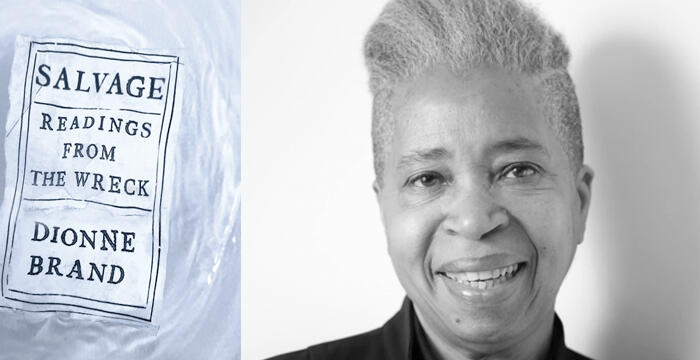
What does it mean that a life can not only be animated by books but destroyed by them? That a self can be not only made by reading, but unmade by it? Dionne Brand’s latest book of nonfiction Salvage: Readings from the Wreck returns to formative texts from her own reading life in order to model a more aware and liberatory way of reading, of thinking, of being, in relation to them. We explore what we can salvage from the wreck, the wreck that is the book before us, the wreck that is us before the book.
For the bonus audio archive Dionne reads selections from the work of Canisia Lubrin and Christina Sharpe. This joins readings, craft talks, writing prompts and more from everyone from Danez Smith to Marlon James to Nikky Finney. You can find out how to subscribe to the bonus audio and about all the other potential benefits and rewards of joining the Between the Covers community as a listener-support at the show’s Patreon page.
Finally here is the BookShop for today.
Transcript
David Naimon: It's hard to be a reader in 2024. Before getting into a good book, you have to somehow ignore your inbox, avoid doom-scrolling, break free from the algorithm, and then just when you're getting into it, there's an alert that pulls you back out. That's why reading technology company Sol designed the Sol Reader, a wearable e-reader that helps you shut out the world and get back to reading. You put on the Sol Reader like a pair of glasses. Just slip it on, lay back, and see the pages of a book right there in front of you on an E Ink screen. Think of it as noise canceling for your eyes. No distractions, just words. Check out the Sol Reader at solreader.com to start reading without distraction. If you use the code COVERS15 at checkout, you'll receive 15% off your purchase of Sol Reader limited edition. Today's episode is also brought to you by award-winning author Melanie Cheng's newest novel, The Burrow. Following the members of the Lee family as they adopt a rabbit in the wake of loss and grief, the novel follows the family as they navigate hope and tragedy. Bringing together four distinct perspectives and one wide-eyed rabbit, The Burrow reveals the enormity of loss, long-buried family secrets, and how we learn to survive in a newfound world. Rajia Hassib declares, “The Borrow’s restrained prose and heartbreaking honesty capture the paradox of living with trauma.” In the words of Helen Garner, the novel provides "a calm, sweet, desolated wisdom." The Burrow is out now from Tin House. One of the great conversations of my time as an interviewer was talking to Dionne Brand in 2022 about her career-spanning new and selected poetry, Nomenclature, looking back and then forward across 40 years of her life as a poet. It's with no small amount of anticipation and excitement to have Dionne Brand back again, this time to discuss her latest work of nonfiction, to discuss this time the fraught power of narrative, of story. This latest book also, within it, looks back across her life, her life as a reader. Salvage has been described as a personal history of how a reader is made and unmade. But it isn't only or simply an exploration of how a life can be animated by books, but also of how a life can be destroyed by them. It isn't only a book about the making and unmaking of a reader, but of the making and unmaking of a self in relation to what one reads and how one reads; how we author a self in relation to the words of others, knowingly or, more often, quite unknowingly. It isn't often that I have conversations from this lens, from this lens of reading, even though I think every conversation in a sense is an exercise in close reading, hopefully done slow enough that it feels as if we're doing this close reading together. In fact, the past episode that most leaps out in relation to today's is my conversation with Elaine Castillo about her book How to Read Now, a conversation and a book in a completely different register than today's, but which deeply shares certain animating questions with regards to encountering texts or re-encountering them, in discovering the self within them, or the self dismissed or deformed within them. Both books I think model efforts to decolonize the mind, to salvage something from the wreck that is the book put before us, but also the wreck that is us before the book. Before we begin, as we head into the holiday season, I wanted to mention a couple of things about the show. For one, Patreon has, for the first time, allowed people to gift memberships to other people, something you might consider for a literary loved one. As of now, this only applies to reward tiers that don't have a finite number of openings, which eliminates quite a few of mine, but it does include the entry level of support, which includes things that every supporter gets, the abundant resources that come with each episode of what I discovered while preparing for it, what we referenced during the conversation, and places to go once you're done listening, and also an invitation to join our collective brainstorm, shaping who comes on the show in the future. Another tier that you can gift is access to the bonus audio archive, which includes Dionne Brand's reading of Canisia Lubrin and Christina Sharpe, Danez Smith's 30-minute incredible reading of six poems, each one followed by a writing prompt that they created specifically for us, Nikky Finney's reading from Lorraine Hansberry's diaries, Myriam Chancy’s close pedagogical reading of Jamaica Kincaid, and much more. If you're interested in gifting a membership, you can check that out at patreon.com/betweenthecovers/gift. But more generally, if you aren't yet part of the Between the Covers community and yet value these conversations, there are a lot of other things one can choose from too. From the Tin House Early Reader subscription, receiving 12 books over the course of a year, months before they are available to the general public, to the 100th anniversary new critical edition of Jean Toomer's Cane, which comes with an oracular deck of prompts, gestures, images, questions, and calls to respond, created by many of today's great Black writers, artists, and thinkers, from Alexis Pauline Gumbs to M. NourbeSe Philip, to past Between the Covers guests, Canisia Lubrin, Christina Sharpe, Douglas Kearney, Gabrielle Civil, John Keene, and many others. To find out about all of these things, not just the few things you can gift to others, but the many things that you can gift to yourself, you can check it all out at patreon.com/betweenthecovers. Now for today's episode with none other than Dionne Brand.
[Music]
David Naimon: Good morning, and welcome to Between the Covers. I'm David Naimon, your host. Today's guest is poet, novelist, essayist, editor, and teacher Dionne Brand. Moving from Trinidad to Canada in the 1970s, Brand is one of Canada's most renowned writers, a writer whom Adrienne Rich described as "a cultural critic of uncompromising courage, an artist in language and ideas, and an intellectual conscience for her country," and of whom Kamau Brathwaite called our first major exile female poet. A writer with six honorary doctorates who was invested as a member of the Order of Canada in 2017, who was Poet Laureate of Toronto from 2009 to 2012, and who has won too many awards to name from the OCM Bocas Fiction Prize for Caribbean Literature to the Governor General's Award for poetry. With Dionne's first appearance on the show in 2022, we looked across her writing life specifically as a poet, timed with the release of her landmark book, Nomenclature: New and Collected Poems, which brought together new material alongside eight volumes of her poetry from 1982 to 2010. Past Between the Covers guest John Keene said of Nomenclature, “Dionne Brand is without question one of the major living poets in the English language. While her individual collections speak for themselves in terms of their excellence and aesthetic and cultural significance, Nomenclature offers readers the fullest gathering of them and provides a survey of her development and trajectory as a poet. Featuring Christina Sharpe’s superb critical introduction, this authoritative volume is an invaluable and important text for her fans, poetry readers, literary scholars, and those working in Canadian, Caribbean, Black, American, women’s and gender, and cultural studies. Any reader will benefit from having a copy in their hands.” Since we talked two years ago, Brand's most iconic book of nonfiction, A Map to the Door of No Return: Notes to Belonging, originally published in 2001, received its first American edition, published just days ago, in fact, with a new preface by Brand and an afterword by Saidiya Hartman. Nonfiction is the occasion of our talking again today, the release of her new book that blends literary criticism and autobiography called Salvage: Readings from the Wreck, a non-fiction book that largely looks at fiction and which serves as the doorway through which we'll explore Brand's relation to narrative and story today. Saidiya Hartman in her BOMB Magazine interview of Brand suggests the work of Salvage is not to educate us about the coloniality of the English canon but to think critically about the novel and narrative as the affective implements of empire. That the toxicity of these foundational texts resides in the values and ideals, in the cultivation and transmission of taste. She suggests that one could look at Salvage as a text that Brand has written across 24 books, that the meta-character of Brand's work always reflects the conditions of writing, the materiality and historicity of writing, the predisposition towards certain kinds of narratives and genres, that in both her poetry and prose, we never forget the literary as a mode of production or the aesthetic as a regime of power. In Hartman's introduction to Salvage in that interview, she says the following which can serve as our introduction to today's conversation. “For Brand, black poesis—as social practice and creative invention—has unfolded as a centuries-long refusal of the given and a ceaseless practice of transfiguration. The possibilities of language are inseparable from the imperative to decompose the narrative of nonbeing. Such concerns have guided her longstanding inquiry in poetics and fiction. Her work has endeavored to retrieve black life from the register of pathology by restoring the ‘synesthetic space of our living,’ the fullness of the sensorium. The task of the writer, simply put, is to find an exit from ‘the collapsed world’ of empire and the ‘coloniality of form.’ Through her employment of verbless grammars and nomenclatures, inventories and forensics, Brand transforms language into an open assembly that yields the possibility of conceiving existence anew.” Welcome back to Between the Covers, Dionne Brand.
Dionne Brand: Thank you, David. Thank you for that extensive and wonderful introduction. Thank you. Yeah.
DN: Near the end of the opening section of Salvage, a section called “to recover belongings from a wreck,” you talk about a life animated by books, which yours has been, but also of a life destroyed by books. You say, “A life animated by books is something that everyone may understand, but a life destroyed by books is the more complex, contradictory, mysterious proposition. The wreck is, of course, possibly a life.” So thinking of this and thinking of your quoting of the Marxist writer and scholar, C.L.R. James, who said, "Thackeray, not Marx, bears the heaviest responsibility for me," with you then placing yourself in a similar way, you being formed, yes, by C.L.R. James, but also having grown up in the so-called post-colonial world of Trinidad and later Canada, being perhaps simultaneously formed and wrecked by the colonial canon you were taught from an early age. Talk to us about the dual power of books in relation to life to animate and destroy it. In its broadest strokes, introduce us to the project of Salvage, what you mean by the wreck, a wreck from which we might dive into rescue or to Salvage ourselves, perhaps, whether that wreck is ourselves as a result of certain books or whether the wreck is the books that we engage with.
DB: Yes, all of the above in a great sense. [laughter] I suppose I wanted to think through how one is made and if one is made, then one is also unmade. There's something that's unmade. There's the unmaking of something. I wanted to think it through the books I'd read or been made to read, their function as educative, their function as instructive, and inaugurative, if I can say that, if I can make that word up. I examine the ways in which those 17th, 18th, 19th-century texts inaugurated some kinds of peoples, all kinds of peoples, entrants into the communal or the social, and who were those people? There were people such as me, who were born into a certain history, the history of what's called the West, or the history of what's called the New World, and how texts functioned, that all the affective tools of those texts will put into service. Those two things seem quite different, service and affect, but they collided in the making of a certain kind of subject. But of course, at the same time that one apprehends that subject, one apprehends the subject being unmade also, or the subject being resisted. The subject against whom those texts position themselves. The subject whom those texts position themselves against was, of course, the Black subject in the main, of course, also the Indigenous subject. Looking at the ways in which those subjects were deployed in those texts, situated the reader. If the reader were someone like me, then that someone apprehended both its destruction and its construction. The wreck is both the subject and the library, but something's being made there and something's being made in the contradiction. I'm interested in that contradiction, which is also refutation, the very, very complex space. Then I wanted to talk about what is salvaged, what is rescued from it, given all of what is known, yeah.
DN: In one of your launch events for this book in Canada, you were asked what it's like to return to these books again, books you had been taught when you were younger, whether Vanity Fair or Mansfield Park or Robinson Crusoe, and you responded that you didn't see it as a return, that you, and I'm guessing presumably all of us have been living all along within the proscriptive ways of living that these books have imagined for us, that they provide the scripts for what is beauty, what is virtue, and many other things. One of the things that comes up on the show a lot is the question, “What do words do? What does art do? What is it for?” But when I think of story in particular with narrative, I'm actually both astounded and a bit terrified at just how powerful narrative and story are, how quickly they can enlist us in a given script or a given allegiance. I'll just make up a sentence. You've made up sentences before in this regard, and I'll make one up. But something like “Jane had forgotten her umbrella, she was late again for work, and the rain-soaked socks were making her toes terribly cold.” Just that line, and we are immediately in allegiance with this person, regardless of who she is, or who she is in relation to us as the reader, we don't even know her yet. This power of story is something that, in your second read of these works, you are working to decouple from in book after book. In Vanity Fair, with your second encounter, you're surprised to encounter a mixed-race woman, Miss Swartz, in the first pages, and a servant named Sambo. In Mansfield Park, in a scene about whether they can buy a new horse, you discover in your re-encounter with the text references to their troubles in Antigua that they have to resolve the disturbances on their plantations there before they can possibly buy this horse. Of course, they're referring, however, glancingly to the people that they've enslaved. These moments were not in your memory from first reading either of these books. I think this is by design, but they leap out now. It's as if some coercive element of storytelling itself kept even you, a reader of the African diaspora, in allegiance with slave-holding white characters when you were a young reader. It reminds me a little of Fanon when he's talking about being in the movie theater in Martinique and watching people responding to the hero regardless of who the hero is in relation to themselves. But now you find yourself or your allegiance is working against the text. I was hoping you could talk to us about, if not a return to these texts, this revisioning of these texts, this seeing them anew in the second reading of them.
DB: I tell you what, even in the first reading of the text, there is discomfort about the text, but that discomfort is film, if you will. There's a scrim presented over the discomfort because of the social world. There's a prescription to read the text as if expected to identify with the main subjects of the text. That discomfort, I think, for a Black reader is early. It's like a doubt. One reads that even as a child with a doubt, because there is a failure of the text to completely obscure the social or obscure the politics that one is living. There is the slight doubt about it, but one is dragooned into the association, if you will, and that the beginning of sort of a bitter association is early, if not articulated, if not fully articulated with these texts. My stance in Salvage is one where autobiography is not genre but conceit. That is, the speaker of the text uses the form of a kind of progression of the character speaking the text in order to illuminate the difficulties that the reader, past and present and future, encounters in those encounters with the text. The voluptuousness of those texts, the voluptuousness of Jane Eyre, for example, or the voluptuousness of Mansfield Park, the text calls the reader into the conspiracy of the text. [laughter] Basically into the conspiracy of coloniality. The making of its voluptuousness is never quite present, or is present as right, as correct, but is never quite obscured either. The texts present a correctness of the world. This is the construct of the world. This is a construct that you might enter, engage in. It might come to reflect your own location too, if you are willing to take part in this conspiracy.
DN: I think it's important to stay with this voluptuousness for a moment. The way you've described these canonical texts working as scripts for living, it seems important to stay with the notion of these texts or scripts as the wreck themselves. It's an inversion of how people typically view the canon where instead of it being innocently this great celestial pantheon of excellence, it's also being a method from which subjugation, dehumanization, and theft is justified. You say, "If conquest, slavery and colonization of lands and people are the main aim, mythologizing and control of the imagination are the equally important conduit to this end." There were at least two ways to me that felt key to understanding what you're doing in this regard. The first involves a quote you share of the Kenyan literature professor and post-colonial scholar Simon Gikandi, who says, “The aesthetic can never be sutured against or cauterized from the ‘colonial event.’” And you explicitly take this thought of his a step further. You propose that the colonial event is the aesthetic. What is pleasing, what is beautiful in the text isn't inseparably sutured to the violence, but is itself the violence. You talk about how codes of moral rectitude, virtue, and fair play were presented to the colonies as particularly British and ultimately unachievable by the colonized. But even though a book like Vanity Fair takes place during British slavery, slavery is never mentioned in the text, but virtue, modesty, goodness, religion, and God are. So we witness a society proceeding as if these things are in fact divisible from slavery. I feel like it's important to stay here because especially for readers who are being addressed, who are used to being more comfortably in the universal, being addressed and can presume their presence in it, might have a harder time understanding or unpacking this distinction between both Gikandi's notion, but also your taking it further, why this collapsing of the virtuous and the monstrous into not only an indivisible pair, but one and the same thing is an important project.
DB: Yeah, I think there is the tendency to separate those two things, the violence that is trembling in the text, this violence in the text, and something called the beauty that's cordoned off from, but that one is supposed to look at. But these two things in those texts are the same thing, not just underwritten by, but the admiration we must feel for the characters that are performing in the text can't be divided. What we consume is all of it. Their ability is to produce this. There is something that is not only adjacent to but is the matter of power that's being consumed by the reader and the reader is being called into that consumption also. There is the scrim or the veil of something called beauty, which I think we now have to examine quite deeply. We have to examine that deeply. What is it that we truly mean by that? But all the violence has collapsed into class, into race, into power, and all of that is being consumed at the same time. There is the frisson of the violence, of the ability to do anything, the power to do anything, not the ability, but the power to do anything. That is the frisson. That is what is desirable in those texts. That is what we admire the characters for performing. Not thinned out to something called charm or thinned up to something called rectitude, but the power to deploy violence, to deploy and employ, to inhabit violence, the power over their conditions in a will is what is also what we are experiencing in that way that we experience the success of these characters. Their loveliness is informed by this power to deploy this violence also. [laughter] That's what's beautiful about it.
DN: Right, yeah.
DB: There's something about that. But take me back to the question, if you will.
DN: Yeah, well, I have a second query about the canon as a wreck. It may be a stretch, so push back if this feels like it is one, but as part of Saidiya Hartman's interview of you and BOMB, she establishes three factors that she sees as formative influences that the two of you share as writers and thinkers. The Grenada Revolution is one, something that you and I talked about when you were on the show to talk about Nomenclature. You're living in Grenada before the US invasion and participating in the revolutionary government. The second was post-colonial theory, which we see explicitly throughout Salvage from Gikandi to Spivak to Said. The third is the revolutionary and revolutionary thinker from Guinea-Bissau, Amílcar Cabral, whose influence she calls the intertext in your work and I don't think he's explicitly named in Salvage so I wanted to give some thought on how he might be animating your work here and of course, once I share my theory, I'd love to hear how he is or isn't part of this project. But we could take his definition of imperialism, which he characterizes as the "worldwide expression of the search for profits and the ever-increasing accumulation of surplus value" as one way to frame your engagement with these canonical books, which largely celebrate life, I think, that inhabits the bubble of that surplus value, the loveliness and voluptuousness you're describing. But I was thinking of something else, Cabral talks about how colonizers believed that they were bringing colonized people into history, that before colonization, they were in a cyclical self-producing system that was static and ahistorical. Now, thanks to the colonizer placed in history, they were dynamic. They had a dynamism that they had before lacked. Cabral argues, obviously, the opposite, that the colonizer fossilized the colonized, fixed them in a static way, denied them a relationship to their own histories, preserved them in the colonizer's imaginary as one thing. I think of this because as you navigate various texts in the book, you note how many of the Black characters are fixed, determined, flat, and not uncommonly comic caricatures, certainly always caricatures. Nevertheless, contrary to many who say Black life has been excluded from these texts, you talk about how Black life still animates them. In a recent event you did for the Early Caribbean Society, you say, “Blackness isn't absent in these texts, it is their meter. They are transfused with colonialism, they make the pages thick.” I wondered if this inversion Cabral makes regarding the colonized in history in relation to stasis and dynamism and your oppositional reading of these texts, if this feels like a real or maybe a forced comparison I'm making. But either way, if you had any thoughts about Cabral as an intertext in your work in the ways that Saidiya Hartman seems to suggest it as one.
DB: More than likely, yes. I think so. I think Cabral was very influential in my thinking in general. I think that it's true, but I use that thinking in analyzing not just these texts, but writing itself and what the project might be given those things. I think of these 17th, 18th, and 19th-century writers as proselytizers for their time and class and the colonial project. I think over the course of the last few hundred years and when these texts now become canonical, that aspect of their work is forgotten, but that they saw themselves as standard bearers for British colonialism. It's in that project of British colonialism, in the ideological project of colonialism, that they created these texts, these main characters, and these locations for blackness in their texts. They're the kind of propaganda-making machine of that era, of that epoch. In order to forward that colonial project, the economies of that colonial project, they saw themselves as rightly and richly doing so by creating these texts, these adventures, if you will. They've been handed down as without form to the present and the incredibly influential on the present and on present forms of writing and fiction making, what you wish for a character, the arc of a character, and all those things. But I don't think that they didn't see themselves as part of the project. They didn't see their arc as so different from their government, [laughs] whichever place they landed, whichever politics or whichever political party they represented or were part of or whichever arguments they were part of in that epoch they didn't see themselves as different from that in the ways that we've compartmentalized that project in the present. I'm trying to think about the unsaid even in our own epoch in writing and in writing shape and in writing form.
DN: Well, before we look at how these elements that we've discussed so far manifest within a given text, I wanted to discuss an exception to this phenomenon, or what seems like one but really isn't one, which is the elevated exceptional Black figure who gets to contain many of the virtues his people are otherwise excluded from, what you call the half-human, intel-educated status of the enslaved, where any emancipation that does occur does nothing to undercut the definition of the savage. You look at the exceptional figure in various ways, but perhaps most at length with the 17th century novel by Aphra Behn, Oroonoko, whose full title is Oroonoko: or, The Royal Slave, a true history, where Oroonoko, an enslaved prince of African royalty, is praised for having European features and the countenanced sweetness and softness of Europeans. You quote Zakiyyah Iman Jackson, who said, “Blackened people are not so much as dehumanized as non-humans or cast as liminal humans, nor are Blackened people framed as animal-like, or machine-like, but are cast as sub-, supra- and human simultaneously, and in a matter that puts being in peril, constructing Blackened humanity as the privation and exorbitance of form.” You also use a phrase romantic racialisms that you say carries forward in literature from the time of Oroonoko onward to today. All that said, I suspect most people are probably unfamiliar with this book today, even though Aphra Behn is often put forth as the first professional woman writer, one that Virginia Woolf said of, “All women together ought to let flowers fall upon the tomb of Aphra Behn, for it was she who earned them the right to speak their minds.” I was hoping you could talk a little bit more both about the exceptional Black figure and the racial romantic imaginary, but hopefully also through the lens of orienting us to this book in particular and your thoughts about this book in particular.
DB: Yeah, I think it's still taught in the 17th century. [laughs] Well, in universities in 17th century, mid-18th century, British literature and so on. I did a talk using this part of the book and a number of professors came up to me and said, "Oh my God." [laughs] But this figure that Aphra Behn represents in Oroonoko: or, The Royal Slave, Aphra Behn, by the way, went to Suriname prior to writing this book. Aphra Behn had a practical experience of slavery and returned to England, wrote this book based, in a sense, on her conception of what was going on in that colony, Dutch colony at the time, and there was a fight between the Dutch and the British for Suriname, and decided to make this sort of idol of that period and those people. She was witness to slavery and then proposed this figure, Oroonoko. In order to make this figure likable or charming to British readers at the time, he had to be kind of like white, like white British, but unlike enough to plumb the kind of dangerous side of a male figure who is Black so one can work in desire in a different kind of way with that figure, unknown, desirous, dangerous, and then to present that figure suitably enough to a white audience, her descriptions of him are most unlike, and continually, repeatedly describing him as not really that kind of Black as those others who are actually savages, but could much be to the liking of British whites. But for his color, he is white. Not only is he white, he's a prince from Africa, and he was himself a slave trader, but was wrongly taken into slavery himself. But one could just see by his royal main and visage, [laughter] how above those other people who we are enslaving are, etc. It's a romance with this added soupçon of danger and the forbidden, etc. Naturally he always saves the white people in the book. Naturally, he is even more noble than the white people in the book, but for that, he will die. I mean, it's just incredible. But I trace the making of that character, if you will, the making of that kind of Black man in those texts and his continued representation in white texts along the way, and the uses that that figure is put to, the desires that whiteness can have for that character, who is both dangerous and savior-like, and how that character works in the ascription of those kinds of characteristics to modern-day figures, the lasting of that particular figure through literature, through English literature, but also just through life, that figure who is the good Black, who isn't like the other Black people, who is more noble and who can be trusted. But that figure always remains up in the air also because that figure can fall from grace. In fact, Oroonoko the Prince is actually murdered in the end. [laughs] He cannot possibly survive whiteness.
DN: You draw a line from the exceptionalized Oroonoko all the way to modern figures like Tiger Woods and Obama. When I think of Obama and now Kamala, I think of a phrase that Saidiya Hartman used in your conversation, the nightmare of inclusion, where about your new book, she says, “The forensics, the analysis and excavation undertaken, is not about the project of inclusion, which desires to step into that same regime of the subject and achieve recognition and visibility in identical terms. Bridgerton is an easy example. If there is an adjustment or shift in this colonial regime of representation, it is in the expanded hues of its cast, but all that it promises is the endless reproduction of the same. It’s the nightmare of inclusion: Yes, black and brown actors can extend and reanimate the imperial text, can resurrect aristocrats and slaveholders, endowing them with a new life. This is happening in the political field too.” When I think of the political field and this notion of an endless reproduction of the same, I also think of when I was talking to Ngũgĩ wa Thiong'o for the show, he talked about the irony of himself being imprisoned in Kenya for writing anti-colonial texts that critiqued the government, but being imprisoned by a government with leaders who had themselves fought the British, but who still now gave their speeches in English, a language that less than 10% of the population spoke, and how kids were being punished and shamed in schools for speaking their mother tongues. We talked more structurally about how in so many African countries, a small elite of African government administrators are essentially preserving the Eurocentric colonial extractive relationship that predated independence, that the hue of skin had changed of the functionaries but not the function. After Saidiya Hartman established the three ways, the two of you were forged from shared influences after talking of these shared post-colonial thinkers like Spivak and Said, she says, contrasting the two of you to these postcolonial thinkers, “Ours is a different moment. We are in the wake of the postcolonial—the post no longer has critical purchase; we are all too aware that we exist in the stranglehold of coloniality.” In light of that, presuming you agree with her about that, it seems as important as ever to interrogate politics of representation and the exceptionalizing figure. I wondered if that sparked any further thoughts for you.
DB: Well, now that you've elucidated it that way, I'm thinking about the other figure, like the other world being made. That is, I'm thinking too about how whiteness is made. I get all the permutations that Blackness runs through all kinds of characters that one has to become or situate oneself against whiteness in these ways or the creations of personas that must be arranged against the thing. I'm interested in how whiteness keeps being reconstructed and in the moment that we are living, it is in a kind of death spiral, but it's taking all of us with it. When I look at the politics around the world and the rising of fascisms around the world, the various fascist parties being elected in Europe, their strength and their comeback for the vengeance, and the one in the United States and the one here in Canada too, and they're presenting themselves with a kind of new veneer, which denies their presence in a way, or makes their presence commonsensical, while they propose a kind of return to a return to slavery, quite frankly, is the end of that because they resay or re-speak what the human is again, they take up that argument once again about who is inside and who is outside, who is human and who is not in their references to people who are fleeing the very projects that they've forwarded for the last hundred or so years, the capitalist projects that have been forwarded for the last several hundred years, and their utter fear and, therefore, violence on those populations that have been enclosed by those projects, those economic projects, whether it's those economic projects forwarded in South America or on the continent of Africa and people fleeing those very economic projects and being pushed back into the sea, I'm interested in that new formation. I understand the ways in which Black people have organized themselves against those formations, certainly, and those are a myriad and crazy ways [laughs] but it is against something. Then I see this repositioning of the something and the strong repositioning of the something. That is something that I'm interested in now, if we could talk about the moment that we are in now, in examining that and its other peril. I'm interested in analyzing these processes and these texts and how and what those are and what they generate and it is for something, it is for analyzing our present, it's for undoing those texts, their influences, and where they have landed us, [laughs] where they have landed us, as educative tools, their influence on the acts of writing themselves, where they have detoured many of us in responding to them, in responding to the processes they described and the processes they generated. Then now I'm interested in where work might go, or what is the kind of literary strategy or the literary structure that might upend that project, even as we are stuck in the project.
DN: Yeah. Well, you engage with a lot of canonical texts and I thought we could spend a little time with one of them and then later on with various strategies that have been attempted in reimagining and then your own predilections around reimagining or imagining. Let's first talk about Defoe's Robinson Crusoe on its own terms.
DB: [inaudible] [laughter]
DN: It's the book I think you spend the most time with, and you say it's a novel whose structure you can call the structure that haunts all structures, and whose narrative you call the narrative that haunts all narratives. You don't say this outright, but I suspect you might agree that because of this, even if we haven't read Robinson Crusoe, that in many ways, we probably actually have read Robinson Crusoe. Talk to us about why you choose and foreground this text in particular. What are the elements of structure and narrative in this book that continue to reiterate themselves into the known world of today? Why this book?
DB: Because it is replicated so much, not only in novels, but in our period on television shows, in movies, et cetera. It's a sort of—it’s a podcast so people won't see my scare quotes, [laughter]—but it's “the adventure.” Someone goes out into the world, an unknown world, encounter unknown hostiles, either kills them or befriends them, and befriending is a relation of power because that character comes from the known world and the real world and anything else outside of the real world is unknown and therefore savage and therefore of lower kind of quantity and quality and must be taught something. It's always the educative European moving out into the world to treat the world in some way. In major and minor ways, that resonates throughout story in North America and in Europe to a degree. It's on television and shows like Survivor, there's that. The expected hostility outside of the immediate, like outside of the immediate is never conviviality. We are never going to see the world and see what we do not know truly or what might enrich us spiritually. We are going to, with all haste, produce violence [laughs] and power. When I think about how that structure, that kind of thinking just is so fundamental to story, it's terrible. You have to undo it in some way to see it and then to make something of it. Many, many, many writers have made other things. But that's a prevalent one, and it's an easy one. One lays one's hand on it so easily without thinking eyes closed, eyes shut. [laughter] One can just lay that story out. So many writers, past and also present, have replicated it, find it fascinating, and have underwritten it, and movies too. All those sci-fi movies going out into space even. It's the same project. It's the same thought. Yeah, what is imagined is that kind of a world. That's its influence, I think. So I chose that book to work with in that way.
DN: Well, Robinson Crusoe, as you said, influences a lot of things from Lord of the Flies to the reality TV show Survivor, both Marx and Engels write about this book, Rousseau writes about this book.
DB: Mathematicians use the book, math texts used to, and the relation between how Crusoe manages that island economically and how it's a kind of every man.
DN: And Swift's Gulliver's Travels, which was written just after it, some people see it as a rebuttal to it. You primarily look at two adaptations or reconfigurations of Defoe that I wanted to touch on. One is by the Nobel laureate J. M. Coetzee called Foe. It is interesting that while Defoe wrote Friday as an Indigenous man, over time, he has largely become adapted in various ways as a Black man, which is true in Coetzee’s book. You note that Foe was written at the height of resistance to South African apartheid. I haven't read this book, but from what I've read about it, both by you and elsewhere, he adds new elements. But in your mind, the new is very much a repetition of the old. So talk to us about what Foe does to modernize Defoe and how and why you see it not as an evaluation of but a doubling down on the original text where you say, “When I read Foe, I see there all the thick curdling histories it disavows, all the sedimented mathematics it ignores, all the sophistry it rehearses, and all the discredited theories it proposes anew.” There's definitely no love lost between you and this book.
DB: No. [laughter] I'm questioning whether one can rewrite something like that anyway, and why one chooses to rewrite something like that. I'm not sure what's redeemable about that project. It introduces a female character in the book as the protagonist. However, the figure hovers over the female character and the female character wants to tell that tale or to find someone to tell that tale. If you think, “Okay, so we introduced a female character into the text,” and this is at the height of feminism's arguments also, as well as the end of apartheid, but what's the purpose of it? How does the female character change the text? For me, not really at all. She's abandoned, she's also shipwrecked on the island and finds Crusoe and finds Friday, and then they are rescued, and Friday runs away. But she makes the ship's captain find Friday and bring him on board. [laughs] Friday is without speech. You have the figure of blackness without speech, without voice, supposedly. That Friday is a kind of unexplained and unexplainable figure. Yes, that is nothing new in the realm of literature and also in the social and political world of our time. Friday doesn't come into speech, if that is important, I mean, it's of no consequence to Friday. Friday is a mere object being moved around the text, just like he was an object, moved around the text in the original. I don't find any of the wanted philosophical arguments of the text interesting or necessary. The text is also taking place in a time where, that is, the text arrives to us in a deeply important political time in South Africa where uMkhonto we Sizwe has won that. [laughs] There are speaking subjects out of that long and devastating history. There are Black South African figures coming into power with their own long stories, with the dreadful power of the apartheid state, its imprisonments, its murders, its killings, unattended. So if there is a correlation of some kind with the appearance of the text and the moment of the ending of apartheid, it's not available to me, [laughs] let's put it that way.
DN: Yeah.
DB: Not in the real life of, yeah.
DN: No, I was curious about Coetzee's relationship to Defoe, whether this book was a passing interest or whether there was something more long-standing for him. Looking around, I was surprised at how central it is for him, with Defoe being central to Coetzee's Nobel acceptance speech.
DB: Exactly.
DN: It's a speech titled He and His Man, which you'd likely think would be a reference to Crusoe and Friday. But instead, it's a meditation on Crusoe and Defoe, given that Defoe writes Crusoe as if Crusoe had written the book himself. The speech is about decoys and parrots, about Crusoe and Defoe as a way to look at Coetzee and Defoe. Friday is barely a footnote referred to in passing as Crusoe's "serving man." It reminds me of what you said about Thackeray, that he's a writer interested in the moors of British aristocracy, not colonial exploitation. But here you could argue, given the political setting you've just fleshed out for us, that Coetzee is at least as extreme in that regard, or if not more.
DB: Perhaps. I mean, but he has his own concerns in A Map to the Door of No Return, I talk about his novel, Disgrace, which is a kind of realist novel unlike many others. His, or the main character’s location at the end of apartheid, the main character and his daughter, but which I think that that novel presented an oblique notion about what might happen after white power was undone in South Africa. The concerns in Foe about Black power, in a sense, if we were to read it that way, if we were to read Friday's silence in that way, the inability to have Friday to make himself to the white world, the white world's misapprehension about Friday. It's also a bleak picture of that relation, but also the same picture of that relation, the same oblique perception of the location of blackness and whiteness, the same misrepresentations of blackness, in a way. Defoe, at least in some senses, admitted the project of his time, admitted being engaged in a particular location in the project of his time. But to still leave these matters as if they are up in the air, as if Black presence or Black consciousness is still unknown or strange, to leave it still ill-defined as it was in its antecedent is problematic.
DN: You ask rhetorically what if Coetzee had instead considered The Autobiography of an Ex-Colored Man by James Weldon Johnson or Herman Melville's Benito Cereno instead in his rendering of Friday, and this gesture toward a potential alternate archive. I want to talk about it in a broader sense later on, but for now talk to us about either or both of these texts, one by a Black writer, the other by a white one, and why they would come to mind as alternate dynamic influences in portraying Black life on the page.
DB: Well, I think Benito Cereno is an incredible text where there's a ship that appears to be run by a white captain. When approached by another ship, and the ship is listing and has some problems and when approached by another ship and another white captain, what appears on board is that there is a white captain, and there are captives, Black captives aboard, who are going about the work on the ship, where the white captain and the white sailors are in control. As the narrative proceeds, there's an uncanniness on board. There's a sense of uncanniness, but the captain of the other ship just assumes, “Oh, well, they're doing this, or that act of work,” et cetera. We come to find out that when the other captain leaves and goes on to his other ship, the captain of the ship, who appears to be in control, dives into the water and swims to the other ship. We realize that, in fact, all the people who had been enslaved on board the ship are actually running the ship. There's been an uprising on the ship and they've taken the ship over and they've made the white captain act as if he is in charge of the ship. The chief of that rebellion is a man named Babo. The other ship then captures the ship, realizing that there had been a rebellion on board and Babo is sentenced to death without saying a word. Not a word in his defense, because it's not necessary. [laughs] Not necessary to defend your freedom in a sense, or rebellion against tyranny. I find that a really amazing story appearing at the time that it did, because it said something about Black sovereignty. It said something about the misapprehension that whiteness was under in terms of Black sovereignty and Black people thinking of their freedom foremost. It objects to the abjectness of Black people. It more represents the time. It refuses the idea of abjection at all and the representation of the abject Black in narratives of the period and before. It represents in a sense the true spirit of blackness in that epoch of slavery, that at every turn, people tried to free themselves. The many slave rebellions, the pressure that system was under constantly from Black resistance. I thought, “Well, what if we looked at that kind of text for at least a true representation of the moment of those epochs? And let us start from there,” as opposed to the projects that triumphed, like The Adventures or Mansfield Park. But there is another archive, and this book being part of that archive. What was the other one?
DN: Oh, The Autobiography of an Ex-Colored Man?
DB: Just a beautiful, arch-subterranean look at the decisions that Black people make. This is a passing man, a man who could pass and observes through that time the difficulties of being Black, with erudition, with a wonderful philosophical exhaustion, [laughs] and deep observation of those times. Yes, so what if that were your character? Whatever that is, the character you choose, the one who is self-conscious about the conditions of their living.
DN: Yeah. Well, before we depart from Crusoe, which I know you would like to do, [laughter] I think it's important to talk about the other adaptation you spend time with because this represents both your meditation on Crusoe and then your meditation on adaptations and missed opportunities around adaptations represents the way you engage with these other texts in the book as well. The other adaptation of Defoe you look at is Crusoe's Footprint by the Creole writer from Martinique, Patrick Chamoiseau, which according to the publisher's text, has Crusoe reconsider his origins and his humanity, and in doing so creates a powerful meditation on race and history by bringing both Creole history and the slave trade explicitly into Defoe's story, which is previously told in a largely ahistorical way, and doing all of this with a free-form prose with a distinctly Creole cadence. Unlike Coetzee or Defoe or Thackeray, Chamoiseau is bringing colonial exploitation and the slave trade explicitly into the text itself in a foregrounded way. Yet the project still remains fundamentally doomed in your eyes in certain crucial ways. I was hoping we could spend a moment with Chamoiseau's project, which is clearly doing things that Coetzee isn't doing in reformulating, but yet brings up some philosophical questions for you, fundamentally as a writer and a reader and a worker of the Black imaginary.
DB: Yeah, I love Patrick Chamoiseau. I love his novel Texaco, Solibo Magnificent, and so much of his work is so thrilling. This text is also very agile because we find that Crusoe is not Crusoe. Crusoe is a dog-on man who gets a blow to the head and is shipwrecked and finds a jacket with the word Crusoe written in it and takes on this persona. But we don't know that until the end. They just meet Crusoe on this island, and the reenactments of that other novel take place. But they take place in quite different ways. What happens to Crusoe on that island, in wanting to colonize the island, he finds himself in a deep existential thought, deep existential moment for him about his relation to the world, the animals, the plants, to the planet, etc. In that way, it's a really interesting meditation because it re-orients that Crusoe, that those relations that that Crusoe established with walking out his plantations on the island, the early Crusoe and only configuring his life in precisely the same way that he would have configured it were he in London or Brazil where that Crusoe had traveled to and started a plantation, but he reconfigures his life in these ways and rethinks his life, we find out close to the end of the novel that he's actually a dog-on man who is in a kind of surreal mental blitz of some kind where he takes on this character. Then a long dissertation or rumination on the human is presented in this work. My question to the work is: Why say that? That rumination may take place in every location, in every other iteration and that one doesn't need that figure to do that in fact. I understand the conceit of picking up that figure to try to work that, make that work. But for me, it only reintroduces that figure and signals that that is the figure worth saving.
DN: Well, let me read some of what you say because I really love this section. It's full of a particular verb and point in this I think. To echo what you've just said, you say there, “Why does Chamoiseau need this figure of Crusoe in order to look again? Why rehabilitate this figure at all? Why must his figure be held up as the one through which all of us must think about the ideas and urgencies of our time,” and “The text as a whole cannot help but be about the rehabilitation of the European in light of colonialism. Its address cannot be anything but a lesson to Europeans, a talking back to, but not talking beyond European feeling.” But the part that I really love is where you say, “In his notes at the end of his book, Chamoiseau remarks: ‘It’s sad: Defoe’s Crusoe was a slave trader.’ But this reader asks, why is that sad? ... I am not sad that Crusoe was a slaver. I am sad that I have had to read him as the universal human.” In that spirit, whereas the moment when Crusoe discovers the footprint on the island that suggests he is not alone, for Chamoiseau, it represents the philosophical call to acknowledge the other. But for you, it creates a hope for Crusoe's ultimate demise, that someone will come and dispose of this guy, which we're shortly going to do. [laughter] But I think of when Isabella Hammad was recently on the show about her book and speech, Recognizing the Stranger, which is about turning points, both in narratives, but also in her own life since October 7th, at one point in our conversation, she addresses people who've been shaken from what they thought they knew into a space where they're on a journey but they haven't quite arrived at a new place yet. The fear of losing the architecture of our lives, the familiar, however rotten that architecture is, the familiar architecture that is suddenly being removed. I wonder if our responses to the footprint might, in the most general roughest sense, be determined by how much of that architecture of empire inside of ourselves upholds our lives versus crushing them down. You write how that from Camus to Cormac McCarthy, it is the footprint that worries the European novel, the European fear and this affectation with other people. It's not really a question, but would spend another beat with Crusoe's footprint and this divergence between you and Chamoiseau in regards to what that signifies.
DB: Yeah, as I say, I don't want to rehabilitate that character. I don't want to rehabilitate that man. It's not my concern at all that man should actually vanish. It is not my project to rehabilitate that man. It is my project to be free of him. [laughs] He's not worth saving. That's a persona that all must abandon in light of what we are living. In making that Crusoe the delusional dog-on-man, I thought that was another crucial and important bit of thinking. Really, it's how we, too, are inhabited and delusioned by that project. I thought that was an interesting piece of work, too. Chamoiseau’s non-fiction text is also an interesting one, Migrant Brothers, only if you know that text.
DN: I don't.
DB: Where he talks about the Mediterranean, the boats of the Mediterranean, the boats coming from the continent in the Mediterranean, and what it required of making relation in the world. So, yes, I want to be rid of that structure or that compulsion to redo certain kinds of texts, not only in terms of story, but in terms of arc or progress, because they are so wedded to the economies of colonialism, the economies of racism, that one cannot be rid of them if one merely imprints them. One has to have the project of being rid of them, not imprinting them, not laying on them. What they are palimpsestic of is colonialism, not freedom. So deeply embedded they are in our structures of storytelling.
DN: Well, Salvage examines many strategies that have been done to reformulate canonical text, whether Jean Rhys's Wide Sargasso Sea in relation to Jayne Eyre or your own rewriting of Camus by giving the Arab figure in The Stranger a name. But even though you put forth some successful examples of canonical re-imaginings like John Keene's story Rivers in relation to Huckleberry Finn, most of these examples that begin with the canon and reformulate it seem unsatisfactory to you as you've just spoken about. Salvage proposes a different way to go, but before we explore it, I want to first explore some of the parallel rivers that run through the book. One is the pandemic, which you engage with at some length near the beginning, where you say, “Increasingly we suspect what has entered is something irreparable, something irreversible, undoable. Like wreckage.” You say at one point, “The pandemic has left the headlines, and we are back to ‘normal.’ Or, ‘normal’ quadrupled, which is to say more extraction, more war—the most rapid means of growth of capital; and more designation/eradication of the human beings extraneous and dispensable to the project of ‘normal.’ ‘Normal,’ it must be concluded, is nihilism-capital, churning up disasters geological and human, since that is all ‘we’ are getting back to.” I remember, I don't know if this is the same or even compatible or not, but I remember thinking during the height of the pandemic that the amazing swift and massive global coordination to shut down commerce, shut down travel, shut down sporting and cultural events come up quickly with new protocols for moving or not moving through the world, pooling scientific resources transnationally to come up with a vaccine faster than ever, voiding all the protocols that would slow that down. For me, it spoke to the lie that we couldn't radically change the way we do things in relation to any number of things, whether that's climate change or immigration policy, that it must really be a lack of will, that we are only motivated to do this really incredible change at a moment's notice by the prospect of this return to normal. The return to normal is so enticing that we will do the impossible and make the world temporarily, utterly unrecognizable, only if the promise is, on the other side, the same thing.
DB: [Laughs] Right.
DN: With no country taking this incredible opportunity to reimagine themselves on the other side of the pandemic. These are my thoughts, not yours, but talk to us about the pandemic, what it showed you, and also how it relates to the project of Salvage, why you wanted to have the pandemic be in Salvage.
DB: Yeah, well, I mean, I totally agree with you on that, that we saw during the pandemic how what we had been told could not be done for decades before, that is to change the world systems and how rapidly that could be done. What the massive structures put to the true use of saving people, how that could be engineered. So we know this can be done. The one great lesson about that is that when we're told, “Oh, this can't be done, this will take this long, it cannot be reversed,” all of those things, we see how all those resources were put to doing some particular thing. I think you're right in the sense of all that happened because of the deep urge to spring back to normal. It also happened because of the deep fear. There was a deep biological fear immediately, the adrenaline that ran through the bodies across the globe, and the powers that be, to make those kinds of moves. Then we heard birds singing. [laughs] Do you know what I mean?
DN: Yeah.
DB: Everything actually did that so we can't unsee that moment. That's possible. But we also saw the inequality across the globe, of the distribution of those very things. The distribution of the vaccine across the globe, who got it first, who got it last, we understood all of that. I think the pandemic entered the text because, well, we were in such a moment. I was writing it in that moment, too. I was writing the book in that moment. Many of the things in the book were revealed to me also, even more, that then illuminated those things even more in some ways. It also said, in a sense, “Hell, I'm going to write this” basically, [laughter] like, “What are we waiting for here?” to assign those texts to the heap of history, to dispense with them, so that we can get on with another life, as opposed to a repetition of life, a repetition of an old and burdensome life. It's centered there. What it did was it also brought all of the world into knowing all of the world, the North could not, as I say in the text, dispel its usual beneficence, its meager beneficence on the South. It couldn't accuse the South of being bereft and always bereft because the North was bereft too so it layered, it leveled a certain living space and a certain framework. Yeah.
DN: Well, when you and I and Adania Shibli spoke in New York City last month, we looked at together and interrogated the notion of the human. We looked at humanism, we looked at who democracy is and isn't for, and Adania's question of whether one's allegiance is with citizenship, with one's government, or with literature. In that aura of that, I wanted to ask you about your extended meditation on the pronoun "we" in relation to the pandemic, but also I think with regards to how we read. I love the missed opportunity that you evoke about the pandemic around a "we" where you say, echoing some of what you just said, “A broad ‘we’ in the Global North briefly felt the way it is to live in the Global South—under siege, under lack, under restraint. The world folded like cloth or like paper into the uncomfortable recognition of the ‘we’—of its geological whole. We suddenly felt the earth as if our feet were on the same shaky surface. The earth compressed its air and time together—and briefly made all distinctions superfluous. We went from world to earth to planet, and we realized the planet is indifferent to us.” But perhaps the return to this nihilistic normal is related to what you say about reading. The ways the white “we” innocently and casually summoned is a metonym for every “we.” That it is, as you say, an administrative category, a gathering place of colonial, imperialist desires. Or as Christina Sharpe says, "As one reads, one always encounters that curious ‘we’ that we constituted with no reference to one's own being, a ‘we’ made impossible by me." It feels like the “we” is a particularly unstable construction, both with insistence and yet also somehow at the same time in flux. One sentence in this book captures the potential of both, I think, where you say, "‘We’ binds the affective, the convivial sense of being in the world with other people to relations of ruling." Talk to us more about this twinning of collectivity in the world and the "we" in the world of writing, which might seduce us with that promise, but yet might be doing its opposite.
DB: Yeah. I really wanted to examine this figure, "we," and as I say, that "we" is often co-opted into the state of the nation, the government, when its qualities are about the convivial, the communal, the social, its qualities are about the recognition of our fragility on the planet, etc. But it is called into, it is drawn into by states, by certain kinds of economies, by certain sets of billionaires [laughter] with projects of their own, which they then dispense to us as projects that we have, certain kinds of economies that present themselves as inevitable, capital presents itself as inevitable and as the “always here” thing but not as itself on shaky ground. It has much reason to present itself as common because it has taken over the social space and the public space in ways that we don't even actually examine anymore. We simply think that is the nature of—and we use that expression—that's the nature of the world. But what this term is using is, in a sense, all the other much more potent, very, very potent materials of our needs, our same needs: the need to breathe, the need to eat, the need to rest, the need to play, etc. It has collected that description as a description of itself. We're living it in this double way, but capital and these economies of capital continually pull that into service, pull that “we” into service so that one cannot anymore see the separation. But those of us who exist at a particular cardinal point in capital understand that “we” is divisible always, the always possibility of being expelled from the “we,” called and expelled at the same time into the “we.”
DN: Yes. Thinking about Christina’s “we” made impossible by me and also, an often quoted line from A Map to the Door of No Return, “One enters a room and history follows; one enters a room and history precedes. History is already seated in the chair in the empty room when one arrives,” I was hoping you would talk to us about you in this book, namely when you say the autobiographical aspect of the book is artifice. How are you, or how is and isn't your “I” in Salvage?
DB: [Laughter] That's a really good question. Two things. In Salvage, I'm always fleeing the “I” in some ways or using the “I” as I use the “I” in my poetry, which is the “I” of the particular moment, the “I” of the particular time. Yes. So now I'm going to one, the passive one contends. [laughter]
DN: I love that.
DB: One contends with that history all the time. I guess I, the writer, try to be what I call clinically aware of that history, clinically aware of my moving it like one moves one, [inaudible] like one moves one's head around the sun or something to be constantly aware of the permutations of that history. The facts of it and its emanations, like how it moves, how it presents in the world. Under capital, its continuous permutations. The angles from which one sees it, or how one sees it, and as I'm saying that, I'm reminded of Torkwase Dyson's Hyper Shapes, the visual arts of Torkwase Dyson's Hyper Shapes, which I talk about in the text, too, which are these shapes that evoke thousands of shapes, which think about the angle from which those in the hold saw the world and what might be put together, the alacrity of that, yeah, the sensibility that that produced, that angle, whichever angle it might have been in the hold to see the world coming in a way. I'm trying my best to orient and reorient myself to the positionings of colonial practices as they to evolve, as imperialist practices, as they to evolve and shift shape. I think as a writer, I'm trying to attend to that and catch the movement all the time in an effort to circumvent it.
DN: I'm glad you brought up Torkwase Dyson and the Hyper Shapes because I feel like before we talk about your proposal of how to move forward, having left the wreck of the cannon, the other parallel streamed through the book from its opening pages is your engagement with visual art. One might think hearing that, that maybe you're contrasting visual art to the writing world that perhaps, it is a less colonized space, but really you're interrogating the frame of these works, too, putting forth examples like you do with writing that felt caught in coloniality, like Kehinde Wiley's paintings, which recreate art from older periods, but replacing white bodies with black ones, where you say, “In my view, such portraits create no disruption in the narratives of the paintings, the corpus of the triumphalist white heroic painting overwhelms and seduces the renewed portraits and reverberates in European painting itself not as parody, but as envy and admiration as desire.” But like with writing, you also put forth paintings that activate your imagination or liberate your imagination, whether Remedios Varo's Exploration of the Sources of the Orinoco River or as you've mentioned today, Torkwase Dyson's Hyper Shapes. But I'd love to hear you talk in particular about the photo of you as a child with your sisters, to be sent to England to your mother and aunt who are away there and thinking of autobiography and your fleeing of the “I,” you say you don't recognize yourself in the photo and/or that you recognize yourself as authored and altered and composed for the photograph and the photographer Mr. Wong but you also say that perhaps your life, your whole writing life emanates from this photo. Let's center this artifact of visual art among the many engagements with visual art in the book.
DB: Yeah, it's a photograph like so many photographs that left the Caribbean or that left the South to go North. In that sense, it's a common trope of those from the other world sending notes to the metropoles. Those notes were letters, sometimes themselves, actual letters, but they were also these photographs. There was a succeeding set of photographs of those who had arrived at the metropole sending photographs back, back as it seemed in time and place. I was interested in that as an artifact or those as artifacts, those photographs. This particular photograph is made to do that work. I was thinking of what is the work that the photograph is doing. The photograph would not have existed in any other context, but to produce this exchange, or to be part of this exchange. Because the people taking the photograph or around the production of the photograph don't have the means to take the photograph themselves. One has to go to the photographer's studio, be set up in a particular way, and then the photograph is transported. It's not a photograph taken for, "Oh, this is the family portrait." But in effect, it is the family portrait. But what lies inside of the portrait are all of these relations of coloniality, all of these relations with the metropole, and the things that are to be produced from the transportation of the photograph. I wanted to think about the photograph in that way. This is why I use the conceit of the autobiography to think with the photograph. But I also use autobiography in the sense that Gramsci defines autobiography as the smallest unit of life that extrapolates through the social and the political. Not a bourgeois notion of the autobiography, [laughs] the grand story being produced to elucidate the life of the grand person, or even the interesting person is not singular in that way, but common in a way. This photograph of myself with my siblings was always a disturbing photograph for me. Maybe that disturbance was contained, maybe that lack of recognizability was contained in that very process. It morphed from a person not recognizing themselves to a person not recognizing themselves because they are produced. That is the representation of the entire process in some ways. All the girls in the photograph, and there are four of them, are in the middle of being made themselves. Everybody is being made. Everything is up even though they are cautioned to present a figure for the metropole. They are cautioned to present a figure, but they are incapable of attending to that direction so they are in medias. I wanted to examine what is in making in the photograph, what is being made in the photograph, what will happen when they leave the photography studio and go outside, what will happen to their familial life, but what also is happening in the political life of the place in which they are. Given that the photograph is a kind of document, a registration of their presence in order to affect a certain kind of response when that document is received by their mother and their aunt, what is the nature of that? I wanted to undo and untangle all of that. Then when the photograph is taken, what is going on outside of the photography studio? What are the interplays in particular in this particular neocolonial space that these girls live in, what's going on? Well, Eric Williams has already written Capitalism and Slavery. C.L.R. James has already written The Black Jacobins and Minty Alley. So much is going on outside of that, which is a counter to the movement of the photograph from that colonial local or neocolonial local to the metropole to Britain. It was just fascinating to me how many things are going on at the time of the production of the photograph when you look at the photograph as a product of his time. [laughs]
DN: Yeah. Well, Saidiya Hartman highlights a line that you write about this photograph about yourself referring to yourself as she. It goes, “‘She does not yet understand (but maybe she glimpses) the full-on violence of narrative. She is trying to be … to find the new medium.’ The girl in the photograph is looking for a new medium.” In that spirit, I wanted to spend the rest of our time talking about how Salvage looks for a new way to read and write, I think. You don't suggest once we abandon the canon that there is an absence of archive, but you rather point us at every turn throughout the book to books written, to alternate books to consider in the last 300 to 400 years outside of it; books I suspect many people will be hearing about for the first time. This gesture of recovery and a repair, it reminds me of something Brandon Shimoda said in his video contribution to the celebration of A Map to the Door of No Return’s 20th anniversary a couple of years ago. There's this immense archive for people who don't know, which can be found on YouTube, A Map To The Door At 20. In his contribution, he recounts an episode in that book when you're a child, I think you're eight years old, and you discover a book in your grandmother's bottom drawer among the sweets next to a Bible and a geometry book; a book called The Black Napoleon about the leader of the Haitian revolution, and you write about what encountering this meant to you. It was a book that must have been touched with frequency and intensity. It didn't have a cover. The binding was nearly gone. You say you don't know the author. You don't know if the book actually exists, that you prefer to imagine it in this bottom drawer. Nevertheless, Brandon himself goes looking for this book and he requests a copy and interlibrary loan from the Wichita Library. [laughter] Interestingly, this copy is also barely holding together as a physical object held together by a black bandage. It has a handwritten note inside it dated from 1983 that it needs to be returned for mending, and Brandon adds that the return for mending seems to be never-ending as it hasn't been checked out since 1988. He writes about this at greater length in an essay of his called The Bottom Drawer, or, The Beginning of Reading. I bring this up because your alternative archive feels related somehow. Your refusal of reformulation of received texts feels like it clears the table for the beginning of reading and maybe for the beginning of thinking. I'd love to hear more about this as a practice. Maybe it is a bottom drawer practice, [laughter] but tell us more fully about having looked at the canonical texts from Mark Twain to Jane Austen to Defoe, you've looked at various reformulations successful and more often unsuccessful or limited, and then you arrive at a place of an otherwise and elsewhere around this.
DB: I love that. [laughs] It's so lovely that Brandon found the book itself and its disrepair, which seems significant, metaphoric for the kind of unseen and not taken out since 1988. That's wonderful, [laughs] and lost in a way, not lost in the bottom, in my grandmother's bureau drawer, but there without a cover, and I think my uncle owned it, but I think I fantasize that it doesn't have an owner either, and that being the beginning of a certain set of recognitions, that being a kind of opening up of the world to what a book can contain, and its potency, because I think both the reader and the writer are active, engaged, not passive at all, they are both intense and intently making the world of the words and the world of the exchange of those words and how a reading can break open a world and can illuminate a world. I mean that if we really truly read those books well, we will see what they have in them. We will see what they contain and what they provide, what they produce, what they illuminate, and what they suggest, and who is called to them; that is, who is called to enact them, to enact the roles of the protagonists, and to ignore the role of the world in those texts. I suppose I want to eschew the innocence of both the reader and the writer. I think that those are conceits sometimes malevolent of this reader and this writer who don't know the world and who don't know the world that they live in. That somehow, I try to begin from the world I know, the world I am not immune to, nor the world that I am shy of reproducing truly. Oh, pick me up where I've left off because I'm having a funny feeling somewhere in the middle there and I'm riffing and going off. [laughs]
DN: Well, I mean, the other element I think is the way you're highlighting the bottom drawer archive as a place to reorient oneself to and then move forward from.
DB: Yeah. Well, the thing about that archive of my early life, of my eight-year-old awakening, and that's about four years after that photograph, what it awakened me to was what was around anyway, namely that Black Napoleon, which seemed to me quite foundational to how I proceeded after. As that bit in that point thought also, that drawer contained the—and I'll use the word again—the voluptuousness of my grandmother's sweets and cakes and butter and whatever had to be in that drawer. [laughs] The flour, the sugar, the rice, the black cakes, the sweets, the candy, et cetera, were all stored right next to this, unusually, next to this book, this Black Napoleon, this geometry book. Yeah, so like the melding of those, their appearance at the same time as part of the world, perhaps, and here, I'm being fanciful, of course, but here is this incredible kind of bounty in this wardrobe drawer where the good things are stowed actually because the drawer above is full of all the folded linen, the tablecloths with the embroidery, the sheets to be taken out when company comes. I mean, that wardrobe drawer is a catch of all of that. If I read that, it produces for me a way to write.
DN: I love how you're saying it reminds you of things already around you because it reminds me of the section, your meditation in Salvage on the way America colonizes the mind through sound. You're looking at these British texts, but then you're looking at American music in the way it's delivering similar messages. I think of when you're talking about Bing Crosby's Christmas songs and how they create an envy or yearning to not be where you are because the signifiers are all of somewhere else. Everything that's happening is somewhere where you aren't. This idea that Black Napoleon not only is among all these other things of life, but that it itself reminds you of all the things around you, the things that you know versus Bing Crosby, which dislocates you from everything you know.
DB: Right, there's a movement in that period between British colonialism and American imperialism. I speak in the text about how America arrives at sound. It arrives on the radio in Jim Reeves and Bing Crosby, etc., which does another kind of interruption, that while British colonialism, those kinds of texts, come as kind of quite militaristically in a way, they are compulsory, this sound arrives as if, naturally, because sound is such a thing. Yeah, so this sound, its seductions are borrowed from all of the qualities of sound itself, all of the qualities of hearing, but it takes so much. It takes away the sound of the place itself because it beckons to the sound of another place, which appears as a kind of invitation, as sound does, as music does, but which conjures yet another place of somewhere where you are not, where you do not exist, where you exist in the abject. That coming of the other imperialism, because it is graced against British imperialism, but not yet so profound in the lives of those people at the time, it appears to be counter, but it actually isn't. It appears to be kind of beckoning to another sense of freedom because it undercuts British imperialism, it appears to be oppositional but it actually isn't. It's merely a transference of some kind.
DN: As we come close to an end, I want to think about what you envision beyond the wreck, if you envision something, if it's a gesture, or if it's also a gesture and a destination in your mind's eye. There was a phrase you said when you were talking with me together with Adania last month, "to escape and exceed." I feel like this captures so much of your work. The protagonist in your novel, At the Full and Change of the Moon, is trying to return to a maroon community, an autonomous community of formerly enslaved peoples, and yet in the book, there's no return. They never find it again. When you say in Salvage, "I'm rereading these texts with the hope of abandoning them as aesthetic objects," it shares that novel's movement away from centers of violence, an escape, and an exceeding. But I wonder with that line and the line, “the salvage is the life which exceeds the wreck,” if there is a destination or if the journey isn't in itself a destination. Before our event in New York, I asked you about how things were going, helming the new imprint at Knopf Canada, the imprint called Alchemy, because you've accepted some incredible projects for publication that are coming out next year. You asked if I had read The Alchemy Lectures, two books edited and introduced by Christina Sharpe. One is called Five Manifestos for the Beautiful World, and the other Borders, Human Itineraries, and All Our Relation. You sent them to me, and I haven't yet had the chance to fully sit down with them. But I'm thinking of the lecture by Rinaldo Walcott called Towards Another Shape of This World, where they're returning to Naples from the Amalfi Coast, and they say, “I look away from the coastline and towards the open Mediterranean Sea, where I see a tall ship with full sails on the water. A strange feeling comes over me and I think that just beyond the ship, just where it looks like sky meets water, is where my people are. I'm not one who is easily drawn into or by what others call the spiritual or the sacred, but what I felt and began to think that day was experienced bodily and I have been troubled by it ever since.” Later in the essay, he calls this an inheritance of feeling that is something more than feeling, a call to alarm to reckon with the urgency of inventing a new fable of and for life. Of course, we've spent the last two hours talking about the dangers of narrative, of reiterating the world, even with best intentions. Of course, many horrible things have been done in dreaming a fable into the world. But I also think of a correspondence that I've been having with an Indigenous Tuvaluian therapist who lives in Australia who is telling me that there's been research in neuroscience on the effect on the brain for both Indigenous and non-Indigenous people of hearing aboriginal stories. That is, she explained to me, many people try to escape the tyranny of the executive function aspect of our brains, the getting things done forward movement part of our lives that really interfaces well with the demands of an individualistic, capitalist, extractive culture. They usually try to do this by mindfulness practices. But in her framing of things, these practices are ways to escape that part of the brain. But in contrast, when one hears aboriginal stories, it actually calms this part of the brain and activates another region associated with wakeful rest. To hear stories of deep time, stories of belonging, of interconnectedness, to be in the presence of these types of stories causes these other anxious stories to recede. One doesn't have to find a way out in the presence of these stories. These stories are a way in. I bring this up, the unrecoverable maroon community, the escape and abandonment of centers of violence, the exceeding of the narrative that we've received, and then Rinaldo's looking to a point where sky meets water and imagining a fable, one that I would imagine is more like these aboriginal stories, Rinaldo's fable, especially because there's no land that he's picturing, he's picturing this intersection of sky and water. I wondered if there's anything that you imagine toward when you imagine on the other side or the beyond, or if what really matters is the journey and the gesture away.
DB: I like this idea of wakeful rest, if you will. I think you're right about the gesture, to be in the gesture. I cannot predict the ending or what I want to do is make sure that I keep examining where I am and when I am with consciousness, and I want my writing to reflect that all the time, to not be satisfied with a given. That is a given thing in terms of its structure, its form, or its language. I recognize the long shadow of colonialism, but I also recognize the long path of its opposite. I recognize that it's precisely because I see that long path that I see what its opposite is. There is a deep and long tradition of writing and thinking against these boundaries and I want to proceed in that way because I think the tradition of coloniality is a tradition of death and that it has led to where we are on the planet right now. That's the genesis of it. Sometimes people say, “But there's this other thing, the world is also,” well, the world is also the other thing because of resistance to that. It's all the efforts to resist that, to resist those economies, to resist that system of grueling that have produced anything good in the world, quite frankly, and that's that tradition. So yes, maybe it is a constant wakefulness, which is rest. Because the other is to live in a kind of zombie-like tradition.
DN: Well, let's go out with the reading of the opening, which I think evokes this gesture really well.
DB: Okay, so I'll just read from the beginning. The beginning section is called “to recover belongings from a wreck.”
[Dionne Brand reads from Salvage]
DN: Thank you, Dionne. It was a special treat to get to talk to you twice this year and also to get to meet you in person in a shared space in the physical world. Thanks for coming back on the show.
DB: No, thank you, David, for your deep and omnibus read. [laughter]
DN: Indeed.
DB: I really do appreciate it. I really do like talking to you and thinking with you and the leaps that you two make, thank heavens, and forgive me mine, [laughter] and I love the discussion we had with Adania Shibli earlier, and love meeting you in person too.
DN: Yeah. We've been talking today to Dionne Brand, the author most recently of Salvage: Readings from the Wreck. You've been listening to Between the Covers, I'm David Naimon, your host. Today's program was recorded at the volunteer-powered, non-commercial, listener-sponsored, full-strength, makeshift home office of me, David Naimon. If you enjoyed today's conversation, consider joining the Between the Covers community as a listener-supporter and help keep this quixotic endeavor going into the future. Every supporter can join our brainstorm of future guests and every listener-supporter receives the supplementary resources with each conversation of things I discovered while preparing for the conversation, things referenced during it, and places to explore once you're done listening. Additionally, there are a variety of other potential gifts and rewards, including the bonus audio archive, which includes Dionne reading Canisia Lubrin and Christina Sharpe. Danez Smith's reading of various poets of the Dark Noise Collective, each followed by a writing prompt by Danez themselves. Contributions by Nikky Finney, Jorie Graham, and many others. There's also the Tin House Early Readership subscription, getting 12 books over the course of the year months before they're available to the general public, rare collectibles from past guests, and a bundle of books selected and curated by me and sent to you. You can find out more at patreon.com/betweenthecovers. Or if you prefer a one-time donation, you can do so via PayPal at tinhouse.com/support. I'd like to thank the Tin House team: Elizabeth DeMeo and Alyssa Ogie in the Book Division, Beth Steidle in the Art Department, Becky Kraemer and Isabel Lemus Kristensen in Publicity, and Lance Cleland, the Director of the summer and winter Tin House Writers Workshops. Finally, I'd like to thank past Between the Covers guest, poet, musician, composer, performer, and much more, Alicia Jo Rabins, for making the intro and outro for the show. You can find out more about her work, her writing, her music, her film at aliciajo.com.