

Hybrid / Nonfiction / Poetry
Eleni Sikelianos : Memory Rehearsal
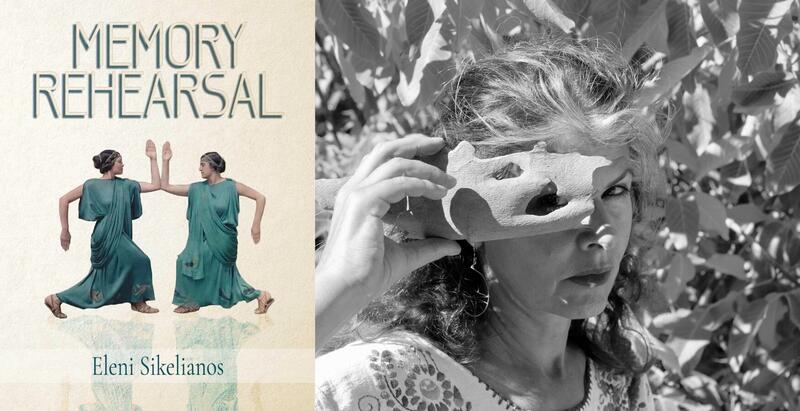
Today’s guest is writer, poet and translator Eleni Sikelianos. We discuss her hybrid-genre, ancestral memoir Memory Rehearsal, a work that moves between poetry and prose, image and text, human and animal, history and mythology, and perhaps most of all tells the story of a poet’s self-discovery, finding her voice within a dual poetic lineage, within a chorus of remarkable voices, past and present. As Anne Waldman says: “Sikelianos’s voyage is a spiritual quest to untangle a history that only she and only poetry can accomplish. It is a meditation on gender, place, and reclamation, a struggle for a whole vision and version for the writer of her own self and purpose. The genius of this pursuit is staggering. . . .The intricate weaving and array of image and language to get there leaves me breathless. There is nothing like it that I have seen.”
For the bonus audio archive Eleni contributes an electrifying reading from book one of H.D.’s Trilogy, called “The Walls Do Not Fall.” This joins many unforgettable contributions, whether Lisa Robertson reading her translation of the long Baudelaire poem “Hags,” Jorie Graham reading Robert Creeley, Jen Bervin reading Paul Celan, a late night whispered reading by Bhanu Kapil from her writing journal, and much more. To find out how to subscribe to the bonus audio, and about all the other potential benefits and rewards of joining the Between the Covers community as a listener-supporter, head over to the show’s Patreon page.
Finally here is the BookShop for today’s conversation.
[Author photo by Laird Hunt]
Transcript
David Naimon: Today's episode is brought to you by Water in the Desert: A Pilgrimage by acclaimed agrarian activist and ethnobotanist Gary Paul Nabhan. Celebrated as "a world visionary" by Utne Reader and "a lyrical poet of biodiversity" by Mother Jones, Gary Paul Nabhan has authored dozens of books and been awarded a MacArthur Genius Grant. Water in the Desert is a profoundly inspiring account of interspecies belonging, collaborative conservation, and the sacred work of caring for the earth. He traces his childhood growing up as a Lebanese-American boy in the dunes along Lake Michigan's southern shore to his interest in earth-based spiritual practices that led him to take vows as an ecumenical monk. "A refreshing account of kinship with other species, Water in the Desert brings science to the service of land and culture, showing up what it looks like to reciprocate the gifts of nature with gifts of head, hands, and heart," writes Robin Wall Kimmerer, author of Braiding Sweetgrass. Water in the Desert is now available at milkweed.org. Today's conversation with Eleni Sikelianos is kind of a dream scenario for Between the Covers, as we use her hybrid-genre family memoir as a portal into a conversation about poetry, about two very different poetic lineages, a conversation about archives, history, mythology, non-human intelligence, leaf blowers, quesadillas, naked great-grandparents, and more. For the Bonus Archive, Eleni performs an electrifying extended reading from Book One of H.D.'s trilogy called The Walls Do Not Fall, one that is so mesmerizing that I instantly became not only an H.D. convert but a person wondering why I haven't been reading her all this time. It joins many incredible readings in the archive, whether Lisa Robertson reading her translation of Hags, the long poem by Baudelaire, Jorie Graham reading Robert Creeley and Edward Thomas, Alice Oswald reading from the Book of Job, Danez Smith giving us poetry prompts, or Jeannie Vanasco's craft talk, "How to Write Memorable Lines." You can find out how to subscribe to the Bonus Audio and about all the many other possible benefits and rewards of joining the Between the Covers community as a listener-supporter, whether the Milkweed Early Reader Program or rare collectibles from past guests, at patreon.com/betweenthecovers. Now for today's episode with Eleni Sikelianos.
[Music]
David Naimon: Good morning, and welcome to Between the Covers. I'm David Naimon, your host. Today's guest, poet, writer, and translator Eleni Sikelianos, is a graduate of the Jack Kerouac School of Disembodied Poetics at Naropa University, studying under the likes of Allen Ginsberg, Amiri Baraka, Bernadette Mayer, Alice Notley, and Diane di Prima. In the '90s, she was a poet-in-residence at two homeless shelters in San Francisco, taught at the Teachers and Writers Collaborative, founded in New York City by writers and educators including Grace Paley, Muriel Rukeyser, and June Jordan, and co-ran the Wednesday night readings at St. Mark's Poetry Project. She has taught at the University of Denver, where she founded and ran their Writers in the Schools program, and is currently a professor of literary arts at Brown University. Sikelianos is the author of 10 books of poetry, most recently Your Kingdom, of which past Between the Covers guest Layli Long Soldier says, "I am utterly awed by Eleni Sikelianos’s Your Kingdom. These poems spread their mammoth wings across a singing, rhythmic soundscape of language and into a layered timescape of evolution, wherein ‘each you is a metaphor for us,’ and us = human, plant, animal, earth / land / its waters, and even the stars as relatives. This is a celebration of our forever-connectivity, our collective beauty, strangeness, messiness, vibrant color, morphing, and seemingly infinite names. Thank you, Eleni, for this book—inside which I have never felt more present in the story of this world." Her translations from French include Jacques Roubaud's Exchanges on Light and Sabine Macher's The L Notebook. She is a frequent collaborator across disciplines, whether with visual artist Mel Chin or musician Philip Glass. Eleni Sikelianos is here today to talk about the third book in her triptych of hybrid and genre-defiant memoirs. The first was 2004's The Book of Jon, of which Andrew Ervin for The Washington Post said, “Eleni Sikelianos is no ordinary memoirist. She is first and foremost a poet, and it's the precision and thoughtfulness of her language that draws us in. In it she explores her troubled love for her father in a series of short chapters that incorporate observations, rants, dreams, letters, a family tree, photographs, poetry.” The second is 2014's You Animal Machine about her five-times-married burlesque dancer grandmother, Melena, the "hardest-assed woman to ever eat wood and bite nails." Past Between the Covers guest Maggie Nelson says of it, “In an age when ‘research’ summons the banality of search engines, Eleni Sikelianos blessedly reaches into the birth-hole, the warming dirt, the wrong side of magic, and brings forth dark whorls of language, imagination, and history. No matter how one summarizes its scope or achievement, You Animal Machine (The Golden Greek) will surpass it, with its too much mother-static, its fundamental wildness.” Eleni is here today to talk about her latest hybrid familial ancestral excavation, 20 years in the making, Memory Rehearsal, out with City Lights Books. Phoebe Giannisi says of it, "Singing at her loom like the sorceress Circe, Eleni Sikelianos weaves a spellbinding work that claims the living ghost of her poetic lineage, flowing full of her own spirit and reaching back to its source in her mythical great-grandmother, Eva Palmer Sikelianos, and the radical revival of the Delphic festivals of 1927-30. With a warp of language and a weft of memory, myth, human, animal, image, and history, this book is a magnificent, shimmering garment: polyphonic, sensorial, a sacred stitching of personal inheritance and historic past in a fiercely contemporary act." Finally, Anne Waldman declares, "An extraordinarily beautiful and complex poet's feat of hyperthymesia, where superior autobiographical memory is transcendent and interwoven with passionately researched documentation. What is the desire that pushes the psyche, and this particular major poet, on this enormous and endless task of devotion, poetry, telepathy and love? Sikelianos's voyage is a spiritual quest to untangle a history that only she and only poetry can accomplish. It is a meditation on gender, place, and reclamation, a struggle for a whole vision and version for the writer of her own self and purpose. The genius of this pursuit is staggering. . . .The intricate weaving and array of image and language to get there leaves me breathless. There is nothing like it that I have seen." Welcome to Between the Covers, Eleni Sikelianos.
Eleni Sikelianos: Thank you so much, David. Thank you for that beautiful introduction. I feel very held.
DN: [laughter] Well, I want to spend the beginning of our time together outside of the book, establishing a shared understanding between us and the listeners that, in a way, I think will be the inverse of your book and spirit. What I mean is one way I think of this three-book project is as shadow work. I'll be curious if you think of it in the same way. Shadow in the sense that you're shadowing the life of an ancestor, but even more so shadow work in the sense that you're doing recovery work within the shadow of a person casting the shadow, the person brightly illuminated by the world, who you don't center in the three works: The Book of Jon, beginning in the darkest place, the overdose death of your father, who was homeless and a drug addict; You Animal Machine, dealing with misfits and outsiders. But in the new book in particular, there's a way that the solar figure, your great-grandfather, Angelos Sikelianos, is always implied or at the edges, even when you're doing this more, what I would call lunar work, not only because he's the husband of your subject in Memory Rehearsal, your great-grandmother, Eva Palmer, but also because he didn't credit her as a peer and partner in what made them both famous and remarkable together. So I want to spend a moment establishing the solar presence that, in your work, is not at the center. At one point late in the book, you say, "Some humans are like rays of the sun, drawing those around them to their vigor." When Eva first encounters Angelos on his island, he claims to live off only honey. Later, you characterize him as a man of huge appetite. When a woman is watching him devouring a roasted chicken, he tells her, "Don't worry, whatever I eat turns into spirit." His first book of poetry has an untranslatable title but could be imperfectly translated as Man Without Shadow. So I was hoping we could start with you introducing us to your great-grandfather, not as a family member would, but how a Greek person might today, especially given how you recount what happens when people learn you are his relative: how priests there want to shake your hand, how gynecologists have wanted their photos taken with you. I'd have to say, I hope you changed your gynecologist after that. [laughter] About a guard who weeps at learning who you are, about people gifting you fresh eggs from their chickens, grapes from their vineyards, gifting you books they've written about your family, how the rays of his life really have warmed the lives of many others.
ES: Yeah, thank you so much for that question, David. I love thinking about this as the solar work and the lunar work and working in the shadow. That makes so much sense. I was thinking a lot about shadows when I was writing this book, and other books too. One of the images I had that was so important in writing The Book of Jon was going on a hike and seeing where my living foot and my shadow foot touched and thinking of the shadow cast by the body as a kind of door that opens up into all kinds of histories and ghosts and to death, of course, too. I was also thinking in this book about the Karagiozis figures, the Greek shadow puppets, and the actual figure versus the shadow it casts. In fact, there was a whole shadow play that was included in the book and in the manuscript initially that I needed to give better shape to things. So I love thinking about things that way. So Angelos is just—he's such a beloved figure. To the degree that when my husband is with me in Greece, he just walks away when people start talking about Angelos. [laughter] It's like, "Okay, I've had my Sikelianos dose." I guess because the way I first received knowledge of him was through his son, my grandfather, Glafkos, who felt very disconnected from his father. He would never have put it this way, but ignored by his father, invisible to his father. So I had that impression of him initially. Then I also had this Selected Poems that Princeton put out in our bathroom in my mom's apartment. So when I first went to Greece and started hearing, people were so enamored of this person. I think his poetry, it's ecstatic. He thought of himself as a visionary, and others thought of him that way. He had this completely over-the-top idea that he could bring about world peace through art. One of the other things that he did that is so important to Greeks is that during the Nazi occupation, when there weren't supposed to be public gatherings, he stood up at the funeral of the poet Kostis Palamas and read a poem that is very clearly an anti-occupation, anti-Nazi poem. That became a really important moment for the Greeks. So he's a political figure as well as a poetic figure. People would devote their lives to him. There are still people like this who are so unbelievably devoted to this poet. The former mayor of Delphi, who I mention in the book, Panos, his whole life is devoted to reviving the Delphic Festival.
DN: Wow.
ES: I think often their versions of him were almost like a cult of Sikelianos. I mean, he was like a Dionysian figure for them, but also Apollonian as well. But he seemed to inspire the devotion that a god might, actually. But then there were also people, and I mention this in passing in the book, who felt, "This guy is so overblown. He's a bag of wind." I think the way that his work has been translated into English, or the work that has been translated, it's a little harder for us to grasp the greatness of his poetry. There was a moment when he was very out of fashion because he was a poet writing in the modernist moment, and his work is not very modernist. It's very romantic in a lot of ways. He's often compared to Yeats and Whitman also. But there's a revival of interest in his work at the moment among young poets, which is really exciting. I think people are understanding him actually also as an eco-poet, an anticipatory eco-poet. Also, I think I began to realize through all this research, the fact that Eva was lesbian came to light much later in our family knowledge and also in archival knowledge for various reasons. But I began to think that there's certainly something queer in his approach, his living as well. There's not the same kind of archival evidence for that as a way of life, but it's certainly in the work.
DN: Well, the shared passion that united him and your subject, Eva Palmer, was their mutual desire to revive the ancient Pythian Games at Delphi. Memory Rehearsal, I think, quite wonderfully goes into the modern Delphic Festivals that they improbably conjured into being in the 1920s. But being curious to know more about the original Pythian Games that they echoed, I did a little exploration on my own: that they were considered second to the Olympic Games in importance, that they occurred every four years for a span of a thousand years from 600 BC to 400 AD, and which were related to the establishment of the Oracle of Delphi by Apollo, the god of the sun, after he slayed Python, the great serpent guarding the navel of the earth. The games either, depending upon the story you choose, celebrated Apollo's victory over Python or were his penance to Zeus because the slaying was considered a crime. Either way, unlike the Olympics, these competitions were largely in the arts and performing arts, with sports only being added later. Also unlike the Olympics and the other major recurring sporting festivals, women were allowed to participate. One of the great pleasures of Memory Rehearsal is engaging with the modern Delphic Festivals of your ancestors. This is really going to be a three-part question for you. The first would be to ask you to introduce us further to the festivals that they put on. The second is Angelos said that the motivation to return to this ancient rite and revive it, as you've alluded to, was on behalf of world peace, which begs the question, "What was his diagnosis of the Greece of his time that it needed a sort of radical correction in this way?" And lastly, even though world peace did not happen as he imagined, you've often said in interviews what he and Eva did change the course of modern Greece and its conception of itself nonetheless. I'd love to hear about that.
ES: Yeah, it's a little bit mysterious in certain ways what it was they felt they were reviving, except the part that is not mysterious is the gathering together of unlike people, people from across class, across station in life, and ideally across nations, to experience art. For both of them, I think the height of art was poetry, and that was manifested in drama. So reviving this ancient Greek ritual of coming together and watching a play together and having that catharsis, that was really the central piece. Where my mind usually focuses is on the production of Prometheus Bound in the first festival. It was produced again in the second festival, but The Suppliants was also produced. So, yeah, this notion of bringing people together across differences of belief, of political ideology, and witnessing this work of art together was really key. When I think about what they accomplished, I'm really amazed at exactly how many different kinds of people they brought together. Not so much, yes, in the audience, but also in the making of the thing—that villagers participated, that the military participated, that the intellectuals, the daughters of the Athenian bourgeoisie, that all of these people came together and did this work together and experienced it together is pretty astounding. It's hard to imagine something like that happening today. Then the other pieces: there was a day devoted to athletic games, and that's especially where she had the military engaged. One of the generals agreed to help by supplying her with boys from the military. Since military duty was obligatory, there were boys to be had. But that's also wild. There's actually footage of the athletic games. It's just wild to see these basically kids in the army throwing the discus in these little loincloths over their genitals and their butts basically bare. It's just amazing. Can you imagine that? [laughter]
DN: Yeah, we should say that the bringing together, even for the play, we're also bringing people together as if they were coming together 1,500 years ago as well, right? So people are dressed in the imagined period costumes of that era. It's not just reenacting coming together for an ancient play, but also imagining it happening in an ancient way.
ES: Absolutely. Although Eva says that she's not trying to be archaeologically correct, she's trying to feel her way through it, but she was also pretty faithful to the past. The audience wasn't necessarily dressed in ancient dress, but she certainly was basically for the rest of her life. Then the other piece that was really important was the folk craft piece. They gathered all the artisans that they could who knew how to weave, how to metalsmith, how to leatherwork. There was a crafts fair. That became one of the ways, just casting forward into the next part of your question, this work changed the course of modern history is this attention to artisanal work in Greece that was already falling out. This is one of Eva's great visions and battles, to preserve handicrafts, things made by hand. She was resisting what she called "machine mind." So now, for example, there's a Folk Art Museum in Plaka that her collaborator, who worked on the folk arts piece with her—it's in her house. There's an attention to folk arts. So this was one of the moments when people started to look at what Greeks made with their hands and to value it. The other piece in terms of how modern Greek culture has been affected is that that was the first time the ancient theater at Delphi was used for a public performance. There had been a play produced in the ancient theater, but not for the public. So this notion that the ancient places could be sites for contemporary productions, that became the Epidaurus Festival, as we say in English, came out of that, really, that notion that we could go back to those sites and still be using them. And the other part of your question was?
DN: The hope for world peace and maybe the subtext of that, what was going on in his mind around the trajectory of Greece and Europe at the time.
ES: Yeah. Actually, you know what? I just realized I want to add something to that last question a little bit, and then I'll come back to that. I think the ways that the festivals have influenced or impacted modern Greek culture are probably immeasurable, but one of them is also thinking of the poem as a site of resistance to, say, the junta or whatever it is, I don't think we could only attribute that to what they were doing and Angelos' work, but that became such a part of Greek culture's relationship with poetry, composers like Mikis Theodorakis using poems for musical compositions that were songs of resistance. I mean, all kinds of ways, too. I think a lot of people in Greece are starting to look to Eva and think about her work and think about women's labor. Also, I think there's thought recently in thinking about it as one of the first site-specific artworks. So it still is unfolding, actually, in the ways that it's impacted Greek culture. Then, coming to what in the Greek nation might have led Angelos to be worrying about this, I think a number of things. One is, I think, the known, the very known history of Ottoman rule that hadn't been shaken off that long before, but actually the contemporary moment when what Eva later called the imperious, the venomous imperious triangle of Western rule and Western Europe taking Greece for its own uses, with no interest in modern Greeks but a lot of interest in ancient Greeks. But the ancient Greeks—I think the Germans and the French, who were some of the first archaeologists, and the Brits, some of the first archaeologists, really thought of the Greek past as belonging to them. Modern Greeks were subalterns who couldn't even run their own archaeological sites. So there was that. So there is a bit of nationalism, for sure. But I think it's a nationalism that is very different from what we might experience in the U.S. Also, World War I had just happened. So there was that as well. Yeah.
DN: One thing I did in preparing for today was to learn more about the Oracle at Delphi, which was a lot of fun. One story is that Zeus sent two eagles in different directions to find the center of the world, and they collided there. An alternate story is that Apollo was wandering in search of a mountain for his oracle until he found this site. In terms of setting this within time, and particularly within literary time, Homer's work is coming together at the same time, crystallizing into an epic, when Delphi is becoming an international pilgrimage site. I say "international" because you see inscriptions of the answers that the oracle gave to pilgrims at sites that are thousands of miles away from it, in Central Asia, for instance, in modern Afghanistan. There were only a few days a year that you could visit the oracle, and you had to bring gifts, so it wasn't accessible to the poor, who would be shunted into more indirect ways of receiving oracular messages nearby, indirect readings through leaves or an animal's liver or the activity of birds. But what was compelling about Delphi is that it wasn't indirect, but direct communication with a god, or nearly so, as there were women called Pythia, named after the slain serpent, who served as a vessel for this direct message from a deity. This was actually apparently quite rare among ancient oracles, too, that a female conduit would be the vessel for a male god. But one story would be that one of these Pythia, never known by their own names, would stand over a volcanic cleft in the earth, and the earth's gas, which was the breath of Apollo, would enter her vaginal canal and then come out through her mouth because, at the time, apparently, there was a belief there was actually a passage or a tube between these two openings. All of this is meant to serve as a preface to spend a moment, as your book does, with the question of why the message is delivered to us as verse, as poetry. This feels like an interesting question in the abstract, but even more so because you're a poet from a storied poetic lineage yourself, and that lineage is reviving a celebration of the founding of this oracle, one that reaches beyond the veil and returns to us with poetry.
ES: Yeah. Yeah, that is such a good question. I want to say that I place the oracle pre-Apollo. The earliest oracle is actually Gaia, which is Earth. So just to say that. Apollo's kind of a takeover god. But why verse? This is something, as you know, in the book, I ask a couple of people and a couple of poets. My friend Monika Rinck, a German poet, says, "Because it keeps things open-ended." You know, the oracle's responses are famous for that, for being open-ended. As she says, I think to Croesus, "A great nation will be ruined if you go to war." But of course she means his own nation. Yeah, I mean, I think that it's also maybe... I think we could think about it in the way that the language of narrative doesn't hold simultaneity for us, or it doesn't hold the circularity or the simultaneity of time in the way that poetry does. I think, for me, that's so often what poetry is attempting to do or doing, even just the line break. There's that beautiful Agamben essay about the end of every line falling into eternity, in that moment where you're suspended from language and the temporal unfolding of language. So we could think about it that way, that by answering in verse, you're allowing the simultaneity of time to occur. I guess you're also hedging your bets, right? Because if you're wrong, if your answer is wrong, which she frequently was, then, "Well, you misinterpreted the poem." [laughs] But as you and I know, that's what poems are for, is for being misinterpreted or for disorienting us in fruitful ways.
DN: Well, maybe just as an aside, I'm curious if you think that oracular is an element of your own poetics.
ES: You know, even though I would be embarrassed to say yes, I do say yes. [laughter]
DN: You do say yes.
ES: Embarrassingly, yes. Yeah, I do. Because, I mean, when I think about the poets who've been so important to me, the oracular is important to them. Maybe it can be oracular with a lowercase "o." But even in the way that dreams are oracular, and dreams are so important to me as a poet and to many of the poets whose work I really love. I think also because poetry is always, where it's richest for me, reaching beyond what we know and beyond how we can say what we know. So that it really is the oracular. I mean, I think that's why we go to the oracle, is because we don't know, right? Yeah, poetry is a really rich site for not knowing.
DN: Yeah, I love that. Well, I could imagine Angelos imagining himself as the sun god Apollo and Eva as one of the nameless Pythia, a vessel for his breath. But Eva was a wealthy American heiress who spent a large part of her fortune bringing the Delphic Festivals back to life 1,500 years after they were last performed. But she was not merely the financier of another's artistic dream. She herself was an incredible, dynamic artistic visionary in her own right. You were part of a movement of people now doing this work of bringing her back to a position and positioning that she merits on her own terms. She's so multifaceted that it's unfair to ask you to introduce her in a comprehensive way. You describe her in the book at one point as "the wild lesbian orchestrating sex parties, the muse, the pseudo-Sappho, the obsessive theater director, the Delphic reviver, the loving but distracted mother, the blacklisted artist, the money loser, the broke old woman with no place to live." One of the laugh-out-loud moments in the book is you're sharing some of Eva's lesbian nude photos, and you caption one of them, "My great-grandmother's ass." [laughter] But introduce us a little bit to your great-grandmother, whether front or back, in the light or in the shadow. [laughter] Just some material that we can begin to understand her with. You don't have to try to encapsulate everything about this figure yet.
ES: Yeah. Actually, David, I love that you call the "My great-grandmother's ass" photo to her attention because there's another one of her ass in the book. Then I realized there are frontal nude photos, but none of them are her. The nude photos are only of her ass, which is telling in terms of how we perceive her in history, that she was always facing the other way. She was actually facing the theater, doing all the work. We don't see her frontally very easily, very readily. There's so much to say about her. As you say, she's so multifaceted. It's really hard even to hold in my mind, after 25 years of thinking about her and researching her, everything that she did in my mind. I guess one thing to say is that she really was the one who did all the work for the festivals, just the nuts-and-bolts work, the whole production. She started by learning how to weave when she first went to Lefkada, the island my great-grandfather was from, that Angelos was from, and she learned to weave from the old women in the villages there, and how to gather herbs and flowers to dye the wool and the linen and so forth. She was already obsessed with drape because she had been with Natalie Barney creating these backyard performances, Natalie Barney's play Équivoque, where she reimagines Sappho not in love at all with the man that the Victorian poets claimed she was in love with, but instead in love with a woman named Timas, a member of her circle. So Eva was already trying to make costumes that draped, and she was teaching herself to weave, looking at vases in the Louvre to try to get the right weave, to get the warp and the weft right. So that obsessive quality then led to her trying to figure out how to make the costumes with the proper drape. She drew hundreds upon hundreds of images of these vase paintings. She taught herself Byzantine music. She got a teacher as well. She became supposedly the first woman to be a master of Byzantine church music. She was trying to write music for the plays as well. She studied the moves on the vases so that she had what has been called the mythic pose that is throughout the dances as well, the choreography of the play. What else did she do? Her obsessiveness is unbelievable. During the day she would train the chorus girls, and at night she would weave the costumes. It took her a while to realize that she would need somebody else to weave, so then she taught others to weave. So that's one little piece. Earlier, she taught herself ancient Greek because she wanted to read Sappho. She was thinking about Sappho, as many lesbian women did in that era, as this possibility from the past that could pose a present for them to exist in.
DN: Well, one of the upsides of putting aside two and a half hours for these conversations is the opportunity to spend a good amount of time, sometimes even the first hour, exploring the context behind the book or the terms of the book from the outside, so that when we talk about the book itself, we're already in a little bit of a deeper place. I feel like maybe now we've arrived at the beginning of talking about Memory Rehearsal as a book and you as a writer. As a first step, I was hoping we could hear two different ways, among many ways, that Eva appears in the book. The first is called "Eva Dreams She Is a Man and Gets Everything Done," which I think is a good example of the interplay of archive and memory. The second is a primary text written by her, a letter to her lover, Natalie Barney, telling her why she is leaving her for the Greek sun god. [laughter] So this would be 189 and 114.
ES: Okay, yeah. I guess I'll start with 189. I guess I don't need to do too much introduction, but she does describe this dream in what people call an autobiography, what Artemis Leontis, the scholar who wrote a wonderful book about Eva, calls more of an attempt to raise money for a third Delphic Festival, that that's why she wrote this book. [laughs] But anyway, yeah. What I decided to do—I was so struck by this moment in the book, not the first time I read it but the second time I read it, because it's the only moment where she reveals her queerness. Otherwise, by the time she's gotten to Greece, it's a very hidden thing. She was very out in Paris, but not in Greece, that she actually dreams she's a man.
[Eleni Sikelianos reads from Memory Rehearsal]
ES: You know what? I have to tell you that I dreamt last night that I was in a crowded room with Donald Trump.
DN: Was it a nightmare?
ES: You know, weirdly, he was horrible, but not as effectively evil as he is in the world. I was telling him, I was saying, "We have to teach poetry to children. You don't understand. We have to teach poetry to children." Then he patted me on the butt. Then I started screaming over the crowd, "Stop patting me on the bottom!" and repeating that, and got a couple thumbs-up from women. I was saying, "Yeah, but did you get it on tape?" [laughter] And that was the end of the dream.
DN: Oh my God.
ES: Yeah. It seemed related to that dream. Then when I woke up, knowing that we were going to do this today, I was thinking about that because I don't maybe make this... It's a subtext, obviously, what women get to do, or the precarity of women in general. Okay. Tell me the other page.
DN: 114.
ES: I just did so many readings, but these are not two pages I read.
DN: Good.
ES: Yeah. Oh, yeah. This one is actually pretty verbatim. A couple of the letters are invented entirely, but not this one.
DN: Oh, really? You invented letters that she wrote?
ES: Yes, I did.
DN: So this is a real letter to Natalie from 1907?
ES: It is. Yeah.
[Eleni Sikelianos reads from Memory Rehearsal]
DN: We've been listening to Eleni Sikelianos read from Memory Rehearsal. One thing that I think speaks to the lie that Eva wasn't an equal partner in the Delphic Festival revivals, and speaks to their deep shared connection around the desire for a utopian restoration of Greece, are her other utopian impulses that you've alluded to. For one, as you mentioned, her interest with Natalie, who she's addressing in that letter you just read, in establishing a utopic lesbian colony. But also the utopian impulse behind her development of an instrument named after her called the Evian Panharmonium. You've touched on that just now a little bit, and the book touches on it briefly. But I mainly learned about it on Matt Marble's music podcast called Secret Sounds, and also a really great episode of the podcast What'sHerName, which relates that with the collapse of the Ottoman Empire and the huge influx of refugees from the war with Turkey, and then with the Greek Civil War, Eva believed that Greece had become too colonized by Western contemporary influences. That's what's motivating her to study Greek ecclesiastical music. She's noting how the complexity of Greek music can't be captured by contemporary notation, that to capture the true nature of this Greek music required learning Byzantine musical notation, which she did. Then she creates a Byzantine organ with a more ancient scale of music that includes quarter tones. She does this thinking that by restoring these lost sounds, it would bring peace to the country. Instead, not only did peace not come despite her proclamations about the arrival of this instrument named after her, unlike the later Delphic Festivals, no one really pays attention to the arrival of this instrument, and it never gains any traction and disappears. When I think of the shared, extreme, totalizing impulse of Eva and Angelos, this desire to shift the trajectory of nations and peoples by skipping over whole epochs and reviving a romanticized version of the distant past, I can't think of anything more distant from your own poetics as a writer. Perhaps as one way of beginning to talk about your sensibilities is to talk about another lineage of yours, one you situate yourself within as a writer, but also one that, uncannily, is also a familial lineage. Your own website says, "Born into a family of tree workers, bohemians, poets, ne'er-do-wells, visionaries, and smalltime sort-of hustlers, Eleni Sikelianos is a poet, writer, collaborator, and 'master of mixing genres.' As a student of the poets of Naropa, she is a lineage-holder in the Outrider poetics family tree." I don't know what Outrider Poetics is, other than knowing it was coined by Anne Waldman, who co-founded the Jack Kerouac School of Disembodied Poetics with Allen Ginsberg in the '70s at Naropa, the school you studied at and now sometimes teach at, and also that Anne happens to be your aunt. This other lineage, the Naropa Outrider tradition, what does it mean to be in this tradition for you to place yourself in this family tree? And what makes a poetics an Outrider poetics?
ES: Yeah. You know, I feel like we should practically call Anne and ask her because I think "Outrider" comes from another poet. Maybe it might come from Creeley or Olson. I can't remember right now.
DN: Well, what does it mean for you? I would say, since you're placing yourself within it.
ES: Yeah, absolutely. David, I'm just going to first actually talk for a minute about the panharmonium because it was such a crazy thing. Also, your attention to Eva having these other utopian impulses pre-Angelos, which I think is really accurate and important. Just to say that her other impulse for building the panharmonium was her lover, Khurshed Naoroji, an Indian student of music who went to Paris to study music and who came to Greece with Eva. They together became obsessed with this notion of the microtones also in ancient and contemporary Indian music. So they were going to found a music school. That was part of the purpose of that panharmonium. So it wasn't just the instrument, but also the school that somehow also was a pipe dream but had maybe some, what seemed to them, like practicality. Khurshed later joined Gandhi's ashram that was weaving khadi cloth, the important anti-colonial gesture of weaving your own cotton. Eva was very aware of that and wanted that cloth for Prometheus to wear.
DN: Wow. I love that.
ES: Yeah, I know. I love that little bit of history that I didn't bring forward maybe as fully as I could in the text. I couldn't quite find the way to do it, but it's a really incredible history. She writes Khurshed and asks her to send some of the khadi cloth for Prometheus to wear. And you know what? Actually, these lineages are connected in that Anne's mother, Frances, married my grandfather, Glafkos, and moved to Greece with him. She participated in the second Delphic Festival. She made some of the masks. So I actually always think of Anne and this utopian vision that is Naropa as being influenced by the Delphic Festivals, even if it was somewhat indirectly because of Frances's involvement with them. But yeah, the Outrider, that's a good question. There's a beautiful film called Outrider that Alystyre Julian worked on for probably a decade that was released, I think, about a year ago. It's a pretty broad tree, I would say. That's part of why I feel comfortable being in it. The Jack Kerouac School was a place where people talked about transmission all the time in a Buddhist sense because it is a Buddhist school, though you didn't have to be a Buddhist to go there or teach there, which I was not. But there's this notion of transmission, and not only in Buddhist practice but also from elder poet to younger poet. But it wasn't in any way that was interested at all in craft. It was really interested in, "How are you a poet in the world, and how are you responding to the world, also affecting change in the world? How are you speaking to the world?" So poets like Allen Ginsberg, who was one of my teachers, Amiri Baraka, who I spent quite a bit of time with, Diane di Prima, who I had an amazing Keats and Shelley class with, also Susan Howe was my teacher briefly, and then two poets who became so important to me, Alice Notley and Bernadette Mayer. So it was pretty broad. I mean, there were poets from the New York School, the second-generation New York School, from the Beats, all kinds of different poets, poets from the Language school coming together. I think what I would say is maybe we could call it a non-denominational poetics, that it's pretty broad and open-minded, even if maybe some trajectories that it holds are less so. But that there's a sense of the wildness of language and also language's communication with a broader world, not just with the self.
DN: Well, I grew up in Boulder.
ES: You did? What?
DN: Well, I just want to bring up some memories and see, because I grew up in the '70s and '80s in Boulder, and I left for Portland in 1993. So I was there, I think, when you were a student at Naropa.
ES: Wait, what year did you leave?
DN: '93.
ES: Oh, yeah, you were.
DN: Perhaps you remember some of the things I remember from Naropa, unless they happened just before you arrived. I'm not sure. But for one, I remember going to a Naropa reading of poets brought from Nicaragua under the Sandinistas during the Contra War in the '80s that Ginsberg brought and introduced. I also remember when the psychiatrist R. D. Laing, the author of "The Divided Self" and "Sanity, Madness and the Family," was visiting faculty, probably, I'm guessing, also in the late '80s. I remember him and Allen Ginsberg doing this amazing piano duet together where Allen would sing a ditty about what student he wanted to fuck. [laughter] R. D. Laing would then sing a psychoanalysis of it.
ES: Oh my God. [laughter]
DN: Something like that. I mean, this is all filtered through decades of memory. Yeah, I just wondered if that brought up any of your own memories from your time there too.
ES: Yeah. By the way, you may know that it's the centennial of Allen's birth this year. So I just participated in an event in San Francisco with the Kronos Quartet and others that was really fun. I don't remember the R. D. Laing event, but I'm not surprised. I don't know if we want to go there, but there always is that question. I think there was a lot of room for, I guess, what the Buddhist teacher who asked Allen and Anne to found that school would call crazy wisdom. But yeah, there was a lot of room for what we would now call bad behavior. That's a question for me, an ongoing question. Because I feel like we've come to a place where everything is normcore, and there's this, I think it's fair to say, bourgeoisification of the poetry world. But I think it's also because we do need to set certain boundaries of behavior. But then when those boundaries become really rigid, what does that mean about where we are? Because it feels like it's completely related to capitalism too.
DN: I totally agree. I had a guest on, the Sri Lankan writer Vajra Chandrasekera, who grew up as a Sri Lankan Buddhist. He is writing books critiquing Sri Lankan Buddhists' self-regard around itself while it commits genocide, the way it uses a reinforcing hermetic logic to never see itself in a way that's examining the self. I brought up in that conversation quite a bit the dark side of Naropa's crazy wisdom, which is still playing out largely in Nova Scotia today with Pema Chödrön and the third lineage holder after Trungpa. But I'm not saying that to argue against what you're saying, because I do think there's something important or valuable in that feral, wild energy. Yet there's also a legacy that's still unfolding that is one of the lineage-holder transmission that is—
ES: Of harm.
DN: Of harm, yes.
ES: Yeah, yeah, absolutely. I always feel grateful that Trungpa died before I got there because that would have been very upsetting to me. Also, as somebody who survived quite a bit of trauma in various ways as a child. I argued with Allen publicly a few times. Also, he was very male-oriented. I mean, Allen was always very focused on male poets. So I don't know how many times I got up to the mic and said, "What about women poets?" And he would say, "Oh, well, Emily Dickinson was okay." Although he loved Akhmatova. Let's give him Akhmatova too. [laughter] But yeah, there were so many limitations to the world being presented. I didn't go there as a Beat head at all. I only went there because I didn't know of anything else, actually. But of course, it makes sense that I went there too, in terms of the world I was coming out of in a lot of ways. But yeah, I do know about the abuses. Also, I can't remember which, what do you call the people that Trungpa tapped to be his...
DN: I think they might be lineage holders.
ES: Lineage holders. Okay. Yeah. One of the lineage holders spreading AIDS and so forth.
DN: Yeah, his successor.
ES: Yeah. Yeah.
DN: With the board knowing about it for three years.
ES: Yeah. Just completely hideous stuff. Truly. Yeah.
DN: But I don't want to derail. I don't want to derail.
ES: But it's important. I mean, yeah. [laughter] I guess just that line. At the same time, I feel like, "How do we navigate the ethics of this?" And also having an elasticity to whose or what behavior is accessible. I was diagnosed with ADHD as a 56-year-old or something. Even that, I feel like the term neurodivergent is really a way for us to come back into line or to behave in more productive ways. So, yeah, I don't know. It's like certain cases are very clear for me, and others are a little less cut-and-dried. How about you?
DN: Well, I think what that makes me think of is this mystery around language and naming, because naming can be really powerful and opening. Like if you get a diagnosis when someone's told you that you don't have a disease, sometimes getting the diagnosis, being recognized as "what's happening to me is real," is a liberating and expansive thing. Sometimes getting a diagnosis is flattening and a prison of sorts. Like Saul Williams, who was just on, saying words can be prisms or prisons. I think that's interesting. I don't know if that relates, but it relates to me, to the notion of neurodivergence, where someone with the Asperger's diagnosis, for instance, there are people who—and I talked with Matthew Zapruder about this when he was on for A Story of a Poem—that label can be really liberating or really limiting depending on the person and their own journey.
ES: Yeah. For me, actually, it was liberating in a lot of ways because it made me realize, because I dropped out of high school. I had a very hard time functioning, and I realized, "Oh, it wasn't just trauma. There was this brain configuration happening." There was another piece that you asked to that question.
DN: It wasn't really a question.
ES: Oh, the Sandinistas. Oh yeah, the Sandinistas. Yeah, that was such an incredible moment for me, like Daisy Zamora being there and seeing these poets who were really just so engaged politically too. Yeah, it was a really powerful moment. I think that Joe Richey had a big part in, and also another student had a big part in, helping organize that.
DN: All right. So after our little side journey... [laughs]
ES: Yes. Oh, wait, but I just have to say this is another... Now I know why you mentioned Colorado toads in your piece.
DN: Oh, in the Creature Needs piece.
ES: Yeah, because I thought, "Oh, he must have been to Colorado." [laughter]
DN: Okay, so that's a perfect segue that no one understands why you're bringing up Colorado toads. So I'm going to ask the next question. Eleni's Colorado toad comment is going to suddenly make sense to everyone. Okay, so as we learn in the first pages of Memory Rehearsal, by the time you were born, vast fortunes had been spent, all family belongings lost. Your father "drifted off into heroin and homelessness," and ultimately, he died of a drug overdose. You lived in Section 8 housing, on food stamps, and in trailers, panhandled, as did other relatives of yours. There was no expansive notion of these visionaries in your family other than, as you mentioned, a book of selected poems by your great-grandfather in the bathroom. This entering of the gap between them and you, this generative space and absence, this continuity and discontinuity, seems important to your writing and your poetics. As we explore your poetics a little more, or begin to explore them a little more, I'm going to hand off this question about your engagement with ancestors and archives to the poet Christopher Kondrich. Chris is co-editor of an anthology that we are both in called Creature Needs: Writers Respond to the Science of Animal Conservation, where we are both given a scientific study to write in relation to. All the authors in the book are given a study to then create art alongside. I wrote about boreal toads and green cutthroat trout. The study was the question, "These two endangered Colorado species, can they be introduced into the same lake and not interfere with each other's establishment there?" You wrote a piece called "Swift Foxes in Kansas Grasses, Five Fields," responding to a study called "Strategic Grassland Conservation for Swift Foxes in Multi-Use Landscapes." Chris's latest poetry collection, Tread Upon, is out this year from Copper Canyon, and Publishers Weekly said this about it: "The probing third offering from Kondrich speculates and ruminates on the state of the natural world: 'If neither side of a blade of grass faces you and both sides are its back, does it hear the wind coming? Does it know it is about to be tread upon without warning, without a trial?' The poet's voice, insistent and unsettled, yet eerily subdued, seems to pick up on the anxious soundtrack of the zeitgeist. The result is an intelligent and often surprising record of contemporary troubles." Here's a question for you from Chris.
Christopher Kondrich: Hi, Eleni. Congratulations on Memory Rehearsal, your gorgeous new book that explores ancestry, performance, and poiesis in surprising ways, and that represents the culmination of an extraordinary trilogy of hybrid works. Reading Memory Rehearsal, I was struck by the recurrence of weaving, how the book keeps coming back to gowns and looms, which got me thinking about the book itself and the work that the book is doing. It weaves together stories and documents, voices and letters, the real and the mythic, the archival and lived experience. And I wonder whether this is the work of elegy, whose acts of processing mourning are originally linked to weaving wreaths and burial shrouds, or perhaps the work of repair, which is a more future-oriented labor, a process that combines both making and unmaking. Thank you, Eleni, and thank you for the gift of this book.
ES: Thank you, Chris. Yeah, I don't think of this book as elegy per se, although I do think of other works of mine as elegy, and I definitely am following ghosts and listening to ghosts in this book. I've been thinking quite a bit about repair and what that means and what we can repair. When I was first doing reading about weaving, an article that really stuck with me was tracing weaving back to a communal act where the whole village—the cloth is made so that it can cover everyone in the village and that the threads connect everyone in the village. I realized that threads have been a motif in so many of these family histories, and fabric in different ways, and just that fabric does so many different things. It's so central, of course, to Eva's work and what she was trying to do with her resistance to machine mind. So, yeah, I guess I am thinking about the weaving of the material of language as well as the material she was weaving as an act of repair. But what is being repaired? Because I actually don't think history can be repaired, and I would love to be argued with about that, but I don't think it's possible. But I was thinking just recently that the future can be repaired, as bad as it looks, that it can be repaired. I guess the other thing about weaving is that, by nature, the very act of it brings things together into connection and reminds us that everything is connected. I would say I've been reading Eduardo Kohn's How Forests Think, which is just such a beautiful book. It's one of those books—maybe you have this experience too sometimes—where you read a book and it helps you realize what you've been doing or what you've been thinking in a more articulate or concrete way. But one of the things he talks about is that all thinking is maybe in relationship with other kinds of living things thinking. So the weaving is a little bit like that, I would say.
DN: Well, I have some questions I want to ask in the aura of Chris's question. But before I do, thinking of his mentioning of weaving, I was hoping we could hear a section called "Warp and Weft," where you approach your grandfather, Glafkos, in his trailer in California to glean more info about your lineage. Perhaps you could introduce us to it and read the section "Warp and Weft."
ES: Yeah, absolutely. I just actually visited my grandfather Glafkos' girlfriend. She's 95, who lived with him in this trailer that's mentioned. One of the things she told me is how much Glafkos loved hearing Eva's loom shuttle and the music of that. So I love that you asked me to read this today.
[Eleni Sikelianos reads from Memory Rehearsal]
DN: We've been listening to Eleni Sikelianos read from Memory Rehearsal. One reason I wanted you to read this is because this section drifts in and out quite unassumingly from prose to poetry and back again, from sentence to line to sentence again. You weave them together, much as this collection also weaves in quotes from other people throughout, or how it includes your translations of your great-grandfather's poetry, and is also chock-full of these amazing photographs from beginning to end. Which makes me want to hear about your notion of hybrid or indeterminate or chimeric work. If there's something about your own story that this is the form you choose for your three memoir projects, or if it's something else, perhaps something less connected to this story, more political or philosophical or aesthetic that we just encounter in this book.
ES: Yeah, I'm glad you asked that question. It's something I keep trying to think about and I have been trying to think about for decades, probably. I would say it's the form that chose me rather than me choosing it. I don't feel that I could write these stories, for lack of a better word, in any other way. Actually, one of the great essays that's useful for thinking through this thing is Fanny Howe's Bewilderment. Actually, in Eduardo Kohn's book too, he talks about the fruitfulness of confusion in communication. So I think applying what are standard narrative forms in this culture just would not make sense in any way to these stories. They're really disparate. I did have to go gathering to bring them all together in a lot of ways. When I was writing the book about my dad, I realized that I didn't want to impose line breaks on him, partly because I think the line break, when you're working with a line break, you're so clearly dealing with an individual consciousness, with someone's consciousness, and I didn't want to impose that on him. Also, just thinking about the very basic thing of the line being broken, and somebody whose life was already broken, I didn't want to further break it. Yet some of it could only be told in lineated fashion because something else happens with the line. I've come to think about these forms in a number of different ways. One of them early on was thinking about the intertidal zone. It came to me from reading Ed Ricketts' Between Pacific Tides. He was a collaborator of John Steinbeck's. He took that boat trip with Steinbeck to the Gulf of Mexico. [laughter] He's the first one who really wrote about these animals that live between tidal zones, that are sometimes submerged underwater and sometimes in the baking sun, and they have to work between those forms. So the form for me is really intertidal in that sense. It's a strange thing, and I'm so glad that you are able to tell that it's moving between sentence and line. Some people feel confused by that, but that's okay too. So that's one way, even the seams between forms as this intertidal possibility. But I'm always trying to make something living when I'm writing. When we look at the tapestry, coming back to weaving, the tapestry of life forms in a forest, or even in our own yards, there are so many different forms present, right? And so many possibilities for form, even in each species. So I think that they really are ways of trying to bring living things to the page and bringing their liveness, that they're not stuck in one form, as all living things are not stuck in one form. So those are some ways I've been thinking about it. It is political in the sense that I think that that narrative that we've come to accept as reality is actually a warping of reality. It feels like it can be linked to capitalist structures, that we can narrativize things in specific ways that aren't really accurate to experience or to life, to living things. Of course, the genre itself is a word that's linked to gender. So there's a feminist possibility in the hybrid.
DN: I'm definitely going to remember the intertidal genre. I love that. I love that as a notion. Thank you. Our next question for you from another is from two-time guest of the show, the poet and memoirist Matthew Zapruder. Both conversations with Matthew were unforgettable. The first was about his book Why Poetry, and the second about his own hybrid memoir, Story of a Poem. Here's what two past guests of the show say about Story of a Poem. Ada Limón, our recent U.S. Poet Laureate, says, "A document of not only how to make a poem, but how to live in a world where language often fails us." Doireann Ní Ghríofa, author of A Ghost in the Throat, says, "How fortunate, reader, that this book has found you. It found me too, and I spent days captivated by its pages, within which a whole life and a whole poem were slowly unfolding before me. Beating on every page is the heart of a father and the heart of a poet. Written with a bright, nimble clarity that lets deep complexity shine, this book is a glimmering candle in darkness." His most recent poetry collection is I Love Hearing Your Dreams, and the limited-edition poetry chapbook How to Continue. So here's a question for you from Matthew.
Matthew Zapruder: Hi, David. Hi, Eleni. Eleni, first of all, congratulations on your beautiful new book. It's wonderful. I had a question for you. I think of you as a writer who is so fascinated by and respectful of the limits of language. You find a border beyond which things cannot be said in your poetry and in your memoir form. The limit, delineating that limit and respecting what lies beyond it, feels very much part of your writerly impulse. I wonder if you would agree with that assessment, whether you find different sorts of borders in poetry and prose, or whether it's all the same type of limit, and what happens and what it feels like to be in each form and reach the limits of what can be said, and to transmit that to a reader. Congratulations again. I hope you're well. David, I hope you're well too."
ES: Oh, that's such a good question. You know, Matthew was just my interlocutor at City Lights.
DN: I watched it.
ES: Yeah. Oh, you did. He helped me think through some things. Yeah. He had wonderful observations. I'm reading his new book right now, which I'm loving. The two things, prose and poetry, do feel really different. I feel like they are doing really different things for me. I couldn't—I don't know that I could, and this is part of the limit that we get to—I don't know if I could actually name exactly what it is. But I think, coming back to that Agamben notion of what happens at the end of every line when you're in eternity and suddenly you're no longer in human temporality because you're no longer in human language, I think that's so important to what poetry does for me, where you're flying, basically. You're flying toward the stars in that moment and beyond. So that does something that the sentence doesn't. It can be a scary space at the end of every line. Agamben wonders then what happens at the end of the poem. In fact, that's the title of the essay, "The End of the Poem." Whereas prose—and writing The Book of Jon is the first book where I started really writing in sentences. Although when I first wanted to be a writer, when I was maybe seven, I didn't really think that there could be a living poet still. So I was writing prose. But I had to train myself how to write in the sentence form. I do think sometimes that certain consciousnesses are just more prone to writing poetry or ways of experiencing the world. I had to train myself to write in the sentence. It was liberating and frustrating both. I do think that writing in sentences has changed me as a poet pretty profoundly. There is more drive to gather meaning in the sentence. Of course, there are always writers of sentences who are going to defy that. But I think that's true. There's just this narrative that wants to accrue. So if you were trying to tell a story, it's the way. For me, that's where I go to tell a story, to get a piece of information into shape, even for myself. So, yeah, they do feel really different. It feels really important to me in each of these books, and sometimes in my poems too, to move between the two pretty fluidly. So there are these little nodes, little cellular nodules that the work moves between.
DN: It feels like the thing about eternity at the end of the line. I mean, maybe that's where the oracle's at the end of every line.
ES: Oh, absolutely. That is absolutely where she's sitting, [laughter] on the tripod with the smoke coming up into her vagina. [laughter]
DN: Every line. That's amazing.
ES: Yeah, I know. Yeah, and I love that the word "enthused" that we use so casually now is actually that the god is coming into your body.
DN: Oh, wow.
ES: Yeah. That's what's happening with the smoke. The theos, the god, is coming into your body.
DN: Wow. Well, I want to return in that spirit to flesh out more of Eva's incredible life. I think of the quote of hers that you've alluded to, that weaving is resistance to machine mind, and how she not only wove all her clothes, but the costumes of the performers in the festivals, that she wanted to have her own hands in contact with every element of what she needed to live. A total art. With the Delphic Festivals, she devised 285 poses for the dancers that were each corresponding to poses that were drawn on ancient Grecian urns. Each movement that they performed was wedded to a syllable from Aeschylus's language in the theater. She said, "I want each person to feel the words, the body of the word, and even the word's shadows." The colossal effort of the Delphic revival, as you've also spoken to, involved the Greek army as ancient soldiers and as Olympiad-like athletes. Her efforts and vision were epic, but they were also wildly extreme. For instance, that she went around wearing a toga that she wove and handmade sandals at all times. I mean, this was weird all over the world. In fact, it made the news when she would disembark in New York in a toga, or elsewhere. But I imagine it wasn't less weird in Greece. Perhaps it was even more weird in Greece, where people at the time were dressing in contemporary fashions following the lead of France. Perhaps it would feel the same way as if someone here in the U.S. were to dress for the rest of their life as a pilgrim off of the Mayflower and then just live among everybody else this way. [laughter] It's wild. It feels like this impulse of return is often in the world associated with reactionary politics, a return to an Eden, the restoration of a fallen nation to its mythopoetic past, or in a crass contemporary mode, "Make America Great Again," or the phenomenon of tradwives, this idea that there is an innocence or there is a purity to return to and to tap into. But as you've also mentioned, Angelos's politics is much more complicated. He opposed the Nazis, protested the occupation of Greece and Nazi atrocities. But nonetheless, maybe because I felt my own fear of this impulse toward purity and innocence, there's a passing paragraph in the book that stayed with me that I just wanted to know more from you about, for you to unpack a little bit. It goes: "For many years I considered this Delphic dream a failure, a curdled dreg of milk at the bottom of the family cup. It was the bitter taste my great-grandfather left in his son's mouth, of my father's descent into drug addiction and homelessness, his sister's into schizophrenia, of growing up on food stamps but learning your ancestor was an heiress who squandered everything on some extravagant, moonstruck dream while her descendants foundered. Of the hints of fascism in the 1930 Festival of Production Design, of nationalism in their efforts, of the wars that kept breaking out despite their grand ideas. Who or what was this utopia for? Was this my inheritance? People so arrogant they thought they could change the whole world but went about it all wrong? You reserve one day for the peasants? I was the peasant." What were these hints of fascism? And also, when you say, "For many years I considered the Delphic dream a failure," the subtext is you no longer think so, or have a different view or a more complicated view than maybe what you had at first blush. But it definitely made me feel like there was a whole lot going on underneath that passage that I don't know. I'm curious to know a little more.
ES: Yeah, yeah. Oh my gosh. There are so many different directions we could go here. Maybe the first place to start is just the madness that Eva was wearing these robes and homemade sandals around. My uncle Mark talks about walking in New York with her and how just hideously embarrassing it was. Everybody's staring at her, and her mother's pleading with her, "Please don't wear those robes when you come." [laughter] Her brother is saying, "You're going to kill Mother." There's a great photo in Artemis Leontis's intellectual biography of Eva, of her in Athens in her himation, her tunic that she'd woven, and all these Greeks in Belle Époque clothing staring at her in this cluster like, "What is this American woman doing in Greece dressed like an ancient Greek?" [laughter] Then, in terms of that notion of a return to some pure time, one of the ways I came to understand this in a way that was more useful to me was through Eva's notion of the anadromic method, which is moving backwards in time. So it's not necessarily that you're returning to this past as it existed, but you're moving back against the current of contemporary time. It's actually a term that's used for what salmon do, right? They move anadromically up the river, and it's not the same river. It's a different river that you're moving against. I just started to think of that as a movement necessary to any kind of resistance. I've never felt a part of my times, actually, because my times have always been horrendous. There's always been nuclear bombs. There's always been BPA particles. There's always been hideous governments making hideous choices. I've never felt a part of my time. So that was a really useful way to think about it, that you're not necessarily moving back to some purity of the past, but you're moving against the current of your own time. And yeah, the failure. But I did. For so long, this just seemed so over the top and so foolish in so many ways. Like, "What were you thinking? What did this accomplish? And where's that house on Gramercy Park that used to belong to my family?" Or even the houses in Greece that were seized by the banks. But then I really came to think about what, in the book, I talk about as the notion of temenos, the sacred space that was initially the sacred space of the god. But Charles Olson and Robert Duncan talk about it as the sacred space of art-making. Just actually the ridiculousness of their endeavor is so incredible, that they would so defy their times, that they put so much effort into defying the state's abandonment of the human, or of the living, let's say, that it just started to be a place I could dwell in my mind. That became really, really powerful. Then, of course, we can think about what we do, what we make as artists, or even when we're reading somebody else's poem or novel or looking at somebody else's art or listening to it, that that also is that sacred space. It's not the product. It's not the thing. It's actually the effort that became really important in my mind.
DN: Well, to return to Chris's question about whether you attend to your family's past as elegy or repair, I wanted to ask you about your poetics in relation to the archive and also the possible role of documentary poetics for you as a lineage or framing in Memory Rehearsal. In 2012, you were on a panel at Naropa that I listened to in the Naropa archives called "Archival Poetics and the War on Memory," where you begin, "The question is how to interrogate the remains. What are the remains, and what are the archives that record them?" Then later you quote Derrida from Archive Fever, where he states, in classic Derrida fashion, "Archive takes place at the structural breakdown of memory. Archive itself invites forgetfulness and thus always works against its own aim, erasing memory as it creates it." Still later, you say, "What is the relationship between archive and vision? In Reznikoff, the line breaks carry the brunt of the emotional work. For me, in family histories or elsewhere, the imagination organizes the evidence in various ways, putting material against material, form against form, creating texture and palpability. Imagination inserts itself and expands the real," which I loved. And also, "The poet sticks her fingers into the holes, to find not what is reported, but what is felt there … she reinterprets event, giving it music and heft. She reconfigures and confounds organizing systems to achieve a new method of understanding, so the forms of history are not dominated by one way of apprehending." You were the one in that panel who most explicitly brings up documentary poetics, but also many other things. I just was curious if hearing back your own words sparks any thoughts for you about either documentary poetics or a poetics of the archive in relationship to memory rehearsal.
ES: Yeah, I mean, there was so much archival work for this book in particular. It was a little bit different working on the two other ancestral encounters, family histories, because so much of what I was working with was oral history and histories contained in living bodies or memory that had been passed on within living memory. Yeah, the archive is, of course, a place of control. Lots of theorists have talked about that because you control what's kept and what's considered the archive. But it's also a place—you know, Susan Howe talks about the telepathy of the archive, which I really love, the spontaneous telepathy of the archive, because that's how I work, really. I'm not going in necessarily—I'm not a scholar. So I'm never going in as a scholar, but I am going in to feel—it's not that different from what I already said on that panel, but going in to feel my way through. Then you never know what's going to suddenly start speaking to you or vibrating or animating things. I think I did have more of a burden of fact in this book because there are so many people who now have worked on Eva's life or on Angelos' life or on the Delphic Festivals. So I didn't want to get things terribly wrong. That was important. So maybe I was more beholden to archives in certain ways. There were a lot of archives to visit. There were also archives on which moratoriums had been placed, the archives of love letters, my great-grandmother's lesbian love letters that Angelos' second wife didn't want to come to light. There was a more formal approach to the archives in certain ways. But then the things that really moved me were often things that were not part of the formal history. For example, in the many, many photographs in the Benaki Museum archives, I suddenly found these pictures of my uncle and my father when they were babies crawling through the grass, and Eva, who was always in performance in a way in her costume and posing, slumped over. Just these moments where there was an intimacy of life that burst through these containers that are the archives. So, yeah. But I think also since that panel, although I already thought this way, I've come to think ever more of our own bodies as archives. That really comes out of Lynn Margulis, for example, the biologist Lynn Margulis, who talks about how, as we're sitting here digesting—for me, the quesadilla I had before we started—our bodies are remembering the Big Bang, those first chemical processes, so that we're constantly in archive mode within our own living. That also extended into the work I was doing in my last book of poetry, where I was thinking about all the bodily structures that other creatures invented. They didn't invent them for us, much as we like to think they did, but that we benefit from, like shoulders and hips that amphibians first invented. So, yeah, we're actually constantly in archive.
DN: Maybe you're the first person to put quesadillas and the Big Bang together, though.
ES: [laughter] Sometimes I say burrito, but I had quesadilla today. [laughter]
DN: Alright. Well, I want to ask you about the title Memory Rehearsal. In Memory Rehearsal, we get the lines, "Is the archive the heart or the mind? The attic or the basement? Is it the enemy? The state? What I want to know isn't there. I don't even know what it is I want to know." This being so unmoored from what even the archive is, but not only that, also being unmoored from what you're even seeking, feels important to me to this project. In this space, I think back to 2012 and what I just quoted where you say, "Imagination is what organizes the evidence," and also the idea that when the poet sticks their fingers in the holes, she does so to find out not what is reported but what is felt there, which makes me think of the body, the finger, and its feeling. When I think of this idea of rehearsal, I think of the body, the rehearsal of the play, and all these dance forms at the Delphic Festival, the movements and poses of the body. But here it is, Memory Rehearsal, which maybe isn't different than body rehearsal in your mind. But I'm curious for you to talk about Memory Rehearsal.
ES: I don't know what I did to myself with that title. [laughs] Yeah, just to loop again to this, the body and the archives, I guess one of the things is that the archives are a repository for dead things and dead people. So in constant obsession, pursuit of engagement with the living in all kinds of forms, I think it's finding out what's living or what can still be resuscitated or made to live again in that way. I don't think that's elegy exactly, coming back to Chris's question. Something else. But yeah, I guess I was in part thinking about the way the body is remembering all these ancient pasts, but also remembering individual pasts too, or familial pasts. The way that Eva and Angelos, Eva in particular, was also trying to remember this ancient past and go back to it and was rehearsing it. Then I started thinking about what rehearsal is and what that does. In part, I was really struck by what the dancer Koula Pratsika said. She was the principal dancer for the chorus. She said that their lives were changed forever from the rehearsals. Eva loved to have rehearsals. She liked to have them at dawn or dusk, these moments where the light was opening or closing. The notion that the rehearsal is what changed their lives, not the play itself. Then actually one of the other things I read was that the children in Delphi, who had overheard the rehearsals, memorized the play lines from hearing the rehearsals over and over, and that they would then do the plays themselves and do the speeches. Thinking about how MLK and Gandhi were always rehearsing for peace. So rehearsal is, I guess, like temenos too, right? It's an activity that we can also think of as a central activity, not only preparing for a future. I haven't quite worked out how these two words work together, but they felt like the right words together for the book.
DN: At one point in the book, you speak to the title. "As children, we learn the alphabet by chanting it over and over in memory rehearsal. Each time I seek a trace, I'm rehearsing how to touch history. We take practice as a throwaway event, not the actual thing, but it turns out rehearsal practices the real. It is hope's body." With this book, it feels like you're practicing the real in relation to Eva Palmer as part of a larger effort to recover her and touch her history, which is also your history. Some of the works that precede yours, you've said that they have situated you within your own family context that you simply didn't know before reading them. You've mentioned, for instance, John Anton's publishing of Eva's autobiography or Artemis Leontis' biography called Eva Palmer Sikelianos: A Life in Ruins, or Therese Sellers working on Eva's papers in the '80s, all of which you recount and honor in the book. It feels like the more you go down this path, the more family you discover and create, whether with fellow archivists and writers or the discovery of your own family in the work of other writers. This is perhaps one of my favorite things about reading about your great-grandmother. For instance, she had innumerable lovers, including Colette and Sarah Bernhardt, and Colette writes about her. Your family appears in Gertrude Stein's The Autobiography of Alice B. Toklas. Eva originally meets Angelos through his sister, who is married to the famed dancer and choreographer Isadora Duncan's brother. Yet, in your not-knowing pre-discovery, you sought out and formed your own literary family, studying with some of the greatest avant-garde poets of the second half of the 20th century. But returning to the sun god at the beginning, Angelos emanating light as if there were no shadows, the story of your family, and also your literary life created in the absence of a knowledge of it, both tracks feel like ones of superabundance. Like when I read the line in Memory Rehearsal, "All I had on my great-grandparents was a pile of rubble, loose facts," I'm sure, I'm confident that was true or felt true to you. But at the same time, compared to most of us, thinking about how there's a museum dedicated to them in Greece or that Eva is invited by Eleanor Roosevelt to speak at the White House, it feels like there's so much that is not only retrievable but already retrieved too. For instance, if my family goes back to the rupture, erasure, and the Pale of Settlement in Ukraine or Belarus, there are apartments built over the Jewish cemeteries, and really there's no records beyond that. So there's nowhere further to go. There's no documentation. There isn't like the archives of the Catholic Church, for instance. You immediately hit a dead end and a pure sense of absence. Whereas here there's an enviable richness and presence in your story, which makes your loss within it not a lesser one necessarily, but it lends, I think, a compelling strangeness to it, to the benefit of the work. I think of Angelos' wife after Eva, Anna, who you visited in Greece as a young adult. Perhaps because she isn't a blood relative to you, it felt like she serves as a hinge between the overabundance of your family and of your chosen literary family and the rupture within it, that it was fitting that it was her, both someone within the family but also, in a way, outside of the family—which I guess you could also say about Anne Waldman too—that it was Anna who taught you Greek or how to cook an eggplant or how to use a loom, not your proximal relatives. This wasn't the home life. This wasn't how you were raised as a child. These weren't the stories you were read going to sleep at night. But I wondered if this brings up any thoughts for you, the loss and rupture you encounter among an ocean of documentation, essentially.
ES: Yeah, absolutely. I mean, I think that's part of why the book took me so long to write. I was very aware writing it, or working on it and looking in the archives, of this abundance and the privilege of having that abundance, even though I hadn't grown up in any way with that abundance and privilege. Of course, I was thinking about Glissant's Poetics of Relation and his warning not to be too obsessed with origin and origin story, and very aware that many, many Americans can't go back to a further history because of all kinds of interruptions in lineage. So I was thinking about that. There were sections where I addressed it more, but I took them out. They didn't feel like they had a place to be. It didn't quite work for the book, but I was definitely thinking about that. I think that's also why I needed to write the book, the strangeness of this illustrious past and the abundance of story about these people that I wasn't a part of. Yeah, I guess it's reclamation in that sense. I think it is. Actually, Matthew, in our conversation at City Lights, had a wonderful observation, which is that it's really about the poet finding herself as a poet. I mean, I guess that's an old thing that we try to do in writing, right? But I think it is like, "Who am I, and how did I get to be in this place?" Suddenly, things about myself start to make more sense from this history that I didn't know about. But I want to say also within that that the self I think of as myriad and that we're constantly different selves because we're constantly in communication with different kinds of histories and different kinds of beings. So just to say that. But yeah, it's a very strange place to be, to have read Gertrude Stein, probably with Anne at Naropa, and not realize that she was talking about my relatives in that passage in The Autobiography of Alice B. Toklas. Then to go back to it and realize, "Oh my God, she's talking about my great-great-aunt Eleni and about Penelope," and so forth. Yeah, so I guess it is. I don't know if I would say it's inserting myself into this history, but it's bringing this history close to me and making it part of my history too. One of the things that has recently struck me is the way that the previous two family histories that I worked on exported those stories from my own body. I exorcised them in some way, whereas this work has brought the ghosts closer to me, has brought these stories more internal.
DN: Well, at one point in the book, you recount your therapist saying, "Legends are interesting, but I don't know how useful they are as parents." I think of this and also how you named your own daughter, Eva, after your great-grandmother, when I think of this next question from another, one about you as an individual in the contemporary moment in relation to the ancestral past. This question is from the Greek poet Phoebe Giannisi. She's the author of many books, including Homerica, which Anne Carson called her favorite book of 2017. Her most recent book to arrive in the United States, in a translation by Brian Sneeden, is called Chimera, which is a finalist for the PEN Award for Poetry in Translation and which, like your book, is formally chimeric, blending field recordings, state archives, and ancient texts, and of which Ricardo Frasso Jaramillo for the Los Angeles Review of Books says, "Chimera is a book made of so much else besides words: goatskin, myth, pasture, time, dream, stone, history, to name a few; rumination, transit, touch, captivity, to name some others. In the center of Giannisi’s poetic frame, one encounters a serious and glimmering inquiry into the human-animal relationship." So here's a question for you from Phoebe.
Phoebe Giannisi: [Greets in Greek language] Hello, my beloved Eleni, from Mount Pelion. I think about how, in recent years, in your last books, you've been writing about Greece. In these books, it is through your ancestors that you connect with the place. It is mainly what has resonated within you from their actions and their past, both the unknown and known. But also, now, it is nighttime. There is a lone cricket beside me. You can hear it. I think of a staircase next to an apple tree, a ladder. A ladder next to an apple tree among other apple trees, and you in front of it. And the fog. Or a dinner table in summer and the sea not so far and below in the dusk. And I wonder, what does this place mean to you? These places you have lived here in Greece, apart from your ancestors, how do you experience them no longer as a mediation of the past but as a living present? Is it perhaps a sanctuary, a temenos for you, like what you very beautifully wrote about the poem as a temenos, or something beyond that? Where or how is your body and your soul located within it? Se filó me pollí agápi, Foívi."
ES: [Speaks in Greek language] Thank you for inviting Phoebe, David. She's describing some scenes we've lived together. I'm so moved by this question. I think I need a moment to come back to language. But I was thinking actually about this very thing today because I think the first things that I fell in love with in Greece were not my great-grandparents' history, even though that was amazing and wonderful, but I think actually this, you know, the ancient Greek sense of what they call philoxenia, which xenia is the root for stranger, and philo is friend of or love, love of stranger, stanger love. But xenia also means guest. So this notion of welcoming the stranger, which I evoke in the book too, is just so present in Greek culture in so many ways. It doesn't matter that I'm Angelos and Eva's great-granddaughter. I think that welcoming would be there anyway. I was constantly asked if I had a place to stay, invited in, given food. They're still like that despite their more solid embracing of capitalism since the EU. It's a very generous, welcoming culture. It's really easy to feel at home there. Also, there's something about the landscape that I find so inviting in the way that myth and story really lives in people's bodies and minds still. One of my first memories—I hitchhiked everywhere on my first trips. One of my first memories is a woman giving me a ride. She was probably a philologist, and it was on the Peloponnese. She just waved her arms around and said, "Oh, yeah, this is where Helen was born," just like her friend Helen was born over there. [laughter] But it was so clear that it was still a living story for her. That way that story and myth still live in the land and in the body just really spoke to me. I was just thinking, as Phoebe was talking, about the way that I think my grandfather, Glafkos, fled Greece, partly to get away, I think, from Eva and Angelos' legacy that felt like too much of a weight. I have just felt this impulse to return. I also love the way that the poets and artists are working these days. Like Phoebe's work is so incredible. It is one of the things, Phoebe, that draws me to Greece and makes me feel at home or engaged there. There are just so many poets working in ways that are different from the national ways that American poets are working that I really respond to and love. I mean, I think there's something about being outside your own culture that always keeps you awake. It's a strange thing because there are a lot of non-Greek Greeks because there was such a huge diaspora and continues to be. But it's a strange thing to feel Greek in certain ways but to not feel Greek at all. So that's an interesting tension to inhabit also.
DN: Well, thinking of Phoebe's question about your relation to Greece in an unmediated way, and thinking about mediation and transmission, and also thinking about the cricket and the dog in her recording, and then about the nameless women, the Pythia named after the serpent who channels the oracle in verse, and about Phoebe and your deep engagements with the more-than-human world, I wanted to end here with an aspect that is central to your life as a poet, which people probably know you more from your poetry collections like Your Kingdom, which explores animal lineages but which is also very present here in Memory Rehearsal. I love something you wrote about your work elsewhere under the title "A Poetics for Now." "Sponges invented collagen, giving us the gift of skin, and our bodies are a moving memory of the first chemical kisses before solids began to clump together and form this planet. We exist alongside these elements and creatures with whom we share a mosaic of structural and genomic remnants—our deep family." The way that our deep family appears in Memory Rehearsal is how you regularly and periodically explore how they themselves pass information down to each other in sections called "Methods of Transmission." I suspect these sections aren't only about the different ways different creatures transmit, put alongside the transmission you're exploring intergenerationally in the human world, but also how much we share across species too. As I also think of this line in the book, "How far are we human? How far animal?" So before we go out with a reading of one example of these creature transmission chapters, talk to us about these sections, how you see them working within a book about your great-grandmother, and also about anything else you want to share about your eco-poetical sensibilities at large.
ES: First, I want to say I think I know that dog who was barking in Phoebe's recording. I think that's Ivan, [laughter] who I'm just going to say Phoebe bribed the shepherd's worker to give her. She stole that dog, basically.
DN: Oh my God. [laughter]
ES: He's a great dog. Yes. So the "Methods of Transmission," they came a little bit late in the writing of the book, and they became to be a structuring element for me. It was, of course, thinking about ancestral transmissions and trying to, struggling to hear these ghosts, I guess. Then as I was reading, a lot of them draw from Ed Yong's incredible book An Immense World, which is just a wonderful book about different kinds of species communication and reading of signs. This book was so much about trying to read, trying to read these signs, trying to listen at the lattices, to listen to history, to listen to ghosts. So they just started writing themselves. I think they also probably came into being because of my own unease with writing only about my own family and thinking about this more expanded deep family that is so important to my thinking and to my eco-poetic thinking. So it was definitely a way to remember that the ancestor field is much expanded, as not just our human, our bloodlines, so to speak. So it was a way to honor that eco-poetic ethos, I guess. Yeah.
DN: Could we go out with a reading of the "Method of Transmission" on 136?
ES: Of course. Let's see. Which one is that? Oh yeah. I recommend listening to these guys, actually, by the way, the creatures I'm writing about, these leafhoppers. It's incredible, all the different ways that they're talking to each other by vibrating stems, and different species doing different things, different rhythms, or within a species. Actually, I'm just going to say that this is one of the reasons that we should not use things like leaf blowers, because then they can't hear each other.
DN: Oh. Just another reason, out of four million, that we shouldn't use leaf blowers. [laughter]
ES: Exactly. Okay.
[Eleni Sikelianos reads from Memory Rehearsal]
DN: Eleni Sikelianos, it's a great honor to spend this time together today.
ES: It was such a pleasure and honor, David. Thank you so much.
DN: We've been talking to Eleni Sikelianos about her most recent book, Memory Rehearsal, from City Lights Books. You've been listening to Between the Covers. I'm David Naimon, your host. Today's program was recorded at the volunteer-powered, non-commercial, listener-sponsored, full-strength, makeshift home office of me, David Naimon. If you enjoyed today's conversation, consider transforming yourself from a listener to a listener-supporter by joining the Between the Covers community. Every supporter can join our brainstorm of future guests, and every listener-supporter receives the supplementary resources with each and every conversation of things I discovered while preparing, things we referenced during it, and places to explore once you're done listening. In addition, you can choose from a wide variety of other things as well, including the Bonus Audio Archive, with contributions from past guests, whether Eleni reading from H.D.'s trilogy, Lisa Robertson reading her translation of Baudelaire's long poem Hags, Jorie Graham reading rain poems by others, Omar El Akkad reading Jorie Graham, Bhanu Kapil giving a long, late-night whispered reading from her writing journal, and much more. Or perhaps you want to subscribe as a Milkweed Early Reader, receiving 12 books over the course of a year before they're available to the general public. You can check it all out, these options and much more, at patreon.com/betweenthecovers. Or if you prefer a one-time donation, you can do so by PayPal at milkweed.org/podcastsupport. Today's episode is brought to you in part by Exhibit G: Poems, Essays, and Photographs of Gaza by Fady Joudah. From a National Book Award finalist comes a collection of poems, essays, and photographs that offer a Palestinian representation of the unwavering resilience and prevailing life force of a people and place enduring genocide. Writing from the split perspective of a Palestinian-American physician caring for the sick while watching the destruction of Gaza from the United States, Joudah presses his reader to comprehend the experience of both the individual and the whole. Centering dignity, tenderness, and resilience with photographs from the Gaza Soup Kitchen, Exhibit G insists on Gaza as a living community rather than the abstraction of suffering. Exhibit G is available for preorder now at milkweed.org. I'd like to thank the Milkweed team, particularly Claire Barnes and Craig Popelars, for everything they're doing to make this partnership a reality. Finally, I'd like to thank past Between the Covers guest, poet, musician, composer, performer, and much more, Alicia Jo Rabins, for making the intro and outro for the show. You can find out more about her work, her writing, her teaching, her music, and her film at aliciajo.com.