

Fiction / Hybrid
Giada Scodellaro : Ruins, Child
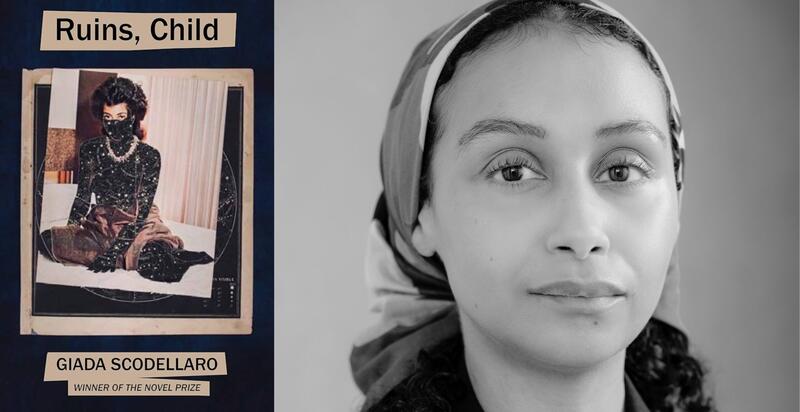
Dionne Brand says of Giada Scodellaro debut novel, winner of the prestigious Novel Prize: “Ruins, Child takes us to the crumbling architecture of a future past; a future past that is possibly now. In this work of fractal seeing, we encounter women in lives that are simultaneously lived, reenacted, and observed. Ruins, Child is conceptually rich, prismatic, and choral, embodied, and surreal, cinematic and textual. Giada Scodellaro writes us Black life watching Black life.” In today’s conversation with Giada we look at this singular novel, one that moves less by story than by sound and by image; we look at the politics and poetics of the gaze, at the grammar of film and dance in relation to the the way Giada’s language gestures and flows; at Black artistic lineages, and at this community in her novel, of largely Black women, who film themselves living, and watch themselves on film alive.
For the bonus audio archive, Giada contributes a reading from Dionne Brand’s touchstone collection of poetry Ossuaries. This joins contributions from many past guests including Dionne herself, Christina Sharpe, Nikky Finney, Ada Limón, Lydia Davis, Viet Thanh Nguyen and many others. To learn how to subscribe to the bonus audio and about the many other potential benefits and rewards of joining the Between the Covers community as a listener-supporter, head over to the show’s Patreon page.
Finally, here is the BookShop for today.
Transcript
David Naimon: Today’s episode is brought to you by The Salt Stones by Helen Whybrow. Winner of the 2026 Vermont Book Award, this moving meditation is set in the heart of Vermont’s Green Mountains, where Helen Whybrow and her partner set out to restore an old 200-acre farm. Dubbed revelatory and magical by the Washington Post, The Salt Stones offers an intimate and profoundly moving story of what it means to care for a flock and truly inhabit a piece of land. The shepherd’s life unfolds for Whybrow in the seasons and cycles of farming and family: birthing lambs, fending off coyotes, rescuing lost sheep in a storm, and raising children while witnessing her mother’s decline. Out in paperback this fall with a stunning new cover, The Salt Stones sings of a way of life that is at once ancient and entirely contemporary, inspiring us all to seek greater intimacy and a sense of belonging wherever our home place may be. The Salt Stones is out with Milkweed Editions at milkweed.org. Today’s episode is also brought to you by Anamot Press, a nonprofit literary arts organization based in London. Anamot means “shameless” in Armenian. They publish queer poetry and essays, develop fully funded residencies for writers, and curate interdisciplinary literary events. This year, they’ve launched the Anamot Press Workshop Series, facilitated by writers and poets from queer and/or diaspora communities around the world, including Bhanu Kapil, Patrycja Humienik, Jane Wong, Dawn Lundy Martin, and others. The online workshops explore a range of themes, including queer letters to a forbidden lover, incarnations and translations, water as method, and constellations of memory. If you are a writer interested in being part of the workshops, find out more details and how to register at anamotpress.com/workshops. One pleasure of preparing for the last conversation with Saul Williams and today’s with Giada Scodellaro is that they are both conversations about film and filming as much as they are about words and writing. Because outside of the show, I confess I’m a bit of a film nerd, and I do get to unfurl my film nerd flag a little with Giada today in a way that is super illuminating about her book and also super gratifying regarding these films themselves, films that I do hope you’ll seek out after today’s conversation. As you’ll soon discover, three-time Between the Covers guest Dionne Brand is also a presence in today’s conversation, both outside of the book, between Giada and I, and within her book as well. For the Bonus Audio Archive, Giada contributes an extended reading from one of my favorite poetry collections of Dionne’s, Ossuaries. This joins an immense and ever-growing archive, which includes a reading by Dionne herself of Christina Sharpe and Canisia Lubrin, another by Teju Cole reading John Berger and his own writing to John Berger, Nikky Finney reading from Lorraine Hansberry’s diaries, a close reading of Jamaica Kincaid with commentary by Myriam Chancy, poetry and poetry prompts by Danez Smith, a craft talk by Marlon James, just to name a few. To find out about how to subscribe to the Bonus Audio and all the other potential benefits and rewards of joining the Between the Covers community as a listener-supporter, head over to the show’s Patreon page at patreon.com/betweenthecovers. Now for today’s episode with Giada Scodellaro.
[Music]
David Naimon: Good morning, and welcome to Between the Covers. I’m David Naimon, your host. Today’s guest, the writer and artist Giada Scodellaro, has an MFA in fiction from The New School and is an assistant professor of creative writing at Columbia University School of the Arts. A MacDowell fellow, Scodellaro’s writing has appeared in The New Yorker, BOMB, Harper's, Granta, and Brick. In her debut story collection, Some of Them Will Carry Me, published by one of my favorite presses, Dorothy, was named the Best Book of 2022 by The New Yorker. One story within it, “Hangnails, and Other Diseases,” was shortlisted for The White Review Short Story Prize. Publishers Weekly, in its starred review, said, “Scodellaro debuts with a wild and wonderful collection of surreal and enigmatic accounts of sex, relationships, and encounters with strangers. It’s an auspicious and consistently surprising first outing.” Renee Gladman adds, “In Some of Them Will Carry Me, Giada Scodellaro enthralls as she evokes the best of the lushly slow and quiet European films of the 1960s, with their long, wide, starkly gorgeous shots, deeply detached yet viscerally sensual plot lines, and lonely meandering figures crossing landscapes. But what is more powerful is how she reorganizes those canonized spaces to foreground the subjectness of brown bodies and to imbue her female characters with volition. It’s a virtuosic reframing done with seductive and disarming brevity. A stunning debut.” Georgie Fehringer says, “These are Black characters whose existence in their surreal landscape is as natural as the soft mentions of cocoa butter on thighs. A world immediately recognizable even in its strangeness. A world confident in and of itself. These are the soft and fragrant spaces of the dreams of Black writers and readers alike. The wholeness of the marginalized existence, what it is like inside the body and inside the love when not viewed from the outside.” Giada is here today to discuss her second book, her much-anticipated debut novel, "Ruins, Child," winner of the Novel Prize, which means it’s arriving on three continents simultaneously, published by New Directions in the United States, Fitzcarraldo Editions in the UK, and Giramondo in Australia. Katie Kitamura says of it, “Giada Scodellaro is one of the most astonishing writers of her generation and Ruins, Child is a visionary novel. Scodellaro refracts and redefines the canon of Black culture, the archive of Black experience. The result is a masterpiece that lives and breathes on the page, every sentence shimmering with wit, musicality, brilliance and verve.” Past Between the Covers guest John Keene adds, “Giada Scodellaro's newest masterpiece, Ruins, Child, endows the concept and form of the contemporary novel with new force and meaning. Cinematic and prismatic, like a camera constantly in motion and yet incisive in its close portraitures of a community of Black women and fems surviving and living amidst the future urban, eco-dystopic, queer ruins of our society, Scodellaro’s novel breaks new ground in spectacular fashion.” Finally, three-time past Between the Covers guest Dionne Brand declares, “Ruins, Child takes us to the crumbling architecture of a future past; a future past that is possibly now. In this work of fractal seeing, we encounter women in lives that are simultaneously lived, reenacted, and observed. Ruins, Child is conceptually rich, prismatic, and choral, embodied, and surreal, cinematic and textual. Giada Scodellaro writes us Black life watching Black life.” Welcome to Between the Covers, Giada Scodellaro.
Giada Scodellaro: Thank you so much for having me. That introduction is just something. [laughter]
DN: With such iconic writers singing your praises, yes.
GS: Oh. Incredible.
DN: You and I first met on the Lower East Side of Manhattan. I’d flown out to moderate a conversation between Dionne Brand and Adania Shibli, both past guests on the show, as part of Jewish Currents magazine’s annual conference. As I was leaving the stage and resurfacing to the lobby of the auditorium, and you approached me and my wife, Lucy, and introduced yourself, I already knew you by name. I knew of your book with Dorothy Project, though I hadn’t read you yet. We ended up, the three of us, having lunch together, some delicious chicken at a place that you knew nearby. Long after that encounter, when Lucy and I were headed to Sicily for the Santa Lucia's Day festivities in the winter, and were going to spend some time in Naples first, which is your birthplace, we reached out to glean some recommendations from you and your family of where to eat and had some unforgettable meals thanks to you. At the time, you probably told me why you were at the Jewish Currents event, though I was not really in my body when we shared that meal, partly because all the venues for that event that had been reserved and planned for by the magazine for a year mysteriously were canceled at the last minute, and they had to scramble. The day before, Masha Gessen wrote an op-ed in The New York Times comparing these mysterious cancellations to what happened in the Soviet Union to silence speech. So I had a lot of anticipatory anxiety. “Would this high-profile op-ed about a Jewish-led event in solidarity with Palestinians be met with protest or disruption?” I also had never flown anywhere like this to be in front of so many people I admired but had never met, people in the audience like George Abraham, Claire Schwartz, Christina Sharpe, Donna L. Curd, and most of all, being onstage with two writers who were meeting for the first time and bringing them into conversation. All that to say, it was all great in the end, but I only realized while preparing for today, years later, that of course you were there for Dionne Brand, something I probably was told by you, but didn’t register really deeply until now. So now that I’ve set the table for our conversation, I want to start things differently than usual. It’s hard to talk about what this book is about in any straightforward way, since this book isn’t really plot-driven. Because you yourself have said you start with sound, that from early on in the drafting process, you read your work out loud to yourself. I think because hearing you read really unlocked this book for me in a profound way, I think we should start with you reading the opening to "Ruins, Child." Then we can talk about the book in the aura of the sound of the book.
GS: Yeah, let’s start there. There’s more to say. I was so happy to meet you that day and to be there and to see these authors live. But let’s begin with the reading first, yes. I’m going to read from part one, which is “The Film.”
[Giada Scodellaro reads from Ruins, Child]
DN: We’ve been listening to Giada Scodellaro read from Ruins, Child. So I’m going to hand over the first question about your work to someone else, whose question far surpasses my own capacity to speak to what you’re doing with language here. It mainly is speaking about a story from your first book, this question. But in doing so, really, I think, is highlighting elements that this book shares with it. This is a question from the visual artist and writer Helen Marten. Helen works across sculpture, painting, drawing, video, and writing, questioning in various genres and mediums the stability of the material world and our place within it. She’s the winner of Britain’s prestigious Turner Prize. Her work can be found in the public collections everywhere from Tate London to MoMA in New York. Her debut novel, The Boiled in Between, was described by Brian Dillon in Frieze in a way that I think could describe yours, too, when Dillon says, “The Boiled in Between proceeds by image and incantation rather than much in the way of explicit plot.” Finally, this is what Helen says about Ruins, Child: “Ruins, Child reads like wild and textured wind, like seeds dispersed, like focus pulled then blossomed outwards, like bodies leaking, thumping, persisting, cleaving: together, then apart. This is a book of breath and people, of the precious metrics of language with all its lakes and tales that flows between and towards women. Giada Scodellaro has written fierce magic, wet earth, hot limbs; it is urgent and beautiful.” Here’s a question for you from Helen.
Helen Marten: Hello, Giada, hello David. Hi from London. This is Helen Marten. Giada, I’m an enormous admirer of your work, so thank you for continuing to write with such searing brilliance. In your story “A Triangle,” the protagonist describes a burned chair broken at the hips that is seen whilst this character has activated charcoal in their teeth, and it’s totally exquisite, this rapid transfer of material between mouth and chair, wood and its embers. The chair is broken at the hips, but it has gained a pulse and a surrogate body via the proxy mouth that sees it or tastes it from afar. So you manage to write this quality of anthropomorphizing that transplants a weird ontological power both to the object described and to the reader, who is newly seeing all at once wooden chair, burned chair, and via translation, burned wood on teeth, and teeth as structure. You then describe somebody subsequently coming along to pick up the chair with their knees bent and their back engaged, and in very few words there is suddenly an algorithmic connection of parts, one thing swallowing another, the punning of chair parts with the body, a flexing of soft and hard, strong and ruin, and you create this magic suggestion of endless exponential growth. I’m often struck in your work how you write with such intensity about physical texture, about food, objects, dirt, color, light, and how that attention to the granular fingertip detail of the world affects your lyrical voices, and gives speech, not explicit narrative per se, but speech in the most live, dynamic, and filmic sense where images flow like unstoppable currents. You capture something of the ancient sonic density or pleasure of words being spoken aloud. So I guess I’m asking about language’s magnetism, language’s flow, and language as an inherent cinematic progression of parts. Maybe about what happens to words at the edge of what can be held when text begins to behave less like a tool for naming and more like a field of attention or even a kind of listening. Finally, I’m curious, and I’m sorry these are not exactly questions, rather meanderings, but I’m curious in your work, how you recognize the moment when a sentence is no longer carrying meaning in the usual sense, but is instead opening a space, almost like a threshold, where perception, memory, and imagination start to rearrange themselves. When you arrive there with all the recognizable human baggage, with all the poetry, all the gritty flints of meaning and partial meaning, how do you decide whether to follow that opening further or to resist it and return language to something more stable or more sayable? Thank you, and congratulations for your new book. It’s exceptional, and I was totally electrified by it. Thank you, Giada. Thank you, David. Goodbye.
GS: I'm sort of speechless. I try to come prepared, [laughter] and I’ve heard other people say, “This is moving.” I’m like, “I’m going to have it together.” Yeah.
DN: Her question is really disarming. [chuckles]
GS: I mean, it’s so disarming. I want to listen to it on a loop. I want to hear it again and again. It’s just wonderful, wonderful being seen in that way, being understood, and then also to discover things that I never intended in someone else’s observations. But the first thing that’s coming to mind is about the threshold and thinking about language when it moves outside of the frame or on the edge of things and that feeling. Helen is right that when I am writing, my impulse is to follow that always. That’s the first thing that I want to do, is when I’m moving toward my preoccupations, always my obsessions, which is the center of my life, my personal life and my creative life. I’m speaking about, for example, my fixation with proximity, with the body, with the discomfort of this proximity, domestic and public spaces, how we share those spaces. Also film, sound. I think a lot about sound, as you mentioned. That’s oftentimes an entry point for me. It can also be image. Image and sound really are entry points for language for me. You know, it’s funny because I haven’t reread the first book in a really long time, or maybe ever fully. Have I reread it? I guess in editing I did have to read it, but I haven’t read it in a long time. So this examination of the short story, returning to the short form, thinking about this object, the burnt chair. I mean, that’s also something that I love thinking about: objects. I love thinking about inheritance and objects and how things are passed down, what an object can hold. So returning to the restraint versus the following of an instinct, that’s the thing that I used to fret about in the beginning, especially when it felt like my writing wasn’t really understood in certain formats or institutions. I really wanted to keep things to myself. I wanted to withhold. I wanted to do really strange things. I wanted the bodies to do strange things in the work. It wasn’t making a lot of sense for the readers or for an audience. I’m less worried about that now. I want to always move within my own pleasure first. I’m not so concerned with, as I’m writing, how things will be received or what they will mean for others. I’m thinking purely about, okay, this is, I want to think about film. I want to think about the camera. I want to think about this character, Vonetta, who is an old woman, an old Black woman. One thing I will say first is that what came to me first with this book are two images. The first image was around landscape and environment, primarily the salt marshes of the Hutchinson River, thinking a lot about Co-op City, which is the largest co-op development, I think, in America, in the country, one of the largest. It’s in the Northeast Bronx where I grew up. Thinking always about the volcano and the gulf where I was born, the landscape of my childhood and this nostalgic landscape. So I was writing toward that topography, environment, researching local plants, and then the largeness of that. Then also thinking about the granular body of this old woman, Vonetta, her body, her thigh, tying a shoe. What I had in mind with her was that she was split as a character, that she was both pregnant and unpregnant, old, ancient, loose, that she was dying. She’s bedridden, but she’s also swimming. The way that I wanted to explore that was through these layers of film, sound, and text.
DN: Well, right before we started talking, I said that I felt like this was a poet’s novel and that that’s why I wanted you to start with the sound of the words. And I like Helen’s question of “How far are you willing to travel away from the meaning of the words on behalf of the sound of the words?” You’ve already answered that. But I’m curious, you’ve sung the praises of Barbara Epler as your editor at New Directions and the pleasure of working with her. This is just me fantasizing now, but I’m imagining working with her as a reader of your work, but also an editor of your work who isn’t coursing through with the desire that you have, but is following the desire that you create within the book. So would have more questions perhaps than you would about orientation or meaning or audience. Is that how that went? It seems to me like you have the sound down, but this isn’t Gertrude Stein's Tender Buttons. You have a story, you have characterization. Even if that story and even if those characters might be more in service of the sound in some strange way, and that maybe more of the meaning resides in the sound, it isn’t entirely abandoning this world of scene and story and narrative. I don’t know if this is really a question, but I’m curious about that interface with you and Barbara, if maybe that was where you were puzzling out the things that you aren’t concerned about when you’re writing, but then become the concerns of, okay, now your editor is reading it as a reader.
GS: Yeah, yeah. I’ve been so lucky with these two projects. I first had Danielle Dutton as an editor. I mean, she does everything, many things, but as an editor, she was just incredible. It was my first experience being edited in a thorough, sustained way. I learned so much from that experience. What the lucky thing about working with Dorothy and with Martin Riker and Danielle Dutton was that they really allowed for the book to exist the way that it was, is. It was really more about punctuation and word choices that we talked a lot about and sequencing, things like that. But in terms of language and narrative and strangeness, they allowed for that to exist. I feel again that the second experience, this debut novel, "Ruins, Child," with Barbara, I mean, I don’t want to say too much about Barbara because I’m hoping she will be my friend one day. [laughter] I don’t want to ruin my chances.
DN: Okay.
GS: But what I will say is the experience was incredible. I mean, her discernment, the way that she reads, absolutely. But once repeating myself, she really allowed for the work to exist as is in a way that was very surprising to me. I thought more things would be changed. I was ready. I love being edited, actually. I want input. I want criticism. I want all the things that can benefit a work. I think editing is an art. The one big thing that we talked about was structure. I have an affinity for triangles and thirds and triptychs. So initially, this book was a triptych with the film, sound, text, part one, part two, part three. We broke the film up into two parts at Barbara’s suggestion. My love of triangles, I’m like, “No, the triangle.” [laughter] But I didn’t ever, I mean, I’m never saying no to Barbara, honestly. But I thought it was brilliant because it allowed for this intermission for the text to come through, the text piece, a text section which is written on the body of a character, on the body of Vonetta, written or marked on the body. It allowed for breath in this dense section of layering of film, these 168 hours of this film that this community is watching during their holiday. So to answer the question, I think it has been exhilarating for the work not to be distorted in a way that would be unmooring or just move away from myself. It would move too far away. I think I’ve just been very lucky to have those experiences with editing.
DN: Well, staying with Brian Dillon’s description of Helen’s work as a possible frame for yours, of work that is proceeding by image and incantation, I wanted to explore both, to stay purely in language a little bit longer before we speak about the story or character or place more. First with incantation and with repetition, that is part of, I think, an essential part of creating an incantatory effect: repetition. I think of something you said to Amina Cain when you were in conversation with her about the work of Marie NDiaye, where you say Marie NDiaye’s “Step of a Feral Cat” includes the line, and then you quote it: “She was tenacious, stoic, and the hours belonged to her, she was bare and impenetrable, strange and tranquil, we could not upset her so easily, in her serene zealotry.” Where you then say, “In this same story a woman, Marie, wears green, a dark, murky green. This line seems to render or set forth all the green figures that are held within NDiaye’s Self-Portrait in Green, these feminine figures, and it seems also to confirm their very existence, or even their slow persistence, their flooding. What is all this green? Is it absolute?” This way, a line activates all the green figures in the book, in your formulation, it feels like something you seem to be aiming for to me. But contrary to the repeated green in NDiaye, the word leg, which is repeated six times in the first two paragraphs of what you just read, the opening of the book, so we get the word leg six times, and then the word thigh an additional three. They aren’t just images, but also they’re images being seen. The first line is “A close-up of a woman’s leg.” The second line begins, “And the leg is seen because the woman is tying her shoes.” Then shortly after, “The woman is lit up by the fluorescent lighting.” This is not only image, but a gaze, a gaze upon the body parts of a woman and an incantatory language repeating those body parts over and over again, a quality that is shared with your story collection, I think. Both books have an interest in fingers and in fingernails, for instance. They are repeated in language, but also they’re constantly scrutinized by the eye as well. I want you to talk more about this. I’m especially intrigued by how you say with NDiaye that the way all these feminine figures that she holds within her book are set forth by the line you read, and it seems to confirm their slow persistence, their flooding. You call those women of hers both bare and impenetrable, which reminds me of Renee Gladman calling your work both deeply detached and viscerally sensual at the same time. Somehow, I connect this to the distancing of the gaze and the pulling close of the language. But I’m wondering what comes up for you around this, because there’s this strangeness to the distancing and the pulling close, which feels like it’s happening at the same time.
GS: Oh. Yeah, that’s it. That is what-- you figured it out. [laughter] I think there’s something about just observing, being witness to something or someone that is endlessly fascinating to me. I think that’s why I chose the film as a form or all of these formats that I thought about and moved into. The film specifically, there is something about that distance, creating that distance, because they’re watching themselves, watching themselves. There is this layering. There is a multiplication of being and this idea of preserving a life, of creating evidence of a life, and of being able to exist within multiple timeframes. What I was thinking about was creating a study, creating a record of existence, of field notes, how to think about preservation. I think, too, there’s something about observation and the knowledge of being observed that is interesting too. Like, what is the performance that is happening within that exchange? Who are these women if they are not being filmed or observed or recorded? So there’s a sense for me of, there’s a definitive part of it where we’re seeing and hearing and feeling, but there’s also an absence or void or a distance, as you mentioned. So the way that I’m thinking about both those things is, or how to arrive closer to a character or a place, if you’re such a remove, is to focus on the language, on the language, on the leg six times, the thigh three times, returning and returning to a word. I think a lot about the sound of a word. I want to fixate on these things. I want to linger. You know, thinking also about plot and the absence of plot, because I’m being asked that in other places about plotlessness. Or I’m not being asked about it, I’m being told there is no plot here. I think plot can be many different things. For me, at least, it is many different things, and the plot can also be created through structure. The plot can be, for me, a moment that is a return, you know, returning, a return. There’s something about that emphasis that is important in the work. But yes, tell me. I think I lost— [laughter]
DN: Well, I want to press into this notion of them watching themselves, watching themselves and what that interest is for you. We know right away in the brief passage that you read and then throughout the book that we aren’t, as readers, just watching the characters, but we’re watching the characters alongside a film crew. We know the camera lens is covered in grease from that first reading, for one. Lines like “We follow her down aisle five,” with that "we" perhaps being us, the audience, or maybe just the film crew referring to themselves or both. This enhanced version of voyeurism, in one way, I think simply foregrounds how reading is always voyeurism, but that we never really register it as such. Here we get it in such an exaggerated way that we see it. We see the voyeurism, but it also underscores the gaze in a way that makes me feel complicit in something with how the camera is framing the scene. Perhaps I feel particularly complicit at the beginning as a man with these women’s body parts repeatedly being lit up and viewed as objects. I think of that iconic scene in Antonioni’s L'Avventura with Monica Vitti in Catania in Sicily, where she’s walking in the plaza by the church, and all the men leaning against the wall are staring at her. Then the camera moves, and we see that all the men up the stairs are also staring at her. Then it moves again, and up on the balcony, all the men are looking down too. They all move in with this menacing collective desire, and the camera feels part of this collective gaze, not her gaze, the gaze of the men. But I also want to pick up on something Dionne Brand said in her description of this book, that the gaze, in her words, is really a work of fractal seeing. Fractals where a pattern repeats at various scales, like the way the swirls and spirals of a galaxy also occur in the whirlpool of water and the swirling of a seashell and the cochlea in our inner ear. Contrary to the male gaze, we quickly see we are in a community of mostly women, mostly Black women, who actually have been filming themselves or having themselves filmed over time. So the gaze is different than this male reader first thought it was when I start reading. They have 168 hours of footage that they then periodically watch together. So for instance, early on there is this passage: “The women (6) are gathered around the television. We (107) watch them watching something. They eat dates. We’ve seen this film so many times, they say. They watch a version of the same film we are watching, but a shorter cut, an older version. The six getting up on the bus. We’ve seen them see this part so many times.” It isn’t entirely clear if we are part of the we that is watching the six women who are watching themselves watch themselves, or more likely that we, the reader, are actually another layer watching this other we of 107 people. But I wanted to hear you speak about this nested framing more as structure, this self-referentiality ad infinitum, this amassing footage of the very same life that is still being lived.
GS: That’s so right about the gaze and this community having agency over their own depiction and record keeping. I do think, too, which I didn’t realize as I was writing it, but after the fact, that the reader or the audience is maybe also witness, also participant, also complicit, as you mentioned. There’s something that I like about that. I like forcing or inviting, I should say, the audience into this place, into this time, into this tradition of personhood and community. I think that within all my writing, accumulation is really important. So maybe that’s the way that I’m creating momentum, is by layering and repeating and accumulating information. There’s a sense that everything that’s happened has already happened and will happen despite the feeling of collapse, systemic collapse and institutional collapse, that there is a way for things to exist, for things to be ongoing and for things to be inevitable. That moves back into time in the way that I love thinking about time. I don’t often write in a linear way within time. So I think that’s part of the appeal for me. But I also really, as I’ve mentioned before, love the idea of these women, as they’re confronting environmental violence, all of these genocides and all of this grief, death, that there’s a way for them to outlive themselves through this film, through this text, through the sound, through this recording, and memorizing themselves and seeing themselves not as objects, but as a unit, a unified, a communal enmeshment, as a whole, yeah, as the center.
DN: I mean, it feels like my misreading at the beginning before I understand the scenario where the women’s body parts are being objectified, when you discover that it’s their own chosen family that are behind the camera, potentially, it changes the meaning of everything, I think.
GS: I hoped that it would. The mundanity of their existence, the everyday, the tiny details of moving through life in community with other people, that is the archive that they’re creating. It’s not a colossal thing. It is about their everyday.
DN: Well, I know you’re a fan of the William Greaves 1968 film Symbiopsychotaxiplasm: Take One. There are some clear formal resonances between your two projects. Most notably, the movie Symbiopsychotaxiplasm centers the shooting of a screen test in Central Park, where one camera crew is shooting the screen test. A second camera crew is documenting the shooting of the screen test in a larger sense, where the first camera crew is often within the frame of the second camera crew. Then a third camera crew is documenting the film being made about the screen test as well as the screen test. So it includes both of the other film crews as well as spectators and people walking by. Sometimes we see only one of these points of view, but we also get two or even all three points of view in split screen in really interesting and dynamic ways in the movie. My favorite part of the film is when the crew, feeling confused by it all, what it means, and even whether Greaves is a competent director at all, they hold a not-quite-mutinous meeting without him where they debate the meaning of the film for quite a while, philosophically, and they debate Greaves’ intentions among themselves. This meeting is included in the film. And, of course, we don’t know if that was Greaves’ plan all along, if he was even perhaps the one filming it, filming this meeting, or whether it’s truly how it seemed, that they secretly filmed this and then later he decides to include it. Similarly, he himself “played himself,” played almost a parody of an auteur. We don’t know how much of his sexism, his unfocused energy, is a critique of the auteur as such, how much of it is a character and how much of it is Greaves. The film really never tips its hand. But beyond the fractal seeing, I wondered what the film meant for you and if there are resonances with your book that might not be apparent to me. If there are things about it that particularly stay with you or find themselves either quietly or loudly in Ruins, Child.
GS: I do love this film, which I discovered after writing the book.
DN: Oh, really?
GS: Yes.
DN: That’s amazing to me.
GS: But I do think they’re very much in conversation.
DN: They are.
GS: I think it’s so much of what you’re saying, that there’s a playfulness to it, to this film. There is chaos. There is performance. I mean, the choreography of filmic language. I think that the parallel for me with film and writing is that I understand why genre exists and why we have the containers, but I don’t really subscribe to them because I think nonfiction is something that you are shaping and forming just as fiction is shaped and formed. The documentary form, this film is considered a documentary, but it is so molded. As you mentioned, there’s no understanding of where those boundaries begin or end. There’s something about that within the book as well, about what is real, what is unreal? What is the performance of things? Where does the choreography begin within all this movement and stillness? So I think that is really the part that attracts me so much to this film. William Greaves as a character within this film, the idea that they’re improvising along the way, that there are things that are being performed, there are actors that are reading lines over and over. There’s a lot of repetition in the film, different actors reading the same lines and then throwing things at them, just strangeness all over, which I love.
DN: Me too. I mean, I think one of the big differences is that he’s filming mostly white actors. As a Black director, the race question is an unspoken undercurrent of the film, maybe not as explicitly spoken to as your book is.
GS: Yeah, I think so. There’s, towards the end, a Black woman actress. This film is just Take One, it’s part one. Then I think 30, 40 years later is the second part of the film, which revisits that same actress and some of the crew and William Greaves as they return to Central Park to try to extend the story. There’s something about the desire to return to that time or to try to capture something of what has already been captured and how time doesn’t really allow for that. But there’s something interesting about the attempt. So I think even these two films as part one, part two are really interesting to me as well. The ongoingness of it.
DN: Yeah. Well, looking into the name of the film, I learned that it came from a concept, symbiotaxiplasm, that comes from a social scientist, Arthur Bentley. It’s a term whose root meanings would be something like together-life-movement-fluid, a fluid moving together life, which feels like a great description of your book. It is also considered a dialectic dialogue between individuals and their surroundings, their environment. Greaves adds the word psycho to bring the mind into it. I found a book that includes his program notes for the movie, and this is what he says about that addition of psycho: “It affirms more aggressively the role that human psychology and creativity play in shaping the total environment, while at the same time, these very environmental factors continually affect and determine human psychology and creativity.” I wanted to use this interplay of mind and place to hear you talk more about place, not only to describe and orient us to it a little more, but also to explain why you made the choices you did and what effect you were looking for through these choices. Because in the broadest strokes, we know we are in a community that is either 93% or 97% Black and overwhelmingly women. We know we are in some sort of crumbling apartment tower that is part of a community of buildings they call “the hill,” a complex that is sinking because it is built on salt marshes. The narrator in "Ruins, Child" says, “It is important to note the makeup of this place. We have reached a point of no return. It’s a place we’ve created for ourselves, okay? Or a place we were forced into and have reimagined.” That tension between what they’ve created and imagined into being and what they’ve been shunted into seems important. We know, for instance, a highway was erected over the outskirts of the hill so that the sun shines on everything but the hill. Yet there’s a different sort of sunshine that’s also coming out of the hill, too. So I was hoping maybe you could just talk more about the hill and also what you’re exploring through landscape and a sense of place as it intersects with the community. Because you’ve mentioned Co-op City in the Bronx. We get an aerial photo in the book of it. To think of fractal seeing, Co-op City is sometimes referred to as a city within the city. It has all sorts of histories of shoddy construction, collapsed garages, outbreaks of Legionnaires’ disease that went through the cooling system. It’s interesting also to think of that very material, real influence alongside how you’ve mentioned literary influences for the hill, also fictional hills from August Wilson or Toni Cade Bambara. So I would love to hear about this interplay of community and space and place specific to this specific place where the sunshine never lands.
GS: I love this question. I began with place. I began with thinking about environment and landscape. I think the environment is directly related to what the characters are experiencing. So the collapse is also a bodily deterioration and the shifts in temperature and the highways that are erected, the sinking, the cracking. These are all the things that are occurring to the characters, the community. There’s a transference there and a direct relation. I’ve had a lot of movement in my life and personally, in terms of home, thinking about home, what home is or can be, what place is home, what geography can be home. That’s constantly changing for me and has since I was very little, very young. So I think that’s why I’m drawn to thinking about communal spaces. I read a lot about urban planning. I did a lot of research about Co-op City, as mentioned, the development of Co-op City, this city within the city. They have their own police department, newspaper. My grandmother has lived there for 40 years, so it’s a very familiar place. There are, I think right now, 55,000 residents. It’s a lot of old people. A lot of Black people live there. That’s the origin point. The way that I think about environment in my own writing, and really more than environment, but I think it begins with these tactile things, this research that I’m doing about how neighborhoods were torn down to build highways in the Bronx, through the South Bronx into the North Bronx. Everything that I’m writing, whether it is surreal, exaggerated, feels real to me. It is real to me. So the hill as a place, I think the way that it’s been described as people are reading the book is grimy or like it’s falling apart and it has a certain connotation. The way that I think about this place is not that. I think the way that I feel about the Bronx, for example, is not that at all. The way that I encounter uptown New York, Harlem, my family’s from Harlem and the Bronx. I think the way that these characters view home and place and their own landscape is with wonder and with dedication and understanding of place as a shifting thing. There’s something about the way that they are attempting to preserve place that was really important. There are plastic coverings and materials. It feels like there’s a lot of reverence toward place with whatever is happening in the hill. There is a sense of communal making and preservation and environment as ownership, ownership, belonging, possession, all of these things. So I think that’s what I was thinking about. Then, of course, greenery and doing research about local plants and the things that are really fun for me to move into in terms of research, but then just allowing them to exist and enjoy this place, this place of their own making, a place that has been designated for them, that they’ve inherited. You know, I love thinking about inheritance, voluntary and involuntary. So I think that’s why this place is vital to their existence.
DN: Well, our main character, who you’ve nodded to early on, Vonetta, whose name not infrequently is followed by an exclamation point, she’s an urban landscape architect. When she notes that only 0.4% of landscape architects are Black, it feels like we can presume from that that the way the world is shaped by humans in this way is only very rarely shaped by the Black imagination or with Black people in mind in any way. So I was hoping you could inhabit Vonetta and her landscape architect mind and talk to us about how she dreams of the interplay—to borrow the framing from Greaves—of mind and environment, of how she engages with symbiopsychotaxiplasm as a concept, not the film. Because you made a nod to the different things you engaged with in landscape architecture, and your endnotes goes further into this. There are books like Emotional Landscapes or Can Art Be Nature? or Garden Futures: Designing with Nature. Within the book, someone raises the question, “Can plants be architecture?” which feels like the flip side of the equally compelling question, “Can art be nature?” One description of Vonetta’s approach suggests that beauty isn’t her goal, nor is functionality, that what she wants is circulation. Also, the intriguing line, “Land in disuse, unintentionally made whole, if not a little dangerous. That’s her thing.” So talk to us a little bit about some of these influences, but also talk to us through the eyes of Vonetta about the way she would view space, given she is an extremely rare example of a Black woman in a profession where all the spaces around her, including the hill, have probably been dreamed originally into being by non-Black landscape architects.
GS: That’s so right. You know, I had an opportunity to see Linda Sharrock, the vocalist, perform recently. I believe she might be in her 60s or 70s now. Returning to sound, her voice, her wailing, her overall performance, but also her body and the way she was moving sound through her body. I had already had Vonetta in mind, but then seeing Linda perform sort of opened it even wider. "Vonetta!" with an exclamation point, you know, the exclamation point is on her birth certificate. She will show it to you if you ask. I really loved writing her and thinking about her. As I mentioned, a really, really ancient woman who is a landscape architect and is traversing or navigating a pregnancy, an ongoing pregnancy, a long, long pregnancy. There’s something about her as matriarch, her as a curator of this place, as memory keeper. You know, she holds everything of the community and of place. She takes care of the design, the landscape design in the public areas, the gardens. She gives advice. She teaches them how to curse. She is everything. She is also finally reaching a point of transition. So there is something about the idea of motherhood with her, mothering, mothering the community and the place. I wanted her to be a caretaker and then for those roles to have to be reversed. In part two of the book is where she is bedridden. I mean, she’s bedridden all over, but in part two specifically, we acknowledge that she’s physically bedridden. The whole of that section is the reading of this, of her own words or ideas. I thought it was fascinating to think about what are the things that she would remember or that she would feel the urgency to record. Some of that is about the landscape and the temperature. Some of it is about Love Jones or Mahogany or Diana Ross as canon. [laughs]
DN: Can I connect Diana Ross to architecture?
GS: Yes, please. [laughs] Oh yeah.
DN: Because one of the things that comes up in the book is the notion of lateness in architecture, as developed as a concept by Peter Eisenman and Elisa Iturbe. Lateness pushes back against a predominant notion of architecture as being expressed through the zeitgeist or the spirit of the age, a notion that is enmeshed with beliefs in progress and in progressive time. That, in contrast, lateness works against this constraint of being of the times and instead highlights architecture that is out of sync with conventions. At least that was my naive—you can tell me if I’m wrong.
GS: I’m with you.
DN: But the hill feels outside of time in this way, and not just architecturally. There’s a sense of it being like a maroon community creating its own time. Also, the way I think that the film that they’re filming of themselves is creating a form and a shape and an architecture within an architecture that they didn’t choose. So they’re inhabiting the film of themselves as they live their lives. In a way, it’s almost like an autonomy over their space. But I also wonder if you’re engaging with lateness or if I’m misapplying it when I think about how many of your references within this book come from another time. The references are out of sync with the moment. They’re mainly from a generation before, whether Alice Coltrane, Stevie Wonder, Richard Pryor, or most notably in the book, Diana Ross. I wonder if this is related to lateness. Either way, if you have any thoughts about lateness, but also talking to us a little bit about your engagement with these real public figures in your quasi-fantastical space.
GS: Returning to my own pleasure and my own obsessions, this is the timeframe that I’m attracted to. I think it has something to do with my mother and my grandmother. But I heard Tayari Jones recently talk about naming in books and how we don’t realize that the naming of a character has more to do with the parents than with the characters themselves. I really like that idea. I’d never thought about it before. It was a way, I mean, Vonetta McGee, Seret Scott, these are actresses that I love. Seret Scott, I just went to see at the Schomburg, Losing Ground, Kathleen Collins’ 1982, I think, film. Seret Scott was there, and they announced it later, but she had run away and I think I spotted her. Anyway, I’m obsessed with her. [laughs]
DN: She’s amazing.
GS: She's amazing.
DN: She’s such an amazing actor.
GS: Apparently, she hasn’t ever watched the film or her own, anything that she’s in. So before the film started, she went back home. But there’s something about the contemporary that I’m not ready to encounter in my work, in the sense that I do want to confront it in terms of politics and morals and to reflect the urgency of things that have happened and continue to happen. But in terms of technology and art and references, not so much. I think I have a fear of it, but it’s also, again, purely my interest in Diana Ross. There are moments where I just focus on certain films and people. While I was writing this book, I was watching hours of Diana Ross footage and interviews. I really love the idea within fiction of meeting or bringing up recognizable people. You know, Sanaa Lathan as a character, Dionne Brand as a neighbor, this uncanny duality, like these two states of dream and reality and a retelling or reframing of culture, because I think it allows for a tethering for the reader in a way of saying, “Maybe this is something recognizable and therefore I can stay here within this world that is floating and moving and returning.” So there’s something familiar here to hold on to. I think I also wanted to consider this community, the lateness of this community. They’re behind. Vonetta is behind, literally behind on things within time, but also behind with her pregnancy, behind with their idea of—I think they allow for things to exist as they are. I think the most important thing in this community is to exist within each other and not really think about the outside, the outsider. It’s more about allowing things to be. So there’s something about that as well. But again, going back to what I think they would listen to and the sound of this place is Stevie Wonder's The Secret Life of Plants, and Alice Coltrane. There’s an amalgamation of, I feel like it’s moving between the ’60s, ’70s, and then ’80s, ’90s, and this intergenerational confluence of art and culture and film with the teenager, for example, Seret, the character Seret, who is a teenager who’s decided to remain a teenager. So there’s something about, I love thinking about intergenerational relationship and influence as well.
DN: Well, I think it’s crazily uncanny that you brought up Seret Scott and Kathleen Collins’ film because our next question feels like we’re—[laughs] it’s so strange that it’s the next question. So anyways, here we go with another question from another person. When I think of the Lucille Clifton epigraph of this book that goes, “The woman who’s over 90 cries for her mother. If our dead were here, they would save us.” That feels related to what you’re doing, in my opinion, to lateness and Black culture. In that light, we have a question for you from two-time Between the Covers guest, Caren Beilin. Caren was on the show for Revenge of the Scapegoat, and then she came to town for her book "Sea, Poison," and we recorded a live conversation at Powell's about it, which we aired as an episode. Amina Cain said of that book, “An absurdist masterpiece, nothing, just nothing, is as wild, outrageous, and free as Sea, Poison.” While Caren was here, she stayed with me, and she found the advanced galley of your book, which I hadn’t read yet, and which you’ve edited since, I believe. She read it while she was here in Portland in my house. Here’s a question for you from Caren.
Caren Beilin: Hi, Giada. This is Caren, your Dorothy and now New Directions pressmate. I’m so glad you found yourself in conversation with David, and I hope it’s going really well. Question for you. When I saw the news of your even being on the shortlist for the novel prize, and I read the synopsis, I wrote you to say that it sounded like a Kathleen Collins film, and we connected a little over our mutual love for Kathleen Collins. She was this incredible filmmaker, film editor, and writer, and she died in her 40s from cancer. So we’re missing a lot of potential work. I can’t help but read Ruins, Child as a continuation of the work of Kathleen Collins, if also many other influences, but maybe especially her. And her film Losing Ground, in fact, makes an appearance in your text. I’m wondering if you could talk a little bit about your connection to her.
GS: Oh, Caren, thank you so much for that. I love Caren’s work. Sea, Poison is—I got to be in conversation with her about Sea, Poison, and it resonated with me so much.
DN: You’re both very language-forward, sound-forward writers.
GS: Yeah, I would agree with that. Yeah, we were just mentioning Kathleen Collins and this work. I absolutely think she was a playwright. Her books are now published. Her daughter is doing a lot of the work of bringing her film to the forefront, making sure that her work is seen and read and reexamined and reconsidered. There’s something about Losing Ground, the environment, this relationship, this marriage, but mostly in Sara, the character, in Seret Scott’s character, her undoing or unbecoming as an academic and moving by the end to performance and freedom and looseness. Yeah, there’s something that I feel—I mean, it’s a great compliment for this work to be thought of in relation to Kathleen Collins. There’s something, seeing it again and seeing it in a theater and with other people was incredible, and seeing it with her daughter present and talking about the legacy of her work and the cost of that work personally for Nina Collins, but also the responsibility of this continuation and preservation of her work. I mean, it’s beautifully shot. The writing is incredible. The dialogue—if the audience has not noticed yet, I don’t have a good memory. I absorb things and then I release them. But I wish I could remember exact lines from the film right now to impart how incredible this is, but I hope people will watch it.
DN: Well, when I think of Kathleen Collins, a couple of things come to mind. For one, she worked on Greaves’ film, Symbiopsychotaxiplasm, as a production assistant. Also that both Collins’ film and Greaves’ film, two films that are now considered touchstone films in film history, neither one received a theatrical release, which begs the question about how many Black films suffered something similar but weren’t “rediscovered” and then represented. Greaves’ film resurfacing 23 years later and Collins’ film resurfacing 33 years later. One metric that might show just how bad things were in this regard is that Collins’ Losing Ground was the first feature-length drama directed by an African American woman since the 1920s. So there were 60 years with none. Finally, at the end of that 60 years, there’s one, but it’s not released. None of this is in your book explicitly, but it does echo against the 0.4% of urban landscape architects being Black. Or when I talked with Morgan Parker, how only 4% of therapists in the U.S. are Black, and so on. Losing Ground also has, I think, some resonances, like your book does with Greaves’ film. Namely, that there is a film within the film, and even a point where the actors within the nested film, who are also the actors outside of the film in the primary film, where they’re wondering what the director wants them to do. Both films feel like examples of lateness, as we are encountering time capsules that never had the opportunity to intersect with contemporary audiences. But largely, Losing Ground is very different. One way it is, is in how it makes Black artists and intellectuals central to the narrative. Very different from the Greaves film, not very different from your book. Not only that it centers a Black philosophy professor and her husband, who’s an abstract painter, and their tensions around feeling and being in the world versus encountering it through words and through representation, but it also explicitly engages with the erasure and suppression of Black life in the arts. In one scene, the mother-in-law of the painter, after he has finally received the news that some of his paintings would end up in the permanent collection of a museum, he asks her, “You really worried I would be a failure?” And she says something like, “No, I wouldn’t judge you for being a failure. I’m not white. I would have said you were talented and unseen.” Another scene where the philosopher wife, when she contemplates acting, she says, “I could be another Dorothy Dandridge.” She’s referring to the first Black woman nominated for an Oscar for Best Actress. It feels like that movie, Losing Ground, is aware of the odds against it existing in the world. It was moving for me—I’m sure it was way more moving for you to see Seret Scott, in person, but it was moving to see Seret Scott, the female lead, get honored in 2015 at the first theatrical screening of the movie at the Lincoln Center, which was thanks to the efforts of the director’s daughter. But it was also heartbreaking that her co-stars and the director weren’t alive for any of it at the same time. Your work in both books, I feel like, is incredibly citational and is also engaging with many other artists, not exclusively Black artists, but largely Black artists. I wondered if you saw this as care and/or repair, or if it’s simply showing what you love. I think of this also because I know your mother was one of the principal dancers in the movie Fame and then went on to join the choreographer’s dance company. I’m not suggesting she did or didn’t experience barriers that were racial in nature, but at a minimum, I’m imagining you saw a close relative navigating the world of performing arts and film as a Black woman around the same time as the movie Losing Ground didn’t come out in the world.
GS: Oh, wow. I think first, what I will say is that the Black archive or record has been sustained and will continue to be sustained by Black people, and that whiteness or the white gaze is not related to how these films are seen or celebrated or preserved. So I think in thinking about the archive as a form and creating in the book, this citation, this study of or excavation of what can inform a life, this information, this collection, it moves against the omission for me. I hoped to create, of course, a record of my own interests and what I love, but more so what I think is important to reiterate in the world, especially the things that are omitted and altered constantly. So I think as long as we continue to talk toward these works, and there are so many people doing the amazing work of restoration and finding distributors, I think in the meantime, I will continue to speak to these works, these ideas. I think everything is and must be recoverable. I don’t think things end just because they’re no longer seen. I was thinking so much about oral tradition in this book and how and when things are passed down or remembered or disremembered. I think this is my way of highlighting things that have sometimes been bent or turned or diminished. Maybe one person will look at the notes section of the book and discover something that they have not thought about before or seen before. That is a success to me. I feel so porous all the time. Anything that I watch or see or absorb and then love is a part of me and therefore a part of my work. I feel this responsibility of lineage, of historical and cultural knowing and understanding and sharing. So I think that’s the thing that motivates the citation and the record keeping. I think all of my work will always have citation. The first book did as well, where I talked about Ganja & Hess, the film. I talked about D'Angelo and Muhammad Ali riding through Harlem on a horse and all of these things. I’m always hoping that someone will go watch a short film or understand something new. So I think that’s the first part. Oh, it’s wonderful to think about my mother in this moment and her work. Certainly, I wasn’t yet a person when she was experiencing some of these performances and the height of her career as a performer and as a dancer. But I am constantly recovering her. I’ll go to the Performing Arts Library at Lincoln Center. There are images of her very, very little at the School of American Ballet. Pictures of her with George Balanchine and Jerome Robbins and Arthur Mitchell. She’s in A Midsummer Night's Dream in the ’60s and The Nutcracker. You can spot her. There are not very many little Black children that were part of the school at that time. Then she went to Juilliard and she was in the film Fame and Louis Falco was the choreographer for Fame. So she joined his company soon after that. She is not well known, Karen, my Karen Ford. So I do think a lot about her legacy and her lineage and her life and her as part of Black performance and Black art in the ’70s and the ’80s. Her on Italian television in the ’80s and ’90s, on La Rai, et cetera, on all these shows. So I think hearing Nina Collins talk about her mother and her mother’s work and the lineage of her work really moved me and has stayed with me. I think it’s important to create these records, to bring forward these Black artists, these disremembered artists. So that’s part of the work that I do want to continue to do and think about. The last thing I’ll say is in terms of Losing Ground and Bill Gunn and Seret Scott and Duane Jones, who I love also, yeah, there’s something about, because my mother is a dancer, was a dancer, I pay so much attention to the body and movement and the line and the elbow and turnout and feet and extension and things like that. So it was also really fascinating in Losing Ground to think about Sara as a character and her rigidity, her physical movement in the film and how the choreography, the literal choreography of the end with Duane Jones and Bill Gunn—
DN: It’s a mind-blowing ending.
GS: Yeah, it’s incredible. Her husband witnessing this transition and shift, all of the physical, him running toward her, the death, the performance of this death and dying. Yeah.
DN: Oh, my God. I mean, one of the great things about that film is this tension between the artifice and the embodied experience. We have the philosopher who needs, when there’s a problem in her emotional life, she wants to look at it literally in the archives to find out how to feel through research. That she finds her real self through acting is also really interesting. But I guess I wanted to stay a little bit—you’re mentioning the dancing in the film, the dancing, which at first is the dancing of the husband, who is much more embodying the sense of, let’s say, what your sound embodies, the forward movement of your sound, the river of the language. He’s in the river of life in a way that she isn’t, at least at the beginning of the film. But then the dancing and the center of gravity of that dancing shifts in the movie. But what I wanted to ask you about is more Ruins, Child-specific around dancing. Because for your UK publisher, Fitzcarraldo Editions, you gave a primer of influences for this book. One of them is my favorite dance piece ever. It’s Pina Bausch's The Rite of Spring. The book doesn’t seem overtly engaged with dance, though I think many people comment on the movement of the book itself, like when Helen describes its unstoppable currents, for instance, or the name Vonetta, which feels like the name of forward velocity somehow. There certainly is a sense of posing the body within the book also. But how would you put words to why or how Rite of Spring specifically, and maybe dance more generally, is one resonance or doorway into Ruins, Child? How does dance relate for you? Why would you put that in a primer for this book?
GS: I love this piece also. It’s so important to me. Pina Bausch’s Rite of Spring. Of course, the original 1975, but it was recently—what is the word?
DN: I saw her troupe do it in Paris.
GS: Oh.
DN: Maybe, I don’t know, I’m going to guess six or seven years ago maybe?
GS: Oh, wonderful. Well, more recently, they restaged it with all Black dancers, dancers from different African countries. Seeing it, I saw it in LA. I actually flew to LA to see it because I had missed it in New York. So specifically to see this performance. It’s incredible for so many reasons. Pina Bausch asks the dancers and the audience the question, “How would you dance if you knew you were going to die?” That is the framing of this choreography and this piece. There’s something about this question, first of all, “How would you dance if you knew you were going to die?” that I thought a lot about in relation to my book and to this work, "Ruins, Child." How would you move? How would you perform through grief, through death, with the approach of death? I heard Hanif Abdurraqib talk about a piece of music that I will tell you later what it’s called, where the guitarist was asked to think about the potential of his mother’s dying, I think. There is something about the creation of art within grief, around grief, that is devastating and incredible, incredibly moving to me. The results in this piece, the urgency of the choreography, the desperation of the choreography, the impending sacrifice and death, the communal experience of this piece. There’s so much movement, very little stillness. There’s so much relation. There’s so much enmeshment. It’s high and low. I mean, there’s so much happening that even though within the book choreography is not specifically mentioned throughout, I was thinking a lot about dance and movement and choreography and how this community is creating opportunities for performance. I wanted to write more about movement and choreography, but I think it’s very hard to write about dance and toward dance. That’s been a challenge and one that I’m continuing to think about. I mean, there’s so much about Rite of Spring. Even Ama Codjoe, who I know you’ve had on the show, she has a poem that’s after Rite of Spring that’s writing toward this piece and performance that I think she also loves and admires and appreciates very much. So I love thinking about how other writers are thinking about movement and dance and choreography. So that’s a big part of movement. I mean, even with my students, I force them to watch Pina Bausch’s choreography. I think it’s just a thing of obligation.
DN: Yeah. Well, that one is one of the best things in any genre, I think, of art.
GS: I agree completely.
DN: Yeah. Well, I want to ask a couple more questions about the body in your book. But to begin with, I was hoping we could hear a one-page chapter of yours called “Old Ass Architecture.”
[Giada Scodellaro reads from Ruins, Child]
DN: We’ve been listening to Giada Scodellaro read from Ruins, Child. I think we see even in this short passage the lateness with questions of Vonetta’s age. And of course we have, as you mentioned, Vonetta’s pregnancy elsewhere, which appears to last decades. To bring Dionne Brand into this space, I think of the title of her last collection, Nomenclature for the Time Being, and how “time being” can be read in so many different ways. In a way, we are time beings. Time perhaps itself is a being. Time is also in action, being. And the way we typically use it, “for the time being,” as a way station or a holding pattern outside of the current of chronological time. But I wanted to ask you about the body, the body in relationship to the mundane and the ordinary. You’ve brought this up already a couple of times, but I want to spend a moment with it and see if there’s a philosophy around it for you. The very first scene exemplifies this, which is a close-up of a woman tying her shoes. I want to quote something that Julia Brown said about your first book, your story collection. Quote: “Some of Them Will Carry Me overall encourages a wholesale reconsideration of scale; narratives are built through close focus, emphasizing the drama in small detail, subtle change, minute movement. Scodellaro, who has a background in photography, is constantly calibrating the vision of the reader, like zooming a camera lens, to more closely examine image and surface; the mundane is surveyed until it gives way to the unusual. The reader comes to discern scenic texture and turbulence that she might, under other circumstances, fail to notice. Scodellaro excavates the narrative tension even from moments with little to no actual motion. Consider the opening lines of 'YYYY:' 'As Kendra’s son climbs through the opening in the floor, he sees the woman. First her heels, her bruised ankles, her buttocks. The woman is standing in the corner of the room, facing the wall. Kendra’s son is looking at her from this position, through the opening in the floor.'” When Julia says, "the mundane is surveyed until it gives way to the unusual," I think of the idea in Jewish mysticism that the repair of the world is finding and liberating the holy sparks in every seemingly inert unholy inanimate thing. But talk to us in your language about this close-in attention to the mundane. Something like lacing one’s shoelaces, which you return to, that really in most stories, not only would that not be zoomed in on, it might not be given language at all. I mean, there’s no narrative reason we need to know that this person is lacing their shoes.
GS: I think we do need to know. I want to hear why. [laughter]
DN: I want to hear why.
GS: Because this is what’s so wonderful about thinking about the novel as a form, what the novel can be, the constraints and the expansion of it. Stillness that I mentioned, the lingering, the quiet, the remaining, the focus. Why do we have to move so quickly through everything?
DN: I mean, what’s so amazing about that quote that I read of Julia’s about Kendra’s son climbing through the opening in the floor, she’s right. There’s nothing happening other than looking. So he climbs through the floor, he looks. The looking becomes the action. It’s strange because it feels like you could say that that passage is just description, but it feels like it’s eventful because, again, we’re getting it through a point of view, through a gaze of this person, of this son climbing through and seeing this. So it’s full of event inside of Kendra’s son, I think.
GS: Yes. For that story, Kendra’s son, he’s looking and yet he’s missing entirely what’s happened to the other character. So there’s also something interesting to me about allowing a character to gaze and to look and then missing the thing, the person, the occurrence that as an audience we’re seeing. The power of that gaze, of looking, of framing a scene. I do also think about what is outside of the frame a lot. I think there are things that are occurring in this place that I don’t want you to see, or I want you to refocus not on the action, but on the—I don’t want the distraction of things. I want it to be slow and precise. I guess there’s a sense of control in that too. It is action. You’re right. It is action. I think action in the traditional sense in this book, for example, writing toward Obit, who is Vonetta's father, and the action of him dying repeatedly. That is the most action that I think is in the book. It was also wonderful to write about this potential death, this dying, this everyday death. But it’s really a retelling of this dying. We’re not actually there. It’s also an observation. So I want to keep things at a distance. The gaze and the observation allows for that. The ongoing tying of the shoelace. I think the tying of the shoelace, I think about that a lot because I’m afraid to admit to everyone right now, but I didn’t learn the tying so well in my young age.
DN: Me neither.
GS: [gasps]
DN: Mine would always come undone.
GS: There’s a lot of shame around this for me. [laughter] I’m so happy that we’re talking about this.
DN: I never really learned to do it. Someone needs to teach me, but I don’t know that I’m ready to do it.
GS: I know. I find it really interesting to think about an action, an act that most people have done all of their lives in the same way. You know, the innateness of it, also the inheritance of it, the knowledge that someone has taught you that thing, whether you know how to do it well or not. I am jealous of the people whose shoelaces remain tied for days on end. So I think that action, the idea of parentage or inheritance within that action and a thing that was learned from very little that then continues on and on through time and that is maybe passed down. I don’t think that I will have children, but I have a lot of children in my life and I’m going to teach them how to do it the wrong way. That might be an ongoing thing. There’s something really beautiful to me about that ongoingness and that exchange and that teaching.
DN: Well, I want to stay a moment with this, both small details and doing things the wrong way, because when I was looking at your Fitzcarraldo Editions primer for the book, all the things that you foreground by others, there were certain works I had to think hard about to come up with a connection for Ruins, Child. One was the short film, 10 minutes long, by Fronza Woods called Killing Time, which is about a woman preparing to kill herself, which is somehow also a funny film. It was the attention to small details of life that I found is the connection to you. I don’t know if that’s true for you, but that her plans to kill herself keep getting derailed because she keeps evaluating how she would look after she was dead. So she has to adjust what she’s wearing or some other small thing that needs to be tweaked before she could do the big thing. So it becomes a comedy of errors. She’s doing it wrong. She’s not lacing her shoes wrong. She’s killing herself wrong, essentially, because she can’t get it right what the gaze upon her will be when she’s no longer here, I guess. But is there anything you’d like to say about Killing Time?
GS: Oh, I just want to bring forth again Fronza Woods, a Black woman filmmaker who I think wanted to create more and I believe made two of the three short films she wanted to make. I could be wrong, but Killing Time and then Fannie's Film, which I also think about a lot in relation to this book. Fannie’s Film follows an older woman, a Black woman, who is taking care of a Pilates studio in the city. There is something about the way that she talks about her work, her life, the care with which she handles the space herself, the joy and grief of her life. I think she just lost her husband. This is a documentary, Fannie’s Film. She talks about her linen closet and the order of the linen closet. I mean, small joys of this life, the mundanity and the revelation of this life, which is a big and valuable life and experience. I love Fannie’s Film. I love Fronza Woods’ work. So same with Killing Time, even though it is a short narrative film. She is in the film, Fronza Woods. That’s Fronza Woods as the main character in the film. There’s something exactly about this endeavor that she’s undertaking. It makes me think about all the things before the film and after the film, things outside of these 10 minutes. How have we arrived here? But then also the absurdity of this moment and of this character who is trying to dry clothes in the oven and then the clothes are burning and she’s performing the death. You know, it opens with her laying on the bed and the stillness of that, of that pose on the bed, of the perceived death, of the undoing of this idea because it is too hard or it is not right or it’s not the right moment. I think there’s something so creative and poignant and interesting about this film, this moment, this character, this glimpse of this moment in a life. I love thinking about a glimpse, a scene, a moment, a fragment, really.
DN: Well, we haven’t talked much about plot and structure, about the book moving from the film to the text to the sound. In the section “The Text” is italicized with gaps in the sentences, and “The Sound” section is full of unattributed, excerpted fragments of others, the sounds of others, whether from Basquiat’s sketchbooks, Walcott's Map of The New World, or an article about the relative sea-level trends in New York City during the past 1,500 years. You’ve talked before about not wanting to spell it out for the reader, that you trust the reader to meet the moment of the book. Our next question from another is in some ways about this. This is from past Between the Covers guest and last year’s winner of the three-continent award you just won, the Novel Prize, Anne de Marcken. Her book, It Lasts Forever and Then It's Over, also won the Ursula K. Le Guin Prize for Fiction, and Kate Simpson for The Telegraph said of it, “Soul-stirringly expansive, darkly comic, and metaphysical. Our culture is obsessed with completion and conclusions, despite being in a world that never concludes or completes. By resisting endings, de Marcken’s deeply imaginative novel reflects that world—our collective story.” Here’s a question for you from Anne.
Anne de Marcken: Hello, Giada. I wrote to our mutual Barbara Epler the other day to let her know I was reading and loving Ruins, Child. She wrote back, “Isn’t it extraordinary?” Truly it is. It is extraordinary. Congratulations, and thank you, Giada. Thank you for this book, this novel novel. It widens the field of possibilities even while so precisely fulfilling its own promise, its sense of wholeness coalescing around affect and through recursion. I love so much that it does this, this future-making without trampling the past. It summons an idiosyncratic lineage of culture-making and living. I read the book knowing I would be contributing something to this conversation. How many times did I wish that I had the benefit of your conversation with David before trying to do this assignment? I made no coherent notes. The book held me in suspense. It held off any conclusions or sustained circumspection. It moves so fast. It darts with such clear directionality, but not predictably. So I realized here I am deferring the moment when I have to try to pose just one question. But I think the best I can do is gather a few loosely strung fragments and toss them at you for consideration. I’m thinking about Toni Cade Bambara’s authenticating audience, the imagined reader who can say yes to this book, ratify it. I’m thinking about what it means to place your intimate trust in that reader. I think this will come up again and again when people talk about your book. I’m thinking about legibility. I am excited by the strangeness and legibility of the body, the pregnant body of the text and the body that is text that can be read and also misread. I could try to put a question mark there so that this becomes more answerable or suggests that it’s answerable. But really, whatever you say, I’m so interested.
GS: Oh, Anne. Love, love, love hearing these voices and these questions and these ideas around the work. I think trusting the reader is as important as any other part of the writing or the experience of putting a work out in the world. Though I don’t think right away of audience or readership or legibility, I really love getting feedback about the work, things that resonate. With the first book, I spoke to students at the Rhode Island School of Design, and one of them talked for a long time about the materials in the book and how I was using textile and material to conceal. That’s not something that I thought about at all. That was a big discovery for me around how other people’s experiences can offer something back to me. So when the work is released, it is a physical release for me, spiritual, physical. I do think that it’s important not to spell things out just for the sake of spelling things out or clarifying. There’s also something valuable about misunderstanding, but maybe feeling an emotion, even if it is confusion or discomfort. I’m not afraid of that as a reader. I hope that people who read this work or my works will go into this work with curiosity and abandon and sometimes just allow things to exist and move into the language and not be afraid to misunderstand or not understand or return to something, reread it. Not everything for me has to be legible or understood in any art form that I absorb. I think there’s something valuable in any, truly any piece of art, even if it’s not my preference, or there is something that I can think about or consider. Even things that are disturbing to me, I’m like, “Well, I’m thinking about it. So that’s something.” Even in terms of—I think a lot about beginnings and endings in books as a reader and as a writer. I love thinking about last lines and what feeling I could be leaving the reader off with. What is the final word of the piece? And for things not to be buttoned up or tied up or good, for things just to be as they are.
DN: I wanted to end with a question about your birthplace, Italy. Your pre-elementary school years were in Italy. Italian was your first language. At first in the Bronx, you didn’t speak English, but now, while you read Italian, you don’t think in Italian like you used to. Of course, the hill in your book exists in a fictional, quasi-fantastical, imaginary, but could also be seen, as we’ve alluded to, to the very real Co-op City in the Bronx. As you’ve also nodded to, the volcano that hovers over Naples. Perhaps I’m reading Naples into the book too much because I saw it partially through your eyes when I visited, but how does or doesn’t Italy or the Italian language find its way into your writing? Whether in regards to the imagined space of your fiction or the sound of your sentences or something else, maybe Italian literature?
GS: Well, it’s a difficult relationship I have with this native place because I yearn for it, yet it isn’t mine. There’s a loss of language. There’s a lot of missing pieces for me in terms of memory in that place. The transition from Naples, Italy, to the Bronx was a big one and a disorienting one, but ultimately a really important and good transition for me as a child. The landscape of Naples, the smell, the sensory things are just—I mean, they live in my dreams. I think about them constantly. My family, a lot of my family lives there. My father, my sister, my brother lives in Europe. So there is still a connection, of course. But it feels so far removed from who I am or like an appendage or just an added thing to my life that I’m grateful for. It gives me certainly a different—I think in terms of sound, it’s very helpful. I mean, learning English as a language is just brutal. I remember the feeling of it. It was awful. But it happened quickly, even though even now there are things that I don’t understand. [laughs] Sometimes I feel like when I’m speaking, there are people that are not understanding me. So there’s always this sense of living in an in-between world of misunderstanding and understanding. I want to be clear and I want people to understand what I’m thinking and saying. So maybe that’s also why I resigned and thinking, “It’s okay.” I feel okay with being misunderstood because I’ve had to become okay with it over time. Also within the artwork, I think I’m okay with it now because it feels like a solace or it feels familiar to me. But in terms of sound and language, I mean, a run-on sentence, a comma. Yes, that is Italian. Mannerism, hands, and on and on and on. The storytelling. I love a long sentence, a long telling. The humor. There’s a certain humor. There’s real beauty in listening, especially to dialect, to, for example, Neapolitan. So sound, rhythm, pacing, that’s really something that I think moves into my writing that when I read in Italian, I’m like, “Oh, yeah, there it is. That’s part of me.” I love listening to my family tell stories and the vernacular and all of these things. The other part that I wanted to say about place and Italy is that there is the way that I’m perceived there physically. There is a rejection of my physicality there and therefore my personhood and therefore my sensibility and my art. So that is the part that I’m contending with as I think about home and place and belonging and origin points. I think about the boats that are always attempting to come in from the south into Italy from these countries and all the drownings. So it just feels like, as of right now, it doesn’t belong to me in any way. You mentioned Antonioni. I mean, there are so many things that I’m attracted to. L'Avventura is wonderful. La Notte, the second film in his trilogy. Then I tried to watch the third in Antonioni’s trilogy recently, like last year, the year before. There is blackface, and so I’m like, “I’m in love with him,” and then you’re confronted with blackface and therefore I have to also release him and unlove him. So there’s always that contention with Italian work, art. Talk about lateness. They’re always behind with everything, culture, politics, art. Everything feels just like a step behind, even though I do have a deep still love and it feels very complex.
DN: Well, I can’t imagine being an author with a coming out party for a book quite like yours, which is like a truly global event happening around the world and all these amazing publishers. I can’t imagine because of that, that in the whirlwind of that public-facing life that you’re doing a ton of writing. But I wondered if you had a sense of what your next project is or if you’re working on a next project.
GS: What has been so wonderful and so freeing, I think in school I would think a lot, or there were conversations around reinvention and new ideas. I think most, if not all, of my work and my books will be circling the same ideas, preoccupations: the body, grief, Black culture, proximity, public domestic spaces. All of these things are always things that I’m thinking about and preoccupied with. So it’s wonderful to release that fear and to say, even if I’m writing toward the same book or the same ideas over and over, there is a real freedom in that. Of course, I love writers that are doing different things all the time. But I also think there’s something wonderful about remaining and repetition and threads and alignment. So with that said, I am thinking about the next work, conceptualizing, thinking, which to me is writing about a work that is thinking about movement and choreography, dance, illness, chronic illness, and loss and grief and recreating a record of existence, piecing things together, motherhood. Yeah, always, always these things that are in all the work, but maybe moving through deep research, maybe fiction and nonfiction, hybridity in that way, which I think I’m always also doing. But yes, so I think that’s the next work.
DN: Well, thank you, Giada. It was such a pleasure to celebrate all these other people’s works through your work and to celebrate your work. It was really great spending a couple hours together today.
GS: Oh, such a deep pleasure. As you mentioned in the beginning, I did show up for Dionne Brand for that live event and Adania Shibli, whose Minor Detail I love, and for you as a fan of yours, of your voice and of your deep, deep knowing, research, understanding, excavation. There is something truly incredible about this work, this archive that you’ve created. I feel so thrilled and humbled and happy that I can be part of this project. Yeah, I’m obsessed with you. Sorry. [laughter]
DN: I’m so moved. Thank you, Giada. It’s a real honor for me too. We’ve been talking today to Giada Scodellaro about her latest book, "Ruins, Child," out from New Directions, Fitzcarraldo Editions, and Giramondo in the US, the UK, and Australia. You’ve been listening to Between the Covers. I’m David Naimon, your host. Today's program was recorded at the volunteer-powered, non-commercial, listener-sponsored, full-strength, makeshift home office of me, David Naimon. If you enjoyed today’s conversation, consider transforming yourself from a listener to a listener-supporter by joining the Between the Covers community. Every supporter can join our brainstorm of future guests. Every listener-supporter receives the supplementary resources with each and every conversation; of things I discovered while preparing, things referenced during the conversation, and places to explore once you’re done listening, where, for instance, today’s includes many wondrous rabbit holes around dance and film and more. In addition, you can choose from a wide variety of other things, including the Bonus Audio Archive with contributions from past guests, whether Giada herself reading Dionne Brand, Natalie Diaz reading Borges, Omar El Akkad reading Jorie Graham, Danez Smith designing poetry writing prompts just for us, Marlon James’ craft talk, and much more. Or perhaps you want to subscribe as a Milkweed early reader, receiving 12 books over the course of a year before they’re available to the general public. You can check it all out, these options and much more at patreon.com/betweenthecovers. Or if you prefer a one-time donation, you can do so by PayPal at milkweed.org/podcastsupport. Today’s episode is brought to you in part by Conversations with Birds by Priyanka Kumar. This lively collection of essays traces acclaimed filmmaker and novelist Priyanka Kumar’s love of birdwatching from her childhood in the Himalayas to the American West. "From the mango-colored western tanager that rescues her from a bout of altitude sickness in Sequoia National Park to ancient sandhill cranes and white-breasted nuthatches, birds become a portal to a more vivid, enchanted world," writes Kumar. At a time when climate change, habitat loss, and the reckless use of pesticides are causing widespread extinction of species, Kumar’s reflections on the avian world are necessary and transformative. Named elegant and evocative by The New York Times, Conversations with Birds is out with Milkweed Editions and available wherever books are sold. I’d like to thank the Milkweed team, particularly Claire Barnes and Craig Popelars, for everything they’re doing to make this partnership a reality. Finally, I’d like to thank past Between the Covers guest, poet, musician, composer, performer, and much more, Alicia Jo Rabins, for making the intro and outro for the show. You can find out more about her work, her writing, her music, her film, her teaching at aliciajo.com.