

Poetry
Hajjar Baban : Low Flying Planes
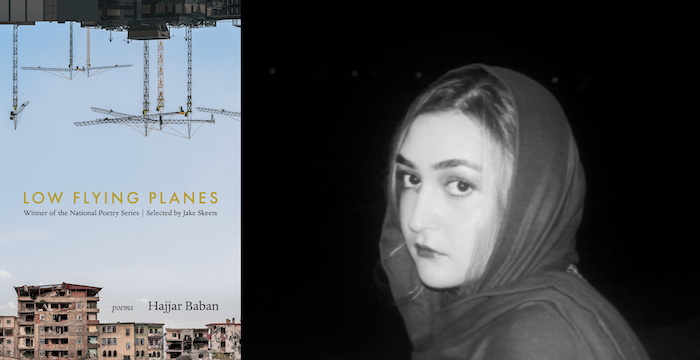
Today’s guest, poet Hajjar Baban, discusses her truly remarkable debut collection of poetry Low Flying Planes. Together we explore Kurdish poetics, the role of silence, refusal and isolation in her work, the Kurdish Poets Collective, writing lineages, and much more. Selected for the 2025 National Poetry Series by past guest of the show, poet Jake Skeets, Jake says of Low Flying Planes: “…if tradition is to be made whole, if memory, if truth, it begins with a book like this. I’m eager for the world to enter this one and emerge on the other side transformed, into a place where words are both nourished and at stake. I’m eager for this poet, for a new voice that asks us to change. It is my honor to introduce this marvelous work.”
For the bonus audio archive, Hajjar contributes an extended reading of short poems by Eugène Guillevic and a discussion of his influence on her work. This joins readings from everyone from Jorie Graham to Omar El Akkad, Dionne Brand to Isabella Hammad and more. You can learn how to subscribe to the bonus audio and about the other potential benefits and rewards of joining the Between the Covers community as a listener-supporter at the show’s Patreon page.
Finally, here is the BTC BookShop specific for today’s episode. And don’t miss Milkweed Editions BookShop as well.
Transcript
David Naimon: Today's episode is brought to you by Red Nun Collective, a new nonprofit literary endeavor that publishes books, follies, and ephemera. Co-founded by friends Mary-Kim Arnold, Kate Colby, and Darcie Dennigan out of Providence, Rhode Island, Red Nun says they want to die on a hill of books. Their first title is Shrine, a novella by V.H. Wildman about the idiosyncratic and elusive artist Paul Thek, whose sculptures and installations were not made to last. In her introduction, Rosmarie Waldrop says that Shrine is an extraordinary book that fuses documentation and fiction in an unusual homage to an unusual artist. Red Nun's mission is to collaborate with artists and writers who attend to the possibilities of language, and they've commissioned four works for 2027, including a book-length essay on era poetics called Sabah from Brandon Shimoda and Dot Devota, a prose piece called Wealthy White Women by Evelyn Hampton, new poems by Farnoosh Fathi, and an experimental music text score by Bonnie Han Jones. Visit rednuncollective.org to follow and support their work. Today's episode is also brought to you by Exhibit G: Poems, Essays, and Photographs of Gaza by Fady Joudah. From a National Book Award finalist comes a collection of poems, essays, and photographs that offers the Palestinian representation of the unwavering resilience and prevailing life force of people and place enduring genocide. Writing from the split perspective of a Palestinian-American physician caring for the sick while watching the destruction of Gaza from the United States, Joudah presses his reader to comprehend the experience of both the individual and the whole, centering dignity, tenderness, and resilience with photographs from the Gaza soup kitchen. Exhibit G insists on Gaza as a living community rather than the abstraction of suffering. Exhibit G is available for pre-order now at milkweed.org. One of the great pleasures of engaging with a debut poetry collection is that sometimes you're lucky enough to encounter a voice that is not only new, but also that feels like it has such a distinct gravitational pull that you imagine it will join whatever forces shape poetry going forward in the years to come. That perhaps, looking back a decade from now, people remark how you talked to that poet way back when. I felt this in reading the poetry of today's guest, Hajjar Baban. Of course, every poet, even ones who seem to arrive fully formed, has their influences and place themselves within writing lineages. And we talk about several today for Hajjar, from the Kurdish poet Sherko Bekas to the poetry of Paul Celan. But one poet whose influence on Hajjar we don't explore in today's conversation is that of Eugène Guillevic. I'm happy that for the Bonus Audio Archive, she decides to engage directly with the work of Guillevic because within her poetry collection, she makes explicit nods towards his work, just as she does with Bekas and Celan. But unlike the work of Celan, Guillevic's not as well known, but should be. And when you hear her read Guillevic, it will deepen your understanding of Hajjar's work too. Not to mention that, much like Eleni Sikelianos' recent electrifying reading for the Bonus Audio from H.D.'s Trilogy, I was left wondering after listening to Hajjar speak about how she came to Guillevic's work and its importance to her, why I haven't been reading him all this time and eager to make up for lost time with both H.D. and Guillevic. Hajjar's extended reading of his work for us joins so many other great bonus readings, whether Jen Bervin reading from Paul Celan's letters, then talking about his influence, and then reading a poem written under his influence; Rabih Alameddine reading and talking about Pessoa; Jorie Graham reading Creeley and Edward Thomas; Omar El Akkad reading Jorie Graham; Ross Gay reading Jean Valentine; Richard Powers reading W.S. Merwin; or Madeleine Thien reading a Gareth Evans poem that Evans wrote for John Berger, Hold Everything Dear. This only scratches the surface of all there is to explore in the Bonus Audio, which itself is only one of many things to choose from. When you transform yourself from a listener to a listener-supporter by joining the Between the Covers community, you can check it all out at patreon.com/betweenthecovers. And now for today's conversation with Hajjar Baban.
[Music]
David Naimon: Good morning and welcome to Between the Covers. I'm David Naimon, your host. Today's guest, poet Hajjar Baban, has a BA in creative writing from the University of Wisconsin-Madison, where she was part of the First Wave Spoken Word and Hip Hop Arts Learning Community. She then pursued an MFA in creative writing at the University of Virginia as a 2021 Paul and Daisy Soros Fellow for New Americans. But Baban's life as a poet precedes her university education. In Michigan, in high school, she was involved with Citywide Poets, an after-school writing program in Detroit, which ultimately led her to be nominated by their parent organization to serve as Detroit Youth Poet Laureate, which she did in 2017. She was then considered for the National Youth Poet Laureate, where she was the 2018 runner-up for the national title, whose ultimate winner that year was Amanda Gorman. During her time at Madison, she published two poetry chapbooks, Relative to Blood and What I Know of the Mountains, winner of the 2018 Rick Campbell Chapbook Prize. Her writing has appeared in Mizna, The Markaz Review, Pleiades, Guernica, and Poetry Daily, among many others. It's also won the 2025 Hayden's Ferry Review Poetry Contest, as well as garnering a Pushcart Prize. She's a poetry reader for Muzzle Magazine and poetry editor for Half Mystic, an international interdisciplinary publishing project dedicated to the celebration of music in all its forms. Her work has been anthologized in Sleeping in the Courtyard: Contemporary Kurdish Writers in Diaspora, and is engaged with at length in the academic study, Anglophone Kurdish Narratives Unveiled: Readers as Witnesses, Witnesses as Resistance. She's also the co-founder of the Kurdish Poets Collective. Hajjar Baban is here today to talk about the arrival of her first full-length poetry collection, Low Flying Planes, selected for the 2025 National Poetry Series, by past Between the Covers guest Jake Skeets, and coming out with Milkweed Editions. Baban joins past winners of this distinction, including Terrance Hayes and Patricia Smith, Eleni Sikelianos, Tyehimba Jess, Douglas Kearney, and Jake Skeets himself. Douglas Kearney says of this book, “Poet Hajjar Baban’s LOW FLYING PLANES haunts with what won’t, can’t, mustn’t be said or understood. Questions left unasked, jokes one oughtn’t tell, Kurdish names vaporized in flanking brackets—these silences compose this startling debut’s anti-lexicon. It’s emptiness that sends the deepest reverberations and Baban’s unyielding echoes.” And Pulitzer Prize-winning poet Diane Seuss adds, “At its best, poetry shapes, from the voices and experiences of our people, our homelands, and ourselves, an approach to language that is revivifying and radically inventive. The poems of Hajjar Baban’s LOW FLYING PLANES do just that, navigating a landscape and a self composed of shards born of multigenerational displacement and violence. ‘She worries about which life / to birth, which meaning to speak,’ Baban writes, and that engine of worry, in balance with the will to speak, the pulse and ingenuity of her syntax, and the design of the fragments of narrative to which she has sporadic access, are the keys to her superb artistry.” And finally, Jake Skeets, in selecting this book, declares, “I look to experience the world through the lens of a poem. Not because I long to step into another’s shoes, but because I hope for the light to be slanted when and after I read. I want to leave a book of poems altered in some way. This collection proves that poems can hold immense beauty, history, and region, and that if language is to be made whole, if tradition is to be made whole, if memory, if truth, it begins with a book like this. I’m eager for the world to enter this one and emerge on the other side transformed, into a place where words are both nourished and at stake. I’m eager for this poet, for a new voice that asks us to change. It is my honor to introduce this marvelous work.” Welcome to Between the Covers, Hajjar Baban.
Hajjar Baban: Thank you so much for having me.
DN: So I had suggested to you last week, and you were enthusiastic about the idea, that we start with a reading of a poem called "The Answer" by poet Sherko Bekas, perhaps the most notable modern Kurdish poet, a poet who in the 1970s was part of a movement in Iraqi Kurdistan that broke away from rhyming couplets and the strict meter of traditional forms, and also used a more everyday vernacular within their work. We'll hear part of this poem again much later on today when you read one of your own poems that incorporates part of this poem as an epigraph. But I wanted to first, before we hear it, orient listeners to one detail I think that won't be legible to those unaware of Kurdish history. The first two words are "After Halabja," which is referring to the Halabja massacre, the largest chemical weapons attack directed against the civilian population in history. And it was perpetrated by Saddam Hussein against his own Iraqi Kurdish population, killing many thousands, and which was ruled decades later by the Iraqi Criminal Supreme Tribunal as a genocidal massacre. And I know that encountering Bekas's work in general was important for you as a poet. So whether before or after you read, if you want to speak about him as a figure or as an encounter or about this specific poem, I'd love to hear your thoughts about it.
HB: Okay, thank you. Yeah, I'd love to just begin by reading that poem and say a bit more after. I also am unsure of the exact title of this poem. When I encountered it, it was titled "Answer." Now this version that I have and hold on to is not available online as well. So just context for if someone's like, "That's not the title."
[Hajjar Baban reads a poem called The Answer]
HB: It's layered and still in progress, my relationship to Bekas. He was the first Kurdish writer I had ever heard of. So that alone sets up some kinship, almost, I feel like, especially in terms of literary lineages. Even before I thought of writing through Kurdishness or what that would mean, there was at least proof that there are Kurdish writers. Obviously, there's a long literary tradition in poetry for Kurds. I don't know Kurdish, so it's hard to access that. So this is a great poem to understand some of what draws me to Bekas. There is the kind of explicit nature in the opening of what the poem is setting itself out to be about, but there's also something that I really admire that I think of my own work as not doing this, but the way that he's making the landscape and what runs through it come alive. The tree crying, the bird, this quote, like I said, well, actually, the quote that comes before it too. I mean, you know, "the great God, who can see him?" There are so many echoes in that, like in writing about and questioning God, that I haven't—I don't think I've gotten to the depth of that in my writing yet. But I think that kind of simplicity is definitely something I look to. But that line that comes after that, "I said, thank you, fly." Just really seeing the image of what does move through his work and the way that he writes through the landscape, I really admire it, even as I get to know and learn more of his work. That balance of the explicit nature and his dedications, almost, I want to say, in his work, whether that's through Halabja, this poem, or certain Kurdish figures who have been assassinated in history and stuff. So yeah, there's a lot to learn from him. I think it's really layered for me. It's also something that's like, you read a little bit of an introduction about him before we jumped in, and some of that was still news to me. So there's also a distance that I still have too. So yeah, it's like I've read several of his poems, and I've encountered some of his work at a much younger age and thought only of it in terms of, "Oh, this is a Kurdish writer, and it's in English, and I can read it." I don't want to—I don't know if I do this with any writers—really learn too much, you know, outside of the work or what initially drew me to them.
DN: So silence in many different ways is an important way through which you frame your own work, both, I think, within the poems and within your discussion of your poems. For instance, your craft talk titled Silence as Form: Navigating Forced Isolation in Kurdish Poetics, or in the recent Kurdish-themed issue of The Markaz Review, your essay, "What's Form to Silence? Kurdish Poets on the Impossibility." But while we will explore, I think, different ways you engage with and employ silence today, I think it felt important to start with God's silence, this sense of forsakenness in the Bekas poem. In the same issue of The Markaz Review as your essay, the Kurdish poet and dancer, Pinar Banu Yaşar, who is part of the Kurdish Poets Collective that you are a part of, they engage with Milton's Paradise Lost, speaking of the relationship between Satan and God. She says, "Their relationship is embroiled in the language of colonialism, positioning the banishment from Hell as a violent birth of the nation Heaven — a place Satan and the fallen angels may never return to, despite it being their home. Satan seeks to find a way to endure what he has lost. For me, Satan is a way to explore my own experience of statelessness as a Kurdish person. The endless abyss of Hell, which God himself never visits, mirrors for me the Kurdish diaspora, my hell which origin never visits. I linger along the fractures, as does Satan, and we both desire comprehension beyond borders." When I think of Bekas's poem, one poem of yours it makes me think of is your poem "Of His Names We Remember." I was hoping you might introduce us to "Of His Names We Remember," and we could hear it along with "Conventional Warfare."
HB: Yes. Okay.
[Hajjar Baban reads a poem called Of His Names We Remember]
[Hajjar Baban reads a poem called Conventional Warfare]
HB: I just wanted to say, like, in terms of the line that I pointed to that made you think of that, "Of His Names We Remember," you know "the great God, who can see him?" I feel like it also makes me think about Gwendolyn Brooks's poem, "The Preacher Ruminates Behind the Sermon." I don't know if you've ever read it, but the way that she writes about God in that poem too, it's so interesting to me how thinking of God as alone or lonely, or even here, like asking that question, you know, "the great God, who can see him?" and asking that to the absence or to, you know, what is happening and isn't, is making you question God. Yeah. That poem, the Brooks poem, "The Preacher Ruminates Behind the Sermon," I read a long time ago, probably around the same time that I learned of Bekas. So it's so interesting, rereading this poem and also having read it recently while writing that essay and thinking specifically of those lines rather than the refusal that happens at the end. It's like those little moments that sneak in and make you think of all of the layers and the questions happening beyond just, again, that very explicit refusal at the end that makes you think away from God for a moment and think back to language and Kurdishness and those things. But yeah, it made me think of that.
DN: Well, silence and forsakenness is not just or mainly from God in Low Flying Planes. It is in many spheres, from the familial to the geopolitical, to your own ways you employ language on the page. As you say in the poem you just read, that as the youngest in your family, you were the one without your own memories of your family's history. You alone having to reach back for details that are not known to you through experience. And there's a silence you have because of that, that even your siblings have to a lesser extent, and that feels enacted in the collection, which isn't a collection that is a primer on the history or geopolitical situation for Kurds now or historically. Even a poem with a title like "On October 13th, Kurdistan's Peshmerga Forces went under attack by the Iranian-backed Shia militias near Kirkuk," which might suggest on first encounter with this title, unlike most of your poems, that it's going to narrate a political event, or at least, if not narrate a political event, explore one. But this poem too is about silence and absence. It's about what you don't say: "I don't actually talk to any of my friends about the politics; I know too much in simple words." And also it's about what you don't know: "The only thing I know of the mountains is that when I get there, the sun disappears. I can barely pronounce Kirkuk. I don't know anything about oil or the difference between Shia and Sunni. I don't know the geography of Iraq. I want to hold all of the world and tell my father I put the flag in my room." Nonetheless, while I think one can have a deep experience of your work without knowing more than what you present, I wanted to know more. Your poems led me to want to know more. And I'm going to share a little bit of this, I presume, very basic information as a preface to asking my next question, but also so all of the people listening have some shared ground. So just indulge me for a minute before I get to the question. But in thinking again of forsakenness, I think also of how after World War I, when the Ottoman Empire was partitioned, the resulting treaty called for there being a referendum in the Kurdish homeland, but Atatürk refused the treaty. But once the post-Ottoman Turkish borders are established and Kurdistan is carved up between four countries, Iran, Iraq, Syria, and Turkey, the history for someone like me, a novice, is quickly bewildering because Kurdish culture and language and rights are subordinated by four different countries and three different peoples, Turks, Arabs, and Persians, where the Kurdish language is suppressed and marginalized by Arabic, Farsi, and Turkish, and sometimes criminalized, with forced mass relocations and displacement by the two Arab countries, brutal suppression by the Persian government during the Iranian Revolution, and both depopulation and eradication of villages in Turkish Kurdistan. But on top of that, any individual country that is suppressing its own Kurdish people, they're also, at the same time, often funding and assisting the Kurds in a neighboring country that they're in conflict with. And then that country as well, while suppressing their Kurdish population, could also be funding factions in another country. Not to mention how outside actors from the Soviets to the Israelis to the Americans intermittently support various Kurdish groups, perhaps most notably the Peshmerga fighters against ISIS, but almost always abandoning them when no longer needed. So betrayal seems to come in every direction. And again, your book isn't directly about this. It doesn't explicate this, just as it doesn't explain the Halabja massacre either. So my presenting all this information now, I think, might be misleading in this regard. But I say this here because it plays a big role in not only how your family becomes a family, but on the questions of language and silence within your family, which is a big part of this book. Your mother and father met in Pakistan as displaced people, one from Afghanistan, one from Iranian Kurdistan. And the most palpable silence in this book, to me, is your father's silence. Both his silence regarding your family history, I imagine, what he saw and experienced, but also the lack of transmission between you and him, as you were not raised with the Kurdish language, his mother tongue. You've quoted another Kurdish person stating in a barbed fashion, "Never say you did not understand the Kurds. We spoke all your languages." Because everyone who speaks Kurdish has to move through the world with another language or languages. But your household, in contrast, has languages spoken by some and not by others. And I was hoping you could describe the situation linguistically for you growing up in Dearborn, Michigan, both in the house and in the world, the gaps and the overlaps, who spoke what and when, and also about your relationship to the language you don't speak, to Kurdish as well.
HB: I first learned Dari, which is the version of Persian spoken in Afghanistan, with my parents, with my family, before learning English in school. My parents don't speak English, so it's still to this day the language that I use to speak with my mom and occasionally, very little here and there, with my father. But there are two answers to this question. One is the answer of in the home, I really only ever heard my father speak Kurdish when he was on the phone to either his sister or, growing up when she was alive, his mom, and sometimes his brother. So really, literally just his family, I would hear him speak in Kurdish too. I don't really even have memory of hearing him speak or hearing his Kurdish friends growing up speak Kurdish to each other. So in those contexts, I would usually be hearing Arabic, which brings me to the second part of this question. And I think growing up in Dearborn, there was English, obviously, living in America and going to school and stuff like that. But I would say I had much more proximity and knowledge of Arabic than I ever did of Kurdish, much more knowledge of it as well. I mean, I did go to Islamic Sunday schools growing up on and off. I really don't have the best memory, so it's distant in terms of the experience and what it felt like learning that language. But it was the language of many of my peers, if not almost all of them, growing up. So it's weird. I mean, even now I still feel less question about my identity as it relates to knowing or not knowing that language of Kurdish. But I think it definitely added to growing up a confusion around what is and isn't, if that makes sense.
DN: It does. You were in a conversation with Giovannai Rosa, where you talk about the language you did speak with your parents, Dari, that even here, even within this question of speaking Dari, the shared language of your home, the Dari at home was not the Dari you learned in school, which was actually Iranian Farsi, a relative of it. But also on top of that, it's a more academic presentation of language in school, which was very different from the way your parents spoke, who didn't go to school. And you say to Giovannai that one of the ways you came to language is through not being able to communicate, not only in the languages you were never given, but even in the ones you first spoke in, like the language at home. And I wondered if you could talk more about that and how that connects to you as a writer of poems and as a poet.
HB: Yeah, it's a really, really great question. I remember being like, "I wanted to take Persian so that I could have words for what I never did." I mean, with my parents, words that we just never said, whether that is beautiful, or whether that is something like anxious, or, you know what I mean, sad, even. And the conversation you referenced, it was still a distance because there are so many words for beautiful. And then many of those are regional. So what would be said in Iran is not the same as what would be said in Afghanistan. But I, to this day, will learn that the way that I'm using a word in Dari is incorrect. Because sometimes, occasionally, when my mom has the energy for it, she will be like, "That's not what you think it means." Like, I was trying to use the word for evil, and I accidentally used the word for enemy. But I would be going off of the feeling that I picked up on of hearing this word growing up. But I never knew that it was the word for enemy and not the word for evil. You know what I mean? And so I think it relates to the way that I enter a poem, because I always feel like there's, even when it's not necessarily explicitly the project of the work, a way that I'm still questioning underneath how I'm using a word or how I'm coming to the sentence. And I think I've gotten this note a lot throughout my life of my syntax. And I think it's really interesting because there are different reasons why there is that tension or what other people are reading as incorrectness. I think that's definitely because of the languages and the lacks with them that are moving through my head. I also think it affects the way that I read, too, and the way that I understand poems. So, yeah, I read a poem and I'll have that feeling after reading it, or a certain line that really jumps out to me, or what I think the poem is about. And then after reading that poem six or seven times, I'm like, "Oh, this is what happened in the poem. The speaker is alone at home," or something like that. It's been four hours, four hours have passed, or however amount of time for the sun to go down. But all I felt was the aloneness, and I didn't see the lights going off. So I feel like there's some of that, both in the way that I read a poem, but also in the way that I come to a poem, in the way that I construct a sentence.
DN: Yeah. Well, Giovannai, in that interview, when you're talking about language, quotes the Algerian Jewish philosopher Derrida, who said, "I only have one language. It is not mine." And he's speaking of French, the language of the colonizer of his country, which makes me think of your line, "I couldn't make sound in our only language." But another poet that comes up often for you, sometimes in your poetry and even more so in interviews, is Paul Celan, a German-speaking Romanian Jewish poet who, after the Holocaust, his family murdered, ended up in France. And I could imagine this impossible dislocated history might be what speaks to you, or that he, like Derrida, was vexed that his language was the language of his family's killers and how that changes his relationship to it. But of course, it might simply be his far from simple poetry itself. So I was hoping maybe you'd just speak to us for a moment about Paul Celan for you, whether his poetics and sensibility in relationship to yours or your favorite or influential poems or something in his biography, whatever comes to mind, that you often name him as an important part of your poetry cosmology.
HB: Yeah, I think it's definitely what's moving underneath the poems. I think before I encountered his work, for a while, I would read books of poems without anything clicking in my brain. I could appreciate a line or I could appreciate a poem on its own, but it was really hard for me to enter the life underneath. So I definitely feel relation with his words, with Celan's words, and his work outside of what I came to learn of him after encountering his work and understanding what can't live on the page and has to in a different way. Definitely in terms of the silence that's happening there and the fragmentation, I feel like.
DN: Could we hear "Reading Celan in Dearborn, Michigan," and then afterwards the first two paragraphs of your new essay, "What's Form to Silence," as a preface to a question that's going to be asked to you by another?
[Hajjar Baban reads a poem called Reading Celan in Dearborn, Michigan]
HB: So this is the beginning of a recent essay I wrote titled, "What's Form to Silence? Kurdish Poets on the Impossibility."
[Hajjar Baban reads an excerpt from What's Form to Silence? Kurdish Poets on the Impossibility]
DN: So our first question from another is from the poet Tracy Fuad, who is a member of the Kurdish Poets Collective you are also a part of and co-founded. She's a Kurdish-American poet living in Germany, where she directs the Berlin Writers' Workshop. Her latest book, Portal, with a starred review from Booklist and praised by many past guests of this show, from Monica Youn to Douglas Kearney to Joyelle McSweeney. Joyelle says about it, "The gene-editing technology CRISPR works by looking for palindromes in genetic code, snipping the line just there, and splicing in new material. I thought of this while reading Fuad's PORTAL—how sound and thought and poetry arrive, split us open, and go off somewhere else, and we are the point of that snip, that splice, that split, rather than anything's origin. But who is doing the snipping—the fates, the gods, the rich? The sheer, mercurial stuff of PORTAL will synch you to its thinking til you wake with your locks in the sink and the shears in your hand." Here's a question for you from Tracy.
Tracy Fuad: Hajjar, it's Tracy. It's such an honor to be beamed into this conversation with you and David. I love the way that radio exists everywhere and nowhere. I've just been so moved by reading your work. So it feels fitting to be recording this just a few weeks after I was lucky to cross paths with you in London and to be leaping into the future and the future paths of this recording. And I think that's a little bit where I want to go with my question, thinking about distance, latency, absence, and erasure. When I was reading these poems, I was so struck by the way your work both enacted and worked against absence. I think absence and silence and distance is such a fundamental precondition to Kurdish diasporic identity. And I was really in awe of the way that your poems both used formal moves in their holes and fracturing, as well as in the repetition and use of erasure and found text and citation. And I was maybe most moved and interested in this recurring motif of rocks throughout the book from the very first epigraph, including the one from Glissant: "I build my language with rocks." And rocks appear again and again, both as this hardened non-human, non-subject, and as a stand-in for weapons, but also as a foundation, as a solid ground, and even rock as bliss in one poem. And in the final lines of the book's final poem, one of several poems which shares its title with the title of the book, rocks appear again, you write, "My attention was to what would fall, how a name is made, what loss decided, living in rocks in my reign." So I wanted to ask about your attention to absence and silence, as well as repetition and citation, either while you were writing these poems or later as the book began to come together or as it is doing now, moving into the world.
HB: Oh, my God, I'm literally going to cry, Tracy. What a beautiful question. And I feel like it was really fitting for us to read Celan to work up to that question. I feel like when I felt most alone while writing this book, a lot of which was in the very thick of isolation, I went from undergrad immediately to grad school. So I had a summer home, and then I was in this new place I had never been, and I did not know anyone. I feel like I really felt at home in Celan's words and also other poets that are mentioned in the book. Tracy mentions the rocks motif, and I think that attention to absence and silence, I feel like so much of it is very literal and the way that I felt like I could physically place myself in how alone that I felt, like being out there. But it was also not very different from how I have come to know my life and understanding of my life in America. So remind me of her question again. It wasn't just—what was the question? [laughs]
DN: Well, she asked many.
HB: Yeah, she did.
DN: She asked many things, or at least alluded to many things. I want to extend—can I extend her question?
HB: Yeah, yeah, please.
DN: And we'll consider it that we're still in the aura of Tracy. But one thing that what you just said reminded me of before I do that is that Celan's late prose writings, Pierre Joris, the translator, translated them as Microliths, which he translated because Celan called them pebbles. So it's interesting, thinking about rocks and how you were drawn to some sort of substrata, some sort of bedrock of the unsayable that you were sensing in Celan, that just seems really interesting about Tracy's question. But I wanted to stay with Tracy's question about the ways—oh, this is what she, I think, this is central to her question—the ways you both write into and also, in a sense, work against absence, but also at the same time enact and reproduce absence. Because I feel like this is true in your work. For instance, you have in some poems the bracketing of white space, which reminds me of Anne Carson's translations of Sappho, where she brackets what we don't have of those poems. So it's not like she just presents the fragments of Sappho. She makes us very visibly aware of what can't be retrieved. Or the black redactions in the poem, "The One Color the Afghan Flag Has That the Kurdish Flag Doesn't Is Black." So sometimes we're invited into the silence, into the silence that you're experiencing. But other times I think you're employing silence in a different way where you are within and we are without. And it makes me think about how Paul Celan was disturbed by the way the German public metabolized and celebrated his Holocaust poem, "Death Fugue," a poem that was massively successful. It entered the German pedagogy. It was in textbooks and schools, and it was taught in this super widespread way. And he ultimately felt so disturbed by this, what he saw as an aestheticization of trauma, where the poem had become a lyrical commodity of the unspeakable, and where it became, in his mind, a way to ease national guilt rather than to confront national guilt, that he not only refused to recite it or have it in future collections, he reevaluates his entire poetics, a poetics that becomes more spare and fragmented and maybe we could say pebble-like. And he ultimately argues that poetry must maintain an essential hostility to art, that it should be artless, art-free, producing a grayer language, a grayer language coming from a wounded mouth. And I think of this when I think of a recent reading you did of a poem for the Poem-a-Day podcast, where after the poem, you're supposed to speak about the poem. But instead, after you read the poem, you say this, "About this poem, I wanted to begin to touch the surface of silence as it built my life. Demystifying this poem would go against the thing that allows it to work. It would unravel the lie in what I tried to declare. Anyway, a lot of it is in that word beyond." It feels like this is a refusal, perhaps in the way Celan is refusing. But either way, a pushback against a curiosity to know, perhaps, or to explain. So thinking back to Tracy's question about how you both are exploring absence and speaking into absence, but also you're employing absence. And I wonder if you agree and if you could talk about, as part of your answer, the refusal to be transparent or forthcoming as part of your poetics.
HB: Yeah, I originally just wrote, "A lot of it is in that word beyond," and they did not like that.
DN: [laughs] They did not like that.
HB: They did not like that. They refused my refusal. They were like, "People who have never read poems are subscribed to our daily poem service." I'm like, "Okay, this is not the first poem of the day." [laughter] But that poem specifically, it felt like—I will say, I don't know, you can keep this on or off the record. It might feel like a little bit of divergence, if I'm using that word correctly, but I had a packet of three poems for Oliver. I just ran it to my editor of the book, Morissa Young. And I was like, "What do you think? Does this align with what Oliver is asking for?" A lot of times, actually, it's really difficult for me to think of my audience or what would be the best thing to read. So actually, that "Low Flying Planes" was my editor's suggestion. The first two poems, she's like, "Yeah, that's great, but wouldn't this poem make more sense for Daybook from Exile?" And it made a lot of sense. But as a writer, because, you know, Oliver chose it and Academy of American Poets chose it, but as a writer, I think my instincts to what poems I think reveal or say a lot are actually really different from what editors, friends, people actually think hold the weight of what I think I'm doing in other poems that I feel much more comfortable to read. I mean, even the two poems that you had me read, "Of His Names We Remember" and "Conventional Warfare," they're not poems at all that I read during readings or anything, interviews and stuff. So it's always really great to hear and learn about my own work in that way. And sometimes I'm like, "Okay, I need to push myself and meet what's already there." So I just wanted to say that as an aside because, again, I said earlier about my relationship to language and how that affects how I write and also how I read other poets. But I think another layer of that is how I read myself as a poet and how I'm thinking of these poems as I write them. I think aside from the intentions that I have, there's also just, I think, something else that's happening for readers that I'm not always aware of. I think then I revisit a poem and I'm like—because I will ask myself, "Did I lie in that line?" And we're poets. I'm a Libra. We're definitely allowed to lie. But then I will look back at a poem like that, "Low Flying Planes," that you mentioned in Poem-a-Day, and look at each line and think, "Oh, wow, there are layers to this." [laughs] Even about the naming, I was like, "Did I really lie in that line? Is this what my name really means?" And I was like, "Yes. No, you did not lie. That is literally true." And so, yeah, they wanted me to demystify. And it felt like I was like, "Whoa, I thought this was so clear," just in terms of what I thought was living underneath the poem or the ending, especially, I feel like as a thesis to the feeling I was trying to paint or write through. But to answer your question and to answer Tracy's question, I think that there is definitely a resistance to naming. And I think that is one part personality and part my relationship to the way that I have encountered certain poets, teachers, who have demanded, like, "Oh, write about this thing and write it this way. Say this thing." So there's definitely a resistance to naming. Then there's also the tension that exists because I do want to write through these things. And then there's another layer where it's like, at least with this book, I don't know that this will forever be true for me as a writer, but I don't just want the poem to be that resistance. I do want to sometimes reveal things the way that I know them or I've learned them to be true and find a way for that experience to match up as close as it can in the writing. Maybe it's easier to think of the empty white space in the brackets, easier to think of that than to think of the blackout. And that would be true for the experience of me writing them. There's an erasure that feels violent, like the severity of the experience of it and the memory of it. Then there's one that almost feels like happenstance erasure, or a bit more mundane, even though it is still violent, if that makes sense. Yeah, grayer language is—that's Celan, the grayer language, that is so real. Also, Glissant's notion of opacity as well. I think I want—I don't know, this is going to sound so romantic, but I would want someone to come to my work the way that I came to, for example, someone like Celan's work, which is maybe not knowing about the specifics of my fractured experience of identity or certain... yeah.
DN: I love that aspiration. That's really beautiful. Well, in the aura of Tracy's question, let's hear two more poems. I was thinking "Two Truths and a Lie" because that poem, I think, is interesting because just the title invites a curiosity but also includes a refusal in not telling us which is which. So we know there's potentially going to be a limitation to what we're going to discover, and yet there's a seduction to read. Then also "Unconventional Warfare."
[Hajjar Baban reads a poem called Two Truths and a Lie]
[Hajjar Baban reads a poem called Unconventional Warfare]
DN: We've been listening to Hajjar Baban read from Low Flying Planes. So thinking of opaqueness in relation to Kurdishness, I wondered if you could speak a little to your experience growing up in Dearborn. You talk about this on the Halal Metropolis podcast, how you presumed that being visibly Muslim, going to high school in a hijab, that you would be legible to your peers in some way that you ultimately weren't entirely, that in a way you were mistranslated in a sense. It makes me think a little, when Charif Shanahan was on the show, one of the things he was exploring in his poetry and in our conversation were the non-Arab peoples within Morocco and their relationship to the dominant Arab culture. So some of that was about blackness, but some of it was also about Amazigh culture too, the indigenous culture that predated Arabization in the Maghreb, and the linguistic, cultural, and religious erasure when a country is framed around Arab nationalism versus seeing itself as its anti-colonial liberation as being one that is multi-ethnic. When I listened to you on the Halal Metropolis podcast, it was before I learned anything about Kurdish history. So my initial naive response was surprised by your experience in Dearborn. But then after learning a little about the Kurdish situation in Iraq and Syria, and also how there is a negligible Kurdish population in Dearborn, which is the epicenter of Arab life in the United States, it made sense that things might echo or reproduce themselves in some ways in North America, whether that resulted in being opaque to understanding or maybe being seen in ways that foreclose understanding. I don't know if this is even speaking to you, but that conversation you had made me wonder a little bit more about your experience outside of the home in Dearborn. You've already alluded to the fact that Arabic was, of course, the language that you were engaging with more than Kurdish or Dari.
HB: I don't know. Something is coming up for me, like immediately after reading that poem, but also after hearing your question. I remember having this one friend. I must have been in elementary school. In Dearborn, for those who are unfamiliar, the population there, like a lot of Arabs from Iraq, from Yemen, from Lebanon. There are smaller populations of Palestinians, Jordanians, et cetera. But in the time that I grew up, mostly people from Iraq, Lebanon, and Yemen. So I remember having this friend growing up, and I must have been in elementary school, and she was Iraqi. I remember being like, "Oh, my dad is from Iraq." The next day she tells me, "Oh, my mom heard your last name and was like, 'Oh, you're Kurdish.'" I remember that being one of the first times hearing that told to me. So it was really interesting, just that kind of, again, proximity and distance. It's also interesting thinking of myself, for a while, not understanding what that meant, or even knowing, again, how to introduce myself as Kurdish, especially because there was already the fragmentation or the fracturing of my identity just in belonging to more than one culture and ethnicity, with my mom being Afghan. Like, that wasn't even, even though I spoke the language, wasn't even something that I could conceive of because I couldn't see it around me. So it was like, here is the entry point of my relation to those around me. Then, even in that, seeing how visible it could be to other people. Obviously not that person that I was friends with, because what did we know? But her mother being like, "Oh, she's Kurdish, her last name is Baban." To this day, I still remember that because it was like this kind of clarity but also a reminder of that thing being marked and being different and it implying what the reality was, which was a different experience, a different relation. So yeah, growing up, it was really confusing. I feel like whether that was within my own home and the way that my dad had a lot of Iraqi friends who he only spoke Arabic with. I mean, they only knew Arabic because they were Iraqi Arabs, and he had maybe one or two Kurdish friends. Even that, I feel like also what I am learning of my dad and of where he comes from wasn't through the lens of his very specific experience. This might be an answer to a different question, maybe what I hadn't gotten to the point of revealing earlier when asked about that silence or what it was like, but I couldn't, and I still can't necessarily access my dad in that way of the language that he first learned or the memories that that connects him to, and even what it sounds like for him to speak that language and what it reveals of him. It felt very confusing, and it felt very something that I was made aware of, also I couldn't know too much about ever. I think in this poem, in both of these poems, kind of, in "Two Truths and a Lie," that impulse you picked up on of the mystery or not knowing which one is which. In this poem, the note about not revealing the full history or refusing the language correction. I feel like there's also a way that if I'm specifically the one writing these poems, as opposed to my elder siblings, I actually couldn't do it with my whole chest to write a poem and say, "This is what happened," because there's also a big disconnect with the trust of my own memory and the way that I am told things have happened. It almost feels like every time I learn of my father's history, whether that's from a sibling or from my mom, each time this story sounds different or something else becomes true or false in it. Yeah, I think maybe I'm getting away from your question a little now.
DN: Well, I want to ask the flip side of this, and maybe that will round this out, because I'm also curious about the Kurdish Poets Collective, which you and Tracy are part of, in your experience there. I watched an event with the two of you and two other Kurdish writers in the collective. For some of you, this was the first time in your lives to gather, if remotely, with other Kurdish writers, which was very moving even simply for me as a bystander and a witness. But one thing that struck me was how profoundly different the four of your experiences were in so many different ways. One's relationship to the Kurdish language, for one, from someone with no relationship to another growing up in Turkey where there were consequences for speaking Kurdish out loud and a sort of self-surveillance around language. Also, whether one grew up in a culturally Kurdish household or whether one sought out Kurdish community for the first time by moving for a while to Kurdistan to work or teach or study. Also differences in religion and religious observance and very much, of course, differences in demeanor and style and delivery. So I was wondering if you would share what it's been like for you, what, if any, surprises have come out of it, like how it's been versus how you imagined it and/or what you're planning as a collective?
HB: So actually, Tracy and I had spoken back in the day when I still had Facebook. Then it wasn't until a year or so later that I saw her and Holly Mason Badra, the also Kurdish American poet. I think maybe it was for Rawi. Maybe they did, like, a virtual reading together. I think shortly after that, the four of us co-founded the Kurdish Poets Collective. It was so different from all of the distance that I grew up with around Kurdishness because, like you said, we all have these very different experiences with Kurdishness. It definitely challenged very quickly those beliefs and allowed me to step away from them just in terms of belonging and claiming Kurdishness in a sense, which I would say now, I look back on it, and I only really experience the disconnect when I'm not around Kurdish writers. So meeting them kind of really opened up this clarity around not having to worry about how little or how much I knew and didn't know, which I would say is very different from how I feel around Afghans when it comes to, even though I speak the language, it feels like almost there's more distance there. I wonder if it has to do with that silence of, like, every single Kurdish person that I know or have met has a very immediate relationship to violence in a way that I don't necessarily think some Afghans, even with the context and the way of what that means, can feel a little bit more distant from that or feel like there are other things kind of moving along the conversation of relation. So it was really interesting. It kind of got rid of that belief of not being able to belong.
DN: Well, before we hear some more questions from others, I want to ask you another question about Kurdish community and belonging. The final lines you read from your essay, which isn't the end of the essay, but the final lines of the part that you read of the essay has you quoting the Kurdish line, "No friends but the mountains," and how you, when you hear this phrase, can't help but feel that it sounds like you don't even have yourselves as friends, fellow Kurds. Your chapbook, What I Know of the Mountains, I presume is named in relation perhaps to this phrase. But the essay continues from there where you learn from another Kurdish person that the origin of this phrase is actually from a historical book written by two white guys in 1992. So the forsakenness that Bekas expressed in the poem that we opened with, where Kurds can get no answer or help from God because they aren't speaking Arabic, seems to extend even here to the false origins of this supposedly Kurdish phrase that is meant to capture something essential about Kurdishness. But who knows, maybe it's not Kurdish at all. It just made me wonder, given how mountains do loom large in the Kurdish consciousness, regardless of and independently of this quote, like I think of the line by Salim Barakat that you quote in one of your lectures, "To cross the mountains is to cross through words the poets have forgotten." It made me wonder both about writing these mountains and these rock-specific poems, having never been to the mountains when you're writing some of them, and then experiencing mountains for the first time in grad school in Virginia. Similarly, if you've ever, like Tracy, wanted to seek out a more fully Kurdish experience, not necessarily in Kurdistan like she did, but even, let's say, in Nashville or in Dallas where one could do so in some way within the diaspora. Lastly, whether or not you did these things, if you could talk about forced isolation in relation to your poetics, given that one of your craft talks is "Silence as Form: Navigating Forced Isolation in Kurdish Poetics," especially now that we've explored many Kurdish-specific forms of disconnect today, whether disconnect at home or out in the world?
HB: It's interesting, both the title of the chapbook and also thinking of living in the mountainous region for the first time or being around mountains that close. I think exactly what you said, the bewilderment of this quote and then realizing that, especially when you try to add in or include the Kurdish part to that quote, it's not something that you can translate into Kurdish. You know, "The Kurds have no friends but the mountains." I think thinking of that and understanding the forced isolation of the origins of the quote, and then also, like what you said, trying to hold that while also holding the fact that mountains are really important to Kurdish identity and Kurdish life. I think that happens both in that chapbook, but also it's representative of a bit of the tension that happens in Low Flying Planes of this refusal and then also a resistance and also a desire at the same time in the poems. Part of that is also, yes, there's the myth of this quote, and yes, there's the violence of who wrote it and who made it so. Then there's also the fact of my father crossing through those mountains as well. Being in Virginia, being able to walk outside and see mountains was, like, so insane to me. I have no other words for it, even though obviously it's not the mountains of my parents' upbringing or of their knowledge. But it still felt like something that I was continuously humbled by. It definitely slowed down time and living for me in a way that filled up my space outside of the loneliness and the isolation of just being in this place, in this really small program, in this really white town. Yeah, and also in this place of navigating for the first time how close and small it felt to be read, like for my poems to be read and to be writing in a way that is trying to actively refuse things and then being told, "???" So there was all of that happening, and I think sometimes they come together in one poem and then sometimes one of those things is seeded out. I've been to Nashville before, but I was only there for a couple of days. When I saw Tracy recently in London, we actually talked about this, and she was like, "You should go." Then I was like, "But what am I going to do there? Like all alone, I feel like I have to have a reason to go." She was like, "Why don't you go with your dad?" And I was like, "What do you mean? Like, we don't really talk, and that's going to be so weird and stuff." She was like, "No, you should go with him and then he should go home and you should continue your time in Kurdistan and see it for yourself. Like, it would be really, really important." So I think hearing that for the first time and feeling like, "Oh, maybe this is something that I should do," has warmed me up a bit more to the idea. But I think it feels really, really strange to think about. It feels like I got to a place with this book where I felt like it was enough, I got close to what I wanted, especially when those, like the titular sequence, like the Low Flying Planes really unraveled and came to me, I felt like I got closer to this thing and brushing up against that silence in a way that felt like I could read it aloud and it held true for all of the things that I was trying to write through. I feel like the work of personal level of what I'm able to let go of and what I'm able to think of as what I can accept almost, like this poem, "Unconventional Warfare," like even that beginning, I feel like I look back at who I was when I was writing that. It's so interesting, like what I refuse to admit or what I refuse to say. I definitely feel much closer to trying to imagine being there and feeling like I could be there and I could learn this thing. So maybe, well, yes, that forced isolation is something that probably a lot of Kurds relate to. Then also, I think in my case, it's something that, to understand, I maybe really took it to heart, like I really swallowed it. Part of that is also just, like, the other things that are moving through this book and through, like, the interiority of my life and my living, and that complicates being in relation much more. But I also think, yeah, it's also something that may just be because of that relation to the understanding of how we have been placed, you know. I don't know. I don't know if I answered that really well. But I'm getting to a place where I'm like, "I want to go see what that feels like."
DN: Yeah. So the next two questions we have for you from others, like Tracy's, are also very much about rocks. But all three are about rocks in different ways. So in a way, you might have to focus on everything around the rocks in these questions, which feels fitting, given that rocks themselves would remain opaque or continue to resist language or resist words entering them to describe them. But before we hear these two other rock questions, I was hoping we could hear two epigraphs for the book, which are rock-centric, and then the poems "On Hardness," "Ghazal with Enemies," and "Fleeing with Flag."
[Hajjar Baban reads from Low Flying Planes]
DN: So rocks, as we've just heard, appear in many ways in the book. There are also lines like, "Rocks have been said to home my unknowing." One wonderful poem title is, "What Do You Mean You Don't Know? Do You Live Under a Rock?" I love that one. Our second rock question comes from past Between the Covers guest, fellow Milkweed author, and the judge that picked you for the National Poetry Series, Jake Skeets. Jake's latest poetry collection out earlier this year is Horses. Here's what another past guest of the show and host of the podcast Poetry Unbound, poet Pádraig Ó Tuama, has to say about Horses: "'I am hunched over like a comma / studying the way a landfill / can be mistaken for a sky,' Jake Skeets writes in a collection that is part hymn, part lament. Written to sing the end of the world, instead he sees a new one: one of potential, breath, language, dreaming, ritual, making, and meaning--if, if, if he repeats throughout the volume. In these pages, the land defines its own ethic, and human capacity for destruction and delight is revealed: 'Something shifts in the bushes / a rabbit an eternity a bull snake / there is a meteorite in my hand / a sparrow in yours.'" Here's a question for you from Jake.
Jake Skeets: Hajjar, David, yá'át'ééh. I'm coming to you over sound waves from Oklahoma, where I'm preparing a move back home. David, thank you for having me. Hajjar, congratulations on this remarkable book. It stayed with me for days after I finished reading it. As I think about returning home, I find myself thinking about the things that feel central to this collection: home, language, and rocks. So, Hajjar, I thought maybe I could begin there with the question, "What do rocks mean for you?" I know it sounds like a simple question, but in this book, rocks seem to become much more than objects. They feel woven, perhaps, with homeland, with language, with memory, and with time itself. There's a geopoetics here, a spatial, linguistic, and temporal glittering, maybe. All of this really echoes for me. I'm reminded of something David Farrier writes in Anthropocene Poetics, that to hold a rock is to hold time. Reading your work, I often felt that same sensation, that rocks were carrying durations, histories, and stories that exceeded language even. The poems tried to speak them, asking readers of something. So I'm curious, when you write toward rocks, what are you writing toward? What do rocks make possible for you as a poet? And what relationships to homeland, to language, to memory, to time, become available? What do they help you imagine?
HB: Bismillah. Oh my God, Jake. It's so crazy to hear his voice and also think of this question as, like, the person and the poet who has helped me be able to really think about this book as a book. Yeah, really beautiful gift to hear his voice in this question. What do rocks make possible for me as a poet? You know, you had us begin with those epigraphs, David, and we spoke a little bit earlier about that quote, you know, "The Kurds have no friends but the mountains." Then we also spoke about the reality of, even if I don't have the specifics of it, knowing that my father once crossed through those mountains. I think it makes possible both what is being seen and being read of us alongside the silence that I'm trying to hold and trying to speak from. I think those two epigraphs couldn't have been anything else because I think it allows, even in the space between the way that rocks are written in those two quotes, and even my imagining or belief of bringing them together, that they could exist alongside each other. They then became their own thing beyond that. Maybe not so much in the ghazal, but maybe more so in a poem like "On Hardness" or the other poem that you had me read that now I can't even remember.
DN: "Fleeing with Flag"?
HB: Yeah, "Fleeing with Flag." So I think it allowed me to then also move from it and sometimes think of it in a way that maybe is a bit more like what people would associate with a rock or a stone. So I think it became the thing that was missing from these poems before. They became Low Flying Planes, if that makes sense. It allowed for that.
DN: I wondered if you felt time connected to rocks the way Jake suggested. I don't remember the quote exactly, but, "When you hold a rock, you hold time." I'm often preparing for two interviews at the same time. I was preparing for an interview with Claudia Rankine at the same time as I was preparing for you. In one interview, she said that the shape of a rock is its memory, which I really loved. We didn't talk about it in the interview, but I wrote it down probably because I'm thinking about rocks as I was preparing for you. But there's something about time in rocks. Also, I love this idea that the shape is sort of the evidence of what it's remembered through time. I don't know if you see it that way, but I wondered if there was anything about time.
HB: I definitely do. I think that's another thing that's underneath them, in a sense. There's the silence, or almost like, the way that you can't make it speak, and then there's also the understanding of what's been shaped, how it's been shaped, how it's been used or taken in, whether that's in the body, like in that poem "On Hardness," or as Tracy said, as weapon. I love that quote from Claudia Rankine. It also makes me think of some tiny poems that I'm trying to write right now that are obviously not part of this project. I mean, this is ready to be a thing soon in the world, but it is related, I guess, to these poems in a way, just in terms of the negation of it. But I've been playing with the cento form and specifically in negation. And how I've been writing them so far is to take a line from a poet and then the first however many lines, those be in negation of that original line. But then in the final line, how I've been playing with negation is to take a poet's negation and then remove the negation. So Etel Adnan said, "Stone has no memory," and in one of these negation centos that I wrote, the final line is like, "Stone has memory." And so I'm just thinking about that because when I read that, I was like, "Well, no, that's not ever how I thought of it." And I think it's interesting because I think it could be true. Like, I could see it and I could believe it, and at the same time, I think the place that I'm writing from is absolutely not that, and I felt like an impulse to negate those words. And I think that reveals a little bit of how I definitely agree with Jake that it's something that could speak and not speak and could hold this memory that maybe at times the speaker can't access and can just know, not as a stand-in, but as a part and a piece of history.
DN: All right. So are you ready for our final rock-centric question in the rock trilogy?
HB: Yeah. [laughs]
DN: So you're becoming a rock star in real time now. [laughter] So this is from the poet Safia Elhillo. Safia is poetry editor at Callaloo, the Journal of African Diaspora Arts and Letters. She's the author of many books, including the Sillerman First Book Prize for African Poets winner, The January Children, the best-selling poetry collection Girls That Never Die, the National Book Award long-listed novel in verse Home Is Not a Country, and the coming-of-age novel in verse Bright Red Fruit. Aracelis Girmay says of Girls That Never Die, “Safia Elhillo traces the ongoing devastations of patriarchy while simultaneously making a refuge out of language, kinship, and sound. Electric, violet, plural with girls, this work pulses with memory and refusal, awakening language with its lucid imagination. Girls That Never Die is a book of resuscitations. Brilliant. And fierce.” Here's the question for you from Safia.
Safia Elhillo: Hi, Hajjar. This is Safia. Congratulations on this truly excellent collection of poems. Mabrouk. I have not been able to stop talking about it since I read it, and I just am really thrilled and excited for you and for the world to have these poems. My question to you requires a bit of setup. So I was really delighted and thrilled to see the way that the language in those twinned second and third epigraphs in the collection, the Yassin Aref and Édouard Glissant epigraphs, which both contain the language of rocks, created almost a linguistic palette for the collection to come, to the point where every time I encountered the word rocks or an image of rocks in the collection, I perked up in a way where I was like, "Ooh, I know this one. I know where this one comes from." I just found it to be so wonderfully done and such an exciting bit of repetition that threaded through the entire collection and transformed with every utterance, with every reappearance. So first and foremost, thank you for that. It made for a really meaningful, exciting, satisfying reading experience. So that this isn't more of a comment than a question, my question is about repetition in the collection. So we have the repetition of the word rocks. There are also titles or styles of titles that recur throughout. Then some of the poems, of course, have repetition within them. I find repetition to be one of my favorite gestures within a poem. Obviously, other forms are allowed to use repetition as well, but it really feels to me like it's the poet's magic trick. So I would love to hear you talk about the way you approached repetition as you were putting these poems together, as you were assembling this collection. What is the function of repetition for you? What is the beauty of repetition for you? The utility, the power. I find it gives such a spell-casting quality to everything to just utter the word over and over and over until the utterances accumulate. But, yeah, I really would love to hear you talk about repetition. Once again, one thousand congratulations, and thank you so much for these poems and for your work in the world.
HB: Oh my God, David, you want me to cry with these selections. That is such an honor to hear Safia talk about my work. I think, like many Muslim girls growing up, her work was definitely a first and a continued voice that influenced distantly and closely as well. I've learned a lot from Safia. So yeah, you're making me cry with these questions. But the second half of Safia's question, especially as it relates to repetition, was really interesting. It does definitely bring a different layer to the question of rocks. It's also making me think of how much it's—I know we talked a little bit earlier about my question with language and how that makes it difficult for me to even read and understand my own work. So just of what's resonating with people as a motif and as a formal choice almost. I think that repetition allows—this is also going to answer or recall Jake's question—I think that repetition allows for the rock to then actually have its history and its stories, like moving from poem to poem and shifting or being shaped as it tumbles along and touches each of these poems. I think it further solidifies it being something that I could have touched and could have learned from to be able to write these poems, but also something that is going to be in its form on its own after I've written them. It sounds like it is working a bit in that way for readers. So it's really lovely to have that understanding of how it is being read. But yeah, that question of the repetition aside from the rocks, the titles and the style of the titles, I do feel like it is important, but I don't think I would say that it was one of the first things I was thinking about as I was in the early stages of realizing that this was a book when I was writing these poems. It's interesting. I was mostly thinking of things like erasure and redaction or what's removed or kept from the reader. So to hear that the repetition is coming through not only in the motif of the rocks, but also in the titles is really great because it's true that is happening. I mean, also Low Flying Planes, that gets repeated. I think from the first time that that title actually shows up to where we end on, it also allows it in the repetition for that title specifically to be, again, holding the immediate association and also the associative leaps that I take. The way that then that can—that repetition allows for, the repetition in title allows for the repetition of the image of the rocks to come back in a way, I feel like. I don't know, maybe that's not true, but that's how it feels like I was able to have that hold and also be, to borrow Glissant's words again, like a place of opacity.
DN: Well, Safia mentions the Glissant epigraph, but also one epigraph by Yassin Aref. That one goes, "Our enemies say that the Kurds have lived on the mountains for so long, they have rocks in their heads and have become rebellious like wild animals." I didn't know who this was. So I went looking for him and found and watched a documentary on him called Witness. That documentary opens with George Bush Sr. calling for an uprising against Saddam, which some Kurds responded to, including Yassin, who expects, quite reasonably, I think, for the cover and support of the United States because of it. But instead, Saddam destroys his village. Most Kurds in the area flee because they participated in the uprising. He goes from Iraq to Syria as a refugee. Then in 1999, he and his wife and three children emigrate to the U.S., again as refugees, to Albany, New York, where he and another person, a pizza maker who started a community mosque, are then accused of being terrorists. The movie details this accusation, which seems entirely to emerge from entrapment. But the premise of this whole investigation in the first place is them finding his name in a notebook in Iraq amidst a group of so-called insurgents. The U.S. claims that Aref is called commander in Arabic in this notebook. It's only two years later that they realize that the word is not Arabic, but the Kurdish word for brother. Nonetheless, he serves 15 years in jail and then is deported to Iraq. His trial happening in the aftermath of 9/11, where they're having trouble finding jurors that are not biased against bearded Muslims. I can think of a million reasons why a quote from him ends up in this book, from the mistake of Kurdish for "God's language," the painful irony that brother is mistaken for commander, or this endless sense of futility and forsakenness. But I don't want to presume. So I was hoping you could talk to us about Yassin Aref for you, how Aref ends up in the book and your relationship to his story.
HB: When I first picked up his book, and I want to say I also was not, because I was pretty young, I want to say, I also was not familiar with his story. Now I'm like, "Am I lying? And did I read on a Wikipedia page somewhere? And that's why I picked up his book?" I don't know. But when I did read his book, it was actually really, really difficult for me because I felt like I was, even though obviously this is a man, I do not know this man, but I felt like from the way that he was writing about growing up in Kurdish culture, I felt like I was learning about my dad through his words. He was writing about his own father's silence and also how he grew up with violence. This is obviously before he seeks refuge in the U.S. So I want to say there's two answers to this question. One is that quote allowed for me to understand a bit deeper, for example, something like a poem like "The Kurdish Joke," something that I knew growing up, which is, and I'm sure I think this exists not just for Kurds, but for certain ethnic groups and sort of just stereotypes or associations of not being smart or civilized or what have you. So, knowing those jokes and growing up and knowing about them, but then reading this quote specifically added a different layer to my understanding of something like that. Then obviously, the physical image of it, of the proximity of the aloneness of being up there on the mountains alone, and then the rocks in the head, it really stayed with me. But to go back to the earlier thing I mentioned of my father, I was thinking a lot about my dad as someone who is Kurdish moving through, at first, trying to seek refuge in Iran from Iraq, and then moving from Iran to Pakistan and then waiting specifically for American refuge. Some of my mom's siblings, well, a lot of my mom's siblings live in Sweden, and that's where they sought refuge after the Soviet invasion and after my maternal grandfather's disappearance. So that was much earlier than my family's refuge to America because they wanted specifically for us to be able to live and grow up in America. So the distance between my eldest sister and me is actually 13 years. So she was born in Pakistan, just as I was, and had her earliest, most formative years there. I'm only mentioning that just to get the context of that, just how long, I try to get to think of what it means to have been there that long, like in a refugee camp, waiting for this new part of life. Then what it was like for my dad to then come to the U.S., deal with what my eldest brother did. It's different, obviously, the context of why Yassin was imprisoned, very different. One is the action, and you have to be responsible for that. Actually, from what I have been told, my dad really was like, "No, you have to be responsible for this. You can't run from this," to my brother and stuff like that. I was really, really young, so I don't remember or have any memories of this time. But I think about that just in terms of all of the, it is very different again, like Yassin's refuge to America and coming here and very quickly realizing the limits to that or being reminded of who he is in that language. Like you said, that mistake of that mistranslation or that not knowing Kurdish being what cost him so many years of his life. Reading his words was like looking into a layer of what my father might have experienced in terms of waiting all that time, the layers of not just waiting all that time while we were in Pakistan, but also before it, waiting for that safety. Then very immediately, once we made it to the U.S., just a couple of years later, being reintroduced or face-to-face with a certain violence that, again, you can't really imagine or make sense of or speak about. This was a very long-winded answer. But I do think there's one that is more immediately present, you can see, and there's another side of all that came up for me when I read that quote and what it held.
DN: Well, we have two questions for you from our next writer, and she sent them to me as separate files. So I'm going to play one, and we can talk about it. Then a little later I'll play the other. The first is in many ways the opposite of the three rock questions. We could almost consider this an anti-rock question insofar as it's not about the earth or the ground, but the sky. These questions are from the poet Marwa Helal. I should say that her second question is about her presence within your book. So you don't need to speak to her influence on Low Flying Planes after the first question, because Marwa is going to ask you about it in the second question. She's the author of one of the most well-regarded books of 2019, her debut collection "Invasive Species," heralded by everyone from Tyehimba Jess to Solmaz Sharif. Her second, most recent book is 2022's "Ante body." Again, I'll let Aracelis Girmay speak about it when she says, "I make my notes toward poet Marwa Helal's 'Ante body'—so alive with plurals, so awake to a we frequency—because it is part of a most vital and mystical practice of undoing. In her precision, she slits the grammars of empire, making language openings that are brief refuges for her beloveds." Here is Marwa's question about your own slit grammars and language openings.
Marwa Helal: Mabrouk, Hajjar. This is Marwa Helal. Low Flying Planes is such an extraordinary debut, and I'm so happy to celebrate it and you and contribute a few questions to what I'm sure is a lively conversation. First, the title. Every poem in this collection left me with a feeling of levity. I would even go so far as to say levitation, and yet the collection is navigating the aftermath of invasion or invasions. That reversal is so brilliant and so precise. Can you talk about how you arrived at Low Flying Planes, what the title is doing for you or this work, and how you achieved this feeling of lightness?
HB: Oh my God. I thought you were done with the questions from the guests, but it is really such an honor to hear this question from Marwa. It takes me back to the rocks again, like I said earlier, in terms of Safia's question of the repetition and the titles. That first poem, the first "Low Flying Planes" that came about, was the one that most explicitly calls back to Yassin's epigraph that I use. I want to say it's "Low Flying Planes: There Is a Song Only the Birds Know," is how it begins. It began in one, just looking outside and in a moment of being alone and with the mountains and literally seeing what is moving through them. Also, in trying to make the worlds of that Yassin Aref quote and everything else that I'm writing through try to come closer. I felt like it is something that was able to hold it with silence and with the motifs of the rocks. Then with this very direct image of violence, I feel like it was an entry point into that fractured interiority. So I feel like if you look at that poem, it answers the questions of how I was able to then begin thinking of it as a sequence. Also, this is a bit of lore, I guess. But that first poem, after that ending, the killing, it was originally a comma and not a period. As I first originally wrote it, I did think of it in that way as something that was being continued or as something that there was an intention of more being there, even on that line, and an incompleteness of sorts. I hope that answers Marwa's question.
DN: Well, let me continue with this curiosity about Low Flying Planes, because you refer to it often as a form within interviews. I'm curious how they are a form. Also, returning to Safia's question about repetition, I counted 13 poems in the collection with this same name as the title. So 13 Low Flying Planes in Low Flying Planes. They're all, unlike the other poems, in all caps, and they're all capitalized. Also, how they amass most predominantly at the end. We have Low Flying Planes here and there throughout, and then a whole fleet of Low Flying Planes as we finish. So I was wondering if you could speak a little more about this form. Is it, like Marwa suggests, a countervailing force to gravity, a force of levity? Either way, what makes a poem a Low Flying Planes poem beyond the title? And then maybe you could just pick a couple of them for us to hear.
HB: I'm loving that I'm getting a lot of vocab words out of this.
DN: You're getting vocab words?
HB: Tracy as well. Latency, levity.
DN: Levity, yeah.
HB: I'm searching, I'm Googling, I'm learning. A lack of appropriate seriousness.
DN: Well, that's one, but it's an upward—
HB: That's one.
DN: If you just think about it, the opposite of gravity. So instead of pulling you down, it's lifting you up.
HB: Wow, that's so deep.
DN: Right?
HB: Yeah. I'm going to have to think about that specific, in terms of the motion and in terms of the placement. In answering your question, in terms of how I thought of it as a form, well, one, like you picked up on that capitalization and that pointing to in the title, I feel like the poems themselves kind of have to have, I mentioned this earlier, but those associative leaps as part of the fabric of the poem. It might happen elsewhere in poems that are not titled Low Flying Planes, but I think it really settles in and becomes part of the fabric of the poems in a way that feels really distinct from those other poems. I think one of the factors of thinking of it as a form as well is the brevity. I'm a short poem girl anyway, but I think especially in the Low Flying Planes poems, once I had written that first one and I would continue to write them, and as they poured out of me, they all adhered to, except for maybe one, really, really short, condensely packed visual poems. So I would say it would be the associative leaps, and it would be taking up less space on the page. Then another thing that didn't make its way through, but when I was originally writing them and how I was thinking of them, was visually getting to the shape of an arrow on the side. But I don't think that that was, you know, the things that you set out to do and then they just let you get closer to the thing that maybe the words should be doing and not the visuals.
DN: Yeah. Well, can you pick two or three for us to hear?
HB: Yes, that I can do.
[Hajjar Baban reads from Low Flying Planes]
DN: So this second question from Marwa is about a form she invented that's been spreading in use. Writers including Safia Elhillo and Lena Khalaf Tuffaha and yourself use this form called the Arabic. It's also been taught in writing groups at the Arab American Museum and more. So here's Marwa's second question.
Marwa Helal: It would be a waste not to ask. You use my form, the Arabic, and you make it completely your own. The way you open that poem with the Sherko Bekas epigraph about linguistic erasure, about Kurdish not being taken to God, about being told to make it Arabic, and then the poem itself moves right to left in the Arabic form. The epigraph positions Arabic as the colonizing language, which it is for so many of us. Yet the form reclaims it as something else entirely. That tension is amazing. I'd love to hear about your experience discovering the form and what that particular epigraph opened for you.
HB: Yeah, there's so many layers. I feel like there's also what isn't necessarily revealed to the readers, I guess, unless you know Arabic, which is part of my trying to enter this form. So when I read that quote, I knew I wanted to write about it. Or when I read that poem, rather, the Sherko Bekas poem, I had attempted to write in Marwa Helal's form of the Arabic before. They were definitely attempts. But this one, when I wrote this poem, it felt like it couldn't have existed, and I don't think I would have ever written it outside of this form and kind of those restraints that it placed on me. And what I mean by what I said earlier in terms of there's aspects or layers of this poem that I feel like mirror that epigraph: Marwa's form of the Arabic has very immediately or almost heavily used—or maybe the only way that I've seen some people engage with this form is with it being from right to left and refusing this reading otherwise. But there are, to my knowledge, other aspects of Marwa's form, and one of them is to use an Arabic word or to reference a word in Arabic. In my poem, that extra layer is that, one, I don't know Arabic, so what I'm bringing to this is incorrect and is fractured. So that word "spoiled" is completely at odds with the Arabic that I'm bringing in, which is Al-Anfal. That translates to "the spoils" and is also the name of Saddam's genocidal campaign against the Kurds, Al-Anfal, of which Halabja was a part. So there are these layers to this poem and also to other poems throughout the work where that nearness and proximity to Arabic or to something that would be more legible and therefore more valid, and not fitting still. So, that proximity and still a disconnect or an incorrect aspect to it get revealed as you look further or deeper. But again, it wouldn't be something that someone would immediately know unless they knew Arabic. Also, it's like the spoils speak to something specific in both the Quranic surah that it comes from, Al-Anfal, like the spoils of war, but also just in terms of the word itself. The verb "spoiled" in Arabic would then be so different from the noun. Also, this noun that is used in a different way. You know, in English, you can say "spoil," "spoiled." If you were writing a ghazal in English, for example, and the end word was variations of the word "spoil," that would work because that's how the English language works. But in Arabic, it is, from my understanding, so vast. There are so many different little shifts between word to word, and there are so many different ways to say things. This is getting a little bit off topic, but another thing that happens in these poems is that it's referenced maybe in one, maybe in "The Broken Ghazal"—my name in Arabic is coming from that root word for migration or flight. But also, some people do read it and think of the word "stone" in Arabic. There's really just a tiny shift that happens. But to some speakers of Arabic, it sounds the same. So that's another way that that proximity and that disconnect or that fracturing shows up in the work. I saw that poem, I read that poem, and I was like, "Whoa." Then I thought of Marwa Helal's form and all that she's been able to make come alive with it, especially in terms of rejecting the expected way to read a poem and refusing that.
DN: This is Marwa's description of her Arabic form: "The Arabic is a form that includes an Arabic letter with an Arabic footnote, and an Arabic numeral, preferably written right to left as the Arabic language is, and vehemently rejects you if you try to read it left to right. To vehemently reject, in this case, means to transfer the feeling of every time the poet has heard an English as Only Language speaker patronizingly utter in some variation the following phrase: 'Oh, [so-and-so] is English as a Second Language...' As if it was a kind of weakness, nah." Marwa alludes to how a Kurd writing in the Arabic form adds a certain charged valence, and thus it seems fitting that one of my favorite poems of yours in the whole collection, which is in the Arabic form, opens with part of this Bekas poem we heard at the beginning about the fraught relationship between the two languages. Also, in the endnotes for this poem, we learn that it borrows from a quote by the Kurdish writer and intellectual Musa Anter that goes, "If my mother tongue is shaking the foundations of your state, it probably means you built your state on my land." This poem looks like it is titled "Mist Miserable to Stone," but should be read the other direction as "Stone to Miserable Mist." So maybe this is a good way to go out. I was hoping we could go out with a reading of "Stone to Miserable Mist," and then also the poem "Lonely Palindrome with Allah."
[Hajjar Baban reads from Low Flying Planes]
DN: Thank you so much, Hajjar. I so loved talking to you for the last almost three hours.
HB: Thank you so much for having me, David.
DN: We've been talking to Hajjar Baban about her debut poetry collection from Milkweed Editions, Low Flying Planes. You've been listening to Between the Covers. I'm David Naimon, your host. Today's program is recorded at the volunteer-powered, non-commercial, listener-sponsored, full-strength, makeshift home office of me, David Naimon. If you enjoyed today's conversation, consider transforming yourself from a listener to a listener-supporter by joining the Between the Covers community. Every supporter can join our brainstorm of future guests, and every listener-supporter receives the supplementary resources with each and every conversation of things I discovered while preparing, things we referenced during it, and places to explore once you're done listening. In addition, you can choose from a variety of other things as well, including the Bonus Audio Archive, with contributions from past guests, whether Hajjar discussing and reading the work of Eugène Guillevic, Eleni Sikelianos's riveting reading from H.D.'s Trilogy, long-form translator conversations, such as the ones with Megan McDowell talking about translating Alejandro Zambra and Mariana Enriquez, craft talks by Marlon James and Jeannie Vanasco, songs sung by Adrienne Maree Brown, music by Dao Strom and Alicia Jo Rabins, and much more. Or perhaps you want to subscribe as a Milkweed Early Reader, receiving 12 books over the course of a year before they're available to the general public. You can check it all out, these options and much more, at patreon.com/betweenthecovers. Or if you prefer a one-time donation, you can do so by PayPal at milkweed.org/podcastsupport. Today's episode is brought to you in part by Ampersand Organ. In this more-than-human lyric, Heidi Andrea Restrepo Rhodes offers the ampersand, a mode of encounter that unfixes the reader. Part of the multiverse series, Ampersand Organ, neuroqueers poetics, with writing that moves toward deft and loving excess, a radiant field guide for how we might all shiver and shimmer into the and and and. Ampersand Organ is perfect for fans of Oliver Baez Bendorf and Aracelis Girmay. A wonderfully unique, experimental, neuroqueer project, it has been hailed as a must-read by People Magazine. Ampersand Organ is available now at milkweed.org. I'd like to thank the Milkweed team, particularly Claire Barnes and Craig Popelars, for everything they're doing to make this partnership a reality. Finally, I'd like to thank past Between the Covers guest, poet, musician, composer, performer, and much more, Alicia Jo Rabins, for making the intro and outro for the show. You can find out more about her work, her writing, her music, her film, at aliciajo.com.