

Hybrid / Nonfiction
Hélène Cixous : Rêvoir
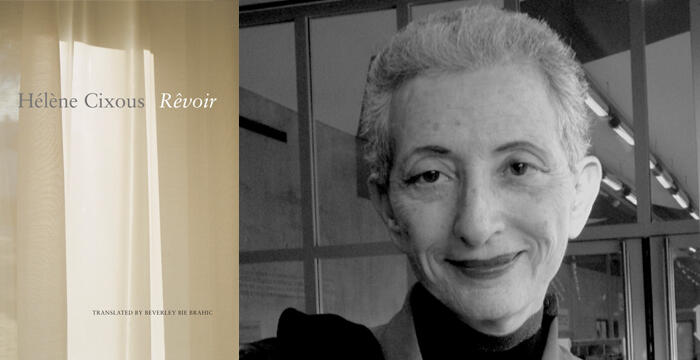
Feminist and literary theorist, playwright, philosopher, memoirist and novelist Hélène Cixous returns to the show to discuss her latest genre-defying hybrid work of prose. Written during the first year of the pandemic, Rêvoir explores the effect of pandemic confinement on time, the effect of pandemic time on writing, and what plagues and confinement show us about the nature of time, memory, dreams, history, language, home, flight, cats, love and death. Struggling to find purchase on her own writing within the timelessness of that year, she conjures and contemplates the works of everyone from Thucydides to Kafka, Shakespeare to Shackleton, to uncover how literature always begins with an ending, always opens with no way forward. What does Cixous mean that language is haunted by writing? That it is not just the writer who writes, but the words themselves? Join us to find out!
For the bonus audio, enjoy a long-form conversation with Cixous’ translator, the poet Beverley Bie-Brahic. Given that Cixous breaks the norms of form, syntax and punctuation, not in predictable or consistent ways, but from a place of instinct and intuition, and given that her playful use of homophones in French, an essential quality of her writing that often leads where her writing ultimately goes, Cixous’ writing presents some unusually difficult challenges for a translator. Something we explore with Bie-Brahic in this conversation. To learn how to subscribe to the bonus audio archive and about all the other potential benefits and rewards of joining the Between the Covers community as a listener-supporter, head over to the show’s Patreon page.
Finally here is the BookShop for today’s episode.
Transcript
David Naimon: What, if some day or night, a demon were to steal after you into your loneliest loneliness and say to you, "This life, as you now live it and have lived it, you will have to live once more and innumerable times more?" Would you not throw yourself down and gnash your teeth and curse the demon who spoke thus, or have you once experienced a tremendous moment when you would have answered him, “You are a God and never have I heard anything more divine?” Want to know what Nietzsche meant or why he thought we'd live our lives over ad infinitum? Every day, moonlit: The Daily Literature App, curates one passage to explore. Search moonlit: The Daily Literature on the App Store and use coupon code BTC1MonthFree to get your first month for free. Again, that's Moonlit Daily Literature with coupon code BTC1MonthFree. Today's episode is also brought to you by Olufunke Grace Bankole, The Edge of Water, a luminous debut novel set between Nigeria and New Orleans, about a young woman brave enough to leave all she knows behind and the way her fate transforms a family destined to stay together. Jami Attenberg calls The Edge of Water, “artfully constructed, beautifully told, and utterly moving” and Vanessa Walters adds, “I savored every line of the arresting prose and ended this book yearning for more from this incredibly talented writer.” The Edge of Water is out February 4th from Tin House and available for pre-order now. I'm extremely excited to welcome Hélène Cixous back to the show for a second conversation. As I mentioned when she first appeared in 2022, given that her work and writing life now spans more than a half-century, but also has this 50+ years of writing exists within and has influenced multiple fields—writings of philosophy, literary criticism, theater, fiction, and memoir, all written with the distinct poetics—that because of the limited time we had together, and this immense wealth of material, it felt important to me to not try to attempt a survey or a retrospective but rather to sacrifice breadth on behalf of depth. In that conversation, we focused on what some call her late style, but really is a style she's been working in for several decades; books that some describe as novel memoirs, but really are books on the borderland between not fiction and nonfiction exactly, but the present and the past, memory and history, imagination and memory, history and literary history, dreams, myth, and story, between the self and the other within the self. In that conversation, we centered the release of Well-Kept Ruins into English. But I triangulated that book with two other books of hers in order to anchor it within her writing history. Today's conversation, in this respect, is similar insofar as it centers her latest release, Rêvoir, also a book written in this borderland style and form. Again, I triangulate it with two other books of hers, one from 25 years ago and another from 50 years ago. But what's so exciting to me about today's conversation is not the similarity in approach and focus, but how utterly different the two conversations are. Whereas the first foregrounded the historical, whether her family's history in Algeria or in Germany, and how it intersected with the psyche and with memory, today's feels both more metaphysical, dealing with questions of time and death, and also more linguistic, where Cixous talks about how writing haunts language, or how the words themselves are writing, and how words themselves do more than depict but generate worlds in a way that reminds me of some of what Cecilia Vicuña and I explored when she was on the show last year. What is great about this to me is even though today's book, Revoir, is a book written in very particular circumstances during and deeply influenced by the pandemic by questions of confinement and flight, death and rebirth, plagues present and past, really today's conversation could have been more historical and psychological like the last one, and the last conversation could have been more linguistic and metaphysical. In other words, I feel like these two conversations are additive and complementary to fully understand all the elements going on in one of Hélène Cixous's borderland hybrid books. Together in either order, I think the two conversations give a well-rounded sense of all that comes into play for her. Before we begin, I want to mention, as I do in the interview itself, that the last time Hélène was on the show, I did a nearly hour-long conversation with one of her main translators, the poet Beverley Bie Brahic, for the Bonus Audio Archive. The focus of that conversation was the translation of Well-Kept Ruins. But at the time, she was in the middle of translating the book that we are now discussing today. Beverley and I discussed back then the challenges she was up against in doing so. I want to highlight Beverley here for a moment and the importance of what she is doing, both because the lion's share of Cixous's work hasn't been translated into English, despite her importance in both feminist and literary theory, but also because of how unusually difficult it is to translate Cixous in particular. This is true with her intuitive and unpredictable use of punctuation and line or paragraph breaks, but even more so because of her love of wordplay within French, her neologisms, and her generative use of homophones. You'll get a taste of what this must be like to read the original French today, as the linguistic turn of our conversation has Hélène making in real time all sorts of spontaneous wordplay both in English and between English and French as we talk. All of this underscoring the immensity of the task before Beverley. In that spirit, I've included Beverley's latest book of her own poetry in the bookshop associated with today's episode, a poetry collection called Apple Thieves, a collection also written during the pandemic, where the reviewer in the Los Angeles Review of Books wonders out loud about how the pandemic might have affected her lines and sentences, just as we wonder this today about Cixous's work. That reviewer uses lines of Elizabeth Bishop’s to try to get to the core of Beverley's collection, “Life and the memory of it so compressed they've turned into each other. Which is which?” These lines that I think could also describe the book Beverley has brought into English for us, Rêvoir. Really these three conversations, the two with Hélène and the one with Beverley, create a dynamic whole, and the conversation with Beverley is only one of hundreds of jewels in the Bonus Audio Archive. You can find out how to subscribe to it and about the many other potential benefits and rewards of joining the Between the Covers community as a listener-supporter at the show's Patreon page, patreon.com/betweenthecovers. Lastly, this conversation, like Hélène’s book, is also one about cats. Cats are actors and agents within the book. They are sources of inspiration and the vehicles through which contemplations of time and timelessness, shelter, and wilderness occur. Fittingly, this is the first time in my cat Zora's two years of life that she wanted to be in the room while I recorded. Uncannily, near the very end of the interview, Zora asks to be let out of the room. At the very same moment, Hélène's cat, Isha, approaches her to become part of the conversation. I leave elements of this encounter of me freeing Zora and of Hélène calling Isha up to the screen because it happens when Hélène is describing her mother, very late in life, at the age of 100, discussing the need to belong, a belonging that's framed as very tribal and familial, a sentiment both foreign to her mother earlier in her life, and much more so to Hélène's own way in the world, whose work is so porous to otherness, to the strange and to the stranger. Fittingly, the cats, on two different continents, interject themselves, puncturing this attempt to harden the borders of identity, and they insert themselves into our kinship circle across species. So, without further ado, here's my conversation with none other than Hélène Cixous.
[Music]
David Naimon: Good morning and welcome to Between the Covers. I'm David Naimon, your host. Today's guest, poet, novelist, playwright, critic, and philosopher Hélène Cixous, is a writer and thinker that Jacques Derrida called "the greatest writer in the French language." Cixous founded the University of Paris VIII and its Center for Women's Studies, the first of its kind in Europe, and remains emeritus professor of literature there. She's the author of more than 70 works of theory, fiction, philosophy, plays, poetry, and critical essays that often create new modes of exploring relationships between history, autobiography, literature, language, psychology, the unconscious, and dreams. She's written extensively about other writers, including Franz Kafka, Thomas Bernhard, and Ingeborg Bachmann, and her extensive writing about Clarice Lispector is to be thanked for bringing Lispector’s work to the notice of a larger audience outside of Brazil. In feminist theory, she coined the term "écriture féminine," women's writing, a method and practice of literary writing that examines the relationship between the psychosocial inscription of the female body and female difference in language and text. Born in Oran, Algeria to a Sephardic Jewish father and German Jewish mother, the occasion of our first conversation was the arrival of her book, Well-Kept Ruins, into English, and several before it that engage both with Osnabrück, Germany, and Oran, Algeria, and her return today is for her latest book to arrive in English, translated by Beverley Bie Brahic for Seagull Books, entitled Rêvoir. A book Publishers Weekly describes as a “surreal, unclassifiable meditation on isolation and resilience centered around the first months of the Covid-19 pandemic. The highly experimental style introduces paragraph breaks in the middle of sentences, resists the strictures of linear narrative, and utilizes fragmentary prose as mesmerizing as it is mysterious. Evocative and enigmatic, Rêvoir intoxicates.” Welcome back to Between the Covers, Hélène Cixous.
Hélène Cixous: Great to see you again.
DN: [Laughter] It's nice to see you, too. So, Rêvoir is a book you wrote during and about the pandemic. While the book is about many things—history, memory, ancestry, cats, home, language, dreams, plagues, flight, love, and death, to name a few—it seems like time is something that unites them all together, and how the pandemic is affecting time in particular. The city of your birth, Oran, Algeria, is the place Camus set his novel, The Plague. I was curious if you wrote about time within that book, and I found these lines in The Plague that I think speak to your book as well. Camus said, “The first thing that plague brought to our town was exile, that sensation of a void within which never left us, that irrational longing to hark back to the past or else to speed up the march of time, and those keen shafts of memory that stung like fire.” In Rêvoir, just to quote a small sample of the engagements with time, you say of the pandemic, "For us, time had almost stopped. Six months took 40 years." And you speak of the difficulty of arranging time into daily slices as if time were now one single love, one day running into the next, and you ask, "What can I call a book that doesn't know what time it is, nor the difference between night and day, nor between memory and the future, whose streets end in ruins?" This new relationship to time feels like it has imperiled your writing life as well. As your family flees Paris to the countryside, you forget your writing notebooks. You're using Kafka's notebooks as a sort of Bible of auguries. You engage with the derangement of time for Kafka himself where one of the journal entries goes, "August 2nd, Germany has declared war on Russia. — Swimming pool this afternoon." And you meditate on the tyranny of the ever-present now, and the difference between the English now and the French “maintenant” where you say, "The word now frightened her like an order to kill, like the barking of a wolf. That was why she loved it, out of her love of fear. But she preferred the rich contradictory hours of maintenant." There seems to be a crisis and a battle around how, and in what way to write when you say, "Today, in the midst of the nothingness, is the day of the battle between literature and king pestilence," and, “You have no idea how difficult it is to sculpt a letter of the alphabet when you have to move an arm sunk in the leadedness of time. It's as if you had to lift the weight of the ocean to get a mouthful of air.” Talk to us about plague time and how plague time affects writing and affected how you wrote Rêvoir.
HC: First of all, I want to underline that this book was triggered by an event that has been unique and that I must say paradoxically did not happen. Nothing happened during the time which can be dated. Nothing happened. You couldn't even swear that you were alive because you didn't know what it meant anymore. The word memory of the idea of remembering, for instance, was like a ghost. I'm sure you have lived that too, and I must say that one of the first things that I experienced was that the subject, the "I", had an extraordinary feeling and kind of feeling that everything that you, I, one could fear somehow was being felt in exactly the same conditions by the whole of mankind. Mankind was deprived of time. This is something that is extraordinarily difficult to apprehend, and, of course, to write. Writing has to do with events, it's eventful, it's always telling something or looking for something, running after something, nothing happened. The question of what time is was the only way the mind, the mind was feeling on not even nothingness, but beingless, beinglessness. This was like a mental illness or something that struck everybody and every bit, every piece, every part of reality. I remember because I made great efforts to try and catch something. The time when I realized that the streets, when I could set foot in a street, the streets had become something completely artificial. I didn't even know whether the street was a street. It was unstreeted. [laughter] Mankind and the world were ill. They were struck by a sickness that was unknown. That's why there were no memories. There wasn't any memory. You couldn't remember anything because it had never happened. Then eventually, I realized after weeks and weeks of derelict, I was derelict, that it had happened that there were books, Bibles where you could see that a comparable event had happened in the very far past, or analogous events had happened, and they all had to do with plagues. Of course, this was the only thing I could catch on plague.
DN: Well, one way the book engages with time and plague time is through beginnings and endings. You talk about how your 1952 edition of The Complete Shakespeare begins with The Tempest even though it's his last play, and how everything starts like this with a shipwreck, that literature begins this way, in a sense beginning with an ending. Similarly, Rêvoir opens with you going to the cemetery, to the tomb, your 20th outing with the shadow, and the visit to the grave is one not of death, or not only of death, but of love and eros, “Next, we made love as usual.” Thinking of this inversion of beginnings and endings, you fall when you arrive at the grave, which in French is a play on the word for “tomb” and for the verb to fall, “tombe.” But another way your fall at the grave connects to beginnings, something that you don't explicitly mention in the book, is that your first book, published 54 years ago, is called Tomb(e), signifying in French both "grave" and "falling" itself. In your 2007 foreword to the reissue of Tomb(e) in English, you say, "As soon as there is love, enters death. It is if I love you had as a synonym, we're going to die." And you also say that in 1968 and 1969, you wanted to die but felt blocked on all sides, that the book you wrote at the time was a living grave, and that it belongs to the species of books which run away, where between you and the book, there is flight. Here a half-century later, during plague time or timelessness, here you are again, both raising a tomb and falling before it, saying, "I love you," and at the same time, "we're going to die." I was hoping you could talk to us about this opening with the shadow and your trips of erotic adventure together to the tomb that opens Rêvoir.
HC: It's just a kind of metaphor, but it's real, but this is before the pandemic, but it's a sign, it's augury, it's strangely the stage or the scene of the person, the subject, the “I” relates to your death that is my death. Your death makes me die. I fall from your fall. So strangely, if it were a film, it could be a first sequence or kind of a prologue. [laughs] The prologue is you don't understand it. Of course, what is important and which you have emphasized is the work of language. Maybe things wouldn't happen if Tomb(e) were not homonymously both the grave and the falling, the fall. This, of course, is the way language keeps inventing, writing, writing poems, books, whereas you think that you are leading your own life and talking and having conversation or meeting David. During that time, an incredible number of little scenes happen somewhere in the world of permanent creation and destruction inside the universe of language. Everything has, during the pandemic, which we never call pandemic in France, so that's also very interesting. Those events like wars, etc., big catastrophes. They are quickly named by the different cultures, countries, languages with different appellations. For instance, we in France simply pointed at the virus as COVID-19. Then if you go to Germany, then it's Corona. But if Corona happens somewhere in my mind or head or my soul, then it will work differently, bring different hallucinations or references. I don't know how you named these events in English or American. These times when the catastrophe was reigning over the universe, we were imprisoned. The French-language people were incarcerated. They were incarcerated. It was agreed that we would design it as “confinement.” I think that “confinement” in English is a lockdown.
DN: Yeah, or confinement too.
HC: You use confinement?
DN: Yes. Well, staying with this question of language, much of this book feels like it has a dream logic, these journeys with the shadow feel like a dream and the book itself also contains many of your dreams, a dream that you are in Oran during a plague, a dream that you were in a portrait called Year 2420 after Thucydides, the ancient Greek historian who both wrote about and survived the plague in ancient Athens. A dream of you being five years old and saving your grandmother from Germany and bringing her to Africa. Another where you were, unlike in real life, lovers and shared a house with your philosopher friend named "D" and many more. I bring this up because the title of your book, much like the title of your first book, is untranslatable into English. If it didn't have the circumflex over the letter "E," Rêvoir would simply mean "to see again" as in "à revoir," see you later, but with the circumflex, the “rêve” part of rêvoir becomes the word dream. Last time when you were on the show about Well-Kept Ruins, I also had a conversation for supporters with your translator Beverley Bie Brahic and at the time, she was in the middle of translating Rêvoir. She talked about all the ideas that she had for titles. None of the ideas she had felt satisfying, titles like Dreamscope, for instance, if I remember correctly. But I think smartly, the title remains itself, impossible to be an English word. The French is some sort of combination of "re-seeing" or "redreaming" or "dream seeing" and surely other things. I was hoping you could talk a little bit about Rêvoir, the word, and the title.
HC: It's interesting, I must say, because of course when we were speaking in another century, centuries after the plague of translating and how to translate, eventually, there was a dead end. One couldn't find a proper way of translating it. That's interesting because as I just told you before we started this conversation officially, I've read Rêvoir during this week in order to kindle, to rekindle the relation to this strange object. [laughs] I didn't remember how we eventually had agreed to translate. I thought maybe there's a title, but I don't remember it. [laughs] I think in a very wise way, and also because it was fatal, you couldn't escape it, it remained in its impossible affirmation, imperative. It can be an imperative or an infinitive or a substantive. You don't know the grammatical category. As you just pointed out, it was actually, you can't escape the circumflex, so I started thinking about the circumflex and the fact that it decides everything, it's a sign, it's most interesting actually, it's a roof if you draw it, isn’t it? If you do a child drawing of it, it's a roof but it's floating there. Then what is fun too, it's the junction of French accents, which, of course, can travel to the other languages. There are no accents in English. You have the cute, I don't know how you say that in English, a cute accent, which goes this way, closing the E. You have the grave accent that I translate. I don't know whether it's correct. This is to open on the contrary. It's also a kind of door opening and closing. Of course, we never think about that when we speak French or write French, but it belongs—and it's important—it belongs to the strange movements and secret thoughts that take place in the French language. Now, it happens that rêve, dream, has this driving wheel. Rêve both opens and closes and it has wings, but then it doesn't work in English or in German, it's the same word in English, in German [inaudible]. It is uncanny in English to see a book with a name which is "Rêvoir", which is foreign, which is untamed, really, it has to do with the happening of something unexpected and foreign. It's uncanny, and it's a good idea to let it be.
DN: Yeah, I agree. I think it's the right choice. When you forget to bring your two dream notebooks with you, when you leave Paris with your family during the first year of the pandemic, you call this your “first separation of me from myself.” At one point in the book, you say that the worst thing is not death, but to die before you die, to have a bad death, which of course could refer to any number of debilitating ailments where you're still alive but suffering. But I wonder if it also refers to the fear of not writing, of losing the impulse to write, to be not only without your notebooks, notebooks you took everywhere like your glasses you say, but your dream notebooks. This separation of me from myself is a big part of the book, not only in the theme, but in form. You ask yourself at one point, “Why are you writing in third person?” Because often you refer to yourself in this book as H, as often as you refer to yourself as I, for instance, “The duel between me and H, my third person. I was divided. Not just between H and me, but also between H and H. A duel to the end. H with my daughter. H without my daughter. H to cats. Me with my mother on my shoulder. My mother in her midwife mask and latex gloves.” At one point you say, "I no longer remember when I was severed from myself." But what it made me think about is your book Veils, a book which is also divided into one part written by you and one part written by Jacques Derrida in conversation with your part of the book. Much as you say that you carry your dream journals around like your glasses, your section of Veils was about your extreme myopia, which you called your native veil, that you could see that you could not see, that every day was a refusal, but there was always the question of who was doing the refusing, you or the world. You say you were born with the veil in your eye and in your soul and that from then on you “did not know,” that you and doubt were always inseparable. Everything was a “perhaps.” But then you get eye surgery and you are delivered a new self, but also a crisis of self, because not to see is defect, penury, thirst, but not to see oneself seen is virginity, strength, and independence. Somehow I connect the separation of you from yourself, not only with the forgetting of your dream journals, but the separating of you from yourself, both because of the veil in your eyes and paradoxically perhaps even more so from the removal of the veil, as if the veil is the dream life that is so essential to life, that perhaps Rêvoir insists upon the veils between various use. I wondered if this sparked any thoughts for you about this splitting of self within Rêvoir?
HC: I'm impressed with your reading. [laughs] I think it's remarkable. Well, I don't know. It's interesting that you bring together these two texts, but they're not the same. What is common is the fact that it deals too with the secret powers that work inside language. For instance, veil, just a word about that. Veil in French is "voile", the same word as in English, I mean the same Latin word. Now, somewhere in Rêvoir, I realized that at one point, near the end of the book, there's a kind of vision where the subject, who I think is “I” at that moment, but might be others, “H” maybe, is now reaching a point where she separates herself or themselves—I should always say that in the plural—from herself, and goes away somewhere, and the means of transportation seem to be ships, magic ships, which have been sailing through the book and borrowed from supposed ships that are the works or the works of Kafka and as if when reading Kafka, you were on a ship which is called Kafka and which you can find in a common fleet where you will find other ships. For instance, the Endurance of Shackleton, a journal and exploration which I admire, I adore, the endurance epic. Now, in French, when I read the page, I realized that when the travel has started and you can see the ships disappearing in the distance, then you see le voile, but these voiles are not the veils, but the sails. Of course, this again is a turn of language, of French. In the same way, the landscape becomes veiled by vapors, haze, etc. In French, it's vapeur, the same word, of course, you've got the same word in English. But then if you listen, vapeur is also a boat. This is the way inside language as haunted by writing. There are so many adventures, so many speeches, so many exchanges. There are so many books and poems inside a book. It's always haunted. Writing is that. It's hosting ghosts and being haunted all the time and of course, a writer is simply somebody who, it’s like a kind of music, you hear whereas you think that you're writing a story, for instance, inside the story, there are many other stories and adventures of all kinds and chaos and creation.
DN: Well, speaking of chaos and creation, cats are a crucial element in this book, both in regards to time, and I suspect in relationship also to the division in yourself. You say, “Except with the cats, who reign over the present moment, I was mostly in the third person, at an undecidable distance from myself.” Cats are major protagonists in this book, but they also are subjects, too. You call your cats "goddesses of the present." You aspire to describe your cat saints every single day as a writing practice. You say, “Long live cats, nothing under the sun is more perfect.” You call Isha a poem with supernatural powers. You describe Haya killing a mouse. Here there is a blurring and a doubling of identities too, where you say, “The cat is a big silly mouse, a Chinese acrobat, a youthful trapezist who smiles at the abyss. The mouse is a micro cat with super cat speed. She doesn't run, she flies. This is love, nothing more deliciously suicidal than desire.” You say, "I can't do without cats. I can't think without cats." And, “Before I was a cat, I was a hunter-gatherer, as a farmer I have contradictory needs.” This seems to echo against the tension between "now" and the more multivalent and contradictory "maintenant," a division between our cat-like pre-agrarian selves and ourselves since then. But whereas the cats most often represent the ongoing present moment, they also, at least in one point in the book, represent memory for you as well, leaping from dream to dream ahead of the nightmare in the so-called real world. I have a theory for you about cats in relation to your writing, but before I propose that theory, I was hoping you would talk to us more about this close cohabitation with cats during the confinement, during the pandemic, and how the cat in Rêvoir is protagonist's subject, mode of being, a reminder perhaps of another aspect of ourselves as well, and also of what we are not, and more.
HC: Yeah, then I must confess, these cats, they exist in reality. They might be fiction, but they're not fiction. What is not fiction is that the blessing that it happened, they were, for very particular reasons. It happens that in this time, the company I had was that of the cats and also characters from my family, that's something else. But this was totally unexpected because these cats were babies, they didn't know about the world. It's as if they weren't born, they still were inside the womb of the house. They had never been outside. What they gave me to contemplate was the fate or mystery of beings whose world was womb. You could see, you could witness the mystery of them being attracted by the world, by outside, of which they knew nothing, nothing at all, they were inside. Of course, observing, observation of beings for whom the world is only a phantasm is extraordinary. I kept asking the cats about the wisdom or knowledge of the world they didn't know about. They had an intuition of what they were completely separate from and maybe sentenced to never reaching outside. But everything in the body, the breathing, everything expressed the urgency to go further, further, further, the sculpting of desire, the pure desire, the mystery of desire, what is desire? Further, further, further, further, going, going, going, vital. So, time, what remained of time, was embodied in the aspiration of the cats, the mystery of the cats. So, of course, I also identified completely with what they didn't know but they were an incarnation of the soul.
DN: Well, in contrast to the contradictory nature of humans, where you describe yourself as wanting to go outside so you may wish to go back inside or wanting to shelter inside in order to want to go outside, with cats you most often associate them with speed. For instance, “When time's doors slammed shut, the cats were newborn. They live much faster than we do. Within our enclosure, our two temporalities ran an unequal race. For us, time had almost stopped. Six months took forty years. Yet cat time, time the cat, leapt at the speed of a leopard. Already youth, already maturity sheen, the cat slipped past like two svelte caracals. I saw them come and go, two fleshly illuminations, grace itself, the one pointing up the other so quick, so quick, that my slowed down memory couldn't keep their quicksilver gleam." Or “According to Isha, what matters most in her exchanges with us, and especially with me, is speed. The message must pass quickly, quickly, it's urgent. Natural rhythms determine this urgency. Life is shorter than life. Isha is twice as fast as me. Our exchanges require, on the one hand, patience, on the other, impatience, which is why she likes winged messages, monosyllables, size, and all the lightning-fast vocabals open. Fast, go, come, know, god, jump, want, yes.” This question of speed, it reminded me of something Gilles Deleuze wrote about your writing back in the early 70s, about your book "Neutre," but also about your work more generally, which he felt at the time that your writing was being misread and misunderstood because of an error in reading. This piece was called “Helene Cixous or Stroboscopic Writing,” stroboscopic being the effect that discontinuous flashes of light have on the perception of motion. But the main reason I thought of it was because of this passage, where Deleuze suggests one needs to read you at speed, and that perhaps like the stroboscopic effect, things slow down when you do. “The mystery of Helene Cixous, such as you see it in her narrative Neutre, is this: an author who is considered to be difficult generally demands to be read slowly; here, on the contrary, is a work which demands to be read quickly (although you may have to reread it, faster and faster). The difficulties that a slow reader would encounter melt away as the speed of the reading increases. This is because, in my opinion, Helene Cixous has invented a new, original kind of writing, which she grants an entirely singular place in modern literature: a kind of stroboscopic writing, where the narrative comes alive, and the different themes inter-connect, and the words form variable figures, according to the accelerated speeds.” He goes on to talk about how the speed of your associations, they come together if the speed of the reader matches you, which makes me think of your cats and makes me think, perhaps he is saying without saying it, that one element of your work is that it is operating on cat time.
HC: Well, yeah, I accept this way of thinking. [laughter] But you know what, actually, when I told you about stories that are happening inside, the story you think you're telling, it's this, it gives you the feeling of acceleration. Because in one minute, you tell several stories at high speed, you know. [laughter] Of course, I'm not the only one who does that, but I belong to those who are aware of that. So, of course, I welcome all these effects and I multiply them because then it becomes also something playful. When I say I'm not alone, of course, if you read John Dunn, everything is like that. Everything he says is playing a game which may be unperceived by the reader. But then if the reader doesn't play, well, then the text will become obscure and heavy, etc. No.
DN: Well, much like you describe cats as leaping from dream to dream ahead of the nightmare, your book, like your first book, Tomb(e), in your words, belongs to the species of books that run away, that is about flight, in this case the flight from Paris triggers both memories and dreams about your maternal family's flight from Osnabruck, Germany to Algeria, and also later your mother's imprisonment there, and then flight from Algeria, all of which we looked at in-depth together the last time we talked. But one flight this book circles around in particular is that of Exodus, and your flight from Paris happens to correspond with the upcoming Passover Seder. You wonder not only if you've brought your dream notebooks, but if you forgot matzah for the Seder meal. Matzah the unrisen bread when the Jews were themselves in flight from Egypt. As a transition from cats to talking about Judaism and Exodus, I think of your interview with Claire Schwartz in Jewish Currents magazine where you said, "When I was a tiny girl, the language of God fascinated and amused me. His seems to be a vegetal speech. The other species see the burning bush, and they understand what we don’t." I love this idea that your cats might understand this bush, this divine revelation, and divine speech in a way that we don't. When thinking about time and the difficulty of arranging time in the pandemic into daily slices, you compare this to the experience of the Jews in the desert who felt the same mummification of time. Much like you say literature begins with a shipwreck, you call this Exodus a desert shipwreck of the Jewish people, tossed from existence into formless, motionless, dateless sands, successive sand, successively the same, devoid of the music of time. The only thing that I wrote myself and published that first year of the pandemic, like you also connected the pandemic with the biblical Exodus, and I was also delighted to discover that Derrida's response to you in Veils, it too engages with Exodus. But before I bring both my thoughts and his, his connections into this, talk to us about the mummification of time or cats and the burning bush or the language of God which is as untranslatable as many of your book titles, including the book that follows this one whose title is a magic unsayable word from a Victor Hugo seance that conjured Shakespeare or even how the return of your notebooks you described as messianic, or when talking about your cats where you say of them, “The need to go out after the belly, after the cradle, beyond the house, further than the house, beyond the territory, the urgency to go, this is God,” talk to us about God and language, and flight in Rêvoir.
HC: I can't say anything about God, except God is, it's an invention, a fantastic invention. It's language inventing, and of course, if the name of God exists, I mean, God exists, God. [laughs] I always enjoyed the fact that Joyce realized, of course, immediately that God was a dog, a dog or cat. In my writing, I realize, I know, I admit that there are plenty of occurrences of God, but it's always like that, it has a kind of the hyper-ghost that we can't do without. It's not, of course, a matter of faith. It's simply inescapable. The key is the key. The key in English and the key in French, who is the who? [laughs] But what I recognize, and I must say I enjoy, is the trace and the mystery of the Bible. For instance, you allude to Pesach [inaudible], when I was a kid, we always said "La Pâque", we said "Pâque". It happens that a little later, after Rêvoir, I wrote a book which is called Incendire, to which I alluded in speaking with you. Incendire is also a title which is "Neologism. It Doesn't Exist". It's a portmanteau word and listening to it, you both make out "incendire", that is fire. It's richer in French than fire. "Incendire", it's also without saying, Incendire. Then, why did I have to write Incendire? Because it happened that four years ago, the region where I have my house and where things take place, my writing takes place, is located in a very large forest in the southwest of France, it's a huge forest, and it happened, what is happening in LA? Broke into fire suddenly, which might have happened a long time ago, it was the first time. Then the flight wasn't in the direction of north to south but suddenly while I was in the south, the south broke into flames and I experienced something which I couldn't have thought really without the help of other comparable events. Again, it was not [inaudible] but it's comparable. It was Virgil. I experienced that time was transformed and was approaching in the shapes of giant fires. My house is located in the forest. So I suddenly had to face that. After two or three days, seeing that the fire was winning over life and earth and everything, I realized that we had to flee. The subtitle of this book is "Qu'est-ce qu'on emporte,” “What do we take along? What do we carry in haste?” And the question, of course, it was vital. I thought, “Now, what do I save?” I thought, “But this has already happened to mankind.” That was Exodus. Suddenly, you get a Telegram from Moses telling you, morning at six, “We have to flee. What do we take? Provided that we're going to spend 40 years nowhere.” [laughter] I thought about that. I thought, “Well, actually, this has happened.” It's, of course, a revolution in the timing and the fate of mankind. We know what they had to carry, what they had to take with them, etc. It's very strange after thinking that what they carry in haste is just bread, and what kind of bread, kind of piece of paper. [laughs] Then I thought “But this has accompanied the whole of literature,” beginning with the beginnings of Western literature that is Homer and the beginning of Iliad and the end of Iliad and beginning of the next chapters which you don't find in the Iliad, but in what comes next, you'll find in Virgil, not in Homer, but in Virgil. The end of Troy, and the extraordinary, beautiful, incredible first songs, chapters of The Aeneid. It starts. Troy is burning, and we know that mankind sleeps and Aeneid is sleeping and he has to be shaken awake and realizing that your neighbor is burning, Ucalegon is burning and Jam Proximus Ardet, and already your neighbor burns. It's a beautiful passage in The Aeneid. Now what do I have to carry away? I have to flee, but what do I take away with me? Of course, the answer is culture and it's the whole of civilization at that time, as we know he carries away his father on his shoulders, his son, he takes him by the hand, the role of the woman is you're going to walk behind us and take care of everything that can happen. On the way of this race away from the fire, she disappears. We don't even witness her death. When she reappears, she reappears as a ghost. That's the landscape of human culture. But it's a story, always.
DN: Well, there are many correspondences one could make with the Exodus story and the pandemic in specific, not just the ten plagues, but in particular the final one where the Jews are told to shelter at home when the angel of death passes over the city. But in the piece that I myself wrote, I focused on the number 40 because the word "quarantine" comes from the Italian "quarantino" which describes the 40-day waiting period that ships had to wait in Venice in the harbor during the plague in the 14th century before they were allowed to come to shore. Here is another correspondence with the ships in your book. But 40 is all over the Bible stories in a way that also involves sequestering and waiting. The 40 days and nights in Noah's Ark, the 40 days and nights Moses is alone on top of Mount Sinai. The 40 years the Israelites wander in the wilderness. In Hebrew, it is the letter Mem that corresponds to 40, which is itself shaped like a confined space with a little narrow exit like a womb because there are 40 weeks in gestation and some say that it was the letter Mem that was painted in lamb's blood on the Jewish doorposts to protect their homes as they sheltered in place. But the thing that I focus on that feels most connected to Rêvoir is the ritual Jewish bath called the mikveh. The letter Mem is the letter of water, and it's a confined space, and it can be seen as a mikveh, which is often described as both a womb and a tomb. When one descends into the water, one is both returning to the womb, a place where one could once live without breathing, and yet it is a place we cannot breathe in, a place of self-obliteration too. Much like you described your first book as a living grave, or how the final moments of your mother's life were like a cradle for end times, the suspended timeless space of immersion in the water is about beginnings and endings. I think of lines in Rêvoir like these: “Like drunkards, my lungs sucked up air, that intoxicating sensation of having been returned to the mysterious pleasure of living, and meanwhile out of breath, full of anxiety, for a moment before you were descending the steps of drowning, and then to find yourself newborn among the breathers,” or “An interminable descent under the water floor and a prayer, literature, brief, bitter gulp of a too late.” This book is also one, I think, of descent, the descent of a staircase with its threat of falling, a book of falling at the grave, and also of descendency, are you the descendant of Eve, the mother who jumps and acts and flees danger, or the descendant of Omi, a grandmother who despite the warnings refuses to leave Germany? This watery descent I think is crucial to your work at large, to a place where one cannot live but something that one also cannot live without. I wondered if this sparked any thoughts for you about this question of descent and the impossibility and the inevitability of living in that descent.
HC: I would say yes, [laughs] everything you say is great, it's true, it's pertinent. Maybe the figure that exists in my own country has to do with how to go, how to reach the floor when dreams happen or take place, and probably something in me fears or imagines that it has to do with the descent. But of course, this is only a hypothesis, I don't know it all. But then downing and drowning go along. For instance, remembering or since you referred to Thucydides, I realized that when I dream, think, I tend to go back 2,000 years before as if it were yesterday. I mean, it's yesterday, yesterday. But yesterday is today, of course. When reading Thucydides or Virgil or whatever, it's as if I were reading the newspaper. Before we talked and we started this conversation, I was reading today’s newspapers with hesitation, that is I wondered whether I should read them or not because everything of course was full of Trump. I thought maybe it's going to disturb me so much that I'll go on fire or into ashes. [laughs] Then I thought no, but this is what is happening, and it's happening as it has already happened 2,000, 3,000, or 4,000 years ago, and it repeats itself. What repeats itself is destruction and death, and what will repeat itself is resurrection, because after that, life will begin again, always. It always happens like this. What do I do? Do I go down, time, or up? Well, I'm not sure it's not up. I think maybe it's up there. Or maybe it's down, up. Maybe it's the two. For instance, lock the expression for confinement, is it lock up or lockdown? But this is the same. You say up and down for the same thing. Well, I can't decide. [laughter] But that of course brings to me the theme which is most important in Rêvoir and then comes back so often in my work, the theme of prison. Somewhere, maybe in Rêvoir or in another book, I don't know, I remember at one point thinking that I was the only person in a very close environment and familiar environment that has never been imprisoned in a prison. Everybody has been in a prison except me, except that maybe I'm imprisoned all the time but concretely, my mother was imprisoned, my beloved was in prison, my brother has been in prison, everybody has been except me. Then I think, “No, it's not true. It's probably that I'm differently imprisoned or that I dialogue with prison, even in the word prison all the time.”
DN: One of my favorite moments is a moment of defamiliarization between you and how you perceive your mother. She's always been the practical one. Unlike you, when she was alive, she avoided cemeteries saying that the word cemetery in French rhymed with nothing to see. She described herself as being born modern. She wasn't religious. But when you look through her notebook now during the pandemic, you see the words written there, Pesach and Shavuot. Shavuot, a Jewish holiday she never celebrated. Pesach, the Hebrew rendering of Passover, a way she never referred to it out loud. You write that it is as if she were living somewhere else now under a different identity. This strange, unspoken connection, disconnection, this possible reassertion of something from her own childhood but very late in her life, this mysterious assertion of modernity and ancient legacy at the same time reminds me of Derrida's response to you in Veils, which was called A Silkworm of One's Own (Points of view stitched on the other veil), where he begins in Exodus also. He talks about how God says to Moses that in the Ark of the Covenant, the veil will be for you with God as the veil-giver. But eventually, Derrida begins to talk, most specifically about his father's tallit, his father's prayer shawl, and how for Derrida, the wearing of the shawl is not to become veiled but something else. He says, speaking of his father's prayer shawl, "A prayer shawl I like to touch more than to see, to caress every day, to kiss without even opening my eyes or even when it remains wrapped in a paper bag into which I stick my hand at night, eyes closed,” and, “It is another skin, but one incomparable to any other skin. It veils or hides nothing. Like an animal, it waits for me. I touch it without knowing what I am doing or asking in so doing. But to know at least two things—blessing and death.” I think of this image of Derrida's daily ritual, or nightly ritual, not of putting on the prayer shawl, but keeping it in a paper bag and in the darkness placing his hand within its folds; as something similar to your mother's secret marking of Jewish time quietly in the notebook, a woman who sees herself as modern, and yet here are the words Pesach and Shavuot privately. I wondered if you had any thoughts about this, this seems like it's both rupture and continuity at the same time about the ancient stories in relation to modern stories.
HC: Actually, what is interesting, I think, and extraordinary, is when Derrida reveals that because after all, it's secret. He's caressing or stroking his tallit in the dark and then suddenly he puts it in the light. It's only that it was completely white, which was exceptional. Apparently, tallit, I don't know what kind of historical value this has, but he told me that in Algeria, they all had a tallit with a dark blue or blue--
DN: Thread.
HC: Yes, additions of painting. I didn't know because there wasn't a tallit in my house, and I never saw one. I mean, except for Derrida, actually. For him, it was deeply, deeply invested with all kinds of indescribable meanings. I won't say it was mystical, but almost really. My mother was really completely atheistic as my father, actually. But I didn't live with my father, he was dead. But she was openly and affirmatively an atheist, my mother. She was a typical Jewish German person with Jewish education, could read Hebrew, etc. but didn't care at all. She didn't believe it. I mean, this was for people who needed it. She wouldn't prevent people from attending the synagogue or believing. She didn't believe. She didn't need it. If you need it, okay, fine. But she didn't need it. She could deal with the world completely. That's why in my dreams, she drives. She will take the car and drive. But of course, it works then in my imagination. It works as the pole of a kind of quiet and fearless rationality.
DN: What do you make of this encounter of your mother as stranger with these Hebrew words and commemorations in the book that she's not actually enacting in life?
HC: Actually, it's a kind of ordinary notebook, which I found quite accidentally and she had simply written down and in a strange way because she didn’t write Pesach but [Besach]. I don't know why, and at that time, she was very old, she must have been a hundred. Why? Because of what she told me about very late also, and that was what she called [foreign language] that is, belonging. Particularly in her very old days, probably for historical reasons, she would tell me that, or she would try to remind me that you should belong, I didn't belong, she taught, “You must belong, it's important.” But for her, it was a piece of wisdom. You need the [foreign language] that is your own tribe, family, which was, of course, the trace of her past in Germany with the experience she had during the First World War. Then what happened later--Isha is coming. Come on, Isha.
DN: Oh. And my cat, Zora, is asking to leave the room, too, so I'm going to let Zora out for one minute. I'll be right back or two seconds.
HC: There she is.
DN: Oh, yeah. [laughter] That's great. Well, as we come to the end to some final thoughts, I wanted to mention that near the end of the book, you ask repeatedly, “Do I have memories? What is a memory? And do you remember my Sonnet 81? Shakespeare asks. The sonnet that has kept me company from May 26th,1594, to this day May 26, 2020.” For people who don't know, Sonnet 81 depicts a poet imagining a future in which both he and his beloved are dead, but where, while he sees himself as completely forgotten, the beloved will be forever remembered because of the poet's poem. In that spirit, I thought I'd end with words of your philosopher friend and dream-lover and Rêvoir, Derrida about the silkworm, this mysterious creature that was domesticated 5,000 years ago and now lives only in relationship to us, and mysteriously whose silk is biocompatible within our own bodies. Derrida says in Veils, and I imagine him here imagining a silkworm weaving its own prayer shawl, but this is what he says, "Sericulture was not man's thing, not a thing belonging to the man raising his silkworms. It was the culture of the silkworm qua silkworm. Secretion of what was neither a veil nor a web (nothing to do with the spider), nor a sheet nor a tent, nor a white scarf this little silent finite life was doing nothing other, over there, so close, right next to me but at an infinite distance, nothing other than this: preparing itself to hide itself liking to hide itself with a view to coming out and losing itself spitting out the very thing the body took possession of again to inhabit it, wrapping itself in white night. With a view to returning to itself to have for oneself what one is, to have oneself [s'avoir] and to be oneself [s'etre] while ripening but dying thus at birth, fainting to the bottom of oneself which comes down to burying oneself gloriously in the shadow at the bottom of the other” Thank you for coming back on the show today, Helene.
HC: Thank you, David, it's beautiful, you know, what you’ve read. [laughs] Also, it's strange and particularly moving, because he really cultivated silkworms.
DN: Oh, he did?
HC: Oh, yeah, of course. When he was a kid, yes. In Nigeria, they would do that also, because it was feasible, too. You could have the trees. I don't know. [foreign language]
DN: Is it the mulberry?
HC: Maybe. I don't know. Maybe it's mulberry that you use, I mean, that silkworms eat.
DN: Yes.
HC: Yeah, he did that. It's a secret. [laughter]
DN: Well, it was a pleasure having you back on the show.
HC: David, I love Zora. [laughs]
DN: And to Isha and Haya. We've been talking today to Hélène Cixous about her latest book in English, translated by Beverley Bie Brahic, Rêvoir. You've been listening to Between the Covers, I'm David Naimon, your host. Today's program was recorded at the volunteer-powered, non-commercial, listener-sponsored, full-strength, makeshift home office of me, David Naimon. For the Bonus Audio Archive, we have a long-form conversation with Hélène Cixous's translator, the poet Beverley Bie Brahic, where we talk about the challenges and joys of translating Cixous's work, as well as about Beverley's own poetry practice, and how it sits alongside her work as a translator. This joins innumerable translator conversations and writers reading other writers, whether Zahid Rafiq reading Kafka, Natalie Diaz reading Borges, Jen Bervin reading Paul Celan, craft talks from everyone from Marlon James to Jeannie Vanasco, poetry and writing prompts from Danez Smith, and much more. The bonus audio is only one possible thing to choose from if you enjoyed today's conversation and join the Between the Covers community as a listener-supporter to help keep this quixotic endeavor going strong into the future. Every supporter can join our brainstorm of future guests and every listener-supporter receives supplementary resources with each conversation; of things I discovered while preparing, things referenced during the conversation, and places to explore once you're done listening. Additionally, there are a variety of other potential gifts and rewards, the Bonus Audio Archive, the Tin House Early Readership subscription getting 12 books over the course of a year, months before they're available to the general public, rare collectibles from past guests, or a bundle of books selected and curated by me and sent to you. You can find out more at patreon.com/betweenthecovers. Or if you prefer a one-time donation, you can do so via PayPal at tinhouse.com/support. I'd like to thank the Tin House team: Elizabeth DeMeo and Alyssa Ogie in the Book Division, Beth Steidle in the Art Department, Becky Kraemer and Isabel Lemus Kristensen in Publicity, and Lance Cleland, the Director of the Summer and Winter Tin House Writers Workshops. Finally, I'd like to thank past Between the Covers guest, poet, musician, composer, performer, and much more, Alicia Jo Rabins, for making the intro and outro for the show. You can find out more about her work, her writing, her music, her film at aliciajo.com.