

Between the Covers Live / Fiction / Nonfiction
Jewish Currents Live : Dionne Brand & Adania Shibli in Conversation
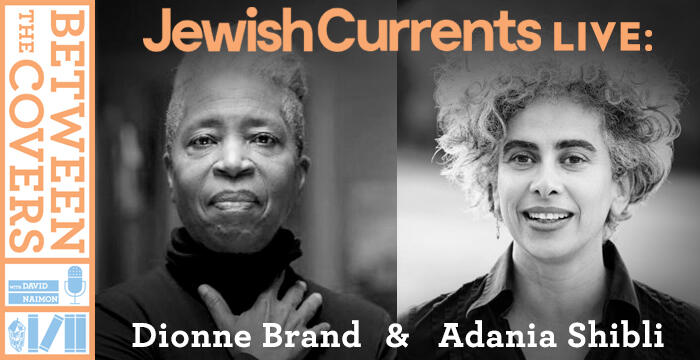
As part of Jewish Currents Live: A Day of Politics & Culture, I moderated a conversation between Adania Shibli and Dionne Brand this September in New York City. Both Dionne and Adania have been on the show individually, and part of why I was hoping to bring them together this way was because of just how unforgettable my conversations with each of them respectively were. Together we look at questions of home and belonging, nations and mapping, humans and animals, as well as at Dionne and Adania’s shared desire to write against grand narratives and to imagine an otherwise for how we might live together. We do all of this within the aura of the eleven months of genocidal assaults on Palestinian life, and how the resistance to it connects us to other struggles around the world.
Jewish Currents is offering two things to entice listeners to become supporters of Between the Covers, one is a Jewish Currents sampler of back issues, the other is their After October 7th compendium of essays, poems and reports with writings by genocide scholar Raz Segal, Peter Beinart’s essay “Teshuvah: A Jewish Case for Palestinian Refugee Return,” poems by Hala Alyan, Fady Joudah and more. To learn about these and the many other things available to choose from when joining the Between the Covers community, head over to the show’s Patreon page.
Finally, here is the BookShop for today.
Transcript
David Naimon: Today's episode of Between the Covers is brought to you by Johanna Hedva's debut essay collection How to Tell When We Will Die: On Pain, Disability, and Doom. In the wake of the 2014 Ferguson riots and sick with a chronic condition that rendered them housebound, Hedva turned to the page to ask, "How do you throw a brick through the window of a bank if you can't get out of bed?” It was not long before this essay, Sick Woman Theory became a seminal work on disability. Reframing illness is not just a biological experience, but a social one. Arguing that under capitalism, a system that limits our worth to the productivity of our bodies, we must reach for the revolutionary act of caring for ourselves and others, called "questing, pissed, propulsive, funny, pervy" by Maggie Nelson, and "the most metal kink crip book" by Leah Lakshmi Piepzna-Samarasinha, How to Tell When We Will Die expands on Hedva's paradigm-shifting perspective in a series of slyly subversive and razor-sharp essays that ranged from the theoretical to the personal, from Deborah Levy and Susan Sontag to wrestling, kink, mysticism, death, and the color yellow, How to Tell When We Will Die is out now from Hillman Grad Books and available for purchase wherever books are sold. Last month, I went to New York City as part of Jewish Currents’ all-day event of Politics and Culture, brought there to moderate a conversation between Adania Shibli and Dionne Brand, an event that almost didn't happen despite a year of careful planning because Brooklyn College rescinded the location nine days prior to the event. The dubious circumstances of this were explored in a New York Times Opinion piece by Masha Gessen published the day before the event, which I'll point people to in the supporter email, but miraculously, in little more than a week, they not only found two new locations on the Lower East Side for this sold-out event, but the event, at least from this participant's perspective, went so smoothly that you would have thought it had been planned this way all along. The day was full of so many intellectual powerhouses both on stage and in the audience. During my event alone in the 300-person auditorium where we spoke, the audience included the poet George Abraham, the political scientist Dana El Kurd, the writer and scholar and past guest on the show, Christina Sharpe, and many, many others. Over the year, when I met with the Jewish Currents working group assigned to dream my event into being, we came up with many different possible iterations of who to invite and why. To my great fortune, it resulted in the two people who were my first choices, not only because my conversations with them, each individually, for Between the Covers, were so unforgettably meaningful to me and not only because their work, their thinking, and their presences in the world are so vital to me as a reader but also because I wanted to witness them in conversation as I was pretty sure they didn't know each other or hadn't spoken to each other. And as you are about to see, the alchemy that I imagined is tangible and wonderful. Before we begin, I want to mention a couple of things about Jewish Currents. I was telling their editor-in-chief, Arielle Angel, that the thing I love most about the magazine is the Letters to the Editor. That might seem like a slight to the magazine as a whole, but it really couldn't be farther from the truth. Their portfolios on Paul Celan and Hélène Cixous are incredible, as is the poetry curated there, and so many of their articles end up informing conversations on the show. But something about the Letters to the Editor, the amount of space they devote within their own pages to debate and outright critique of what they've written, is something I really admire. There's a lot of meaning-making that happens there. It feels like the magazine is both beholden to its readers and aware that as we create meaning across difference, it's always an imperfect, ever-evolving process that requires a polyvocal approach, that involves listening as much as speaking. I do want to say that for people who become a Jewish Currents’ sustaining member—which is not the same as subscribing to the magazine, but which includes a subscription to the magazine among other things, and can be found at jewishcurrents.org/membership—you can get access to videos of not just my event, but all the events that happened at Jewish Currents Live that day. Events with Palestinian thinkers from Noura Erakat to Rula Jebreal, with art makers in the film industry from Palestinian documentary filmmakers to the producer of Zone of Interest, with Amy Goodman to Peter Beinart to Daniel Denvir, the host of the podcast The Dig, to performance artists and musicians. Jewish Currents has also donated two things to entice people to become supporters of Between the Covers. One is called After October 7th, a compendium of essays, poetry, and reports from the magazine, including Raz Segal's A Textbook Case of Genocide, one of the earliest declarations that what we were seeing was likely genocide, published last October, and relevant to Rosh Hashanah and the Days of Awe between it and Yom Kippur, Peter Beinart's piece, Teshuvah: A Jewish Case for Palestinian Refugee Return. There's poetry by Hala Alyan, and as of yesterday, National Book Award shortlisted poet Fady Joudah, and also the poem by Dionne Brand, prologue for now – Gaza, which we discussed today. The other is a sampler pack of back issues of the magazine, the issue organized around rest, which contains a profile of past Between the Covers’ guest Johanna Hedva, a great meditation on the Jewish notion of Shemitah, also the issue with Isabella Hammad's review of Arabesques, which I discussed with her in the last episode, and an issue containing Hannah Black's essay also relevant to today on Black-Palestinian solidarity called From Minneapolis to Jerusalem. The Jewish Currents sampler and the After October 7th compendium are only two of a gazillion things to choose from if you join the Between the Covers community as a listener-supporter. You can find out about all of them at patreon.com/betweenthecovers. Now for today's conversation with Dionne Brand and Adania Shibli.
[Music]
Claire Schwartz: Hi, good afternoon. My name is Claire Schwartz, and I'm the culture editor of Jewish Currents. It's my tremendous pleasure to welcome Adania Shibli, Dionne Brand, and David Naimon, and to welcome all of you. I'm thinking today of the detail, the small, the minor. I'm thinking, of course, of Adania Shibli's exquisite and devastating novel, Minor Detail, where the coincidence of a birthday catalyzes the search by a Palestinian woman from Ramallah for the truth about the fate of a Bedouin girl during the Nakba, and of how this brief note that seeks to convey something of the novel's subject is inadequate to communicate the language's kinship with quiet, its shimmering attunement to the relationship between complacency and pain. I am thinking of Dionne Brand's note, prefacing the reissue of her landmark book, A Map to the Door of No Return, where she writes, "Hijacked materially and narratively, your life appears in fragments.” Whenever I could, like anyone, I tried to detail the minor acts in a day under fracture, under force, under pressure, to bring together time and life lived, rejecting the spectacular appearances that only identified a suppressive event after suppressive event as totality. Of the elements under fracture, under force, under pressure, not least these writers remind me is language. That place we come to meet where something about who “we” is gets reiterated, contested, worked out, reimagined. Here today are three writers and thinkers whose attention to the minor summons the reader to join in upending the enclosures of the “we” that confirm the ongoingness of Zionism and other forms of colonial domination. I see this across Adania Shibli's novels, which appear in English as Touch, We Are All Equally Far from Love, and Minor Detail, as well as in her plays, short stories, and essays. I see this in Dionne Brand's 23 books of poetry, fiction, and nonfiction, including Salvage, which will be out in the US in October. I feel this across the gorgeous archive of conversations with authors that David Naimon has assembled by way of his podcast, Between the Covers. Attending to the minor, these writers refuse the endlessly accelerating logics of the spectacle, where life itself becomes the submerged unthinkable, death the common sense. They refuse to naturalize the eagerly proselytized workings of empire, or to grant its mythic claim to totality, and in so doing, these writers attune us to the other worlds rattling inside this one. I am so grateful to be in their presence. Please join me in welcoming Adania Shibli, Dionne Brand, and David Naimon. [Applause]
David Naimon: Well, first I just want to say thank you to Jewish Currents for creating this space, a space to gather and make meaning together, and also creating a sense of home for these sorts of conversations. I want to thank Claire Schwartz. I would point to her book, Civil Service, as another book that is animated by a lot of the questions we're going to explore today. So do seek out Claire's book. When we were having our meetings about who to have a conversation with for this specific part of the Jewish Currents Live, this was my dream conversation, the ones with Dionne and Adania. Their books, The Blue Clerk and Minor Detail, are two of the most important books for me personally written in the last decade. I was debating about how to start today. I was thinking of Brooklyn College's late-in-the-day cancellation and wondering whether to start with questions of silence and silencing or questions of home. Now that we have two new homes in the Lower East Side or temporary homes, I wanted to start with home. I'm going to start with a question for Dionne. Thinking of the subtitle of A Map to the Door of No Return, Notes to Belonging, but also that you say you have no interest in belonging, I think about, in that book, how you had not gone to the physical door of no return when you wrote it, and you said that you didn't want the shores of Africa to be in that book. There's a sense I think, sometimes in your writing, of a moving away and I wondered if home was a useful term, if home, as a writer, was a useful frame or term for you, and if so, in what way or if not, why not?
Dionne Brand: I don't think that it is a useful term because it is so weighted, it is so weighted with what it takes from notions, other notions that are also up for grabs like nation and family and heteronormativity and so many pressures. So while I understand its pull and perhaps its original meaning, it is that meaning that also is so easily fettered to other kinds of violences, if you will. My thing is that I want it to be always up for description, that it can have a moving description in some way. I don't want to jettison it completely, but I want to pay attention to its fracturedness, and how even fascists can call something home. I really wanted to keep the meaning open and disturbed in some kind of way, qualified.
DN: Yeah. Well, Adania, recently at the Hay Festival, you were asked a similar question, and you talked about how growing up, your parents were very restless, that they were always renovating, and that there was this fear of being attached to anything because of the possibility of it being taken away at any moment. One thing that you said in that conversation that I thought was interesting is that you said, for you, Palestine, you didn't think of as home or as a homeland, but as an ethical relationship. I would love to hear what that means and the distinction between that and home, if there is a distinction between an ethical relationship than a home.
Adania Shibli: A home always is a state of restlessness for me and this is how I experience it and probably it is also what my parents, it was a moment that they could not shift or transform, this restlessness in the destruction of home or not feeling safe at home, a home is not a question of safety, so it becomes somewhere else and something else home. I think this kind of return to a home, I think it's more like a return to a place wherever we arrive. It's like, for me, it's never about Palestine, it means something else when I go to Palestine, but whenever I come to a place, I hope to believe that I'm returning to a place. It's not like I'm arriving there for the first time because of this constant restlessness. You seek something solace somehow. Therefore, Palestine no longer plays any meaning with this home or homeland but what it teaches you, what it opens to you beyond the idea of nationalism and the nation-state, which we are victims of. I mean, you think about Zionism and the creation of the state of Israel, and this is a nation-state, and you think, “Well, is this the model that Palestine is going to imitate or replicate?” And you are filled with fear. It's no longer about that. Or at least, for me, it's no longer about that, but taking all the lessons that they're shared and to allow new forms of imagining being, being also with others. I think maybe three or four months ago, there was a conference in Berlin on Palestine, and of course, the old Nazi racist German authorities, they closed down that venue and canceled the conference. A friend, or not a real friend, somebody I knew, but everybody's a friend, [laughter] she's a mathematician and I have so much love to mathematicians so I always try to be their friend, [laughter] and she emailed me, telling me about the cancellation of this conference and suggested we meet there to protest. It was like the day after, and we agreed to meet near a fountain, and we didn't discuss it so much where to meet there, because I thought it's going to be 50 people maximum, 100. When I arrived there, there was like, I don't know, 5,000, 6,000 people, of course, I couldn't see any mathematician in the crowd, [laughter] but what I saw there, I mean, all these people that suddenly gave Palestine a new meaning, all these marginalized, attacked, oppressed groups in so many levels, and suddenly this becomes the return to Palestine as a new place for so many people who are excluded. Then also it goes back to when I encountered, for the first time in my life, the erasure of the word Palestine from the map, that moment of pain, it's a strange pain. It's not like pain, but it is a disorientation, like, “Okay, if it doesn't exist, what it means in all these existence?” Suddenly, the word Palestine appears as a lived form with all these groups. The word changes its significance. This is for me the idea of ethics, how the word is no longer associated with a nation-state or with a country or with a specific group of people, but it's open to so many possibilities and meanings and practices. This is what I mean, the ethics of you not replicating. You say, “Okay, you continue the act of generosity.” It expands. It goes beyond what is being destroyed, or it transforms what is being erased into something bigger that you cannot erase any longer.
DN: I'm glad you brought up maps because when I was thinking about the overlaps or the resonances between both of your works, I want to explore the way I see both of you working against narrative, but as a step towards that, I wanted to mention maps, which we might automatically think of as tools of orientation, but they're also tools of narrative or of story and those tools get weaponized, and so these stories can be modes of erasure also. So I wanted to read, I'm going to read from Dionne's book, A Map to the Door of No Return, just a little excerpt. “There are maps to the Door of no Return. The physical door. They are well worn, gone over by cartographer after cartographer, refined from Ptolemy’s Geographia to orbital photographs and magnetic field imaging satellites. But to the Door of No Return which is illuminated in the consciousness of Blacks in the Diaspora there are no maps. This door is not mere physicality. It is a spiritual location. It is also perhaps a psychic destination. Since leaving was never voluntary, return was, and still may be, an intention, however deeply buried. There is as it says no way in; no return.” I'm thinking of the protagonist in the second half of Minor Detail, who is trying to return in time to investigate a crime, a so-called minor detail of the Nakba in '48, the rape and murder of a Bedouin girl, and the impossibility of her, not only the navigation of space, do you have the right permit, do you have the right license plate, which area are you in, but literally she's in the car with many maps because no map really is mapping her own memory and her own experience. Towns have disappeared, everything has a different name, and so there's a bewilderment of orientation. I think about how there's no map to the psychic door of no return and this character who almost seems to have too many maps, which almost functionally seems to be like having no map in this sense of being uncharted. I wondered if you could both speak to your own work or to each other's about this question of the map and narrative and story for you?
DB: The map in this sense that you've reprised for me is really an aperture for imagining and seeing, and it is a set of historical details, if you will, that any protagonist walking through this aperture has. They may not be like the maps of colonialists, which were only a map to extraction, but they are a map to living. They are a map to the lives that were lived and the lives that are in process of living against these historical details with these historical details but not with the historical details in the linear fashion of the colonists and the colonizer and the oppressor, but the map that was used in a sense to escape and exceed those notions, if you will. For me, narrative must take a much more open form than the handed down processes of narrative of imperialism and imperialistic structures, and structures of extraction, and so on. What is narrative then? Narrative must be thrown up again. So narrative isn't simply the path of the colonizer through life and really through our lives that I speak with, but the kind of movement that exceeds that life, and that doesn't seek to imitate that structure narratively, but to actually point out and record the details of actual living, not just the details of the regimes of a certain kind of economy, of violence, but what exceeds that economy. For me, it is to look at the we who live beyond that economy and whose actual lives are restricted and constricted by those economies of violence and extraction.
AS: There is a lot of violence in drawing maps. The immediate violence you would see is these absences, things that cannot be traced there in a map, and therefore also it's not the route that you navigate through your movement, even the imaginative, even the literary. I mean, how do you move when there is this absence? Also on the level of language, like what lies there as an equal between an absence in the map and the word, and who holds these maps and who can read them and who can draw them as also drawing the narrative form and the linearity of that narrative form and the rationality of that, which all elements you would be excluded from in your imagination, because you don't have a presence in that, in this kind of the scientific. When you are thrown out of that violently, you really end up going beyond that. I think you going beyond that, it becomes an existential form of going beyond. It's not a choice, it's not a luxury, but it's only where you find yourself and then how to move your characters as well and where they start their trip and how they return. This is really questions that I think have haunted me always. Perhaps they started with a map because this is like the first act of naming. We don't have God now asking Adam just name, but this is like you come across these absences and okay, how do you narrate after that absence and how do you move, how your characters move? Do they go in a line or a circle? Because when we are lost, I don't know, I learned this somewhere that when you are lost, you always have to look in a straight line, because our tendency when we are lost is that we go in circles. So in case nobody wants to be lost, they should look straight, [laughter] but if you prefer to be lost, just don't look. This circular return, and I find this circular return, the continuous, as also a narrative form is very inspiring. Because this circle goes, and each time, with each return, there is also a new discovery of an absence somehow. Then you don't become also the one who controls the place within which you move, but you move alongside things. This is a complete also different relation of drawing, of looking at nature from above. This comes really, this practice also of mapping as a colonial practice that brings culture against nature. Your tools of navigation are completely different. Really for me, it always haunts me. If you start from this erasure, then every start can come back as a new start. This for me is the stutter. You stutter with the beginning. Linearity completely disappears somehow.
DN: Well, one of my favorite conversations that I've watched you in is with Layli Long Soldier and Madeleine Thien. In that conversation, you said something similar that you've never been good at explaining and that whenever you've tried to explain something, you've felt like you've destroyed the thing that you were explaining. You said the beginning of writing for you is both a failure of explaining and also a refusal to explain in the face of people who narrate too well. In that same conversation, you say there's no grand narrative of Palestine that, to put forth a grand narrative, given the absences, would be to put forth a fiction. I wondered if you could maybe speak a little further about writing against grand narrative in this way and about this beginning of writing actually being a failure of explanation.
AS: My writing is a failure of many things, [laughter] a failure of finding a proper job. [laughter]
DN: That's for sure.
AS: But this is something we experience every day until now. It's not maybe, in my case, the indignity in explaining. Because as it comes with a demand from somebody, like, who are you to demand what from whom? To whom are you explaining? I think this is the trouble with explaining.
DB: I agree. There is a kind of regime of literary practice that demands from certain bodies explanations for their presence and this is the indignity of it, this is the insult, and this is what the writer who is located in this space resists. I am a writer who resists that question all the time because it is a location of something that's called humanity in a particular terrain. But the demand is strong because the writing world is also an industry, it's an economy of some kind, but that economy dovetails with colonialism and imperialism, and therefore, it demands of these bodies a certain kind of explanation about their presence. That demand for me must be resisted and frankly ignored.
AS: I mean, I lived with a very strong mother. So I think all these industries of literature and culture, if they force me to explain, I should tell them go and speak to my mother because she's much stronger than them and I had my training there. I think this is like the refusal of explanation. This is also of the ethics they passed on because this is like, maybe continue but we were at a certain time, very rude kids to our parents asking like whether once we knew the Nakba, what happened? We have a language and a claim to our parents, like, “Oh, why you didn't tell us?” They just look at us like, “Who are you?” [laughter] They don't say anything. I think this moment, like, really, who are you? It's not like they tell it in a way that we are some less humans, but as if it's like, “What is your claim?” I think this is really fascinating. We grow up with that. You don't explain. Then it allows you something else. I think this allows you also to think of language, not as an instrument for explanation. It's not something you use. It's something more than that, alongside other experiences of language and narrative and narration. So narration is never about explanation but it's really about transforming and going to that beyond.
DN: Were you going to say something, Dionne?
DB: It slipped to me.
AS: We can wait. [laughter]
DN: I'm going to read something of your talk, Dionne, Writing Against Tyranny and Toward Liberation, where you said, “I don’t believe in the notion of justice, since it presumes a state of affairs that is somehow formerly good, a state that, but for certain anomalies is legitimate. In our case, I think that we live in a state of tyranny and to ask a tyranny to dismantle itself, to claim, to ask for, to invoke justice is to present our bodies, already consigned in that tyranny to the status of non-being, to ask that tyranny to bring us into being and that is impossible and it won’t. That state is, in fact, anathema. That state is anathema to us and so I do not write toward anything called justice, but against tyranny and toward liberation. Poetry is a liberatory work for me, reflecting, intuiting, making sense of and undoing the times we live in, a kind of overriding, a diacritic, a remedy, and a repudiation of the narratives of non-being in this diaspora.” When you and I talked for the show, we were talking about your collected poetry. As a poet, it's very clear this work against the linearity that Adania talks about in the sentence, but what about as a storyteller or as a narrative maker writing narratives that are working against narratives and non-being?
DB: You know what you just said that I said is what I was going to say. [laughter] Writing is a very difficult thing, I do it instead of living in a way because living is hard. [laughs] I told someone a week ago that living is so difficult, I have to write. I think both poetry and fiction, for me, have the same questions in terms of language, in terms of what language I must deploy, or what language I must make up to describe the condition of being in the world. When there's a certain linearity that's attached to my presence in the world, that linearity can only bear my body as it has transported it in the world. It cannot bear the fullness of my experience or the fullness of my being so that I must—and I use this "I" in a very "we-ish" fashion, it's not me personally, it's the condition in which I enter the constructed, restrictive world of capital and imperialism—so it cannot bear all the language that comes along with my body, including that body's indictment of those practices. So it must always make that body function in a particular way in the economy of what we live, in the economy of that linearity. I keep using the word economy a lot, but I do think it is economy because I think capital constricts time, capital eats time, eats the body, eats the human being that it works with. It only summons certain parts of that being that are useful for it, and jettison is the rest of it. My project as a writer is to collect the bits of it that capital would chew and spit out and present that. So for that, I need all the language that I am possibly capable of to reconstitute constantly, to reconstitute around capital’s ever-demanding questions to reconstitute that body and to reconstitute that living, that type of living, that kind of living. Where am I? Yes, there. [laughter]
DN: Well, taking this phrase, the narratives of non-being, I wanted to spend some time with the question of the human. In your poem that's in Jewish Currents, prologue for now – Gaza, you look and engage with the phrase that the Israeli government used, human animals. One thing that seems noteworthy about the language since October of last year of the Israeli government is the absence of any coded pretense to the way that the language is being made: Children of light against the children of darkness. This is a war of civilizations or a war of civilization. When I think of human animals and I think of Minor Detail and you have these two sections, one from '48 and one contemporary that are mapped on top of each other, the continuity between the two are the animals, the spiders, and the dogs in particular. But also in the first section with the Israeli soldier, he's bitten by the Bedouin girl who is ultimately raped and killed. He's also bitten by a spider. He's obsessed with this spider. He's obsessed with the wound that the spider has created. He has this elaborate ritual of cleaning the borders of this wound. He, at the same time, will never look at it, which feels really important to me somehow, that he won't look at the wound, but he attends to the borders of the wound and the stench that his own bite is creating, he does this act of projective identification and believes the stench is coming from the girl, the Bedouin girl, instead of being produced by him. But I wondered if you could both speak to the animal, the human animal and the human in light of the ways you both are overtly engaging with all of those.
AS: It's very interesting how time, the movement between one meaning and another, brings so much about what is this time. Like it's not a measure again of the linear that is moving, but there's something as there are so many things happening, probably happening elsewhere and here and there, the there you just went to. [laughter] As kids, I remember the idea of the God, because in Arabic, you have the God with a capital and the god, or the goddesses. They were always, teachers explained they were, what was special about them, that they were human animals. It's very interesting how these human animals, it took all this time to shift. That was when we were studying all Greek culture, and this kind of movement. For me, perhaps what was always there between the two chapters is also this trip of the words from one time to another and the shift of that meaning but in this case, it's not going from a Greek mythology to nowadays with this, but it is from almost in the same place, the same smell that the words shift their meaning and they bring into a new life. I wonder, because for me when I listen to you of looking for words, somehow I approach words with so much, not fear, but wondering like what life will they bring forward beyond our lives, beyond what our bodies carry. I think this is a haunting question when you're right. I understand it's not about the "I" but it's the "we" and this "we" and the continuation and the relation to language and what we bring to it and the so many lives we bring to it and the pains where this shift also can lead. So, it's not related to an act in a narrative. It's related to something, I think, beyond that. There's a lot of these returns. I'm just thinking about it because thinking of also poetry, how it allows these new lives to come constantly, really these days, I'm remembering a lot, the epic poetry from the seventh century Mu'allaqat and the fact that they always started on a side of destruction. Now, today, I never knew why we learned these poems. I thought it was a complete waste of time, until today. This is also what your life carries in terms of the things beyond the linearity where words come to you and hold you and take you somewhere else. I know I omitted the officer on the bite, sorry. I omitted the part of the bite but for me, it's not about an actual creature, but really goes back to the language itself and the transformation of these words. There's no relation to an animal or to an act, but there's a relation to the language and how it carries on.
DB: I think just briefly that when I heard that expression, human animals, it struck a familiar note. I think it struck a familiar note for many people around the world, people who had been subjugated, people who had been subjugated by British, French, American imperialism in some way, because that is a designation that has always been given to oppressed people. Millions and millions of us suddenly heard these words that were usually designated to us and thought, "Ah, I see," and we knew where this was going. We knew that it would involve this incredible force, this incredible violence and genocide. We had lived those genocides already and understood them deeply, and so it's significant that the rhetoric of humanism arose at the same time as slavery, as transatlantic slavery, and operated in the same vein. What it operated to do was to designate certain populations as human animals and certain others as human. So that is a physical and psychic alert immediately. That is where my poem began, and in the recognition of how language is deployed to assign those positions in the world.
AS: If I may, because it also goes back to how colonialism positions the human against the animal and suddenly as if it's an insult. I remember something very important in Polynesian mythology about where care, care to nature, is because people are born from the sea, their ancestors, the ancestors, they exist in the water, they are coming from a certain type of fish, and so the relation, and this is like also the different wording, what a colonialist would relate to the human animal. Whereas in the colonized, this is almost a sacred relation, and this gap in meaning, it's also a gap in position, it is like how words change their context, but when they are saved, each will have a goal and a completely different meaning, and the question where we find their inspiration, will we allow now the Israeli government with its acts, and the violence that it brings, not only that we cannot comprehend, and then it touches something so central. This is what also keeps me thinking. What do we do with this word “human-animal” when it's a system of care? Because I remember the Polynesian cultures, the idea of taking care of the sea is also taking care of your ancestors and you're extending cultural nature, they're no longer opposites, whereas the colonizer want to tell us they're opposites and the minute that you meet together this is an insult and you don't deserve to be a human. I think this is another taking, another attack on language, another attack on something so intimate where there is a solace of a relationship between the human and animal, and if this relation suddenly becomes an insult, you imagine this kind of attack on something so deep beyond the language and also where the animal lies, it's beyond the language and this is to beyond the explanation and not agreeing to go into this level of modernity or civilization, modernity, where colonialism starts. For you to be a human, you need to be the real beast. You will be a beast, but a kind of a legalized beast.
DN: I want to spend a little bit longer with humanism and liberal democracy. In the poem, prologue for now, you say, “I’ve taken this inventory before for all the ‘human animals’ liberal democracy has entirely failed and failed to even hide its fascisms; this narrow path of language leads me here.” But I was wondering when Israel puts forth, “This is a war of civilization,” and then the Western powers go, “Yes, it is,” if it goes farther back than 1492 because I'm thinking of Daniel Mendelsohn, the classicist. This is what he says, “The stereotype of the decadent, despotic, effeminate, inscrutable, untrustworthy, servile, fawning, irrational, sexually ambiguous ‘Oriental’ makes its first appearance in Greek literature, particularly in tragedy. The Eastern ‘barbarian’—whether in the person of the protagonist in Medea, or of Bacchus' seductive Dionysus, often stands as the negative image of the idealized Greek self, which is presented as masculine, rational, and self-controlled,” which very much reminds me of the ritual of the Israeli soldier and the wound. But I wondered about if you could both speak to this question of liberal democracy or humanism in relationship to how you write, because I'm thinking of Dionne right before the passage that I read about Writing Against Tyranny, you're relating an anecdote from 25 years ago of a communist friend of yours in Tobago who you're asking if they're going to vote, and they say, "I don't believe in democracy," and you have this moment of fear, but then you also ask rhetorically, “Well, how can we believe in democracy given all that's done under democracy's name?” I think, Adania, you often tell the story of Sakakini, the Palestinian under Ottoman rule, getting his door being knocked on by a Jewish man who is illegally there and is being accused of being a spy and his decision whether to be a good citizen or to give this person shelter, and this question of what it means to be human, which I think in both of your cases is not to be a good citizen, I wonder if this sparks any thoughts for either of you.
DB: Three things if I can remember them as I go. One, I don't think that rhetoric of the Israeli government or the US government, or the Canadian government, or the French government, or the British government, I don't think anyone believes it. It's now become very, very thin. Perhaps that rhetoric might have been plausible, vaguely, in some kind of strange way 40 years ago or something. But we now know how thin that administrative language that's used now to justify all kinds of horrors, we now know how thin that is. It's very, very flimsy at this point, one thing. Secondly, democracy as a concept has always been, I think, only available to whiteness, or to White people. It's available to White people, kind of in North America, in Europe, et cetera, and an aspiration of Black people. It's placed as a kind of aspirational thing. Black people must aspire to it, just as we must aspire to freedom. But it's available to whiteness. It's seen as a right in some kinds of ways. That's two, what was the third thing? When I wrote that about, I've taken this inventory before, I was referring to the poem of mine called Inventory, the long poem called Inventory, which I wrote during the Iraq war, during the invasion by the US of Iraq where one was invited to sit and watch that war on television, in North America at least, I live in Canada. It was late at night, and there was a big star on a map, and that star was supposed to be Baghdad, and somewhere where Saddam Hussein was, and these bombs we were invited to look at falling on this city of five million people. I sat in front of the television and I thought, “Oh my God, I live in a city of five million people. There's something going on in a city of five million people. Not simply the location of someone called Saddam Hussein, but the devastation of a kind of everydayness of people who live in a city of five million people.” That poem erupted from there, but taking a list of the everydayness, the life that's being lived, that's being overlooked, but that's being broadcast as evil being destroyed, so that is the inventory in a sense that I take on as a poet to make that list of the everyday life of very ordinary, very regular people on an individual street, or sitting at a cafe, wondering whether, “Oh, hell, did I leave my bicycle outside? Did I unlock it? Did I not? Where will I find money to do something very, very simple?” and so on. So I think that's my job as a writer to make those kinds of small accounts.
AS: Yes, right, because I just was thinking about it today, these kinds of democracies because somebody asked me yesterday if I ever voted in my life. I said, “No.” But he was perplexed by my reaction. Because this is also the experience of what democracy meant to me. It's an oppressive apparatus, this democracy, and this idea of who's a citizen. I mean, the violence that is being practiced aren't just the act of naming who's a citizen and who's not and what this implies is inclusion and exclusion. It's wonderful that you mentioned Sakakini but because at that moment when he's faced by the dilemma of betraying his government or literature, that's the dilemma, and he categorizes this of being the citizen that you follow the rules of the state, of not allowing somebody asking to have a refuge with you, or betraying your literature that always says you should welcome the weak and this is hundreds of years where the idea of generosity and being an ally to the weak and oppressed is what instructs you, not who's a citizen or the laws because it's a completely different register of ethics. In Arabic, he goes on to say that he refers to this literature to instruct him, not the government. This is fascinating because in Arabic, again, the word for literature and ethics is the same. It's “adab.” When you are well-versed in literature and poetry, it also means the same that you have, like you said, as an ethical person and this gives us a hint. I don't want to be concerned with opposing or not opposing democracy and being trapped within that discourse but try to think of different forms that allow us to imagine how we can be together. This is very interesting because the novel also as a form, it appears during a time in modernity, and it is used to introduce the idea of the nation. This is going back to the idea of the grand narrative of the nation. But what is there, luckily there are different forms of literature and different types of narratives and non-narratives and anti-narratives that allow to so many other narratives, other than the grand narrative to emerge. The grand narrative is almost like one narrative, whereas the non-narratives of so many, this is about the multiplicity. This multiplicity is important because it keeps us alert, alert in our forms of engagement, our political engagement within liberal democracies. It has been reduced to an act of voting or not voting or one act that happens and then the domain between the private and the public is private and the care towards others is reduced into that form. It's like you shouldn't care as a person because we, as a state, representative of you, can take care of you. What Sakakini proposes is our constant engagement of what’s to be done. I think now in Palestine and many other places, we don't have the luxury of saying, “Oh, this is political and I'm stepping out, and then I can come and practice my right once every four or five years.” If I should choose between either, of course, I would find more inspiration in the one that constantly calls us to care and to ethically engage and wonder what it is. As opposed, because this is also something that goes back to literature, which is another thinker because Munir Fasheh proposes about neighboring and the aesthetics of neighboring, which also abandons the fact of who's a citizen. You no longer think of others as citizens, but as neighbors where the relation is, there's no other citizen, or the citizen and non-citizen, but there is the extension towards the other, the intimacy within this relation. It comes also from sometimes the relations between two, the relations that exist on the margins are not bringing into the center, the state, as your point of reference. It abandons the center and the ethics of the center and wanting to be in the center and withdrawing from the center. You're constantly functioning in the margins on the side to create something else. For me, this is more an ethics of literature because of the intimacy that also reading and writing create.
DB: To follow on, there's a way in which these democracies that now have reduced being in them to that voting once every four years or so, but I can walk along the street and see an unhoused person, and I simply can walk along the street because I voted, I don't have to do anything about that. So it's reduced the act of being in the world or being in relation to that. It's convinced us that that is the only act that's necessary, not the other acts of being in relation with each other.
DN: Well, just before I came to New York, I was in conversation for a second time with Isabella Hammad. Her book that's coming out is the book version of her Edward Said Memorial Lecture from last year, and it's called Recognizing the Stranger. It deals with a lot of what we've just talked about, but why it's such an interesting document is because it’s an examination of the shapes of Palestinian narratives and looking at the middle of narratives, so turning points or what Aristotle called recognition scenes or epiphanies, but she delivers this speech nine days before October 7th, and then after October 7th, and witnessing the way the world at large responds to what Israel projects that it's going to do and wants to do, she has her own recognition scene where she's shaken around her own notion of what she believes and writes an afterword. The afterword is a third of the book. We have this, they're not at odds, but they're at right angles to each other, I think. For on the one hand, you have in Recognizing the Stranger, this really great ending where Said is sort of lovingly putting Freud on the couch and psychoanalyzing why Freud believed that Moses wasn't Jewish, that he was Egyptian, and that he learned monotheism from a pharaoh, and Said's meaning-making being around there being an otherness at the heart of Jewishness, and this meditation that Isabella does around finding the stranger within the familiar. Then her connection of that to Said's notion of Palestinianism, of being not entirely comfortable inside or outside, the connection that Isabella makes between the unhoused character of Jewishness and Said's own notion of Palestinianism. But then with the afterword, post October 7th, the recognition shifts, it starts with her mother looking at the television, seeing the genocide and live streamed in real time, and her mother pointing at the screen at some Palestinian women and saying, “That is me.” We have this conversation where we leap back and forth uneasily, I think, for both of us. I think there's an unease in the book between the notions of the first part and her sense that she's explicitly lost faith in humanism and yet framing that Said himself and even in her mind, Sylvia Wynter and Fanon were what she said were rating the conceptual toolbox of the Western philosophical tradition to use them to their own ends. But she was shaken from that as a project. So she's giving an Edward Said Memorial Lecture and also at the same time, changing her view of recognition. I guess this would be my long preface to ask if anything about the last 10 months has either put some pressure on what you believed or was clarifying to things you already believed in your writing practice and the ways you're, as we've discussed today, recognizing the otherness, interrogating narration, speaking into and from erasure and anything else.
DB: I guess for me, it's dreadfully confirmed things, a certain course of history in some ways, but also affirmed some things, given the response that people around the world, students on campuses, it affirmed also the fight back against those very things. It, I think, calls for broader analysis. It calls for seeing all of the connections that we have to each other in the world, those of us who think of a world differently than through capital, and then through racism, then through imperialism. It connected with things happening in Sudan, Congo. It connected with what I see as a great migration that's been happening, it connected with the great deaths in the Mediterranean, or the Gulf. It called, in a sense, for narrating, for thinking about, for imagining other worlds, imagining a different kind of world—and not that I didn't feel this pressure already—but added to the immediacy of a certain kind of pressure on writing. I'm searching for company in this world of writing the world, and writing the world we want to live in into being in some way, small. That sounds grand, but it's really a tiny, tiny thing, paragraph by paragraph, or poem by poem.
AS: I remembered a poem by a Swiss poet that I forgot his name, but I just remember the image. It's the rider on the Lake Constance that he crosses this lake. It's very windy and it's breakable but he crosses and he crosses and he crosses, maybe you know the poem. Then when he reaches the village, everybody's surprised, “Oh, you managed to go through this,” and then he has a heart attack and dies. It's a very fascinating poem because I'm always thinking about this rider that like no one should tell anyone how did you manage or how you've been managing, maybe we just should keep riding, I don't know why I think that, but maybe what I mean that it's a time for me at least, it's moving without knowing somehow or not seeing, and I think the fear of looking is immense of what's happening. I think the minute that personally I would look, I would collapse. This is the importance of nobody telling you to look, we will all end up like this rider having heart attacks. This is where I recall with a friend in Gaza, somebody we've been in touch since years, every one or two weeks, because we're working together in relation to a magazine and suddenly we stopped, like in October, we stopped communicating because there's also an immense sense of shame how we could live just in general like how, and he initiated the the contact back because you always think you cannot look, you cannot look, you cannot. What he said was fascinating that it's quite terrible like I would rely on somebody in Gaza to give me the means to survive. He said that I need to write not to become a monster. I think this is what writing is suddenly like, yes, you're right we need to write not to become monsters. This is I think what these last period, it's not like the last 10 months and I think the pain is old, is even older than us or I don't know, it's so old that is around you and just growing and growing and growing but this is a moment, perhaps, writing also has a different meaning, it has a shift that is the last thing before you become a monster. It's your resistance in that. Yes, of course, it is a savior. This thing comes, it saves you. It saves your practice. It saves the end like, “Okay, you might not have a heart attack and drop the edge of the lake, but you might drop your ability to write and then this is exactly the moment that it should continue in any way, in any direction.
DN: Well, I wish we had a lot more time to have a lot more questions. [laughs] But let's give it up for Dionne Brand and Adania Shibli. [Applause] Today's program was recorded at the volunteer-powered, non-commercial, listener-sponsored, full-strength, makeshift home office of me, David Naimon. If you enjoyed today's conversation, consider joining the Between the Covers Community as a listener-supporter. Every supporter can join our brainstorm of future guests, and every listener-supporter receives supplementary sources with each conversation, of things I discovered while preparing, things referenced during the conversation, and places to explore once you're done listening. Additionally, there are a variety of other potential gifts and rewards, including the bonus audio archive, which includes an extended reading of Walid Daqqa's Parallel Time by Isabella Hammad, Roger Reeves reading Ghassan Kanafani, Naomi Klein reading Philip Roth, Dionne Brand reading Christina Sharpe and Canisia Lubrin, among many, many other contributions. There's also the Jewish Currents compendium After October 7th, a sampler pack of back issues of Jewish Currents, the Tin House Early Readership subscription getting 12 books over the course of a year months before they're available to the general public, rare collectibles from past guests, and a bundle of books selected and curated by me and sent to you. You can find out more at patreon.com/betweenthecovers. Or if you prefer a one-time donation, you can do so via PayPal at tinhouse.com/support. I'd like to thank the Tin House team: Elizabeth DeMeo and Alyssa Ogie in the Book Division, Beth Steidle in the Art Department, Becky Kraemer and Isabel Lemus Kristensen in Publicity, and Lance Cleland, the Director of the summer and winter Tin House Writers Workshops. Finally, I'd like to thank past Between the Covers guest, poet, musician, composer, performer, and much more, Alicia Jo Rabins, for making the intro and outro for the show. You can find out more about her work, her writing, her music, her film at aliciajo.com.