


Hybrid / Nonfiction / Poetry
Joan Naviyuk Kane : with snow pouring southward past the window
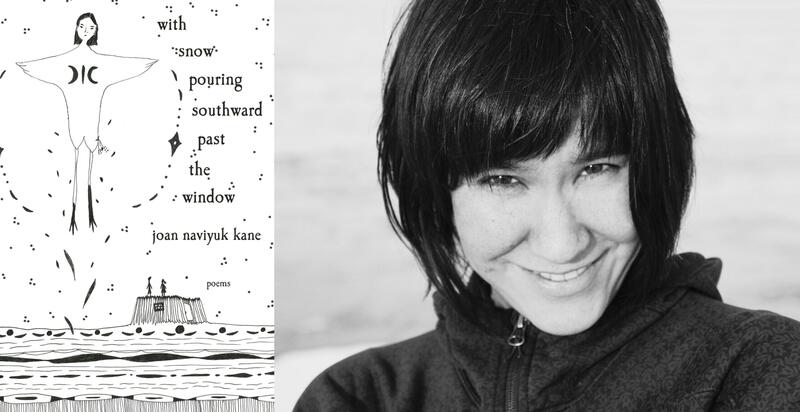
When Cynthia Cruz describes Joan Naviyuk Kane’s latest collection as a series of poems that “both shows and enacts how a self is brought to being through the abyss,” I think of Kane’s own words about poetry: as “a place of refuge and possibility, a generative space. Not a space of loss, but contingence.” What is a home in the face of dispossession? Inheritance in the face of rupture and colonial erasure? And what is the role of language on behalf of continuity and continuation? We explore all of these questions and much more, both generally, but also quite granularly within the context of the indigenous circumpolar North.
For the bonus audio archive, Joan contributes the reading of a long poem, one that she is still working on, called “Provisionally.” She grants us a sneak peek of a poem that she has been drafting and revising for a year, in its current provisional form. This joins many remarkable contributions— from everyone from Layli Long Soldier to Dionne Brand, Isabella Hammad to Arthur Sze, Jorie Graham to Danez Smith. Find out how to subscribe to the bonus audio, and about the other potential benefits and rewards of joining the Between the Covers community as a listener-supporter at the show’s Patreon page.
Finally, here is the BookShop for today’s conversation.
Transcript
David Naimon: Today's episode is brought to you by The Evolution of Fire: Essays on Crisis and Becoming by Angela Pelster. From the celebrated author of Limber, this is a luminous collection of essays about crisis, hope, and the decision to resist or embrace evolution. It is a book about time for our time. Pelster documents crises from childhood to adulthood, from her father's rage to the dissolution of her marriage. Hanif Abdurraqib writes, “In the braiding together of language, The Evolution of Fire is stunningly written—vivid in imagery. Meditative and curious, pulsing with fascination, fear, and the untamable human spirit,” these essays contemplate who we are now and what we still might become. Published by Milkweed Editions, The Evolution of Fire is available wherever books are sold. It isn't uncommon on the show that the question comes up: What is poetry for? What does it do? I'm interested in why it seems like it is poetry in particular meant to shoulder this question. I'm not saying novelists or short story writers or, for that matter, painters or sculptors or playwrights aren't asked this, but my impression is that it is far, far less. I wonder if it's because of poetry's connection to the oracular, to the ancient oracles that spoke about fate in mysterious syntax, that we expect poets in a certain way to be able to reach beyond the veil and provide us with a sense of meaning about the present or about the future. I might also highlight in our current times these lines from the poem Possibilities by Wisława Szymborska: “I prefer the absurdity of writing poems to the absurdity of not writing poems.” In my mind, how can you not love a poem that begins with “I prefer movies. I prefer cats,” and ends with “I prefer keeping in mind even the possibility that existence has its own reason for being.” I think over the past seven or eight years, as the show has developed its own politics and its own poetics and puts forth that these two aren't really separable things, this question, “What does poetry do?” comes up less and less in an overt way as it becomes the subtext, the reason why we are meeting to discuss art making at all as the wheels come off of the world as we know it. That's true about today's conversation with Joan Naviyuk Kane, which on the one hand covers so much territory: questions of home and dispossession, questions of colonial erasure and continuity, questions of voice and identity, and much more. But as I was finishing the audio edit and listening to Joan's answer to my last question, one that connects to so many questions and answers that lead up to it during our two and a half hours together, I do think this conversation makes an unusually compelling case for the invaluable nature of poetry. That perhaps, as Wisława Szymborska says, “I prefer keeping in mind even the possibility that existence has its own reason for being,” that I was left feeling, after my time with Joan, that poetry too has its own reason for being. Before we begin, I'll just mention Joan's contribution to the Bonus Audio Archive. She reads for us a long poem, still in progress, called Provisionally, that she's been working on for a year now, and we get a sneak peek of it in its current iteration. This joins Danez Smith reading poems and designing poetry prompts for us, Bhanu Kapil's Late Night Whispers from her journal, our current U.S. Poet Laureate Arthur Sze reading his translations from four different eras of Chinese poetry and then relating each to a breakthrough and evolution in his own poetics, Jake Skeets reading Luci Tapahonso, and much more. The Bonus Audio is only one thing to possibly choose from when joining the Between the Covers community as a listener-supporter. Every supporter gets the resource-rich email with each and every conversation, and every listener-supporter can join our collective brainstorm of who to invite on the show. Then you can choose from a wide variety of things, from access to the Bonus Audio to the Milkweed Early Reader subscription, receiving 12 books over the course of one year before they're available to the general public. You can find out more at patreon.com/betweenthecovers. Now for today's conversation with Joan Naviyuk Kane.
[Intro]
David Naimon: Good morning and welcome to Between the Covers. I'm David Naimon, your host. Today's guest, poet, editor, and teacher Joan Naviyuk Kane, is Inupiaq with family from King Island and Mary's Igloo, Alaska, with herself being raised in Anchorage. She has a BA with honors from Harvard and an MFA from Columbia University. She is founding faculty of the Graduate Creative Writing Program at the Institute of American Indian Arts, has taught at Tufts University, Harvard, and Scripps College, and is currently Associate Professor of Creative Writing at Reed College in Portland, Oregon. She's the author of many books of poetry, including Hyperboreal, winner of the American Book Award and the Donald Hall Prize in Poetry, selected by our current U.S. Poet Laureate Arthur Sze. Orion Magazine says of Hyperboreal, “Around, within, and beneath the poems, the vast silence of the Arctic landscape reverberates, along with the brutal silencings of its Native people. Silence also lives in these poems as a space where something else might come into being: a new way of feeling, thought, or understanding; an openness that wasn’t there before.” Of her collection Milk Black Carbon, Carolyn Forche says Kane “writes in English and Inupiaq Eskimo, toward a horizon of radical futurity, against nostalgia, with awareness that there is no turning back. This is a twenty-first century poetry, urgent, necessary, and of its time. ” Melissa Febos calls Kane's 2023 Kingsley Tufts Poetry Award finalist, Dark Traffic, “a ravishing achievement—one of our best poets at the height of her powers.” Among her many accolades, Joan Naviyuk Kane has garnered a Whiting Award, a Guggenheim, a Lannan Literary Fellowship, and the National Artist Fellowship from the Native Arts and Culture Foundation. She's been a judge for the Griffin Poetry Prize, co-edited the 2017 Griffin Poetry Prize anthology, as well as co-editing Circumpolar Connections: Creative Indigenous Geographies of the Arctic. Her writing can be found widely, from Orion to The Guardian, The Yale Review to Poetry International, and in many anthologies, including American Wildflowers: A Literary Field Guide, Solastalgia: An Anthology of Emotion in a Disappearing World, Shapes of Native Nonfiction, and Best American Poetry. Joan Naviyuk Kane is here today on Between the Covers to talk about her latest book, just out from the University of Pittsburgh Press, called With Snow Pouring Southward Past the Window. Poet Tawanda Mulalu says of this book, “What troubled music our ears are filled with when we read Joan Naviyuk Kane’s poems with the intensity and care that they call for. She writes via a syntax of shadows, whispers within whispers, whose dense sonic interiorities work through a terrifyingly embodied colonial history, and through deep familial trauma. But the distressed white spaces of this work provide a clearing for the mind not only to (just, just) begin imagining other worlds. They also share with us the weight of winter’s unyielding silence, as Kane matter-of-factly states: ‘I will look through a darkness I could have walked through alone.’ Here is a poet who sings aliveness despite the brutality that continued breath demands.” Poet Stephanie Adams-Santos adds, “These poems move ferociously through landscapes of rupture, wielding exacting, rigorous vocabularies that feel scraped from the wary and hoarfrosted voice of a poet-seer who spares no bullshit: ‘No more I want to go home. No more I want to go into another time. No more want, just need.’ Kane’s word is urgent throughout, marked by an insistent naming of plants, people, places—an act of preservation against all that slips away. Even as everything edges toward loss, this collection builds something lasting and vibrant. This book will gut you and sweep you clean.” Welcome to Between the Covers, Joan Naviyuk Kane.
Joan Naviyuk Kane: Thank you so much, [foreign phrase]. I'm really grateful to be in conversation with you. Sometimes I forget in the day-to-day. I'm able to put up a lot of blind spots about my own practice as a writer, as I spend a lot of my time working with undergraduate students and in the world of their poems. So I'm grateful as well for the generosity of the introduction. It reminds me that I do have a past and maybe a future. [laughter]
DN: Well, I'm really excited too. I tried to look back through email to see how many years ago we first entertained the possibility of talking, and I couldn't find the origin point. But nevertheless, I want to start in an impossible place, not because we can entirely answer this question, but because I think this question animates so much of your poetry. I think by starting here, we can return to it in different ways as we talk today. That's the question of home, which perhaps itself is an impossible place. This collection engages frequently with place. You were raised in Anchorage, Alaska, and if you were a settler, it might feel like a simple thing to say you were from Anchorage, that Anchorage was your home. Within the collection, there are seven Anchorage poems, six in a series called After Anchorage and a final one called Without Anchorage, which is three pages of dense prose blocks where you are cleaning out your childhood bedroom closet: old journals of yours, photographs, your memories of immense violence in that house that your mother survived and that you survived. With you saying near the end of that poem, “I come from a long line of Inuit.” But even your grandmother, who grew up in a mission orphanage north of Nome after much of her family were wiped out by the flu of 1918, Pilgrim Hot Springs was both her home and not her home, having had to leave Mary's Igloo to the orphanage. The title of your book suggests both a sense of moving and direction, but also being inside, inside a house which may or may not be a home, with snow pouring southward past the window. The cover, which is dominated by an immense white sky and the sky and the expansive spirit being within it, a part bird, part girl being, dwarf the tiny humans below who are standing atop a tiny structure, a tiny shelter, looking up at it all. I liked this image so much, I reached out to the book designer, Alex Wolfe at the publisher and learned that this work is from an artist from northeastern Siberia. While I now know what it signifies, as I've since had an unexpected correspondence with the artist named Tulluk, prior to knowing what it means, I wondered, “Are they happily atop their home, looking out at the sky, at this spirit being? Or are they atop their precarious structure because around them are rising waters or something else?” But either way, on the one hand, this image is not from your "home." But if we think of the circumpolar region as a place with shared life ways and concerns, in a way it is from your home in a different sense. So perhaps this isn't a fair question to begin with, but speak to us about whatever any of this brings up around this question of place and home.
JNK: Thanks for the question. Also thanks for calling attention to the artist and the amazing design that Alex Wolfe brings to bear on the books that he has brought into production of mine for Pitt. One of the reasons why it's a real pleasure to remain with the press and find a home for my full-length collections there. I guess I'm thinking about the cover because I think one of the questions that guided me as I was writing this collection and bringing it together under this title was actually this great sense of uncertainty, not only that autobiographically I feel, but I think that many, many people in this country feel when it comes to the question of, “But where will we be housed?” How will we live? I think for me the question also began to take a different shape because of the way that I have left Anchorage multiple times in my life and had this feeling of starting over so many times and beginning again. When I had been working over the past couple of years trying to make sure that we have good networks of Indigenous artists across transnational borders, I was thinking about how to wrap my head around this collection of poetry, but also how to situate myself in terms of where I am in my life. You know, I've spent the last almost two decades now—that's an exaggeration, but it feels a lot longer than that—being concerned with my children and how I'll provide for them. I think this question of home is something that I've had to reestablish in my interior and my private life for my kids, but also thinking about how so many of my mother's siblings and many of my relatives from King Island, and many people in Alaska in particular after the devastation of the flooding in western Alaska this last fall, I'm thinking about how many people have no conception of how to find any place that feels safe. Any place that feels safe, either as a place of refuge or as a place to begin the work of repairing oneself, repairing families after the pandemic, talking about some of the most existential concerns that I see my children dealing with every day, and I see my students grappling with new ways too, in ways that didn't exist prior to the pandemic, let's say. I think of how my grandmother before her death—so she was raised, as you mentioned, at Pilgrim Hot Springs Orphanage, which at the time was called the Our Lady of Lourdes Chapel and Orphanage. It was run by the Ursuline nuns on the Seward Peninsula of Alaska. I remember how my grandmother, after receiving a terminal diagnosis of her cancer that had metastasized, she walked with another elder from the Kougarok Road, which there are three roads that lead out of Nome, Alaska. They're all about a range from 60 to 200 miles long. They're all dead ends, as it were, which is to say that they don't connect to any other road that leads anywhere else. But my grandmother walked from the Kougarok Road about six miles with another elder to Pilgrim Hot Springs, to the ruins of the orphanage site. It was before there was a road that was constructed. It's not easy country. Some of the biggest grizzly bears, brown bears I've ever seen in my life have been right around that spot on the Kougarok Road. I mean these enormous, enormous creatures that when they run past a car or a truck, if you're in a truck, you can see them throwing up clumps of earth with every step. I mean there's no exaggeration. It's a rough country. I think about how I'd wondered—I mean I was too young to remember any conversations, or I don't know that I would have had them, or I don't know. My grandmother may have talked with me about why she chose to return to Pilgrim. But I've been thinking about, for my grandmother and my mother, thinking about all of the very real federal policies, federal Indian policies that they were subjected to at times when they were just trying to raise their children. I think about how I've tried to talk to my mom, even though at times conversation with her can be very, very taxing on her. She often cannot remember things when I ask her questions now. She's quick to acknowledge that in our conversations. But I think about how I spoke with my mom in October and I asked her if she had any advice for me in terms of my kids. She gave me some advice. She said, “Be good to them.” I said, “Well, do you have any advice for me?” And she said, “I don't know. I never really had a hard time, so I don't know. I don't know what advice to give you.” [laughs] It really put things into perspective for me because in as much as it has been a challenge to start over and over in my life and to show my kids that starting over is sometimes the only option that you have, I also became aware that my mom and I haven't really talked about what it has meant to try to make a home, not just for oneself but for others, and to take care of them. I'm also thinking about—this is a very long reach—but I'm thinking about the idea of a stanza as a little room. I'm thinking about the one-room houses that people inhabited and lived in on King Island that my mother was raised in, that all of my family members were raised in. I guess I'm thinking about home as a place both to return to in some way, but also seeing how for Indigenous people across the Arctic, but particularly as I have after moving to Massachusetts, working a lot and spending a lot of time in Sápmi, thinking about the biggest change for all people but especially Indigenous people in the Arctic in recent decades has been this sedentary nature of our lives. And how all of the skills of recreating shelter, recreating refuge, recreating home and stability and continuity actually reside in language, not just in the material aspects of being able to find a place where you can spend the night. But I'm also thinking about the stretch of time I spent in Tromsø working with the artist collective Máze there of Sámi and other international artists. It was really remarkable. There's a Sámi architect and scholar, Joar Nango, who is able to assemble indigenized spaces very quickly, public spaces and spaces of gathering and community and celebration. So, you know, as I've moved a number of times across the North American continent and wondering how many boxes of books I possibly need and how many notebooks I should save and things like that, I also realized that some of the quality of having a home actually means having a place where one can surround themselves—in my family in particular—with books, and books that they return to, and books that stand in for conversations that people may not be able to have because of the way the King Island Native community is distributed. Oh, I'm losing my train of thought. I'm looking down at my page and I'm just vamping. Let me take a breath and a sip of water and come back to earth.
DN: Before we talk about the stanza or the little room in poetry, let's spend another moment with the little room on King Island and what King Island means for your family and people, a place no one has lived year-round since 1965, and where the number of King Islanders born after 1974 who have ever visited it can, by your account, be counted on two hands, but which your family's ancestors lived on for thousands of years. Your description in essays of your one trip there in 2014 makes it seem nearly impossibly hard to visit. You and three other mothers go after a year of planning, 26 hours on a 42-foot aluminum-hulled boat, several more hours in a small inflatable Zodiac dinghy two at a time. You talk about the terrifying experience of working backwards down several hundred feet of hard-packed melting snow at 45 to 80 degree angles without ice-climbing gear. Yet you also say, “How essential the journey, both in actuality and metaphorically through poems, has been to my survival and to, I hazard, my family's survival. One return to my family's homeland is far more than I ever imagined I could make. My poems relating to this place, a place that will continue to thrum with life and memory, look up and out, away from the self.” So I was hoping we could speak maybe a moment about King Island, whether literally about why this line to it was broken or to this expedition you undertook, or to the island in the imaginary/cosmology of your family and your poetry.
JNK: I was raised by my mother and grandmother and other relatives every day with the knowledge that I was a King Islander and I was to be proud of that. It wasn't until my adult life, I guess starting with when I began to return to Nome when I was completing my grad school degree, I had the sense that perhaps the storyline was that if I ever tried to go to King Island, my yearning for it, my homesickness for a place that only existed for me in language, in story, in song, in our traditional dances, in the carvings of my uncles, in the prints and artworks, many visual art, just brilliant works of art that King Islanders have made contemporarily but also across time. One of the things that was a challenge for me was that in 2006, when I first moved back to Alaska, one of my relatives who has passed away, Deanna Kingston, who is a professor of anthropology at Oregon State University, she had obtained this grant from the National Science Foundation to bring elders back to King Island. My mom was one of the people who wanted to go. My mom really wanted me to go with her. At the same time, I was finishing my MFA and I was looking for a job. I knew that I wanted to move back to Alaska and that chances to work in academia are very few and far between. I had the chance to teach at Upward Bound for that first summer, which is a program for rural and low-income, often first-generation college students. In Alaska, this is how the program was practiced and administered. My mom was in one of the first Upward Bound classes at the University of Alaska Fairbanks. So I was eager to start this job at UAF and teach kids. I wanted to be a point on their trajectories of figuring out the skills they would need to face whatever future might come before them. I remember getting these emails from my mom. She was sending them via satellite phone from Cape Woolley, which is near King Island. It's about 40 nautical miles away from King Island on the mainland. Her insistence on saying, “You should really come. If you just come here, maybe we can get you to King Island.” The contingencies were so many. Also, the practicality. It's like, “Mom, I have a job. It's a time-limited job. I need to work at it.” But I remember feeling that I'd really missed this chance and didn't bring her to King Island when she asked me to bring her. She asked me to take her when she was physically able to do so and in the time before I had children. I had been working for one of the village corporations to which I am enrolled, Alaska Native Corporations, and was working in Nome a lot. Essentially between 2006 and 2011 was when I began traveling to Nome regularly. So there were times when I would have to fly up on the milk run flight in the morning and fly back at night. It was rare to see King Island from the mainland. It's rare to see it from the air. But a lot of my friends in Western Alaska who would fly from, let's say, St. Lawrence Island or Shishmaref or other places in the Western Arctic to Nome, they would always send me pictures if they flew over King Island or if they could see King Island from the plane. People let me know that they were thinking of me and thinking of the island. I'd also started serving on my village corporation for King Island Native Corporation at the same time that I was working for the Nome Village Corporation. I had this conjecture—and this is before land-based education, the land-based education movement in particular, and in relationship to Land Back and land-based practices had become as developed as they are now—I think that I had this sense that if I could just figure out how to get to King Island once, I would have a better sense of how to help other people go back. I also really wanted to go while my mom was still alive, while as many of her siblings were alive that I could talk with and assure them that this connection to the island was a firsthand experience that I could make possible for myself and for other people, but also to reassure my community where I am regarded in some ways as a very helpless person. Everyone knows that I faint at the sight of blood and that I have a really strong vasovagal response to everything. So although my relatives will say, “You're so observant. It's too bad you're not a boy. You'd be a great hunter. But also maybe you wouldn't faint at the sight of blood and you'd be more useful, right? Then you could help harvesting and you could help with all of these things.” I thought, “Well, if I can go back to King Island, if I can plan and undertake and safely get people there and back, I will have some understanding of the ways in which I was raised by my family and by my community and my relatives,” who would tell me that our dialect would make sense to me if I could actually go to King Island and see the complexity of the topography of the land, to witness firsthand the strength of the currents that surround the island and the profound amount of distance and journey that it takes to get there and to get anywhere in the Bering Sea. I think my ambitions, as poets' ambitions can be, were grand. My ability to undertake this trip was uncertain at a time when I was also trying to get the first classes of graduate students at the Institute of American Indian Arts situated and producing work and figuring out how that program was going to run with the uncertainty of telling students, “This is a strange thing, but if you want to try to come to the summer residency, you have to send me all of your work from the semester by this date, because I could be out of communication for anywhere from two days to two months. So the time to communicate with me about your education is now.” [laughter] But I also think about this really striking sense of being on King Island. Only one of the women who brought me went into any of the dwellings, any of the houses. [Marilyn Kizuna Ireland] went into her mom's house. But the rest of us felt that it was too dangerous and too risky for us to spend as much time as we had wanted to seeing what, if anything, had survived of the homes that our families grew up in. The most striking thing to me, and I keep meaning to write more about it someday, was the complete lack of fear that the Arctic foxes who had overtaken King Island had. They have overtaken the island to the extent that they are inhabiting the community houses, the men's houses on King Island that had fallen. Many of them had not been used by the community in decades, but there were three surviving in my mother's childhood. To see how these foxes were so unafraid of us as people, as other creatures, but also how little they seemed to care about our presence on the island—in some ways it was reassuring, but in other ways there were all of these other things that had happened when we were on the island and approaching the island that even those people who are endowed with the narrative gift would be pressed to invent. The fact that we saw a humpback whale with two calves in the distance in this long, long Arctic dusk and dawn that we encountered there at the end of June in 2013, spouting and breaching, and she was feeding her calves. We could see all of these things from a distance in the water, which is really, even for avid whale watchers, a very rare thing. Also, the seabirds, some of which have these really anthropomorphic calls. There was one bird in particular—we were taking a rest, working our way up this very dangerous snow-packed area on the island. We were resting and we heard something that sounded just like a young girl screaming. I was very, very concerned that there were other people on the island, or that all of us—I had gotten scopolamine patches for all of us to deal with the seasickness—and I was wondering if it was some side effect of scopolamine. My relatives assured me that it was just a bird that sounded like a girl. There was no haunting, there was no ghost, there were no people hidden on the island. But I think going to King Island showed me that this idea that home would be a fixed and stable place and that certain values of stability or security or continuity or continuous presence or inhabitation—a lot of that pressure, a lot of the volition that I have to determine where I choose to go in my body on this planet and how I choose to enter spaces—in some ways I felt immediately after going to King Island this profound sense of depression about, “You know, I failed to get the things done that I wanted to get done. I failed to spend enough time on the island on this first trip. I failed to bring my mother. I failed to bring other elders.” I had the sense of having failed myself, failed my community, failed my ancestors, failed my children. I felt so terrible. But it's also the sense, I think now I look back on it very differently. I realize that it wasn't so much that I felt that I was a failure or that now I feel that I failed in that trip, I actually think I'm getting closer to this idea that home is a construct, in particular a Western idea, the American idea of a home and a nuclear family. These myths are so pervasive and have determined and circumscribed my life in ways that I would never wish for. So I guess I'm seeing now a bit more. I have a lot more perspective, but also seeing how I was making the best decisions I could at the time and how much I appreciate the trust that other King Island women had in me to go on this trip. But also because, in particular, [Marilyn Kizuna Ireland] and [unclear name], they understood that one of the results of that trip was that I might be discouraged. Culturally, it wasn't so much that they wanted me to experience this discouragement or to experience the difficulty of choosing who to bring or not to bring or realizing there are constraints, right? But that those constraints and the decisions that I made at the time, that in time I would have enough experience to contextualize them and also to learn from them. I think that's one thing that actually inadvertently helped me prepare for what the next decade of my life was to bring, which was a sense of failing over and over again. Failing my kids, failing my practice as a writer, all of these failures. I don't want to say the word another time today. [laughter] Yeah, but I think what has come from this is, and maybe this is some of the challenge I have in thinking through this book, because I also feel like I wrote many of these poems in such a rush and in such conditions that I hadn't expected to make this book of poetry, that I realize now that the poems are still teaching me things, that I'm just making meaning and making sense of this now for the first time in this conversation. The sense of failure was because I failed to affirm an American myth of reinvention or reconnection. But what I managed to do was to inform my experience that a failure in one cultural reading is survival in another cultural context. It's a failure again. [laughter]
DN: Well, before we talk more directly about your poetics and questions of language and the role of language, let's hear some of your poetry from the new collection. I was going to suggest possibly three poems: “After Anchorage I,” “Turning Back,” and “No Litanies, No.”
JNK: Sure.
[Joan Naviyuk Kane reads from her latest poetry collection, With Snow Pouring Southward Past the Window]
DN: We've been listening to Joan Naviyuk Kane reading from her latest poetry collection, With Snow Pouring Southward Past the Window. So as a first step toward discussing your poetics, I want to ask you about the “I” in your poems. One poem that jumps out from the new collection, “Letters from Learned Men,” which juxtaposes a 2014 exchange between you and a priest who is asking about your trip to King Island and how it went, who writes in a cheerful way urging you to dwell on the positive, to eliminate the negative, to let the past be past, but it's an exchange that is partially redacted, so we don't know the specifics of what he's referring to. This is juxtaposed with another letter from exactly 100 years previous, also from a priest, but a vile, dehumanizing letter. Most notably, not only is your name redacted, but your responses to these men, if there are responses, are not there at all. But if we go back in time in your career as a poet, back to the time of Hyperboreal, you said then you had issues with the confessional “I” and that you made sure there wasn't a locatable speaker in your poems. Perhaps this relates to the line I quoted from you about King Island, that those poems about King Island look up and out and away from the self. Or in your essay “Where To?,” where you say, “I’ve been trying for decades, maybe my whole life, to put my absence of ease into language, to walk myself out of the frame. To erase myself backwards through my own footsteps. Every time the page opens to me, I cross uneasily through myself, losing something, disappearing into marks on the page.” In discussing your book Milk Black Carbon, you had expressed some uneasiness with the more autobiographical poems, where in an interview with the Library of Congress you say, “The way the ‘I’ sprawls and bores is one of the things that makes me distance myself from some of the poems in Milk Black Carbon. I prefer poems that step away from their intentions.” All of that said, I feel like Dark Traffic and With Snow Pouring Southward Past the Window, your last two books, I feel like you found a new complicated relationship to personal narrative and the “I” that I think both more fully steps into it, but also perhaps does this to take it apart or perhaps to refuse it within its own voice. I'm not sure, but I wanted you to talk to us about your perhaps evolving relationship to voice and speaker in your poetry.
JNK: Thank you for the question and for contextualizing it in terms of things I have said and written. Sometimes I'm astonished by all the contradictions I'm able to communicate and also hold in my head. I'm thinking about this act of contradiction when it comes to getting to the page. I'm also thinking about my relationship to revision and thinking about how much privacy I might have. But also how a sense of revision in my poems—which is to say, I think in the years that I lived in Alaska, I was often receiving then from the person I was married to, this disappointment with every publication. Or let's say when I received the Guggenheim Award and I was told by this man that at this point I would never be able to get a real job, that no one would hire me. That I ruined our prospects of having a stable home and life for our kids through the act of publishing and pursuing a literary self and establishing a literary self. I think the sense of the “I” in these two collections is—I think you're right in mentioning this relationship to narrative. I think part of the way that I had revised this collection of poems was sort of with it holding in my head that I have been under contract but haven't had the time to get together my essays for an Alaska-based publisher, and how I feel that I have been attentive to the challenges and the necessity of thinking about what autobiographical writing might look like, or what anything that proceeds from the first-person speaker in the Indigenous experience—like essentially how literary genres that I am working within and working alongside have complicated my relationship both to the lyric and to the role of narrative in poetry. I think in this collection and Dark Traffic, I think I was doing less of the kind of revision that marked my early work where I might substitute another pronoun for the “I” in my work. I might provide some more distance and would often revise in entirely different ways than I do now. Also, when I was putting together this collection of poems, it's different in many ways from what the University of Pittsburgh Press had originally accepted. I think I needed to, in a time of uncertainty last spring when I was bringing this collection together, I was thinking about the implications and concern with the implications of free speech and also of certain aspects of my identity and my family's identities that I would need to protect or blur or amalgamate in order to think about some of the dynamics of place and home and situatedness of the construction of a self, inhabitation of a self. But also thinking about the very many coded ways of signifying to members of communities a way of being present, in a way of inscribing the “I.” That, I think, has also really been shaped by thinking through and thinking alongside, in particular, Sami artists and writers. Some of the way that the first-person speaker works in this collection and in Dark Traffic is also taken up with the fact that these are the first books that I have written when my family now is me and my two children. That means something very different, essentially, for the kind of self that I can construct on the page and the kind of speaker that might carry a reader through a collection. I'm also contending with the fact that my kids are—well, now one of them is an adult as of last week. So I'm thinking about this relationship I have to my kids' privacy and also to how they're perceived if people know that I am their mom and certain things about my life and how I am, and the things that my children—they're never hidden from them in terms of things that they witnessed firsthand or things that they have heard our family talk about and in our support networks talk about that we've experienced. So I also think that some of the change in how the first-person speaker is constructed and deployed in these books also really has to do with a very quick and intense community of readers that I was able to work with as I was working on Dark Traffic in 2019, before the pandemic in March of 2020 changed everyone's lives. But I was thinking about how I was working with this group of readers who were mostly undergraduate students, femme or female-identifying students who were essentially my first readers, undergraduate students that I was able to work with in my year at Radcliffe, and how essentially I think I was being empowered by and being challenged and given this imperative by some of these first readers who—many of them have gone on to really interesting careers in terms of their own poetry, in terms of their literary practice, in terms of their scholarship, and also in other areas. But I'm thinking about how I was essentially given—I would kind of float different iterations of Dark Traffic to these readers, and they would tell me things like, "It is the year 2019, and you don't need to have an epigraph from David Foster Wallace before any of the poems in your collection." They would say things like, "For this reader, such a reference pulls me so far from the space between the title and the poem that you might want to consider who you're writing for and who you're writing with." There's nothing like Gen Z candor to make a midlife poet think, "Well, what am I doing here? And who am I talking about? And is anyone looking to my poems for any aspect of what my real life is? And are we still having this conversation for women who write poetry, in particular women who have multiple responsibilities, both in terms of private and public relationships?" Which is a lot of circumlocution. I think some of it is also coming into more confidence and into—I would not say confidence—coming with a sense of urgency. It's not confidence. It's urgency and necessity, right? So as I've taught a number of writers, an ever-growing number of writers, and get to think through what they do in their work, I'm also attentive to the ways that everyone now has an incredibly mediated presentation of the self because of the ways we interact with each other through technology. So it's less concerning to me now essentially whether or not people look to the “I” in my poems as some kind of mapping onto myself. As it is, they're reading the work of an Indigenous writer who is bringing words to the page in English and outside of English and thinking about how many people are navigating these complexities of what constitutes a self and what permission you give other people when you explicitly inhabit the first-person perspective.
DN: Well, I wonder if there is something about your shift in relation to the voice of the poems and to the “I” in your poetry that relates to shifts in form in your work as well. I'm hoping our first question from another might answer this for me. This first question is from the poet Brian Teare, author of many critically acclaimed collections, including Poem Bitten by a Man, winner of the William Carlos Williams Award, and Doomstead Days, winner of the Four Quartets Prize. He's also the man behind the amazing one-man micropress Albion Books that makes these beautiful-to-hold and touch-and-behold limited-edition handset chapbooks, including one of your prose called A Few Lines in the Manifest. These chapbooks often sell out, as did yours, and when I reached Brian, he expressed such a fondness and admiration for you and your work that he said that even though usually they sell out to the point of him not even having his own copy, he had kept a copy of yours. Perhaps sensing the ways his endeavor with the press and these long-form, many-hour conversations that I have both are refusing something about the form and demands of the contemporary world, he broke a rule of his on behalf of today. He explained it this way, “Because I believe limited editions have special value now in the digital age, I generally wouldn't send a digital version. But I love Joan, and I deeply respect the thorough work you do as reader and critic and dialogue partner—ever rarer in this age—and feel like the essays offer irreplaceable context for Joan's poetics. So I scanned A Few Lines in the Manifest for you.” I mention this because the lion's share of what I'm quoting from today from your prose does come from this chapbook. Not everything, but I would say the majority. So here's a question for you from Brian.
Brian Teare: Hi, Joan. It's Brian Teare. I'm going to begin by saying congratulations on With Snow Pouring Southward Past the Window. It's a beautiful extension of your body of work. I'm really honored to get to ask you a question today. However, I'm going to read it because I get tongue-tied when I improvise. So here goes. I've long been struck by how each new book of yours offers continuity with its predecessors and fresh invention. I couldn't help note the way this book's formal juxtapositions navigate the movement between intimacy and distance, history and the present, English and Inupiaq. The mix of tight lyric, fragment, and the projective page brought me back to your essay “The Broken Line,” in which you write, “Poetry too is a practice of precision, and such a practice is necessary to ensure that the line, broken or intact, persists.” In the context of the essay, and in your poetics as I understand it, the line is both linguistic and ancestral, and lyric itself carries the charge of a nearly ethical imperative. With Snow Pouring Southward Past the Window made me think about experimentation with form as another way to ensure persistence. But I wonder how you think about the way your sense of the line has changed over time. And do some of these new poems represent shifts in your poetics? Thanks so much, Joan, and congratulations again.
JNK: It's wonderful to hear Brian's voice and also the complexity and nuance of his question. I think this question about form and the line—So I had this—it wasn't just the conditions of production for Dark Traffic. Which is to say, I remember Friday, March 13th, taking a long walk. It was a sunny day. I remember taking a long walk and finding this corner in Cambridge—what I thought was an anonymous corner—to hide and sob in for a moment where no one could see me. There's a beloved security staff who spent many years a very familiar sight around the Cliff part of Cambridge. He saw me and he said, “Joan, what are you doing here? Why are you hiding out? Why am I seeing you in this way?” I was blocks and blocks and blocks away from anywhere near campus. I said, “Oh, I just have this feeling that this might be the last chance that I will have to be alone for a very long time, because they're closing the schools and there's no date that I can tell my kids when they will go back to school. I just wanted to find someplace to go and just be as alone as I possibly can. I didn't expect anyone to see me hiding out and stomping around in these random corners of Cambridge with tears running down my face.” He stopped and he said, “Don't ever change.” I thought both of how impossible that is to adhere to, but also how much I appreciated the paradox in that. It's true, I was not alone. I think until June of 2021, I had my children consecutively from March 13th until then. So I think about how I felt that in Dark Traffic in my revision, when I had to have this fantasy of having a year at Radcliffe with brilliant and engaged readers to help me get the book into a final form, I had a little bit of that. But what I really had was a lot of time in a very small apartment with my kids. I felt like I lost my line in Dark Traffic. I really had this sense, which also was marked for me. I received copies of the book from Alexander Wolfe and from Pitt on the day that the Alaska State Troopers had told me that one of my uncles, who had been missing for months, that the Alaska State Troopers and the Anchorage Police Department had located his remains and he was no longer a missing person. So I also have the sense of, I think the sense of having lost my line and also losing my actual lineal relatives at once. I think I'm conflating those two things. I think in this collection, With Snow Pouring Southward Past the Window, there are a couple of poems, some that I read—I think After Anchorage I. Even that ambiguity, I think, speaks to this anxiety I have about the first-person speaker, about the lyric “I.” But I think about how there are a few poems that I would consider to be me finding my line again, or finding the lyric, finding the lyric impulse or locating it, or having that drive me to the page and drive my language across the page and find its lineation. I think I'm also processing in some ways in this collection through some of the more prose-like or some of the texts that aren't poems. So these emails—I had mentioned to a poet that I often show my first drafts to and exchange poems with regularly here in Portland. I said, “I'm just really worried because I feel that some of these poems—I think my commentary on some aspects of contemporary poetry are going to be confusing.” Because I spend most of my waking hours making statements and helping students formulate questions and offering some insights onto what has informed the poetic line across cultures for millennia. But I'm also realizing that I have this anxiety because essentially people are going to wonder—I wonder if people are going to be attentive to how I lineate someone else's email. And also remembering Brian Teare's emails, which he writes as if he is using a letterpress to compose the emails themselves. [laughter] I'm also thinking about this relationship, this very real material relationship, of a constraint of how I feel that I write when I'm really writing. Which is to say, I write longhand, which is one part of my compositional practice. Then it's like in moving from my notebooks to the screen where I'm essentially making more improvisational moves when it comes to lineation, when it comes to form. But I'm also thinking through conversations that I had 10 years ago and longer with other Native writers and other Native writers who teach, especially Native students. Thinking about this relationship, this close and problematic relationship to documentary poetics and also to erasure or found forms. In conversations that I think I'm still thinking through—and I welcome and look forward to having these conversations and also changing my mind about things—is something that I'm realizing is not just a survival strategy as a mom of two teenagers, but also in terms of coming to terms with essentially the fact that I'm convinced that I learn so much every day. I learn so much that I'm surprised that I've gotten here at all, frankly. But I'm thinking about form and about this desire of mine to find that I could work with it in one collection. Both think about how a prose poem or how a prose sentence functions as a way of delivering information versus a recursive nature of a poetic line. Thinking about how I could make distinctions between those two things in poems that are as different from each other as they are in this collection. But I'm also thinking about how much for me—and I know Brian used to share this—the practice of walking, the relationship essentially between walking or moving on the land and composition for me in terms of poems. I think I wrote the first of these poems when I was able to take a long-deferred residency in Sápmi in 2023 that I think Sigbjørn Skåden had originally invited me to do in 2019 and I could not. He made sure that my accommodations and where I was staying for some of my time in Sápmi in Norway was around a lake. He said, “The lake is a nice place for walking.” I found that it was in writing the first poem in the collection that I was able to, as I was walking, reestablish my sense of what kind of language I could hold within my head or hold within my body before I would actually get to the page. I think this question of form is one where I'm willing to change my mind when it comes to, again, these are poems in this collection that do contradict each other in terms of formal choices. But I'm also thinking the thing that predominated my daily life from 2018 for years well into this decade, where I was involved in an extensive litigatory process that characterized my divorce. I think of the many, many banker’s boxes full of therapy transcripts, for instance, that I had to redact or review before turning over to the courts. My own therapy transcripts, not someone else’s. So I think in terms of form, I'm one, thinking about how silence functions. Two, I'm thinking about whether or not for me in my life, whether or not the poem is a place where I can say the difficult things that I don't often have time to have in real time with people or that are challenging to write to my mom. I write her every single day and I mail her every single day. Every single day I mail her something. I guess I'm thinking about in terms of Brian's question, whether or not form is also dependent on context and dependent upon essentially, I don't want to say the procedural uses of language, but there's something that I'm trying to work out, I think, in this collection that is somewhere between the documentary and also maybe critical of the documentary impulse in poetry, and also curious about the distinction that we make between a lyric poem and a hybrid work or something that may not quite be prose, but can't easily be read as a poem, essentially. I think there are probably other things I have to say in response to Brian's question, but I think for now, those are the first things that come to mind.
DN: When I think of the music of your titles, like Milk Black Carbon, and Dark Traffic, compared to With Snow Pouring Southward Past the Window, there's a looseness and ranginess to that title that also I think suggests a movement of form in the newer two books. I was wondering maybe we could hear a poem in that mode. I was thinking of “In Which the Poet Agrees That Being Alive Is a Whole Bunch of Being Wrong.”
[Joan Naviyuk Kane reads from With Snow Pouring Southward Past the Window]
DN: We've been listening to Joan Naviyuk Kane read from With Snow Pouring Southward Past the Window. So we have a series of questions from others that feel like they're all reaching towards something similar in your work, but from different vantage points. The first is from the poet Tawanda Mulalu, whose first book of poetry, Please Make Me Pretty, I Don't Want to Die, was selected by Susan Stewart for the Princeton Series of Contemporary Poets, and about which our 22nd Poet Laureate, Tracy K. Smith, said, “I am moved by the cool, wounded clarity of Tawanda Mulalu’s poems, and startled by their flashes of stark, irrefutable knowing. Please make me pretty, I don’t want to die is an elegy, an aria, a prayer for bodies—and a nation—and a planet—on some dire cusp.” So here's a question for you from Tawanda.
Tawanda Mulalu: Dearest Joan, Tawanda here. I'm wondering how to ask my question in a way that doesn't violate Glissant's notorious but still frustratingly salient claim of our right to opacity. Which is to say, neither of us, as poets of such ambiguous relationships to the United States, are obligated to write in such a way to make ourselves transparent to those who may not share our struggles of identification, or rather, disidentification. That perhaps we have the obligation to enact an aesthetics of difficulty, of a difficulty that gets at the heart of our trouble with being here, even when we're here together with one another. Still, I'm rather desperate to ask: where do you imagine from history these poems sing from? What is withheld, either consciously or unconsciously, from the audience? When is the audience of these poems hearing the speaker directly or instead overhearing the speaker's voice in privacy? Most importantly, what is withheld from the speaker's performance of their own being? I was struck by how the poem “Elixirs for Words to Come” opens with the following metallurgical refusal: “The first thing I will do, make myself indecipherable to you, for our understanding revises a kind of hunger.” I'm thinking, too, of how you respond to Elizabeth Bishop's historical voyeurism in Brazil, January 1st, 1502, with your own Portland, January 1, 2025, with a speaker there seems to enact a different kind of knowledge-making, which is deeply indeterminate though nonetheless in communion with nature. As you write, “Now I know like a willow grove, like a kelp grove, like a birch grove, a spruce grove, like angelica in the hemlock.” Lastly, I was struck by the many moments in the collection where translation is either only gestured to or outright denied. Anyway, so much to think about. Thank you so much for gifting us with such a beautiful book and sending lots of light to you and your family. Cheers.
JNK: Oh, such a good question. I'm thinking about some of the context that both Tawanda and I share, which is having attended the same undergraduate institution and making our way through that experience and thinking about this question of, I love the way he phrased it, “our right to opacity.” I think something that I feel less isolated in articulating now, and less isolated both out of a sense of necessity, but also, which is to say, being able to connect other people to knowledge and resources that I might have access to or be able to share, but also thinking about the real need to have some sense of a validation and talking about the complex relationship to the United States of America that many people have and grapple with, I should hope on a daily basis right now. I'll just say that in an inflected way. I'm thinking about the weight of inflection and how oftentimes I think I am working through this question of audience in the sense that the words on the page are one thing. This act of performance, a lot of people know, many don't, that I've struggled with performance anxiety my entire life. I think some of it comes from being a part of King Island Dancers as soon as I could walk, essentially, and being on stage in that context. But I'm thinking about this question about history and audience. I'm thinking about the accident of print culture, of texts, as I encountered them in my childhood. I think about the very real difficulty of putting books into people's hands, whether it's children or anyone who wants to read, and thinking about that challenge, particularly in Alaska, and in the context of the impact of climate change when thousands of people had to evacuate homes and communities, villages, sometimes with nothing in hand. So thinking through this sort of, I don't know, this wish perhaps on my part or a hunger for obscurity in a certain way or a desire to have my work maybe only exist in the past or in history or in an archive as it's assembled. But also thinking, I guess, about this question, this question of my own sense of history having changed so much even in the last five years. In particular, again, I think about the work that I have been doing with others around Unaatuq or Pilgrim Hot Springs, and thinking through the ways we have been spending time reading through church records, trying to reconstruct from various archival places essentially what life was like at Pilgrim Hot Springs for the children who spent the rest of their childhoods essentially at the orphanage there. I'm thinking about the sense of history as both in terms of oral communication, in the way that my grandmother herself was the first person to ask King Islanders, in the King Island dialect, to tell stories and tell anything that might be assembled and brought together like an oral history. King Island Tales is the book that she worked on editing and transcribing before her death. I don't know. I think, too, in this moment, and thinking back to Brian Teare and especially about the title, I think about the relationship of the writer to their own archives and essentially how the title of this collection is borrowed from an email that Jean Valentine wrote to me. I am a poet who actually will go back and reread her emails. If I'm thinking of her or wishing I could ask her a question or reach out to her in some way, I'll reread emails. She'd signed off an email to me “with snow pouring eastward past the window.” I'm also thinking about this, as you'd mentioned, the title, the length of the title in relationship to my other collections. One thing I noticed when I first moved to Portland in 2023, I would emerge sometimes from Reed to go to Portland. I remember going to a reading Mother Foucault's, and listening to, I think there was a whole group of readers and I was able to attend the whole thing. I was thinking about how long and rambling the Portland poetic line is. [laughter]
DN: I love that.
JNK: I feel like the Cambridge literary scene is—well, I mean, Portland and Cambridge are both full of writers. But I think there's more of a style that is shared, I think, by Portland-based writers across genres. The long, rambling poetic line is one of them. I thought, well, what if I let some of that—I wonder how this long rambling line will work in terms of—I also wondered how long will I live in Portland? You know, will I write any poems while I'm here? What will the future hold? [laughs] But I remember thinking with some curiosity, “Oh, I wonder if I'll end up writing these long rambling lines or can I even do that?” Because I think a lot of my work is characterized by poems of short lines. Brevity and concision, economy, were things that not only determined how I wrote the poems but also what aesthetic I was bringing to the page. I think, too, of Tawanda's work and also the conversations that I began to have with him in 2019 and other young poets, when I realized that I, in some ways, being over the hill allowed me to be less concerned and less guarded about essentially the ways in which, as a person who inhabits many different types of communities and many different types of literary communities, essentially determining, I think in this collection, and in determining as my children incrementally both become adults, I'm thinking about also this relationship I have to opacity about my own autobiographical past and a transparency about my inner life and some of the turbulence, I think, that I could only work out on the page and only work out in a poem. I'm wondering now about this idea about whether or not, I guess my poetics right now might be a process of disidentification rather than inhabiting identities or drifting towards something that subsumes myself. Barbara Johnson would probably have things to say to me about the way I'm thinking about deconstruction in this moment. But essentially, what's actually constituent of myself and what also needs to appear on the page for any lyric “I” to be credible or verifiable or to have any interest for an unknown reader or an imaginary reader, I guess, in a way.
DN: There's something in the book you co-edited, Circumpolar Connections: Creative Indigenous Geographies of the Arctic, that I want to ask about as a way to extend Tawanda's question. But first, I just want to take a moment to say how incredible this book, Circumpolar Connections, is. It contains work in 10 different languages and many different forms of visual art, including painting, photography, film, and mixed media artworks.
Mishuana Goeman asks in that book, “What happens when the poet takes over the cartographer's tools? More interestingly, what happens when the poet is from a group of people who were categorized, colonized, and subjugated in the wake of the colonial moment and implementation of modern conceptions of space?” Then in the introduction to the book, written by you and the other editors, it states that stories are the starting point for an Indigenous positioning of self. This book explores Indigenous geographies of the circumpolar north through artistic practice. I love how the book points out that in English, the word geography literally means “earth writing.” But thinking back to questions of home and of orientation, the intro also notes that conventional compasses are notoriously unreliable the closer they get to the North Pole. The Iñupiaq word for compass comes from the word for fog, which obviously suggests a radically different mode of orientation and navigation. Perhaps this is captured a little bit by the notion of rambling explored in the intro, of non-directed movement, of being led by terrain, perceptions, language, rather than by a predetermined course. Lastly, I think of this passage from the essay “The Broken Line.” “I write not to claim ground, but to understand my place on the periphery. The lyric accommodates this because it works outside of the narrative structure, outside of stories with plots, beyond and before them. As an Indigenous poet, I am necessarily concerned with the periphery. There is little in my poems that claims to be at the center. They progress, I hope, through elision, image, escape, survival.” I wonder how, if at all, fog as a compass, periphery as a mode, relates to Tawanda's question and invocation of Glissant's right to opacity, or if it's something else entirely.
JNK: I think the thing that I'm trying to consolidate my thoughts around has to do with this idea of image as being anything involving the senses. So as my eyesight begins to fail me, my sense of vision is becoming more and more limited, sometimes really rapidly. Sometimes it's every quarter or so that I need to get this—I need to get a new prescription. But I'm thinking of two things when I'm thinking about polar night, and I'm thinking about darkness, and essentially the sensory experience that I had, say, for instance, last night as I walked uphill from Reed's campus to where I live in the dark. I remember last night thinking, “I couldn't see anything.” I didn't want to turn on my flashlight on my phone and how I thought this actually might do something for my ability to rest my brain if I have to essentially walk through complete darkness and rely upon my senses to get there. That required me to be more perceptive in other ways and less dependent upon just my sight, that there was a sense of perspiration and sort of my own spatial awareness. But I'm also thinking about how in dense fog, not just on the sea or on the land or whiteout conditions in snow, but I'm also thinking about at times when pilots have to operate under visual flight rules and this complete sense of disorientation, of not knowing where the horizon is, not knowing which way is up and which way is down. And the sense of trust, the sense of trust essentially—a refusal to be transparent or refusal to be legible, a refusal to be ciphered, or to be solved in some ways—is connected to a sense of working, Toni Morrison has said “playing in the dark,” but working in the dark, essentially, in terms of my poems, in terms of my coming to having a literary practice. But also thinking about how to make meaning through things that are not dependent upon the visual image in order to either reflect a shared environment with other people or communicate something about a shared environment. I'm thinking about opacity, and opacity as oftentimes is conceived of in terms of travel and in terms of embodiment, in terms of how we experience and move through the world as an impediment to navigation. When really, I think about my grandfather who passed away before I was born, but I think about how he provided for my mom, my aunts and uncles, and others that my grandparents raised by hunting in his kayak, or his umiaq, and hunted oftentimes when he couldn't see anything beyond what was immediately in front of him. My mom has described to me many times how scary it was for her as a child to see him practicing his rolls. She would be on King Island and watching her father in the Bering Sea and always being concerned with this time when he was underwater in his kayak and how she would always be afraid that he wouldn't come back up and reappear. She never learned to swim. But it's a very real sense in the Arctic that if someone is lost out of sight, either beneath the water or beneath ice, that they're lost forever. I think I'm coming to and thinking through in the context of Glissant, not so much in the context of Tawanda and the way Tawanda phrased the question. But I'm thinking about opacity as a way to trouble, I think, and ask people to come to poems with more than they usually are willing to come to a poem with in terms of interpretive approaches. As much of my life in terms of my writing is about—I think in the early part of my career it was about wishing to not be understood or refusing an easy read, but also how much of the work that I have made in recent years and hopefully will continue to make—I don't know—might turn these things on their heads many times over. I also think about how mediated forms of communication have predominated my life, but how quickly that might change and how unexpected what the future might hold essentially for literary culture, but especially for literary culture across national borders.
DN: Well, we have another question from another poet that is in part about a poem in the book. It's a poem whose title is in Iñupiaq, and the first line is, “Harvested walrus, sustain our line.” I was hoping we could hear that poem, and then we'll hear the question.
JNK: Sure. Let me find the ghazal. I just taught this form last week, actually, to one of my intro classes.
[Joan Naviyuk Kane reads from With Snow Pouring Southward Past the Window]
DN: Okay, so our next question is from the poet and fellow member with you and I of Literary Portland for Palestine, Stephanie Adams-Santos. Stephanie's most recent book is the book-length poem Dream of Xibalba, which was a finalist for the Oregon Book Award in Poetry. Here's what Jericho Brown said of it when he selected it for the Orison Poetry Prize: “Dream of Xibalba is a long and hypnotic meditation on rediscovery. Each page spirals out from the page before in a manner of breathless recognition. This is not a poetry of fearlessness, but of the journey one takes in spite of fear. This is what you must listen for.” Here's a question for you from Stephanie.
Stephanie Adams-Santos: Hi, Joan. The poem that I wanted to ask you about has a long Iñupiaq title that I made a note to self to ask you about the pronunciation, because when I tried to look it up, I couldn't find anything about how to pronounce it. That makes me really happy to be reminded that there are things that we cannot turn to the digital world to know. It reminds me, too, of so many of the words that my grandmother held that I can never ask her again, and they live embodied in memory only with those who carry them, and they are not somewhere out there in the digital world, in the cloud, in dictionaries, on YouTube, wherever things are stored outside of bodies. But in considering this poem, whose first line is, “Harvested walrus, sustain our line,” you seem to be thinking so much about kinship and lineage and the way things are passed along and the way things continue. It's just such a touching poem to me, especially in these times where there is such violent and destabilizing and rapid loss. It's hard not to feel like there's just nothing to hold on to. Then I read this poem and it's written in a ghazal form, which was a form that started in, what, the 7th century? And for those who aren't familiar with the ghazal form, it has a refrain, which is a repeating second line that drives in the themes of the poem. There's also this convention that happens where the poet names themselves in the poem. You have that moment in this poem, but you cross out or block out your name, your English name, and you name yourself in your Iñupiaq name, the name that your family calls you. I'm just so stunned by that move, Joan. I feel like I just want to hear you talk about that, about your relationship to this poem, to the ghazal form, and if there's anything you want to say about the connections you're making between lineage and language.
JNK: This poem in particular, I was surprised to produce it, but also I will confess that I was shamed into writing this poem. I had invited a poet, a local poet—or a poet who happens to live in the Portland area—to campus. This poet had started saying, “Well, today we're going to write ghazals.” She said, “Joan, you've written ghazals. Do you want to say anything to begin?” I said, “I've never written one.” This poet said, “What? You've never written one and yet you have a Guggenheim?” [laughter]
DN: That's horrible.
JNK: Yeah, it was horrible. In front of my students. [laughter] And Reed students are so—oh, just lovely, lovely human beings. But many of them I could tell afterwards said, “We felt that so sharply, to see that you were being scolded for this.” I appreciated that. I assured them that I was okay, but that the worst thing that would happen is that I would write a ghazal. You know, that this is actually how sometimes a lot of my poems begin. A lot of my poems begin with a quarrel that I don't want to have with a person. So instead I bring the quarrel to the page.
DN: I love that strategy.
JNK: It's helpful. Again, I learn things as I go. I think about this too in the context of the things that I do on a daily basis, not just trying to make sense of or trying to share in my agreement that there is no sense to be made of our world on a daily basis with my kids, but also the young minds that I get to be in conversation with every day. When I teach classes on poetic forms and particularly global poetic forms that come from outside of the English language tradition, I feel like I'm restoring a lot of aspects of literary culture and literary history in some ways when I teach this course. But I also wanted to do it so that every form that I teach in my classes I can speak with about my students outside of class if they have questions for me about the form and about how I do it. I can have those conversations in a knowledgeable way. I had in my mind how when my first book came out in 2009, which was printed in an edition of 500 copies, I found the most obscure press I could possibly find. So this is like a poet who ran a press on a solar cell in Port Alsworth, Alaska. Also, when you wanted the book, you had to go to the website, print out a form, mail it with a check to Port Alsworth, Alaska. Then her husband would have to fly a plane from Port Alsworth to Dillingham, the nearest place, weather permitting, to pick up the mail, get these snail mail checks, then go back to Port Alsworth and they would process and begin the process of shipping out books. I had many other jobs in my life. At the time, I was an executive appointee in the second Bush administration.
DN: Wow.
JNK: Yeah. [laughter] I was a program manager. It was a job that involved a lot of accounting, which was an interesting choice. Anyway, but I'm getting very far from the answer about this poem. So essentially, I found the most obscure press that I could. I was happy, I thought, “Well, I've done something with my MFA thesis.” I revised it a million times. I spent five or more years, or I spent maybe 10 years with a collection, revised it a million times. I just want it done and out in the world. In the first edition, the same designer, Gretchen Sagan, who's an amazing visual artist who did a lot of the project design for the Circumpolar Connections anthology, Gretchen designed that book, and I was happy to have it be in the world. At the time, I remember bringing copies of it actually in Nome, the King Island Native community, Northwest Campus. We had a big celebration in honor of this book. One of my mom's sisters, who was the Iñupiaq culture and language teacher in Nome for many, many decades—so everyone in Nome essentially had had some time with my aunt—she really got mad at me when she saw the book. She said, “Why does this say Joan Kane on the cover?” She said, “No one knows who Joan Kane is.” She said, “You're Naviyuk.” She said that the next book you write, you can't just identify yourself only by what the Americans call you. So I was also thinking about the recursion and also thinking, how can I work into a ghazal? Essentially, I was thinking about one way that I teach the form, that each couplet should be autonomous as a bead. I was thinking about the first jewelry that I was given. My uncles made for me out of fossilized walrus ivory, essentially a bracelet when I was born. I still have this in my possession. Thinking of how as a child, all of the choices that all of the adults in my life were making to constantly remind me really of who I really was. So thinking not just of the carvings my uncles made for me, the language that my grandmother and mother and aunts and uncles and cousins spoke with me. Carving in particular, my uncle Hubert made for me, which he gave to me and he told me that I am to wear always. It's carved from a walrus tooth and has a walrus and a polar bear transforming into each other. I thought in terms of this poem and in terms of naming—I guess since my aunt told me Joan Kane is only part of your identity—that I think of how my children were also named by my mother and named in accordance with our traditions. But how at times, and as we've moved so many times in their lives, when I have to remind my kids or bring them back to who they really are, who they're named for, and their relationships that they have a responsibility to carry on, I think about how grounding it is for my children to be called by their Iñupiaq names and not by their English names, and also how freeing it is for them. I think this question of naming and lineage and language—what I teach my students is that a ghazal must have at least five couplets. So there were a lot of other couplets that didn't make their way into the poem. I was trying to keep it focused. I guess I also had this dread of the final line or the closing couplet of a ghazal, which is, as someone who is still establishing this relationship to how I position the lyric “I” in my poems, I was wondering, “How can I eventually get around to articulating my real name or inscribing my namesake's real name?” The sole name that I happen to inhabit right now along with others, my other relatives who also share the name. But I was thinking about ways to make that inscription with such pleasure, with such pleasure, how I redacted, yeah, my American name. But also this poem, I think I originally wrote because I had been in a conversation with, and continue to be in conversation with, as you mentioned, artists in, say, Siberia who, for very many reasons, at times have to communicate with other Indigenous artists and appear as Indigenous in ways that are also visible to those who have certain knowledge and invisible to those who don't have certain knowledge. So I'm also thinking of, in Sami culture and in Sami tradition, all of the symbolic language of patterns and designs, not just for ceremonial items but everyday items, whether it be a drinking cup, a vessel that you carry around with you everywhere, or in the [spoken in Inupiaq], like in the clothing. So I think in this poem, Naming and Lineage and Language, I'm trying to see how far I can take each one of those things, but also how a poetic line might be the only thing that can encompass things that are otherwise, I think, in the American or in the Eurocentric tradition contextualized or thought about in terms of juxtaposition or difference, right? So I was given to take up the challenge of trying to see how the shortest line that I could get away with, a ghazal, might contain these very, very distant things for readers who are outside of the Inupiaq culture and language.
DN: Well, thinking of how Joan Kane is redacted both in letters from learned men and in this poem Stephanie is speaking about, I think of you saying, “I write some of my poems from the imagined perspective of my immediate namesake, Naviyuk. I also write with consideration to the generations of Naviyuks that lived with and in relation to others in the Arctic and subarctic.” I'd love to hear more about what it means to write from this perspective within English, but even more I'm curious about writing in Inupiaq. When I think of you writing outside of English and also thinking about your extensive use of redactions in this collection and your use of untranslated Inupiaq and this notion of fog related to orientation, when I think of all these tools to potentially resist ready legibility and perhaps capture, I think of something from Moby-Dick that you cite in your essay, “Citation in the Wake of Melville,” a part of the book where Melville is talking about whale eyes. Here's that section from Moby-Dick: "From this peculiar sideway position of the whale’s eyes, it is plain that he can never see an object which is exactly ahead, no more than he can one exactly astern. In a word, the position of the whale’s eyes corresponds to that of a man’s ears; and you may fancy, for yourself, how it would fare with you, did you sideways survey objects through your ears. You would find that you could only command some thirty degrees of vision in advance of the straight side-line of sight; and about thirty more behind it. If your bitterest foe were walking straight towards you, with dagger uplifted in broad day, you would not be able to see him, any more than if he were stealing upon you from behind. In a word, you would have two backs, so to speak; but, at the same time, also, two fronts (side fronts): for what is it that makes the front of a man—what, indeed, but his eyes?" You say, “Let us consider what it means to be an Indigenous writer, one with two backs, so to speak. A woman, say, a woman whose bitterest foes might truck in English.” The book ends with a three-page long untranslated poem, one that actually looks like two poems running down the page side by side in two columns, perhaps in conversation with each other. One side is italicized. I love that it ends this way, but it also makes me wonder about audience. I think, for one, of you recounting that your mother would tell stories to your sons about your grandfather singing sad songs about King Island from their shack in Nome—songs of what he was meant to be seeing and doing: hunting on moving sea ice, harvesting birds and eggs from the cliffs, building boats from walrus hides and driftwood. Then you say that the songs did not only function as lament but also asserted something essential about himself that could only be communicated through the pattern language of the lyric. You then note that they were not for public consumption, that they weren't concerned with audience, that they were pure lyric. But you've also said, “The lyric invents its audience as much as it invents its speaker.” So I guess I wondered a little bit about either voice or audience. What comes forward in you in voice or tone or mood when you're writing in a language that your bitterest foes can't reduce to meaning? Or how has imagined audience changed as you move into untranslated Inupiaq?
JNK: I'm glad that you've asked this question because this last poem in particular I think is the most provocative poem of the book, in part because I was really experimenting with trying to translate the first poem in the book. It began to come to me in English in Norway, in Sapmi. I always travel with, and I always carry with me, a photocopy. We only have one copy. I really should change this and I at least should scan it somewhere. But there's one copy of the King Island dialect that linguists and many community members had worked on for a very long time. It has never been brought into print for a lot of reasons that I probably will not have time to discuss for a long time. But there is an app that is experimental. So I actually travel with and bring with me, especially if I'm going to write somewhere, if I need to have the language with me. I bring this folder with all of these loose photocopies of a book of our dialect of the King Island language that has never been brought into print. But I also now have access to how people, linguists and scholars, led by Inupiaq language speakers, have created an experimental web interface for it, deeply indebted to Inupiaq language scholars and teachers like Edna MacLean and Jana Harcharek with the North Slope Borough in Utqiaġvik. But for many years, and especially when my children were young, people would say, “Your children should learn the North Slope dialect because it is a language of the future. If we're able to hold on to the Inupiaq language, that is the dialect that we will all be speaking.” It's so different in many ways from the King Island dialect, which is very specific. I was trying to translate the first poem in the book, “Trail Coltsfoot,” into both the King Island dialect and the North Slope dialect of Inupiaq. I say it's the most provocative poem of the collection because, just as, let's say, Helen Vendler taught me when I was a young teenager that essentially a lyric poem springs from disequilibrium, that there's a provocation into the lyric mode essentially, is one way to conceive of poetry. I think about the provocative, it's like, who reads my work or who might read my work? Is this one poem written specifically for those people who are invested in the future of the Inupiaq language? Is it meant, as King Island Tales was for me, as a way to understand bilingualism, understand both English and the Inupiaq language, and understand translation and understand what translation can and cannot do? But I'm also thinking about this poem, as with the poems in Hyperboreal that are often translations of the poem immediately before or after the Inupiaq language poems. I think specifically of Bob Holman when he went and used some of those poems to teach a workshop in Kotzebue, Alaska, which speaks a different dialect from King Island. He said it was really interesting to him and important to him that people were saying, “Oh, this poem that may appear to be about a little rock or pebbles in the Inupiaq language,” they're like, “That rock, that's King Island. We understand that in Kotzebue as we conceive of King Islanders.” I'm thinking about how they said, “But this is slightly wrong,” or “We would say it this way.” They would make corrections. I'm thinking about the relational aspect of this poem and thinking about how my relatives correct me all the time and how I seek that correction, not just that I'm conditioned to be taught and always seeking knowledge and trying to make sure that I'm not making mistakes and things like that. But actually, I know that there are things that are not correct in this poem, especially in the North Slope dialect. There was such difficulty I had in trying to translate. I could not translate certain things. This also contains Sami language as well as Norwegian. So I think I was really trying to be as giving. I think the last word is like a way to be corrected, maybe as a way to ask for those who think about what Indigenous languages actually—what power they actually have and will continue to have and have always had. I love English. I love the English language, yet I'm also very critical of it. So I guess in this poem I'm trying to reach out to show the insufficiency of English, but also to show that if there are things that I am not doing correctly, I hope that it serves a function that allows for someone to come and improve upon it, that there is some discourse, that there is something more meaningful than essentially the politics of confronting English language speakers with anything other than English. I think I'm trying to do something a little different in that I'm interested in translation, but I'm also interested in seeing how people might come to some of this language in this last poem. Stephanie mentioned she looked it up and couldn't find it. And people do want to look at things. I think inupiaqonline.com is where they house one of these translators, translation sort of machines. I also want to show that as much as there are scholars trying to say, “Oh, as Indigenous people, we have to take time to prepare ourselves to praise AI in the sense that it might help us reclaim or revitalize our languages,” these problematic rhetorics. But I’m also trying to show the limits. So this is the word builder that I use to create the poem on the right side of the page. It contains things that are logically hallucinatory in terms of linguistics and in terms of language. There might be a root word or a base in the Inupiaq language that's there, but how essentially the cases, the tenses, the ways that a machine modifies a language and presents a language are things that don't actually make sense. Not in the way that a lyric evades meaning or produces new meaning. But actually there are hallucinations in machine learning that, if nothing else, maybe this last poem could be read as a criticism of an over-reliance in technology to save everything or fix everything. Or that the answer to a human concern is technology. I think maybe that's the commentary I'm trying to make in this last poem.
DN: Well, our next question for you is from the poet Victoria Chang. Victoria came on the show for her book with Milkweed called Dear Memory, which is one of the most listened to episodes actually of all time on the show. Back then she was doing this amazing book review series called Two Roads, where she and the poet Dean Rader would do what they called reviews in dialogue, where they analyzed/reviewed a book through their conversation about it. They did this with your last book, Dark Traffic, a book that they both had immense respect for, and their conversation about it opened up aspects of the book that I otherwise might not have experienced fully. Her last collection, With My Back to the World, was lauded by Craig Morgan Teicher for NPR’s Best Books of the Year as follows: "Poems of remarkable vividness and depth... engaging in a constant celebration of life in terms of its inexorable passing. Victoria Chang's finely tuned ear for microtones among the lower emotional notes makes this book good company as the days darken." Here's a question for you from Victoria.
Victoria Chang: Hi, Joan. This is Victoria Chang, and I am excited to ask you a question. I could ask you so many questions, but I thought I would keep it simple with this one. When I read your poems, I'm often struck by all the really unusual and strange and unfamiliar to me vocabulary that may appear in some of your books—in your most recent, maculation, oxlip, and so many other interesting words. I actually am in the process of writing a writing exercise that I'm calling out-of-place diction or strange or unexpected diction. So I guess a long route to the question to you is what is your relationship to this kind of language? And how are you thinking about these interesting words? And how are you actually deciding where, when, and how to place them in your poems?
JNK: So I'm glad for this question from Vicky because I get to share part of my process and maybe connect this to Inupiaq language learners. One thing that I spent a lot of time with, actually, as a child—I have it on my shelves here—is that I had a relative who would actually send me dictionaries when I was a child, Webster's dictionaries. I spent a lot of my childhood essentially at Anchorage's big public library when my parents were working. I remember finding such satiation in dictionaries and etymologies in particular because having come to reading through seeing the difference between an oral language, the Inupiaq language in print—for instance, my mom, who is fully fluent and fully bilingual—how my mom cannot read the way that the Inupiaq language is written in orthography that linguists have adopted. Or she can read, but it's not intuitive. It's not the same as the spoken language. She does as I do when I have to actually make sure that I'm isolating certain aspects of the printed Inupiaq language as I read them so that I'm articulating each different part of a sentence or a phrase or a word. But what I'm thinking about is how I am often trying to lateralize or introduce or reintroduce some associative aspect to working with languages and material. So when I spend a lot of time laboring over diction, it's not that I think that only one word is right. I would quarrel with any sort of assertion about rectitude and stuff when it comes to writing and when it comes to diction necessarily. But rather when I'm looking for words in the English language that have sort of fallen out of conversational speech, I think I'm reminding myself and hopefully reminding readers—but I'm certainly reminding the English language—of its connection to its history, its colonial history, and its history of empire. When I spend time in the OED, when I'm thinking about diction and word choice and thinking about making these questions of authorship at the level of the word and the line, I'm thinking about music and composition as a whole. But I'm also trying to remind people that English is this large machine that takes whatever it needs. It's like large machinery rather than a large machine that takes whatever it needs from other languages, extracts what it needs, makes new words, and then we begin to use this kind of English in very procedural ways. So when I'm thinking about choosing something that might frustrate or repel certain readers from reading further, I'm actually trying to remind people that the history of the philology, the history of the English language, has a lot to teach its readers. I think it sometimes amuses, mystifies, baffles my students at the beginning of the semester when I'm handing out rhyming dictionaries. They can agree that the rhyming dictionary is a useful thing. But increasingly, when I give my students a hard-copy paperback dictionary in English, they act as if I'm giving them a concrete balloon to carry around behind them. But what I'm also trying to do is sort of remind writers at all levels that sometimes it's like letting language lead you to other language, or to see their compositional methods in English that are not simply, "Here's a writing exercise," or "Here's an idea, now write about it." For me, it's not just a question of history and context. It's also a question of reminding people that the more language, the broader your vocabulary is, the more specialized it is, the more specific it is, if you are in a time of duress or when you need to communicate something very clearly in a limited amount of time, you can look to language to essentially establish proximities to action. I think that is one way to summarize it in a way that I can rest with for now.
DN: Yeah. Well, at the beginning of your essay “Where To?”, you quote Barbara Johnson, who says, “To follow the trail of what is lost is possible only, it seems, if the loss is maintained in a state of transference from traveler to traveler, so that each takes up the pursuit as if the loss were his own.” You yourself say, “I'm not interested in perpetuating notions of Indigenous people as endangered or imperiled or extinct. I suppose that I look to language and the role of the lyric, the unidentified fragment, as a place of refuge and possibility, a generative space, not a space of loss, but contingency.” On the one hand, when you said at Georgetown in 2014 that you don't believe in reincarnation but you do believe in continual incarnation, it feels like language can be a crucial part of the continuity of incarnation. But it also feels like the loss is suffered in the language itself too. When Barbara Johnson says what is lost can be maintained through a state of transference, I imagine language can be a vehicle for this transference. So paradoxically, it feels like there's a continuity of loss within language, that broken lines are not just broken lineages, but also that poetry is made of and from broken lines, from line breaks. In one of your essays, you say, “I once spoke with a Danish journalist about the relationship between language and survival, how my kids knew well the Inupiaq words for airplane, pencil, tomorrow, but how they did not know many words for traditional subsistence food or its harvest because our lives did not include hunting. Their father is not Inupiaq. He cannot legally harvest a single seal, bearded seal, or walrus.” Then later you say, underscoring the precarity of this knowledge, I think, “I am not a hunter and I have no brothers.” You also write of how your grandmother and mother agree on how to raise you by letting you teeth on seal bones so you would always hunger for real nourishment. Also, they taught you to think in Inupiaq: “Both women knew that love and care given from the start could protect an individual for life, that a child bonded to the women in their family would be instilled with strength and the memory of safety during times of family and community breakdown.” I wondered if you could speak a little to the choices you've made in raising your kids, another generation further removed from the immediate relationship of language to place, and that they're learning a whole new vocabulary within Inupiaq that isn't the central vocabulary of how it was for so long. Figuratively speaking, what are or were the seal bones for them?
JNK: Yeah, this is something that actually I've asked my kids sometimes. “Is it okay if I talk about this or that?” And oftentimes they'll say, “Absolutely not,” or—
DN: Yeah. Well, I want to respect your desire not to bring autobiography here if you don't want to.
JNK: Well, this is something that I've talked about with them and they said it's okay for me to talk about, so it's been interesting. It's been really reassuring and validating for me—well, pleasurable and exciting and whatever. All of the good things in terms of dopamine receptors, but both of my children have pursued literacy in languages that I don't have. For instance, my older kid attends Latin Mass, only Latin Mass, and he reads only Latin. I'll get home and on our doorstep, I'll get home and I'll say, no one's taken in the mail. I look and I pick up these boxes that weigh so much. They say, you've got a package. I ask with curiosity, “What is it?” And I ask this to both of my kids. He'll open it up and it'll be an incredibly dense Latin tome. [laughter] I mean, just the page is so thin, so thin. It's as if they must be read by holding them up to a window rather than reading them on the page. Also that my younger kid, when we moved to Cambridge, by a lot of accident and stuff, as happens in the public school system, was placed in a Mandarin immersion school. So has actually become fluent in Mandarin and, in fact, spent much of the summer outside of the country, but a lot of that time in Taiwan. It took a lot of work to try to raise my kids in this century in the Inupiaq language, in ways that not only included what my mom's time and presence would be like in our daily life, but also relatives who would come and live with us. Some of my relatives, as they would come to Anchorage to work or to study at the University of Alaska. So how much work was involved with making sure that my children heard the Inupiaq language every single day, and not just by me and not just from the North Slope Borough's Rosetta Stone content that I could play on a Mac only. But that my children, that the language for them—I couldn't, seal oil and for me any kind of traditional food, seal meat, anything related to marine mammals is becoming increasingly hard to obtain, almost impossible in Oregon. But I'm thinking about how for my kids, just having the auditory experience of the Inupiaq language, even if it was sometimes surrounded by English language. When I think about how I was nourished by those seal bones, and I'm also thinking how today is a day of fasting—it's the first day of Ramadan and the first day of Lent—I'm thinking about how hungry I immediately, it was just a biological response. When you mentioned the seal bone, it's like, “Oh, I would love nothing more than to have, if I could just have a little bit of seal oil or taste seal.” [laughter] But I think for my children, I guess for them it is this constant reminder to them. This often has irritated my older kid when we have traveled outside of the United States. We were in Zurich a couple of years ago. I was meeting with a friend, a poet, a writer, a filmmaker that I met in Ukraine in 2015. She had traveled from Munich with her kids to visit us. My older kid, after hearing us talk, really angrily asked me, “Why do you change the way you speak when you're talking to someone who doesn't speak English as a first language?” He was furious. He said, “Why do you change the tone of your voice and why do you sound different?” And I've had to explain to him that it's not a conscious thing that I do. But because his language that he chooses outside of English and outside of the Inupiaq language is a dead language that is not used in conversation. Like he can't have a conversation with anyone, which may be why he's chosen this language. But I'm thinking about how I'm not just trying to do something cultural when I might change the pace and cadence and intonation of how I speak English. But also I think I'm trying to remind, especially if either of my kids are around, that it takes so much work to actually switch and to be intentional and to move into the Inupiaq language or to bring it along with me into the present moment. I think there's some of that at play. But I also think for—and it really was my younger kid who had said to me, who pointed out to me this thinking about lines and consequence and consecutive action and continuity. My kid was so young when I had said, “Oh, I come from a long line of Inuit.” The response, “Well, since I come after you, I come from an even longer line. So therefore, I'm even more Inuit, more of an Inuk than you are, Mom.”
DN: I love that, actually, the inversion of that.
JNK: Yeah, yeah. So I don't want to say that my attempts and my intentions are my kids' seal bones, because that also sounds very close to the rhetoric of “thoughts and prayers,” right? But since our material lives have been so disrupted and such, I think—and also because it's not just climate change and not just federal policy and federal subsistence policy when it comes to things that actually nourish us. But I think what I'm hoping for maybe—and maybe this is the hidden answer that is visible now—maybe it's also recognizing that it might be my poems and my work that will help my children survive. Not in a sense of where are they the beneficiaries of my life insurance when I die, but that they might in their adult lives see things or remember things or reconstruct things. I mean, my younger child writes and publishes. Maybe my kids will see that my poems are the best, using the technology I had at hand and under the conditions of their production, maybe the closest thing I could give them to the Inupiaq tradition, and the closest thing to a kind of technology that would help them survive and help them not just make sense and meaning and develop an understanding. But also they have the unique position of being able to call me out on almost everything too. So yeah, I think maybe that's what I hope, that the poems are in some way, just as in many places they work for me, to have a kind of very delayed response to the ways in which in my childhood and early adulthood, I was unable to have the close relationship with my mom that I now have with my kids. I had mentioned to my kids this last week that of the things that I regret the most in my life, and when I start with a sentence like that I assure you not only do their eyes glaze over and they check out, but they don't want to know. [laughter] Actually, no teenager wants to know what their parents regretted most. [laughter] But it's also a comic moment because it's just like, “What I regret the most is that before you could buy more space on your Gmail,” right? So I've had a Gmail account since 2004. I said, "Before you could buy more space, you could only have a certain number of megabytes or gigabytes of email." I said there came a point when you both were—maybe I just had my older kid—when I had two babies at once that I found myself that I couldn't send or receive email until I deleted a bunch of emails. I said, “I regret almost more than anything that the things that I deleted included emails from my mom that she would write me at work or write me at home all the time.” I remember when I was a child a job that she had. She was hired to be a typist and she actually did not know how to type. I think I had just begun school. My memory is fuzzy, but I remember typing for my mom at this job. We were in an office building and she was in a room on her own and I was allowed to be there. This was back in the day when it was illegal even to think about having a child and having a job at the same time. But I remember this feeling of seeing my mom being unable to use a typewriter and I did her work for her, and it left such an impression on me. In fact, maybe it's one of the reasons why I became a writer. I remember this later pull that I had toward the feeling of having some critical distance from what I was thinking and what I was writing when I was typing it on the typewriter versus when I could write it down on a piece of paper. So maybe that's closely connected.
DN: As we get close to an end, let's stay with the broken line a moment longer and this question of inheritance and continuation. Because even if your family—and you've already nodded to this—even if your family had not been forced to leave King Island, and even if the flu pandemic had not happened, where your grandmother is orphaned and has to move from Mary's Igloo to Pilgrim Hot Springs, even if there were an unbroken continuity, there's a way in which their life ways would be disappearing right beneath their feet nonetheless. We often hear about the Polynesian islands that are going to disappear and will need to evacuate with rising sea levels. But rarely do we hear about the Arctic. When you were on the Tundra Podcast, that episode was about, in part, how whole towns are built on permafrost that is now melting, with structures tumbling into the ocean. Towns that are having to relocate from rivers that are going to flood, carrying these dislodged ice sheets that will themselves take out structures. And also how traditional hunters rely on sea ice to hunt and how seals themselves need the sea ice to have their babies and that entire food chains are in peril. By chance, I was recently reading an essay in the UK magazine of revolutionary arts and letters called Salvage that cited that between 1980 and 2012, the Arctic lost 40% of its sea ice cover and 65% of its ice thickness, and also that 95% of the oldest ice is gone, that what remains is fragile first-year ice. You talk in the Tundra Podcast episode about how one of the strongest memories you have of growing up in Alaska is the smell of the tundra in bloom in summer, something that can't be reproduced in any other setting. But now, even in that setting, in that place, the summers are dominated by wildfires and wildfire smoke. How you remember that when you were pregnant with your second child, there was a brief reprieve from the smoke, a brief gift of what had before simply been a normal day. Because of how dramatically and rapidly Alaska has changed, the transmission to your children of this experience would now be through language, not through experience. So as you just suggested, your poems, in a sense, being these figurative seal bones, that the smell of the tundra in bloom is now shared in words. I think of many poems of yours when I think of this, and it also makes me wonder if this loss of direct experience is part of the impetus behind circumpolar connections of polar solidarity across language and culture in that book. I also think of my conversation with Tulluk, the artist that graces your cover. I never reached out to them. I reached out to Alex, and he told me about their Instagram page. So I started following their Instagram page, and they reached out to me and said, “I see you're following me now. I listen to your podcast.” So I thought that was so great that not only is there someone in Siberia listening, but that they are on the cover of your book, listen to the show, and will be listening to us. But their artwork, they told me, comes from a dream informed by a memory of her and her brother in the summer in Siberia finding these abandoned winter huts, then climbing onto their soft grass-grown tops, in her words, and spending warm days imagining stories about the girl that was part bird, part white crane, and part girl. I wonder how that has all changed there. If it's changed, how it's changed, is that something that she can still live and experience, or is that now something that's no longer part of that? Does it only reside now in language and memory and dream? But I'd love to hear your thoughts on any of this, and also I was hoping maybe we could then hear “Trail Coltsfoot,” the poem that opens the collection that you said also ends the collection in two different dialects of Inupiaq, which also evokes a lot of very, if we go back to Victoria Chang around real granular language, language of place and specificity, I think that would be a nice way to end.
JNK: Yeah, I think first to think about the question, it reminded me that part of the reason I wrote the ghazal is because Tulluk was actually part of an editorial collective. We were making these zines that were essentially gathering work from Indigenous artists in Alaska and Siberia, Sakha Republic, Chukchi area, and doing it in a very clandestine way, not just because of the pressures that influence daily life in terms of censorship and print material, and especially Indigeneity in certain parts of the former Soviet Union, but also thinking of a couple of different things. One, how the first time I went to St. Lawrence Island, which is an island south of King Island in the Bering Sea, I had been there for work. I was working as a public policy consultant and I was doing a study on rural utilities and needing to go and talk to city clerks and look at things like tank farms and stuff like that, talking with people who were looking at regular storage. It was a very, very niche thing. But anyway, I ended up on St. Lawrence Island, and the city clerk that I was interviewing said to me, “Oh, so you're Johanna's daughter. That means Robert must be your uncle.” I said, "Yes tentatively," and she said, “Oh yeah, Robert. Robert, [you see my boyfriend.] I'll make sure to send you home with a big box of muktuk.” [laughter] I felt very lucky, but I also, because it can be a small world. But I remember being on St. Lawrence Island and seeing Siberia. There's an experience of Fata Morgana that also brings things through essentially different types of mirages, brings things that are very distant much closer, seeing Siberia so clearly and how similar to parts of the Seward Peninsula the geography appeared to me. But also thinking in terms of your question about the houses, and I didn't know the story behind the image. I'd actually asked other Sakha artists about the specific translations and to help me try to prepare for this, because all I knew is that instinctively, when I was looking at Tulluk's work, I was so taken by this image. It occurred to me that those were sod houses. That is a sod house that the small human figures are on top of. But I think now of just this recently, there's a brilliant, brilliant, brilliant figure, Charitie Ropati. I saw recent testimony of hers about the impact of the floods in Western Alaska on her community. I'm thinking about how there's this idiomatic expression, I think, and it could be traced back to a Brower from Utqiagvik, that before the missionaries and the whalers came, Iñupiat people lived below ground and laid our dead to rest above ground. Then after the missionaries and the whalers came, we have lived above ground and started to place our ancestors below the ground where we would normally live. Charitie had said that in a lot of the communities in the Yukon-Kuskokwim Delta, how even in death our ancestors have no rest. So that all the grave sites, artifacts, archaeological sites—and I mention St. Lawrence Island in this because the Punuk Islands off the coast have some of the most extensively collected and sought-after artifacts of very many different Bering Straits cultures over millennia—but I'm also thinking about how, in Charitie’s thinking through the current crisis in Alaska, which is the displacement of thousands of people and many communities across Western Alaska, I'm thinking about how, for her, it is thinking about, yes, the ancestors did not ask. Our ancestors didn't ask for this to be the timeline that we inhabit. Reappearing after the floods, their places of rest exposed and remains of our ancestors washing into homes that have been flooded in Western Alaska. I'm thinking, I don't know, I'm really thinking about how the last time when I went to the Seward Peninsula, I brought my older kid with me on this trip. We were on the plane from Anchorage to Nome, then he realized we were sitting towards the front of the plane. He said, “Do you know every person on this plane?” I said, “Probably. And they all know who you are too.” [laughter] But I was surprised when we got to Nome and we landed and we both have Verizon cell phones, I and both of my kids, and we had no reception at all. I thought, “Oh, how is this?” We were supposed to be in Nome for a couple of days, but we hadn't been there for more than a couple of hours. On the plane, we were invited to do the Nome solstice raft race. People said, “Oh, we have extra boats. Use our boats.” When does that ever happen? And we ended up doing the Nome raft race. He had such a ball and also really enjoyed people knowing exactly who he was and treating him and welcoming him as if he hadn't been gone at all, or all the things that had happened in our lives hadn't happened. And he asked me, “Mom, can we stay here longer?” [laughter]
DN: Oh, I love that.
JNK: I said, "Of course." I could see this question mounting and I thought, “Oh, he's going to ask me, can I get a SIM card, maybe so I can stay on my phone?” But he was actually like, “Oh, this is our land.” Now I see this in a different way. But also thinking about how I was able to observe to him. We spent part of our time there, along with my cousin Carrie Ayagaduk Ojanen, who also brought me to King Island, whose first book, Roughly for the North, also talks about our trip. But how we spent a large part of one day picking willow greens beneath [unclear: Singatürk], which is this mountain on the mainland that is visible from everywhere in the Bering Straits region when there is visibility. We were picking willow greens from these willow shrubs that in my mother's time and in my childhood would never have been above the waist. Now they're towering over me—not over my kid because he's very tall. My cousin and I and her mom, we were able to tell all of these kids—my cousin's three kids, and there were four or five kids all together that we had with us, her sister's kids too—and how we were able to narrate and tell the kids, “This stream used to only—you know, we didn't need a culvert to pass beneath this road,” or “We would have always had a line-of-sight visibility before 20 years ago.” Because this would have been a safe place to be on the tundra, because we could have seen for miles, right? And now with the willows obscuring and obstructing our vision, bears, muskox, anything could be there and we might not be able to see it because the shrubs and bushes are so tall. But I'm also thinking about how the sod house—when you fly into or if you spend any time in the Arctic and subarctic—you can still see with the naked eye all of the houses' forms and actually village sites where houses and community houses are clustered together. These are still visible, and things that haven't been looted or excavated or lost or destroyed. How the sense of, even when I look at the cover, how I'm thinking about how the permafrost also historically—and now in practice—I'm thinking of how my grandfather would spend a lot of his time with other men roaming the tundra, roaming eroding cliff banks to harvest mastodon tusks that had been fossilized and were being produced. It would appear through erosion. I'm also thinking of the Alaskan Seth Kantner, who grew up in a sod house. I remember him telling me many things that I have quarreled with. But one of them is that I had been invited to teach on Little Diomede Island during one time, one period. I couldn't go. I thanked everyone for the invitation, but I said, “I can't do this.” It's not compatible with my—to go to Little Diomede is also like King Island. You could easily get stuck or be weathered in or have to remain on the Diomede for months rather than weeks or days. Seth went instead of me and taught a writing workshop. He got back and he wrote me and said, “You don't know how lucky you are. In the blink of an eye, your life could have been entirely different.” I think he was talking about I could have been born on Diomede instead of coming from King Islanders and I could be living a very traditional life. Or he could have meant that I could have been born on the other side of the ice curtain, the arbitrary nature with which the line between the international date line was drawn, you know, which islands are on which side. In the blink of an eye, it could have all been different. When I think of this image and the image of transformation and all the metaphors, and in thinking too of dreams, I wonder how much of it is also an Arctic Indigenous thing, the dreams of the sky, something that comes from our culture and our stories and our medicine people who often in trances travel through the sky to the moon or enter different worlds through the sky. So I'm thinking actually of how maybe the image also is doing what lyric poems can do, which is to collapse or explode temporalities. So long answer short, I think, yes, the image that Tulluk has created and that is on the cover of With Snow Pouring Southward Past the Window—yes, it's a work of art and a work of imagination—but it also is almost even truer to me, to real life, to the life that is real. That is, say, in the image of my grandfather that is on Dark Traffic, which my grandmother took all these photos from the 1930s until the 1960s on one roll of film and gave it to my mom before she passed away and said, “Hold on to this. Someday you'll want to develop it.” It was only after, in 2021, after my mom was vaccinated in Alaska—it was the first time she'd seen us since we'd moved to Massachusetts—that she had come and brought the roll of film because she couldn't get it developed in Anchorage. They had to send it to Seattle or Portland. So instead, she brought the film and said, “I think we can get this developed here.” We were able to. It was the first time she'd seen any of these images, but especially that image of my grandfather, which my grandmother took. I had never seen an image of his face so clearly before, because in most other photos that my mom had, he's dancing and wearing masks over his face. So I'm also thinking about the cover as being, yes, not only is it possible, but also I hope that, just as maybe my poems might have another function in terms of the future for people of my community, for people of my ancestry and my descendants, but also for people in the Arctic, in the subarctic. Coming back around to this question: what is a home, right? How will we survive, right? And so maybe it's also, if our knowledge of having survived and living below ground falls away from our culture as we practice it, then art’s function is to carry meaning and deliver a set of instructions or represent something, I think that gives me hope, as much as I'm a person who is not given to it by temperament.
DN: Well, let's hear Trail Coltsfoot as a way to go out.
JNK: Okay, thanks.
[Joan Naviyuk Kane reads from With Snow Pouring Southward Past the Window]
DN: Thank you so much, Joan. There's been so much anticipation over the years, and I'm so glad we got to spend this time together to celebrate this latest book. It's really remarkable.
JNK: [Spoken in Inupiaq] I'm really grateful, David, for the space that you create and have created and continue to create. Thanks for your patience with me. [laughter] But I also want to say thank you to everyone who is listening, and thanks especially to the artists and the knowledge bearers and leaders and conveners and organizers who made it possible for me to make it to this day and also to make this work. But also, I really hope that people are able to find the light where they can now, and find the communities, and find the places and sites of imagination, and experimentation, and interrogation that we're not only confronted with, but also have a responsibility to respond to together—with a lot of uncertainty and with as much bravery and hope as we can. So thank you so much.
DN: Yeah, thank you. We've been talking today to Joan Naviyuk Kane about her latest poetry book, With Snow Pouring Southward Past the Window. You've been listening to Between the Covers. I'm David Naimon, your host. Today's program was recorded at the volunteer-powered, non-commercial, listener-sponsored, full-strength, makeshift home office of me, David Naimon. You can find more of Joan's work at thejoankane.com. If you enjoyed today's conversation, consider transforming yourself from a listener to a listener-supporter by joining the Between the Covers community. Every supporter can join our brainstorm with future guests, and every listener-supporter receives the supplementary resources with each conversation: the things I discovered while preparing, things that were referenced during it, and places to explore once you're done listening. In addition, you can choose from a wide variety of other things, including the Bonus Audio Archive, with an ever-growing and wide variety of contributions from past guests, whether Joan herself reading from the long poem Provisionally, (still in progress), Brandon Shimoda reading Fog by Etel Adnan, Canisia Lubrin reading Dionne Brand and Christina Sharpe, Natalie Diaz reading Borges, Danez Smith designing poetry writing prompts just for us, Marlon James Craft Talk, and much more. Or perhaps you want to subscribe as a Milkweed Early Reader, receiving 12 books over the course of a year before they're available to the general public. You can check it all out—all these options and more—at patreon.com/betweenthecovers. Or if you prefer a one-time donation, you can do so by PayPal at milkweed.org/podcastsupport. Today's episode is brought to you in part by Transitions: New and Selected Sonnets by Marilyn Hacker. Over the course of her celebrated 50-year career, Marilyn Hacker has continuously proven to be a timely, fearless, and lauded poet, highly skilled in a wide variety of forms, most famously the sonnet. Transitions is her first volume, consisting entirely of the beloved form, from her early sonnets to those written decades later. This book offers a portrait of the seasons of an extraordinary life, a life lived between New York, Paris, and Beirut as an activist, a polyglot, and a queer woman. Intelligent, contemplative, and justice-driven, this profound collection cements Marilyn Hacker's reputation as one of the indispensable poets of our time. Published by Milkweed Editions, Transitions is available wherever books are sold. I'd like to thank the Milkweed team, particularly Claire Barnes and Craig Popelars, for everything they're doing to make this partnership a reality. Finally, I'd like to thank past Between the Covers guest, poet, musician, composer, performer, and much more, Alicia Jo Rabins, for making the intro and outro for the show. You can find out more about her work, her writing, her music, her teaching, her film, at aliciajo.com. Thank you.