

Fiction / Hybrid / Nonfiction / SF/F
Jordy Rosenberg : Night Night Fawn
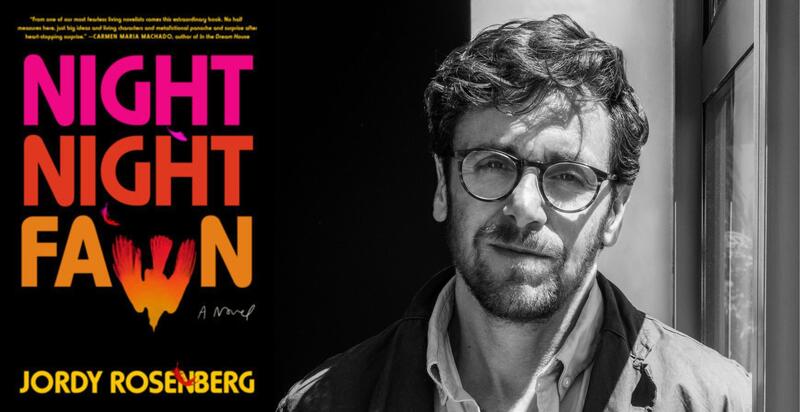
Today’s conversation with Jordy Rosenberg is many things but at its heart it explores the question of what it means to write revolutionary literature (or as Trotsky would call it “October literature”). Whether we are talking about trans horror or a Marxist surreal, the originating violence of early capitalism or writing toward utopian horizons; whether we are getting granular on the level of craft and form or looking more broadly at the role of art and artists, the question of how our writing can lend itself toward conjuring an elsewhere and otherwise is, I think, the animating force behind it all.
Jordy’s provocative choices in his latest novel Night Night Fawn bring these questions urgently to the fore as it centers and is narrated by someone whose worldview Jordy strongly opposes. Night Night Fawn is an opioid-addled, deathbed rant by one Barbara Rosenberg, a transphobic Zionist woman modeled after Jordy’s own mother. Barbara holds court not only on her life’s disappointments, but on Marxism and gender delivered through her cracked lens. All while her greatest disappointment, her transgender son, who may or may not want to kill her, visits her at her bedside. What opportunities, challenges and dangers does this approach create for a writer with revolutionary aims? How can looking back at originary violences, within a family or a nation or an ideology, be a liberatory act? And when confronting structural or familial violence, what is the role of humor and satire? Perhaps it is best summed up by Book Page in its starred review when they say Night Night Fawn is “comedic fiction as political firepower.”
For the bonus audio archive Jordy contributes a reading of Kay Gabriel & Andrea Abi-Karam’s “What is the Project of Trans Poetics Now?” This joins supplemental readings by Torrey Peters, Mattilda Bernstein Sycamore, Rickey Laurentiis, Randa Abdel-Fattah, Isabella Hammad, Naomi Klein, Dionne Brand, Christina Sharpe, Layli Long Soldier, Natalie Diaz and many others. To learn how to subscribe to the bonus audio, and about the many other potential benefits and rewards of joining the Between the Covers community as a listener-supporter, head over to the show’s Patreon page.
Finally, here is the BookShop for today. Given Jordy’s generous citational practice, it is more robust than most.
Transcript
David Naimon: Today’s episode is brought to you by Nocturama. From the winner of the National Poetry Series, "Will Brewer’s Nocturama is a dazzling second collection from an immensely gifted poet," writes Eduardo C. Corral. Spanning Appalachia to California, Will Brewer’s new poems attempt to make sense of some of life’s darkest turns: a father’s bout with leukemia, the slog of mental illness, a friend’s early death, and the rise of environmental catastrophes in the West. Yet despite these difficult moments, strands of light emerge. Richie Hofmann, author of The Bronze Arms, writes that these poems give us something exquisite and indelible to live for. For lovers of modern poetry by Diane Seuss and Fixer by Edgar Kunz, Nocturama offers readers a presence of mind and spirit that notices the mysterious, even in the wake of disaster. Published by Milkweed Editions, Nocturama by Will Brewer is available wherever books are sold. Today’s episode is also brought to you by Coastal Lines Press. Coastal Lines Press is a collective of writers in Gaza turning words into life-saving supplies for their families. Through zines from Gaza, they publish independent booklets of poetry, essays, and testimonies that travel like tiny vessels from coast to coast, carrying stories of survival, resistance, and hope. The name Coastal Lines Press honors the Mediterranean Sea, which anchors life in the region, and celebrates the lines of language—words, sentences, prose, and poems—that connect writers to readers worldwide. Profits from every zine directly fund essential supplies for families under siege. Learn more, follow their journeys, and purchase a zine from Gaza at www.coastallinespress.com. Once you listen to today’s conversation with Jordy Rosenberg, you’ll understand what I mean when I say that his citational practice is remarkable. Remarkable because it is so clear that he sees his own work as part of a collective community, that it is participating in and indebted to the work and thought of others, many of whom he names and honors as we speak about his own work today. Supporters of the show at any level of support know about the resources that I send out with each episode. It always includes the most notable things I discovered while preparing, but also things during the conversation itself, so that you can follow threads and go down your own rabbit holes after listening. Because Jordy’s practice of being a writer in the world involves placing himself among so many other writers—whether writers that came before him or right alongside him—the resources are truly oceanic this time, ranging in topic from reframing the horror genre through a trans lens, to a look at the role of the poetic, the surreal, and the fantastic in the literature of revolutionary movements; from the writings of Palestinians on writing in a time of genocide, to the particular short story Jordy teaches to students to demonstrate all that fiction can do. Every supporter gets this resource-rich email with every episode and can also choose from a wide variety of other things as well, including access to the Bonus Audio Archive. Jordy’s contribution to the Audio Archive is a reading of an essay by Andrea Abi-Karam and Kay Gabriel, an essay called What Is the Project of Trans Poetics Now?, where they explore what it means to move toward a revolutionary practice, a question that I think also animates my conversation with Jordy today, a question that also raises many questions of craft as well—around voice, point of view, representation, and much more. Jordy’s contribution joins bonus readings from Torrey Peters, reading the first thing she wrote after she transitioned, a piece called How to Become a Really, Really Not Famous Trans Lady Writer; to Rickey Laurentiis reading a poem called “Second Nature” that they had finished just days before we talked and was not yet published; to Carl Phillips reading and discussing a medley of Black Swan poems and then one of their own. It includes Isabella Hammad reading from Walid Daqqa’s prison writings, Roger Reeves reading Ghassan Kanafani, Naomi Klein reading Philip Roth, Randa Abdel-Fattah reading Chelsea Watego’s Always Bet on Black (Power), and Dionne Brand reading Christina Sharpe, and much more. You can check all of this out and more at patreon.com/betweenthecovers. Now for today’s episode with Jordy Rosenberg.
[Intro]
David Naimon: Good morning, and welcome to Between the Covers. I’m David Naimon, your host. Today’s guest, writer and scholar Jordy Rosenberg, is professor of literature at the University of Massachusetts Amherst, where he teaches 18th-century literature and gender and sexuality studies. He’s the co-editor with Amy Villarejo of Queer Studies and the Crisis of Capitalism, and with Chi-ming Yang of The Dispossessed Eighteenth Century, as well as the author of the academic monograph from Oxford University Press called Critical Enthusiasm: Capital Accumulation and the Transformation of Religious Passion. Jon Mee says of it, “This book is a challenging reassessment of the problem of enthusiasm. Rather than understanding the term as a throwback to a pre-enlightenment past or a persistence of religious thinking, Critical Enthusiasm offers a brilliantly dialectical analysis of the role the term has played in mediating the transformation to modernity and the emergence of capitalist forms of social being.” Janet Jakobsen adds, “Critical Enthusiasm is an ambitious book that draws upon a number of fields of thought--literary works; studies of secularism and religion; historical materialism; and the history of moral philosophy--in order to produce a synthetic reading of the eighteenth century.” Rosenberg’s debut novel, Confessions of the Fox, arrived with both critical and popular acclaim. Publishers Weekly, in its starred review, called it “astonishing and mesmerizing.” Booklist called it, “Resonant of George Saunders, of Nikolai Gogol, and of nothing that’s ever been written before . . . irreverent, erudite, and not to be missed.” As a New York Times Editor’s Choice, they described it as “a mind-bending romp through a gender-fluid 18th-century London, a joyous mashup of literary genres shot through with queer theory, and awash in sex, crime, and revolution.” Tithi Bhattacharya adds, “If Capital, Volume 1, was rewritten as a novel, brimming with sex, romp, blood, and politics—all of which Marx loved to talk about—then we would have Confessions of the Fox.” Confessions of the Fox went on to be shortlisted for the Center for Fiction First Novel Prize, a Lambda Literary Award, the UK Historical Writers Association Debut Crown Award, among many others. It was named the best book of the year by The New Yorker, BuzzFeed, Lit Hub, Electric Literature, The Feminist Press, and Kirkus. So it’s with immense anticipation that we greet the arrival of Jordy Rosenberg’s second novel today, Night, Night, Fawn. Torrey Peters says of this book, “Night Night Fawn contains an unabashed, unhinged, urgent id that rockets around its pages at escape velocity—and yet it voices that id with control, precision, and originality. Moving! Thrilling! This is me applauding in blurb form.” David Chariandy adds, “Night Night Fawn is one of the most astounding novels of our time, a triumph of voice and social critique, a generational reckoning that is as urgent and gripping as it is playful” Andrea Lawlor says, “Rosenberg invites us into an epic, audacious investigation of a mother, and thus of gender, familial homophobia and transphobia, Jewishness and Zionism, and memory and self-delusion across the millennium—and all at an angle. I love this brilliant and hilarious novel.” Finally, Sam Sax says, “A singularly hysterical and ferocious novel, a book that has you in stitches while re-suturing you—inviting you to feel how history both moves through and acts upon a body . . . an urgent intervention into contemporary Jewish letters and the ways in which settler colonialism and gendered violence reproduce inside our families. . . . I was absolutely floored by this book and am just now peeling myself up off the ground." Welcome to Between the Covers, Jordy Rosenberg.
Jordy Rosenberg: Thanks so much for having me, David. I’m a devoted fan of your podcast. [laughter] Forgot about your legendary introductions—very humbling introduction. Thank you for that review of my oeuvre so far.
DN: Well, four years ago—maybe five years ago—I came across a description of your novel in progress and then expressed interest to you in having this conversation today. Back then, it was called The Day Unravels What the Night Has Woven. When it was sold to One World, it was described as, “an exploration of transgender sexuality, Jewish assimilation, and the author’s difficult relationship with his mother, an accomplished bargain hunter, committed homophobe, and dazzling old-world yenta, weaved throughout with fictional vignettes of the author’s mother’s life as well as her imagined retellings of landmarks of leftist philosophy.” But I think the description that I saw was another one that was just two quick sentences, "A yenta on her deathbed rewrites Karl Marx's Magnum Opus, Capital. Liberties are taken." Neither of these descriptions are entirely true with Night, Night, Fawn, but both still describe something about it. We are with a yenta on her deathbed, who is intermittently delirious from the painkiller she is on, as she both looks back on her life and narrates her present moment. She has a long-estranged trans son who is back at her bedside now, and his presence provokes many of these unhinged meditations. I know that this book, at its first conception, began as memoir, and it retains many correspondences with your own life and the life of your mother, both broadly and sometimes granularly—not the least that after a many-decade rupture with your mother, you did find yourself at her bedside as her caretaker during the final weeks of her life. Also, that the name the fictional mother gives her child—named after a minor character in the film Exodus—is the name your parents gave you. I wanted to start here with questions of form, in particular because I might be inclined to say, based on all of this, that Night, Night, Fawn is autofictional. I also know from your afterword to the anthology Transgender Marxism that you see the categorization “autofiction” as a fraught one for trans writers. You speak of what you call the vexations of trans self-reflexivity and the “dusty old questions that continue to dog us, a seemingly ineradicable refrain.” You quote the critic Viviane Namaste, who asserts that autobiography is the only genre in which transgender people are permitted to speak. Or as you put it, we are allowed to write creatively when we are attesting to the authenticity of our own subjectivity. So talk to us about Night, Night, Fawn in light of this.
JR: Yeah, that’s a great review of the convulsions that this project has gone through since its original conception. I like that you ended with that quote from Viviane Namaste, who, I mean, she just perfectly encapsulates some of the demands that we all know have been put on transgender writers for a long time. Many people have responded to these demands in incredibly creative and wonderful ways. Many people have written wonderful autofictions. Many people have repudiated these demands. I think, for example, the recent turn in transgender horror writing is an incredible way to deal with these demands of respectability politics, that we can only get rights if we’re “good” in liberal terms. So I won’t get into that at length here, but we’re talking about Gretchen Felker-Martin, Grace Byron, Zefyr Lisowski’s account of trans horror. I could say more about that, but I’ll just say I found that turn to be very, very inspiring. But the book started its life as memoir. It started as memoir. I had written a couple of memoir-ish essays in a fugue state while I was taking care of my estranged mother. I mean, back in like 2014, I think they were published in like 2015 and 2018, these two pieces that this project originated in. Actually, I was taking care of her for more than a year after decades of estrangement. I barely remember that time. These pieces just came out of me. I didn’t intend to write memoir or autofiction. I just did it. I can talk a little bit more maybe later, if you want, about what some of these pieces were trying to do, especially the second piece, which was called “The Daddy Dialectic.” I was trying to make a certain intervention around really what I saw in the beginning of the Trump regime, and many people had commented on, which was this return of a certain libidinally unhinged racial paternalism, and the rise of what Alberto Toscano had referred to as the obscene father. I was trying to think about queerness and transness and gender in relation to the entrance into the public sphere of this very uncensored discourse around these clownish varieties of fascism and this figure of the obscene father. But anyway, that’s in brackets. I wrote these pieces, and I immediately announced myself for having written them. They were like a compulsive thing that happened, but people responded very well to them. I guess Confessions of the Fox, my first novel, was this very intentional creation that I had made. It was very explicitly shaped by a set of historical questions around the origins of colonial capitalism and carceral modernity. It was a very explicitly a theoretical project that was trying to engage with these questions on a fictional level. I think I thought, “Well, maybe for my next one, I should just go with what the people like.” The people like these memoir pieces. People responded to them. It was very gratifying, very moving to me. But it wasn’t really what I intended to write. I just thought, “Well, I’m just going to go with the will of the people and write a book-length version of this.” I got a little ways toward doing that. I just couldn’t make myself fall in love with the form of what I was doing. Sometimes things work well as essays; they don’t work well as a book. For me, it wasn’t going to work well. I didn’t feel like it was going to work well as a book to do this as memoir. I guess the easiest way of saying this is by reference to a book that I think does work really well as a book, the author Emma Heaney recently published a book with Pluto called This Watery Place. I don’t know if you’ve come across it. It’s an incredible book, a very short book, but it’s an autofiction about gestation and parenting and mothering, I think, in specific. I read this book and I was like, “This is a dialectical autofiction.” Very difficult to write dialectical autofiction, in my estimation. I’m being polemical. But I read this book, and it’s really about the way the experience of what she describes as meeting this stranger who is your baby and coming to care for a stranger—she’s describing the way in which this intensely personal “personal” experience of the family opens out into a collective orientation, a political orientation, which is essentially, “Hey, I met this baby, this stranger, and I care for it. Why can I not care for the world? It’s a world of strangers, of ex-babies, or some people who are still babies.” Obviously, she wrote it in part in the context of the genocide in Gaza and the slaughtering of hundreds of thousands of people, probably at this point is the estimation in The Lancet, many of whom are babies. But that’s really beside the point because we’re all ex-babies. That’s what Heaney’s getting at, is this movement from the intensely privatized sphere of the family into the collective. So anyway, all to say, dialectical autofiction exists, but I didn’t feel like mine was going to achieve anything so momentous as what Heaney’s achieved here. So I decided that I was going to write as fiction.
DN: Let me make a nod to one of those essays that you were writing at that time that you said were really enthusiastically received, including by me, your 2014 essay “Gender Trouble on Mother’s Day.” In that, you explore how vital your early and first encounter with Judith Butler’s Gender Trouble was for you, even as at the same time you found it largely mystifying at first approach, where you say, “Within moments of opening the book, I realized I had no idea what Butler was saying. I mean, truly no idea. Each sentence made less sense than the last. To begin with, I did not understand what the word 'ontology' meant, and I was not sure that 'Lacan' was the name of a person. Reading Gender Trouble was like sticking my head into a paper bag that someone was stepping on, and then trying to make the noise into something meaningful.” I say this because I appreciate how skilled you are at modulating the way you talk depending upon context, that you can talk deeply without the lexicon of Marxist or gender or literary theory. Likewise, you can talk deeply with others who share a deep knowledge of the lexicon in a certain field. I say this because when you’re doing the latter, I’m not mystified like when you describe your first encounter with Gender Trouble, but sometimes I realize that I’m out of my depth at times, while also recognizing the importance at the same time of what is being said. So, for instance, in the Transgender Marxism afterword, you talk about the publishing world’s tacit enforcement of an autofictive impulse in works by trans authors. You’ve mentioned today how trans authors will produce subversions of this that lean toward more of an autofictional wink. You suggest that we can and perhaps should read those texts not so much as autofiction but rather as a poetics. Or, using a more explicitly Marxist and literary theory lexicon, you say, “What if for ‘autofiction’ or ‘memoir’ or narrative self-referentiality, we instead regard contemporary tropes of self-reflexivity as auto-apostrophic—as, in other words, poetic? And how would it allow us to more accurately name the violence of ongoing primitive accumulation as the underlying condition for tropes of self-referentiality?” So, stepping to the side of terms like auto-apostrophic or the Marxist notion of primitive accumulation, talk to us in layman’s terms more about what reframing an enterprise like Night, Night, Fawn in terms of the poetic or a poetics affords you and/or the trans writer more generally. Also thinking again of the passage about primitive accumulation, how you see the violence that undergirds capitalism as the underlying condition of tropes of self-reflexivity. I know this is an unfair question because this quote comes at the end of an entire essay that you’re writing to establish this quote. So maybe a nod toward these two things: the poetic, and then how this capitalist violence might undergird the tropes of self-reference in literature.
JR: Yeah, I love how you’re like, “Can you answer this question, but don’t go on and on about primitive—”
DN: [laughs] That’s not what I’m saying. If you want to go on and on— [laughs]
JR: Well, I’m not going to. Don’t worry. So actually, I’m going to answer the second question first, because that will stop me from going on and on about primitive accumulation. The essay that you’re reporting from is not a piece of craft advice. Actually, maybe in writing it, I was trying to talk myself into being able to write autofiction. That advice, to the extent that it was unwittingly advice to myself or an exhortation to myself to try to write autofiction if I just thought of it as a poetics, didn’t work for me. But I think what I was trying to say there is that maybe we could think about autofiction as a form of recursive return to an origin that is never really closed, maybe, in our lives. That is, in part, what Marx is trying to say about capitalism, that there are originary moments of violence—specifically colonial moments of expropriation and extraction—that are very explicitly violent, as opposed to the hidden violence of the wage form that we’re compelled into through contracts that hide their violence. That there are originary moments of violence that establish capitalism that we all know about—slavery, colonialism—but that those moments are never closed. They’re continually returned to in order for capitalism to continue being profitable. This is something anyone can see and certainly can see right now very explicitly. So I think I was trying to think about that structure and maybe how it gets mediated in narrative form in general. In a way, maybe it’s a facile compression that I’m doing there. But also, there’s a scholar named Nasser Abourahme, who’s made a really incredible argument recently in his book called The Time Beneath the Concrete, which is really about the establishment of UNRWA and the refugee camps in Palestine. But he is talking about the way in which Palestinian resistance to settler colonialism is a refusal of the settler desire to close the time of the origin and to have established itself. Palestinian resistance disallows that time from being closed. In other words, engaging in the constant process of resisting the closure of settler time. So that’s a very short thing on primitive accumulation. I think I was hoping that we could think about autofiction as this poetic recursive return to origins that are never closed, maybe originary traumas, whatever. But anyway, I wasn’t able to do that for myself in this project. I’m going to describe in vernacular terms one of the ways in which this ended up becoming fiction. I was doing a reading of one of those memoir pieces. I think it was at the paperback launch of Melissa Febos’s Abandon Me. I can’t remember. But I was doing a reading of one of those pieces that’s about taking care of my mother as she’s dying. There’s one line in the reading where I’m ventriloquizing in my mother’s voice, something she had actually said to me in 1990 after we had entered into this terrible months-long pitched battle after I came out to her. In reality, we were deadlocked because I was trying to reason with her, with her homophobia. You can’t reason people out of their homophobia because it’s an extra-rational, libidinal form of what China Miéville would call social sadism. She was trying to strong-arm me out of my queerness, which you can’t do either. So we’re in this battle. At one point, I thought I was just going to have the final word on the whole thing because I was like, “I’m going to say something that’s not about reasoning. I’m just going to say a feeling.” What can my mother say in relation to that? And I said, “Hey, I just don’t like sleeping with men.” I say this line, I sit back, and I think, “I won.” What can she say? What could anybody say? And she just looks at me like a complete fool. She says, “No one likes sex with men. Marry one and divorce him for the alimony.”
DN: Wow.
JR: So I was reading that line, which is an amazing line, just objectively. It’s absolutely bonkers. But to her, she was like, “Wait, this whole debate about queerness—we’re not talking about sex. We’re talking about money,” is what she was saying. She couldn’t believe I even brought up sex. This is ridiculous. But when I read that line, there was this breakthrough moment of laughter from the audience, like a really long laughter because I read it in her voice. It really took me aback how much of an effect doing this voice and that joke had on people. I really couldn’t stop thinking about the intensity of that moment. What was I doing channeling this voice, a person whose politics I totally abhor and a person who I’d been estranged from my entire adult life? What was that melancholic voice doing inside me? What was it doing for the audience to see it performed? When I have written fiction in the past, it usually starts when I seize on something that seems to me to be a situation that needs to be addressed fictionally rather than in any other genre. That situation of possession, or that psychic knot of melancholic possession with all of its horror—voices inside you that you’re totally opposed to, and uncanniness, and also laughter—that resonated with me as a kind of situation. From there, I committed to the idea to rewrite the memoir as fiction. But the fictional situation would be inverted. Instead of—I mean, obviously, formally, it is about me being possessed by this melancholic voice of someone whose politics I reject. But in the book, you get a mother character who’s trapped and dying and being taken care of by this estranged trans son who she believes is actually trying to murder her. So there’s an inverted possession. She’s having to deal up close with the subjectivity of a person that she’s really horrified by. And I really wanted to lean into the aggression and paranoia and obsessiveness of the transphobe in reaction to this, where she’s basically thinking, “I gave birth to this. This is a part of me. This monster is a part of me.” And I wanted to give fictional life to the total paranoia of transphobes. I can talk more about why I committed to those choices, but for one thing, to me, it seemed a pretty effective way to satirize transphobes. But then, as you can see, there was also an element that was beyond my—again, it was a narrative compulsion to do it this way. Then I had to commit to it. Then I had to understand it to myself. Then I had to make sense of it formally. Then I had to figure out how I was going to do it. But that’s, I think, the kernel.
DN: So at first glance, your first novel, Confessions of the Fox, and the latest one couldn’t be more different. Confessions of the Fox, set largely in the 18th century, written in an invented underworld slang, is a book engaging with the rise of commodity capitalism, where you could be hung for minor property crimes, the origins of the police force in London, about the draining of the fens in England, about colonialism in the East India Company, about the rise of certain forms of gender, and also even an alternate history of testosterone extraction. In its parallel thread, it’s also about 20th-century neoliberalism and liberalism in universities through the life of an adjunct professor. Formally, it is more wildly metafictional, with copious footnotes by this 20th-century teacher who stumbles across the 18th-century manuscript that is the main text, finding it in the university library that is about to be liquidated for a cafeteria. I suspect the obvious and profound differences between these books might obscure some shared DNA beyond the fact that they are both fictional retellings of real people. But even if you disagree, this first question from another steps into the space between the two books. This question is from the writer Alexander Chee. You can find his incredible craft talk in the podcast archives as a Tin House Live episode called From First Draft to Plot. Vulture said in its “10 Best Books of 2018” review of his essay collection How to Write an Autobiographical Novel, “Chee’s essays convey the effect of new forms being invented before your eyes. His book is a fragmented portrait of the young artist donning and shedding various masks. Chee makes use of conventional vehicles — the memoir, the list, the litany of didactic aphorisms — to arrive at moral and aesthetic discoveries that you sense he didn’t see coming himself.” So here’s a question from Alex.
Alexander Chee: Hi, Jordy. It’s Alexander Chee. I hope you’re doing great. I am thinking about something you said about your first novel, about how you had shaped the characters in large part through the laws that governed them at the time. This new novel, it seems to me to be very different from that first novel. Yet I found myself wondering if perhaps you had shaped the characters in the same way. Then, if not, was there some other governing principle?
JR: First of all, wow, I didn’t know you called Alex. I love Alex. I love his work. He is one of the most generous people within the literary community that I know. He’s very important to sustaining a social world and a writerly world of collective engagement. So that’s very nice that you turned to him. That’s a very interesting question. Well, part of the reason why I said that about Confessions of the Fox is that Confessions of the Fox, in many ways, is about the coming into existence of what we understand to be Enlightenment-era bourgeois law. So I was very interested in thinking about how intersecting with the law was shaping subjectivity and resistance to the coming into existence of this law. I’m at that moment where your book hasn’t really been received yet, so in some ways, you don’t even really know what your new book is about because you won’t know until people respond to it. I hadn’t thought about this question of the law as such. But I guess I will say, thinking about these two projects in a somewhat distinct way, I didn’t even think about the fact that both projects are fictionalized versions of real people’s lives. I haven’t even thought that. So that’s disturbing and weird. Amazing that you brought that out. With the first book, I was interested in characters who were confronting these developments: the birth of capitalism, the birth of the modern carceral system, the birth of the bourgeois legal system. The situation with that book was that we have a bunch of characters who share political aims—resistance to these developments—but differ on strategy. I was interested in a book that was debating, having characters debate these strategies diegetically, that is, within the world of the book. With Night, Night, Fawn, much of the novel takes place during the Cold War, and I was really interested in how Marxism became suppressed as a lived part of working people’s dailiness during that time, and then abstracted as a discourse as the 20th century comes to a close. So a lot of the tension, diegetically, I guess, between the mother character and the son comes from occupying two different sides of that historical divide. But formally speaking, part of deciding to narrate the novel from the mother character’s point of view had to do with reentering that historical divide in a vernacular way and blocking the trans son’s abstract discourse of Marxism from framing the narrative. So that is another way of talking about deciding to do this as fiction rather than autofiction or memoir. When I was writing memoir pieces, there are these constant framing interjections from me trying to explain what I’m describing in terms of memoir, in terms of the conjuncture, in terms of a larger political, economic, social situation. Because of what I’m describing about what happened to Marxism—that is, it went, to some extent, from being a vernacular part of people’s daily lives, then through the McCarthy era it gets suppressed, then it comes out the other side as an abstraction. Because I, like many leftists, grieve that historical development, part of the project of this novel is then, like I said, blocking off my own tendencies/the trans character’s tendencies, from using this abstract discourse of Marxism to frame the narrative. Just mostly having the mother character, who was raised before McCarthy and then through that period, her vernacular engagement with Marxism, to some extent, is what is the medium through which Marxist discourse is engaged. Now, the mother character is antagonistic to Marx, but her position is not where the investments of the novel, the project, lie. They lie in the way that her point of view allows a vernacular Marxism to structure the novel as a whole. That’s not really an answer about the law as such, but to the extent that my interest in the law in the 18th century in Confessions of the Fox was born out of a Marxist understanding that the bourgeois legal system comes into existence to legitimate forms of primitive accumulation and to force people into wage labor and to protect private property, my investment in a Marxist account in certain different historical periods remains the same. It’s just that in the 18th century, the question of the law was more predominant for me in that project.
DN: In light of what you just said, it’s also not surprising that, in my opinion, that Torrey Peters, in her description of this novel, would compare it to Portnoy’s Complaint when she characterizes Night, Night, Fawn as, “the unleashed id and post-war hysteria of Portnoy’s Complaint, compounded with transmasculine prodigal sons and a touch of gothic noir.” For one, both books are looking at the same generation of assimilation-striving mid-century Jewish American families in greater New York. Also, more pertinently, both trap you largely within the consciousness and monologue of the main protagonist. Both are also engaging with Zionism. The last chapter of Roth’s book, when Portnoy goes to Israel, is tellingly called “In Exile,” as he feels utterly not a part of it. Israelis feel both physically and psychologically other, and the people he engages with despise Jewish diaspora culture and his “ghetto humor.” But at its heart, I think your book is a reverse Portnoy’s Complaint. The main character in Roth’s book, the one whose head we are inside of until the final line of the book, is the one breaking the calcified norms, the traditions of the past, and the decorum of the present moment, delivering a feral, libidinal diatribe against the received world. But in Night, Night, Fawn, it’s as if we’re trapped inside the mind of one of Portnoy’s parents, I think—the consciousness upholding a status quo. We’re trapped inside of someone deeply concerned with conforming to and upholding norms, where outside appearance is paramount, whether plastic surgery as status or noticing fake versus authentic mink coats; where her grand disappointments are her daughter not wanting to fulfill a role as a producer of grandchildren in a heteronormative nuclear family, and also the disappointment that her husband didn’t fulfill his role as an upwardly mobile person, as she marries him for his perceived function versus his interior life. Her mindset is also about scrambling up a ladder of scarcity, and her playbook is all about this. So I was hoping, maybe before I ask a question or more explore this question of the vernacular Marxist analysis within the consciousness of Barbara Rosenberg, I was hoping you’d read this short passage that I think shows her extreme exteriority about how she starts with how she’s perceived rather than anything she’s feeling in the interior, the passage that’s about how she eats soup.
JR: Yes. By the way, I just did the entire audiobook in my mother’s voice.
DN: Oh my God.
JR: Yeah, it was actually a very emotionally undoing experience. But I guess I’ll do a light version. The audiobook was the heavy version. It just takes—it’s like a mental thing to get into that character.
DN: Take care of yourself however you need to.
[Jordy Rosenberg reads from Night, Night, Fawn]
DN: We’ve been listening to Jordy Rosenberg read from Night, Night, Fawn.
JR: At one point, in the many contortions of what this book was going to be, I thought, “Yeah, I’m just going to rewrite Portnoy’s Complaint as a transgender memoir.” Because, when you go back and read Portnoy's Complaint, they're just like, "Holy shit, this is so trans. This is a trans memoir." But then it’s like, really, the book is about sexuality, a form of sexualization that is not specific, ultimately, to trans people. Or, put another way, trans people’s sexualization is actually a specific version of an extensive subjective process. But then I decided not to do that. I guess I would say, obviously, Roth has been an irritant for me, as his work has been for many authors. I think one of the best things I’ve ever read that’s written about Roth is Ari Brostoff’s piece in Post45. I’m trying to remember the name of it. It’s called “The Double Allegiance: Philip Roth and the Question of Zion.” I didn’t reread it recently, but I remember Ari’s tracking the agonized reflections on Israel that appear in Roth. Can we interpret those as anti-Zionist moments? Obviously, this has been something that’s been much debated in the public sphere. But ultimately, Ari comes to what I think is—and which I agree is—the correct position, that you don’t really get an articulated anti-Zionism or any considered anti-Zionism in Roth. What you get is a kind of—well, Ari describes either Roth or the reception of these moments in Roth where characters will encounter Israeli norms with a certain diasporic horror. Ari uses the language that there is a cynical cooptation of dissent there, that you don’t really get an actual opposition to the settler state. You get this kind of—well, this is really a longer argument—but I think what Ari is looking at in Roth, and forgive me, Ari, if you ever hear this and I’m getting this wrong, is the way in which, as Jews are assimilated into whiteness in the US—this is a huge reduction—they are permitted forms of perversity and an articulation of a scandalous eros that is the privilege of a certain entry into whiteness. So then what you see with Roth, where he embraces his diasporic perversity, or Portnoy does, when he’s in Israel, and it reads on one level as an opposition to that back-to-the-land, cleansing Jewishness of diasporic weakness sort of vibe of Zionism, it’s not really the oppositionality to Zionism that we can hang the hat of a movement on. It is, I think, rather, an articulation of perversity that is a register of the level of Jewish assimilation to whiteness in the US, if that makes sense.
DN: Yeah. I mean, I think he might be more concerned about centering or seeing as a legitimate center a diasporic Jewish reality, assimilated or not. Whether he’s Zionist or anti-Zionist, he doesn’t see Israel as the axis mundi of the Jewish experience he’s rendering.
JR: No, he doesn’t. But the assimilation of diasporic Jewishness to whiteness in the United States is part of a larger system in which Zionism is able to act as a supremacist ideology in the Middle East. So, I mean—or just put another way—it doesn’t fully articulate its opposition in a way that can translate into an actually anti-Zionist position.
DN: Well, the reason why I wanted you to read the soup scenario, which could have been one of many things I could have had you read to demonstrate this, is it could seem harmless, but one way you’ve characterized this book is looking at how homophobia and Zionism become a normalized obsession within the nuclear family. What’s interesting to me is that when talking about Confessions of the Fox, you talked about how 18th-century characterization in novels was, in many ways, a lack thereof. Characters weren’t given interiority in the same way as now. On the Novel Dialogue podcast, you talked about how you won’t watch cop shows on TV because of how they’re centered and given depth, and how you won’t grant subjectivity to cops in your fiction, and how not giving a cop subjectivity really wouldn’t fly in today’s context. But with a book set in the 18th century, like your first book, it does. But here, you’re giving the subjectivity to the cop, so to speak—to the person who wants to police the borders of gender, family, and more. I think of the original title for this book, The Day Unravels What the Night Has Woven, which is a nod to Walter Benjamin’s idea that forgetting is a key to the writing process. But here you are remembering and imagining in detail the interior life of not only a person whose worldview you oppose, but a fictional person who is a literary cousin to your own mother. I think of the epigraph to Night, Night, Fawn by Gillian Rose, “Let us make a film in which the representation of Fascism would engage with the fascism of representation. A film, shall we say, which follows the life story of a member of the SS and all its pathos. Why would it not be possible to produce a dialectical lyric about such a character?” And you mentioned the work of two writers I also admire, Adania Shibli and Roberto Bolaño, as inspirations for writing from the viewpoint of one’s adversary, let’s say. You’ve already nodded to giving a deeply rendered interior life to such a position as part of what you’re doing. So maybe, if there isn’t more to say there, talk to us about the formal constraint that you gave yourself—not just to limit the trans son from bracketing things with an academic or abstract view of Marxism, delivering that Marxism and thoughts on gender through Barbara’s distorted lens, but also that all representations of queer and trans sex within the book had to be screened through Barbara’s distorted lens. Talk to us about that constraint and then what you discovered in operating under it.
JR: You are right that with my first novel, I was able to evade the question of character. Probably because it was modeled on very early 18th-century work, stylistically, like Defoe, where they just don’t have a sense of character depth yet in the same way. I could not have predicted in a million years—especially because I did have a very vulgar negation of, “Yeah, I don’t need to watch cop shows. I don’t need to pretend that these subjects have interiority. I don’t need to reproduce that in my own fiction”—so I could not have predicted that now I’m going to write an entire novel from the perspective of the cop, essentially. I will say that this is a novel that is really about complicity. As you mentioned, one of the things I was interested in portraying was the ubiquity and ordinariness with which transphobia and Zionism have been normalized for North American households. I wanted to be very honest about what is going on here. Part of doing that was depicting a character who enjoys certain forms of power, who identifies in an unconcealed way with these supremacist and colonial projects. For something like that, I came to feel that it was going to be written from that character’s perspective because I wanted a character who was not going to conceal or hedge or varnish over the libidinal aspects of that cruelty, because the libidinal aspects are part of how those ideologies perpetuate. But when I say I believed that I was going to be writing from that character’s perspective, once again, it was something that just happened, again, because of the melancholic installation of that voice inside me. I consider myself complicit with these projects as well, having grown up in a Zionist household, having been sent to Israel many times. I think part of writing from my mother’s voice is including myself within the landscape of complicity. Another thing, though, that I’m getting at—and I think the writer who’s really gotten at this very well is Sophie Lewis in her recent book Enemy Feminisms—where she talks about the origins of, or prehistory in a way of, TERFism in the 20th century in second-wave feminism, where you have a movement where people are legitimately oppressed in terms of gender and then, for this character that I’m writing about, in terms of class as well. But there’s nothing that has historically prevented people in those positions from turning a response to those oppressions into what Lewis describes as a restrictive pessimism about what it means to be female. So I guess I came to the position where I was like, there is no reason that this character isn’t a full character. She is a full character. But I came to a point where I think I felt, at the time that I started writing, that there might be some value in depicting honestly the level of ordinary violence that was going on. Now, I’ll just say very briefly, but of course I started writing it 10 years ago, and the intensification of the genocide against the Palestinian people has changed, I think, everybody who’s paying attention’s writing process. We all—or certainly I am—having to reconsider all of the decisions that I made. Maybe 10 years ago, I did think there would be some value in being explicit about this violence. But the thing is that now everybody knows. That is because Palestinians have been representing their own genocide. So in terms of this question of trying to figure out how to orient toward writing in this moment of live-stream genocide, there have just been many authors who have said many things that are extremely helpful and resonant. Mary Turfah, in the journal Parapraxis, in a piece called “Seeing Everything but Palestinians,” speaks a lot about the fact that no matter how much evidence is gathered, no matter how many words are lent to witnessing the genocide, it hasn’t stopped the genocide—a feeling of despair with words that I think a lot of people have articulated. There’s the work of Lara Sheehi, where she is talking about repetition compulsion and the training of psychic militancy through clarity about the system, and meeting the Zionist repetitions of violence with repetitions of our own. In other words, I think there’s an unresolvable toggle between the despair of what little difference words make and sometimes the necessity to keep making the words as part of a much larger apparatus of resistance. It’s, at this moment, an irresolvable question. The question of language in relation to genocide is irresolvable in a vacuum in itself. It has to be considered in relation to a larger field of political practice, I guess I would say. Anyway, what the value of this will be at the end of the day, I don’t know. It’s up to readers. I guess I continue to be heartened by works of fiction that are either satiric or, in the case of Shibli, not so satiric, representations of fascists and fascism—authors who have braved proximity to those ideologies. I’ll just say that the lawyer and writer Dylan Saba recently described what I’m talking about, about libidinal aspects of those ideologies, as colonial jouissance, or the cruel pleasure that colonizers take in the act of colonizing. I think at a certain point in writing this—again, what the value of this is, I’m not sure anymore—but I thought, “Well, I’ve been inside those families.” To me, I didn’t really have a lot of experience with the liberal discourse that is ranged around, “Well, we didn’t know. We didn’t know.” To me, I felt like, “You know what? A lot of people did know. A lot of people, even who would be considered to have come from liberal families, did know.” And they didn’t just know—they enjoyed it. They identified as colonizers. So that was what I was interested in representing. In terms of the formal restriction—this is the last thing I’m going to say about this—one of the ways that came out for me was trying to make it so that the only time that transgender or queer sex was represented, it was represented through Barbara’s paranoid, transphobic imagination. There’s one exception to that, but basically I hewed to that. I guess I would say, for me, that’s an example of leaning into that aggression and paranoia and obsessiveness of the transphobe. I found that quite—I don’t know if I would say fun to write, but a little bit, because I just took it to an extreme. It was a way to satirize that character. If anyone came out in the ’90s, it’s like that was the most monstrous thing you could do, was be gay. The level of reaction to this—I mean, obviously this has actually come around again—but the level of reaction to this, it really shocked me at the time, the extent to which this was perceived as genuinely monstrous behavior. I think there was a certain amount of maybe what the psychoanalyst Avgi Saketopoulou describes as exigent sadism. But there was a certain amount of sadism, I think, on my part as an author, in putting that character, Barbara, in the position of having to imagine things that she finds to be monstrous. I thought it was funny. [laughter] I think satire, as a form of at least pleasure-giving on the left to the left, can do many other things, too. It can’t mount a revolution on its own or make a general strike happen, but it can narrow and focalize anger. So that was some of those—sorry for that extremely long answer.
DN: It wasn’t long at all. Well, the next question for you is from the writer Sara Jaffe. Sara’s latest book, the story collection Hurricane Envy, also, like yours, engages with queerness—in her case with queer parenting—and also with anti-Zionist Jewish identity. It was named a best story collection of 2025 by Electric Literature and Largehearted Boy and was described by a past Between the Covers guest, Brian Blanchfield, as follows: “Sara Jaffe—I knew already from her exquisitely subtle novel of young queer adolescence, Dryland—is the maestro of rendering what it means to be misperceived. If her narrators in Hurricane Envy have grown some, have found themselves and organized their lives according to their inmost convictions and their agonizingly niche proclivities, their basic plight is the same: to attract notice or to escape notice—or, narrowly, both. The giggle to heart-pang ratio here is expertly one-to-one, and both columns of the ledger are brimming. Brilliant.” Here’s a question for you from Sara.
Sara Jaffe: Hi, David and Jordy, and thank you so much, David, for the opportunity to ask a question about Jordy’s brilliant book. So there’s a certain liberal artist who believes that the way to contend with ordinary people who hold horrific beliefs is to get to know them, to put forth the project of extending a degree of empathy in order to—I suppose the thinking goes—use their own powers of persuasion to get them to see the light, ignoring any number of structural and systemic barriers to that transformation. You are absolutely not that kind of artist, and you've been clear that that was not the project of your portrayal of Barbara. That said, this book will inevitably get into the hands of readers who hold those beliefs, who are swayed enough by her humanity and complexity to affirm their empathy for her over their critique. What would you say to those readers? And/or did you make choices in the writing of the book to try to anticipate and circumvent that reading? Thank you so much.
JR: Thank you so much, Sara. Thanks for inviting Sara. I love that question. It's something I thought about constantly. First of all, there's nothing we can do about bad faith reading of our books. But assuming that that's not what we're talking about, I guess I can talk a little bit about the thought process behind some of those choices. I always, for better or worse, try to think about the aesthetic choices that I make against a political landscape. Not in an instrumental way, but it's part of my process. I was thinking throughout about the two faces, roughly speaking, of settler colonialism. One is the openly exterminationist base, and the other is the attempt to normalize and make ordinary extermination. The first largely takes place in the sphere of political rhetoric, and the second largely in culture. I was directing, obviously they overlay each other, one cracks through the other, and also the relationship is porous and inextricable, like each needs the other. There are so, so, so many examples of that openly exterminationist face of settler colonialism. I hardly need to say them, but for example, one might draw on the very clear statements of the early settlers of Palestine. David Ben-Gurion, for example, said, "We must expel Arabs and take their places. If we have to use force, then we have force at our disposal." They're very, very clear. But I was largely concerned with the second, with the question of the making ordinary of a settler colonial ideology. I was thinking at the time, once again, like it takes so many years to write a novel and the political landscape that you're measuring your aesthetic questions against is changing. But I think at the time that I made and committed to certain decisions, I was thinking about something like the way in which that ordinariness has hidden itself and made itself ordinary. Steven Salaita, actually in the introduction to Ghassan Kanafani's On Zionist Literature, makes this point. He says something like the great irony. This is in the introduction. This isn't Kanafani. It's Salaita. He says, "The great irony of Zionist literature is that it becomes legible only through rejection of Zionism. Otherwise, that literature presents as a natural occurrence in the modern world. Zionist literature has to appear purposeless in order to accomplish its purpose." That's how Salaita explains Kanafani's project to make certain things legible. I think at the time that I was making certain choices, I'm not comparing myself here to the great work of Kanafani. I'm saying something like what Salaita is saying here resonated with me, that there's something about the way that that ordinariness of settler colonialism operates where it's not visible until it's made explicit and opposed. So at some point, I think I made a decision against a particular political landscape that there might be merit in making explicit what had tried to make itself implicit. That for me involved going into that character and drawing out her opinions and making her say them, I guess might be one way of saying that. Because that ideology has normalized itself, she doesn't want to say them out loud. She's saying them to herself. That's something she's more comfortable doing. That's something you can do when you go inside that character. So that's, I guess, one way in which my own commitments intersected with some aesthetic choices. But the landscape changes. I guess I would say, I think that it's a question right now. I think the ways in which that second face of settler colonialism has tried to hide itself and make itself ordinary are not working anymore. I think that it's very visible at a wide scale for reasons that we've talked about. So because Zionism as an ideology is much less able to disappear into culture as a status quo position because of the force of Palestinian resistance and the international solidarity movement, well, I guess I would say then I think it's good to interrogate certain choices that I myself made and to engage in a process of self-critique and reevaluation. I mean, I'm not going to die on the hill of defending this novel. If there's a critique to make of it, I want to be hearing it and part of it, part of hearing it and engaging with it. Politically, I feel like, obviously, we always have to be open to debating our strategies, because what we've been doing up until this point has not been enough. But that's my position politically. In terms of decisions that I've made about aesthetic shapes given to a conjuncture, they're not the same as political strategy, but I do think they are part of a broader effort to broaden a base, to contribute to a culture of the left, as Kay Gabriel and Andrea Abi-Karam say, "to force an encounter between the ideal and the actual." I mean, to that extent, then I feel like my work is open to the question of politics. As all work should be open, I think, to that question, and my work is part of that, and I think I would be as open to the question of where it lands now as I could be. I think it's good to be open to that, because I believe that these are questions that we're asking of all literature. So certainly mine would be included in that.
DN: Well, we have another question. This one is from the poet Sam Sax, whose debut novel, Yr Dead, was longlisted for the National Book Award, named a top debut novel of 2024 by Kirkus, and won the 2025 Independent Book Award for Literary Fiction. Yr Dead is described by Kirkus in its starred review as a poetic depiction of pain, queerness, Jewishness, and what it is to live. Saeed Jones adds, "It's not just that I trust Sam Sax's imagination. My sincere belief is that Sam's creative freedom unlocks the potential for our liberation." Sam records this while commuting, so there's quite a bit of ambient noise. At the very end, I think you can hear as it fades out a turn signal. So maybe he's getting off of the highway at the end. But here's a question for you from Sam from the highway.
Sam Sax: Hi there, David. Long time listener, first time caller. Thanks for inviting me into this conversation. Hello, Jordy. I'm a little starstruck, to be honest. Your book was such a singular and profound reading experience for me. It took up residence inside my body as I was reading, and refused to leave when I was done. I found myself lamenting not having a wide swath of folks to discuss it with because it wasn't yet in the world. I'm so excited for it to be in the world so those discussions can happen. So my question for you is a tripartite one around research and practice. I was curious how you went about assembling the various texts and media and family archives that allowed you to reanimate the past and breathe life into these static structures of cultural and systemic violence that you do so beautifully throughout this book with such deft, wry humor. My second question is about how you cared for yourself through that process and managed to stay grounded as you were sitting in these materials. Lastly, and maybe an impossible one to answer, since it seems like you spent six years working on this book, and often when we work over this length of time, our work becomes inseparable from our lives, but I was curious about now that the book's in the world, how you felt most changed by that research. Yeah, I can't wait to hear your thoughts and can't wait to listen to this conversation.
JR: Wow, thank you. I love Sam's work. I loved his book. I blurbed that book. It was a real joy to blurb that book. It's a wonderful book. I appreciate this tripartite question. The first question, I think, is easy. Well, not easy, but I can answer it without going on a long tangent. Because as I spoke about earlier, I'm most interested in the intersection of subjects with their historical moment. That's Lara's thing about the material world and the psychic. When I was going back, looking at the different moments that this book is taking place, I did want to understand what were the, say, intersecting forces that might have been impinging on the characters at the time. Well, this goes back to Alex's question too about the law in the 18th century, but for the book that took place in the 18th century, I was in large part looking at how laws were impinging on people as a form of historical forces. In this book, there were many different things that I was looking at. It starts in the 1960s in Brooklyn, and it's really focusing on the period from the '60s through the '80s in New York. Also, there is a section that takes place in Israel, or several sections. In the period in the '60s, Barbara is working in a garment trucking company as a receptionist. I was very interested in the development of the garment industry in New York, but in particular, the way that the garment industry is responding to imminent deindustrialization, labor fight back, and the way that it starts moving from the city into the exurbs and the suburbs and Pennsylvania and up into Connecticut. So one of the characters that we’re following is a secondary character, I want to call him a fixer because the garment industry is very connected to the Jewish mafia in this period. But he’s basically going around to different factories in Connecticut and Pennsylvania. He’s trying to make sure that his trucking company, let’s say, is the one that these factories are using. So I got into some periodization around garment trucking and the way that it’s shaping the tri-state area and labor politics and the geographies of labor and stuff like that. Then we touch down in the ’80s. Barbara is a receptionist for a mid-level plastic surgeon whose business consists largely of doing breast jobs for the mistresses of the Brighton Beach “bratva,” or the Russian mafia, who are paying cash. I was very interested there in what’s called vernacularly the nine-to-five movement, or the rise of clerical labor, the pink economy, all these things. I was very interested in looking at the histories of these workplaces where you’re in very close proximity and tight spaces in non-unionized workplaces where it’s just a couple, say, receptionists or administrative assistants. I mean, all those places are places that my mom did work. So I was interested in those histories and looking at that too, and trying to, as we do with novels, again, vernacularize the way those historical forces are working on the subject. There are also sections that take place during the First Intifada on an army base in Israel. There I had a lot of experience because I was sent as a minor to do what was called “volunteer logistics work” at an army base. I, for what it’s worth, refused to do that work. But what it means for a volunteer to refuse doesn’t cause a crisis at any level for the state or for me. It was terrible to be there, but I didn’t suffer any consequences for refusing. But I did a lot of research into the way that these volunteer organizations are supported and perpetuated in North America that are feeding directly into the Israeli military. I did that research largely for a long-form journalistic podcast episode that I’m narrating that’s specifically about those things. I got to interview some incredible people. I interviewed—well, I don’t know if I should go into it—but like Diala Shamas at the Center for Constitutional Rights. I actually interviewed Zohran Mamdani before his mayoral run because he was sponsoring a bill that made clear that these organizations are receiving tax-exempt status and they’re feeding directly into the Israeli military. I interviewed a lot of great people for that. So that was a lot of research. The question about taking care of myself—yeah, this was a pretty terrible book to write. I like to have a utopian outlook, and this was a very dystopian book to be inside of. With my other book, it’s fun when you’re writing a book—those moments when you’re not at your computer and you can just let yourself daydream about the world that you’re creating and what’s happening in it. With this book, I absolutely didn’t do that. The minute I’m not at my computer, I’m not thinking about this book because it was painful and unpleasant to be in. So it was a really different writing experience. It just wasn’t a world I wanted to revisit when I wasn’t writing it. So I took care of myself, I guess, by reading other people’s books or other people’s pieces of writing, basically just submerging myself in either really good writing or really good politics. I guess a lot of us have been organizing around Palestine solidarity. I’ve been organizing around Palestine solidarity for over 20 years, but it obviously intensified and took different shapes after 2023. I don’t know that this would be described as taking care of myself, but I guess I would say it’s really important to do things that aren’t writing and that are collective. The third question, what changed? Well, I’ll try to give a really short answer to this. In terms of Palestine organizing in particular, I have always engaged with it simply as an anti-colonial, anti-racist endeavor. I didn’t actually go back into and interrogate my own history. This goes back to this question of the psyche. I’m not that interested in my own journey, let’s just say. My own journey to anti-Zionism, I think of as immaterial to the movement. The movement is an anti-colonial movement, and my own process is not, to me, the point. But writing this book meant re-engaging with those histories in my family, which I thought I was prepared for, but I guess I would say it redoubled my anger.
DN: Well, I want to approach this question of “real life” versus fiction, and/or lived experience intersecting with the story space in another way. Both Barbara and Israel are coming of age in the 1950s, so to speak. There is a comic set piece in the book where Barbara is accused of removing one of the photos within her sister-in-law Blanche’s coffin, where Barbara is trying to cajole various people to slide their hand under the corpse—what she describes as “200 pounds in the flush of life, now a prune reposing on satin”—to retrieve the photo to vindicate her from this accusation that she took it. Amidst all of this tumult, we get various meditations on life from Barbara, including why she prevented her daughter from seeing Flashdance, because in her mind it was a barely subtextually lesbian film. But the photo she’s been accused of stealing is of Blanche’s kids, Barbara’s nephews, both in yarmulkes standing at the Wailing Wall in Israel. So from Barbara’s perspective, it checks all the right signifiers enviably, whereas her daughter in the photo of her looks, in her words, like a diesel dyke at Parrot Jungle. She contemplates not putting that photo in the casket in the first place and says, “I’m talking narratives and shaping them. Does it matter what really happened?” She’s talking about the photos, but she could have been talking about Israel-Palestine, where she also says in the book, “Ninety-nine percent of what I know about Israel I know from the movie Exodus.” This makes me think of past guest Vajra Chandrasekera’s acceptance speech for the Ursula K. Le Guin Prize for Fiction, where he says, “Late capitalism’s death drive is so perfected that it is not only willing but eager to sacrifice the real present in pursuit of an imaginary future, and the language, the concepts they use to construct that imaginary, come from a vocabulary and a grammar built by science fiction. This is a dangerous dynamic, but not a new one. We cannot forget that the originator of modern political Zionism, Theodore Herzl, first wrote the occupation of Palestine as a science fiction novel, four decades before the Nakba. The speculative genres are as fertile ground for monstrous imaginations as they are marvelous ones. There is nothing inherently liberatory in the imagination, but it must be made so. It is necessary to pay attention to what is being written, to what we’re writing, and to what we are reading.” What Barbara says about Exodus and what Vajra says, I think both show how powerful art can be. This question that comes up on the show all the time, “What does it do?” Well, it seems like it does real material things. As absurd as it sounds, her admission that everything she knows about Israel comes from the film adaptation of a novel of the same name—I think that’s describing a very commonplace thing among American Jews whose knowledge of “what happened” exists largely in a story space. I guess in light of all of this, talk to us a little bit about Exodus, a movie that I think is central to this book in many ways, and which at a pivotal place in the book, we get Barbara on a date with her soon-to-be husband watching it beat by beat—and forgive the pun for those who’ve read that scene—but talk to us about Exodus in light of narratives and story in relation to what really happened.
JR: Yeah. I mean, Exodus, for people who don’t know, was a novel by Leon Uris and then a movie—what year did it come out? The novel came out in ’58, and the movie came out in 1960. It’s a fictional presentation of a Zionist account of the founding of the state of Israel. It depicts the mandate-era Zionist militias as heroes. It’s starring Eva Marie Saint and Paul Newman, and it’s very much about glamorizing that process of colonization. I was very guided in some ways by the scholar Amy Kaplan, who has a book called Our American Israel. She talks about the role that Exodus played. It was a huge phenomenon for American audiences. She talks about the role that Exodus played as propaganda in developing a story for those audiences about what the Israeli state project was purportedly about. At one point—this is a direct quote, it’s a very helpful quote—she quotes Israel’s Ministry of Tourism, who said, “We could have thrown away all promotional literature we printed in the last two years and just circulated Exodus.” So that’s how well it functioned for the state. There’s a scene in there where I’m trying to fictionalize—I mean, in literature, you compress things, right—but there’s a scene in there where I’m trying to fictionalize Barbara and her husband’s erotic attachment to the coming into being of their erotic attachment to the colonial project and their ability to see themselves as part of it and their desire to do so. So that’s an incredible Ursula K. Le Guin speech. I hadn’t heard it before. I think it’s really important, getting at this question about the political character of fiction, which has obviously become very central lately. It’s something that I’ve been thinking about a lot because of teaching in an MFA program. Over the past eight years, the desire on the part of students to talk about politics and fiction, or “What is political fiction?”—these are framings that often will come up for classes, it’s totally intensified for very obvious reasons. I mean, there's been widespread radicalization, which is great, though it's occurred for terrible reasons. So I've gone back and forth many times over the past couple of years teaching this in different ways, that question of political fiction. Lately, if I can say something polemical, the question has returned to the public sphere in the form of a Chekhovian proposition issued by George Saunders in a lot of the publicity for his recent novel. I'm just using this as an example. The Chekhovian proposition that has been floating around lately is that fiction should pose problems rather than solve them. That's the quote: "pose problems rather than solve them." The generous reading of this is that this formulation has reemerged as a register of intense anxiety about the place of literature at a time of increasing fascization. Okay. While it is true that literature itself cannot solve problems, that would be like an idealist fantasy about where social change comes from, the choice between posing and solving, I think, is perniciously misleading. Driven to despair by this formulation, I returned also to a Russian author, Trotsky's Literature and Revolution, and took great comfort in it. It's an amazing reread. He says many things. One of them, he is talking about the way in which just before the 1917 revolution, there's this whipsawing thing happening in Russia between revolutionary and counter-revolutionary events. He says that the political chaos in the period just prior to 1917, he says, "struck the intelligentsia heavily and continuously as with the battering ram." In the face of that political intensity, bourgeois art insisted on its own "terrifying helplessness." There have been a number of militant declarations of terrifying helplessness lately from some authors. Like I said, my generous reading is that people are trying to respond and they don't quite know how because they're not maybe involved in political organizing. But this flight into self-trumpeted impotence, I think, is coming to seem increasingly absurd to readers, even readers who don't consider themselves on the left, like wine moms. People are looking for a way into thinking about politics and fiction that is not this trumpeting of impotence. So Trotsky makes the point that each class has its own policy in art, a system of presenting demands on art that changes with time. But what he's really just saying is all art is political. It's just that some of it is non-revolutionary and some of it is revolutionary. He actually is talking about post-1917. He says there's some October literature, because it's October 1917, the Russian Revolution. There's some October literature and there's some non-October literature. That is, literature that is responding to this event, a definitive event. I think we could say that we've had a lot of definitive events lately. This is not to say he's arguing that literature itself leads to revolution. This gets back to, sorry, can you remind me the name of the author who gave that Le Guin speech?
DN: Oh, Vajra Chandrasekera.
JR: Chandrasekera. Why do I not even know? I don't even know this book. I feel crazy.
DN: You should listen to our conversation. It's really about what you're doing with Zionism. He's looking at Sri Lankan Buddhism and the way it maintains its sense of self-regard while committing genocide.
JR: Oh my God.
DN: That conversation just really sticks with me. It's a book called Rakesfall.
JR: Oh, Rakesfall. Yes. I keep meaning to. I meant to read it. Jesus. Okay. Anyway, this gets back to what you quoted Chandrasekera saying, which is literature itself cannot lead us into revolution. Trotsky is very critical of Stalinist equivalences between culture and revolution. There's no way to know ahead of time what is the political valence or meaning of a book, and you certainly can't mandate it. But I think Trotsky is basically arguing that it's one of the—it's not just that it makes us more feeling-full, which is something that some authors have also argued—it's that it is a sensory organ that allows us sometimes to grasp with more precision our material conditions. That is, on the one hand, not so far off from saying that literature poses problems rather than solving them, except that for Trotsky, posing problems is part of confronting them. Saunders says "solving"; I think we should replace that with "confronting," because those problems are part of a broader field of political action and life-making. There have been a number of authors recently who have spoken with great clarity about what it is that literature does or can do, which again can't be determined in advance. There's a really good review of Wisam Rafeedie's novel Trinity of Fundamentals, which is about a member of the PFLP during the first intifada who's running a printing press and hiding. But Kaleem Hawa's review basically just articulates, "These are questions that the novel raises: What is revolutionary subjectivity? What is political commitment? What is the role of culture in national liberation?" So sometimes literature helps give language to a revolutionary event or registers a political upheaval or expands the base of popular struggle. I guess the last thing I'll say is I think a lot of people have probably read that piece by Fargo Tbakhi called [Notes on Craft: Writing In The Hour of Genocide]. He says, "What Palestine requires is an approach to writing whose primary purpose is to gather others up with us, to generate with them an energy which their bodies cannot translate into anything but revolutionary movement. Creative work readies us for material work by offering a space to try out strategies, think through contradictions, and remind us of our own agency." So these are things that literature can do. Yeah, that's it. Running away into, "Oh, all we're doing is posing a problem," is just really, to my mind, so insufficient and silly at this point.
DN: This isn't a question, but just as an aside, and going back to Sara's question about, "Did you do anything to mitigate a potentially regressive reading of this book?" I think that scene of Barbara and her future husband watching Exodus feels to me like I can sense the author's mitigation of a poor reading of it because she doesn't recognize she's being sold a bill of goods by watching Exodus, but she identifies this moment as when she was sold a bill of goods on this date because she thinks she's going to marry a surgeon who's going to become really wealthy and instead he goes into public health. Yet it's a parallel that this moment of this bill of goods being sold around the date is also one being sold around the movie she's watching during the date. It feels like an interesting twinning.
JR: Yeah. That's great.
DN: But the only other thing I wanted to say is I am no small film nerd. I am big into film, as I can tell you are. I love that your work engages with film so much. So outside of this book, you do this often around film noir and around voiceover, and also quite memorably around Invasion of the Body Snatchers. Within this book, we have that film-centric epigraph at the beginning, a large place for Exodus, but also Eyes Without a Face, Dog Day Afternoon, Stalag 17, Double Indemnity, Sunset Boulevard, and Judith. I guess I just wanted to pause for a moment to hold the space for asking how film or your theorization of film influences your fiction, if it does at all.
JR: Oh, thank you. Yeah. I mean, on the one hand, I'm just giving some language to that character, Barbara's erotic relation to film and to representation. It buffers and helps explain what you're talking about, about her relationship to Exodus, why it's going in so porously. But I think in relation to literary form, I'll get stuck on something for a long time. I've been stuck for a long time on Theodore Martin's book Contemporary Drift, which is about film, and in particular, there's a section where he talks about noir voiceover and the way it works. I think he's using Sunset Boulevard as an example, but Sunset Boulevard is a very good example. There's a voiceover, and actually that voiceover is from a character who it turns out is dead. So the character is outside of the space and time of the film in a diegetic sense—they're deceased—but also the voice is coming from outside the space and time of the film because voiceover is recorded separately from the filming of, well, voice tracks in general at that point are. So Martin is talking about the way in which film is making meaning across the suturing of these gaps that are formal and they're also conceptual around the fact that this character is dead. And it doesn't bother you as a reader. You are able to derive pleasure from working across those gaps, and it's seamless. You're not stopping. You're not like, "Hey, wait a minute, that character's dead. How are they talking to me?" So I think something like that is very heartening to me in terms of thinking about literary form and just taking chances and leaving spaces for the reader to fill in and not having to fill in every single gap. You could see someone like Knausgård obviously goes in the opposite direction to just a manic degree. I'm not saying I like it.
DN: [Laughs] Well, to get a sense of the tone of the book and also some of the ways film finds itself within it, let's hear a section where Barbara's friend/nemesis finds Barbara collapsed on the floor.
JR: Right.
[Jordy Rosenberg reads from Night, Night, Fawn]
DN: We've been listening to Jordy Rosenberg read from Night Night Fawn. Well, I wanted to save my questions about the book that I'm most excited about toward this last stretch of our time together, not only because they're the most exciting for me, but also I think they're the most liberatory. Many people have come on the show to talk about the rise of the novel in relation to everything from the rise of the steam engine and the Industrial Revolution to the rise of the modern notion of the individual. But you make another correspondence that I really love. In one podcast conversation about your debut, you link the rise of the novel with the rise of the prison system, that the prison is conceived as a place of character reform, and the novel is itself a sort of prison where this also occurs. But even though we are imprisoned inside Barbara's mind, Night Night Fawn ultimately moves towards some really wonderful prison breaks that I'll largely leave for the reader to discover on their own. But I did want to talk about humor, joy, eros, pleasure, sensuality, and fantasy in relationship to your book. I think a lot of people, when they think of communist art or social realist art, they think of something self-serious, humorless, and with an emphasis on the literal, the so-called real. I think of one of China Miéville's talks where he speaks about Lenin's wife, Krupskaya, who was an educational theorist, and her critique of a children's book that portrayed a crocodile who smoked. Not because she thought smoking was bad for you, but because crocodiles don't smoke. "Crocodiles can't smoke." This was part of the critique, and about her general distrust of elements she described as mythical or fantastical or anthropomorphic in literature. China's own conjuring, in contrast, of a Gothic Marxism or a Marxist surreal. I also think of an interview with one of the editors of Transgender Marxism, pointing out that early on in Marx's Capital, the sensual is evoked, the sensuality of physical things, also how when these things step out into the world as more than things, as commodities, they metamorphose into sensually supersensual things with mystical or magical qualities beyond their inherent value. I bring these both up because I imagine you as part of a larger movement of bringing this aspect of Marxism to the fore, even though I realize I'm presuming this. I don't know that this is actually true. But other examples in my own imaginary around this possibly imagined community that I include you in include, during a Red May podcast about Confessions of the Fox, Tithi Bhattacharya talks about how at the heart of capitalism is a struggle and contradiction between life-making and thing-making, how your main character in that book, just like Marx, has a special gift because he can hear things speak. I also think of a conversation you had with Kay Gabriel in Salvage magazine, where Kay says, "I believe that poetry secretes a kind of pleasure that theory can’t, and I believe that pleasure always carries a political charge. That’s a different way of adumbrating the relationship between poetry and Marxism: poetry can leap extravagantly into those zones Marxism tends towards—totality, solidarity, utopia. So I approach the two as a tandem activity in which neither collapses into the other." Also how, in your essay The Daddy Dialectic, you conjure José Esteban Muñoz's exploration of eros as the hinge between the individual and the collective, desire as our "most exquisite guide," or in the same essay, Samuel Delany's notion of literature as sensuous thought. Finally, these lines of yours there: "Indeed, if the Nazi dances all night, then our resistance requires something other than logic; something other, too, than cultured tsking or frantic bursts of wheel-spinning panic. We need desire — that messy, sometimes un-gentle, self-shattering descent into the underside of reason." So I guess my question, if there is one, is, do you see yourself like I see you as part of bringing to the forefront a more messy, erotic Marx or Marxism?
JR: Yeah, I love that. I love that. That was such a thoughtful account. I am really grateful to you for that, bringing that all together that way. The thing that you ended on from The Daddy Dialectic goes back to why I decided to write this as fiction, because I think I thought, well, if I'm going to take those claims seriously, I need to write this in the form that I think, for me, is best able to conjure affect. In that piece also, I had quoted and was very affected by something that Suzanne Césaire had written, where she was calling for the transformation of sensibility as part of revolutionary movement. She describes a combination of readiness for the marvelous with an army of negation. She's talking about surrealism. So I do think that, at a certain point, I thought, well, the novel form is the way to embody and live out those attachments, commitments, whatever. I love that you went to the editors on Transgender Marxism. I love what they say about the place of sensuality in Marx. Obviously, we have to do all this work as Marxists, following Marx and drawing those elements out. There are horror elements in this novel. There's a submerged sci-fi element. There are those engagements with the fantastical. I already explained some of my feelings about trans horror in this moment as a really powerful way of rejecting politics of respectability. I think, overarchingly, the question of fantasy gets embedded in the satiric element with this novel for me. Actually, your interview with Randa Abdel-Fattah spoke really directly to some of these things that I can't claim to have the same relationship to in any of the ways that they've attempted to silence and oppress her. But at one point, she says, "They've taken our voice from the media, attempted to silence us and discipline us through lawfare and media campaigns. The one thing they cannot take from us is our ability to satirize, and to do that with a contempt for their," and there was a word I couldn't hear in there, but essentially for their hypocrisy. So she is articulating something about satire as a mode. Obviously, there is a way in which, and I guess I am talking about that in The Daddy Dialectic as well, the way in which the contemporary far right has seized on humor and meme culture and exploited this unhinged libidinal energy. So there's a desire, at least on my part, to use a certain version of unhinged humor of our own for lampooning, for parodying. Part of creating a culture of resistance has to do with satire. We already talked about Bolaño. We could talk about Orwell. We could talk about Emile Habibi. You know, my partner, Jasbir, at some point during the writing of this said something really meaningful to me about humor as a way to, this gets to Sam's question about care for organizers in a way, but humor as a way to relax the left or give us a measure of respite in the middle of organizing. Then I also talked about it as a way to focus and narrow anger. I think all of those things. I love something Ricardo Piglia, I'm very obsessed with Ricardo Piglia's very short piece in New Left Review from a couple of decades ago about theses on the short story. It's amazing. But somewhere else, he also describes one of the virtues of literature being that literature is the society without a state. I think that's a very utopian way of thinking about literature. I love that. But I guess I will just say at the end of the day, I think all of these things about literature. I also think it's incredibly important that we not abandon the public sphere at a moment when they're trying to excise trans people from it and deport people from it and totally silence Palestinians and dehumanize Palestinians and remove them from the sphere of the human. So all of those things are true. I think we can't abandon the public sphere. We can't abandon the field of discourse. I think you probably agree with me. Well, maybe you don't, but I do believe that it's always more valuable to take a collective stand of refusal than it is for me, I guess I would say, as one person to say any one thing. So at the end of the day, for me, the question of writing about politics is superseded by the political act and by the collective act. That's how I think about it, ultimately, I guess. Did I respond to what you're asking?
DN: Yeah. No, I mean, maybe it's a countervailing or oblique thought around it. I just wanted to mention as an aside, this isn't a question and this isn't around the collective, but somewhat critically, I'm just going to nod towards what was the most moving and mind-blowing scene for me in this book. Mind-blowing for how unexpected and unexpectedly moving it was for me and for Barbara, where someone so invested in appearances and in status and in scarcity and in competition and in rivalry, who would avoid risk of humiliation like the plague. There's a scene in the book that by any normal metrics should be humiliating for Barbara and yet ends up being something that courses through with Eros that crosses boundaries, that is messy and self-shattering in the most beautiful and pleasurable, sensual way, something that should have harmed her status but which became a discovery of something unanticipated. I know from what you just said that you're emphasizing the collective, not the interior subjective or affective perspective. I don't think this redeems Barbara, but I do feel like there's a moment, and I'm not going to even give more details on it, that is so moving. That is one that you couldn't see coming. I just wanted to bow to you for that moment. I don't even know if you know which one I'm referring to, but—
JR: I think I do. I guess I would say it's interesting to me that you see it as moving. I mean, I think without any spoilers, it's a moment of weird desire that happens to her at a moment of extreme physical vulnerability.
DN: Yeah.
JR: But when I think about that moment, I think about a certain amount of sadism on my part in writing it. There was a pleasure in putting that transphobic character in a position of having a queer feeling. Not at all to redeem that character, but I think I was, on a certain level, literalizing the worst thing that could happen to her is experiencing that moment of Eros. Yeah, I don't think of it as redemptive, and I'm glad that you're saying that you don't think of it as redemptive either. I mean, I guess to the extent that I think queer Eros can be a very, I mean, no, I'm not sure. Yeah, I guess I see it as a moment of crystallizing a certain thing and putting it inside this character who really doesn't want it.
DN: Yes.
JR: I see it as a little bit sadistic.
DN: [Laughs] Yeah. I mean, I love that we're having, I love that double experience of that scene.
JR: Yeah.
DN: Well, before we hear another question, near the beginning, there's a short one-paragraph chapter called Antic God. I was hoping we could hear it.
JR: Yes. Thank you.
[Jordy Rosenberg reads from Night, Night, Fawn]
DN: Such a good passage. Well, you've talked about how one of the things you were exploring in Confessions of the Fox was the rise in the 18th century of a certain conception around body and gender, where gender non-conforming individuals were seen either as a disease to be corrected or as a monstrosity. I wanted to talk about monsters in this light, as three centuries later, it feels like Barbara lives within this same frame of things that was emerging at that time, I think. Again, thinking of fiction and reality, Barbara is in and out of delirium because of her opioids, so she's an unreliable narrator of her own reality. But her trans son appears to her at her bedside as a human-sized bird, who, as you've mentioned, may want to kill her. Pre-cancer, there was no love lost. Her son calls her a colonist and racist homophobe. Barbara sometimes refers to Jordana as "it." Jordana, falsely believing she could dress herself out of femaleness, has her own cathected object, her own fetishized commodity in the corduroy blazer that aspirationally would be the portal towards something else and somewhere else. But now in her final days, Barbara sees her trans son as another species altogether. In light of this, we have a question for you from past guest Sofia Samatar, who has been on the show twice, once long ago for her fantasy novel The Winged Histories, more recently for her co-written book with Kate Zambreno, Tone. Sofia also wrote a book of image text with her brother called Monster Portraits that quotes Clarice Lispector when Lispector says, "Who hasn't ever wondered, am I a monster or is this what it means to be a person?" So here's a question for you from Sofia.
Sofia Samatar: Jordy, I want to thank you for this book and for your work, which is so expansive and extravagant and funny and really has the scope that I associate with world building. I think your work builds worlds that are strange and inhabitable, which is everything I want from a novel. Thinking like a speculative fiction writer, I want to ask you about the beings that inhabit these worlds, in particular, the animals, the fox and the fawn and the bird. There's something monstrous here, I think. I prefer the word monstrous to hybrid, but one could say hybrid as well. In describing these beings that somehow extend beyond or imaginatively reconfigure the human, and thinking of the fawn as both a young deer and a mixed spirit of nature, I want to know how you think about animals and the more-than-human life that haunts your stories.
JR: First of all, I love Sofia's work. I love all of it. I love every single thing that she's written. When I teach undergrad creative writing, I always, always start with Sofia's story, An Account of the Land of Witches, just to give students a sense of what is possible with fiction. It's such an experimental story. It's a short story that has like four or five sections, and each section negates and then expands on the section before it. It's just amazing. Anyway, so I really appreciate this question, for which I fear I'm not going to have a satisfying answer. I take some courage from, back to China Miéville's work. He's an intellectual, he's written historical accounts, he's written legal theory, but whenever he's asked about monsters, so far to my knowledge, he just goes, it'll be like, well, did this come from Gramsci? Is this about "now is the time of monsters"? Or is this like a Marxian thing? And he's just like, "Nah, I love monsters." I think that there is a way in which, in particular in this book, the bird figure, I mean, it just appeared to me and I just went with it. I think there are kernels in our writing, or at least for mine, where I don't interrogate, and that goes back to that thing about Theodore Martin that I was using as an example for letting a reader fill in certain gaps or trusting in certain opaque moments that are opaque to yourself in the writing. The thing about monsters is that they're so multiply significatory, so you can drop them in a text and not know what they're doing there and people will do things with them. So after I dropped the monster bird in the text, which I did, again, as just a pretty simple and straightforward, it appeared to me, but then I embraced it because, like I said, I really think that rejecting the respectability politics is a great thing to do in trans fiction, that we have to continually reiterate our authorizing ourselves to do this. You can put ‘to do this’ in brackets. We have to continually reiterate our authorizing ourselves. So that's one thing. Once it was there, I started to think about all these other significations of it. Then you're like, oh, wow, this really relates to, you know, I don't know. Like it is something about Marx when he writes about primitive accumulation. He talks about divorcing the subject from the land, divorcing the peasantry from the land so they have no other way of supporting themselves and they're forced to sell their wage labor. That's the onset of capitalism. The word he gives to describe this in German is vogelfrei, or bird free. He says they're free as birds. It's dialectical. They're free from being burdened by having to reproduce themselves in every part of their lives, but they're also now free of any form of supporting themselves but selling their labor. So it's a double dialectical freedom. That's the contradiction of capitalism. It's how we're caught. So I think there are certain aspects of those monster figures that I probably am not thinking through as rigorously as Sofia may for herself. I think, yeah, I think it's for me something that flashed up.
DN: Well, let me ask you a little bit more about vogelfrei as part of that. Because, okay, so in the 16th century, so pre-Marx, it was used for a person being banned, where this is how the proclamation would go. "As you have been lawfully judged and banished for murder, so I remove your body and good from the state of peace and rule them strifed and proclaim you free of any redemption and rights. I proclaim you as free as the birds in the air and the beasts in the forest and the fish in the water. You shall not have peace nor company on any road or by any ruling of the emperor or king." So then, as you referred to several centuries later, the same term in Marx's writing, referring to the emergence of the proletariat during the decay of feudalism, where people are both suddenly free and free of rights who could not immediately adapt themselves into their new condition and were turned, "in massive quantities into beggars, robbers, and vagabonds, partly from inclination, in most cases under the force of circumstances." Later, "legislation treated them as voluntary criminals and assumed that it was entirely within their powers to go on working under the old conditions, which in fact no longer existed." There are lots of these nest eggs in the book. I think that if you don't know them, the book totally works. But these passages that you narrativize Marx's theory or passages from Marx. But talk to us about this longstanding interest in vagrancy and in vagrants and in outlaws. Because in a way, this bird is an embodiment of, in a sense, literally, of someone who's free as a bird. It's strange, I guess, from the 21st century to be proclaimed as free as a bird of the air sounds entirely good, whereas then I think it was considered you were banished, you're away from human society. But talk to us about this vagrant outlaw bird a little more in relationship to Confessions of the Fox, for instance, which very explicitly is centering in a much more overt way vagrants and outlaws.
JR: Yeah, that's a great question. So in Confessions of the Fox, yes, and Marx talks about this as well, what happens, again, when people are expropriated from the land is that then you get the development of bourgeois, a system of bourgeois laws that is declaring these people vagrant and then subject to all kinds of arrest. In order to not be vagrant, you have to be said to be walking to work, for example. If you're just walking now, you're vagrant. If you're foraging, you're vagrant, whereas foraging used to be a completely normal practice. Foraging for firewood or a squirrel to eat or berries or whatever. That categorization of vagrancy, which has historically always been a very porous category, deliberately from the perspective of the law, because anyone can find themselves within it and be subject to it. So, I mean, maybe we can think about that category of vagrancy around the bird, the transgender bird character in Night Night Fawn, in relation to, actually, I was just reminded of reading a really, really good Substack post by the writer Charlie Markbreiter this morning. It's an amazing periodization of trans road novels in relation to a kind of constitutive struggle in the U.S. between states and federal rights and the way that trans rights have gotten caught in this interstitial zone around, are these legislated at the level of the state or at the level of the federal government, and that in large part these questions have been addressed at the level of the state and trans people have been able to feel, okay, in this state I will have rights. But obviously, what the Trump administration is trying to do is federalize it. Markbreiter is actually looking at trans fiction, that is, road novels, in relation to that question of the relationship of trans people to the state, to states, various states. Anyway, it's amazing. But in the course of it, he refers to the historian Jules Gill-Peterson's work on trans misogyny and the way in which historically Black and brown trans women have been pushed out of the formal labor market entirely and then subject to policing and arrest for sex work or "vagrancy." So vagrancy in that sense is another way in which trans people have been subjected arbitrarily to the law. Of course, largely proletarianized or sub-proletarianized Black and brown trans people have been differentially affected by this.
DN: So perhaps this goes back to the beginning of our conversation when you were talking about returning to the original violence of capitalism in relationship to self-reflexivity and autofiction. But I wanted to end perhaps in a weird place that at least makes sense in my weird brain, which is with the notion of metabolism and Marxism and the influence on Marx of soil science, [laughs] I see you laughing, of how the wastes of farming the soil used to return to the soil to rejuvenate it. But the cycle of rejuvenation is broken by capitalist agriculture and urbanization, where the wastes don't return to the soil but become pollutants in the urban environment instead in a different place. Night Night Fawn touches on this very lightly and obliquely with a compare and contrast of Trotsky versus Engels with regards to how to make a politics that reconciles the relationship between the country and the city. But I wonder whether the metabolic rift or Marx's notion of metabolism plays any larger role in Night Night Fawn. In Gender Trouble on Mother's Day, that essay, you look at a different rift, a positive one, where you characterize Lacan's statement that we shouldn't give up on our desires, not as a statement of striving toward knowable ends, such as commodities or marriage, but the opposite, "to have a commitment to that which fissures the otherwise seamless appearance of sense," which I love. Later, it talks about cracking open a seam in the reproduction of the status quo and the labor of remaining truthful to the seam, to the crack. I wonder if repair or attending to the metabolic rift, the original violence, is paradoxically achieved by following the rift or the crack or the seam within the status quo and forcing it open. This is totally going to be a stretch, but in your essay, The Daddy Dialectic, you talk about how in Marx's Capital, after 800 pages, Marx brings us back to the beginning, to the moment of transition from feudalism to capitalism and how capitalism arose in the first place. Rather than pointing forward to some post-capitalist utopia, he takes us back to the prehistoric stage of capital where the fetishism of the commodity first takes hold. And you say, "Readers encountering this quirk of Capital for the first time may feel despair or at least bewilderment. After our long slog, we’re returned to the beginning in a sickening loop. Worse: The pre-beginning." I want to say, and I'm curious if you agree, that Night Night Fawn embodies this too. Not that it ends with the beginning, it doesn't do that, but that the impulse of the book as a whole is one of looking back to questions of beginnings, to the origin or to the rift. That perhaps the future we want involves attending to and examining this rift. But either way, talk to us about metabolism and Night Night Fawn or any other final thoughts you want to share about this book that feels like it goes back and inhabits this rotten past as a way of looking forward?
JR: Oh my God. I was laughing because, first of all, you really took a deep dive into my work, which is what you do, and you're incredible. But you've landed on the thing which I am very susceptible to going down a totally snarled rabbit hole, metabolism, Marx's metabolic rift. [laughter] It's been such a compelling framework for me to think in for a long time, but I don't feel like I've actually ever come to an overarching clarity about what I'm doing with it. But I will say, actually, there's a young artist named Francis Whorrall-Campbell who wrote to me long ago with some amazing thoughts on transness and metabolic rift that I don't think I can equal. I feel like they're nigh on dropping some really interesting stuff. I just want to shout them out right now. But very quickly, you referred to the Marxian concept of metabolic rift. In some ways, I see all of Confessions of the Fox as a novel about metabolic rift, because it's very much about that, what Raymond Williams talks about in terms of the relationship between the country and the city in the early modern period and that originary moment of ecological violence where you get, well, once you get this separation of the country and the city and the urbanization to the extent that you start to get it, you get, just to be very concrete about this, materials being produced in the countryside in the form of food that then get eaten in the city and become waste products of the body that are then dumped through the open sewer system into the Thames. It was actually quite alarming to people in that period because all forms of waste at one point used to be fertilizer. There was more of a loop going on between people and the land. Obviously, the Marxist who's spoken most importantly about soil science is Amílcar Cabral, who was himself a soil scientist. He sees the soil as a zone of conflict. I think it's important to think about that zone of conflict because he is talking about it politically, but he's also talking about it chemically. He's not under the kind of romantic fantasy that we really could heal the rift into some kind of originary state of nature, which even sometimes Marxist eco-socialist bros will imagine. I think some versions of degrowth, some, there's a reduction, verge on this. So let's remember the soil is always a zone of conflict. But okay, so that's something that undergirded Confessions of the Fox. But this issue of metabolic rift has dogged me throughout. I have not been able to let it go. Part of that is because that originary moment of the divorce of the person from the land goes on. It goes on in the form of settler colonialism in Palestine, but it's a constantly reiterated separation, a constantly reiterated violence all over the globe and here. So it remains relevant. But I have been trying to think about this framework in relation to the neo-fascisms of our day and the obsession with a tradness and homesteading, which is a very obvious place to go around these. Again, that's a very old fascist fantasy. It masquerades as anti-capitalism, but really it's like a romantic homelandification, a back-to-the-land fantasy. Now, it takes an interesting twist in the current day when you also have an entire media-mediated gig economy based on filming yourself doing this. So it doesn't even actually hide how hyper-capitalist it actually is in its anti-capitalist imaginary. But anyway, so there's this return of this, what a colleague of mine, Asha Nadkarni, described as reproductive nationalism in the homestead fantasy that's really taken over. The connection there with metabolic rift is pretty obvious. Just one more thing to say about that homestead fantasy is it's a fantasy of white supremacist self-sufficiency and white supremacist self-sufficiency as having a closed loop with the land, that me and my family and the land constitute a closed metabolic loop. That's part of what I mean about that's an incorrect fantasy, the way soil metabolism works, but it's turned into a romantic fantasy about the family. That's very old. That's also a settler fantasy that you see in the early modern period as well. But I also think that fantasy, that right-wing reverie about an originary or settler myth of the closed metabolic loop of fascist family and land, which again, that's a fantasy that has gone on, it's at the founding of the state of Israel, but it's also at the founding of the United States, and it is continually reiterated, that is this closed metabolic myth for which transness functions as an exemplary opposite. I think there's, to go back to this jouissance question, there's an anti-trans jouissance in the idea of divorcing trans people from the ability, I'm not saying that all trans people are medically transitioned, but I do think there's a specific jouissance at the idea of being able to interrupt an exogenously mediated metabolic loop of transness through interrupting access to hormones. That's very much related, I think, to the metabolic myth of fascist family and land. Then transness functions as an abjected anti-metabolism whose violent divorce from the means of its own reproduction casts cis metabolism as naturally self-sustaining and productive, as an organic metabolic land relation from which racialized and Indigenous subjects must be again and again violently and literally expelled. So that's in some relationship, like I'm trying to bring together anti-transness, anti-trans animus with some of the other animating animuses there of fascism. So I do think that this question of metabolism, I guess, comes up a lot in the imaginary of the right. To get to the utopian kernel, I think maybe that Kay Gabriel speaks about this in her work. She doesn't use metabolic rift, I don't think, to talk about it, but the idea of transness standing in for a horizon of transformation that is a utopian kernel. It is a metabolic transformation, but it's like a reiteration that leads to difference that then gets, I don't think Gabriel talks about this, but gets scavenged by the right as a horizon that it itself does not have. That is more applicable to the 2016 version of Trumpian right-wing ideology, which was very backward-looking and nostalgic. Now I think we need a little bit of a different way of thinking about it because now the right does have its own totally bonkers version of futurity that it is putting out there. It wasn't really doing that in 2016. But I do think that there is an extent to which transness functions as a utopian horizon of transformation that in many ways gets scavenged or stolen or expropriated for the right at the same time as it's trying to abject trans people from the society.
DN: Where does finishing Night Night Fawn leave you in terms of desire, literary desire? Of course, you may not want to nod to anything at all, even if you know what it is. But I'm curious if it leaves you with a specific literary craving around your own writing now, or a curiosity that you can't entirely articulate.
JR: On the one hand, every time I'm in the middle of a big project, I always say to myself, I don't want to write another book. I just want to be in the world. But there is a refractory period for me. I don't really jump from one thing into the next. I like being able to focus on reading other people's work. Obviously, there's this question of political organizing. I think it's fine for people to not write books or myself to not write books. If I didn't write another book, well, maybe I would have personal feelings about that. But I think having more time for other work is fine. That said, the old feelings about writing do start to creep in. I definitely cannot write another dystopian thing. I can't right now. I would like to do a collective project or collaborative work. One thing that I have been working on, it's actually been very hard. Eman Abdelhadi and M.E. O'Brien, who wrote Everything for Everyone collectively, it's like a book of fictionalized oral histories with characters who are inhabiting a post-revolutionary society. It's a great book. It came out, I can't remember, maybe 2022. They have gotten together a bunch of other writers who are collectively extending that world and writing our own short stories in the world they created. We've had a lot of workshops together. It's as collective and collaborative as a fiction writing project, I think, could be. It's very difficult. It's been actually surprisingly difficult for me to write a story that has a utopian horizon. It's a post-revolutionary society. It's been difficult to write it in somebody else's world, but I love the demand or brief or opening or invitation. That's been great. Personally, I think I would love to edit something, and there's something that I'm thinking about that has to do with Leslie Feinberg's physical library that ze left to an archive. I would love to have a bunch of people be able to work with that library. I'm very aware of Leslie Feinberg kind of, I don't know if a Leslie Feinberg biography should exist. My initial impulse is no, that Leslie Feinberg, it seemed to me, had a lot of desire to control their own narrative. I personally don't feel comfortable, even though I think a biography would be amazing. Maybe the only way to do it would again be collectively, but I do think an engagement or re-engagement with the library would be really interesting. So that's something I'm thinking about.
DN: That's exciting.
JR: Yeah.
DN: Well, Jordy Rosenberg, I'm so excited to be able to release this into the world and see where it travels and who's going to gather around it and make meaning together around it. It's really been a pleasure to spend these couple of hours together.
JR: Thank you so much, David. It's just an incredible honor to get to talk to you. You always do such incredible work. So thank you for everything you do.
DN: We've been talking today to Jordy Rosenberg about his latest book, Night Night Fawn. You've been listening to Between the Covers, I'm David Naimon, your host. Today's program was recorded at the volunteer-powered, non-commercial, listener-sponsored, full-strength, makeshift home office of me, David Naimon. You can find more of Jordy Rosenberg's work at jordy-rosenberg.com. If you enjoyed today's conversation, consider transforming yourself from a listener to a listener-supporter by joining the Between the Covers community. Every supporter can join our brainstorm of future guests. Every listener-supporter receives the supplementary resources with each and every conversation, of things I discovered while preparing, things we referenced during it, and places to explore once you're done listening. In addition, you can choose from a wide variety of other things as well, including the Bonus Audio Archive, with a wide variety of contributions from past guests, whether Jordy reading the essay by Kay Gabriel and Andrea Abi-Karam, What Is the Project of Trans Poetics Now?, to Joan Naviyuk Kane reading from the long poem Provisionally, still in progress, Brandon Shimoda reading Fog by Etel Adnan, Canisia Lubrin reading Dionne Brand and Christina Sharpe, Natalie Diaz reading Borges, Danez Smith designing poetry writing prompts just for us, Marlon James' craft talk, and much more. Or perhaps you want to subscribe as a Milkweed Early Reader, receiving 12 books from Milkweed Editions over the course of a year before they're available to the general public. You can check it all out, these options and much more, at patreon.com/betweenthecovers. Or if you prefer a one-time donation, you can do so by PayPal at milkweed.org/podcastsupport. Today's episode is brought to you in part by Sharks in the River. Former U.S. Poet Laureate Ada Limón's classic first collection with Milkweed Editions is extensive, with poems that are vulnerable, tender, acute, serious, and brave. Sharks in the River is extraordinary, at once urbane and earthy, navigating the thoroughfares and tributaries of human nature. Its speaker finds herself multiply dislocated from her childhood in California, from her family's roots in Mexico, from a dying parent, from her prior self. Jennifer L. Knox remarks, "These poems exhale the cosmic force of love." Limón's exquisite work grapples with the hard-won truth of what it means to live in an imperfect world. Her poems are observant and genuine masterpieces. Ada Limón's Sharks in the River is available wherever books are sold. Finally, I'd like to thank the Milkweed team, particularly Claire Barnes and Craig Popelars, for everything they're doing to make this partnership a reality. Also, past Between the Covers guest, poet, musician, composer, performer, and much more, Alicia Jo Rabins, for making the intro and outro for the show. You can find out more about her work, her teaching, her writing, her music, her film, at aliciajo.com.