

Hybrid / Poetry
Kenzie Allen : Cloud Missives
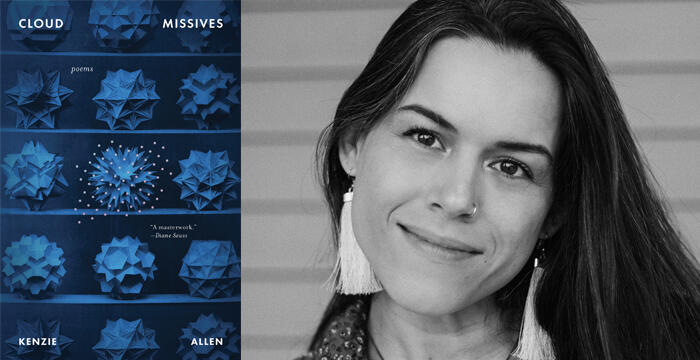
Today’s conversation with Kenzie Allen, about her debut poetry collection Cloud Missives, is unusually wide-ranging. We look at the influence of archaeology, anthropology and cartography on her poetry, and on her notion of gaze within her work. We explore the fraught colonial history of these fields, and how, as an indigenous poet, she orients herself to her own work in this regard. We look at questions of identity, representation and stereotype both in the realm of language and art-making, and also in the realm of tribal sovereignty, looking at the colonial history of blood quantum and its repercussions today. We also look at questions of form, both inherited forms and the creation of new ones, of both poetry on the page, and multimodal works that live off of it, from visual poetry to literary cartography to the wampum belt as an ancient form of hyper-text.
For the bonus audio archive, Kenzie contributes an extended reading of a sequence poem that she calls Love Songs to Banish Another Love Song. By reading this, she gives us a peek behind the curtain of the process of revision, because this sequence is an earlier, very different version of a much shorter poem in Cloud Missives. This joins many other supplemental readings in the archive from everyone from Jake Skeets to Layli Long Soldier, Elissa Washuta to Natalie Diaz, Brandon Hobson to Tommy Pico to Terese Marie Mailhot. You can find out how to subscribe and check out the many other possible benefits and rewards of joining the Between the Covers community as a listener-supporter at the show’s Patreon page.
Finally, here is the BookShop for today.
Transcript
David Naimon: It's hard to be a reader in 2024. Before getting into a good book, you have to somehow ignore your inbox, avoid doom-scrolling, break free from the algorithm, and then just when you're getting into it, there's an alert that pulls you back out. That's why reading technology company Sol designed the Sol Reader, a wearable e-reader that helps you shut out the world and get back to reading. You put on the Sol Reader like a pair of glasses. Just slip it on, lay back, and see the pages of a book right there in front of you on an E Ink screen. Think of it as noise canceling for your eyes. No distractions, just words. Check out the Sol Reader at solreader.com to start reading without distraction. If you use the code COVERS15 at checkout, you'll receive 15% off your purchase of Sol Reader limited edition. Today's episode is also brought to you by Masquerade, a coming-of-age mystery by Mike Fu that chronicles the discovery of a book with curious connections to the main character, Meadow Liu, a possibly haunted apartment, a deceptive mirror, a stranger speaking in riddles, revelations regarding past romantic partners, and more. Called “sensuous, sexy, and at times surreal” by Juli Min, “Stylistically daring” by Jinwoo Chong, and praised as "capturing the vibey-cool of diasporic Shanghai and the restless pulsing of New York’s heart" by Xuan Juliana Wang, Masquerade explores friendship and queer longing, asking what can be trusted when nothing and no one is as it seems. Masquerade is out October 29th from Tin House and available for pre-order now. I'm really excited to share today's conversation with Kenzie Allen about poetry, yes, but about poetry that touches on so many things I was eager to learn about and explore with Kenzie, and doubly so because I came to Kenzie's work with some long-standing questions and curiosities that were produced by a past conversation on the show with fellow Tin House writer Morgan Talty about his story collection, Night of the Living Rez. That conversation and Morgan's engagement with Native identity since that book has been percolating in my brain ever since. Engaging with the animating questions in Kenzie's book gave me an opportunity to explore them further as part of exploring her incredible poetry, poetry that engages not just with identity and representation, but with memory and ancestry, archaeology, anthropology, and much more. For the bonus audio archive, Kenzie contributes something special. She reads an earlier, completely different version of a poem that exists in her collection, Cloud Missives, the poem Love Song to Banish Another Love Song. But prior to a reimagining of it, this poem was a sequence, a sequence of multiple poems, a Franken poem in her words, that she calls now Love Songs to Banish Another Love Song. She gives us an extended reading of this earlier, longer sequence poem, so we can see how it existed in the world before it was transformed into what we have now. This joins other bonus audio contributions from Natalie Diaz reading Borges, Layli Long Soldier reading a poem written since Whereas, to Jake Skeets reading and analyzing a poem by Luci Tapahonso, to Brandon Hobson reading a new story, to Elissa Washuta reading an essay in progress, to Morgan Talty’s contribution, which is probably the most directly resonant with today's conversation, his reading of his essay The Citizenship Question: We the People, which extends both my conversation with him and with Kenzie today about blood quantum, belonging, and native identity in the United States. The bonus audio is only one thing to choose from if you join the Between the Covers Community as a listener-supporter. Every supporter can join our brainstorm of future guests. Every listener-supporter gets loads of resources with each conversation. Then, among the many other things to choose from is the Tin House Early Reader subscription. Morgan Talty and Kenzie Allen are only two of the remarkable authors at Tin House. I think 2025 is going to be a new high watermark for Tin House as a press. Becoming an early reader with them means receiving 12 books from Tin House over the course of a year, months before they're available to the general public. You can find out about all of this and much more at patreon.com/betweenthecovers. Now for today's conversation with Kenzie Allen.
[Intro]
David Naimon: Good morning and welcome to Between the Covers, I'm David Naimon, your host. Today's guest is the poet and artist, Kenzie Allen. Allen has a BA in anthropology from Washington University in St. Louis, an MFA in poetry from the University of Michigan, and a PhD in English and creative writing from the University of Wisconsin-Milwaukee. She's currently an assistant professor of English at York University, where her research centers on documentary and visual poetics, literary cartography, and the enactment of Indigenous sovereignty through creative works. She's the founder and editor-in-chief of the online literary magazine Anthropoid that curates writings focused on the themes of participant observation, personal ethnography, and humans in our unique environments. She's also a member of the High Plains Society for Applied Anthropology and serves as an archivist and volunteer fire lookout for the Sand Mountain Society. A finalist for the National Poetry Series, Allen's poems have appeared in Poetry Magazine, the Boston Review, Narrative, and twice in Best New Poets in 2016 for her poem In Which I Become (Tiger Lily), selected by Mary Szybist, and in 2022 for her poem Quiet as Thunderbolts. Kenzie Allen is also an inaugural winner of the James Welch Prize for Indigenous Poets as judged by poet Sherwin Bitsui. Additionally, Allen is the recipient of the 92Y’s Discovery Poetry Prize, which for nearly 70 years has recognized exceptional work by poets who have yet to publish a first book, in whose past winners include John Ashbery, Mark Strand, Lucille Clifton, Brigit Pegeen Kelly, and past Between the Covers guests, Solmaz Sharif and Diana Khoi Nguyen. Given the trajectory of these luminary poets just mentioned, it's with great excitement that we welcome Kenzie to Between the Covers today to discuss her debut collection of poetry, Cloud Missives. Shelf Awareness calls Cloud Missives "A stunning consideration of constructing identity, finding love, and living life." Pulitzer Prize-winning poet Diane Seuss adds, “Kenzie Allen’s Cloud Missives renders an unchartable landscape, ‘wide as a child’s face,’ in poems that enact Indigenous autoethnography and a profoundly embodied recovery operation. These are poems of revelation and repair, twenty-first-century poems that extend the work of the lyric into the territory of ‘elegy against elegy,’ love songs written to drive out violence and exoticization masked as love, and poems that wake to the desire to awaken. Allen has written a masterwork of self-reclamation and survival through love.” Heid Erdrich adds, “With archeological care, Allen begins a poetic and meticulous examination of the layers of life. Intensely scrutinized events that involve Native women are separated into strata to reveal a powerful self and a voice that seems to have been waiting beneath the pressure of years to, at long last, speak.” Finally, Craig Santos Perez says, "Through impeccable craft, Allen explores themes of health and healing, Indigenous genealogy and identity, kinship and love. These poems are a ‘song against the song of our demise.’ May their missives travel far and wide; may their words bloom like sweetgrass.” Welcome to Between the Covers, Kenzie Allen.
Kenzie Allen: Thank you, yaw^ko, David, for having me on the show. I'll say, for those listening, (speaking foreign language) So hello to all of you, my friends. I am glad that you have arrived here.
DN: Well, I wanted to start in a broad sense with your interest in anthropology for it seems like it was hardly a passing interest as an undergraduate, but rather seems to extend to the present day, whether it be the founding of the online literary magazine, Anthropoid, where the mission statement says, “In our mind, every poem or story is also an ethnography, and an artifact of our cultures,” or the writing classes you teach, which have names like The Art of Excavation: Writing the Artifacts of Memory and Self, and Mapping & Memory: Poetic Cartographies. Let's open with you talking a little bit about this enduring interest in anthropology in its own right, but also the ways you explore it as a frame or framing from within which to write.
KA: Oh, what a good question. Thank you so much for recognizing that passion for anthropology that has really led me from the very beginning. My first semester at college at Washington University, I took a world archaeology class with Professor John Kelly, and I just absolutely fell in love with the way that material remains could contribute to telling a human story. Then I got to take an archaeological field school with John Kelly that summer out at Cahokia Mounds, and I fell in love with all of the different processes involved in recovering those remains and cataloging them and starting to interpret them as well. One of the things that we did during field school was actually we mapped one of the mounds. We surveyed it using both a modern-day total station as well as an old transit, which is like an old version of a theodolite basically. We had to work at mapping the contours of the mound and then we had to map the actual site. I talked about this a little bit in that class and in an article that I'm working on that the grid is this essential element of archaeology because archaeology is a destructive science. I'll talk about too the way that anthropology is a colonial science. But archaeology in particular destroys what it seeks to study through the nature of excavation itself. So you use the grid system to try to preserve as much context as you possibly can as you go along. You map things out, you draw the different swirls in the soil, and you compare their colors to a color chart that's like straight out of Sherwin-Williams. It's called a Munsell color chart. That can tell you different clay deposits and different presence of ash in the soil and things like that. So you'll map that out. You'll actually draw it out in your field notes. On the one hand, it's very scientific. On the other hand, all the artifacts sometimes go into paper bags, depending on the fragility of the artifact and things like that, and you catalog them, you take them back to whatever site you're using, museum site typically, to work out their presence again. So you reconstruct the site even after you have deconstructed the site. Then at the end of the summer, we actually ended up piling all the soil back into the trench. We worked so hard to excavate it and then we just piled all the dirt back in but with those field notes that we took with us. I really fell in love with that process and I see that as a reflection of the writing process too because you dive in, for me, it's helpful to have some sort of orienting factor similar to a grid whether that's a structure or just a kind of throughline or method of inquiry for a poem. Then you consistently refine it, but the poem itself becomes like a layering the same way that the soil is layered. The things that you can tell from a site or from, I took later on a class in forensic anthropology at University of Missouri, St. Louis, and that was a little bit of a different process. You're using some of those techniques you use in archaeology, but you're applying cultural anthropology understandings, and then also applying a legal context as well. What you could learn from the body became something that was really fascinating to me, the body as a site to examine. Then in cultural anthropology, I became really interested in human variation and migration stories, diasporic stories, forced relocation stories, particularly because of my Indigenous background. I became interested in the history of the science itself, the history of the science as colonial as emerging from the tradition of naturalists on the side of cultural anthropology and grave robbers on the side of archeology and how that has slowly evolved over time and some of the challenges that are still basing these fields in terms of if we were going to do something like decolonizing. So that's something that I'm really interested in when I'm working on and just attending the meetings of the High Plains Society for Applied Anthropology. The applied part is where instead of being a sort of observer, you're supposed to preserve the distance in a lot of these sciences with the aim of objectivity. But there's no true objectivity, is there? So applied anthropology recognizes that in a particular way as to utilize what teachings of anthropology toward solving human problems in the world around us. So housing problems and things like that. Then I'm also interested in NAGPRA, the Native American Graves Protection and Repatriation Act, which was passed only in 1990, and the ways that we caretake these remains now. So it's been an evolution, a journey in terms of my relationship with anthropology and archeology, but then that has always affected the way I think about writing and indigenous literature, for example. I bring in a lot of that into my teaching and into my written work as well. I think of a lot of what I do in terms of ethnography. I think about human stories and how to tell the human stories from whatever is out there as far as materials of our culture.
DN: Well, I'd love to spend a little more on this notion of you as an Indigenous person interested in using anthropological lenses in your art-making and how you position yourself very fully aware of the legacy and also engaging with the legacy, given how there's no group of people for whom anthropology has been more fraught, even with looking at the United Nation in New York, all across New York State, universities, and museums have housed in their basements and archives for decades and decades countless human remains and ceremonial objects used and funerals, which forever were seen as objects to study rather than human loved ones to be returned to their communities like any other or nearly any other human remains would. Of course, anthropology itself has changed a lot. I mean, I was also thinking when you were talking about gravediggers or tomb raiders, like how Indiana Jones is the hero in those movies, and he really is a grave robber or a tomb raider, but anthropology, like the time since that first Indiana Jones movie has changed a lot and gone through a lot of its own self-reckonings. So has Colgate University and Cornell University and a museum in Rochester all step-by-step repatriating these so-called collections to the Oneida Nation, admitting that they should have never been in the first place in these collections. In your magazine, Anthropoid nods to the past and to the future of the profession when it says it wants to "further anthropology’s troubled but continuing process of indicting the biases of gaze." So really in a way, it seems like nothing could more significantly achieve an indictment of the biases of gaze than having more native people as anthropologists, at least that's what I imagine, and listening more deeply to First Nations people, but tell us a little bit more about navigating this intersection of indigeneity and the history of anthropology, and if there's a way your poetry is also then indicting biases of gaze in the manner you raised in the magazine that you founded.
KA: When I first think about the interaction between the Haudenosaunee, or sometimes known as the Iroquois Confederacy—which is the confederacy to which the Oneida Nation originally belonged and still has those traditions and belonging—I think about Lewis Henry Morgan, who was kind of obsessed with the Haudenosaunee and did ethnographies on them, or on us, and also played dress-up at one point and had his own society that he modeled after it, but then he also disparaged it a little bit, so it was just a strange relationship. You make do with what you can back then, and you make do with what you can now, but Lewis Henry Morgan eventually came up with this model of social evolution, which looks like a bit of a stairstep. At the bottom of the stairs is savagery, essentially, which is defined in opposition to at the top of the stairs, civilization, which is characterized by advanced architecture, which tends to emphasize things like Roman columns versus, earthworks would not be considered advanced architecture in this model and privately held property. In the middle, it's like barbarism and sort of agrarian societies somewhere in the middle. But if you're at the bottom or the middle of the stairstep, the idea is that that is your lot. You cannot climb the stairs. You would think so, but you can't climb the stairs. It's just the natural byproduct of the possibilities of your particular culture. Some cultures are destined to be civilized, some cultures are destined to continue to be barbarians. This model ended up entrenching the notion of primitiveness. That lasts up until today. The thing that you'll hear on Twitter or X, the thing that you'll hear on there is, “Oh, but you all were warring with each other anyway,” et cetera. Well, at least in the Haudenosaunee, there were also notions of the great law of peace. There was a confederacy, there were these alliances, there were these deeply-held relationships with the land and with our non-human family members. All of that gets thrown aside, well, you were warring anyway, well, it's not the same thing as a colonial invasion. But that notion of primitivism lives on. I mentioned before that a lot of these sciences were trying to project the notion of objectivity. I liken this to a camera lens a lot of the time. Everything within the range of the camera lens is objective truth according to particularly this older model of anthropology. Modern anthropology and maybe some of what I'm trying to do takes that camera lens and almost moves it back behind the head of the observer and includes some of the observers within the observation so that you get a sense of their biases and you get a sense of what their insights might be and what their inability to imagine might be as well. That's something that I'm trying to do in my poetry a lot of the time, and in my writing in general, is also include the observer and indict the gaze through that like to look at the act of observation as much as what is observed and to note that what is observed is entirely subjective really and it's just one story within a larger range of stories. So to also recognize the different stories that are out there. One of the things that anthropology has needed to do and archaeology has needed to do in the modern era is to recognize, for example, oral histories as data. The moment they do that, they suddenly get explanations for a lot of the sites that they were puzzling over before. Such a mystery. Then the local Indigenous nation will be like, “Yeah, we know exactly what that is. We have a story about it and we could probably tell you around when it happened.” There are winter counts and there are a lot of different written histories as well. Haudenosaunee Wampum Belts are a written history. Recognizing these things as literature, recognizing these things as a way of writing, doing multimodal work is also part of this sort of attempt to move storytelling into that realm that encompasses those instincts to, I mean, Indigenous people have always been telling stories multimodally, so even that is that act of resistance against the old school written ethnography. Renato Rosaldo also started moving this forward by including poetry as an anthropological method. There are certain ethnographies now that use the “I” in the ethnography, like “I observed this,” and that's not something that they were doing before. I do see that movement happening in anthropology and archeology, and I'm trying to also participate in that. Part of what I'm also trying to do is think about the language that I'm using. So some really great folks to check out are Bernard C. Perley, who is a language revitalizationist and an anthropological linguist. He has written about critical indigeneity and the idea of zombie linguistics where people come in and in the name of preservation, these linguists will record people and think, “Oh, I've done my job,” instead of recognizing that language lives in community and it lives in usage. Just recording it and the idea of focusing on preservation is not focusing on the idea of revitalization or emergent vitalities, he calls them. Then he has also studied the work of Daryl Baldwin, who is also a language revitalizationist for the Miami tribe. That's out in modern-day Ohio. If you've heard of Miami, Ohio, you're like, “Why is it called Miami?” It's because of the Miami tribe, Miami Nation, and their language was considered bilingualist to be extinct. It was really remaining in the place names and in a few missionary accounts of different missionary dictionaries, which have their own biases. Over time and through a lot of hard work, Daryl Baldwin actually revitalized that language along with a group of linguists. His children were one of the first to speak it in the home as children again in so many years. The key to that—and there's a really good documentary on this called Miami Awakening—the key to that is to say, “What if the language is not dead? What if it's only sleeping, waiting to be awoken again?”
DN: I love that.
KA: And how does that change things for us when we change the language that we use about a particular thing to move away from this idea of dead or extinction, which is not an Indigenous concept anyway to this idea of it's just waiting to be awoken again. That shift actually, in the same way as changing our hypotheses about something like the Bering Strait theory, and not leading with a particular biased hypothesis, that changes what's possible in the world and what's possible to be imagined and what's possible to be studied. To me, that's a lot of my constellation of influences, if you will. I think about that, like, what are the emerging vitalities within the poetic language that I'm using? How is poetry something where we can create our own language? I talk about this a lot, how my grandmother has passed away, but in a poem, she can be alive again, and speaking to me. What can be imagined is really affected by the language that we use to talk about something. I think that that's something that anthropology is also starting to embrace. That works when you have Indigenous anthropologists like Bernard Perley, who is Maliseet. [laughter]
DN: Well, the reason why I wanted to start here is because the first section of four sections in Cloud Missives called Pathology, if you skip to the end notes, we discover that this section is inspired by the course you referred to or largely inspired by this course on forensic anthropology. I was hoping maybe we could hear the first two poems in the book. The first Light Pollution stands alone, opening the collection before the first section, and then Breaking Ground is the first poem of the forensic anthropology-influenced Pathology section. I love how we start the book in the sky and then break the ground and the earth, but also you talking now about the language not being dead, but waiting to be revived, we're going to hear echoes of that, I think, in both of these poems.
[Kenzie Allen reads a poem called Light Pollution from Cloud Missives]
KA: And this is Breaking Ground.
[Kenzie Allen reads a poem called Breaking Ground from Cloud Missives]
DN: We've been listening to Kenzie Allen read from Cloud Missives. I really love this opening move, what almost feels like a gesture of "as above so below" with both poems being about recovery of something erased or buried, the celestial one with the lines, “and tried to lick back stars the city had obliterated, to resurrect anything at all by taste.” The second one going into the ground and asking “What of the memory. I carried, the almost-end of me,” which feels like it echoes back to the stars that we can't see. The first poem where the light has erased everything before our eyes and the speaker is trying to resurrect the stars by taste instead of sight and the second, in breaking the ground to find things where light can't go with the lines, “I have left the world behind to find the world still sheltered in the dark.” Of course, we think of what can be carried forward of the almost erased, what has been buried but can still be retrieved, how to pull tradition forward through a rupture. But I also think of how both acts, the looking up and the looking down, are not just spatial acts but enactments of time that are different, I think, than colonial time. It makes me think of an essay by a past Between the Covers guest, Jake Skeets, one that he wrote since he was on the show, it's called The Memory Field. In one part of it, he says, “Memory is a physical construction. While memory is normally associated with the cognitive functions of the brain, I argue that memory’s connection to time imposes its existence onto physical space as much as it does onto cognitive space. I am always fascinated by the idea that the starlight we see today is in fact old light cast out from a time existing simultaneously in the past, present, and future. The star’s light began in its present, a past to us when we see it in our present, which is the star’s future.” Then later in the same essay, “because sunlight takes 8 minutes and 20 seconds to reach the earth, the things we see are in some way a part of the past. Pasts, presents, and futures exist simultaneously.” I was also recently watching Nick Estes get interviewed by Layli Long Soldier, where he talks about—as many other native writers do—how popular non-native histories of natives are always trapping native peoples in the past, which of course, his book, even in its very title, Our History Is the Future, is subverting. I guess I wondered if this sparks any thoughts for you, generally, or in relation to those two poems you just read.
KA: I mean, so many thoughts. It's making me think about the way that memory and time intersect, but also how memory and time and place intersect. I immediately think of Bakhtin's chronotopes, which I have from another anthropological book or from Bernard Perley's class actually, the collapsing of time and place and the way that places hold memories and places hold stories. I don't think it's necessarily solely for, I mean, it's not solely for Indigenous people, right? It's just that those stories have been really held onto and it continually imbued into the landscape. I think that's true for most cultures. We all have to just do the work of reclaiming those stories and awakening those stories again. But I do think about the way that memory for me does get rooted in place. So can the stars be a place? Can the ground, in general, can the gravesite be that place where memories are imbued? It's like you bring your memories to those sites and then those sites have their own memories and they have their own long reach through maybe seven generations back and seven generations forward, we think of in Indigenous time, but those places have their own memories since time immemorial. I think excavating those things, you have to be very cognizant of that. You have to be very cognizant of people's memories of these things, people's relationships to them. You mentioned earlier the collection still held in museums and a key part of the NAGPRA law is also to figure out if you are given permission to continue to house those things, you have to figure out a visiting policy for their descendants to be able to visit their relatives. That's one basic thing. You also have to treat the remains, the individuals, they're called in forensic anthropology, with deep respect and care the same way that you would your own relatives. Those are some things that I think about a lot based on that class that I took, but also just based on Indigenous histories and Indigenous notions of time. Then in the collection too, there are a lot of things happening with time. There are those cyclical, looping, far-reaching, deep-time elements in terms of being rooted in indigeneity, and there's also a lot of flashing forward and back. I think it's called analepsis and prolepsis, but the healing process for having gone through violence and gone through trauma involves a lot of flashing forward and back, a lot of living in the memory and then also working your way through the gaps in memory. I think a lot about that in terms of that's another way of being trapped in the past at times. Then I'm also interested in Indigenous futurities in this collection. I'm interested in not just looking at trauma but looking at joy. Susan Sontag talked about how the appetite for images of the body in pain is almost as strong as the desire for pictures that show the body naked. So this human fascination with the idea of pain, the idea of a kind of mindset of deficit, is also a form of what you might call Indianness and this conception of Indigenous people that is based on these falsehoods, based on things like primitivism and being trapped in the past. How do you change that is by helping people imagine a future. That also makes me think about one of the core values that guides this collection and guides my work in general is these Oneida core values, one of which is “kalihwiyo,” good words. So the use of good words about ourselves, our nation, and our future.
DN: Well, another thing that I found really interesting that feels connected to this book opening with Breaking Ground, with both tilting the head up and then going down into the earth, is Nick Estes suggesting that he felt like space was more temporal than time, and I'm paraphrasing him when I say that, and he didn't really elaborate, but I wonder if it is related to Jake Skeets' notion of the simultaneity of time, and that in contrast to this, space is actually the temporal axis. Either way, Skeets in The Memory Field defines the memory field this way: “There is a pond near my family’s sheep corral. Whenever I see or remember the pond, I am reminded of many moments of my childhood, my past. The pond is a physical construction of my memory. It is a memory field. The memory field is a matrix of time, memory, and land. Land’s connection to time feeds our development as human beings, and understanding this connection strengthens our relationship to the universe itself.” Thinking of temporal space, of land and memory, I wanted to take a moment to talk about cartography and how it relates to your work. Descriptions of your research at York University include what you call research on literary cartography. As I mentioned, you have classes like Mapping & Memory: Poetic Cartographies. Recently, when Carl Phillips was on the show, he also likened his poems to maps. He says for him, "Art is the result of my having allowed myself to stray from any marked path and to become lost. The poem is the evidence—like tracks, or footprints—of my quest into and across strange territory, the shape I’ve left almost as if unintentionally behind me. The poem is a map, but after the fact; not a way of getting somewhere but a record of having been lost, of where that lostness brought me, until what was uncharted country became, for the space of the poem, a place to live.” While both of your engagements with maps, I think they share the qualities that they aren't about conquest or the imposition of knowledge on a space. It does feel like your relationship to them is different than Carl's. Talk to us about poetic cartographies in general, how you see poems and maps, but also more specifically too in relation to this book, how you describe the map that is Cloud Missives.
KA: Well, I want to start by defining literary cartography, as I understand it. The term might have come up before this, but I do tend to cite Robert T. Tally Jr., who talked about how literature represents a kind of spatial orientation of information. I think about that when I am writing a poem, like what is the map of the poem? I think about that when I'm reading a poem too. Literary cartography, just as in cartography, you have map markers, cardinal directions, and symbols that represent different things on the map and you have a map scale. What are those elements when you look at the poem, how is the poem teaching you to read its map? That can be something as simple as an indicated title, so Thirteen Ways of Looking at a Blackbird or Elegy Against Elegy, in my case. It can also be mapping on the page. It can also be mapping through extended metaphor or individual images. It can be mapping through rhyme or music. There are a lot of elements that come clear in terms of their spatial relationships in a poem when you start thinking about it as a map. When I'm looking at these maps, one of the things that I tend to present on is what I call alternative or Indigenous forms of mapping. I don't really have another word for it other than alternative and I talk about alternative storytelling too, because I don't want to say non-Western because that just poses it in terms of the Western alternative does that too so I'm still looking for a word there. If anyone has ideas, go ahead and send them to me but I think too in terms of alternative map making, Howard Fisk has these really beautiful Meander Maps of the Mississippi and particularly the way that the river changes its course over time. It has different ways that it cuts through the earth. These meander maps layer that and they use color as a way of denoting time. So the different decades or time periods are denoted with different colors. And then the delta maps over itself and over again, it looks like a pile of snakes and it's beautiful, these maps are so beautiful. He actually mapped the whole thing. It's something like 30 different images of the map as the river goes along. It's this really beautiful loving, I think it's caretaking of the Mississippi River by doing this, by recognizing its path over time, by recognizing its power by doing that, and by making something beautiful out of it, you're honoring it in a way. So I really, really love these maps, and I tend to reference them. Another map that I reference is a map from, I think it's from K. David Harrison, maybe, but it's a chapter called Atlas of the Mind, and it talks about knowledge that, and this book actually frames it in terms of knowledge that might be lost, which I don't love, but the way that, for example, Sherpa peoples think in terms of the vertical dimension rather than the horizontal. As the bird flies wouldn't tell you much about how to navigate the landscape and it wouldn't tell you much about how long it'll take you to get there, whereas the vertical dimension, if you're moving up and down through the mountains, that makes more sense to map. It's not done using a grid system at all. Then I also look at a map from what's called Decolonial Atlas, which is a really great website. Check that out. But it's an Anishinaabe or Ojibwe place map of the Great Lakes. Those are rotated so that east is the cardinal direction. You'll also find some maps of Australia that turn the whole thing upside down, which is kind of fun, to say, why are we orienting things the way that we are, what about that is actually steeped in colonial forms of map making? Like the T–O maps back in medieval Europe that said, “There's nothing out there except for Europe, Asia, and Africa.” Those maps so entrenched that thinking that you had something like what they called the New World because they couldn't imagine that anything would be out there. That affected things like what they could imagine of it being populated or it being civilized. These new decolonial forms of map making, like all of the place names on the Anishinaabe map are in Anishinaabemowin. They are orienting the Great Lakes as the primary factor as the focus rather than the land around it, although the land around and is also honored. But it's these different forms of map-making that inform my approach to mapping just mentally. I also am working on multimodal projects that try to map things on the page in this way. I'm also trying to think about ways to map time. In another project that I'm working on, I have a map scale that I'm using along the bottom of the pages. It starts with B to D as far as the markers instead of 0 to 50, it's B to D, birth to death. But then the map scale extends across the pages to say that these memories extend across generations. So I do think about memory and space as temporal. Then I also think about how these things span intergenerationally and how the stories of places are imbued in those memories.
DN: We'll also point people to your website so they can check out some of these off-the-page poems, your use of VR goggles, geolocation, Google Maps, the embodied poem literally written on your body.
KA: About the body too as a map. The body is a map of memory in that way. The body shows the markers of the things that have happened to us. The way that maps, like the Howard Fisk map, is a palimpsest in terms of the layering, but so are our bodies a palimpsest of the maps of our memories.
DN: Well, before we hear a couple more poems, let's take this mapping from the earth back into the sky. You've talked or tweeted about how every year in your poetry class, you have students make a star chart of their poetic influences and constellations, their ancestors and techniques that shape their poetic ethos. So I was hoping maybe you could spend a moment talking about your star chart, your poetic star chart for us.
KA: Oh, this is difficult. I need to make mine out again, but a lot of it involves these Indigenous ancestors who are many of them still alive. Indigenous literature, it's not that it's been a short timeline, it's just that there's been this incredible proliferation once those things started being recognized as very publishable. Folks like Roberta Hill Whiteman, now known as Roberta Hill, but that was the name she was using for her book Star Quilt. I love that it's a star quilt, which is this important tradition, but also there is that notion of stars that starts with an invocation poem with the four directions. That's definitely a big influence. She also has a glossary at the back that uses, instead of dictionary definitions, it's like talking about different concepts that are in the book and the memories and stories that are associated with them. It talks about mosquito, and it talks a little bit about the traditional story of mosquito, but it also talks about her relationship with her father and his stories that he told about the mosquito. That's definitely a big influence of mine. Craig Santos Perez as well is a big influence of mine in terms of that mapping and the poems floating on the waters and the kind of journeying that happens in the long series, the From Unincorporated Territory series. Stephen Dunn is one of my strong guiding stars. I really like these poets that I consider to be, and I think they've only been called this like once or twice, but the wisdom poets, I think that would also include Dorianne Laux. It certainly includes Pattiann Rogers, who's The Question of Affection is one of my favorite poems of all time, and really guided some of the poems in the Pathology section, in terms of locating in the body the different ways that our lives are encoded. Bones thicken like pearls from the heft of a child in one of the Pathology poems. That same kind of idea of the different ways that we know that the ribs can grow facile by fondling alone, I think is the line from Pattiann Rogers. Stephen Dunn in general is just something I return to to soothe the spirit a little bit, there's that sense of wisdom. I think Matt Donovan I would say is, I see a connection there in terms of being like a modern-day wisdom poet, but the wisdom is not as much steeped in looking back somewhat ruefully the way it is in Stephen Dunn but it's looking forward with a kind of like indomitable hope. I think about folks like all of my mentors, Kimberly Blaeser, Elise Paschen, Laura Kasischke, Khaled Mattawa, these folks who taught me a long way, Bernard Perley, Brenda Cárdenas has been such a guiding force for me and introduced me to so much of the literature that has affected me in a deep way. I'm looking over at my books right now that I keep really close to me. Leslie Marmon Silko and things like that. There's this pantheon that I think of. What that lesson comes from is a series of lessons that I teach. When I teach the canon, I teach it under the heading of constellations and ancestors. I actually have students look at the old school canon one week and I make them sit down with that stuff because it took me a long time to fall in love with folks like Elizabeth Bishop and Emily Dickinson and Sylvia Plath and Philip Whalen and Gary Snyder. It took me a long time to fall in love with these kinds of poets from the different movements to become obsessed with imagism, for example. But then I have them move into different kinds of traditions, extra-canonical traditions the next week, and I have them each time take ownership over this research. They pick a particular movement, and they research it, and then they present it to the class. I think a lot about communal forms of learning because of Indigenous pedagogies. But then they get to explore what's out there and they really start to think about their own influences and the ways that these movements are connected. Like the one movement has been reacting to another movement or has been shifting things from another movement. Then they think about their own heritages and their own legacies that they can leave behind. They do such creative things in terms of mapping that on the page. I love when they sketch things out or they use all kinds of computer programs to make something really beautiful and then they get to talk about it and they really light up when they talk about their influences. I find that they always talk about not just people but concepts and places and that's important too. I would say the land is as much an influence on my work as anything else. The different places that I've lived, Norway and West Texas, and the United Reservation in Green Bay, even Ann Arbor, Michigan, and New York City. Now Toronto and Canada in general, love me the Canadian images now. Your star chart is always evolving and you have to repeat making your star chart as you go along.
DN: Well, let's hear a couple more poems. The first I was hoping to hear was Determination of Racial Affinity. But before you read it, I'd love to spend a moment with your frequent use of italicized outside sources in your poetry and the novel way that you use them. For instance, in Determination of Racial Affinity, you're using lines that are commonly found in forensic anthropology. But in a different poem, Forensics, and in other poems, you're imagining an outside source. For instance, the italicized lines “could be from an imagined textbook entry that references a real museum collection of skeletal remains.” I'm curious about both the use of citations, but also the use of fictive citations, whether it's because of sonic and syntactical considerations, wanting the language to work in the poem, or something more practical, avoiding copyright, or if there was something else that makes the use of the imaginative in an authoritative way important to you.
KA: I think it's all three of those things. I think sometimes, the words come and I know that they're so heavily influenced by the vocabularies within that particular discipline or field, and they're influenced by the vocabularies of either something I heard or something maybe I misheard that still influenced me in that way or influences the particular figures in the poem in that way. Sometimes it's something that just needs to be there. I didn't realize how much it was going to help with avoiding copyright until we had to start clearing copyrights for the book, [laughter] which I think the only thing we really had to clear was the Disney quote. Because the rest was kind of, it wasn't just that it was from these sort of textbooks, it was also from like no particular attributable source. Once I started going down that rabbit hole, I was like, “Oh, I swear this was from a textbook because I wrote it down at some point.” But then I look and it's from some PowerPoint that's then been reproduced so many times, I have no idea where it comes from. But it's like that same language every time. I think that's actually the language at the beginning of Determination of Racial Affinity is one that has been reproduced so many times that I cannot find a singular source. I really thought it was from the forensic anthropology textbook that I used, but it isn't. But the ideas are, lines that come later about the different features, those are things on a chart within the actual textbook, and then also have been reproduced in a million powerpoints. Some of them are, by their nature, mysterious, but they are used within the science, whether or not they have been attributed to a singular source. Then some of the time, it's things that we might have said within the room, I don't know exactly what we said. It's like the difference between memoir and strictly nonfiction versus creative nonfiction, but it's useful and it's demonstrative. The phrase at the very beginning of the Pathology section, "The dead do not bury themselves," is this thing that's just said about archaeology that means there's a story imbued there. There are other people who cared for these people or who enacted violence against people. These sorts of phrases have been within that other pantheon of the book. Then some of the time, it's also that these are the things that would be said, or these are the things that I wish would be said, or these are the things that would be said by actual characters or people in life. Some of the time, the italics do the more traditional of “This is something that was said,” although it could very well be imaginative or not. I tried to indicate some of that in the end notes but not all of it. I'm interested in just letting these things live. Then some of the time it's Oneida which is in italics primarily because it's just not a language that people are very familiar with. Then some of the time, it is these direct quotes from these different sources. So this is Determination of Racial Affinity, and it begins with an epigraph that is not attributable to a particular singular source that reads: “Oftentimes a skeleton exhibits characteristics of more than one racial group and does not fit neatly into the three-race model.”
[Kenzie Allen reads a poem called Determination of Racial Affinity from Cloud Missives]
DN: We’ve been listening to Kenzie Allen read from her debut poetry collection Cloud Missives. The second poem I was hoping you'd read, we have a question for you from someone else that's very specific to this poem. The poem is the first poem of the second section called Manifest, the poem is called Repatriation.
KA: Repatriation. The epigraph comes from the Native American Graves Protection and Repatriation Act of 1990. It actually comes from an early draft.
[Kenzie Allen reads a poem called Repatriation from Cloud Missives]
DN: We've been listening to Kenzie Allen read from Cloud Missives. This is a question for you about that poem from Diane Seuss, whose 2021 collection, Frank: sonnets, won the the PEN/Voelcker, the National Book Critics Circle Award, and the Pulitzer Prize for Poetry, and whose latest collection out this year is called Modern Poetry. Here's a question from Diane.
Diane Seuss: Hi, Kenzie. This is Diane Seuss. I'm really interested in the poem Repatriation for so many reasons. One is the use of vastly different language types, textures, and temperatures. Can you speak about how the poem responds to or refutes the language of officialdom and the epigraph from the Native American Graves Protection and Repatriation Act of 1990? I'm especially intrigued by the third and fourth stanzas, the stacking and listing, and the insistent repetition of the word “piled,” your various sonic approaches to that word in the poem. Thank you.
KA: Ah, that's just so great to hear. [laughs] She's been so kind to this book and such a deep reader. It's been such a privilege. What a wonderful question. I think when I first encountered the language of NAGPRA, NAGPRA is something that I'm very fond of. The law is very important to me. It's important to me that it was finally passed. I don't know why, it's just something that I'm very familiar with and I just really appreciate as a kind of entity. I think of it as an entity. But when I think of it as an entity, I don't think of the clinical nature of the language of it. When I finally start diving back into it again, and look at it after a while, that clinical language is so alienating to me. I think it would be alienating to anyone who's thinking of these individuals as relatives. It doesn't matter if the individual walked on rather than died, if they walked on yesterday or in time immemorial, that is still a relative and that's still someone that deserves care and deserves intimacy. I think that that was part of the approach, particularly from the very beginning, to use lyrical, but also loving language toward the material remains. Then to tell the story of those remains, the swan wing actually comes directly from Cahokia Mounds and was also an indicator that you had cross-national trade as far as from one end of the country to the other showing up in these things that show up in Cahokia Mounds. So the idea of the usage of these things and the way to kind of bring them alive again, and the kind of stacking is referencing that collection that we looked at at University of Missouri-St. Louis that was from a time of, it was a Catholic cemetery, it was from a time of consumption, and it's interesting that depending on the time period and what need there was for grave sites, they actually would stack the coffins and the coffins would deteriorate over time and some of the remains would actually fall into the area below and be mixed up with other remains. Part of the task was actually to find the wholeness of these remains again as well. I think about that a lot. The piled is that kind of feeling of estrangement from remains when you see them, I mean they come to you in cardboard boxes and you have to open the box and lay them out on the table and put them back into this like composition of the body, and that a lot of the time in traditional Indigenous burial practices, it wasn't necessarily that you tried to preserve the body in a state of a box. It was that the body returns to earth in some way. So the idea of being piled is about as violent as I can think of in those terms. That's the reason also for the sonicism in that particular stanza. It was a challenge actually because the original way that I formatted that stanza is just the word over and over again. It didn't have what it has now, which is italics, small caps, and all caps in it, and em dashes and things to try to emphasize the way that I read it aloud. And I've always read it that way. I always reach a point during that stanza where I lose control of my own emotions. I've never read that poem and not gotten choked up during that part. But I think that allowing that to come through and allowing that to be heard in the reading is just as important because these things have emotional effects on us. Even if it's not your particular ancestors, it can have that emotional effect on you. That's important to let it have that emotional effect on you so that you don't get as estranged from it as the legal language might have you do.
DN: Well, let's continue in section 2 Manifest, which is my favorite section of the book. There are poems in the first section, like the one you read Determination of Racial Affinity, or the poem Psychomanteum, which meditates on one's identity in front of a mirror versus in the dark. Let's foretell the themes of part 2, which both have to do with real questions of Indigenous identity, and also indigenous identity in the cultural imaginary at large. Manifest has poems with titles like How to Be a Real Indian, Red Woman, In Which I Become (Tiger Lily), Dress like Pocahontas, Then Let's Make Love, and Sometimes When I'm Sad I Think about Indiana Jones. I was hoping to start with questions of identity and also the fraught notion of blood quantum. It's something I've been thinking about since Morgan Talty was on the show. I haven't read his new novel Fire Exit yet, but he mentioned at the time that he was on, that it was going to be about this very thing. Quite recently, he published an amazing piece in Esquire called I'll Show You My Indian If You Show Me Yours, where the present-day scene of the essay is Morgan with his toddler son making coffee in the morning and while doing so, he's teaching him Penobscot words that he knows and also telling the Penobscot stories he learned from his own mother, enacting on the page the unbroken lineage between his mother, himself, and his child, not only that they share the same blood but in terms of culture and kinship. Yet as we learn, in which I believe is also in a different formulation, the issue in his novel, because of the way the Penobscot people define themselves with blood quantum, Morgan is seen as Penobscot and his son is not. I bring this up because I believe you're in a similar situation. You're a first-generation descendant of the Oneida Nation, meaning your mother is Oneida, an enrolled member, but because of blood quantum, you cannot enroll. Morgan's piece is, I think, quite persuasively arguing for another way of self-definition for Native peoples, not only because blood quantum is colonial in origin, but because of the ultimate outcomes like this, from its implementation, which go against much longer-standing notions of kinship. I was hoping we could spend a moment where you could share some of your views about blood quantum either in concert or contrast to Morgan’s, and perhaps how you would orient people who've never heard this term before to the term.
KA: Blood quantum is certainly a colonial construct as you mentioned. In a more traditional sense, if your mother was Oneida and your father was non-indigenous, you would just be Oneida. There wouldn't be a question of that. There wouldn't be, “Oh, your half.” That concept didn't necessarily exist. In Haudenosaunee traditions, you did receive your clan through your mother and it's a matrilineal society but you weren't necessarily considered like non-indigenous. That concept came about mainly through the Allotment Act which produced the Dawes Rolls which are now used to determine blood quantum for a lot of the tribes. But what it was related to is during a time when it was not advantageous to be considered full-blooded, so you couldn't obtain a divorce, you couldn't sell your land for bettering your situation necessarily, a lot of the time, people were forced into that kind of corner, but the government agents would come in and they'd say, "How native are you?" The answer would either be, “Oh, not really native. So I could have some of these rights,” or it would be, “Well, I don't understand the question.” [laughs] Or people would avoid that census altogether. So what you had is they would generate these rolls and the purpose behind it was to separate people from their land. It was a system of land-based disenfranchisement. I tell my students that's the answer to everything is like if you take one answer away from this class, it's land-based disenfranchisement. Everything relates back to that, but the idea behind blood quantum too, it's a terminal math. There is no way to increase quantum over time. You can either maintain it or it diminishes, or as people like to say, it dilutes. Certainly, connections to culture do not necessarily dilute. Culture is not quantifiable in that way. It does not need to be subject to a deficit perspective. As Morgan Talty's beautiful essay illustrates, just like language lives in community, culture lives in community. Just like I was raised by my grandmother, my daughter also has that relationship with her grandmother. My mother actually has spent 20-plus years, much more than that, I think on our reservation, we had to leave the reservation during one particular generation. That was after the Carlisle experience, the Carlisle Indian Industrial Boarding School that my great-grandfather and his mother went to. That was an assimilation project. They said, “You know, to better yourself, you have to go out, for one, you have to learn to trade and then you have to go out and not speak your language and not wear your hair in traditional ways and really try to stamp out that culture as a way of both killing the Indian and saving the man in the terms of Richard Henry Pratt, but also as a way to not have to uphold treaty relationships after a while, treaty responsibilities.” Blood quantum has that effect as well. If you end up without people who are considered native enough to have those treaty responsibilities upheld, then you don't have to deal with “the Indian problem” anymore. Blood quantum is up and down a colonial system. However, resources are determined by certain amounts of blood quantum by the federal government as well so Native nations only have limited resources a lot of the time. That often affects the actual percentage that's used for blood quantum. The percentage that's used is based on those Dawes Rolls that were taken at the time that they said, "How Indian are you?" and people were either not listed on those rolls, they were listed incorrectly on those rolls, or they were listed correctly, but that has been affected by things like generations of assimilation. My great-grandfather went to the Carlisle School. He was sent overseas when he signed up for the war, World War I. That was a tradition, really, because Indigenous people are one of the highest demographics that sign up for the military and have fought in wars all the way back to the American Revolution. It's not necessarily that you're always fighting for the nation as much as for the land itself. But he was sent overseas in the war, he met a woman who was working in a fancy box factory, turned munitions factory, and he wrote her letters when he came back over two years and convinced her to come over to the reservation in Oneida to be with him. That's a love story. How do you say, “We told you to assimilate and then we're going to disrupt your love story as well and say that it's going to doom your descendants to not be able to carry on that culture in the same way”? Although they will do their best like it's very hard when you are not the same level of citizenship within your nation. I feel like I have to tell the story of it because it's not just a number on paper, it's a story for every single person. There was a whole generation that was sent to Carlisle, several generations sent to Carlisle. Then we turn around and we say, “You're not native enough” after they went through being told they had to not be native. So it's tragic and it's painful, but there are stories behind it, people's lives and people's relationships behind it. When coming back, there was not work to be found on the reservation leading up to the Great Depression and they moved down to what was Indian country at the time, Oklahoma, and made their life there. My great-grandfather actually used the trade that he learned at Carlisle to build their house. He was a bricklayer and that's what he did in the war as well. In that generation, we went from Carlisle to overseas to down to Oklahoma. My grandmother went to the University of Oklahoma and met her husband there, an Irishman who worked for oil companies. He worked for Statoil and they moved down to Venezuela. My mother was born in an oil camp in Venezuela. In two generations, we've gone from the Oneida Reservation down to Venezuela. Then after that, my mother traveled around a lot and eventually met my father and they moved around as well, and I've moved around my whole life. So this not only puts the lie to the idea of the static Native person who never moves around. Reminder, the rivers were our roads and we did get around quite a bit in traditional times but we also have been sent all over this earth by circumstances and then we did find our way back to our reservation community and it's a slow process to integrate but you also have to respect people there, you have to respect their stories, what they've been through and their oftentimes distrust of people who just show up all of a sudden, like if you were to show up all of a sudden and say, “Oh, I'm 50%, you gotta let me in,” it's like, “Okay, but you are going to form relationships too, right?” Because of those limited resources and because of those hurts sometimes and the things people are working through, you just have to respect what people have gone through and what they feel about it. You have to ultimately respect the sovereignty of the nation. Even if they've inherited this system that is a recipe for termination eventually, you will eventually, and we say, enroll yourself out of members. In fact, I think one of the statistics that they did said that the last full-blooded, I think it was the last full-blooded Menominee actually was going to be born in 2050. This has a very short timeline on it. It's not a way of planning for the seventh generation in the future to have this. Those conversations are actually happening right now. Like in Oneida, there are initiatives to have those conversations about how do you shift away from blood quantum? What are the criteria that you might have instead? One of those things might be cultural traditions, like how much are you engaging with cultural traditions? How much are you engaging with language? What are your relationships? What are the ways that you give back to your nation? If it is living in a tribal community, that is a communal way of life. How are you engaging with that? How are you upholding responsibilities? How are you living in good ways according to our core values? I think those are some things to think about in terms of the blood quantum, but it is something we have to deal with pretty quickly. But I have to always respect the sovereignty of my nation. So I'm listed on the rolls as a first-generation descendant, but I'm not eligible for enrollment. My daughter is listed as a second-generation descendant. We just put her on the rolls essentially so they have copies of our birth certificates and things like that. I was like, “Oh, you actually have a copy of that.” She is also not eligible for enrollment and we do only register down to a second generation. So I don't know what's going to happen after that. It's heartbreaking because we have done so much work to regain elements of our culture. To come up against a wall with that is just not what my grandmother would have wanted for us, not what my great-grandfather would have wanted for us.
DN: Well, preparing for today, I used it as an opportunity to satisfy more of my own curiosity about blood quantum. Please course correct me if I mischaracterize. I'm going to also say some things that you've already said, but I think in a different way. Morgan, both in the essay and outside of it, contrasts how Natives were viewed by settler society compared to enslaved peoples. Since enslaved African people in the Americas were considered a resource whose reproduction you would want to encourage because it would augment the owner's wealth, because of this, we have the one-drop rule, where no matter how remote one's African ancestry, the smallest amount defaults one to black, increasing the pool of potential coerced human labor and increased property, i.e. human property. In contrast, Indigenous people, obstructed settlers, access to land, as you just mentioned, so any increase in numbers would be counterproductive, and thus, blood quantum arises under this rubric of a logic of elimination and less and less people will be Native over time. I listened to some really interesting podcasts about blood quantum, one on Code Switch and then a couple on the All My Relations Podcast, and they echo many things in Morgan's piece, that it's based on pseudoscientific race science, that one's tribal ID card will tell you the percentage of blood that you have that nevertheless, as you've mentioned, many tribes use blood quantum to define membership, though from tribe to tribe, it differs the percentage cutoff and whether or not native blood from various tribes can be counted or only one's own. Also that both sides of the debate within native communities, the pro and the anti-blood quantum arguments, they both argue it's about survival. That some tribes have reached such a critical mass of divided families that they eventually vote to lower the blood quantum requirement or to change what is considered year zero, making perhaps people who were before 25% Native now full blood, essentially, and then counting from there. But as Morgan notes, and what these podcasts note is that proposing a return to a mode of self-definition that is not colonial, something that would increase the population of Native nations often causes fear, anger, and confusion rather than the optimism around the opportunity of having more citizens that Morgan, I think, movingly argues for in his framing. In the All My Relations Podcast, they talk about how 80 tribes have removed over 10,000 relatives from membership, partly because of casino money and how many people the proceeds should be divided among, but also fear of, among many other, real material things too. For instance, when Morgan says, "They also worry about federal funding that supports various programs, like our small Indian Health Clinic, and how, if too many Penobscots exist, the University of Maine system might take away the Native American Tuition Waiver, as they did with taking away free room and board.” I know you at least at one point were working on a book on this that you also teach about blood quantum and allotment in your classes and you've tweeted about it over the last decade-plus calling what I just described a colonial feedback loop, and that you were 31 years old before you met your first Oneida man who was your age and single and had “good blood quantum.” Yet even though it took 31 years to meet your first supposedly eligible Oneida man, because you were from the same clan, the Turtle Clan, there was a prohibition on the two of you dating, so just the impossibility of using this as sort of the mode of survival into the future. But there are innumerable material things that your mother and her child don't have the same access to, regardless of how strong your kinship relations are, from voting to healthcare to funding from the tribe to national opportunities tied to enrollment. Before we hear any other poems from the Manifest section, I wondered if you could share any thoughts about the other projects that you're working on. I think you touch on blood quantum at multiple points in this book, not by name necessarily, but are there still ongoing projects you're doing that are coming our way eventually that are directly engaging with it, or more explicitly engaging with it?
KA: Two projects come to mind, one of which was my dissertation project. Now it has evolved into an even longer book, completely unpublishable, just a behemoth puzzle box, cootie catcher, multimodal, many-legged project. That's the one where I'm mapping time. I'm also essentially storying the blood quantum in that book, because I'm talking about the last four generations. I'm talking about all the way from my great-grandfather to today, and I'm just realizing now that there is a fifth generation I should really talk about with my daughter eventually. But I do tell that story that I told you a few moments ago about what happened, and that's a way of talking about why there are so many different landscapes in my life and in my books. I actually encountered some resistance to the idea of there being that many landscapes. When I was first sending this book out and getting editorial feedback, it was actually Cloud Missives that I was sending out. I didn't know it was what Cloud Missives really was at the time, and it was a very early proto version of the book. But there was that reaction that I was like, “Oh, I don't get it. You have Norway and Texas and the res and the res is not the res that I picture,” and things like that. This was kind of my reaction to that and my petty reaction in a way to say, “Okay, but here's the story and we have always been traveling. The rivers were our roads.” Telling the story of those generations is a kind of answer to blood quantum. In that book, there's also a poem that talks about the generations that we sent to Carlisle, and then we turned around and we said, "Oh, but your descendants aren't citizens." There's also that memoir book that I am slowly working on that does talk about blood quantum from many different perspectives. It talks about my love story with my husband, who is Norwegian, who I met in Portugal, really traveling. There's a line in Cloud Missives, “I love a man to Punnett squares.” That's the idea is that you have to do these strange maths, these strange genetic maths. When I mentioned like, “Oh, I met this Oneida guy,” but he's the wrong clan, I forgot that happened, but also that he had a quantum that was higher than mine, but if we were to get together and have a child, that child would be a lower quantum than him. There's no way for us to increase quantum. Again, you can only maintain it. It's sort of like, “Well, I don't want to spoil it for him either.” It does come down to resources and it is really difficult. One of the things that actually also separates me and my mother as far as access to resources is eagle feathers. Not being able to have access to the materials that you use for certain traditions like smudging. Now, smudging is not necessarily a Haudenosaunee tradition originally, but it's part of what we do on my reservation at any rate. So I just use my hand. That's good too. I do have some access to some resources just based on being a descendant and being my mother's child, as does my daughter because it's her grandmother. But what are we saying about those relationships by continuing this system? It's very difficult. Again, I want to respect the sovereignty of my tribe, but it's difficult. This book stories blood quantum, and it talks about actually the poem that you mentioned How to Be a Real Indian was originally an essay in this book or a chapter in this book. It was prose. So there are different perspectives. There's one talking about the Indian Health Service, IHS. There's one talking about different journeys. There's one talking about the initial uncovering of my great-grandfather's attendance at Carlisle, which I only found out because it was put online. The records were put online and my family never talked about it. When I did ask them about it, they were like, “Oh, but everyone went to Carlisle.” Then they really didn't talk about it so I think that there's pain there too. I think telling that story is really important and doing it through the multifaceted lens says that this isn't just one thing, it has these effects that reach out into every part of the life. I talked about a little bit how my grandmother raised me and every night, she would say to me, “Let's make some music,” and I would go to the piano and she would play and I would sing and she taught me how to sing. Music is woven throughout this book Cloud Missives, primarily because that's also of source of identity and it's a source of fraughtness too as far as the kind of violences in this book to be a singer who has lost their song or can't seem to sing, or singing till your lungs give out when afflicted by consumption. There are a lot of references to opera in this book. There are a lot of references to different musical terms. The reason for that is because music is so wrapped up as well in identity for me. One of the ways that coalesces or manifests, if you will, is that my Oneida name means “She plays music as she goes along.” [latlʌnóthaˀ], she plays music as she goes along. That speaks to both the different places and landscapes in my life that I've traveled. That music is a thing that you can bring with you, just like Turtle brings his home with him on his back, you can bring your home with you and you can sing that song as you go along and you can come back to yourself through singing that song.
DN: I love that. Well, could we hear How to Be a Real Indian and Red Woman?
KA: Yes.
[Kenzie Allen reads a poem called How to Be a Real Indian from Cloud Missives]
[Kenzie Allen reads a poem called Red Woman from Cloud Missives]
DN: We’ve been listening to Kenzie Allen read from her debut poetry collection, Cloud Missives. So if we think of this section called Manifest as both about manifest destiny and its legacies, and also by extension, how "Indianness does and doesn't or should or shouldn't manifest," another thing that complicates the question of identity and self-definition is the phenomenon of pretendianism and pretendians, and by that, I don't mean what the outside gaze expects natives to pretend to be—which you also engage with as you just have—but instead, what seems like a rampant problem of non-native people, mostly white people, but also Asian Americans and others claiming a false native identity, because so many resources are tied to this, whether scholarships, grants, teaching positions, speaking engagements, and more. This isn't a minor thing, and unlike blood quantum, which for all of its problems, does at least put forth a metric. Most universities rely on self-identification, not enrollment. When someone like Elizabeth Warren, for instance, claims to be Cherokee and is given two prestigious jobs at universities who themselves both require no proof and then feature her prominently in their materials as a diversity higher, there's someone else not getting any of these opportunities. This is way more widespread than people realize and something out of personal interest I've been following over the years because the controversies around it raise lots of interesting questions. What happens when someone who isn't native gets adopted by a community along the way, or questions around a person stolen from their community. For instance, from a PBS documentary on forced adoptions, they say, “Estimates from government agencies suggest that between 25 and 35 percent of all Native children were stolen from their homes and communities in the 1960s. Of these children, an estimated 85% were often adopted into non-Native families to further the government's goal of assimilation.” Or sometimes the people seeking to out pretendians have been accused of anti-Blackness if a given situation taps into the fraught relationship between African-American descendants of people who were enslaved by certain tribes and whether or not they can be considered enrolled members. Or ambiguities around how people were classified racially if their people come from northern Mexico versus the United States. But I suspect, I don't know if this is true, but I suspect most of the cases of pretendians are simple cases of deception or people who have a story that's very vague and passed down in their family of an unnamed Cherokee ancestor, but have no kinship connections, no community calling them their own, and they use the names of different tribal nations with this vague language to advance their careers in some way. That vague language is often saying "descendant of," [laughter] but not in the way you used descendant, which actually has a material, emotional, and historical meaning, which I imagine must be infuriating that there is this entire other phenomenon happening that undermines the language of identification. You said this long ago on Twitter. I know I'm looking back at your Twitter account, but I have no idea if this is how you still feel, but a long ago on Twitter you said, “I had a thought today where I wondered if writing descendant on my bio was actually undermining my identity rather than asserting it. Also, descendant means I'm recognized on the rolls, for your information. I have to keep playing this colonist game even to hold space in many circles.” All of this to say, you might think the pretendian question would be simple, but the most prominent pretendian hunters are extremely polarizing figures within the native community itself because of some of these other issues that often come up and also the approach, the methodology, the publicness. But given that this section of your book is partly about performativity and stereotype with poems like In Which I Become (Tiger Lily), In Which I Become (Pocahontas), etc., I wondered if you had any thoughts in this area in specific.
KA: This is such a tough discussion because there's a lot of emotion wrapped up in it and there's a lot of pain wrapped up in it, whether that is the pain of having to come to terms with something that is a family myth or the pain of having been removed from your family or the pain of having been disenrolled. Yes, because of some anti-Blackness, for example, with the freedmen, there's also a lot of pain in terms of deception that goes on that you're describing. There are relationships that are built upon what's assumed to be honesty, like that people lead with these values of honesty. Then there are things like citations that you make of information. For me, my dissertation, I had to change course about certain citations because it became a question about whether or not one of the people I was citing actually was of Haudenosaunee background. I do still feel the way that I described in that tweet. It is complex. I have heard some people use phrases like an unenrolled member of such and such community. We do have to think about things like community belonging, things like lineal descendants, we would call them. It does frustrate me a little bit that when I use the word descendant, and more and more this is happening, since that tweet, more and more it's happening, that that is not understood what it really means. I did shift some of my language more recently to clarify that because that's exactly how I'm actually listed on our rolls is a first-generation descendant. I'm also Haudenosaunee because my mother is Haudenosaunee. That is a matrilineal line. I also call myself a Haudenosaunee poet. I am an Oneida poet, but I also am very careful not to ever say I'm an enrolled member or to make sure that I'm portraying that in a good way because I do want to respect tribal sovereignty. I do want to respect my nation because of all the pain that's associated with this. There are these family myths that are very predominant. There are family myths that are related to land grabs. Portraying oneself as Indigenous, turning around like you were too Indigenous to sell your land and then like a little while later, you had access to land if you said you were a little bit Indigenous, that is some of the origin of some of those family myths. Another origin of those family myths is particularly in regions of the south and regions that are contested having belonging to the land, a sense of belonging, a sense of the land. In that case, it's usually that the land belongs to you, rather than that you belong to the land, which would probably be the more Indigenous way to think of it. But there are these issues like the adoption pipeline that are still going on today. You have the Indian Child Welfare Act that has come up and been challenged recently, even though that is seeking to address things like the Sixties Scoop, where children were removed from their families and the reason they were removed from their families is because of perceptions of Indigenous parents not being capable or good parents. So this all goes back to the primitivism idea right and that you need to rescue people from themselves and that you need to civilize people and assimilate them. So there's a lot of complex issues, and that's mainly the thing that I always say about it, is that it's really a complex issue. You have to go back to not just tribal sovereignty and tribal relationships, you have to go back to community relationships. I've heard the phrase pretty often, “It's not who you claim, it's who claims you.” But again, there are interrupting factors to that. You mentioned earlier casino funds per cap, right? And defending per cap is sometimes a priority. I think that antidote to all of this is telling the story and investigating the story, doing the work of looking into genealogy. It's not about taking a blood test because that's not going to do it. Even if you took a blood test, what are you going to do? Say, I'm Oneida, but not have those values or not know what that means? You learn that in community and you learn that with relationships. But with relationships come responsibilities. One of those responsibilities is accountability. You always hold yourself accountable. You always say who your people are. You always say what your specific relationship is. That's what I see as a bit of some of the antidote to it. But in trying to come up with a policy for my own university with the Indigenous Council, sometimes it comes down to people will deceive and it's just at some point, they have to be responsible for the deception. Something that I found, I think it was 10 years ago, it was a postcard on the PostSecret Project, which is where people write down their secrets on and they make postcards out of them and they send them in. It was a postcard of a landscape with a Native man wearing one of those, I don't know if it was actually regalia or a stereotypical costume because there's kind of some overlap in terms of some regalia has buckskin and things like that, but it was a man in buckskin. It said, "Because I don't fit the stereotypes, I feel fraudulent and invisible." I think about that a lot in this book. I think at the beginning of when I was writing some of these poems, I felt that way. I felt like I had to write toward the stereotypes before I could write away from them and write back into lived experience. That's why you have engagement with characters like Tiger Lily and like, well, Indiana Jones is just a chip on my shoulder that he's not a good archaeologist, but he doesn't do real archaeology. [laughter] But you have Disney's Pocahontas as well. You have these kinds of expectations about indigeneity or Indianness that like the compound noun names, am I less Indigenous because I have a name that's primarily Irish and Scott? It's hard. If I were to even say my Oneida family’s name, would people recognize that as Oneida outside of our reservation community like people would recognize it in our reservation community? When I say who my people are, they know those people. But it's complicated to portray that to people who don't have that reference point. When your only reference point is things like Tiger Lily, how do you help people imagine a different future? When your only reference point is extinction, how do you have them imagine revitalization? For a while, I felt like I had to speak to the shared reference point before I could speak to lived experience. Then later on, when I was writing the book, I started to realize I've done some of that work and now I've established the relationship with the reader and now I can move into Haudenosaunee cosmologies.
DN: Speaking of moving towards stereotype in order to move away, I wanted to ask you some questions about form. The third section of the book, Letters I Don't Send, is one 14-page poem, perhaps the biggest formal departure for the book. But I wanted to ask you about form outside of this specific poem and also beyond your multimodal works using mapping or technologies off the page. You also have some text-based works that are not in this book that either involve constraints or depart more obviously away from received forms. You have your erasure of Henry Wadsworth Longfellow’s Hiawatha, called He Is Of It, your concrete poem or poem that is also a contour drawing using one continuous line of text to make the shape of a house, a house that you lived in with your mother called 109 Bermuda, and a poem that won the 2022 49th Parallel Award for Poetry called Even the word Oneida / can't be written in Oneida, which is a lipogram, meaning a text where certain letters are excluded, like the most famous version Georges Perec's novel that doesn't use the letter E. But in this case, you only use the 13 letters, which are shared by English and the Latinized Oneida language. None of these are in Cloud Missives, but the third section made me wonder if perhaps in the other sections, there are unusual formal constraints like the lipogram that might exist that brought a given poem into being but which might not be immediately obvious to the reader. Is there any use of constraint or other of these more adventurous ways of writing poems that find their way into Cloud Missives in that way?
KA: There's a couple that are using space on the page a little bit differently. I did this a lot in my dissertation project as well. I thought about the Two Row Wampum Belt and how it has these two lines that go across the belt and they're supposed to represent the Indigenous folks and the colonists at the time moving down the river side by side, but each in their own canoe. There's a little bit of complication in that, in that we're still moving down the river together, but at the same time, having those side-by-side elements. I do a lot of that in that particular book. I think there's a little bit of that in the poem, Elegy Against Elegy, where on one side, I have the lived experience element, then on the other side, I have this more didactic element, specifically speaking to the idea of elegy and speaking directly to the reader more. Then the centered section is like a shared moment in there. Same way, I also have a poem that was very tricky to format. I feel so grateful for the team at Tin House for working so hard formatting this poem, but In Which I Become (Skywoman) is a poem that moves across the page, but it's also contrapuntal. You can read a series of vertical poems as it moves across the page. It's a little bit difficult because it spans two pages, but it does line up eventually. I was really interested in those ideas of form. This actually comes from Brenda Cárdenas, my mentor at Milwaukee, who talked to me about context or content-aware forms. Leading with a form that actually relates to the meaning of the poem in some way or the framework of the poem in some way. I also think about, within those terms, Dean Rader’s idea of compositional and contextual resistance. Contextual resistance embodied in, I always mix this up, but contextual resistance embodied in the direct words of the piece and compositional, related to the form of the piece. That's another way I think about multimodal work as well. That's the reason behind a lot of the explorations of form that you mentioned in my multimodal work, which is always kind of difficult to publish. In Cloud Missives, it might be a little bit more subtle what's happening as far as, for example, with the poem at the end, Ode to Puddle Jumpers and Chicken Buses, you have words jumping across the sides of the page and it's a little bit like you're on that tiny plane or on that tiny bus that is being thrown back and forth physically and having your position change and you're mentally all over the place a little bit. Then in the Letters I Don't Send, I was really interested in moving across the page from side to side from being right and left justified and center justified. I see poetry in that way in general, that poetry rewards experimentation and it projects the reader, “Something unusual is going to happen here.” When you encounter the shape of a poem on the page, it's very different from prose. Your guard is let down a little bit. You are ready to take in the possibilities of a poem in a different way because it's something unusual that you don't encounter in your daily life in the same way. Then I want to even disorient you a little bit further and say, “This is a little bit moving through past and present. This is moving through different worlds.” It's almost like the multiverse because you have Marilyn Monroe in there, you have the movie Death Becomes Her, you have Cersei. The Evil Queen is like throughout this thing, but the Evil Queen is different every time, so kind of mirroring that on the page a little bit. Then also the way that we chose to format this for publishing, these were originally named, each of them, Letters I Don't Send #1, Letters I Don't Send #7 so they were more of a series than a sequence. Then when we put them in the book, it seemed like I just wanted them to speak to each other a little bit even more than that and just to be a little bit neater on the page so it became more of a sequence poem at that point. I really like the idea of including a longer sequence in a work. I look at things like Bellocq's Ophelia, I look at things like Natalie Eilbert's work and I'm just really interested in the sequence poem being inserted in a book so this was a cool opportunity.
DN: At the beginning of this answer, you mentioned Wampum Belts, and you've given a presentation at the High Plain Society for Applied Anthropology called Mapping Wampum: an ethnographic poetry memoir, and also a research seminar at York University called Mapping Wampum: Storytelling & Sovereignty in Indigenous Poetry, all of which made me want to know more and to look into the beating tradition a little bit. I found a poem of yours from 10 years ago called Even Hiawatha, Even This that has the lines, "What of our ways, the wampum bead touching all other beads, all stories linked, woven, not a timeline but a möbius strip. A round Earth, carried on the back of a giant turtle.” I also stumbled across an academic article by Angela M. Haas called Wampum as Hypertext: An American Indian Intellectual Tradition of Multimedia Theory and Practice that puts forth Wampum Belts as hypertextual technologies that have extended human memories of inherited knowledge through interconnected non-linear designs and associative storage and retrieval methods along before the Western notion of hypertext, which reminds me of the Quipus that I talked about with Cecilia Vicuña, the knotted cord system that the Incans used which we still don't entirely know what was encoded in them. We know information was, we know sometimes narrative was that it could have been related to celestial patterns as well. But I wondered if you could just talk a moment about what mapping Wampum means in relationship to the poetry.
KA: Well, this has a lot to do with my dissertation project and the multimodal book that I'm working on as well. This idea of weaving together stories is really important to me because they do touch all other stories. Every story that has a beginning and end, there's always something that came before it and came after it that's even, I think, belied by that idea of once upon a time and the end. So what happens when you say these stories are interconnected and they are nonlinear? I mean, we do that when we tell stories and when we talk in general, we go on these little tangents. Those are sometimes the most fun bits of the story. Each story, even our creation stories are told differently based on the storyteller, based on the audience and what they need to learn. That informed a lot of the project that I've been working on Mapping Wampum. That's the thing where I'm trying to tell that story of those generations. I tried to think about how to tell it to different audiences at the same time. An audience that needs the linear story, that needs the chronological story, has it in the printed order of the book. The other order, the wampum order, is based on a wampum belt table of contents where it loops through the different generations over time. It never stays in one generation for consecutive poems. It loops through these generations, it loops through different lifetimes. That being a more Indigenous sort of timeline for telling the story. If you want to do the work, you have the Wampum Table of Contents as well. If you can't go there just yet, if you have to hear the chronological story before you get there, that's okay too, those readings are embedded in the same book. That's the idea behind Mapping Wampum. In order to do that project, I've been looking at the maps of other Indigenous writers, like Craig Santos Perez in the From Unincorporated Territory series where each of those poems is actually an excerpt from a longer work that sometimes spans across several books and the way that they map on the page floating on the waters. The same thing that I mentioned about Roberta Hill Whiteman's work and having that invocation poem as well as the glossary, that's another form of mapping. Layli Long Soldier maps across the page and throughout different forms and through different intertextualities in Whereas. Deborah Miranda maps some extraordinary things in Bad Indians. Even at the very beginning of the book, you have a blood quantum chart that's turned into a kind of beating template with the different colors. I'm interested in that literary cartography in the way we can read the maps of Indigenous people, I'm interested in the way time and place are collapsed, and we can map that in some way and I'm interested in Wampum Belts as literature. Each of the symbols in a wampum belt speaking to different parts of the story, speaking to different parts of responsibility and a covenant that you have to enter into, that Angela Haas’s article is really fabulous and talks about how there is a covenant that exists, whether or not one of the different sides is upholding that covenant, that doesn't diminish the promise of that covenant and the responsibilities thereof. That particular article also talks about purple and white being different. It's almost like binary code at the very beginning, like way long before you had the zeros and ones of the Western world. We tell a story about technology that seems to start at a certain point within the Western world. We don't acknowledge that you had these technologies. Digital, you make things with your digits, your physical fingers on your hands, and that's what a wampum belt is. With these purple and white elements, that book is also mapped with purple for sorrow and solemnity, white for joy and celebration. Each of the poems also goes back and forth between those things and the table of contents looks like a wampum belt. It was a little bit like beading one because I made it out of a table in word and I hand colored each of the cells in the table to make the Oneida wampum belt that describes our adoption of the Tuscarora into the Haudenosaunee Confederacy. Something that's really interesting about that belt is the ends are left open in order to potentially invite others into the Confederacy in the future. Not only am I trying to invite the reader into a shared covenant, but that's the Möbius strip. That's the way that the end in the beginning of the story can link back together if you actually tie the ends of the belt together.
DN: I'm so glad I asked about this. That's amazing. As we near the end, I want to end with how you end with your section called Love Songs. Indigenous Nations poets kindly granted me access to the recording of a class you taught on this very topic called I Love You Like a Love Song, Baby: Poetic Apostrophes, Odes, and Open Forms. There are many great poems in this section with many different targets for your love, from Love Song to the Man Announcing Powwows and Rodeos to Ode to Lookouts and Lighthouse Keepers. But I wanted to spend a moment with your love of the non-human in this section, whether we're talking about the poem All I Need to Know about Love I Learned from My Fellow Primates or Love Song to the Alpacas of Solomon Lane. It made me think of the mission statement of your journal, Anthropoid, where you say not “We love the fundamental business of being human,” but instead “the fundamental business of being humanesque,” and where you also say, We embrace a broad subject matter, in the name of ‘what it is to be / feel / resemble — or not — that which is human.’ We are, each of us, anthropoids,” which you define, again, not as "humanoids" but as "resembling a human being in form," which reminds me of a word you use in a poem in this section, a poem called Convergent Evolution, where you use the word "carcinization," which refers to when non-crab crustaceans evolve a crab-like body plan. So they are non-crabs, resembling crabs. It feels like an anti-taxonomic impulse to see what we share. It's, of course, central to the title of your poem All I Need to Know about Love I Learned from My Fellow Primates since love is something, in much of recent Western history, we've reserved for ourselves as a way to distinguish ourselves over and against the animal, but where do you now return it to something that we share, a resemblance between us. I wonder, before we hear some final poems, if you have anything in this regard you'd like to speak to around kinships and descendancies and collectivities that include our non-human fellow earth inhabitants of being humanesque instead of or in addition to being human.
KA: I think about the shift in language from, and I still use our non-human relatives because I hear that a lot, but I think about this shift in language to the more than human world and the kind of way that we need to think about our place in the world as not so hierarchical, but as being in relationship with not only the land, but the inhabitants of this land and that we share inhabitants of this land and we share the caretaking that needs to happen. I think about too the way that Oneida language also teaches us these things. I have a poem that I wrote about the deer oskanu:tú and what I was taught about that by Brian Doxtator who learned it from Tom Porter, that it speaks to more than the idea of the dictionary definition and it speaks to a notion of peace and you cannot separate that out from the animal or the animal from that concept. The “ska” sound in oskanu:tú is peace and so it's not just the deer. It's the peaceful one. You also have concepts of peace that say it's not just the notion that we have on paper or the symbol of a dove. It's interesting, we have animal symbols for things like peace throughout. But that peace can also mean, are you willing to die for your people? That is what our cousin the deer does for us. He lays down his life for us and we have to honor that life and we have to see ourselves in kinship with that life and as a family. We have to think about that with fruits and the fruits of the earth. We have to think about that with our medicines and our three sisters. I think a lot about relationships, both human and more than human, I think that probably what Cloud Missives really comes down to is relationships. It comes down to the idea that love itself is a thing that also makes marks on our bodies. Love itself is one of our favorite ways and it makes marks on our bodies, it makes marks on our identity, it makes marks on the world around us. So we have to move through that world in good ways. That includes reaching out to and honoring the inhabitants of this earth. I do love the Alpacas of Solomon Lane. I did study primatology in college during my anthropology major. I love them. They're great. There are so many of them. [laughter] They do such cool things. Everything in that poem is true. I did find this thing, I mean, a Crab Love Poem is I feel like one of my greatest accomplishments. [laughter] I have such a hard time expressing like, for example, the love I feel for my husband, because I just feel like I can't get our molecules to come together. Like, what's that about? That's what's cool about the idea of a cloud, too, is a cloud is made up of molecules. The cloud is made up of these different things that are different beads in the belt that touch all the other beads. But we touch all of these different lives and we need to connect to and honor them and love the influences that act upon us and that we act upon the different pantheons and constellations of our lives. This section, this section of celebration is really that idea that healing is a process through recognizing the wound and recognizing the body and recovering the body, recovering and recognizing and manifesting the self and reclaiming one's power, even through all of the names one has been called and then coming to this place of remembering your place in the great pantheon around you and remembering who you owe for your good life and who you should honor and what you love.
DN: Well, let's go out with Love Song to the Alpacas of Solomon Lane and then hopefully Quiet as Thunderbolts.
KA: So happy you picked this one. [laughter] Love song to the Alpacas of Solomon Lane. I have to say too, these are real alpacas. They actually still live on Solomon Lane.
DN: I think I might have seen photos, did you have photos of them on your Instagram or something?
KA: Yeah. They live in West Texas and they have little miniature horses that are their friends that live in the same thing. They don't belong there at all and they're not friendly. The poem says they're friendly but they're not friendly at all. [laughter] They're just nonplussed about everything but I love them so much. Okay.
[Kenzie Allen reads a poem called Love song to the Alpacas of Solomon Lane from Cloud Missives]
[Kenzie Allen reads a poem called Quiet as Thunderbolts from Cloud Missives]
DN: Thank you, Kenzie Allen.
KA: Yaw^ko, thank you.
DN: I've been talking today to the poet, Kenzie Allen, the author of the debut poetry collection, Cloud Missives. You've been listening to Between the Covers. I'm David Naimon, your host. Today's program was recorded at the volunteer-powered, non-commercial, listener-sponsored, full-strength, makeshift home office of me, David Naimon. To find more of Kenzie's work, I highly recommend checking out her website at kenzieallen.co because, among her other written work, you will also find there her multimodal work, her installations, and visual poetics that we mentioned today. If you enjoyed today's conversation, consider joining the Between the Covers community as a listener-supporter and help keep this quixotic endeavor going into the future. Every supporter can join our brainstorm of future guests, and every listener-supporter receives supplementary resources with each conversation; of things I discovered while preparing, things referenced during the conversation, and places to explore once you're done listening. Additionally, there are a variety of other potential gifts and rewards, including the bonus body archive, which includes Kenzie's reading of an extended sequence poem that is an earlier version of a poem that ends up in Cloud Missives, but in an utterly different way. This joins contributions by Morgan Talty, Tommy Pico, Brandon Hobson, Layli Long Soldier, Jake Skeets, Natalie Diaz, and many others. There's also the Tin House Early Readership subscription, getting 12 books over the course of the year, months before they're available to the general public, rare collectibles from past guests, and a bundle of books selected and curated by me and sent to you. You can find out more at patreon.com/betweenthecovers. Or if you prefer a one-time donation, you can do so via PayPal at tinhouse.com/support. I'd like to thank the Tin House team: Elizabeth DeMeo and Alyssa Ogie in the Book Division, Beth Steidle in the Art Department, Becky Kraemer and Isabel Lemus Kristensen in Publicity, and Lance Cleland, the Director of the summer and winter Tin House Writers Workshops. Finally, I'd like to thank past Between the Covers guest, poet, musician, composer, performer, filmmaker, and more, Alicia Jo Rabins, for making the intro and outro for the show. You can find out more about her work at aliciajo.com.