

Hybrid / Nonfiction / Poetry
Layli Long Soldier : We
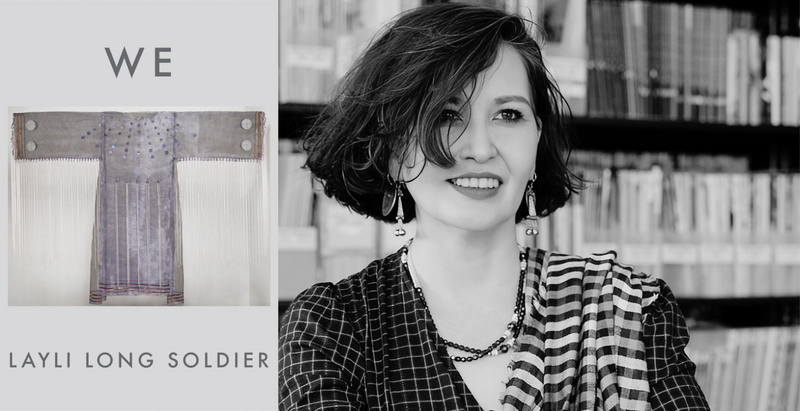
Layli Long Soldier returns to the show to discuss her latest remarkable poetry collection We (and/or Wé). We talk about these two connotations of we/wé, the questions of address, audience, identity and kinship implicit in them both. We explore the many visual art installations documented within We and how they intersect with both poetry and community. We explore what it means to treat a poem, not yet finished, as having its own desires and needs different than yours. And we look at language and the law, navigating thorny questions of language as a tool and as a weapon when it comes to treaties, to Land Back, and Layli’s art and writing practice engaging with it all.
If you enjoy today’s conversation consider joining the Between the Covers community as a listener-supporter. One of the many things you can choose from when you do is access to the bonus audio archive with contributions from many past guests including: Layli Long Soldier, Leanne Betasamosake Simpson, Dionne Brand, Arthur Sze, Ada Limón, Omar El Akkad, Danez Smith, Christina Sharpe, Alice Oswald and many others. Find out more at the show’s Patreon page.
Finally, here is the episode-specific BookShop for today’s conversation with Layli. And for your general book shopping needs, don’t miss Milkweed Editions BookShop as well.
Transcript
David Naimon: Today's episode is brought to you by Nicholas Triolo's The Way Around: Walking a Reimagined Path. Winner of the Reading the West Award, The Way Around models what it means to experience a true revolution of heart and home for the flourishing of all. While traveling around the world, it was in Kathmandu that Triolo first encountered kora, a form of moving prayer in which pilgrims walk in circles around a sacred site or object—a kind of “ritualized remembering” birthed by place. Unable to shake this initial encounter with circumambulation, he sets out here on three such extended walks. The Way Around chronicles several journeys taking Triolo from California to Tibet to Montana. Robert Macfarlane calls this memoir smart, funny, wise of mind, and vast of heart. Published by Milkweed Editions, The Way Around is available wherever books are sold. Today's conversation continues a remarkable stretch for me this year of guests returning to the show after an unusually long stretch of time. First, with Valeria Luiselli after 11 years. Then Claudia Rankine after 12. And then China Miéville who was actually the fourth person I ever interviewed, coming back after 15 years. All three of the original conversations were remarkable, but there was such satisfaction to account for the passage of time together in all three of these new conversations. The wait made their returns that much sweeter, and I think it made the conversations that much deeper, as our second conversation spoke both back across time and forward into the future. This is also true about today's guest, Layli Long Soldier, who was last on the show eight years ago now for one of my most cherished poetry collections, "Whereas." If Layli never wrote another book of poetry, it feels like she has already changed the canon in a big way. That first conversation sits on my Mount Olympus in the topography of my poetry brain. I have to confess that I didn't expect Layli's new collection to rival "Whereas" in impact and power. I didn't see how it could, and it seemed like an unreasonable expectation. But her new collection, "We or Wé," it has. It is an incredible achievement. You can feel how time—the nine years between the two collections—was an important part of making a book like this possible and so improbably resonant. I'm really excited to share today's conversation with Layli, one we recorded just a day after the announcement that she had won the MacArthur Genius Grant. For the Bonus Audio Archive, I'm going to re-up what Layli contributed after our first conversation. The reading of a long poem of hers, written after Whereas, called King, a poem that is not collected in either of these books. Much as the resource email from our first conversation was chock full of incredible material, this one is as well. You can find out about it all, the supporter emails, access to the Bonus Audio Archive, and more, at the show's Patreon page at patreon.com/betweenthecovers. Now for today's conversation with none other than Layli Long Soldier.
[Music]
David Naimon: Good morning and welcome to Between the Covers. I'm David Naimon, your host. Today's guest, poet and visual artist Layli Long Soldier, holds a BFA from the Institute of American Indian Arts and an MFA from Bard College. She was first on the show eight years ago now, to discuss her landmark poetry collection, Whereas, a book that has, much like Claudia Rankine's Citizen, Solmaz Sharif's Look, and Natalie Diaz's Postcolonial Love Poem, endured as a touchstone of 21st-century poetry. A finalist for the National Book Award, Whereas won the PEN/Jean Stein Book Award and the National Book Critics Circle Award for poetry. The judges for the latter cited it as follows: How not to write what has been omitted. "I have often crouched in footnote or blazing in title. Where in the body do I begin? she asks. This question opens into a book whose wildly inventive forms include narrative lyrics, cartographic explorations, prose poems, and bilingual lexicon. Long Soldier's verses braid landscape, identity, loss, motherhood, history, and oppression. Long Soldier's movement between collective and personal makes this book intimate and urgent. She uncharted new ways to write in what's left out. Whereas offers a powerful reckoning." Jesmyn Ward adds, "Whereas made me recommit to writing... and made me believe again in the power of writing and the truths that it can reveal for people and what that remembering and honoring the truth can do for the individual, but also for the group, for all of us." While working on Whereas, Layli had garnered a Lannan Fellowship for Poetry, a National Artist Fellowship from the Native Arts and Culture Foundation, and the 2016 Whiting Award. Both before its publication and ever since, Layli has been creating visual art, whether in parallel to or explicitly intersecting with her practice of language making. Around the time of Whereas, she installed her star quilt exhibition of visual poetry, Obligations, at the Lakota-centric Arts Space Racing Magpie in South Dakota. Since then, she's been involved in many visual arts projects, including two large-scale sculptures for Tinworks Arts in Bozeman, Montana, one called Day Poem: Sun Mirrors, featuring lines from her Night Poems and Day Poems series, and the second made from a repurposed light cabinet from an old RV park called I Don't Trust Nobody But the Land, which itself repurposes this line from her poem Steady Summer. Or her lecture on buffalo-hide painting for the Dia Art Foundation in engagement with Duane Linklater's buffalo-centric exhibition of sculpture, music, and dance called 12 Plus 2. Long Soldier's engagement with the visual and spatial has inspired many other artists, including the Mississippi Choctaw and Cherokee painter and sculptor Jeffrey Gibson, whose 2024 Venice Biennale installation took its title, The Space in Which to Place Me, from Long Soldier's poem, Ȟe Sápa. Layli's poetry and narration is also featured in the Emmy Award-winning documentary, Lakota Nation vs. the United States. Just yesterday, we learned that she was named a 2026 MacArthur Foundation Genius Grant recipient. We welcome Layli back to the show to discuss her first poetry collection since Whereas, her new book, already long-listed for the National Book Award, called We (and/or Wé). Here are our thoughts on this collection from two past guests of the show. Poet Diana Khoi Nguyen says of it, "We is an astonishing anti-treatise treatise brim with tenderness, community, and collaboration. . . . Language is Long Soldier’s reparative instrument, and she, our guiding constellation to turn to as we navigate the turbulent past and present. . . . This is a sky-breaking magnum opus." Finally, Claudia Rankine says, "With brilliant linguistic acrobatics and in kinship with family and community, the lyric-essay-artwork-memoir We . . . is one of the most generous and open reading experiences I have yet encountered. One can only have gratitude for language’s possibilities in the hands of this extraordinary poet." Welcome back to Between the Covers, Layli Long Soldier.
Layli Long Soldier: Thank you.
DN: When you announced this book was coming out last year on Facebook, I commented there that you actually already knew the title back in 2018 when we talked for Whereas. You were surprised that it existed already as the frame for the book even back then. But before we talk about the title, I was hoping we could hear the first page of the book called An Invitation.
[Layli Long Soldier reads an excerpt from We]
DN: I have a question for you about this invitation, but in the spirit of the notion of we, I'm going to invite another to ask a question about an invitation with me. It isn't the same question as mine, but both are about what we just heard you read. What I love about reading this book is that as we progress through it, the notions we have of both of these words, we and wé, they become more complicated. The boundaries and differences become less delimited and less bordered, I think, as we progress through the book. I think about how Claudia, in her blurb, calls this book one of the most generous and open reading experiences. I think this idea of an open reading experience echoes something that the Native Arts and Culture Foundation said when you received a fellowship over a decade ago, when they said, "In her writing, Long Soldier emphasizes possibility, not closure." So even as an invitation establishes the terms of the book or the elements that make the book, my part of this question would be to ask you to say more about the possibilities or the open space between these two connotations of we and wé. Along with that, we have a question for you from Claudia Rankine, who really needs no introduction. She first came on the show 12 years ago for Citizen. Earlier this summer, she returned for a really unforgettable discussion of her newest and my favorite of her books, Triage. So here's Claudia's part of our shared question about an invitation.
Claudia Rankine: Layli, I love when something I have been waiting for arrives, and it is more than I could have imagined. Congratulations on We, and thank you for this light in the night. I was considering saying light in the dark, but I like better your notion of the night as an agreement we traverse together. Because David has invited me to ask you a question, and you begin We with an invitation, I thought I might invite you to consider the role of invitations in We. I love that placing a stress on the E in We brings to the surface blood, ancestry, slaughter, and life. All the things, all the X's and yeses and refusals that create or prevent the formation of a We. But what do you think, my friend, whom I hope to see soon?
LLS: One of the first things that came to mind, which is outside of this book, but when I think about invitations, I think about a little experience I had when I was younger, and I was dating someone. I'm sorry to get so personal, [laughter] but I remember when I was young, I used to always think, "Okay, it's up to the person I'm dating, the man." I had these ideas about roles, and it's up to the man to ask me to do things or to make the first invitation or gesture. So I had been dating someone for a while. One day he said to me, "It's nice to be invited to do things. Sometimes I would like to be invited." [laughter]
DN: That's very sweet.
LLS: It was such an eye-opening moment that I had been walking through this world with certain ideas about roles, about who does the inviting, who does the accepting. I had these very rigid lines in my head, these parameters and rules I had to follow. But it was so nice to hear that, because it was very freeing, not just for him to say, "Hey, I would like you to make the first step sometimes," but it was freeing for me. Then it made me think a lot about what it means to be invited to do something. And it is, it's a really wonderful experience when someone invites you, because I think it creates a sense of inclusion. And I think that's really the point of that opening page in the book, to include readers, to invite them to interact with the title of the book so they can choose to put an accent mark over the E or leave it as is, so there's a collaboration in the experience together. So that's in answer to the first page, you know, the intention. But then I think Claudia is on to something, and I just want to say thank you to Claudia because that was so kind, [chuckles] what she said. So thank you, Claudia. But throughout the book then I feel in sometimes not such explicit ways, there are still moments of invitation throughout. For example, I have an essay, "Now, You Will Listen," where I talk about an experience that my kid had in their school, where I went to their class and I gave a presentation on the boarding school era and some of the things that have happened in the Native community to help the non-Native students there understand a bit more of the history that their classmates, their Native classmates are carrying with them. You know, they're born into this understanding and knowledge through their families and they come into the classrooms and not all of the other students know this. They don't understand the context for some of their strong reactions to certain language, for example. So I went in and I gave a presentation. There are a few things in that essay, for example, that I think are invitations, not just to the students that I was giving this presentation to, but also to the readers as I'm providing this account of that lecture. But one of those things is, for example, I talked about how anyone living on this land is a treaty inheritor. So it's to say that we are all a part of this. Those agreements, those historical agreements, those legal agreements are something that involves all of us. So I wanted the students to understand that it's not just the concern of Native people alone. I'm trying to think. I had one other place in the book that I felt was also a kind of invitation, although I don't name it as such. But it's a moment where I'm quoting Faith Spotted Eagle, one of her videos. There's a short transcription from this video where she's talking about the need to share our perspectives and our stories, like for Native people, but also for non-Native people to be able to hear those stories, like what that's all about. That really, essentially, it's not about guilt or shame. That's what I took from it because guilt and shame usually don't create good relations, right? So ultimately, that's the hope is that we can come to a way of understanding each other. So I wanted to just read what she said, her words, and how I see that also as an invitation that's embedded within the text. So Faith Spotted Eagle says, "When we talk about these losses and these traumas, it's important, since the student body that will be watching this is Native and non-Native, it's important that when we talk about this, it is not to impart a sense of guilt. It's to impart a sense of freedom from denial. When you look at that trauma response, the Native people's objective is to heal. The non-Native people's objective is to come out of denial. And when these folks can come out of denial, and these ones can start to heal, then they can start to come together on common ground." So, yeah, I just felt like that was also another moment where it's like, it's us, it's we, we're all together thinking about these things.
DN: I think this is a perfect moment for the next question, which is another shared question. I think that it might deepen what you're just talking about. It's very interesting to having this invitation that is an invitation to enter the book at any point in two different ways. It's two different invitations, and the invitations aren't both necessarily to the same people. So this is another "we" question, a two-person question. It's also not the same, but it does share a lot of elements and I think harmonizes. And my part of the question is, a couple of years ago, you were in conversation with two other writers that I love and whose conversations on the show are highlights for me. That's Madeleine Thien and Adania Shibli. Thinking how the title of your book is about how we address people and who we are addressing, and also, I think by extension, about audience and also about community, I think of a question that Maddie asked to you and to Adania in that conversation, because both of your books had come out a while previously to this conversation. She asked you and Adania to reflect on your last books and your relationship to them from the vantage point of the present moment, which was at that point many years removed from publication date. Adania spoke about how she has always had a fraught relationship with explaining things, that when she tries to explain something, she often destroys the thing explained, and that this failure of explaining and also her refusal to explain in the face of people who, in her mind, narrativize and explain too well, this is the beginning of writing for her. You at the same time speaking about Whereas, which at that point came out seven years before, but which even then you were still frequently requested to do public events around, you said that your work has shifted to being more about community rather than outward-focused. That when you were reading from Whereas now, it can be tiring because of all the explaining and the contextualizing that necessarily comes with it. But in contrast, the work you were doing within your own community wasn't like this. So thinking about your work over the last nine years that is faced inward toward those you share kinship with, I wonder how that work relates to this new book because the new book engages with many of your visual art installations over that time. So I could imagine, on the one hand, the possibility that what was once inward is now becoming outward-facing. But I also could imagine perhaps the community-facing work you referred to when you were talking to Maddie remains that way. That this is something different than that community work. So holding that in mind, my part of the question, our second voice in this question is that of the Lakota multidisciplinary artist, Dyani White Hawk. Her work is in the collections of the Guggenheim, the Museum of Modern Art, the Whitney, the Smithsonian National Museum of the American Indian, and many others. Like you, she's a recipient of the MacArthur Genius Grant. She recently had a retrospective of her work at the Walker Art Center called Love Language. So here's a question for you from Dyani.
Dyani White Hawk: Hi, my name is Dyani White Hawk. I am Sicangu Lakota and a visual artist based in Minneapolis, Minnesota. Hi, David. Hi, Layli. There are so many questions I would have liked to have asked. I have a long list, but I've narrowed it down to one that I think would be beneficial for this particular audience. It comes from the piece within the book titled "Now, You Will Listen." There are two sentences in particular that I want to respond to. It reads, "Sometimes I think to myself, I am already so tired. Must I really explain and relive an experience to be understood? Perhaps I am hoping the effort is worth it. I am always asking, is it worth it?" There's so much weight in these two sentences. This is something that any person who comes from an oppressed community can understand. There's a tremendous effort in constantly weighing the necessity against the potential consequences of doing our best to explain or represent a feeling or a situation and the way that it affects our daily lives. Is it worth the risk of being misunderstood or not seen once again? Or at its worst, is it worth the potential violence that could be directed towards a person for speaking their truth? As Native artists who come from communal kinship systems, we're often asked about our responsibilities. We're asked about the necessity of activism within our work. We are asked about the political nature of our lives and our artistic output. I'm wondering, what might you like to share with the audience about the need for Native artists to work as educators and activists through our practices? How do you balance this necessity with your own personal drive for creative freedom? And as you think about the responsibilities and necessity for Indigenous creators to utilize their practices for education, for justice and activism, how might you think about the responsibilities of the non-Native audience members when engaging with the work of Indigenous artists?
LLS: Well, that was quite a question, and also I would like to thank Dyani, who I just adore. [laughs] And she and I have often have really long conversations about everything from A to Z, and we knew each other in undergrad.
DN: Oh.
LLS: And our kids were little ones. So we used to babysit for each other. So I've watched her practice really grow and expand over the years. So thank you, Dyani. Thank you so much for thinking about that line. I wrote that because I was thinking about that essay where I'm recounting what happened at my kid's school. It's difficult to sit down and write about something, relive all of the details, and then navigate all of the questions we may have. I don't want to throw anyone under the bus. I want to be direct, but also respectful. There are all these things I have to work through in order just to address this particular issue, which was the kind of language that was used in the classroom to describe Native people. So that's where the question came from that I was wondering, is it worth it? Because I'm tired, [laughs] and it's difficult. It's difficult to do all of that, but essentially that essay was about the young people, the students, my kid and the other Native students in the classroom. I decided it was worth it because it was for them. I wanted to acknowledge them and to acknowledge what they had gone through as an adult, as a parent, and someone who could speak about things and advocate for them in a certain way that they couldn't do themselves. So really it was for them and for our community in a sense, you know. Then of course my hope is, well, maybe other people will read that and gain something from it. You know, think twice about the language they use and think about the Native students in the classroom and so forth. So really that's the first thing. Ultimately, the answer is it was worth it because it was for them, the young ones, you know. It's so funny that Dyani would ask about this essay too, because just before, I don't know why, but just before this interview, I was texting my kid. I don't know why, but I said, Chance, do you remember when you were at that school, the school that I was writing about? Another thing had happened that wasn't in the essay, but there was one week when the Native students, and these are high schoolers, had made big posters about missing and murdered Indigenous women, sort of like public service announcements, PSAs, or things to educate and create awareness in the school. Someone, one of the students had taken a photograph, a photo of one of those posters and digitally changed it and put it on Instagram or somewhere like that and changed the language on the original poster to say something really, really horrifying, really derogatory. So Chance was one of the first students to see it and to bring it to my attention. I didn't write about that in the essay because I was also thinking about some of those students were under legal age, so I didn't want to bring all of that into the conversation, you know. But that too, just before this interview today, I said, do you remember that time? So they had posted this digitally altered poster and then other students at the school had pressed like and they were commenting on it. It was extremely hurtful, and we had just lost a relative, I think that same month in South Dakota, a young girl, a young relative, and so just the fact that they didn't realize that this is real. This is real life for us. So that was another reason there were so many other things going on at the school that I felt like it was worth it to write that essay. I also wanted to say on the role of activism, Dyani was talking about what is our responsibility and all of that. For some reason, she made me think about a student I had a few semesters ago at the Institute of American Indian Arts. He was from the Northwest, one of the tribes up there. I really loved working with him. He used to write a lot about land, also art, in the sense that he came from an artistic family. So he wrote a lot about their historical art practices and then contemporary art as well. And one day he said, "I feel like I could write about a lot of other things," he said, "but I can't seem to stop writing about these things. I can't help it." So, and I laughed and I said, "Oh, I mean, I completely understand." So maybe that's all I can say to that. I think that we all have the freedom to write about or make things. I mean, there are just so many ways to approach our artistic practice. So I am just always one to say whatever it is that continues to tap you on the shoulder or nudge you or you are up late at night thinking about, that's what we need to pursue and maybe spend time with. But I certainly couldn't make rules for anyone about what they should or should not be doing.
DN: Yeah. Well, immediately when we open the first section called Tumbleweeds, we're already in a multimodal or multi-genre space. Before we encounter any language, we first encounter image photography of you and your daughter. The images are themselves documenting visual art that you and your daughter are wearing, giant tumbleweed crowns. While the first words we encounter of yours are poetry, this section moves from poetry to prose and then back to poetry again with images interleaved between them. But before we talk about this project and the narrative that you weave as part of it, I'm hoping we could hear that first poetry section of this chapter, as I think it continues something from the question of your invitation, of this tension and this openness between we and wé.
[Layli Long Soldier reads an excerpt from We]
DN: We've been listening to Layli Long Soldier read from her newest collection, We. I really love the way this contemplates how language differentiates, whether the sky from the land or the firstborn word from the next word. Yet you seek this other power in language, the right words to connect instead of differentiate. It reminds me when I talked to Eleni Sikelianos earlier this year, whose ancestors revived the ancient Delphic festivals, and they walked around in togas in the modern Greece of the early 20th century. In discussing the dangers of trying to reclaim a mythic past to make Greece great again, she argued for a different way to look at what her lineage was doing. She talked about what are called anadromous fish, fish that return from the ocean to swim upstream against the river current to their home; the idea of not trying to erase the present, but instead to swim against the current of the times. In a way, it feels like the gesture of writing to connect when each individual word is moving towards individuation is an anadromous motion. I also think of this with your tumbleweed project. We see you and your daughter with these wonderful giant tumbleweeds branching forth upward from your heads while you're doing various things. There might be a photo of you washing the car at the Squeaky Clean Car Wash or visiting the Santa Fe obelisk both before and after it was toppled. A monument that was to honor U.S. soldiers who died "in the various battles with savage Indians." But what I love about the tumbleweeds themselves is when I think of the final lines that you just read, your pursuit of the right words to connect you and your daughter together in a line, but then the line breaks and you then consider the other relationship, the "One I most learn from," where one is capitalized. The tumbleweeds above each of you reminds me of many things. It looks like a thought bubble above each of your heads, perhaps words that are unspoken or thoughts that can't be put into words, but also because it's branching out of both of you, the idea that something else more than human is emerging. Perhaps it's even related to the "One I most learn from," with us humans as the roots of something that really isn't us. But I'd love to hear your thoughts about this project and the ways images of it and the language that accompanies the images of it are in relationship to each other.
LLS: Thank you for talking about this opening section. It's one of my favorite, but it's also one that I felt the most uncertain about because it's so personal. [laughs] So this section is dedicated to Ohitika. So my kid's name is Chance Ohitika. During COVID, as you know, it was lockdown. It was a very, very difficult time. Especially difficult, I think, for our young ones who had to go to school all day online and they couldn't socialize with their friends. They were indoors. In our case, my mom lives with us. So Chance was stuck with grandma and mom all day. [laughs] So I was trying to think of something interesting and enjoyable we could do together outside while still being safe, abiding by all of the protocol. And so I don't know why, but all of my life, like ever since I was a kid, whenever I saw tumbleweeds, I always wanted to put them on my head. I always, always imagined making a crown with them and wearing them around. I have no idea why, but because we were in COVID times, everybody was making banana bread and doing all these things, sourdough bread things that they'd always wanted to do. So for me, I had always wanted to make these tumbleweed hats. So that was really just the motivation to do something enjoyable and entertaining outside of the house with my kid. So then the accompanying pieces, as you said, there's like a poetry, but also these prose poems. Those were really to meditate on my relationship with Chance. That time we were in, which was high school, teen years, which was very different from Whereas, when I wrote a lot about Chance in Whereas, but Chance was much smaller then, you know. So then as Chance got older, that relationship really changed. So that opening poem where I start off saying I'm not afraid of being alone, it was really a way to work myself into that mental and emotional place of letting go. [laughs] It's hard. It's hard as a parent to really begin that process of seeing that they are going to be leaving soon, getting their own wings. So, yeah.
DN: It makes me think of the double movement, not only of Wé and We, but this double movement you mentioned in the language of differentiating and connecting, that we have the differentiating daughter and the mother who's moving towards keeping the continuity while also letting their daughter differentiate, perhaps. I mean, because we might at first think that shared blood means more connection and more flow. But in this section, when you and your daughter are working through stresses that are happening to her at school, she says to you, "I want you to see me for who I am, not how you want to see me. I'm different. I've always been different." At one point you say, "The younger are making the rules for us now. I must listen." And you bring up that the word for child in Lakota means holy or sacred. It's an inversion of a hierarchy. It makes me think again of anadromous fish moving against the current to honor the wisdom of children, and also of the humans being beneath the tumbleweeds. Feels like it's another inversion of hierarchy. I was also thinking in my conversation with Valeria Luiselli earlier this year, where her daughter, like yours, is a really big presence in her book. So much so that in her case, where they're actively problem-solving the book together, Valeria asks her daughter if she wants her name to be on the cover. I both wanted to hear more about reorienting yourself to the wisdom of your daughter, especially when you notice a difference between the generations, because you could have, like many parents do, insisted on the way you have lived and done things, but instead, you listen. But also more largely, I'd love to hear about how you and Chance navigated her presence within the book, deciding how much her thoughts, her life and feelings would be in it. Did it involve a lot of negotiation or trial and error? Did you have parameters? Did she have parameters? How simple or complicated was it? And what questions did you each ask as part of figuring that out about her being represented in your latest collection?
LLS: Yeah. Oh, thank you. That's such a thoughtful question. So, yeah, it is something I'm sure my experience as a parent has motivated me to really spend time thinking about the wisdom of young people. Because certainly I am always, always learning from Chance, from Ohitika. I just wanted to also mention the word is in our language, Lakota language, is Wakaneja. It actually means like sacred being. So Wakan is the root word, which means sacred. But Wakaneja, then every time you say child, you're calling them a sacred being. Thank you for bringing that up because that's also something I've really thought about a lot, how the presence of children or young people, just their presence alone, it makes us stand a little taller. A lot of times we think twice about what we're going to say. We're careful with our language. We're aware of our behavior. So it's very much like the impact of their presence on our behavior. It really is similar to any other sacred thing or sacred site. When we go to sacred places, we're very conscious of how we conduct ourselves, you know. So I feel like they have the same kind of, at least for me, influence. But yeah, speaking specifically about Chance and their presence in the book. I mean, one thing is even to refer to Chance as my daughter. It's been quite a journey with gender. Those are some of the conversations we've had at home. So I think right now where we're at, Chance is okay with any pronoun. There's a lot of fluidity in their expression of gender, masculinity, femininity. So that in itself was really quite a journey for me. The line that you quoted was from a conversation where Chance was saying, "I want you to see me as I am." I'm getting chills as I say this, you know. It was very emotional. For me to let go once again, remember I was earlier talking about invitation, all of the gendered ideas I grew up with. Same in parenting, I had all of this lens that I was looking at Chance through, these parameters and these ideas about having a "daughter" and so on. Chance was begging me to stop, to let go, let me be who I am. I had to sit with that in that poem. I had to step outside. Chance was sort of really emotional, had to go to the bathroom, was crying. I had to step outside and sit on the steps and really think about what I was doing to my kid, imposing all of these ideas and expectations around being a so-called daughter, right? And to really strip all of that away and get to the essence of being a person, a human, a soul. I feel like our soul transcends all of this and to really honor and acknowledge what my kid was saying at that time. So that was huge growth and a moment also when I was really being taught and I was learning from a young person teaching me. So I had to listen. I had to stop and listen. Yeah.
DN: That's really beautiful.
LLS: I did want to say that all of the pieces that I've written that refer to Ohitika, that I actually asked Chance or Ohitika to read those pieces before I included them in the book. That's something I try to do. I always try to make sure that people feel okay with that. And so there was even one piece in the Tumbleweeds section. I write about when I was a child that I was very quiet and that likewise my dad was very quiet as a child and so was my brother, one of my brothers. And so I was going to say that that piece was actually a letter. Originally, it was a letter that I had written to Chance. Ohitika was having all kinds of questions, reaching adolescence and so on. So I was trying to explain in this letter that sometimes the world tries to make us into something that we're not. The world expects certain things of us that are not always part of our nature, and that's okay. So that letter then I asked Chance permission, could I turn that into a prose piece for the book? And so Chance agreed and said it would be okay. But that's part of my review and writing process when it comes to family.
DN: Well, in a lecture that you gave on buffalo-hide painting, you talked about how, in older Lakota language that there wasn't a word for animal because each animal was always referred to specifically by their nations and as relatives. I think of this when I think of your relationship to your own writing as well, almost like a poem, once it has been started to be composed, becomes a separate being, a creature with its own agency. For instance, the final poem of the Tumbleweed section begins, "I learn when I type the first letter, when the poem becomes a life, a shape, a voice, an identity, it moves in its own way. I sense the mood. We hold conversations." And later in this collection, you say explicitly, "From the moment I write the first word, I view a written piece as a being with its own needs." Which makes me think perhaps like how you position yourself to your child and their generation, where their generation, you say, is making the rules, and it is your role to listen, that perhaps this is true with poetry too, the desire to recognize the poem as a relative and to listen to it. But these are my words or my imaginings of yours. Talk to us about both the relationship you have to the poems as they begin to emerge and what it means to listen to the poem as if it isn't coming from you, but in a way is speaking to you, and what the process of writing poems looks like when it's conceptualized this way or experienced this way.
LLS: Yeah, well, I think that that's really the unifying thread through all of the pieces in We or Wé in this book is this idea of relationship. And that applies both to our family, our community, but also our writing or creative work, creating a relationship. The essence is relationship. I mean, I wrote about that a little bit in Whereas, just one little line where I said Lakota. The word Lakota means friend or ally. So essentially, to say I'm Lakota person, you're always connected to someone else. When you say I'm a friend, that means, of course, you are always in relationship to another person or people, right? Or I'm an ally. I'm an ally. I'm there. I am here to offer strength and support to others, right? But the same goes, you're asking about the writing process, the same, I think, applies to that, to be a friend or an ally to whatever it is that we're making. That means listening to its needs. So I know that sounds really weird, but I'll explain it as best I can as far as my own writing process. This is something I try to share with students as well. So a lot of times when I'm starting a piece, whether it's a poem or an essay or whatever, there's an initial spark or an idea. There's a reason that I'm coming to the page. There's something that is wiggling or nudging me, as I said before, something that insists, continues to insist. So that is what I would consider the core, the essence. It's something that I try very hard to honor and protect throughout the writing process, whatever that initial spark, that spirit is, or we may go so far as to say the soul of the piece. I don't know, [laughs] but that beginning. So I try really hard to continue to come back to that. This is what I'm here for. But every other consideration, every other word, every other line that I add to the piece, I try to think, is this giving energy or is it taking energy from the work? Is it draining it or is it creating more life? Is the spark building into a fire or is the spark dying out, you know? So that's energetically something that I'm always balancing as I'm writing. But it's in consideration of the piece. I don't know any other way I'm supposed to explain it, except that along and along the piece tells me if I'm making the right moves.
DN: Is it a useful analogy to the mother-child relationship in the sense that a child comes from a mother, but might turn to the mother and say, "I want you to see me for who I am. I am different than you." Is that also true about the poem? The poem comes from a poet, but as it's coming into being, turn to the poet and say, "I am different than you. Listen to me."
LLS: Yeah. I do. I feel that strongly. I have examples. For example, when I think about that comes to mind first is I have a section in We titled Mosquitoes. And those poems are made, I consider like found poems in the sense that I'm using language from a short story by Zitkala-Ša. So it's a series of eight poems. I remember one of those poems; there are some lines in the short story, Zitkala-Ša's short story, which is titled The Widespread Enigma of Blue-Star Woman. Okay, it's a really beautiful story that I think resonates even today on issues of land, issues of identity, also resistance. So there's a paragraph in that story where one of the figures sets some documents on fire. The language is so, so amazing. Like the fire, the flames, the paper, the this, the that. I hope I'm remembering correctly. I think there was paper documents involved in that. But I do remember especially the fire. So I sat down and I was like, I really want to use this language in this piece. No matter how many times I tried, I tried, I want to say five to ten different versions, it was not going to work. That poem did not want any fire in it. [laughs] I was so disappointed because me, Layli, I wanted fire in it. So that poem was saying, "I am different than you. I'm different than you. What I want is different than what you want." So I had to step back and start from scratch and then listen and try a few other things. I finally found the language that fit. So, yeah. [chuckles]
DN: Well, I want to move to talk about one of the visual art pieces in particular. But before we do, we have a question for you about image and form. When I think of this question, which is from past guests of the show, Jake Skeets, I think of your epigraph to Whereas from our U.S. Poet Laureate, Arthur Sze, that goes, "No word has any special hierarchy over any other," which was a saying that you wrote down as a student of his in a class on deep image. And I also think of the Cherokee poet Santee Frazier when speaking about being in a class of Arthur's called The Poetic Image, where Frazier suggests that more than one generation of Institute of American Indian Arts graduates can trace their ability to construct what he calls potent word pictures to ancient Chinese and Japanese poetry, thanks to Arthur's influence. So thinking again of We and Wé, I love thinking of how the Chinese poetic relation to the image might have been a pathway for Native poets here in North America to perhaps bypass the American settler poetic tradition and lineage to find something that felt truer to the lived experience of the poets at IAIA. Image and form is not only constantly at the forefront of the reading experience of your new book, but it's contemplated within the language itself, where, for instance, you say that Diné blue corn mush and Hopi piki bread both have the same three ingredients, but they have entirely different forms. And in Artforum you speak of how you tell your students that content and form are like a bicycle: content is one wheel, form the other wheel. Jake's latest poetry collection is Horses. It's out this year from Milkweed Editions. And Billy-Ray Belcourt, another past guest of the show, says of Horses, "Skeets' use of language is so precise and considered, it makes me feel that English can be something besides what history is made of it. Horses is a lifeline thrown through an open window toward us, a stunning achievement." So here's a question for you from Jake.
Jake Skeets: Yá'át'ééh, David, and yá'át'ééh, Layli. David, thank you for having me today. Layli, congratulations on a beautiful book. I feel so lucky because I've been seeing glimmers of this work for quite some time now through the various readings and presentations that I've attended over the past few years. And during a recent virtual reading, you were searching for a poem and quickly scrolled through the Word document, and the audience got this wonderful glimpse of the shape of the book. I thought about that moment again when I encountered the opening piece, where we're invited to consider We in English alongside Wé in Lakota. As I read, I kept thinking about the shapes of letters and words. For me, the book presents a kind of orthographic and typographic map. And I'm wondering if you could talk about the shape of letters and words, and how the visual and spatial dimension of language shows up for you in your work, particularly, and a little selfishly, as I've moved into prose myself, did you feel any tension between the attention to shape and your shift into prose and the sentence?
LLS: I love Jake's question, thank you so much, Jake, about the shapes of letters and words. I can't say I'm an expert on that. I do know that there are other poets and Native poets who think very visually with regard to particular letters and so forth. I think that's so beautiful. I can't say I really think about them in that way, but I do think a lot about space. For example, the Star Quilt poems, the Obligations poems, for example, those poems came from these large 12-foot by 12-foot star quilts that I made. And the diamonds were one foot long each. I had to laser-cut the language into each of those diamonds. So one line had to fit into only that one phrase. So there was only enough space for two or three words at the most. So in that regard, I am very particular, very visual. So I'm always balancing "content" or meaning with form, with space. I have to get it down to the centimeter almost, you know. So what was the other part?
DN: Jake is in the middle of writing his first novel. And so he was also curious about contending with moving from poetry into prose, and I think the challenges that might present from moving into prose.
LLS: Yeah. I like that question too about prose. I think he was asking a bit about form or if I think about the way it looks on the page. Absolutely, I do. So very selfishly, because I studied poetry first and think about the page in the way that a poet does, I can't help but think about my essays in the same way. So they have to look nice. They have to look beautiful, [laughs] as well as have something to say. So an example is in We, there is an essay, and this actually, I have to be fair, this isn't all about looking beautiful or having beauty, but it's about how the form is working with what I have to say in the essay. So an example is I wrote an essay titled (K)Nots and Footnotes, which is a kind of legal essay where I'm looking at land diminishment over time, especially in the Northern Plains. Thinking about the treaty that we have signed and then how that land has gotten reduced and smaller and smaller over time. What's the process? So I have a dominant, the primary narrative in black text. So that's the legal narrative that runs throughout. But then the footnotes, I wanted the footnotes to have equal visual importance. So I wanted to play with the hierarchy. I wanted to give those two elements a different relationship. I know that myself, I'm guilty sometimes of skimming past footnotes. But in this case, I felt like those stories from our community, our family that are part of the footnotes, that I felt that they were just as important as the legal language and congressional acts or Supreme Court cases. I thought that they were just as important to be read. So those footnotes appear in red ink and I think the same size font, if I'm remembering correctly. So, yeah. In some cases, they are actually on the page, there's a few places where there's just a footnote on the page and there's no other text. [laughs]
DN: Well, we have another question that I think takes us another step towards your work outside of language within the book. This is from recent guests of the show, Eleni Sikelianos. Her new book, Memory Rehearsal, like yours, is full of images and also engages with craft and dance and other non-linguistic elements alongside and also within the poetry. When I think of Eleni's question, I also think of how your mother was a musician, and your father is a painter, and your first love was music. All of which, while all of it being outside of language, is also likely inside your language too. This is what the poet Phoebe Giannisi says about Eleni's latest book, "Singing at her loom like the sorceress Circe, Eleni Sikelianos weaves a spellbinding work that claims the living ghost of her poetic lineage, flowing full of her own spirit and reaching back to its source in her mythical great-grandmother, Eva Palmer Sikelianos, and the radical revival of the Delphic festivals of 1927-30. With a warp of language and a weft of memory, myth, human, animal, image, and history, this book is a magnificent, shimmering garment: polyphonic, sensorial, a sacred stitching of personal inheritance and historic past in a fiercely contemporary act." So here's a question for you from Eleni.
Eleni Sikelianos: Hello, beloved Layli. Hi, David. Thank you so much for inviting me into this conversation. And thank you, Layli, for this beautiful address to Ohitika, to your child. Thank you for the radiant structures you've built to keep Ohitika close and safe. And by extension, to keep others so too. Today I'm thinking about a few things. First, I'm thinking about silence and the time it takes, the time things take. Actually, the first thing that comes to me, and maybe David and others will hear this as they're listening, is the pause you sometimes take, Layli, before you respond, that little moment of gathering. And I'm thinking about that silence between the words and the images in your new book. There are many ways that you indicate silence or empty space for us. Sometimes you give us empty spaces for and in words. For example, we lose the letter and the word I in the beautiful Night Poems. Or you show us the nothing inside an elk's eye and presumably our eyes too, where light passes. Or you tell us the way X marks a silence like the great disruption in Lakota language, but also the way it marks in your text the breath that gives life. And as it turns out, even the X itself is absent in Lakota language. Sometimes you give us an underlined blank space where the words privacy and strength, as you put it, has to be protected. At that moment, the word has transformed itself into a crystal. And all these and many more moments that are working around silence and emptiness seem to be, at the same time, piercing the kinds of silence that harm us and shaping space for the silence, the pause in time and place that brings us back to life. I feel this happening in your new book, between language and form. So how is this a question? Can you speak about your experience working between language and the extra to language or the other than language forms in this book that bring a different kind of radiance to the page?
LLS: I really appreciate that. Thank you, Eleni. [laughs] Well, one thing I want to say is I think that maybe that's why I work visually sometimes because I feel that language cannot say everything I want to say and I need to feel, I need to touch something and I need to move my hands. I need to have an object that I have a physical relationship with that I'm sitting with, I'm looking at, I'm working with color and texture. I'm able to speak in a different way. It makes me laugh. I just suddenly thought about, sorry, this is also a personal anecdote. [laughs] But a long time ago, this was many, many years ago, I was going through a tough time. So I went to see a counselor or like a therapist, somebody to talk to, you know. He was a Native. He was also a Native. I remember one day, I was having a hard time trying to explain myself or explain whatever was on my mind. I don't even remember it this time, to be honest. [laughs] But back then, whatever it was, it was very serious and it was very upsetting. But I was having a hard time articulating whatever was bothering me. He said to me, "Have you ever been with like a grandma or a mom or an auntie?" But he's saying someone older, like a grandma, "They will just come sit next to you and they'll just hold your hand. And that's enough. You know, that's all you need. You just need someone to hold your hand and to be with you and to know that they're there as comfort. You don't need to tell them everything all the time, you know. It's enough. It's healing. It gives you courage or strength to go forward, you know." And so I don't know how that relates to this question except it does make me think sometimes of the power of silence, those pauses, the silences, not always having to articulate or explain or put everything into language, but sometimes we just need to feel something and feel something in the quiet, feel something in that power of just being together, you know.
DN: To further set the stage to talk about the non-linguistic parts of the book and about the art portrayed on the cover more specifically, I was hoping we could hear part two of the section, "Now, You Will Listen," the part called Metamorphosis, partially because people won't be able to pick this up, but when you read Metamorphosis, there are missing words where there's an underline and a blank space. There's also pages that are mainly an image with maybe just one line or two lines. Mainly what we're looking at is not words, but art being made. Could we hear Metamorphosis?
[Layli Long Soldier reads Metamorphosis from We]
DN: We've been listening to Layli Long Soldier read from her latest collection, We. Again, one thing we're missing is the collaborative experience of the images and the words which people will get to see when they follow this along with the book. But as part of talking about Carrier, the wing dress that graces your cover, whose construction you just read about for us, I wanted to hear you talk more about collaborative work, as perhaps this is what most distinguishes We from Whereas, the sheer number of other people involved in the making of these pieces. When you talked in Artforum, you said that many of the installations you engage with in We, you don't consider yourself the sole maker of. To name just a few examples, your installation A Line Through Grief actively solicits people to submit three things to balsa wood boxes, what they are grieving, questions they've asked themselves during the grieving process, and how they've dealt with the grief to offer as potential advice for others. Then you created epistolary poems from the responses. So this installation moves from a visual art installation into the minds and hearts of others, and then back again to you, and then back again to us as poetry. Another example is you engaging with the testimonies from the Wounded Knee Massacre for an exhibition, where you say that you consider the individual testimonies as collective memory. Or in the Mosquitoes section of the book, which as you've mentioned today, involves found poems made from a story by the early 20th century Dakota writer and violinist and political activist Zitkala-Ša. Even with this wing dress on the cover, outside of this book, you talk about how even before you knew what this would become, before you knew that this would be a dress, when you and your daughter were braiding and nothing more, you knew it would become something and started adding silver caps and wire to the braids in anticipation of that. This involves not just your daughter, but one of your aunts and a niece. And eventually, perhaps like the way you engage with your poems as having a desire within themselves, the dress you visualized as a person itself, a person carrying these braids back to all these boarding school children, where the first thing done to them was having their braids cut off. Lastly, I wanted to quote something you said in that Artforum interview that perhaps relates to this collaborative collective book, "The anthropologist Ella Cara Deloria wrote about something called 'social kinship,' wherein 'one’s social kin . . . would be the same as one’s friends, neighbors, and acquaintances in white society.' She argues that because the Dakota word Wacekiya translates both as 'to address a relative' and 'to pray,' the concept 'implies that in every meeting of two minds the kinship approach is imperative; it is the open sesame to any sincere exchange of sentiment between man and his neighbor or man and his God. Once the channel is clear between the two, a reciprocal trust and confidence are guaranteed.'” I'd love to hear anything about any of this. Collective art making, the Carrier wing dress, Wacekiya, and the twinning of prayer and the addressing of a relative as being contained within one word and one connotation.
LLS: Well, there's so much there and different directions to go in. I guess I'll start with the last thing that you mentioned about addressing a relative. I don't know if this answers your question, but it made me think of something that I really appreciate and makes me smile, you know. So one of my cousins, she's very conscious and diligent about trying to maintain certain manners or ways of doing things in our culture. So one of the things she insists upon with her children is that all of her kids, she makes them address their relatives, our relatives, not by their name, but by their relationship to them. So if it's an auntie, they say auntie. If it's cousin, they say cousin, so on. Then also, of course, the way that we understand family relationships is a little bit different than American ways, Western ways. Okay, I'm getting too far down a rabbit hole here, only to say that I love that. I love that she has raised her kids like that. There's a lot of other families who do that too. But there's ways in which in contemporary times, sometimes people don't always do that, you know. So they might call their cousin by their first name or they might call their uncle by their first name instead. But even myself, I have found that the difference it makes when we address each other as relatives versus using our first names or whatever. I mean, just internally how that feels, or even by our friendship names, like women, we address our women friends as mašké. So how different that feels when I call my friend mašké versus when I call them by just their name, you know, and certainly I do both all the time. I guess I'm relating to that in the sense of that double meaning of also prayer, like just the feeling is so different. So I really loved that quote by Ella Deloria, and I think I used that quote when I was writing a piece for Dyani's catalog book, Love Language. But, yeah.
DN: Oh. Well, I wanted to ask you about something around the phrase "all my relations" or "all my relatives," or actually a couple of things, because your piece within that exhibition at Racing Magpie Gallery, you title Obligations, which is the title in this book, We, also Obligations. And my first question about the word obligations is in relation to the phrase "all my relations." When I was preparing for my conversation with the Nishnaabeg writer, Leanne Betasamosake Simpson about her book Theory of Water, I was thinking at the time about the overlaps between anarchist theory and Indigenous lifeways, because both have no police, no prison, and no state. But one thing I noticed that seemed really different was the emphasis in Western anarchism on freedom and freedom from coercion. In contrast, in Leanne's book, at one point, she's relating a conversation she was having with one of her Indigenous mentors and teachers, Doug Williams, where he was asked for the Michi Saagiig Nishnaabeg understanding of the word freedom. And his response was, "Freedom from what?" And Leanne then discussed this with her friend, who also heard Doug say this, "We talked about how his response made complete sense within the world that our ancestors shared. In the absence of colonialism and in a radically egalitarian society, freedom from what exactly?" And this made me think that in the absence of colonialism, there's an understood obligation, I think, to the land, whether to its cycles and seasons or to the health of various other non-human nations and relatives, plant and animal and otherwise, that we're beholden to this in this framework. It isn't about getting free from this, about finding more time unburdened from it or putting that burden on somebody else.
LLS: Yeah.
DN: I think of the Diné Indigenous anarchist and musician, Klee Benally, who said, "Nature negates the state." But I'm not sure Western anarchism, if it were to become free of the state, would automatically or necessarily see itself as having obligations to nature in the same way that Indigenous lifeways do. I guess this is my long way to ask you [laughter] to speak about why your artistic engagement with the Lakota phrase "all my relations," why it's called Obligations. What does it mean to be in good relation? Who is included in this word relation? And what are our obligations to them in this framework? Or why does obligations come up for you to place it within this framework?
LLS: Uh-huh. Hey, this is a really good question. [laughs] I like it. In fact, I was thinking about some of this myself the other day. I think it's because I don't know what it was on social media. I came across some, I don't know, a reel or I don't know what it was, something on social media. So somebody was talking about love and family and obligations. I remember, I feel like it was somebody like a writer, somebody that we would respect what they're thinking about or writing about. But in this instance, I had to pause and I wasn't sure I agreed with them because they were proposing that if our love for someone is based on obligation, that they propose that that's not really enough. That isn't love. That isn't what love is about. I was like, "Well, I'm not sure I feel the same." And I like what you said about free from what, you know. So if we have obligations, who better to have obligations to than our relatives, our family, the people we love, and this earth that gives us so much, that sustains our life. We have an obligation to care for it. It's a responsibility. I'm here, I'm taking from you, I'm going to give back to you as well. That applies to our mother, our human mother, or our earth mother. I might also return to the beginnings of that exhibition, Mitakuye Oyasin. So it was titled Obligations and Responsibilities, Mitakuye Oyasin. The curators, Mary Bordeaux and Clementine Bordeaux, invited me to participate. They wanted to think a little deeper about that phrase, which translates to "we are all related" or "all my relatives," "all my relations." They wanted to think a little deeper because it's a phrase, Mitakuye Oyasin, that has really been appropriated and been used in many different forums. There are even sometimes politicians in like the Northern Plains who are trying to appeal to their Native electorate. Is that the word? [laughs] And they're trying to appeal to them. So they'll use that phrase, Mitakuye Oyasin, to create a quick relationship with them, and what we would call easy familiarity, or what have you. So Mary and Clementine felt like there are times when I don't think people are really understanding what Lakota people, what that philosophy is really about. It's not just to say, oh, it's so easy, we're all related. Well, if we are all related with our relatives, at least from Lakota perspective, we have responsibilities to each other. If I call you auntie, even if you're an adopted auntie, if I call you auntie, I have some responsibilities and obligations to you, you know.
DN: And our relatives in this phrase, are relatives blood relatives or is it cross blood lines and also species lines?
LLS: Yeah, absolutely, that includes all of creation. That was another part of the project, is to understand that, in Lakota view, it extends far beyond just our human relations.
DN: Well, let me ask my second Obligations question in relation to this notion of both We and Wé. Because I think of what you say in anticipation of going to speak to your daughter's class. You've mentioned this already today. After she confronted her teacher's racism in an essay, in anticipation of going to the class, you say, "I'll share a little of our history. I'll emphasize that by our history, I mean Native and non-Native. Anyone who lives on this land is a treaty inheritor, thus accountable to the methods by which this land was seized." And this feels important, that the boarding schools you engage with in Carrier, the treaty violations you engage with in other installations, or even the 38 Dakota men executed by hanging by Abraham Lincoln that you write about in Whereas, none of that is your history, but our history. We find ourselves together within this version of We. But I was curious about the other version and what's included and not included in Wé. You say in the book that the death of George Floyd hit you to your core as if "he were my brother, my blood, my wé." I love this reconsideration and also this complication of blood. Because of it, it made me wonder what your thoughts were on blood quantum, something that you don't explicitly engage with when engaging with Wé. But I think of Claudia saying earlier that this book contains blood, ancestry, slaughter, and life. I also think of my conversation with the poet Kenzie Allen, whose mother is an enrolled member of the Oneida Nation. But because of blood quantum, she herself cannot be an enrolled member, even though she has an unbroken cultural and blood relation with her own mother. What relation could be more primary and direct than that? I remember when preparing for that conversation, I was listening to different Indigenous podcasts and reading about blood quantum, how the policy was the opposite of the one-drop rule for Black Americans, where American power wanted to increase the number of people who qualified as Black and thus as slave labor, and thus the slightest amount of Black "blood" made you Black, increasing the labor pool. But blood quantum was meant to reduce the number of people who were Native, even to the point ultimately of eradication, because each Native person, in the eyes of the government, took land and resources away from the state. The less, the better. It's borne out over time in some circumstances, where some Native nations, I'll just make this up as an example, say originally you needed to have 25% Native blood to be enrolled, but the numbers of people enrolled were shrinking at such a rate that they had to do a reset where the people who were 25% are now considered to have 100%, and then going forward they would count from there with it diminishing over time. But thinking of an example like Kenzie's, where there's an unbroken chain of transmission, of relation that is actually broken by blood politics rather than brought together by blood politics, and thinking of how you feel blood, wé, with George Floyd, I wonder if wé isn't blood as we understand it, but something else. I have no idea. I'd love to hear about any of this, about a little bit more about wé, or if you have thoughts on blood quantum, I know that it's a divisive issue. Or about your history being our history. Whatever comes to mind around this side of the we-wé equation.
LLS: Yeah, I think the issue of blood quantum, I'll just say this, it's a very painful issue in our community. It's a big conversation right now, especially as the generations continue. So a lot of people are thinking about how their children or grandchildren may continue to be enrolled citizens or members of their tribes. I mean, it's a very complex issue. I'm not an expert on it, except that I know that it's hard. It hurts. It hurts. As you said, it can be really divisive sometimes. But I think essentially it's a conversation that is very alive right now. So I think a lot of communities are trying to find ways to keep their nations together and their families together. I have to have hope that we will find the solutions to that. I just say that because, like you might say, you mentioned, oh, someone can be 25%. If they drop below 25%, then they can't be enrolled. That's true in some cases. But that doesn't mean the person is only 25% Native. They could be fully from both sides, you would say, intertribal heritage. Their parents have different tribal lineage, but none of it amounts to more than 25%. So it becomes very complicated. All I can say is I remember, and I apologize, I cannot remember the speaker who said this. I remember when I was young, listening to a Native speaker, and they were saying that they felt that for Native people, we were probably the only people in this country where having children with someone was a political decision. In the sense that we had to think about all of that, like if we have a child with somebody, will our children be able to be enrolled or our grandchildren? And these are talks that we have to have with our kids, even my own kid to be aware of, it's certainly not to say, oh, don't marry outside of your tribe. We're not saying that. It's just to say this is something for you to know. So yeah, it's messy. It's hard. It brings a lot of pain. So yeah, that's all I can say about that.
DN: I should probably just add that from nation to nation, the rules are entirely different. Not all of them use blood quantum.
LLS: That's right. Yes.
DN: Well, thinking of our history and what our obligations are regarding it, I'm excited to talk about my favorite part of the book, which I've saved for last, which is your engagement with treaty language, questions of oral and written language in relation to the treaties. Also, when thinking of questions of legality, thinking about what people did or didn't know when they signed treaties. But before we do, I'd love to hear just for a moment about your enrollment in law school, both what attracted you to go, what has stayed with you from your brief time there and why it wasn't for you in the end, because I remember all of that happening, that entire story arc happening on Facebook years ago. [laughter] It features in this book, you walk us through entering law school and leaving law school.
LLS: [laughs] Yeah, well, I actually applied to law school after I started writing 184 X's. That's in my book. I started that piece at the invitation of the filmmakers of Lakota Nation vs. United States. So that film really explores our treaty agreements and land base and especially our rights to the Black Hills. So for that film, I started working with our treaty. So you would consider that kind of a documentary, a form of documentary poetics. I began to realize that there was so much that I didn't know. I mean, I could read the page, but I knew that there was language, there was terminology, and there were ways that policies were created, ways that the treaty was broken, but then the agreements were changed "lawfully" through Congress and so on, that I didn't understand. So I started thinking about my own writing practice, and I felt like I legitimately needed more knowledge about how all of these things work together, if I'm going to write in this way. Because clearly, in Whereas, I engaged with that congressional apology. So just like I talked about my student who's compelled to write about certain things, he just can't stop. It seems to be something that I always return to. I return to some of these documents and governmental documents and so on. So I decided for the sake of the work that I do that I wanted to enroll in or apply to law school. So I applied to UNM, University of New Mexico, and I got accepted. That in itself was, at the time, so exciting. [laughs] I couldn't believe it. I was just over the moon, you know. And part of that too is because I still carry this shadow side of myself from when I was young. I performed very poorly academically. So when I was young, I went to a lot of different schools. By the time I reached my junior year, I was flunking, failing everything, even PE. I just couldn't seem to perform at the level that I needed to. [laughs] So I dropped out. So I was a high school dropout and I returned to college really late, later in life. So the fact that I got accepted, I was so excited. So, yeah, I did post about it on Facebook. [laughs] It was really a wonderful moment. Then I started this semester, I was interested, obviously, in tribal law. I had one class on land and resources with a professor, Professor John LaBelle, who in the end for this book, I'm very grateful to him. He was one of the readers of (K)Nots and Footnotes, the legal essay that I wrote. So he reviewed that and helped me out with some of the sections in it. I only went a semester, as you said. Well, first of all, I didn't enroll in law school to become an attorney or a lawyer. My aims were towards strengthening my writing practice. But what happened is in the course of that semester, I reduced the number of readings that I had to travel for, because that's a big part of my practice is being able to travel and read and share my work with others. I had reduced it to just two readings that I had to leave for that semester. So I had those two readings. One day, my mom got COVID. So I had to take her to the hospital. So altogether, I had some absences, which I thought were excused, they were legitimate reasons to be gone. But one of my professors sent me an email saying if I have one more absence, he was going to drop me from the course. I remember being so upset. I felt like those were professional reasons that I was absent and I thought it would be excused. But for them, it wasn't. I was a student. I needed to be there. I needed to be in class, participate and so on. So I quickly realized with the workload and the expectations in the program at the university, that I would not be able to maintain both. I would have to put aside some of my own professional life as a writer, not just traveling, but I also have to be fair in saying it was very hard to write poetry or my creative work because of the workload at school, all of the reading and the exams. I had to go to a tutor and all this stuff. So eventually, by the end of the semester, I just knew I was not going to be able to do both. I know some people can. There's a beautiful writer, m.s. RedCherries, Michaela Red Cherries, who is a tribal attorney as well as an incredible poet. There are a lot of people who are able to somehow do both, but I knew that I would not be able to. So that's why I only did one semester. In a way, that was an interesting moment. I had to look at myself and maybe it comes from that shadow side that I mentioned of underperformance or failure as a young person that as I got older, I was always wanting to prove to myself that I could do more and I could achieve and do all these things and accomplish things. That was when I decided not to return to the next semester. It was a different kind of maturity of saying, "It's okay, you know, who I am, what I'm doing now is enough."
DN: I just have to say that I particularly love being with your legal mind as a creative writer. Your mind engaging with the legal is really thrilling. I think of the poet and ex-lawyer and past guest on the show, Monica Youn, who liked to compare poetry and the law. Her argument was that metaphor is analogical reasoning, which is also what the law is. She gives the example of the Citizens United ruling, which is composed of three metaphors. Money is speech, corporations are people, and elections are marketplaces that should go to the highest bid. But also in a similar spirit, when I think of the subtext of the treaties you engage with in this book, as well as the film Lakota Nation vs. the United States, it feels important to orient listeners to something that's in the movie, but isn't in the book explicitly, I don't think, because you're dealing with a different point in history around this, that in 1980, the U.S. Supreme Court affirmed that the government's seizure of the Black Hills violated the Fort Laramie Treaty, that the Lakota Nation "won," but nevertheless, the court wouldn't give the land back. Instead, they ordered the government to pay $100 million in damages and accumulated interest. The Lakota refused the payment, saying the Black Hills were not for sale. They demand the stolen land back, which if law and language mattered, obviously that should have been the result of this Supreme Court ruling. As of 2018, the unclaimed funds have grown to over $1 billion as the Lakota continue their efforts to regain the land itself. This isn't what you're focusing on. You're engaging with the same treaties and the same illegal theft of land, but you're doing so from the time of the signing and the circumstances of the signing. You do this in the section that you alluded to called 184 Xs, the 184 signatories who each signed this treaty with an X, people who lived in an oral language tradition, who could not read the agreement, and who could not sign their own names. In the following project in the book called Constellations, you wanted to restore each X to the name in the Lakota language, but the effort to do so turned out to be more difficult than you imagined, and you didn't do this in the end for Constellations. I was curious if you could just talk for a moment about returning to the 184 northern tribal leaders who signed the 1868 Treaty of Fort Laramie and your approaches to understanding them and honoring them and then the obstacles you encountered in trying to honor them in your work. Because if I understand correctly, those obstacles are partially obstacles of language and of transliteration and phonetics.
LLS: Correct. Yeah. Oh, well, that might take a whole hour to explain, but I'll do my best to explain. [laughs] It was quite a learning process. So when I first set out with the Constellations section, it's really a visual section where I've taken the leaders' names, the leaders who signed the treaty with an X, and I've put them in little groups or constellations, and then I made stars, star constellations on the page. So there are different colors and shapes and so on. So I wanted to do that to honor them in a way that is free from that governmental document and just remember their names. And also remember the poetry that is inside of our historical names. They're just so beautiful. But when I first set out to do that, what I wanted was to have one page with those constellations and names in English, and then an opposing page with the very same constellations, but have them appear in Lakota language, in our original language. So I was working with Rose Rosales, who works with Thunder Valley Lakota language program on Pine Ridge. I contacted her and asked if she would be interested in helping me to write those names in Lakota. At first, I think for both of us, it seemed very achievable and doable. But yes, as you mentioned, we ran into some complications. So on the original treaty, you will see a column of X's, right? Which is all the so-called signatures. On the left side of the X, there is a phonetic spelling or transliteration of their name. So what I imagine is some person sitting at a desk, taking the signatures and just jotting down phonetically what they said their name was. So that's on the left of the X and on the right is a quick translation. So what we found, what Rose found, and I'm not that good with our language. I'm a learner. But what little I know, I found the same thing, is sometimes the translation on the right side of the X did not exactly correspond to the phonetic spelling. The other complication, the other layer of this is if you go to the National Archives, then there's a transcription, where they've taken the handwritten treaty and they've typed it out. So we're dealing with all these different parts that we're trying to connect so that we have a proper Lakota spelling of the name. So just one quick example is on the transcription, there was a name that said Pretty Coon. We were sitting here like, "What is this? Does that mean raccoon? What is it?" We didn't know. So then we had to go to the original handwritten, and we could see how when they translated it on the right side of the X, those letters, those handwritten letters could be seen as C-O-O-N. But when we looked at the phonetic spelling, it seemed as if it was actually crow in Lakota language. But that phonetic spelling is so rough. All of this is online, anyone can go look at it themselves. That's only one example, but there were many where we began to find these contradictions or little difficult areas to decipher. Then we began to feel, okay, I don't want to incorrectly write one of those family names in Lakota language without being sure that the family themselves would write it this way. We didn't want to be like an authority on it. So we realized that the project would take a lot more research and time and really conversation with the descendants of those leaders to make sure that they felt good about it. But that was quite a process. Again, it's one of those things where the poem, those constellations spoke to me, spoke to us. I started out wanting one thing and I had to let it go, abandon that part of the section, the Lakota language. I also worked with an Arapaho speaker and he ran into similar difficulty. He said, "I feel like I need to talk to some of the elders and family members in order to do this correctly." If we think about we, as in terms of relationship and connection, that we really had to think about, it's not to put the project or the text or the book first, it's to put the community and the families first because ultimately it was to honor them. So we wouldn't want to mishandle any of it.
DN: It feels almost like one way you end up honoring them instead is by all the things that you do with the X. Because as you say, there's no X in the Lakota language, and yet this is what these elders are supposed to write to represent themselves. So they're using a symbol that doesn't even exist in their own speech. But you make the X so many other things, good and bad. For instance, you write, "X marks Lakota language as a living being with its own feeling. X marks our language as the most generous relative. X marks the swindling, the legalese. X marks persistent intergenerational questions that are not poetry but legitimate inquiry with concrete answers. And X marks my belief that form precedes content contrary to what some poets say." I'd love to hear about any thoughts you have about form preceding content. I'd also would simply love to hear a couple pages of the 184 X's. I was thinking page 107, 108.
LLS: So that moment in 184 X's, when I write about form preceding content, that is a moment when I do take a kind of poetic liberty, a way of thinking about things in a poetic manner, it's not something I can prove. It's something that I feel. What I was trying to say is, I think I'll read that actually. That quote comes from actually one of my favorite passages from it. And it's where I'm talking about form preceding content, but also about our language and language loss and language restoration. In 184 X's, I'm identifying that break in language transmission as coming from the boarding school era, which comes from the treaty agreement to place our children into American education institutions. So all of it is connected. But I'll read. This is page 120.
[Layli Long Soldier reads an excerpt from We]
DN: We've been listeningn to Layli Long Soldier read from Wé. Well, when we arrive at the section K(N)ots and Footnotes, it feels like that's where we really see how powerful a lawyer you would have been. You really lean into an examination of language as a colonizing method of control, and you push back against what your teacher in law school said, that law is language and the court's role is to interpret this language. You seem to instead align yourself with what one of your fellow Indigenous law school friends says in contrast: there is no law, only argument. How what is missing from these legal documents, and maybe this goes back to foreign preceding content, like the manner in which we're going to do this, because what you're investigating is the manner in which this treaty happens in the first place, because what's missing from these legal documents is a written translation of these treaties into Native languages, so we don't know what was understood. And it's here you bring this really fascinating counterexample to prove that they could have documented understanding if they had wanted to document understanding. This is the treaty between the Maori in New Zealand and the British, where the original agreement was both in English and in Maori translation, which has turned out to be really vital when it comes to questions of sovereignty disputes now, because they can refer to the original Maori language to decide whether what the Maori signed is pertinent to what's going on in the law today. I was wondering if you could just talk about the Maori translation in relation to how you relate it back to the Lakota situation.
LLS: I used their treaty and what their legal scholars, Maori scholars and attorneys were able to argue in their courts. It was that the word sovereignty, as it was understood in English, was not what was translated in the Maori version of the treaty. So that one word was a turning point for being able to restore some of their rights to land and resources and other things. So I used to work at the Indigenous Language Institute when I was young. There was a team of linguists and community language people who visited New Zealand and spent time, from here in the US, they went and spent time at Maori immersion schools. And they learned about some of these things and about the word sovereignty and how powerful that was to understand the gap between languages and how useful it was in restoring certain rights. So I brought that example into my essay. However, the thing that differentiates US treaties with the Maori treaty with the Crown is that we don't have textual translations that were signed at the same time. And this was what was interesting, again, about that essay. I started out with a different kind of ambition. My ambition, my hope at the beginning, much like Constellations, I had certain aims that I had to let go of, my aim with that essay was to find certain language or terms or phrases that could serve as a keyhole to unlocking and perhaps restoring certain claims or rights to the Black Hills or to other areas of land. If it was possible, if I could find, that was my hope, I was going to find some word that unlocked things. But in the end, what I came to and what I had to allow is I wasn't quite going to get there in one essay. But what I could do for the time being is to propose that it is through language itself. That is right now our tool. It is through language for us to refuse, to resist, and to restore some of our rights. That's what we have at hand. So it's just really to encourage our community to stay strong and to use the power of language right now.
DN: Well, that's a perfect segue to what I was hoping we would finish with. I was hoping we could do a final reading of a particularly powerful section of K(N)ots and Footnotes. I was thinking of the non-footnoted parts of page 172 and 173.
[Layli Long Soldier reads an excerpt from We]
LLS: Now, these are my words.
[Layli Long Soldier reads an excerpt from We]
DN: Thank you, Layli Long Soldier. It was a real pleasure to have you back on the show.
LLS: Oh, you're welcome. Thank you so much for having me.
DN: We've been talking today to Layli Long Soldier about her latest book, We or Wé. You've been listening to Between the Covers. I'm David Naimon, your host. Today's program was recorded at the volunteer-powered, non-commercial, listener-sponsored, full-strength, makeshift home office of me, David Naimon. If you enjoyed today's conversation, consider transforming yourself from a listener to a listener-supporter by joining the Between the Covers community. Every supporter can join our brainstorm of future guests, and every listener-supporter receives the supplementary resources with each and every conversation: the things discovered while preparing, the things we reference during the conversation, and places to explore once you're done listening. In addition, you can choose from a wide variety of other things as well, including the Bonus Audio Archive, with contributions from past guests, whether Layli reading her long poem, King, Natalie Diaz reading from Borges' Book of Imaginary Beings, or our U.S. Poet Laureate, Arthur Sze, reading from his translations from four different eras of Chinese poetry, and how each sparked a shift into a new era in his own poetic practice. Or Morgan Talty reading his essay, The Citizenship Question: We the People. Jake Skeets reading and analyzing Luci Tapahonso's poem, Hills Brothers Coffee. Elissa Washuta reading from her essay, Apocalypse Pathology. Or long-form translator conversations, such as those with the translators of Hélène Cixous, Jenny Erpenbeck, and Georgi Gospodinov, craft talks by Marlon James and Jeannie Vanasco, songs by Adrienne Maree Brown and Leanne Betasamosake Simpson, and much more. Or perhaps you want to subscribe as a Milkweed Early Reader, receiving 12 books over the course of a year before they're available to the general public. You can check it all out, these options and much more, at patreon.com/betweenthecovers. Or if you prefer a one-time donation, you can do so by PayPal at milkweed.org/podcastsupport. Today's episode is brought to you in part by acclaimed poet and scholar Rajiv Mohabir's Banbas/Exile, a brilliantly crafted retelling of the ancient Ramayan that valorizes the epic poem's queer heart. Mohabir first learned of the Ramayan from his grandmother while sitting on his parents' round-tiled porch surrounded by the scrub forest of central Florida. Here, in a singular gesture of deeply layered translation, this ember of song is passed along again, with Creole, Caribbean, Hindustani, and the King's English on his own decolonized terms, Mohabir reimagines the Ramayan anew. "Mohabir's Banbas Exile is a book of insistent and essential jewels," writes Victoria Chang. Published by Milkweed Editions, Banbas/Exile is available at milkweed.org. I'd like to thank the Milkweed team, particularly Claire Barnes and Craig Popelars for everything they're doing to make this partnership a reality. Finally, I'd like to thank past Between the Covers guest, poet, musician, teacher, composer, performer, and much more, Alicia Jo Rabins, for making the intro and outro for the show. You can find out more about her work, her writing, her music, her film at aliciajo.com.