

Poetry
Laynie Browne : Apprentice to a Breathing Hand
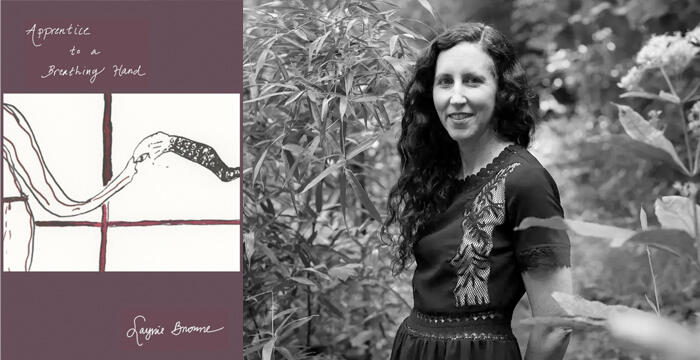
What does it mean to write toward or under the aura of another poet one admires, to write in homage, as a celebration of another? What happens to language when it hovers between two writers, between how they each separately inhabit it? What does it say about the self, or is discovered about it—within the poem and in the world at large—when that self works through a devotional practice of homage? Today we look at one of Laynie Browne’s homage books, her most recent collection Apprentice to a Breathing Hand which is in deep engagement with the poetry of Mei-Mei Berssenbrugge. Fittingly, the conversation becomes a deep exploration of both Laynie and Mei-Mei’s poetry, their animating questions and concerns, and the work that arises when their work is placed alongside, nested within, in dialogue, in this way.
For the bonus audio Laynie reads for us from another one of her homage books, this one to Alice Notley, called Everyone and Her Resemblances to demonstrate a very different aesthetic and syntactic, formal and thematic project. To learn about how to subscribe to the bonus audio archive, and the other benefits and rewards to choose from when joining the Between the Covers community, head over to the show’s Patreon page.
Finally, here is the BookShop for today.
Transcript
David Naimon: Today's episode is brought to you by PROTOCOLS: An Erasure, an urgent new work by poet and artist Daniela Naomi Molnar. Molnar's work transforms the world's most influential anti-Semitic document, The Protocols of the Elders of Zion, into an erasure poem, exploring essential questions of power, history, belief, language, and collective memory. By redacting words from the original document, Molnar has created a book-length poem that breathes space and light into a text dense with hatred. She uncovers the questions buried within the source text: "What is the true nature of power, and how is it tied to a fear of the unknown? How can language, even when weaponized and eroded, also be a tool for healing? How can silence help us reckon with history and shape the future?" PROTOCOLS: An Erasure is out now from Ayin Press. Today's episode is also brought to you by Brian Buckbee's We Should All Be Birds, a charming and moving debut memoir about how a man with a mystery illness saves a pigeon and how the pigeon saves the man. Dictated to Carol Ann Fitzgerald, an editor who channels the details of Brian's personal history to the pages, We Should All Be Birds follows the end of Brian's old life as an adventurer, an iconoclastic university instructor, and an endurance athlete through the lens of what has come to define his present, a chronic illness, and his relationship with a pigeon named Two-Step. Raw and perceptive, delirious and devastating, We Should All Be Birds is an unflinching exploration of chronic illness, grief, connection, and the spectacular beauty of the natural world. Surprising and heartwarming, the relationship between Brian and Two-Step provides readers with insight into what it means to love, to suffer, and to never forget, even for a second, how big it all is. Brian Buckbee's We Should All Be Birds is out now from Tin House. Like I mentioned at the beginning of the recent conversation with Rob Macaisa Colgate, today's conversation with Laynie Browne, like the one with Rob, feels like it breaks new ground on the show. Today we discuss how many of Laynie's books over the past 15 years are homage books written toward and under the aura of poets she loves. Today's conversation, because it is a conversation about her most recent book in homage to Mei-mei Berssenbrugge, it becomes a conversation about not just Laynie's poetry and her practice, but also about the poetry of Berssenbrugge too. One thing that makes Laynie's contribution to the bonus audio particularly revelatory is that she does an extended reading and discussion of a different homage book, the one to Alice Notley. So you really get to hear a different music, a different line, a different set of concerns in contrast to that of Laynie writing in celebration of Mei-mei. It shows you how deeply these books set their own terms and how those terms are, in some ways, set by another. There are many great contributions in the Bonus Audio Archive from great poets, whether Arthur Sze, Forrest Gander, or Jorie Graham and Alice Oswald, whether Ada Limon and Ross Gay, or Dionne Brand and Rosmarie Waldrop. The bonus audio is only one possible thing to choose from if you transform yourself from a listener to a listener-supporter by joining the Between the Covers community. You can check it all out, everything from the Tin House Early Reader subscription to the supporter resources that come with every episode, regardless of what level of support you choose, at patreon.com/betweenthecovers. Now for today's conversation with Laynie Browne.
[Intro]
David Naimon: Good morning, and welcome to Between the Covers. I'm David Naimon, your host. Today's guest, poet, writer, artist, and editor Laynie Browne earned a BA from the University of California, Berkeley, and an MFA from Brown University. She has taught at Mills College, University of Washington, at the Poetry Center at the University of Arizona, Swarthmore College, as a mentor in the Afghan Women's Writing Project, and is currently a professor of creative writing at the University of Pennsylvania. Browne is the author of four works of fiction, most recently Book of Moments and Periodic Companions, where each character corresponds to an element on the periodic table. She's the co-editor of I'll Drown My Book: Conceptual Writing by Women, which contains the writings of many of our great boundary-crossing writers, from Theresa Hak Kyung Cha to M. NourbeSe Philip, and including past Between the Covers guests Danielle Dutton, Cecilia Vicuña, Jen Bervin, Bhanu Kapil, Sawako Nakayasu, Rosmarie Waldrop, and many others. She's also the editor of Forest of Many Stems: Essays on the Poet's Novel, which includes everyone from Brandon Shimoda on Etel Adnan to C.D. Wright on Michael Ondaatje to John Keene on Fernando Pessoa. She's also an artist, and a solo exhibit of her collage work entitled On the Way to the Filmic Woods was exhibited at the Brodsky Gallery at Kelly Writer's House. Laynie Browne is probably best known, however, as a poet with innumerable collections over the past 30 years. Her 2005 collection Drawing of a Swan Before Memory garnered a Contemporary Poetry Series Award, and her 2007 The Scented Fox was selected by Alice Notley for the National Poetry Series Award. Her work has appeared in Poetry, Conjunctions, Fence, the Norton Anthology of Postmodern American Poetry, and many other places. Past Between the Covers guest C.A. Conrad has said of her work, "Laynie Browne has made me catch my breath for many years with poems that glide the occult borders of scorpions as spirit animals and other lifted veils of parallel worlds." Laynie Browne is here today to talk about her latest book of poetry, Apprentice to a Breathing Hand, from Omnidawn. Karla Kelsey says of this collection, beginning with a line from it, "The women who ask bodies to be present and constant are dancers'—a proposition suggesting that significance and signification are ever-present, awaiting the activation of attention. Lyric address to a beloved 'you,' dilated to include the fictive, the plural, and the non-human is one such activation offered by Apprentice to a Breathing Hand. Also: the release of song and chant that harbor in speech alongside the histories that shelter in etymologies. Here we learn to believe in the agency of expansion and preservation, energetic forces by which the word and its selves blossom." Brenda Coultas adds, "Browne writes the path forward in this luminous manuscript where language is alchemy, the mercury in a medium that dissolves and reconstructs the self by growing tendrils under her own banner. Apprentice to a Breathing Hand is a brilliant lyrical achievement." Welcome to Between the Covers, Laynie Browne.
Laynie Browne: Thank you so much. I'm so happy to be here.
DN: Well, before we talk about your latest book, I want to talk about several aspects of your writing and your writing life that I think are quite unique. I think by doing so, it will better ground us to approach this latest book on its own terms. One of the things I want to explore together is relation and encounter, both vertically as lineage and inheritance, and also horizontally as community and solidarity. When I spoke with Cristina Rivera Garza for the second time, we talked about her notion of returning writing to its plural origins, of making visible the debt to others inherent in our writing. I think there is something magical that happens when you take even a small step on this path, a multiplying effect where you quite quickly find yourself in a web of relation. For instance, if I talk about my relation to you, someone I've never met before today, you first reached out to me three years ago, shortly after I talked to Rosmarie Waldrop, a writer we both consider of great importance in our literary imaginaries. But my first encounter with you is before this. When I was in my first year of my MFA, I took a cross-genre, constraint-based writing class called Writing Inside the Box that was co-taught by a prose writer, Leni Zumas, and a poet, John Beer. The book you edited, I'll Drown My Book: Conceptual Writing by Women, had just come out and was one of our main texts. Later, also before you reached out, I encountered you as a guest on Brian Blanchfield's old show of poetry and music, Speedway & Swan.
LB: I forgot about that. That's great.
DN: Yeah, and I'll just say to Brian, as an aside, I have mourned your absence on the radio waves since you left.
LB: Yes.
DN: Here in this show, you and Brian celebrate innumerable poets, and you each bring poets and poems to share. So already what seems on first glance like a pretty thin and tenuous connection between us, a brief exchange of emails and nothing more, has revealed itself, I think, to be a thick network of writers that continues to sprout new nodes of connection. I want to argue that there's something about your work and your public persona in relation to it that fosters this phenomenon. As a first step into exploring that, I want to hear more about something that defines much of your work over the past 15 years, what I might call your homage books, but what you have called at different times your epistolary books or books that you've called your dedicated intentional reading practice. It began in 2010 with a book you wrote in relation to or under the aura of or in response to one of the works of Bernadette Mayer. Your book, The Desires of Letters, in relation to hers, The Desires of Mothers to Please Others in Letters. Since then, many of your books are in relation to another, whether Rosmarie Waldrop, Alice Notley, Lyn Hejinian, C.D. Wright, an as-of-yet unpublished book for Cecilia Vicuña, and more. In the broadest sense, invite us into this ongoing and ever-unfolding project. What are these homage books from your point of view?
LB: Every writer needs to find a way to continue to stay interested and engaged in a life of writing. One aspect of that is audience. So there are a lot of different ways one can think about audience, which can be challenging and disappointing. There are so many talented writers who don't have enough audience, who want attention. That never seemed like a way I wanted to live. So what I'm doing is, it's the opposite. So instead of thinking, what is the most audience a person could have—for instance, I've never been on social media—I thought about what makes this possible for me and what have I received and how can I try to make that visible and to make it not just visible, but in these relationships that I've been fortunate enough to have that are not only reading, but friendships over decades, what can I do to express my gratitude, to go back to these works that matter so much to me and to write through them? So I guess it's a strategy, a many-pronged strategy for thinking about how one can exist as a writer. I don't think that I'm new at all to this. Maybe I'm articulating it in a time that not that many people are articulating a sense of lineage in this way, but I feel like all the writers who I'm writing for, I've learned from them. I was going to say beginning with Bernadette, but I think really it began with C.D. Wright, who's the one who first introduced me to Bernadette's work. Yeah, through that, all this proliferation of friendships happened.
DN: Well, in the first paragraph of your introduction to I’ll Drown My Book, which I love, it goes as follows: “Looking for a title for this collection I turned first to the work of Bernadette Mayer, and found in her collection, The Desires of Mothers to Please Others in Letters, the title 'I’ll Drown My Book.' The process of opening Mayer to find Shakespeare reframed seems particularly fitting in the sense that conceptual writing often involves a recasting of the familiar and the found. In Mayer’s hands, the phrase 'I’ll Drown My Book' becomes an unthinkable yet necessary act. This combination of unthinkable, or illogical, and necessary, or obligatory, also speaks to ways that the writers in this collection seek to unhinge and re-examine previous assumptions about writing. Thinking and performance are not separate from process and presentation of works. If a book breathes it can also drown, and in the act of drowning is a willful attempt to create a book which can awake the unexpected—not for the sake of surprise, but because the undertaking was necessary for the writer in order to uproot, dismantle, reforge, remap or find new vantages and entrances to well trodden or well guarded territory.” I wonder if you see your relationship to Bernadette or the others you write in relationship to the way you see Bernadette in relation to Shakespeare, that you are reframing Mayer and recasting them, or perhaps the inverse of this, that you are recasting yourself within the work of Mayer. In other words, how do you see these homage books in terms of relation? Are they addresses to, explorations within, celebrations of, travelings alongside, reframings, or something else?
LB: Well, each one is a little bit different. I mean, definitely they are all celebrations of the writers and the work and hoping to bring more readership there as I write toward and for. But then there is sometimes a very specific formal relationship with a book, and sometimes not so much a formal relationship with the book. I mean, for Bernadette, for The Desires of Letters, there's a formal relationship because they're both epistolary works written during a period of time and addressed mostly to unnamed phrases. So that's clear. In the book for Rosmarie Waldrop, I wrote through every single poem in every single order. I took a phrase from every single poem. Do I even remember what I did? I think it started with that. Yeah, some of them, it's very clear, the formal relation, and some of them, like the book I wrote for Alice Notley, it's more a concept, like I'm writing to an advisor that is not human and I'm attempting to communicate with some other realm, which I associate as Alice as the poet supreme of this time that does that. I'm inspired by that, but it's not formal in the same way.
DN: Well, even just reading this paragraph from your introduction, it causes my thoughts to ramify and leap to other writers. For example, the notion of drowning a book reminds me of Bhanu Kapil burying her book in the snow over the winter and beginning again with the remnants in the spring. But this question of other-focused writing makes me curious about your notion of selfhood. Again with I’ll Drown My Book, you say, when describing the authors you have gathered there, “I would venture to say that in all of these works collective thinking is primary, reader participation is requisite, the 'I' when present is often an assemblage of voices, and process is often primary and integrative.” In your work with Essay Press called Deciduous Letters to Invisible Beloveds, you meditate on various intimate registers and versions of the second person you, including a you that is not emerged and a you that contains everything. In the book we're going to discuss, there are lines like, “Where you are inside I, an ounce in a small vial, a notion with no firm attachment to any singular person,” and “How to be multiple, dendritic, how to hear soothsayers, how to say anything transparent, wilting, essential to want, as one and separate.” I wonder if this sparks any thoughts for you about your notion of self, both in an existential sense, but also your notion of self within a poem by you?
LB: It's a great question. So I think it is a through line in my work, though my books can all be really different from each other, asking this question again and again: what is the Self? What is a Self? Not self with a lowercase s, but a self for which there really isn't adequate language, like not the ego, not the body, not what I look like, not even my thoughts in the day. But what is a changeless aspect of a person? Yeah, I'm always interested in that question, which I see as an essential question in all different mystical traditions as a basis for one's own evolution. So, in a poem, like a creative work, is one vehicle to try to explore these questions that are beyond language. So it's ironic to try to do it with language, but poetry is a medium that is another language. It exists in every language, but it also in itself is a language that is attempting something else, sometimes beyond the constraints of how we conventionally use language. So my experimentation is always with that in mind.
DN: Something about this is reminding me of one of my favorite moments when I talked with Mary Ruefle. One of the two times I talked to her, she was talking about her writing practice for a while, and then at some poin,t she interrupts herself long into the conversation and says something like, “Oh, I just need to say when I say I, I don’t mean me.”
LB: Yeah.
DN: [laughs]
LB: I mean, what is me? I don't mean personality or—yeah, something that is unnameable, unchangeable, something that persists beyond the three-dimensional world, something that we can't always have access to, yet it's easy to forget that that's even a possibility.
DN: Yeah. Well, I'm going to ask this unanswerable question in another way again.
LB: That's the best kind of question. [laughter]
DN: Because one thing that's really remarkable about you is that when I go searching online for your presence, the vast majority of things I find are Laynie Browne doing things on behalf of others in some way. You're a frequent guest on the show Poem Talk, which are these great collaborative readings of one text by another, where a small group of people are assembled to discuss this text, you and others discussing everyone from Harryette Mullen to Fanny Howe. Of course, your editing of conceptual women's writing or editing the new book on essays by poets on their favorite poet's novel should be mentioned as another example. Because your own books are largely now homage books, when you talk about them, you are talking about someone else as well. The question I asked about whether you are recasting a given author or being recast by them is, I think, a false binary, as it is, I think, really both, neither, and something that exceeds the notion of recasting altogether. But as you adopt different modes of being from one homage book to the next, whether different thematic or syntactical modes or aesthetic or philosophical ones with each different poet, I wonder what you would say remains the same across these books. I know you're identifying the I as something or the self that you're looking for as something that doesn't change. But what is that I for you? Of course, we learn something about you simply by which poets you choose. Also noticing that they are all contemporary women poets you are engaging with. But I wonder if you could articulate what else returns book to book that can't help but be Laynie Browne, even when you are writing under the aura of radically different poets with distinct aesthetic universes.
LB: Wow, I don't know if I can answer that question. I want to say something that's just too easy, like the love of language, or the use of the question, trying to push the boundaries and figure out the elasticity of any given form. So each book, there is a poetic form usually. I'm trying to see what are the edges of that. That was one of my questions around the poet's novel. But so letters, sonnets, odes, psalms. I'm sure there's more. Rondels in the book I wrote for Lyn Hejinian. So I'm always trying to do something I haven't done, and see what are the edges of it. I think part of that is this question of being in the present moment. If poetic form is a living thing, then it's not the same today than it was 100 years ago. So writers like Bernadette Mayer gave this new life to the sonnet. Now I'm trying to figure out what is the sonnet now for me. So I have been somewhat obsessed with poetic form. So that's one thing. I think this idea of thinking about language, and I don't think this is unique to me, but thinking of language as a material, as opposed to something transparent like a glass of water. So if I want to use language the way a painter would use paint or a composer would write music, so that I'm trying to get outside of an expected narrative, an expected sense of speaker. I'm trying to see what else is possible when I just have an experience of language. Again, I don't think I'm the only person doing this, but that is something that I think is throughout my work.
DN: So this is going to be my third question that's the same question, but in another way, and then we'll move on.
LB: Okay.
DN: So Rachel Zucker is doing a course on Zoom called Reading with Rachel, which I'll point supporters to in the resource email. She shared with me the two videos of your appearance as part of it. In one, you mentioned a new year-long project called Self-Portrait of Valentines to Herself, where, in contrast, in great contrast to much of your work over the last 15 years, you are now actively engaged with self-portraiture. So talk to us about the impulse toward doing this, how it's going, any surprises you've discovered through it, and anything else that comes to mind about doing an inverted project now?
LB: That's great because it's really fresh in my mind. You're right. You're absolutely right. It's totally antithetical. So the way that this started was I went to the Philadelphia Museum of Art. There was a show by a New York photographer named Melissa Shook, who in the early 70s in New York did a series of black and white self-portraits, mostly nude in her apartment, some with her young daughter. I was so moved by this sequence. It just took my breath away. I thought, "That's such a good idea. Wait, why have I, and most writers I know, especially women, don't do self-portraits in writing?" Then I thought, "That's horrible. I would never want to do that. That's the last thing in the world that I would want to do." Then I caught myself having the thought. I thought, "Oh, oh, I have to commit to this because if you want to find out who is the I, you can't just be comfortable. You have to do the thing that makes you really uncomfortable and see, "What is this repulsion to the idea of doing a self-portrait about?" So I committed to this. When I saw the show, it was early February. So I said, "I'm going to do this every day from Valentine's to Valentine's, writing and doing visual work every single day," and I did. I finished on Valentine's Day of 2025. Now I have all this material. This summer, I finished my first edit of all the writing, and it was all done in hand in notebooks. So it's about 500 pages of typed material that I've only done a cursory edit, and then thousands of photographs and then drawings and collage, and paintings also in the same notebooks. So about 10 notebooks of handwritten, and this. And one thing that was a surprise is that when I started photographing myself, I realized that my whole life, I'd been uncomfortable if I'd been photographed. I wanted a good picture, but I was always uncomfortable. But when I was photographing myself, I thought, "Oh, it's just me. I can relax." Then when I had that experience, I wanted to share it. So I started photographing other friends, mostly women poets. What I wanted to do was create that experience for them that they can have whatever photo they want. That's all about the photo they want. It's not about me, the photographer, telling them what to do. So it involved having this conversation, "What's your fantasy photograph that you've always wanted, that you've never had?" Having these conversations with close friends and then taking pictures of them and editing them. I should say, I don't have any skill. Like I've not had any training. I was just doing it on my phone. Then with the collage, I've been doing that forever, but I don't know how to draw. So my younger kid, who's an artist, said, "I'll teach you how to draw, Mom." So then we would sit together and draw each other. I got a little bit better. So now, even though the project's done, I'm playing with how do I want to present it? Then, of course, I realized it wasn't just Melissa Shook. It was Bernadette Mayer's Memory, obviously. That was also an inspiration, but it was so close to me that I didn't even see it. Although she's not photographing herself. It's not self-portrait, but it's this idea of a durational project.
DN: So there are several more elements of your writing that really stand out as unique to me, but I'm going to weave them in later as we move forward to speak about Apprentice to a Breathing Hand, an homage book to the poet Mei-mei Berssenbrugge. As a first step toward doing that, we have a question for you from Al Filreis. Filreis, among many other things, is co-founder with Charles Bernstein of PennSound, the most amazing archive of recordings of poets and a great resource for me over the years. He's publisher of Jacket2 magazine and is the host of the remarkable podcast Poem Talk, one of the most rigorous and craft-oriented poetry shows I know. So here's a question for you from Al.
Al Filreis: Laynie Browne's Apprentice to a Breathing Hand, just the title alone suggests the synesthesia that so interests Laynie. I note in the same vein that the book is dedicated to Mei-mei Berssenbrugge. So my question for Laynie is about, well, it could be about any number of the poems, but in particular "Vapor," which is near the beginning of the book, in the section of the book titled Apprentice to a Breathing Hand. This poem strikes me as Berssenbruggian, very much in the manner and in homage to Mei-mei. So my question for Laynie is, would you read the poem and talk about it in terms of Mei-mei's influence on you? I'll just point out a couple of lines that I think are particularly Mei-mei intense: "Remove the memory of silhouettes from your posture. Open your throat until your mouth swells with darkness." And "Ignore grains of sand or pollen in the back of your throat." The influence of Mei-mei in this book is spectacular. I can't wait to hear what Laynie has to say in response.
LB: That's great. It's great to hear Al's question.
DN: Do you want to read "Vapor," and then talk about the correspondence between it for you?
LB: Absolutely.
[Laynie Browne reads a poem called Vapor from Apprentice to a Breathing Hand]
DN: We've been listening to Laynie Browne read from Apprentice to a Breathing Hand.
LB: So influence of Mei-mei. I think Mei-mei's influence is in many of my books, I have to say, even before this deliberate homage. But the first thing that comes to mind is just the way that she is rooted in this sentence. Her lines are long, sometimes even to the extent that her books are printed in landscape format instead of in vertical. She has a connection to the physical world that I'm always inspired by, a close looking and consciousness in all things, communication with plants and animals and stars, these magical, mystical moments. There seem to be always these questions about the nature of human perception in her work, which is also really important to me. Trying to understand, like the line, "Lift the glass and stain the frock of your consciousness." Well, you can't stain your consciousness as if it were a garment, but it gives us an image to imagine something that isn't physical. Maybe that's one way to circle or approach these questions that are beyond the physical.
DN: Well, I want to follow up with some questions of my own that extend Al's question. But before we do, I want to play two questions for you that both relate to qualities that are apparent both in the poem you just read and the first section of your collection at large. They aren't the same question, but they could be seen as asking about the same quality in your work, but using different language. I'm not sure. So I'll play both before you answer. The first question is from the poet G.C. Waldrep, who, interestingly, when I think of Al Filreis mentioning your synesthesia, Waldrep also says about your book, "This is a book of the phenomenologies of intention as functions of the senses: the five physical senses, yes, but also the other senses that drive the self towards the 'calm words' that bracket both empathy and ephemerality." Waldrep's latest book is the 2024 collection, The Opening Ritual. Past Between the Covers guest Kaveh Akbar says of this book, "The Opening Ritual is the kind of furiously curious, unabashedly ambitious poetry book I want to show everyone to prove such books can still be written." So here's a question for you from G.C. Waldrep.
G.C. Waldrep: Hi, Laynie. This is G.C. Waldrep. I'm sorry I sound as if I'm speaking from the bottom of an ocean. Could you tell us a little bit more about the imperative, how you use it in part one of the book, the title sequence? I'm interested in your sense of the imperative as a lyric mode. Thanks.
DN: Okay, so the second part is from the poet and essayist Kate Colby. She, like you, has been on Poem Talk many times. Her upcoming book, Paradox, out later this year, asks the question, "What's changed more since I was born, the world or my perception of it?" Kristin Hersh, the songwriter and singer for Throwing Muses, says of Paradox, "The best falls from Eden tumble with a desperate love for the beast within. If the story we write on this path is funny, is wounded, is giving, is sensuous, is confused, is telling, as Kate Colby's is here, then we survive that fall with flying colors." So here's a question from Kate.
Kate Colby: Hi, Laynie. It's Kate Colby. A thing I've noticed is that many of your more recent poems take the form of to-do lists or sets of instructions. Sometimes they feel like poetic post-its on the mirror. The Translation of Lilies Back into Lists from 2002 is a whole book of numbered lists. In the poem "Coax" from Apprentice to a Breathing Hand, we have many such lines as, "Conjure milky lunar winds," "Leave your outline behind," and "Stay lost, waiting for words to come alive as they enter your mouth." I think of you as a person with an open and receptive approach to your life and days, which in many ways feels antithetical to successive list-making. But the items on these lists are vaporous and subject to interpretation. Maybe they should be understood more like prompts. Can you talk a bit about how lists function in your work?
LB: Wow, those are great questions. It's so nice to hear from Kate and G.C. So instructions, lists, I think sometimes the use of the you is a way to talk to the I that is not me. In other words, I'm not presuming to give instructions to anyone else. But like Kate said, they're not necessarily always clear or doable. But there's something about actions that can be a relief, even if they're impossible. So the list making, I'm a list maker. So I love list poems. I came up with this form for Translation of the Lilies Back into Lists because my list-making was starting to really be a problem for me. It was too much. So I thought if I could translate my to-do list every day into a poem, then at least I would still have my to-do list, but I would have something else. The way that I did that was to think about what are the thoughts and emotions surrounding any item on a list? Then that becomes the new list, not the things to do, but the thoughts that get in the way of sometimes the simplest thing on the list is the hardest to do. Why? So, trying to get underneath the unsaid impediment, whatever that is, and get it onto paper.
DN: Is there anything about the imperative and the command-like tone, like when we heard in "Vapor" and the lines from "Coax" that Kate read, which feel like they're, I don't know if they're demands necessarily, but commands perhaps?
LB: I think that instructions can be comforting because a lot of times I don't know how to proceed. I need a benevolent instruction, something concrete. I'm trying to remember where I first encountered this in the work of another poet, and I'm not remembering, but I'm always struck by that use of instructions, like translation of some task that feels nebulous and overwhelming into steps is comforting. It's a way to break things down and see what's there. But then again, because it's in the form of poetry, it might be more like a prompt, as Kate was saying, but somehow, I still find it comforting to me. So hopefully it could be useful to somebody else as well. You know, not as a demand, but as like when you don't know how to do something and you go on YouTube and you're like, "Let me find a five-minute video that will tell me how to do this thing that I don't know what to do." Then there are a hundred videos. So I guess it's funny. Maybe I'm arguing about the usefulness of poetry in that way, that it's famously not useful. But it can be useful because it's not useful. [laughter]
DN: I like that. Well, to return to Al's question about how your poetry engages with Mei-mei's, I want to ask the broader question of why you chose Mei-mei Berssenbrugge, which you've started to answer, but also why you chose the specific poem of hers that you did, Hello, the Roses, as the one you wanted an entire book-length collection to be in conversation with. A two-part poem, which is an encounter between a woman and a rose, where perception of the rose in part one, the woman's description of the rose, her "reading" of the rose swells in part two into something I think that we could call bi-directional into a communication and a more than communication, a communion, or as she describes it in the poem, the cultivation of interbeing. And much as the woman and the rose become hard to separate from each other, I now have trouble separating you from Mei-mei's poem. Under the spell of the poem, I think of each of your poet subjects in your various books, book to book, like different roses, and how the way you perceive them, the way you read these poets, becomes the way you receive them in your own writing. Before you answer my question of why Mei-mei, why this poem of Mei-mei's in specific, let's listen to a recording of her reading the poem, about seven minutes, four minutes for part one, and three minutes for part two. It is a recording from 2016 at the Dominique Lévy Gallery in New York that we can hear today, thanks to the generosity of the PennSound Archives. So here's Mei-mei Berssenbrugge.
Mei-mei Berssenbrugge: I'm going to read the title poem of this book, Hello, the Roses. It's in two parts. It's about a woman perceiving a rose, or communicating or perceiving a rose, and then the rose communicates with the woman.
[Mei-mei Berssenbrugge reads the poem Hello, the Roses]
LB: So beautiful.
DN: It's amazing. I come to visit drooping white cabbage roses at dusk. [laughs] All right, this insurmountable task before you, Laynie Browne, talk to us about, I mean, it may be self-evident why you would choose this poem on one level, hearing it, but talk to us about why this poem of Mei-mei's, why Mei-mei, why this poem has blossomed into your book as an engagement with this single poem?
LB: Well, I've always loved Mei-mei's work, all of her work. She's one of the writers who makes it possible for me to be a writer. Why this book in particular, it might be, I'm trying to remember when this book came out, it might be that this book came out when I was thinking about this project. It could have been another book, but I also do have a special affinity with plants, which is not only in this book and others of her work, but I don't know. I absolutely love it. It's just gorgeous. I mean, just starting with the title, Hello, the Roses, and the line that you just picked out of going to visit the plant at dusk, this is normal for me. Saying hello to plants and going to visit them. Maybe it's surprising to many, but I don't know. I had this realization one day when I was just walking in my neighborhood at all the beautiful trees and how I love where I live because of the beautiful trees. There are certain trees that I'm always greeting in my mind. I thought, "But what about all the other trees? How come I didn't greet every single one?" So it's impossible to talk about it without it sounding ridiculous. But if you feel it, you just feel it just how it is. So Hello, the Roses, she has me already there, but also she starts out with "my soul radially whorls out." Okay. So we've got roses and we've got the soul, which are these classic poetic images, which most living poets, they can't do anything with it. It's just completely off limits because it always falls into cliché, but not with Mei-mei. She makes it possible to read about flowers and the human soul in a way that is immediate and unique and deeply felt, but also philosophical, intellectual, visually spectacular. The quality of her voice is unparalleled by any living poet just listening to her. So, yeah, I mean, I feel like she's writing a kind of philosophy and poetry that is easier to read than philosophy, but we could spend five hours just talking about one line. Like "I'm saying physical perception is the data of my embodiment, whereas for the rose, scarlet itself is matter." We could talk about physics. We could talk about the nature of seen, seeing. We could talk about communication between humans and plants. It opens endlessly.
DN: Well, we are going to talk about a lot of these things. So that's why I wanted to put this poem here, because I feel like I wanted it to be the aura under which we discuss your book. When Poem Talk did an episode on this very poem, they unpacked the notion of interbeing as nested frames of being. For instance, they talked about how she used books on visionary plant consciousness, plant spirit healing, and the lost language of plants, and she worked sentences from them into the poem, creating a limited vocabulary from which to work. Then, in the other direction, she exploded the actual rose in the poem to the ways it evokes roses from poetry's past. From Stein's "Rose is a rose is a rose is a rose," to Blake's rose, to Mallarmé's rose, to Dante's rose, to H.D.'s rose. The heart of your book is a sequence called Euphoric Rose, where your long sequence builds on lines from Mei-mei's poem, perhaps in a similar way to what Mei-mei herself is doing by bringing in these plant texts and their language into her poem. I'd love you to read something from Euphoric Rose and talk a little bit more about the two poems, yours and hers, your sequence and her poem, and how you see them talking to each other. Let's hear a page of your sequence, Euphoric Rose.
LB: So you were speaking about how this notion of interbeing was unpacked in the Poem Talk. I just wanted to add that it also seems as if this notion of interbeing between the rose and the human in her poem, it just becomes natural. Like anything else is illusory except for the interbeing between humans, between plants, between different species, and so on. There's this aura or climate in the poems, in her poems, in which this is true, which I really appreciate.
[Laynie Browne reads from Apprentice to a Breathing Hand]
DN: We've been listening to Laynie Browne read from Apprentice to a Breathing Hand. So later in this sequence, there are lines like, "To write to and for and with and from is Euphoric Rose." And, "Illusion that anyone has written in a solitary state is forgetting plant intelligence." In a different reading from PennSound, also of Mei-mei reading the same poem, but in 2019, she prefaces the reading by saying, it is part of her ongoing exploration of communication with plants. In that spirit, this June, she was on the Poetry Magazine podcast, where she walks through her practice of writing in engagement and communication with plants. In that conversation, she says, "Every molecule of sugar on earth comes through a plant, that plants are the ultimate givers," which she calls loving. Which makes me think you are plant-like in this way. She says each plant has its own song and that it is the joy of the plant to teach a person that song. In a recent email exchange I had with her, she mentioned that her manuscript in progress is also a continuation of this plant-centric exploration. You mentioned when you were on Rachel Zucker's podcast, Commonplace, eight years ago, that you were a herbalist, which made me wonder if you had any more you wanted to say about your own engagement with plants. You said it sounded ridiculous to talk about addressing "Hello, The Roses" or "Hello, The Trees," but I recognize that in myself when you mentioned it. But are there other things more specific to plants that are involved in your practice?
LB: It's been in my daily life since I was in my early 20s. I took my first herbal medicine course. I was living in New York City. I ended up studying herbal medicine and being an apprentice to herbal teachers and learning how to make my own medicine and making it for friends and then for my family. I have a little garden. I'm not by any means any expert gardener, but I've got herbs and vegetables and flowers and some fruit trees. So it is something I think about every day. The intelligence of plants and the beauty of plants, and how we breathe with plants and our planet. Yeah, I don't know. I did start writing an herbal book that I never finished, that I should finish someday.
DN: Is it an instructional manual or a poetry book?
LB: No, it's poems. I think the reason I didn't finish it was that I learned in this tradition where you get to know every plant that you use intimately, like over a year, you get to know the plant in all the seasons, and making the medicines and so on. I only wanted to write about the plants that I felt I really knew. So that was a limited number. I couldn't do it justice, but maybe I'll, maybe I'll return to it.
DN: I hope so. As part of that Poetry Magazine podcast episode, which is part of a series they're doing right now called Wake Butterfly, she says that as you open yourself to the plant, what you imagine the plant is saying to you is what the plant is saying to you, which reminded me of when I talked to Forrest Gander. I'm not sure if it was in the conversation itself or in preparing for it, but I remember his engagement with some shamanic poets where with the right preparation, language and words, in certain circumstances, could be not merely imperfect approximations of experience, but more like a tree producing a fruit, more like a full expression of what you are, not only what you are, but where you also become a vessel for the earth speaking through you. In that spirit, I'd like to ask a couple of questions to you about writing practice and writing ritual. The first is a corollary to my question earlier about what endures as Laynie Browne as you dive under the spell of these various poets. Because I also wonder if there is any commonality and method between these homage books. You've already acknowledged no. When I look across them, my first guess would also be no. But I don't want to fully presume. But on the side of the no, for instance, I know that your book, Intaglio Daughters for Lyn Hejinian, all the titles are taken from her book, The Unfollowing, and the book is a series of rondels with the final line in each poem returning to and resounding Hejinian's language. The way your language echoes hers is often sonic and rhythmic, where, for example, "ghosts are the shadows of knowledge we crave," is echoed by you as "coaxed are the meadows of solace we engrave." This returning and resounding is meant to mimic the looping motion of grief, and both of your books are elegies. But whereas the Hejinian book seems to address her language, it feels almost like the Waldrop-centric book, In Garments Worn by Lindens, in addition to addressing her language, with your writing being appropriately for Waldrop in prose blocks, it also sometimes feels like it's addressing Rosemarie herself with lines like, "What if your books hadn't been placed in my passage? What if I didn't recognize your words, which guided me toward a latent pause? I only now begin to understand." A line that makes me think of Hélène Cixous's notion of words writing themselves, "her sentences spoke to my sentences, and in turn, I learned language was talented in itself." In contrast, as you've already said today, with Alice Notley, you wrote guided by the question, "What if one were to have a person or divine entity or being one could consult at any time and always receive an answer?" You described the experience of writing that book as receiving the work almost as a form of oracular dictation. With Cecilia Vicuña, everything arises just from the word indivisible. Nevertheless, even though I've amassed this evidence against what I'm going to ask, thinking of method, of practice, of orientation, of Mei-mei sitting before a flower to receive the communication from the flower, is there any commonality, any way of preparation when you begin a project that engages with a new writer? Is there something that you always do to put yourself in a certain state, like I imagine Mei-mei does with a rose? Or is it exactly how it looks, that each of these different projects is happening in a discrete and specific and separate way from each other?
LB: I think I know the answer to this. Just one word. Love. It's just love. It's just love of the work and love of the person and love of the person being in the world doing the work that they do as a poet and in the community, making it possible for other poets to do the work. I think it's that, I don't want to say basic because there's nothing basic about love. It sounds simple, but it's not simple. But it also is simple. It's just gratitude and love.
DN: So I want to spend some more time with writing practice and explore another aspect of your writing life that jumps out as unique, namely how prolific you are and how that happens, what practices and rituals are involved in making this happen. I know I'm not alone in this curiosity about your output, as when you were on Commonplace in 2017, Rachel Zucker asked you about this. Then again, eight years later, with Reading with Rachel, she asks you again. Both times, you sidestep this inquiry. When you were talking to her about your new self-centric project, Self-Portrait of Valentines to Herself, you mentioned that you noticed a revulsion in yourself at the idea of self-portrait. Then in response to Rachel saying that she was asking her students in Reading with Rachel to do this practice for a week, you said the internal difficulty around this self-centering practice is one particularly difficult among women, something you've echoed today. I have been presuming entirely in my imagination, I realize that perhaps this is why you dodge answering this question, because it places attention squarely on you. But I'm going to try on behalf of myself and Rachel because I think we stand in for a much larger, curious audience, that this doesn't need to be about a moment of self-aggrandizement, but rather a curiosity about method, ritual, and more. When I say you're prolific, putting aside the books you've edited and putting aside your prose, some places say that you're an author of 17 poetry collections, but the first pages of Apprentice to a Breathing Hand list 30 books by you under the poetry section of your bibliography, perhaps because it's including chapbooks and other poetry books that aren't full collections. But whether we're talking 17 or 30, it's an incredible body of work. The critic Rob McLennan even mentioned in one of his reviews of your work that he had never seen a writer have three books come out in one year, with 2023 seeing the arrival of Letters Inscribed in Snow, Practice Has No Sequel, and Intaglio Daughters. So, setting aside the wonder of this, the wow of this, I do wonder if you could pull back the process around writing practice. Do you work on more than one thing at a time? How do you keep them separate? What does a writing day look like? Do you set goals and constraints or perhaps imperative commands for yourself and more?
LB: I'm really surprised that I dodged the question. Did I really do that?
DN: I think so. You sidestepped it.
LB: Yeah. Anyway, I'm going to talk about it. But I mean, the three books coming out in one year, that's only because you never know when things are going to be published in small press publishing or when somebody is going to want a book or how long it will take them. I seem to have books often come out two or three at once. It's not because I wrote two or three books in the year right before, necessarily. But it is true that I write a lot and that a lot of people want to know how or why. Maybe I said this to Rachel, I can't remember. I mean, more isn't necessarily better. I mean, it doesn't really matter. But I have recently come to meditate on this question myself when I was doing the daily practice for the self-portrait, which is like, it's very rigorous to write and do visual thing every day. At first I thought I will do a poem, a photograph, drawing, a collage, and a painting, all of it every day. People's response was like, "How are you going to do that? That's too much." I thought, "No, I could do it." But as I got into it, it's really rigorous. You know, if you have a job, which I do, [laughter] and other responsibilities, which I do. I think it's taken me to get to this point in my life to really start to think about why I'm writing so much beyond the conscious doing it. Why do I feel that I must be always writing? Why do I feel if I'm not writing, maybe sad or something is wrong because I'm not writing? I think that it's a coping mechanism. I think that it probably arose really early in my life with reading and then writing, just like turning to books as safe space and refuge and believing some untrue, toxic messages that are in the air that have to do with productivity and worth, diligence and worth. Of course, it's all unconscious, but I have been trying to slow down how much I'm writing in recent years, not with much success, I must add, but having switched to mostly composing by hand as opposed to always writing on the computer, which I used to do, is helpful. So I've been really trying to look at that in terms of what are the demands I'm making up myself and why, you know?
DN: Do you have a regimen?
LB: Well, I like to write every day, and it's not because I want to produce a certain amount of work. It's because I have this idea that whatever you do first thing in the morning is the most important thing. It just sets up the whole day. But the problem is there are a lot of things that I want to do first thing. It takes half the day. [laughter] But if I start with writing in a notebook and reading the very first thing, when I wake up in the morning, and now like a little sketching or a collage or something, I just feel better. You know, it's like meditation practice, which I do next, the yoga and walking, and all the regimens that I have. Recently, I thought, "Why do I do all these things every day"? A lot of my friends, I think they could be annoyed that I'm doing all these healthy things every day. Like, how do you do it? I mean, I just feel I can't survive without it. I had this epiphany the other day, like, "Well, why is it do I never want to skip a day of cooking healthy food and walking in nature and doing yoga and writing in my notebook? Like, why is that?" I realized there is not a day that I don't have a body. I have a body every day. So that means that I need to do these things every day. That doesn't mean everybody needs to do them every day, but I feel more clear-headed, more generous, more focused, more able to contribute in whatever ways I do if I do this first and that doesn't mean it has to ever be a book, but I am organized and I do eventually get some of it in books. I write a lot more than I publish. I throw away a large part of it, or I just abandon it. Did I sidestep it?
DN: No, you did good. You did good. It's still mysterious, but less mysterious. It's good. Well, thinking back to G. C. Waldrep and Kate Colby's questions about address and the imperative, given how the book opens in that mode, even as it fades away as the book progresses, I think, the first lines of the book almost feel like they could be about writing practice, as Kate suggests when she says they read like prompts. For instance, "First advice, if you can't find your desk or you don't have a desk, you still have to clear debris. First, the horse's head. Then, the bird outside the frame. Then, the window. Then the one forsaken leaf, orange and desiccated, caught in an abandoned web." They read almost as if they were instructions, but there are other poems operating in a non-imperative mode with different qualities that don't feel instructional at all. But even so, I still imagine you preparing to write in these poems too, just in a less linear, more mysterious way when I read them, even as I don't think any of these are necessarily about that at all. But before I ask you some more metaphysical and even mystical questions about writing, I was hoping we could first hear examples of this other mode, and I was hoping we could hear Molten and Vivid.
LB: Great.
[Laynie Browne reads from Apprentice to a Breathing Hand]
DN: We've been listening to Laynie Browne, reading from Apprentice to a Breathing Hand. So you were in an anthology called Quo Anima: Spirituality and Innovation in Contemporary Women's Poetry. Your contribution was called Devotional Practice, Writing and Meditation, where you argue for poetry as devotional practice, that, like meditation, poetry can be a way to approach the unapproachable. I particularly like the part where you say that at one point you had thought of meditation as a means of relaxation or having a health benefit, but then you wondered, "What was the purpose of meditation beyond the intent of the I? What is the purpose of writing beyond the intent of the writer?" A lot of this essay is about meditation and poetry through a Jewish lens. It opens with epigraphs from the Kabbalah, Paul Celan, Edmond Jabès, Clarice Lispector. Even independent of this essay, I might think, in relation to your homage books, of the Jewish tradition of Hevruta, where you always do textual study in pairs, where the engagement with the texts is always relational and in conversation, that the meaning-making happens this way. But I also think of Lispector's epigraph in particular: "Everything in the world began with a yes," which feels like an incredibly Jewish line insofar as the world in the Hebrew Bible is indeed affirmed into being by speech. When I talked with Robert Macfarlane, we talked about how, with a generative orientation to speech acts rather than a descriptive orientation, words can create worlds. Something that Cecilia Vicuña and I explored in depth in our conversation, and which seems common across many Indigenous communities and also within a Jewish relationship to language. In the devotional essay, after quoting a passage about Jewish meditation on permutations of Hebrew letters, you say, "In working with words, we are working with a substance potentially primordial, something which contains all possibilities." Also, "Imagine a fish attempting to contact water. No matter which way it swims, it remains within the medium it seeks. We can think of language as a similar container, one so present we may not realize we reside within it and therefore miss many aspects of how it directs our perceptions." I love this. I love this notion that we aren't trapped within language, that it doesn't prevent us from communion with the rose, but can be the medium through which we connect. It feels alchemical and beyond understanding, and your book is, in fact, steeped in alchemy and alchemical imagery. So talk to us a little about whatever any of this sparks for you.
LB: Well, the image of alchemy or the idea of alchemy, I started with that in the epigraph for the book from Pizarnik, from her book, Diana's Tree. I just love this. I love this image of this tree that is not a tree that reminds us of a tree. In other words, the possibility for change and transformation, and alchemy as a metaphor to help think about that is definitely, as you said, present throughout the book. Thinking about writing, I never want to be prescriptive about writing, but for me, I'm always interested in this devotional path. The aspiration is to be 24/7, like whatever it is, is not separate as part of it. And being inside writing is a way to get close to that.
DN: Well, I want to mention another thing from this essay that I love, which is that contrary to Buddhist meditation and its focus on detachment, the Jewish mystical path has "an emphasis on passionate attachment characterized by a strong connection to the body and the physical world." When I talked to Madeleine Thien, whose latest book is partly about the Jewish philosopher Spinoza, I went on a little riff about what I saw as the Jewishness of Spinoza's assertion that the mind is not separable from the body, something that seems Jewish to me. He didn't associate it as such. In contrast to Descartes' notion of the mind being different entirely from it, rather than an emergent quality of it, Descartes' notion dovetailing so well with Christianity, which seems to be always moving away from the body and its sinfulness, and because of Christianity's notion of original sin, having a more vexed relationship with sex and other bodily urges, how Jews were often persecuted through the framework of being seen as trapped in the material and unable to transcend it. I suggested that a praxis that is beholden to the body, and by extension the earth, is perhaps part of the renaissance of interest in Spinoza. But thinking of a spiritual practice that is mediated through passionate attachment rather than transcendence, I do think of the way Mei-mei arrives at something beyond the self, something collective, and even cosmic, through what feels like passionate attachment to me or passionate material engagement. I think of lines in Hello, the Roses like, "I'm saying physical perception is the data of my embodiment, whereas for the rose, scarlet itself is matter." Or, "Then experience is revelation, because plants and people have in their cells particles of light that can become coherent, that radiate out physically and also with the creativity of metaphor, as in a beam of light holographically, i.e. by intuition." I love this pairing of a beam of holographic light and intuition, or elsewhere, awareness and the gesture of blossoming. Her passionate attachment reminds me also of the notion of tikkun olam, the repair of the world by the practice of seeing the hidden holiness in everything, in every physical thing. But talk to us for you about passionate attachment and if and how it relates to your poetic practice.
LB: I love that. Another line from Mei-mei's poem that I noted when we were listening: "A space opens and awareness gathers." So within being in these physical forms, creating a wakefulness or a spaciousness allows us to remember that what is material is not just material. So this notion of passionate attachment or devakut is like this focus on the present, this body, and this life, because that's what we have now. That's how we learn love, like human love, interspecies love, love for something beyond that is unnameable. So it seems like you can visualize different pathways by which this awareness could happen, either ascending up from the body into the heavens, or as some of my teachers would say, bringing down from the heavens into the body. But either way, the process is circling and renewing so that humans are remembering to connect with what is more than human. So it seems like a shame to not appreciate this body and this life and this physical world. It also seems a waste to forget that the material is not only the material. That's just an illusion.
DN: Well, your book has nothing overtly Jewish within it unless we consider the epigraph, which is the Jewish Argentinian poet you just mentioned, Pizarnik, that her words become the title of the book itself. The epigraph goes, "Waking up like a breathing hand, like a flower opening to the wind." Talk to us about how these lines of Alejandra Pizarnik find themselves in a Mei-mei-centric book and what it means to be an apprentice to a breathing hand.
LB: I just love Pizarnik's writing. This idea of the word apprentice, this idea of learning intimately with another person, I think is related to what we were just talking about with the physical body and the physical world. I had the experience of being an herbal apprentice. That's probably the only time in my life where that particular word was in what I was learning. I just loved it. I love everything about it. So this idea that one could be an apprentice to something like a hand, like the wind, a flower, is this nod to, again, just trying to remember that there is so much to learn from everything around us, including the plants, including the roses. So that's, I think, the connection there. So while it's true that in this book, Apprentice to a Breathing Hand, there's no specific reference to Jewish practice, I do have some books which more directly speak about Jewish practice. One of them is Lost Parkour Ps(alms), which is the book of Psalms, and a little chapbook called Original Presence that has artwork by Toni Simon. Then the one that's more recent is called You Envelop Me. I think it's the first book where I was really working with elegy, marking the passing of my beloved stepmother. In that book, I asked my rabbi, "What do I do? What's the Jewish practice that's going to help me?" She said, "There are these healing psalms by Rabbi Nachman of Breslov, and there are 10 of them." So I started reading those psalms every day. There's a sequence that actually the title, You Envelop Me, is from Psalms. I use a translation by Norman Fischer, which I really recommend. It's actually a Buddhist interpretation of Psalms. He's another bright light that we could talk about related to so many things we talked about today. But anyway, I go through in the title poem, each beginning with one of those healing psalms.
DN: Well, as we approach an end, I want to spend a moment with an impulse that perhaps we share, which is to engage with and celebrate poets who are our elders in a country that puts so much emphasis on the young and the new, on the debutantes, not on people who in other cultures and in other times would have been revered as the wisdom holders. Perhaps part of this focus on youth is related to our flight from the body as part of our fear and denial of death. I'm not sure. But I do think about how many of the people you've written books to and for and with and alongside while they were alive have since crossed over. C.D. Wright, Lyn Hejinian, Bernadette Mayer, Alice Notley. As wild as it is to think of now, I reached out to Toni Morrison to be on the show and to Etel Adnan, but I also think about all the people I could have reached out to during my 15 years of doing this where I can no longer do so, like W.S. Merwin or Jean Valentine or Nikki Giovanni. I think of Pierre Joris, the translator of Paul Celan. He reached out to me in 2023 to inquire about being a guest, and we began to anticipate the possibility of a future conversation together; he is now gone. I think of how important it was to Fanny Howe to have been seen the way she wanted to be in the Paris Review interview that came out just before she died earlier this summer. I think of the lines you quote in your devotional poetry essay from her poem, "Splinter": "The holes in our halos widen the higher we die." I think of Mei-mei's poem, of how the rose communicates by collapsing its boundaries while the woman widens her boundaries. Somehow, I feel like this is my passionate attachment, that if it didn't take so much time to sit with the collected works of a lifetime of living literary giants, I would do far more of these sorts of conversations. The thrill and vertigo, the sweep of history of talking to Rosmarie Waldrop and her mentioning protesting Heidegger in the 1950s in Germany, or Dionne Brand joining Grenada's revolutionary government in the 1980s. That's one part of the appeal. But part of it is honoring the accumulated wisdom of a full artistic life over time. I think also of you speaking of Lyn Hejinian's work, The Unfollowing, that she wanted every line to be as difficult to accept on the basis of the previous and subsequent lines as death is for we who are alive. You then asking, "What follows loss and rupture? What follows unfollowing?" You're seeking a form that evokes the non-sequential experience of time when mourning a loss. I also think of a conversation you had with Alice Notley in 2013, where she says, "Poetry tells me I'm dead, prose pretends I'm not. That dead is a world where boundaries are erased. That prose is society's enabler, collaborating with it in its linearity, and poems send you back into itself repeatedly." Finally, she says, "It's more as if poetry, great poetry, is the real. The real is composed of endless overlapping poems," which feels very Kabbalistic to me. The world made from and of words. I wondered if this field of associations or us speaking within the never-ending world of overlapping poems, if this brings up anything for you.
LB: Just a lot of emotion. I'm glad that you mentioned Fanny because her passing is so recent at the time that we are recording this conversation, so she's been much in my mind. And you mentioned many of the writers that I've written for, whose friendship and work have been important to me for many decades, and I wanted to add Leslie Scalapino and Hannah Weiner. It seems moments ago, right? But it's not, it's a long time ago. But I guess when I first met many of these poets, they were elder to me, but they were not elder. They were the generation, one generation older than me, but I was an infant poet, and they were pretty young, actually. [laughs] So even though I think of them as elders in terms of their wisdom, I think of them more as timeless than as older, if that makes sense.
DN: It does.
LB: But I guess that what is most striking when I think about it, and I have been thinking a lot because there's been all of these losses close together of these extraordinary poets who've made life as a poet possible, is just the extreme abundance of brilliance in which we're living, in which we've had the benefit of coexisting with these bright, bright, brilliant lights of poetry, and how fortunate that is.
DN: Well, let's go out with a final reading from The Euphoric Rose, the part of your book that most directly receives Mei-mei's words and world and spirit and returns it to us.
[Laynie Browne reads from Apprentice to a Breathing Hand]
DN: So great talking to you today, Laynie. Thank you so much.
LB: Well, I just want to say thank you. I mean, not just for this but all of your interviews, because nobody's doing what you're doing. Nobody's doing long-form literary podcasts where they're actually talking about the work. [laughter] I mean, it's really rare, and your time and attention, research is always evident, and it's always unique. Like the way you weave all these questions. Sometimes when I would be listening to episodes recently, knowing I was going to be on, I was like, "How am I going to remember?" Because it was like all these questions, you know what I mean? It's really interesting, but you could see me, I had to pause and just think, "What do I want to say?" I feel like it demands attention and engagement in a way—of you, of the guests, and of the audience. I love it. I feel like there's not enough of it, you know?
DN: Thank you.
LB: Yeah. Thank you.
DN: I've been talking today to Laynie Browne about her latest collection, Apprentice to a Breathing Hand. You've been listening to Between the Covers. I'm David Naimon, your host. Today's program was recorded at the volunteer-powered, non-commercial, listener-sponsored, full-strength, makeshift home office of me, David Naimon. If you enjoyed today's conversation, consider transforming yourself from a listener to a listener-supporter by joining the Between the Covers community. Every supporter can join our brainstorm of future guests, and every listener-supporter receives the supplementary resources with each conversation; of things I discovered while preparing, things referenced during it, and places to explore once you're done listening. Then you can choose from a variety of other things as well, including the Bonus Audio Archive, which now includes an extended reading of Laynie's poetry written under the spell of and in homage to Alice Notley. This joins many incredible contributions, whether Jen Bervin reading from the letters of Paul Celan, and then her own poetry written toward Celan, or Rosmarie Waldrop reading Edmond Jabès, the writer she was the lifelong translator of. There's also the Tin House Early Reader subscription, receiving 12 books over the course of the year, months before they're available to the general public, and much more. You can check it all out at patreon.com/betweenthecovers. Or if you prefer a one-time donation, you can do so via PayPal at tinhouse.com/support. I'd like to thank the Tin House team: Alyssa Ogie in the Book Division, Becky Kraemer in Publicity, and Lance Cleland, the Director of the summer and winter Tin House Writers Workshops. Finally, I'd like to thank past Between the Covers guest, poet, musician, composer, performer, and much more, Alicia Jo Rabins, for making the intro and outro for the show. You can find out more about her work, her writing, her music, her film, and her teaching at aliciajo.com.