


Fiction / Hybrid / Nonfiction / Poetry
Lisa Robertson : Riverwork
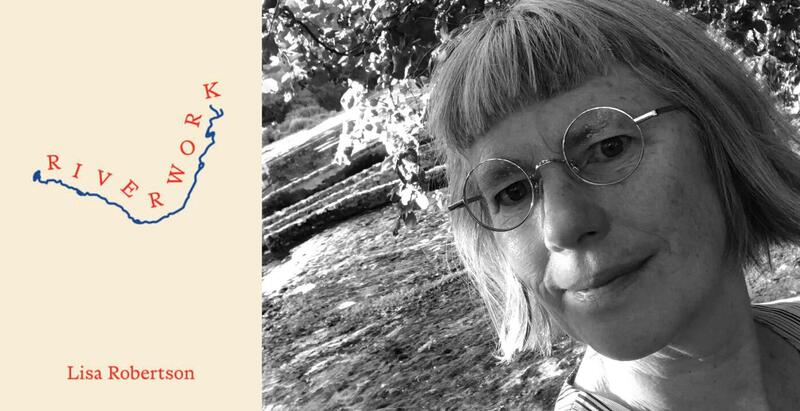
Lisa Robertson’s Riverwork twins the mysterious disappearance of the great aunt of our protagonist, Lucy Frost, and that same aunt’s interest in a long-disappeared river, buried under the streets of Paris. As Lucy searches for traces of her aunt, by attempting to inhabit and complete her work on this long-forgotten river, erased histories about both come to the surface. Today’s unforgettable conversation—whether when talking about laundry or linguistics, text or textile, dust or menses, archivists or troubadours—floods designation, spills over with newly daylighted significations.
For the bonus audio archive Lisa introduces us to and reads her translation of “Hags,” the long poem by Charles Baudelaire that is a germ for both of her novels, The Baudelaire Fractal and Riverwork. This joins many contributions from past guests including Dionne Brand, Christina Sharpe, Canisia Lubrin, Sheila Heti, Leanne Betasamosake Simpson, Bhanu Kapil, Kate Zambreno, Sofia Samatar and many more. To learn how to subscribe to the bonus audio and about the many other potential benefits and rewards of joining the Between the Covers community as a listener support, head over to the show’s Patreon page.
Finally here is the robust and wide-ranging BookShop for today’s conversation.
Transcript
David Naimon: One review that I came across after my conversation with today's guest, Lisa Robertson, a review by Claire Foster for Bookforum, describes her latest book, Riverwork, as a hymn to slowness and close reading, unknowability, imperfection, wobbly human labor, false starts, and angry love; a scream against the increasingly omnipresent, automatically generated offers to synopsize or synthesize, and therefore to strangle. It opts for excess. This characterization of Lisa's book stood out not only because it rang true, but also because it described my own hopes and aspirations for the show as a whole, where by ignoring the normative mode and length of an interview, by allowing the space to be slow, to think together in that space, to conjure a very different relationship to time, to be maximal in service of creating a little oasis or sanctuary space that moves differently than this automated summarization that happens outside of thinking that Claire's describing in her review, that's something I reach for. So it's particularly exciting to have Lisa on the show to discuss her latest book that exists in this mode, Riverwork, in relation to her life as a writer and the works that precede it. Thinking of hymns to close reading, there are certain conversations where I'm fairly confident they will become ones people listen to more than once, where they will re-read them, so to speak. The two with Jorie Graham perhaps come most to mind, but I suspect today's with Lisa will be one many of us will return to again and again and hear it again differently each time. For the Bonus Audio, Lisa introduces her translation of the long poem by Charles Baudelaire called Hags and talks about how it becomes an inspiration for both of her novels, including the one we talk about today. Then she gives an electrifying reading of it for us, one that echoes against so many of the themes we discuss during today's conversation. So be sure not to miss this if you are subscribed to the Bonus Audio. Also, as listeners who've been hearing me say this for years, while the Bonus Audio is one thing you can choose from among many when you join the Between the Covers community as a listener-supporter, one of the things every supporter is invited to do is join our collective brainstorm. Today's conversation is a prime example of how that has shaped the show, as many supporters have reached out to suggest Lisa beginning years ago now. It's thanks to the Between the Covers community that I'm presenting this unforgettable conversation today. If you want to check out all the rewards and benefits of becoming part of the Between the Covers community as a listener-supporter, you can do so by going to patreon.com/betweenthecovers. Now for today's conversation with none other than Lisa Robertson.
[Music]
David Naimon: Good morning, and welcome to Between the Covers. I'm David Naimon, your host. Today's guest is poet, essayist, translator, and, more recently, novelist Lisa Robertson. In the late '80s and '90s, Robertson was an important part of Vancouver's literary scene and culture. She left her English literature and art history studies at university to helm a bookstore, Proprioception Books, a bookstore that under her vision focused on contemporary poetry, theory, philosophy, and art criticism in downtown Vancouver. She was the poetry editor of Front Magazine, a board member at Artspeak, ran a poetry reading series at the Vancouver Art Gallery, and became part of the storied writers' collective, the Kootenay School of Writing, which, paraphrasing Rob McLennan's description of it, has since the '70s carved out a unique space in Canadian writing, both in regard to pushing writing and language to thrilling extremes and with regard to social involvement and community organization. It was one of the few Canadian writing organizations that engaged with the avant-garde of other countries as well. For the past 20 years, Robertson has lived in rural France, and her work has increasingly engaged with the literary culture and history of her second home. Lisa Robertson is the author of two books of essays, her 2003 Occasional Work and Seven Walks from the Office for Soft Architecture and her 2012 Nilling: Prose Essays on Noise, Pornography, The Codex, Melancholy, Lucretius, Folds, Cities, and Related Aporias. She's the author of nine books of poetry, including Debbie: An Epic and Lisa Robertson's Magenta Soul Whip. Publishers Weekly said of her much-cherished book, The Weather, “The fourth book from Robertson is another book-length poem and another stunning and severely rich repatterning of the mind's generally uncharted terrain.” Of her book, The Men, Hadara Bar-Nadav for the American Book Review says, “Robertson's formal investigation of the epistemology of lyric poetry mirrors the difficulty of our subjects: men, poetry, and construction of the lyric I.” In 2020, Robertson published her first novel, The Baudelaire Fractal, which was shortlisted for the Governor General's Literary Award, and which Andrea Brady for the London Review of Books described by saying, “Robertson’s work offers a philosophical defence of the girl, a celebration of the menopausal dandy, a speculative release from the constraints of gender, and a portrait of reading as drifting.” Anne Boyer declares, “As far as I'm concerned, it's already a classic.” Robertson has been a visiting poet and professor at Princeton, the University of Cambridge, and the American University of Paris, among many others. She's the inaugural winner of the C.D. Wright Award in Poetry, has an honorary doctorate in letters from Emily Carr University of Art and Design. The Los Angeles Review of Books once said about Lisa Robertson, “A new Lisa Robertson book is both a public event and a private kind of bacchanal.” So it is with great pleasure, public and private, that Lisa is here today to talk about her much-anticipated second novel, just out from Coach House Books, called Riverwork. Brad Johnson says of Riverwork, “Inject this into my bleeding veins. Lisa Robertson's follow-up to the underground classic, The Baudelaire Fractal, is nothing short of stunning. My most memorable reading, or at least remembered by me, are those works that mention or invoke, in secret or as shouts, other books. They have a way of exposing the genealogical trails, with all the resulting dead ends and diversions, that help compile a library worth its weight in words. Riverwork is as a modern examplar of such a work, and I will treasure it by following where it may yet lead.” Donna Seaman for Booklist adds, “Riverwork is an incantatory tale of water and dust, textiles and insomnia, the slipperiness of history, the shape-shifting of art and literature, the mysteries of dreams and memories, and the knottiness of time ... Robertson's mesmerizing portrait of a learned and reflective mind shimmers with striking perceptions, murmurs with loss, and whirls with ardor and moxie.” Welcome to Between the Covers, Lisa Robertson.
Lisa Robertson: Thank you, David. It's daunting to be here.
DN: [laughs] Well, I first reached out to you almost two years ago, prompted by a growing number of listeners who have been suggesting a conversation between us over the years from our collective brainstorm. When I did, I was thrilled to discover that you knew of the show and that you had listened to the first conversation with Hélène Cixous and the one with Rosmarie Waldrop, two conversations that are particularly dear to me. You were still deep in the writing of Riverwork at that time, but we placed a bookmark in 2026 to anticipate today. It's rare that I get to have so much time to get to know a writer's work. I think of the 18 months I spent with Dionne Brand's Collected Poetry before our first conversation as a similar experience for me. But beyond thanking listeners for making today happen, I wanted to just take a moment to thank all the small presses you've published with over the years that were helpful to me in the last two years, whether New Star or If I Can't Dance or Book Works or the two most significant publishers of your work, Bookhug and Riverwork's publisher, Coach House. Before I ask a question, I was hoping I could ask it in the aura of a very brief reading of yours, and I was hoping we could hear the prefatory italicized page that happens just before chapter one, spoken by our protagonist, who is speaking about and also to her great aunt.
LR: Yes, yes. This is Lucy Frost, the Riverwork narrator and protagonist.
[Lisa Robertson reads from Riverwork]
DN: So as you said, we're hearing the voice of Lucy Frost, a Canadian who moved to France 40 years previously, in her words, to search for poetry and an idea of the erotic, who now in her 60s lives a precarious existence, “quite untrained for the death march of late capital.” Her literary erotic dreams have become a somewhat aimless life as a house cleaner for academics and professors that, in a way, have passed her by in terms of the normative notions of success. That is until she begins to engage with and continue the work of a great aunt who herself had come to France long ago and yet had disappeared without a trace. An aunt who left unfinished work about a river in Paris, the Bièvre, that itself has been disappeared, has been buried and covered over a century ago. So when Lucy says in what you just read that she will finish her great aunt's book, it is the book of her disappeared aunt about a disappeared river. My first question for you might have been something like, what is the origin story of your interest in this river in particular and this framing for a book? But instead, I'll ask you to hold that in your mind in the hopes you'll answer it as part of a related question to you from someone else. This is from past Between the Covers guest Kate Briggs. Kate is who I reached out to to find out how to contact you. But beyond her connecting us, I feel like there are many connections between your work and hers. Among them, your engagements with French literary culture and thought, the feminism that undergirds your aesthetics and sensibilities, the way you both bring the margins to the center, the troubling of form by centering things that are not considered worthy of story, the foregrounding of women's maintenance labor, the bringing of elements outside of the novelistic tradition into it, your shared attention to the sentence and syntax, and more. So, in a way, listening to the conversation that I had with Kate in the archives about her book, The Long Form, I think, or I suspect, would be a great companion to our conversation today. So it seems fitting to start with Kate's question and my half-question. So here's a question for you from Kate Briggs.
Kate Briggs: Hello, Lisa. Hello, David. This is Kate speaking from Rotterdam. Thank you so much for the invitation to crash your conversation. Lisa, Riverwork, your second novel, it exists now. I'm in the slightly weird position, at least in relation to your other questioners, in that I have not yet read it. I have a copy currently speeding its way to me. I thought initially that that might or maybe should disqualify me from asking you a question in this context, but then it occurred to me that perhaps it's an interesting position to ask out from because I do have a fantasy of your novel. It has had such a strong form of existence for me for the past four years in my imagination ever since you first described the project to me: Lisa's river book, her roman-fleuve. This is the source of my question. I'd like to know what is the relation for you between that first impulse or vision or projection of this novel and the one you're now holding in your hands? It's so tempting, I always find, to remain in the space of fantasy and possibility and not risk stepping into actually writing the thing. Does the novel still hold its original impulse, its own fantasy? Or has it somehow disobeyed it or exceeded it? I'd love to know, and I can't wait to read it. This question is sent with, as I know you know, lifelong love and admiration. I'll speak to you soon.
LR: Well, that's a really beautiful surprise, to begin with Kate's warm, articulate, generous voice. We did speak together about our work on our two novels in progress, and I think of her novel in progress as being Kate's color book, as she thinks of mine as being Lisa's river book. When I began this project, I began with two parallel curiosities, questions: one having to do simply with the sight of the Bièvre River, which I had discovered in a text by Rousseau. His sixth walk in The Reveries of a Solitary Walker begins with mentioning the Bièvre, and I had never heard of it. So that's how I heard about the river and became curious about its existence, to then learn about the history of textile industry on the river and its pollution and its gradual hovering over and disappearing over the 19th century. So I didn't have a story. I had an interest in this abjected site, in parallel to a lifelong question in my mind about an actual relation of mine, an actual great-aunt who had disappeared in the way this book describes. My great-aunt was not a researcher and spent no time in Paris. So I fictionalized her life in order to bring the two questions into relationship. But I did begin with those two parallel absences, feeling that I wanted to weave a relationship between them, but not having any sense at all of a plot. For me, the problem was not so much entering into the writing of the book, as Kate suggests could be a problem. It wasn't the problem of beginning. It was more a problem of ending. I didn't stop changing the book until minutes before it went to print, as Crystal, the page designer at Coach House Books, will tell you. Now, Coach House is really unusual in many fabulous ways. One of them is that part of the business of the press is to also be a print shop. So the editorial offices are above the presses, which are on the ground floor of an actual old Coach House in an alleyway in downtown Toronto. One of the interesting things about this is, other than the fact that it makes Coach House like a 19th-century London press-
DN: I love that.
LR: Where you almost feel like you could be sleeping upstairs the way Coleridge did at his publisher's place of business. One of the interesting things about it, other than that romantic continuity, is that the editors and designers are in direct touch with the printers up until the moment of the printing. So you can intrude. [laughter] I have found ways to do that, I think, to my editor's dismay. So the hard task for me was to stop writing the book. I enjoyed the book as a movement and as a process much more than I enjoyed finalizing it as an object. That might sound overly tidy given the topic, a river, but I think that that's been the general case in most of the books I've written, that the stilling of the process has been the main problem. Before the moment of needing to end, attendant problems such as defining a structure which will hold the work together, which needs to be defined, of course, far, far before the endpoint in order to put the shape in place, that aspect has been very difficult for me in this book, Riverwork, partly because my lengthening history as a writer has not pertained so much to narrative. So narrative structure and narrative form have presented a new set of problems for me. Very often in my poetry books, I actually begin with a structural impetus. So the process has been very, very different. Because of that, extremely stimulating for me, that especially in Riverwork, a little bit also in The Baudelaire Fractal, structure has come very late in the process and is sort of hard won.
DN: Well, before we talk about Riverwork in specific, I wanted to ask about one of the connections I see between it and your work before it. If we look at Riverwork itself, there's an immense amount of doubling within it. You can say there is an echo between you and your protagonist, Lucy Frost, both Canadian expatriates in France of roughly the same age. There's, of course, a resonance between Lucy and her great-aunt, with Lucy gathering her great-aunt's unfinished materials, creating an archive, and aiming to both inhabit it and finish it. There's a doubling between her, Lucy, and the archivist who she cleans for, a woman 30 years her senior in her 90s, as both women of dramatically different class statuses are both engaging with archives. We have the doubling of the Paris above ground and the one below, not just physically but also historically: what has been physically buried, but also what history has been buried along with it. And the most prominent doubling is between the great-aunt and the river Bièvre. As Lucy tries to daylight her great-aunt, she is inevitably daylighting the story of the river. But the book is riven with many other doubles. For instance, just as one example, we hear Proust's voice preserved within the recording of his secretary, where when you listen to the recording of his secretary and she, for a moment, speaks like him, there's an homage to his voice within her voice. This doubling, I think, can be seen in many ways in your writing life. Perhaps, and this is a stretch, but perhaps even uncannily, going back to the bookstore you took over from your professor long ago. Not only taking over a bookstore and inhabiting a bookstore that someone else had started, but that the bookstore originally was created and centered on the idea of duplicating the personal library of Charles Olson. Books of yours, perhaps most notably R's Boat, reuse material from your diaries and notebooks, creating a certain double life. Many of your works feel structured around a certain mode of repetition within the language, too. Perhaps most notably, your first novel, The Baudelaire Fractal, begins with our protagonist, Hazel, waking up realizing she is the author of all of Baudelaire's work, something Baudelaire himself experienced in relationship to Poe, feeling that when he read Poe, that he was reading a text of something he himself was about to write. So this fractal or nested relationship between Hazel, Baudelaire, and Poe, and the one between you, Lucy Frost, her great-aunt, and the River Bièvre, seems to echo against the ways your completed works that you publish and the writings never meant for publication that you carry forward into them are also living double lives. So I guess, as a first step to talking about Riverwork, first talk to us about this doppelganger nature or mirrored nature of much of your writing.
LR: Honestly, I hadn't realized until listening to you right now that it was so prevalent as a continuity. Obviously, I'm very conscious of working with repetition as a structuring device, which is a way of composing that for me comes in part from my long reading of Gertrude Stein's works. Also, my close relationship with the works of Lyn Hejinian, the recently deceased California poet. Her book, My Life, which I first read probably when I was 26 or 27, in the context of a little reading group I had with other young women poets who I'd met, some of them in classes and some of them just through word of mouth, we read My Life, and I felt that my own writing life was absolutely altered and remained altered by that reading experience. One of the interesting compositional tropes in Hejinian's My Life is its almost sort of emblematic use of repetition. Certain phrases which were taken from the body of the long prose poems are pulled out to become slightly marginal subtitles within the ongoing text. It creates a formally beautiful echo chamber that also acts as a cohering force within the work. Reading Lyn gave me a different kind of access to Gertrude Stein, whose work I had been reading for several years at that point. It very quickly shifted into a turn in my own relationship to my poetry writing and became my early published work. I had been probably writing for about a decade at that point with not much personal satisfaction, but with a sense of maybe there would be future potential. Something about the Hejinian-Stein moment that arrived in my mid to late 20s caused a small revolution in my own writing practice. So the thinking of repetition as not just a formal trope, but as a psychic patterning, really, or a way of reaching towards some of the less clear activities of consciousness within language, or subconsciousness within language, became evident to me, and I began to experiment with that right away. Now I can see from what you've said that this repetition or rhyming or echoing trope that came out of my readings in modernist and avant-garde poetry has extended in a broad way through the several genres that I've worked in, which include the essay as well as the poem and the long prose narrative, the novel. So it's curious to me to have that brought forward right now. I feel like I would like to really think about it for a while. But those are the longer threads that I can bring forward.
DN: Well, there'll be many opportunities for us to rethink it because I think a lot of the questions I ask are going to also be echoes or repetitions of what other people are asking outside of the interview, within the interview. For instance, the next question for you is from the visual artist and writer Lucie Bonvalet, who also happens to be my wife. I asked her to be part of this because her family has an uncanny set of correspondences with your book. One correspondence that isn't related to Riverwork, that has more to do with your work with the once prominent and then wiped-out troubadour tradition of sung poetry in France, is that Lucie is from a town called Ribérac, which was the hometown of one of the most famous troubadours, Arnaut Daniel. In fact, her high school was named the Arnaut Daniel High School. This is a poet praised by Dante, called the Grand Master of Love by Petrarch, and the greatest poet to have ever lived by Ezra Pound, and the poet who invented the sestina. But the main connection with her family to you is through the River Bièvre. I didn't know of this river before I started reading your book, but I remembered that my father-in-law, Jean-Jacques's email address, used to be this word, Bièvre. So I wrote to him to ask him why and what his connection to the river was. I knew that part of her family were originally from the 13th arrondissement, a working-class neighborhood of Paris, where, from reading your book, I learned that the Bièvre ran through, I knew that they talked about how this part of Paris, when they moved there, used to be quite rural and full of windmills, but I knew little else. I did know that Lucie's uncle, her father's brother, spent his career as a water engineer for Paris, but I had no idea that in 2001 he was the one who wrote the feasibility study about the possibility of daylighting the River Bièvre in certain places within Paris. If you'll indulge me, I'll share a little more of what Jean-Jacques wrote as a preface to Lucie's question: that Jean-Jacques's great-grandfather, so Lucie's great-great-grandfather, Gaspard, came to the 13th arrondissement with his family in 1881 when he was 10 years old, along with other refugees from Lorraine, which had been annexed by the Germans. This area, which was poor and rural, was limited on the south side by a wall of fortification. The Bièvre entered Paris there and formed sort of a muddy lake, and kids would build rafts or even take baths in it, despite the fact that it was full of waste and garbage coming from the tanning and leather-making workshops along the shore. The other bank of the river was considered by the kids enemy territory, the neighboring village of Gentilly, with the kids on each side throwing stones and launching battles against each other. When a cemetery was destroyed for new housing, children would use the unearthed skulls to scare people passing by by putting candles in the eye sockets and placing them on fences at night. [laughter] Gaspard worked in a tannery. He invented a toy submarine using the innards of watches to make a wind-up motor. He built a crossbow using the ribs of umbrellas as arrows, and then he would hunt big rats in the river and sell their skins. So Lucie's question has nothing to do with any of this, even if her visual art today is mainly watercolor, using water from different specific water sources. Nevertheless, I wanted to establish her Bièvre bona fides before she asks her question. So here's a question for you from Lucie.
Lucie Bonvalet: Bonjour, Lisa. This is Lucie Bonvalet. I am so grateful for this opportunity to ask a question. I really enjoyed reading Riverwork. Before I ask my question, I'm going to read you two short passages that I really loved particularly. Hopefully, it will lead to my question. The first one is: “In my struggle to systematize Em's overflowing notes, it became impossible for me to observe any law, whether compositional or conceptual. My process was marked by serial failure. I thought of the artist Claude Cahun's gnomic proclamation, now become mantra, ‘I write for those who don't know how to read.’ To approach my own thought, I had to unlearn how to read. I repeatedly started over, accumulating a bulging dossier of moot beginnings in my attempt to compose anything, whether a compellingly idiosyncratic catalogue bound nonetheless by some abstruse conceptual logic in the manner of Benjamin in his Passagenwerk, or a coherent historical narrative with its specters of causation, influence, and development. In my own papers, I discovered not lines but submerged [knotworks], no, not [knotworks], but sediments of baroque accumulation. All of the problems of historiography became my own, as she had possessed them before me: personal, partial, troubling, psychically invasive even. I dreamt reconfigurations, compelling reshufflings, articulate subtitlings, scintillating narrative positionings, then lost the new methodologies as I awoke to compose. They survived only as moods, postures, feints.” The second fragment's fervor starts like this: “I am unable to go further. My materials are scant and my capacities are both untrained and exhausted. I am bitterly disappointed and I weep. I weep at great length. My tears keep coming. I am the weeping woman of the ancient iconography. Nothing new, only this. I weep for my aunt, for Victorine Gorget, for the archivist, for Edith Thomas, for every woman I have named in passing, for their disappearance, for my failure to show them as breathing persons or to attend to them through their deaths. I weep for the laundresses and the itinerant ash sellers in the 16th-century streets, for the women bent under the weight of the city's filth and its scorn, for the newts and the water lilies and the mountains of oak bark. I weep for the weaver girl named Louisette who went to the drying meadow to kiss, for the passed-out drunk in his blue smock on the riverbank, and my tears keep coming, and I will never write the book.” Given with how much care you write about writing, and given the very specific position or importance you give to the element of water, my question is: Is your book a river? Thank you so much, Lisa.
LR: Lucie, I just loved hearing your specific voice read those passages. Oddly, both the passages you chose to read were composed very, very late in the process and inserted almost as afterthoughts. So I'm very close in time to their compositional moments now still. I hope that the book is a river. I hope that it can be felt that way by many readers. I also know that we can't, as writers, control the reading of our work, and intentions dissolve pretty quickly as a finished work enters the hands of strangers, really. So I can only say I hope so. I hope it's a river. I thought of it during early phases of the composing. I thought of it as a river or as a ribbon. One of the definitions of river that I found somewhere, and for a long time I thought that I found it in Samuel Johnson's miniature dictionary—I have a 1831 tiny, tiny condensed version of his sprawling dictionary—I thought that he defined river as a ribbon of water flowing downwards by force. So I cited it as such in something I had published somewhere about this book in process. Then I found out, with the help of a fact-checker, that in fact I had gotten that definition from National Geographic. [laughter]
DN: If I'm remembering correctly, isn't your process very physically involved, making ribbons of text? Could you talk about that a little bit?
LR: Yeah. Well, once I found that description, wherever I found it, whether it was in National Geographic or Samuel Johnson, that freed up a tactile approach to splicing fragments together. I mean, the first good half of writing this book, it took, I don't know, four years, five years, something like that, probably at least four and a half years. So for the first couple of years, I was writing fragments without knowing what their relation would be. At a certain point, I realized I have to start constructing narrative. So I printed out all of my fragments, which were in scattered files and all over the place in my computer. I did the old cut and paste, like with scissors and tape, really the old-fashioned cut and paste. I ended up just adding and adding to these long ribbons of text, which ended up being much longer than I am tall, and I'm medium tall-ish height, 5'7". Many of them were over six feet long, say. Each of these ribbons became the first model for the chapters. I just kept not adding to the end of them, but splicing into them. They draped over the long table that I was working at at that point. I had such pleasure working on these textual ribbons and also pleasure in their performativity when I would take them with me to read from at public readings. I just rolled them all up into this chunky, raggy, taped-together roll. [laughter] Then I would let them drop. [laughter] It was really fun. So there was this substantial life of the book as a series of ribbons, if not rivers. But that ribbon notion came in part from the definition of a river and in part from a ribbon I found in Rousseau's Confessions.
DN: Well, thinking of Lucie's question about the river as form, especially because you point out that the Bièvre was the river where tanning and parchment-making happened, and thus books and their glue and their bindings, I wanted to connect the theme of doubling and repetition with this question of the river as form and see what you think of when I do. Because if I were to pick the theme that most unites your work, I think it would be your fascination with reading and what reading is. You said before that part of what motivates you to write is, in fact, your ongoing marveling at and mystification around what reading is. In one conversation, when talking about the act of reading as a child, you say, “It will be done secretly against the current of family and class protocols, often for the sheer pleasure of that secrecy. Reading becomes a resource of inwardness, a resistant immateriality that's both ludic and transgressive, giving the child a powerful sense of the essential privacy and plasticity of their own inner life. The child becomes several. Dreamlike, this reading life intertwines with fantasy, memory, inventiveness, forgetting, and oppositionality. It coaxes us to accept difficulty as inevitable, and sometimes interesting. It is probably constitutive of what we experience as consciousness.” In that same conversation, you say that what readers and people who are dreaming share is that you aren't in control of anything, that in both cases we are altered against our wishes, which also reminds me of something you say in Nilling about reading, that, “So much of its acute pleasure seems bound up in the release of purposiveness and instrumental cognition. It feels like a text's strange will desires me. It's up to me to receive, to be inhabited by this alterity. As I read, my self-consciousness is not only suspended, but temporarily abolished by the vertigo of another's language. I am simply its conduit, its gutter. This is a pleasure.” I'm struck here by the word gutter. Not only that the reader is almost possessed, becoming a vessel for the writer, but that that vessel is not only like a riverbed or a ravine, but more specifically a gutter. Thinking of gutter, I think of Lucie's great-great-grandfather, Gaspard, hunting big rats in the muddy stink of the Bièvre or scaring people with unearthed skulls from that same water, that perhaps as readers we become not just river-like, but Bièvre-like in specific. But I'd love to hear about the importance of the gutter versus, say, a canal, as there's also something about the low and the louche that is of interest to you. I think of you speaking about reading porn in French to more effectively learn the language when you were learning French when you moved. One of the epigraphs of this book is by the Goncourt brothers about the Bièvre that goes, “It's my origin, I'm telling you, yes, it's the slutty little river that baptized me. In her, I started to fish for what I am, what I feel, what I represent.” So I guess I'd be curious if you could talk to us about the gutter we become from reading, which perhaps suggests a transgressive eros, this reception of another's language with us as its dirty receptacle.
LR: That's a nice challenge.
DN: [laughs] Or just about reading, too.
LR: Yeah. Well, the second citation you read that was from Nilling was from an essay that was in part about reading Pauline Réage's Story of O, the high-tone, high literary pornographic tale written in '59, I think, by somebody who was an editor at Gallimard but who wrote it under a pseudonym and whose privacy was kept, I think, her entire life. Anyways, yes, I did read Story of O as a way to get more comfortable with reading French. I had been speaking French for a while and having problems feeling at ease reading it and did the standard dull task of reading a newspaper article every day with the aid of a dictionary. I would read from Le Monde or whatever. It was just so boring, and I didn't want to do it. I forced myself to do it, and it was not working. It felt mandatory for me, personally speaking, to be reading in French. There's this whole body of literature. Of course, there are translations, and I have nothing against translation at all. But some things I want to read aren't translated, and sometimes it's just fun to read a text in the language it was written in. So a friend in the nearby town of Montmorillon, which is one of the Cité de l'Écrit, a town of bookshops, which used to be across France, had an erotic bookstore. It was partly an erotic bookstore and partly a bookstore and cinema. But I did find myself gravitating towards the erotic shelves. So I picked up several things from his shop and ended up discovering that it was easy to read French after all [laughs] if you were not laboring your way through some sort of abstruse political article in Le Monde, trying to understand everything. So, yes, part of the thing about the gutter is that the gutter is part of the anatomy of the book as well, of course, of the codex. So you've got the crack between the pages, which forms an appealing metaphorical space. But saying those things actually does not even approach the question you ask, which is much bigger and very personal. I'm not sure how to answer it now. I mean, I find myself drawn towards representations of marginal lives and communities, often, but not always, those of women or queer people or immigrants. A lot of the French literature that I've ended up spending a lot of time with could fall under that rubric. Reading Violette Leduc's work has been really important, or Severo Sarduy, who actually is Cuban and wrote in Spanish but lived in Paris since '61 and was part of the French intellectual local community. His work as a queer Cuban writer who wrote about trans bodies. I don't know why I'm drawn towards these kinds of representations because they only partly describe my own position. I think part of my interest has to do with the stylistic density that accrues in the composing of these kinds of works. Clear styles, simple styles, straightforward developmental narratives can't address the diversity of social and political and subject positions which are being inhabited by people like Violette Leduc or Jean Genet, somebody who I've been reading more recently, or Édouard Glissant, another person I've been reading in the past few years. I've gradually been becoming aware of the emergence from more marginalized literatures of a baroque stylistics, which is infinitely fascinating to me. It's something that Fred Moten talks about in his book Black and Blur. He's talking about stylistic tendencies and movements within Black writing, such as C.L.R. James's writing in his book The Black Jacobins. There's the emergence of what has been termed a neo-baroque within very diverse positions in terms of literature. But what this neo-baroque has in common across the field of its expression is a shattering of narrative unity, a welcoming of an abundant, abundant surplus of signification. Fred Moten describes this beautifully in Black and Blur, and so does Édouard Glissant in his essay “For Opacity,” for example. So the embrace of opacity as a position to expand rather than dissolve has seemed to me to be a preferable stance as a writer. Given the unsolvable grotesqueness of political events in the world, what can we do other than attempt to make space for the diversity of human experience as each of us can? So my interest in these gutter communities, to come back to that word, is not so much from the point of view of identity or identification with such positions, although tentative identifications can, of course, that's part of relationship and reading and so forth. But for me, more than identification, it has to do with the problem of style and what role style plays both at a personal level of consciousness and at a more social level of positioning within a collective.
DN: Well, speaking of style, maybe this is a good time for us to hear another short reading. I'd picked out one that I think both evokes the doubling of Lucy Frost with her great-aunt and also the way Lucy becomes a gutter for her and the way her great-aunt's spirit gutters through her.
[Lisa Robertson reads from Riverwork]
DN: We've been listening to Lisa Robertson read from her second novel, Riverwork. Our next question from another is from the poet and scholar Sarah Dowling. Sarah's poetry collections include Entering Sappho, which, like Riverwork, is a Coach House book and which, like your book, to borrow words from Juliana Spahr about Entering Sappho, examines the legacies of forgotten places. Her scholarly work includes the book Here Is a Figure, which is a study of supine, prone, and recumbent figures in literature. The prostitute, the invalid, the murder victim, the layabout, all the people associated with lying down, the people refusing the postural logics of uprightness. So here's a question for you from Sarah.
Sarah Dowling: Hi, Lisa. This is Sarah Dowling, your Coach House Press mate. I wanted to start by just congratulating you on this wonderful novel, Riverwork. I think I've read it about three or four times now, and with every reading I'm enthralled in new ways and just in awe of what you've achieved here. When David invited me to ask you a question, I was a bit flummoxed because there's so much in this novel to discuss. While I was thrilled with the opportunity to ask you something, I was a bit frightened at the thought of having to narrow down to just one thing. But I think what I would most like to hear you speak about is the relationship between intellectual work and care work in this novel. I have been so interested in the way you've described the tactility of both of these practices. I absolutely love the passage in the novel where the narrator finds among her aunt's papers a file containing descriptions of the garments worn by the women Communards of 1871. Then we get to read those descriptions of each one of these pétroleuse garments. It struck me that in that passage, we have this wonderful example of the kind of detailed attention and commitment to preservation that might unite the work of housecleaning with archival and intellectual practices. I could think of so many other places in the novel where I see these kinds of similarities. So if you have any thoughts about that, that you'd like to share with the world at large, I would be most grateful to be one of the recipients. Congratulations, Lisa. This is an absolutely beautiful novel. It's wonderful.
LR: It was a belated realization, more or less, as I was finishing this book, that I was feeling more and more of a parallel between the kind of work that Lucy does, which is cleaning, domestic cleaning work, and also that her workmate and friend Cami does, which is nursing work. So Cami is the archivist's private nurse, as well as being also a researcher working on his doctorate in queer studies at Paris 8 University. I think I had an instinctive feeling about this earlier on in the composition, especially about the parallels between housecleaning and archival work. Although, in retrospect, it seems obvious to me, I wasn't thinking about it that clearly until very, very recently, really, until after having finished it. Part of it is just basic technical parallels. I mean, a lot of housecleaning is actually ordering. You are spending a certain amount of time with your hands in buckets of hot soapy water, etc., and scrubbing things and brushing things and all of that. But before you do that, you have to do the tidying. You have to do the ordering. A lot of the appearance of household cleanliness actually can be produced through a simulacrum of order. You can make a relatively dirty house look clean if it's orderly. At least I convinced myself about that. [laughter] That's not a professional assessment, by the way. That's a personal assessment. I did work as a cleaner when I was much younger, and you had to clean in order to work as a cleaner. But in a lot of just domestic regular housecleaning, you're ordering stuff. So there's that really simple technical parallel. How do you create order? What are your categories? There are some passages in the novel where the archivist is instructing Lucy, bossing Lucy around as to the constitution of piles. What is a pile? What belongs in a pile? What are the different kinds of piles? How are different kinds of piles treated? And these questions are archival questions. They're bibliophilic and bibliographic questions. I mean, what's a library if it's not a pile of books? That's something that Aby Warburg, in his library, played on really beautifully. He believed piles—piles are also batteries. Pile is a battery in French, and piles create energy by the juxtaposition of the components within them. But I think that there's a different aspect to this question of care work and intellectual work, which more directly pertains to the political moment we're living in, in late capital, where intellectual labor and the resources, the material resources of intellectual labor, are being dismantled all the time. Archives are being shut down. Libraries are being shut down. Curators are being fired. Librarians are being fired. We've been seeing this across the States, and during the Trump regime it's ongoing, but it's happening in other places as well. It's been happening in Canada for a long time. People in certain positions in industry and government want to get rid of archives that prove the veracity of global warming, for example. So part of the work we do as writers, thinkers, teachers, curators, librarians, is to figure out ways of preserving what there is. Preserving not just for the good of preserving a dead mass of matter, but in order to be able to transmit the complexity of human culture, because that's what's being foreclosed in these movements. It's not just the fabulousness of all those documents, all those books. It's the fact that there is a diminishing access to the history of what people have made and thought and written and documented historically. So the less access we have to that, the less of a chance we have of living responsibly as human communities. So I do feel, in that sense, that part of the work we're doing as writers and intellectuals is a kind of care work. Like care work, it's also increasingly devalued. I don't have to go on about the difficulty and impossibility of monetarily surviving as a writer. I mean, it's actually harder every year. I've been a freelancer since about 34 now, so for over 30 years. Actually, my income falls. It's worse. I publish more and more, and I have a wider and wider community. It's impossible because print media has been dismantled. Magazine publishing has been dismantled. So there is this dismantling of value of the work we perform culturally, which actually puts us shoulder to shoulder in many, many ways with care workers, not only in that kind of work that we're performing culturally, but in the abjection of that work in the larger view by its economic disabling.
DN: Well, to stay with Sarah's question a little longer, I think of Lucy Frost saying, “Cleaning is a form of world building,” and, “I am a dust artist displacing cosmic matter temporarily from its solid support to make a negative image of time.” I also think of your extended engagement with the Chantal Akerman film Jeanne Dielman in this book, a film that puts women's maintenance work at its center. Like Lucy Frost's assertion that cleaning is making a negative image of time, you say this film is a negative image of conventional film narrative, a realist portrait of negative space. You quote Akerman herself as saying, “I'm not militant. I simply make films that are not colonized.” There are many ways the Bièvre becomes a portal into meditations on other writers who have written about it, from Rabelais to Rousseau, but it also becomes a portal into the negative space of Paris, a negative image of time in Paris, all that doesn't make it into the official narrative but makes it into your book. There are many different things we could choose from in this realm to talk about in this regard, but I was hoping you might speak for a moment about the conflict between the textile dyers and the launderers, the fight over who's to blame for the river's pollution, because it feels like this fight was both very gendered and one of class, and how the fate of the launderers, in a way, becomes the fate of the river itself ultimately.
LR: Yes. The Bièvre River during the Middle Ages and the Baroque period was known for tapestry production. So the textiles that were being produced there were of very high cultural value. They were portable commodities in early capitalist economies which connotated extreme wealth and cultural hierarchy. The Bièvre was not the only river or the only place in which tapestries were produced, but it was the place in Paris where tapestries were produced. The tapestry production atelier on the Bièvre is called the Gobelins, and the Gobelins still exists there. It was formed, I believe, and I'm forgetting dates, I think it was the 15th century, maybe the very early 16th century, around there. The Gobelins made tapestries for royalty and aristocracy. So the artisans who worked on tapestry production were by no means abject. They were extremely wealthy and had very, very high social and cultural cachet. It was in their interest for their worksite to remain unaltered. It was believed, or at least the idea was propagated, that the particular quality of the water in the Bièvre, which was a very tannic water, was the cause of the very vivid red colors that the fiber dyers would produce. At the same time as the Gobelins were producing these extremely sophisticated and very valuable tapestries, there were much more demoted forms of industry going on on the river, much as your father-in-law suggested, and as my research into the women who did the laundry, who laundered on the Bièvre River, suggested to me. The laundresses were of the lowest social classes. They usually were not Parisian. They came into Paris from the villages. So they were the daughters of peasants, poor peasants. Their pay was the lowest in the city. They often had to supplement their livelihoods through prostitution, which was the case with many women-only trades and crafts. They were scorned and looked down upon. So there was a change that was happening in the 17th and 18th centuries in the water of the Bièvre River. It was becoming more and more polluted and basically a kind of river death was going on. I did a fair chunk of research reading articles in the history of industry. A person whose work I look to a lot is named Thomas Le Roux. Le Roux and his colleagues suggested that a change in the chemical makeup of the dyes which were being used by the Gobelins tapestry works was actually responsible for an escalation in the pollution levels of the river, which the city was blaming on the laundresses. The laundresses were noisy. They were big, loud, noisy women. The actual physical work of doing the wash consisted—it was done in public places outside for centuries. The women used wooden paddles to beat the fabric. So it was a cacophony. They sang, and all of the descriptions of laundering going on mention this. So Hugo mentions it. Other writers mention it too. It's noisy. It's filthy. They're washing the filthy linens of the city in times of disease and everything. So they took the rap because they were the lowest in the social scale, whereas to keep the dye works functioning was in the interest of the political economy. Some of the research that I did suggested—and now I'm saying suggested, although I express it with more certainty in the book—suggested that part of the cause for the increased polluting outcome of dyeing was that after the conquest of the Americas, the cochineal beetle was brought back from Mexico and Central America, first to Spain and then to the Netherlands and Belgium. The Belgian dyers discovered that they could get a brighter red from the Mexican cochineal beetles if they used a different mordant than had been traditionally used with red dyes on the river. Mordant is a chemical substance used in dyeing that fixes the color and makes it bite into the fibers so that it's permanent, it's indelible, it won't fade in sunlight or wash. So traditionally, different kinds of stuff was used as mordants, including urine, whether human or animal urine, which is one of the reasons the Bièvre stunk so much, because people kept huge vats of piss to use to create these valuable tapestries. Or ash could also be used. Various things could be used, vinegar. We now know if you add vinegar to your wash when you're washing new jeans, it will run less. But the dyers of Antwerp discovered that using tin salts as mordant would create a particularly vibrant red. When those dyers were brought to France in the 17th century to take over the Gobelins tapestry works, they brought the new mordants with them. Now, some of the claims I'm making in this book, I personally am not a historian of industry. So I actually have not read any text which says that tin salt mordants killed the Bièvre. But I've done research on tin salts. What tin salts do is kill aquatic life forms. They kill plankton. They don't really hurt mammals. They can cause some skin or lung problems, but they don't egregiously damage the people who are working with them. So they're not really considered to be negative agents. But they kill plankton. Therefore, they kill water ecosystems. So it's actually my deduction that the tin salts brought to the Gobelins by the cochineal dyers were the cause of the ecological destruction of the water, which was subsequently blamed on the laundresses. There's another aspect to the death of the river, which is kind of odd to talk about, because tapestries were the cultural capital of the aristocracy and royalty. After the French Revolution, there was no market for tapestries. Therefore, the infrastructural traditions which had served to maintain the waterways were abandoned with the change in governmental structure. So where the kings had their various aspects of government who looked after various things, such as dredging the Bièvre River annually, after the Revolution the dredging did not continue because there was no market left for the tapestry production. The shift happened in textile industries on the Bièvre to much more large-scale weaving mills, not small artisanal high-value production. The shift towards mass production was happening. So the textiles produced had a very different value economically and culturally. So unusually, perhaps, the conservation techniques, which were one of the things that had somewhat maintained the quality of water, were conservation techniques that had been perpetuated by an aristocratic monarchy. So once the monarchy was gone, the conservation traditions disappeared as well and were replaced by capitalist modes of production. But in all those cases, in either case, whether you're talking tapestry or whether you're talking weaving mills, the weaving mills of capital, the laundry workers were the most abject and maltreated workers on that waterway. My consultation of Thomas Le Roux suggests that they were among the very first ecological protesters, as well as early protesters for labor rights. The laundresses stopped doing the laundry. So they were organizing mass strikes, stopping washing as early as the 1820s.
DN: Well, there's this line in the book: “A river disappeared. Also women. Also poetry.” At one point you also quote from Ursula Le Guin's carrier bag theory of fiction, which, like you with the women in the laundry boats, Le Guin is centering in that essay the erased labor of the gatherers in comparison to the over-narrativized hunters. She wonders what narratives would be like if they centered the quiet, regular, mundane daily work of gathering. Much as Kate Briggs asks the same question in her book, The Long Form: what if we took the very being not meant to be in the story, the infant, and centered them? What would happen to the form? Le Guin also writes a lot about water, not uncommonly in relationship to her interest in Taoism. When I think of your thoughts on the reader as gutter and how the Bièvre is treated like one, I also think of how Le Guin speaks of Lao Tzu's description of water as always seeking the low. Her paraphrase of him saying, “Water goes to the lowest places, vile places, accepts contamination, accepts foulness, and yet comes through again always as itself.” Or in her translation of the Tao Te Ching, she translates section 61, which is called “Lying Low,” as follows: “The polity of greatness runs downhill like a river to the sea, joining with everything, woman to everything.” Le Guin also talks about how there is nothing more weak than water, more yielding. I think of this so-called lowness and weakness when I think of Lucy Frost saying, “This is about the exhausted body, time in the body, what writing once was to me and what it became. Lateness, failure, dust, the disappeared river.” Or when she asks the question of how she can rethink the task of femme history while one is also sleepless and broke. Or how the Bièvre River itself is feminized into a derogatory notion as being a capricious river. Similarly, how Lucy's great-aunt is diagnosed with schizophrenia, a term, "attached to women outside or beyond supposed social use: menopause, depression, anger, poverty, lesbianism, and eccentricity, or its textbook traits." This isn't really a question, but it feels like part of this book is about those who are losing, those who are failing, those whose qualities don't register, those who fall behind and are forgotten, and about a river that is itself the loser river, both how it's treated while above ground but also how it's forgotten underground. I guess I wondered if this sparks any more thoughts for you about lowness and weakness and losers and the way so-called feminized qualities get shunted into these categories, whether capriciousness or schizophrenia. Because the passages that Lucy read earlier that she characterized as passages about water, they were also passages about failure or the fear of failure.
LR: I really like this word “losers” that you're using. [laughter] The word that I was thinking all the way through was lateness and lastness. I mean, insofar as I have intentions, which always get diverted as you go along, one of the big intentions was to represent age and some of the indignities and difficulties of people nearing the last parts or the late parts of their lives. For me, this was partly a response to the previous novel I wrote, The Baudelaire Fractal, which is really about youth and becoming, which is not a position that I'm currently in in my life. I wanted to write a book about old women, basically. I'm not aware of very many books written about old women. One of them that I love is Violette Leduc's The Lady and the Little Fox Fur, which is about the last days of an elderly, very poor woman's life on the streets of Paris. I wanted to set that challenge for myself, to look at different kinds of experience of aging and lateness and lastness. But there is the irresistible lure as well, which can be related, of talking about failure. I mean, the last stages of aging are a kind of failure. That's what death is. It's the failure of the body. This book does not narrate a death process, but it narrates various forms of failure. Lucy's experience of her own troublesome physical symptoms—that passage I read near the beginning of our conversation—and other fairly chunky descriptions of ailments at the beginning, and ailments of various writers, what killed Rousseau, etc. But alongside that physiology of the failing body was wanting to talk about failure in terms of writing and intellectual work and what is an experience of failure. Lucy represents herself as being a failed poet, which could almost seem like a humorous appellation because isn't anybody who's a poet kind of a failure? [laughter]
DN: Almost every poet.
LR: Yeah, yeah. There's a certain arch romance around that idea, too. But the fact is, with writers, not everybody is able to continue doing the work that they hope to be doing when they start out. So what happens? What is the experience of failure? It's not nothing. It's not a black hole. It's a texture of other activities or other kinds of thinking that come in to displace more youthful ambitions. What happens when somebody loses ambition? I mean, we're in a failing world in so many ways that I don't need to describe or enumerate right now. So to expand a description of failure, to bring an attentive abundance towards not failure as a unified thing but as a very complex network of differences, felt like a challenge I wanted to take on. A novel about a young person glamorously becoming what they want to become has an inbuilt pleasure zone. We enjoy reading it, and we can enjoy writing it. The Bildungsroman is a genre for lots of pleasant reasons. I felt the need to face in the opposite direction, to face in the direction of dissolution and to find a language for ways that things don't work out. There's no resolution. There's no solution. There's not a happy ending. You don't find the solution to the problem.
DN: I wonder if that's connected to you liking being in the movement of the making of the book versus the finishing of the book.
LR: Yeah, I don't know. I don't know the answer to that. I mean, obviously, as long as you're making it, there's the possibility that maybe it won't fail yet. It hasn't yet failed. There's that for sure.
DN: Yeah. I want to connect some things that you've brought up over the years that you don't necessarily connect, but just to see what you think of these being connected. Because water in the Taoist construction, while seeking the lowest place, exemplifying so-called weakness, allowing itself to be a gutter that accepts being fouled, always seeming to yield, is also in that framework really seen as the most powerful force, the force that ultimately nevertheless shapes all things and sustains all things. I think of how the Bièvre is defamed as capricious because of its frequent flooding over of its banks and how you take this same descriptor to evoke a positive sense of power when Lucy says, “My great-aunt's vocation was to flood designation.” One thing I might think of around flooding designation is when Hazel in The Baudelaire Fractal stands up from her chair in the restaurant to discover she's bled out a map of the arrondissement of Paris in menstrual blood. But more obliquely, I wanted to connect it to two different things. One is the notion of interfusion that you introduce in the book, coined by Giordano Bruno, a mystic who was burned for saying that the stars were all themselves other suns. It feels like you are suggesting interfusion, or maybe I'm reading into this, but it feels like you're suggesting interfusion as a new possibility for form or the lack thereof when you write, “The real experiment is how to conduct a life whose form is unrecognizable because none of the known forms are elastic enough. Nothing is thorough enough, femme enough. No style is enough, no desire. The congenerous and interfused study is ongoing. How to throw our cunts beyond the moot economy of paucity, incarceration, and doubt. How to not disappear. How to disappear tactically. How to rethink the task of femme history. How to do this sleepless and broke.” This is where the stretch comes in, but I feel a connection between this and something you write about in your other recent book, Anemones. Anemones is your translation and commentary on Simone Weil's essay on the troubadour poetry tradition in France. I think of it because the troubadour tradition seems to share some of the qualities and the ultimate fate of the Bièvre. For one, the troubadours wrote in vernacular Occitan, a language whose six dialects today are endangered. This language isn't just fading out naturally, so to speak. This form of troubadour poetry and song and the languages that it was sung in was killed by the Catholic Inquisition because it was a tradition that was heretically marginal to authority. You write about how Glissant sees this Inquisition as constituting the beginning of, “the political construction of the defensive concept of a bordered, exclusive, rationalist, and racialized Europe.” It was also the beginning of the destruction of local cultures and languages. The Catholic Inquisition was eradicating a more porous, fluid, polyvocal intellectual and spiritual interrelating, or perhaps interfusing, of Christian, Muslim, and Jewish life, which coincided with this poetry tradition of songs of love. You connect this to Weil's heretical vision of love, love as the opposite of force. And in conversations around this book, you've touched on her ideas about the power of consent in relation to powers leveraging great violence. The way you speak of love and consent around Simone Weil makes me think again of the weakness and lowness of water as really being also water's strength. But I also think of this notion of interfusion when I think of the troubadour tradition of singing love that in spirit exemplifies an era that transgresses borders of language, of nation, and religion. I guess this is my long way of asking you to talk about anything that I just brought up about consent and Simone Weil or interfusion as form, or how you do or don't see these two books in conversation with each other, the book on troubadours and the book on the Bièvre.
LR: Hmm. My work on the Simone Weil essay was difficult for me. My work on it being my translation of the essay and then my annotation of the translation. Difficult because I have not shared her idealist position. She was coming at medieval Occitan culture, both the Cathar heresy and troubadour poetry, from the point of view of Platonic idealism. In her essay, in this essay I translated, she cites a passage from Plato's Symposium. I forget the name of the speaker in the particular passage, but he's exploring the common ground which love and good government share. For him, what these two forms of cultural relationship have in common is the obligatory presence of consent. We cannot have just politics without the consent of all parties, just as we cannot experience love in a situation where there is no consent. This incredible passage which she brought forward, first of all, gave me a new view on Plato, and probably more importantly, gave me a different way of thinking about both politics and love, which, sure enough, as she builds towards in this essay, have a meeting place in troubadour culture. Now, probably because of this very non-institutionalized and consent-based love practice, which was perhaps part of the culture of troubadour poetry, composition and song and transmission of song, that culture was victimized by the alliance of the French king and the pope. There were other aspects that perhaps were not directly related to troubadour poetry but nevertheless formed part of the soil in which this culture could flourish, such as this southwestern area of France. Here where I am right now, I'm just at the northern edge of it. I'm just north of Poitiers, which is where William IX of Poitiers was from, supposedly the first troubadour. This region, but I think more specifically more towards the south and the west of here, had a much less punishing set of customs around women's autonomy and power in the culture. Women, for example, could inherit independently from their marriage status, and they could will property to other people independently from their husband's wishes. Women also could be the heads, for example, of monasteries, which were at that time both men and women. Women had much more say in the dissolution of marriages, etc. So this region had some very different traditions and also different systems of civic government that distributed power in a less hierarchical manner than the church was comfortable with. So there were many, many reasons why the crusade, the Albigensian Crusade, which was the first crusade unleashed by the church, happened in this region. It was mass slaughter and caused emigration for those who weren't killed. A lot of the poets went to Italy, which is how Dante became the transmitter of this poetry tradition. With the poets who went to Italy also, the manuscripts went to Italy, the books that the poems and the songs were transcribed into, and went into various libraries there and were preserved. So that's why we have this poetry, not because it remained active. So the relationship of song to love to politics was borne in a moment of loving freedom that was a cultural practice here. It's difficult for me not to have a utopian view on this moment. But I'm not the only person for whom it's difficult. I mean, Glissant talks about the troubadour moment and the Cathar moment with a lot of deep interest as being a Europe that's not European in the current sense, a Europe that has different values, absolutely different cultural values, different political values, different erotic values than the ones that are currently transmitted. My curiosity about this poetry practice and this cultural matrix that it arose within and flourished within is ongoing. I learned from people like Jacques Roubaud, whose grandfather spoke Occitan, actually, and was from the south, and who wrote an incredible book called La Fleur Inverse about troubadour poetics. So I'm continuing to learn about it. The work on Simone Weil was one moment in this ongoing learning, which I will return to. I had not been thinking about this really in relationship to the Bièvre project. One of the threads I wish I had been able to go into more in terms of the laundresses, who are in fact a chorus throughout the novel, really, is the songs of the laundresses. They all were said to sing. They sang together. They sang individually. They were singing women. They sang in public. They sang to the tempo of their labor. So I can see in their watery song culture a continuity, definitely, to this ongoing troubadour research, which I call wide rhyme because it's very wide. But I hadn't thought of it directly.
DN: Thinking of Lucy's question about river as form or my suggestion of interfusion as the possibility of another form, we have a question from another for you about form and the significance of the form you've chosen to write this book in. This question is from the author Jennifer Kabat. Kabat is the author of two books with Milkweed in the last two years, The Eighth Moon: A Memoir of Belonging and Rebellion and Nightshining: A Memoir in Four Floods. Past Between the Covers guest Jonathan Lethem says of The Eighth Moon, “Kabat is a rural flaneur, probing for exit from the Capitalist endgame in this psychogeographical memoir of the Catskills. As political time collapses the events of her study into the present day, mysterious doors open into the possibility of an encounter across history with every risk attached, including that of renewal of our most elusive faith in one another.” Of Nightshining, Rachel Lutwick-Deaner says, “Jennifer Kabat's scintillating new memoir, Nightshining, is a feast of words. As much as this memoir explores the way water floods, it illustrates the power of memory to flood our consciousness.” So here's a question for you from Jennifer.
Jennifer Kabat: Lisa, I'm thinking about this question as a bird outside my office. She's stitching together moss and grass, and I'm thinking about labor, female labor, sewing, themes in your work, and this bird all at once. You and this phoebe, she's a phoebe, are together, Lisa. David and Lisa, hi. I love getting to record this missive for you here in this landscape and to think of you both and how much I love your work. David, in your interviews, in this moment, like right now in them where people get to appear to say, “I love your work” to another writer, and you, this other writer, Lisa, who are everything to me, and on my desk right now before me is a stack of your books, nearly a dozen of them. I have so much to say because I'm just terrified of not saying enough. I want to ask about erotics, and I want to read, while I think about erotics, this last paragraph of “Spatial Synthetics,” just because I want everyone else to hear it and read it: “The most pleasing civic object would be erotic hope. What could be more beautiful than to compile it with our minds, converting complicity to synthesis? A synthetics of space improvises unthought shape. Suppose we no longer call it identity. Spatial synthetics ceased to enumerate how we have failed. Enough dialectical stuttering. We propose a theoretical device that amplifies the cognition of thresholds. It would add the body, the vertiginously unthinkable.” Or I want to read from The Weather, where the sky is mauve lucite and then it's interspersed with disappearances, like “Where is Tigris?” And throughout so many ages and phases of my own writing, you've been with me as my guide. Occasional Work and Seven Walks I'd read as I would start art writing, and The Weather, that's just been with me in everything, as I've been writing about the weather and loss and feminism. My two books wouldn't exist without you. Nightshining, I felt like I was writing to you and to The Weather and to Riverwork, even before that existed, knowing you too were thinking of hydrology as theory. So there's everything I want to ask on class and labor and women. But maybe the real question is form, about writing a novel where actually smuggled in is the essay, a Bildungsroman, coming of age as an essay on Baudelaire and a feminine feminist poetics, or a story of a cleaner and her disappeared aunt that is really about rivers and research and loss and also aging and class and writing. So I want to hear about form, the temporal space of a novel. That's what you called it, the temporal space. Because without these novels, there would be none of my own writing. Mine is all nonfiction. So you open that door for me, and I'm curious about the decisions you make in both formally, how you approach them and bending form in a novel about research and a novel as an essay in a novel. I am just so excited to hear your answer. I want to say thank you for everything. Yeah.
LR: I think, Jennifer, that more and more my experience of form in writing is in terms of a belatedness. I'm not beginning with a formal idea. I'm beginning with a group of problems, curiosities, itchy spots. I'm trying to describe these problems and trying to find contexts or companions with these problems through research or through imaginary projection or through preposterous rhetorical poses. But I'm doing this without knowing what kind of form I will arrive at. In the long middle, though, you have to have some kind of formal idea. You can't work on nothing. So I think as I've been writing these two novels, but particularly Riverwork, my sense of the possible form of the novel is as a meeting ground for many, many genres to jostle together and find connections. Some of the chapters in this book are absolutely like short, short, short essays, really. Others are more like catalogs. Others are more straightforward tellings of things that happened in a certain sequence. So the idea that I can proceed without knowing what the work's final form will be, but with the agreement with myself in my process, with the interim agreement that many genres or approaches will come together, has been the only way I can progress. I guess I get a certain permission for that from reading novels that are not from the 20th century. A major work for me is Thomas Carlyle's Sartor Resartus that came out in, I think, 1830, 1831. Or another work would be Laurence Sterne's The Life and Opinions of Tristram Shandy. So these are works in which chapters have very different tones and different moods and different ways of progressing altogether. The montage effect of bringing these modes together in the auspices of a single work, in their work, I see that it creates a jostling energy. The kind of montage energy that, like Eisenstein talks about in his montage theory, he talks about making a third, that there's a third thing that happens when you put two supposedly unrelated things, when you abut them and create that seam. So the seam between these kind of transitory genres that can come together, for me, is hopefully what, over the duration of the reading of the book, creates that third space, which is the superstructure of the whole text.
DN: I want to spend a minute revisiting the ways you've thought about form because you've thought about form since the beginning of your career. I think in a very different way than you do now.
LR: Yeah. It's the big mystery. There's no definitive answer.
DN: Because, for instance, 10 years ago when you were talking to Charles Bernstein on The Close Listening Show, you characterized your writing trajectory to him, saying that your first three books were working through the Virgilian genres. Your first book was pastoral, your second book was epic, and your third book georgic, and that you were exploring classical forms, but from a feminist perspective. That with your fourth book, The Men, you were engaging with the lyric. But it seems like “engaging with,” which is my paraphrase, isn't the right phrasing. For instance, you say that you came up in a school of poetry in Vancouver that taught the book as a unit of composition. With your next three books, fifth, sixth, and seventh, you endeavored to trouble the book as a unit of composition, where, for instance, Lisa Robertson's Magenta Soul Whip had no cohering concept. I bring this up because while the book unearths and centers the erased histories of women, whether on laundry boats or on the barricades of the Paris Commune, as far as thought is concerned, we are definitely situated within an ocean of largely male thought. For one, Lucy's great-aunt's interests were in the work of Rousseau and Chateaubriand. Thus the book Riverwork lives within the aura of these concerns to some degree. But also the, I don't know, 40 or 50 epigraphs—which, there's an epigraph or two with each chapter. It's another way the book feels very non-fictional and polyvocal, also in this way, and citational, is that the epigraphs can take the first half page or even almost the full page of some of the chapters. But of the 50 or so epigraphs, they're overwhelmingly the thoughts of men, perhaps 90%. I think of this when you describe entering classical forms from a feminist perspective. Because in a conversation you had with the Australian writer Louis Klee, he brings up an essay you wrote about the idea of the shack and how shacks pose impossible questions. For one, “How can we fearlessly acknowledge weakness as an animate and constructive content of collectivity?” Then you have an exchange with him about weakness. Of course, when we think of shacks, we might also think of ditches and gutters, of low things, of weak things too. But with weakness, I think not only of the so-called weaker sex, but again of Le Guin's gloss on Taoism, where weakness is the truer strength, where water is seeming to fall into the cracks but is really the origin of those cracks and the ways in which cracks grow, the way in which a mountain is potentially brought down. In that conversation, you say, “Rather than fearing weakness, is it possible to choose to deviate, to align with it, tarry there? Then what? What could weak thinking do? What are its techniques and potentials?” And at another point, “To take a master text back to a moment of foundational weakness, to let the inner secret weakness of a text find a line of expression in the present, and then to gregariously inflate this weak expressivity, this is a very pleasurable possibility for feminist writing.” All of this is one way I wanted to ask if that's what you're doing, partially, I mean, this would be reductive to say this is all you're doing because I sense a love for these thinkers. But I also wonder if you're creating an ocean of these thinkers, these master texts, also to find foundational weakness and expand the crack in the foundational weakness of these texts.
LR: That's very much what I hope that I'm doing. I mean, my own relationship to a lot of these writers—talking about Rousseau, talking about Chateaubriand, Baudelaire, etc.—is that, well, first of all, my formal educational background's limited. I almost finished a BA, and then I didn't. So I'm not professionally trained as an academic, as that kind of a reader. So part of my process of going further into my writing is, of course, coming to terms with the canon in some way. But to come to terms with the canon, you have to be familiar with the canon. You have to read the canonical texts. You have to read Virgil. You have to read Rousseau. You can't come to a position about power and authority if you're not familiar with its structure and its rhetorical positions. But I've had a very uncomfortable experience repeatedly of coming to these so-called master texts to read them for sort of studious purposes and then finding out that I loved them and feeling bad about that. [laughter]
DN: I love that.
LR: So, I mean, I was shocked to discover that I loved reading Freud. So part of my thinking process about forming a relationship to canonical texts is coming to an understanding that every text has multiple weak spots. Every text is expressing things that it does not intend to express, that there are many things going on in any interestingly written text, whatever its political status is or the stance of the writer. There are things going on in spite of the main movements of meaning in that text, and trying to draw out those threads as places where I can enter a relationship with the text at issue. So that I'm finding points of entry is too simplistic a way of putting it. But when I'm reading, I'm questioning where does my pleasure as a reader come from? And I find often it doesn't come from any identification with the text. It comes from a recognition of the equivocity that's carried, the ambivalence beneath the surface of a seemingly coherent stance is the place where I want to go deeper in order to widen that. I'm not finding the word that I'm—
DN: What I love about your description of what you do with these canonical texts is it's also the description of how you yourself revise your own work, almost as if the day-before text of your own is the canonical text, because you don't go and then extend from the end. You go back into the interior the next day, look for a place, maybe a crack that you can then widen from inside. So in a sense, it mimics this other way in which you are doing this with the canon.
LR: Yeah.
DN: With your own canon.
LR: I mean, the word that I've used to describe this little technique is augmentation. I got that word from Émile Benveniste, a French linguist whose work I absolutely adore. In his essay on the word author, or auctoritas, I guess is the Latin, he says that the etymology of the word author comes from a common root with the word augmentation. So the author is the person who augments. What can be augmented is not always a stance of certainty. It's more interesting to me to be bringing abundant attention to the uncertainty, the difficulty within any position. I mean, Moten talks about this in Black and Blur. He talks about meaning being cut and augmented by outer noises. So this idea of bringing an outside which historically and culturally and institutionally is not meant to be represented in a canonical sense, bringing that outside into the interior of a reading experience, is something that happens if you're not from inside the institution. If you're reading these canonical masters as a feminist, as a working-class person, etc., it just happens. But if you can take that “just happens” and open it, as Fred is suggesting, as an augmentative strategy, which then functions to disperse or scatter the structure of authority in a text in order to let different meaning structures into the inside through this flooding, juxtaposition, cut, and the position of abundance rather than limit.
DN: People can't see that you're rocking as you do this. [laughter] I want to ask you about rhythm also, since you brought up Benveniste, your interest in Émile Benveniste and Henri Meschonnic, which are not specifically engaged or overtly engaged with in Riverwork, but I feel like thinking about river as form or looking for a form that is somehow also an anti-form as you're disrupting authority, it seems like one of the ways they're disrupting authority is in relationship to, in the tension between the non-connotative notions of language and the connotative notions of language. I went down a rabbit hole, particularly around Meschonnic, watching videos of conferences about his work and other things just to get a sense of a river-like notion of language. For instance, Benveniste speaks of how the word rhythmos literally means a particular manner of flowing. Meschonnic speaks of rhythm as not just oral of the mouth or oral of the ear, but as social movement and cultural circulation, where the rhythm is a form of continuity within language in contrast to the sign, which is a discontinuity, where rhythm is ultimately a critique of sense. Rhythm overflows sense. He says language does not realize itself except in discourse, where I imagine discourse requires a certain overflowing from one to another. He quotes Saussure when he uses the phrase le fleuve de la langue, or the river of language. I think of this when you say in Riverwork, “Sex is not a meaning. Sex is cadence, accent, in language as well as in kissing and dressing and wandering.” But I also think back to your essay collection, Nilling, whose epigraph from Stacy Doris is, “Form means we keep changing our minds at every velocity due to life. Poetry is that fact's lucidity.” And from Erich Auerbach, that the word figure stems from the Latin figura, which means plastic form, pointing to new manifestation, the changing aspect of the permanent. You say there that what makes an object figurative is its capacity to overflow intention, which in a way brings us back to the mysteries of reading too, I think. But not just reading. Also, I think of politics. You say again in Nilling, “The substitution of persona for self, of a series for an origin, of a rhythm for a state. Here is love's tension, love's politics. Here is form.” I have no idea if this is the specific way, or one of the ways, that these linguists have influenced you, but I guess I wanted to at least create a moment for you to speak a little bit about questions of syntax or the poetics of the sentence, of writing a novel as a poet, of the possibility that rhythm is a critique of sense, and that maybe that's one way to go into the inside of a text and to critique the authority of the text is through rhythm.
LR: Yes, I agree with all of that. [laughter] Short answer. Coming to terms repeatedly with Benveniste's essay on rhythm, rhythmos, in which he critiques the standard definition of rhythm as a metrical iterative beat or movement to instead propose rhythm as a much more idiosyncratic expressive tendency in his readings of pre-Platonic philosophers, and particularly the atomist philosophers, Democritus and company, let's call them. For Benveniste, the more generalized and, to his mind, faulty notion of rhythm is that it's what nature does. Everything comes around again. You know, there's another wave, there's another season, there's another day, etc., which makes the notion of rhythm seem inevitable, unchangeable, ongoing, and, ironically, fixed in a certain way. When he takes his analysis of the usages of this ancient Greek term, rhythmos, back to its philosophical sources in the atomist philosophers, he reveals it as being a social expression, not an expression of a fixed pattern in nature. The examples he uses are social examples, really. They're the movement of a robe as it's being worn by a moving body, therefore inevitably perceived by other bodies in movement. So you have a somewhat fixed or constrained situation, one body wearing one robe. So it's bordered in a certain sense. But within that bordered state, there are infinite recombinatory movements which are disturbing the surface in irregular ways. Likewise, the features on a human face. If we're lucky, we've got two eyes, a mouth, etc. But the expressions that move across anybody's face are utterly plastic and extremely idiosyncratic, and yet they're fixed by the constraint of the figure of the face. Or he uses the idea of alphabetic characters in written language, and that there are only a certain number of strokes. There's vertical, diagonal, horizontal, whatever. But with this fixed set of strokes, all of the meanings of language can emerge. So those are the kinds of examples he uses. They're all very social examples. They're bodies, faces, language moving out towards a receiver. They're both recognizable as individual at the same time as they're infinitely changeable. So when you denaturalize rhythm—instead of “here we are, another spring,” etc.—and look at it as a human emanation, a human expressive emanation, suddenly in the thought of Meschonnic, for example, who was a very serious student of Benveniste's work, suddenly that expressive social capacity, that interpersonal or collective capacity of rhythmic social expression, takes on a geopolitical meaning. Benveniste is very, very deeply, widely read and very respected in France and hardly at all in Anglophone North America. But he has a lot to offer us, I believe, and Meschonnic too, in thinking through problems of politics of temporality.
DN: Well, I wanted to end maybe in an opposite place of where we've been. I wanted to end superficially, to come up from the gutter and resurface. Because we've explored how you've daylighted many things, things in the shadows or buried or erased, forgotten or dismissed, which feels like a gesture of going down into the dark and unearthing something the larger culture doesn't want to be seen or valued. Also this idea of going back into the text, back into the interior. But you also have a longstanding preoccupation with surfaces. I suspect you share Lucy Frost's assertion when she says, “I have always been on the side of artifice and ornament.” You're attracted to the Baroque, which you've spoken a little bit about today, which you described once in a lecture in ways that are very tactile and surfacey, as a rough unfinished pearl, as a gutter made of water flood, as hard earth made of pebbles. One of the ways you engage with surfaces and ornamentation is through clothes. One of my favorite parts of Riverwork is the section that Sarah mentioned earlier, the pages of descriptions of the women of the Paris Commune and the garments that they wore. Two past guests of the show, Jen Bervin and Cecilia Vicuña, come to mind as writers who, like you, explore the relation between text and textile. The Bièvre River is also a place where both books and textiles are created and their pollutants disposed of. This interest of yours isn't Riverwork-specific. The epigraph to Anemones by Simone Weil, for instance, goes, “To make six shirts from anemones and to keep silent: this is our way of acquiring power.” Or when speaking about syntax, you said, “Repetition and rhyme carry the attention in a shuttle-like way. We move forwards and backwards almost simultaneously with each iteration. The result is an integrated fabric where sound and sense complement one another in a cognitive patterning.” But in Riverwork itself, the notion of book as a dress is evoked, not only with lines like, “The book is a garment that can hold complex time together with new beauty,” and “voice as a fabric, a concealed inner garment,” but also your long engagement, your long wonderful engagement in this book with Proust and how it was his secretary who taught him his patching technique, his way to re-sew his writing fragments as if making a dress. That quote, "His grand book was more mended or darned than written." Lucy Frost thinks about all of this about Proust on the train while sitting down on a seat that no one else will sit upon because of a menstrual stain there. Where while sitting upon the stain, thinking of Proust, she sees herself as a “student of the history of the degradation of surfaces, the fray, puncture, lesion, abrasion.” I see you as a diver into the wreck, but also as someone paradoxically locating meaning on the surface. So you've talked before about how you were often apologetic in your early career for the aesthetics in your work, but that you do love beauty and were able, with the help of poetry peers, to realize that the aesthetics of pleasure were actually a very important part of you and your work. So I wanted, as we resurface from our deep dive together, I was hoping we could hear some final thoughts about surfaces, whether those surfaces are dresses or stains or the ornamentation of the body or the ornamentation of language.
LR: The kinds of surfaces that you're naming, and which are the surfaces I enjoy describing and inhabiting, are the ones which are used as negative critiques of feminized positions. So very often the kinds of craft work, artisanal work, that go into the production of such surfaces have no value because it's feminized work. So it's been a basic stance for me to bring value to the surface. But I've also found some really fabulous accomplices in that. Back when I was beginning to work on my architectural essays, I was finding this incredible history of textile thinking as part of the project of architecture. For example, Gottfried Semper, the 19th-century architect and theorist, talking about architecture in terms of cladding, that the meaning of architecture is in its cladding. So it's very much antithetical to modernist architectural stances, seemingly, until you think of the curtain wall. Or look at, for example, Mies van der Rohe's relationship to Lilly Reich, who was a clothing and textile designer who began to collaborate with Mies van der Rohe at the Bauhaus in doing exhibition design. Or in Rem Koolhaas's practice, the Dutch architect, his collaboration with Petra Blaisse, whose company Inside Outside pertains to textile and plant installations in and outside of the built environment. Or Anni Albers and her writing on weaving, for example, as being fundamental texts on how to compose and the problematics of composition, whatever your mode or materiality is, whether you're working with thread or words or filmed images. So I had this initial reactive tendency to want to bring value to what is feminized and thrown away. But I found a very, very stimulating set of accomplices in doing this and found that actually people have been doing this for centuries. But guess what? Even these discourses get thrown out. So part of my work has been to educate myself in those artisans and practitioners and thinkers who have thought this surface as the very threshold of meaning. All of those people I named are people who I reread, but also in terms of literary practitioners, somebody like Djuna Barnes, for example. Her descriptions of interiors, of garments, of the clothing of a sleeping, passed-out, drunken, beautiful woman, these vividly animate the pages of her text. So, yeah, what started out as being a reaction ended up becoming a long-term historical deep plunge, ironically, into finding accomplices in this work of the surface.
DN: Well, thank you for spending all this time together with me today, Lisa. Sort of hearkening back to Kate's question at the beginning about how she imagines the book versus the real book that she maybe is reading right now as we speak, and your imagined book, and the book that we're now reading, we did it. We had our imagined conversation two years ago or we imagined this conversation two years ago, and here we are. Thank you.
LR: Well, thank you, David. Incredible generosity on your part for bringing all of those gorgeous friends and interlocutors to my work and into the space of our conversation. I was and remain deeply moved. I had to fight tears a couple of times.
DN: Oh, that's wonderful. I'll just also say, when I was researching, gathering all of these books, also asking different people what their favorite Lisa Robertson book was, this one is my favorite, Riverwork.
LR: Oh, thank you.
DN: And I love a lot of the books that I read of yours. I still feel like this one ultimately is the one that I feel closest to.
LR: Probably the most unruly of them.
DN: I love it. Well, I'm excited to share this and to share our conversation with the listeners who've been clamoring to have you on the show for years.
LR: Thank you.
DN: Thank you. We've been talking today to Lisa Robertson, the author most recently of Riverwork. You've been listening to Between the Covers. I'm David Naimon, your host. Today's program was recorded at the volunteer-powered, non-commercial, listener-sponsored, full-strength, makeshift home office of me, David Naimon. If you enjoyed today's conversation, consider transforming yourself from a listener to a listener-supporter by joining the Between the Covers community. Every supporter can join our brainstorm of future guests, and every listener supporter receives the supplementary resources with each and every conversation, of things I discovered while preparing, things that we referenced during it, and places to explore once you're done listening. In addition, you can choose from a wide variety of other things, including the Bonus Audio Archive with contributions from past guests, whether Lisa Robertson reading her translation of Charles Baudelaire's long poem Hags, Jorie Graham reading rain poems by others, Alice Oswald reading “A Ballad” to Anne Carson and from the Book of Job, Omar El Akkad reading Jorie Graham, Bhanu Kapil giving a long late-night whispered reading from her journal, and much more. Or perhaps you want to subscribe as a Milkweed Early Reader, receiving 12 books over the course of a year before they're available to the general public. You can check it all out, these options and much more, at patreon.com/betweenthecovers. Or if you prefer a one-time donation, you can do so by PayPal at milkweed.org/podcastsupport. I'd like to thank the Milkweed team, particularly Claire Barnes and Craig Popelars, for everything they're doing to make this partnership a reality. Finally, I'd like to thank past Between the Covers guest, poet, musician, filmmaker, composer, teacher, performer, and much more, Alicia Jo Rabins, for making the intro and the outro for the show. You can find out more about her work, her writing, her music, her film, at aliciajo.com.