

Fiction / Hybrid / Nonfiction
Michelle de Kretser : Theory & Practice
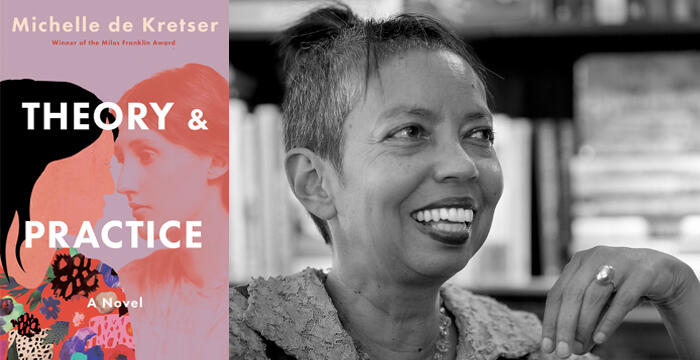
Today’s guest, one of Australia’s most celebrated and daring writers, Michelle de Kretser, discusses her latest uncategorizable book Theory & Practice (one she describes as 80% fiction, 15% essay and 5% memoir). Theory & Practice is a book that is wildly erudite and erotic at the same time, both an engrossing, immersive read and one that is constantly experimenting with and breaking form. A book that dwells in the contradictions between what we believe and what we do. And one that uses, as a lens, the liberatory power of Virginia Woolf’s published words alongside her often snobbish, racist, and antisemitic private ones, not only to explore this contradiction but also questions of gender, race, class and colonialism more broadly. You’d be just as correct, however, to call it a book about love, sex, shame and jealousy, set on a university campus in the 1980s at the height of deconstruction’s hold on the minds of its thinkers there.
If you enjoyed today’s conversation consider joining the Between the Covers community, receiving supplemental resources with each and every episode, and being able to choose from a wide variety of other gifts and rewards as well. You can check it all out at the show’s Patreon page.
Finally, here is the BookShop for today’s conversation with books from everyone from Ursula K. Le Guin to Shirley Hazzard to Virginia Woolf.
Transcript
David Naimon: What, if some day or night, a demon were to steal after you into your loneliest loneliness and say to you, "This life, as you now live it and have lived it, you will have to live once more and innumerable times more?" Would you not throw yourself down and gnash your teeth and curse the demon who spoke thus, or have you once experienced a tremendous moment when you would have answered him, “You are a God and never have I heard anything more divine?” Want to know what Nietzsche meant or why he thought we'd live our lives over ad infinitum? Every day, moonlit: The Daily Literature App, curates one passage to explore. Search moonlit: The Daily Literature on the App Store and use coupon code BTC1MonthFree to get your first month for free. Again, that's Moonlit Daily Literature with coupon code BTC1MonthFree. Today's episode is also brought to you by celebrated author and artist, A. Kendra Greene's No Less Strange Or Wonderful, a collection of 26 sparkling essays illuminated through both text and image, from exploding sharks, trees riding bicycles, a Hollywood-esque balloon dress, a giant sloth in a costume, and a sentient bag of wasps, A. Kendra Green uses the seemingly every day to make sense of what matters most in life: Love, connection, death, grief, the universe, meaning, nothingness, and everythingness. Ben Fountain declares that what A. Kendra Greene makes of the world, which he makes with the world, is unfailingly wondrous and revelatory, and Amy Leach cautions that this collection will take readers into the wild trackless unknown. Each essay brings us back to our smallest and biggest moments in life, and reveals that they are, in fact, one and the same. No Less Strange Or Wonderful is available now from Tin House. Late in the conversation with today's guest, Michelle de Kretser, she says that one thing that unifies her work at large, work that otherwise is incredibly varied with regards to genre and form and how it deconstructs both, is that her work across her career interrogates power and abuses of power. Given that we are witnessing a stunning abuse of power right now, where really no one can predict how this will all turn out, I thought I'd spend a moment and highlight some contributions to the Bonus Audio Archive over the years that speak to this moment, much as de Kretser's book, set in the 1980s, also speaks to us now. If you were a parent raising children during the first Trump administration, you surely still remember the name Betsy DeVos, the woman Trump appointed as Secretary of Education. When Leni Zumas came on the show during this time to discuss her remarkable book Red Clocks, she had just published an utterly blistering and goose-bump-raising essay called Vos, Bree, Fend, Light and in my dreams, she would record a reading of it for the Bonus Audio Archive for us, which, in fact, she did. In that spirit, Lidia Yuknavitch's contribution was a reading of Zoe Leonard's landmark poem, I Want a Dyke For President. There's also Teju Cole reading Etel Adnan and John Berger, and a letter to John Berger that he wrote, Isabella Hammad reading from Walid Daqqa's letters from prison, and Vajra Chandrasekera speaking about a Sri Lankan writer who was imprisoned for writing a story that was deemed by the government to be anti-Buddhist, where Vajra then translates part of the story for us and reads it. Access to the Bonus Audio is only one of many things one can choose from when transforming yourself from a listener to a listener-supporter by joining the Between the Covers Community, past Between the Covers guest Anne de Marcken, who wrote one of the best books of last year in my mind, she's also the head of a press called The 3rd Thing, which makes these incredibly beautiful books. The quality of every choice in their design feels like an act of love. Also, like de Kretser's books, they often cross and blur the borders of category and genre. The book she publishes troubles the relation between a performance space and the written page, for instance, or a lyric noir written by an evolutionary biologist. She's put together bundles of these 3rd Thing books to offer supporters. There's also the Tin House Early Reader subscription, where you get 12 books over the course of a year, but months before they're available to the general public. But regardless of what you choose, every supporter at every level of support is invited to join our collective brainstorm of how to shape the show and who to invite going forward as well. Perhaps, most importantly, every supporter receives a robust amount of supplementary resources associated with each and every conversation. You can find out more about it all at patreon.com/betweenthecovers. Now for today's program with Michelle de Kretser.
[Intro]
David Naimon: Good morning and welcome to Between the Covers. I'm David Naimon, your host. Today's guest is Michelle de Kretser, one of Australia's most exciting and groundbreaking writers. Her writing has been praised by everyone from Hilary Mantel to Ursula K. Le Guin, with Max Porter proclaiming her one of the living masters of the art of fiction. De Kretser was born and raised in Sri Lanka until the age of 14 when her family emigrated to Australia. She took her master's degree in literature in Paris and began a PhD at the University of Melbourne, where she co-founded the journal Antithesis. She was also one of the founding editors of Australian Womens Book Review. Ultimately, instead of pursuing her doctorate, she worked for a decade as an editor for Lonely Planet, founding the company’s Paris office. But it was in 1999 with the publication of her debut novel, The Rose Grower, that began her storied trajectory as a writer, whose work is always shifting and interrogating form and genre, often circling questions of migration, colonization, gender, and race. For instance, whereas her debut novel was set centuries ago in the French countryside as Paris was on the brink of revolution, her next novel, The Hamilton Case, followed the fictional murder of an English planter in Ceylon (now known as Sri Lanka) and the lawyer trying to solve the case. In her third book, The Lost Dog, follows an Indian Australian professor trying to write a book on Henry James, but who becomes more preoccupied with finding his lost dog. Already at this point, 16 years ago now, her book stood out, winning the Commonwealth Writers' Prize, the New South Wales Premier Literary Award, Book of the Year, the Tasmania Pacific Award, and more, with The Lost Dog longlisted for The Booker and the Orange Prize that same year. But it was with her fourth novel, Questions of Travel, that she leapt into another orbit, winning Australia's most prestigious book award, The Miles Franklin, and with AS Byatt proclaiming in The Guardian, “This is a novel unlike any other I have read. Questions of Travel is about uprootedness and travel, about tourism and flight from terror, about the trivial and the terrible. It seems to proceed with an uncanny lightness, in glimpses and sudden shifts. De Kretser is a master storyteller and again and again prepares small – and large – shocks that explode tens of pages later, and cannot be given away.” Since then she has written A Ghost Story, Springtime, a second Miles Franklin winner with the novel The Life to Come, her book-length essay part literary criticism part memoir on Shirley Hazzard, and the formerly audacious Scary Monsters which follows two Asian immigrants to Australia, one in the early 80s and another in a future Australian dystopia, where one story ends in the middle of the book, and you must start again from the back, which now becomes the front, flipping the book over and upside down to reach the middle a second time. Michelle de Kretser is here today to talk about one of the most anticipated books of the year and one of the most unforgettable reads for me in recent memory, Theory & Practice, a book of which Sigrid Nunez says, "Theory & Practice is a thrillingly original hybrid work that seeks truthful answers to the most difficult questions of the day—questions about the nature of love, art, and desire, about the thorny cultural legacy of colonialism and the unappeasable human yearning for connection." Jack Callil for The Guardian adds, "This appears to be De Kretser’s impetus: to push the margins of what a novel can look and feel like. It also asks questions of the act of reading itself. This is a book of intrusions: of unacknowledged inequalities, of flawed maternal figures, of raw human emotions. So much is condensed into its brief length, not least of which is a probing interrogation of novels and why we write them.” Finally, Neel Mukherjee says, "Michelle de Kretser, one of the best writers in the English language, has written her most brilliant book yet. It is, in short, a masterpiece." Welcome to Between the Covers, Michelle de Kretser.
Michelle de Kretser: Oh, thank you so much for having me on the show, and thank you for that incredibly generous introduction. Thank you.
DN: Well, you've described your own writing before as questing, jesting, testing. It is awe inspiring to me how much of this happens in the first 15 pages of the book alone. The shifts in mode and tone that occur in those few pages. I want to spend some time with what happens in the beginning, but before we do, I wanted to start with orienting listeners to our protagonist a little bit, who we learn about after this opening flourish. Perhaps we could start with you talking about how we first encounter our 24-year-old narrator arriving in Melbourne from Sydney with a scholarship to pursue an advanced degree in English. Who is Cindy, where's she coming from? What academic dreams and curiosities does she have that propel her to Melbourne? And how does the reality of academia there surprise her or unmoor her from how she imagined it might unfold?
MdK: Yes, so the narrator is a young Sri Lankan Australian who's migrated to Australia as a child with her parents. Her mother is now a widow and she's moved to Melbourne to pursue a master's degree in English literature and specifically to write on gender in the late fiction of Virginia Woolf. She goes along to Melbourne University. This is in 1986 and meets her thesis supervisor and is given a reading list of post-structuralist theory where she was expecting perhaps a reading list about Virginia Woolf. This is disconcerting, to say the least, to her because she realizes that her undergraduate years are really no kind of foundation for the work she's now supposed to read and understand and incorporate into her own work because she has never really encountered French post-structuralist theory until this moment. Just for the benefit of your listeners, I should explain that I believe in the Marxist principle of always historicize. This is 1986. In Melbourne, the charge of theory, which was led against [inaudible] in English departments at Melbourne University, was very, very oriented towards deconstruction. You could read feminist criticism, Marxist criticism, anything you wanted to read, but the orthodoxy was deconstruction. That meant Derrida, but also his American advocates, or US-based advocates like Paul de Man, like J. Hillis Miller, like Jonathan Culler. This was a theory very much focused on the canon. Later on, as feminist theory really establishes itself in universities and a post-colonial theory comes along, let alone in the '90s queer theory and cultural studies, the focus shifts, and the canon is profoundly questioned. But at this stage, it's really still very focused on mostly the romantics, romantic poetry, and it's exciting to our narrator that she has to embark on this whole new field of work and thought and philosophy, but also dismaying because she really feels that in some ways it has very little to do with her project. So there is that. She's intellectually disoriented, I would say. Then she makes friends in Melbourne, connects with various people, and she begins an affair with another student who is already in a relationship with another woman, he tells her that it's a deconstructed relationship, [laughter] which seems to mean nothing except to him to infuse it with an aura of cool, I suppose. Then as she reads further, does more background reading on Woolf, she is also rather disconcerted by something she finds in Woolf's diaries.
DN: Yeah. Well, let's hold off on talking about those for a beat, but I think that's a pretty nice way to orient to the character. I'd love to spend some time with those few pages that precede us understanding who she is, because the book opens in this really wild way. At the beginning, it opens in a very traditional, immersive way. We're in what seems to be a novel. There's an Australian geologist protagonist who's in the Switzerland of 1957 who's captivated by a Spanish music teacher who herself is in London, a teacher whose family had fled Barcelona at the end of the Civil War. But the emotional core of this opening is his recollection from when he was six years old. He's visiting his grandparents at their sheep farm in New South Wales, Australia. He seems to really love it there. He's captivated by his grandmother's rings. She shows him her collection, including the one most precious to her. But when he learns suddenly, abruptly, that it's time to return to his mother, he steals the ring and hurls it into the forest. A big search is conducted for the ring, and ultimately, one of their native servants is accused of stealing it, and when his grandmother says she ought to be whipped, shivers run through the boy's body, but he says nothing and leaves as planned the next morning. As I'm reading these ten pages, I'm, as a reader, very engrossed and interested and immersed. I'm all in, but then suddenly there is a rupture, a breaking of the fourth wall, with only one sentence by the author of this novel that goes, "At that point, the novel I was writing stalled." Then equally as abruptly, we are now with that author, describing an essay from 2021 from the London Review of Books called Tunnel Vision, which looks at how an Israeli military commander was inspired by post-structuralist and situationist texts in developing his strategy of raids into the West Bank to further Israeli colonization. Then several pages later, much like her Australian geologist character in her stalled novel, the author thinks back to being a seven-year-old, recollecting piano lessons about music practice and music theory and how the examiner for her music exams as he tested her ability to enact music theory and practice slips his hand into her underwear while doing so. All of this happens before we settle in with Cindy in Melbourne with her thesis and thesis advisor in what is much more of a stable world and point of view. When you were touring with Scary Monsters, you talked about the purpose of the formal and structural element of that book, namely that there was no front or back and no right way to begin and that you had to flip the book over on its head to begin the other half. One reason for this, you said, was that you wanted it to echo the way the migrant experience is one of life being turned upside down, and the bewilderment that causes, and the second reason had to do with the novel form itself, which is usually seen as a single, continuous narrative with a unity of time. In contrast, you wanted Scary Monsters to be radically discontinuous. Here again, in Theory & Practice, the novel form is ruptured by the author of it, and we quickly travel through several modes of nonfiction with this author as she ruptures the fictive spell. Before we talk about any of these parts on their own, talk to us about the gesture of this series or sequence of disruptive and disjunctive moves at the beginning of Theory & Practice.
MdK: Well, I guess I wanted to, as always, shake up the reader a little. We tend to consume novels effortlessly, don't we? I mean, and this is me, I love an immersive novel that just slips down, like eating something delicious and undemanding. But I feel that I want to question that, that way of consuming art, of consuming literature, that perhaps it should stick in our gullets occasionally and cause us to think about what we're doing and what we are consuming and to resist the easy commodification of literature. I'm not sure about the United States, but certainly in Australia, realist fiction is the dominant mode of fiction. I love a realist novel, I love an immersive read, but I want to also just disturb that from time to time to make the reader aware of the act of reading, and what we are reading, and what the meaning of that is. I mean, one reason for having that opening in Switzerland is that it is, as you say, a conventional, realist novel. I feel that as a writer, I can do that too easily. I'm suspicious of anything I can do easily. There is always the temptation with art to go back to what is familiar and feel safe. I don't mean that there is no work involved. Of course, I still need to polish the sentences and so on. But I'm at my seventh novel, it's basically something I know how to do. So, I want to challenge myself, above all, as a writer, in the same way I want to challenge the reader, well, more so, really. So, I think I thought to myself, “Well, what is one way of making myself more uncomfortable and also challenging the conventions of realist fiction?” And I thought, “Well, showing them up as conventions is one way of doing that.” We can get into detail as we go on. But I would say that the novel from the point that the beginning is said to have stalled, that the novel from that point on is what I would call a hyperrealist novel; a novel that doesn't read like a novel. Most of this novel, I would say 80% of it, at least, is fiction, is pure fiction, but I wanted to give the impression of something that was perhaps diary-like, brief extracts from someone's personal journal, for instance, the whole Cindy story, I would say. The purpose of having that beginning, well, one of the purposes is that when you say, “Well, this was fiction, and now I'm going to tell the truth,” which is what the narrator says, “I want to write a novel that doesn't read like a novel and I'm going to tell the truth in order to do that,” well, the reader then immediately thinks that that must be true, because what has come before it is this is called fiction. It is like placing black and white next to each other. Each appears clearer. But in fact, it is only a very heightened form of realism, what I'm calling hyperrealism. To give you an example of what I mean by that, you mentioned theft of jewelry in the first part of the novel, and the wrong person is identified as the thief and punished for it. Now, of course, this can happen in real life, especially where the racism enters the mix, because realism must be plausible, it must be credible. However, for us as readers, as individuals to personally come up against that kind of miscarriage of justice is relatively rare. It is a hidden event. In the second part of the novel, jewelry also goes missing, and various explanations are put forward for what might have happened to this jewelry. But when we discover what has happened, the explanation is utterly banal. It's utterly trite, it's utterly every day. It's something that all of us have experienced at some point in our lives and will no doubt in what's left of them. You can contrast that heightened form of realism with what seems to be very factual, very understated, very unmelodramatic. Of course, that is also a convention. But as one of the characters, a very minor character in the novel says right at the end of her husband, he made the mistake of confusing realism with reality. Realism is not reality, it is just another set of conventions. I suppose that that's what I was gesturing towards. [laughter]
DN: I want to take that further, but I have a couple of questions I want to ask you and then we'll loop back to this question of hyperrealism and realism because it's something that comes up a lot. Maybe I'm attracted to this question myself. Maybe that's why I'm attracting certain books and certain writers of certain books. But before we go there, I was curious if the protagonist's stalled novel is the real beginning of a novel that you yourself tried to write and abandoned or whether it was the beginning of a novel that you wrote on behalf of Cindy, knowing all along that it would stall.
MdK: Oh, the second.
DN: The second one. Yeah. Well, the reason why I wanted to ask this beyond the fact that the book, I think, invites us to ask this, is that the Australian cover for the book I think is particularly and wonderfully provocative and quite different than the American cover. The cover in Australia is a photograph of you from the 1980s, as if this book were simply about you, that we could collapse your story and Cindy's into one story without a second thought but then below the photo we see the subtitle “A Novel.” I really love it because it makes me think of how fiction by women is so often framed and insisted upon as memoir, as testimony, or as personal and lived as if a woman couldn't have done the work of imagining it, and yet you are literally framed on the cover itself provoking us with your personal history. I wonder, do you see Theory & Practice in this way, partly questing, jesting, and testing this gendered response to the imagination of women?
MdK: Well, yes, indeed. When the very brilliant designer of the Australian edition proposed putting this photograph on the cover, I was uneasy about it for exactly that reason. I should say that with my previous novel, Scary Monsters, that was the first novel written entirely in the first person for me. One of the stories, one of the narratives in that book, is narrated by a young Sri Lankan Australian woman working in France. Because I had worked in France at the same time, it was assumed by many, many people who interviewed me, for instance, this is unproblematically nonfiction. I had experienced this already. I love the work of imagination. That is why I am a novelist. I think that the work of imagination, people are afraid of it, suspicious of it. Of course, this goes back to Plato; the banishing of poets from the Republic. I don't know why, really. But anyway, it was of concern to me. Then my partner made a very pertinent point as he so often does and he said, "Look, you've written a novel with a female protagonist and told in the first person, you could put a picture of anything you like on the cover, a polar bear, and people would still think about you. [laughter]
DN: They’d still think it was you. [laughter]
MdK: Which is a good point. I thought, “Well, thank you for raising this, because one of the reasons I thought it was a good choice of cover was that it gave me the opportunity to talk about these things in interviews.” But the other reason that I love that cover is simply for, as you said, that provocation of the photograph with the caption, “The new novel by,” and when I looked at it, what it reminded me of was that famous Magritte painting, a photo, realist painting of the pipe captioned, "This is not a pipe." It could have been captioned, “This is not Michelle de Kretser, really.” [laughs] I think the designer, who one of the reasons he's brilliant is that he's a very good reader. If you think about it, a good cover, a smart cover, is a good reading of a novel, of a book, whatever kind of book it is. I think Chong W.H., who was the designer, had read, perhaps, what I just cited, that little bit where a character says, “Do not confuse realism with reality,” nothing more realistic than a photo of the author. Yeah. [laughter]
DN: Well, as you've already said today that the book is perhaps 80% fiction and in other places you said it's 15% essay and 5% memoir, though as a reader, we don't know one from the other. We're just reading. But one inspiration for this hybrid form was the topic of Cindy's thesis, Virginia Woolf, and something that she herself aspired to do in her late novel The Years, but then abandoned similar to your character abandoning their novel. But unlike you, Woolf abandoned her plans and reverted to the recognizable novel form or a more recognizable novel form, whereas Cindy and/or you abandoned the novel form for this indeterminate, hard-to-categorize hybrid form. But what was Woolf aiming to do and to what end when she was starting the years?
MdK: Her initial plan for that novel was to narrate the story of a fictional upper-middle-class family over half a century. Each chapter of the novel would be followed by an essay, a chapter of nonfiction, discussing social changes that had taken place in the period just described in the novel, with a particular focus on changing attitudes towards women and changes in women's lives. She called this alternating between granite and rainbow, between facts and vision, which are beautiful descriptions of these things. I suspect that the reason she abandoned it was that it's a very schematic thing to do. I mean, she wrote about a hundred thousand words, but this strict division between chapter fiction, chapter essay, chapter fiction, it doesn't really suit Virginia Woolf, does it? She was a very impressionistic writer. I feel that that very rigid form was probably not suited to her. Well, she decided it wasn't anyway so she wrote The Years as fiction, as you said, and she recycled much of the essayistic material into three guineas, the nonfiction book she wrote at roughly the same time. I thought that if it hadn't worked for Virginia Woolf in a way, was it going to work for me? And that I would prefer to try this more, as you say, blurry tangle of forms. I think some bits, it's quite easy to say, “Well, this is obviously essayistic.” The narrator herself says so when she's summarizing, for instance, the Tunnel Vision, the piece in the London Review of Books. But other times you don't know. I think, well negative capability, it's good to rest in one certainty and learn to be comfortable with it. [laughter]
DN: Well, to go back to the difference between realism and reality, or how one of the impulses of this book is to expose the conventions of and the artifice of realism, all of that provoked thoughts for me about one of the other main influences for this book. In the early pages, your protagonist says, as you've alluded to, “An artist once told me that she no longer wanted to make art that looked like art. I was discovering that I no longer wanted to write novels that read like novels. Instead of shapeliness and disguise, I wanted a form that allowed for formlessness and mess. It occurred to me that one way to find that form might be to tell the truth.” This is something that I think about a lot. For instance, are we really telling the truth when we tell our lives with received forms, telling our memoirs in three acts and double timelines, when we shape our lives to make them entertaining or propulsive or suspenseful to the reader, which I think you alluded to with hyperrealism, isn't truth or life as it is actually lived in many ways, anti-form or even banal in what you were saying in the second theft of the jewelry? In other words, I agree that if she were to use truth as her guide, it would likely allow for more formlessness and mess from which perhaps she could find a form that is all her own. What's interesting about it too with regards to form and genre is that, as you've said here in an interview, putting the hyperrealist novel next to realism highlights the artifice of realism. Thinking of reality and realism not being the same, I think not only of how the formal elements of how we tell a realist story don't really map to lived reality, but also how the realist novel centers the human, often one individual consciousness, how it banishes the non-human world to the margins or out of the story altogether, which isn't realistic, but to take it a step further than that, the realist novel often banishes the imagined and the fantastic even though the imagined is deeply part of the fabric of every human life. That made me think of Ursula K. Le Guin who once said, “I think the imagination is the single most useful tool mankind possesses. It beats the opposable thumb. I can imagine living without my thumbs, but not without my imagination,” which of course suggests that the imagination may be the most real thing, or one of the most real things about us. I don't know if this is a question necessarily, but I bring up Le Guin here because in listening to you talk about Theory & Practice, I was delighted to discover that her essay, The Carrier Bag Theory of Fiction, alongside with Woolf's early attempts to write a hybrid version of The Years, is another primary influence on the book. But Le Guin's presence isn't explicitly obvious at all within the book itself. Talk to us about Le Guin and Theory & Practice, or The Carrier Bag Theory in relationship to Theory & Practice, anything about her, and anything that might have sparked in your imagination itself.
MdK: Thank you so much. I mean, one reason why Le Guin is not present in the novel in the way that Woolf is, is that I think The Carrier Bag Theory of Fiction, if I'm not wrong, dates from the late 80s. It's not in the sort of the main part of the novel, although the novel does go beyond 1986. But another reason was that it wasn't until I first listened to this podcast, David, that I am ashamed to say I hadn't encountered The Carrier Bag Theory of Fiction prior to that and I heard quite a few different writers talking about it. I immediately procured a copy of it. But by this stage, I had already conceived a sort of Theory & Practice and indeed started writing it. I had written all of the realist novel part and had just started on the rest. So it didn't lie at the very beginning of the book in the way that the Woolf novel did. But what was immensely reassuring to me after I read that essay by Le Guin, was the idea of these different forms and different kinds of narrative, all being able to coexist happily within the carrier bag of the novel. As a writer, especially if you're trying to do something that you haven't done before as I was, you are anxious to some degree that will it make sense, does it make sense, are you just making a mess that doesn't reveal truths, that is just a mess. These anxieties attend upon any creative endeavor, I think. That was Le Guin's voice telling me that, no, this was okay, just keep going and you have your carrier bag of fiction. I thought that was, I mean rather wonderful. I remembered, of course, back to Henry James who described the novel as a baggy monster and I thought, “Well, it can be a carrier baggy monster. It would be what mine is.” [laughter] Not such a not large in volume but holding lots of different kinds of narratives and not really focusing on one particular narrative. It was both exhilarating and inspiring and reassuring, all of those things. I'm very grateful to your podcast for bringing that to my attention. [laughs]
DN: Yeah, it's such an honor to discover that. I also feel like The Carrier Bag, contrary to the way we're going to talk about how theory is employed in this book, feels like it's inherently generous and generative as an essay. Like it doesn't prescribe an alternate form to the received form. It feels like it keeps renewing itself in some sort of open-ended way.
MdK: It's a very important aspect of influence, I think, that as readers and critics, we tend to overlook because as readers, when we talk about influence, we talk about generally what we're pointing to, because we can point to it similarities of style, of content, perhaps of formal innovation. But I would like to cite something that Fredric Jameson, the great Marxist theorist, said in an essay about influence, and he describes interviewing an East German writer, and he doesn't identify, this is back in the day, obviously, and he asks this guy about the influence of Faulkner on his work. The writer replies, "Oh, yes, yes, when I read The Sound and the Fury, I realized I could have a chapter of italics in my novel." Now, maybe this writer never went on to have a chapter of italics in his novel, maybe he never did anything typographically unconventional, but what reading The Sound and the Fury did to him was to show him a possibility. A very important kind of influence is simply opening the door to possibility, I think.
DN: I did too.
MdK: That is what well, I suppose both The Years and Le Guin's essay did for me.
DN: Your protagonist says, “I began to see that my novel had stalled because it wasn't the book I needed to write. The book I needed to write concerned the breakdowns between theory and practice, and the material was overwhelming. Particles of it had entered my novel and jammed up its works.” As a first step to talking about her crisis around both Virginia Woolf and her thesis on her, I'd like to spend a moment with the London Review of Books essay Tunnel Vision, which is the first thing she encounters when her novel stalls, and it's an essay that sets her on this other path of spelunking into the gap between theory and practice. Thinking of your hybrid genre book, it's also fitting that she talks about this essay because she notes that the essay in all of its improbable truths reads as if it were a fiction. I was hoping you could read that short section where she summarizes the Tunnel Vision essay.
[Michelle de Kretser reads from Theory & Practice]
DN: We've been listening to Michelle de Kretser read an essayistic segment of Theory & Practice. Surely, the situationists who were inspired by Marx who meant their disruption not to be employed for colonization but for busting through the walls of inequality would have been likely horrified by this article, by this gap between theory and practice. Obviously, if your book took a binary stance one way or the other around theory, that theory was bad or theory was good, your book wouldn't be as good as it is. But nevertheless, it's quite unsparing when it comes to the essential damage of theory, fueled in large part by Cindy's anguish that she's no longer writing from love and desire, that after being given all these theorists to read a secondary reading for a thesis, she's finding herself at odds with the subject that she loves. Not only do we get this diabolical co-optation of radical theory, which then prompts her memory of being molested by her music theory teacher, but she brings us out to more of a general principle when she says, “In 1986, critics applying theory to literary texts like to cast themselves as torturers. The text told the story, but that story was a screen. The critic was obliged to probe and interrogate the text in order to make it yield the story it was concealing. The critic always already knew every detail of that story, but it was necessary to make the text confess. Applying pressure to soft, secret places, the critic exposed fake oppositions, crude essentialisms, bourgeois hegemonies, totalizing mechanisms, humanist teleologies, squalid repressions, influential aporias, and many more textual fragilities. The text bucked and shrieked under the critics' administrations, but the critic was merciless. Things always ended the same way. The text came apart, divulging its hidden significance. That was the story under the story. When it was revealed and the text was in pieces, the critic had won.” I think there are many layers to why Cindy is feeling like theory is abusive and/or that she's being abused by the interjection of theory into her engagement with Woolf. But I can't help but wonder if one of these layers is related to how it is interfering with a certain type of reading experience, one that you've already referenced today. It reminded me of something you wrote in your book on Shirley Hazzard, which feels in many ways to me like a companion book to this one. The epigraph to that book reads, "Works of art can be more important than anything critics can say about them." And you explore how Hazzard's understanding of a work of literature requires, “a submission akin to that of generosity or love.” But I also think of two different reading experiences you had when you were reading Hazzard, the first you describe as the greedy, gulping way you read The Bay of Noon, like a child devouring sweets, you say, where whole days were spent deep in fictional worlds. "It was reading as a form of enchantment, a way of reading I continue to value." But then when reading another of Hazzard's books, you say this, “The Transit of Venus played havoc with my expectations of Hazzard's fiction. Instead of immersion and enchantment, it encourages detachment and appraisal. It presents itself as Brechtian estrangement. Characters are often referred to by their full name; sometimes they’re merely ‘the man’ or ‘the woman.’ These cool designations foster observation rather than identification. We watch and assess the characters like people in a painting. This distancing operates even at the level of rhetoric. The narrative is steeped in irony, a trope that promotes seeing through rather than seeing with, a trope associated with disabused, not enchanted, vision.” I wondered if you feel like our protagonist is partially rebelling against the ways theory is stepping between her and this experiencing of greedy, gulping, if that is one of the ways she's rebelling, of being in whole days in fictional worlds of seeing with. You've already mentioned that you were also interestingly using this food metaphor earlier about drinking something down or something being caught in your gullet. But I wondered if you could talk a little bit more about these two modes of reading, both of which you seem to admire and how and why you think Cindy is buckling against this, and if part of it is a loss of a reading experience.
MdK: Yes, thank you so much. It's such an astute reading on your part. Yes, I think one of the reasons Cindy is disconcerted and disoriented is that she is realizing that she has to let go of some, at least, of that enchanted reading, and really step back a bit from the novels of Woolf, which she does, of course. When she finally writes an essay on Woolf, it is a disenchanted essay and one that uses theory. I think I do still value that kind of immersive reading, especially for certain kinds of books. I mean, I'm a great fan of the "whodunit." That is my guilty reading pleasure. I absolutely loathe "whodunit" where "whodunit" is given away at the start. I want it to be a puzzle of that I have to figure out along with whoever's investigating the crime, et cetera, et cetera. That's a generic requirement I feel must not be interfered with while having written what dare I say, deconstructed whodunit myself in my second novel. But I think it is also the sense that what she knew, what was solid grounding in literature and literary criticism has now gone, that's rubble on foot, and she has to learn a whole new way of looking at and assessing and analysing literary texts, one which is very challenging, and then what she learns also can be a useful tool for her. So, it is partly about the making of Cindy as an intellectual, as she grows into understanding different ways of reading literature and analyzing literature. We might infer, although this is never spelled out, that this is where the seeds of her own interest in becoming a writer are sown. But the other thing also, I mean, there is a contradiction there, isn't there? There's a kind of mess. It's not clear-cut. She wants this immersive reading, and then she shies away from it as well, and uses another kind of reading to get her revenge on Woolf. There we have, again, that contradiction, that mess, that gap, that complexity. This is, I firmly feel, what the novel feeds on; that the novel as a form feeds on contradictions that aren't resolved, that perhaps cannot be resolved, and that out of this, art springs. It's certainly what interests me as a writer, so that Cindy as a character, for instance, is not entirely admirable. She indulges in some, well, what she would call shameful feelings. [laughter] It's complicated.
DN: Yeah. Well, much like you interrupt the fictive spell of the novel that you abandoned at the beginning, I want to interrupt the momentum we've created around looking at the book through a theoretical lens. Even though I feel like I could happily continue this way for many hours, I don't think it would do it justice to do that, justice to the actual experience of reading your book. In the 30-second video you did for Abbey's Bookshop introducing this book, you called it a book about love, sex, shame, and jealousy. I think that gets closer to the experience of reading it. This book is obviously very erudite, but it is also very sexy and sexual. I think of the famous line from Sontag's Against Interpretation essay where she says, "In place of hermeneutics, we need an erotics of art." But I'd argue that the arrows coursing through this conceptual book might suggest that this is actually a false binary. Either way, one of the joys of this book and other books of yours are the love triangles and infidelities. One of the ways the tensions between theory and practice plays out is through the lingering question of what solidarity one feminist owes to another when it comes to sex, to sleeping with another person's partner, and how Eros is unruly and doesn't conform to what we think of ourselves. But thinking of the erotics of art or the greedy gulping experience for you of reading Hazzard’s The Bay of Noon, I thought before we appraised Virginia Woolf, before we looked at the so-called story behind the story of Woolf, before we see through instead of seeing with, I was hoping we could begin by seeing with, and have you talk to us about Cindy's experience of Woolf pre-thesis, why Woolf is important to her, and perhaps to you, that would move her, in the beginning, to center her academic work around her writings in the first place, pre-deconstruction, pre-theory.
MdK: Yes. [laughs] I think Cindy, as she says, has read Woolf when she was still at school and specifically the book that has really galvanized her and changed her thinking is the essay A Room of One's Own. She talks about this with various friends of hers in Melbourne and the women say, “Oh, yes, that was a book that changed my life, it changed the way I thought.” The male friend she talks about it with, who's a young Marxist, says, “Well, she was just a product of the upper middle class, and she wasn't interested in working-class reality.” But the women are galvanized by Woolf's understanding of experience of an analysis and critique of gendered roles in her day of Victorian patriarchy, really. Then we presume also that Cindy has read fiction, has read Woolf's fiction, and finds the descriptions of female interiority that are immersive and respond to her experience of being a woman. That is both in the essay, A Room of One's Own, and in Woolf's fiction, it's fiction that is centered on women's lives. I should just also say you mentioned Hazzard and The Bay of Noon, and of course, it occurs to me only now that in that book and in The Transit of Venus, the female protagonist sleeps with another woman's partner.
DN: Oh.
MdK: It's actually her friend's partner. I mean the friend has gone off with someone else and then she has a brief but intense affair with Jenny who’s the friend’s long standing partner, lover. In The Bay of Noon, there's this wonderful scene where Caro sleeps with a man who is engaged to a British woman. Not a friend of hers, I might add. But they're in the topmost room in a house, and they've just had sex and his fiance turns up in the driveway and sounds a horn and he hastily puts on a shirt and rushes to the window and says, “I'll be right down, Darling,” and Caro just comes up and stands beside him and has it so she was wearing nothing but a watch. So it's this wonderful display of herself and claims what's clear, what's been going on. [laughs] In fact, both these novels, which have been important to me, have also contained this infidelity.
DN: That's interesting. So, in an interview you did with the Write Around the Murray Podcast, you really lit up and became particularly animated when you were asked a question about syntax, punctuation, and the poetics of the sentence, where you said all sorts of really interesting things like how you like to end your books and also sections within your books with monosyllables, for instance. Of course, this could explain some of your attraction to Hazzard as a writer, but I also would imagine to Woolf. It certainly was for Le Guin who wrote often about Woolf. In one of my conversations with her, I quote to her something that she had said in a speech. This is Le Guin's words, “Beneath memory and experience, beneath imagination and invention, beneath words, there are rhythms to which memory and imagination and words all move. The writer's job is to go down deep enough to feel that rhythm, find it, move to it, be moved by it, and let it move memory and imagination to find words.” When I read this to her, she answered to my reading, "That is something that I learned from Virginia Woolf, who talks about it most wonderfully in a letter to her friend Vita. Style, she says, is rhythm—‘the wave in the mind’—the wave, the rhythm are there before the words, and bring the words to fit it." I'd love to hear you talk about this aspect of writing for you.
MdK: Yes, indeed. Thank you. I mean, I so agree with Le Guin and before her, Woolf, about rhythm preceding language, I suppose the child, the fetus in the womb is aware of the the murmur and the flow of the mother's blood and then the mother's heartbeat, the rhythm of the heartbeat. I certainly know that I have sometimes volunteered in aged care residential homes and worked with residents who have dementia. These people, without exception, remember songs and nursery rhymes from childhood and can recite these to you perfectly, whereas they can't perhaps sustain a conversation that has meaning. Yeah, it's very primal, I'd say. Sometimes I have actually found myself having a rhythm in my mind and writing a sentence to fit that. I remember this very clearly, most clearly, I think, with my novel The Life to Come, which is a time where I was walking my dog every day for long walks and walking is of course a rhythmic activity. Those rhythms were in my mind a lot and I'd actually come home and then write some sentences that seemed to fit. Or sometimes I just have a word that was missing and the walking helped me to find that word. I really do think that rhythm is incredibly important. I learned by heart a lot of poetry when I was a child and what a nicer way to learn anything than by heart through love. This tended to be in old poetry I found in old-fashioned anthologies. Pretty much exclusively poetry in formal meters. I think it was a very good foundation in rhythm and meter and helped develop my ear from an early age for sound. Sound in language often poems that I didn't necessarily know the meaning of every word, but the meter was there. Every time towards the end of a book, I would read the whole thing aloud to myself to try and fix awkward rhythms. Also while I'm writing, sometimes I'm just going, [humming] to see if it's working on the page. I started my professional life as an editor and I think that a lot of editing focuses on the structural aspect of fiction. I think you can do an awful lot, an awful lot at just the level of the sentence, if you just look at the sentences, this is of course the famous Gordon Lish principle. But I have worked with writers where I have really just encouraged them to look at every sentence and take out anything that isn't strictly necessary. That has an immensely lightning, aerating effect on narrative. It doesn't mean that you can't have elaborate sentences, but you don't have anything that is unnecessary. Of course, the writer determines what they believe to be necessary, not the editor. But everyone I've talked about this with has found it a liberating principle and I try to apply it to my own work, although I'm quite sure, one of the reasons I'm slightly hesitant about reading my own work is that I feel I'll be reading something, “I should have taken it out. I should have taken it out.” [laughter] But certainly, one principle I have adhered to is ending a novel, let's say, with a monosyllable, a stressed monosyllable. In this novel in Theory & Practice, it's “But all that was the past.” The Lost Dog, “Tom said, 'I won't let you fall.'” It has an air of finality, a stressed monosyllable. It's a good strong form of punctuation. It's the rhythmic equivalent of the full stop, what you call the period. So I’d rather not have that. [laughter] Endings are important. Endings are what a reader takes from a novel most strongly, I think. But to go back to sentences, I mean, what is a narrative? What is a novel except a collection of sentences? On bad days, I tell myself, “I'm not writing a novel, I'm writing a sentence.” And then I'm writing another sentence and then I'm writing another sentence. It makes it manageable if you think about it in those ways. If you fix the sentences, you fix everything. I ask people to trust me on this, you fix character, you fix dialogue, you fix plot, to the extent that you have a plot, work on the sentences, just fix the sentences. Yeah, and that is if you fix style. I mean everyone, especially newer writers are preoccupied with style, which is style, how do I work on my style, work on your sentences, the style will follow, you know.
DN: Well, as a first step towards looking deeper at Woolf, we have a question for you from the novelist Neel Mukherjee whose most recent book Choice is itself engaged with form in relation to reader expectations where the book can be read as a novel or three standalone stories. With Sam Sacks for the Wall Street Journal saying, "Mukherjee sacrifices the readerly satisfaction that comes from dramatic payoffs; instead of providing pure narrative, he creates a dialectic, pulling the reader into these problems with a seriousness and technical excellence that makes a lot of what is published today seem immature. ‘Choice’ asks much of us readers. But, for all its pessimism, it trusts us to be up to it.” Jonathan Lee, in a rave review for The New York Times, “Mukherjee is brilliant at tracing the ways a choice deferred becomes a fate sealed. But the book’s tripartite structure is even better at showing how we graze one another’s lives with our decisions, some of which may be catastrophic for our conscience but beneficial for our art” Here's a question from Neel.
Neel Mukherjee: Michelle, this is Neel. This astonishing new novel of yours, so fiendishly intelligent, questions the whole project of what is now fashionably called autofiction as if it's something ravishingly new when the truth is that it's been with us for a very long time. You play with the idea of reality and representation in such dazzling ways. My question is now about Virginia Woolf who plays a very key role in the book. I want to ask you about the ways your protagonist’s work on Woolf and her discovery of, let's say, certain things about Woolf, how that mediates the life fiction pairing that is at the heart of your novel.
MdK: Oh, thank you, Neel Mukherjee, a great question from a great, great writer. I would say that when the narrator of my novel reads Woolf's diaries, she finds an aspect of Woolf that she was not aware of and which really undermines her faith in Woolf and shakes her admiration for Woolf. Woolf's life and Woolf's art, she's been revering the art and now she comes up against an aspect of the life that she can't stomach. This is an entry in Woolf's diary where she describes the visit of a Sri Lankan, a Ceylonese man to her house to meet with her husband, Leonard Woolf, over afternoon tea. Woolf describes the man in very disparaging racist tones. This man was an independence activist and had come to London, along with other Ceylonese activists, to protest an injustice that had taken place in Ceylon, which was a British colony at the time, and Leonard Woolf, who had served in the colonial administration in Ceylon before he married Virginia, was helping these men with their case. The narrator is utterly thrown by this discovery. I suppose we get back to that question, which seems very much on people's minds and reader’s minds and critic’s minds at our present moment of “How do we reconcile unpleasant aspects of creative people with the brilliance of their creative product?” Actually, if I could digress, the exemplary writer here for me is not Virginia Woolf, but it's V. S. Naipaul, whose politics were despicable, really, and yet was a great, great writer who articulated the never-before-articulated experience of millions of people in his writing about immigration from the global cell and colonialism and what colonialism had done in those countries of the global cell. So how do we reconcile the person and their art? Well, I don't know that we need to reconcile them, I think we need to acknowledge that these gaps, these messy gaps exist. I mean, Woolf, in her fiction, is trying to represent the interiority of women's lives and the difficulties of being a woman in Victorian and Edwardian Britain. These were things that she knew firsthand. She had experienced Victorian patriarchy and she could write about these convincingly, movingly, empathetically, wonderfully, really. But she wasn't able to extend that empathetic, compassionate scene into the lives of the Ceylonese activists, which is odd for someone who was married to Leonard Woolf who was absolutely admirable in that respect. But there you are, we all have our limits.
DN: Yeah.
MdK: As for the question about representation in Theory & Practice itself, well yeah, I mean all fiction you could say is at some level a quest for mimesis, isn't it? How to represent the world as truthfully as possible, and that might be through fantasy, you're still representing something very truthful about the world, as Le Guin, of course, demonstrates in her work. It goes back, I think, to the hegemony of realism, which is now pretty much seen as the only lens through which the truth about life can be revealed. Yet realism is a relatively new mode, isn't it? The same character in the novel who berates her husband for confusing realism with reality also refers to Bovarysme, which is very much a gendered term, it originates, of course, with Madame Bovary, and Flaubert, very near the beginning of realism as a mode was his mission, really, to make the realist novel seem as close to life as possible and also give it great beauty so that it might unseat poetry as being the highest genre in those very hierarchical terms that operated in the 19th century. He polishes his style, he works on his style, and he takes aim at romantic fiction, the mode that precedes realism and was the dominant mode when he was a very young man. Emma Bovary in the novel, of course, famously reads nothing but romantic fiction, tries to live her life according to its precepts, comes to a sticky end. So Bovarysme has come to mean romantic foolish delusions and is applied to women, basically, because men are, of course, realists. But realism is also a set of conventions. So that is what the Theory & Practice is also trying to unpick.
DN: Well, as you've already said today, that all these discoveries are happening in her diaries, far less so in her published work, and Theory & Practice details some of this around Woolf, what you mentioned, but also that she hated marrying a Jew, calling her husband in his presence “the Jew,” but even what is detailed in Theory & Practice around this and Sri Lankan only scratches the surface of what is outside of the public eye, whether her hating the sound of Jewish voices or the way Jews laugh to the donning of blackface as part of what's called the Dreadnought hoax. But it does break into our fiction a little, too. For instance, the Jew in the bath in her book, The Years, is a man down the hall on the other side of the wall who shares the same bath with the lodger who's trying to entertain someone in a room and can hear the coughing and snorting through the thin walls, where she comments to her guests that there'll be this line of grease around the bath the next day and hair, where there's this palpable physical revulsion and this portrayal of an almost like animalistic figure uncivilized and perhaps uncivilizable that doesn't feel that different than the language the Israeli government now uses to describe Gazans.
MdK: Yeah.
DN: But understandably, Cindy is most unmoored as she discovers the ways Woolf's life intersects with and portrays South Asians. I was hoping you could read another little section that sort of, I think, captures her in this indeterminate contradictory state of love and assessment.
MdK: This is having discovered the passage in Woolf’s Diaries. She's going around to her friends taking reassurance.
[Michelle de Kretser reads from Theory & Practice]
DN: We've been listening to Michelle de Kretser read from Theory & Practice. I love that scene with a thin thread of comedy going through it too, I think, in the heartache and heartbreak. Thinking about Cindy's angst around the critique of theory, I wonder if the questions in the book aren't simply about Theory & Practice, but also about the practice of theory, both who is practicing it and to what end is it being practiced, because when Woolf calls the Sri Lankan visitor a mahogany-colored wretch with the likeness of a caged monkey, eventually Cindy is inspired to include Sri Lanka in her work on Woolf, and she also wants to focus on an Indian character in The Years who's given no lines, who's rendered a non-speaking figure. Something you would think would be an embraced approach, as taking a small detail on the margins as a way into a deconstruction of the text is the modus operandi of the day. But people are not interested in her pursuing this anti-colonial mode. It made me think of two things. I don't know if they are actually related, but one was her noticing that all the Marxists on campus are men, and that when she goes to see the Australian film My Life Without Steve, an essay film much like the book is an essay novel, a feminist film that opened up possibilities for what art could be for Cindy, when discussing it with the man she is with, he focuses on something that seems truly insignificant in the film, not a key, some men and some boats, in a way that seems to derail what is powerful about the movie. She even describes it as if he's taking a knife to a painting, which made me wonder if the subtext of noting the preponderance of male Marxists might be that Marxism and this context might be a way for a certain type of campus man to stay at the center of things, too. Whereas in contrast, Cindy's desire to center this non-speaking Indian man feels much more generative, a project that could be illuminating about Woolf in many ways, that who is doing the theory down or up a vector of power and to what end might be just as important as what they are supposedly doing within theory. Cindy seems particularly well-equipped to wade into the complexities of this. I love that part about the liberatory aspect of Woolf around her jettisoning the afternoon tea ceremony, this obligatory woman-conducted daily ritual, but at the same time Cindy commenting upon the "ongoing immiseration of the tea-pluckers," the former made possible by the latter by the exploitative colonial practices that underwrote British progress and wealth, where Woolf is disrupting the tea ceremony in one way, but couldn't have written this way without the tea pluckers who don't rise to human regard in her world. I don't want to be reductive and suggest it takes both Cindy's love of Woolf and Cindy's experience as a South Asian immigrant to be able to hold Woolf in this complex position. But it does make me wonder if the male Marxist comment and the thick-headed takedown of the film My Life Without Steve by a man were pointing at agendas being played out via theory that weren't really about theory. I wondered if you had any thoughts about that.
MdK: Well, certainly that was my experience of theory in the mid-80s on that campus. There were also certain kind of theorized man who described himself as "feminist" and used this to sexually exploit students and women more generally. Yeah, your comment about this was a worry of men staying at the center of the world of the picture, I think that’s an ongoing project for men, I don't think it's ever really stopped, although the feminism has tried to disrupt it in various ways. I think the other salient point here is that in the mid-80s, feminism is working hard at trying to disrupt the male canon in universities and therefore is really resistant to any critique of its great female writers, for example, Virginia Woolf. The narrator's supervisor, who is a feminist, really just does not want to hear the narrator's concerns about Woolf's racism and anti-Semitism. She brushes them away. So, this changes later on, of course, and post-colonial theory, the introduction of post-colonial theory into university English departments really shifted the discourse around race. But it's a very male-centered universe, the one that Cindy encounters in the university, a very power-centered universe, and theory is a form of power. This is Theory with the capital T, French post-structuralist theory. If you can talk that talk, you are powerful within the academy. While, for instance, a thinker like Foucault and his critique of power is pointing out that all institutions are complicit with power, the will to power, all these theorists would pay homage to that, yet in their practice, they are busy securing their own positions, well, basically through humiliation and exclusion. They are very much deploying and practicing power, and it's always, of course, aimed at those who are vulnerable in students, women, the precariously employed, and so on. Though, yeah, within the university departments, there's a whole lot of messy gap between Theory with a capital T and practice.
DN: Well, you've already, through the course of our conversation today, answered my next question, because I feel like because of what time period this book is set in, the position around theory is one that's mostly critical of it. But it's before anti-colonial and decolonial reading practices, as you've just said, have come into it. Because one of the things I wanted to bring up was how, for me, the experience of theory hasn't been one of torture, but one that's often felt liberatory, like the impulse of Cindy that is discouraged to look under the surface in an anti-colonial way around Woolf. I think of conversations I had with Elaine Castillo about her book How to Read Now and with Dionne Brand about her book Salvage: Readings from the Wreck, both which advocate a praxis of reading and re-reading that is not greedy and gulping, but more in the manner you describe of reading Hazzard's Transit of Venus, a scene through instead of a scene with. Depending upon the text, I often find this approach to be a form of liberation. You lose the magical feeling of the greedy, gulping. Some of my favorite reading experiences remain these greedy, gulping experiences, but I do think you gain something else. I'm halfway through this eight-week course right now with the Australian psychotherapist, Leah Avene, who's also the Indigenous Pedagogy Lead at the Wilin Center for Indigenous Arts and Cultural Development. The class is called FIELDWORK: Collective Recovery from Colonial Fragmentation Disorder. One of the terms that she uses in it that I really love is her notion of what she calls learning injuries and that part of the work is working to heal learning injuries. To me, when I think of Dionne Brand returning to the books of her childhood where the black characters were either absent or on the margins, they were silent or sources of ridicule and where on the second read of Jane Austen or Thackeray, she discovers the oblique euphemistic references to how their lives are upheld by their plantations on the islands. But the first time through, she is enlisted if uneasily and in a way one can't quite articulate into being with and alongside and in allegiance with a protagonist who at best would have no regard for her if she were in the book, that the ways you have to contort who you are in relation to the world of the book when you gulp it down do feel like they have the real potential through repetition to injure, that this other way of reading gives you back a sovereignty in relation to the text in a way or a maneuverability that is different than the way the author themselves intend to maneuver you. I guess I wondered if you had any further thoughts. You've already touched on this some. Your book allows for an enormous amount of maneuverability, I think, which I love. [laughter] But do you have any thoughts about the gap between theories, essentially? Because it's not just about theory and practice or the practice of theory, but it's also perhaps this moment of time, as you've suggested.
MdK: Yeah, I think that it was a time of, we're talking about me personally, I'm not sure about Cindy, but where I discovered, I was starting to discover theories that I found, as you did, immensely liberating. I still remember the excitement of reading, oh The Madwoman in the Attic, for instance, and you never look at Jane Eyre the same way again. But of course, there had been, prior to that, Jean Rhys and Wide Sargasso Sea, though a novelist had already done that, really. Then, of course, reading Said and reading various Marxist theorists and Marx himself. Freud was immensely useful to me. These were all exciting new ways of understanding the world, not just literature, but the world, you know. But yet I would say that for many people, not just me, that encounter with capital T Theory at that particular time in that particular place was a learning wound in itself, was injurious in itself. Interestingly, when I was touring Theory & Practice here, there were often people who had been at university with me at the same time in the room. One of them said to me, “I think of us as survivors.” [laughter] Look, I take responsibility for my acts. I left my PhD because I realized that I didn't really have a scholarly brain. I have a novelist's brain, I have a magpie brain that goes and picks shiny things from here, there, and everywhere, and then makes them into something. But I can also think of if I'd been 10 years younger, I might have finished that PhD because I would have come to a different environment and found it more conducive to ways of understanding and reading literature that I was comfortable with. I mean, the real reason I left was I discovered editing and it was so immensely satisfying to be able to fix up sentences. But I think it was, I mean, I love that phrase recovering from, was it learning injuries?
DN: Learning injuries, yeah.
MdK: Yeah. I love that. I can completely understand, I mean, if I feel alienated, it's almost impossible really to conceive the extent to which an Indigenous Australian would have felt alienated, and possibly still does within university contexts, not to mention Middle Eastern students feeling alienated by institutions at the moment. So the learning injuries go on. I completely understand that it is seen as anti-theory, but it's important to understand that it was a particular kind of theory at a particular time.
DN: I wouldn't say that I would characterize it as anti-theory, but just more that it's leaning more towards that direction than the other.
MdK: Yeah, yeah. Although right at the end, or towards the end, there is Cindy deploying theory in ways that are satisfying and liberating.
DN: Yes.
MdK: Yeah.
DN: Well, we have two more questions for you from others. The first is from my fellow podcast host, the cohost of the podcast, Fiction/Non/Fiction, the writer V.V. Ganeshananthan. She's the author most recently of the novel Brotherless Night, which was winner of the 2024 Carol Shields Prize and also the winner of the 2024 Women's Prize for Fiction. She is also the former vice president of the South Asian Journalists Association and a current member of the boards of the American Institute for Sri Lankan Studies and the Minnesota Prison Writing Workshop. Here's the question for you from Sugi.
V.V. Ganeshananthan: Hi, Michelle. I'm a huge fan of your work and have been for many years. David, thank you so much for the invitation to ask a question. I first encountered your work when I read The Hamilton Case, an experience from which I still haven't really recovered, and I'm interested in how impunity and its consequences appear in your work and have appeared in your work over the years, because that seems to me like something that stretches from your earliest work to your work now, even as it has changed wildly in its approach to things like form and genre. That seems like a common emotional theme. In the Hamilton case, of course, the book appears or appeared to me as a younger reader to be a mystery and then turned out to be something so much larger and astonishing and really having a lot to do with that. In Theory & Practice, there is, even at the very opening, a scene that gestures at the intersection of innocence and impunity. Yeah, I would just love to hear you discuss this. Thank you so much.
MdK: Oh, thank you so much, a wonderful question from another really wonderful writer. I guess I hope that all my work in some way takes aim at the abuses of power of one kind or another, whether that is state power, institutional power, or the power that is deployed between individuals. I hope that it is always on the side of the powerless and tries to reveal the forms of abuse that are practiced on them. Yes, sadly there is often impunity for perpetrators involved. But I think it is the quest of the purpose of art to hold power to account. That is what I try to do.
DN: Well, our next question comes from novelist and critic Mireille Juchau, whose last novel, The World Without Us, was longlisted for the International Dublin Literary Award and the Miles Franklin, shortlisted for The Stella Prize, the Christina Stead Prize for Fiction and winner of the Victorian Premier's Literary Award. The Australian said of The World Without Us, “A bright, bracing marvel of a book ... Her prose is a marvel of balance: witty and sensual, self-aware but not jaded, and capable of making poetry from anything.” Here's the question for you from Mireille.
Mireille Juchau: Hi, Michelle. It's Mireille here. Theory & Practice has so many compelling passages about the blurred lines between truth and fiction. I found it intriguing to think about how the choice of genre in turn shapes the cells described within it. For example, in a passage on Virginia Woolf, you write, “Did Woolf's diary represent one self, while her fiction and essays represented another? If her diary expressed private thoughts and her books expressed public ones, did that mean that her diary self was the true one?” These categories, fiction, diary, essay, non-fiction, are to some extent imposed on us by marketing and publishing conventions as much as freely chosen by the writer, so how did you establish for yourself what the parameters of this work would be during the writing process? A second part to this question is about the freedoms that some theoretical texts seem to offer the narrator. So, Cindy repeats that indelible line from Roland Barthes' A Lover's Discourse, “Who will write the history of tears?” She's troubled when theories are imposed on a work to rest the narrative's supposed true meaning but while writing the book we're reading, she also suggests that writers create their own theory by finding a unique form for each work, that practice produces its own theory. Cindy's relationship to theory seems like a really productive ambivalence in this way so I'd love to know whether theory enabled or limited how you came to write your earlier works, which often played with form, and this latest book, which feels like a more radical departure.
MdK: Thank you. You have found so many wonderful writers to ask me questions, really brilliant people. I'm very touched and honored that they've read this book and engaged with it. The second part of Mireille's question is about ways in which theory has certain kinds of theory that helped me write my earlier books. I think simply that certain theories, as we were saying just earlier, have given me new ways of understanding the world and seeing how it operates, analyzing its operations. Feminist theory, Marxist theory, post-colonial, decolonial theory, Freudian theory. What hasn't stayed with me and which I don't think has proved useful very much in the decades that followed the 1980s is deconstruction. I mean, it might be helping people to think things in a certain way. I suppose it does with in that sense that the narrator uses it in Theory & Practice where she's wary around these absolute alternatives is either always you have to choose between rejecting Woolf completely or admiring her unreservedly and she wants to find a more nuanced way, and perhaps that is the way of literature to look for nuance and shade in what seems to be black or white to explore the mess. As for the questions about form, yeah, I think absolutely that each new work suggests its own form or imposes its own form and that might be a deconstruction of a conventional genre like the whodunit or the ghost story, another form that interests me greatly or it might be this undoing of forms entirely or not undoing but trying to resist that imposition of is this true, is this not true, is this fact, is this fiction, which, as we're saying, the cover of the Australian novel gestures towards and yes, I completely agree that to some extent, these are conventions imposed on literature by conventions of bookselling and publishing so that books in bookshops are classified as fiction or in one of many different categories of nonfiction, memoir, biography, whatever. I note that in France, for instance, there is often a much more elastic approach to that, not always this very rigid categorization. The work of a writer like Annie Ernaux, it's referred to as text, text rather than fiction or nonfiction, although Ernaux herself insists on its truth and its truth to experience and says she's writing memoir, but you will find it in a bookshop, it sits there along with Proust and the translations of Virginia Woolf's fiction or anything else. It's considered a literary text. I guess with this novel, I really did enjoy making that, I suppose, a bit more obvious because clearly, all fiction contains elements of truth; it might be research about a particular period or a particular topic that the writer has done. Realist fiction relies on that, particularly, and similarly, one could say that all memoir or biography aims to shape a life and give it form and necessarily leaves out inconvenient parts of the reality it's choosing to represent or try seeking to represent. I think that's a very astute comment about the ways in which we are taught to keep these categories separate. I have a theory that in Australia, this is pursued and policed perhaps with more rigor than elsewhere because Australia is founded on one great binary which is white or not white and that is the foundation of the modern nation. These categories must be kept separate, of course, must be identified and policed. So, yeah, thank you to Mireille for that really productive question.
DN: Well, thinking about Sugi's question before about impunity and innocence, and about the boy that gets away with the theft of a ring, where a Native woman likely loses her job and is whipped for it, and the way in so many of your books you make living in the patriarchy tangible and palpable, the menace of male violence's atmosphere, something you do in many ways we didn't explore today, but as an ending thought and question, I just wanted to say that I really love how you stay in this gap, how you insist on staying in this gap between the either/or notion or impulse between Theory & Practice. Like when you quote Aristotle as saying, theory increases knowledge and praxis is action for its own sake, where poiesis is the in-between an action on behalf of creation, this book feels like poiesis in that regard, that as we unpack all the unsavory aspects of Woolf's life, we don't lose sight as we move through the weather and landscape that is misogyny in your books, we don't lose sight of the vital space Woolf carves out within her narratives, this place of interiority and sovereignty there that has been so vital for so many people. It makes me think of the epigraph for this book by Ali Smith that goes, "‘My mother told me they'll want you to tell them your story,’ the girl said. My mother said, ‘Don't, you are not anyone's story.’" So now that you've written a story that is not a story or a true story that is truer than any story, what does writing this leave you thinking about and perhaps wanting to write about now?
MdK: Well, I'm a slow writer and it's a long time between drinks. [laughter] I am still thinking about where I might go next and unsure, but possibly I will try to write something utterly immersive.
DN: Utterly immersive?
MdK: Maybe who knows?
DN: I love that. [laughter] That would be the least probable move. Or maybe. I love that.
MdK: Exactly. Exactly. Maybe, and maybe not. I don't know. I hope it will be different from what's gone before. Adventure in changing, as Woolf said, the beginning of repetition is the death of the artist. Obviously, everyone has certain continuities of subject matter, but you have to try and find new ways of exploring that, I think, or you start to repeat yourself. There are many great artists whose career testifies to that, sadly, you know. So I don't know, yeah, I don't know really. There are those glimmerings in the offing, but I don't know. I might not write first person again, I think, because I might have to shift back to third. Although I have so loved writing in the first person, and it was a commission to write a book about Hazzard in this Australian series called Writers on Writers. That really got me writing in the first person. When I started off writing, I was really resistant to the idea of writing in the first person. Partly because the most recent kind of editing I've done was travel literature, which is always in the first person. I was just tired of that. I was tired of this intrusive person called “I” who dominated the page. In English, the capital letter just seemed so who is interested in “I” and then also, I love the possibilities of the third person. That third-person narration with a mobile point of view still seems to me a very, very satisfying way to write fiction and that you can get beautiful effects with it. It's like oil painting or something. It seemed like the grown-up way of writing fiction. But the child's voice has power too. What you lose, of course, when you first start writing, or you always lose when you start writing in the first person is you lose that range, that ability to shift between various viewpoints in the third person. But what you gain is depth. You gain intimacy. You can create this very intimate voice. I think that is related to the notion of truth-telling as well. Because we are used to testimony as a genre, aren't we? As a factual genre to witnessing to the speaking of what one has experienced. The first person is linked to that in our reading experience and in our memories as well. I don't know but I think maybe just because I need to change because I've done these three things in a row now that have first person in them, I need to maybe go back to the third. [laughter]
DN: Well, even though I like writers, I like some writers who are always writing the same book. There are writers that it doesn't bother me at all, but one of the most distinct pleasures of reading you are those gaps between your books and the leaps that you take to a new challenge. Whether you're going to write an immersive novel or maybe you're going to write a fantasy novel, who knows what you're going to write next, but it was so great to have you on the show. I'm never going to forget Theory & Practice. This was such a wonderful book.
MdK: Oh, thank you so much. I'm always, when I listen to you and then again today, just so grateful for and admiring and appreciative of the amazing astonishing amount of work that you put into these interviews in reading not just the writer's work, but all sorts of things around it. I mean, they're wonderful interviews. They are really wonderful interviews. It's the best podcast I know about reading and books. Thank you for everything you've brought me, I mean that utterly and I'm truly grateful. What an honor and a delight to have been a guest on the show. I couldn't have imagined it when I started listening to it two years ago. [laughter] So thank you so much.
DN: Strangely, Le Guin brought us together, too, which is kind of--
MdK: And Le Guin, yes, we were part of her carrier bag.
DN: Yes.
MdK: We are held in her carrier bag. Yes. Thank you.
DN: Thank you. We've been talking today to Michelle de Kretser, the author most recently of Theory & Practice. You've been listening to Between the Covers. I'm David Naimon, your host. Today's program was recorded at the volunteer-powered, non-commercial, listener-sponsored, full-strength, makeshift home office of me, David Naimon. If you enjoyed today's conversation, consider joining the Between the Covers Community as a listener-supporter to help keep this quixotic endeavor going into the future. Every supporter can join our brainstorm of future guests, and every listener-supporter receives supplementary resources with each conversation, of things I discovered while preparing, things referenced during it, and places to explore once you're done listening. Additionally, there are a variety of other potential gifts and rewards including the Bonus Audio Archive which includes supplementary contributions from past guests from readings to craft talks to long-form conversations with translators and even music. There's also the Tin House Early Readership subscription, getting 12 books over the course of a year months before they're available to the general public, rare collectibles from past guests, or a bundle of books selected and curated by me and sent to you. You can find out more at patreon.com/betweenthecovers. Or if you prefer a one-time donation, you can do so via PayPal at tinhouse.com/support. I'd like to thank the Tin House team: Elizabeth DeMeo and Alyssa Ogie in the Book Division, Beth Steidle in the Art Department, Becky Kraemer and Isabel Lemus Kristensen in Publicity, and Lance Cleland, the Director of the Summer and Winter Tin House Writers Workshops. Finally, I'd like to thank past Between the Covers guest, poet, musician, composer, performer, and much more, Alicia Jo Rabins, for making the intro and outro for the show. You can find out more about her work, her writing, her music, her teaching, her film at aliciajo.com.