

Between the Covers Live / Poetry
Milkweed Live : Canisia Lubrin : The World After Rain
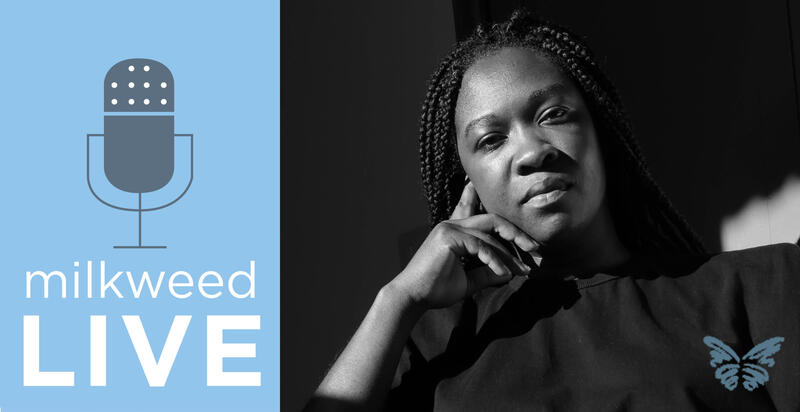
Canisia Lubrin returns to Between the Covers for a live conversation in downtown Portland, at Powell’s Bookstore, about her latest poetry collection The World After Rain. A private book, that Canisia never intended to publish, we explore what it means to write elegy beyond personal biography, what it means that “metaphors unmake the too-made,” what it means to write against the literal, with a folk sensibility and consciousness, and much more. How does elegy relate, formally and aesthetically, to water? What is the utility of poetry, its effect in the world? How can autobiography be a way to move beyond the self? Join Canisia for a deep exploration of these animating questions in her latest work.
The first time Canisia was one the show, to discuss her book Code Noir, her contribution to the bonus audio archive was a reading of as-of-yet-unpublished works by Christina Sharpe and Dionne Brand, and a soundscape she stitched together from six years of touring, from Canada to Europe to the Caribbean. This joins an immense and ever-growing archive of supplemental material and is only one of many possible things to choose from when you join the Between the Covers community as a listener-supporter. You can find out more at the show’s Patreon page.
Finally, here is the BookShop for today.
Transcript
David Naimon: Today’s episode is brought to you by award-winning author Sean Hill’s The Negroes Send Their Love: Poems, Perspectives, and Possible Futures. A groundbreaking cross-genre meditation on the Black experience in America, The Negroes Send Their Love excavates the complexity of heritage, fatherhood, and environmental collapse, and inherited memory. Hanif Abdurraqib calls this collection brilliant and immersive. For fans of Jericho Brown, Terrance Hayes, and Natasha Trethewey, Sean Hill has created a deeply unique yet deeply realized collection. The Negroes Send Their Love, published by Milkweed Editions, is available for pre-order now and in bookstores on March 3rd. Today’s episode was recorded live at the flagship branch of Powell’s Bookstore in downtown Portland, Oregon. Even though Canisia Lubrin and I had been corresponding for years leading up to her appearance on the show in 2024 for her book Code Noir, we had never met in person until this day. Past Between the Covers guest and editor and founder of the press The 3rd Thing, Anne de Marcken, drove down from Olympia, Washington to come, and we all had dinner together before the reading. At dinner, Canisia came bearing gifts that she gave to me to give to you, or more particularly to give to the you that is a listener who isn’t yet a listener-supporter. One is the now out-of-print early chapbook of Canisia’s called Augur. The other two are signed copies of limited edition books: a bilingual English-Spanish book of Canisia’s called What New Map or Qué Nuevo Mapa, and a collection of poetry and performances by four writers—Sarah Tolmie, Nicole Brossard, Margaret Atwood, and Canisia Lubrin—called Fiery Sparks of Light. Another possible thing to choose from if you join the Between the Covers community as a listener-supporter is the Bonus Audio Archive. The first time Canisia was on the show, she read from as-of-yet unpublished work by Dionne Brand and Christina Sharpe and shared a soundscape she created over six years of touring in Canada, South Africa, Kenya, Trinidad, the U.S., Italy, the U.K., Germany, and stitched this all together for us. This joins supplemental readings by Christina Sharpe and Dionne Brand and Myriam Chancy, Sheila Heti, Naomi Klein, and many others. This and many more things to choose from can be found at patreon.com/betweenthecovers. Now for one of my very favorite live conversations to air on the show, where not a minute of our time together isn’t freighted with depth and meaning about one of my favorite books of hers, The World After Rain, here’s today’s conversation with Canisia Lubrin.
[Intro]
Emcee: Hi, everyone. Tonight we’re excited to welcome Canisia Lubrin in conversation with David Naimon, winner of a Carol Shields Prize, Griffin Poetry Prize, and the Derek Walcott Prize, among others. Canisia Lubrin now brings us The World After Rain, a poetic tribute to her mother. In this stunning long-form poem, Lubrin’s signature epic vision is distilled into an elegy to her mother, Anne. The 100 pages of lucid beauty and grief are a meditation on love, time, and loss. Lubrin will be joining in conversation tonight with David Naimon, host of the literary podcast Between the Covers, which is now brought to you in partnership with Milkweed Editions. Tonight’s event includes an audience Q&A, and then Canisia will be up here to sign books for you if you like. You can find the books back there by the information desk, and you can get them signed and then pay for them downstairs at the registers. All right. Please welcome Canisia Lubrin and David Naimon.
David Naimon: Hi, Canisia Lubrin.
Canisia Lubrin: Hello, David Naimon. Nice to see you, and nice to see all of you. Thank you, Powell’s, for the home and the welcome. So I’m just going to dive right in.
DN: So both at dinner tonight and also in interviews of you around this book, you’ve said that you didn’t necessarily want to publish this book. It’s your most autobiographical book. You’ve also said that you don’t have an interest in autobiography. So in a way, we have a book, a private book, becoming public. I guess I was hoping we could start with your thoughts about autobiography, but also your thoughts about this book as autobiography.
CL: It’s a great question. Very David Naimon to start with a softball. [laughter] I’m not exactly sure that I have a profound philosophical answer to this question. It’s mainly that I have a hard time conceiving of a genuine exchange that asks someone else to sit in the stuff of my life. It’s a strange mirror that I’m uncomfortable with. I would want for a more equitable exchange. It just, to me, seems like a lot to ask. It’s not that I don’t think there’s value in autobiography. I just don’t find it personally interesting for me to stare at my own image. [laughs] I find it stops a certain kind of thinking that I like to do. So let’s not ask Freud for any answers to this question. But I very much enjoy staying with the kind of vulnerability that other people extend from an autobiographical source that is about enlarging our sense of relation. I just doubt that I can do that well. When it does happen, I feel actually quite fortunate. So in a sense, this work is a kind of entre nous that is aware, or maybe even painfully aware, of its limitation, and also aware of the world that it enters now, because it was written 10 years ago, put in a drawer, and then left alone. It’s after the prompting of my agent that I said, “If you think so, then I suppose.” But there’s an interesting restraint that I’ve learned to navigate, which is less about staring at a mirror and more about the imperative for a certain transcendence. I think that’s what I’ve found in staying with this book and having to talk about it with people. That it’s taught me something that I didn’t have a grasp of before.
DN: Well, when we talked last for the show about Code Noir, I brought up the anecdote of you bringing to Dionne Brand in your writing group a draft of your book The Dyzgraphxst, and how Dionne said, “Where is the I in this book? There is no I in this book.” You return to the manuscript and you come back with work that has an I, but an I that you call a prismatic or fragmented I. It’s a lowercase i, it’s an uppercase I, it’s a they, it’s a you, and then there’s this character, Jejune, who collects all the I’s, and there’s almost like a polyvocal conversation happening among many selves. It feels like this book is the opposite. I think there’s something I found particularly gratifying about—even though you’re breaking out of autobiography—you’re starting in autobiography and then you’re bursting out. So what you are or what your I is and what your mother is starts in one place and becomes many other things in the course of the reading. Even though we’re not going to spend a lot of time on autobiography, let’s start with your mother. The book is dedicated to your mother. The subtitle is Anne’s Poem. So can you speak a little bit? Can you conjure your mother for us as a starting place? And then we will complicate the presence of mother in the book as we talk.
CL: Yeah, that’s a really good invitation. But I might begin by saying I enjoy what that anecdote about The Dyzgraphxst has become. I think that’s your version of a story. I love that you can keep it that way.
DN: Is it wrong?
CL: Yes. [laughter] Yeah, it is. But I like David Naimon’s version, and I’m going to use that from now on. [laughter] Well, it was in a workshop, an MFA workshop, poetry workshop, that I was writing poems without any I’s in them. Dionne noticed and said, “Where is the I? Where is your I? Write me an I poem.” So that really was the seed for what became The Dyzgraphxst years later. But I really like your version. [laughter] You’re a really good editor.
DN: Thank you.
CL: Yes. So mothers and that prismatic I, which again, I think I was simply bred in an environment that, as we say in certain parts of the Caribbean, is located in a sociality of collectivity of I and I and I in that Rastafarian kind of way. I is always we. So I think that is the sociality that informs much of my own poetics. Complicating the sense of the mother as the figure who, in a more traditional and perhaps also simplistic way, is that figure who somehow has to be everything to everyone and who must escape the forms of fallibility that everyone else can pass through without too much judgment or reproach. A mother somehow has to be short-circuited through the very act of humanness into a kind of super-presence, an answer to every possible need that a human can have. This is something about giving birth and gestating another person. But there are also the kind of socially constructed visions of who a mother is and who that person called mother is allowed to be. I wanted to keep the full fabric, the full complicated fabric, of the person without having to do the easy, or maybe not so easy, but the expected maneuvers around memorializing or in the elegy to want to be nostalgic about an uncomplicated relationship. I think family is complicated. It’s a complicated unit, certainly complicated by many different histories. To allow the mother, or my mother, to be complicated, to be held in the complicatedness of being a person and a human being, being painfully aware, because it is a painful awareness, of the history that created the circumstances of her life and the life that ultimately I inherited. So I wanted that, the full shape and the full dimension of that person, to exist in the poem that I call Anne’s poem. It’s really my mother who just sensed this large—there’s a kind of largesse to who she is that is really instructive for me, because this is someone who was born into very meager material conditions. At the same time, being a child and seeing what she was able to accomplish, that I found utterly inspiring. There are certain things about my mother and her own artistic sensibilities, even though she didn’t have the opportunities that I had, that I feel I am always trying to mimic in the way that I pull myself into artistic sensibility.
DN: You were recently on another podcast talking about this book.
CL: Which one?
DN: I'm trying to remember which, I don't remember the name offhand. But I was surprised because this book is presented to us as elegy. But in this conversation, it became clear that your mother was alive and that some of the tone of the book was influenced by medical racism that your mother had experienced that had resulted in the situation that you were addressing partially, at least in this book. I wondered if you could speak obliquely or directly to this aspect of what's happening in the poem.
CL: It’s a really important aspect of the book because the book began as a confrontation with anticipated grief. That incident that I referred to, I still find that I cannot really be very articulate around it. It is a thing that puts many knots in my own tongue still because I was there and I witnessed and had to advocate for quite a lot. Even the medical professionals didn’t think that my mother would leave the hospital alive. They very much doubted it. So it was a traumatic experience, even for me. What it produced was an outlook that allowed the doctors to say, “Well, she probably has two years.” She’s outlived that. It’s now 10 years, and of course, she’s end of life right now. But it is that sense of being forewarned that I found was too much for me to handle in the non-artistic milieus of my life. I had to find another language, another vernacular for it. So if we really want to talk about autobiography, it is in the insistence of what was available to me as an artist, as a poet. I was actually really thankful for that. So I got home that afternoon when they said, “Okay, she can go home on X day, but she’s going to have to do all of these other things to try and maintain a certain autonomy,” which proved almost impossible, even today, is that I had to put everything that I was feeling somewhere. I felt a kind of disruption, a kind of rupture, that I knew that if it stayed in me as it was, it could make me a worse person. It could change me in a way that would not be pleasant. So I just sat there for 16 hours, and I didn’t know that it was 16 hours until I emerged from those 16 hours and just wrote this thing that became The World After Rain. Because of that genesis, it didn’t live with me as a thing that I would want to publish. It just seemed as a thing that performed a certain life-saving duty. Then it could go in a drawer. But the invitation from my agent was, perhaps there is a life beyond your immediate experience of this thing. I said, “Okay, let’s try and see what that could look like.”
DN: Well, you recently delivered the Derek Walcott Memorial Lecture in St. Lucia. In that lecture, you talk about folk consciousness or folk sensibility or folk philosophy. You talk about an elemental concept of loss, which I think you can see in this book with the weather and flora and fauna really are participating in the poem. You talked about how folk sensibility centers an ordinary person. You also talked about how St. Lucian folk consciousness is a creolization transnational consciousness. I guess I wondered if you could speak to how folk consciousness relates to this book in particular.
CL: Of course, you saw the lecture. [laughter] I think of myself as a folk-wise writer always. I feel angled always toward the folk. It’s because this was my introduction to language as a material of story and song and poetry. That’s really because my grandmother was such a powerful folk storyteller. So the consciousness, for me, the consciousness of the folk is one that is a transformational consciousness that can take the most ordinary thing and turn it into an otherwise way of seeing, and the way that that otherwise way of seeing is deeply implicated in the life that you can make. It’s less about a transaction that produces a nameable outcome. The folk, for me, is most powerful because it’s mysterious. It’s because it knows, perhaps ahead of you who experiences it, that the vision of the elemental is part of what constitutes a character that is particularly concerned about the well-being of oneself in relation to someone else. That someone else does not necessarily need to be a human else. I think this book is that kind of work. It’s concerned with all of these registers of loss because the elegy is a relational form. It is about that sense of being connected to something beyond you, to someone beyond you. That sense of loss can lodge whether or not it’s a human being. You see it happen all the time with people who lose pets, and it takes them years to recover sometimes. I think that there is something to living in this historical moment that is so rife with all kinds of grief—ecological grief, sociological grief, cultural grief. We’re seeing all kinds of disorder happen, perhaps on a scale that we’ve never experienced before as a collective, as a species. To return to the ordinary, to return to seeing the ordinary, and to being buoyed by the ordinary mattering, especially now with the zeitgeist of LLMs and artificial intelligence, this and that, and all of the shiny things that take us farther and farther away from our elemental connection to life. If we don’t appreciate or love the thing, then we don’t mourn it. We don’t see a catastrophe in its demise or in its loss. I think the folk is always a reminder to go back to that center, to go back to that elemental relational sense of just the ordinary being enough. And I think The World After Rain as concept owes much of its character, much of its poetic and musical character, to this motif of rain as both renewal and grief and the intertwining of those things.
DN: Well, there's a line in the book, "Metaphors unmake the too-made, I'll be literal when I'm dead," that I wondered if is related to this folk sensibility in some way. Also the word wor(l)d that has the L in parentheses, so it's also word, which makes me wonder about that tension. Is it suggesting there's much more to the world than word or is the world within the word? But I'm wondering about folk consciousness around both of these things, around metaphor and being anti-literal, perhaps.
CL: That is such a great question. Such a great insight. Because I think the folk is necessarily figurative. It’s necessarily metaphorical. It’s putting a different lens on what we think of as language or what can be represented in language and in a visuality of the fecund, of what is fertile and rich about who we are. So in Caribbean folk consciousness, everything is represented two or three or four degrees at a removal from the literal. Because historically, these stories and these poems and these songs were ways to encode certain historical experiences at the height of colonialism and slavery. So the symbolic is doing a huge amount of work. I think that sometimes the literal can flatten things, can flatten experience and can position us to dismiss what is mysterious and complex about who we are and our sense of relation to each other. So the folk consciousness is an invitation to, at the very least, imagine or practice imagining that the world is more than what we can actually name, more than what we can language. I think that is part of what makes the book The World After Rain most itself, because there’s something just beyond language. It’s because of that, perhaps those 16 straight hours that I spent at that desk, simply letting the word do its worlding, to simply trust that the things that I could not approach with language, that I was able to grasp a certain elemental quality to them. There are certain things in here that I don’t even necessarily understand. They just needed to be expressed.
DN: Well, let's hear some of your words doing some of the worlding.
CL: [Laughs] Okay. So I’ll read from the first section. The poem is in three sections, all of which remix waking in some way. So one, Waking Again.
[Canisia Lubrin reads from her book The World After Rain]
DN: Thank you. So this book, and particularly part one, has these really long lines that feel like they spill forward or cascade forward. The poem itself is aware of this aspect of the poem with phrases like "we tumbling" and "time unspooling, time galloping," and "the engine of longing." Also, this notion of water as form, falling integers of rain, rivering our echo, or rain gathering, gathering into translations. Also the way you call this long poem merely abbreviated water from a shared sky. You've also, as you've already done today, linked elegy and water and elegy and rain. I was hoping you could speak a little more about that, but also about this forward engine or this gallop. So if we could talk about the form, the spilling forward and water as form, and elegy and water as form.
CL: Yeah. I think grief can have many registers and many forms. We all experience grief differently. We might experience grief multiply in the same instance. But there is this sense of fluidity to the music, which is the thing that guided the writing, I think. I was not overly in control of crafting this with an intention to make the lines long. It just felt to me as I started writing that there is something to a sensation of raining on the inside. It felt like I was awash with feelings that were much bigger than my frame could handle. It’s that sense of being overwhelmed in the presence of mortality, even though it’s a cognitive or an intellectual grasp because the strangeness of it is anticipated. It felt real and final, even though it hadn’t happened yet. It’s that mystery, that sense of being in a kind of river that could exceed its bank, could recede, could dry up. Most of it did feel metaphorical in that sense. It was not anything concrete that I can grasp with any certainty. It’s surrendering to that sense of uncertainty that produced that fluid music. I think perhaps elegy, or the form of elegy in The World After Rain, is perhaps a learning through the instinct of anticipating a loss. Because it was not anything that I’d experienced before. It was fresh. I think keeping that sense of newness allowed me to return to the motif of water and rain, and I was just, again, not terribly in control in the sense of having to craft something that would answer to a formal conceit. It just happened as it happened. I was in a state of surrender. But in retrospect, there is something to the elegy, I think, that is about being unrooted or unmoored or, in a way, on a river from the thing that could potentially stop you from living. That overwhelming sense of mortality. It’s so big. It could be so dark that one of the ways we find a way to get through is to allow ourselves to be fluid in time. It’s in that reorienting ourselves around the loss, around that sense of loss, even when it is anticipated, because it’s so powerfully gravitational. This thing met me at a place in my life that was at a remove that I didn’t know prior to it happening. So I think the elegy being deeply concerned with the relational and with the mysterious produces a kind of oracular fluidity. It’s a strange fluidity. It’s a strange music. We always know it when we encounter it. It’s less familiar in abstract. It’s also really hard to talk about in abstract.
DN: You're doing a pretty good job.
CL: Am I? Good. I’ll take your word for it. [laughter]
DN: There's this wonderful part in the Derek Walcott Memorial Lecture in the Q&A. It's an extended moment. The Q&A is maybe 30 minutes long. An older man gets up and asks you a question. He says, basically, "As I get older, more and more, all that I care about is something useful. Is there a utility to what's being written?" And then you ended up in a conversation with him about the 70s in St. Lucia and in the literary world versus now. But you also brought up that relative to its population, St. Lucia, I think, has less than 200,000 people. Just the immense amount of contribution, disproportionate to the size of the island, it has given. But it became a community conversation in that Q&A about, are we doing enough here? Are we doing enough? What aren't we doing? And there was a tension between all that had been done and what does the poetry do. The reason why I bring this up is because the epigraph to your book is by Derek Walcott. It's the phrase, "At the end of this sentence rain will begin." I remember when I had my first conversation with Dionne Brand, she talked about this phrase of Derek Walcott too, and how she has to believe that when she writes, that the thing that she writes is going to happen, which also reminded me of there's the Russian writer Daniil Kharms. He wrote, "If you throw a poem at a pane of glass, it should break the glass." I guess I wanted to ask you about this epigraph for you, but also about this question of poetry and effect, because your book opens with this suggestion of Walcott's that so many of the people in your Walcott Memorial Lecture were also asking is, at the end of the sentence, will it rain?
CL: So I think I said something to the effect that because the artist is involved in an activity, and for us, let’s say it’s language because we’re writers, which is weighted with many ethical questions to begin with, because this is the material by which we find ourselves animated in a sociality, we want that the art will do something, will serve as a utility. I think we often want the art to work in a way that is tangible and visible and measurable. But I think art doesn’t necessarily care about that desire of ours for it to break glass and for it to cause rain. Because I think its activity is much more clandestine. It’s that each individual has an encounter with art that can produce something that no external structure has the capacity to mediate and therefore to measure. You might have an experience with art one night and then wake up the next day altered. I think that is what is so frightening for the despot. That’s what’s so frightening for the tyrant that wishes to have a single version and a single vision for the world, which is always a utilitarian one. It’s always that something has to be useful in the direction of a measurable gain that we can think of as capital. But because I think art moves in a way that doesn’t necessarily require an audience and a trumpet, while at the same time it is happening in that context, that’s the great paradox of art. I think we’re stuck in this ouroboros of endlessly asking for something that we know on a fundamental level is not happening in the way that we’re asking it to happen. So I don’t know what’s wrong with us. But this question seems to stand the test of what we call time. So that epigraph, “at the end of this sentence rain will begin,” it’s from Derek Walcott’s Map of the New World, Caesarea of Odysseus, and of course he’s making a kind of echo to Caribbean history in the moment of anti-colonial struggle, moving into a new age of itself that you can look into a mirror that is perhaps more triumphalist in terms of one’s place in the aftermath of a really horrific history, then to have the autonomy to say this sentence, which I take as upon having to draw oneself out of captivity and for rain to stand as symbolic for hope, for something new, for some other kind of renewal, a shifting of the lens, so to speak. I think that’s the way poetry moves. That’s how it moves in the world. It’s a shift of the lens. It’s a quieter form of transformation. You know that when you’ve encountered a poem that profoundly affects you, that you look at the world in a different way, even for a few moments. That can be a powerful thing. We don’t have a barometer of reward around that. But I think art is concerned with an entirely different set of materials for us, not necessarily something we can measure with the stock exchange or something that, as I said to Kendall, who’s a wonderful St. Lucian poet, the poem might not be able to cure malaria, and I would like that if it can cure malaria, but the effect that that poem has, we trust it nonetheless, and we know that even though there’s no shards on the floor, that a glass has broken somewhere.
DN: Well, one way you could look at this book, or look at this book in terms of a main character, it could be time. Booklist said that you make time atmospheric in this book. I really like that as a framing because there is one sense in which we are carried forward in the river of time. We feel this rush of time, but there’s also another sense in the book where we’re apart from the river of time and looking at time. So time feels like a weather in this book. But there’s also a way, maybe this relates to poetry and effect, there’s a lot of repetition. A lot of the first lines mention time. It almost creates an incantatory effect. So you think of language in spellmaking. Here we’re accumulating a sense of linguistic momentum with this repetition of time. I’m just going to read a couple of those lines, and then we’d love to hear more about time from you. So here are some examples: "I am keeping time, mama, the time of stop signs and swarms. It is time I run. I run one day into the next, into the time of games, this gameness of homes on the graveyard of origins. It is time unspooling past, time galloping. It is time harvesting hit and runs. It is a sometime-ish time for the animals. In this time of roads closing for walking, is it time again for rivers? Imagine living things, billowy, torrent time portraits." Talk to us about time as a subject.
CL: So part of my engagement with time, I do think of time as weather, as atmosphere, as everywhere-ness, as simply is-ness. I don’t think of time in terms of chronology. To me, it doesn’t quite work. It doesn’t seem true. Because the way that memory works and the way that experience intertwines with memory can collapse huge swaths of time. Something, a scent or sound or taste, can put you back in your five-year-old self for an instant. It seems like something extraordinary. It seems like a gift, or it could be even terrifying. Then there’s this sense of causation. I think grief is a thing that can often disfigure us. That’s certainly how I felt. I felt disfigured in that realization of anticipated grief. I could not recognize myself. I think time is one of the ways that we measure how we reorient ourselves around that disfigurement to try and rescue something that perhaps would slip either notice or something less temporary. So I think the way that we mark our experience of those we love is through time. We’ll say we want more time with a person, or I would have appreciated less time in that conversation, or if something’s not worth the effort, you’re like, “I got no time for this.” So it is a way that we tend to make sense of our experience and a way that we measure our being amongst each other. In that disfiguring work of grief and certain kinds of grief, the flip side is where love is. We don’t grieve what we don’t love. And I think one of the ways that we make sense of the subject of spending time, of being in relation, is through this sense of knowing that things are finite, that we put the effort where we think it’s worth it, and we have all of these external signposts. We know that on a day in 1994, the sun was yay in the sky, and there was this thing happening at that time. Even in the way that we story our experience and our memories, we say, “Do you remember when? Do you remember that time when?” And so that’s really what I’m carrying in that incantation. It is a spellcasting, a way of holding on to more where grief would seem to present less.
DN: I like that you use the word disfigurement because the line that I love the most in the book is “vital pulse of undoing.” It feels like everything or everyone becomes disfigured literally into something else. Like you say, I am dense, damp grassland. The final line of the collection, “the thing you least expect will mother you.” We arrive at a place where your mother is still your mother, but also many other things. Mothers are many other things. Distance is even potentially a mother. But before we open it up to Q&A, let’s hear something from section three, which I think is a very different section formally than section one.
CL: Yes, that is true. Section three is new waking. So in a sense, I had to also transform the repetition that was happening here in the previous two sections.
[Canisia Lubrin reads from her book The World After Rain]
[Applause]
DN: For the Q&A, if you’re okay having your voice on the podcast recording, I’ll just hand the questioner my microphone and we’ll go from there.
Audience Member: Thank you for beautiful talk and beautiful readings. I am curious to hear about the specific waters of your home, which I assume infuse this book. Water seems through and through. Is there a type of water, a presence of particular waters that are in the book for you?
CL: That’s a great question. Thank you. Yes. Actually, when I think of my life, my early life, which were the formative years, rain is a constant presence. Many forms of rain, drizzles, hurricanes, tropical storms. There is the Caribbean Sea, the Roseau Beach that you can see from our yard. There’s a river, a mighty river that flows to the Roseau Beach that comes down from the mountains and could swell without warning because the water would start from the mountains where you don’t really hear it. Then it comes down into the valley, which is just a serpentine wound toward the estuary. There was a lot unpredictable about that river. One of my very favorite sensory experiences in the world is the petrichor. After a really hot day and then there’s a brief drizzle and that scent, I would probably spend money I don’t have to have that repeated every single day. It’s a thing that I really love. So I’m glad that you asked that question because it is partly one of the things that I feel incredibly enriched by, even in terms of how I think about the world and how I think about my experience of things. It’s probably through all of these various iterations of water and rain and the presence of water in my life. I often feel that I need to be close to water. If I’m too far away from water for too long, I start to feel alien. I just think there’s something deeply important to nourishing. It’s not just on a biological level because we know we can’t last very long without being close to water. But there’s just something, I think, that reminds me to not take things for granted. Things can change really quickly. That changing is the point. That’s the point. So even loss and that change and changes we don’t want and changes that disfigure us are the point.
Audience Member: Thank you both for this. Thank you for the book.
CL: Thank you, Anne.
Audience Member: All right. So I think this is a “will you talk about it” kind of question. Or "what do you think about this" kind of question? [laughter] So I think you said these words. It’s recorded, so we could check. Referring to the book, "the life of the life-saving thing after these 16 hours of pouring yourself into it," pouring yourself out of you. Then the conversation shifted to folk, folkways, and it made me think about the book as a folk object, the clay into which life has been breathed, and how you don’t really want this to be a book, but it just was without you wanting it or not. It has its own life. So what do you think about books as folk objects and things that have lives of their own, a kind of agency, or maybe as interlocutors across the non-chronological time?
CL: Yeah, that is a really great question. I happen to think, I was talking with a poet friend from St. Lucia, John Robert Lee, and I was saying that, to my mind, all of the great canonical works, what we think of as the great canonical works today, were the folk objects of their time. There’s no Dante without the folk of Italy. There’s no Homer without the folk of Greece, et cetera. All of these major classical texts have at their foundation the folk sensibility, and the substrata of them is there. So I tend to think of literature as the representation of our folk imagination, no matter which form it takes, that we can have things refined and transformed and even talismanic in certain ways. So there is something to insisting on life at a terminus, at a point where something has to change, where something must find a different register to live in. For me, that’s the passageway from the folk to the literary. For me, it’s a very important bridge. So I think generally my objects, my books, are on some level uneasy with their literary identity. I think they’re much more committed to the folk sensibility. I think I’m always trying to replicate that somehow. I have to be okay with the dissonance. The question I ask is, “Is it generative? Is it interesting dissonance?” And if I think the answer is yes, not necessarily because someone else will think it’s yes, I think there’s something to that folk object that is ultimately really instructive. I don’t know if that answers your question, but yeah, it’s what it makes me think.
Audience Member: Yeah. Thank you.
Audience Member: Thank you both so much. I wrote down my question because it’s easier for me. So there’s a prophetic nature to this work. It was written in anticipation of a grief that has not yet come to pass, but we cannot anticipate that it will come to pass. Your mother will die. What has its production done to your sense of anticipation, the feeling of anticipation, and what has been your mother’s response to this work?
CL: Thanks for the question. So the way that I understand it is that that grief belongs to anticipation. It doesn’t exist outside of anticipation. The thing that really stuck for me was that my experience is not singular. There’s no way that I’m the only person on earth whose experience anticipated grief. Mostly, we hear of the tragic forms or the abrupt forms, but not the anticipated forms. Because grief, just like the elegy for me, is relational, there’s an invitation to have an exchange with someone. I could not have that conversation with myself or by myself. It cannot go in only one direction. So the grief belongs to anticipation. The second part of the question was what has my mother’s reaction been to the work? So my mother is basically bedbound. There’s not a whole lot of communication that’s going on. It’s just been a very slow journey to the inevitable. So I don’t even have an expectation for a reaction. But she is very much herself and present, even in that very slow, I think in the book I call it a “long, godless thinning.” She still has a powerfully wicked sense of humor when she can muster the strength to be engaged in that way. The cues and the communication is mostly nonverbal. So there’s going to be smiles and what the day allows. It really changes from day to day. But again, part of the mystery of living in that world, in that world of anticipation, is that it’s hard to place expectations on things. So she’s the book of it, in it, and has her own reactions, which are mostly tears or some other thing. There’s no conversations going on in that sense. It’s not part of the book’s life.
DN: Well, ending with your mother like we began with your mother seems like the perfect way. So let’s give it up for Canisia Lubrin. [Applause]
CL: Thank you.
DN: Today's program was recorded at the volunteer-powered, non-commercial, listener-sponsored, full-strength, makeshift home office of me, David Naimon. If you enjoyed today's conversation, consider transforming yourself from a listener to a listener-supporter by joining the Between the Covers community. Every supporter can join our brainstorm of future guests, and every listener-supporter receives supplementary resources with each and every conversation, of things I discovered while preparing, things referenced during the conversation, and places to explore once you’re done listening. In addition, you can choose from a variety of other things as well, including the rare collectibles Canisia offered for us, also the Bonus Audio Archive with a wide variety of contributions from past guests, whether Canisia Lubrin reading future as-of-yet unpublished works of Dionne Brand and Christina Sharpe, Jake Skeets reading and analyzing the poem “Hills Brothers Coffee” by Luci Tapahonso, Natalie Diaz reading Borges, Leanne Betasamosake Simpson giving us a sneak preview of new music, Roger Reeves reading Ghassan Kanafani, Omar El Akkad reading Jorie Graham, and much more. You can check it all out at patreon.com/betweenthecovers. Or if you prefer a one-time donation, you can do so by PayPal at milkweed.org/podcastsupport. Today's episode is brought to you in part by The Seed Keeper by Diane Wilson. Winner of the Minnesota Book Award, The Seed Keeper is a haunting novel spanning several generations of a Dakota family’s struggle to preserve their way of life. Robin Wall Kimmerer writes that this novel invokes the strength that women, land, and plants have shared with one another through the generations. Weaving together the voices of four indelible women, Diane Wilson tells a beautiful story of remembering our original relationship to seeds and, through them, our ancestors. The Seed Keeper, published by Milkweed Editions, is available wherever books are sold. I’d like to thank Craig Popelars and Claire Barnes and the whole Milkweed Editions team for welcoming me and making this partnership a reality. Finally, I’d like to thank past Between the Covers guest, poet, musician, composer, performer, and much more, Alicia Jo Rabins, for making the intro and the outro for the show. You can find out more about her work, her writing, her music, her film, her teaching at aliciajo.com.