

Between the Covers Live / Fiction / Hybrid / Nonfiction / SF/F
Milkweed Live : Creature Needs with Thalia Field, David Naimon & Anne de Marcken
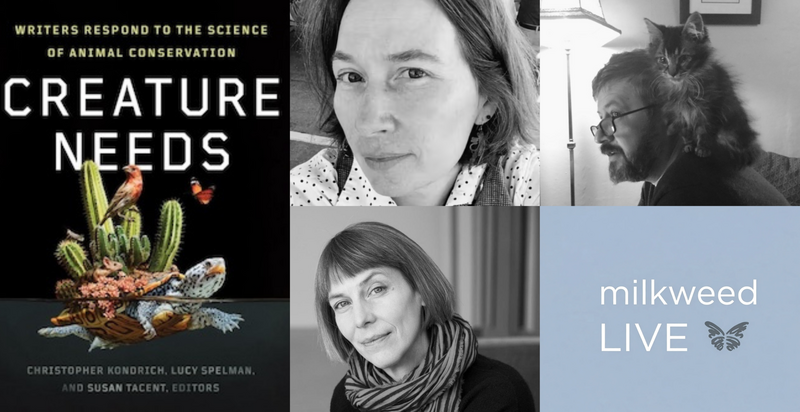
Today’s conversation between Thalia Field and David Naimon, moderated by Anne de Marcken, was recorded in February as part of the Pacific Northwest College of Art’s Visual Arts low residency MFA program. Thalia and David discuss and explore their pieces within the anthology Creature Needs: Writers Respond to the Science of Animal Conservation, where each writer was given a scientific study to engage with and create art in relation to. As a result, side-blotched lizards, boreal toads and the green cutthroat trout all help make up the cross-species chorus of today’s conversation, one that isn’t just about making art in relation to science, but also about interrogating, through art-making, the assumptions baked into the scientific frame, and using art to reveal the unexamined stories hidden within that frame. Looking at other non-normative modes of scientific inquiry, ones where the line isn’t so bright between art and science, nor the subjective and the so-called objective, Thalia, David and Anne explore the various possibilities and pitfalls for art-makers and writers when engaging with the more-than-human world.
If you enjoyed today’s conversation, consider joining the Between the Covers community as a listener-supporter. Find out about all the potential rewards and benefits of doing so at the show’s Patreon page.
Finally, here is the BTC BookShop specific to today’s episode. And don’t miss Milkweed Editions own BookShop bookstore as well.
Transcript
David Naimon: Today's episode is brought to you by award-winning author Jake Skeets' newest collection of poems, Horses. As a visionary literary voice and the Navajo Nation's third poet laureate, Jake Skeets captures a fast-changing Navajo landscape in the face of environmental destruction. Horses begins with a meditation on 200 horses found dead, mired in mud that had once been a stockpond on Navajo land in Arizona. Employing the Diné language throughout, Skeets captures with tremendous emotional depth a queer Indigenous poetics that is inextricable from a connection to land. Joy Harjo dubs this second collection an astounding book, while former poet laureate Ada Limon writes, "It is singularly stunning." Horses, published by Milkweed Editions, is available wherever books are sold. During the first 15 minutes of today's conversation between me, Thalia Field, and Anne de Marcken, it becomes clear how this event came to be and why. So I won't repeat myself here, but rather I will speak briefly not about the how or the why, but about the what of it all. This is a recording of an event hosted by the Pacific Northwest College of Arts Low Residency Visual Arts Program in collaboration with PNCA's Low Residency Creative Writing Program. The first person speaking is Ryan Pierce, the chair of the visual arts program, and a great artist himself. I'll point people to his work in the resource email going out to supporters. The occasion of the event is a conversation between me and Thalia, moderated by the writer and past guest of the show, Anne de Marcken, about our pieces that appeared in the anthology, Creature Needs: Writers Respond to the Science of Animal Conservation, where each writer in the anthology is given a scientific study to engage with and create from. Beyond Thalia and my presence in the book, you'll notice other past guests of the show, such as Eleni Sikelianos, Sofia Samatar, and Mary Kim Arnold. There are Milkweed Editions authors, Beth Piatote and Rajiv Mohabir, and other writers many of you will recognize by name, whether Kazim Ali, Amy Bender, Juliana Spahr, or Craig Santos Perez. So I encourage you after today's conversation to check out the anthology, Creature Needs. If you enjoyed today's conversation, consider transforming yourself from a listener to a listener-supporter by joining the Between the Covers community. Everyone who does can join our collective brainstorm of who to invite as future guests and receives the supplemental resources with each episode. Then there are a ton of other things you can choose from, and one of them is access to the Bonus Audio Archive, whether Forrest Gander reading poems written in collaboration with a lichen scientist, Richard Powers reading a poem about trees by W.S. Merwin, Carl Phillips reading a medley of Black Swan poems by others and then by him, Elvia Wilk reading from Death by Landscape, Ted Chiang reading an essay about what is behind Silicon Valley's fear of superintelligent AI, and much more. You can check it all out at patreon.com/betweenthecovers. Now for today's conversation with Thalia Field, me, and Anne de Marcken.
[Music]
Ryan Pierce: Good afternoon. I'm Ryan Pierce. I'm the chair of the Low Residency Visual Studies Program, which is part of the Hallie Ford School of Graduate Studies, which is part of the Pacific Northwest College of Art, which is part of Willamette University, which is part of the ever-resilient landscape of higher education, which is, for now, part of the world. On behalf of this cohort and our sister program, Low Residency Creative Writing, it's my pleasure to welcome you all to a conversation between three writers that I admire very much, centering a topic that's dear to me, animal conservation, and more broadly, what it means to make art in an age of extinction, climate catastrophe, and abundant despair. This event arose because two of our guests, David Naimon and Thalia Field, contributed to a remarkable collection of short works called Creature Needs, edited by Christopher Kondrich, Lucy Spelman, and Susan Tacent, and published last year by the University of Minnesota Press. The editors invited a who's who of contemporary letters to use scientific studies as the spark for works of poetry and short prose about the six basic needs of creatures to survive and thrive. The book is arranged accordingly with sections on air, food, water, shelter, room to move, and each other. That is, we need each other, human and non-human alike, now more than ever. At the risk of over-introducing everything, I want to contribute just a sentence or two about each of our guests, and then I'll pass it over to Anne de Marcken, who is our actual moderator for this event. Thalia Field's literary project seems to be invested in blazing a light into the abyss of misunderstanding that impairs human connection to other species. In her much-lauded genre-agnostic collections, such as Personhood and Bird Lovers, Backyard, Field asks her readers to consider how human language shapes the world we encounter in ways that limit our own ability to fully understand it, including especially to fully comprehend animal consciousness and, I suppose, animalhood. David Naimon is beloved to many of you as the host of the Between the Covers podcast, a master class in deep reading and long-distance community building that exemplifies a model of creative citizenship I'd like to aspire to. Humble, unhurried, committed to fostering a dialogue about how writers engage with the thorniest and most meaningful themes through their work. Some say the podcast archive is better than getting an MFA, but in the name of job security, I'll just say that it complements an MFA really well. David is an accomplished writer in his own right and the recipient of a Pushcart Prize. He's a scholar, collaborator with, and legacy builder of Oregon's forever artist laureate, Ursula K. Le Guin. Our moderator tonight is Anne de Marcken, author of most recently It Lasts Forever and Then It's Over, winner of the Novel Prize. This is the book I have most pressed on friends in the last two years, but I have no idea how to describe it. It's a zombie novel in the sense that Proust's Remembrance of Things Past is a book about sponge cakes. Anne also runs the small press The 3rd Thing, which publishes interdisciplinary and hybrid works whose forms necessarily resist easy categorization. So that's our crew. This is my first time using the Riverside platform, so what could go wrong? You can put questions in the Q&A feature, and we'll get to as many as time allows. Thank you so much for joining us, and please welcome our moderator, Anne de Marcken.
Anne de Marcken: Ryan, thank you so much. Thank you for that introduction. Thank you for sparing me from trying to introduce David and Thalia. What a disaster, making an introduction with David Naimon in the room. So I appreciate your wonderful attempt. Such a generous introduction. Thank you all who are gathered here from far and wide. Thank you to PNCA and to Creature Conserve for really creating this reason for gathering us together today. I'm so happy to be with you, Thalia and David, also everyone else out there. We regretfully can't see you, but we know you're there. We sense you. So thank you for joining us. As Ryan said, you can put your questions in the Q&A and we'll make sure that there's time for those coming up. First, I'll ask some questions. I'm going to have David and Thalia read a bit so we can get a feel for their pieces and for the way the anthology operates to the extent that Thalia and David's pieces are so very different from one another and the collection of work together is wonderfully uncategorizable. I would just say that although having not attempted an introduction of the two of you, I really feel so honored to be here in this position and in the slightly precarious position between you two people whose thinking and work I admire so much. You both were the poles, the first and nearly last and most favorite experiences I had of bringing my own book out into the world a couple of years ago. David, I got to be in conversation with you in Between the Covers, and Thalia, you made Rhode Island Providence my favorite stop on my book tour. It was wonderful. So this book, the little blurb about Creature Conserve in the beginning says, "This book emerged from the work of Creature Conserve, a non-profit outreach organization dedicated to bringing together artists, designers, writers, and experts with scientific and traditional knowledge in a supportive, welcoming space to learn about threats to wildlife, share empathy for animals, exchange ideas, and find opportunities for growth at the intersection of art, science, and conservation." It was edited by the founder, Lucy Spelman, and two of the writers in residence, as Ryan said, Christopher Kondrich and Susan Tacent. The book calls itself a polyvocal call to arms about animal extinction that harnesses the power of literature and scientific research to stir our hearts toward action and change. It invites, I think, about three dozen contributors, and each of you were paired with a paper, having chosen which of these five essential requirements for life you wanted to be categorized in. David, you're in water. Thalia, you're in air. I'll just say a brief introduction of your two pieces that doesn't say really what they're about, and then have you read a bit. So, David, Where One Thing Begins is in the water section of the anthology and takes as its starting place a study that is ostensibly about the impacts of one non-human species on another, cutthroat trout on the boreal toad, but really is about the unintended consequences on toads of an effort by humans, human conservationists, to reinvigorate the trout population in a region of the Rocky Mountains. So three separate species are embroiled in this complex relationship. Thalia, your piece, Jump/Scare, is in the air section, which strikes me anyway as a not entirely natural position for this work, except that it did originate with a study of the effects of wind turbines with the descriptive, although perhaps not evocative title, "Ectoparasite Load Is Reduced in Side-Blotched Lizards (Uta stansburiana) at Wind Farms: Implications for Oxidative Stress." So this is where you began. Each of you had these as starting places, these papers. Thalia, why don't you read first from Jump/Scare, page 43, starting with scene eight.
Thalia Field: All right, Jump/Scare. Scene eight, interior, University of Utah Laboratory, a few minutes later.
[Thalia Field reads from Creature Needs]
ADM: David, are you ready on page 114?
DN: Yeah, I want to do just a brief introduction before I read, if that's okay, because one of the circumstances of this all happening is Susan, one of the editors of Creature Needs, reached out because there'd been a lot of Creature Needs events over the course of a year, and I hadn't participated in any. She reached out to see if I wanted to do a public event. I said that I would be interested in doing one if I could do one with Thalia. The reason why I said that, other than just as a reader enjoying her work, is because I feel like my piece and also a lot of the thinking that I do is indebted to the thinking that she has done. I wanted to just preface what I'm going to read in the aura of that, because while we're all paired to a scientific study in this work, something that Thalia and I share is not just an engagement with the study, but an engagement with the shell or the frame of the study. And what are the implications of the way science is conducted? But not just that, Thalia is deeply involved in this piece, but also in her book-length works in questioning the frames of history and archives, and also narrative or story frames. I think all of those are evident in the piece. So the piece, in a weird way that I'm going to read, is about shells. I mean, it isn't really about shells, but it's about like how the cochlea in our inner ear is a shell. The outer ear is a shell. The scientific study is a shell. I mean, you could take this further. Marx talks about the laborer and the means of production are like a snail and a shell. So the way capital is produced is when you separate the snail from its shell. Hopefully we will talk about what are the implications of frames or shells. But in this case, the part I'm not going to read, the first part of the section, is looking at the differences between fish, amphibians, and humans in the way that we hear. So we have hairy cell bundles as humans that are very nested deep within us and are hermetic versus, say, a fish that has them covering the length of their bodies. So halfway through the piece, once we've established differences in listening through our various shell-mediated hearing devices or non-shell-mediated hearing devices, it moves into a fictional space, but a fictional space on behalf of nonfiction. So that's where I'm going to read my little part.
[David Naimon reads from Creature Needs]
ADM: Thank you. Also, thank you for prefacing the reading, which I think really establishes a nice starting point. I was going to start somewhere else, but let's just keep going with the idea of the shell and the frame and the way that you each establish the terms, the narrative terms, and how the narrative terms, how they create the possibility for not objectivity, but awareness of subjectivity within the supposed objective space of scientific study and observation. I love that you conjure the name of Italo. I don't necessarily know which Italo, but I felt like you spent the first part of that piece, of your piece, establishing what in Italo Calvino's essay, Exactitude, is the second part of three for writing in Exactitude, which is an evocation of clear, incisive, memorable visual images. What you do, you begin by summoning this constellation of emblematic images that you use and are taken up throughout your piece, which create this network of relationships, a web of relationships between toad and fish and human, very much via our ability to apprehend the same phenomenological world. So there's this kinship, the phenomenological kinship created. Similarly, Thalia, in the introduction of the screen conventions, the conventions of screenwriting and persistently used throughout the breaking of the piece into scenes, the use of language like close-up, tilt down to move in on, slow montage sequence of lizards, I think it's lizards waiting in cages, you create this superstructure for us to encounter. Beyond that, the evocation of the tropes of the monster film, the startle, the jump scare, and the immediate debunking of the supposed lizard brain, so that really the reader becomes the main character in the piece. We have this self-aware presence of the reader of monster movie about a monster that we're not sure who the monster is. So you introduce this hyper-reflexivity via form, via the form of the screenplay and self-awareness of the tropes. Is it reflexive for you at this point? Is it just what you do and how you work? It certainly tells you how I know your work in a way. But how did you find that form? How did you find your way in? Is it necessary in order to consider the non-human to rely on form?
TF: That's a very interesting question. To talk about David's piece for a minute before I talk about my own. I mean, what I thought was amazing about David's work here was the structuring of that kinship and analogy and the convergent evolutions and all of the ways in which there's a kind of blurring of species boundary when it comes to large scale of time or, you know, meanwhile, simultaneously, we have to acknowledge a situation that is ripe with tension. I guess that leads me to my one thing I think about mostly, which is this notion of a situation which is complex and multivariable. I guess that's where conventions of narrative or conventions of telling numb us to our awareness of situations often. So I don't really think of form as something predestined in a piece. It's more that there's an awareness about how we succumb to the numbing of conventions. I felt like the scientific article that I was given in particular really was so conventional and so narrow. The fear in it and the confusion in it, I don't know. It just really evoked for me the sense of the way in which we indulge and codify fear. I didn't start with the idea of the jump scare. I mean, that evolved as I worked with the piece. I hope that answered your question.
DN: Can I ask Thalia a question from there?
ADM: Yeah.
DN: Because I loved seeing that there was this filmic aspect, obviously the Jump/Scare itself, the horror tropes, the tracking shots. Because when we talked for Experimental Animals, I ended up quoting from a Dalkey Archive Press interview that you had done, and then ended up for many years after that, quoting it to other authors. I remember with Jeff VanderMeer and other people and sharing it with writing teachers and everyone who wrote this piece. But I think it speaks to something that you're doing with film in Jump/Scare. I'm just going to read it and see if it provokes any thoughts for you. "What I call human-centered poetics is where the scale is human, the time is human, (i.e., weeks, days, months, years) the landscape is human, the psychology is human, the crises are human. It’s become equivalent to the cinematic in that what we consider 'human' is eminently filmable, or able to be conceived in terms of edited, visual screens. Cinematic prose contains consistent scale, in space and time, and the human figure, whether in close-up or establishing shot, predominates. This aesthetic holds because ultimately we don’t spend a lot of time in the awareness of our world without ourselves as tragic heroes of it. Larger timeframes or scales rarely occur to us. Participation in the chorus of other creatures seems impossible, and it’s scarcely imaginable to write ourselves out of the picture altogether."
TF: I think, for example, here, I think the scientists are the fear. I mean, the humans are more of a sense of a, like, love or power. I say that we become an ineffable force. The scientists in this particular scenario really embody that, even though we can capture them in certain visual shots and stuff. But I think this piece is in some ways the inverse, or I don't know, it's working with that what you read a little bit differently, because in some ways it's the narrow scientific jargon and the narrow scientific logic that is, that's the cinematic coding here. You know, it's like we're used to the conventions that make us have a response. The startle versus the jump scare. These are just, who is the monster and where is the fear? Really, it's a roving question in this piece.
ADM: I wrote down, "the problem is the problem" when I was reading your piece. I have this sense that the experimental problem is the problem in the story. So the monster in the story is the scientist. The question that the reader is almost in a state of misdirection from the beginning.
TF: Right, that notion of misdirection that we're constantly like, there's a problem here, but we're creating it, which is a little the same as David's piece. I mean, we have a similar, we were handed these, just so the audience knows. We were not choosing these articles. They were given to us. But we have a similar conundrum in our pieces, I think. I mean, David's piece really decays into the body, into an embodiment that is so complex and so irreducible that it becomes a different kind of question altogether. I mean, that's why I think that piece is so beautiful.
DN: Thanks.
ADM: I have also this sense of it moving from the figure to the figurative. I mean, decay is a wonderful word in that it is so evocative of the physical, of the body, and of the breaking down into constituent parts, and also evokes sound. Sound decays as it moves away from us. The piece relies so much on notions of sound and hearing and apprehension, a different kind of apprehension than fear. I wonder if you could talk about what for me was a move from the figure to the figurative, from the body to the idea of a folktale. Really, the epigraph for the piece is from Sabrina Oremar's The Silence of Witches. So conjures the idea of the folktale, the fairy tale, immediately. Of course, the excerpt that you read begins with "Once upon a time." So you really are moving from this literal to a different kind of knowing, a different kind of being with.
DN: This is where I think also Thalia is an inspiration because back when she wrote Experimental Animals, and a lot of that book is using literal primary sources from the archive, which by definition highlights what isn't in the archive. So you're collaging all these mainly male voices to conjure a time through a collage. So the collage makes it fictional in a way by the placement of actual non-fictional material. But then she has to rely on the imagination in service of what isn't in the archive. So the erased or never present female voices or the voices of animals. In this case, you see that again. The lizards here have faces in this piece. They experience pain. So it's fiction in the service of something. I mean, not more than fiction, but it is weirdly fiction in the service of, like, that book is called a reality fiction. So I think there's something similar going on in my piece, for one. I choose for sure that the fictional scientist who enters the piece is a poet-naturalist. So just to nod back to a different tradition of science where maybe sketching something and writing a poem about it is actually part of your engagement with it and not separate from your engagement with the scientific process. Because what's happening with the frames where we are studying but not being studied is it's re-inscribing the problem that we're supposedly studying in the first place to solve. So I just gathered a whole bunch of quotes. I'm going to read one. This is Bayo Akomolafe when he says, "When is the imperative to take in the 'full picture' an obstacle to transformative differences? We often privilege 'big picture' analyses, systemic appraisals, macroeconomic perspectives, and knowledge production values that urge us towards getting all the data and then making a decision. There's something geometrically striking about this urge towards completion or saturation: it risks positioning us - the knowers - as outside the analysis, external to the 'system'." I feel like even though what's interesting about all three of our works is that Thalia is talking about the lizard brain and the way we use it as this mythical thing inside of us, this reptilian part of our brain, we use it as a way to blame something other than us for our fear and our hunger. But even that fictional thing, I think, is somehow also true because you say also in the piece that we don't have the language to describe fear any more than we do love or beauty. I think about, like, we are made of things that we don't have language for. I mean, it's not a lizard brain, but Anne's book has a crow in the chest of the protagonist and the crow speaks with a syntax that's not a human syntax. My piece is looking at the different aspects of our hearing that we're indebted to creatures that are nothing like us. So we have a middle ear because of what amphibians decided they wanted to do. But even like this notion, because boreal toads can listen through their lungs and they can listen through their mouths. But we can too. I mean, we don't need to go into the why of this, but I spent a period of time without eardrums. You discover that you do hear through bone conduction, through your jaw and through your mastoid bone. You can hear without the things that we devised through the amphibian wanting to be able to hear in water and air. We are composed of creatures that are not us, like we are. To de-center this question of agency, you have to be implicated in the study. You have to be in the frame. So the way that the scientist is sitting outside of this study that I have, or two endangered species, can they be reintroduced into this lake and not harm the reestablishment of each other? It's never asking, well, why do we have to ask this question in the first place? And how can we implicate ourselves in that question within the actual study of that question? And so I guess the answer around the figurative would then ultimately be, we have to bring in the imaginative. We have to subjectify the universe. As Ursula Le Guin would say, "Look what objectifying it has done." I mean, not that there aren't perils to subjectifying, but we know we're living the perils of standing outside of the frame.
ADM: I think there's a line in your piece, David, that to me says every single thing there is to say, which is "the pain is in the lake." Like to me, that gets to exactly for me where we go beyond some concept of ourselves as outside, you know.
DN: I quote from Le Guin's, she has this essay called Telling Is Listening. Part of why I quote from it is because I'm using this notion of the way toads can hear through their mouths. So you have this notion, telling is listening seems like a conflation between the mouth and the ear. But in her, she uses as a model for listening, which she doesn't see as a receptive thing, but as a joining in. She uses the sexual activity of amoebas. So amoebas, sometimes they reproduce alone, but sometimes they decide to reproduce by creating this tube or channel between two pseudopods. So they open up the barrier of their individuated bodies, and then they pass through this tube genetic material for a while and hang out. She uses that as the model rather than a mechanical model that you have two delimited individuals that are passing material A to B, that actually the listening and the telling is not just conflating the mouth and the ear, but it's conflating the you and the me, I guess. So the you and the me part is the thing that science is allergic to. So, like, not just poet naturalists in the West, but you see in many other scientific traditions around the world and even in ancient times, or even particularly in ancient times, you see the gathering of knowledge happening. The gathering of knowledge and the writing of poetry and song and illustration is all of a piece.
TF: It really makes me think a lot. I mean, the purpose of this book was to galvanize a kind of energy, and I think it's really like, what are we not looking at? What do we not pay attention to? You know, what are the omens and the clues and the hints and the worldly events that we're not paying attention to? And so I think that the project of listening to science is really important because scientists, like everyone else, look with attention in certain generic ways, often very codified. As you're pointing out, David, rarely in Western science does it go beyond, I think, the limitations that we're calling attention to here. But the urgency of really getting past our conventional thinking is really where art can function, I think. It's just that of bringing that awareness to what we're not aware of. Paying attention to just storms and weather and the clues of nature that we're part of, that both happen within us and through us, that's where science and art come together because there isn't a distinction there. I think you're calling attention to places in which that's been the truth before.
DN: Also, I think like when you're giving an interiority to the lizards, but also your employment of a biting humor points to the problems with the study. Like they're studying the oxidative stress response of side-blotched lizards. So how can you study the oxidative stress response when you've just bagged the lizards, [laughs] painfully labeled them, thrown them in a car trunk, and then brought them to a lab? And it's not really a spoiler. I mean, it is a spoiler to your piece to say that they end all being killed. But it's pointed in your horror story that that's just considered a given. Like the subjects being studied will be killed.
TF: But this is a situational awareness that scientists, I feel, forego for the sense of abstraction. I mean, there's a willingness. I mean, this is what I was interested in when I was studying laboratory culture. You know, the culture of physiology, the history of this laboratory science is really a turning off of awareness, of pain, of suffering, of communication, of all the clues and cues of the world, and the situation that you're in. So I'm interested by that, by these figures, these major scientific figures whose determined legacy is a kind of dulled awareness, whether it's Konrad Lorenz or Claude Bernard or whoever. But I feel the same thing in a lot of science. Now, that's not to say that there are not millions of conservation scientists out there doing extremely good work. You know, this anthology really looks to artists to take on this work and make something of it. I wish the opposite anthology were also true where scientists were asked to really change their practice a little to become more situationally aware, more conventionally aware about what limits how they tell their stories.
ADM: Yeah, the limits of their practice. Where I imagine starting the conversation is really with this question of the idea that artists are not a new idea to this anthology, that it is the work of artists to make the science compelling, to make people care, to breathe, well, truth into facts is the language of the forewords. I can't help thinking about the conversation that I was recently in the audience for between David and Canisia Lubrin, in which Canisia makes a compelling argument against the utility of art and the impulse, the instrumentalization by empire of art is entirely resistant. Art is just like uncaring about this impulse and cannot be made to function. It does feel, I do understand the premise of the collection and appreciate it, in fact. But I think I appreciate even more how far off the rails the two of you went, that you really did not breathe truth into the facts of the papers, but rather looked at what the revealed truth of the papers is that the scientific premise is flawed here, or the presentation of the information points to a different set of problems, a problem with the unfeelingness of the killing of the lizards, or the narrowness of the concern about the introduction of one species into another, into the habitat of another. So I'm interested in what you think about that. It's this, it was bound to happen, that art was going to go off the rails because it can't be forced to work. You can't make art do a job and have it also be art. Or maybe you've already proposed the answer, which is that the reverse is where it's really at. Have the scientists read the writer's responses and make studies that reinvigorate their work.
TF: I mean, I think there's just as much bad art as there is bad science. I mean, I have no romantic view of art as some, and art is often in the service of terrible things. I'm not sure what I'm saying by saying that. It's just that I don't want to, like, there's brilliant art in the service of things and there's bad art in the service of things. I mean, I just...
ADM: Maybe there's the question, right? What's the difference of the utility of art and art in service? Because certainly I work in service of things, of ideas, of feelings more than anything. I will have a sense of something and I am working towards something. I'm shaping toward a sense of wholeness that is informed by purpose. So there's some difference between the utility of work and work in service. I think you both did, to quote Lucy Spelman, who says the writer's job is to make the real feel real. I believe you both did that. You did, for me, make the real feel real. But I am, having not had the source materials, having not had these studies, but having a sense of them from your work and other pieces in the anthology, I have a sense that the real wasn't necessarily what they thought it was. Like the real of the study, Thalia, that you had wasn't necessarily about the presence of the parasites on the lizards and whether or not they had a stress response, but rather the study itself, the nature of the study is the real that I have a sense of, a felt sense of having read your piece. David, likewise with your piece, although I understand immediately the problem of the introduction of the trout to the same stream in which live the boreal toads. The water's where the pain is, is a different kind of real that your work is in service of.
DN: I mean, I would say that at least for my piece, but I think of Thalia's work this way. My piece was working against taxonomy or against category, which is a critique of science also. The way science is conducted, not a critique of science as an enterprise, but that my piece hopefully has elements of all genres or is no genre, that it moves between genres, that you start to blur the sound of what a toad makes and the sound of a flock of Canadian geese, and then the differences between what a fish is experiencing, a toad and a human, and that continuum. Because there are these unexamined stories within science that change everything about science, and they're not just frames. I mean, they're different stories. They're narrative frames. For instance, the onus is on a scientist to prove that an animal has emotions, that the onus would be that way rather than the obvious opposite way, that we might start with the presumption that what we see in a dog's eyes when we're hanging out with it is emotion, and that the onus would be the other way to prove that it doesn't have emotion, already is a story. Whether you're on one side of that story or another, it's not objective. It's not impartial. So, like Frans de Waal, who was studying empathy in primates and other animals, for years he was made fun of, even though he's proven incontrovertibly now many species that have high levels of empathy and will forego immediate gratification on behalf of their perceived communities. Because it's working against, it comes originally from Abrahamic traditions, I think, but like this idea of human superiority, so this is supposed to be an emotion that's only for humans, and you're doing a study, it uses all these feminized things, you're being romantic, or you're being sentimental, or you're succumbing to your feelings or your fellow feeling when you even propose this as a frame for a study, that this other creature could share this with me. I think there's no reason why science can't also be about what we share rather than what differentiates us. Of course, there is a ton of science now coming out. Notably, I think a lot of it's by women, obviously not all of it, but like Suzanne Simard with trees and the mother trees and trees that are moving nutrients across other species of trees. I don't even know where this began, my answer. I don't even know what I'm answering anymore. [laughter]
ADM: I like it.
DN: But there's still science, like science doesn't think that there's a story. They think they're starting in this value-free zone, white walls, white coats, humans are not in the frame. We are bringing nothing to it except this subjective space. Really, we're operating from stories and we defend those stories in order to defame other people who want to do counter-narratives. So I guess if you're asking about utility in my piece, I would say, ultimately, I'm trying to write a piece formally and in content that is a counter-narrative to the premise of the study that I was supposed to do. It's not particularly against that study. I think that study within the framing of our society is a valuable study. For all I know, it was well conducted.
TF: It really does matter. It matters because definitions, I mean, such as what involves a species. I wrote about this a bit in Bird Lovers, Backyard. I mean, there's no agreement on the idea of a species. It's a complete mystery to everybody. But yet we pretend and we parade around like we know what it means. So it matters if we're going to defend endangered species because bureaucrats and capitalists, as Juliana Spahr so wonderfully put it at the end of her piece, everybody's got a toe in the game or whatever you say. I think that the language around it and these definitions do matter. So I think there's an involvement of artists who care about language because there are real-world situational implications around all of this. I think that's part of what you're talking about, David, is that to engage this idea, in my opinion, we have to look at these languages, the stories, and where we fit in that, our own pathetic fallacies, our own need to be comforted and in the story and see it through our metaphors and our language and our poetry. We have to critique ourselves there. Like artists are as much involved in this, in my opinion, as scientists are, because we reproduce this human-centric art constantly. We put ourselves center frame and we put ourselves in the tragic hero. It's all that I said before. I mean, I think that the more we do it, the more we reinforce this idea that we are front and center.
ADM: And that it is manifestly true rather than a received form, which, I mean, in some ways that I feel that the acknowledgement of the received form in science is a saving grace. That there are ways we do this, the scientific method as such, rather than the illusion of inspiration that infuses so much art, that it just comes to the artist, that the story just comes through them. Rather than having been received, rather than being informed by all of these notions of who is primary and of a hero, of a narrative arc, all of these things that come down to us.
TF: Well, and I think we have to acknowledge that there's in fact so much we don't know or understand, that no matter how much we take it apart and analyze it, we aren't actually going to reproduce that scientific modality, that we're not doing that, that we don't control it all, even art. There's too much mystery and unknown. We don't know how to act or behave. We do everything backward and wrong. We're just as much part of the circumstances as the agent of anything. Somehow, to release ourselves from this need to be as though we're alone with our work, with our thoughts, like we're not alone. We're all together in it. Somehow we don't make art that feels that way.
DN: Just to add something from science, because I like what you said, Thalia, about the question of whether we even know what a species is and how we're reproducing these forms, including, I would say, the form of the individual and maybe the lonely individual, but also humans is the only repository of knowledge and intelligence, and the only agents or actors in the world rather than all these other actors, and what could science look like if it was participating, truly acknowledging agency elsewhere that we don't understand, like the lizard brain, like the crow in Anne's book, like our mysterious shell in our inner ear? But this is from physics. This is from Karen Barad, quantum physicist. It's a term she coined called intraactivity instead of interactivity, because interactivity re-inscribes that we start as two delimited beings that are separate and then we interact. So, intraactivity: “To be entangled is not simply to be intertwined with another, as in the joining of separate entities, but to lack an independent, self-contained existence. Existence is not an individual affair. Individuals do not preexist their interactions; rather, individuals emerge through and as part of their entangled intra-relating." This is coming from science. Of course, it's not coming from clinical trial science, but it's coming from legitimate quantum physics theory. A lot of people in art are like Fred Moten uses Karen Barad's work, questioning of the particle, the questioning of the individual, other people do in poetry and in philosophy. But it makes me think of that around the species, like all these things that are getting reproduced as givens that are being reproduced because of stories, really, not because they've been proven as such.
ADM: I want to ask a very straightforward question. Well, it's a straightforward question, and I'm imagining, you know, if I were to try to answer, it wouldn't be a straightforward answer, but we'll see what you have. I'm wondering, in this uncanny pedagogical nowhere, somewhere that we are gathering here today, there are a lot of students, I wonder if you have advice to writers, to artists, to scholars for approaching the mystery in fact. So how do you approach what is unknown, how I'm going to say this, because for me, I feel it is knowable. Mystery is knowable. It's a sense. You can feel it. There's a presence. I mean, what you just read, David, it feels very relevant in science as well as in art. So how do you approach the more than human without turning it into either it, either into metaphor or spectacle? So how to incorporate mystery into this endeavor to encounter one another without resorting to pure abstraction or spectacle? Practical advice. [laughs]
TF: Yeah, that's hard. I guess the foundation of how I think about it for teaching is really that we have a relationship to our work, that it isn't something we make in some "I-make way," that it's a relationship. Because it's a relationship, it develops in process, and process itself is always involved in other processes. The notion of a process approach means that you're not rushing to understand or to nail down or to construct. You're really gathering, you're trying to get to know, you recognize the difference between different kinds of knowledges as you work on a piece. As you develop this relationship, the basis of relationship in a lot of ways is that you're involved with an other, respect for its mystery. I mean, that in fact, the whole purpose of being an artist is to respect the mystery of the work. How to teach toward that is really difficult because I feel like a lot of workshop culture is actually designed to basically make writers miserable and mush them and detach them from their sense of relationship to their work. So my own personal pedagogy is really just to develop a healthy and sustainable relationship. Everybody should have that, no matter what it looks like or how long it takes. That's the most important thing. Again, so that mystery question has to do with not rushing to answer, to knowing the different kinds of knowledge that we have about the world, about ourselves, about work, and how it all is about process and change. Anyway, so that's where I come from when I'm working with other writers and myself, obviously.
ADM: I'm curious about how you cultivate that relationship with your work.
TF: By really actually a lot of awareness about what a relationship, the wisdom that we have about relating to what we don't understand or other, what's outside us. That to get outside of our habits, to get outside of our own fears and needs to control, what is the wisdom that we know about process and what's the wisdom that we know about relationships? And you don't force things. You don't sit alone in your room and decide what something is. You have to go encounter it. You have to be with it. For artists, that's through our practice. So you have to constantly practice. Through practice with the piece, you develop the relationship and you get to know it. But this is a slow process. What happens is people often show their work too soon and then other people come in and mush it. I mean, I really give a lot of time to the gathering of getting to know this thing. Part of getting to know it is getting to know what you can't know, right? We will never know some things. But I liked what David said in the sense that we all co-arise with each other. This is, I guess what I mean. It's all relationship and process and change. So teaching from that perspective leads to work that's always going to be great. Because that greatness is inherent in that respect and trust and love that comes from really taking the time with a piece.
ADM: That's great. David, advice?
DN: I feel like I'm the wrong person to give advice. A, I've never been a teacher. B, I have no books.
ADM: I'm not asking how you would teach it, but just as a writer. You're certainly a writer.
DN: Yeah. Maybe the two things I guess that come to mind is I think of finding your form or anti-form. I think I wasted a lot of years trying to write in traditional short story form. Now one of the big influences for me was Elliot Weinberger's form, which are these non-fictional modular pieces that move like poetry, but even though they're nonfiction, they read fantastically. Maybe that brings in mystery when you don't know what you're reading. One way to bring in mystery. Also, I think of how Le Guin would argue for how unnatural realism is, that all of our great literature is fantastical, whether that be the Odyssey or Hamlet or Don Quixote. Not that there's not great realist, she's not saying there aren't great realist novels. But throughout our time on the planet as storytellers and writers, the fantastical is the default mode for humans. That actually writing without the imagination is really unnatural. Like to not have the imagined in your work in a realist situation is very bizarre and not the normal for the human psyche. But also when you look at fantastical works, it's like Chinese scrolls where the humans are really small and you see these giant landscapes. You have these giant mountains, you have huge skies, you have all these creatures, some of which you're familiar with and some of which you're scared of or you don't know. There's a lot of not knowing. I mean, not that all fantasy, I mean, there's tons of regressive fantasy as there is regressive sci-fi. But in its best notion, you're a small part of a huge world and you only know part of it. So already right there, you're situated as minor in something large that's not you. So there's mystery and then there's also all those creatures. Then with that in fantasy, you're imagining all sorts of other things, whether that be magic or creatures that don't exist. But even not, even if you were writing realist eco nonfiction, you could write it that way. You could write the world with humans on a tiny little piece of it.
ADM: I mean, if you were writing realism, how could you write it any other way than humans in the corner.
DN: Classically, the novel arose with the notion of the individual and with the Industrial Revolution, with this idea of it as the ideal vehicle for one single human consciousness. I mean, of course, there are counterexamples to that, but we think of them because they are counterexamples. But nowadays, like so many novels where maybe the only non-human things are a houseplant and a cat. There are a lot of novels like that where we're really with several minds the whole time, human minds.
ADM: I'm looking over at our Q&A. We have several questions lined up and some others actually that are in the chat and not in the Q&A, which is totally fine. We can jump between them. Ryan, do you want to pop back in or I can actually go back and forth, it feels like, but you might have been keeping track. Do you have a sense of if there's a place to start?
RP: Sure. I'll rematerialize here. As a brief aside, David, I invited my students to make this a Valentine's Day date. So your digression about amoeba reproduction, I thought was really on topic. [laughs] That probably turned up the heat for some couples or bestiaries out there.
DN: I hope so. [laughs]
RP: M Freeman asks, "Did writing your pieces change you in some way, and if so, how were you changed?"
TF: David, do you want to go for it? [laughter]
DN: I don't know. I mean, I like writing pieces where I learned something, so there was something nice about diving into the material that's not in the piece, just learning about amphibian sensory reception and fish, and then trying to come up with a fable that used real anatomical similarities and differences between the three of us in a fictional scientific space. It's the same with the show. When I do prepare for conversations, I think the thing that keeps me interested is like, I usually start from a place of not knowing. Then through the preparation, I can approximate knowing with the guest enough that I can be in the same conversation with someone who does know more. So I guess that would be the way it changed me. I feel a different conception around the ear, which my piece was really about the ear. So.
TF: Yeah. I mean, I similarly, I guess I would say that I didn't know a lot about, I wanted to know more about the lizards, which was, of course, frustrating because the science was not at all about the lizards ultimately. I guess that absence was intriguing. Also, I guess I don't know much about film. I'm not a film person and I did learn a lot by trying to look into the conventions there. So, I agree with David. You always learn when you write. I mean, I always learn when I write, because I don't know where I'm heading. So it's always an interesting journey.
ADM: Great. I'm going to pick up with Susan, one of the anthology editors. "Hello, a note wrapped around a question. No instructions were given to the 39 creative artists who wrote for this collection other than word count limit for prose and page limit for the poets. Folks could choose from the six basic needs we all living beings have, and most did choose one or the other, and no one saw the entire puzzle until the book was in their hands. Fact and fiction decay on every page to reassemble as one connected whole." But I don't see the question mark, so I'm going to make a question out of the note. I'm curious about how you took the whole book, how you received it, and third thing, I'm currently editing and have put together several different anthologies or things that pass for anthologies since we're always doing things that haven't been done exactly like that before, but we're always aiming for a sense of wholeness rather than a beginning, a middle, and an end. What gives this thing its wholeness? And I wonder how you would describe the nature of this book's wholeness?
DN: Well, I mean, the obvious frame of the different categories that the editors envisioned.
ADM: I like that.
DN: I mean, all the way they created and held the space. So pairing art and science, which in my case, became an interrogation of art and science, or using art to interrogate science on behalf of science. But not everybody's was like that. So you could be in the category of air or water with someone else who has a more friendly relationship with their scientific study.
TF: I loved to see the whole book. I thought everyone's piece was passionate and interested and I really liked it. I also thought there could be 20 more categories. I kept thinking of new categories like privacy or feelings. There are so many things that we all share. So I did think, oh, wouldn't it be interesting to keep going with the categories?
ADM: I'm so glad you said that, Thalia. That was one of my questions. Like, what other things belong on this list or what alternate set of essentials?
TF: To me, privacy, awareness. I mean, these are part of the same endangered species world problems, I guess I would say that we're all endangered. We're all endangered. Why are we all endangered? So, power, competition. I think that there's a lot that I would continue to ask about that science could continue to ask about. I mean, this is where there's some interesting places to push a little, I think, on where the potential collaboration that science could also budge a little here also.
ADM: Yeah. Okay. What are each of your preferred ways, intentional or incidental, of connecting with the non-human world or de-centering yourself?
TF: Yeah, that's rough. [laughs] Obviously, making work is probably my primary practice in life. But I do try to work always with animals in some way. I'm part of a group in Rhode Island, the Congress of the Birds, and we do wild bird rehabilitation under the amazing leadership of Sheida Soleimani. The learning that goes on because of all of the traps that it is very easy to fall into working with wild animals is a constant learning experience and a humbling experience. So I think that that for me, unfortunately, I can't work directly with the birds anymore, but I'm still a big part of the organization. The experience of the fumbling nature of our effort to help, it's just a daily exercise in wonder. Also, just a daily reminder in the human-caused suffering that we inflict is just extraordinary, even on the most local levels. So people like Sheida who do saintly work every day at the border of life and death and pain, it's an amazing thing to watch. So, being in the trenches with the effects of human action on animals, I'd say.
DN: I think the main non-human creature that I'm engaged with is my computer screen. [laughs] But mainly I'd say it's through humans, through talking to both of you, through talking to many people since both of you and before both of you too, about these questions. They're longstanding questions for me about living and also about making art, I think. Even, I mean, one of the most recent conversations with Sangu Iyer, who was working with orphan chimpanzees and looking at the issues around that, Robert Macfarlane, were two that jump out in the last year that were really doing that. In an embodied way, I don't do it nearly enough because I'm a walking human-shaped podcast.
ADM: [laughs] I do actually think that talking to humans is good. Interacting with actual non-humans and talking to humans, done the right way, both of them can really help. Okay, so this is a different kind of question. How do you recommend overcoming imposter syndrome for students trying to make a space/career for themselves in this niche, underexplored movement of blending art and science?
DN: That's out of my wheelhouse, I think. I mean, I can't speak to careers in this regard, but there's a ton of people doing this in ways that are not similar to each other. I mean, I could think of in poetry, Juliana Spahr, who's in this book, Forrest Gander, Arthur Sze, our US Poet Laureate, Jorie Graham. I'd say they have little in common with the techniques and the tone and the approach that they do. Then in fiction, you're going to find a million iterations of that as well, let alone people writing about literary theory or writing about philosophy with regards to narrative. Like Amitav Ghosh has whole essay collections on questions of human and non-human representation in narrative and also the history of narrative.
ADM: It sounds like you're saying the very diversity of voices in the field should help alleviate any sense of being an imposter?
DN: I guess maybe check it out and see what moves you because there isn't a way to do it. There's a whole bunch of exciting ways to do it. Some of them will probably speak to you rather than because everybody's doing it in different ways, you're going to succeed too more, maybe decouple career from the art-making. When thinking about the art-making, try to find something that excites you about the formal and aesthetic choices that certain writers are doing. Maybe you're going to find that they have a posse of other writers that they're in conversation with, that you can join that conversation.
ADM: Yeah. I don't know about this imposter, the imposter syndrome aspect of it. I'm sure that I have felt this, but I think when I'm doing the other thing that I think, I'm answering this too, that I think is harder, which is trying to listen to what I'm trying to say when I'm in the work, that is actually practicing. I think going back to what Thalia said, actually doing the work, practicing writing, I think is where the sense of authenticity comes from. That sense of your own authenticity, sense that you are legitimately endeavoring to do the thing that you can do. That if you're doing it, you're doing it. If you're attempting it, you're attempting it. I think also that is helpful, the idea of attempt, of rehearsal, that everything is always being staged again and again, that there's no arrival. It's attempt after attempt, rehearsal after rehearsal for some production that's never going to be put on. That, I think, is important to separate yourself. What, David, you said about banishing the idea of the career. When you're cultivating the one, the career can be pretty damaging to the other.
TF: I guess all I would add is like, I think I agree with what both of you just said. I think that when you're working in that relational thing with a project, there's a reason that you are called to that project. Like there's a reason that only you can do that project. So there's no imposter there. There's just you and the work. That calling, that feeling of being compelled, I think that's the hedge against that. Also, just your work will suck along the way. That's okay. You're going to write shitty things a lot. That's okay, too. So it depends on what point you're talking about. But anyway.
ADM: Absolutely.
DN: I think a complementary yet minorly countervailing point to Thalia's is that when you're doing something like the Creature Needs Project, I'm presuming that Thalia didn't know a ton about side-blotched lizards before she started, and I didn't know anything about boreal toads or the green cutthroat trout. So you do start from a place of, I mean, not necessarily an imposter, but of utter ignorance, and then find your way towards something that is meaningful and relational, like Thalia was just mentioning, that only you can do. Like someone else in that book had gotten my study, it wouldn't have looked anything like what I did.
ADM: The goal is not to become the expert or the real thing, but to just do the work, right? So the imposter of what exactly? Like, what are you pretending to be? But yeah. Benjamin Parzybok writes, "I'm not sure how much this question dovetails with your specific pieces, but in the last couple of decades has raised the awareness of cultural appropriation to the point where there is a micro industry of sensitivity readers," not a phrase I'm familiar with. "But when attempting to write from the consciousness of non-humans, we don't have that luxury. Yet, giving voice to other species on this planet feels more vital than ever. I'd love to hear you speak on how you think about writing from or about non-human perspectives and what you might advise for writers doing so."
DN: My cat is a sensitivity reader from all of my more than human writing. [laughs]
ADM: I can't believe you actually didn't name her, that you said you have more contact with your computer screen than Zora.
DN: It's probably true, though, sadly.
TF: I mean, I think that's a very complicated question. That's a question that has obsessed me for a lot of my writing life. I've tried to answer it a lot of ways just by trying stuff out. That's, I guess, what I would say is there are traps and pitfalls and horrible ways to ventriloquize into others. But there's also ways in which you can really empower a narrative by just the shock of not being bound conventionally to how we're supposed to think or feel or participate in language and in storytelling. So for myself, I don't have an answer. I feel like it's really a trap that we're in that we need to constantly emerge from. For me as an artist, I do it as many ways as I possibly can, so that I can feel my way around the question. But I definitely don't have an answer to that question.
DN: Yeah. I mean, I think Ben knows many of the writers I might think of, like Jeff VanderMeer or China Miéville or Ursula Le Guin or Octavia Butler. A lot in science fiction and fantasy that are puzzling out alternate narratives. I mean, I think of Embassytown by China Miéville, where the species has a different physical set of double vocal cords. So there's this entire linguistics that emerges out of that book that the human protagonists have to engage with this culture based on an anatomical difference in speech that creates a different formation of language. That's not really an answer to the question, because they're not animals. I mean, they are animals, maybe, but they're aliens. But often it feels like aliens are stand-ins for creatures that we don't understand.
TF: But when you think about the idea of this anthology, like where science unvoices animals to such a degree in certain ways, like we look, it's observational and descriptive, but it's silent when it comes to the, you know. So in this case, I would say what's so important is to ask, well, what would an animal, what are the voices that, what's the perceptions that's missing? What's the subjectivity that's being abandoned here? And so I think that it depends partly on context. I think this anthology points exactly right at that question. Or at least when you're working with science, when you're trying to engage these urgent questions, then that question you're asking is quite urgent also. Yeah.
ADM: Okay. A question from Alissa Hattman. Hello, Alissa. I'd be interested to hear you both talk more about your thoughts around characterization, human and non. Thalia, in your piece you write, "It's never really about the characters, though, if you think about it. They are simply the vessel for the feelings of the reader. They are the carriers of atmosphere, the screen on which the real projection occurred." David, your choice to include the poet naturalist in what you said about how de-centering also means implicating the self. Just curious to hear more about these vessels we call character. Great question.
TF: That is a really good question. So in my piece, I mean in a horror movie, which is so genre-ed, it doesn't really matter. You know what all the characters are. It doesn't really matter who they are. They're stand-ins for the affect that is being evoked and for the impact of the frame or the shell, as David was saying. So in that way, it doesn't matter. It doesn't matter who the lizard is. It doesn't matter really who the fish is. They fit into the scientific study a certain way with a certain kind of trajectory. It's the individual at the center of it. That character doesn't quite matter because really what's more important is the genre. So I guess that's what I meant in that quote that you're doing. But I do an exercise with students frequently. Like, what's the difference between character and landscape? You know, what's the difference between character and anything? Again, it's like a species. What is a character? It's a non-existent category. So as an artist, looking at what is an event or what is a character, these are questions that are important to ask. We don't inherit that. Be careful not to just inherit that as though it has a certain predetermined human shape, I guess. You know, we mostly have it in a certain human shape. Anyway, that's my answer.
DN: That's my answer, too. [laughs] I feel like I'm slowly over time less and less interested in characters. Obviously, I'm interested, I think everyone's interested in characterization. But maybe characterization that gets decentered from characters, we are not as concerned about grading characters. I don't know. On the one hand, the poet naturalist in that piece, in implicating the self within the study, it's based on the idea that a poet naturalist doesn't automatically feel that their feelings when they're in the presence of another creature, a plant or an animal are contaminating the study. They are engaging in their own feelings that arise out of being with this other being. That creates art. It creates observation. It creates illustration and maybe something else. But on the other hand, the characterization happens in the piece through syntax and rhythm and repetition and through formal decisions, like to have modular prose poetry and then have it move more associatively rather than narratively. Because there isn't really a story in my piece, though I think there's movement in the piece. You don't spend a lot of time in the poet naturalist's interior psychological mind. You're in it a little bit, but it's more at the interface between the action of the poet and what the action of encounter is creating perceptually. I don't think the poet-naturalist really is having a story of movement necessarily themselves more than the piece is having a movement. I think Anne disagrees with me.
ADM: [laughs] Well, I'm not, I don't disagree with you entirely. There was a lot in there. I think it maybe just doesn't ask the question, I'm thinking about how you could think of it if there is character, but character doesn't function the same way, rather than just the necessity or non-necessity of character in a piece and that the role of character is malleable and more capable of more and other than we have allowed. I would say that in both of these pieces, in your piece, the character is not driving story and that that is a mode, that is a received mode for character. We have to know what they want. We have to find out what their motivation is. We have to give them obstacles. They have to encounter those obstacles. They have to have setbacks. It's all about the character and what they want and what they really want, secretly want. That's not happening in your piece, but it does feel that there are characters. So I maybe misapprehend or misunderstood what you were saying about it, but there are collective characters. There's a confounding of that traditional kind of character by time and the fact that the time scale is very large and also oscillating between a sort of persistent now and a long ago. But I do feel that the toads are a collective character, and maybe there's even a coral toad trout or ear, maybe ear is character. So that there's a vaster conception of character. It's not an absence of character, it's just a different nature. So am I disagreeing with you or agreeing with you?
DN: No, I agree with what you said.
ADM: Yeah, and Thalia, I said earlier about the character in your... I think I'm not sure if I've said this or not, I thought about this about the casting of the reader as the main character in this piece because of the noticing, the making of the reader very aware of their casting them in the role of the movie watcher. And I began to anticipate the jump scare having been told about the jump scare. So I think it's, it's almost like you've described character as such. You've made character a character. You've made audience a character and monster a character, but without actually casting for the role of monster, if you know what I mean. So that you've revealed the shell, the shell itself, the shells of characters are characters in your piece.
DN: So in either piece, are our characters like classically psychologically present? Like we don't know their childhood, we don't know their family of origin, we don't know who they're friends with, we don't know anything relational about the humans in the story.
ADM: Right. And yet you also don't—I don't experience this anyway—make the move to inhabit a non-human consciousness. So there's inequality to how all the humans and non-humans are treated and that nobody's motives are really explored so much. There's a little bit more. The scientists have a villainous quality about them.
TF: Well, the little mite gets a close-up.
ADM: He does. Well, everybody gets their little mite gets nothing. [laughs]
TF: I mean, this is the thing is even the viruses and the bacteria, there's so much that isn't even in the scene, but is in the scene all the time. This idea that we have some kind of unified, autonomous character is already just such an old, I mean, it's just silly. But the ways in which that, the art could take that up, but science could take that up. I would love to have as much science taking that up as art taking that up.
ADM: When you paid special attention to the mites, I was so pleased because they weren't mentioned as a life form. You know, the fact of them having lower distribution, that they're not being that as many in these wind farms, was troubling to me. That it wasn't the subject of the study. Clearly, they're not doing well in these wind farms. Anybody worried about the mites? [laughs]
TF: Exactly. Who do we worry about? Right. Exactly. Yeah.
ADM: Susan writes, "It occurs to me to say that each piece in the book is ushered in by an excerpt from the science article itself. I wonder about positioning the science article as another character," the scientists bear that burden to an extent, "I wonder about positioning the science article as another character inextricable from the rest of the story." Alissa says, "Yes, I love that idea, Susan." So do I. Science as character and article as character. I'm imagining that was true in a lived way. You probably spent time with the article the way you might spend time with a person. Maybe more than you spent time with other things, than with lizards or toads or trout.
DN: Yeah, in my case, because both of the species they were looking at were endangered, I wanted to go past the article to find out when were they endangered, how long ago was that, and what was it like before they were endangered? Which I nod to a time when boreal toads were abundant and also the time when the trout became endangered, which is the state fish of the state that they're endangered in. Not that that really matters, but.
ADM: Well, just in the sense that it's risen to the level of character in our culture is a state fish.
DN: Right.
ADM: I think I'm going to go back and, if we have time for one question or another question from my list that relates to something with this about the opacity and unknowability. I guess, do you see a value in preserving the opacity of animal consciousness? And I would say human or non-human animal consciousness and foregrounding what cannot be known.
DN: I find that important for both non-human and human consciousness. The art that I want is art that recognizes the limitations of language regardless, I guess. That somehow that awareness around the limitations of description is part of the sensibility of the person writing the book.
ADM: I guess I'm asking that in relation to the question about appropriation and the solutions, like strategies for that. Shining the light on the failure feels to me like a strategy or showing the attempt to know and the failure to know feels strategically possible to me. It's something I've tried. I'm going to tell you, you said you've tried everything and I absolutely believe it. I've seen your excellent attempts at knowability, and the mystery is very present and very important in your work, for sure. The inscrutability of an other. I think it's probably the one that I've tried most in terms of strategies is to point out the unknowable, to point out the gap, the failure, the misdirection, the moment where you get lost instead of connecting. But doesn't get at really what the question was of appropriating.
TF: This is a very complicated and difficult question. A lifetime of work can't even get near it. But I think for me, more than the inscrutability has been a question of harm. I feel like yes, the entanglement of our language and the force that we inflict through a kind of analytical narrowness, I would say, but really, it's about how language masks awareness. I mean, to me, it comes down to a kind of masking of fundamental awareness. That fundamental awareness has to do with harm. Somehow we are just so good at layering on bullshit so that we don't see harm directly in front of us, no matter how loud it's screaming. That is a mystery. I mean, that's the mystery to me is just how much ignorance we're capable of living daily and all the time. So somehow if the work can just scrape at that ignorance for myself even, just to get into the problem, into the situation enough, not to answer it, but to bear witness to it. So it starts to sound very abstract when I start to think, that's what I guess I wanted to say. It's not really about the mystery in some literary or aesthetic sense. It really is about the kind of ignorance that language seduces us with, the false comforts, all of that, that keeps us from knowing the harms that we're doing.
DN: I don't disagree with that. I would just say that for me, the mystery is more about preserving the agency of the creature I don't fully understand. It's not just linguistic and aesthetic, I guess, but I think you can do 500 contradictory strategies to get there. You can have flat characters. You can have The Passion According to GH by Lispector, where it's intensely within the psyche of one person and a cockroach, but extremely deeply interior subjectivity to the point of mystical merging and horror. But there can be mystery in both, I think, opposite strategies.
ADM: Okay, I think we have time for this one last question, but I will read Susan's comment aloud. "Your piece in the book, Thalia, broke my heart, and your last comment did so all over again. It's a good kind of pain, and I'm grateful." Then finally, this question from Amos Ledger. I'm going to mispronounce this name. I apologize. I think the answer to this is yes. So I'm going to say, elaborate, please, up front: Is there a form other than printed text that is suited to share non-human-centric narratives? Orally, maybe? Or eschewing language entirely? Can one leave a human-centered environment and act as the author of or audience to a narrative without words? So I think, how, what, say more, because I feel like the answer must be yes. [laughs]
TF: I couldn't have done Experimental Animals, for example, with sound. Like, no one could have bared two seconds of it, which is people already told me, "This is impossible to read. It's disgusting. How could you put this torture in there?" You know, and I had to take out so much. Like, this is nothing. I felt like I gave the G-rated version of what was really going on. So I think that oral, sound, to go to David's piece, we would not be able to tolerate the sound of pain that is in the world. I don't think we could tolerate it for one second. Unfortunately, I think visually we're probably pretty deadened because we live in such a bombardment of visual stimuli, of visual shock. But I think sound would be impossible. That's my opinion.
ADM: I love that you said what can't, what form will not work. Yeah. Sound.
DN: Yeah. I mean, dance and theater and song.
ADM: Feels like yes, yes, and yes.
DN: I mean, it just all points to how far away we are from everyday life ways that are in communion with other creatures now. If we were to look back at pre-colonial Indigenous life ways, this question would be inconceivable. I mean, you'd just be doing things all the time. Like, everything you were doing, every practice you were doing probably was connected to story and to a song and to some sort of movement and was probably done among other people in your community at the same time.
TF: That's a great point. Yeah.
ADM: I just want to say that I wish I could reel off the list of examples to point to people doing this because I know people are doing exactly this in all their media. I have zero doubt, including sound, that these are what we attempt in words, others attempt in their ways, with the same range of failure and success and with the similar questions and other questions that are formally specific and materially specific. I love the idea of the interaction of those things and the invention of those things and the limitations of those things requiring innovations that we don't think of with language.
TF: Yeah, that really made me think, David, what if there were pieces that had to do with the seasons or the weather or took place in the environments that these scientific things or just that engage a kind of embodied... I love what you said. I think that's exactly right. I don't practice in those areas, but I think that's an enormous place of exploration for artists. I think that's terrific.
ADM: The first thing I thought, I'd been reading this question, was what you said, Thalia, about the ways that you engage, you work with birds. That feels like the most essential when I think about a practice, a creative practice. I think about a whole range of engagements with the world, which include just being outside every day or being in relationship in various ways with the world. Those are a form of not only not representation, but I don't think we're talking strictly about representation when we're talking about creating. They are a part of a creative practice, those ways of being with the world.
TF: Although I wish I had about 10% of David's brain. [laughs]
DN: I don't know about that.
TF: I really do. I mean, there's a lot of ways to be smart about art and literature, and I respect everyone on this chat so much. I can't thank you all enough. I'm really grateful, Anne, for your smart presence and for your work, which we didn't get to discuss enough.
ADM: This is wonderful. What a pleasure and honor. I feel like I just got to spend time in the room with the two of you, and there's really nothing better. And you all, Ryan, thank you for this and everybody who came and the questions. Great questions.
TF: And I do want to say also, Ryan, just a big thank you to Susan and to all of the Creature Conserve group, Dr. Spelman, the passion, which they really, really have taken to education and to getting people to write who've never even tried it. I mean, just the workshops that they run and the people they bring together. So I think we should all be really grateful for the passion there. Thank you for that.
DN: A hearty thank you to the Pacific Northwest College of Arts Low Residency Visual Studies MFA program and their Art and Ecology track for hosting. To Ryan Pierce, the chair of the program, who created and held the space for this to happen, for the Creature Needs editors, poet Christopher Kondrich, writer Susan Tacent, and scientist and writer Dr. Lucy Spelman. Thank you to Anne de Marcken for moderating and participating in today's conversation, and thank you to Thalia Field for being in conversation with me today. If you enjoyed today's conversation, do check out the work of these incredible writers and art makers. Check out Creature Conserve as an organization. Creature Needs as a book. While you're at it, consider transforming yourself from a listener to a listener-supporter by joining the Between the Covers community. Every supporter can join our brainstorm of future guests. Every listener-supporter receives the supplementary resources with each and every conversation: of things I discovered while preparing, things we referenced during it, and places to explore once you're done listening. In addition, you can choose from a wide variety of other things as well, including the Bonus Audio Archive with contributions from past guests, Richard Powers reading a poem about trees by W.S. Merwin, Jorie Graham reading rain poems by Robert Creeley and Edward Thomas, Forrest Gander reading poems created in collaboration with a lichen scientist, Alice Oswald reading a ballad written to Anne Carson. Not to mention long-form translator conversations, Craft Talks by Marlon James and Jeannie Vanasco, songs sung by Adrienne Maree Brown, music by Dao Strom and Alicia Jo Rabins, and much more. Or perhaps you want to subscribe as a Milkweed early reader, receiving 12 books over the course of a year before they're available to the general public. You can check it all out, these options and much more, at patreon.com/betweenthecovers. Or if you prefer a one-time donation, you can do so by PayPal at milkweed.org/podcastsupport. Today's episode is brought to you in part by The Seed Keeper by Diane Wilson. Winner of the Minnesota Book Award, The Seed Keeper is a haunting novel spanning several generations of a Dakota family's struggle to preserve their way of life. Robin Wall Kimmerer writes that this novel invokes the strength that women, land, and plants have shared with one another through the generations. Weaving together the voices of four indelible women, Diane Wilson tells a beautiful story of remembering our original relationship to seeds and, through them, our ancestors. Find out more at milkweed.org. I'd like to thank the Milkweed team, particularly Claire Barnes and Craig Popelars, for everything they're doing to make this partnership a reality. Finally, I'd like to thank past Between the Covers guest, poet, musician, composer, teacher, performer, and much more, Alicia Jo Rabins, for making the intro and outro for the show. You can find out more about her work, her writing, her music, her film at aliciajo.com.