

Between the Covers Live / Fiction / Nonfiction / Poetry / SF/F
Milkweed Live: Ursula K. Le Guin Conversations on Writing with David Naimon & Lidia Yuknavitch
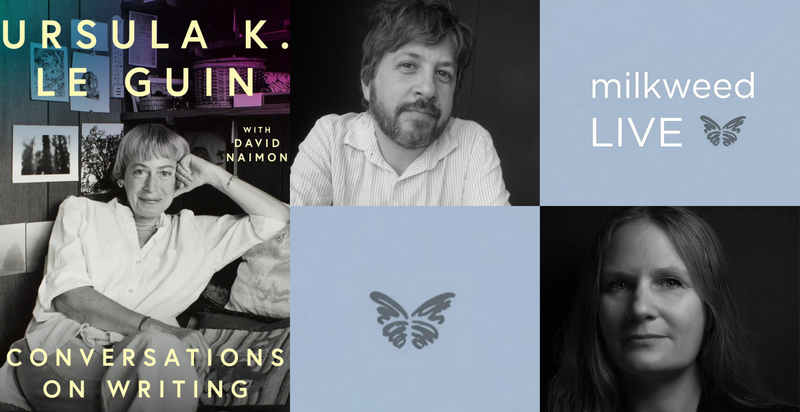
Ursula K. Le Guin titled her introduction to Ursula K. Le Guin: Conversations on Writing “Fear and Loathing in the Interview,” and in it she said: “The good interview is like a good badminton rally: you know right away that the two of you can keep that birdie in the air, and all you have to do is watch it fly. Facing each other for the first time in one of KBOO’s lovable, terminally funky recording rooms, David and I were a bit stiff and shy, but we soon got going, and I knew our bird was on the wing.”
Lidia Yuknavitch, whose own life, like mine, intersected with Ursula’s, and whose writing engages with and is enlivened by Ursula’s work, joined me at Powell’s Bookstore in downtown Portland to celebrate the launch of the reissue of this book. Together we explore Ursula’s thoughts on craft, on prose versus poetry, fantasy versus realism, the political in relation to the artistic, and her fascinating relationship to her own imperfections, namely how she enacted self-revision while facing her reading public.
If you enjoy today’s conversation consider joining the Between the Covers community as a listener-supporter. You can find out about all the potential rewards and benefits of doing so at the show’s Patreon page.
Finally, here is the conversation-specific BookShop for today’s episode (and for your more general book shopping needs don’t miss Milkweed Editions Bookshop bookstore as well).
Transcript
David Naimon: "A book holds words. Words hold things in a particular, powerful relation to one another and to us." These words come from Ursula K. Le Guin's essay, The Carrier Bag Theory of Fiction. It proposes that a good story is like a bag. It has space to hold many smaller, more humble stories, reflecting the many people and perspectives that make up the bigger story we all share. This winter, Street Books, a non-profit mobile library and outreach project, is asking for your support to help them hold space for all the stories that make up the "book of Portland." Street Books meets people where they are, bringing their bike-based library to folks living outside, on the margins in Portland. One of the most important things they do is just to show up and listen week after week, building relationships based on storytelling and shared humanity. Every donation made in November and December will be matched one-to-one up to $20,000 to help them reach their goal of $60,000. If you're in Portland, you know of the Willamette Week's Give!Guide, and you can give there at giveguide.org, or wherever you are, in Portland, elsewhere in the U.S., or in the world at large. You can find out more information and donate directly at streetbooks.org. Today's episode is also brought to you by Polly Atkins' The Company of Owls, a moving new memoir set in England's Lake District, where a clutch of tawny owlets becomes the author's unexpected companions. Living with chronic illness, Atkins' days are shaped by a smaller world, yet filled with wonder. As Atkins watches the owls grow from curious fledglings into sleek raptors, she contemplates the act of survival and our place within it. Hailed by best-selling author Sy Montgomery as a work filled with wonder, wisdom, and warmth, The Company of Owls is a resounding call to find joy in the most unexpected places, a love letter to the natural world and those that inhabit it. The Company of Owls, published by Milkweed Editions, is available everywhere books are sold. I confess, I had hesitation about airing an episode on the show where I am a co-author of the book in question. But given how inseparable this book is from the show itself, that it begins with this show and the conversations I had with Ursula K. Le Guin on it, that this book then set off a chain of events that led to one of the things I'm most proud of in the show's history, the limited 2022 series Crafting with Ursula. And given that her presence looms so large for so many writers who come on the show, from Lucy Ives to Michelle de Kretser to Olga Ravn to Robert Macfarlane, it actually would also seem strange not to air it. Tin House, very unexpectedly, is sending me on a mini regional tour, and it begins with this event recorded live at Powell's Bookstore. Past Between the Covers guest, the writer, the publisher of Future Tense Books, and the head of the small press section at Powell's, Kevin Sampsell, is the first voice you'll hear introducing the event, and my interlocutor is none other than Lidia Yuknavitch, whose life, like mine, has intersected with that of Ursula's, and whose work, like so many, has been influenced by hers too. If you enjoyed today's conversation, consider transforming yourself from a listener to a listener-supporter by joining the Between the Covers community. You can find out about all the possible rewards and benefits of doing so at patreon.com/betweenthecovers. Now for today's conversation with none other than David Naimon.
[Music]
Kevin Sampsell: Hello. Hi, everyone. Thanks for coming out tonight. Before we get started, a reminder to please silence your cell phones or devices. And you can always keep up with who's coming to Powell's by looking online at Powells.com. Our event calendars can be found around the store as well. There's some on that table right there for October, if you want to plan ahead. Tonight, we're excited to welcome David Naimon in conversation with Lidia Yuknavitch. Tonight's event is being recorded for an episode of Between the Covers, which is the long-running podcast that David started in 2011. It's also where you can hear the interviews with Ursula Le Guin recorded at KBOO that this book features. The author of many genres, Le Guin was called America's greatest writer of science fiction by the New York Times. The celebrated Portland author of books such as The Earthsea Books, The Left Hand of Darkness, The Lathe of Heaven, and many others was one of the most influential writers of the 20th and 21st century, and left a legacy that continues to shape the literary landscape today. These interviews with David Naimon are insightful, specific, philosophical, and dazzling. Discussing the craft and aesthetics in her writing, the interviews provide ample advice and guidance for writers, and give Le Guin a chance to sound off on everything from the genre wars to the patriarchy. David will be joined in conversation tonight by Lidia Yuknavitch. She's the best-selling author of several books, including the memoirs Reading the Waves and The Chronology of Water, as well as novels like The Book of Joan and Thrust. We thank her for being part of tonight's event. Now, please welcome David Naimon and Lidia Yuknavitch. [applause]
DN: Hey, everybody. I thought I'd start before Lidia takes over and maybe asks me some difficult questions with just an orientation of how this book became a book. I was hosting a radio show at KBOO, and Ursula's revised Steering the Craft, revised and expanded edition of her writing craft book came out. I asked myself a question at that point, not really having read Le Guin since I was pretty young: "I wonder if this very famous writer is mostly asked to talk about her very famous work and if maybe she would be delighted to talk about something outside of the spotlight." Little did I know how true that was because we ended up talking, for Steering the Craft, about the craft of fiction writing. And then that went so well, especially realizing, which I didn't know when I invited her, how much she really hated being approached as an oracle. That's something that a lot of science fiction writers face, especially really big ones, that this idea that they can predict the future and to be asked to talk about what their work can tell us about the future. She really liked that we were just talking about this one book in front of us, that we were talking about the nuts and bolts of craft. So when a poetry book came out a year or two later, I was like, "Okay, let's see if Ursula would like to come back to talk about poetry." And we had this poetry conversation. I'll just say as an aside, she wrote this really incredible intro to the book when it eventually became one called Fear and Loathing in the Interview. In it, she talks about her feelings about the three genres, and she mentions how nervous she was to talk about poetry. Hopefully, we'll talk about that tonight. But it's not something that I was aware of when we had the poetry conversation. But after the poetry conversation, we had enough rapport that it suggested itself when a nonfiction book came out. We had done two genres. And so here we were, nonfiction, essays, book reviews, intros to other people's books. That conversation we didn't have at the radio station, but in the upstairs reading room of her house. At the end of it, I said, "I don't know who else I could have done this with. Like, not only look back across a half century of writing, but a half century of writing in all three genres." That's when she said, "Why don't we make this into a book?" And that's how the whole thing started, with her imagining that maybe this could be a book. And I think we'll talk about what else enters the book other than what we actually did in the radio interviews, because there's a lot else in there other than that. But I just wanted to start by mentioning that. And the other thing that I wanted to mention also is this idea of fractals or holograms. When she passed away, one of the first things I wrote was originally titled—it got changed—but it was called "The Holographic Universe of Ursula K. Le Guin," which got changed by Lit Hub to "Editing to the End." But it was this idea that, like holographic film, like if you have a holographic film of a chessboard, you take that film and you cut it into tiny pieces, and then shine a laser through any one of those tiny pieces that will recreate the whole. Because this book admittedly is a book of marginalia, if we think about it in terms of what she was most known for. But what I discovered in talking to her about these things is they weren't marginal for her. They were actually central to how she perceived herself as a writer and as a person in the world. I think they tell us a lot about the things that we know most about her. That strangely, by understanding how she approached poetry differently than storytelling, for instance, it tells us something about The Left Hand of Darkness or The Dispossessed that we might not know otherwise. Then this idea of the fractal or the holograph in the world, because we would have never had these conversations if she didn't really see herself as a small part of a whole, a small part of an ecology, a literary ecology and a literal ecology. She could have published all of her books with a Random House, and yet she was publishing with small anarchist presses in San Francisco. She was publishing with really small micro-presses, feminist micro-presses in Seattle. She did tons of interviews at KBOO, community radio, not one of the most listened-to shows on the dial, a show that has a lot of radical sensibilities, a sense of being connected to the needs of the region. She could have done all those interviews at the NPR affiliate, at OPB. Of course, she did some there too, but she wasn't just thinking about maximizing her effect in the world in terms of how many people listen to this one thing. She was thinking about how she could help grow and sustain the ecosystem that she was one small part of. So what I'm going to do is I'm going to read the In Memoriam and then hand it over to Lidia. So the book was in its copyediting phase when Ursula unexpectedly passed away. And the book was already set. There were only two pages that were possible to add anything to. So I was given a very limited space to write an In Memoriam, which I wrote nine days after she died. I'm going to read it, and then we can go from there.
[David Naimon reads “In Memoriam”]
DN: And lastly, I just want to also mention that I couldn't imagine doing this event with anyone else. I mean, obviously, I imagined and hoped I was going to be doing it with Ursula herself, but out of the 350 or so episodes on the show, the most listened-to ever is the third conversation I had with Ursula in her upstairs reading room. The second most listened-to episode ever is with Lidia, where we were discussing Ursula's Carrier Bag Theory of Fiction for the Crafting with Ursula series I did in 2022. So thank you, Lidia, for being here with me today. [applause]
Lidia Yuknavitch: My pleasure. Are you kidding? I love listening to all of that. Thank you all for being here. I'm a huge fan of David in terms of his interview style because you always enter story space in whatever conversation you're creating with someone. So I'm grateful to be here with you. I was thinking the day Ursula passed, I was driving in my car in eastern Oregon in the middle of bumfuck, [chuckles] and I ran out of gas. I pulled over, and I'm sitting on the side of the road going, "Well, shit, no gas." I got a text from someone who told me when it happened. Right when I got the text, I'm sitting there on the side of the road in the dust, no gas. I look up, and there was a bird murmuration, like right there. No one else was there. I'm the only one that saw this particular moment of it. I'm like, "It's Ursula. It's so obviously Ursula." [laughs] And it reminds me of some of what you're talking about in terms of how she saw herself versus how other people may or may not have seen her. So I'm getting to the question. On the topic of rapport, how does one build rapport with Ursula Le Guin? The first time I met her, I was at some fancy literary dinner where I felt completely out of place. I was talking this way, and I turned, and they sat her right next to me. I thought, "Oh, great, I'm going to pee. I'm going to wet my pants right here." [laughs] You know, she's beloved. She's revered. She's very Oregon queen. How did you go from "I'm interviewing Ursula Le Guin" to "I'm in her house making this series," relationship-wise?
DN: Yeah. Well, there was something intimidating about encountering Ursula. She was small of stature, but you could also tell that she didn't suffer fools, that you couldn't get away with asking a question that she wouldn't respect, I think. But I think I also lucked into not really taking in her stature while we were having those conversations. First, because I hadn't read many of her most significant works yet. I became an expert in her poetry, her essays, her short stories, her translations, and her book reviews before I read most of her most famous novels as I prepared for that. Because we were sitting and it was narrowed to not trying to take in the scope of her life, but really narrowed to whatever the book was that was sitting between us, it buffered me from the vertigo that you might experience of all that she's done and accomplished. As I was telling you before we came up here, Lidia, this book has changed the trajectory of my life, really, and it's continuing to. But the first year and a half or two years, since this was the first book that came out after she died and one of the last books that she was involved in, people just assumed I was an expert, and they would ask me to write about her, different aspects of her. I just basically said yes to everything and faked it till I made it in the sense of, like, so the Poetry Foundation asked me after this book, "Will you write an essay about what her poetry can tell us about her storytelling and her science fiction and fantasy?" And I said yes. I went up to Port Townsend to Copper Canyon Press, which was putting out her final poetry collection and one where she knew she was dying within these poems. Michael Wiegers shared with me some really great, charming, and funny anecdotes, which I share in that essay. But he also shared with me that she'd never been given any editorial care around her poems before him, that people were just publishing her because of the other things, but not taking the poetry on its own merits, and how grateful she was to be approached that way around her poetry. Then, looking around, I was like, there is no scholarship on her poetry. So whatever I'm going to write, there isn't something to draw upon, really. I mean, if there is scholarship, there's very little. It's just going to be a foothold for whatever can come next. Since then, Library of America has put out her collected poems with a Harold Bloom introduction, and other things have happened. But for several years, I was writing different pieces, even just this last year for an anthology in London about her relationship to maps and cartography. So I was like, "I learned so many new things writing that essay last year that I had no idea about before I wrote it." But it was in 2022 when I did the limited series. So I invited 12 different writers to each speak about their own work in relationship to a very narrow aspect of Ursula. So it could be how to create alien cultures, or it could be feminist translation and feminist classical retellings. It could be any number of things: women in science and experimentation. That's when I really first experienced the vertigo of how big she was. Like, I actually was like, "Holy shit. [laughs] This person is a giant." The more I sort of venture to where I think the horizon is around her, the more the horizon recedes and there's more to explore. I still feel that today. As I'm being asked to write for this reissue, I'm still learning new things. I had to do a playlist, or I wanted to do a playlist for Largehearted Boy for this book. So I'm looking at the operas she loved and that she was a huge Willie Nelson and Bruce Springsteen and Dolly Parton fan. What were those songs and why, and how she was slipping some Bruce Springsteen lyrics into her most famous speech for her Medal of Distinguished [Contribution to American] Letters at the National Book Foundation. But while we were actually talking, I lucked into not knowing the full scope of who I was talking to.
LY: That makes sense. I mean, especially how you described it, but also a couple of times, you've talked about her in a way that feels very profound and real to me, which is that she didn't inhabit being a writer in the way that I have noticed some other famed writers inhabiting being a writer. I've met a few now on the horizon. It's more like what you have described, where she moved around in an ecosystem that included anthropology and sociology and environmentalism and philosophy and politics, and her novels would manifest a certain angle. Her poetry would manifest another angle, but she also just didn't breathe that rarefied air and walk above the people she was writing for and with. Would you agree with that? She was just not a writer like other people seem to step into it. She was a writer laterally, like she put her forces and her talent out laterally. I mean, it feels to me that's partly the reason she could inhabit more than one genre so easily, because she was always reaching out to all these worlds all at once. But you know what I mean about other kinds of writers, or am I just being an asshole?
DN: No, I think it's really true. I think you see that maybe particularly in the fiction section, which, because of the book we were discussing, is the most craft-oriented, because she talks a lot about the importance of knowing grammar, which might seem obvious, but a lot of writers don't really go to the toolbox, as she would say, around grammar. But at the same time, she warns against this idea of what she called grammar bullies, which were people who were enforcing rules that weren't really good grammar. They were really enforcing the status quo, either with gender or class or other things, and how to distinguish between writing well and finding your own way to do that from these societal pressures, which are masking themselves as grammar rules, but really aren't grammar rules. Also having this really long point of view, watching tons of writing fads come and go, like whether it's the present tense being all in vogue or something else. Just this idea that you can step back and expand your toolbox. Like, just because the omniscient point of view isn't super popular right now doesn't mean you should rule it out as a possibility as the best way to write your story. So part of the whole approach to her talking about craft is lateral and horizontal, I think, like you just mentioned. I mean, maybe that would be a good segue to at least mentioning it's not part of this book, but I feel like it lives in everything that she's doing, including this book. But the Carrier Bag Theory of Fiction.
LY: Please.
DN: Well, maybe I was hoping maybe you would talk a little bit about it.
LY: Have you heard of this? The Carrier Bag Theory of Fiction? Oh, there's clapping. Raise your hand if you've heard of this before. Oh, very cool. It's impacted and influenced so many of us here. Raise your hand if that's true. Yeah, because in it she tells this beautiful little story. You can look it up if you've never seen it, and I encourage you to do it. It's a hoot. She tells a beautiful little story about going back through time, time traveling to the first peoples, like Neanderthal peoples, and how they came to prioritize, say, action and throwing spears and killing things. That became the story drama. Then she says to the side of that drama was a different drama, always alongside it, was people carrying bags, collecting seeds or planting seeds or trading the bags so that someone else was carrying the bag that day, and that that was equally important, maybe profoundly important, and that that drama had a shape too, like the action in the spear-type of drama, and that why not explore that as a valid and legitimate shape to narrative and to storytelling, which might not have the same, let's do a visual aid trajectory—that won't be on the recording, but you hear what I'm saying [laughter]—that would have a different shape to it, that was maybe circular or included repetition as the primary shape. And so this Carrier Bag Theory of Fiction writing became just a mind-boggling green light for so many of us to explore the possibility that you could tell a story in different shapes than Freytag's pyramid shape. And it changed everything for so many of us, not just in terms of form, but in terms of content, like maybe look for the story in the sea, not the spear killing an animal, but look for the story in the water, the river, look for the story in planting and carrying and activities like holding. Does that about cover it?
DN: It's pretty great.
LY: Yeah. [laughs] That.
DN: Not just writers, filmmakers, visual artists, social scientists. There was a Palestinian film called Lyd that came out. One of the directors of that film wrote an essay about the Carrier Bag in relation to documentary filmmaking. That movie is about the city Lyd, which was depopulated during the Nakba and then became the Israeli town of Lod. They tell that story, but they also go back to before the Nakba and imagine a speculative alternate alongside it. So there's a science-fictional element to the movie where you follow both in parallel to each other, where they actually imagine an alternative way it could have been.
LY: There is something that was a gift, I feel like, that I received from Ursula in a kind of mentor-ish fashion, which is I once asked her about fiction writing that is political or writing that is political. And she talked to me very seriously about the need to stay away from trying to write political writing. But she didn't mean that her writing or all writing or art wasn't political. What she meant was, and what she coached me on, that I try to achieve to this day, whether or not I succeed, is that what you write about are the material conditions of the people or characters you're concerned with. How they live, how they eat, how they sleep, how they love, how they live, how they die, how they bury their dead. That if you keep focusing with specificity on the material conditions of the lives you're resurrecting on the page, that that will generate what people should care about as they read this story. And so I wanted to ask you, out there, a lot of people will say she wrote political novels or she wrote environmental poetry. How do you land on this question of political writing?
DN: What's strange, I guess, I would go back to the fractal in the sense that in this book, there's a lot of extra material that are black pages with white print that aren't our interviews. Like she talks about diagramming sentences, which nobody does anymore. But then there's a page of a George Orwell sentence diagrammed. There's where she'll talk about the rhythm of Tolkien and Virginia Woolf, and there'll be a page of an excerpt of one of their pieces. But the reason why I bring it up is because even when you're talking about the length of your sentences, which has a lineage and also has history to it and can often be gendered also, you end up in those discussions having very political considerations, I think. I think she was making political decisions in that regard, too, about gender, about capitalism, about environment. I mean, even this idea, again, about moving laterally, if you think of the carrier bag and the person who's doing the same thing every day, gathering seeds for the bag, a circular motion, and how you're supposed to believe that that's not worthy of being dramatized and therefore maybe your life isn't worthy of story around the fire, well, part of what she does in the fiction craft talking is collapses the borders, where she'll talk about Virginia Woolf and she'll talk about J.R.R. Tolkien in the same lesson. But she'll also talk about oral storytelling, Indigenous oral storytelling. So the oral and the written, the genre and the so-called literary. That feels like a very political decision, whether she calls it a political decision or not. Also, I think most notably in the Carrier Bag is that she's really deconstructing inherited forms, particularly the hero narrative. She doesn't really—and I think this is good—she doesn't really offer forth the form you're supposed to replace it with, but rather hints at ways you can figure out what that form for yourself might be.
LY: That's another difference about her as a writer and a teacher and a brilliant person, is that the lessons that come delivered in her work, in her books and in her talks, are invitations. They're like someone opening some doors very near you, [laughs] and without didacticism or some kind of lofty giving you knowledge from high above you, it's more like showing you how to move through a threshold or a door or there's the window or a portal. That happened in conversations with her, even though I remained mildly intimidated by her my entire relationship. [laughter] I got over the pee thing, but I was always a little vibrating near her.
DN: Yeah. I'm just going to read a couple of things. I'm not going to read from the interviews themselves. That would be too weird. But I'm just going to read a couple little pieces by Ursula. So one point in the first conversation, I quote something that she said at Portland Arts & Lectures in 2000. Maybe this is the thing that is hardest, I think, ultimately to teach, which is how to find the sound beneath the meaning of your words that you want to have in what you write. But she says, "Beneath memory and experience, beneath imagination and invention, beneath words, there are rhythms to which memory and imagination and words all move. The writer's job is to go down deep enough to feel that rhythm, find it, move to it, be moved by it, and let it move memory and imagination to find words." She connects us to Virginia Woolf's notion of the wave in the mind. And I'm just going to read, because all these examples in here, which I think when you can't teach, like, how do you do the wave in the mind? I think what you do is you show it instead. And so here's an excerpt from The Left Hand of Darkness. I think you can really hear the rhythm beneath the words.
[David Naimon reads an excerpt from The Left Hand of Darkness by Ursula K. Le Guin]
DN: And another thing I'll just add to this, this is something I really discovered after the book too, is her own relationship to her own limitations of what she knows at any given moment, and how she revised herself in the world is one of the most fascinating things about her, I think. Because she found a way to revise herself as she learned new things or abandoned old things. But she did it publicly and without disowning her former selves. For instance, she talks now, or she talked when we talked about the problematics of using "he" throughout the book, The Left Hand of Darkness. If she had written it later, she would have found a different way to write it than she did. She had an essay called "Is Gender Necessary," which in the end she ended up feeling didn't really land the way she wanted it to. A decade later, she writes it again, but she leaves the original and annotates it. Similarly, there's all sorts of problematic gender dynamics in the first Earthsea trilogy that she reenters the Earthsea trilogy. She doesn't disown it, but she finds a way to break and remake the rules in the second trilogy. That's one of my favorite things about her, is that she is willing to do that all publicly, slowly, over time. You can enter a thinking process over years where she knows she has a problem that she hasn't solved, her own problem around writing. That's a really important one. For instance, how am I going to write an adult female point of view? She has a crisis. She tells her agent this in the seventies. She doesn't want to just slot a woman into the narrative and call it good. For 15 years, she writes essays, short stories, and other things, poems, where she's thinking it through, and you can watch her do it. You really feel that in this book too, like the windows and doors you talk about.
LY: Yeah. She is intimidating.
DN: I think she's a serious presence, but she's also inviting, I think, at the same time.
LY: It's incredibly rare, too, though, in my lifetime as a writer, to have a person performing their mind wanderings and their mind revisions, like a mind under revision, as you're saying, publicly in front of people to let you see. Ordinarily, that's thought of as too vulnerable, or you're exposing that you didn't know something before and now you have learned this thing. But that is so like her to have opened up the process of the mind under revision to let you see that your mind is under revision too. So it kicks your righteousness down a notch to have to admit that we are all minds under revision. Winning the argument or the debate is a way of shutting that down, that idea down. All of her work performed that in the ways you're talking about. But I also think her poetry was a way of going back to the worlds she built in her novels. And I loved your fractal idea because they move like fractals in terms of size compared to novels. They go back to ideas in all the novels. They produce this little micro-world where she takes another look at it from a different angle and opens something up that the narrative line didn't address. I mean, I've literally made a weird little map on the wall and tried to chart some of the poetry and poetics and with colors and thistles, trying to get back to where is it in the novels? They're all there. So if you ever want a weird little map— [laughs]
DN: I want a weird little map. There's certainly poetry in her novels too.
LY: All the time.
DN: Yeah. One of my theses around her poetry versus her fiction, I think she was most comfortable talking about her fiction and maybe most nervous about talking about poetry. But I think it's because, I mean, she really found the imaginative faculty of the human being to be the most essential part of being human. She has a famous phrase about, "I can't imagine myself without my imagination, but I could imagine myself without opposable thumbs." I don't remember the exact phrase, but something like that. Or children know perfectly well that unicorns aren't real, but they know that books about unicorns, if they're good books, are true books. Most of great fiction throughout time was fantastical fiction, whether we're talking Cervantes, The Odyssey, Hamlet. It seems to be the default mode for humans is the fantastical. But with poetry, it felt more like it wasn't about the imagination than it was about contemplation or placing yourself, de-centering yourself, weaving yourself into a world rather than generating a world. I think that's why she didn't write science fiction and fantasy poems, even though I do think there are real resonances and connections with her novels. She's not creating an alien species in her poems or a fantastical beast in her poems. She's doing something else which feels very political and ecological. Maybe if you'd be willing, I'll have you read one of those poems in the book.
LY: Sure.
DN: This poem that Lidia's going to read is a really good example because it's about how you relate to the things that you've inherited, whether it's the world that you're living in or something that's been passed down to you across generations, which is maybe just a different mode of being in than world-building.
LY: The poem is called "The Small Indian Pestle at the Applegate House."
[Lidia Yuknavitch reads a poem called "The Small Indian Pestle at the Applegate House by Ursula K. Le Guin"]
LY: It's such a beautiful poem. It moves into those rhythms you were talking about earlier that language affords a path to, and she rests the content inside those rhythms of women's work, women's hands, but also the way language can move inside syntax and diction and the rhythm of sound and phonics.
DN: For sure.
LY: Very beautiful.
DN: Indeed.
LY: Should we let them ask some questions?
DN: Yeah.
LY: [laughs]
DN: Should we do it?
LY: We should.
DN: Okay.
LY: This would be an excellent opportunity for you to ask everything you always wanted to know about Ursula K. Le Guin.
Audience Member: Hi, this almost seems off topic, and I feel embarrassed to ask in front of a group of people, I'm sure very eclectic readers. But okay, briefly, I've been a long reader of "science fiction," and lots of other things. First question, I assume by genre wars, that could be connected with, I could see her as somebody who would reject being classified in terms of a genre. So I was wondering if you could confirm that. Secondly, I could never read fantasy. I can read Ursula. I can read The Left Hand of Darkness, finally. It's anthropology, it's culture, it's gender. This is not the world of Heinlein and Asimov. But I can't read fantasy. As soon as a wizard or something appears, I'm out of there. [laughter] So I don't know if you can help me out here, as good writers yourselves and readers of all this and as readers of Ursula, because I can't read her Earthsea stuff. So what am I missing?
DN: I don't know if I can answer the second question, but the good thing is there's every mode with her. I mean, there's every mode within her novels and her short stories and her poems and translations. But the genre wars, I think the genre wars are, I don't know if they're won, but they're largely won now. But she played a large role, I think, in winning them in the sense that just say even 10, 15 years ago, most literary magazines would say they don't want genre fiction or "Don't send me anything that has a talking animal." I don't think that's the case in most scenarios anymore, where I think it was largely the case up until the recent past that there's something about genre fiction that makes it—it's more relying on tropes. It's less artistic, more pulpy in some way. Whereas her argument, I think, would be that realism is also a genre. You think about it, it's a really relatively new one. The rise of the novel with the Industrial Revolution and the rise of a new notion of the individual—you can have all sorts of novels, and a lot of novels are entirely human-centric, where most of what you'll see in a contemporary novel could be human, maybe a houseplant, and a cat—but a lot of fantastical fiction, I guess the merits of fantastical fiction, I think of them sort of like those Chinese scrolls where you see a little human and these huge landscapes. So you'll see a human, these huge mountains and trees and sky. Often that's what you think of when you think of fantasy too. The human is a very small part of something really large, whether there's a wizard or not. And she's written quite a bit in her essays about this also, about fantasy in this regard. I think realism moves towards anthropocentrism, whereas fantastical literature tends to move away. I'm not saying it's inherently progressive and good. Fantasy can be super regressive and conservative, just like science fiction can. But I think the genre wars, a lot of science fiction writers and fantasy writers today probably don't think about because of people like Ursula, who fought for and considered themselves and owned the genre. Whereas, like Margaret Atwood, for instance, she said, "I'm not a science fiction writer." Ursula very proudly would say, "I am a science fiction writer." She would say also that she's not only a science fiction writer. She did not like to be pigeonholed as only a science fiction writer.
Audience Member: This is a question I'm a little nervous to ask, but I'm a huge Le Guin fan but came to it late. I moved to Portland the year she died, so it felt very much like I had a lot to catch up on. Her craft writing has been really inspirational to me, and I teach a lot of it too, and some of her short stories as well. I've been surprised by the reaction of some younger science fiction or speculative writers, especially those coming from marginalized backgrounds—Indigenous queer science fiction writers—who have some critique about how she portrays certain civilizations or her world-building, and especially the anthropology roots. I've been thinking about this a lot. I guess my question is, is she beyond reproach? And I'm really curious to hear what you would say, because I like her and want to keep teaching her and reading her.
DN: Thanks for that question. I mean, I think this goes back to her limitations and her relationship to her limitations. Because, for instance, back in the '70s, she was part of a feminism and science fiction conference with Samuel Delany and Joanna Russ and Vonda McIntyre. Several of them really took her to task on her own relationship to feminism at the time. Twenty years later, she agrees with a lot of what she's being critiqued on. But she was also ahead at the same time around feminism and relationship to motherhood. So there was this weird way in which she was in two places at once. I also want to hopefully have Lidia chime in on this question as well. Her father is one of the most significant anthropologists at the origins of anthropologies in North America, in what was called salvage anthropology, when genocide's happening, and the anthropologists are recording whatever is left before it's going to be destroyed. He had a friendship, a problematic, if we can call it a friendship, with the so-called last Yahi Indian, Ishi. His family's been killed. He comes out of the forest. He's put in jail and is a spectacle. Her father and other colleagues get him out of jail and bring him to live as a janitor in the Natural History Museum. But he's also part of a diorama. There are all sorts of problematic things with all that happened in this impossible circumstance and the way he's placed in that. I can't help but wonder, her most famous thought experiment, The Ones Who Walk Away From Omelas, where everybody in this utopia learns when they hit a certain age that the only reason everything's perfect in this society is because one person is kept in a broom closet in never-ending suffering. If we were to let them out of the broom closet, the utopia will go away. I've always wondered, "Why is it a broom closet? Why isn't it a dungeon or a basement?" And I'm thinking of the janitor. I'm thinking of Ishi as the janitor. This doesn't mean to let her off the hook, but I also don't feel like she's guilty of what her father did, who was in his 50s when she was born. So he's already grandfather age at the time. I think he was born in the 1870s. I don't remember when he was born. But there's a generation skipped between, like, in terms of his age. I think she really learns about Ishi, if I'm correct, when her mother writes a quite popular book about it. The way I read a lot of her work around first contact and other things is a working through of questions around anthropology that feel to me that move, generally speaking, towards liberation. But on the other hand, we could also look at race in a double way. She made most of her main characters other than white, and there are people who speak about how in the '60s and '70s, reading a book where the person, the main character, isn't white served as a life-saving foothold for them. But there are genuine critiques around, she didn't engage with racism in a societal way. She didn't bring the questions of racism into the world in a deep way. I don't know if you have anything you wanted to add in that regard.
LY: I don't want to open up a can of worms. I'll say something quickly, which is that, first of all, younger students of yours or people you work with who are feisty, God bless them for being feisty. I think that that's their job as they encounter literature and art, is to be feisty and ask the questions and dig it up and throw this out and collect this. So that's exactly what should be happening. Then about Ursula, Ursula Le Guin doesn't need me to defend her. No artists need me to defend her, but I am drawn to artists who turn ground over. She turned ground over. No matter what happened after that, I don't hold an artist who's dead now accountable for not having the premonition of the politics that would be happening in 2026. It's enough for me that she turned ground over, and good that they're feisty in the dirt. That's where they should be, and they should get even feistier.
DN: I mean, just to continue on that note, a double vision around things too, there's been a lot of trans engagement with The Left Hand of Darkness and trans critique of The Left Hand of Darkness. Yet the book still is, like, a node, I think, around, like, she created this world of gender fluidity. She went back into that world later and tried some short stories in that world that attempted at least to extend, deepen, change aspects that she herself found limited. But other people are taking up questions from that book, critiques about that book, like they're doing that with a whole bunch of her work. I think maybe it just goes back to the sense of the open doors and windows again. Her whole mode is not that she knows, but she's in the process of knowing or learning. It's a gerund. I really like writers like that. I mean, there are writers that I love who are not like that. Toni Morrison seems like somehow fully right on, but maybe I don't know enough. But when I learned about the limitations of Baldwin around gender and his conversations with Audre Lorde, I like Baldwin more. He was so wrong-footed in these conversations. It was amazing. He kept being given gracious off-ramps from Audre Lorde around this. Then Audre Lorde has been wrong-footed on other things, where June Jordan was incredibly right. So, the imperfections don't bother me. I guess what I like about Ursula is her relationship to her imperfections. If she lived forever, I think that she would slowly have come around on a lot of the things she's being critiqued on around these things.
LY: I suspect that's true. This is the part of the night where we bring in the wizards. [laughter] Actually, what I want to do is thank you all for joining us, and could you please give it up for David Naimon? [applause.]
[Music]
DN: Today's program was recorded at Powell's Bookstore, and at the volunteer-powered, non-commercial, listener-sponsored, full-strength, makeshift home office of me, David Naimon. If you enjoyed today's conversation, consider transforming yourself from a listener to a listener-supporter by joining the Between the Covers community. Every supporter can join our brainstorm of future guests, and every listener-supporter receives the supplementary resources with each and every conversation: of things I discover while preparing, things we reference during it, and places to explore once you're done listening, which in this special case includes many things I was asked to write as part of this book's reissue, including the playlist I devised to accompany this book with many surprising songs related to Ursula's life as a listener of music, to the letter that I wrote to educators when Conversations on Writing was added to the Penguin Random House academic catalog, arguing for why this book could be a worthy addition to teachers' syllabi. In addition, you can choose from a variety of other things as well, including the Bonus Audio Archive with contributions from past guests, whether Layli Long Soldier reading her long poem, King; N. K. Jemisin reading from Jane Jacobs' The Death and Life of Great American Cities; Ted Chiang reading an essay on Silicon Valley's fear of superintelligent AI; or long-form translator conversations, such as those with the translators of Hélène Cixous, Jenny Erpenbeck, and Mariana Enriquez, or craft talks by Marlon James and Jeannie Vanasco, songs by Adrienne Maree Brown and Leanne Betasamosake Simpson, and much more. Or perhaps you want to subscribe as a Milkweed Early Reader, receiving 12 books over the course of a year before they're available to the general public. You can check it all out, these options and much more, at patreon.com/betweenthecovers. Or if you prefer a one-time donation, you can do so by PayPal at milkweed.org/podcastsupport. Today's episode is brought to you in part by Water in the Desert: A Pilgrimage by acclaimed agrarian activist and ethnobotanist Gary Paul Nabhan. Celebrated as a "world visionary" by Utne Reader and a "lyrical poet of biodiversity" by Mother Jones, Gary Paul Nabhan has authored dozens of books and been awarded a MacArthur “genius grant.” Water in the Desert is a profoundly inspiring account of interspecies belonging, collaborative conservation, and the sacred work of caring for the earth. He traces his childhood growing up as a Lebanese-American boy in the dunes along Lake Michigan's southern shore, to his interest in earth-based spiritual practices that led him to take vows as an ecumenical monk. A refreshing account of kinship with other species, Water in the Desert brings science to the service of land and culture, showing us what it looks like to reciprocate the gifts of nature with gifts of head, hands, and heart, writes Robin Wall Kimmerer, author of Braiding Sweetgrass. Water in the Desert is available now from milkweed.org. I'd like to thank the Milkweed team, particularly Claire Barnes and Craig Popelars, for everything they're doing to make this partnership a reality. Finally, I'd like to thank past Between the Covers guests, the poet, musician, composer, filmmaker, performer, and much more, Alicia Jo Rabins, for making the intro and outro for the show. You can find out more about her work, her writing, her music, her film, at aliciajo.com.