

Hybrid / Nonfiction
Molly Crabapple : Here Where We Live Is Our Country : The Story of the Jewish Bund
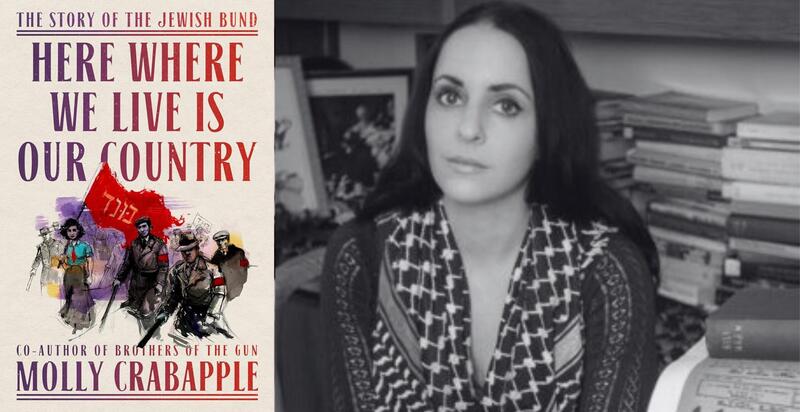
One of the elements that makes Molly Crabapple’s latest book so remarkable is, not only the remarkable stories it unearths and retells, but more specifically how she tells these stories, these erased stories, these stories meant to be forgotten. Not only does she tell them in a dynamic, often thrilling, way, she also does so in a way that somehow opens up the history and gifts it to contemporary movements, organizers and their artists. You can feel how alive to the moment Molly’s book of history is in the words of everyone who praises it. Whether Naomi Klein calling it a “gripping, human story of love, idealism and betrayal” or Tareq Baconi “a road map for our revolution today” and we explore this together—how to write, in whatever genre, in a way that offers one’s work to anti-colonial movements of liberation.
A great conversation to pair today’s with is the recent episode with Jordy Rosenberg, who asks many of these same questions, but within the realm of fiction. After Jordy and my conversation had aired, Jordy sent me a second contribution to the bonus audio archive, a reading of the Palestinian writer and performance artist Fargo Tbakhi’s “Notes on Craft: Writing in the Hour of Genocide.” This joins many contributions from past guests whether from Naomi Klein, Dionne Brand, Isabella Hammad, or Omar El Akkad. You can check out all the potential rewards and benefits of joining the Between the Covers community, including access to the bonus audio archive, at the show’s Patreon page.
Finally here is the BookShop for today.
Transcript
David Naimon: Today’s episode is brought to you by Patient, Female: Stories by Julie Schumacher. From the New York Times bestselling author of Dear Committee Members, Julie Schumacher’s stories in Patient, Female are sharp, darkly funny, and deeply human. Each protagonist, ranging from girlhood to senescence, receives her own indelible voice as she navigates social blunders, generational misunderstandings, and the absurdity of the human experience. Schumacher’s talent shines in this masterful collection, writes Library Journal. Exploring motherhood, friendship, and work, Patient, Female renders the foibles of human behavior with dark humor and wit. Patient, Female is available now from Milkweed Editions, wherever books are sold. Today’s episode is also brought to you by Coastal Lines Press. Coastal Lines Press is a collective of writers in Gaza turning words into life-saving supplies for their families. Through zines from Gaza, they publish independent booklets of poetry, essays, and testimonies that travel like tiny vessels from coast to coast, carrying stories of survival, resistance, and hope. The name Coastal Lines Press honors the Mediterranean Sea, which anchors life in the region and celebrates the lines of language, words, sentences, prose, and poems that connect writers to readers worldwide. Profits from every zine directly fund essential supplies for families under siege. Learn more, follow their journeys, and purchase a zine from Gaza at CoastalLinesPress.com. For long-time listeners of the show, you know that last year had an unusually high number of episodes that, in some way or another, were engagements with and interrogations of the archive, and by extension, interrogations of history and how it’s codified, and collective memory and how it is shaped. More than that, about salvage, about diving into the wreck of the archive on behalf of those erased from it or excluded from it. This question goes back a long way on the show, from Thalia Field’s amazing book Experimental Animals, to more recently with Dionne Brand’s book itself called Salvage. But last year had a long sequence, from Jazmina Barrera rescuing Elena Garro from the long, obliterating shadow of Octavio Paz, to Olga Ravn figuring out the most ingenious strategies, from the somatic to the ritualistic, to conjure the voices of women accused of witchcraft in 17th-century Denmark, to Diana Arterian’s recuperation of the figure of Agrippina the Younger, who herself ruled Rome, who wrote multiple memoirs, and yet whose own work, like the work of so many women back to Sappho, was destroyed, and where we mainly know her through the words of men who judged her, to Rickey Laurentiis looking to antiquity for trans antecedents and exploring the opportunities and pitfalls of doing so. Molly Crabapple’s book is very much doing this too, telling the story of a remarkable group lost to history. But “lost to history” isn’t the right word, because like so many of these other examples, they weren’t lost to history, but there are forces that want them forgotten, that play a part in their continued erasure. When Molly and I talked, the book hadn’t come out yet, and since then, it has received a glowing review in The New York Times with the title, What Does Judaism Look Like Without Zionism? A review that set off a freakout of unhinged responses on social media with crazed, sadistic, and gleeful responses, like posting a photo showing an emaciated death camp inmate lined up to be gassed and saying, “This must be your Bundist ancestor,” not from a far-right white supremacist, but from a fellow Jew. One comment about all of this on Twitter was, “The degree to which prominent Zionists on this platform are collectively losing their shit over a book defending the legacy of the Bund is, as they say, a tell.” Molly herself also saying, “They’re in fury over the mere existence of a book they haven’t read, based on archives they haven’t looked at, in a language they don’t read.” Also, “If Bundism is such a self-evidently bad ideology, why the outrage?” These people astonished that Molly would stand lovingly in solidarity with the losers are right to be losing their cool, however, as they have lost the reins of the narrative that they have shaped for so long. Molly’s book launch with Naomi Klein had 450 people at the New York Public Library. The book, a book of history depicting an early 20th-century political movement in Eastern Europe, debuted on The New York Times bestseller list at number four and was already in its fourth printing on day three of its existence. What makes this book remarkable is not just the remarkable stories it tells, but even more so, in my mind, that the way she does tell it, the way she does her salvage work in the archive, very explicitly opens the history to contemporary movements and organizing. Right after Trump began his new term as president, a little over a year ago now, I shared a message with supporters called “Solidarity Narratives.” How when the world is hurtling entirely and wildly in the wrong direction, when the mechanisms of government have become parodies of themselves, how important acts of mutual aid and solidarity become. Acts that are outside of any sort of governmental framework. I mentioned the kayak-tivists in Portland delivering food and supplies to homeless encampments up and down the Willamette River, about Street Books, the mobile library for the homeless, about people puzzling out safe houses for undocumented neighbors, and meal trains for those whose breadwinner in the family have already been abducted, about the forest defenders at both public hearings and up in the canopy, about The Elakha Alliance and the Confederated Tribes of the Siletz working to bring back the sea otter to our coastline, themselves forest defenders of the rapidly disappearing underwater kelp forests. In that spirit, I shared in that post the audio of an incredible reading of one of the listener-supporters of the show, someone who had reached out to me after my second conversation with Isabella Hammad and shared how she was recruited by the African National Congress to establish an activist safe house in apartheid South Africa, herself posing as a non-political white immigrant, something she retold in a keynote speech to the North American Levinas Society, and which she read again for us. I’ll re-up this post for any supporters who missed it the first time or who have joined since, but I bring this up now mainly because Molly’s book opens history up and gifts it to these current movements of mutual aid and solidarity across difference. We explore today how she does it. I think today’s conversation with Molly and the recent one with Jordy Rosenberg are a particularly good pairing in this regard, as questions of how their work can participate in movements of liberation are at the forefront for both of them, for Molly in nonfiction and Jordy in fiction. Lastly, before we begin, Jordy contributed a second reading to the Bonus Audio Archive after our episode had aired, a reading of the essay by Palestinian writer and performance artist Fargo Tbakhi of his essay Notes on Craft: Writing in the Hour of Genocide. Jordy’s second reading joins bonus readings from everyone from Omar El-Akkad to Naomi Klein, from Isabella Hammad to Danez Smith, from Natalie Diaz to Dionne Brand. This is only one thing you can choose from when joining the Between the Covers community as a listener-supporter. You can find out about it all at patreon.com/betweenthecovers. Now for today’s episode with Molly Crabapple.
[Intro]
David Naimon: Good morning, and welcome to Between the Covers. I’m David Naimon, your host. Today’s guest is writer and artist Molly Crabapple, who got her start as a house artist for New York’s most notorious nightclub, The Box, creating their signature logo of curvaceous waitresses and drunken, bowler-wearing pigs that they use to this day. During her tenure, she designed everything from theatrical backdrops to vodka bottles to rolling papers to condoms. But it wasn’t long before her work took a journalistic turn, sketching the front lines of Occupy Wall Street, the U.S.-Mexican border, Greek refugee camps, the ravages of Hurricane Maria in Puerto Rico, and one of a rare few artists to draw the U.S. military prison at Guantanamo Bay. She has embedded with Doctors Without Borders in Iraq and conjured the memories of Uyghur prisoners for Amnesty International. As an award-winning animator, she pioneered a new genre of live illustrated journalism, collaborating with Alexandria Ocasio-Cortez, Jay-Z, Amnesty, and more. Her murals can be found everywhere, from the Democratic Socialists of America’s New York office, to the Haymaker Gym in Chicago, to the Salam School for Syrian Refugees in Turkey. Her illustrations and art have graced the pages of countless newspapers, magazines, and books. Her political posters have been a part of countless street movements, and her art is in the permanent collections of the Museum of Modern Art, the Library of Congress, Columbia University, and the New York Historical Society. She has written for The New York Times, The New Yorker, Rolling Stone, and The Guardian, among many others. She’s the author of the memoir of image text, Drawing Blood, and co-author of the book she first appeared on Between the Covers for, Brothers of the Gun, an illustrated collaboration with Syrian war journalist Marwan Hisham, which was a New York Times notable book and long-listed for the 2018 National Book Award. Anand Gopal says of this book, “Marwan Hisham took part in the uprising against Bashar al-Assad and then did the unthinkable—wrote journalism from inside ISIS territory, risking his life so that the world might know the truth. He gives us an unforgettable portrait of what it feels like to resist a tyrannical dictator, live under ISIS occupation, brave bombs falling from the sky, and somehow survive with your humanity intact. Punctuated by Molly Crabapple’s beautiful, haunting art, this heart-rending memoir is essential reading to understand one of the greatest catastrophes of our time.” Angela Davis adds, “A revelatory and necessary read on one of the most destructive wars of our time . . . In great personal detail, Marwan Hisham and Molly Crabapple poignantly capture the tumultuous life in Syria before, after, and during the war—from inside one young man’s consciousness.” Molly Crabapple returns to Between the Covers today to talk about a book that I’ve been waiting eagerly for for years, perhaps like no other, and one that, in reality, far exceeds my hopes and dreams of what it could be, Here Where We Live Is Our Country: The Story of the Jewish Bund. Palestinian scholar and writer Tareq Baconi says of this book, “With the brilliance of a scholar and the creativity of an artist, Crabapple delves into personal and communal histories, intimately reconstructing the genealogy of a rebellion for dignity and justice, and in the process, gifting us nothing short of a roadmap for our revolution today.” Zach Roberts for The Progressive adds, “This isn’t the story of a 'great man' like so many other written histories, but rather a remembrance of a struggle that is alive with many fascinating characters. Artists, writers, doctors, all regular folks were turned into activists as they saw the world around them. This is a people’s history of a movement. As one activist falls away due to jail, sickness, or death, another picks up the metaphorical flag to carry on the fight. This is how movements survive.” Finally, past Between the Covers guest Naomi Klein says, “Here Where We Live Is Our Country is that rarest of books: a gripping, human story of love, idealism, and betrayal—and an immense, rigorous contribution to the historical record. Reading it feels revolutionary.” Welcome back to Between the Covers, Molly Crabapple.
Molly Crabapple: Thank you so much, David. I’m so, so happy to be here.
DN: So I feel like we have to start with your great-grandfather, the post-impressionist painter and sculptor, and former revolutionary Samuel Rothbort, for whom this book would have never existed without. Though you never knew him, your mother, who taught you to paint, learned to paint from Sam. But it is far more than a direct lineage of artistic influence, I think. You’ve said you grew up within the aura of his life, not just among his paintings, but also among stories of him. I watched an old television news story about him where they interviewed his daughter, your great-aunt, Ida Rothbort. She literally lived floor to ceiling among his paintings. Her house was a living homage to his work, and the basement was also full of his sculptures. That short video touches on the stories around him a little bit too, that LaGuardia collected his paintings, or that Einstein called him a genius. I picture Ida among her father’s paintings when you say you lived among his life too. Hundreds of his paintings were what he called memory paintings, paintings from the shtetl town he grew up in, in the Pale of Settlement. When I went to the Sam Rothbort private collection on Facebook, you can see many of these memory paintings among his other types of paintings. But as far as I can tell, all the ones that they foreground are ones that depict a sense of joy or harmony or nostalgia, picking mushrooms in the woods, a wedding celebration, feeding birds on the Sabbath, resting under birch trees. But there were another subset of these memory paintings that portrayed something more subversive and more disruptive of norms. Similarly, it seems like the stories of Sam are as someone who’s a nonconformist who found his own path, which I think you’ve inherited too as a person in the world. So to begin, talk to us about the Sam of the stories of your childhood, about the more wild memory paintings that you gravitated to, and ultimately how one of those you encountered when you were a teenager raised questions about his past in Europe, which up until then had been unknown to you.
MC: I’m so glad that you saw that film of Ida. That house, that was Sam’s house. Ida never married, and she grew old taking care of Sam and her mom, Rose, and she lived in that house up until the year before she died. That was the house that me and my cousins would go to and we would play in. We would play in the garden, the same garden that Sam and Rose grew with all of the wild snapdragons and sunflowers. We would go into the basement where his paintings lurked like minotaurs. Ida would make us blintzes, and she would tell us stories about Sam Rothbort. All of us, me, my cousin Misha, who’s also a brilliant painter, my cousin Barry, who became a comedian, all of us, I think, were profoundly marked by growing up in this home, in this milieu where art was everywhere. Not just art, where a devotion to nonconformity was everywhere. I would hear stories about how Sam Rothbort said, “You have to do a painting a day.” I would see bits of paper where he would write, “Without art, you’re dead,” or “Reject spineless authority.” I learned about how he took back his own painting from the Brooklyn Museum because he didn’t like where they hung it. Then he made what he called the Rothbort Home Museum of Direct Art, where he and his son Lawrence would spread their paintings out on the lawn of their home and just invite people to look at their work. I always had the sense of him as this great artist who had been unjustly denied his due, in part because he wasn’t like a schmoozer and an ass-kisser and a brown-noser. He was just a real artist. I also had the sense of him as this profoundly joyful guy. I had photos of him hanging from his ankles from a chin-up bar when he’s in his 80s. He made this contraption that he called a Venetian violin that he made out of old wooden Venetian blinds that made a sound that you have never heard and you would never wish to hear. [laughter] He was a moral vegetarian. He thought that the brutality that humans carried out against each other had its roots in the brutality that they carried out against animals. He made a no-kill egg farm during the Depression that went bankrupt. He was a character, as they would say. One of the bodies of work that really spoke to me, I think in some ways almost shaped my idea of how art could be used as journalism, was this body of work that he called memory paintings. These were paintings that he did to try to draw back into existence Volkovysk, which was the small town that he grew up in. My mother has boxes and boxes and boxes of them. He did over 600. They show every aspect of life. The ones that are, I would say, more foregrounded, probably because they’re more commercially popular, are ones that either show the bucolic nature of Volkovysk or else they show holy religious moments like studying the Torah. But he painted everything. He painted Jewish girls fucking Russian boys behind a fence while their dad looks for them. [laughter] He painted himself teaching other 10-year-old boys how to smoke. He painted himself teaching other boys in his heder—heder is like a traditional religious school—him teaching the other boys how to draw mean-spirited caricatures of their rabbi, then he painted the rabbi beating his ass bloody afterwards with the caricatures on the desk. [laughs] I really identified with this because I also was a bad student who drew mean pictures of my teachers. He drew scenes of ethnic conflict. He has a drawing of little blonde boys bullying a little dark-haired girl that he titled, “What do you think? You’re a princess? You’re a Jewess.” But he also drew scenes of collaboration, like a Jewish artisan gilding the cross on the Ukrainian church. Oh, and he drew a lot of himself spying on women in the bathhouse or women swimming naked. [laughter] This is the type of guy he was, a fullness of life, shall we say. But there was one painting for me that always stood out. It was a young woman standing on a twilight street, just like this miserable dirt road. She has a long skirt and big old hair. She’s throwing a rock through a window. Next to her is her boyfriend who is offering more rocks. It was titled “Itka the Bundist Breaking Windows.” I must have been maybe 17, 19, 20, around that age. I saw this and I was like, “Itka, that’s an old-fashioned name, and Bundist? What’s that?” And that was the question that led me on this obsessive search to rediscover the Bund.
DN: So take us to 1897, the city of Vilna in the Pale of Settlement, a city that used to be called the Jerusalem of the North, a city that was about 40% Jewish at the time, which is now known as Vilnius in modern-day Lithuania and now has a population of far less than 1%. This was not long after the assassination of the Tsar, an event blamed on foreign influences, in other words, on the Jews, which resulted in over 200 pogroms in a two-year period. I’m hoping you’ll talk about three things in relationship to each other. One, talk to us about the Vilna group that is one of the main groups that becomes the Jewish Labor Bund in 1897. Two, what are the defining characteristics of this group or of the Bund? And three, speak of this first meeting of the Bund within the context of the Pale of Settlement, for those who don’t know what it is, which encompasses not only where Sam’s hometown of Volkovysk was, now part of Belarus, I think, and Vilna, now part of Lithuania, but also large swaths of modern-day Poland and Ukraine, which were all then part of the same thing, the Pale.
MC: I think I might actually start with the geography of the Pale first. When we think about the European map, we actually think mostly of post-World War II ethnostates. We think about countries with names like the Czech Republic and Serbia, Bosnia. But that was not what Europe looked like at the turn of the 19th century. At the turn of the 19th century, Europe was a place that was dominated by large multi-ethnic empires, by the Ottoman Empire, by the Habsburg Empire, and by Tsarist Russia. These were empires that had many, many different types of people that spoke many different languages, that practiced many different faiths, and that were united under an emperor. The way that the Pale of Settlement comes into existence is that in the 1700s, the Polish-Lithuanian Commonwealth, which has the largest population of Jews in Europe, is invaded and is partitioned in between three imperial powers, in between the Habsburg Empire, Prussia, and the Tsarist Russian Empire. As soon as the Tsarist Empire takes Eastern Poland, they immediately start worrying about what they are going to do with this massive Jewish population. What Catherine the Great decides to do is she’s like, “We are going to build a legal wall around them. We are going to make it so that they cannot move into the Russian interior, that they cannot go to the great cities of St. Petersburg and Moscow, that they can’t compete with our merchants, that they’re stuck here.” With each tsar that followed, a further elaboration of these legal restrictions grew. So you couldn’t go to university outside of a certain quota. You had a military conscription term that at one point lasted 25 years, not like five years for Christians. You couldn’t get certain jobs unless you converted to Christianity. As always happens when a state marks a minority for discrimination, this enables popular bigotry and violence. Pogroms very much start becoming used as a safety valve for the frustrations that peasants and workers are feeling from living in this utterly inbred aristocracy that is spending all of their money on building little diamond eggs that open up to other little diamond eggs. So that’s both the Pale of Settlement. That’s the Western provinces of the Russian Empire that Jews are confined to. But that also gives you a snapshot of the Jewish condition. For Jewish workers, they find themselves in what I would call a triple oppression. First, they’re oppressed as workers, as all workers are under capitalism, but extra so because Russia is really, really backwards. So if you’re a worker inside the Russian Empire, you are way poorer than you would be if you were inside Britain or France. Then they live in an autocracy that has a secret police force, that has a hereditary class of mounted cavalry called the Cossacks that go and beat up protests. They live in a place that is so repressive that they will send you to Siberia for having a book club. Many, many Russian revolutionaries, when you look at their backstory, they literally had a debate society, a book club. These were like Jacobin kids who suddenly found themselves in leg irons in the frozen north and return as the enemy of the state. So that goes for everyone. That’s not a Jewish-specific thing. But as a Jew, you also are subject to these specific laws that racialize you and that fuck you over in particular, the specific bigotry that those laws validate and the specific violence that comes out of that bigotry. So a group of young, rebellious Jewish Marxists from assimilated backgrounds—these are Russian-speaking kids, not the Yiddish proletariat—they come to understand this triple oppression and they decide that Jews need an autonomous organization, that they should both fight for democratic socialism in Russia, for the overthrow of the tsar, but also that they need their own organization to advocate for their own liberation and their own safety and their own dignity. The Vilna group, it’s an amazing thing. So at the very start, these kids—two characters that I follow are the extraordinary Pati Kremer and her husband Arkady—these will go on to found the Bund. These kids, at first, they think that the way that you’re going to make a revolution in Russia is that you’re going to set up reading groups. That’s the only way to describe it, that the workers in Russia are so backwards and they’re so uneducated that they cannot possibly have a revolution. So what you need to do is you need to set up a lot of reading groups and you need to teach these workers Russian because they speak Yiddish. Then they can read Marx in the Russian translation and they can read Darwin and they can read Karl Kautsky. Maybe you teach them German so they could really read some stuff in the original. Then these workers are going to bring other workers from the factory and they’re going to be reading Marx’s Grundrisse. Then, one by one, you’re going to have enough people who have read Marx’s Grundrisse and work in factories, and then revolution. It’s like a real Underpants Gnomes logic to how revolution works. “You know, step one, book club. Step two, question mark. Step three, revolution.” [laughter] So they try this for a few years, and these circles, they call them, become very, very popular amongst Jewish workers who have been systematically denied education. But they do not actually lead to the revolution. I know, shocking, right? Instead, what they lead to is they lead to Jewish workers learning enough Russian that either they posture like they’re cooler than the other Jewish workers, or sometimes they try to take the college entrance exam so that they can be intellectuals, just like the intellectuals who are teaching them these circles. So Pati and Arkady and these other young Jews in the Vilna group realize, “This is not going to overthrow the tsar and bring utopia on Earth. We are not creating revolutionaries, we are creating hipsters.” They decide that they’re going to take a different tactic. They start actually looking at the workers as they are. Now, at the same time as revolutionaries are trying to set up these learning circles, workers themselves are organizing little proto-unions and strike funds and mutual aid societies, and they are organizing themselves for their own economic rights. Because the basic thing about capitalism is that workers want to get paid as much as they can to live a dignified life while having enough time to raise their kids and have some beers and maybe even read Grundrisse. Whereas the capitalists want the workers to spend all of their time working while paying them as little as possible. This is the fundamental conflict of capitalism. Most workers will realize that they would like some time off and they would like to be paid a little bit more and they will do something about it. They don’t actually need a Marxist revolutionary to tell them that. It’s a pretty obvious thing. But the young activists of the Vilna group, what they realize is that they can help these workers. They can show them aspects of employment law they can exploit. They can connect them with workers in other cities. They can organize with the workers as opposed to just having reading clubs about Grundrisse. It’s this act of organizing with the Jewish workers in the language the Jewish workers speak, which is Yiddish, that the Bund comes out of. It comes out of not highfalutin theoretical debates. It comes out of street-level organizing in some of the toughest industries and some of the toughest milieus in the world.
DN: Well, what’s remarkable about this book, a book of history about a group that has been lost to history, is that three of the four questions that I have for you from others are about the future, which I think speaks to two things about this book that I think make it remarkable. Just how relevant the Bund’s organizing is to our current moment is one of them, but I think also how you yourself render this history in a way that gifts it to movements in a particularly inviting and dynamic way. Both of these things I do want to ultimately talk about. But one thing that you’ve already just mentioned that might not seem remarkable to us from our intersectional vantage point today is that the Bund both believed in and pursued international solidarity across difference, but at the same time the necessity to organize as Jews in defense of Jewish culture, that solidarity didn’t erase difference, that solidarity was across difference, that that is what made it solidarity, that one could be against ethnonationalism and also strongly against assimilation. Something that sounds like a simple position today, but it seems like then nearly every force across the political spectrum was against this political iteration when the Bund was prominent. So we have the millennia-old backdrop and atmosphere, which is, of course, Christian Europe, who saw themselves not only as the fulfillment of Judaism, making its purpose obsolete, but saw the persistence of Jews as living evidence of the rejection of Christ and the killing of him. But more proximal to the formation of the Bund, you bring up Tsar Nicholas I, wanting one-third of his Jewish subjects to die, one-third to emigrate, and one-third to convert. Originally, the founder of political Zionism, Theodor Herzl, prior to coming up with the idea of Zionism, first wanted to, “liberate” the Jews through mass baptism. But there was also an imagined disappearance of Jewishness on the revolutionary left. Marx, Trotsky, and Luxemburg believed there was no such thing as a Jewish people as such, in a positive sense, that once legal oppression was ended, and once medieval prejudice vanquished, Jews would cease to exist as a separate group. Bundists, and more generally Jews, were probably not coincidentally, disproportionately targets of the Stalinist purges. So the Bund was at odds with this too, being themselves Marxists but also anti-Bolsheviks, being defenders of Jewish culture in a positive sense while also being adamantly internationalists. This is something that I brought up when I talked with Naomi Klein, that 30 years ago in my own Palestinian solidarity work, many of the leftist Jews saw organizing as Jews as only having a point if it were strategic and scoffed at any positive Jewish expression within a radical international activism. But now, three decades later, what is manifesting is more, if not Bundist, as I do think Jewish spiritual practices are coming into that movement today, perhaps as a connective tissue that was once served by Yiddish. But certainly something is happening now that’s Bundist adjacent, with a celebration of and defense of difference while moving toward solidarity. So I bring this all up as a preface to ask you two things. You relate the Bund to groups like the Black Panthers, and I suspect probably the Young Lords too, though you don’t mention them explicitly. Armed groups who saw themselves defending their people, but not as a barricaded enclave, but as part of global international struggle. Like these groups, they also fostered culture within their groups. So I would love to hear about how you see this connection between the Bund and the Panthers. But I also was hoping you could speak to how central Yiddish culture was to the Bund ultimately, and what the Bund then subsequently did for Yiddish as a result, as a language.
MC: When I was researching the Bund, I kept trying to think of other analogs in revolutionary history. The Panthers were the ones that hit me over the head in the most explicit way, to the point where I was like, “How isn’t this the analog?” So the Bund and the Panthers were both parties of the oppressed and racialized other, primarily of young people who the state and who the majority society said were shit, said that were culturalist people, were criminal people, that the state and large society were structurally oppressing these groups. They were also groups that were made by Marxist internationalists who profoundly believed in coalitional politics and in solidarity across difference. I bring up in the book Fred Hampton’s Rainbow Coalition, when Hampton, the chairman of the Black Panther Party in Chicago, united not just the Chicano Brown Berets and the Puerto Rican Young Lords, but also the white Appalachian Young Patriot Front as well into a coalition that was so terrifying to state power that they murdered Hampton when he was only 21. They also were groups, the Bund and the Panthers, that had overwhelming concrete similarities. They built vast networks of mutual aid, of free breakfast programs, of clinics, of organizing for their people’s survival, and not just desperate survival, but delicious, healthy food, like dignified clinics. The Bund had a sanatorium that was for tubercular slum kids. They had tons of doctors in the Bund that did pioneering types of medical treatment. I think about the great Anna Braude Heller, who ran the Warsaw Jewish Children’s Hospital. The Bund and the Panthers were both intensely committed to the idea that the oppressed should tell their own history, as were the Young Lords. They both built vast realms of scholarship and of communal education. I think about YIVO, which was founded by the Bundist Max Weinreich, a guy who literally lost an eye in a pogrom, who believed that Jews had the right to tell their own history and that even if they were excluded from academia, that these popular scholars could gather their own people’s story and that their own music and proverbs and literature was just as fine and just as good as the culture of any empire. I think about the work that young Black and Puerto Rican students did in New York in the 1970s to get ethnic studies departments. This is something my own father, who’s Puerto Rican, was very involved in. This involved taking over buildings. This involved major street protests because they also believed that even if the dominant society said that Black and Puerto Rican narratives didn’t matter, they believed their history was valuable and it was beautiful and they had the right to tell that story. The Bund and the Panthers were also involved in militant defense against evictions. They literally both had groups of tough guys in berets that, when a family had all their furniture thrown on the pavement, the tough guys would put the furniture back in the apartment. Same technique, same technique in Warsaw and in Chicago with only 40 years’ difference. There are also groups that believed in the right to armed self-defense, not just self-defense as a practical thing, though they both obviously used self-defense in a practical way, but also self-defense as a way to reclaim dignity and to reclaim your own power in a society that insisted on your group’s submission and repression. The Bund and the Panthers also both wore cool berets. They literally both had tough young men and women parading around in cool berets as a show of force. I also think the reason that I didn’t bring up the Young Lords, though of course there are many, many similarities too, because the Lords were inspired by the Panthers, is that the Young Lords, which was a Puerto Rican group, in its later stages had the, in my view, ill-advised idea to go to Puerto Rico and to fight for independence there. I think that there are many amazing movements that ultimately become independence movements or become movements about liberating a specific piece of land. But the thing that was common to the Jewish experience, or the Bundist Jewish experience in Eastern Europe, and the Black experience here in America was that neither of them was primarily concerned with taking over or liberating blocks of land. They were not movements that were about that. So that’s why I feel like they have that very, very, very deep commonality.
DN: I’m hoping you’ll also speak to the Bund in relationship to Yiddish culture a little bit. I mean, in stark contrast to the Bund, we could say the Jewish settlements in Palestine were actively, by policy, anti-Yiddish as a language of weakness, or not even a language at all, as a jargon, where Yiddish newspapers were banned, where people speaking it were attacked, where movie theaters showing Yiddish-language films were stormed, that this culture was, by policy, being stamped out in the settlements. So talk to us about any effect you see that the Bund had on Yiddish by centering Yiddish as part of how they did their activism.
MC: When the Bund started, originally Yiddish was a language of practicality. The activists who founded the Bund, they were primarily Russian speakers, and they learned Yiddish in the exact same spirit that I would learn Spanish if I was trying to organize farm workers. This is the language of the working class. You speak the language of the working class. You produce your propaganda in the language of the working class. That’s how it started. But very quickly, I would say within the first few years of the Bund’s formation, they began to develop a different idea. They started seeing Yiddish not just as something practical, not just as a tool, but rather as a symbol of Jewish working-class Eastern European culture. They thought that Yiddish, the language of Eastern European Jews, was just as dignified and just as beautiful and just as valid as any of the languages of empire, as French or Spanish or Chinese or Arabic or English. They thought that it deserved everything that those imperial languages got, that it deserved state support, that it deserved to have schools in Yiddish, that it deserved a beautiful literature, songs, theater, all of the cultural expressions, and also that you deserve the right to be able to vote in Yiddish, should they be able to make a country where people could vote, or that you deserve the right to be represented in court in Yiddish, all of these things. Things that are very, I want to say, obvious if you live in New York City, where there is such an emphasis on this vibrant multilingualism, but ideas that were very threatening and counterintuitive in Tsarist Russia, especially because Yiddish, unlike, let’s say, Polish, was not the dominant language of a single territory. There wasn’t a dream that you would make a Yiddish separatist state where everyone would speak Yiddish in it, the way that there might be to have an independent Poland where everyone would speak Polish. Instead, the commitment to Yiddish was really a commitment to the idea of pluralism and multiculturalism and the idea that you could have multicultural states where no one had to cut off their tongues, no one had to forget their God, no one had to lose themselves and change their name to Bob or Franz or Ivan in order to have civil rights, where everyone could be who they were and yet still exist as equals. The Bund devoted immense resources to championing Yiddish. In interwar Poland, they were the dominant force in an entire secular Yiddish school system called the TSYSHO schools. These were like a counterpoint both to the traditional religious schools that my great-grandfather went to, where you would just memorize the Gemara for 10 hours a day while your rabbi whipped you. But they were also a counterpoint to Polish schools, which were about assimilating people into Polish culture. They were like, “No, we’re secular. I mean, most of us are atheists, but our culture is valuable too.” They made publishing houses. They made amazing songs and poetry in Yiddish, like the coolest songs ever, songs about the whole family getting together to build barricades. They were very influential in Yiddish theater. The Bundist Max Weinreich, who I told you about, who founded YIVO, I mean, YIVO is the preeminent institution of Yiddish in the world now. That was founded by Bundists. While it was never only Bundists and certainly is not now at all a Bundist institution, at its root, Bundists dominated it. It certainly would not have existed without the Bund. YIVO is like the storehouse of Eastern European Jewish culture.
DN: What I’m curious about, I’m curious about something about Yiddish, because this book is a thrilling read, which I want to explore from a craft perspective, partly because you’ve posted videos of yourself holding up some of these books from the Bundist archives. Books that you learned Yiddish yourself to read. From the way the covers look, and I could be totally projecting onto these books, I imagine them as really boring stylistically, as if they’re full of leaden prose. I don’t know if this is true, but if it is true, and you’re nodding that it is, it makes the alchemy you’ve performed, I think, all the more remarkable. So I was hoping you could talk to us about this aspect of your encounter with the archive. You learn Yiddish, but also you’re encountering a type of writing. I’m wondering about that encounter in relationship to transforming it into something dynamic and even thrilling to read.
MC: So there are two types of Yiddish that I was dealing with. The first is what I would call poetic and literary Yiddish. That’s the writings of someone like Avrom Sutzkever or songs like “Shtil, di nakht.” This stuff thrills me to its core. I mean, Yiddish is, well, in New York we know it as the language of comedy, right? It’s a funny language. Words like “schmooze” and “schmuck” come from it. But it also has this almost Germanic darkness and tragedy to it. Yiddish songs will bring me to tears. They’re so beautiful. So that’s one way I engaged Yiddish, as someone reading beautiful and moving literature. But for my book, I’m not primarily writing about literary writers. I have one woman poet, Sofia Dubnova, but in general, I’m writing about socialists. We all know what socialist writing is like. We all know. We know what it’s like in English. We know what it’s like in German, in French, in Spanish. It sucks. I’m sorry to say, I wish we had the beautiful romance of anarchist writers. I think it’s probably no coincidence that the man who I consider the greatest socialist writer, Victor Serge, started as an anarchist. But in general, when socialists pick up the pen, suddenly it’s “the material conditions enhance the dialectic thrusting of the masses,” and you just want to die. That’s just the case for every language. But I’ve always thought that there are several registers a movement is lived in. There’s the register of the conference and the theoretical text, where you make your resolutions and you write your discourses. But then there’s also the register of the body, of holding someone’s hand in a protest, of getting dragged off to jail, of waiting at that jail to give someone cigarettes, of painting the banner, of the thrilling moment where you take over a building. What I tried to do is I tried to write this as a book about how movement and life feels, what it feels like to be someone who is living through history and who thinks that you can shape history. I was far less interested in theoretical debates and in plumbing the different factions at a conference than I was in, “What does it feel like when you have slipped a pamphlet into a stranger’s hand and that stranger looks at you with recognition? What’s that feel like in your soul?” So I read what I would call infinity books. Anyone who buys my book, I have a selected bibliography. It’s very long and very tiny type. I also have endnotes, also in minuscule type, very long. The way that I decided that I would bring back the living reality of being in a movement is I decided I would read everything. I read these dull-as-dirt histories, the Di geshikhte fun Bund, which, I mean, it’s staggering. This writer, [J.S.] Hertz, he was like the Bund’s official historian. He will start some fascinating story about how, for example, during World War I, people were paying bribes so that rich kids weren’t getting deported, but the poor kids were being dragged off in their place. Then he’ll just end it to spend seven paragraphs describing who voted for what resolution on the board of a communal kitchen in Pinsk. It was a bit of a martyrdom to read these books, the five-volume set, to put it lightly. I did that over and over again. But I also read other things. I read a lot of memoirs. Whenever I could, I read letters. Brian Gotshel, he’s the descendant of the Bundist youth leader Henoch Ross. He shared a lot of letters that he translated. The family of Sofia Dubnova and Henryk Erlich, they shared Sofia’s memoir, Bread and Matzoth, which I looked online to see if people could buy it. I don’t even think you can buy it. It’s so obscure. It was something the family put out to honor their grandma. I also read memoirs by Bundist adversaries and enemies when I could. I loved Sukhanov’s day-to-day chronicle of the February Revolution. He knew a lot of Bundists and liked some of them, but then started putting in digs. I’d read what Trotsky said about people. I would read Lenin, another Lenin prose stylings man. I would read the Jewish Telegraphic Agency, which was awesome because it was very juicy, utterly unconcerned with theoretical things, very concerned with the fact that a Bundist threw a chair at an Orthodox delegate’s head at the Jewish communal council because the Orthodox Jewish guy read a mocking poem, very concerned with that stuff. I read stuff from the Zionist Yiddish daily Haynt to get a sense of fights that people were having. I looked at tons of original photos, videos where I could. There’s an amazing documentary that the Bundists themselves made about Medem Sanatorium in the 1930s. I just tried as much as I could to throw myself into it. I would spend so long just researching stuff like, “What would people have been listening to?” I got really obsessed with Polish tango that was really big during the wars. There’s a scene that I have where some Bundists are bludgeoning some nationalists. I figured out the hit song that year, which was Mieczysław Fogg’s “Suicide Tango.” I mean, I just tried to get every aspect. And also I was able to become friends with some descendants of Bundists, people like the brilliant poet Irena Klepfisz or the great union leader Mark Erlich, whose parents or grandparents led the Bund in Poland between the wars. I even interviewed a guy who unfortunately has passed away, but his name was Zenon Neumark. He smuggled guns for the Bund when he was a 15-year-old during the end of the Nazi occupation. It’s people like this that I really just tried to learn everything. Also, I went to all the places too that I could. I couldn’t go to Belarus or Russia, but I went to Ukraine during the war. I went to Poland. I went to Latvia, Lithuania. I used these deadly dull socialist texts and I used these memoirs almost as tour guides. I tried to walk the streets, even if the streets didn’t exist, even if they had been burnt to the ground and the whole map had been remade. I at least wanted to see what are the wildflowers that were growing, what does the air feel like.
DN: Speaking of different registers of reading and also the registers you choose to foreground in your book, we have a question for you from another. It’s not one of the three about the future, but in a way, I think it pertains to something about how you write the book, an aspect that is making people not respond to it as a work of history, or not only as such, but as more akin to a book of inspiration for revolutionary action. This question comes from a recent guest on the show, Jordy Rosenberg, the author of Night Night Fawn.
MC: Yay!
DN: Night Night Fawn is narrated by a transphobic Zionist yenta on her deathbed with her trans son by her bedside who may or may not be trying to kill her. Cat Acree, in their starred review for BookPage, says of it, "Night Night Fawn is comic fiction as political firepower. We are invited to laugh at Rosenberg’s yenta, let her fall down and lose her friends, lose her dignity. But she is pitiable too, as we see the forces that built up the kind of person she is. Rosenberg’s novel is a bright streetlight illuminating one strip of a dark street: The dangers are still nearby, but it’s a place to stand and laugh loud enough for the whole neighborhood to hear." Here’s a question for you from Jordy.
Jordy Rosenberg: Hi Molly, it’s Jordy Rosenberg. I’m really excited to ask you about this book because I really, really love this book. It’s a book that has commitments. It’s an urgent book. It’s so meticulously written. It’s so passionately written and beautifully written. I just love it. So my question is about the writing of history and how you made certain decisions about the tone and the style of the book. In particular, the not-so-infrequent humor in the book. I have a sense that one of the effects of the way that you use humor has to do with not just opposing Zionism, but making it ridiculous. So there’s a quote, in fact, at one point from Medem, one of the Bundists, that uses this exact language about the urgency of making Zionism ridiculous. I see some of what you may be doing in the book as carrying this thread through into the present in some of the way that you use language. So there’s a phrase about Ben-Gurion “prancing on public stages.” There’s a quote about tourists “hee-hawing” the words “Holy Land.” I really laughed when I read those lines. Certainly, the book is, I mean, it’s huge. It’s really a formidable book, and it’s doing many, many things. But I’m struck by the humor that shoots through it and see it as, in some ways, critical to what you’re doing, which is not just making history accessible, but also through a comedy that carries something forward from the Bundist, I think, around ridiculousness, you’re deconsecrating the aura Zionism would like to project. I guess I’m just curious to hear a little bit more about how you thought about the style and the tone of writing this history and how you thought about the reader receiving it. Yeah, if you felt like humor was integral to that, but also just in general, how you thought about the style of the writing. I really loved it. Okay, thanks very much.
MC: Oh my God, I love Jordy. Well, I think when anyone writes a book, you bring your whole self to it. I’m not someone who’s an academic historian. I’m not someone who had it beaten into me that there’s a certain style that you write things in that means that it’s serious and that there’s a certain format and you do this and that and that. While my book is endnoted to death and while it is a work of history, I also am an artist. I also am someone who has been a leftist since I was a child. I grew up in a leftist home. These are two sensibilities that I bring to it. Now, in terms of humor, I use it against Zionists, but I also use it against leftists, too. I think that anyone who grows up in any ideology or any religion, let’s say if you grew up Catholic, let’s say you grew up leftist, let’s say you grew up as someone who was really involved in the Irish independence movement, whatever it is, if you grow up in something, you know all the silliness of it as well as all of the serious and glorious things of it. You just know because you grew up in it. You saw your parents doing it. I remember my father, he took me to the Socialist Scholars Conference when I was six, and I disgraced everyone by flopping on the floor and screaming, “This is boring,” at the top of my lungs. [laughter] It’s like I grew up in this world. I can’t pretend that that’s not also part of being a leftist. I think as often as political movements try to frame themselves as these serious grand things, and sometimes they are those serious grand things, they’re also just people, and people are flawed and people are fuck-ups. We all know how people are. I had another part of the book where I talked about this very significant meeting, the Second Congress of the Russian Social Democratic Party, where the Bund ends up being basically bullied out of the party by Lenin and Trotsky and Martov. I found out in Trotsky’s memoir that this very serious and important Congress was held in the back room of a Belgian wool cooperative that was infested with fleas, that every single person, while they’re making these grand pronouncements, is itching themselves constantly because they have all been infested with fleas. This is extremely funny. [laughter] I could never look at Lenin solely as a world historical man. I also just saw him as the most disagreeable boy in the book club, because I know that guy. I know the guy that wants to dominate the book club. I know how much leftist meetings suck. I know the gap between the grandiose pronouncements and the lackluster fulfillment. With Zionism, I increasingly feel like it’s a psychosexual disorder disguised as an ideology. When you read the early Zionists, they are these men who have this very deep feeling of humiliation and weakness from being members of this racialized minority that is subject to all of this violence, this very emasculating racist caricature of themselves. They respond to it by creating another caricature, which is like the big, strong muscle man, like the tough Jew, Max Nordau would say, the Hebrew, as Jabotinsky would say. Jabotinsky, who’s the founder of Revisionist Zionism, he has this famous passage where he compares the yid, as he calls it, who is weak and sickly and pathetic, and everyone hates the yid, so cowardly, with the strong, beautiful, big, muscular Hebrew that is going to be created by creating a Jewish ethnostate. This is also ridiculous. They almost act like a bunch of drag kings. You know what I mean? Honor to drag kings. But you know what I mean, that almost masculinity as a disguise, and that to me was also important to get. I found this amazing anecdote in Tom Segev’s, the great Israeli historian Tom Segev’s biography of David Ben-Gurion, where David Ben-Gurion is doing a debate in a synagogue with a Bundist. This is something that happened a lot. Synagogues were often used as a stage for debates because of the architecture. David Ben-Gurion was a little guy. He was short. He had a squeaky voice that many people found irritating. He lost the debate, maybe for unfair reasons, maybe it was just because people found him short and comical and they thought his voice was annoying. But when he loses the debate, he starts screaming, “We have weapons and we will shoot you down like dogs.”
DN: Wow.
MC: I’m like, "How can you not look at this vision of a five-foot-one teenager with a high-pitched squeaky voice," which I imagine sounds like fucking Donald Duck, screaming, “We have weapons and we’ll shoot you down like dogs,” to someone who he just lost a debate with? Like, how can you not laugh at that?
DN: Yeah, yeah. I mean, just to add on to Jordy’s thoughts about the portrayal of Zionism, you also make an effective, and I think scornful, compare and contrast between the proto-Bundists huddled in a Vilna basement forming the Bund, and in the same year, the first Zionist conference taking place in a glitzy casino in Switzerland, but also how before the Balfour Declaration, before the Zionists made a devil’s bargain with the British Empire, for the first 20 years of Zionism’s existence, it did appear utterly ridiculous on the face of it. But as soon as Zionists and Christian Europe make this deal, the Bund’s critique of it long before there was a state of Israel, long before the Nakba, often reads really prophetic now. So I just want to read a couple of the quotes of Henryk Ehrlich, because this is coming from an entirely different era, but I think people are going to see how prescient it sounds: "Zionism, in point of fact, has always been a Siamese twin of anti-Semitism. Zionism has always regarded the law of force, of nationalistic action, as the normal law of history, and on this law has based its perspectives on Jewish life. The Zionists regard themselves as second-class citizens in Poland. Their aim is to be first-class citizens in Palestine and make the Arabs second-class citizens." And, "If a Jewish state should arise in Palestine, its spiritual climate will be eternal fear of the external enemy, Arabs, and eternal struggle for every bit of ground with the internal enemy, Arabs. Is this the climate in which freedom, democracy, and progress can grow? Indeed, is it not the climate in which reaction and chauvinism ordinarily flourish?" And speaking of the Zionist Jabotinsky, “To be sure, Jabotinsky is nothing more than a small-scale Hitler, a fascist clown. Of course, Jabotinsky’s brown-shirt soldiers are nothing more than a tragicomic caricature of Hitler’s S.A. people. But the only thing missing in order for them to become the same beasts is some muscular strength, some territory, and a political opportunity.” So I guess I want to extend, this isn’t really a question, but I want to extend this, what you’ve brought into the conversation around the muscular Hebrew, because there’s an irony of Zionism that the creation of the new Jew, the muscular Hebrew-speaking Jew, was supposed to be the get-out-of-jail strategy, the liberation from 2,000 years of being forced into an abject middleman position in Christian Europe. But to me, at least, it feels like it re-inscribes this position with Israel becoming the face of Europe in the Arab world, the client state of imperial powers, and also dependent upon them to dominate their neighbors. You don’t quote this in the book, but Theodor Herzl once said, “The anti-Semites will become our most dependable friends. The anti-Semitic countries are allies.” In other words, he wasn’t focused on eliminating anti-Semitism but mobilizing it to launch the colonial project. You see this in your book in Tsarist Russia, where the Zionists say to the Tsar, “We will help prevent the Bund from trying to overthrow you in exchange for you pressuring the Sultan to support colonization in Palestine.” We see this in interwar Poland before the Nazis, where the Polish government wants to get rid of their 3 million Jews, either in Madagascar or Palestine. They’re also funding right-wing Jewish militias in Palestine, and the Zionists side with them. You see this echoed when Ben-Gurion, after Kristallnacht, says he preferred that half of all German Jewish children take refuge in Palestine than all of them finding safety in England. But I think we also see that today as policy. Israel’s friendly relationship with overt anti-Semites, whether Viktor Orbán in Hungary, their love affair now with the Trump regime, or more generally with Christian Zionists whose end-time prophecies, if they came true, would result in the widespread death of Jews, where the March for Israel in Washington, D.C. in 2024, actually 2023, a month after October 7th, which was touted by organizers as the largest pro-Israel rally in U.S. history, invited megachurch televangelist John Hagee to speak, who believed Hitler was sent by God as a hunter to drive the Jews to Israel. Perhaps this thing of Herzl, where you say, “Our best friends are going to be people who hate us,” perhaps that’s the first step towards everything you do being not just making friends with your enemies, but also making enemies, because Israel is then arming the white apartheid government in South Africa. They armed the Hutus in Rwanda. They violated the arms embargo of Myanmar and sent arms during a genocide of the Rohingya people there. It feels like all of this could be extrapolated out from Herzl’s statement, as Ehrlich and others seem to do, pointing out all of this long before 1948. It feels like this is one way we can see the future that we are living today in the words of people 100 years ago. I don’t know if it sparks any more thoughts for you about any of this, but I wanted to lay that field of my own thinking around this from your book, thanks to your book, before you, to see if it did.
MC: Zionism comes from a profound cynicism at its core. It comes from a belief that this racism against Jews is impossible to overcome, that it’s a fact of human history, of all societies, that it’s always going to be there. It is not something that will ever change. So the best thing that you could do, if that’s the fact of the world, is to make a little country that’s yours and arm it to the teeth and make it so bristling with guns and nukes that no one will ever dare fuck with you. There’s a whole other, many other things that are said, but that’s really at its core. It's that “everyone hates us because there’s nothing we could do about it. And if that’s the world we live in, then we just need to arm ourselves up.” It’s almost this profound Jewish pessimism. It’s the only way to describe it. I think that one of the reasons that Israel has been such a reliable friend of such disgusting regimes is that Israel is a disgusting regime. Israel is a regime that has always used torture, that was built on ethnic cleansing. It’s not a liberal regime. It’s not a regime that respects human rights. It’s gotten crazier and worse, obviously, but it never did. When that’s who you are, you make deals with other regimes that won’t call you on it. You don’t want to make deals with regimes that claim to strongly support human rights, because eventually their citizens will start doing mass street protests, calling those governments on their commitments. Now, one of the things that always struck me as a great irony is that all of the founders of Zionism, whether they were left-wing Zionists like Ben-Gurion or fascist revisionist Zionists like Jabotinsky, all of them thought that once Israel was created, if Israel was created and once it was, that anti-Semitism wouldn’t matter because you could just move to Israel, like, “Chalas, over.” They saw it almost as a way of regularizing Jews because they were like one of the reasons Jews are hated is because they don’t have a land that makes them normal and normal groups of people have land. Very boring ethno-nationalist idea. But what we see now is not that feeling of emotional security from Israelis, quite the contrary, or from Zionists. Instead, these are people who literally were working with the U.S. government to yank students off the street and throw them into ICE detention for writing op-eds. Instead of being the strong, manly Hebrew, the self-confident, self-possessed, and beloved Hebrew that Jabotinsky wrote his paeans to, instead they have become the ultimate cry-bullies who both are endlessly crying about how they’re the ultimate victim and having all these conferences about how people are so mean to me and anti-Zionism is anti-Semitism and blah, blah, blah, while at the same time throwing tens of thousands of children into a meat grinder in Gaza. It’s a very, very unattractive and very morally rotten position. It’s so ironic when you read the original founding fathers of Zionism, who had many evils, but at the very least, they were not piss babies. That was not part of what they were. Now, I want to trace a little bit the Bund’s changing views on Zionism. So as you said, when Zionism, first political Zionism, should I say, first comes onto the world scene in 1897, the Bund literally looks at them like people who are smoking the good drugs. They are thinking, “Yeah, sure, you’re going to get millions of Jews to move to the Levant and become collective farmers anytime now. That’s totally going to happen.” They even almost see it as a scam by Jewish bosses to endow a yeshiva in Palestine, say, and then make themselves look good when they’re paying their Jewish workers starvation wages in Poland. They see it as an ideological capitulation to anti-Semites, because there are a lot of people in Europe, not just Zionists, who think that Jews are eternal foreigners who should get their asses back to Palestine. It's actually a classic thing that European racists always said. The Bunds saw Zionists is capitulating to that. The Bunds were like, “No, these are our homes. We deserve to live in our homes with dignity and safety and rights because we’re born here. They’re our homes. We do not think that because we do not fit into this weirdo schema of the ethnostate that we are obligated to move to the Levant, a place we’ve never been, and learn a language that we don’t speak in order to become regular.” They thought this was insane. But then when Balfour happens, the Bund takes a more ethical opposition and they see that Zionism is working with the British Empire to deny Palestinians very basic political rights. The Palestinian movement at this point, they want crazy things like a parliament, voting. “Oh my God,” right? Crazy shit. That’s what the Zionists are working to deny them. They’re working to deny them basic democracy and the same basic political rights that pretty much everyone wants. Also, Zionism in the early days always involved land expulsions. You had the situation where wealthy Zionists would go and they would buy tracts of land from Palestinian landlords who were basically rich absentee landlords. They would buy them knowing that there were whole villages of people, of farmers who had lived there for hundreds of years, who had not been consulted because of land laws. They would evict these people and they would evict them at gunpoint if necessary. It was very, very systematic. It was very violent. It led to the mass dispossession and impoverishment of Palestinians who are then going to the cities as landless workers and who are being locked out of the Jewish-only union, the Histadrut that Ben-Gurion led, and who are being paid structurally less than Jews are. It was always a project that was built on the dispossession of Palestinians and the denial of their rights. The Bund was disgusted by it because they were socialists and because they believed in human equality.
DN: Well, let’s hear one of the three questions we have about this book in relationship to now and going forward. You could say that all three of these questions to come from others, in one sense, are the same question, but they are all asked very differently. Even if they weren’t, I think answering this question three times over the course of our time together is worth it because it gets at something crucial about this book and how you wrote it. The first question is from the writer and historian Greg Grandin. His most recent book is America, América: A New History of the New World. He was a finalist for the National Book Critics Circle Award, the Kirkus Prize, the Andrew Carnegie Medal for Excellence in Nonfiction, and more. Naomi Klein calls it “Dazzling. Sweeping. Mind-altering. World-changing. This is a once-in-a-generation contribution destined to become our new reference for understanding the making of the modern world,” and Amitav Ghosh adds, “Greg Grandin provides a groundbreaking reinterpretation of the intertwined histories of the two Americas, foregrounding Latin American resistance to the hegemony of the United States. This is a compelling new vision of the relationship between the two continents.” So here’s a question for you from Greg.
Greg Grandin: Hey, Molly, it’s Greg. I’m so happy that David gave me the chance to send in this short missive and a question. Here Where We Live really is a wonder. I don’t know how you did it, but it’s a completely unsentimental tale of mass slaughter that is filled and conveys hope and the highest expression of humanity. But it’s not like those, I don’t know, those sappy exhortations to be optimistic that many of our Dale Carnegie writers often do, make you feel guilty if you’re not hopeful. I mean, your book is honest and authentic. I’m sure this is a cliché and others have probably said the same, but really, your words are as vivid as the colors in your painting, and your writing is as expressive as your artwork. It’s really just a wonderful book. So David asked me to ask you a question, and I’d have many if we were sitting around just talking, but it’s hard to think of one to mail in, as it were. But I was thinking, I’m sure I’m not the only one drawn, obviously, to the core concept of the Bund, the concept of “hereness,” and how it resonates today, obviously, both in the right to stay in one’s land and not become a refugee and the right to stay once you have become a refugee. But apart from it resonating to us, I guess the question I’d have is, do you see any politics emerging out of today’s millions of people on the march, any effort at transnational organization for migrant rights around something similarly existential and ethical as the concept of “hereness”? That’s a very specific question. I’m sorry. I hope I didn’t put you on the spot. Anyway, thank you for giving us Here Where We Live Is Our Country. Take care. Bye-bye.
MC: Oh, Greg. It’s so funny getting these voice notes. I feel like I’m in the room with Greg talking to him now, not that it’s a recorded thing. I want to be like, “Oh, Greg, thank you.” I’m going to start with an anecdote that’s not from my book. So I spent a lot of time covering refugee stuff. I snuck into refugee camps in Greece. I covered the U.S.-Mexican border. I am convinced that as climate change ramps up, that the choice is going to be death camps or open borders, that it’s one or the other, because people will have to move and you either stop them from moving or you don’t. It’s one or the other. I remember saying that 10 years ago on some muckety-muck radio show and the radio host was like, “Huh, interesting.” [laughter] But I think we see it now. We see it now, not just in the U.S. either. Sometimes people are like, “Oh, this is the Western world. They’re so evil.” But I assure you, the border regimes are just as evil in India or in Pakistan that deported millions of Afghans recently. It’s not just a Western thing. It’s a border regime thing, wherever it is. This is going to be one of the most fundamental challenges of our time. “What do you do with the fact that so many people are going to be losing their homes to climate change and they will have to live somewhere?” Do you put them in death camps or do you think of a way to live where people’s rights, people’s ability to exist as humans, is not determined by where they fall on borders? And you know, my book, it’s about a lot of things, right? It’s about the left. It’s about Zionism, betrayal, the Holocaust. But it’s really a book about refugees and about people who have to move and what happens when countries don’t take them. I mean, in so many ways, Zionism’s realization, not Zionism’s foundation, Zionism was not founded as a refugee movement, but the fact that Zionism succeeded, because many ideologies fail, is because of the failure of the Western world to deal with refugees, because of the failure of Western democracies to—and not just America, but all the South American countries, Canada, Australia, lots of blame to go around—but the failure of the world to deal with the fact that there was thousands and then hundreds of thousands and then millions of refugees. I have this moment where I talk about how it’s after the war and you have hundreds of thousands of Jewish displaced persons who are rotting in these camps in American-occupied Germany and Italy. These are people who have had to flee Poland because Polish nationalists kill a thousand Jews after the war. It’s just an atmosphere of insane violence and instability. They’re in these camps and they are applying for visas, usually to America, over and over again. For years, they’re applying for visas, right? And the Western world is like, “These people are terrorists, these people are communists, these people are poor, they’re a burden,” whatever. Then you have a movement that offers them dignity, a chance to restart their lives, possibility of strength through violent supremacist ideology, which is Zionism. It is a movement that uses its foot soldiers, radicalized refugees, and it is far from the only violent supremacist movement in history that has taken its foot soldiers from the traumatized survivors locked in refugee camps, abandoned by the world. One of the, I want to say, subtexts that I want people to take from this book is how do we build a politics that’s based on our human solidarity to each other? Because if we forego that, that’s when monsters step in. It’s either solidarity across borders, across difference, or it’s death camps and then the psychopathic reactions that people do to being locked in those camps. That’s your choice. I sometimes feel very frustrated when people speak to me about certain aspects of Jewish history. They’ll say to me, like, how could Jews who went through the Holocaust have founded this state built on ethnic cleansing and then do a genocide? How could people who have gone through the Holocaust do such a thing? And I feel like I’m like, “That’s so foolish. That’s exactly who does such a thing.” I mean, Russia lost 20 million people to the Nazis and it didn’t make their government nice. I feel like one of the things that we have to reckon with when we look at the horror that Israel is inflicting now is that this state is what happens. The creation of this is what happens when human solidarity failed and broke. If you do not want this fucking monstrousness to arise again, you have to have solidarity across difference. It’s the only thing that keeps people from savagery. It’s fragile. It’s difficult. It’s hard. It breaks all the time. But it’s all we fucking have, or else it’s savagery and death camps and genocide.
DN: Well, I want to stay with Greg’s bringing up this question around transnational movements that you’ve so eloquently spoken to. Because I did want to mention ways you make your book open to them. For one, the Bund itself is transnational. Not only are they making alliances with non-Jewish Polish socialists and non-Jewish Russian revolutionaries and risking themselves on behalf of them, but thousands of Jews, many of them Bundists, and many from Poland joined the International Brigade in the Spanish Civil War, making up 15% of that brigade. Because like the Black Panthers, they were about fostering and building up the culture of their people, they had lots of schools and they taught about Palestine, introduced Palestinian points of view in their newspapers, and they argued for how Zionism was putting Jews in danger. But you also do this telescoping through time, where quite regularly we zoom out to our moment, whether you at the Occupy encampments or the George Floyd protests, or most notably engaging with the genocide in Gaza. Your book weaves the past into our moment in this way as we read it. Lastly, your book reaches outside of the Jewish Labor Bund and looks at them from other vantage points within the world. For instance, noting how the Black papers in the U.S. reported upon the 1905 pogroms in Odessa, and also how Bundist papers indicted the state-backed mob murders of Black people in Missouri, or after the Russian Revolution when a million people in New York celebrate, turning the day into a day of rejoicing, where the revolution was framed as like the coming of the Messiah, because Jewish New York was so deeply socialist. The notable exception was the New York Age, the preeminent Black paper, who offered a much more measured response, that they had celebrated similarly after the Emancipation Proclamation, and how they were the only Americans who could understand the joys Jews were experiencing, but that they had learned bitterly that equality on paper was far from what results in practice. They presciently warned Jews that they would grow disillusioned if they trusted the Christians of the Russian Empire, that at best it had given them a chance to fight. Lastly, and I love this detail that you drop in here, given our current freakout when people use this word, you report how the Arab press, of course, refers to the Warsaw Ghetto Uprising as the Warsaw Ghetto Intifada. All these choices that you make, small choices and large, beyond the choices the Bund themselves make, I think opens this book up to organizers and revolutionaries. I wonder if this sparks any thoughts for you or other examples of either cross-identity coalition building, or ways the Bund were perceived by others elsewhere, or how you integrate your present-day moment into the book when the book already is trying to cover such a large and momentous chunk of history long before us?
MC: I think sometimes some people, some academics will write about the past as if these are people that are so foreign from us, that they’re so essentially unknowable. I’m not talking about the ancient past, I’m talking about a recent past, a past within living memory. They’ll write about people who are the ages of our grandparents as if they’re a triceratops roaming on the savannah before the ice age, as if, “How could we possibly understand what they were thinking?” And because I grew up on the left and because I’ve spent so much time in leftist spaces and because I’ve spent so much time in radical milieus, not just in America but all over the world, these people felt familiar to me. They felt like kin. I would be reading about how, for instance, Bundists were feeding Jews who had been forced out of Germany before Kristallnacht and who were forced to live in this muddy field in Poland because the Polish government wouldn’t take them in. The Bund were the only people feeding them. I would think about the Greek anarchists that I knew who had stepped in to feed refugees when the state refused. I would read about how Vladimir Medem tried to hide things in his shoe when he was imprisoned. I would think about a Central American woman who I met at a bus station who had gone through the hieleras, the horrible system of cages that people first enter into when they seek asylum in the United States. She showed me really proudly how she had written her brother’s number in between the treads of her white tennis shoes because she figured they wouldn’t take her shoes. These things came to me while I engaged with the archives and I included them because I want people to be able to see themselves in the Bundists. I didn’t just write this book for historians or for nerds like me. I wrote this book so that all sorts of people, Jewish and not Jewish, academic and not academic, people who are dead obsessed with this history and people who didn’t think it applied to them, that all of them could see themselves in it because I wanted it to live. I wanted to do necromancy as well as history. I had this real commitment to following things that interested me. One of the things that has always interested me the most is internationalism and the international solidarity across difference. I have this moment that I found—I couldn’t believe it when I found it. The Warsaw Ghetto was in the process of being liquidated, of hundreds of thousands of people being shipped to the Treblinka death camp. The Bund sends a message to their representative in London. They send it through an illegal radio message. They demand that the British free Mahatma Gandhi, because they believed in Indian independence. They were reporting about Rabindranath Tagore in their underground newspapers in the Warsaw Ghetto because they believed in that, not only did they see themselves as Jews, but they saw themselves as socialists and as part of a movement that fought for Jewish liberation, but that also fought for the liberation of the world.
DN: Well, to take that and to return to Jordy’s question about humor, which I think dovetails with my discussion with him on the role of pleasure and the sensual within Marxism, it makes me think of a recent conversation you were involved in called The Radical Politics of Pleasure, where you reject the dichotomy between the serious and the sexy. You’ve very much made this read sexy in some ways.
MC: So much.
DN: You have. One of the many electric figures in this book that you’ve unearthed from a silenced archive, Sofia Dubnova, who I imagine you having a particular fondness for. You describe her as someone who wore Marxist dogmatism like an itchy dress, someone aware of the movement’s absurdities, a sharp-eyed bohemian who shunned revolutionary asceticism, who read Nietzsche even though he had been declared decadent, someone who dressed in lavish costumes for artist balls and read her poetry in smoky basement cabarets, all while being, at the same time, a serious, committed revolutionary. This feels like an important reminder to us in organizing. Yet, as the wheels come off in every conceivable way in our current political moment, it’s actually all the defeat in this book that I found unusually helpful to read about. Yes, in 1902, not long after the Bund’s formation, they become the largest revolutionary party in Russia, which is amazing given how small a percentage Jews were in the Russian Empire at that time. But the Russian Social Democratic Labor Party Second Congress, as you alluded to already, is a disaster for them. They’re outmaneuvered by Lenin, even though they go in from a position of strength. After the failed revolution a couple of years later, the Bund drops from 30,000 members to 600 in merely four years. They turn by necessity away from revolution for the moment to building and organizing ordinary life and setting up unions and schools, with many disastrous strikes that fail and accomplish little. Little would they know that a real successful revolution was just on the other side of the horizon, nor that they would reach the height of their power in the late 30s. They were often organizing, building culture, creating solidarity with others, without a sense of horizon. They were often spending years in jail and years in exile, years with things moving in the wrong direction, and confronted with innumerable, relatively small but nevertheless difficult obstacles, like what you mentioned with the Vilna Group, largely Russian speakers, and they’re wanting to organize Yiddish-speaking workers, let alone how they become targets not just of pogroms by anti-Semitic nationalist and fascist forces, but targeted by communists, and most notoriously by Stalin. I say all of this as a long setup to introduce our next question. It’s from past Between the Covers guest, Naomi Klein, who needs little introduction. She was on the show for a two-part, five-hour conversation about her latest remarkable book, Doppelganger. This is her question for you.
Naomi Klein: Hi, David, and hi, Molly. I am so happy that your magnificent book is finally out in the world. I think it was almost two years ago that I read a very early draft. It was my honor to do so. I have been torturing people ever since, talking about this book that wasn’t out but that everyone had to read. So I can’t wait for the life it’s going to lead. I think of you—I have this picture of you in my head of this time-traveling witch flying over our heads and communing with the dead. And I know that that’s really hard work, to spend so much time with people who died violently and to honor the beauty of their lives, which is what you do so magnificently in this book. I wanted to talk to you about ghosts and the work that they can do for us. You know, I remember there was a period when you were doing this research where you weren’t sure what the Bund’s ghosts, who died so violently, who were killed, who were murdered, who were betrayed, had to teach us. I think you worried that the story would just be too sad. But I know that’s not where you landed. It makes me think of Walter Benjamin and his final text, “On the Concept of History,” which he wrote very shortly before he died, took his own life rather than be captured by the Gestapo. He was writing and thinking about defeat as so many of his friends, like the Bund, were being captured, were being imprisoned, would eventually be killed. Many had already been killed, and they were closing in on him. He wrote, “We ask those who will come after us not gratitude for our victories, but remembrance of our defeats. This is a consolation, the only consolation afforded to those who no longer have any hope of being consoled.” So he wasn’t asking for the people who came after him to lie or rewrite heartbreak and failure into rosy victories, but he seemed to be offering up their generation’s defeats as a soil in which future movements could grow. So I just wanted to ask you to speak a little bit about what the ghosts you’re bringing have to offer us by way of soil. Thanks, Molly. Thanks, David.
MC: So rich. There is an easy book that you can write and that I think many people would have expected me to write. I think some of my internet haters are arguing against because they haven’t actually read my book. That’s a book where it’s like, just be good. Just be a good, solidaristic person. That’ll keep you safe. These alliances you have with other people, if you’re just a good enough ally, they’ll be a good enough ally to you. It’s all going to be okay. That’s not what this book is about. This book is a history of the 20th century. There are no easy, happy things about the history of the 20th century. One of the things that does not happen is that solidarity does not keep the Bund safe. Not at all. It’s a book about overwhelming power. It’s a book about where solidarity and love, friendship and love also crack and fail. It’s a book about people being valiant and still being overcome, and not just Jews either, but also all of the many, many European socialists and anarchists and communists and leftists and simply good people who were murdered beneath the boots of Hitler and Stalin. It’s a book about brave people who are outmaneuvered by scumbags. It’s a book about idealistic people who don’t understand the necessity of seeking power and thus find themselves condemned to huddle next to whatever powerful people seem least likely to mass murder them. It’s a book about defeat. It’s a book about defeat. As we live in this world now that is hurtling towards global horror of the likes that I’ve never seen—and I was 18 when 9/11 happened, so I remember the war on terror well. This is not an ignorant assessment—I think it’s really important to look unflinchingly at the past in all its horror. I often get so frustrated with the Instagram slideshowification of history, where people try to make perky lessons about resistance fighters who ended up dead, where they try to turn armed groups into avatars of unproblematic heroism when everyone knows that no one who’s ever picked up a gun has ever been only that. I think it’s important to look, to really, really, really look, to look at what worked and what didn’t work, to look at how people’s pettiness, how people’s beefs, how people’s delusions made them lose the most important things, to look about how you could do everything right and also be overcome by a greater force, about how losing doesn’t necessarily mean failure. It just means that it was an impossible fight. I think that the first step to have that soil is to just really look and to not be afraid and to let yourself grieve and let your heart be broken. I mean, one of the things that Naomi often says is she talks about how Israel is sold as this redemptive happy ending of the Holocaust. You know, like, “Okay, not only did six million people get murdered, but we lost European Jewish civilization.” That was destroyed. You cannot go to a place like Vilnius right now—even though there are some Jewish people there—it’s not the Jerusalem of Lithuania. It’s dead. Like Lviv was 35% Jewish before World War II, and it is not anymore. But Israel was sold as the happy ending, as the redemption. And to really look at what Israel always was, and especially what it became, and to realize it was not a happy ending—it’s just another ethnostate built on ethnic cleansing. It’s doing a genocide. In many ways, Israel—the Holocaust couldn’t be redeemed. That to just sit with the fact that we not just lost six million people, but we lost an entire world.
DN: Yeah. Well, I want to stay with being outmaneuvered, thinking not just of being outmaneuvered by scumbags, but also about fighting between people who should potentially be allies. One thing that was particularly helpful reading the book, given all the crazy infighting happening right now, particularly online around Gaza on the left, where if you don’t assume the correct position on one thing or another, you might then be considered just as bad as someone who actually should be the shared enemy of both people who are squabbling, is that this book shows how that seems to have always been the case.
MC: Oh my God, yeah.
DN: So even simply within the Bund, they’re able to overcome differences of language and class and nationality in a way that seems remarkable. But the fighting among the revolutionary left is really wild. The thing I wanted to spend a moment with was the communist notion of social fascism.
MC: Yes.
DN: Because I have thoughts on it, and I’m not sure if they’re right, and you’re way more well-informed than me. So that’s partly why I wanted to bring it up. Where all sorts of Marxist and socialist parties, including the Bund, as well as communist dissidents who are dissidents from the official party line, were called by Stalin social fascists. So the Stalinists defining themselves over and against these other socialist and Marxist parties, which originates in a less black-and-white form in Lenin, that these other socialists and Marxists were actually the soft side of fascism, upholding the system. Structurally speaking, this move rhymes with the ways the left today says, contrary to the way liberals see themselves as opposing the far right, that liberals are often the enablers of the far right. It's an argument that to me, today, feels like it has merit. I think of when Truman was worried he would be labeled a commie sympathizer in the next presidential election. Instead of saying no, he actually tries to out anti-communist his future Republican opponent, passing the employee loyalty laws, the National Security Act, forming the CIA, and paving the way for McCarthyism. Or Obama inheriting a giant executive overreach by Bush post-9/11, with new agencies that never had existed, the Department of Homeland Security and ICE, and an immense surveillance apparatus. Instead of walking these things back to where they had been for the half-century before, he expands and normalizes them. He's caught in a huge surveillance scandal. He becomes known as the deporter-in-chief. He's breaking records in regards to deportations. He's leaning into a disastrous and immoral drone assassination policy. Or Kamala, who had a chance to differentiate herself, if even performatively, from Biden's genocidal policies, instead campaigns with Liz Cheney, won't let an elected Palestinian-American give a vetted milquetoast speech at the convention, and sends her most pro-Israel representatives to campaign for her in Michigan. I'm not informed enough to speak to the various iterations of democratic socialism in Europe in the first half of the 20th century, especially given how that word, even today, feels like it means different things country to country. But historians of that period feel like the infighting that happened around this phenomenon of social fascism was part of what greased the wheels for Hitler's rise to power, that the left took their eyes off the ball, off the actual fascist threat right before their eyes, by labeling each other fascists, because the Social Democrats were calling Stalin's communists fascists too. You also see this in a series on the Dig Podcast on Arab revolutionary politics with Abdel Razzaq Takriti, and the fights between Arab socialists and communists when they too had a common enemy, the European Empire, an enemy that you would think demands them to find a way across difference, but which they don't. So to me, from a naive place, this historical disastrous infighting on the left, it does look gesturally similar to this left-liberal infighting today, but it feels like when I read your book that it's a difference in substance. But I'm not sure. I wonder, do you feel like it's a difference in substance? I wanted to hear your thoughts on social fascism at that time and how it does or doesn't for you rhyme with liberal left fighting happening today. There's a similarity in rhetoric and gesture, but I wonder if the content is actually entirely different.
MC: So I think it rhymes, but rhymes is different than is the same as, you know what I mean? Rhymes mean that there's a rhetorical similarity. You can definitely see the echoes of it. But I think it's really important to note that the left is not the Communist Party of the Soviet Union in America. There is not a massive state-backed leftist project that's also murdering other socialists, and that the Democratic Party are not the social democratic parties of Europe, that both of these groups are immensely different from each other, and that the rhyming is just that. They're not the same. The structure of the infighting is the same, but the groups themselves are not the same, if that makes sense.
DN: Yeah.
MC: But let me talk about this a bit, because I also absolutely saw the rhyme. So social democrats and communists had very real reasons to hate each other. This was not just a matter of "oh, this person tweeted wrongly." The Soviet Union was a state that was murdering other socialists, including sometimes the friends and comrades and family members even of people who were members of social democratic parties in Europe. This was not a Twitter beef. This was a beef based on blood, right? At the same time, social democrats had many sins of their own. We all know, if you've ever hung out with disagreeable commies, that social Democrats killed Rosa Luxemburg. It's true, with the Free Corps. A lot of social democratic parties supported European colonialism and imperialism. The Social Democratic Party of Germany was the first party that voted to fund war bonds that got into World War I, which led to the bloodbath that consumed the entire continent and set the stage for World War II, which would consume 3% of the earth. Neither of these parties were blameless, and they had very real reasons to hate each other, including the fact that both of these parties had killed members of the other party, right? However, I think anyone who is serious would acknowledge that even with all of that, a European social democrat is not Hitler. They're not. While Stalin has many more bodies by a factor of infinity, he's also not Hitler. Fascism was fascism. You read these things where the Comintern is issuing these communiqués saying not just that social Democrats are fascists, but almost that they're the worst fascists, because they're tricking workers away from the real communism. I mean, this gets to ludicrous depths in Germany when you have the German communist parties saying, "first Hitler, then us." They had this idea like, "Okay, yeah, the masses will put in Hitler. Then they'll learn their lesson and then communism." But the really important thing is not to ally with the social Democrats. If you look at German history, there are so many times when both the communists and the social Democrats do try to reach out, one group to the other, to make an alliance to stop Hitler at crucial junctures. Each of them rejects the other one because of these deep-seated grievances. In Poland, it's much more ridiculous. It's much more like a tragic comedy, because the Communist Party of Poland had many, many Jewish members. What social fascism means in the Polish context is essentially that Jewish communists are bludgeoning, stabbing, and shooting Jewish Bundists for control over matzah factories or for low-end women's shoe sweatshops. These are not fights for industries that are going to lead the revolution. You even have a point when communists shoot up the Madame Sanatorium, which is the sanatorium for tubercular slum kids that the Bund makes. They murder a bunch of Bundist workers in these weird attempts to dominate unions. I really do think that what social fascism is, is it comes from what happens when people are too theory-pilled and when they make these elaborate theoretical reasons where, "yeah, this is just like this." When anyone who looked at the actuality for five fucking seconds could have seen that Mussolini was worse to live under than the most milquetoast and annoying social democrat. Anyone could have seen that Hitler was worse to live under than a social democrat. It staggers. It beggars belief that people would be so up their own asses that they would turn their eyes away from reality in order to essentially make points and squabble for power while this cancer is growing that's going to eat all of them.
DN: I came to a similar conclusion, I think, around this idea that they're being theory-pilled. Because that's another useful thing about the Bund, this focus on tuers. Do you say tuers?
MC: Yes, tuers.
DN: Tuers, which means doers. So maybe today's equivalent to theory-pilled. I know there are people who are theory-pilled now, but also social media-pilled. So people whose battles that they're having or the alliances they're making are all happening in this disembodied, virtualized space. Because what's so great about focusing on action rather than theory is it gets people in the same space together, doing things together, which is, I mean, the downside, and maybe it isn't a downside, but the reason why we don't have great books of Bundist philosophy is because they're spending so much time actually doing. It's like theory or praxis through action. I wonder if some of these spinning outs that are happening today would be avoided if we were doing more of that. But I also wondered about something else about the Bund. As it seems like at pivotal moments in their history, they either get outmaneuvered or say no to invitations of real power. I'm not saying that in any given specific moment that they should have said yes. I'm not sure on some of them. In some instances, it may be a virtue not to step into a certain position, but a huge missed opportunity in others. But when they go into the Russian Social Democratic Labor Party Second Congress as the largest party and leave in a disastrous way with Lenin benefiting, I wonder about it.
MC: Oh, yeah.
DN: When they later decline to be part of the government in Russia post-revolution, and when they are offered to be part of the newly independent Polish government in interwar Poland and say no to two invitations, I wonder about it. There are all these opportunities to seize power that either others seize or they decline. Part of me wonders if being a group that is decentralized and coalition-based versus Lenin, who wanted maximum centralization and who distrusted many of the other iterations of revolutionary politics, if being decentralized in this way is an asset in building horizontal connections, in creating networks of mutual aid and fostering culture and community, but in contrast to a more monolithic and centralized approach, can't or isn't predisposed to step into the moment and take the reins in a specific moment, or perhaps recognizes that to do so might damage the very thing that makes it what it is. I'm not sure. I think the answer might be different circumstance to circumstance. But I'm curious about your thoughts about the Bund at these pivotal moments, having a chance to lead, but not getting to or not wanting to.
MC: I mean, the Bund's tendency to flounce out at various moments, I feel like is one of their defining tendencies and definitely one of those things that had me tearing my hair out and being like, "No, guys, no, don't do it," while I was writing these histories. [laughter] Yeah, if the Bund had stayed in the Russian Social Democratic Party conference, they could have basically prevented Lenin from being able to claim the mantle of Bolshevik, of majority as his own. They had real power, but it was like beneath their dignity to stay because they'd been so outmaneuvered. If not just the Bund, because the Bund couldn't have done this alone, but if the more moderate socialists had stayed in the Petrograd Soviets after the Bolshevik seizure of the Winter Palace, and if they had forced the Bolsheviks to make a coalitional government, and that would have been everyone, not just the Bund, to be clear, maybe they really could have moderated a lot of the worst impulses that would then be able to reign unobstructed afterwards. If the Bund had taken Pilsudski's offer to enter the Polish government, they could have done a lot more to protect their people. For all of these moments that they flounce out or touchily reject things, there's always a reason for it. They're not crazy, but it's a major weakness. One of the things that this book really taught me, and looking at this history really unflinchingly taught me, is that mutual aid networks are beautiful. You know, so much respect for decentralized things. Obviously, they keep us alive. They're amazing. If you do not have power and bastards do, those bastards will kill you. You have to take power. That's one of the reasons I'm so heartened by the victory of Zohran Mamdani and the very serious way that the DSA is contending for power, because you have no other option. There's this very idealistic notion that people have like, "Oh, the people, we just go out into the streets." No, man, they'll gun you down eventually. They'll shoot you in the face like Alex Pretti and Renee Good. You need to take state power. I think the Bund did a lot of dawdling and a lot of theory-pilling themselves to avoid that very, very fundamental truth.
DN: Well, there are many things we could spend, I think, a whole episode on that were amazing in the book. For one, just simply your dilation of the time after the Russian Revolution, when there was a new provisional post-revolution government, and to see all the different ways it could have gone that involved coalition, that involved difference within a movement rather than a centralized authoritarian command. The other is all the time you spend with Poland in the interwar period pre-Nazi invasion, which makes the claim by Polish nationalists today that it was the Nazis and only the Nazis involved in anti-Jewish hate not only seem laughable, but also makes Poland seem like the most anti-Semitic place on earth.
MC: I wouldn't say that. I mean, most, but it was pretty psycho.
DN: Yeah, pre-Nazi invasion, let alone during the Nazi occupation with Polish pogroms happening of their own accord then too. But I do want to spend a moment with your portrayal, not only of the Warsaw Ghetto Intifada, but of the several years of the Warsaw Ghetto as a community before it. It takes up a large space in this book in a wonderful way. How, like with these other events, by opening them up from being events into embodied situations over time, they bring all sorts of important texture and nuance and detail to the fore. It's amazing to read about how a half million people are penned into an area the size of Central Park, that there were more Jews in this one ghetto than in all of Palestine. About the removal of Poles from what is demarcated as the ghetto, Poles that were living there, and then the swapping of apartments between Jews who were living outside the ghetto and now had to live within it. About the Nazi plan to have seven people in each room. About not only tons of mutual aid and soup kitchens, but also high culture and concerts, given how many of the performers in the symphony and other cultural institutions were now forced into the ghetto. How there were brothels and underground synagogues. There was also a Catholic church for Christians who were considered Jews by the Nazis because of a parent or grandparent. The ghetto developed its own culture, its own lexicon of songs, slang, jokes, and insults. People visited it. Jews who looked more Aryan snuck out on missions. There were even Nazi-orchestrated tourist buses to look at ghetto dwellers and sometimes shoot into the crowd. But as we've discussed, even in the ghetto, there were tons of turf wars and squabbles, but also a mania for parties with the notion that every dance was a protest against the occupier, which in specific made me think of these photos today of Palestinians playing at the beach or creating beautiful celebrations that are posted by Zionists as a gotcha, that they aren't really living in an open-air prison, that there really isn't a genocide happening. The Bund also explicitly prohibiting its members from joining the Jewish police force that the Nazis used to enforce the system within it. You call what everyone wrote from within the ghetto an anthropology of the apocalypse that I think your book now joins. But what I'd like to ask you about relates to solidarity and betrayal. The Jews in the ghetto for years are asking for arms from the Polish Home Army and from their comrades and the Polish socialists. For the most part, they're rebuffed. There's a strategic fear that if they help the Jews, it will bring the Nazis down on the resistance more generally in Poland before the Americans or Russians are close enough to help. When the Nazis liquidate the ghetto, which is in the center of the city, sending 90% of its inhabitants to Treblinka, they don't do anything. Even when the remaining ghetto inhabitants begin to plan their suicidal final stand, when these final ghetto dwellers finally do get arms, it's hardly anything, 50 guns or so from them. But you say that before writing this book, you felt like the Polish socialists had betrayed their Jewish comrades. I have to say, it does seem to me like a massive abandonment of solidarity. But you say writing the book made you feel differently, and that this is related specifically to writing this as the Gazan genocide is unfolding. I wanted you to speak specifically to that, this switch in perspective as you write about this massive failure of cross-difference solidarity while the genocide in Gaza is still ongoing today as we speak, but certainly through much of the time you're writing this book too.
MC: I want to complicate the picture of what the Polish socialists did because it's not that they did nothing. That's really, really important. So the Polish socialists, they provide, and this is even before the ghetto, just from the first moments of the German occupation of Warsaw, they provide fake papers for their Bundist comrades. They hide people in their homes. Hiding someone in your home in Poland was one of the only countries in Nazi Europe where that didn't just mean death for you, it meant death for your whole family, like for your kids, right? So to hide someone in your home is, it's not nothing, you know? Polish socialists led a group that was called Żegota that was founded after the Great Deportation. That was the only council to aid Jews that ever existed in occupied Europe in any country, right? There was no special thing by the fucking French, like the French government in exile, to aid French Jews. No, this is only in Poland. There was a story I found of a Polish socialist woman who went to Auschwitz for distributing the Bund's press. They got the news from abroad. Polish socialists, but also just members of the Polish Home Army like Jan Karski, they smuggled Bundist reports about the Holocaust, literally hidden. Jan Karski hid them inside his dentures, which he wore because Nazis had knocked out his teeth. They smuggled food to people. It was Polish socialists who taught Bundists how to build souped-up Molotov cocktails and landmines. Individual Polish socialists, in addition to the 50 shitty guns provided by the Home Army, individual Polish socialists provided guns themselves. They just tried to work the underground. Polish socialists, you have to remember, it wasn't just a theoretical thing. These people were the lovers of Bundists. They were the friends. Sometimes they were the siblings, you know? They were the cellmates. They were people who had very long histories. It's dead wrong to say that the Polish Socialist Party did nothing or that the Home Army did nothing. But nothing and enough are two entirely different things, right? And so the Home Army, they had a strategy, and their strategy was that they would build up their arms and they build up their men and they would wait until either the Russians or the Americans were close enough. Then they would try to launch a nationwide uprising, which is a fine strategy, actually. It's actually a very effective strategy. I think it's not stupid. It's not evil. It just also is not protecting your Jewish citizens when they are being murdered en masse. It's not acknowledging the different fates for the different peoples in your nation. So the Polish Home Army basically, in the early stages, they blew off Jews. They did not give them guns. In part, they thought that they couldn't do anything in the ghetto anyway, so why? They thought it was a lost cause. There was a real sense that they had written people off to their deaths. They finally provide 50 guns for the uprising and they also make two attacks on the wall, which they lose. Home Army fighters and teenagers die doing these attacks. But at the same time, what they refuse to do is they refuse to allow the revolt to spread to the Aryan city because they think that if the revolt spreads out of the ghetto into the Aryan city, that the Nazis will just burn the city and they'll burn everyone in it. They essentially make the calculation that the Jews in the ghetto are doomed and the Poles aren't. That even though the Nazis are murdering millions of Poles in the most horrific way and using Polish women for medical tests and using Poles as slaves, even with all of that, they don't think that all Poles are doomed. So they let the ghetto burn. There are these stories that you find, which I think show the complexity of it, where one of the chairmen of Żegota, he's a Polish socialist. While the ghetto is burning, he's walking around the walls trying to see if anyone's fleeing so he can fucking save them and hide them. That's not people who are indifferently watching. That's not the right thing to say. It's people who were not choosing to commit mass suicide with the Jews inside the ghetto. I think the real failure and horror is that it got to that point, because I think if there had been solidarity, not just from Polish socialists, but from Polish society as a whole, and from the Polish Home Army and the Polish government in exile, it never would have gotten to the point of putting people in the ghetto. It wouldn't have been in this position where you had to choose, like, "Do you just write off one third of your city or do you condemn everyone to death?" And one of the great ironies is that after the Warsaw Ghetto burns, about a year after, the Russians, they reach the Vistula River, which divides Warsaw from its suburb Praga, and they make all these radio broadcasts that are like, "Poles, it's time to rebel." The Polish Home Army listens to the call and they rebel against the Nazis. Then the Red Army waits on the other side of the river for the Nazis to murder the entire Polish Home Army and to destroy Warsaw, because Stalin didn't like the Polish Home Army and he was quite happy for them and the Nazis to kill each other off, saving him the trouble. So a year after the Warsaw Ghetto burns, Warsaw burns while the Russians watch from the other side of the river.
DN: Oh my God. Am I right to say that the reason why Gaza reoriented you to your own opinion about the Polish socialists is because we're doing things, whether small or large, to oppose the genocide in Gaza, but it hasn't materially done anything that, if we were to look back in history, has stopped anything?
MC: Yeah, and the things that I've done, I mean, the things, I mean, I'm not saying everyone, obviously there's very heroic people, but I'll speak for myself, to even describe them in the same species of the heroism of what Polish socialists did, like hiding children in their home, right, you know, like teaching bomb making, going to Auschwitz, like to describe them in like, I mean, that's a blasphemy, you know what I mean?
DN: Yeah, it really is.
MC: So I have a scene that's towards the end where, so it's after the Holocaust, it's after the war, and Yaakov Patt, who's a Bundist, he becomes a former Bundist, he goes back to Poland in 1946 to give aid to survivors, obviously it's facing a completely decimated country where it's just filled with racist violence all the time, but also just like the death is everywhere and the poverty. People are literally looking through the ash heaps in Auschwitz to try to find gold teeth and corpses because they're so poor, you know? It is a broken country, and everyone who's Jewish in it pretty much wants to leave, and they don't care where it is. He has a line where he's like, "In Poland, you can smell the ships, whether they go to New York or to Palestine," you know? No one knows. And he only has like his very few positive memories, but one thing that is, he's in his town in Silesia and there's like a Jewish community center, which is socialist-inflected, obviously, because it's a communist government now. He sees all these Polish and Jewish young people dancing with each other. They're dancing the waltz and they all have the numbers on their arms and everything. Then he goes into the Polish Socialist Party's clubhouse, which is next door. The secretary, who's not Jewish, Polish guy, he gives him a big hug and he rolls up his sleeve to show that he also has been to Auschwitz, that he has a tattoo on his arm. He starts talking about solidarity and internationalist brotherhood. He's offering him drinks and, you know, toasting his friends who have died and his Jewish friends who have died. Then finally, he's getting really drunk and he looks at him and he's like, he's like, "Comrade, you have to understand me, please, like we socialists, we had nothing to do with this, the Jews and the other things, like comrade, you have to believe me. Like I'm ashamed of what's happening in this country. Like comrade, brother, we socialists, believe me." He's pleading, right? He's pleading for forgiveness. Because even though he went to Auschwitz, right, as a resistance fighter, even though all his friends had died, even though they had beaten the Nazis, the truth is that they didn't save the Jews, they failed, right? And he's living in the ruins. He's seeing this Jewish guy who's from Poland is coming back. He's just like, he wants to be forgiven. That's what he's doing. When I first read that scene, I must have read it in like 2018, I was very cynical about the Polish guy, very unjustly cynical, I want to say. I think I had a lot of tribalism where I wasn't seeing from his perspective because he's Polish and I'm Jewish. I was just like, well, you know, everyone died. Like what do you want? But now, after three years into the Gaza genocide, which is now trying to spill outwards, Israel is trying to steal, what is it, 15% of Lebanon right now and pulverizing whole parts of Lebanon to make life impossible and doing the same thing, these horrific bombings of Iran, I look at that and I'm like, "Okay, what have I done?" I've fundraised, I've signed letters, I boycotted institutions. What the fuck, right, do I have to judge this guy who literally went to Auschwitz trying to fight the Nazis? What can I possibly say? And all I felt when I read it later was my own inadequacy, a sense of perhaps empathy for him, but yeah, my own inadequacy.
DN: Yeah, I feel it too. Well, our last question for you from another is from the Palestinian writer and scholar Tareq Baconi. Baconi is president of the board of Al-Shabaka, the Palestinian Policy Network. He's the author of Hamas Contained: The Rise and Pacification of Palestinian Resistance, and most recently of the memoir of political and queer awakening, Fire in Every Direction, one that portrays political consciousness, both desire and resistance, passed down through generations. Past Between the Covers guest Omar El Akkad says of it, "Drawn here in beautiful, crushing clarity is an account of what systems of degradation, fear and theft can do to a person, a society, a world. That Baconi has managed to do all this in a memoir that still feels so firmly rooted in love is a marvel. Fire in Every Direction is a marvel." Past Between the Covers guest Isabella Hammad adds, "Tareq Baconi refuses to separate the story of sexual identity from the story of political commitment, and in so doing models a way to see our personal struggles as intertwined with our collective ones. Fire in Every Direction is a beautiful account of one man's confrontation with the histories, silences, and desires—both communal and private—that have made him who he is." So here's a question for you from Tareq.
Tareq Baconi: Hi, Molly. This is Tareq. You know, I'm a huge fan of your art and your scholarship. I have been for a long time. And coming to your book was incredibly moving because I could see all of the hard work that you had been engaged in the past few years make way for this wonderful piece of scholarship that is so timely and so important in this moment of crisis that we're living in. I think the work of excavation that you've done to go back to the Bund, to reconstruct the movement and its ideology and its politics is so important and so crucial and fills a gap in our thinking today around Jewishness and Zionism and the nation-states. So I hope you understand the contribution of what you've done and what you've offered the movement for a free Palestine. My question to you is about time. You know, often when we think about a free Palestine, we imagine in many ways a return to a Palestine that is undefiled by Zionism. There's this desire to return to the pre-Nakba. But really, we also understand that a free Palestine is never a return to that, but rather a grasping of that past and bringing that into our future, a future of post-Nakba, where the past century of colonization will obviously have affected Palestine, but we're no longer tortured by it and dominated by Zionism. So it's a reaching into the past to understand what our future could look like. I wonder when you were writing this book and now as you're sitting with this book, I imagine that there's a similar mode of thinking, that while there's this impulse sometimes to go back to Jewish anti-Zionist thought or Bundist thought of the time period that you're writing about, that return is actually impossible. So what I imagine you're grappling with is how can some of that ideology, how can some of those values and politics be grasped from that past and brought into our present and hopefully into our future. I wonder if you can reflect a bit on that, on time, this turning back to look forward, this going back to the Bund in order to articulate a future for Jewishness that is not implicated with Zionism and with colonialism. What are the things that we can take from that past into our future to feed our movement today? I'd love to hear your reflections on that. But more than anything, just gratitude for all of the work that you do. You're a beautiful human. Thank you.
MC: I don't know how I'm supposed to listen to all these recordings from my beautiful friends and not get soppy. Oh my God. Thank you, Tareq. Yes, there's always this temptation by any group that both has lost so much and also sinned so grievously to try to go back to a pure past that is before the loss and also before the sin. I think in many ways, that's one of the things that Zionism was trying to do, right? Trying to recreate this tough Hebrew from before the Bar Kokhba Revolt and the diaspora and all of the things that came with it. That return, it's always both ridiculous and impossible and often fascistic, as it was in the case of Zionism. Sometimes merely it's just like shirking your responsibility to the present. I think that the value of the Bund is not from trying to pretend that we're in the same world that they were in. We're not. The world has changed and fractured indescribably in the last 80 years. There is no going back to that. It's rather to learn from our valiant ancestors and to learn and expand our imaginations. I mean, one of the things that Zionism has always tried to do is it's tried to make itself seem like it was the only option, right? Like all of the many rich, diverse, annoying, brilliant, contradictory, at each other's throats, beautiful Jewish communities in the world, that all of that could just be reduced to Zionism and this desire to take over Palestine and live there again and be Hebrews as you were in the old days. I think that the rejection of Zionism requires realizing that it was not the only option and it was not all we were. It's not all we have to be. You don't have to cut off the fact that you're a Jew to reject this disgusting supremacist ideology that is wreaking such violence around the entire world. That's why I think it's so important to look at our histories. I also think, though, that there is so much you can learn from the Bund, and not just as Jews, but as leftists too, as all people who are fighting for the better and more beautiful world. You can learn from their failures. You can learn from their defeats. You can learn from their praxis, from the way that they organized unions and had street brawls and hid underground libraries. You can learn from their stubborn, principled natures. I think above all, Zionism, like all fascist ideologies, it tries to make a history that's settled, and history isn't settled. Victories don't last and neither do defeats. Bodies rot, but ideas remain ready to resurface. You can change the world. That's what Marxism gives us. It gives us the knowledge that we as people, we can change the world, that history is not written. It's up to us.
DN: Well, I want to approach the end in a, I think, a difficult but important place, especially since we're talking today on the day of the first night of Passover and how the Bund used the imagery of Passover with their idea that if they liberated Egypt alongside the Egyptians, they wouldn't have to flee, which makes me think of the Aurora Levins Morales poem, Red Sea, which has the stanza, "This time we're tied at the ankles. We cannot cross until we carry each other, all of us refugees, all of us prophets. No more taking turns on history's wheel, trying to collect old debts no-one can pay. The sea will not open that way. " Or the Talmudic Midrash that has God chastising the angels who rejoiced when the Israelites crossed the Red Sea, because how could you rejoice when my creatures, and God is saying my creatures, referring to the Egyptians, are drowning? But when you look not only at how the Bund were eradicated, both by the Nazis and then by Stalin, when you look at the post-Warsaw Ghetto surviving partisans in the forests being ratted out by peasants, about the Jews who tried to go back to their properties now inhabited by others after the Holocaust who were killed after Europe was liberated, and the blood libel-induced pogroms in Poland after the war. In your postscript, you talk about how, in a lot of the later Bundist writings, they often proclaim, "we were right."
MC: And earlier Bundist writings as well. [laughter]
DN: Okay, and earlier ones too, and you paraphrase what other people, often Zionists, say. I see this in abundance today on your Facebook page, on most of your posts, just this exact response: Okay, they were right. Right and dead. What's the big lesson you want us to take away from that after all the Bund failed? That, in fact, Bundist history is actually an argument for Zionism in these people's minds. In one podcast, you answered that the Jews of Palestine did not survive because they were right or smarter, but simply because the British happened to stop the Axis troops in Egypt. Otherwise, the same thing would have happened to them, that it was merely a result of a historical contingency. I guess I wanted to add something to this pushback of yours that I learned from your book. You spoke a little bit about it already today. After the Holocaust, how the Zionists were active in the displaced person camps, displaced person camps which lasted for many years post-war, where hundreds of thousands of Jewish survivors who had no homes to return to lived. Zionists were active in conscripting these survivors into the Zionist army in Palestine. But it wasn't like all these displaced persons wanted to go. The Zionists threatened those who wanted to dodge the draft with losing their jobs or their housing in these camps. Eventually, they conscripted people by force. People were publicly whipped. There were mob beatings. Elderly fathers of draft dodgers were beaten until a third of the army in Palestine was made up of displaced person camp survivors. Ben-Gurion said explicitly that if America hadn't clamped down on Jewish immigration at the time, at a time when it was needed the most, if Jewish immigration hadn't been clamped down upon around the world, if the gates had been open, and particularly to America, only a tiny minority would have chosen to come to Israel. That if anyone had taken the Bundist spirit to heart, perhaps the Nakba couldn't have happened due to the lack of numbers, that most people ending up on the shores of Palestine didn't arrive because of Zionist ideology upon arrival, but were refugees who would be shaped and forced into the mold of conquerors. That Zionism, I feel like we've touched on this too, in many ways feels like the enemy of Jewish history and of Jewish multiplicity. That, for instance, when Poland commemorates the 50th anniversary of the ghetto uprising, Israeli leader Yitzhak Rabin is invited to speak, but the actual leader of the uprising itself isn't permitted to. That people like you and me connecting now with these histories, these vibrant histories of our people, are also discovering them for the first time and are not supposed to speak either. You see this, again, on your Facebook page, people are like, "why are you bringing up this group? Like, why are you bringing this group up? This is just crazy." I mean, you see, this is not an uncommon opinion on some of these posts. When you were on a panel at the last national gathering of Jewish Voice for Peace, you were on a panel called Judaism Liberated from Zionism. It itself was a panel of multiplicity. For instance, you, a secular Puerto Rican Jew, and Shoshana Brown, a black Jewish organizer who said that she centered her Jewish life around the Shekhinah, the divine feminine in Jewish spiritual and religious practice, and couldn't conceive of, like, that had in her mind to be the central way you would organize yourself, would be around this, on the same panel with Ariella Azoulay, an Arab Jew of Algerian descent. One of you, and I think it was you, but I'm not sure, perhaps noticing like I did, the ways these Jewish experiences represented on the panel overlapped in some ways, but in many ways didn't overlap at all, that you were all comfortably under this banner of Judaism after Zionism, but maybe in every other embodied way, you were extremely different from each other. I believe it was you who brought up this notion of conspiracy, how the word conspiring comes from breathing together. Again, maybe this goes back to doers and the Bund, that all the different people, the different Jewishnesses that can unite under this frame, Judaism beyond Zionism, can find each other and build things in doing, in marching, in striking, in breathing, in conspiring, not rhetorical battles. Of course, it's important what you believe. This isn't really a question, but I guess it's an invitation for final thoughts, also really to say thank you for this book, which I think is, it's just the most amazing gift to activists and artists of the left, Jewish and non-Jewish both.
MC: My final thoughts, you know, it's hard. I have to think, sit with this for a moment. I feel like we've been through this huge journey through the 20th century and through all of its betrayals and glories. I guess my final thought was that in addition to ideological reasons I did this, in addition to reasons of leftist history, in addition to obsessive curiosity, I did this as an act of love. I did this because I loved these people with all their foibles, with all of their stupidity and tendency to flounce, with all of the times that I wanted to shake my head at them because they were involved in some silly dispute. These are my, they're our ancestors, our beloved disputatious, loquacious, and stubborn ancestors. I wanted to bring them back. The book is an act of necromancy as well as scholarship. I would go to these people's graves and I would take dirt from them and I would bring it home and I would light a candle and I'd ask them permission to write their stories, and I hope they give it to me.
DN: Thank you, Molly.
MC: Thank you, David.
DN: We've been talking today to Molly Crabapple about her latest book, Here Where We Live Is Our Country: The Story of the Jewish Bund. You've been listening to Between the Covers, I'm David Naimon, your host. Today's program was recorded at the volunteer-powered, non-commercial, listener-sponsored, full-strength, makeshift home office of me, David Naimon. If you enjoyed today's conversation, consider transforming yourself from a listener to a listener-supporter by joining the Between the Covers community. Every supporter can join our brainstorm of future guests, and every listener-supporter receives supplementary resources with each and every conversation of things I discovered while preparing, things that we referenced during the conversation, and places to explore once you're done listening. In addition, you can choose from a wide variety of other things as well, including the Bonus Audio Archive with contributions from past guests, whether Jordy Rosenberg reading Fargo Tbakhi's Notes on Craft: Writing in the Hour of Genocide, Ted Chiang reading his essay on superintelligent AI, Naomi Klein reading Philip Roth, Brandon Shimoda reading Etel Adnan, Canisia Lubrin reading Dionne Brand and Christina Sharpe, Natalie Diaz reading Borges, Danez Smith designing poetry writing prompts just for us, Marlon James' craft talk, or Vajra Chandrasekera translating an imprisoned Sri Lankan fiction writer and reading it just for us, and much more. Or perhaps you want to subscribe as a Milkweed Early Reader, receiving 12 books over the course of a year before they're available to the general public. You can check it all out, these options and much more, at patreon.com/betweenthecovers. Or if you prefer a one-time donation, you can do so by PayPal at milkweed.org/podcastsupport. Today's episode is brought to you in part by Late Migrations, A Natural History of Love and Loss by Margaret Renkl. From New York Times opinion writer Margaret Renkl comes an unusual, captivating portrait of a family, and of the cycles of joy and grief that inscribe human lives within the natural world. Growing up in Alabama, Renkl was a devoted reader, an explorer of riverbeds and red dirt roads, and a fiercely loved daughter. Here, in brief essays, she traces a tender and honest portrait of her complicated parents and the bittersweet moments that accompany a child's transition to caregiver. Ann Patchett writes, "This is beautifully written, masterfully structured, and has the makings of an American classic." Late Migrations is available now from Milkweed Editions, wherever books are sold. I'd like to thank the Milkweed team, particularly Claire Barnes and Craig Popelars, for everything they're doing to make this partnership a reality. Finally, I'd like to thank past Between the Covers guest, poet, musician, composer, performer, and much more, Alicia Jo Rabins, for making the intro and outro for the show. You can find out more about her work, her writing, her music, her film, her teaching, at aliciajo.com.