

Nonfiction
Omar El Akkad : One Day, Everyone Will Have Always Been Against This
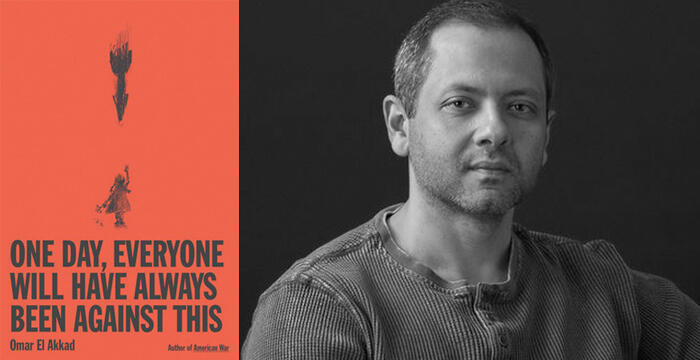
In late October 2023, weeks into Israel’s bombing of northern Gaza, the novelist Omar El Akkad retweeted a video taken by a Gazan man. This video showed a lifeless moonscape with endless empty streets of rubble, every building, one to the next, a hollow blown-out shell of itself. No people, no animals, the only sound the strained breath of this man stumbling through this indiscriminately obliterated city that was once a home. El Akkad captioned his tweet with the words: “One day, when it’s safe, when there’s no personal downside to calling a thing what it is, when it’s too late to hold anyone accountable, everyone will have always been against this” a tweet that has now been viewed over ten million times. Despite El Akkad’s past as a journalist, one who reported on some of the most notorious and fraught moments in recent U.S. history—whether embedded in Afghanistan, down at Guantanamo Bay, or reporting from Ferguson, Missouri—it was the aftermath of October 7th that was a turning point for him in relation to the West and its notions of humanism and liberalism. Together we discuss his debut work of nonfiction that resulted from this, that many characterize as his breakup letter to the West. We look at the role of language in providing cover for the middle, the centrist, the well-meaning liberal to look away and the power of language to create a climate of dehumanization, allowing the unspeakable to seem tragic but necessary.
For the bonus audio archive Omar contributes a reading of one of his favorite poems by Jorie Graham. This joins everyone from Isabella Hammad reading Walid Daqqa to Roger Reeves reading Ghassan Kanafani, to Zahid Rafiq reading Franz Kafka. If you enjoyed today’s conversation consider joining the Between the Covers community as a listener-supporter. You can find out about all the benefits and rewards of doing so, including how to subscribe to the bonus audio, at the show’s Patreon page.
Finally, here is the Bookshop for today’s episode.
Transcript
David Naimon: What, if some day or night, a demon were to steal after you into your loneliest loneliness and say to you, "This life, as you now live it and have lived it, you will have to live once more and innumerable times more?" Would you not throw yourself down and gnash your teeth and curse the demon who spoke thus, or have you once experienced a tremendous moment when you would have answered him, “You are a God and never have I heard anything more divine?” Want to know what Nietzsche meant or why he thought we'd live our lives over ad infinitum? Every day, moonlit: The Daily Literature App, curates one passage to explore. Search moonlit: The Daily Literature on the App Store and use coupon code BTC1MonthFree to get your first month for free. Again, that's Moonlit Daily Literature with coupon code BTC1MonthFree. Again, that's Moonlit Daily Literature with coupon code BTC1MonthFree. Just this week, I was sharing with supporters how one way I've been coping with the world hurtling wildly in the opposite direction from anything good was to surround myself with narratives of mutual aid and solidarity of people taking risks on behalf of others and to connect with such activities here in my city too. Thinking that others might benefit from this too, I shared with Between the Covers supporters two stories from the past. One, an incredible audio documentary called A Porous Place, made by a supporter who shared it, that engaged with resistance by French sheep farmers in the '70s that engaged with questions of French colonization of Algeria as well as ways of saying no to capitalism's insatiable hunger. The other story was of a supporter herself who was recruited by the ANC to set up a safe house for activists in Apartheid, South Africa, a story she tells for us in her own words in her recorded audio. But there are also many examples from the public archive of what I'm talking about too. I think of the conversation with Roger Reeves about his book of Fugitive Essays and with Christina Sharpe about Ordinary Notes and her notions of both distributive risk and of beauty as a method. Also the conversations with Naomi Klein with Billy-Ray Belcourt and Nalo Hopkinson. But more recently I feel like a human-shaped magnet that is pulling books like this into my orbit, and the book of today's guest, Omar El Akkad, feels like one of these books, one of my newfound cherished guides and maps to an elsewhere and an otherwise; a book to think alongside this year, long after the reading experience. All of my conversations feel to me like stepping stones that help me navigate the year, but some of them feel like survival stones, steps of survival, and I'm excited that this is one of several upcoming episodes going into spring and early summer. I hope it feels like this for you too, that some of these conversations might be places to gather and pause and also, at the same time, pathways forward. Before we begin, I should mention that Omar's contribution to the Bonus Audio Archive is a reading of his favorite poem, one he returns to more than any other poem. It's a poem by two-time Between the Covers guest, Jorie Graham. This joins an immense archive of bonus material, whether Roger Reeves reading Ghassan Kanafani, Isabella Hammad reading Walid Daqqa, Dionne Brand reading Canisia Lubrin, or Jorie Graham herself reading Robert Creeley and Edward Thomas. The Bonus Audio is only one possible thing to choose from if you join the Between the Covers Community as a listener-supporter. Every supporter is invited to join our brainstorm of future guests, and every listener-supporter gets a robust collection of resources associated with each episode. Then there are many other things to choose from in addition to all that, including the book-length anthology from Jewish Currents called After October 7th, with work by everyone from Hala Alyan, Arielle Angel, Dionne Brand, Fady Joudah, Noura Erakat, Hannah Black, Mari Cohen, and more. Also, the Tin House Early Reader subscription, where you receive 12 books over the course of a year months before they're available to the general public. This only scratches the surface. You can check it all out at patreon.com/betweenthecovers. Now for today's conversation with none other than Omar El Akkad.
[Intro]
David Naimon: Good morning and welcome to Between the Covers. I'm David Naimon, your host. Today's guest, Omar El Akkad, was born in Egypt, grew up in Qatar until his family emigrated to Canada when he was 16. El Akkad's writing life began in journalism, first in a student newspaper then as an intern at Canada's biggest paper, The Globe and Mail, where he ultimately gets hired just as the biggest terrorism story breaks in Canada, that of the Toronto 18. Because he's one of the only people of color in the newsroom, he sent to the mosques these suspects had attended, and this unfolding national story was something he wrote about for several years. This led El Akkad's journalistic career to engage with some of the most important events of our time. At the age of 25, he embeds as a journalist in NATO's war in Afghanistan. He goes to Guantanamo Bay to report on Canada's last detainee there, Omar Khadr. After this, he reports on everything from the Arab Spring to the uprisings in Ferguson, Missouri, after the police murder of 18-year-old Michael Brown. Despite this remarkable trajectory as a journalist, Omar El Akkad is best known as a fiction writer, and his uncanny timing continued in this sphere as well. His debut novel, American War, arrived just months after Trump's inauguration in 2017 and seemed like a message from the future, delivered specifically for the present moment. With starred reviews from the Library Journal, Publishers Weekly, and Booklist, this best-selling and critically acclaimed book was heralded by Ron Charles at the Washington Post as follows: “Follow the tributaries of today’s political combat a few decades into the future and you might arrive at something as terrifying as Omar El Akkad’s debut novel, American War. Across these scarred pages rages the clash that many of us are anxiously speculating about in the Trump era: a nation riven by irreconcilable ideologies, alienated by entrenched suspicions. . . . both poignant and horrifying.” He followed this with the 2021 novel What Strange Paradise, which centers a young boy from Syria who has survived the sinking of the ship carrying him and other refugees. Named a best book of the year by The New York Times, Washington Post, and NPR, and winner of Canada's Giller Prize, Ron Charles again says of El Akkad's second book, “Nothing I’ve read before has given me such a visceral sense of the grisly predicament confronted by millions of people expelled from their homes by conflict and climate change. Though ‘What Strange Paradise’ celebrates a few radical acts of compassion, it does so only by placing those moments of moral courage against a vast ocean of cruelty.” Omar El Akkad in the city that we both call home, Portland, Oregon, is also the go-to interviewer for public literary events here, sharing the stage with everyone from Margaret Atwood to Madeline Miller to Ta-Nehisi Coates, as well as emceeing the upcoming Oregon Book Awards. It's with a great honor to welcome interviewer to interviewer Omar El Akkad to the show to discuss his debut work of nonfiction, one of the most anticipated books of the year, and yet another uncannily, timely work, entitled One Day, Everyone Will Have Always Been Against This. Here are some thoughts on the book from past Between the Covers guests: Naomi Klein says, “It is difficult to understand the nature of a true rupture while it is still tearing through the fabric of our world. Yet that is precisely what Omar El Akkad has accomplished, putting broken heart and shredded illusions into words with tremendous insight, skill, and courage. A unique and urgently needed book.” Christina Sharpe adds, “Omar El Akkad’s One Day, Everyone Will Have Always Been Against This, lays bare and eviscerates the genocidal logics of fascism and liberalism. Here, language does what we need it to do: it clarifies, it condemns, it names, it grieves. Here, too, is a lexicon for what might survive this. Devastating and scathing; you will want to read, will want to have read, this book.” Isabella Hammad continues, “In this powerful indictment of Western complicity in the genocide of Palestinians, Omar El Akkad asks: how are we supposed to go on living in this world? He looks for his answer to the worlds colonized and oppressed, who have always lived according to a love that ‘cannot be acknowledged by the empire because it’s a people’s love for one another.” Finally, Rabih Alameddine says, “Is this the most urgent book you can read right now? Yes, it is. Is this the most moral book you can read right now? It sure is. Is this the most eye-opening book right now? Yep. Is this the most needed book for our times? Absolutely.” Welcome to Between the Covers, Omar El Akkad.
Omar El Akkad: Thank you so much for having me. It's a pleasure to be here.
DN: The origin story of the title of this book comes from a viral tweet of yours shortly after Israel began its wholesale indiscriminate attack on Gaza that went: “One day, when it's safe, when there's no personal downside to calling a thing what it is, when it's too late to hold anyone accountable, everyone will have always been against this.” But I'd love to hear what the origin story is of the book itself for you. Did the events themselves call you to account or did something else? How and why did you decide to move from fiction to nonfiction in engaging with Israel's genocidal sea [inaudible] Gaza?
OE: Thank you for that. In early November of 2023, right around the time of the Portland Book Festival, my editor was in town and we went out for dinner. By that point, I think all I was talking about to anyone who'd listen was the sense of feeling deeply unanchored from the Western world to which I've oriented myself since I was five or six years old. The sense that whatever institutional load-bearing beams hold up the society, they appear to have a rot in the core. Of course, I was saying this in the context of what I firmly believed then and believe now is a genocide, one that was being live-streamed, one that was showing up on my computer every morning and had become a kind of narrative companion. I say this knowing how pathetic it sounds, given that I live on the launching side of the bombs, I live in the relative safety of the heart of the empire. My suspicion is that my editor got so sick of me rambling at him that a few days later he called up and said, “You really should be writing about this.” I had been sketching out thoughts. I often describe writing as not only the only thing that I'm halfway good at, but also my first avenue of retreat, when the world doesn't make sense to me, I go to the page. At the end of that process, it still doesn't make sense to me, but I have a fuller understanding of the many dimensions in which it doesn't make sense to me. I kept on writing, and I had no sense that this was going to become a public-facing thing. It was only months later that I sent something of a draft to my editor, and to my surprise, he was interested in acquiring it and going through that process. But the book originally was written under the title, my working title was The Glass Coffin. I was spending a lot of time thinking about how when a population is under siege to a colonial power, to an oppressive power, one of the most dangerous things that that population can do is show the body. I was writing under that title and it was only, I think, months later that an editor at Penguin Random House suggested paraphrasing the original tweet as a form of the title so that's what we did. But now I find myself on this fairly futile mission to try and convince people that I didn't just take a tweet and expand it out to 250 pages, which I promise you is not how this book came together.
DN: Well, the book is at its heart, a breakup letter with the West and its dream of itself and for itself, written in ten parts from departure to arrival. Just before that, there is a brief prologue, which I'd love for our listeners to hear. But I wanted to bring up one thing first to see if you have any thoughts about it as a preface to your reading. Recently you were in Doha being interviewed by the acclaimed Pakistani British writer Kamila Shamsie at a climate energy conference. In that conversation, she expresses surprise that after all you've engaged with from Afghanistan to Iraq, to Guantanamo, to Ferguson, that you say in the book that up until October 7th, you still held to some of the ideals you associate with the American story. In the months since, I've been thinking about the power of these stories and myths. I think of an exchange between James Baldwin and Audre Lorde, where Baldwin says, "Du Bois believed in the American dream. So did Martin. So did Malcolm. So do I. So do you. That's why we're sitting here." And Lorde replies, “I don’t, honey. I’m sorry, I just can’t let that go past. Deep, deep, deep down I know that dream was never mine. And I wept and I cried and I fought and I stormed, but I just knew it. Nobody was dreaming about me. Nobody was even studying me except as something to wipe out.” Baldwin responds, "You are saying you do not exist in the American dream except as a nightmare.” Lorde answers, “That's right. I knew that every time I went to school. I knew that every time I opened a prayer book. I knew it, I just knew it.” I think about it because this is Baldwin in the 1980s in the last decade of his life, believing this still, how powerful the hold and the promise can be. This isn't a question exactly as I think your whole book, in one sense, is about this. But if this sparks any thoughts for you as a lead-in to reading the prologue, I'd love to hear them.
OE: You and I right now are having this discussion while I'm on the other side of the planet in Edinburgh, of all places. In the past few days, I was in London for the beginning of the book tour, which is another way of saying the beginning of my public-facing self, putting on the costume of somebody with social skills and attempting to speak about this book in a matter remotely as eloquent as I do in writing, and I'm not all that eloquent and even in writing. But one of the recurring motifs of the questioning that I've received so far has been along the lines of the salvageable nature of facets of the society, which is to say, people asking me variants of the question, "Do you really think there's nothing here worth saving?" And I find that to be a fascinating construction in terms of what it tells me about that person's relationship with the institutional power centers of the world we both inhabit. The more those power centers were built to serve that person, the more they seemed frankly astounded that I would even consider this position. It's very difficult for me to explain to them that I'm thinking along this axis, that in fact, were these privileges applied uniformly, I would be cheerleading for something like the American dream from the rooftops. But having seen it in its fragmented nature, in its asymmetrical nature, in its plainly inaccessible nature, to huge swaths of people who, by virtue of history and by virtue of the reality of their existence, have every right to it, I find it so difficult now to think of it as a holistic thing rather than a series of shards told out perhaps piecemeal, perhaps not at all. That's the first thing I think about when you bring up that quote. I mean, I remember reading an interview with James Baldwin who was living in Paris, and the interviewer convinced that this was a great literary adventure on his part to follow in the footsteps of Hemingway and Fitzgerald and Baldwin trying to explain, "You know, man, I had to get the hell out of that country. I was too angry to be a Black man in America. They would have killed me." And that chasm of interpretation is I think one of those areas where I see some commonality with my work because I think I'm trying to contend with similar chasms.
DN: Could we hear the prologue to the book?
OE: I recently read the audiobook and in addition to the audiobook, I have read the prologue publicly twice and every time, I have not managed to make it through in one piece.
DN: Would you prefer me to play what you have in the audiobook?
OE: No, I'll take a shot at it.
DN: Okay.
OE: I'll take a shot at it. Just bear with me. I apologize in advance, I suppose.
[Omar El Akkad reads from One Day, Everyone Will Have Always Been Against This]
DN: We’ve been listening to Omar El Akkad read from One Day, Everyone Will Have Always Been Against This. I'm particularly interested in talking about what it looks like or could look like to break up with the West, what an otherwise could be like, and how to foster it now and here, something I myself often have had difficulty imagining, but where your book and a couple of others I've been reading recently have really helped me to imagine. This is where your book ultimately culminates and where I hope we will ultimately culminate today too, but it feels important to first begin, as your book also does, with questions of language and the fortress of language you just read about, about who upholds this fortress and to what ends, and how and why we might break out of it as part of breaking out in a larger way. As a first step toward our spending some time together doing this, we have a question for you from the writer Madeleine Thien. Her last novel, Do Not Say We Have Nothing, won the Governor-General's Award, The Giller Prize, was shortlisted for the Booker, and much more. Nine years later, we are just about to receive her new book, The Book of Records, of which Maaza Mengiste says, "Most of all, it is a gifted writer's uncompromising vision of a world where the imagination has the ability to transform the rules of existence, and provide new mercies to those most vulnerable.” Here's the question for you from Maddie.
Madeleine Thien: Hi, Omar, this is Madeleine Thien, or Maddie as you know me by. Thank you so much for this incredible work. I am truly grateful for it. Among other things, I am very grateful to you for returning what is sacred to language, by which I mean to not let language obscure, to not let it destroy or dehumanize or impose meaninglessness and helplessness. I think what is sacred is this capacity to name things and to bear our responsibility to the living and to the dead and to keep the record. I have been haunted for the past 14 months as we see the destruction of Gaza and the destruction of life by the silence of writers. What moves me so much about this book is your deep engagement, which manifests as the refusal to turn away, the refusal to be silent, to be made silent, and the refusal to say that there are no words. I felt, and I suppose this is my question, is if in fact you are choosing ever deeper levels of engagement to find the words that have to be spoken, and in fact, if you have found a renewal of the vocation of the writer, first and foremost, not as a writer, but as a human being, first and foremost as a human being who is responsible to other lives and that this is where journalism and the vocation of writing begin, always begin and must remain, I wanted to tell you that for me this book is a living thing. It shatters me but it doesn't break me and it gives me the courage to refuse to stay silent. I wanted to thank you for not being silent in the face of genocide, and to thank you for not refusing the task of the writer.
OE: Sometimes I get to thinking that whatever it is we do as writers, it is a patently ridiculous profession. The pay is not all that great. The opportunities are up and down at best. You get yelled at a lot by strangers. But if you are very, very fortunate, Every once in a while you come across a situation where you meet the sort of people who not only inspire you with their writing, not only inspire you with who they are as human beings, but also with this kind of courage that is deeply, deeply infectious. There have been many, many moments over the last year and a half where I have desperately wanted to look away, to keep my head down, to save whatever the hell has left of my career, by not being the troublesome Brown guy, and in so many of those moments, I remember that I have the very good fortune to know someone like Maddie, who in addition to being just one of the best human beings I have ever met has one hell of a backbone. There are things I know about what she's gone through over the last year and a half that may never come out to light, but I know them and I know how resilient she is and how caring she is so I'm deeply grateful for that question, but more so, I'm deeply grateful to know her. Last year I was teaching an online weekend course with the MFA program that I work with in Oregon, and I had been asked to construct a sort of thematic container for this course. Obviously given the state of mind I was in, I decided to focus on the idea of how you write when you're very, very angry. Not because of the quality of the course or my talent as a writer, but rather because I think a lot of people feel this way right now. The course was very well attended. We're sitting there on this Zoom call and we're talking about craft and the nature of the sentence and precision and language and all of the stuff that I think more than just as an outpost of nerdery, where writers can join a little gaggle and talk shop, is generally just what we do as writers when we talk about craft. But we're sitting there doing this, and at the same time I've got my phone next to me, and it's one of my old friends from high school, and he's in Lebanon, and he's describing to me how he's trying to keep his kids from freaking out because there's jets overhead and there's bombs nearby and they don't know where the bombing is going. There have been many moments like this but this is the one that comes to mind because I think it was the one that was most stark where I had to stop and think to myself, “What the hell is this? How do I attach any kind of seriousness of purpose to the work of language if I'm going to be talking in abstractions and talking shop and talking craft and sentence structure when human beings are being slaughtered wholesale?” I think that we are in an era and the culmination of an era that has been going on maybe for a very, very long time, but certainly for the last 20-plus years, where institutionally, language has been used for the exact opposite of what language does. Language has been used to unmake meaning. There are sections of this book where I talk about my time in Guantanamo Bay. In Guantanamo Bay, there were never any interrogations. Of course, people were interrogated left, right, and center, but they weren't called that. They were called reservations. There were no prisoners in Guantanamo Bay. There were only detainees. This, of course, exists on a continuum. Before this came along, there was the bombing of a wedding party renamed Collateral Damage. Years after this we will all witness ethnic cleansing termed by the New York Times as a redevelopment plan. I think if any of us are worth a damn as writers, we can't, in that kind of environment, hide behind this notion of art as being unsullied by the political and unsullied by these common gutter-like debasements that are somehow higher than this. You address this now, or it will address you. You don't want your writing to be political, the political is going to infest your writing. There's a section in the book where I talk about how my favorite writers write about the moon, they write about what the finches are doing, they write beautiful sentences about beautiful things, and I adore that, and I wish I had the talent, and I strive for it, and I try to write that way, and I have nothing against it. But if we are to think of writing as a conduit of beauty, then we must contend with the idea that there is no sentence so beautiful about the finches or the moon that can offset the amount of beauty taken out of the world when a child is murdered by a drone. I struggle with this because there are many days when I get up and I feel less than useless. What is this writing going to do? But at the very least, I think if we're going to call ourselves writers, which is to say, if we're going to claim that we are invested in saying something about what it means to be human, then we have to stand in the way of this. We have to throw everything we have as writers against the machine invested in the unmaking of meaning. You know what, we might fail, but the greater failure is to not attempt it, to simply look away and talk about how beautiful the moon is.
DN: I wanted to spend a moment with something that the book doesn't focus on, but that is the climate that this book arrives within. Since October 7th, we've seen lots of high-profile instances of censorship, whether the 92nd Street Y halting their storied literary series after canceling an appearance by Viet Thanh Nguyen because he signed an open letter critical of Israel, an open letter that included many past guests of this show, Viet himself, Naomi Klein, Natalie Diaz, Isabella Hammad, Laila Lalami, Jonathan Lethem, Carmen Maria Machado, China Mieville, and many others, or past Between the Covers guest Adania Shibli who was attending the largest book fair in the world in Frankfurt in order to receive a prize and honor for her book and to take part in the panel and having both events scuttled because of October 7th, or the Democratic Party unable to countenance a Palestinian American speaking at the convention. Even an elected representative of the state of Georgia, whose speech was vetted and sanitized and had all the platitudes of standing together across faith and ethnicity. Or the anthropology professor, my friend, Maura Finkelstein, being fired from a tenured professorship for her teaching of an advocacy on behalf of the Palestinian narrative. All of this, of course, before the funhouse mirror version of this with Trump, where who knows where protesters could end up, maybe El Salvador, but none of this is actually new, other than it is now making the news. Palestine Legal, for instance, responded to nearly 300 incidents in an 18-month span from 2014 to 2015, and most years have over a hundred incidents. But what can't be measured, I think, is the silence it creates, the self-censorship of people who are worried about their reputations being destroyed or their careers being ruined. I should add, however, that at the same time since October 7th, we're seeing a huge increase of interest in books by Palestinians with a giant wave of books now coming out written from a Palestinian point of view. Perhaps that is one thing that is different, that the censorship isn't new, but that a new space, at least for now, has been created for these narratives. All that to say, outside of this book, you've spoken about how your publisher is scheduling more events for the book than you can possibly do, factoring in that some might get canceled. You've considered changing the last names of your children to your wife's last name in advance of the book. You've talked about how there was an agreed-upon movie deal for American War where your partners walked away from it after October 7th. So thinking of Maddie's question about silence and speech, I wondered if you could speak a little more about writing into this climate with no small amount of fear and apprehension, I imagine, and if you had to battle a self-censor, if there were things you did to keep your barometer true as you were putting words down on the page.
OE: In the case of this movie deal, for example, where it was such an interesting construction of the leaving that I decided to include it in the book, I think my net loss on that was something like $10,000, which granted, we’re writers, nobody's handing us checks for $10,000 left, right, and center, and I don't want to pretend that that is a significant amount of money for me, but that's what it is, an amount of money. I had an event that was due to take place this summer after the publication of this book and when they asked me to do it, I told them, "Sure, I'd be happy to, but you should know I have this book coming out and take a look at it and let me know." I got an interesting response in the sense that the person said something like, “This book makes me want to invite you even more, but I don't think the board will go for it.” So that event was canceled. I'm fascinated by these kinds of constructions because they tell me something about the ever-changing equilibrium between reward and punishment in the society I live in. Look, I don't care too much about my career. I don't have one really to begin with. I'm a guy who's written three books. Obviously, matters of personal safety are different, but if we're talking about professional consequences, I've been watching kids get murdered for a year and a half. I've become conditioned to knowing that if I check my social media feed and there's a picture of a smiling Palestinian kid, it's almost certainly because they've just been killed. There are lots of things that I used to give a shit about two years ago, but I simply don't anymore. I don't want to preemptively frame myself as this great martyr for the cause. I've done less than nothing. I've written a book, who cares? But it's not so much that this stuff didn't exist before. Writers like anyone else in this society includes many who are very well-versed in keeping their head down. In fact, to be perfectly honest, I would bet that right now, if you are a writer or if you're engaged in cultural industries generally, one of the safest and most rewarding things you can do is keep your head down. Nobody's going to blame you if you wait until this is a settled issue, and then you stand up and hop on whatever side makes the most sense to your self-preservation. But, as a factor of something bigger that's happening, I think these kinds of moments are indicative of the reward-punishment equilibrium sort of falling apart because you're seeing writers who are at the beginning of their careers, who have every incentive to play nice, going out and risking everything, because they quite simply can't live with the state of the world as it is. A lot of personal considerations come to a grinding halt at the sight of tens of thousands of dead kids. What has been interesting on the other side of that is watching some of the most famous, established writers who have nothing to lose anymore, whose entire legacies are intact and yet can't say a thing. It has been deeply, deeply instructive. In terms of the actual practical effects, there's detrimental consequences, of course. But also, one of the things that has changed for me over the last year and a half is that I've always known that I very much want the admiration of people I respect. But I've come to realize that I also don't feel so bad about the antagonism of people I don't respect. That's something that I'm fine with. I've lost opportunities, but it's so minor. It's so minor. On top of that, there are things I don't want to do anymore, and I'm quite happy to be apart from that, but that's from a very privileged position. I don't know that there's ever been a situation in which standing up to atrocity hasn't come with exactly this kind of cost. The Iraq War, Apartheid in South Africa, you hit the wall, the wall hits back, but eventually the wall crumbles.
DN: Well, let's talk about who you're most deeply critiquing in this book, the liberal, and how this relates to language. In the part you read for us, you said, "It is instead the middle, the liberal, well-meaning, easily upset middle that desperately needs the protection this kind of language provides,” and, "It is the middle of the empire that must look upon this and say : Yes, this is tragic, but necessary, because the alternative is barbarism." You also characterize Western liberalism in this way, that in the moment, all resistance is terrorism, but at the same time liberals will imagine in retrospect that there was a virtuous resistance to colonialism available. I think we see this over and over again, people forgetting just how unpopular MLK was in his time or that Rosa Parks went to jail, lost her job, received death threats, had to relocate, and lived in poverty most of her life. Or that Nelson Mandela was the head of the paramilitary wing of the ANC. All of these people were loved only after it matters in what you call a malicious fiction of moral convenience. But you also explore the way languages employed by liberals such as passive language like Palestinian journalists hit in the head by a bullet or language that sanitizes violence, like you've spoken about already today, such as collateral damage, where you draw a direct line between this type of language's deployment and the well-meaning liberals ability to shrug their shoulders and say, "Yes, this is sad, but so complicated." I'm interested in talking about this, but even more so about the way the "easily upset middle" wants things to remain in the realm of language and feelings versus what is actually happening in the material world, where you say, “American liberalism demands a rhetorical politeness, but there is a deranged honesty to current leaders in US Israel. Conservatives will gleefully sign the bombs, liberals sheepishly initial them.” It feels like a lot of the outrage from liberals is outrage around decorum or politeness or how someone signs the bombs gleefully or sheepishly, not that they are signing the bombs in the first place. I think of Theodor Herzl, a founder of Zionism, who said, "We must remove people from the land discreetly and circumspectly." Articles of impeachment have been submitted against Trump based on his comments about wanting to empty Gaza entirely, level the ground, and build a Riviera there for Israelis. But just last week in The Washington Post, about this, an article called "Egypt lobbies against Trump plan to empty Gaza of Palestinians as Israel prepares for it," a Western diplomat, under the cover of anonymity in that article, said Biden, alongside some of Europe, early in the siege of Gaza, approached Egypt to explore doing the very same thing. Yet he did it discreetly, circumspectly, it didn't ruffle liberal sensibilities or lead to articles of impeachment. Lastly, the conflation of comfort and safety feels part of this looking away from the world and staying within language where we're focusing on how it makes someone feel if another says a word: genocide, settler, colonialism, or occupation, that whether a so-called well-meaning person is going to care is based not on what is occurring and whether that thing is bad but on whether the way it is described meets every criterion of correct language. In other words, language becomes the way not to care while seeming to. I apologize for this stump speech, which is not really a question, [laughs] but I was hoping maybe this would spark some more thoughts from you.
OE: No, no, that was fascinating to listen to. I mean, one of the privileges of putting a piece of writing out into the world is that for all of the sort of five-minute TV hits and bizarre interviews with people who have not read the book and do not care about the book and do not care about books, you get something like this. I'm appreciative of that, as I am of this series, of which I'm a huge fan precisely for this purpose, precisely for this reason, that there is a depth to it. There's this collection that came out a few years back. It's one of my favorite poetry collections of the last few years. It's called Whereas by Layli Long Soldier, and at least a major part of it is predicated on a government, a US Government resolution, effectively apologizing for all the genocide of the Indigenous people. It's a resolution that came a few hundred years too late and was passed without much fanfare. Then this poet takes it and reworks it into an indictment of the very thing it's pretending to be. I think writers, in particular, are especially sensitive to the machinery of duplicity, and that often takes us to some very strange places when we're writing, because effectively, once you start putting words down on paper, you are learning your various thresholds of sensitivity. Instinctively, I know there are two answers to the question of what I find most horrifying, most frustrating, what inspires more rage in me, the openly fascist current administration, or this sort of neoliberal, friendlier-sounding previous administration. Rationally, intellectually, I know that this person in power is going to unleash and has already unleashed incredible amounts of suffering on the most vulnerable people in this country. I know that, and I know that that should be the sight of my greatest anger, but there is something else that kicks in when you spend a year and a half watching a smirking press secretary talk about how nobody is doing more for the Palestinians than this current administration as at the same time that administration is facilitating their mass murder. It's something else. It's a chasm between the costume and the skin. I don't think this is just writers who respond with such a kind of antibiotic reaction to this sort of thing. I think we're in the position we're in right now because so many people react so badly to there being a chasm between the pretend and the reality. This, to me, gets to the heart of the conversation that I've been having over and over and over again, and that I try to contend with in this book. We live in Portland. Portland, at the very least, is a city that has a veneer of a kind of liberalism where there are neighborhoods where every house has a Black Lives Matter lawn sign, and there's not a Black family for 20 miles in any direction. The performance is very important in a place like Portland, and the performance is very important in a place like America. You constantly find yourself in these conversations where you are trying to explain to somebody that you understand the stakes and that you understand the relative difference in evil between these two parties and between these two modes of thinking, and that you get all of that, but that there is a kind of threshold beyond which you cannot sit with your conscience. Of course, I'm saying you, I mean me, I can no longer go for the lesser evil when the lesser evil has wandered into the space of genocide. But the response over and over again is yes, but the other side is worse. I understand that, but we've gone to a place where this relativity falls apart. One of the things I've seen on the other side of that that has been very instructive for me is this parade of people who previously were pleading with me to vote for the lesser evil, now taking a kind of gleeful delight in the continuation of atrocities that began under the previous administration and saying things like, "Well, you didn't vote for the Democrats. I hope you enjoy getting deported." This is instructive to me. It lets me know you were never my ally. We simply had a brief meeting of self-interest, and once that meeting ended, I was useless to you. So, functionally, intellectually, rationally, I know who I should be angrier at. But viscerally, it's a different kind of frustration that's aimed at a different kind of duplicity.
DN: I want to spend more time around this question of neoliberalism versus fascism, but as an intermediary step before we do that, to talk more about performative language and silencing, there are a million instances we could talk about, but the one that you do bring up in the book is the boycott of the Giller Prize because its main sponsor was one of the largest investors in an Israeli arms manufacturer, a prize that is a life-changing prize for many authors, both because of its prestige, or some say former prestige, and its quite large monetary reward. Both you and Maddie have won it, and both you and Maddie have been two of the most visible and outspoken Canadian writers asking them to drop the sponsor. Protesters interrupted the ceremony in 2023. Nearly 2,000 writers wrote an open letter asking for divestment. You and other Giller winners including the 2023 winner, Maddie, Michael Ondaatje, wrote an op-ed, 30 writers with eligible books for this year's prize and two of the five jurors withdrew, and yet the head of Giller seemed to center herself, her feelings, and to make ad hominem attacks on certain writers, arguing that this is a place for celebrating literature, not politics. Yet this year's winner among the diminished field and Michael's speech had lines like, “Everything I write is a form of witness — against war, against indifference, against amnesia of every sort.” It mentions solidarity over and over again, and yet never says the word "Palestinian," nor makes a nod towards the solidarity that thousands of her Canadian writing peers were asking for at that moment. I was hoping maybe we could just spend a beat on The Giller Prize, why it finds itself in this book, and how it finds itself in this book.
OE: I think it finds itself in this book because it was another deeply instructive period for me. I should say that at this point, the folks at the Giller Prize and I are never going to have anything to do with each other again. That's sad, but we're all grown-ups and we'll get over it. But the first thing that comes to mind when I think back at that saga is that writers like Maddie and I were the most visible in terms of public attention. But not to speak for Maddie who did an immense amount of work but only to speak for myself, I did very little. I signed a few open letters, I gave a few interviews, and that was sort of the end of it. There were activists who were working on this for a very long time and who have suffered particularly brutal consequences, and they're the reason that this happened. As you and I are talking now, we're only a week or two removed from the Giller Prize announcing that it is cutting ties with Scotiabank. That's something those activists did, and they'll never get the credit for it that they deserve, and they will have to live with the consequences. The thing that interested me most outside of the desire to simply not have an investor in a manufacturer of weapons of death be the sponsor of a major prize in the arena where I work, was that the whole thing seemed to showcase within the arena of culture this thing I talk about in the book which is the difference between penultimate consequences and ultimate consequences. Most cultural workers, particularly on this side of the planet in this country, are broke. We don't make that much money. It's a precarious living. Grants are not something you can rely on to live, fellowships, this very sporadic financial existence, all of that. So there is an immense, immense lure to play nice and I'm not talking in abstractions here, I've done this many times myself, not only with the Giller Prize, and granted, I had no idea about Scotiabank's relationship with Elbit the year I won, but also being nominated for an award that is sponsored by Amazon and showing up in a nice suit and smiling and doing the dance. I've been spineless many times in that regard. But fundamentally, these organizations, these groups, these awards cannot exist without the people who do the cultural work. That's a fairly straightforward, uncontroversial statement. So I understand, and I had these conversations back when the folks from the Giller and I were actually talking, where it was made clear to me that they felt fully that they might not be able to financially survive. I understand that. A lot of us at many times feel like we might not be able to financially survive. But that is still a penultimate consequence. You lose the funding to hold this thing at the four seasons, yeah, that sucks. You got to hold it in somebody's basement. It's not ideal. But the ultimate consequence is the participation of the people who do the work without which your organization quite simply not exist. In this case, I promise you that this was a cooperative process at the beginning. These initial conversations felt constructive, and we were led to believe that we were on the same team. Then, I think at a certain point, this narrative emerged, whereby we had all suddenly decided for some strange reason that we were all raging anti-Semites and that we were going to attack this prize in particular because some of the people on the board are Jewish. That's a very powerful narrative. I don't think for a second that that allegation was made in good faith, but it's a very powerful narrative. All I ever wanted in this whole situation was for the prize that changed my life and that I once associated with one of the happiest moments of my professional existence to not be tied to a company that invests in a manufacturer of mass death and somehow it got to this place where it became deeply antagonistic and I decided to cut off all communication with the folks at the Gillers, and Maddie I believe sent them a letter saying, “Stop using my name.” Maddie is one of the sweetest human beings you will ever meet in your life. To get Maddie to go to that place, you got to go out of your way. It's an incredible shame, but it highlights this idea that participation is the ultimate consequence. Enough people leave and you can have all the money in the world. You now operate a phantom prize. The last thing I'll say about it is that I want to push back against this idea that we were doing this gleefully or that we are all happily invested in the idea of picking a fight with this prize or that prize. There was nothing joyful about any of this. This is a really sad parting. I'm not happy about it. Just as I assume those kids who got kicked out of their universities for protesting probably at one point were quite proud that they got into those schools. It's not this deliberate desire for antagonism. That, I think, and the inability to express that to people I once considered friends is obviously, in the grand scheme of things, not a particularly huge deal, but it's something that I think about with quite a bit of sadness.
DN: You began, I think, to answer my next question, but I want to stay with it because I feel like it's one of the most important takeaways that I had from the book and so indulged me for a minute. But one of the things that I took away from this book is that to break up with the West values with the American dream, with how it narrates its story back to itself isn't simply to say from the beginning America was genocidal and we are still living in the afterlives of that, but also to say that liberalism is not what it thinks it is in regards to this, that it isn't the opposition it thinks it is, but ultimately an enabler of it. I realize, I'm not entirely sure, but I realize I might be taking away something that you might not fully agree with away from your book. But let me read some quotes it made me think of, and then I'd love to hear your thoughts. The first thing I think of is Martin Luther King's letter from a Birmingham jail, where he says that he's almost reached the conclusion that the greatest obstacle to Black liberation is not the Ku Klux Klan, but the white moderate, who is "more devoted to order than justice," who prefers a negative peace, which is the absence of tension, to a positive peace, which is the presence of justice, who constantly says, "I agree with you in the goal you seek, but I cannot agree with your methods of direct action, who paternalistically believes he can set the timetable for another man's freedom." I also think of an interview more recently with the American historian, Robin D.G. Kelley, in The Nation, "Liberalism is used as a framing of history—that is, the idea that history is continual progress. The idea that there is a ‘real America’ and these other dark moments are an aberration is based on a liberal conception that progress is inevitable if you wait. Fascism has always been a threat, but this country is built on fascism. Fascism is the use of the state to force people into subjugation and to extract wealth for a class. And if fascism is based on nationalism, and especially a racialized nationalism, then America is fascist. But liberalism underwrites it." You have a new op-ed in The Globe and Mail called "Biden was a failure. Trump will be a catastrophe," and within the book itself, and also already today, you speak about the lesser evil position with lines like, "When after decades of such thinking, decades of respectful prodding, the condition one arrives at is reticent acceptance of genocide, is it not at least worth considering you are not changing the system nearly as much as the system is changing you?" Which suggests, at least to me, that Trump is a difference in gesture and rhetoric, and also very much in terms of degree and brazenness, but possibly not entirely a difference in kind. That in the spirit of the anthropologist David Graeber's line, "The true enemy of the left is not the right, but the center," that this book is a breakup with the center for this reason. But I don't know if I'm reading into your book in this regard. I'd love to hear thoughts or pushback regarding whether breaking up with the West with the well-meaning liberal is because of this sanitizing of horror and terror and not just the horror and terror since October 7th.
OE: Certainly, I think this is one of those rare occasions in which you're reading, in my intent, a line given the kinds of books I write. I don't get that privilege quite often. Yeah, I think that we are in this stage in large part precisely because the center is believed to be one thing, but actually is something else entirely. In the conception of the centrist, the center is fixed. That's what makes it such a prized possession because it affords once you occupy it this level of implied superiority where you hover above the partisans with the high-minded central position. But I think one of the things that the far right in this country—which in terms of administrative power, now seems to overlap with the right in this country—has figured out is that the center is in fact incredibly flexible. If tomorrow Donald Trump proposes executing all migrants at the border, and a centrist manages to convince him to compromise and only execute half of them, that's centrism. Surely there's some raging leftist somewhere who has the patently unreasonable position that maybe we shouldn't execute migrants at all. But the center is moving. To misquote one of the most famous lines in literature, the center isn't holding. This, I think, is the source of so much of my frustration with this all. I think I would find it all so much less infuriating if there was an admission that the center is moving, that a means of exploitation has been found that now leaves us in the position we're in. I remember when Howard Dean yelled a little too loudly and was immediately deemed unsuitable to be president. That's a different universe now. How does that come about? How does any of this come about? It's because somebody decided that the reasonable grown-up serious position is to stake the middle. Well, you know what? One side shifts and the middle shifts with it. If you're not going to fight against that and actively try to pull the middle back into the middle, at the very least, have the decency to acknowledge it.
DN: Before we talk about what a breakup with the West while still living here might or could look like, I want to spend a moment with barbarism because this comes up a lot on the show and as a first step I was hoping you'd read the brief italicized paragraph that opens the Resistance chapter.
[Omar El Akkad reads from One Day, Everyone Will Have Always Been Against This]
DN: We’ve been listening to Omar El Akkad read from One Day, Everyone Will Have Always Been Against This. That we need to be as barbaric as necessary to prevent the barbarians at the gate to me seems like a really old thing. It seems like we are tapping into something really old in the European project and psyche of which I include Canada, Australia, and at the helm now the United States with this notion of the barbarians at the gate. I think of all the myths around the Hamas attack that they'd beheaded 40 babies. With Biden talking publicly about how horrifying it was to see these confirmed pictures, pictures that didn't actually exist, he walks this back, but then in the coming weeks is saying that again, babies beheaded. They talk about a dead pregnant woman cut open with her fetus removed, which also didn't happen. But Israeli soldiers did do this in the early 80s in the Sabra-Shatila massacres, which made me think of the projective identification Naomi Klein explores in Doppelganger. But thinking about why they need to insist on a particular ravenous monstrousness beyond what actually happened, I wonder what they're tapping into when they do and why it is as apparently effective as it is. I think about a lot of things. I think of Daniel Mendelsohn's quote about ancient Greece, “The stereotype of the decadent, despotic, effeminate, inscrutable, untrustworthy, servile, fawning, irrational, sexually ambiguous ‘Oriental’ makes its first appearance in Greek literature, particularly in tragedy. The Eastern ‘barbarian’—whether in the person of the protagonist in Medea, or of Bacchus’ seductive Dionysus, often stands as the negative image of the idealized Greek self, which is presented as masculine, rational, and self-controlled.” Thinking about Europe defining itself against the other, against the neighbor, and the stranger, I think of Dionne Brand in her latest book, Salvage, when talking about Robinson Crusoe's discovery of a footprint on the island in the sand of another, of an other, the discovery that he isn't alone, where she says the footprint is the image that worries the European novel or the novel in general. It worries Albert Camus and it worries Cormac McCarthy. It is the European fear of and disaffectation with other people. Then I think of Theodor Herzl again. He takes up this European self-construction over and against the other when he argues for a Jewish state in the Middle East by imagining this future state in this way: “We should there form a portion of a rampart of Europe against Asia, an outpost of civilization, as opposed to barbarism.” Leap forward to now, and we have The New York Times columnist Thomas Friedman in its pages writing an article where Israel and the US are described as "higher animals," as a lemur and an old lion respectively, and the various Arab and Muslim actors as various forms of insects, some of them parasitic insects. Or you mentioning The Washington Post article titled Welcome to Dearborn, America's Jihad Capital, or the Israeli paper in 2014 calling Palestinian children "the explosives of the future." I can't help but think that both the fear of and the silencing of Palestinians and the need to chaperone their speech come from something this old. But I wondered about your thoughts about the evocation of barbarity and the way it's been employed in not just this situation but particularly in this situation.
OE: I think a lot of the time that I spent writing this book and contending with that dynamic of the barbarian versus the civilized, I was thinking about it overwhelmingly from a narrative perspective. The narrative container that establishes quite firmly the barbarian and differentiates the civilized from the barbarian comes with a pre-made set of implications that date back to many of the examples you just brought up. The barbarians come to the gate. It's a much more awkward story if the gate is dropped onto the heads of the barbarians. Narratively speaking, there's a kind of ease to it, precisely because we have such a lineage of exactly that kind of story. Besides a matter of narrative supremacy and one of the questions that I've asked myself quite often as I was looking at some of these examples that you gave, particularly the stuff like what Friedman wrote, and the article about Dearborn being the Jihad capital of America, whatever the hell that means, is whether if I had access to the same kind of narrative power, I wouldn't use it myself. If I knew that I could establish terms that stark, so stark that they could justify mass slaughter of people that I thought were subhuman or people that simply got in the way, would I not be tempted to use it? I hope I never have an answer to that question. But the other thing that narrative supremacy does is establish starting points. It bleeds into the world of chronology. I was on a panel once with [inaudible] who was describing the situation in Palestine, and narratively he said something like, "The Palestinian does, and so the Israeli must respond." That is a statement of chronological supremacy. History starts at the action of the perceived barbarians such that every action by those civilized folks on the other side of the gate is necessary and a reaction, and thus sort of justified preemptively. These are incredible tools of narrative power. They all point back to something deeply, deeply human in us, which is the vector of our fear. I think, and I have an entire chapter about this on the purchasing power of fear, why some people's fear buys them nothing, and other people's fear moves entire armies. But I think the vector of our fear is so often oriented, not in accordance with what the entity or individual we’re afraid of has done, but what we believe them capable of doing. I would not be surprised if Joe Biden doesn't really make a distinction between actually seeing those pictures of something that didn't happen and simply believing that they could exist. This is where we end up, I think, with all of this talk of the barbarian and the civilized and all the narrative framing. We come to the simple conclusion that people are judged by and large in accordance to what they are believed capable of doing rather than what they have actually done. If you don't have control of the narrative, the ceiling on your negative action is unlimited.
DN: I also think of the translator of The Odyssey in English, Emily Wilson's introduction that frames the epic through the lens of Xenia, which is the rituals of hospitality, which is where the word xenophobia comes from, too, the fear of the other, that Xenia were these elaborate customs of hospitality for elite Greek men who've entered another's home, that she describes as a network tool that allowed for the expansion of Greek power from the unit of the family to the city-state and then across the Mediterranean world. That hospitality, which maybe I would link to our discussion around decorum too, was not a way to be porous to difference, but to extend the empire of the known. Not only were the rituals of hospitality performed by a host's slaves, who obviously aren't seen as subjects worthy of hospitality themselves, but if the rules of decorum are not performed by a stranger from a strange culture that is used as a justification for why one might murder them or steal from them, enslave them, or colonize them, none of this is in your book, so this might be a stretch, but I wanted to use the story of the Cyclops as a preface to asking you a question, because here Odysseus, fresh off of a murder and pillaging spree on a previous island, he arrives at the island of the Cyclopic people, and one of their justifications for this people's barbarity is their lack of technological sophistication. They have no ships, they aren't traveling off the island to other islands, that they aren't properly using the land, abundant, fertile land that could be plowed and it could be planted. Instead, these cyclopic people are mere herders. They're not farmers. Of course, these primitive barbarians are perceived in the narration of Odysseus as one-eyed, ugly, loud giant cannibals but they’re minding their own business. They’re raising lambs and goats and making cheese which they store in this cave, only to become the latest people the Greeks decide to steal from and kill as their monsters. Again we see this echoed, I think, right now. For instance, the British Columbia Minister of Post-Secondary Education, Selina Robinson, said, "An entire generation of young adults do not know about the Holocaust or understand that the region on which the State of Israel was created decades ago was previously a crappy piece of land with nothing on it. There were several hundred thousand people, but other than that, it didn't produce an economy, it couldn’t grow things, it didn’t have anything on it.” Naomi Klein, in her remarkable Edward Said Memorial Lecture, Let Them Drown: The Violence of Othering in a Warming World, interbraids green colonialism that justifies the superior use of land with the Palestinian situation, and also elsewhere talks about how the West is spending much more on gaming out how to fortify against the mass migration that will occur from climate change than on remedies for climate change itself. Palestine is a place where they can provide all these new weapons of death and take notes on how they're used in densely populated areas. This is not a significant element of the book we're discussing today, but it is an element of your writing at large, you bringing together questions of climate and colonialism. I wondered if this provoked any thoughts.
OE: It was very interesting when you get these little serendipitous bursts where somebody digs into a piece. Granted, it's not a little-known piece. We're talking about the Odyssey, but a piece from which I've stolen so liberally so many times. In my second novel, there's a reason why much of it takes place in the shadow of a hotel called the Hotel Zenios. This notion of hospitality or the absence of hospitality and the prerequisites for hospitality, the certainty of ownership are things that have stuck with me for a very long time, in large part because of the kind of life I've had. We had to leave Egypt when I was five years old. My dad had to leave the country. I grew up in one of the richest countries on earth. I grew up in Qatar, a tiny peninsula with massive, massive stores of oil and natural gas. I distinctly remembered two very different forms of hospitality there. There's a natural hospitality in the Bedouin culture and many Arab cultures that is unlike anything I have seen, perhaps outside the east coast of Canada, perhaps outside a few spots in Newfoundland, and it's deeply organic, it's a deeply organic kind of hospitality. Then there is the much more artificial mechanical hospitality of the five-star hotels and the constructions paid for with oil and gas money. I don't know that there's a distinct narrative thread that one can follow from the moment we're in to the more grand existential climate crisis, or the mass migration crisis that it's going to compel. I only say that because, in my head, I want desperately to believe in that thread. I want desperately for it to exist because it allows me to make a kind of appeal, again, to the Western centrist, middle-of-the-road, liberal, et cetera, et cetera, that I think might work and yet is a reminder of just how shaped I am by the very empire that I'm trying to appeal to the good graces of. What I mean by all of this is I want to be able to say, “Yes, this horror in Palestine is coming for you, that the muscles you are exercising now, the muscles of looking away, the muscles of passive cruelty, once exercised, become strong enough to abide anything. When the planet warms and the crops fail and you head to the grocery store and the shelves are empty, you will regret having exercised those muscles so vigorously.” I want to say all of that, and maybe it's true, but interrogating it even a little, you are faced with the reality that you are making an appeal predicated on the relative worthlessness of a group of human beings. Yes, the bad thing happens to those people over there now, and God knows they're subhuman and don't matter, but one day it might happen to people who do matter, who are sufficiently human. This, I think, is a sort of textbook example of the liberal appeal to our best angels. Overwhelmingly, it has been shown not to work. When first they came for this person, and then they came for that, sure. But that still allows me to not care until they come for me. Instead, I've been trying my best to reframe these appeals in terms of the moment itself. Even if that drone that kills that Palestinian kid today never makes it to your kid, the damage being done to your soul as you look away from it is happening right now. It is just as evil if it never ever happens to anyone else. The only problem is, I don't know in the long run if that kind of appeal, whether it might make me feel less morally compromised, is going to be any more successful than the other kind.
DN: Well, we have another question for you from another. This one is from the Palestinian novelist, Isabella Hammad, whose last book, Recognizing the Stranger, is like this book in the sense that it's a breaking away from Western humanism and what it masks. Her book is remarkable in that it captures a before and after the Edward Said Memorial Speech that she gave before October 7th. Then the shift that occurred in her after that date, which is evidenced in the Afterword, where she arrives in a different place than Said’s. Here's Isabella for you.
Isabella Hammad: Hi, Omar, this is Isabella. I want to thank you first of all for your writing and for this book in particular, for its clarity, both moral and analytical. My question is about reading. When we are being bombarded daily with images of genocide and when in Western countries, most of the mainstream news like other industries and institutions practices some form of denial, either by reframing the violence or disguising its severity, or ignoring it or sometimes justifying it, what do you find yourself reaching for to read besides the testimonies of people on the ground? Are there particular books or particular writers who have, if not given you solace, at least helped you to think more clearly about the times we are living through?
OE: I understand that not a single one of your readers is going to believe that this is anything but a very sycophantic response, but Isabella's name is at the very top of that list. I mean, she very kindly refers to a kind of clarity in my work, which is quite simply minuscule, compared to the work that she has done from a place of closeness that I cannot begin to understand. There are, of course, several Palestinian writers who come to mind. We talked earlier about Adania Shibli. I think Minor Detail is quite possibly the best novel I have read in many, many years.
DN: Me too.
OE: In large part because there is this immense reordering of time without reordering it. It's a very short novel in two parts, one in the past and one in the present. Yet you find yourself corseted by context, in a kind of story that when it is presented in this part of the world, is almost surgically rid of context. I think that novel is an absolute masterpiece. I found it quite difficult to read into the moment, in part because I think one of the fundamental failures of this book I've written is that it's the kind of book that should have been written by somebody more talented. We go back to Baldwin and one of the central talents, as far as I'm concerned, of a writer like Baldwin is this alchemy where he could take immense, immense anger, which in my mind is a source of heat, and he could turn it into something profound and surgical on the page. I know from previous experience, and I certainly know from writing this book, that I don't have that talent. You read the book and you can see the scorch marks all over the place where it got away from me. I tried my best to go to places that allow me to look at this from angles that are instructive. I found them in the strangest places. A novel that has actually given me quite a bit of solace recently is a book called It Lasts Forever and Then It's Over.
DN: I love that book.
OE: It's a brilliant piece of work. I hadn't heard of it before it showed up on this prize that I was on the jury of. I shouldn't be giving this away because I think it might be confidential information, but also I don't quite care enough to check. [laughter] We were talking and one of the judges, for your listeners who don't know this is a zombie novel, but it's absolutely not The Walking Dead. It's a very quiet, very beautifully written book.
DN: She's been on the show about it, so a lot of listeners will know a lot about it.
OE: Okay, there you go. [laughs] But we were sitting around talking about this book, and then one of the judges said, "You know, this is a book about dementia," and everybody stopped for a second. She said, "This is a book about losing parts of yourself against your will." Suddenly you could hear everyone racing to pick up this book and reread it in that light and reading it about this idea of loss and grief. This is a book that has nothing to do with most of the subjects in any overt way with any of the subjects we've been talking about. Yet, I was thinking the other day about trying, at one point or another, once the urgency of the current moment is over—and maybe the urgency of the current moment will never be over—trying to sit with the grief, just the plain human grief of seeing these kids killed, seeing families torn apart, seeing human beings subjected to the very worst thing. I have never sat and simply grieved this as human beings should. I think my very roundabout answer to Isabella's question is that I have read directly into this moment and I have read writers with far more courage and clarity than me, including her work, which is astounding and I think will be remembered.
DN: I do too.
OE: But I also have tried to read into emotions that I think I have had little choice but to suppress because of the barrage of atrocity. This, I think, returns us to some of the discussion we had about literature and what the function of literature is in a moment like this. Here is beautiful writing that is a bomb that does what literature does and it is of immense use to me.
DN: Yeah. Well, as a first step toward talking about what a breakup with the West might or could look like, particularly while still living here at the epicenter of extractive capitalism and arms manufacturing, I wanted to ask you about Egypt and Qatar in the book; Egypt, which your father leaves because of political oppression where he could be stalked by the police, they could ask for his papers, and then tear up the papers and then ask him again for his papers, or Qatar where 90% of the country is run by foreign workers who have no path to citizenship, where you witness a car accident, where a native beats a Southeast Asian man who hit him with his car. He pummels him with his shoe, which you describe as this non-citizen having violated the bounds of his assumed non-existence, “In this place, at this time, people who looked like him were to be invisible. They could perform labor and be paid wages, but as vessels of agency beyond the most necessary transactions, they quite simply did not exist. They were not subhuman, they were nonhuman. To allow oneself to think otherwise risked having to contend with the reality that this whole place lived on top of people who looked just like this man, it risked an indictment of everything.” You also say in another section of the book, because of where you fall within the Western caste system given your ethnicity and religion, there is no such thing as enough condemnation that you could give, and you say, "It is not sufficient to say I despise Hamas for the same reasons I despise almost every single governing entity in the Middle East, entities obsessed with violence as an ethos, brutal in their treatment of minority groups who in their view should not exist, and self-decreed to be the true protectors of an entire religion." Because of all this, some personally lived, you say that the West, when you were growing up, became in your imagination the negative space of all you despised about the Middle East. You are obviously not putting forth these countries as the otherwise to reach for as one breaks up with what one lives under here. My question is, is it important to have a vision or an articulated idea of the endpoint, the alternative, the otherwise? Or is it enough to know what one is saying no to? Or is this the wrong way to think about it all together?
OE: I think one of the central difficulties I had with writing this book is that I knew I was being unanchored from something, but I didn't know what I was going to become on the other side of that. Because of the kind of life I've had growing up in the Middle East, I do have this natural mistrust of any governing entity in that part of the world, but the distinction that I make here, I think is between the institutional and the individual. As disgusted as I've been with the West’s institutional power centers, be they political, journalistic, cultural, academic, or anything else, I've been so, so inspired by what individuals are doing, the kind of solidarity that exists at a time when it would be so much easier to just say nothing. The book is full of examples of people chaining themselves to the gates of weapons manufacturers and refusing to load missiles onto ships and risking their entire futures by protesting on the campuses of their universities, immense courage, far more courage than I have. I can sit here and I can talk to you about how much I despise this governing entity or that governing entity, and I can sit here and I can talk to you about how much of a pacifist I am and how I bore all forms of violence and I might believe that. But first off, that doesn't give me the right to tell anyone how to resist their occupation. Secondly, by virtue of where my tax dollars are being spent, and I say this over and over again, I am one of the most violent human beings on earth, and so I'm left in a place where not only do I know nothing about what I'm becoming, I know that whatever it is, I am headed there, saddled with a kind of hypocrisy that is the last remnant of the person I used to be with relation to the empire. I was in Qatar in November, I was teaching at the Georgetown campus there. If you had asked me two years ago, maybe, would I ever return to Qatar? The answer would be an absolute no. There's too much history for me there. There's too much of my past. There are many, many other considerations. For the first time in my life that November, I found myself thinking about it seriously and it wasn't because my feelings about Qatar had changed all that much, it was something else entirely. There are all manner of practical considerations in terms of moving from one place to another or acclimating to a different culture, all of that stuff. But fundamentally, I think there's a deep uncertainty here. I thought that it was a fairly unique thing for me when I was starting to write this book. But I've talked to so many people who, unlike me, never even really had another experience outside living in the empire. I talked to people of Arab descent who have never seen the Arab world, who were born and raised here, who for the first time are looking elsewhere because they don't know that there's a place for them here. But there is a kind of individual and communal solidarity that allows me to think that the work can be done here. Every morning when I wake up and I want to burn all of these institutional beams to the ground, if it would mean one of these kids not getting shot in the head, I see a path towards something much, much better that is predicated on something anti-institutional. But it's still deeply uncertain for me and most of my days are spent thinking in terms of dejection and in terms of this incredible uphill climb, you have to wake up every day and convince yourself that something better than this is possible. That is what's anchoring me now because God knows I don't know what I'm oriented towards anymore.
DN: Well, I've long been curious about how important, if at all, it is to be able to picture what an otherwise would look like when saying no to the world we're in, especially when if you only look through a European model, and one says, “We need to get rid of the nation-state,” I know they're not advocating for feudalism or monarchies or princely fiefdoms, none of which I would rise to fight to return to, but sometimes it's hard to picture what is on the other side. Another book coming out this year that I read alongside yours that I know you've read because you blurbed it, is Leanne Simpson's The Theory of Water, which really was a breakthrough for me around fighting for something you cannot see and also seeing what you're fighting for. I felt like I understood what that looks like in all its detail and texture by reading her book and your book in the Arrival section, the final section, The Departure from the Western Dream. I want to spend a time with how you frame that departure. You frame this departure using the phrase "walking away," but I don't feel like fundamentally you mean physically or geographically, but something else. You don't make this connection, but I wonder if it's implicit from you using the phrase "to walk away," but I immediately think of, when I think of this language of Ursula Le Guin's story, The Ones Who Walk Away from Omelas, which is about a society that is in utopia with real happiness and abundance and sophistication. But when you come of age, you're told about and you're shown the one unfortunate child who, in order for this utopia to exist, has to be kept in perpetual filth, darkness, and misery. If you free the child or help the child, the utopia for everyone else goes away. People are shocked when they see this, when they have this encounter with this wretched child, but almost everyone ultimately acquiesces to the bargain. This to me feels like it speaks to Israel and to those anywhere who think that it started on October 7th, that Hamas broke a peace when in reality, one group's utopia was predicated on the other's continued apocalypse, the absence of a future of the possibility of equality or even dignity, where land theft and dispossession continued both circumspectly through legislative and bureaucratic means and through various overt pogroms by Jewish gangs all before October 7th. That regardless of what you think of Hamas, whether you think they are freedom fighters or terrorists, what they violated was a status quo that allowed their wretched child to be out of sight and out of mind. Instead, they redistributed risk, to borrow a term from Christina Sharpe, from a situation of safety and security for one group built on the ongoing apocalypse of another. The Palestinian poet and performance artist Fargo Tbakhi, he tweeted along these lines, the tweet, "Every citizen of Israel quite literally lives in Omelas." And recently, I was reading an article in the Israeli paper, Haaretz, about the massive database of evidence that has been compiled by historian Lee Mordechai, documenting Israel's war crimes. Everything from the killing of disabled people, humiliation and sexual assaults, the torching of homes, forced starvation, random shootings, looting abusive corpses, the running over of cuffed people with tanks, the shooting of people waving white flags. After the interviewer departed, Lee Mordecai sent him a last link by email, a link to the short story, The Ones Who Walk Away from Omelas. The most controversial and much-debated part of that story is the ending, this mysterious ending of those few people who walk away from the devil's bargain. It's not clear what that means, what that looks like. But since you used the same terminology, talk to us about what walking away means for you.
OE: I think one of the things that has always struck me about Leanne Betasamosake Simpson's writing in particular—and she may well be my favorite living writer, I've been a fan of hers for many, many years—is her concern for the notion of care, what it means to care. Of course, in the context of this most recent book, which yes, I did quite love, much of the focus is on care for this earth, this thing that sustains us. I go back to this a lot because you can see a relationship between a people and a land through the prism of care. Conversely, I think you can see a negative relationship between the people and the land in the context of colonialism through the absence of care, through this desire to lay waste. One of the things I've had to contend with over the course of writing this book is the many arenas of engagement between an oppressed people and the agent of their oppression. One of the things that I've had to contend with in one of those arenas, the arena of violence, is that quite simply, my opposition to violence, in terms of a case to be made, can no longer be made on moral grounds. Because I have seen over and over again that case obliterated. I can sit here and I can talk to you about how all violence is wrong, but my neighborhood hasn't been raised to the ground. My bloodline hasn't been ended. It's the most smug thing in the world for me to concede on someone else's behalf in any of these arenas. My primary argument against violence now resorts to the pragmatic. There's an asymmetry of power. The state has the bigger weapons. The state has the narrative justification, whereby the use of those weapons is almost never held to any kind of account. But there are other arenas. The arena of non-involvement—and again Baldwin said this much better than I did—but the arena of non-involvement is much less asymmetric. The state has a much harder time punishing you for what you don't do. This, I think, relates to why there is this incredible desperate need to clamp down on boycott campaigns, for example, no matter how many of your own freedoms you might be trampling in the process. Another arena in which the asymmetry is in the other direction is the arena of joy. There's a reason that when Palestinian hostages are released from so-called administrative detention, they are so often warned not to celebrate when they see their family members. Joy is also an asymmetric battlefield only in the other direction. I think it's an incredibly depressing place that I've gotten to because I would like to live in a world where I could make the moral argument for non-violence. But having seen what I've seen, it becomes increasingly impossible.
DN: Well, we have a question for you from yet another, the Indian novelist Megha Majumdar, who along with past Between the Covers guest Dinaw Mengestu was one of the two jurors who withdrew in protest from the Giller Prize deliberations. Her debut novel, A Burning, was longlisted for the National Book Award and the National Book Critics Circle Award. Parul Sehgal for the New York Times said of it, “This is a book to relish for its details, for the caress of the writer’s gaze against the world. The interplay of choice and circumstance has always been the playing field of great fiction, and on this terrain, a powerful new writer stakes her claim.” Here's the question.
Megha Majumdar: Hi, Omar. This is Megha Majumdar. I feel that your book is a profound text on love. I want to ask you how your thoughts on love, your comprehension of what love can be and must be, evolved as you wrote the book.
OE: Thank you so much for that, Megha. I don't want to dwell on this too long because I think I get asked about the Giller so often, and I tend to answer the questions that I'm asked, and now it looks like I have this ongoing, endless obsession with this thing, which I promise you I don't think about all that often. I got it out of my system in one of the chapters of this book, but I will say that the amount of pressure that was put on these two judges and how much easier it would have been to just run the course and play it safe, and the fact that they didn't, I think, was incredibly courageous. There's a section in the book where I talk about love in the shadow of empire and the shadow of colonialism and it comes in the context of trying to think about this consistent demand from the empire and from the centers of colonial power that the oppressed become, to quote Mohammed El-Kurd's newest book, Perfect Victims, which necessitates this kind of very fraudulent love, because I can't count the number of times I've been asked, or I've heard someone ask where is the Palestinian Martin Luther King, setting aside what was done to that man or the conditions that necessitated him taking on the mantle that he did. But I think I go on in the book to talk about this idea of what that kind of love entails because the demand from the empire is “love me, despite it all, love me.” I've seen these incredibly horrific obligations of love. I've seen people burying their children or what's left of their children and they're engaged in a kind of love that no human being should be forced to express. But again, I go back to this idea of arenas of engagement and love to me is one of the most asymmetric in favor of the oppressed, in favor of the people. When you see folks risking arrest to protest the genocide, that cannot be done outside the context of love and care for another. I think if you start to read the book, I suspect one of the takeaways is that so much of it is, as much as it pretends to barge in through the door throwing punches, there is to me an immense element of doubt that runs through the book. Self-doubt and warring arguments about whether it's better, for example, to walk away and deprive the system of your labor and your participation or stay in the room and try to change it from the inside and so on and so forth. But one of the reasons that I have almost no doubt about how this all ends—and I firmly believe that it ends with the dismantling of an occupation and with liberated Palestinian people and with liberation throughout—one of the reasons I firmly believe that, when I don't firmly believe very much, is because the central rootedness is love. People returning to the ruins of their homes with a kind of resilience that I don't think I will ever be able to muster for anything in my entire life is rooted in love. Those guys who carried the little girl out of the rubble and told her she was beautiful beyond the bounds of this earth, that is rooted in love. There is no mechanism of the state that can extinguish that. It quite simply doesn't exist. I think that's what makes it particularly scary to the enterprise of colonialism, because colonialism is insatiable. It is a taking, a constant endless taking, and it begins in the concrete, the taking of land, the taking of resources, the taking of the lives of anyone who gets in the way, but it will take everything, it will take narrative, it will take stories. It has no idea how to take love. That is insurmountable, I think.
DN: Well, I'm tempted to end here because it's so beautiful, but I wanted to end with your conversation with Ta-Nehisi Coates and his book on Palestine and something that you ask him about the obligation of the writer. In your book, you explore the contradiction within journalism and the limits of the journalist as a referee or as an announcer or as a scorekeeper. You also look at some questions of writing craft in relation to all we've discussed. At the limits of “show, don't tell,” particularly when you're a writer on the margins of the societal forces that form the canon and its writing aesthetics and as people have witnessed throughout today's two hours, you often downplay what you've done saying you've just written a book as if that's nothing or that you've written a book but not in a particularly talented way. But I love how Ta-Nehisi Coates frames things in this regard that all the money and all the bombs and all the smoke screens and all the censorship and all the threats are necessary because if the Palestinian narrative were allowed to be heard in an unobstructed freeway on equal terms, it would garner support, that perhaps chipping away like you have at the language of looking away and the silencing of language when it comes from the so-called barbarians is a lot more than you think. But as a way to end, given the preponderance of writers and poets and translators and art-makers and aspiring ones who listen to the show, perhaps you have some parting thoughts about the obligations of the writer.
OE: I was at an event last night actually. It was only really the second book event for this book and afterwards, I was doing the book signing and someone came over to me and gave me a bit of a dressing down about this thing I do where I downplay the book or I downplay the quality of it. I promise you, it's not in sort of affectation. It's not this thing. Certainly, my publicist doesn't enjoy it. It comes from a very real place but she said, I mean I'm paraphrasing here, but I think her point was that it doesn't much matter what I think of this book, but if somebody is getting some use of it, and I come along and downplay it, that's the disservice. I was thinking about that a little bit because not only do I think of this as quite literally the least I could have done given my complicity in this endeavor, but I can't even begin to conceive of a set of actions that will somehow absolve me of the reality that I killed those kids. So, you and I are having this discussion and it's for a literature podcast. We talk craft and we talk the obligations of the writer, and I have so many things in my back pocket, I've been doing this for a while, I took a stand-up comedy class when I first got to Portland where the instructor was not interested in making it as funny by any stretch of the imagination. He was all about practical advice. One of his pieces of advice was that you should always have a solid five in your back pocket. You're at the club, you get called up to the stage, you better have five minutes that you know will work to get you the hell out of that situation. [laughter] I have so many solid fives from years of stepping up in front of a crowd or doing interviews, and I can give you the rundown about the necessity of saying what is true at all costs, about all that good stuff, but this is something else, I think. We are, all of us, that's not true, not all of us, but many of us are deeply complicit, and one of the worst things that has ever been done, certainly one of the worst things I've seen in my lifetime, how we choose to respond to that or not respond to that is not an argument between me and anybody else. It's an argument between each of us and our souls. If you are a writer in this moment, you write about whatever the hell you want. I don't care. I've been inspired by all manner of text and all manner of work. That'll always be the case. But I think, and I said this recently of journalism as well, I think there is an obligation to consider the story you would write absent external pressures and the story you write with those external pressures applied, and ask yourself how distant those two things are from one another. If they don't overlap completely, what are you letting these forces do to you? I know a lot of people who have deliberately not written a lot of things. They'll have to live with that just like I'll have to live with what I did write. So, obligation-wise, I never like to impose any obligations on writers. But I do think that question should be foremost: What would you write if you were not afraid? What are you writing now? What's the distance between those two things?
DN: Thank you, Omar, for being on the show today.
OE: I've done so many of these things and this might be the first time I've listened to somebody walk through who I am and not fuck it up 10 different ways. I can't imagine the amount of research you put into this. It really is unlike anything else I've done independent of how this turns out or whatever, like holy shit, man, fantastic, fantastic job. [laughter] It really is the best of its kind. I can't stress that enough.
DN: Thanks, Omar.
OE: It's my pleasure. Thank you for having me.
DN: We've been talking today to Omar El Akkad, the author of One Day, Everyone Will Have Always Been Against This. You've been listening to Between the Covers. I'm David Naimon, your host. Today's program was recorded at the volunteer-powered, non-commercial, listener-sponsored, full-strength, makeshift home office of me, David Naimon. For the Bonus Audio Archive, Omar El Akkad contributes a reading of his favorite poem, the one he returns to more than any other, by two-time past Between the Covers guest, Jorie Graham. This joins Zahid Rafiq reading Kafka, Natalie Diaz reading Borges, Jen Bervin reading the letters of Paul Celan, craft talks from everyone from Marlon James to Jeannie Vanasco, poetry and writing prompts, designed just for us from Danez Smith, and much more. The Bonus Audio is only one possible thing to choose from if you enjoyed today's conversation and joined the Between the Covers Community as a listener-supporter to help this quixotic endeavor going into the future. Every supporter can join our brainstorm of future guests and every listener-supporter receives supplementary resources with every conversation; of things I discovered while preparing, things referenced during the conversation, and places to explore once you're done listening. Additionally, there are a variety of other potential gifts and rewards, including the Bonus Audio Archive. But there's also the Tin House Early Readership subscription, getting 12 books over the course of a year, months before they're available to the general public. There are rare collectibles from past guests, a bundle of books selected and curated by me and sent to you, the book-length anthology After October 7th, and more. You can find out about it all at patreon.com/betweenthecovers. Or if you prefer a one-time donation, you can do so via PayPal at tinhouse.com/support. I'd like to thank the Tin House team: Elizabeth DeMeo and Alyssa Ogie in the Book Division, Beth Steidle in the Art Department, Becky Kraemer and Isabel Lemus Kristensen in Publicity, and Lance Cleland, the Director of the Summer and Winter Tin House Writers Workshops. Finally, I'd like to thank past Between the Covers guest, poet, musician, composer, filmmaker, performer, and much more, Alicia Jo Rabins, for making the intro and outro for the show. You can find out more about her work, her writing, her music, her film at aliciajo.com.