

Poetry
Patrycja Humienik : We Contain Landscapes
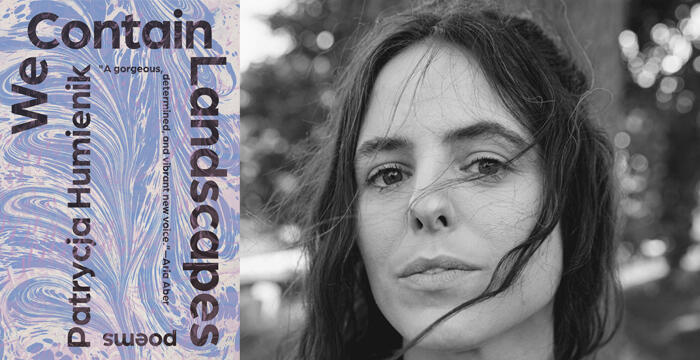
What does it mean to risk rupture for rapture, on the page, and in one’s life? Or for water to be one’s method, mode or muse? Are inherited forms (of womanhood, of sexuality, of national identity) a gift or are their borders meant to be crossed and breached? Together we look at forms and norms in Patrycja’s poetry, at bringing unruly forces into one’s work—eros, love, solidarity across difference—that, like a river, are summoned to a larger body.
If you enjoyed today’s conversation, consider joining the Between the Covers community as a listener-supporter. You can find out about all the potential benefits and rewards of doing so at the show’s Patreon page.
Finally, here is the BookShop for today’s conversation.
Transcript
David Naimon: Today's episode of Between the Covers is brought to you by the Summer Writing Program at Naropa University. Since 1974, the Summer Writing Program has been a wild and inspiring combination of writing school, counterculture event, and literary festival. This summer marks the 51st Summer Writing Program. The title theme for SWP 2025 is "The Living Thread" to signal a recommitment to the collective study of writing as an art, spiritual practice, and agitating force for social change, the living thread extending for another half century. Some of this year's faculty and guests include Anne Waldman, CAConrad, Safaa Fathy, Elizabeth Willis, Cody-Rose Clevedence, Eleni Sikelianos, Edwin Torres, Cedar Sigo, poupeh missaghi, Farid Matuk, Prageeta Sharma, Joshua Beckman, Tongo Eisen-Martin, Valerie Hsiung, Julian Talamantez Brolaski, and others. As part of a contemplative education project and an experiment in community, the Summer Writing Program does not engage in gatekeeping, and nearly all writers, artists, and interested or curious students are welcome to register. There is no application fee. While the window for 2025 scholarships has already passed, a robust and diverse slate of scholarships is awarded annually to support students from across the globe. For more information, please visit the online catalog at naropa.edu/SWP. Today's episode is also brought to you by Sour Cherry, the much-anticipated debut novel by Natalia Theodoridou that is being called a diamond work by Morgan Talty, a stunning reimagining of Bluebeard—one of the most mythologized serial killers—twisted into a modern tale of toxic masculinity, a feminist sermon, and a folktale for the twenty-first century. Rory Power calls Sour Cherry “a folktale, a whisper, and a dream all at once.” Benjamin Percy calls Natalia Theodoridou among the likes of Kelly Link, Angela Carter, and Carmen Maria Machado, claiming that fans of their work will find a new favorite author in Theodoridou. Timely, urgent, and beautifully written, Sour Cherry invites readers to confront age-old systems of gender and power, long-held excuses made for bad men, and the complicated reasons we stay captive to the monsters we love. Sour Cherry is available now from Tin House. Today's conversation with poet Patrycja Humienik is about a book called We Contain Landscapes. Of course, we'll explore what this title means as part of the conversation. A conversation that itself, I think, contains landscapes that feels unusually capacious, generous, and generative. What does it mean to risk rupture for rapture, both on the page and in our lives, to honor what we've inherited without being trapped in inherited forms, to love a culture, but not a nation, to look to water as method, mode, or muse, to write across boundaries, borders, containers, and norms—whether of family or womanhood or sexuality or religion? Because Poland and Polish poetry are both significant elements in this book, I'll mention two Polish-specific past contributions to the bonus audio archive. When Jay Chakrabarty was a guest, he read two poems by the Polish poet, translator, and biographer Bruno Schulz, Jerzy Ficowski. Similarly, past guest Ayad Akhtar, who in his 20s moved to Italy to study with the famed Polish theater director and theorist Jerzy Grotowski, who himself was a former student of the Armenian mystic Gurdjieff, Akhtar reads for us one of Grotowski's last published pieces called "Performer" and discusses it. This joins, among many other things, a late-night, whispered reading by Bhanu Kapil from her notebooks, Danez Smith reading poetry from each of the fellow poets in their writing collective—and after each poem devising a poetry writing prompt just for us—and Torrey Peters reading the first thing she wrote after transitioning, a zine called "How to Become a Really Really Not Famous Trans Lady Writer," which she reads for us in its entirety, all 20 steps. Subscribing to the bonus audio is only one possible thing to choose from when you join the Between the Covers community as a listener-supporter. Every supporter can join our brainstorm of future guests, and every listener-supporter receives the supplementary resources with every conversation, of things I discovered while preparing for the conversation, things referenced during it, and places to explore once you're done listening. Then there's a whirlwind of other things to choose from: access to the bonus audio, the Tin House Early Readers subscription, getting 12 books over the course of a year, months before they're available to the general public, rare collectibles from past guests, or a bundle of books selected and curated by me and sent to you. You can find out more at patreon.com/betweenthecovers. Now for today's episode with Patrycja Humienik.
[Intro]
David Naimon: Good morning, and welcome to Between the Covers. I'm David Naimon, your host. Today's guest is writer, editor, interdisciplinary performance artist, and embodied facilitator, Patrycja Humienik. She has a BA in Creative Writing and a Certificate in Peace and Conflict Studies from the University of Colorado Boulder, a Spanish-English Translation Certificate from Western Michigan University, an MA in Communication from University of Colorado Denver, and is currently an MFA candidate at the University of Wisconsin, Madison. Humienik has a past in interdisciplinary theater or collaboration across mediums in live performance, collaborating with everyone from Dances for Solidarity to Language of Fish Collective Arts. She has also done site-specific performances and workshops in California, Colorado, and Washington. She’s offered somatic approaches and creative workshops designed for nonprofit, government, arts, and business organizations including Arts+Literature Laboratory, Northwest Film Forum, and in prisons. She was an Events Director and is an editor for the Community Anthologies Project at The Seventh Wave. As a writer, Patrycja Humienik has received fellowships from the Jack Straw Writing Program and Brooklyn Poets and was a semi-finalist for the 2021 92nd Street Y Poetry Discovery Prize. Her poetry has been published widely, from The New Yorker to The Atlantic, from Ninth Letter to Poetry Northwest. She’s here today to talk about her debut poetry collection out from Tin House called We Contain Landscapes. Past Between the Covers guest Aria Aber says of this book: “Patrycja Humienik picks up where the great Polish poets of the twentieth century left off, writing of exile, war, fragmented families, and grief for a ruined environment. And yet, her mind is utterly contemporary and new, searching and witty, always striving towards a politics of solidarity with the Other–the reader, the ancestors, the daughters of immigrants. The poet’s wondrous imagination flows like water across these pages, picking up the peculiar and astonishing facts of life on earth. We Contain Landscapes introduces a gorgeous, determined, and vibrant new voice to American poetry, a voice that dances with, exults in, and blurs the boundaries of the lyric.” Poet Joanna Klink adds, “Daughter of immigrants, Patrycja Humienik confronts the agonizing betrayals of nation-states, as well as the pressures of sexuality, the obliterating lure of the internet. She writes with a physicality that is utterly mesmerizing. Shot through with radiance and self-possession, Humienik’s poems are reminders that life at the edge of exorbitant longing can feel more free, more alive.” Finally, Matt Sutherland for Foreword Reviews says, “Neuroscientists speculate that humans might have thirty or more senses, and we speculate that Patrycja Humienik’s acute sense of longing for a place that no longer exists on a map affects the way she perceives all the others. She is an immigrant daughter fielding questions from generations of ancestors and this debut collection answers affirmatively: ‘I hear you.’” Welcome to Between the Covers, Patrycja Humienik.
Patrycja Humienik: Thank you so much, David. What a generous intro. Such a pleasure to get to chat with you.
David Naimon: Given that this is your first book, your debut, and given that I have a question for you from another about its arrival and the elements and circumstances that went into us having this book to hold today, and given that this question from another is from someone of great importance to you, I’m going to hand over the first question to past Between the Covers guest, the poet Gabrielle Bates, or as she refers to herself in her question, your art wife. People sometimes hear me marvel at the arbitrariness of awards and accolades when it comes to art and art making. I often bring up Rosmarie Waldrop’s The Nick of Time and Nikky Finney’s Love Child’s Hotbed of Occasional Poetry as books that mean a lot to me, that seem like particularly significant arrivals of poetry and that continue to work on me. Yet, if awards were any indicator—and to be clear, I don’t think that they are—you’d never really know that these books came and went. I feel the same about Gabby’s debut collection, Judas Goat, which is in the trophy case inside my heart. Nicole Sealey said of Judas Goat, "In disbelief, you'll want to pinch yourself while reading. No need. Believe me, Judas Goat is just that good." Here’s a question for you from Gabby.
Gabrielle Bates: Patrycja, beloved art wife, I’ve been thinking lately about the many returnings in and around your stunning debut collection, We Contain Landscapes. You completed the book having recently returned to the Midwest—the region of your birth and youth—after living elsewhere for many years. The book entered its production phase the summer you returned to Poland for the first time in a decade, if I’m remembering that correctly. You started writing toward the collection initially in Seattle, where we met, and where you turned more fully to poetry after years of focusing the majority of your mind, time, and energy in other directions. There is a poem in the shape of a spiral in your book, “The Language Traveling Inward,” which I love as a symbol of returning, orbiting the same nucleus from different vantages, approaching. I’ve been thinking a lot too about your recent return to school and how so much of this book is a testament to the learning, mentorship, and artistic community you were able to find, collaborate with, and co-create with outside of academic institutions before returning to school to study in an MFA program. As poets, we often turn to poetry to grapple with our messiest, most inarticulate questions and feelings. Then when a book comes out, we’re expected to be able to talk about the book’s terrain in an articulate way outside of the poems, as if the poems themselves haven’t already divulged everything we felt willing and capable of articulating. So, this is a question less about the book’s material and more about your pursuit of learning and rigorous artistic community as you worked towards the book. How did you go about it and what were some meaningful stepping stones along the way which emboldened, energized, or otherwise impacted We Contain Landscapes as it was being written? I think many listeners, whether they’re in academia in some form or not, whether they have MFAs or not, will find meaningful lessons in the spirit of your particular approach. Thank you so much, David, for your brilliance and care always, and for inviting me to ask a question. Patrycja and I send voice notes to each other every day, multiple times a day, so recording this feels at once very normal and very unnatural, like brushing my teeth behind a podium or something.
Patrycja Humienik: Well, what a delight to start the interview here. As Gabby mentioned, we’re in touch daily, how lucky. In her question, in talking about those stones and essential forces that helped shape this book, I mean, she’s a huge part of that. I think about my return, as she mentioned, to deepening in poetry and moving to Seattle, I had the charmed experience of moving to a place that was really close to Open Books: A Poem Emporium in Seattle. And prior to moving there, I was so excited to live near a poetry bookstore. I had the pleasure of working at Innisfree back when it still existed in Colorado, and that was another looking-back part of this spiraling route. Prior to living in Seattle, years before that, I had worked at the café and bookstore, the all-poetry bookstore. When I knew I was going to be living next to another rare poetry bookstore, I was so thrilled. And really shortly after moving to Seattle, I went to an event. I remember hearing there was a lovely lineup of readers, and Quenton Baker was one of them, also released an incredible book in recent years. I remember he cited Fred Moten before he even started reading. And I had just, the year prior to that in Colorado, seen Moten at Naropa. I just really had this sense that I was exactly where I needed to be that night. I met Gabby that night at Open Books. And she bought Inger Christensen’s Alphabet for me. It was this really, like, before we even knew each other’s names, we had this really charmed moment of her overhearing me talking about the book, and she was like, “Can I get that for you?” [laughter] We just had this wild, charmed beginning to our friendship in poems. I remember going back home and voraciously reading Alphabet. This was a time for me when I wasn’t reading a lot of contemporary poetry books all the way through. Even though this beginning goes so much further back to childhood and to a love of poetry, that this journey of this book really started so much earlier, I think about that moment in Seattle as this returning, as Gabby mentioned, and this acknowledgement of it as being so relational for me. And fast-forwarding through our beautiful friendship and having a writing group with other brilliant writers, Erin Lynch and Erin McCoy—also, Erin’s incredible Removal Acts came out recently. Erin McCoy has a book coming out soon. We all got to be with each other week after week in deep study, just workshopping poems for years. It was actually over two years that we met pretty much every week, including on Zoom once the pandemic hit. That kind of study alongside other writers when I didn’t, at the time, when I was working full-time and just craving writing being a richer part of my life, it really happened with other poets and through voracious reading, and realizing, learning that there’s this whole world of contemporary poetry I had been longing to connect to. I had done some study of it in undergrad; I did study creative writing, so I had some exposure to it, but a lot of my poetry loves at that point were poets who had already passed on. There’s so much to say about the journey, but one piece of it has been friendship and study outside of institutions, in that sort of moan and horny way of the undercommons, finding the places on the margins where we could talk about poems together, at a time when I was just hungering for more learning. Honestly, this show, various podcasts, so many things were part of that growth. Just listening to writers talk about their work. So building this book came out of that and being nudged to think about the individual poems I was writing and the orchestra they might be a part of. I have a memory too of the poet Adrian Matejka, who visited a class I took in undergrad, and we stayed in loose contact over the years, and he sort of witnessed me from afar—and this turning away from poetry and returning back to it. When I was in Seattle, starting to more actively write again, he asked that of me, of a few individual poems he wrote, he was like, "I want to know about the cousins to these poems." He was sort of nudging me to think in this larger way. I was so intimidated around the idea of making a book. The book is indebted to those relationships, the questions asked together, the study together, that appetite. Further, just really thinking about the arts background that I have and letting that be an asset to the poems, like thinking about dance and the body, and realizing that and having workshops and bringing my questions about words that I still don't have a single answer to, like the question of devotion, for example, it felt like this secret hack that I could bring that into a workshop full of other writers, thinkers, artists, and unpack that word together and then have more poems emerge from that and have a book start growing from that deeper looking at a single word. That is some of the journey that eventually then brought me to letting this book write me into a new life, by coming back to the region of my childhood, as Gabby mentioned, and now studying and writing toward other books in this program.
David Naimon: Well, I love how Gabby’s question enacts the title, We Contain Landscapes, how, as the book is coming together over time, she notes your return to Poland, your return to the Midwest, the place of your childhood, to pursue your MFA, your life in Seattle, all contained, explicitly or not, within the pages in some way. But while we’re talking about the pre-book phase, I wanted to ask you something about her question about learning. Because if I remember correctly, sometime in late 2023, I had reached out to Alyssa Ogi, the poetry editor at Tin House, just to puzzle out some of my own scheduling. At this point, your book had already been accepted for publication. She mentioned that when she floated the possibility of a 2024 release, you said you preferred more time to revise it. That more time that you asked for coincides with your first year of your MFA, which made me curious. Did you find yourself exposing this already accepted manuscript to new eyes at your MFA, that you wanted to invite this new, not entirely known community into that final process with the book? Or quite the contrary, you protected this almost-ready book from your MFA experience and worked on other things in parallel?
Patrycja Humienik: Before I moved to Madison, I had this strong sense that I would protect this manuscript from the institutional experience and that I was really wanting to honor what it had come out of. When I came here, I had the intention to be revising, giving myself the time of letting even being back in this region be part of the revision process with me. The life changes I was going through at the time, it felt right to honor that with time as my revision partner, more than thinking about bringing it to anyone here. I had that more strict idea with myself that I would solely work on new work in this program. Then, as it happened, as I was generating new work, I remember in the first semester, Amy Quan Barry had us generating two poems a week. I don't write at that pace. We were working with received forms and generating new. Naturally, I was still in the world, in questions and obsessions of We Contain Landscapes. Actually, at the time when I entered the program, I was still with the title Anchor Baby that I was doubting at that point was the real title. I was really in a deep revision space. I was still revising poems from the book. I did start letting myself bring a little bit of that into the workshop. What happened too was that I was surprised by the beautiful cohort of poets I've gotten to study with here. I had really low expectations, as someone going later in life to school. I felt, well, fully funded time to get to write and teach and have healthcare, that's about all I'm expecting. If I get any mentorship and connection on top of that, beautiful. Then I was stunned to meet these incredible writers here, who also, many of them, grew up speaking other languages at home, also share so many wonderings, even as we're all really different poets. There was this trust that built a lot faster than I expected it to. Then I also just couldn't help but keep writing. I ended up writing poems that made their way into the book, including the very last poem in the book. A number of poems in the book came out of that time. Even into the second semester, just as I had to turn in revisions, there was a prompt that Paula [inaudible] gave that also allowed a new poem to emerge. I couldn't help but let it bleed over in that way, actually, and it's been a beautiful lesson that we can be surprised. Even in the ways that institutions do still let us down, it's really a testament to the people I met, that there was this trust that was built. And of course, being back near in the region of my childhood, near to these bodies of water, a little drive away from Lake Michigan, that was formative for me as a child, all of that felt like a necessary partner to revising.
David Naimon: Well, before we hear some poems, since we're talking about the book and how it came to be, let's spend a moment with how you came to be. As you mentioned, the book's title when it was accepted for publication was Anchor Baby, and the first poem is titled "An Anchor is an Argument," and the penultimate poem is called "Bury the Anchor." You yourself are a so-called anchor baby, a term often used pejoratively. Like you did with the book itself, orient to the circumstances of you: alive but not yet born, or, as you say in the book, "I was born an ocean away from where I was conceived."
Patrycja Humienik: I think that being conceived in one place and born in another necessarily impacted this obsession I have with questions of place and rootedness, or lack thereof. It's a fascinating term, anchor baby, because I knew that the choices that shaped my arrival here, that this way in which I, in part, anchored my family legally, this was the manner in which my parents eventually got citizenship, while I knew that was true, at the same time I've lived so much of my life not feeling grounded at all, in feeling this fascinating tension between being a supposed anchor and then having so many different longings for me, for other places, both the sort of mythological, in-my-mind motherland of Poland, because I didn't get to go there till I was 19 for my first time. It loomed large in my mind and was full of romanticization and all sorts of things before I ever got to go there. In the same way, because of the landscapes I'd heard about, that my mother grew up in a mountainous place, I was so drawn to the West in the U.S. I went to college in Colorado, not ever having—I saw it when I was really young—and then not ever having seen Boulder, Colorado, I moved there for college and felt something strong in me that wanted to be a part of that place. And then I was flying home very infrequently because of resources and the limitations around how often I could get home. That old title poem for the book, I was thinking about that sense of knowing that my family was also asking me, as I got older, to sort of root down in a place. And that that was the maybe charge of this phrase of anchor baby, and yet feeling like if one is conceived in one place and born in another world, there's always going to be a push and pull. That sort of awareness as a child that was pretty hefty, of like, here are the sacrifices that have been made for your life to be better and the very serious separation of 22 years that my parents were unable to see their families created a pressure that sometimes rooted me and other times just made me want to see all the edges of the earth and to understand that weight. That phrase to me is so fascinating too because of its relationship, of course, to travel, to water, to ships, to mooring and unmooring, and this idea that we anchor in order to then set off as well. That was some of the origins that led to my being here at all. Then of course, the particularity of the experience of growing up Polish American, to a very Catholic household, and having parents that—despite all of their challenging circumstances—insisted I speak Polish at home and still have a connection to that place through language, and had me in a Saturday Polish school and all those sorts of things, those are so much a part of my poetry journey because I was memorizing poems in Polish at a young age and I was studying Polish literature. All of that was also a kind of origin of the book and my own being. I was hoping we could hear two poems “Wilno” and “Salt of the Earth.”
Patrycja Humienik: Sure.
[Patrycja Humienik reads from We Contain Landscapes]
David Naimon: We’ve been listening to Patrycja Humienik read from her collection, We Contain Landscapes. The next question from another, I’m placing here as a sort of frame for much of the rest of our conversation. Because, as she admits, she could have asked this question in ten different ways, or asked ten different questions about the title of the book. In many ways, I’ll be doing just that, taking what she has asked and asking it differently again and again as I feel there isn’t one question or one answer to each question. In that light, if you don’t answer every element of this question, you can be assured that I’m going to be picking up the threads of both the things that you answer to ask again, and also things that you may not answer that we will talk about nonetheless. This is from the poet Sarah Ghazal Ali, whose debut collection Theophanies was a finalist for the Kate Tufts Discovery Prize. Kazim Ali says of it, quote: “That god's words would be splintered into many forms and tongues is inevitable and appropriate. This book utilizes many forms, ancient and new, to contend with the long legacy of a multitude of spiritual traditions: the expulsion from the divine, living in gendered bodies, the fate of humans to live as mortal. There's music aplenty here to accompany difficult truths, and that is really all one can ask of god or garden or ghazal.” Here’s a question from Sarah.
Sarah Ghazal Ali: Hi Patrycja, it’s Sarah. Congratulations on this beautiful book. It’s a feat, and I’m so excited to ask you a question about it. My question is about the title We Contain Landscapes. In all honesty, I could ask you 100 different questions about the three words comprising this title, but I’ll hold back. Early on in the book, you write, “We contain landscapes. They do not belong to us.” Later in the poem “Floodplain,” you write, “To try to contain anything is to rid it of water. Admit that the water is rising. Admit that you need a flood.” I’m really curious about your relationship as a writer to these two ideas, to containment and to the body as a container or a cave of some kind, and to possession and ownership. Perhaps what the differences between these two ideas are for you, where they overlap, where they diverge, and also how water comes into play, and how landscapes come into play.
Patrycja Humienik: Such a pleasure to hear the voices of writers I adore so much. Both Sarah and Gabby’s books are works of art. Thank you for this question, which is, I suppose, a question that the whole book asks and wrestles with throughout. I love the astute pairing of those two passages. I think about the Silueta Series of Ana Mendieta, where she leaves imprints of a form with flowers and branches and moss and gunpowder and fire. Sometimes she’s carving or burning her own form into the earth—which we do daily. We leave a mark in some way. She spoke about her work as sort of carrying out a dialogue between landscape and the female body. For her, that’s also particular to being torn from Cuba, from her homeland. There are often quotations of her, the oft-quoted passage on her overwhelm of having been cast from the womb and from nature, and art as this way, I might be misquoting it, but of returning to a maternal source. While my questions might slightly, that the speaker of this book might conceive of this a little differently, I do feel resonances with her project and with this wondering about our separation or not from the land and the ways we mark it and the ways that we can never own it. In my longing that I mentioned earlier, that part of me, that restless part of me that felt the pressure of anchoring and yet longed to be everywhere, to know so many different ways of living in the world, there’s that sort of tension and idea of the impossibility of knowing every place, and then knowing that in ourselves, there are places uncharted. That is an idea I’m really fascinated by. I didn’t encounter this until later, I was at a residency, I was watching more Agnès Varda, and of course by the time the title of this book came out, so many people sent me the little still shot from one of her films that says, “If you carve people open,” or something like that, “you find landscapes.” The title wasn’t consciously influenced by Varda—or I hadn’t seen that film yet—but I think that idea, a lot of artists wrestle with that question of what is inside and outside of us. I’m really troubled by ideas of possessing anything at all, and of the impulse, in particular, to own land is one that has been a really violent project worldwide. I think about all of that when I think about this question of containment and what we contain or cannot contain. I think it’s endlessly confusing and intriguing for me to think about what we are made up of. Sarah, of course, brought up water, which, I mean, I mentioned earlier, I grew up near Lake Michigan and have been fascinated by lake effect, by the graveyards of the Great Lakes, by the complexity of those ecosystems. There was a weeping willow not too far of a bike ride or long walk from me that, in childhood, I would go to for comfort. I felt like water was this space for me early on, of reprieve, but not always even comforting so much as just like holding space for grief. Bodies of water are just endlessly fascinating for me, as a person and as an artist, as a writer. Rivers in particular, I think, are just connected to my thinking of the poetic image itself. I think the poetic image at its best is at once grounding and transporting. It is inextricable from the sensuous material of life, and it’s also fantasy. It’s imagination. It’s myth. And irrigation, transportation, border, it’s all those things. When you’re actually physically near a river, you can feel that, and it’s constantly moving. The fact that the often-quoted, maybe trite fact of our own bodies being made up of so much water, the fact that migration often demands crossing bodies of water, the fact that I haven’t heard a more true statement than the Lakota phrase, “Water is life,” heard worldwide in the struggle to protect tribal lands at Standing Rock, all of those things are part of my thinking about water and containment, and how water can never be contained. I think, too, of the inexhaustibility of water as this space of contemplation, and yet, fresh water is a finite resource. That all is on my mind when I think about questions of containment. Then when it comes to another body of water, the sea, I think often of Etel Adnan saying, “To look at the sea is to become what one is,” which I think I can’t say it better than that. In the book, there’s that wrestling with all the different bodies of water that cannot be contained, and then what exists in the form of our own bodies.
David Naimon: Well, let’s spend some time with the word “contain,” and with containers, and with form. Some lines in the book explicitly engage with it. For instance, the question posed in one line, “Is a shape always externally imposed?” Or, “I want form without the rot of control.” Or, “If belonging is form, its constraints erode the land, recurring floods.” And perhaps in that spirit, the line, “The desire for excess I inherited.” The last third of the book also sort of spills out of any regularity of form too, I think, with a higher amount of formally experimental poems of all different sorts; longer, narrow justified columns, spirals, and short prose blocks. But I also wonder if there is another type of form too, as I think of how you are suggesting we contain landscapes rather than the more familiar notion of landscapes containing us. You’ve said in interviews before how you love “a world within a line,” “a poem within a poem,” which makes me think of the untranslated epigraph at the beginning of the book by Szymborska, which could be translated: “After all, every beginning is only a continuation.” Or if we place it in the full final stanza of the poem it comes from, Love at First Sight, in the Clare Cavanagh and Stanisław Barańczak translation, it would be: “Every beginning is only a sequel, after all, and the book of events is always open halfway through.” We’re here again. And beginning contains within it its own repetition, which reminds me of the author’s note in the advanced reader’s copy where you say you’re wearing a ring made of amber from the Baltic Sea from a recent trip to Poland after a decade away, and how this amber ring that goes against the amber ring you lost that your Polish grandmother had given you, and how both amber rings share the memory of a forest that became a sea. That one ring contains the other ring, and both rings contain a forest that is now a sea. So that when you say you wrote this book for your younger selves, wearing this ring that hearkens to a younger ring, and a younger iteration of the sea as a forest, perhaps that’s suggestive of a form that does not constrain. I think of a fractal, or a hologram, or a holographic film. But talk to us about form. Is a shape always externally imposed? Do forms feel controlling? Do constraints need to be eroded and escaped? And when we contain landscapes, which I think of as unbounded spaces, is that a form?
Patrycja Humienik: Ah, David, your questions are so generous and rich. I could spend the rest of my life thinking about them. I love that you brought into this question of form the borscht and the amber ring, and that memory within that material. I think that is so helpful right now for me in trying to sort my thoughts around this massive question, that maybe I’ll attempt to think through in a roundabout way of thinking less about the words on the page in the book right now, and thinking back to your last question, thinking about the container of the body, and thinking about my relationship to dance, and how, in studying a bit of dance and loving dance so much since childhood, there was this exploration of the limits and possibilities of the body, just as I find so fruitful in language, and the line, in writing. The form, the container of the body and its limitations are propulsive for me. At times, they are externally imposed, because we receive whatever genetic makeup we receive for the body, just as we inherit certain ideas and shapes for making language. And the language that one even writes in is a form, like English. Yes, there’s a part of me that has always revolted against constraint, against what I sense to be any kind of wall or boundary or border that might contain in a way that is violent. When I think about the question of form, I can’t help but sometimes think about walls and borders and violences. At the same time, then I’m left to think about the body, and the shape of the body, and what I was just alluding to with dance, and the way that being in an embodied form allows for certain kinds of felt experience. I think poetry is capacious enough for a play with that and for breaking out of ways we’ve been taught to speak, to use language, to take a very word and examine it in so many ways, that, in itself, to even think about etymology, to break it down, and then no form is actually as oppressive as it seems, when you can sort of start to take things apart. Sometimes my own lines are mysterious to me. And that question of shapes being externally imposed, I mean, certainly, out in the world we see and receive shape. But again, I’m obsessed with this idea of the unseen within us. And of course, there are the organs and things we are made up of, and the shapes there. Then I wonder about the emotional material, the sort of idea that a lot of brilliant people talk about, like epigenetic memory, other things that form us. So, God, it’s an endless question to me. In poetry, you get to play with that visual of the shape. There are so many writers who really take that to such a gorgeous level. I think in this book, I was more interested in—as you so astutely noted—the permission giving, by the end, to take up different kinds of space. It’s not something I assigned myself to do. It’s just something that happened once I looked back at the poems and saw them all together. I think that answers part of your question.
David Naimon: Yeah. Well, there are lines from Milosz’s poem Ars Poetica? that made me think of—to borrow your language—the uncontainable excess you’ve inherited. They go: “The purpose of poetry is to remind us how difficult it is to remain just one person. For our house is open, there are no keys in the doors, and invisible guests come in and out at will.” But as a way to explore this spirit, I think we need to explore what constraints your work is pushing against or breaking out from. One of the questions you pose in your author’s note is, “To whom do we belong, and at what cost?” And one of those belongings is with your family of origin, not only as an immigrant, but in a decidedly gendered way, as an immigrant daughter. In one interview, you describe it as a reckoning with imposed and inherited scripts for women, daughters, and sexuality. You explore this explicitly in your essay, Unlearning My Immigrant Mother's Ideas of Beauty, where you say, “I’ve inherited an idea from both sides of my family about the kind of woman I’m supposed to be. It’s an antiquated idea of womanness but one that persists—it has to do with pleasing others and obedience. Beauty, in this view, is both regimen and reward.” And, “Like many immigrant daughters, I’m of a lineage of women who didn’t put themselves first. I don’t have the lived experience of unbridled authenticity and honesty in my personal life, nor do I have many models of it. Writing often feels antithetical to the charge as an immigrant daughter to be a secret keeper, to never bring shame to the family, to obey.” On the level of form, inherited forms and constraint, I thought most of the paragraph in that essay: “My mother and I wear the same size. When I fly to my childhood home twice a year, she insists that I don’t need to bring much because I can borrow her clothes. I alternate between feeling held and controlled by this. I am held by her care and by the comfort of the option to arrive with little. I bring my own clothes but inevitably go to her closet and try on a few of her carefully chosen, hard-earned items. When I wear them, she gives me compliments and an approving look. Sometimes she says, ‘You can keep it.’” Talk to us more about what you're working through with gender, within the belonging of family and ancestral inheritance, through your book, through your writing in this book.
Patrycja Humienik: I haven’t thought about that essay in some time. It was a very scary essay for me to write because I think this question of belonging when it comes to family is very delicate, especially for those of us whose families have sacrificed so much for me to even be able to write this book. That bit you mentioned, that I’m haunted by, the sort of role of the daughter, and the way in which to be a writer at all feels at odds with that secret-keeping charge, that feels to me particular to many daughters of immigrants I've talked with about this very thing. To write at all is to threaten all of that, and to threaten them to sever from the bonds that even brought me here. So, in that sense, as I reckon with ideas of gender and sexuality and my own religious and cultural inheritance, it becomes really fraught terrain, it has been really fraught terrain for me for some time, because I want to honor all that brought me here. I don’t flat-out reject—It would be easier if I felt like, “Oh, I reject everything about Catholicism or these ideas that my parents have passed on.” The interesting part, as I get older, is starting to think about—and it’s mentioned in that essay—there’s the care element. There are the ways that people attempt to care within the frameworks they have for caring. Within Catholicism, there are the mystics and the traditions of doubt and questioning and insistence that the comforts of our lives in America demand of us in some ways, or try to demand of us, I appreciated as a child that my religious background was asking the question that there might be something more than the material world. That maybe, at its best, at religions at their best, there’s some real seed of care, of loving your neighbor. All of that is a part of the question of belonging. These questions of form and containment and bonds to family are the beautiful parts. I can’t just completely cut that out either. I’m grateful for some of that inheritance. I’m also really troubled by the violent legacy of the Church. That can’t be separated from that. All of this meandering, it’s related to gender because, I mean, the very texts of the hymns—I remember being at a monastery in New Mexico that an atheist friend had suggested to me and another friend who were both grappling with our relationship to Catholicism, he said, “You’ve got to go here. It’s a great place to write and be. You both are thinking a lot about church and stuff. You might like it.” We go to this monastery in New Mexico that of course is on Indigenous land. I mean, it’s like they’ve got plaques and they’re totally revising that violent history. And there’s this chapel, and there are these monks who live there and are praying and singing throughout the day. I was attending some of that, and looking at the text itself of the hymns, and thinking about the gendered, violent text itself, then also having like a spiritual experience while I was there, feeling really moved, and holding all of that complexity at once, actually feeling many times like I was going to faint, quite literally having a very strong somatic, like psychosomatic reaction to that space. I mean, that place along the Chama River, that comes up in the book a bit and some poems and surfaces, because I think about that as a place in which I was asking of myself these very questions. Of feeling the bond back to belonging to this religious tradition to some degree and being like, “Can I belong to that? Do I want to belong to that? I don’t want to belong to its violent legacies at all.” And yet I have to reckon with that. I can’t pretend that I haven’t inherited what I have inherited, either. I think all that is to say, when I think about gender, it is inextricably bound to questions of faith and family for me, and of obedience. Then writing is this way in which I get to question obedience, while still, through poems, uncovering that devotion can still exist actually. Devotion and obedience are actually different. When I was younger, those two ideas were more conflated.
David Naimon: Well, similar to the double feeling you have about being the same body shape as your mother, and then what that means about assuming a form, literally going into the same clothes, in the essay, you also talk about your mother’s distress when you changed your Facebook profile to one where you're wearing a second-hand dress and the angle of the photo makes your face look too long but also where you’re caught in motion. You’re not composed for the photographer. You’re not captured in a specific, received form of what you’d expect from a photographer taking a photo of someone. It made me wonder about your relationship with her as you’ve become a writer, and how much or how little of you as writer, and her as a represented figure in your writing, is something shared, or perhaps not shared, but acknowledged.
Patrycja Humienik: The first thought I had, as you read that back—this essay from some years ago—is how petty of me to bring up this moment that does not at all—this is the thing about writing about our families. Writing about anyone, and why I struggle so much with nonfiction sometimes—is that one can take a story like that, and I suppose that’s the trouble with language at all, it can diminish the fullness of a person. And sure, there are still these chasms between my mother and I, and I, at times, grieve them. On the other hand, I have only grown in my admiration for this person who, at such a young age, got on her first-ever plane pregnant with me and gave birth to me without even speaking the language of the staff in the hospital where I was born. I have reverence for my mother. I also have frustrations with her, as she has with me. And I hope that the writing, I hope that I'm bold enough now by even putting this book in the world to, off the page, deepen our relationship in some way. I mean, it’s a challenging thing to be as bold off the page as we sometimes are on it, I think—I’ll speak for myself—as I sometimes allow the poems to help me think through things and be more bold. It is something that I want to practice off the page as well. When it comes to her and I, I don’t know yet what this book will do for our relationship. I hope that it is only going to deepen it with both of my parents. But I think that’s also the thing that kept me from writing for so very long, was the surveilling eye of the mother, of the parents, and not even just them specifically, but even those figures, that idea of the familial gaze, and of everything that they’ve inherited, and the lens with which they look was so prominent. It kept me from even writing for myself for so long. It kept me self-censoring. As a part of this book, I’m grappling with ideas of self-deceit and self-betrayal, and the ways that I silenced myself, that I can’t even blame them for. But I look forward to being more honest, if I can. I think the poems have really written me into a new life. I keep saying that I really think that the book has pushed me there. And now, it’s not even mine anymore. And whether I like it or not, I have to maybe engage with some of these questions.
David Naimon: Yeah. One of the ways I think you break out of the vertical, lineage-based constraints of inheritance is to reach across horizontally to other immigrant daughters. A series of poems runs throughout the book, the Letter to Another Immigrant Daughter series, that, like the title suggests, are poems addressed like letters to a different immigrant daughter, including Sarah, who asked the question earlier. As a preface to reading one of them, I was hoping you’d read the one to Itiola. If you could speak about this series, what it means to you, how you chose the people you wanted to address, why you wanted to address them and in this way, and then perhaps we can hear that example of one.
Patrycja Humienik: That series was born out of an epistolary exchange with Sarah, who asked the question earlier. We met in an online workshop with Leila Chatti and were drawn to each other’s work and questions quickly. I had the luck of starting this exchange with her in poems, where we were writing these sort of letters addressed to the other. A fragment of that makes its way into the book, in the poem for her. At the same time, I was thinking about the constellation of immigrant daughter poets in my life and artists in my life who’d also been born to people from elsewhere, all over and thinking about, as different as all of our stories are, all these shared obsessions and threads. Through that exchange with Sarah, I was also thinking about various conversations I had had, or was currently having, with these other beautiful people. I feel like I could have just gone on and on. But I think what happened was that I really went with the conversations, exchanges that were lingering in my mind. In moments where I was wanting so badly to write, it made the most sense to address someone who I’d just been in conversation with. That’s how a lot of those poems emerged. Or in some cases, even, there were poems that were sort of failed poems, I could say, fragments of poems that I couldn’t figure out. Then I would think about a conversation I had with one of the writers that I address, that I write a letter to in the book. This happened on multiple occasions, where then I was like, “Oh, that and that—this fragment and this fragment—it all actually makes so much more sense when I’m addressing it to this person. I can make sense of it.” It’s that intergenerational reaching and making sense of long-held questions that, in the book, when I tried to maybe, as you mentioned, go vertically and think intergenerationally, there was no response maybe because of me trying to speak to the dead, or because of the questions unanswered by my parents working really hard, and questions I didn’t even feel like I could formulate to them. The intergenerational reaching became the place, also because in poetry, I’m not necessarily reaching for a single answer. In fact, I’m suspicious of a single answer and I’m constantly arguing with myself about different ideas. That was a place for those—a better word than argument—that was just the place for that making and unmaking together, for the rethinking and reshaping it. It was just happening already in my life, relationally, in conversations we’re having in voice memos and texts and in real life, walking near a waterfall or on a call after much time not seeing one another. This book is indebted to the brilliant questioning conversations with other people. I really don’t see it as a solitary act to write at all. It's never a solitary act for anyone because of the long conversation happening with the dead. I’m lucky to get to speak with both the living and the dead in this book.
[Patrycja Humienik reads from We Contain Landscapes]
David Naimon: We’ve been listening to Patrycja Humienik read from We Contain Landscapes. In your essay about your mother, there is a counterbalance to fitting into your mother’s clothes—or into the matrilineal form—which is the photography of Francesca Woodman, the avant-garde and now iconic photographer from Boulder, my hometown and where you went to university. Photography where she is often the subject, not uncommonly unclothed. Often there’s a sense of motion, of shadow, of blur, something uncanny and dreamlike, as if the camera both can’t capture something and maybe in not capturing it, is capturing something very real but usually unseen, a psychic landscape, perhaps. You say in that essay, “Performance and the page are where I practice enacting the autonomy I aspire towards.” And in that spirit, we have a question for you, it’s not about performance per se, but about the body in relation to your poetry, especially when I think about your somatic work off the page, too, I’m curious about your answer. This question is from the poet Joanna Klink, author of five books, most recently The Nightfields. She’s the winner of many accolades, including a Guggenheim and an American Academy of Arts and Letters Award, where Nobel laureate Louise Glück said in her citation: “In a culture inclined to mistake opacity for depth and stridency for passionate feeling, Joanna Klink has made a body of work at once utterly lucid and breathtakingly urgent. She navigates between those most suspicious extremes, despair and ecstasy, without ever seeming to be a poet dependent on extremes. The extraordinary beauty of her poems, from the beginning, has resulted from a constantly refined attention to the ordinary and the daily. Taken together, her books are an amazing experience: harrowing, ravishing, essential, unstoppable.” Here’s the question from Joanna:
Joanna Klink: Patrycja, I admire your work so much, and this book is especially important to me because the poems are so deeply physical and visceral. You use your whole body as an instrument, attentive to extreme pleasure and pain, always leaning on your senses, and the struggles in the book seem to stream through your body. Many of your poems express a kind of extravagant longing to belong, to connect, and not just with lovers and friends, but with countries, with a God, with forces far beyond yourself. This desire to belong requires that you leave your body behind. There are so many poems where I feel this in the book, but I’m thinking in particular of ‘Archival’ and ‘Recurring,’ where you’re physically disembodied or almost engulfed in a wall of water. There’s a threat of obliteration in the desire. It reminds me of that late poem by Paul Celan, translated as Discus Starred with Premonitions. The whole poem is: “Discus starred with premonitions, throw yourself out of yourself.” It’s an impossible instruction. I wonder if this tension I’m trying to describe between being acutely physically present to what’s happening to you, grounded in your body, and the need to wrench yourself out of that body in order to connect, I wonder if this resonates at all with your experience of writing these poems. And I wonder how this tension might be tied to your sense of yourself as a daughter of immigrants, someone like Celan himself, who lived painfully between countries and languages, displaced from his Romanian homeland.
Patrycja Humienik: Wow. Should we just play that again so we can hear that articulation again? Because she said so much that sums it up.
David Naimon: Pretty great.
Patrycja Humienik: I’m so grateful for that and for Joanna’s attentive read of this book and the generous blurb. I love that question. I think of so many things. It’s astounding to me, because there’s actually a poem of Joanna’s, “On Kingdoms,” that I at one point had memorized, that I think feels like one of those poems of many that felt instructive for this book. I’m thinking about the questions in that poem that also feel like they reach toward different longings and possible separations. I think also, with this question, another phrase that often pops to mind is from the work of Etel Adnan, which is often on my heart, she has that amazing line: “I go always faster than I go.” And it’s from a passage that, earlier in it, she talks about, each year, I might be misquoting it, but each year I get younger. I’m a year younger. I love the articulation in some of Etel Adnan’s work of this tension and possibility. I see it too in this impossibility and possibility that I see too in June Jordan’s “Bell’s Theorem.” I don’t remember the whole title of that poem, but that’s another one that I think of those lines so much. They’re also always in the back of my mind of the theorem on Long Distance Love.
David Naimon: I love that poem.
Patrycja Humienik: Oh, it’s so good. There is no chance that we will fall apart. There is no chance. There are no parts. I think that’s some of the unbelievable, mystical question that we have of the body, well, on one hand, of course there are parts of the body. And on the other hand, yeah, this potential for wholeness and our non-separation. I think it is all of those things definitely are a driving engine, those tensions, those supposed paradoxes are definitely part of what helped me write this book. And they made it so that the questions of this book are questions I’ll keep wrestling with. I mean, gosh, I think about even in your work, David. I felt so lucky that in that On Rivers issue I got to curate, I published that piece of yours. I think also of “the time of the soul is not the time of the calendar.” All of these questions about the time that’s ticking and measurable, and the time that feels immeasurable. Again, going back to spirals and Gabby’s question at the very beginning, the fact that at any moment, there is past, present, and future, all of that is a driving force of poetry to me. I think I’ve just inherited that material as a poet at all. Age is old to question separation and wholeness, time and the body, and all of those things. The embodiment piece for me is that I have to actually use my hands to write something. I have to remember that it doesn’t just happen in the mind. Dance is such a gift for me in that way because it’s given me different practices, even something as deceptively simple as feeling my feet when I’m writing and thinking, “What’s the temperature? Where are they touching or not touching the floor beneath me? Where is that floor connected to the earth?” It’s actually a vital exercise for me to, sometimes when I write, attempt to think of a body part and put my attention there. I don’t always do it, but sometimes when I’m writing, I play with that and remind myself that this work doesn’t just happen in the head, actually, are in the brain. The brain itself is part of the body. All of that sounds so basic and yet I think it’s being snatched up from us at all times because of the pace of our living and the insistence on a pace that denies the body. I think we’re in a time of such a demand for instant gratification and speed. When I write, I have to really slow down in order to go to another place that is not just the conditioned place from which to compose something. I think the body is one passageway there. And in the question, Joanna mentioned “Archival,” and that poem came out of a very embodied experience of being invited to teach a workshop in the Henry Art Gallery in Seattle, where they had this exhibit called Archive of Longings by Diana Al-Hadid, an incredible Syrian American sculptor and visual artist. I invited people to both write and be in that space and move in that space. She had all these disembodied sculptures, headless sculptures, and feet and legs separated from the body, made of both earthly and man-made materials like copper and steel. Just exquisite. Some really huge pieces in there. And questions she had with those headless sculptures, there was a question in one of the artist plaques, something like, “How much of me could be lost and I’d still be there?” or something like that. She was wrestling—and is wrestling—with so many shared questions and what Joanna just articulated. So being in the space of her art, Archival came out of that, and from also seeing other people in that space near the sculptures and thinking about feet, which, there’s an obsession with that idea of that which takes us elsewhere and allows us to walk, and these questions of migration. To see them in the physical form that Diana Al-Hadid had rendered in sculpture was so moving for my work. So for me, it’s impossible to write without also being in my own body, acknowledging other bodies, looking at how bodies are fragmented or not in art and in life. It’s such an endless question, but that’s some of what I would say.
David Naimon: Could we hear the poem Archival?
Patrycja Humienik: Yeah, Archival.
[Patrycja Humienik reads from We Contain Landscapes]
David Naimon: To return to Sarah’s question about water and to link it to Joanna’s description of being engulfed in a wall of water, let’s talk again about water. I know you already have, but it’s I think one of the two most prominent themes, perhaps the most prominent theme. Here are some lines from the book, a book that is full of an overfall of rivers and seas and floodplains: “I’m watching my favorite dancer, feeling the ghost of my teenage body. A river rushing superimposed boundaries,” ”Do to me what sunlight does to a river,” “The difference between a river and a creek is that from a creek, no new branches are formed,” “To try to contain anything is to rid it of water,” “Admit that you need a flood,” “Summoned like a river by a larger body,” “I’m watching two bodies of water converge,” “I want to know the details that crossed seas,” “The water I am made of asks me to be quiet in it,” “I was born an ocean away from where I was conceived,” “Life is precious, monstrous, marked by tides,” “River speaks in reverse elegy,” “I will seek the freshwater lake at the bottom of the sea.” Reading these, I notice also the word body shows up a lot in relationship. The bodies of water show up very much in the description of water. Also, outside the book, as we've both alluded to, you curated a community anthology at Seventh Wave, the one that you invited me to be a part of with the theme "On Rivers." In your intro to the On Rivers anthology, you say, "A river is a contested site. I return again and again to rivers, real and imagined." In Natalie Diaz's poem The First Water Is the Body, she writes, "Do you think the water will forget what we have done, what we continue to do?" So water is on my mind too, as this is going to be the first of three extremely water-centric conversations this spring. Like the others, it doesn't feel just like metaphor, but something you're exploring in its own right for meaning. Perhaps something you're connecting to is a different form of lineage. To me, it's suggestive of another form that isn't a form, like the Miłosz line I read earlier about how it's difficult to remain one person, a form that is a river, a glacier, a mist, a lake, rain, sweat. But I want to say, what's the deal, Patrycja? [laughter] But you've already spoken to it, as I knew this would happen with Sarah's question, which itself contains landscapes. But let's return to the question: Why water? What is your relationship to water? Is it teacher, mentor, lover, stranger? Is water a form? What's the relationship to containment? Or how is a river a reverse elegy? Anything that comes to mind from me reading your lines back to you?
Patrycja Humienik: I think water is at once a vehicle for dreaming and for being present with. What I mean is that dreaming not as escape. I think water reminds me that all of that is happening at the same time, that it can be a kind of portal but because it is moving and arguably really difficult to contain, it can carry us to unimagined places. At the same time, when we feel it, when we step into a river or a lake or the sea, at least for me, when I do, I can't help but feel its temperature or its pull of the current or a tide. I am immediately forced to be with my body, whether I like it or not. Even just to, in the case of the dangers maybe of the sea or a quick current, I have to be, to protect myself. In that way, thinking and being in the body, it's easy to romanticize these things. It's also dangerous, like thinking, being really in our bodies, these are things that can hurt us, and water can hurt us. Water can ravage a place. We’re seeing with climate catastrophe this reality. My obsession with water, of course, there's the danger that I will romanticize it to a degree that negates the harm of very real things right now, like floods, for example. I think one can't contemplate water without thinking about each other and ecosystems and nourishment and danger and rupture and all of that, and the precarity of all of this, and both the endlessness and preciousness of all this. I'm thinking about Ruthie Gilmore, the prison abolitionist and scholar, saying, "Where life is precious, life is precious." Water is just like reminding me of that. Like it's so precious. Like having clean water is unfortunately really a privilege, actually. I think it's inexhaustible for me to contemplate water with all the other questions that I set forth to attempt to start to unpack in this book, whether it's the ideas we've been talking about, about belonging and questions of place and home, or desire, all of these things. I think it's like, what better vehicle to think through it than a river, which connects to the veins of the earth? What better way to contemplate love, which can be so nourishing and so terrifying, and can utterly reshape our lives? That's the endlessness of water for me. Of course, it doesn't surprise me at all that you have other people you'll be talking to about water that I’ll eagerly be tuning in to hear that from, because I think sometimes writers get anxious. Sometimes I talk with writers when I teach or edit, and I think there's an anxiety around some kind of newness or invention that needs to happen. And I just wonder about that. I think these deceivingly basic things, like water, are worthy of our deeper attention and questioning.
David Naimon: Well, if water is everywhere in your work, the one thing that’s as ubiquitous is your engagement with devotion, which you’ve alluded to earlier. In the poem "On Devotion," there are the lines: Winters ago on the phone a friend saying, "Jealousy is good because it is a form of protection," then you saying, "But what if protection is a form of harm?" And later in that poem: "Easy to confuse habit with ritual, ritual with devotion, devotion with desire." Then you have an essay that you wrote about the poem of Joanna Klink's that you’ve memorized, called "On Kingdoms." And you say that what draws you most to that poem is one particular sentence, which you feel is the poem’s pulse. That line is: "Devotion is full of arrows." You’ve also taught a writing and movement workshop called Devotion and Play. You've offered one-on-one workshops called Devotion and Creative Practice. Yet despite all of this, you say you aren’t sure what devotion is. In your Substack newsletter, which is called Wait For It: On Devotion, you say, "There is something I am learning about devotion from rivers, how they move toward a larger body, their pursuit of sea," and you take this notion of pursuing a larger body to suggest devotion has to do with something bigger than us. But you also say, "As obsessed as I am with the idea of devotion, I have no definitions or answers for you, only questions and ongoing arguments with myself." So I was hoping you'd argue for us and with us about devotion. You've alluded earlier that devotion is different than obedience. Is devotion something uncontainable? Why this continual return to devotion? And this framing of so many things as a pursuit of or interrogation of devotion?
Patrycja Humienik: I find it really interesting to try to sort through differences between, as I do in the poem that you mentioned, On Devotion, devotion and desire. What’s the difference between that? Devotion and obedience? I think that anytime I’ve brought that word to a room full of people, like in a teaching context or a conversation, right away, always, there’s such a range of response because it connects to these major questions of faith. It has often religious associations, questions of romance and love and partnership and making a family, questions of our passion in life, maybe devotion to a cause, to an art form. The word touches on so many essences of being human and so many of the ways we’ve maybe been disciplined into being a way that some of us might be writing against. I would venture to say that asking anyone about their relationship to the question of devotion would be very interesting because of those different elements and knowing what comes up for someone. For me, at different times in my life, I’m thinking about it through different lenses, whether it’s in thinking about romantic relationships, thinking about my relationship to poetry itself, that has brought me back to the Midwest, perhaps one could say a devotion to this art form, and in that has been a risk, a leap, some kind of act of trust. I do think it’s distinct from obedience. I think it’s something else. Yet I inherited ideas about religious devotion that were filtered through the lens of obedience, of not questioning. As I have been thinking about devotion as very connected to questioning, that’s really opened up a lot for me. You mentioned the Devotion and Play workshop. I love putting in conversation those two words that sometimes people see as very binary and thinking, “Wait, are they actually? Is there something playful in devotion? Is there devotion in the idea of play?” It just is endlessly generative, both for things we can try out and literally play with in embodied exercises and being playful. But just that lens of devotion on anything is really interesting to me. In that poem, there’s the question of like, is bringing a lover a glass of water an act of devotion? If we keep repeating something, if we do that every night—night after night—how are ritual and devotion different, if at all? I don’t have answers, as predictably as I said, but I think that it is a way to make new choices, as an invitation. You asked earlier about gendered ideas and inherited scripts. And I think that for me, to keep rethinking my relationship to devotion, whether to other people, to an inherited faith tradition, to poetry, to the things I love in this life, to the ways I want to love better, then I have to keep making a choice to do that. Maybe in that too, I’ve been thinking a lot about refusal and refusing ideas in this moment that we have, that is particularly, I think, when I say “we,” I think about those of us in the States. I think about the pressure on many people around the globe to not actually be in touch at all with any of our desires and needs for the sake of a pace dictated elsewhere. So devotion is a kind of antidote for me, even as I’m learning what that even means. But that room in it for people to decide: What am I devoted to? What does that mean to me? What have I been told I should be devoted to? What can I refuse within that? It feels both fruitful for working on the page and also toward aspiring toward any kind of collectivity, if that is even at all possible, which this book dreams toward by using the failure of the “we,” the pronoun “we,” there is that, maybe that devotion is that pathway toward that impossible dream of some kind of collectivity.
David Naimon: Well, one of the ways I connect water and devotion in this book is the eros and sexuality within the collection, which feels like it's grappling with the ways desire doesn't fit within containers. I'm not sure for sure what those containers are for you, whether they are monogamy, heteronormativity, or really any relationship that involves a certain baked-in expectation or promise. But I think of the lines I already read: "Easy to confuse habit with ritual, ritual with devotion, devotion with desire." But even more so, I think of the line, "To risk rupture for rapture." And “To try to contain anything is to rid it of water,” “Admit that you need a flood,” and “Avoiding great pleasure to avoid great pain is a kind of obedience antithetical to music.” Talk to us about risking rupture for rapture.
Patrycja Humienik: I'm so glad you articulated this, because in your last question, you mentioned that amazing line that I didn’t talk about, “Devotion is full of arrows,” and of course, the word “arrows” sounds like “eros.” I love that line from Joanna Klink. I think it does so much in that one line that in different parts of my book, I might be trying to do, which you so astutely note is part of this very thing: that the erotic, that thinking about pleasure, that facing that pleasure and not being afraid of it, is actually really linked to devotion for me, and these questions, as you know, of containment and moving beyond what has been prescribed to us, certainly, it is a time still, even in the year 2025, when these are taboo wonderings still, which just seems shocking. To wonder about sex and pleasure, which also can feel very indulgent amidst the many struggles we have right now, I think I've been really thinking about, like, is it indulgent, though? I mean, so many people have written about pleasure activism. Of course, we have Audre Lorde way back talking about the transformative power of the erotic. These are not new ideas, and yet they are still newly contested in very unimaginative and mundane and heteronormative, boring ways that really restrict the imagination of what's possible in relating to another person and the care that's possible between us all. But I'm speaking vaguely because it is still scary for me to talk about this, especially with the ideas I grew up with, and that secret-keeping part that I mentioned, of immigrant daughterhood and respect and the family and the privacy that was sort of instilled in me as a value. Yet what happens in our bedrooms is so connected to what's happening out in the world and the dreams we can make together in romance. I am, whether I like it or not, a romantic. And I think that that is a space for refueling and for thinking about: What can we imagine and make together? I mean, it's no wonder that poets across centuries are obsessed with the questions of love and desire, because it is a life force. It is a life force. So I think that it's a question that troubles and excites me because there are so many powers-that-be that want to infringe upon what's possible in our own relationship to one another. It's pleasure. Yet, for decades, there are so many queer people who have found spaces and ways to love one another even when that legislatively wasn't possible. There are all these examples of rupture, of finding a way out of containment in some way, for rapture. For this idea that actually that is even part of my parents’ story in coming here at all. Even as very religious people, even where there might be chasms between our worldviews, the dream and migration itself, the love that they had for each other, them giving birth to me, has its own erotic and dreaming component. I have inherited that question too. I think it is also hard to talk about sometimes when there’s so much senseless violence and harm that I do also want to be careful about the kind of advocacy I do for pleasure as a white American. But I do believe that within that, in a deep and profound way, there is something there for each of us that will replenish us for the struggles ahead.
David Naimon: Could we hear Eros and Sorrow and I Found a Lover and We Left the City?
[Patrycja Humienik reads from We Contain Landscapes]
David Naimon: We’ve been listening to Patrycja Humienik read from We Contain Landscapes. One other major character in the book is Poland, the country. In the author’s note you say, “I am a daughter of formerly undocumented Polish immigrants from a country that’s been taken off the map, whose borders have been drawn and redrawn over centuries.” In the book itself, you speak of “great Polish poets born in cities that no longer belong to Poland.” And Poland is portrayed as a vexed relationship of love, distance, absence, rupture, return, and departure, where you say, “If I make of myself the mythical protagonist, she must journey against fixed belonging.” But talk to us about Poland, the country with borders, on a map, and how the story of it getting smaller, perhaps hearkening back to the line: “If belonging is form, its constraints erode the land,” how does this story—the way you tell it—fit into what you're exploring in We Contain Landscapes?
Patrycja Humienik: Yeah, in the poem that you mentioned, Borderwound, I mention that the birthplaces of so many greats, like Czesław Miłosz, Adam Mickiewicz, Adam Zagajewski, are all now different countries. The very place near where my grandfather was born, the poem I read earlier, Wilno, is also now Lithuania. My grandparents had a choice, my grandfather had a choice at that point, to stay or to go and still be Polish. That question for me, early on, early on in Polish school, I mentioned in that same poem Wilno, standing up in front of the class, Mickiewicz has this famous Polish poem, and it’s an ode to Lithuania. It starts “Litwo! Ojczyzno moja!” And so that, for me, from an early age, made me question nation and borders and what Polishness meant at all, while also feeling very grateful and proud to be speaking Polish at home, to have this connection to the culture through language. Language has actually been my tether, even as the borders change, the political realities change, that I wasn’t there, didn’t even get to go there for the first time, as I mentioned, until I was 19, it was speaking the language, reading the work of writers past that connected me to the place and helped me sort of build up this mythology of it. That then, in the few trips I’ve had there, I’ve had to reckon with the places where there are gaps, where the language itself has evolved, as languages do, where there are things I don’t understand. On my most recent visit, which Gabby mentioned that I was finishing up production for this book, it’s true, I was looking over, making copy edits while I was on a train with landscapes flickering past, headed up north to the Baltic Sea in Poland. I was there for my first time in 10 years, and I got this glimpse of also the very alive literature, literary scene in Poland, and meeting some writers there and bewilderingly encountering a small press, becoming friends with someone who runs a press where they translated the work of writers like Natalie Diaz, her Postcolonial Love Poem, into Polish, a book that means so much to me. Alexis Pauline Gumbs, Wydawnictwo Współbycie is the press in Poland that I was so stunned to find all of this kinship in, and be able to speak in Polish with another writer and thinker about these major questions, like many of the ones we’ve been orbiting in this conversation, in the language that I had used in a much more constricted manner when I was younger, in church on Sundays, in Polish school on Saturdays, maybe memorizing something in the narrow confines of the conversations my parents and I would have. That understanding of the Polish language mirrored my understanding of Poland. Then, when I went to Poland on my own, I suddenly stretched my use of the language and got to talk about literature and queerness and desire and nation-states and all of this. Suddenly, I was like, “Oh wow, I don’t know Poland at all.” I'm reconnecting with this whole other Polishness. Meeting particularly other queer Polish writers was a huge transformative thing for me in the understanding of Poland as a place, which, even with the spaciousness of the trip that I had there this summer, was not nearly enough time to make any kind of sense of that nation amidst rising fascism across the globe, and really trying to understand the political reality there. It’s not something I’ve wrapped my head around at all, and in fact, I feel like there’s so much learning of history, so many gaps I have in my understanding of Polish history. In the book, there’s just a grappling with that very thing. I mean, I wrote the book before I went back, I hadn’t been back in 10 years. It would have probably been a very different book in the aftermath of that trip. But I’m glad that I could put down what I did, including some of that romanticization, and those gaps, I mean, there’s quite literally a big gap in the page of that Borderwound page, a place for the different outlines of the map of Poland shifting shape, a place for the gaps that I don’t have an answer to. It’s something that I dream of, to spend more time there. It’s been really beautiful to meet Polish people with shared questions or Polish diaspora people with shared questions, because the country’s national identity, as it’s changing, but has been so conservative, and so it’s a troubling and exciting time to be reckoning with Polish identity. I feel lucky to be asking those very questions with other Polish diaspora thinkers.
David Naimon: Well, I wanted to ask you a question that you pose about Poland and Polish identity in relationship to the map and borders and its past history. At one point, quite a large empire in Europe with the Lithuanian Commonwealth. Then, as you refer to in the author’s note, for a period of time, not even on the map, and then shrinking in a variety of other ways. But you say in the book: “Did I inherit a colonial mentality from a people whose country was partitioned, disappeared from the map? I come from a people who weren’t colonizers, but did they want to be?” I would love to hear the subtext of the question for you, because I don’t think you meant to say—but perhaps you did—that to be a settler here in the U.S., you would have had to have come from a colonizing country, or a country that dreamed to colonize. But I guess really what I want to know is what is behind that question, and what does that question mean in relationship to the work and in relationship to Poland’s notion of itself?
Patrycja Humienik: Yeah, it's a hefty question, and no, you're right to say that's not what I meant by that question. It's more specifically directed at thinking through Polishness and Polish national identity. Particularly right now, you have a lot of intense xenophobia and a lot of rhetoric that I find really troubling, how often nation-states will rely on that kind of rhetoric and weaponized ideas of safety in order to assert an idea of national identity that I have a lot of questions about and take issue with. I do wonder about this desire by the powers that be to have power. Poland and U.S. relations are such that for so long, it was so, so hard, it still can be challenging to get a visa here just to visit. I mean, I had cousins who were trying—even once, the case of a cousin trying to come on a trip with an orchestra, and their visa was denied, you know? And you have this country that keeps allying with the United States and has this history of allyship with the United States and has also constantly been promised things that weren’t delivered. It looks to the West, I think—and I’m wary to talk about these things because, again, I think there’s so much I have to learn—but I think it has been westernized in all these ways, and yet continues to be failed by the forces of the so-called West. There’s this entrenchment with national identity, the xenophobia, this intensity, the alignment with the rising powers of fascism that is a complex aspect of Polish national identity and its connection to whiteness that I really want to think through as a white, Polish-American, risking romanticizing my homeland. I want to keep thinking about the ways in which even its intense connection to Catholicism, which has, of course, also been a force, a partner in colonization across the globe, is something to unpack and to not flatten in my own desire to connect to that place. Those lines in that messy, longer poem on chronic conditions are really thinking through inherited relationship to, and fantasies about, power. When people have been so disempowered, there’s a lot of Polish history and a lot of anger about violences that have happened, about struggles that even within my family, there’s just a lot of hurt over history. Within that, I’m thinking about the lie that then the state provides of how to deal with that hurt. It’s actually something that I think we must refuse. Any kind of national project then is entangled with that. Then when I think about Poland and Polishness and my own longing to honor that side of myself with that language, I have to also be careful to refuse that type of thinking.
David Naimon: Well, as you’ve mentioned, you grew up speaking Polish at home. Of your two epigraphs, one is a translated one, a quote by Julio Cortázar. The other is the untranslated epigraph by Szymborska. Occasionally, as I think people have already discovered, we get untranslated Polish in the poetry itself. You did this recent interview with Miriam Milena for the Bellingham Review, a writer who’s also of Polish heritage. She talks about how your book feels haunted by so many people and so many bodies all the time, that if she closes her eyes, she sees ghosts and sisters and family members and more. She brings up your ghost MFA committee of 12 poets that you posted on Instagram. This dream committee of poets, most important for you, are of all nationalities, from Palestinian to Japanese to Spanish to Polish. I’d love to hear more about the poets that make up this committee, a committee that is perhaps another landscape that you contain. But I was also hoping you could speak to your Anglophone lineage in poetry versus your Polish lineage in poetry. Particularly given how storied a tradition of poetry Poland has, how and where do you situate your sensibility between these two worlds, if you think about it at all? How do they blend and spill into each other? Or how do they refuse to mix, like the freshwater lake at the bottom of the sea, perhaps? Are there idiosyncrasies taken from the Polish tradition that you’re using in English-language poetry that maybe we wouldn’t catch, that are less obvious choices that an American poet wouldn’t make, or are not in vogue in the contemporary American scene? But anything you want to say about these parallel lineages, if they are parallel lineages?
Patrycja Humienik: I’d love to be more conscious of those patterns of language and how they’ve imprinted upon me, but some of that is just so intuitive in how I write, where I can’t help but believe that definitely the Polish language has impacted how I write in English. I just don’t always know how. And I think I’m reconnecting with and trying to investigate that. Your question is well-timed because I’ve been reflecting on that trip in Poland and wanting to return to reading more in Polish, which is something that forever, like every writer, there are the stacks of books that I have to read in English alone, and then I dream of reading in Polish and Spanish more too. I think it's the reading, when I return to reading in Polish at times, that I can sense something different in the music, in that music, and I know that that music has mapped its way onto me, and not always in ways I can explain. But I think I reach also toward poets of all nations because of that rich cacophony, those different musics possible. I love the feat, the impossible feat that translation is. I find it fascinating. But the truth is, I read the most in English. Although a fair amount of the writers, those 12 of the ghost committee, there are some I read through translation, like Alejandra Pizarnik. I read her both in Spanish and English, but more often in English, and I get so much out of those incredible translations, in Extracting the Stone of Madness, and Darwish, obviously, I read in translation, and among other Palestinian poets that are translated that I read. My main engagement with poetry has been in English in recent years. When I was really young, as I mentioned, I had the luck of studying poems in Polish. But at that point, it wasn't a deep study, and it was somewhat forced upon me. I even was not feeling super connected to the work of Polish poets at that time that I now feel so much more connected to, like Szymborska, who, there’s a poem in the book on Reading Szymborska at Friday Harbor, where I talk about this very thing, about how my relationship to her work changed over time. I allude to that. That sort of ghost committee for me, too, is about writers that yeah, gives me different kinds of music and engagement with image and the line. And even as different and varied as they all are, like Brigit Pegeen Kelly’s poetry being so very different from June Jordan, or from Lucie Brock-Broido, or from Pizarnik, or Zagajewski, I do feel like there’s a shared—well, I’m still learning what the threads are—but like a shared boldness, a voracious approach to language, that I get that strong felt feeling when I’m reading any of their work, and I’m thinking about what that is, like the hard-to-articulate threads between any work that moves me, is instructive for me as a writer. The same goes for how it can be that mysterious question of how the work still strikes me in translation into English, for example. That’s all part of the constellation for me. Deep reading is always going to gift me new music that I can’t even always fully trace how it shows up in my work, but I know it does. I know that the work is indebted to so many writers that have come before.
David Naimon: Let’s hear Reading Szymborska at Friday Harbor.
Patrycja Humienik: Yes, this is a poem in a lineage of poems of “reading so-and-so at this place,” but this poem does engage overtly with Aria Aber’s “Reading Rilke at Lake Mendota,” which, here in Wisconsin, where I now live, in more than just the sense of a “reading a poet in a place” lineage, but also some of the shared questions I feel kindred to in Aria’s poems. This is “Reading Szymborska at Friday Harbor” after Aria Aber.
[Patrycja Humienik reads Reading Szymborska at Friday Harbor]
David Naimon: I love that poem. Well, I was going to ask you questions about form and home, and home in relation to real land versus imagined. I feel like you’ve answered this in a deep way. But nevertheless, I’m going to just read a couple of things that you write about it in the work. In Anchor Baby, you say, “If I could bind myself to a place, put cut flowers in a vase, I would thank my mother that way. Instead I pour the petals out.” In other places, you say things like, “Let landscapes skip rocks across our faces,” and “He left his birthplace to keep his country,” and “I’m looking for the place where the trees unmake our image.” Also, “No such thing as the world—I touch fragments,” and “Yes, there are songs without flags.” Thinking about the notion of an anchor as an argument and about home and belonging and the dual way you looked at anchors, I can't quite tell if your longing is for belonging, as Joanna suggests, or the opposite of being summoned like a river to a larger body that isn't you, a larger body that perhaps is unknown. But maybe, as you suggested around Etel Adnan, also is somehow you looking at the sea. But I just wanted to read the line by Björk that inspired one of your poems because I feel like this captures an element of your book at large too, which is, “You have to imagine something that doesn’t exist and dig a cave into the future and demand space,” which feels like this great intersection of imagination and actual physical land or physical space. But as we come to an end, what I'm going to do for the next question, I want to return to the notion of beginnings as we come to a close, to the untranslated Polish of Szymborska that mysteriously suggests “every beginning is a sequel or a continuation.” To your amber ring, which is itself a sequel to another amber ring, and a sequel to the sea that began as a forest. Even though people who are listening to this will be doing so after the book comes out, we're talking just days before the book comes out. Given that we are in the "before the first book" space, I can't not mention the "before the first book" roundtable series you moderated at The Rumpus, three rounds of roundtables, each time with three different writers to discuss the time before the first book. In that spirit of every beginning as a sequel, I'm going to ask you a couple of the questions you asked them before their first books. Here's the first question for you, composed by you: Is there an idea about being a writer/artist that you've let go of that you used to believe? Or an idea about being a writer/artist you've come to believe more strongly?
Patrycja Humienik: I should never ask questions that I haven’t thought of answers to. [laughter] Although I suppose I do think about this.
David Naimon: It’s karma. [laughter]
Patrycja Humienik: We do inherit so many ideas about what it means to write and make art, and to be a person at all, don’t we? I think I alluded earlier to the lie of writing as a solitary act, that has been disproven at every step of the way in my journey in writing this book and as attempting to write it all. Many people speak beautifully to the ways that writing is relational, yet it is a time where I think we need to insist on that, where I need to remind myself in the times where it can feel really lonely or challenging or terrifying to write at all. I mean, there are such beautiful lines. I think about Hélène Cixous has that incredible book on Three Steps…
David Naimon: On the Ladder of Writing.
Patrycja Humienik: Yes, thank you. You've interviewed her on this show twice. It was such a gift for anyone who has to listen to those conversations. You know, there’s that idea she has of reading and writing themselves where she says, "the book is the door," I have it jotted down nearby, “the book is the door, the dream of the other that doesn’t escape us, that dreams us and waits for us. What is magnificent about books is that they can wait for us.” And also says, "Reading is eating the forbidden fruit, making forbidden love," and makes the connection between reading and writing. It makes me think, too, of another book that was important for me, especially in thinking through that long, unwieldy, unbelonging poem in the book, was Dionne Brand’s A Map to the Door of No Return: Notes to Belonging, where she says, “Writing is an act of desire, as is reading,” and “Desire is also an act of reading, of translation.” And all of this feels like a really important reminder for me of the necessity, I guess it’s the reinforced idea that we must read in order to write, but it’s sort of subverting, thinking about the why a bit, about the desire-as-life-force part of it, and the parts of it that make and unmake us. So I think when I think about ideas I’ve let go of and return to, they’re kind of connected. I have to come back to the very basic facts of if I feel myself getting stuck, I simply need to open a book and read and re-enter this age-old conversation. But I also need to remember that this is an act of desire, as Brand says, that this is part of it. This is not like that these things are so entangled, and they're the gift of getting to write it all. I think sometimes, especially when one is in a program and thinking about—it can become like this to-do list. I'm really trying to come back to those foundational things about what brought me to language at all and thinking about being really young and cracking open a book and going somewhere else entirely. That’s been on my mind, about not forgetting what reading, what a portal reading is.
David Naimon: Another question for you from Patrycja. [laughter] What is a creative dream that scares you?
Patrycja Humienik: Oh, so many. Writing this book scared me. Writing the next book scares me. I'm writing toward other books that really make me nervous to write. Both a sort of second poetry collection, sort of a novella. I used to sing a lot, and I've always been terrified of—and desired—making a record. Every creative act scares me to some degree and also feels so magnetic to me. I suppose that’s the truth of being scared is part of it, and I’m accepting that that's okay.
David Naimon: Let's stay with that fear for just one more beat. Before we hear a final poem, just to paint the landscape at least, at how I imagine it for you, you're in your MFA right now, you're living in Wisconsin, which I should say, as an aside, has the highest percentage of Polish people in the United States. You're with a new cohort, a new community of writers, presumably all working alongside each other on writing new poetry. You're teaching poetry. You're having your poetry examined and assessed in a more intense way than probably before you came there. With that landscape in mind, you've mentioned some projects and, of course, venturing on new things, there's a certain amount of fear in the dream, but what qualities could you say about the new poetry? The ones that have escaped the container of We Contain Landscapes that are working in another way, whether the same questions are or not, if they are different? What are some of the animating questions that are different, or what are some of the elements that aren’t questions, that are formal or confessional or whatever, that make it scary?
Patrycja Humienik: One of the questions you asked me earlier that I struggled to answer candidly was orbiting the idea of the erotic and romance. That is something that jokingly, my thesis is jokingly titled Romantic or Pathetic. [laughter]
David Naimon: That’s really good.
Patrycja Humienik: Maybe I'll keep it. I’ve been thinking about this old question of desire and love. Of course, with some of the old questions from this first book, that I’m still living into, are there. But there are other layers of trying to risk even more mess in this questioning and even more honesty. Then the other, you could say, formal factor that’s influenced by the people here, by poets I’ve gotten to teach in prison with here, study alongside, I’ve been thinking a lot about the humor in the work of some amazing poets here like Chessy Normile, who’s going to read with me at my book launch and in my cohort, Andrew Yim. They’re very funny poets, and they’re influencing me a bit to access the part of me that is such a goofball and has that impulse toward even that jokey second book title. What does humor allow for? I’m really curious about it. At the same time, I embrace and I’m here for the seriousness and heft and sadness. I think a lot of poets, sometimes, we’ll come up to a podium and we’ll sort of be like, “Well, sorry, we’re going to bum out the crowd now.” I sort of own that I’m here, I say it in the book in many different ways, cry with me, let’s do that. But at the same time, I am a person who loves to laugh. I’ve been thinking about what humor is as an invitation, as a form, and I’m influenced by some of the writers here in Madison that I’ve been reading the work of, too.
David Naimon: Well, let's go out with a final poem. I was hoping we could end with Bury the Anchor.
Patrycja Humienik: Bury the Anchor, with an epigraph from Bhanu Kapil.
[Patrycja Humienik reads from We Contain Landscapes]
David Naimon: Thank you, Patrycja, for spending the time together.
Patrycja Humienik: Thank you so much, David.
David Naimon: We've been talking today to Patrycja Humienik about her debut collection, We Contain Landscapes. You've been listening to Between the Covers. I'm David Naimon, your host. Today's program was recorded at the volunteer-powered, non-commercial, listener-sponsored, full-strength, makeshift home office of me, David Naimon. You can find more of Patrycja Humienik's work at patrycjasara.com. If you enjoyed today's conversation, consider joining the Between the Covers community as a listener-supporter and help this quixotic endeavor go forward into the future. Every supporter can join our brainstorm of future guests, and every listener-supporter receives supplementary resources with each and every conversation, of things I discovered while preparing, things referenced during the conversation, and places to explore once you're done listening. Then there's a whirlwind of other things to choose from. You can subscribe to the bonus audio, which includes everything from a late-night whispered reading by Bhanu Kapil from our notebooks to Danez Smith reading poetry from the fellow poets in their writing collective, and after each one, devising a poetry writing prompt for us. Or Torrey Peters reading the first thing she wrote after transitioning, a zine called How to Become a Really Really Not Famous Trans Lady Writer, which she reads for us in its entirety, all 20 steps. Also, a couple of Polish-centric contributions from Jai Chakrabarti, reading two poems by the Polish poet Jerzy Ficowski, and Ayad Akhtar, reading from the work of Polish theatre director and theorist Jerzy Grotowski, one of his last published pieces, Performer. The bonus audio is only one possible thing to choose from if you join the Between the Covers community as a listener-supporter. There's also, just to name a few, the Tin House Early Readers subscription, getting 12 books over the course of a year, months before they're available to the general public, rare collectibles from past guests, a bundle of books selected and curated by me and sent to you. You can find out more at patreon.com/betweenthecovers. Or if you prefer a one-time donation, you can do so via PayPal at tinhouse.com/support. I'd like to thank the Tin House team: Alyssa Ogie in the Book Division, Beth Steidle in the Art Department, Becky Kraemer in Publicity, and Lance Cleland, the Director of the Summer and Winter Tin House Writers Workshops. Finally, I'd like to thank past Between the Covers guest, poet, musician, composer, performer, and much more, Alicia Jo Rabins, for making the intro and outro for the show. You can find out more about her work, her writing, her music, her film at aliciajo.com.