

Hybrid / Poetry
Rickey Laurentiis : Death of the First Idea
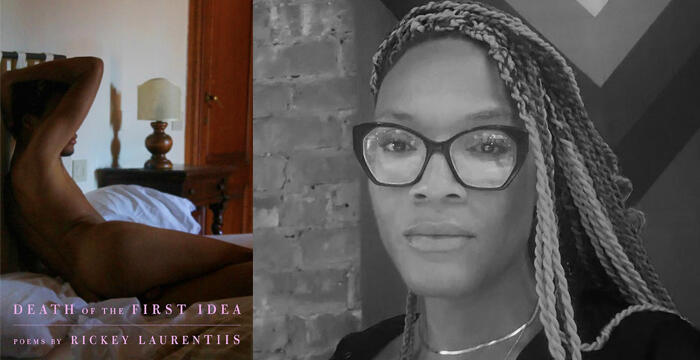
Ten years in the making, poet Rickey Laurentiis joins us to talk about her much-anticipated remarkable new collection Death of the First Idea. “In the past decade, as Laurentiis has transitioned, her ideas of the lyric and poetry have transformed, as has the America in which she lives,” says the back copy on this book, whose poetry fittingly resists easy categorization. Oracular and lyrical, mythic and confessional, archaic and futuristic, personal and communal, Rickey’s poetry takes us far and wide, from Ancient Greece to New Orleans to Palestine, from Dante to Emily Dickinson to her own past and future selves. As Safiya Sinclair says: “Here is a poet in an ecstatic trance, dancing with the muses. Each page is an inferno of linguistic fervor, reforging trans identity and femme imagination. Deeply felt, rigorous, and erudite, these poems strike deep in the mind and stick to the soul. Startling and raw and exquisitely fearless, above all, these poems choose to live.”
For the bonus audio archive Rickey contributes a reading of a new poem, written just two days before this conversation was recorded, entitled “Second Nature.” This joins bonus audio from everyone from Danez Smith to Torrey Peters, Jorie Graham to Dionne Brand. To learn how to subscribe to the bonus audio and about the other potential benefits and rewards of joining the Between the Covers community head over to the show’s Patreon page.
Finally, here is the BookShop for today’s episode
Transcript
David Naimon: Today's episode is brought to you by the poet and culture worker Mahmoud Al-Shaer, whose collection of writing, I Am Still Alive: Dispatches from Gaza, is a searing testimony written over the past year and a half from inside Gaza. With breathtaking lucidity and devastating intimacy, Al-Shaer uses his voice to record the quotidian Palestinian struggle while resisting erasure and bearing witness to unbearable loss and violence. The dispatches gathered in the book offer far more than a chronicle of destruction. With composure and clarity, Al-Shaer offers readers a vital affirmation of presence, relation, and survival. From the wreckage of homes and futures, Al-Shaer builds a shelter with language itself. His writing, raw, lyrical, and defiant, refuses the daily cruelties imposed by the genocide, demanding instead that the world face these atrocities as their own. On every page, Al-Shaer relays an ethical insistence: "I am still alive." I Am Still Alive: Dispatches from Gaza is available now in print and e-book editions from K. Verlag in Berlin and is shipping globally via their web shop at kverlag.com. The book is dedicated to Mahmoud Al-Shaer's three-year-old twins, Majd and Nai, with all proceeds from its sales going directly to his family. Today's episode is also brought to you by Natalie Bakopoulos' Archipelago, a stirring and impeccably balanced novel of self-discovery that will appeal to fans of Katie Kitamura, Rachel Cusk, and Deborah Levy. Along the way to a translation writing residency on the Dalmatian coast, Archipelago's unnamed narrator has an unsettling, aggressive encounter with a man on a ferry. What ensues is a series of strange events involving romance, a novel, and an impulsive road trip back to Greece. Spare and lyrical with subversions of the Odyssey and its singular Ithaca, Archipelago charts a winding journey back to the narrator's family house, offering readers a meditation on the slippery borders of nations, languages, middle age, and the self. Archipelago is available now from Tin House. It would be a great understatement to say I am excited to share today's episode with Rickey Laurentiis about Death of the First Idea, a book ten years in the making, a book we've been eagerly waiting for during those 10 years that doesn't disappoint. A metamorphic book. During that decade, Rickey transitioned, and so has her relationship to the lyric. The country itself has gone through cataclysmic shifts in that time as well. Our conversation fittingly travels far and wide, from ancient Greece to New Orleans to Palestine. I can't wait to have you travel it with us. For the bonus audio archive, Rickey contributes the reading of a poem she wrote just two days before we talked, a poem called Second Nature, a gift to supporters to hear a poem like this, not yet out in the world. A contribution that joins many incredible contributions to the archive, whether Danez Smith reading poems from each member of the Dark Noise Collective, and then one of their own, after each poem devising a writing prompt just for us; to Carl Phillips reading a medley of Black Swan poems by others and then one by him; to Jorie Graham reading rain poems by Edward Thomas and Robert Creeley; to Nikky Finney reading from Lorraine Hansberry's diaries; to Torrey Peters reading "How to Become a Really, Really Not Famous Trans Lady Writer." Access to the bonus audio archive is only one thing to choose from if you transform yourself from a listener to a listener-supporter. Whatever you choose, from rare collectibles from past guests to the Tin House Early Reader subscription, every supporter is invited to our collective brainstorm around who to invite as guests going forward. Every listener supporter receives the resource email with each episode of all the things I discovered while preparing, of links to things mentioned during the conversation, and places to explore once you're done listening. You can check it all out at patreon.com/betweenthecovers. Now for today's conversation with Rickey Laurentiis.
[Intro]
David Naimon: Good morning, and welcome to Between the Covers. I'm David Naimon, your host. Today's guest, the poet and artist Rickey Laurentiis, has a BA from Sarah Lawrence College and an MFA in writing from Washington University in St. Louis. Their debut collection, Boy with Thorn, from 2015, like Solmaz Sharif's Look or Layli Long Soldier's Whereas, has endured as a touchstone and grown in stature with time. But even back then, the arrival of Laurentiis' voice was recognized as a moment to recognize. Here are some lines from Terrance Hayes' introduction to it: "The poetic lair and lure of Laurentiis, I'd say, recalls Frank Lloyd Wright's Fallingwater House. A stone home built on moving water, this poetry is fluid and assured. It integrates interior and exterior worlds, demotic and eccentric idioms, swagger and humility. One senses the poets who have informed Rickey Laurentiis, but their influence seems more telepathic, subtle, than telegraphed, advertised. There's a restlessness to this book that recalls James Baldwin, as well as W.H. Auden, for example, and an integrity that recalls Audre Lorde, as well as Robert Hayden. Call Rickey Laurentiis' stylistic range virtuosity, or call it just as correctly necessity, a range essential to the protean lives these poems praise, elegize, and shelter. Rickey Laurentiis' astonishing poetry feels like the opening of a brilliant new door in poetry's enduring shelter." Boy with Thorn was a finalist for the Kate Tufts Discovery Prize, the Thom Gunn Award for Gay Poetry, the Lambda Literary Award, named a top debut by Poets & Writers Magazine, and was winner of the Levis Reading Prize and the Cave Canem Poetry Prize. She's a Lannan Literary Fellow, winner of a Ruth Lilly Fellowship, winner of a 2018 Whiting Award, and her poetry has been published widely from The New York Times to The New Republic to Poetry Magazine, and it has been anthologized in Extraordinary Rendition: (American) Writers on Palestine and Tales of Two Americas: Stories of Inequality in a Divided Nation. As a curator and art writer, they have partnered or collaborated with Prospect New Orleans, the Andy Warhol Museum, the Clyfford Still Museum, Museum of the Invisible Woman, the Carnegie Museum of Art, the Johns Hopkins Archaeological Museum, and the Museum of Modern Art in New York. They have taught at Columbia and Sarah Lawrence. They have served on the executive board for the Black Art Futures Fund and are the inaugural fellow in creative writing at the Center for African American Poetry and Poetics at the University of Pittsburgh. We're lucky to have Rickey here today to discuss her follow-up to Boy with Thorn. A decade later, the much-anticipated Death of the First Idea. Past Between the Covers guest, Safiya Sinclair, says, “Death of the First Idea is a potent lyric collection of resounding transformation and ingenuity. Here is a poet in an ecstatic trance, dancing with the muses. Each page is an inferno of linguistic fervor, reforging trans identity and femme imagination. Deeply felt, rigorous, and erudite, these poems strike deep in the mind and stick to the soul. Startling and raw and exquisitely fearless, above all, these poems choose to live.” And Ocean Vuong adds, “For those who’ve followed Laurentiis’s work since Boy with Thorn, there is no doubt that she is the real deal from first utterance. With erudite, vexed, and scintillating syntax, at once archaic and unimaginably futuristic, this long-awaited follow up is an ecstatic and undeniable celebration of language and being. I’m truly in awe. But mostly, I’m grateful to be alive alongside this once-in-a-generation talent, who has given English new angles to live and fight by.” Welcome to Between the Covers, Rickey Laurentiis.
Rickey Laurentiis: Thank you so much. You're making me blush with that. Wow. Thank you.
DN: [Laughs] So the back copy to Death of the First Idea has the lines: "In the past decade, as Laurentiis has transitioned, her ideas of the lyric and poetry have transformed, as has the America in which she lives. This staggering, irreverent, gentle, and erotic book is a record of that ten-year journey. It draws on, expands, and then fractures the many poetic traditions which informed Laurentiis’s poetics." Thinking of the title, Death of the First Idea, or one of the epigraphs, the one by Jesus that says, "If your foot causes you to stumble, cut it off," I'm curious about what has died or been removed and what continues. Or to use the language of the back cover, what is drawn on and expands, and what fractures. This dynamic tension exists, I think, within the first book, too, before this 10-year journey, where Terrance compares your poetry to a stone home built on moving water. This question of endurance and flux, and perhaps even an invisible long-term erosion of a foundation of what might seem solid and immovable. This is, I imagine, an impossible question, one we nevertheless, I think, might try to answer in many ways during our time together. But I thought one way to begin would be to talk about the poem from your debut collection that reappears in Death of the First Idea, a poem that both repeats and changes. Perhaps fittingly, my question is both echoed and repeated, and also changed by our first question for you from another. So we have a question for you from Danez Smith, who was recently on the show about their incredible collection Bluff, a conversation that is in my personal pantheon of all-time conversations on Between the Covers. So here's a question for you that travels alongside mine from Danez.
Danez Smith: Hey, Rickey, this is Danez. I am so proud of you. This book is magnificent and bold and transformative and long and earns its length. It is just such a fantastic return to form. I'm just so excited for all of us readers who once again get to live for a spell in your mind and with your words. I'm wondering, can you talk a little bit about Improvising on an Early Theme and the choice to put a book from your first collection, One Country, in a now past tense, now new understanding of self-rearrangement, slight remix, and put it into this book. It is, I was sitting with it, and it's such a powerful poem, and I was like, "Why does this sound familiar?" I flipped back to the notes that I picked up my copy of Boy with Thorn. I'm just so moved by the idea that a poem can grow and transform with you. So what was it like returning to this poem? Or maybe it never left you. How did it make its way into the book? I guess, what is Rickey [Reese] now? How is she thinking through the work of Rickey at age 26? Love you.
RL: I love you, Danez. Thank you for that question. Thank you, David Naimon, for leading up to it. It seems like an appropriate... You said a lot, and I wrote some notes. [laughter] So I'm going to try to reply back to what you said. But what was really exciting about coming to this book, and it did take the 10-year journey, that doesn't mean that every day I was writing, but every day I was doing something or something was happening to me that would bring forth this new collection. Just to redirect to what Danez said, I knew, I had some hints. This is the kind of, I'm going to address this, I'm going to move from Danez because he's a champion in this ring. He's like a book five or six, seven, eight. I'm a book two. I'm trying to catch up, trying to catch up. [laughter] But to other writers who maybe don't have one book out yet or maybe are about to get to the second book, it's a challenge because it's in the gap between those two books. You realize that you have some form of audience, whether that be the editor that you had the first time. That can be a debilitating gap because that doubt will seep in. You're suddenly aware of yourself writing is more than just a hobby, more than just an amateur approach. That it's something professional and it's something that will have some audience, whether they be one person or that might be 100,000. So I had some guesses about how I wanted to maneuver in this book. One of them was, I wanted that literal moment that Danez described, where there's a haunting in their ear. They're like, "This poem seems so familiar. Why do I know? I don't have a note in the back." I wanted them to actually stop and, if they had, go back to Boy with Thorn and realize that I'm trying to work in tandem, but also against some of the things that were brought about in Boy with Thorn. So you beautifully set it up. You know, Boy with Thorn ends with, "He shut the thorn up in his foot, and told his foot. Walk." I still believe that. It's true. All the pains and all the malaise and ennui and angst and anguish and anxiety and hurt that I had accrued to in that book, I had to shut it up. I had to shut it up in such a way that would allow me power and able to walk across the world. In this book, I had no idea, though. You know, this is the secret. I had no idea that I was trans writing Boy with Thorn. So I came into that knowledge over these 10 years. But the poems were aware. So even in this poem, improvising on the early theme, it has the moment where the penis gets cut off. That happens twice in Boy with Thorn. Not to get into the particulars of what transness is, nothing gets cut off, per se, but metaphorically. Metaphorically, I found that arresting. Because I'm like, "Oh, the poems already were introducing myself to myself." So I like that he called it a remix. Because that's what I had in my mind. I was thinking about the remix in terms of R&B and hip-hop, but also in terms of improvising on the early theme, thinking about jazz. There are a bunch of poems in Boy with Thorn that have titles of jazz standards. Let me see if one just comes up, like Take It Easy is one. Do You Feel Me? Move for Love. I'm still jazz. I mean, I still think that jazz wasn't done. Its thoughts on time and its thoughts on signature, key signature, I think are still interesting. I think that they were at least dangerous enough for programs across America to stop funding music programs. So something was going on to such a degree that jazz became fatal in this sense. Originally, I wanted to bring in three poems from Boy with Thorn, but the book just became so large that I couldn't justify it. But with Improvising on an Early Theme, I thought it was important. It also has that subtitle, age 26. I thought it was important to show the span of time that has accrued over these 10 years. Now, the book isn't exactly autobiographical. It isn't exactly, "This is how I transitioned. This is how you transition. You do this, this, this, and this," because it's not like baking a cake. It's rather like, "Oh my God, I'm about to buy a house. Oops, I got to build a house. Oh, wow, there's a cake." [laughter] It's rather like that. You know, because life is rather that way. So I knew this poem was important to me, and I just wanted to have it repeat and rehaunt in a productive way that will bring people back to Boy with Thorn and hopefully will bring them to the future. As I was writing this book, there was one line. I'm not sure if you have it in your galley copy. It should be in the final hard copy where it says, after the dedication, it says, "This is the Illuminative Way, part two of a trilogy." Mary Jo Bang is one of my mentors and was a teacher, and she's been translating Dante's trilogy over the last three years. So I've been reading it with her. I said, "Well, what would a trilogy like that look like today?" To me, I was like, "Oh, I'm already doing it. It's an investigation and interrogation of the self and the seven hells within the self." This would be purgatory, where you're trying to purge something, try to transform. Then the next one whose title I think I know, but I'm going to keep it, [laughter] it's like, because this book, as I said before, isn't like a how-to become trans. There's no one moment in this book because I still haven't found a way to write this, whether or not it's important. There's no one poem that's like, "Okay, and this is it. Now, for all my people, all my detractors, all my non-allies, this will be the poem that convinces you." All I can put forth is a fat book. It's a rather fat book, a thick book that shows the purging, and it shows the beauty, too, of becoming something that fits you. It's like finding the perfect pair of jeans. You didn't make those jeans, but you had to find it, and then when you put them on, they fit you. It's a relieving moment.
DN: Could we hear Improvising on an Early Theme? Maybe also, if you're willing, Coming Back to Poetry?
[Rickey Laurentiis reads a poem called Improvising on an Early Theme]
RL: As I reread this, I also note that this poem cleverly, I hope, describes and it follows the way I move through pronouns. So I started off he, and you're always I. Forget he, she, they, you're always the I as you're speaking. But I moved from the he to the their to the her. That still feels important to demonstrate and to show that this wasn't just an overnight fantasy. There was actually some sort of process throughout the whole point, whether or not the book is going to replicate that process or not. I should also mention, during those 10 years, I said all of it was productive towards the book, but not every day I was writing. Actually, for a period of about four years, I didn't write at all, which was a terrible time, my most depressive time. So when I say coming back to poetry, I mean that quite literally.
[Rickey Laurentiis reads a poem called Coming Back to Poetry]
RL: What a weird poem. What a weird poem.
DN: [Laughs] To continue with this question of what continues and what changes, we have another question about this for you, this time from the poet and essayist, Camonghne Felix. Their upcoming book, coming out next year, is called Let the Poets Govern: A Declaration of Freedom, and it is described as follows: In this part memoir, part manifesto, at the intersection of personal grief and political resistance, an acclaimed poet and policy strategist leans on Black radical literary traditions to reimagine freedom through rupture, rhythm, and refusal. So here's a question for you from Camonghne.
Camonghne Felix: Hi, Rickey. This is your friend Camonghne Felix. I am so, so excited to see your new work in the world. I know that I have always been really inspired by you. I know that many, many people across the globe, across generations, remain inspired and moved by your poetics, by your craft. As a poet, you have always been, in many ways, a philosopher. I'm wondering, when you consider the title Death of the First Idea, what philosophy or psychology are you pushing back against? I'm essentially asking, what is the first idea, and how did it die?
RL: My, just get to it. Hi, Camonghne. It's so nice to hear my friend's voice. Well, let me be honest. "Death of the First Idea" came to me as a phrase. It's just like a lightning bolt in my head. I knew immediately, "Oh, that's the second book's title." But it was well before I knew I was trans. It was well before I knew we'd go and do a change. It was well before even America went through a change. I just looked it up. In 2015, Barack Obama was president. Now, in 2025, Trump's president for the second time. So I feel like we are in a moment, we're in some tight, narrow keyhole that we're pressing through to get to something else, whether that be great or bad or terrible or wonderful, it remains to be seen quite yet. I think for me, to start this off most plainly before I move up to the philosophical, the first idea was the first idea I had of myself. I think we do have ideas of ourselves that wrestle with ourselves. So Death of the First Idea was a reference to that, a reference to a revisionary practice that would allow me wings to fly into the new person that I've become. Now that's a totally different person. People hear the word change and they either gladden with a smile or they frown like, "Why should you change? That means you don't love yourself. That means you must hate yourself." Some aspects of that were true. There were aspects that I didn't love, that I didn't quite admire. I wanted to take up my responsibility to change that. I really want to press that point. I think we live in a millennial age where we've come to the language around trauma, we've come to the language around triggers and anxiety and stuff, but we haven't, and we still are shy of saying responsibility. I think if it's your life, which as far as we know, this is the only life that you will have, it is your responsibility, and it is your glad responsibility, your happy responsibility to take up your own body, your own life, and to really have it. There's a poem that opens up the book, or it's the third poem, Implications for an Arriving Mysticism, where it's a litany of lists that says, I have known, I have this, I have not that, I have not that. It occurred to me, "Well, how am I going to get it? I can't just wait. I don't have time. I don't have the luxury. So I need to get to that myself." More philosophically, I come home to such a philosopher herself. I don't know if I'm moving against philosophy as much as adding on to. There's another poem that says, "All good things will be added on to you." I'm thinking about death in the Black way, where death is not just a total final ending place, but it's actually a home going. You know, in funerals that I've been to or funerals I was an altar server for in New Orleans, I'm from New Orleans, and there would be Black Catholic funerals. It would be more of a celebration than it was a sad occasion, at least in the Catholic tradition. So I'm working with that. I'm also working with Gnostic texts that understood Jesus' resurrection as more or less metaphorical. More or less, it's impetus and it's an impulse to try to find the Christ consciousness within yourself and resurrect that. So the death is not final. It's not fatal. It's not literal. But it is an invitation to go through another door and to re-see yourself. So death, for me, is a good thing. It's a good hallmark. Just as much as matriculation is. Just as much as graduation is. It's a promotion, if you will, into another space. If I go back to what I was saying before about the trilogy, if Boy with Thorn is my inferno, this would be the purgatorial. That's the purge. It's February, where everything can purge and purge and purge. It's a messy time, which is the reason why I wasn't so upset with this being a fat book. It's a slightly uneven book. I mean, Boy with Thorn is so precious and so regimented. But when you're purging, you don't have that kind of space. Then, of course, he gets to heaven at the end, and it becomes this resplendent thing. So I wanted to show that death, even though it's not literal, even though it's not fatal, even though it's not bad, still comes with its mess. I don't know, it's chunky bits. There is a line I want to say is from Jack Kerouac, I hope I'm attributing it right, where it says anybody can walk into an ocean, but it takes a goddess to walk out of it. That's how I feel about the book. Like I walked into an ocean or I walked into hell. In order to get out of it, you have to come out like a goddess. I mean, it's ticking up after Babylonian texts when Inanna or Ishtar walks into it. I mean, she decides to walk into hell herself, and she loses parts of her body as she does it. The only person who has never died by going into hell is Dante. I don't understand how he got through so well. [laughter] So I think I'm working with a lot of different philosophies, even the Neoplatonists. In my notes section, which goes on forever, and I wanted it to. I wanted my notes section to be, [laughter] I did, I did, I did. Even though my notes are never like, "Well, in this poem, the second line is this," I don't try to explain my poems, I just try to give context to it, I wanted all those philosophies and schools of thoughts to be in your head, because deliberately, like, the future is here in the book, but also the ancient past, the archaic past, the antiquity, because that's the last time you really see a space for what I'll just call gender-varying people, where they had their own space, their own realm, two-spirit people, if you will, and it wasn't denigrated. It was actually respected for what it was. I'm not suggesting that we can necessarily return back to that, because in the interim, we have gotten through very patriarchal Christianity, which seemed like an entire enterprise interested in thwarting all the ways of the past before it, and in particular, of subduing the feminine in privileging the masculine. That has led to our world today, which is completely out of whack with nature, with itself. Look at our government. I mean, it's completely like where you can have Elon Musk and President Trump just go tit for tat over Twitter and that not shock and actually embarrass somebody. That should embarrass everybody. That only seems possible in the world that so reveres patriarchy that it's too scared to critique it. So in some ways, Death of the First Idea is the first idea, which really wasn't the first idea. It would seem like that is patriarchy. [laughs] The first idea might be patriarchy, and it might be time for that to really die for something else more androgynous, more ambidextrous, more amphibian, if you will, to come in instead, where women and men, masculine and feminine, are married. I don't mean that literally in marriage, but married to each other and working with each other, because in fact, we are humans. We all have to get in that crucible and make this work.
DN: Well, maybe this is in a syntactical way related to this question of two spirits. Both of these poems you've just read have parentheticals in their titles, always beginning with the word or. The most legible example is Improvising on an Early Theme, where the parenthetical is Or One Country, One Country, the name of the poem in the first book. The others might not be so linear in their connections, Coming Back to Poetry (Or Trans?) Vulnerability (Or Riding with Death), Creole Love Song (Or Under the Bridge), Trying to Make More English (Or Out at the Congo Square). I can imagine many things this could be, including a second voice or spirit to the poem, perhaps a countervailing one, or an older one, or a newer one, or maybe a key or hint at how to enter the poem. How do you see the parenthetical voice in the titles?
RL: Well, I'm glad they noticed. I got that. Let me just speak practically before I speak a little bit more poetically. I got that from people like Cy Twombly, artists who can be very good at titling their work and very bad. But Cy Twombly comes to mind because he has a bunch of paintings that are untitled. It'll be like Untitled or 1949. Basquiat does it here and there. So I got it from visual arts because I was thinking about the visual artists, where they use language, and where it's most important. It seems to me that their titles, it's most important. Although it might be a bit of an imposition because they shouldn't necessarily have to title their work. They're just painters. All they're being asked to do is to create an image. But in terms of practically, as I said, in terms of cataloging and just understanding where your painting is versus this and that one, you have to have a title on some level. Another way I think those parentheticals is working, this started as early as my first book, where I don't know if I can find an example, but there were some parts where it was a parenthetical with a metallics. That always felt like another voice, an inner voice. You know, if we sit down and quiet ourselves, we will discover inside of ourselves an inner voice. You know, Jesus called it Christ the Father. You know, Socrates called it his daemon. You know, today we call them intrusive thoughts, you know? But if you gain the control and the stillness with your breath and with your heartbeat, you can actually become in tune with that inner voice and it can actually help you. So I think of the parentheticals there as a moment where the inner voice is pushing back against on the title, but it's not in conflict. The "or"—I never think of "or" as a violent preposition. Is it a preposition? I think of it as something that is pressing upon plurality. That's really what I want people to walk away from the book, that we are plural people. We are plural. We have not only the permission, we almost have the painstaking requirement to change and to grow and to pluralize ourselves. It doesn't necessarily necessitate that one version of yourself has to die a fiery death. Although for some of us, it may be the case. I'm not sure that this is what prisons are doing today. I don't think they're really living up to their task as rehabilitation centers. But someone like myself will want to hope that there is a place where if there's a criminal side of you, that part of you can be burned, and we can actually accept a forgiven, rehabilitated person back into society. Fire is all throughout my book. Everything's on fire. Because fire is the element of change. You know, if you watch something burning, it's showing you in real time the change of information because it goes from a leaf to ash to smoke. So that's how I'm thinking about the parentheticals, and I had to trim them back. I had so many that I was like, "Okay, it's going to [inaudible]." [laughter] So I'm glad that you noticed it. I'm glad it had some resonance for you.
DN: Well, in both books, there's this deep engagement with time. Obviously, time is essential to the title, Death of the First Idea, where one might think it implies a progression away from a first idea toward new ones. But you trouble this in the end notes, where you question a progressive interpretation of history, and you assert the importance of also considering regression as well. I also think of the duality in Ocean Vuong's framing of this book as being at once archaic and unimaginably futuristic. It is the reach into and pulling forward of antiquity that I love in both of your books, where in your first book, Katrina, Wallace Stevens, Orpheus, and much more swirl together. Where in the new one, we have epigraphs from Plutarch and Pliny the Elder sitting alongside Simone de Beauvoir. But I do think you expand this gesture until it fractures into something more cosmic and futuristic in the new book. You meditate in the end notes on the potential rewards of, and also the limitations of looking for trans antecedents in antiquity. Even you quote Pliny in antiquity about this tension and contradiction existing then, where you quote Pliny as saying, "There are beings that unite the two sexes, we call them hermaphrodites; they used to be called androgynous, and they were looked upon as monsters. Today, they delight in the delights of libertineity." You add, "Which is to say the delights of a future, next liberated world." But I wanted to, just for a moment, reach back not to antiquity, but to 2016 again, which does feel a little bit like antiquity these days. But you were interviewed in Blackbird Magazine then, where you said, "To me the second poems are the most important in the book. That’s my secret. The scene between the first and the second poem is the tender spot. ’Cause you don’t see it. Whatever happens [during] that shift is so important to me, in being able to go between. And then, larger than that, the scene between the first book and the second book is an important thing." I wonder if this is still true today a decade later. In your debut, I Saw I Dreamt Two Men was the second poem. It came from a dream you had, a horrific dream that you had twice, where you saw two African men being hanged in a tree and then set on fire, presumably for being gay, and then you yourself become the fire. You say you knew that it needed to be the second poem. I wonder if the second poem theory endures, if the second poem in this new collection, The Ardency, is sitting in a tender place in Death of the First Idea. If it is, if The Ardency is sitting in a tender place, how and why is it this poem?
RL: I still agree with myself. I think that I had that so much in mind that I cheated. I was like, "Okay, I know, I want two poems to be in that tender space," which was The Ardency, but also Implications for an Arriving Mysticism. That title, Implications for an Arriving Mysticism, is looking back to when I wrote Conditions for a Southern Gothic. It just seems important to me to let people know what's coming up. [laughs] You know, an arriving mysticism was the phrase I captured that best foreshadowed the antecedents that I would be exploring. That's most interesting for me. The Ardency itself is a poem of life, of blazing of the sunset, of the sunset, sun falling, but at the same time, life blazing on. It's important for me to put that in that tender spot because we are given in our society still, and we have a ways yet to pitying the trans figure and pitying her for several reasons, but not in the least because she is sometimes murdered. She is sometimes the site of violence. I can't suggest differently from me. I have seen violence on my person that I don't think would exactly have arrived if I had never transitioned. So The Ardency for me does occupy that sweet spot coming out of Steal Away, which is such a short, cryptic poem. Steal Away, it's just two stanzas. It has little rhymes. Then The Ardency blows up, and it gets a little messy. It shows that mess early on. That's the seesaw I move between this book where there are poems that are tight and like, whoo, they're like American poems. Then there are these proto poems, because I did go back, when I went back into antiquity, I was reading hymns, I was reading [inaudible], I was reading carmens, I was reading epics. I had my ear to the floor a little bit. I had my ear to the floor of contemporary poetry a little bit. I thought, "Oh, huh, the girls haven't been reading as deeply as they should." [laughs] I was like, "Okay, everybody's interested in form, which is fine. But I'm only 36, but I'm a little bit older spiritually. I remember when writing in form was conservative. That was a conservative move. So I was like, "Well, there are more forms than we know." All these forms that we've received have codified themselves over time. I was interested in where and how form started. Where did it start? How did we get to a sonnet? You know, for instance, never mind you have Terrance Hayes and Shakespeare and Petrarch making different variants of the sonnet. Never mind that. I was interested in how we got to poetic forms. So The Ardency is one of those poems coming in that kind of world. I edited it many times, but I wrote it originally in one sitting. It felt important to put it early on in the book. Just so I like to give people some, not trigger warnings per se, but like, "Hey, this is about to be what you're going to encounter. If you can't handle this, maybe just close the book, go pray." [laughs]
DN: Could we hear the first three poems? So we're moving from Steal Away and to The Ardency and then into Implications for an Arriving Mysticism.
RL: Sure.
[Rickey Laurentiis reads a poem called Steal Away]
[Rickey Laurentiis reads a poem called The Ardency]
[Rickey Laurentiis reads a poem called Implications for an Arriving Mysticism]
DN: We've been listening to Rickey Laurentiis read from Death of the First Idea. So another way...
RL: Can I see your copy?
DN: Yeah.
RL: You have a hard copy?
DN: I just got it today.
RL: I'm supposed to get mine today. So I'm probably reading slightly different versions.
DN: It is slightly different. It's super fascinating. Yeah. [laughter]
RL: Yeah. Okay. Cool.
DN: Well, another way I think of your work is not only through the twinning of the archaic and the futuristic, but also the mythic and the lyric, the oracular and the confessional. The borders between the two seem always in flux and porous to me. Thinking of their oracular, I think of Tiresias, who was a seer and who gave prophecies that were often ignored, even if they were also usually true. Because you have many short poetic sequences that punctuate the book that engage with Tiresias, more than 10 throughout the book. Because of that, following my own curiosity about Tiresias, I did some of my own, learning about them. Much of what I learned resonates with the themes in your book, though they aren't explicitly in the book. For instance, that Tiresias is a child of a human and a nymph. So they are a hybrid figure from the beginning. When they see two snakes copulating and strike the snakes, they are punished by a goddess to become a woman for seven years. But also after that seven years, they see snakes like this again. They strike them again and become a man again. But another thing I discovered that I really loved was that Hera and Zeus were debating who had more pleasure during sex, a man or a woman. Ultimately, they decide to have Tiresias settle the score since Tiresias has been both a man and a woman. But when Tiresias says a woman has more pleasure during sex, it makes Hera furious, and she blinds Tiresias. But Zeus thinks the punishment of blindness is excessive. So he gives Tiresias the power of prophecy. So Tiresias is both blessed and cursed around this power of vision. But I want to hear of all these things about Tiresias, what does Tiresias mean for you as a figure? What are you exploring in these short pieces? Sometimes as short as one line.
RL: Yeah. I think I'm gearing up toward my Tiresias because I'm like, "He deserves his own story," because he's constantly, I mean, he's famous in Greek archaic up to antique thought. I mean, he pops up in Oedipus Rex. He pops up in the myth you say about Hera and Zeus. He pops up in Sophocles' writing. He's everywhere. He's not the only seer, because Cassandra's there. No one believes her. He has a daughter named Manto. She's a seer. In some instances, Daphne is a seer. So there are different seers that they can call upon, but they always come to Tiresias. I want to say something about that. I think what's interesting about the archaic period to me, that whole moment of sweeping from Egypt into the 12 Hebrew tribes and Babylon and up to Rome and Greece, is that they were interpreting more or less the same handful of myths and reengaging with them and having different schools or creeds inside. So they had the Orphic school versus the Bacchic school. Then they would perform, at least in Greece, they would perform these plays back to the audience. So religious life really was life. There was no division between, even though you would consecrate an area as sacred, but there really wasn't a division between what is sacred and what is mundane. So I really find that fascinating because this was how they created a civilization. This is how they created the Greek figure or the Egyptian figure or the Hebrew figure was through these textual engagements, dramatic engagements, if you will, or even artistic engagement or athletic engagement, thinking about the Olympics and all that. So Tiresias, to me, stands as a great mascot for all that because he has seen widely. In the myth that you mentioned, what I think is so interesting about that, and it's a secret, it's one of the mysteries. I don't point out, it's like when Hera punishes, she's constantly, constantly punishing somebody. That woman is mad. [laughter] You can see why. Because Zeus can never keep still. Zeus, I mean, is pansexual with a problem. He has a rapist problem, except for his little Ganymede. He loved Ganymede. But she punishes him by rendering him blind. There's a line, "Because a god cannot undo another god's action, Zeus renders him with prophecy." I thought that's one of the mysteries. A god cannot undo another god's power. Doesn't that make sense? Because if it was true, there really would be chaos because we wouldn't have fire, we wouldn't have air. Even for the gods, there is this grammar that they have to work under, which I found fascinating. I don't know. Did that answer your question exactly?
DN: Yeah. No, I really like that.
RL: There was one more thing I wanted to mention. Maybe we'll have time to speak about it. It was Aristophanes. Are you familiar with Aristophanes and his theory of the origin story of love? He uses this figure, he says that men are from the sun, women are from earth, and then the people who were from the moon were an androgynous figure who were like an O, and they had all their limbs and extremities in this circular. Because they were so powerful, because they were whole within themselves, even Zeus himself got frightened and threw a thunderbolt and split them in half. So that now you have some that are men, and now you have some that are female. That's the origin story of the soulmate, because they go on in their life constantly trying to find that other half so that they become whole again. There was something you said earlier about androgyny that reminded me of that story of Aristophanes, and that doesn't come out. I mean, there are so many stories. There are just so many. The androgynous, or what we would call today transfigure, was so arresting, was so excitable in the archaic mind, it constantly comes up. It's just so interesting that now we've come back to 2025, having gone through Christianity and all its schisms, and you can see exactly where, I think I have a note about it, exactly where King Justinian denounces the androgynous figure, denounces the eunuch figure. Even though the eunuch, if you read about it carefully, the eunuch is the Ethiopian. The first Ethiopian to convert to Christianity supposedly was a eunuch. So there are places that we do have our antecedents in history. We don't have to make them up. Some of them were gods. You know, Hermaphrodite is a god.
DN: Well, taking this punishment for pursuing the wrong forms of sexual pleasure and/or of gender expression into the contemporary world, moving it from the mythic and oracular into the lyric and from attacks by gods to attacks by other humans, you engage in the collection with the 10 violent attacks on you by cis people and your resulting PTSD. Also, about trans loneliness, a term coined in a medical paper where in the end notes you also quote Carl Jung who said, "Loneliness does not come from having no people about one, but from being unable to communicate the things that seem important to oneself, or from holding views which others find inadmissible." Which reminds me of Major Jackson's introduction to this poem, Trans Loneliness, before reading it on The Slowdown, where he said, "Society’s debates around gender identity boils down to this simple fact: people want others to see them as they see themselves. This is a pure, human need for affirmation from friends, parents, and peers." Then later, "Today’s poem grapples with the emotional difficulty of transitioning, but proudly asserts a sovereignty over the body and importance of the right to shape one’s identity." I wondered if you wanted to say anything about your thought process about how to render or not to render violence toward you, as well as trans people more generally, on the page and the aftermath of it on the psyche?
RL: That was a tough decision having to come to, especially with Boy with Thorn. The difference between Boy with Thorn and Death of the First Idea, for me, in terms of if I was thinking of my identities, which is both Black, trans, a woman, I still call myself gay because I understand myself culturally as gay. [laughs] You're like, I'm into Greek mythology. That's pretty gay. [laughter] The difference is that it's a matter of where each identity group is in terms of their time in the arc of progression. So it seems like I could take some liberties in Boy with Thorn and even devote a whole long poem in the middle to Black violence. Because not only because it wasn't before necessarily celebrated, it's not the word, but exposed, if you will, but because it's just that time. What I'm trying to say is that as a Black writer, if I could just shuttle myself down as a Black writer, I have a fuller history. I have a fuller literary tradition to look back on and say, "Okay, I'm not Phillis Wheatley, so I don't need to have signatories." Whereas to some extent, when I realized I was a trans writer, I did feel like that. I felt like, oh my God, I suddenly need signatories to underline this as poetry and as something worthy of the lyric. In terms of trans loneliness and the violence on the page, it arrives, and I hope, I would like to hear your thoughts on this, it arrives in the book just all of a sudden, and then it goes away, which I wanted to do that specifically because that's how violence happens. I didn’t necessarily want it to be a looming thing because that’s not how I live my life. Even though I do have PTSD, I also work with my psychiatrist so that I am a happy person. Violence usually comes about surprisingly, especially this trans violence where people are using things like the gay panic laws or the trans panic laws to excuse their violent behavior. It happens so quickly. The only way I can describe it is like a crack. It’s like they crack in front of you and then all of a sudden you’re assaulted. What I didn’t want to do is necessarily reproduce a book of just pain. It didn’t seem necessary, although some people would argue that’s the way to change people’s hearts. I think that comes with a cost. It still bothers me that the world seemed to have shifted after, not Michael Brown, but I forget his name.
DN: George Floyd.
RL: Yes, exactly. It still bothers me that it was through that act of violence that people suddenly were like, "This is wrong." That tells me something about those people. You should have always known that was wrong. When people are thriving, you should also thrive with them. So I don’t know if I’ve answered that question yet because I still feel like there is a lackluster or just—I don’t have the time, put this in quotes, “I don’t have the time to think about these people too”—ism in America, which might necessitate a book that’s like, "Well, you need to find the time because people are dying. People are dying. Children are dying." One event that really stayed with me was Brianna Ghey, who was a young girl in England who was tortured by her own peers. The calloused way in which even people like J.K. Rowling just use that to buttress and push on their own narratives really begins to reveal me, she’s a children’s author. She’s a children’s author. She don’t care about children. That’s shocking. That makes me want to not ever think about Harry Potter again. I’m like, "That’s a child." I mean, first of all, you were over here debating children, but someone else’s children? I noticed that she has none. But it just puts a bad, bad, bad taste in my mouth specifically. So it was something I’m still struggling with. I knew I had to have those three poems. It feels like there are three poems, at least in the poem that goes specifically towards that violence. But I didn’t want to ignore it. It’s not like I’m trying to say, "Oh, it’s peaches and roses and creams over here." But I wanted to do something with this book that might challenge some preconceived notions of what it is to be trans and Black and alive today. For me, on most days, it’s a beautiful day. On most days, it’s a beautiful day.
DN: This double notion of Tiresias’ vision, the punishment and the blessing of it, makes me also think of all the doubling and mirroring in the book at large. Later, I want to talk about the snake in Tiresias’ story and how it’s doubled and mirrored in a very different snake. But there are many other doublings—not only your two books in relationship to each other, but also the doubling of 1919 and 2019 in one poem in this book. Also within the epigraph in Boy with Thorn by Auden: “And ghosts must do again/What gives them pain.” Or how on Facebook you twinned the cover of Death of the First Idea, the way you are positioned bodily with the way Jorie Graham is on the cover of Erosion, which I love. [laughter] You have the phrase in your poem Toward a Tall Lyric for Palestine, which I want to spend some time with, where you turn Du Bois’ theory of double consciousness into what you call doubler consciousness, saying in the end notes, “I refer to W.E.B. Du Bois’ theory of a Black person’s double consciousness, which keeps divided interests between Blackness and what he called Americanness, ever within the confines of Black life.” With you ending it with a question that I think is what moves double to doubler consciousness, that question being, “Can there be more?” This seven-page poem called Toward a Tall Lyric for Palestine (Or, The Harder Thinking), written in 64 numbered prose blocks, engaging with your 2016 visit to Palestine as part of the Palestine Festival of Literature, feels also like one of the anchors of the book to me, perhaps because it feels like another transition or volta in your life, where in the poem you say, “When I am home again, I will begin a change," and, "What must you admit really to be free? Admit everything. Tell everything you’ve seen.” Much of this Tall Lyric for Palestine is passing through checkpoints and noticing how people are categorized as they do. Perhaps this is why the poem is numbered and fragmented the way it is. At one point, you wonder why Saidiya Hartman is let through and not you. But also, to return to double consciousness and doubler consciousness, you are suddenly thrust into the positionality of you as an American, as you representing Americanness and its complicity in a way you aren’t moving through the United States. You wrestle with Black pain in relation to America and in relation to what you see in Palestine. Talk to us about this poem for you, the harder thinking of it, the change it portends, the form it operates under, anything that comes to mind about the Tall Lyric for Palestine.
RL: Well, that poem quite literally took ten years to write. I remember coming back from—I read in Jerusalem when I was in Palestine. I remember coming back and thinking about that experience. This was before, again, the turning of the tides. This was before the Columbia, all the things that happened in Columbia with the students being expelled. This is only five years ago. It was before there was any kind of thought to say something like pro-Palestinian in American politics. So I have to give props where props are due, because that has seemed to be taken up majorly by young folks, younger than me. So that’s you. That’s good. But coming to that poem was interesting because I had to realize, "Oh, I can’t write a beautiful poem about this." It’s going to have to be fragmented and probably long and a little bit outside of my wheelhouse, outside of my comfort zone, to write a poem that I think would be useful to whatever audience received it. I had to realize audience was a big part of my writing this book. I had to realize I’m ultimately writing to American, cis-Americans. [laughs] It would be lovely if this book fell into the hands of a trans-Palestinian person, but it’s probably not likely, probably because that person doesn’t really have the time to sit down and read poetry. So knowing that, I had to finagle my way and even use, in that poem, I use my own self. It’s not quite autobiographical; I didn’t quite fall to pieces when I was there. But all of these questions came up for me. You mentioned double consciousness. What I was interested in is—and I’m not sure the history, but I’m going to look this up—I was doing some research in the Reconstruction period of America, and I noticed that double consciousness was the phrase used even there, and it wasn’t by Du Bois. So I became curious to know, I wonder if double consciousness was a larger term that Du Bois would specify, or if the reverse was true, if he coined the term. And, as we are wont to do, we dilute stuff. I remember when “toxic” was attached to masculinity, then three days later, it was just toxic. So we have this way in America of, there’s this tricky logic that once there’s a phrase that arrives, that describes exactly the injury, suddenly it becomes broken or finagled in such a way that it ignores the injury. So me writing that poem, which I was thankful to have published in many places and under many forms, it was an act of hope in some sense, because I hoped to write it. I hoped to finish it, and I hope it has some effect in the world. One can never know for certain, especially being complicit, being an American, knowing where your tax dollars go, knowing how it works. Also knowing how this works in terms of generation. It seems like the last president we had, the former president, Biden, just doesn’t get it. [laughs] He represents a block of people who just don’t get it. From his point of view, everything must be for Israel. But having gone there, having been in Palestine, I can tell you Israel is now KKK. It’s a terrorist group. Zionism, I should otherwise say. Zionism is manufacturing that kind of terror on the ground day to day to Palestinians who can’t even control their own borders. The borders are controlled by Israeli figures. It was a lot because it made me realize my certain privilege I had, not just as an American, but even as a Black American. I had a passport. I could fly from New York or New Orleans and go to Jordan and be in Palestine. A Palestinian can’t necessarily do that, let alone do that and have the privilege of returning back to Palestine. So that was a profound moment upon me, both as a poet but as a person.
DN: Well, two of the things you’ve spoken about that this poem raises are the fraught questions around both witness and empathy. For instance, in 2016—I’m not sure if this was before or after you going to Palestine—you said again in Blackbird, “Years ago, I was reading (and I’m still obsessed with) Carolyn Forché and the notion of witness. But then I began to question witness. Are we witnessing the witnessing? And it is a way I live in the world because it’s directly coming out of Katrina—seeing what others were seeing and not seeing, and also what I wasn’t able to see because I was living it. There’s all these ways of seeing something that I think we either obscure or don’t think about. We need to do more than just empathy." That last line makes me think of Solmaz Sharif’s lines: “Empathy means laying yourself down in someone else’s chalklines and snapping a photo.” You’re clearly trying to navigate a way to honor what you feel echoing between your own experience in the United States and the Palestinian one without doing this move that Solmaz describes, where you say things in A Tall Lyric for Palestine like, “I told myself not to collide our pains, but I feel a resonance.” And the same question appears in a different political context, I think, in your poem The Vague Year, which has lines like, “I am not asking you to be identical or have the same life as me, same pain, but to recognize pain in your own family, name it and sympathize," and, "I’m not asking you to be identical or have the same tragedy as me, but to extend your graces.” So I wondered if we could spend a moment on witness and empathy for you as a human, but also as a poet, when trying to write toward being in allegiance with someone else’s pain that isn’t yours, but also is echoing with yours or speaking to yours.
RL: Oh, I’m glad that those lines stand out to you in exactly the way that I hope they did. You know, I have culpability as much as any other American, but I also have a responsibility to name that culpability and to name it out loud. I say sympathy as opposed to empathy. Me and Solmaz gave an interview where we talked about empathy. Empathy is a rather new word. It literally comes from German abstract expressionism, where you empathize with an abstract painting. You never want to think of your life as an abstract painting, as an object. So it occurs to me that we’ve forgotten the word. In lieu of empathy, we’ve forgotten sympathy, forgotten compassion. That word comes from the Latin, to be with someone suffering—cum pati, be with someone suffering. That’s hard to do, to be with someone suffering, either suffering yourself because you’re with that person suffering, or suffering alongside their own tragedy. But despite its challenge, it’s rewarding to get to a place where you can, even though you don’t want to collide those pains, you get to someplace—hopefully in the poem—you get to some resonance that comes through, through all of the muck and all of the mess. Because it is beautiful. I remember writing Toward a Tall Lyric, and that moment with the four boys, which I have a picture of, playing on the sofa, was just so touching because they were just, for one moment, we weren’t even in Palestine. We weren’t across the world. It was just four boys playing. It just reminded me of the humanity that is always present in war at the end of the day, and what is being risked at the same time. It’s really hard to write a poem when you’re in a war. That’s why most people don’t do it. You have to be outside the war. So I took that on seriously. I was one of the youngest people on that delegation. I said, "Well, if anyone’s going to write about this, it will have to be me from this perspective, like from this millennial perspective." So that’s what I’ve hoped to do. I’m not quite sure yet if I’ve succeeded. I mean, I put it in the book because I thought it was an important way to track my own trajectory. It doesn’t quite conflate with me being trans, but it conflates with my politics, which ultimately conflates with me being trans. So it made sense within the parameters of the book.
DN: Yeah, it made sense to me too. Well, the other most noteworthy place other than Palestine in the book is New Orleans. In 2011, in the Basin blog, you write, “Immediately after Katrina, —this was in 2005, so I was a junior in high school and had been displaced in southern California—I wrote nothing. I want to say I thought nothing. Life was all blur and motion. I didn’t exactly congeal until some time later when my family had returned to New Orleans and until I left that city en route to New York for college. I needed time, space and distance to effectively analyze and mythologize my experiences with the storm. Let me be clear, it wasn’t objectivity I was aiming for, but honesty. Poetry, for me, is about honesty.” It feels like Boy With Thorn as a collection engages more with Katrina, and Death of the First Idea more with the mytho-poetic space that is New Orleans. You quote Seneca, speaking of Eleusis, the prime center of religious ritual in ancient Greece: “There are holy things that are not communicated all at once. Eleusis always keeps something back to show those who come again.” A quote that evokes a doubling, a departure, and a return. Then you say, “I would offer New Orleans as a modern-day Eleusis, appropriate for the new world.” So talk to us about the New Orleans of your imaginary. I know it’s also the city you live in in the real world, but you’re also exploring New Orleans in a different space at the same time.
RL: That’s exactly right. It’s a New Orleans of several minds. Because being native to New Orleans, there is just the plain fact of it’s the city that I’m from. And it’s a little bit boring, but you know, blah blah blah. But the reason I came back to notice and to be able to see New Orleans in a specific way is because over the trajectory of time that I had been away, so since 2007 until 2021 when I returned back, not just New Orleans, but the whole world has gone through such an incredible revision, sometimes for good, sometimes for bad. New Orleans, specifically, I still remember when senators were debating whether or not New Orleans needed rebuilding on C-SPAN. That hurts you. That hurts your feelings. That makes you like, this is the place that I love. Y’all love it too. Y’all come here for three days and love it. I couldn’t imagine that same question being asked of Manhattan or being asked of Los Angeles, even though they are just as susceptible to wildfires or hurricanes, more and more by the day due to the climate changing. But when I came back to New Orleans, it was a New Orleans that was different. It was a New Orleans that was rebuilt in some places, and in some places not having been rebuilt because of the storm. I was also coming back as an adult. So I wasn’t a child. So I was able to see it from that point of view. It was inundated with a bunch of who are called locals. This is not a term I remember growing up. We didn’t call ourselves locals. We just said we were from New Orleans. Or if we had to give a word, it would be Native. It’s so interesting that the word local crops up, because it’s useful because it describes those who live in New Orleans and are local to the city but who aren’t actually from New Orleans. It’s tricky because it’s not that anything’s wrong with local culture—I call it local culture. What’s problematic about local culture is that nine times out of ten, these locals are white people from Indianapolis or Ohio. [laughs] So it’s like, there’s a specific reason why you are attracted to New Orleans and you want to be a part of that thing and replicate it. But can you? Can you do that while excluding the Black people who created that very culture, or while excluding the Creole people who created that very culture? One of the ways this has happened, there’s now a thing called downtown Mardi Gras. Before I left, there was no uptown/downtown Mardi Gras. It was just Mardi Gras, or Carnival season. But now there’s a downtown walking parade. The beautiful thing about New Orleans is that it is and it isn’t an American city in the sense that it allows for change. It allows that water to come through and be changed for better. This is not the first time that Carnival season has changed radically. In 1804, when it was purchased and the Americans flooded in, they felt excluded by the Krewe Balls. They weren’t invited. So they went uptown and created the floats, these huge, all those krewes, they created all of that. So in some ways, I see that same thing happening again, where more Americans came, they felt excluded from some part of Carnival, and created their own version of it downtown, which is—I’ve been to it—it’s very fun, it’s lively. But I’m always looking at it from a different vantage point where I’m like, “Hmm, is whiteness seeing itself as it does this?” I’m always just like, your impulse to come here and buy land is not—I’ve had people literally say this, like, “Well, we helped the city.” I asked them how. “Well, I bought a house.” I was like, "That’s not helping New Orleans. That’s preventing people who first lived in that house from returning." But also it’s just an interesting logic to do that, like, "Oh, my buying up property is going to help." I’m like, "It helped you, because it makes your life more interesting. Now you’re from New Orleans. Yay!" [laughter] Well, what I also am referring to is, in terms of Eleusis, when I came here, I didn’t mean to do this, but I fell in with what are called the train kids, who are volunteer homeless kids who jump on trains and ride the train as far as they can go. There's a huge population of homeless and train kids who show up in New Orleans expecting something. They expect to be transformed or they come to New Orleans so they can exercise all of their shames and exercise all of their, you know, because New Orleans in their mind is just deviant, Catholic. [laughter] So I'm like, "Huh. What New Orleans really needs going forward is an organized lesser and greater mysteries tradition so that when these people come, they can have some apotheosis or some sort of graduation that is useful for them, as opposed to just having a bunch of tenement houses underneath the bridge where people are just here in this in-between land." I've heard people say New Orleans is lawless. I'm like, "No, there are definite laws. They may be different from where you come from, but there are definite laws." So I don't know. I'm still learning the city as an adult. I'm just so glad that it's here. I mean, I love it more and more.
DN: Well, before we hear another question from another, let's hear a couple more poems. I was hoping maybe we could hear Visible City and Beautiful Bottom, Beautiful Shame.
RL: Okay. Again, the version might be a little bit different than what you have, but Visible City.
[Rickey Laurentiis reads a poem called Visible City]
RL: I kept changing that last line. What did it say in your version?
DN: In the final version, it says, "You must cope the world."
RL: You must cope the world. Yeah, I think that's right. [laughter] I kept changing that line. I could hear how it wanted to go, but you must cope the world. That's where I am. I kept changing. They were so sick of me. I'm like, I just don't know what that was like. [laughter]
DN: Can we hear Beautiful Bottom, Beautiful Shame too?
[Rickey Laurentiis reads a poem called Beautiful Bottom, Beautiful Shame]
DN: We've been listening to Rickey Laurentiis read from Death of the First Idea. So, similar to the mirroring of my curiosity with that of Danez's, we have another question for you that mirrors questions I also have about imagining and the imagination in your work. This time, let's start with the question from Major Jackson, and then afterwards, I'll ask my questions in the aura of your and his exchange. Major, like Danez, is a past Between the Covers guest. We talked about his new and selected poetry Razzle Dazzle, collecting 20 years of his poetry, as well as his essay collection, A Beat Beyond, where he meditates on poetry. He's also the host of one of the most prominent poetry podcasts, The Slowdown, started by U.S. Poet Laureate Tracy K. Smith, then hosted by Ada Limón, who herself left when she became U.S. Poet Laureate. So who knows, maybe Major Jackson is now up to bat. So here's a question for you from Major.
Major Jackson: Hi, Rickey. It's Major. Did you know that you are on a short list of my favorite native New Orleanians? I taught at Xavier University of Louisiana, probably around the time that Lil Wayne just hit the scene. By the way, Lil Wayne's not on my list, although I admire his lyrics. I have a very short list. In any event, it's been wonderful watching your growth. I think this particular question emerges from that perspective of your journey and your life thus far as an artist. So my question is this: I am thoroughly taken at how you create in language, poem after poem, dynamic, multitudinous selves, that is, lyric speakers that measure how we treat bodies as foregone footnotes to historical narratives or as social determinants. "It is a tragedy. No. It is a sonnet," a speaker states in the poem 2019. This is a brilliant association for me because it invites us to ponder voltus, or the lack thereof, and stasis and the predictability of structural violence. While I detect a sly commentary on our imaginative inertia, especially as it relates to seeing individuals as whole beings, I sense in this book multiple acts of becoming. It is as if you had to pen a collection that clears the space for your own transformation. That is, here, the poems write you into existence as much as your hand, body, eyes usher them into existence. Death of the First Idea, in my mind, is your chrysalis. So how do you reflect on the power of your writing to imagine possibilities for your and our futures? I hope you're well. I look forward to seeing you. Bye.
RL: Oh, wow. This is so lovely to hear people comment. He's exactly right. I feel like Death of the First Idea is my chrysalis or my cocoon. The next book is the eclose and where the wings come out, and you really take flight. So much of what he says resonates with me. I'm glad to hear his reflections on some parts of the book. He mentioned the dynamic, multitudinous selves that come up in the work. What I can say about that is that I noticed as early as Boy with Thorn that I have this hiccup with pronouns. It'll start off with I, and then it'll get to he, and it'll get to it. Beautiful Bottom, Beautiful Shame is a poem like that, where it works. That shifting through pronouns seems to work. That was one of the earliest hints I had, because that was one of the earliest ways I could detect a transness. I was like, "My poems are doing this already. I don't know. I don't do this consciously." It's as if I want to slip out of this gender and go to this gender and go to that gender. That seems like ever more so what our future will be permitting, allowing people the permissions to come out their doors. Not a completely changed person. Again, I want to reiterate that I don't think change means from top to bottom, you're completely a whole different thing, but a different aspect. You know, back in antiquity, back in archaic times, which I'm always in. I mean, I read it. I need to stop reading it. I'm always reading, I don't know, Pseudo-Origen or Thomas Aquinas, something like that. But even back in that day, when there were multiple gods in pagan times, each god would have many different epithets that would reflect different aspects of their divinity. I see us moving, I would like to see the culture moving in such a way that that is allowed on our own mortal persons, where we are allowed to come out. You know, today I want to be audacious, but tomorrow I feel like I'll be a little bit more shy. It allows people to maintain their humanity. I think it's a way against violence, if I can say so. Because if you think about a volcano, just to follow this metaphor, if a volcano had vents, it would never need to erupt because it would be constantly letting that pressure go in intermittent ways. I think allowing people, giving people the permission to show different aspects of themselves by day to day or person to person allows for them to vent or to release that creative energy that's so pined up within them so that they won't be a nervous breakdown, so that there won't be a total collapse into nothingness because for so long you've been shouldering this image of yourself that's not exactly true to who you want to be or who you see yourself as. So that's what I'm hoping this book allows for. I'm hoping this book gives one example, gives one way that that could be the case.
DN: Well, thinking of Major saying, you're not just a self writing, your pen is writing you into existence, I want to ask you about your views on the imagination too, and the aura of that, if they've changed, and how. Your first book definitely engages with Wallace Stevens, a poet that didn't see the imagination as the opposite of reality, but is equal to and interdependent with it. He also said that the imagination, insofar as it presses back against the pressure of reality, was important for our self-preservation. At the time, you said Stevens was likely your favorite poet or certainly your favorite modernist poet. In Boy with Thorn, I think of the line, "To imagine is the one mirror I trust." One of the epigraphs in Death of the First Idea is from Pliny and goes, "For whoever believed in the Ethiopians before actually seeing them, or what is not deemed miraculous when first it comes into knowledge. How many things are judged impossible before they actually occur?" In the Palestine poem, you ask, "What could I imagine now? What new eyes could I claim?" I also think of the line in vernacular history. One could resurrect a language light enough to fit our flying into. In the poem, Staring Out the Psych Ward's Window, you see twin black trash bags snagged in trees that for a second appear to you as ravens, and you exclaim, "Treasure, what a mind can do!" Finally, you open the poem Black Hole with a direct address to Wallace Stevens, "Not every blackbird is blackbird, Wally." [laughter] I'm curious if you see your relationship to the imagination changing over the past 10 years, philosophically or theoretically, or within language and sound or otherwise? How has it extended or grown or extended and fractured itself between Boy with Thorn and now?
RL: Just off the top of my head, that one moment at the end of Staring Out the Psych Ward's Window, in the final version, I think it says, "Treasure, what the leaky minds can do." I put leaky because it seems like that is what the imagination can do. It can leak into the real in powerful ways. It can happen in a kind of simultaneity. Then that poem, In the Psych Ward's Window, is a true account. I remember looking out the window and seeing what I thought were ravens, but then also seeing trash bags. I saw them both at once. That's how I'm beginning to think about my imagination. It's not as something instead of reality, but something that comes in tandem with. Honestly, it makes life more enjoyable. It makes it more fun to have that kind of belief where you can look out and really paint a world that you want to see, but also not to the destruction of the world as is. I was thinking about how Major talked about voltas or the lack thereof. That moment, again, with the psych ward window feels like a volta to me. I don't think of myself as a deeply imagistic poet. When I use images or when images come to me to be used, they're important. But otherwise, I feel like I'm more syntactical or inside the textures of language. But that seemed like a really powerful way to show how the imagination, if you could call it just imagination, because at that time, I was under psychosis. So the difference between imagination and psychosis is that with imagination, you're steering it. You're steering it. It's not even a dream. Dream is happening without your conscious steering it. Psychosis, you're not steering. It's powerfully happening to you. Eventually, as you work through it, you come to understand, "Okay, this is what psychosis was. This is what was happening." But until that moment, I think of that moment with the trash bags as pivotal or like a volta for my mind to repair itself because it was able to see that, wait, no, it reintroduced a productive doubt into my mind. It reintroduced, "Wait, you thought they were ravens, but they actually are trash bags." So to remember that not everything that you see is there, Rickey, not everything that you hear is actually being said, this might just be your psychosis. So it was a useful lesson, which is why I included it in the book. More than that, the imagination has come back to me recently as I've just started writing the third book. I decided that I wanted to return back to Of the Leaves That Have Fallen. I started reading it the other day, and I was like, "Wow, this is so good." [laughter]
DN: I love that.
RL: I was so surprised. It's a poem of 50 short sections. I was like, "Well, what would the 51 look like? What would 52?" Now I'm at like 60-something. So I'm like, "Maybe I can get up to 100 and call it a day." That'll be like a nice trilogy, if you will. But it led me back because that poem begins, I can, "In the imagination there is no daylight and, Like Wallace Stevens, I know the dark is crucial. I sing, I grieve in it, I dream what haunts each night: These bodies, even lynched, still are thinking. Nothing is final, I’m told. No man shall see the end—But them, my fathers, lifted into fire, like tongues." "Who wrote that?" [laughter] You know, the imagination, I think, does need to come back and sharper focus in my work because it's a natural step to get back to in terms of recalibrating myself together. But when you transition in any way, whether it be as a trans person, whether it be a funeral, whether it be promotion, it necessitates a weirding of the body, a strange making of the body. Like your body goes back in the chrysalis. I don't know if you know this. I love telling people this story. When the caterpillar engorges himself, eats all the leaves, and then goes under this strange transformation that he's not aware of, he has no idea what's going on, he's following instinct, he creates the chrysalis, and inside of it, he has to de-anomize. He turns into a ghoul. It's not as easy as just, "I'm going to pop up some wings." He has to completely turn into a ghoul and then re-anomize himself into a whole new figure. So that seems like both involved in this book, but also what I'm meaning to come back into, because after he does re-anomize and becomes a butterfly and he closes and pumps the blood in his wings, then he has to imagine that he can fly before he can fly. So that seems like a natural bridge to take.
DN: That's great. Well, the poet who's perhaps most explicitly evident in the new book is not Wallace Stevens, but Emily Dickinson. Back in 2011, you said, "I think of Emily Dickinson, who wrote well before confessional poetry was 'discovered' and coined, but confessed to an incredible degree in her poetry; whose emotional vulnerability and unforgiving honesty at times makes me, literally, tremble; and who told us to tell the truth but tell it slant—that is, not exactly un-masked, not exactly directly-at-the-thing. To make it strange: this is how I approach poetry." I also think of something Ocean Vuong has said about Dickinson that I love too: "One of my heroes is Emily Dickinson. Dickinson’s force is perennial. Here is a woman who had centuries of patriarchal literature march up to her door, Emerson entered her foyer, invited her down, and she says, 'No thank you.' She worshiped at the altar of language. To me, her work was about radicalizing worship, turning the act itself into a gift. If you are going to do something that is so difficult, if you are going to do something that has so little chance of success, like being a poet, why not permit yourself something wild and grandiose in the craft? Why not say, I am attempting to make a gift?" In this collection, there are many signs of Dickinson. You address her intimately as Emily, the way you call Stevens Wally. [laughter] Her frequent engagement with bees in her poems becomes part of yours, and syntactically it isn't uncommon in this book that you capitalize interior words like she did also. So talk to us about how and why Dickinson is addressed or manifests in Death of the First Idea. What does she mean to you and to this book, and what is she doing within the book?
RL: You know Emily, Emily's that girl. [laughter] Oh God, you know Beyoncé has that song, "I'm That Girl." Emily Dickinson can have that song too because she's that girl. I remember during the lockdown, you know, remember when the world locked out, I have to remind people, remember when the whole world stopped, remember that, because of a pandemic? It's still going. I decided to get on the internet and just start reading poems. A lot of them were Emily Dickinson poems. It was as if I forgot who Emily Dickinson was. It was like the first time. I was freaking out. Her poems are so good. They're so good. [laughter] They're so amazing. They're like this big. They're that long. They're that big. Big as a snap of a finger. Or as long as that. So that's literally the answer. I just found myself rereading her. I put Wallace down for a bit, and I picked up Emily Dickinson, and I was rereading her, and I was just fascinated by what she had to say and how she said it. But before that, even before the world locked down, I remember going and visiting her grave with the poet Safiya Sinclair. So I don't know. I like to think of that visit as having some sort of prophetic effect on me. Her work is just so good because it runs the line that I wanted to run, but in a different way in my book, which is between her common meter and her ecstasy. She's constantly in between those two poles. I feel like that is something that I learned from my own book. As I reread my book, I'm like, "There is a kind of meter. There's a rhythm." I call it rhythm. There's like a straight rhythm that goes along. But at the same time, I wanted to be able to find a way to break through. Trans means to go through to get to another side. So I wanted to be able to get through something because I ultimately believe that in each book we're learning another chop. We're learning another—I don't have a word. I was going to say ingredient or maybe if it was cooking, we're adding another ingredient to the stew so that we can ultimately write our grand opus. So I know I had to study her and be in that kind of tension to understand how to actually navigate that tension. Also, poets that I admire are people like Amiri Baraka, Adrienne Rich, Gwendolyn Brooks, who, if you look at the course of their careers, they started off one way and they ended up another. That's really fascinating to me. You know, Jorie Graham is like that, too. She wrote The End of Beauty, and she meant it. [laughter] Even Louise Glück, who completely disavows her first four books. She's like, "No, no, no." The only poet that I know who is a poet of steady, steady measure is Carl Phillips. But even if you read his first two books, there's a departure. So that's exciting for me to remind myself that I'm in a career. I also, not for nothing, I felt like I had to tell the girls something. I had to teach the girls that they can wait. I know that seems silly for me to say because I was like, at one point, I was the youngest girl on the scene. I was so young writing these. I was so young. [laughter] I'm 36, but I was like, "I'm so young." But I was so young writing this book. I was like the youngest, the earliest poem, I might have been 19 when I wrote. That is crazy to me now. It's wild. Poetry can really take you places. But I feel like I had to come back and show some of the girls, you can take 10 years. You can take your time and work towards something. You don't have to be worried about tenure. You don't have to be worried about fame. You can actually just be worried about the poem and tend to the poem as an altar, if you will, and it will come to fruition. So [inaudible] Dickinson, who didn't even want to publish her poems.
DN: Well, one aspect of your first book that really, I think, extends and fractures and becomes something bigger and perhaps something else is Christianity. Death of the First Idea is awash in biblical allusions. With it, there is also a continued mirroring. Boy with Thorn has the poem, You Are Not Christ. In the new book, You Would Be Christ as one example of this. In that earlier poem, we have lines, "Like prey caught in the wolf's teeth, but you are not the lamb. You are what's in the lamb that keeps it kicking. Let it." In the new book, there are the lines, "I am the prize of the slaughter, the bride whose blood of the lamb creates a snake's anti-venom." It is the snake I was hoping to use as our entryway into talking about the Christian element of the book. Of course, the biblical snake, God's opponent, echoes against and mirrors the other snake story that you have set into motion, that of Tiresias and the way Tiresias' two gender transitions are mediated via snakes. There are snakes and snake imagery throughout this book with lines like, "I wandered on sad way of the serpent in a fugue alone," or "Who's seen a snake walk on two legs, walk down Bourbon's throat." So I was hoping you could talk about the snake, which never feels just like the creature, but almost always like the religious or mythological snake charged with meaning. Sometimes the meaning passed down and sometimes I think subverted, its opposite. Or more broadly, talk to us about Christianity and the imagery employed of resurrection, which you've talked about today. The move from the poem You Are Not Christ to the poem You Would Be Christ, or really anything about Christianity in the book, but particularly about the snake.
RL: Isn't it true that people would be Christ if not for Christianity? Wouldn't we be beautiful people if not for the history of violence and terror that came along with the Christian government, if you will? The snake. Oh, the snake. What did the snake ever do to y'all? [laughter] The snake is such a patient, quiet figure. Eats once every two weeks. It's not really trying to bother you. Even in the Bible, the snake is a dual figure. Who let the snake into paradise is my question. [laughs] Then he becomes the sigil of Moses, because when he throws his rod, it becomes a snake. Then there's a time in the wilderness when Yahweh is at his pettiest. The people are complaining of starving because they have to eat. They just left Egypt. They're like, "You would send us out of Egypt just to have us starve in the desert?" So he sends flying serpents to bite them and then Moses is like, "Okay, we can't just have them all die, what are we going to do?" He's like, "Put up your pole and erect a bronze serpent, and everyone who looks at the bronze serpent will be cured." I only mentioned the bronze serpent in—I don't have a poem about it, but I think I want to write one because it becomes this dual image of the very thing that will harm you will be your cure. The very thing that will harm you will be your cure. So I think I was born in the year of the snake. I've just always been intrigued by the animal and by the mythology around it. I hope to teach a class about this soon, but the snake represents many things in many different cultures. I often think about the snake is a symbol of a deep and dark, sometimes, feminine kind of spirituality. Pause. I'll show you something. This is going to be the most New Orleanian thing that I can do. I'm painting her, but she's standing on a snake.
DN: Tell our listeners what you're showing me.
RL: I'm showing a two-foot-tall statue of the Virgin Mary, the pretty famous Virgin Mary. She is really all gold when I'm done with her. But she's standing on top of a snake, and the snake is on top of a world. It seems like that was one of the goals of Christianity, was to smite the snake. But you can't smite wisdom. The snake is also a symbol of wisdom, of feminine wisdom, particularly. So it's like you can try, but it's not going to do much good to stamp that down. Because the snake never did anything wrong to you. [laughter] It never did.
DN: Well, perhaps this is going to be an impossible question to answer, but I want to ask you about your thoughts on the soul, a word that this book is full of, the word soul, which also makes me think of Jorie Graham. The first time she was on the show, the soul came up many times, both in relation to being present to one's life and also present to the poem. At one point, she said, "It seems to me that's always been the job of poetry, to put our human existence, our emotions, our suffering, our joys into a ratio of perspective that allows us to understand what it is to be mortal, what it is to have limited time. Why is that the source of joy? Why is that a source of incredible initiation? Why the veil of soul-making, as Keats would have it, is our job?" Then there's the question of what you do with language to experience that. Then, another point she says, "When Coleridge says the poet, in using the poem, tries to bring the whole soul of man or of woman into activity, it implies that our souls and our senses in particular lead us to the soul. To bring the whole soul into activity means that our souls can be dormant, that we can be not present, that we can be going around life rather than through it." I like this notion of our job being that of soul-making, but I don't think necessarily the soul in your book is necessarily this. I have no idea. I'd love to hear about your own relationship to this word, which is a word that a lot of poets don't use anymore. I just had a conversation with Laynie Browne, and we were talking about how roses and the word soul have been taken out of commission due to the history of these words being so used.
RL: Here I go, here I come using soul and roses again and again and again and again.
DN: Yeah.
RL: Well, I already read The Ardency, but in that second line, it says, "So the soul is what I'll know." I really mean that specifically. It occurred to me that I have a soul and that it is an immortal piece of me that is unchanging. It felt necessary. Just as much as I was in the process of changing or transitioning, and that's exciting to come upon what might be new or what might be different upon my body, it seemed also necessary to be able to anchor into something that I knew wasn't changing. You know, at the core of myself, I am still myself. I just made a decision around sovereignty over my body. So that became a weighing scale that I had to do. The things that you just quoted from Jorie are just so smart. I love the idea of, we're not moving through the world, but we're moving around it. I think if you were to ask me why the soul disappeared for poetry, it's because I think the soul has disappeared from American life. I'm even thinking about how the word soul used in a Black way. Soul food. Or W.E.B. Du Bois even said that Black people are the soul of America. But we don't really think about souls anymore. We think about taxpayers. We're not even citizens anymore. We're taxpayers. It's not even intelligence we want of the soul. We want artificial intelligence. So it's like we're becoming so much more machines and just plain workers and laborers of a time as opposed to persons whose job it might be. I'm not sure if we make the soul in our encounter on Earth or we inherit one, but whatever the case might be, we have to nourish that soul so that it will be replenished and will sustain even possibly after our mortal lives are done. It seems the way that we do that, we replenish our soul and we feed our souls through art, it's through making, it's through community, it's through social activity, it's through being good. This is my loud, loud advertisement for being good. Please be good to each other, y'all. We only have each other. We have to be good. Even if you don't, even if you won't be mad about it, even if you're like, "What's so good about being good?" You just gotta be. [laughter] The opposite of being good is destruction. The opposite of being good is destruction. For my own poetics, it was a rescuing to remember that, oh, wait, I'll have a soul. So it's something I don't want to pretend to say I know exactly, but I'm working towards what the soul might be and what the soul might offer us. At the very least, I think the soul is the seat of our emotions, which is different from sensation, different from feeling, but it's the seat of our emotions. I think our emotions are what make us incredibly human.
DN: Well, before we hear a final poem, I wanted to talk more about what you do in a syncretic way in this book, spiritually, which feels both ancient and futuristic, taking ancient, disparate things and creating a new hybrid form that becomes, I think, a container perhaps for a future self, even a future community or a community practice, perhaps an act of soul making, which perhaps is part of forming the chrysalis that Major was talking about earlier. In your extended prose piece in this book, The Vague Year, you mention the Mississippi River and say about it, "The Mississippi River, who is also a god." Then right away, you also say, "Alone I was with my God, the Oshun," Oshun, which is a Yoruba, Orisha. You say, "Alone I was with my God, the Oshun, when I idled into a tricky crisis God, the Christ." I love this recognition of the river as a god, as you dance with and around these other gods. At one point you say explicitly, "That's when I conflated gods. Why I syncretized a new religion upon my body whole to make of myself an Easter." Before we hear a final poem, I wondered if you had any thoughts about any of this, whether about specifically The Vague Year or really more generally about the move toward conjuring a syncretic vision tailored for you, which I feel like is part of the journey of what we experience in traveling this book that you've created for us.
RL: That's a beautiful way of saying it. I often say it is I can extend my altar to include whatever God is best for me in that task of trying to be who I am, know myself, and be good to myself and to others. The Vague Year, oh, The Vague Year, when I keep mentioning this mess, this thing, I mean The Vague Year, [laughter] which is both one of the triumphant pieces in the book, but also one of the most tragic. Because it's a more autobiographical story than some of the other poems. But I thought it was, in terms of trying to be honest, it seemed like it was necessary to have that part in the book, even to explain that I don't know how yet to write this in a poem, much less beautiful prose, but I'm going to write it anyway so that you can see what's breaking open and what comes out from that moment. Thank you for noticing that. I don't really have much to say yet about, I'm still in the process of having it happen. So thank you.
DN: Let's go out with the poem, Good Night.
RL: Okay. Good Night is one of those poems that are very early. I remember writing this in grad school. It could have been in Boy with Thorn, but I didn't put it in Boy with Thorn, and it felt perfect for this moment.
[Rickey Laurentiis reads a poem called Good Night]
DN: Thank you, Rickey Laurentiis. I'm really excited to see this book out in the world and whose hearts it changes.
RL: Thank you so much. I appreciate it. This has been a wonderful time and interview.
DN: Yeah, for me too. We've been talking today to Rickey Laurentiis, the author of Death of the First Idea. You've been listening to Between the Covers. I'm David Naimon, your host. Today's program was recorded at the volunteer-powered, non-commercial, listener-sponsored, full-strength, makeshift home office of me, David Naimon. You can find more of Rickey Laurentiis' work at rickeylaurentiis.com. If you are subscribed to the bonus audio, Rickey has contributed the reading of a freshly written poem called Second Nature to the Archive, which joins contributions from Danez Smith, Carl Phillips, Dionne Brand, Nikky Finney, Jorie Graham, Alice Oswald, Torrey Peters, Mattilda Bernstein Sycamore, and many others. The bonus audio is only one thing to choose from if you transform yourself from a listener to a listener-supporter by joining the Between the Covers community. There's also the Tin House Early Reader subscription, receiving 12 books over the course of a year, months before they're available to the general public, and much more. Every supporter at every level of support can join our brainstorm of future guests. Every listener-supporter receives the supplementary resources with each and every conversation of things I discovered while preparing, things referenced during it, and places to explore once you're done listening. You can check it all out at patreon.com/betweenthecovers. Or if you prefer a one-time donation, you can do so via PayPal at tinhouse.com/support. I'd like to thank the Tin House team: Alyssa Ogie in the Book Division, Becky Kraemer in Publicity, and Lance Cleland, the Director of the summer and winter Tin House Writers Workshops. Finally, I'd like to thank past Between the Covers guest, poet, musician, composer, performer, and much more, Alicia Jo Rabins, for making the intro and outro for the show. You can find out more about her work, her writing, her music, her film at aliciajo.com.