


Nonfiction / Poetry
Sangamithra Iyer : Governing Bodies : A Memoir, A Confluence, A Watershed
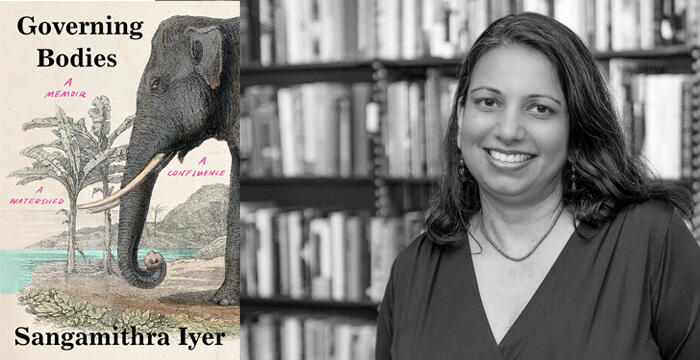
“When I tell you a story about my body, I cannot separate it from a story about water. And a story about water is also a story about family. And a story about family is rooted in the earth…,” opens Sangamithra Iyer’s Governing Bodies. What does it mean for a memoir to assume the elusive, ever-changing shape of water, to be the story of family but where the notion of family crosses the boundaries of blood, culture, nation and even species? Governing Bodies, as the Whiting judges said in their citation, is “a subtle, meditative exploration on grief and nonviolence, an international and intergenerational voyage through shared histories and a consideration of what we owe to each other and the natural world.”
For the bonus audio archive, Sangu contributes a reading of her remarkable essay “Are You Willing?” which originally appeared in the anthology Writing for Animals: New Perspectives for Writers & Instructors to Educate & Inspire. This joins an ever-growing archive of contributions from past guests—from Richard Powers to adrienne maree brown, Forrest Gander to Arthur Sze, Natalie Diaz to Ada Limón. You can find out how to access the bonus audio and about the many other potential benefits and rewards to choose from, when you join the Between the Covers community as a listener-supporter, at the show’s Patreon page.
Finally, here is today’s BookShop.
Transcript
David Naimon: Today’s episode is brought to you by Brick, a literary journal. Each issue is as purposely crafted as a good novel, says John Irving. Juan Gabriel Vásquez calls Brick “an indispensable feature of my personal landscape and a place I visit to renew my pact with the written word.” Christina Sharpe declares Brick “a wonder.” An international literary magazine based in Toronto, Brick is beloved by writers and readers the world over. The masthead of each issue hosts these words from Rainer Maria Rilke, as translated by E. E. Cummings: “Works of art are of an infinite loneliness and with nothing to be so little reached as with criticism. Only love can grasp and hold and fairly judge them.” It’s this love that drives Brick to publish the most invigorating and challenging essays, interviews, translations, poems, and boundary-pushing fiction. Brick’s winter issue is available now, featuring Lydia Davis, Cristina Rivera Garza, Madeleine Thien, Solvej Balle, Rinaldo Walcott, Diana Seuss, and many more. Visit brickmag.com to subscribe to the magazine or gift a subscription this holiday season. Print subscribers get free access to Brick’s complete digital archive, with issues spanning nearly 50 years. As a bonus for Between the Covers podcast listeners, take $5 off any subscription with the coupon code BETWEENTHECOVERS. Today’s episode is also brought to you by Polly Atkin’s The Company of Owls, a moving new memoir set in England’s Lake District, where a clutch of tawny owlets become the author’s unexpected companions. Living with chronic illness, Atkin’s days are shaped by a smaller world, yet filled with wonder. As Atkin watches the owls grow from curious fledglings into sleek raptors, she contemplates the act of survival and our place within it. Hailed by bestselling author Sy Montgomery as a work filled with wonder, wisdom, and warmth, The Company of Owls is a resounding call to find joy in the most unexpected places, a love letter to the natural world and those who inhabit it. The Company of Owls, published by Milkweed Editions, is available February 3rd everywhere books are sold. Speaking of Milkweed, in the last episode on New Year’s Day, I teased that a big change was coming for the show. I talked about my wonderful six years with Tin House Books and the Tin House Writers’ Workshop. Today I wanted to focus on Between the Covers’ new home. But briefly, before I do, in my thank-yous last time to the Tin House staff who helped the show week in and week out, I did want to also mention the two incredible graphic designers I most worked with, Jacob Valla and Beth Steidl, and also mention that the Tin House Writers’ Workshop, now separate from Tin House Books, has rebranded as the McCormack Writing Center. So please do follow them, as they will continue to provide their amazing workshops and craft classes and more. But now I wanted to speak for a moment to this transition for the show, a transition to one of my favorite presses, Milkweed Editions. Two of the most listened-to episodes ever on Between the Covers were with Milkweed authors, our recent U.S. Poet Laureate Ada Limón and the poet Victoria Chang. But you’ll also recognize unforgettable Milkweed conversations in the archives, whether with Jake Skeets or Ama Codjoe or Karthika Nair or today’s guest, Sangamithra Iyer. Not to mention the many other writers Milkweed publishes whose work I admire, from Marilyn Hacker to Fady Joudah to Rick Barot to Robin Wall Kimmerer to Aimee Nezhukumatathil to Debra Magpie Earling. Whether it be their Seedbank series focused on literature from around the globe, the Multiverse series devoted to different ways of languaging, whether through a lens of disability or neurodivergence, whether we are speaking of their robust list of Indigenous literature and their longstanding engagement with writing that relates to and engages with the more-than-human world, I’m really excited to partner with Milkweed Editions going forward. Today’s guest, Sangamithra Iyer, her debut memoir with Milkweed, Governing Bodies, exemplifies many of these things. A book that is deeply personal and yet global in reach. A book about violence on both an interpersonal and structural level, but also just as much, or more, about the potential for care and tenderness on big and small scales as well. A book that stretches that care beyond the borders of self, of culture, of religion, beyond the borders of nation and of species, to suggest a different way to orient ourselves both to ourselves and to the world. Sangu makes a generous contribution to the Bonus Audio Archive, an over 20-minute-long recording of her reading of her remarkable essay, “Are You Willing?”, where she takes this line, “Are you willing?”, from a Mary Oliver poem to explore insights for how to write animal literature, whether fiction or nonfiction, in a way that will open hearts beyond a reflexive defensiveness to change, and toward a feeling of openness and beholdenness to the community of creatures we’ve exempted ourselves from. The Bonus Audio Archive is only one possible benefit of joining the Between the Covers community as a listener-supporter. Every supporter at every level gets resources with each and every episode, and every supporter can join our collective brainstorm, shaping who we will invite going forward. There’s plenty more to choose from, all of which can be found at patreon.com/betweenthecovers. And now, for today’s conversation with Sangamithra Iyer.
[Intro]
David Naimon: Good morning, and welcome to Between the Covers. I’m David Naimon, your host. Today’s guest, Sangamithra Iyer, is a writer, editor, engineer, and environmental planner. She holds a bachelor’s in civil engineering from the Cooper Union, an MS in geotechnical engineering from UC Berkeley, and an MFA in creative writing from Hunter College. In her career as an engineer and planner, she’s devoted to watershed protection, wildlife coexistence, nature-based stormwater solutions, and sustainable cities. She has also been an associate at the environmental action tank Brighter Green, which raises awareness of and encourages political action on issues spanning the environment, animals, biodiversity, and the climate crisis. She has volunteered at primate rescue and rehabilitation sanctuaries in both the U.S. and Africa, and her TED Talk, What Hands Can Tell, is partly about learning American Sign Language to communicate with orphaned chimpanzees. These interests in city planning, engineering, wildlife coexistence, and watershed protection are not separate from her writing life, but rather deeply woven within it. Sangu is the founder of the Literary Animal Project, a site of curated conversations, questions, and writing about the ways animal lives are portrayed on the page, exploring methods beyond using animals as metaphors or as symbols or as mirrors for our own lives, using multi-species storytelling as one step toward exploring how we can forge a more just and compassionate multi-species world. She was also the assistant editor of Satya magazine, a magazine of vegetarianism, environmentalism, social justice, and animal rights. She served as editor of their special anniversary edition called The Long View. She has served as a member of the Associates Board of the Asian American Writers’ Workshop, and her writing has garnered a Pushcart Prize, been a finalist for the Siskiyou Prize for New Environmental Literature, appears everywhere from The Kenyon Review to Creative Nonfiction to n+1, and has earned many grants and fellowships, from the Emerging Writer Fellowship to Aspen Summer Words to the Diamonstein-Spielvogel Fellowship at the New York Public Library. Perhaps most relevant to today’s conversation, her 2021 Whiting Foundation Nonfiction Grant for Works-in-Progress was for the book we are discussing today, Governing Bodies: A Memoir, A Confluence, A Watershed, what she describes as a lyrical reckoning of the ways bodies, human, animal, water, are controlled and liberated. Aimee Nezhukumatathil says of this book, “Sangamithra Iyer writes with the kind of intelligence and attention that makes you lean in, asking how we might live in this aching world with more care, more kinship, and more courage. Governing Bodies beautifully guides us with the lyrical grace of someone who knows the liberation and legacy of what magic can happen when you combine the language of water and the weight of memory.” Kazim Ali adds, “It’s a remarkable book that blends the modes of memoir, journalism, essay, and cultural commentary with the lyrical sweep and rhythm of poetry to paint a vivid picture of both the natural world and the life of a family.” Finally, Shruti Swamy says, “Through memory, research, imagination, and profound love for the human and more than human world, Sangamithra Iyer has not so much written a book as created a utopia inside its pages. Governing Bodies is the work of a mind as agile as water, with many surprising streams feeding into the shining whole. This book does what the best books do: It helps me live.” Welcome to Between the Covers, Sangamithra Iyer.
Sangamithra Iyer: Thank you, David. Before we begin, I wanted to say a few words. As you know, I’ve been a listener of the show for a long time and a proud supporter, long-time listener, first-time caller at radio speak. [laughter] I was thinking recently of how I first came to your show. I think it was the episode with Eileen Myles. It was a few months after I had lost my beloved pit bull, Mookie. My friend Emily had asked me if I had read Eileen Miles’ Afterglow. In the process of looking that up, I came upon your episode. I just recently re-listened to it. I could totally see how I fell in love with this show on that episode. It reached me at a time I really needed to be reached. That episode was extraordinary in terms of articulating that radiant suffering that they call, in terms of attending to a loved one’s death. Eileen was also talking about the death of their father. Water was also something that was in that episode, and wanting to be like Mary Oliver and live on the beach with your dog. It was just an episode that had all of these things that were swirling around in my own work, and also talking about the possibility of memoir. After that, I was just binge-listening to the archive. I found this early post I had done on social media when I first got into your show. I said, “Between the Covers podcast hosted by David Naimon may be my love language.” I think what I meant by that was really acts of care and the amount of care and invisible labor you put into every episode, just such a generous reading of all of the work. As you probably have seen by now, I also had a little acknowledgement to you and the show in my book. I write, “Thank you to David Naimon, whose podcast accompanied me on so many walks and train rides and provided nourishment and inspiration for this literary life.” So I’m just, again, beyond honored to be with you here today as you embark on this new era of your show. Perhaps it’s fitting, because the opening lines of my book are “Begin again.” So I’m happy to begin again with you.
DN: I’m so happy to begin again with you too, Sangu. It feels like what you just enacted in how we begin is actually kindred to the way you deal with form in Governing Bodies, which is my first question, which is how you see the form of this book. A book whose subtitle, A Memoir, A Watershed, A Confluence, suggests multiple possible forms at once, I think. As you’ve alluded to, you and I have been corresponding for a while for, I looked back at least four years. Similar to your multi-form subtitle, you would often reach out bringing together and connecting episodes that I wouldn’t have thought to connect, kind of the way you’re now connecting various things around your book and me and Eileen. For instance, one time you reached out. You were connecting the language of sorrow in the conversation with Georgi Gospodinov to the Korean notion of han with E.J. Koh, to the notion of autumn in the heart, autumn in the mind, with our new poet laureate, Arthur Sze. But you would most often reach out about water after my conversation with Leanne Betasamosake Simpson about her book Theory of Water, about how you had just witnessed the eel migration from the Sargasso Sea to New York. Or with the conversation with Robert Macfarlane about Is a River Alive? to talk about the water restoration projects he mentioned in Korea, or the situation in Chennai, India. The first thing we encounter in the book is your incredible table of contents, where the three parts of the book are portrayed as three rivers, the first two rivers joining to form the third, with all sorts of animals along the shoreline beginning to end. If the words spill and spillage weren’t so loaded with negative connotation, which they are, I might suggest spilling as the way the book moves forward, but in a good way. The way your Alexis Pauline Gumbs epigraph suggests this, I think, “and to trust that all water touches all water everywhere.” Or perhaps the word formless, which also interestingly is largely negative too. But when thinking of water, water is many forms and also no form at once, but in an extremely powerful way, I think. I might borrow the words of Bayo Akomolafe, who says, "Something about becoming-river, about becoming-water, meets the logical impasses of these times. For one, it is impossible to do within the managerial, human-centering, logics of our sensorial frames. Becoming-water does not lend itself to the ways we've become comfortable with speaking about solutions, scaling up, sustainability, embodiment, and justice. Becoming water is the politics of the spill." I was hoping we could start with you reading the page before the first chapter, which I think puts this, in my words, spilling or cascading into motion for me. But then here you talk to us in your own words, with your own vocabulary, with your own preferred language, about the form or forms or anti-forms of Governing Bodies.
SI: Thank you. So I open the book with these lines: What you must understand is that when I tell you a story about my body, I cannot separate it from a story about water. And a story about water is also story about family. And a story about my family is rooted in a story about the earth. And when I tell you about the earth, I must tell you about elephants and chimpanzees, cows and chickens, coral and trees, monkeys and bees. What harms one body harms all bodies. Like tributaries to the same river, our stories are entwined. Thank you. And thank you for such a generous reading and opening question. The form and the structure of the book came through iteration and evolution over time. I was listening to your podcast with Lily Dunn recently about memoir. That question came up of, “Do you have the structure first that you write into, or do you write to find the structure?” And for me, it was the latter, like Lily suggested too. When I found it, it was very obvious, but it wasn’t obvious for many, many years, potentially decades. I think writing a book like this that spans so many subjects, so many timeframes, generations, species, I knew early on that I wanted it to span all of these things, that they were all connected. But it took a really, really long time to figure out how to hold it all. I think early on, when I was writing, the advice I was often given was like, “You’re trying to do too much. Make it less. Make it smaller. Make it easier, simpler.” And I had to figure out a way to tune all of that out and really protect the work. I’m really grateful for my younger self for sticking through with that, especially knowing that it is a book about all of these things, but not knowing yet how to hold it all and wanting to do justice to all of the subjects. Because I didn’t want to just feel like I was throwing a bunch of stuff on the wall and putting that out there. There’s a lot of care in all of these stories and the connections. I think the connections are really the heart of the book. What I’ve come to realize is the core governing principle of my writing philosophy is seeing these connections. Water, again, it’s very obvious now, but going through it, I think there’s an evolution of the relationship to water and the relationship to realizing water as a structure of the book, but also like a teacher and a guide. My professional background is in engineering. Most of my projects have been around water. I started this project, it was a project that was born in a particular grief of my father’s passing in 2003. We had taken his ashes to the Ganges, the Ganga. I had written an email to friends back home saying our journey began in North India. But the story really begins in South India, in a place called Kallakurichi, where my father was born. At the time, I wasn’t a "writer," just a daughter in grief writing about this experience. I remember getting so many comments about that email, like, “Oh, are you going to publish?” And that was the farthest thing from my mind. I did have this other thing happening, like there’s sometimes this clarity that comes from moments of grief, and you take risks in your life. I ended up quitting my job to train a magazine that you spoke about. I think that also just became a home for my grief on this different level, like on this planetary level, and thinking through all of the ways the planet is being harmed and the systems of oppression that are rooting all different kinds of beings, and seeing those connections between the various causes. When that magazine closed, I still wanted to write, and I wanted to figure out how to write. I ended up going back into the water sector for my work, but I enrolled in an MFA program here in New York. I remember I was at a talk, and they were talking about, at that time, the big concern was Marcellus Shale and fracking and impacts to water. I was at some lecture, and they were talking about water fingerprinting. I was like, “Oh, the fingerprint of water.” I just wrote that down. Then I was thinking about water as an entryway into the stories that I’m trying to write. I was really trying to research my grandfather, who was a civil engineer in Burma, and he quit to join the freedom movement in India. His whole thing was about divining water and finding water, providing water to villages who were denied access to water because of the caste system. I think I came into this project with just a lot of gaps. My father was the youngest of thirteen kids. In the course of writing this book, I’ve lost many of my aunts and uncles. So I was really interested in the story of my grandfather, because I was trying to figure this out for myself. I was trying to look at a model of how do you disentangle yourselves from systems of harm? Like, how did he quit the British to do this radical experiment? And what are these connections between water and social justice, and sanitation and social justice? And I didn’t have a whole lot to go with. So then I was like, “Well, maybe I can find his engineering projects in Burma. That’ll be an entryway.” There’s also something interesting that I’m trying to figure out right now that I don’t know what to do with. I write in this book of, like, at first in college, I wanted to write a paper about my grandfather’s bridge in Burma, which I knew nothing about. At that time, in the late nineties, the internet was not that great. I had no luck. Then I remember in, like, 2007, there was the Saffron Revolution in Burma, and all these monks were marching across this bridge. Then there’s a different spelling of the bridge. Then I looked that up, and I found all this, it had a name. Then it turned out it was the only bridge across the Irrawaddy. So then I was like, “This must be my grandfather’s bridge.” I was told the only way to really find more information about the bridge is to go to the British Library. I applied for a grant. I remember there was this opportunity to have your application reviewed by the staff just to make sure it was complete. The president of the grant called me, and she’s like, “This is really great.” But there were two words that threw my whole application into question, which was I said, “I think my grandfather worked on this bridge.” I think it was like, well, is there a book or is there a project if he didn’t work on this bridge? And I changed it to just say, like, “I’m looking to go see whatever he worked on.” I got the grant. That was also really validating early on to be like, “Oh, someone is invested in the story.” I ended up finding this civil service archive and then later tracing his footsteps in Burma. A lot of that was all about water. Like, all of his posts were on water, and they were wadi. So I was thinking about water as a witness to history, trying to see what was happening at the time to water, water as how it was used in colonial empire. Again, I go back to the begin again because it just feels like everything was the beginning. Then this is ten years after my father died, and I had more information than I ever had before, but then just leading to more questions. I had written an essay. It took me a few years to figure out what to do with all this archival information. I was trying to read into the gaps. I was reading a lot about working elephants in the British Empire. That was my connection too. It’s like, “I’m going to do water and animals because that’s what I’m interested in,” to make these connections. I just started writing these small fragments about elephants and elephant stories in my family. I was interested in what it meant to be a subject of empire and when you submit and when you rebel. So I had written this essay that was about all these things. It took this flowy structure. I realized I found the voice of my book. Again, that all ended up being the beginning of my book. So it was all of these years just to get to another beginning. It really was just more accumulation, more accumulation stories. Then I had this epiphany, which came really late. It came a few years ago. It was just sketching out my table of contents, and I sent it to my mom. And she’s like, “This is wonderful. This looks like the Triveni Sangam in India, the confluence of three rivers.” It made so much sense. Just in my professional life I see things in watersheds. Like, I understand the watersheds and how water moves in the systems that provide water to New York City. That was the way I could hold everything that I was doing in my head and see how they’re all connected. I realized it just gave me a lot of freedom. Like you said, you know, water can take the shape of any container, and it can be narrow, it could be wide, it could be moving fast, it could be moving slow. That gave me a lot of freedom. I think what I was thinking a lot about in the book was not so much plot, but flow and how things flowed. And I think the more and more I was doing it, just all the water metaphors, I was just accumulating so much of it. But I think that also made me feel I was on the right path. So that watershed form, I think each of the rivers that are letters in this book have their own flow regime. That was a thing to figure out. But I think it was doing a whole bunch of work and then witnessing the patterns and the repetitions and seeing what it was to figure it all out.
DN: Well, I want to ask you not about your grandfather’s bridge, but about the bridge between you and your grandfather, which I think is an unusual flow and confluence because your book is very much about inheritance, but it’s in a way that I think is really rare on the show. Most people who come on the show who are reaching back within their own families or ancestry are confronted by a rupture. Perhaps that rupture is part of what brought them to become an artist. Whether a rupture as big as, say, the Middle Passage and transatlantic slavery, or perhaps where there’s no rupture of knowing who your grandparents are, but a massive rupture around language and culture, whether from Native boarding school or fleeing war or many other things. But there’s this uncanny, even enviable sense of intergenerational continuity in your story. Not something like a father who has insisted that his son carry on the shoe store business that he began, but a natural continuity of flow or spilling forward of interests and of sensibility and of sensitivity and of spiritual orientation, of academic curiosity, and more. So much so that you can identify an inherent quality in yourself within the book and then find it in a family member who came before you in a very beautiful way. I guess I wondered if you could speak a little more about engaging with your grandfather. How much of this was a surprise, the amount that you found these correspondences, like these incarnations of past generations in you, very specific interests that are non-normative interests?
SI: Yeah. So I feel like my father, you know, when I went to study civil engineering, reminding me of his father. And my father lost his father when he was sixteen. So I never knew my grandfather. I think in writing this book, I also just came to this relationship. You know, my father was always an orphan when I knew him. Like, both of his parents had passed. So I feel like there was this civil engineering connection, but I didn’t know a whole lot. So I was learning a lot. I say something in the book about something else, about I was named after Sangamithra, Ashoka’s daughter. She was responsible for bringing a sapling of the Bodhi tree to Sri Lanka. Then later that sapling from that tree comes back to the original location after it was destroyed. I was saying there’s something about lineages, about them going both ways, and how my father used to tell me stories. And that section of the book, I’m writing to my father. So it’s like now I’m telling him. I feel like the same way there’s this inheritance, but I’m sort of—it’s not coming to me from the past to the present. It’s coming from the present, re-looking at the past and these choices. I write, again, with this epistolary, which again is another part of the form question, which also came later. I actually wrote the middle of the book in epistolary. I had written some of the first part of what I thought was the first part and what I thought was part of the third. I was working through what I had called at the time my “messy middle” of all of this archival information. I was trying to find my voice. I didn’t want it to be pedantic or scholarly. I felt like, “I want to write it to my father,” to think about all the things I’ve been thinking about since he passed, who I wished I could talk about all these things with. Again, that also helped with this voice. My editor was like, “Okay, why is the middle written as a letter and the rest of it aren’t?” I was like, “That was a good question.” But I didn’t think the whole book was to my father. I felt the first part was really about engineering and activism. It was really about me and my grandfather. Going back to the bridge, so there’s this bridge, I tried to find it in college. I can’t find it. I went back to my Hunter MFA application. The name of my project then was called Bridge to Burma. It was one bridge, two continents, three generations or something like that. Then I think when I did go through the civil service record, I actually couldn’t pin him to the bridge that I thought it was. Like, I found all these other things, but I still felt like this kinship with this bridge just because it got me all this way. You know, like me searching for the wrong bridge brought me to all these places. I think what I was saying earlier about what I’m trying to figure out is, you know, last year in March, there was a big earthquake, and that bridge collapsed. My friend Rocco was sending me—he’s like, “I just saw the bridge collapse.” And it was like, I don’t know how to process, like this bridge that I’ve been searching for, that was the wrong bridge, but was the right bridge because it led me to all these other connections, collapsed. But I think it was this earnest looking for what I think, again, it is an imagining. And going back to your conversation with Lily Dunn on memoir and what memoir is, I think memoir is also about these desires and these questions and these unknowns and how we make meaning of all of that. So it’s hard because it is a person I don’t know who seemed very complex. There are a lot of things. Then I think the other thing that I was doing in the book was a bit of substitution. Because I didn’t have my grandfather’s writings, I was looking through these newspaper articles of that time of people who are like my grandfather, who had left their careers to work in villages. Because I was looking for this particular place called Kallakurichi, I ended up going further and further back to this other lost homeland, Kumari Kandam, this mythical land bridge between India and Africa. So swapping one homeland for another. But all of them had these variations of themes. It was very interesting to me. I think the same thing with Sangamithra, Ashoka’s daughter. There’s not much about her in the archive. So I feel like I’m the substitution for that Sangamithra in the archive. [laughter]
DN: Well, we have two questions for you that I’m going to play together and also add a little of my own to make this a three-river question.
SI: Ooh. [laughter]
DN: Both of these questions touch on the ethical, perhaps spiritual orientation of this book in your life. I would love if your answer, beyond how you answer these questions on your own terms, could also touch on the ways this connects you to certain family members too, the way these principles are, in a sense, reincarnated in you from other generations in your family tree. So I will introduce and play the first question and then introduce and play the second before you respond. The first is from Megha Majumdar, whose latest book, A Guardian and a Thief, was a finalist for the National Book Award. It was named a notable book by everyone from The New York Times to The New Yorker to NPR, and which Kirkus has called, in its starred review, an electrifying depiction of dignity and morality under siege. So here’s a question for you from Megha.
Megha Majumdar: I loved what your book had to say about the continuity between chickens and people and forests and the whole planet. To love one is really to love them all. I’m so curious about how you arrived at that mode of seeing the world.
DN: So the second part of our question is from the writer Shruti Swamy, thinking again of water, both assuming the shape of its container and always defying being contained, crossing boundaries, I definitely think of Shruti. For one, she entered your and my correspondence. You told me about a panel she was moderating on Le Guin’s Always Coming Home and asked if I was going to watch it, Always Coming Home, for which she had written the introduction to the newest edition. I had been coincidentally invited to be on that panel, but I couldn’t be on the panel for logistical reasons. But much more so, I think, of an uncanny correspondence within your book. It would be uncanny enough that both you and your grandfather were governmental water engineers who ultimately become water diviners, people who literally and figuratively need to bust out of both the forms and strictures of empire, governmental conquest, and power, and also find a relationship to water and community that includes the scientific but goes well beyond the scientific. But we also learn in Governing Bodies that Shruti reads an essay of yours on water divining in your family, sends it to her father, who also improbably is an engineer like you, like your grandfather, and who even more improbably is also a water diviner too, and reaches out to you and offers to teach you. Shruti’s most recent book is the California Book Award–winning The Archer. Here is her question.
Shruti Swamy: Hi, Sangu. Congratulations on Governing Bodies being out in the world. I just started rereading it this morning and have been moved again by its generosity and vulnerability and its expansiveness. It is just such a beautiful book, and I’m so excited that it’s now in people’s hands and in their minds and in their hearts. I am so excited to hear this conversation between you and David. My question was about ahimsa, the concept of nonviolence that you talk about so much in your book. One of the things I’ve been struck by in this book, again, and I probably was the last time I read it, was how much like water you are, how you move like water. There are all of these divisions, these artificial divisions or boundaries that people might place on things just aren’t there in your thinking and in your living. The fact that you write as an engineer, so poetically, as an engineer, about the earth, the composition of the earth. You write just as poetically as you write about losing your father or this utopia that your grandfather created. All of these things that we might categorize in totally different rigid ways are so porous. Your thinking is so expansive and connects so many things that feel surprising, that we wouldn’t connect, others wouldn’t connect, and that you do so beautifully. So when I ask this question, it’s both a question about ahimsa and the book, which is a very important concept in the book and is a guiding principle in your life. You live, you’ve lived your book. In some ways, you are your book, and your book is your life. So there’s already a division I’m placing that doesn’t exist. But in the book and in your life, ahimsa is a guiding principle for you. You live your values through your veganism, through your activism, through your writing, and through your work as an engineer who’s working to mitigate the effects of climate change in New York. I’ve been so privileged to hear you speak about all of those things throughout the time we’ve known each other. So this concept, I know this concept to be so important to you. I was curious to hear how it showed up in your writing life. I ask that because I don’t think that violence is necessarily a component in writing a book. But I am curious. This book is very committed to the truth and is telling so many difficult and sometimes violent truths about the way that our world operates, the values of our society, the values of many societies, the violence of colonialism, violence toward bodies of water, violence toward the earth, violence toward animals. So I’m curious, as a book that is really part of its project is this truth-telling that involves this aspect of violence, how did ahimsa shape the research and the writing of this book? Were there things that you noticed? It might have been conscious, and I would love to hear that. It might have been unconscious, something that you can look back now and see: the ways that you researched, the choices you made on the page, the directions that you let this book travel to, and maybe the directions that you didn’t take, all the choices you made in the shaping of this narrative. I’m really curious to hear how ahimsa guided those choices. Yeah, that’s my question. Thank you. I’m so excited to hear the rest of this conversation.
SI: Wow. Thank you, David, Megha, Shruti. Again, so, so, so grateful for such generous readings of this work. Shruti, this is probably one of the best outcomes of writing this book, is our literary pen pal–ship that came. It is also how books are written, things you can’t plan for, this serendipity of how your words go out in the world and come back to you. I don’t know, it’s really magical. I think both Megha and Shruti nailed it, this concept of ahimsa, which I think the closest translation is absence of a desire to cause harm. But I don’t know if that’s quite right, that captures its meaning. It is the central tenet. It’s also my curiosity. So I think when I’m searching for my father and my grandfather, I’m searching for this lineage of ahimsa. Then I expand it outside of this familial. I’m looking at it across time and continents. So I was really interested in this lineage of thought around ahimsa. I write just early on, and I think it’s true for many children, and I think this came up in one of your Ursula Le Guin conversations too, about how children are more connected to the world and can see and recognize the lives, the innerness of all these beings. I think about how we can continue that into adulthood and acknowledge, as Shruti said, this world is really, really violent. And how do we move through it without all of that weighing on us so much? And that, I think, is also a big question in this book. So yeah, going to Megha’s question, I was just in a book talk with E.B. Bartels, who wrote this book about grief, Good Grief: On Loving Pets, Here and Hereafter. We had this great conversation about animals and grief. I think she had asked also about my earliest animal writings. E.B., when she was young, her early writings were writing memorials for the animals in her class, hamsters and things like that. I feel like in my book, I say that the earliest thing was an elegy for the fruit flies in my biology class in high school. So I’m also thinking about this younger self who was really affected by this experiment on fruit flies, which most people may not think twice about, and where that comes from. And I think this animal-rights worldview is where my sense of courage comes from or was first formed. I think it was a really good lesson to learn really young. It is really alienating, but again, looking back to that younger self, I am impressed with standing up for something that’s not popular, where the wins are almost never, and still continuing to move on. So I think in terms of the book, the search for ahimsa, these lineages of nonviolence, this thinking around that was very interesting to me. The other part is satya, or truth. That was also this other contour of the book. I kept revisiting different thinkers across time and coming back to truth as where we start. Tolstoy is the first step. It’s like, “First, don’t lie to myself,” as very far as I may be from the path of truth. And I think that reminder is really powerful. And also my auntie, who’s like, “Fear not the path of truth for the lack of people walking on it.” And so that sort of kept going through it. And then later I also talk about this Jain concept of the sevenfold of truth, of how we hold multiple truths. But I really want to think some more about these questions about how it showed up in the work. I think I also wanted to be kind to my reader. I didn’t want this assault of truths to burden the reader, to have this response of turning away or shutting down. So in terms of that, I think there’s this balance of how you confront the truth, but also how you can present it in a way that the reader can sit with. So I think, in terms of a philosophy of the book, not only the subject matter, but I was trying to figure out a way to invite the reader in, to go on this journey that’s filled with sorrow and pain so that we both can transform it. I also came to writing by way of activism. So my first, in the adult world of writing, was in My Child’s Elegies for Fruit Flies. It was writing for this magazine, and it was an activist magazine. So I came to it more from the activist perspective versus art. I think later I was sort of evolving and then coming to see art as an extension of the activism and what literature can do. For me, it’s a way to hold and process all this grief and to hold these truths. So this sitting with. And I also wanted to say that to you in terms of the flow. If we look at the book and people look at the table of contents, I have, I call them little rock islands. I’ll have this chapter, and it’ll be a really heavy chapter, then I’ll have a short meditation. So I think that was also part of the care in the book, to put in these moments of pause and reflection and a stopping point. Because the book took me 20 years to write, and I don’t think it should be consumed quickly. I think it needs that space to rest and to pause. So I think there’s an ahimsa component in how this is presented. Both wanting to be honest about the sheer magnitude of what we’re facing, not to make it light, but at the same time to be really kind and caring. I think there are other words. So we have ahimsa, we have satya, and we have kalyana mitra, which is a Burmese water activist, [Nini], shared with me. That’s like the spiritual friend or co-worker, and how when two people are meditating side by side, it’s more powerful. I feel like that’s the third component in terms of having that relationship also with my reader, that we’re in this together. I’m not lecturing at you. I’m not judging. I didn’t want any of those things. I think those things are harm. I was listening to this other animal podcast, Our Hen House, and they had the scholar Melanie Joy on. She was talking about shame and judgment, which often can be tools for activism. But she was also talking about how they’re harmful too, because when you are approaching it from a place of shaming or judgment, you no longer become a safe person for someone or a safe space for someone. I really wanted this book to be a safe space for these kinds of thinking. I studied with Meena Alexander at Hunter, and it was an extraordinary class because we were talking about fragmented memoirs. Not all memoirs can, because of gaps, because of the ruptures that you talked about, we need to invent new forms that are true to the ruptures in our lives. We were reading Theresa Cha's Dictee and all of these working from the motherland, the mother tongue. I was writing a lot about the ruptures between mothers and young and animals. I was reading a book on PTSD and elephants in the wild and writing a lot about the dairy industry and things like that. With Meena, I talked about narratives of trauma and how they have ruptures on the page. I wondered how to confront trauma without invoking it. Can the writer provide a type of sanctuary while exploring difficult material so that the reader can be transformed by it? I think that is what I was trying to do in terms of ahimsa as a philosophy in the book.
DN: One related question of the book is, can we acquire knowledge without violence? You explore this with regards to daily choices, most prominently what we choose to eat. You explore this also with how we portray the more-than-human world within our art. But I’d love to spend a moment with this question in relationship to science, particularly with all these engineers in this book also doing water divining, a practice that isn’t considered scientific, which reminds me that in the not-so-recent past, we had poet-naturalists in the West, people conducting real scientific inquiries who, in the same notebook, might be drawing the plant and writing a poem in engagement with it. That these activities weren’t siloed. That one’s fellow feeling, to borrow a Le Guin phrase, wasn’t contaminating the acquisition of knowledge but was part of that knowledge. That we were within the frame of the study. That we have to be implicated. And that perhaps our banishment from the frame is part of the mechanism of how we ultimately commit violence. I wonder if all the engineer/diviners in this book is a sign that perhaps in South Asia that division isn’t as bright as it is here. I don't know. But you quote a Hindu priest who was also a professor of hydraulic engineering who said about the Ganges, “There is a struggle and turmoil inside my heart. I want to take a holy dip. I need it to live. The day does not begin for me without the holy dip. But at the same time, I know what is biological oxygen demand, and I know what is fecal coliform.” This quote evokes a conundrum of looking at something outside of science, a sacred rite, but bringing with you what you know of science to it. But I’m actually curious about this conundrum in the opposite direction, of taking what we know outside of science in order to look askance at science. We’ve talked at times, you and I, about the question of science and violence. Can we conduct it in a way that doesn’t cause harm? I raised with you in one of our correspondences a question that for most people is beyond the pale, that it’s considered taboo for most humans. Namely, could we go further than that question and ask the question, can we as a species not only look to minimize violence in scientific inquiry, but also consider foregoing a clear human benefit on behalf of the non-human world? For instance, just as a thought experiment, if we could extend the average lifespan of humans by one or two years, but to do so would require the death, captivity, and prolonged misery of hundreds of millions of animals, could we consider that maybe we don’t get that extra year? Because right now we make the choice. We make that choice for us all the time, for us only, over and over and over again. Talk to us a little bit about this question, the question of science and the spirit, because we have all these people who are staying in this troubled space of science and spirit. You included. Your grandfather. Shruti’s father. This priest hydraulic engineer. But also the subject of science and violence.
SI: I’m going to start with the science and violence. I think it was something that I was exposed to really young, any of us are, of just like the dissection in class. We were dissecting a fetal pig, which required the death of a mother pig. It was something very early on. This is biology class. This is the study of life. That tension early on imparted a lot in me. Then when I went to college, I went to an engineering school, and we didn’t have a biology lab, which was great. I didn’t have to worry about that. But I had done a summer fellowship because I was like, "Oh, maybe I’ll go into biomedical engineering and look at the body as a structure." My project was very simple. It was just mechanical measurements. It didn’t have to deal with live animals. But my other fellows were acquiring bunnies from pet stores to work on them. The reason the bunnies were chosen was because they heal quickly. There were all these fraught reasons for why. Then I share a story in the book about it being like a bonus, like, “Oh, you get to sit in on a surgery.” And the surgery was dog surgery. I was like, “How did this dog break their bones?” And all of these questions, they weren’t used to being questioned. It was like, “Oh, this is great or good.” I felt really alienated and alone. I write in this book, because it comes up in Thalia Field’s Experimental Animals, there’s this passage that I quote in the book that’s also in her book about Anna Kingsford, who was this anti-vivisectionist animal activist in the late 19th century. She went to medical school in Paris. She has this twinning experience that I do of being exposed to the dogs in the laboratory and wanting to commit the rest of her life to ending their suffering. It was a year after that that I read this book, Next of Kin by Roger Fouts, that I'm often talking about as my spark book. I think that was the first book where I heard a scientist think through the ethical implications of using animals in science. Fouts was part of these early sign language experiments on chimpanzees, which came with their own sense of harm. These animals were often wild-caught, and even if they were born in the laboratory, they were stripped of their mothers pretty early on as part of these experiments. He writes really meaningfully and beautifully about how there’s no denying that these are beings, that there’s personhood. With that comes this, “Oh, I’m just a jailer.” What are we doing? How captivity is apparently wrong. So I felt a kinship with that. I think he was really looking to end this. He was like, in other fields, zoos should be trying to make themselves non-existent. We should be phasing all of this out. So I appreciated your Thalia Field conversation and your Karen Joy Fowler conversation on Le Guin, discussing these things of how do we get out of this? And in the book, I write about this lighthouse island, you know, on the tip of Burma that got occupied by these long-tailed macaques. I revisited at the end, and it is like these macaques have been targeted in Asia for biomedical research. There was this quest for monkey bodies after the pandemic. There was a really great New York article a few weeks ago on monkeys. There might be some strange bedfellows going on with DOGE and now trying to free up some wasteful research on animals, which might be a win for the animals, but to be determined in this context. We don’t really know. But yeah, I think we were going in a direction of trying to reduce, and some of the greater apes have gotten more protections, but monkeys are still denied. I was really disheartened coming to the pandemic, where there was a real opportunity to understand the interconnection of all these things and how harm to animals is only going to exacerbate this planetary harm, and then to revert back to, like, “Oh, let’s kill all the monkeys and do research on them.”
DN: You’ve already spoken a little bit to my next question, but I’m going to ask it because I think there’s more to uncover here. This question of fellow feeling is another way you’ve made improbable connections between past episodes. You just did again with Karen Joy Fowler and Thalia Field, which are two standout conversations for me. I really adore that book, Experimental Animals.
SI: Me too.
DN: Another example. You wrote me about my intro to the Douglas Kearney episode, where I was speaking about the heat dome in the Pacific Northwest, where it reached 118 degrees, where millions of intertidal shellfish were cooked to death in their own shells. I was talking about taking my cat, Ewok, to urgent care. She had thrown a clot that paralyzed her hind legs during the heat wave, which ultimately led to her premature death, and about waiting in line with people who were there with birds of prey that couldn’t fly or other animals that weren’t their own, these people who had gone out of their way and were now cued to help animals that were suffering in the heat dome. You connected this to a friend of yours trying to find advice for a fallen fledgling hawk on a stoop in East Harlem when the city was socked in with smoke from the Canadian fires, also to the conversation with Eileen Myles about her dog memoir and her book about her pit bull, and you speaking about Mookie, your pit bull, and Myles’ notion of care in the face of what they described as radiant suffering. One of the themes of this book, I think, is a spiritual one of striving to align one’s embodied life with one’s values. On one extreme of that spectrum, of either really aligning your values with your life or really not aligning, one extreme is this very bizarre thing in this book of seeing you visiting the owners of these industrial chicken farms in India. Frequently, these owners of these industrial chicken farms are vegetarian, and they serve you a vegan lunch when you visit these places. So bizarre. But I would say most people live in the squishy middle, I suspect. For instance, just as one example, when I was around 19, I spent a summer in East Africa as the only foreigner volunteering at a rural Kenyan hospital. I had been a vegetarian for years. I decided, as part of fostering a sense of belonging, I would eat what everyone else was eating. But on the other side of the spectrum, if we go from these vegetarian chicken farmers to the squishy middle, which I think captures a lot of people for various reasons, on the other side of the spectrum, there’s something radical and even radically utopian in the way you yourself are uncompromising regardless of context. I don’t say uncompromising in a negative way. I know all these words I want, a spilling, formless, uncompromising. I don’t mean that in anything except with esteem, actually. Not just refusing to dissect animals in high school, but even within the traditions of your family and ancestry. For instance, if I’m remembering correctly, during the funeral rites in Varanasi for your father, which is an exceptional moment that might be particularly charged with expectations, you refuse to partake in the part of the ritual that involved dairy. That regardless of the pressures of decorum or ritual or culture, you stay true to something else. I wonder if this is something cultivated, something that requires discipline, practice, and courage, or if it is something inherited and innate, something you simply discover in yourself as you. Because I also think of you writing, for instance, that your father suffered from extraordinary empathy, always taking care of injured wildlife, walking out of Return of the Jedi when Jabba the Hutt eats a frog, which I just love. Perhaps you simply, or not so simply, suffer the same.
SI: Yeah. When my father passed, I was realizing how similar we were. I think he had this twinning benevolence, but also a little bit of misanthropy toward the world that I understood later. I’m not a misanthropist, and I don’t think he was either. But that pain from what you see your own species doing, I think it is a process. I don’t want to come across as purist. It’s more like a guidepost, an orientation of where I want to go. Again, with Tolstoy, it’s like, “This is the truth, and I may be close to it or far from it, but I’m walking toward it.” So I’m always thinking about that. I do think it’s a process and a practice, and each situation, you know, we’re navigating how we want to be. I wanted to be, on the one hand, not preachy or judgmental in the book, but on the other hand, really unapologetic for caring about animals in this way, and trying to find that right balance. To be humble, but not self-deprecating in a way that negotiates against the animals, if that makes sense. Here’s the other thing that happened during the course of this book. I feel like the first part is about me and my grandfather as engineers and activists. The second part is really about me and my father as these empathetic creatures. Then I learned that my [inaudible] auntie, my dad’s sister, said [Adi] was born a poet, that my dad was a poet, and he wrote poetry when he was little. I think he stopped when he came here at the age of 26. But I was really trying to interrogate what it means to be a poet. I feel like there’s this linkage between what that means and what it means to have fellow feeling. Even listening to your show and listening to all the poets talk, I was like, “Oh, am I a poet?” Going back to the question about science and these other ways of thinking, I think you’re right. I feel like in the West, actually, probably modern India too, people are studying one subject, and it isn’t as wide-ranging as it once was. But going back to when things weren’t that separated, I go bak to these ancient Tamil poets, the Sangam poets, and reading commentary about their work. There’s this framing of their work being categorized as agam and puram, inness and outness. But the inness, writing about the inner world, is so connected to the natural world. I was gravitating toward all of these connections. The way they were writing, they had this ecological grammar. They really understood seasons. They really understood when things happened. Every tree was associated with the animals that inhabited the tree. They were writing about animal grief. They were observing the world like you might have a scientist today observing the world and coming to realizations about the inner lives of animals 2,000 years ago. There was something about that that I wanted to bring down these walls between all those things, that they really shouldn’t be as separated as they are.
DN: Well, thinking of radical empathy and of utopian visions, we have another question for you from another. This is from Beth Gould, the co-founder of Satya Magazine, where you were once a writer.
SI: Amazing.
DN: A magazine which features prominently in Governing Bodies. Beth is now executive director of Positive Tails, a nonprofit focused on animal and community welfare in New York City. Here’s a question for you from Beth.
Beth Gould: Hi, I’m Beth. Kallakurichi appears in your book as both a liminal realm and a real historical place. I’d love to hear you talk about how it operates symbolically in the narrative and what it represents for you personally. Thank you.
SI: Yay, Beth. So I think for me, growing up, Kallakurichi was this like mythical place, this romantic ideology of giving up all of your worldly possessions, sewing your own clothing, pumping the well for your own water, this basic self-reliance, but rooted in what they call jeevakarunyam, compassion for all beings. It felt like it was all of these things. Again, it’s this thing that I imparted all of this adoration for, but everyone left. So I was contending with that too. If this was such a wonderful place, how come everybody left? What you see in the book is that in each part, I have a few lines about what Kallakurichi is and the many things that it is, but it’s shifting over the book. Then I realized what I’m looking for is my Kallakurichi. There was also legit difficulty like I am the youngest of the youngest of the 13 in Kallakurichi. I was born here. I’m the farthest removed from Kallakurichi. I’m the farthest removed from knowing people in Kallakurichi. I felt like I was going to get it wrong. I’m trying to figure out what Kallakurichi is, and I get different stories, and they’re all conflicting, and I’m trying to piece it all together. But then I realized what the book is, in terms of memoir, it’s like, why am I searching for Kallakurichi? What does it mean to find Kallakurichi? It did sound like this utopia. It did sound like the how you live your beliefs, this model for that. I had never been to Kallakurichi when my father was alive, and I was trying to figure out who could take me. In the book, it was like maybe five years after my father died, I asked my uncle and aunt to take me. It was like this interesting negotiation where I’m like, I’m coming to India. They’re like, "Oh, great, let’s go to Pondicherry." I was like, "Actually, can we go to Kallakurichi?" And they’re like, "Why do you want to go there?" You know, like my uncle was like, "Why do you want to go there?" And it’s interesting because I do really feel like the other inheritance is everyone tells me I have my father’s face. So when they look at me, they see my father. So I felt like there’s like a pity of like, “Who else is going to take her?” You know, let’s take her. But I told my uncle, and he got on board. Then my aunt comes over, and he’s like, they want to go to Kallakurichi. She’s like, "Why do they want to go there? There’s nothing there anymore." [laughs] I just wanted to see it, even if there was anything there. I write about this in the book, and it’s like maybe more than halfway in the book. Like, I get to Kallakurichi, and it is not the Kallakurichi of my dreams that I’m picturing, like lush and green and water. And it’s like dry and brown and like dead carcasses of animals and skinny cows. It’s going to be slated to be a housing complex. I think there’s like an interesting turn in the book. Here’s, I’m like looking to find the Kallakurichi, and then I find Kallakurichi. I think the turn in the book is like, I don’t stop looking for Kallakurichi after I find it. So then I do this deep dive. I’m looking into the archives to find like these proxies for Kallakurichi in the archive. But I think ultimately I’m like trying to figure out how to make my own Kallakurichi. But I’m so happy that Beth asked this question because I feel like there’s like these twinning lineages of how I came to know her, you know. She and our other friend Martin Rowe had started this magazine in 1994. It was this community publication in the city. When I came to it, it just felt like such an amazing home and community. I just felt like it is a version of Kallakurichi to me. So I think about these lineages of my grandfather being inspired by a Gandhian movement and quitting his job to go to Kallakurichi, and me quitting my civil engineering job to go to Satya Magazine, and having these lineages around satyagraha and these ideas come to me in like these two very different ways, like one from family and one from vegan friends in New York.
DN: Well, this feels like the perfect time to talk about Mahatma Gandhi and how his life intersects with that of your grandfather’s, and also how his philosophy intersects with yours. You mentioned Satya earlier when talking about ahimsa as one of the three principles that motivate this book’s truth, which is the name of the magazine that Beth co-founded, which comes from the philosophy of satyagraha, which is Gandhi’s philosophy. So talk to us about looking for your grandfather in the archives through looking at Gandhi, but also about Gandhi himself and the ways he activated possibilities for anyone to possibly be engaged in revolutionary change without themselves necessarily having any political power, how choices in daily life can be the engine of profound change in Gandhi’s philosophy. I was particularly captivated by you looking at spinning and the spinning wheel in this way, and I don’t know how much people will or won’t know about that. But in many ways, it reminded me of how Adrienne Maree Brown talks about fractal responsibility, that he was advocating something about things that seem incredibly small can reproduce themselves on different scales, including quite large ones, if done en masse.
SI: Yeah. I do quote your interview with Adrienne Maree Brown in that context in the book.
DN: I loved that.
SI: I think in that sense, it was also tied to, I think right now, I feel like there’s always this false choice between individual action and systemic change. I think I was trying to blur that. I think the Adrienne Maree Brown fractal responsibility, I think what she says on your show is like, “If we think we can enact this on a large scale, which we have no embodied practice on a small scale, we’re operating on a delusion.” I think Gandhi is a very complicated figure. We’ll talk about that. But when I got into college at Cooper Union, there was like a local newspaper wrote an article about me. It said I was following the footsteps of my grandfather, who was like a follower of Mahatma Gandhi. I write in the book that I really didn’t know much about either of these people. In the course of writing this book, I felt like, I guess I mentioned before in the conversation with Beth, like I had all these lineages to these ideas around satyagraha and didn’t have much material on my grandfather. So I was looking into Gandhi’s archive, which is kind of extraordinary. On the one hand, I have very little on my own family. Then here’s a person whose almost every thought was recorded. So there’s something interesting about that archive. There’s also his secretary, Mahadev Desai, who is quoted as saying he lived Gandhi’s life three times. He prepared for the day, he experienced the day with him, and then he wrote it up. For that twentieth anniversary of Satya Magazine, I had read this book about Gandhi’s printing press in South Africa. It was really about slow reading and a philosophy. So some of what I was really interested in is Gandhi as a reader and as an editor, and what it was like to run a newspaper project in South Africa, and comparing it to some of the things that we were doing at Satya Magazine, unaware of this history and unaware of the practices. So that was a newspaper that was both like an activist engine, but he would put in essays of Thoreau or Tolstoy and poetry in it and have all this juxtaposition. The scholar Isabel Hofmeyr, whose book I read, was talking about the philosophy was to slow reading down to the rhythms of the body. It’s fascinating because at that time in 1911, he was concerned about the bombardment of information, nowhere near on the scale of what we’re dealing with today, the importance of just thinking slowly. I write in the book about how Gandhi became a writer. You know, he goes to London to study law. He’s this reluctant vegetarian. He makes his promise that he’s not going to eat meat. He experimented with it and had these nightmares, but is really struggling. Everyone in England is like, you can’t survive here without meat. But one day he encounters this central vegetarian restaurant. I love what he says. It’s like, “The sight of it filled me with the joy of a child getting a thing after his own heart.” But it’s in that restaurant that he encounters this pamphlet by animal rights pioneer Henry Salt, A Plea for Vegetarianism, which is like an extraordinary essay. I think Salt is really brilliant. But I think for Gandhi, experiencing vegetarianism in this light, he recommits to it from an empowering place. Because I think he and his colleagues in India felt like, oh, we’re weak people, we don’t eat meat, we’re up against the British Empire, we have to eat meat. Then he reframes it as a kind of power. His first writings are for the London Vegetarian Society. I feel like he had this pathway of writing for this and getting into activism and then going to South Africa. I think it’s just cool that he’s reading Tolstoy. He’s like, let me build a Tolstoy farm, and let me write to Tolstoy and tell him about all of this stuff. It’s super interesting. He’s young, and he’s trying to figure out how to live his ideals and take what he’s reading and immediately put it into practice. So all of that stuff I found really fascinating. Then these ashrams that he did in South Africa become a model for what he does in India. Kallakurichi is a legacy of that. So I was sort of tracing all these lineages. Then, as I mentioned before talking with Beth, our magazine in New York was distributed in all these vegetarian restaurants. So I really love Gandhi encountering Salt in this vegetarian restaurant in the same way that someone in New York might have encountered something that we wrote, not knowing all of what can come from that, of this one person encountering this and the range of his legacy. So that part was really interesting to me. You know, going back to Adrienne Maree Brown and the fractal responsibility, I think today there’s always this tension between individual action and systemic change. I feel like in reading the archive and reading the newspapers, I felt like those things just collapse in Gandhi’s world. It’s a way of empowerment, and where you may not have political power, there’s still many things you can do in your life to affect change. I write about this person who writes into Gandhi’s newspaper posing a question, and they’re called posers, which I love. [laughter] So it’s like this one poser writes. What I also love about the newspaper and about these practices is the engagement with people who disagree with you. He has a lot of critics, and some for very good reason. But what I do like is that there’s space for that on the page, and there is engagement with it.The poet Tagore writes a piece about polished rice and how that's harming people and all this stuff about things you can do in your daily life to survive, you know? And this poser writes, like all of this talk of polished rice and unpolished rice is mere moonshine, like what we need is real political power. Gandhi has this really great response. He's like, "I agree with you. There are many things that can only be accomplished by political power, but there are many things that don't." The echo of the Adrienne Marie Brown quote was like, he who is not ready for small reforms will never be ready for great reforms. That part I really loved.
DN: Well, I'd like to spend much of the rest of our time together talking about how you bring many of these questions we've raised into the realm of language and into the realm of story. As a first step, we have a question for you from poet, essayist, and first poet of color to serve as the poet laureate of Delaware, JoAnn Balingit. This summer, The Nation magazine ran a piece called These Dis-United States, where they asked 50 writers and artists to report on the state of our disunion. JoAnn's piece, which ranged widely from the contradictory history of Delaware to baking bread during the pandemic to the decline in numbers of the eastern box turtle, feels like it shares many of your concerns. It ends with the lines, quote: “In my kitchen in northern Delaware, this defiant bread is already rising. Amid fragmentation, I am here for those who need me, here for those whom I need, family, friends, artists who matter so much to me. We keep us safe. New world, I think. Future. Hang on, threatened trees. Hang on, sacred rock, hang on, sturgeon, hang on, hatchling turtles. I love you, cypress springs. Hang in there when I am gone, my beloved granddaughters. Living in isolated patches, confined to itself, a species cannot survive. Hang on.” So here's a question for you from JoAnn.
JoAnn Balingit: Hi, Sangu. It's JoAnn. I'm so happy to be here for you and your book. Congratulations. It's beautiful work. Your questions comfort me and trouble me in good and precise ways. I felt so many confluences while I was moving with you through your memoir, especially when you are divining words themselves, looking for and meditating on with your Kalyanamitra the languages and concepts you require to articulate those questions. First, I want to reference chapter 42, “Speaker of Rivers,” where you write, “The invisible river in my invisible city is filled with invisible losses, invisible grief, invisible violence, invisible kindnesses, invisible labors, invisible infrastructure, invisible poets, invisible homelands, invisible histories, invisible archives, invisible ancestors, invisible descendants. What is it I have come to say? I see you.” Sangu, this passage, it makes me cry. Then you end this one-page chapter with a reminder, really an exhortation to the reader to be a storyteller, because as the river speaker knows, our stories are not just for us. One reason I love your book is that its stories meander. We encounter understory, story, lost or hidden story, invisible stories. My favorite pristine river in North Florida is the Osceola River, which will disappear into sinkholes and travel underground for a while before it reemerges again, calm water or as rapids. That's like the stories in your book. My question is about an understory. You drew this wonderful map for your table of contents, and I see an understory on that map. Thirteen of your book's chapters are depicted on the river map as rocks or stepping stones, rather than just points along the river sections like the other 34 chapters. We know from the chapter entitled “Question Mark” that you memorize the names of the 13 children of Kallakurichi, the youngest being your father. When I looked back at those 13 chapters that look like stepping stones or outcroppings on the chapter map, I experienced each as an oracular encounter with language or your divining words. Did you engineer those 13 chapters about divining words to be an understory about finding and recovering language? As a water and soil engineer, you point out that soil, like bodies, carries the history of its previous stresses, affecting its bearing capacity. Sangu, were you thinking about the bearing capacity of language by coding these 13 chapters in your table of contents? Were you thinking about the bearing capacity of the story of Kallakurichi? Thanks, Sangu. Person hug.
SI: Wow, JoAnn. So, so grateful. JoAnn and I became virtual friends in the pandemic, and it was so wonderful to give her a big giant hug in DC. She came to one of my DC events, and we met for the first time in November, and she came bearing sourdough bread that she made. So really, really wonderful. Oh my gosh, JoAnn, thank you for all this. I just counted now. I didn't realize that there were 13 rock islands and matching the 13 children of Kallakurichi. One of the conversations JoAnn and I have too is about language and her relearning languages too and studying her Filipina history. As I mentioned before, I think these rock islands come to be, they are functioning a couple differently. There are places where we've just gone through some very heavy material, and it's a place of rest. There's also, towards the end, I think what's happening also is like it's like a delta and like this accumulation of sediment as we approach the final confluence. So there is this like we're in this and we're encountering all of these things. I think JoAnn has been my Kalyanamitra in this journey to poetry and like as a guide to that too. We have our own writing circle. There's a point where we were sending like 100 words, like each person sent 100 words a day of the week. I think that practice of 100 words I was using to process a lot of these things around language. I think JoAnn was witness to me taking Zoom classes, learning Tamil. Anytime I had a lesson, again, I'm learning baby Tamil, but I'm trying to have these really sophisticated conversations about ancient Tamil poetry. I think maybe our interest in these ancient languages is all the wisdom that they carry. Like Tamil, one potential etymology of it is [Amal], it's like love waterness. I think there are these mappings of language that I'm carrying. Sometimes I feel like English is insufficient. So every time I encounter a word in a different language that is doing something that either I feel like we've lost. I love that JoAnn signed off with “person hug,” which is one of the chimpanzee sign language phrases that I use. I had volunteered with these chimps that Roger Fouts wrote about. I think that the chimps were poets, like the way they combined words. I write about Washoe going to the bathroom. She called it dirty good. Then I play with that. Like when I talk about colonialism, I call it dirty bad. Moja's traits, it's like good or sorry. And thinking about it not as a scientist recording vocabulary, but trying to really understand. It's really interesting when they make “mistakes.” It's more interesting to think about how their mind works, where if they saw a real car, they'd call it a car. If they saw matchbooks, they'd call it baby, you know? And to me, that's amazing. So I think there's that thread of language in the book with the chimp language that I also wanted to give some sort of agency. There's the thread of relearning Tamil, a submerged tongue. What I wanted to do was just have it in my subconscious while I was writing the book, thinking about that sort of understory, this undercurrent, that I thought it was a language that was lost, but it was submerged. I think that was a big revelation. This book is about many things, but one of them is reclaiming knowledges that are almost lost, whether it be language or spinning or divining. So there's that with language. And I think there's also the language like ahimsa, like jeevakarunyam, compassion for all beings. [Nini] in Burma tells me the word for vegetarian, which I assumed was going to be some vegetable something, thet that lut, which actually is free from killing life. And I was like, "Oh, this is amazing to have that as the word that I was carrying." But I do think these rock islands are distillations in terms of, again, what seems obvious now in terms of, “Oh, I'm a poet,” was not obvious earlier. And I think those are understanding how I think as a poet in terms of making these associations, making these distillations. The thing about language in this book is there are a lot of words that are doing a lot of labor. Going back to the science and the non-science, I feel like sometimes in science, precision is what matters. It's like this word means just this. What I'm doing in this book is this word means so many things. Even every time I read the book, I see a new thing, which is like, well, you know, it's teaching me how to read it. So I think there's that language too, but I'm grateful for JoAnn for counting these rock islands, 13, because that is another beautiful level of meaning.
DN: Well, I wanted to take your personal actions in the world that disrupt norms and assert a different vision for living into the world of story and how you do this within the world of narrative too. It isn't a prerequisite to be on this show that a writer have this element in their work, that their story is porous to counter-narratives or, to use the language of water, countercurrents or eddies. People come on the show where their work is solely engaging with something, let's say, terrible that has happened to them or their people. But it's true that I'm particularly attracted and interested in work that is willing to interrogate the story that one's people tell themselves. Storytelling that creates connections across difference. One example I think of is when Roger Reeves was on and his exploration of how Black people in America have historically built power through the acquisition of land, and Reeves wanting to engage with this land being stolen land to begin with. Because one could say from within the Black community, and I'm sure people do, that it isn't our fault. We didn't choose this. This is the best we can do with the situation we were given. One might even raise the history of anti-Black racism and slavery within some Native communities as a reason not to do this. But Reeves looks to Toni Morrison's Beloved and the fugitive spaces it depicts where Native and Black communities find shared cause with each other. He seeks out solidarity between peoples on the margins of identity, being beholden across difference, even though it's fraught and there are grievances on both sides. Or Vajra Chandrasekera's deep interrogation of Sri Lankan Buddhism, which he was raised within, and the way it weaponizes its seeming virtues on behalf of genocide. I suspect most oppressed people in most communities hold a less complicated story of themselves than these artists. But in both art and in activism, that's often less interesting to me. I'm more interested in: can a Jewish artist or activist care deeply about anti-Jewish violence and also about Jewish supremacy in Palestine? Can a Buddhist puncture the self-regard, which might seem obvious to many Buddhists, that this is an inherently good thing, and interrogate the ways the language and the rhetoric and the ritual can be used for the opposite? Can an Arab artist care about Islamophobia and anti-Arab racism in Palestine and also be outspoken about Arab supremacy in Sudan? It's harder to tell a story when you do this, I think. It presents challenges around voice, and I think challenges around form. But you do this in this book, and I think of you quoting a past guest on this show, Bhanu Kapil, when she says in your book and outside of your book: "Walk until you find a verge. Lay down in the verge. Take notes in the verge. Return to a verge in your work. Transport these verge notes to the verge in your work." I feel like I seek art that has this verge, and yours exists in the verge, I think. I think of how you're willing to revisit both Gandhi and your grandfather with different eyes. You talk about how even something that seems as unimpeachable like Gandhi's philosophy, Satyagraha, can be and is weaponized, and also how, despite all the reverence for your grandfather's Kallakurichi, as you've mentioned already today, every one of his grandchildren leave and don't come back. You describe somewhat elliptically how returning to Kallakurichi for your family is like “opening old wounds.” So talk to us a little bit about how you trouble your own inheritance, whether that's a philosophical inheritance or actual familial inheritance?
SI: It took me a while to figure out how to hold these multiple truths. I think both with my grandfather and Gandhi, to take them down from this concept of legend. So I had all of this adoration for my grandfather, but I also felt like I was getting conflicting messages. My grandmother, she would say, like, “Gandhi came in my youth. When he left, my youth was gone.” My uncle went into the Air Force, but was recruited to be a priest, you know. She's like, “My husband was a saint. I don't want my son to be a saint.” So I was curious about what that meant. Some of my cousins, who were the children of the older siblings of Kallakurichi, I feel like they carried this burden of caring for the family. My grandfather was out doing all the cool things, but the burden of raising 13 children fell. It was a hard life. So I've asked that question in different ways to cousins, like, why did everyone leave? And I think there were a lot of things that happened after Gandhi died and my grandfather died, and there's 13 kids. I think they kept selling off parts of the land to educate the kids and get them to college. It's interesting that I think the older children all went into the military, which I thought was opposite of the nonviolence. But I do think my father, being the youngest, also inherited the lore and what was passed on. So I was trying to navigate all these conflicting things, that it was this childhood of a nonviolent philosophy, but what I was gathering was there's a lot of fear in the household. There was a reverence for the grandfather, but there was a fear of the grandfather, too. So those are the things I was toying with. I just got a really nice note from one of my cousins who just read the book. She said I articulated so many of the questions she had about this dual nature of the violence and the nonviolence in the same person. So that felt really good because I think, as I mentioned earlier, I was just feeling how to do justice to this place. That still is a question mark. Then at the same time, as I mentioned before, I was looking in the archives of Gandhi as a proxy. In doing so, you also see the problems of Gandhi. I had read Joseph Lelyveld's biography of Gandhi many years ago. I was shocked when I learned about Gandhi practicing his celibacy and brahmacharya and testing it by sleeping naked with young women. One of them was his niece. I was like, “This is really hard to sit with.” Then I had read Arundhati Roy's great book, The Doctor and the Saint, and it's looking at the conversations and the debates between Gandhi and Ambedkar. There are so many wonderful things I found in Gandhi's newspaper, but I also found things that were deeply unsatisfying. Or when you read it in a certain lens, it seems very paternal and condescending. Much of the work was on behalf of the Dalit, or the Untouchables, but I think there was a lot of rightful criticism in the newspaper of wanting their own agency in this fight, and not it being passed down, and conversations about tactics and approaches. I quote a couple of the more salient conversations or criticisms from Ambedkar. I think it's just like the very opening of Harijan, his final newspaper project, which is dedicated to the eradication of untouchability. The opening page has Ambedkar saying as long as there's caste, there will always be outcast. Untouchability is one thing, but really we need to radically get rid of the whole hierarchy. I think there is engagement with that as the newspaper goes, and maybe potentially an evolving thing. Again, as I mentioned, I do appreciate Gandhi's willingness to engage and change a little bit. But there are these troubling things. In terms of Satyagraha, which is this beautiful philosophy and approach, I have multiple lineages towards it. I'd come across this other scholar who talks about the ways in which it can be weaponized. There are many brilliant ways that Gandhi uses his own body and fasting. But sometimes, in this essay, I was talking about Satyagraha being weaponized when you're relying on somebody else's vulnerability. I think that's where Ambedkar's critique is saying where Gandhi's optimism—“it's going to happen”—he's like, being optimistic is delighting in other people's sorrows, and just because you were standing with me, it just means that we're going to have to struggle longer. So those are legitimate concerns. I think for a long time, in terms of how to get this on the page, it was really hard to figure out the right balance. Because I didn't want to throw away so many of these beautiful things, but still acknowledge the troubling. And also, there's so much scholarship, both in praise of and critique of Gandhi, that I didn't want to get sucked into having this book be that book. So trying to figure it out, and I think the way I do it is interesting. It's very quick. I remember writing it and going back to: I was Mark Antony in my fifth play. It's like, “I come to bury Caesar, not to praise him. The evil that men do live after them, but the good is oft interred with their bones. So let it be with Caesar.” I was thinking about what is interred with people's bones and what lives after them. Trying to navigate both Ambedkar and Gandhi of what to bury and what to pass on, you know? And so that was how I was working through those complexities.
DN: Yeah, I love that. What to bury and what to pass on. I just want to spend another moment with the exchange between Ambedkar and Gandhi, which I had only learned about for the first time in preparing for talking to Vauhini Vara about her book, The Immortal King Rao. But I've thought about it ever since. Ambedkar, as you said, a Dalit, what used to be referred to as an Untouchable, critiqued Gandhi's desire to address untouchability while re-inscribing and preserving the caste system at the same time. Which sent me this time to Arundhati Roy's introduction to Ambedkar's Annihilation of Caste, a speech he was invited to give but then disinvited before he gave it. She speaks in the introduction of the history of erasure of Ambedkar outside of India via the myth of Gandhi, that the myth itself is what has erased Ambedkar from anybody knowing him outside of India. Of course, people know him outside of India, but I'm a great example of not knowing much until recently. For instance, Gandhi's Salt March overshadowing Ambedkar's earlier march with Dalits to drink from wells they were prohibited from drinking from, which Gandhi didn't support. She speaks of Ambedkar's critique being also that Gandhi was against the performative aspects of caste's consequences, but not for someone to be liberated from where they stood within it, which you've just referred to. Interestingly, I thought this was an interesting way to frame it was Roy pointing out as an example that when he lived in South Africa and there was one door at the post office for white people and one door in the post office for everyone else, Gandhi didn't argue for the eradication of the second door, but instead argued for a third door for Indians so they didn't have to go through the door that Black people went through. You quote Ambedkar a couple times. You've done that today as well. There will be outcasts as long as there are castes. You know the definition of an optimist. An optimist is one who takes the brightest view of other people's suffering. But you yourself also ask, “How do you parse the parts you've inherited, whether biologically or philosophically, from the parts you wish to leave behind?” Or put another way in the book, you also ask, “How do I find the matriarchal, non-hierarchical, animal-friendly, make-love-not-war, vegan, bonobo ashram?” Which, when you find it, I want you to give me the address. I'm heading there. [laughter] But I think you provide your own answer in this book. Formally, I think you provide it philosophically and tonally. With Bhanu's notion of the verge, for one, or when you quote the Nigerian writer Ken Saro-Wiwa, "All of us have a choice, to make our children safe in the world or to make the world safe for our children, and there are implications to that." In a way, it feels like it goes back to this notion of spilling, or at least in my framing of spilling, or of Leanne Betasamosake Simpson's notion of how water violates home spaces of everything on the planet, that we either can reinscribe and waterproof the coherent narrative of self and home and nation, or we can spill. But before I highlight some other ways you do this in story and language, I just wondered if this sparks any more thoughts for you on this.
SI: Continue.
DN: Continue? Okay.
SI: Yes.
DN: Well, I love how you're continually pulling forth threads from your lineage and making them your own and/or questioning them one to the next. For instance, your namesake, as you've mentioned today, Sangamithra, comes from the word community and the word friend put together. That your namesake was Ashoka's daughter. Ashoka, who announced the way of the warrior to become a Buddhist, and Sangamithra spreads Buddhism to Sri Lanka, starts an order of female monks, and also plants the first recorded planting of a tree in the world, the sapling of the Bodhi tree of the Buddha. But on the other hand, you were raised worshiping the elephant-headed god Ganesh, and you recount the story of how Lord Shiva comes home one day to a child his wife has made of clay, and not knowing who the child was, he beheads the child. But because his wife is so distraught that Shiva has come home and beheaded her child made of clay, he runs into the forest, takes the head of the first creature he finds, a baby elephant, and gives it to the child. That's supposed to be the happy ending of the story. But you say, “I don't understand how a god can behead two beings. What happened to the baby elephant? This is the first of many questions I have about faith.” Furthermore, I love how you compare you and your grandfather to the logging elephants he encounters in Burma, part wild and part subject of the empire. But I would love to spend a moment with any of this, actually. It's a dance. You say what to bury and what to continue. I mean, these are all examples where you are deeply enmeshed. You're not rejecting your culture, but you're in an active, I think, analytical engagement with your culture.
SI: I think that was the thing that I was trying to figure out because there is a lot that I'm challenging in Hinduism in how it's been practiced. I think personally, I feel like Eileen Myles talking about finding God and dog, and in terms of a spiritual practice, I think it's more related to my veganism or caring for the world than any particular faith. We talked earlier about the slaughterhouses run by vegetarians and Jains and sort of troubling a lot of this narrative too of seeking an inheritance in this lineage of ahimsa, and going to this place where all of these philosophies were born and seeing the massive contradiction, and how the Hindu fundamentalist right is weaponizing the notion of cow protection in the name of violence against Muslim Dalits. That was also another chapter where I was really trying to figure out how to hold and acknowledge all of these things. So it wasn't as clear-cut.
DN: Is that the chapter called “Ruminate”?
SI: Yeah.
DN: That's one of my favorite chapters because the cow then becomes this vector for almost everything we've discussed just now—power, empire, hypocrisy within faith, using faith that on the surface seems like, how could you argue against this faith, regardless of what faith it is, put in any faith, and yet using it to oppress people, essentially.
SI: I'm so glad you love that chapter because it was probably one of the last things I revised. Putting together this book, I had all this stuff, and I felt like my chicken and cows chapter, which a lot of my research into it was back in 2009, I really wanted them in this book for multiple reasons. Earlier versions just felt different. I was trying to interrogate what that difference was. I think part of it was I was trying to maybe publish them as a standalone, more of a traditional narrative journalism thing. That voice was a little different. I really wanted to do this stuff on chickens, which it does not fit in because it's not as easy as elephants and chimpanzees for people to fall in love with. So I was really struggling with how do I write about these things and these subjects and these animals that people don't want to engage with. And I really wanted to talk about the egg and the dairy industries and the harms involved with them and the sexual and reproductive violence on female and male animals. Then bringing it into India in this whole other context where you have a reaction to the violence of the state and some folks using beef eating to protest the state. So you're responding to violence with different kinds of violence. I was trying to really think about all that stuff, but hold space for it and understand where it was coming from. It's really tricky. It's similar to figuring out how to write about Gandhi, which can be a very polarizing subject. I wanted to figure out how to write about this and it not being so black and white. I had an earlier version of “The Cows,” and I sent it to my friend Naisargi Dave, who I think is just a brilliant thinker. She wrote a book about queer activism in India, and she wrote a second book about animal activism in India. I was really wanting to trust her opinion to figure out how to navigate this. In an earlier version of “The Cows,” I was relying heavily on her and other scholars to do a lot of the work. She was like, “I don't think you need us. I think you should take this out.” Then it came to me about what to do because anytime I'm stuck and I don't know what to do, I try to write into what the problem is. I had this other part in the book about the Seven Folds of Truth. Do you want me to read them?
DN: If you want to.
SI: So it's like the Jain concept of Seven Folds of Truth. “In some ways it is. In some ways it is not. In some ways it is and it is not. In some ways, it is, and it is indescribable. In some ways, it is not, and it isn't describable. In some ways it is, in some ways it is not, and it is indescribable. In some ways, it is indescribable.”
DN: That's amazing.
SI: I use that as this framework of trying to think through all of these things of like is India a vegetarian country? In some ways, it is. In some ways, it isn't. What about this? In some ways, it's indescribable, of how writing into the challenges, writing about cows in India, cows that are sacred, cows in the sense of their treatment being too highly regarded to be questioned even. Like the sacred cow is a sacred cow itself. Again, it is a thing where nobody really wants to hear, especially dairy. I think the realities of dairy and the harms on cows are really not well understood, and it's erased.
DN: Well, what you just read, the Seven Folds of Truth, it reminds me a little bit of you talking in the book about your high school English teacher who said that it isn't what a poem means, but how a poem means that matters. You do talk, as you've talked a little bit today, about your literary inheritance, or one aspect of your literary inheritance, being the Tamil poets of 2,000 years ago, which I wanted to stay with a little bit to talk about portrayal of animals in art. I mean, you say in the book that you're searching for your grand unifying mind, gut, divining poetry, vegan theory, and that you're looking for a vegan poetics beyond food or words. But when you're writing about the Tamil poets, who you also talk about as amazing water engineers, just to bring these together again, you talk about how they portrayed the more-than-human world in their poetry as an influence. I was hoping you could use that as an entryway toward maybe discussing more generally the considerations you have around the portrayal of animals in writing, or the common failures you witness that exasperate you and the solutions that seem most appealing to you.
SI: Yay. With the ancient Tamil poets, I also thought it was interesting the ways they were talking about what we might call climate grief, but experienced from the perspective of the animals, what it was like to be in unbearable heat, you know, a deer fainting, forlorn. There’s this line that I absolutely love that is an elephant in drought and finds a river, but it’s a mirage, and it’s disappointed and defeated, lies in a waterless river. I encounter that while I’m sitting in the library, which is on top of a now waterless reservoir. I’m thinking about all the labors that made it possible for me to encounter these words. There’s so much of this ancient Tamil poetry that was lost. It was a community that was twice drowned by the sea. So there’s all of this that’s lost and recovered. But I write in this Ashland Creek Press essay, Writing for Animals. The anthology is called Writing for Animals. I have this essay, “Are You Willing?” in it. I think I write about the challenges of writing about animals, and the “are you willing” comes from a Mary Oliver poem. I don’t know if the title is called Led or Lead, L-E-A-D, and it begins with, “Here’s a poem to break your heart. Are you willing?” And I love the work those two lines are doing in terms of it being a warning and an invitation, like, I’m going to take you on this journey, and we’re going to talk about these dying glooms. Then what happens is it becomes about, “I tell you this to break your heart,” by which I mean to break it open so it can never be closed again to the rest of the world. I think that is the heart of what I think about writing for animals, of how to have that heart opening so it can’t be closed. I’m always fascinated by encounters on the page where that is happening. Again, going back to Naisargi Dave, who I really love, I had interviewed her for Satya magazine’s The Long View, and she was talking about this concept that she calls the tyranny of consistency. It’s like, well, if I do this, then I have to do that. If I can’t do that, I might as well not. If I can’t do everything, I might as well not do anything. That is what prevents people from doing anything. But that’s not really how we act in the world. Each moment we do something. And the burden of consistency is put on anyone who’s challenging a norm. So all the oppressive industries and the people in power, they’re never held accountable for their contradictions. But if you’re a vegetarian, they’re like, “Oh, what are your...?” You’re always asked, “What about this?” or “What about that?” You get all the whatabouts when nobody’s asking anybody else about the whatabouts. But she says that that consistency is not coming from ourselves. It’s coming from how normativity maintains itself, which was a really cool realization. There’s a line that I love in an essay she wrote in Cultural Anthropology about encountering this woman who’s like, “Oh, I can never volunteer at an animal shelter. I’m deathly afraid of caring too much.” That line, “deathly afraid of caring too much.” Naisargi is like, “Is there any other politics constrained by this mortal fear of caring too much?” So I’m trying to figure out, trying to understand this question of how to write about animals to get people to care, to open up their circle of care, but trying to understand, in the most generous way, why they might be closed down. It is a protection mechanism. I think what we were talking about earlier about having to create a sanctuary in our work, in that essay I talk about this Buddhist concept called Wu Wei, which is purposeless wandering or inaction, these moments of pause. I think about that in the work and that maybe these are rock islands of one strategy of how to write about it. When I’m talking about writing about animals, I’m really often talking about writing about grief and writing about violence. But in terms of writing about animals themselves, I’m thinking a lot about how they convey agency on the page, how we can have these multispecies perspectives. It’s just really difficult. Writing any “other” has the same questions. But I think having gestures toward those kinds of considerations matters. There are a lot of people doing really cool things with that, or thinking about an animal’s umwelt and their sensory perception of the world. I had done an event with Rajiv Mohabir and his book Whale Aria, with Shruti and Talia Lakshmi Kolluri, who actually, I'll get to tell you in a minute, but with Rajiv, he was studying whale song and trying to create poems that were like whale song, interrogating the page where in the ocean, noise comes from all directions, to have words come from all directions. I thought that was really interesting. Talia Lakshmi Kolluri’s book, What We Fed to the Manticore, is one of my favorite writings written from animal perspectives, which is really hard to do in really brilliant ways. Some of the ways she’s writing about animals is like next-level questioning of what an experience is like. She writes this amazing chapter about vultures, about intergenerational trauma in vultures, where their ancestors were poisoned due to drugs given to cattle. They moved to a new place, then there are these other animals where there’s a mass die-off, and they view their important role—eating the bones, doing this and that this is their gift. But then you have this vulture who’s like, “This is a burden.” It was an amazing short story about intergenerational trauma, about one die-off in one species and that species encountering a die-off in another species and what that means. Thinking about all the ways that animals are experiencing that now, there’s just a lot of brilliance happening there.
DN: One of the things I liked about your pursuit into poetry in the book was that it comes back to science in a way that I didn’t expect. I guess I don’t really entirely understand it, so I wanted to hear your thoughts on it. Because when you were talking about the poets of antiquity in Tamil Nadu, you bring up this notion of Thinai. It seems to be a poetic convention of these poets of long ago, but much more than that, it represents a social order, too. Thinai is related to poetry, but it’s also related to geography and ecology in a way that puts forth, in my limited understanding, a non-hierarchical relationship where everything within it forms a sort of continuum with each other. I think I could see animating this book, or as one lens through which to describe the experience of reading it. This comes up in the part of the book where you also talk about emergent ecologies, and about the notion of micro-inclusions in contrast to microaggressions, and about the practice of Tamil women making intricate designs in rice flour that they then feed to ants and worms. So talk to us about ancient and emerging sciences in this regard. Because somehow, here we are back in a culture where I don't think being a water engineer and a water diviner wouldn’t be a weird thing. Here we have poetry, ecology, and geography being inseparable from each other. What does this concept of Thinai and/or micro-inclusions mean for you?
SI: I love this. I feel like also with micro-inclusions, I had a wonderful chat with Sunu Chandy, who introduced me to the term. She was my conversation partner when I was on tour in DC. It helped me think about my book in terms of strategies of how to include all of these things that don’t seem to go together, and what the micro-inclusions on the page were to allow for that. I think even having it be called a confluence in a watershed and having these “what you must understand” opening lines, there are these little gestures that I’m doing to have that sort of inclusivity. But I have this chapter called “Landscapes of Grief.” I say, “In my library built on top of a waterless reservoir, I learn about the Thinai, the landscapes of Tamil Sangam literature: Kurinji, mountainous land; Marutham, agricultural land; Neithal, coastal land; and Palai, dry land.” In her essay, “Retrieving the Margins: Use of Thinai by Three Contemporary Tamil Women Writers,” scholar Chitra Sankaran tells us that Thinai combines geography with the rules for poetry and is a concept that holds the ecosystem in an integral embrace. Each physical landscape invokes an emotional one. The forest is for waiting. The coasts are for pining. Lovers unite in the mountains, fight in the farms, and separate in the desert. Sankaran says Thinai is a gestalt, a field of co-constitution in which women, men, land, deity, flora, and fauna occupy a non-hierarchical relationship and form a continuum. “What is the Thinai of the dairy, the piggery, the hen house, the slaughterhouse? What does it mean if we no longer understand the grammar of landscape, or if our landscapes no longer contain the grammar they once held? Are these new combinations and intensities of fire, wind, and water an evolving grammar? What landscape, if not our bodies, can hold all this grief?” I think I was attracted to this concept of having the kind of ecological grammar in a poetics, that it was ecopoetry before there was ecopoetry, and what it means to lose that and how we can reconnect to it. Later in the book, I discover this Japanese primatologist, Kinji Imanishi. I think he was also troubling science with poetry or these other philosophies. At that time, so much of Western science was focused on collecting skulls and skins, that was science measuring head sizes and tail sizes. He was interested in culture in primates and other animals. In 1940, he thought he might die in World War II or get conscripted, so he wrote this personal treatise, maybe a self-portrait, talking about all of these things. I think he was also trying to take down the walls between science and philosophy and life. I think so much of science, to him, was focused on differences. If you’re only looking for differences, that’s all you’re going to find. So I took his philosophy on that, because in terms of looking for connections, and isn’t it wonderful that with any being in the world, you’ll find something in common. It’s extraordinary. He articulated this thing called Shizengaku. It was talking about nature in a way that it’s not really taught, and it’s not separate from us. It’s this maternal being that we’re all connected to. It was like 1940. His writing was like, “At no time has there been more talk of nature with the least understanding of what nature is,” and trying to have that connection. So I think, again, what I keep seeing is these patterns, whether it’s 2,000 years ago or 100 years ago, 50 years ago, today of trying to reconnect, having those connections, taking down those walls, and not just looking for differences.
DN: Well, I didn’t conceive of my next question as being related to taking down these walls, but I think maybe it is. Because your book very much centers your patrilineal line. But you could say at the same time that this book, at its core, is about mothering. You are a mother of sorts to the orphan chimpanzees. In your TED Talk, you say it’s the first time you felt like a mother was with the primates and sanctuaries. You’ve reflected on how much of your writing and activism around animals is related to the rupture between mothers and their young, whether that’s dairy cows or primates. You highlight one of the questions from Bhanu Kapil’s Vertical Interrogation of Strangers, where she asks not the question, “Does your mother suffer?” but “Who is responsible for the suffering of your mother?” And you take that question out more generally, I think. Who is responsible for the suffering of these mothers, whether it’s cow, primate, human, and more. We also follow you in this book as you seek medical care for issues around fertility, and perhaps most poignantly, taking care of your dog. You get the sense that what matters in all of this is not whether a person succeeds in taking care—whether that means getting pregnant as a success or your dog recovering from an illness as a success—but what matters is the act, the act of mothering itself, independent of it leading to a desired outcome. Perhaps it’s related in a different way to the difference between what poetry means and how poetry means, but I wondered if you wanted to speak to this matrilineal river that flows beneath your exploration of your patrilineal line of your family.
SI: Yeah, thank you for setting this up in this way and seeing all the questions. It was a book about my father and grandfather, and I did want to honor the women who are more invisible in the archive and invisible in the storytelling. As I mentioned before, I really wanted to talk about the egg industry and the dairy industry and the harm it has on these mothers and the suffering of them. This section of the book, which is maybe the most personally vulnerable, I didn’t set out to write. It is what happened to me while writing this book. I think there’s also this change of going from governing bodies to ungovernable bodies and finding a way of being. Maybe I struggle with the word “mother,” or needing an alternative to it, to be a kind of it. Maybe the alternative is it’s just being. I think there was a lot of ambivalence and complexity in the decisions around personally pursuing parenthood or motherhood, and wanting to acknowledge these other kinds of ways of caring about the world that aren’t limited to this one particular kind that are there. Some people might argue that is another kind of mothering, but maybe it’s something else that I wanted to give space for. I do think in the canon there’s more writing about motherhood. There’s also more writing about climate and parenthood. Sometimes I feel there’s a missing discourse where I feel like you’ll have like the J.D. Vances of the world talking about childless cat ladies and not being invested in the future. It’s problematic. For me, it’s a little easier to dismiss him saying that than maybe my kin who are involved in these various causes with me. I think there are ways that people don’t know they’re harming others in terms of saying things like, “You’ll never know love until you have a child,” or any variant of, “You don’t really care about the planet unless you have this investment.” I wanted to give space to those who do care deeply about the planet and other beings that aren’t part of this familial line. It’s really tricky, because I’m also a very private person. All of this is a lot of invisible pain, but I didn’t want to perform that pain or perform that trauma. So I tried to figure out how to get it on the page that feels right, and wanting it to be kind. I think it is all fraught. When I open the book with, “What you must understand is that when I tell you a story about my body, I cannot separate it from the story about water,” that is how I start the book. If I’m writing this book about governing bodies and the ways bodies are controlled and liberated, and this thing is happening to me in real time, when I tell you a story about water, I can’t separate it from a story of my body. I think the flip is true. There’s a lot I can say. It’s writing about this not in a vacuum, but in what else is happening in the world and what else was happening in my life. There’s a version of the first essay on trying, which is really about my dog, Mookie. I had submitted it to a local journal, who accepted it. They were like, “I think you’re trying to do too much.” And the whole essay is about being told you’re trying to do too much. Because it was such a personal thing, I wasn’t going to make the changes they wanted. But I could see how I could make changes to address it because they're like, "Oh, you're trying to do so much. Maybe get rid of the animal stuff, and it's about," something that it wasn’t about, it wasn't about choosing a career. But then I realized how I can make it all work was temporally, just acknowledging that these things are all happening at the same time. I sent it back, and they were like, “Oh, this is great. It's fine.” It’s really important to advocate for yourself in figuring out how to address whatever the problem is. Because I really do think that that story is about my dog. That story is about Mookie and to take her out of it wouldn’t be right. There’s something really beautiful, and that's why I really love the Myles conversation too, is like I think that was one of the hardest times and thta there was really something beautiful about me and my husband getting up every few hours to take our dog out, and to use a harness, each of us taking hold. It was really beautiful and really challenging. I wanted to give space to that. I haven’t seen many places where I felt seen in writing about this subject. There are a few that do a good job. Belle Boggs’s The Art of Waiting is something in the canon that was helpful. Rebecca Solnit’s The Mother of All Questions is really great. She has a really great quote about society being so focused on this one particular kind of love when there are so many ways for love to be in the world that I felt really wonderful about. Yeah, I don't know. This is the first time I’m really talking about this publicly. It’s in the book. Even people very close to me in life, very few people knew what we were going through.
DN: Maybe this last question is related to it obliquely too. Before we end, I’d love to spend some time on the title, Governing Bodies, because when I look at it, I see that it’s unclear whether it refers to bodies that are being governed or bodies that are governing. I suspect it’s both. But also there are so many ways to interpret both words. The word body is a word we share with so-called non-living things, particularly water, bodies of water. Weirdly, water, which in the moment seems to assume the shape of the bodies of other things, whether that's the valley or the gully or the ravine or wherever, the canyon, it also often has created the body whose shape it is assuming in the first place, which is begging the question of whose body is it. But the most unpinnable and perhaps most fraught word is governing. Is governing a good thing or a bad thing? The launch of your book happened on Election Day for New York City, so Mamdani is now in charge of a governing body, City Hall. Complicating this further, the first two parts of the book, the first two rivers, which are called Divining Water and Our Kind of Book, they flow into a final section. They merge into a final section called Ungovernable Bodies. You refer to your own body and your dog's as ungovernable, which calls into question the goodness of governable and governing in your title. Talk to us about governing bodies.
SI: Titles are so interesting. I feel like in the course of writing this book, there's been other titles that I think I view them as like a scaffold. So I had my Hunter MFA thesis, which was called Earth, Water, Animal. Then I was using divining water for a while and I repurposed divining water. I want to say like 2017, 2018 is when I came to Governing Bodies because I felt like any one of my chapters could be called governing bodies, you know, weather and like the bodies being human, water, animal, all living beings and thinking about bodies being controlled and being liberated in the three different parts where the first part is kind of against colonialism. In the second part, there are things about caste systems that control bodies. I think in the third, it might be like capitalism and climate change and how bodies are affected under those regimes. I like it when the words can have multiple meanings, and whether we're talking about the section and governing bodies, or if we're talking about water governance in Burma. Then this book being a body of work and this book being ungovernable. [laughs] Then finding that is the way of just letting the water flow. So there's a kind of liberation in it. I think the other thing with the flow is maybe the first part is more of a passing of a baton, like these river reaches. The second part, I feel like, has these currents, a lot of this juxtaposition. Then I think by the time we get to the third part, it really is a confluence, and it is really everything everywhere at once. It is really undeniable, the connections between all these things. I think about that also, because we get to the pandemic and the rallying cry of “I can’t breathe,” and whether that applies to George Floyd or if that applies to COVID or that applies to all the wildfires, and air being the thing that all of our bodies and water connect us. I talk about this also. I was in France, and there's this national park, and the park rangers say Cassis and Marseille are ungovernable. And I was like, “What does that mean?” And everyone has a different definition of what ungovernable is. It can be valorizing. It could be racially coded. It could be a whole bunch of other things. But I feel like there is this desire of water to be undammed, this liberation it's aspiring towards.
DN: Well, one question your book poses about writing, which I think relates to the first episode of the year with Lily Dunn and her book Into Being: The Radical Craft of Memoir and Its Power to Transform, is when you ask, “Can a writer provide a type of sanctuary while exploring difficult material so that the reader can be transformed by it?” In that spirit, I was hoping you would read an excerpt from the section called Sanctuary City for us as a way to bring this all together.
SI: Yes. This is from a section that I call Sanctuary City, and I'm on a writing residency in France that is situated near this national park, the Calanque.
[Sangamithra Iyer reads an excerpt from Governing Bodies]
DN: Thank you, Sangu. I'm so happy that we got to usher in this new era of the podcast and this partnership with Milkweed. This uncanny coincidence that we get to do this together with your book with Milkweed and the show and our half-decade correspondence all manifesting in this today.
SI: I really love it. I thought about something else I wanted to say about just going back to some of our correspondence and some of what I appreciate too of how you've brought in all these things that are happening on planetary time and scales into the conversation. I was thinking about your conversation with Mary-Kim Arnold and the beginning of that conversation, there's a windstorm and there's fires and you're packing your go bag, which ends up being a podcast suitcase because instead of packing clothes, you're packing for the apocalypse with your books. And I just also think about your show as being like that podcast suitcase, that emergency bag that I've been carrying with me on the train or plane while I think through all these really important questions about story, about craft, but also about living in these times. So thank you.
DN: Yeah, thank you too. We've been talking today to Sangamithra Iyer about Governing Bodies. A Memoir, A Confluence, A Watershed. You've been listening to Between the Covers. I'm David Naimon, your host. Today's program was recorded at the volunteer-powered, non-commercial, listener-sponsored, full-strength, makeshift home office of me, David Naimon. You can find more of Sangu's work at sangamithraiyer.com. If you enjoyed today's conversation, consider transforming yourself from a listener to a listener-supporter by joining the Between the Covers community. Every supporter can join our brainstorm of future guests, and every listener-supporter receives supplementary resources with each conversation, of things I discovered while preparing, things referenced during our conversation, and places to explore once you're done listening. In addition, you can choose from a variety of other things as well, including the Bonus Audio Archive with a wide variety of contributions from past guests, whether Sangu reading her essay, Are You Willing?, Jazmina Barrera reading Elena Garro, Omar El Akkad reading Jorie Graham, Danez Smith giving us writing prompts, and much more. You can check it all out at patreon.com/betweenthecovers. Or if you prefer a one-time donation, you can do so by PayPal at milkweed.org/podcastsupport. Today's episode is brought to you in part by Chi Zijian's award-winning novel, The Last Quarter of the Moon. In Chi Zijian's sweeping work, a 90-year-old Evenki elder recounts a life shaped by breathtaking wilderness, fierce devotion, and the quiet endurance of her reindeer-herding people on China's northeastern edge. As her tribe prepares to leave the mountains behind and settle in town, she tells her story of a century marked by love and grief, and the sacred bonds between humans, animals, and the natural world. Set against the sweeping forces of empire, industrialization, and displacement, Chi Zijian's illuminating novel becomes both a deeply personal family chronicle and a powerful act of witness, honoring an indigenous way of life rooted in reciprocity, memory, and resilience.The Last Quarter of the Moon by Chi Zijian, published by Milkweed Editions, is available now everywhere books are sold. I'd like to thank the Milkweed team who have navigated this transition over the last couple months: Craig Popelars, Milkweed's Vice President of Sales and Marketing, who I knew when he was at Tin House and who jointly envisioned this new partnership with me; Claire Barnes in digital marketing; creative director Mary Austin Speaker with graphic design; and our two remarkable hired guns and tech guides that made it all happen and work, Karl Shea and Ben Parzybok. Finally, I'd like to thank past Between the Covers guest, poet, musician, composer, performer, and much more, Alicia Jo Rabins, for making the intro and outro for the show. You can find out more about her work, her writing, her music, her film, her teaching, at aliciajo.com.

Sangamithra Iyer
Sangamithra Iyer is an environmental planner, engineer, and writer. She is the recipient of a Whiting Creative Nonfiction Grant, a Café Royal Foundation Literature Grant and the Diamonstein-Spielvogel Fellowship at the New York Public Library.
Nonfiction
A Memoir, A Confluence, A Watershed
Available Now!
A CLMP Firecracker Award Winner
An Orion Magazine Reading Recommendation
A South Asia Institute, Harvard University Reading Recommendation
A beautifully rendered debut memoir of family, legacy, conservation, the natural world—and those who inhabit it.