

Fiction / Hybrid / Poetry / SF/F
Saul Williams : Martyr Loser King
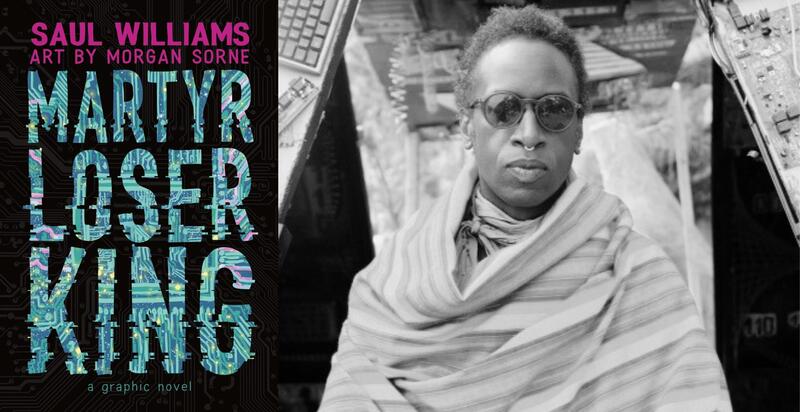
Martyr Loser King, the debut graphic novel of poet, musician, actor and director Saul Williams, with art by Morgan Sorne, not only exists in the same world as his feature film Neptune Frost, but also that of three of his albums, one of his poetry collections and a touring dance performance called The Motherboard Suite. All of these works, in their respective disciplines, explore the distribution of power, the intersection of technology and race, and how our digitally-mediated lives are sustained by the crudest and cruelest of analog exploitations.
In Martyr Loser King we follow two Central African protagonists—a miner of coltan, the trace mineral that powers our smart phones and laptops, and an intersex hacker with designs on the system extracting wealth from their country and people. To borrow words from Saul’s song and poem “Coltan as Cotton,” in today’s conversation we hack into land rights and ownership, faith and morality, masculinity, femininity and sexuality. We hack into the rebellious gene, the storyboard, and the history of revolutions. We hack into the database and the panel marked “survival.”
If you enjoy today’s conversation consider joining the Between the Covers community as a listener-supporter. One of the many benefits and rewards you can choose from is access to the bonus audio archive, with contributions from everyone from Dionne Brand to Isabella Hammad, N.K. Jemisin to Danez Smith, Naomi Klein to Viet Thanh Nguyen. You can find out more at the show’s Patreon page.
Finally, here is the BookShop for today’s conversation.
Transcript
David Naimon: Today's episode is brought to you by Patient, Female: Stories by Julie Schumacher. From the New York Times bestselling author of Dear Committee Members, Julie Schumacher's stories in Patient, Female are sharp, darkly funny, and deeply human. Each protagonist, ranging from girlhood to senescence, receives her own indelible voice as she navigates social blunders, generational misunderstandings, and the absurdity of the human experience. "Schumacher's talent shines in this masterful collection," writes Library Journal. Exploring motherhood, friendship, and work, Patient, Female renders the foibles of human behavior with dark humor and wit. Patient Female is out with Milkweed Editions wherever books are sold. Today's episode is also brought to you by Coastal Lines Press. Coastal Lines Press is a collective of writers in Gaza, turning words into life-saving supplies for their families. Through zines from Gaza, they publish independent booklets of poetry, essays, and testimonies that travel like tiny vessels from coast to coast, carrying stories of survival, resistance, and hope. The name Coastal Lines Press honors the Mediterranean Sea, which anchors life in the region, and celebrates the lines of language, words, sentences, prose, and poems that connect writers to readers worldwide. Profits from every zine directly fund essential supplies for families under siege. Learn more, follow their journeys, and purchase a zine from Gaza at coastallinespress.com. Because I'm so excited to share today's conversation with Saul Williams, to release it into the world, to see where it travels, to see where it lands, what conversations it sparks, and who gathers around it to form connections and carry it forward, I'm going to keep this brief. I'll just say it was unusually pleasurable to prepare for today's conversation, given Saul's work in so many different fields and his dynamism as a speaker about that work. And even though I only include a subset of the materials I engaged with in the supporter resource email associated with today's episode, that set of resources is nevertheless particularly robust and alive. Every listener-supporter at every level of support gets these resources of what I discovered while preparing, of the things that we referenced during our time together, and places to go once you're done listening. And then there are a ton of other things to choose from. Books, of course, but also the Bonus Audio Archive with contributions from many past guests who, like Saul, are diagnosing history and the present moment as part of seeking a future otherwise. Contributions of everything from readings to writing prompts to music from Dionne Brand, Danez Smith, Natalie Diaz, Omar El Akkad, Jordy Rosenberg, Isabella Hammad, Naomi Klein, Randa Abdel-Fattah, Christina Sharpe, Layli Long Soldier, Leanne Betasamosake Simpson, and many others. You can find out about all of it and more at patreon.com/betweenthecovers. And now for today's conversation with none other than Saul Williams.
[Intro]
David Naimon: Good morning and welcome to Between the Covers. I'm David Naimon, your host. Today's guest, writer, poet, musician, director, actor, and more, Saul Williams, earned a BA in acting and philosophy from Morehouse College and an MFA in acting from NYU at the Tisch School of the Arts. It was while he was at NYU that he started writing poetry. For those who wonder what poetry does or what the power of poetry is, consider this. Saul, at his first open mic, has only one poem to his name, "Amethyst Rocks." After he finishes reading it in a tiny New York cafe, someone comes up to him and asks if he'd like to open for Allen Ginsberg. And then someone else asks if he would open for The Last Poets and Gil Scott-Heron. And then someone else asks if he'd open for The Roots, The Fugees, for KRS-One. All from one poem. The documentary SlamNation follows his Poetry Slam team as they compete at the 1996 National Poetry Slam held in Portland, Oregon. And in the same year, the feature film Slam, co-written and starring Saul, not only brought Saul's performance poetry to a wider audience, but went on to win the Sundance Grand Jury Prize and the Caméra D'Or at the Cannes Film Festival. Since then, he has released many poetry collections, from Said the Shotgun to the Head to The Dead Emcee Scrolls. As a musician, he likewise has many albums, from the Rick Rubin-produced Amethyst Rock Star to the collaboration with Trent Reznor of Nine Inch Nails for The Inevitable Rise and Liberation of NiggyTardust!, to the album Encrypted & Vulnerable. He has collaborated with and been featured on tracks by many other artists, from Janelle Monáe to Deerhoof to DJ Spooky. And this year's album, Saul Williams Meets Carlos Niño and Friends at TreePeople, was nominated for a Grammy in the Best Spoken Word Poetry Album category. As an actor, he starred on Broadway in the Tupac Shakur musical Holler If Ya Hear Me, a performance New York Times theater critic Charles Isherwood called mesmerizing. He has appeared in many films since his role in Slam. He starred in the Senegalese film Tey, also known as Today and Aujourd'hui, and was the first African American to win Best Actor at Africa's largest and oldest film festival. And Tey also won the Prize of the City at the Venice Film Festival. He starred in the 2021 film Akilla's Escape, which earned him a Canadian Screen Award nomination for Best Actor. And last year, he played the preacher Jedidiah Moore in Ryan Coogler's film Sinners. In 2021, he had his directorial debut with his film Neptune Frost, which he wrote and co-directed with Anisia Uzeyman, which premiered at Cannes at Directors' Fortnight. And New York Times film critic A.O. Scott picked it as one of the 10 best films of 2022. And Roxana Hadadi for New York Magazine says of it, "Neptune Frost is a mission statement by way of a musical, and its defining image is a middle finger taking up the whole lens. In this audaciously vibrant tapestry of original songs, dance choreography, and poetic speeches, co-director, writer, and composer Saul Williams aims at myriad targets: at capitalism and resource mining, at Google and drone warfare, at all the systems that exploit the workers of the world while dividing it into 'first' and 'third.' The result is an Afrofuturist kaleidoscope of defiance that vibrates with neon hues, smirks at the narrowness of western thinking, and revels in collapsing the fourth wall with straight-into-the-camera statements like, 'You think I don’t know that you’re bad and wrong?' Williams and Rwandan-born co-director Anisia Uzeyman refuse to tamp down either their ambition or their resentment. Both of those make Neptune Frost unforgettable." And as if that were not enough, Saul Williams returns this spring with his debut graphic novel, Martyr Loser King, with art by the artist, songwriter, and musician Morgan Sorne, a book that inhabits the same world as his film, Neptune Frost, in the book we're talking about today, one which Essence Magazine describes as "reframing sci-fi through a Black radical lens, spotlighting the power of community and collective consciousness." And Publishers Weekly calls it "a graphic poem of resistance, wonderfully told through Afrofuturistic flair." Welcome to Between the Covers, Saul Williams.
Saul Williams: Wow. [laughs] Thank you so much. It's a pleasure to be here. [laughter]
DN: Okay, so the specific questions and themes that animate Martyr Loser King you've been living with for well more than a decade, and in a transdisciplinary way. So correct me if I miss anything, but the projects you've created that exist in the same world as this graphic novel include the albums Martyr Loser King, Encrypted & Vulnerable, and Unanimous Goldmine, the poetry production USA or "Us (a.)," the dance performance The Motherboard Suite, and perhaps most tightly connected to the book, your feature film, Neptune Frost, a movie that was originally conceived of as musical theater. So across the page and the stage, poetry to music, to film, to dance, you've engaged with these characters in this world you've conceived of. So orient us a little to the origin story of this world for you, and also your enduring interest in dreaming it into being.
SW: Sure. You're 100% correct. All of those projects do have connection to the fact that during all that time I was working on the script of Neptune Frost and on the text of Martyr Loser King, the graphic novel. So as a result of that, there was a great amount of research being done on technology and also thoughts connecting poetry to technology. We'll get to all of that. But I think we can best get there by me answering your question about the spark. So the spark came when my partner and I, Anisia and I, were both working on a film that you referenced. There's a Senegalese film called Tey, which we shot in Dakar, Senegal, in 2011. And while we were there, we would wander the streets of Dakar when we weren't shooting. And at that time, so it's 2011, this is Arab Spring era, this is WikiLeaks era. And at that time, we were noticing a lot of Senegalese kids walking to or from school with bright-colored headphones, just as they were in other metropolises across the world. This was the beginning of Beats headphones and all this type of stuff. And the kids there were no different. But I started noticing some kids sitting in front of their houses with Beats headphones, smartphone beside them, obviously listening to music. But between their legs, they would have drums that they were either building or adjusting. These drums are called sabars, and so is the event. A sabar is a dance drum competition where the dancers respond to the drums, and they happen in communities and what have you. You would hear a drum call and we'd rush through the streets trying to say, "Where's the drum coming from?" so that we could see this dance drum competition. Now, in the Western world, many of us refer to these drums as talking drums, right? So they are traditional African drums, but they have these strings on the side that can be tightened, and they're hit with a stick. You can heighten the sound, the pitch, or lower it, what have you. The players play in accordance to the syllabic structure of the Wolof language, so you can pick out words from it. I point this out because many of us don't know that within the history of the colonial United States, these African drums were banned. They were banned because the slaveholders realized, especially after the Stono Rebellion in South [Africa], that enslaved Africans were using these drums to communicate with each other and feared that they might be organizing rebellions through the drums. So they banned the drums. Me seeing this kid one day in Senegal at that time, working on a drum while wearing headphones and having a smartphone, I saw all these different generations of technology and began looking at the drum as the earliest form of wireless communication. That was the spark. [laughs] That was the spark.
DN: Yeah. Well, introduce us or give us the first taste of these two main characters of Matalusa and Neptune. Who are they as we begin the story, whether the story be the film or the graphic novel?
SW: Sure. So Matalusa is a coltan miner. I guess for listeners who don't know coltan, nowadays people know. But of course, when I started writing this thing in 2012, I had to do a lot more explaining what coltan and cobalt was, that these are the precious minerals that are sourced primarily, like 85% of the coltan and cobalt in the world is sourced from the Congo and Central Eastern Africa. These precious minerals are used in our smartphones, laptops, drones, what have you. What they do is they distribute power through small circuitry boards. And, of course, when I learned what they did, and it was on that same trip to Senegal that I learned about e-waste camps, which is another phenomenon that is particular to not only the continent of Africa, also in Asia, where our e-waste goes to die. A lot of these e-waste camps are next to these coltan mines so that the planes, sometimes illicit planes, that fly in, they fly in with e-waste so that the people can upcycle whatever minerals are in the e-waste and then fill the planes up with the coltan and what have you to take it back to wherever these things are being made, right? So Matalusa is a coltan miner. His family had their land confiscated after, I mean, we allude to the fact that they are survivors of a genocide. We allude to that. We don't really go far into their history, but he gives a bit of his history that after the war, it was just he and his brother, and they went back to their home, that their home was on what was said to be a mine, and they were given the option of just skedaddling, getting out of there, or working in the mine. So these are two brothers that grew up working in a mine. The story begins with the death of Matalusa's brother, Tekno, in the mine by one of the mercenaries working at the mine. That is what sparks his desire to escape, to leave after he buries his brother. So that's Matalusa. Well, that's him without giving the whole story, right? So then there is another character who we refer to as Neptune. Neptune is, in the context of the story, she is an intersex hacker. She is an intersex hacker that was assigned male at birth. We encounter her just at the moment where her aunt, who raised her, dies. She decides that that's the moment for her to leave her small village where everyone knows her as a boy and all this stuff, and to leave that so that she can be herself, who she feels she is and how she identifies. So why the fusing of these two worlds, one might ask? That is because during that same time in 2011, when we were on the continent filming Tey and having that epiphany around the idea of the drum as the first form of wireless communication, we were also learning about e-waste camps. We were also learning about coltan and cobalt. We didn't know about the precious resources. The other thing that we were learning about was the wave of anti-LGBTQIA+ laws on the continent that were being passed in government, which, if you did a little bit of digging, you would learn was because they were in deep communication with U.S. evangelists who were offering aid or finances if they would try these laws out in their countries. So all of these things fall under the umbrella of colonial influence. Whether we're talking about extraction, whether we're talking about religion, whether we're talking about gender, all of these things. So this story was a way for me to talk about all of these things under one umbrella and to make the connection. Then on the other side, since you referenced the album and the film and the poetry books, it was also a way for me to look at my creative life with a zero-waste approach too. Because I'm always working on music as I'm writing and I'm always writing poetry as I'm working on music. I was like, "Well, what if all of this stuff belonged to the same story?"
DN: I love that. I love the zero-waste approach. [laughter]
SW: And Neptune Frost is about the zero-waste approach. If you ever see the film, upcycling e-waste, we built a village out of e-waste. So yeah, it's all about that zero-waste approach.
DN: So as a first step into this world of Martyr Loser King, with the enthusiastic blessing of the Toronto Poetry Project Collective, I'm going to play the audio of your performance of a poem that exists in this world, a poem that exists in one of your poetry collections, but also which is echoed within the graphic novel too, called "Coltan As Cotton." I think this will be a good frame from which to begin to discuss the themes of the book more deeply. But it will also give us a sense of your work performed for those who might be encountering you for the first time. So this is from the 2019 Toronto Poetry Slam finals.
[Audio recording of Saul Williams performing “Coltan As Cotton” at the 2019 Toronto Poetry Slam finals plays]
SW: Recently I've been, hello everyone. [crowd cheering] [laughs] Recently, I've been thinking a lot about technology. I've been studying a lot about my relationship to it and the changes that it affects and the changes that it doesn't necessarily affect, and what is technology except a reflection of our own awareness and consciousness? And I've been thinking about stuff like the coltan that's in our phones and laptops that's mined in Central Africa in places like the Congo, Rwanda, Burundi. I think of the analog exploitation that our digital advances are based on. It's important that we don't talk about these things. It's important that we don't talk about the fact that the majority, the overwhelming majority of mining companies that work on the continent of Africa are actually based in this city of Toronto. It's important we don't talk about that. Let's not talk about that. I've been thinking about the role of fear in technology because we were talking about this earlier. I don't know if you know that the word robot comes from the Czech language. In fact, it means slave or free labor. That's what the word robot means, is slave or free labor in the Czech language. I was thinking about the connection between the, well, just the fact that you had the colonial era where you had slave labor and human bodies on this continent, primarily enslaved Africans, right, that were forced to work in plantations, and thinking of the plantation as a machine. Then thinking of the colonial mentality that went into the industrial era, which followed the colonial era, when the machines then could go into the plantations and be responsible for picking the cotton or the tobacco or the rice or whatever it was, and the machines that were constructed. If you know engineers or are one, you know that if you take apart those machines, that the colonial mentality is embedded in the machines because the engineer will explain the machines to you in terms of, "Well, that part is the master and that's the slave." We see it in the music industry, right? When artists talk about owning their masters, that's because if you look at the old two-inch tape, you'll see two wheels running, right? And one is called the slave and the other one is called the master. The master is the main recording and the other one just follows it. It goes all the way up into coding, into computers, if you know anything about computers and what have you. The zero one, the whole terminology behind coding is also master-slave. So you could take apart the computer, but you could also go into the coding itself. Still that colonial mentality is embedded in the machines. And the irony and the fact that the fear of the colonial era was that the slaves would learn too much, which is why teaching a slave to read or write, and I know very well that people from where I'm from were escaping to places like this, but we're not delusional enough to think that everything's cool in Canada. We pay attention to all those missing Indigenous women and the whole nine. We know what the fuck is going on. [applause] Nonetheless, I think about the fact that reading, teaching a slave or enslaved African to read or write, was something that could not happen. I think about the Haitian Revolution and how when that happened in 1804, they were not allowed to write about it in the United States in those newspapers because they had fear that maybe some enslaved Africans could read and would find out what happened and get some ideas about how to defeat the system. So the fear of the colonial era was that the slaves would learn too much and take over. The irony is the fact that in this age, in the modern age, the fear is that the robots, the machines will learn too much and take over. So I have questions, real simple ones, like, what's new? [crowd cheering] Hack into dietary sustenance, tradition versus health. Hack into comfort, compliance, hack into the rebellious gene, hack into doctrine, capitalism, a relation of free labor and slavery. Hack into the history of the bankers, beating the odds, mere act of joining the winning team, hack into desperation, loneliness, the history of community in the marketplace, hack into land rights and ownership, hack into business law, proprietorship, hack into ambition and greed, hack into forms of government, systems of control, the relation of suffering and sufferance, hack into faith and morality, the treatment of one faith towards another, hack into masculinity, femininity, sexuality, what is taught, what is felt, what is learned, what is shared, hack into God, stories of creation, serpents and eggs, hacking the nature, biodynamics, biodiversity, cycles and seasons, hacking the time, calendars, Descartes, its relationship to doubt, is it wired to fear, the notion of control, the space-time continuum, the force of gravity, whether the opposite of gravity is freedom. Hacking freedom, power, responsibility, justice, the Bill of Rights, hacking the coincidence, the summer of 68, the 27 Club, a number of people with Facebook profiles, people choose to share, people share too much, people seem lonely, people want to connect, people want to uplift, people need uplifting. Hack in a self-help, self-sufficiency, and self-indulgence. Hack in a crazy. Hack in a lunatic. Hack in a star. Hack in an infamous, detorious. The effects of the construct of poverty on the psyche. The effects of the construct of race. The victims that survive. There is a panel marked survival. Three simple copper wires coiled round an orb. Hack in an orbit. Equatorial landmines. Useful and precious metals. Colton as cotton. Hack in a hazardous. Nuclear. Blue clear. Cloud foams and fish farms. Cow farts and pig shit. Hack into horse, industrial, digital hack into code, use your instrument as metaphor. Harness your craft. Hack into the mainframe, dismantle definition, dogma and duty. Hack into destiny, hack into dream, subtext and subconscious. Hack into heart, cardio, Congo, blood, rich and oil. Hack into suffering and despair. Hack into the unfair advantage of those lucky enough to be born into one family or another, into one condition or another. Hack into the circumstantial evidence that proves the obvious and wakes the oblivious. Hack into birthright, bloodlines, royal and tainted. Hack into superstition, old wives tales, rituals of the shaman. Hack into DNA, chemistry, the pharmaceutical industry, the modern day rape of the forest. Hack into the coiling serpents, the time it takes for modern men to determine whether ancient women were foolish or not. Hack into the database. Hack into the subconscious, the panel marked survival. Hack into celebrity. Hack into the cultural development of taste. Hack into violence, fear, and ignorance. How are they linked? [applause]
DN: Woo. [laughter] Well, I wanted to start there because I wanted to start with coltan as cotton as an idea because when I had the Kenyan author in exile Ngũgĩ wa Thiong'o on the show, the author of Decolonising the Mind, I brought up Neptune Frost with him for many reasons, but one of the reasons is because I thought of his notion of poor theory, which I think might be him riffing off of the theater director and theorist Jerzy Grotowski's notion of Poor Theatre, where you strip away elaborate sets and costumes and focus on an immediate, visceral, emotional, and bodily presence between the actor and audience. But where for Ngũgĩ, it was also maximizing the possibilities inherent in the minimum within a political decolonial frame, one that centered the poor as a site of dignity and possibility, like, for instance, Trinidadian oil workers creating steel drum music from 55-gallon oil barrels. Or in this book with coltan, because for us to be able to power our cell phones and laptops and electric cars, as you've mentioned, for us to have them at the price we do as products that we can dispose of every five years, it requires millions and millions of people to not be considered even remotely human. Or as you say, this labor is the labor of the robot. But in Martyr Loser King, we open with Matalusa's brother, Tekno, deep down in the pit, just before he's killed by the guard, holding a coltan rock, he's communing with it. He can speak to it and hear the rock. You can feel that there's another relationship between him and the earth. Coltan in our smartphones is the so-called heart of the phone. As you mentioned, it's the distributor of power within the phone. But here, between Tekno and the coltan, it is Tekno that feels the power and feels empowered, not just some smartphone user in Europe or in the United States. The power distribution is inverted in your work, I think, similar to Ngũgĩ's poor theory. So I was hoping you'll speak a little bit more about coltan in relationship to this distribution of power, but not just coltan, because coltan as cotton could be a lot of other analogous things. Coltan as tea, coltan as nutmeg, coltan as coffee.
SW: Rubber, sugar.
DN: Yeah, so talk to us about the coltan as, but also about this relationship of power that you're troubling within these works.
SW: Well, yeah. I really appreciate the question and the thought behind it. At the root of it, I am, and as I said in that performance that you've played, I'm thinking of us as the technology, that the people embody the change that we need to see and must see. With coltan and the character Tekno, what I'm playing with there is, one, I'm playing with the idea of fossil fuels, right? Because we say fossil fuels, and my thought immediately is, "Whose fossils? Whose fossils?" We think of, I don't know, decomposed dinosaurs and mammoths or something to speed the process. [laughs]
DN: Yeah. Something like that.
SW: But if you're aware of the uncharted genocides, for example, in places like the Congo, where over 10 million people were killed under King Leopold for rubber, right? Rubber for our tires, companies like Firestone. It's not just Congo. It's Sierra Leone. It's Liberia. It's South Africa. It's on and on for diamonds, for gold, for uranium, for all of this stuff. And it's ongoing. Our country has obviously invaded Venezuela. We're at war with Iran. All this stuff surrounds resources and Indigenous people. My question became, what is it that's making the soil so rich? Geologists will tell you, well, it's because in the Congo region, you have the seven volcanoes, and it's because of the volcanoes and what they bring to the soil. Of course, of course. But I'm also just thinking of who's buried in the soil. Is it, in a sense, in a mythological sense, our ancestors that are once again powering our ability to communicate wirelessly with each other? Because, of course, when I think of the use of the drum to communicate and the fear that that evoked in slaveholding societies, I'm not only looking at it as they're frightened by the fact that we could communicate with each other, but also frightened by the fact that maybe through the drum, they felt as if we were communicating with something larger than ourselves. That is the question of power that I'm addressing, is the connections between this invisible viral world and the invisible world that is referenced through cosmological mythologies and what have you. So in Martyr Loser King, that poem, for example, and I'll give you a little bit of the process. Once the idea for this story was born, the first question that I had is, "What does music in that world sound like?" So I started constructing music, and from there, soundscapes, and from there, voices would arise. That's how the characters were born. The first character to appear, the first text to arrive, is that poem, "Coltan As Cotton." Okay? And that poem belongs to a character named Po Tolo. Po Tolo is actually a Dogon word from the Dogon of Mali, which is their name for Sirius B.
DN: The star?
SW: Yeah, the star. The star, Sirius B. The Dogon were actually the first to chart that star. For those of you who don't know, the first 30 years of NASA, some of that had to do with them confirming what the Dogon had already charted without telescopes. How? They say their mythology is that they came from the star Sirius. [laughs]
DN: So great.
SW: And I was very interested in the Dogon. It's part of what led me to want to play with the connections between African mythologies and technology because the Dogon numerological system is binary. It's 0-1, 0-1, 0-1, 0-1. The deity Nommo is both male and female. So I was always making connections between that binary coding and coding and its relationship to drum patterns and what have you. So I'm playing with a lot of ideas here, but it's all connected to this question of power surrounding if indeed it's our ancestors coming through these devices and what have you, and it's here for a reason. You know that there's a fight for power, right? There are those of us who are fighting for our open-source internet, for example. There are those who want to make sure that we are completely surveyed and have to pay for everything, including information, everything. There's a fight there, right? But we know that when the idea was born of the internet, I'm referencing here, that we had the sense that the hackers and all this stuff were on our side, trying to liberate information. And of course, that raised questions for certain industries, the music industry, the film industry, all of this stuff. Then we started getting the feeling that a lot of hackers were getting hired up by these companies as cybersecurity. [laughs] And we're left on our own like, "Oh my God." There is a fight for power in this realm, in this new world, as there are always fights for power, dominance in the new world. So, yeah, it's a heavy-handed or loose-handed or dancing-handed critique of Western civilization as we know it and practice it, with a heavy glance on racial capitalism operating from the theory that all capitalism is, in fact, racial. I really like the definition of race that the abolitionist scholar Dr. Ruth Wilson Gilmore gives, which is, "state-sanctioned vulnerability to premature death." [laughs]
DN: Yeah, no, that's great. Coltan mining sent me down a million rabbit holes that were really interesting for me. What I'm going to do, this isn't really going to be a question that I'm going to do next. I'm just going to create a field of associations from what I engaged with. You can say whatever you want at the end of it, whatever captures your imagination. But one of the things that is remarkable, and I think this relates to racial capitalism and also this notion of racism as measured around premature death, I think this question of power is central to so much of your work, maybe all of your work, is that the Congo, with regards to untapped resources, is possibly the richest country in the world, far more than Saudi Arabia or the United States.
SW: Without a doubt.
DN: Yet it has the lowest median income in the world. The poorest country on the planet literally sees no material benefit for all that they provide: coltan, cobalt, uranium, copper, tons of essential things that uphold international aerospace, electronics, the military. Or how Africa as a continent, as Ngũgĩ wa Thiong'o noted when we were talking, it's a continent bigger than North America, Europe, China, and India put together, where nearly 20% of the world lives. I first started my coltan rabbit hole with King Leopold II in Belgium, whose colonization of the Congo was not only so immense in scale, death, and misery, but also so cruel that all the other colonial powers, all the other powers who were themselves unimaginably cruel, were themselves horrified by King Leopold II. For instance, the Kaiser, who at the same time is committing a genocide in Namibia, refers to Leopold as Satan. I think of how the manual of the companies extracting rubber instructed on how to loot the villages. Then once you've looted the villages, you would capture all the women. You would hold them hostage until the men produced enough rubber, then not release them afterwards, but actually sell them back to the men. Not to mention the cutting off of hands so that no bullet would be wasted, that you could prove that every bullet led to a death. This was the day-to-day mode of providing rubber to meet a rising global demand that partially included the rise in popularity of bicycle riding after a Scottish inventor attaches a pneumatic rubber tube to his child's tricycle. Amazingly, Leopold frames it all as philanthropic and about freedom, that he's fighting the slavery of the Arab slave traders. Many people actually go there to check it out, predisposed to be impressed. So there's a Baptist minister and a writer of African American history, George Washington Williams. He's told by Leopold himself, Leopold says that he doesn't want to be rewarded at all or paid back even a penny for all that he has spent on civilizing the country. But when Williams discovers how brutal all of it is firsthand, he's the one to coin the term "crimes against humanity" that we still use today. So we can flash forward to 1961, the first democratic election in the Congo, and only 11 days after Lumumba is elected, Belgium occupies the Katanga region where most of the mining resources are. Within six months, Lumumba is executed in a Western-supported coup. But as I continue down this hole, which I could go on for this whole podcast—
SW: Yeah. I have more to add. [laughs]
DN: Yeah, no, for sure. But it's not different today. I learned that the majority of the world's chocolate is now grown in West Africa and that children are abducted from Mali to work in the fields of the Ivory Coast. That control of the cocoa fields by various armed groups translates what should be called blood chocolate into income for AK-47s and other things, let alone cobalt mining practices. I went down a whole thing around cobalt mining practices, which were extremely alarming. But we could look at just since the beginning of this year, there have been multiple coltan mine collapses and landslides. Each time there's a collapse, 100 people die, 200 people die, 400 people die. This barely makes the news, let alone enters any meaningful discourse about iPhones. Lastly, just to connect Leopold to the very present moment with AI, I was reading an article called "AI Is African Intelligence: The Workers Who Train AI Are Fighting Back," where Michael Geoffrey Asia, who was a data labeler for Meta in Kenya, where AI sex bots and chat portals are created and then readied by the unseen hidden labor of Africans, where Asia says, "AI can never be AI without humans. It is not artificial intelligence. It's African intelligence. Most of these are dirty jobs, and most of these jobs have been done here in Africa. Then once you're done, once a tool is functional, all the communication stops. You get locked out. We are training our own death. We train ChatGPT, and it's killing us slowly." So I wonder what any of this sparks for you, given that you've obviously thought about all of this for much longer and more deeply than I have.
SW: Well, on the first layer, like you, as I travel down those wormholes, I'm shocked and flabbergasted by the information, everything up to the present. I know that those Kenyan workers, for example, many of them are seeking help because they've been traumatized by the images that they've seen. Also because many of us do not know that we're being surveyed and that our cameras are on, and they're seeing people in their regular lives going through all sorts of personal and intimate moments that they have to label and what have you to train these machines. Many report being traumatized by what they see and what they're being asked to do. This is the strategic formation of our society. This is why whenever someone brings up the idea of Western civilization, we have to cut to the chase because of its roots in racial capitalism and genocide. People think we're talking about history when we say that without any clue that these things are ongoing. There's tons of other places we can name, and there's way more details we can give. This is also why I'm glad that you mentioned the murder of Patrice Lumumba, whose dream, of course, was to bring the Congo its independence and what have you, and the way that the Western world responded to that, okay? And they responded, you have to look at it clearly and go, okay, well, they responded as if it was the election of Maduro in Venezuela. The Western world, the banks and the ruling class, the elite, of course, are opposed to Indigenous sovereignty. Indigenous sovereignty, when it includes people setting their own prices, not only for their labor but for their resources, for their land, what have you. It's more easy for them to say, "Why don't we just work to destabilize their government?" Because if the government is destabilized, then it's easier to get these resources in and out. It's easier for us to work if the government is destabilized. Why is that? Because it's not operated the same way in Western countries. They seek to do business there, but they refuse to do business on those terms with Indigenous and African people. That's why we have to keep pointing to race as a part of this. This is true also in Haiti. This is true right now in Sudan. This is true right now in Congo. It's so many places, right? We may be moments away, and maybe by the time this airs, our country will have invaded Cuba, for many of these same reasons. It's the writer Michael Parenti who says they use fascism to defend capitalism while claiming to be defending democracy from communism. And, of course, it's important to point out when talking about communism that we're not only talking about the economic and political ideology, that the term itself was coined. The term is coined by the Dutch West India Trade Company in their description of the Lenni Lenape, the Indigenous people of the island of Manahatta, when they arrive and believe that the Indigenous people of the island of Manahatta are uncivilized because they don't have a practice of private property. That is the question at hand, right? Because they did not have a practice of private property, they were referred to at that time—and this is in the 1600s—as communists, meaning that they lived communally, collectively, that they shared in their stewardship of the land and their relationship to nature and to resources and all this stuff, that they shared, that they didn't have that practice of private property. That's the first multinational corporation. I think it's important to think about the Dutch West India and Dutch East India Trade Companies in these times because there are so many multinational corporations now. We know the role that they play in our lives and in our work. It's a growing threat that we feel in our government as the political and economic donors behind both parties in the United States and what have you. It's a very hard thing to imagine, how we'll be able to restrain these corporate powers. Well, the first multinational corporation, the Dutch West India, Dutch East India Trade Company, they devised a plan, right? They decided to "purchase" the island of Manahatta from the Lenni Lenape for the modern equivalent of about $24. A lot of us know that, while thinking that these people were communists or uncivilized because they did not have a practice of private property. Thus, after the Lenni Lenape received that currency, that offering, which they received, I would say, in reciprocity of the many offerings that they had given the Dutch settlers in welcoming them to Manahatta and teaching them about the crops that grow there, fishing and sharing with them, but the Dutch over time became upset because the Lenni Lenape did not leave the island of Manahatta after they had "purchased" it. [laughs] So what did they do? They decided to build a wall. They built a 12-foot wall around the southernmost part of the island of Manahatta. The first thing they constructed within the wall was a marketplace, an exchange under the buttonwood trees where they sold settler goods, which were horses, guns, cannons, gunpowder, weapons and ammunition, and enslaved Africans. I look at that wall that they built as the first apartheid wall built on Turtle Island, built within this nation, right? Because it's a wall that was built to keep the Lenni Lenape out, a wall that was built to keep the Indigenous out. Then they mounted that wall to shoot and fire at the Lenni Lenape to scare them from the island of Manahatta. The interesting thing about that to me is, one, that the exchange that they built, the marketplace that they built within the confines of the wall, still exists to this day. I would say it still sells settler goods. It exists in the same exact location under the same buttonwood trees. The Dutch were defeated by the British, and those walls, which they called New Amsterdam, became New York. That exchange went from being the New Amsterdam Exchange to the New York Exchange to the New York Stock Exchange, but it's in the same exact location. The wall that they built no longer exists. The only thing that exists is the line of demarcation that tells you exactly where that wall was, where the northernmost part of the wall was, Wall Street.
DN: Yeah. It doesn't seem like it would be hyperbolic to say, given the commodities that are traded there, cotton, cobalt, and the literal, I mean, wage slavery, but also literal slavery happening, that there is still slave trading happening.
SW: Oh, of course. To go back to the Congo, because it's not enough to talk about now with coltan and cobalt, or to talk about then with King Leopold with rubber, and before that it was ivory. But also the slave trade, which then goes back another 100, 200 years. So it is, many would argue, the richest country in the world. It's been the most tortured as a result. So it's been robbed of its people, robbed of its resources, government completely destabilized again and again and again, so that they only have tried to give power to the comprador class, those who are willing to do "business" with Western powers at the expense of Congolese lives and wealth. Yeah, it's something that I would love to see shift in our lifetimes. But yeah, they're not alone in that, but they are alone in perhaps having such rich land. Not only that, it's the Congo Basin that is seen as the lungs of the world in terms of the forest life and the trees and oxygen and all of this stuff. So it's super important. A lot of enslaved Africans that came to the United States and to the Caribbean were taken from the Congo. The United States decided, I think it's about 1850, I forget what year it was. It's after the Stono Rebellion in South Carolina where they decided that they would no longer, that they would ban slaves from the Congo because they saw them as too rebellious.
DN: Wow. Well, I want to take this discussion more explicitly into language and into the power of language and the politics of language. It was another reason I brought up Neptune Frost with Ngũgĩ because he links securing Africa's resources to securing its languages, which your movie also seems to enact, a film that's spoken and sung in so many languages, and many of them are African languages, where each language feels porous to the next, with French spilling into Kirundi, into English, and more. Ngũgĩ said, "Securing African languages should be part of a whole vision of Africans securing our resources. The moment we lost our languages was also the moment we lost our bodies, our gold, diamonds, copper, coffee, tea. The moment we accepted or were made to accept that we could not do things with our languages was the moment we accepted that we could not make things with our vast resources." The movie could be in many languages because of subtitles, whereas the graphic novel is by necessity more monolingual. But you nevertheless hack into the English in the graphic novel and in the movie, into certain words, and you explode them into various other meanings. So our first question for you from another person is about one of these words. This is a question from the anthropologist Maura Finkelstein. She wrote a book on mill workers in India called The Archive of Loss: Lively Ruination in Mill Land Mumbai. She's the person who first told me I had to see Neptune Frost. You may or may not recognize her name.
SW: Oh, I know who she is.
DN: Oh, you do? Okay, great. Okay, because she taught a class on Palestine in her anthropology department, teaching it through a settler colonial lens, and is the first tenured professor to lose their job due to criticism of Israel. And I know you yourself lost financing for your next film because of being outspoken on Palestine and had your Instagram suspended for a little bit too. I'll be sure to share with supporters several essays by Maura about teaching Palestine, one called "May Your Classroom Be a Sea Change." But for now, let's hear a question from Maura.
Maura Finkelstein: Hi, David. Hi, Saul. This is Maura Finkelstein. Saul, it's been such a pleasure to spend time with your stunning book while also rewatching Neptune Frost and listening to both the soundtrack and the concept album on repeat. With that in mind, repetition is what I want to ask you about today. First is context. I remember so vividly how it felt to watch Neptune Frost for the first time. It was COVID days, and I was very touch-starved and just emerging into the world when the film became available for streaming in the US. I watched it several times, soothed by the repetition, soothed by the queer embodiment, the shape-shifting, the refusal of boundaries and binaries and categories, and the beauty. What a visually stunning piece of work. Fast forward several years, you have once again become a beacon for me and thousands and thousands of others throughout the ongoing Israeli genocide in Gaza, as social media became and continues to be a place where you have said the things that need be said, shown the images and videos that need to be shown, bore witness to atrocity, provided resources for mutual aid support, and tirelessly and consistently linked the Gaza genocide with Sudan and the Congo, as well as rising fascism in the United States. This is to say, over these past six years, in times of punctuated anti-Black and anti-trans violence in the United States, in the time of the first livestream genocide and widespread Western-led genocide denial, in a time where the ruling class is trying to convince us that words and images have no real meaning, you have modeled a form of refusal through repetition that has contributed to the archive of an otherwise, a fusing of witnessing and action, a commitment to liberation, a steadfastness in the face of fascism. So I'd love to ask you, with all of that in mind, about the politics of repetition in the brilliantly titled Martyr Loser King, in particular around the word mine. So I'm thinking mine as extraction in terms of coltan, but also mine as possessive, mine as memory or embodiment, so meaning to mine oneself or mine one's past, and of course, Unanimous Goldmine. Thank you again for your art and your vision and the way you lead us toward the horizon of possibility we desperately need these days.
SW: Oh, that's so sweet. So sweet. So, yes, it's one of the first things we play with in Martyr Loser King in the text there. One of the things I like about the graphic novel, ironically, is that it carries a lot more text than the film did. It's once again a zero-waste thing because all these things were written. So when I would reread the graphic novel, I was like, "Oh my gosh, I forgot I wrote that." [laughter] Yeah, very excited about it. One of those things, but the film has this too, this question of what is mine. What is mine? And the irony of a miner asking that, while simultaneously, this is someone who's had their home confiscated. Going back to what I was saying about this Western idea around private property in relationship to what or whom they consider savage. Because mine, of course, embodies the idea of ownership as well. So the repetition of that, of what is mine, what is to be mined, it makes me think of, I guess, a little bit of a point of maturity that I reached maybe a little over a decade ago in my career, when you can have management or your own ambitions or what have you where you're trying to get these things done and what have you. I reached a point where I was like, "You know what? I really only want what's mine. I don't need everything. I just want what intuitively feels like it's connected to me and that this is a place where I can be of service and perhaps be fueled or serviced by interacting with it. I really only want what's mine. I don't want everything." On one hand, yeah, it's just playful semantics to look at the distinctions between extraction, extraction, right? And in many cases, violent extraction when we talk about mining and its role. This also connects to what excited me about when I learned about coltan and cobalt. For instance, when I learned about that, that it was for the distribution of power, and I couldn't think about the distribution of power without going on to the distribution of wealth, which is another form of power. [laughs] So it automatically had me thinking about political systems and economic systems, which then goes back to the question of what is mine or what are you owed? What are your inalienable rights? What should be characterized as inalienable rights? What are we fighting for? What shouldn't we have to fight for? You would think, for example, with a country with this amount of "wealth," that if the government, and I think of the poet John Trudell, who talks about American politicians saying that when they talk about democracy or freedom, what they're avoiding talking about is responsibility. What is the responsibility of the government? I would say that it would be to see to it that all the people of this land have housing, are fed, have access to education and healthcare, as many people in "developed" nations do, right? If we go to Europe, oftentimes we have to explain what medical debt is because they're clueless. Like, "What do you mean, medical debt?" Also, when we talk about student debt, they're like, "What do you mean by student debt?" Somewhere in Denmark or Sweden, it's really just a matter of testing into a school. If you have the capacity to study to be a lawyer or a doctor, then you can do that. The most you might have to pay is a series of fees that might add up to like 5,000. So it's not a choice based on how much you're going to go into debt to pursue this dream or what have you. So once again, we get into what's tied into our system and what exactly does a free market mean? Free for whom? Which, yes, brings us back to the question of what is mine? What have I earned? Whether we're talking about wage labor or just what a country or government should be responsible to its citizenry for. So as much as I'd like to shake it off as like, "Yeah, yeah, I'm just playing with words," I don't see how we could not arrive at these questions also because we are consistently put in a position in this society where we're forced to balance our checkbooks, balance everything out so that we can survive in a meaningful way. Some of these fights that we're fighting, I would say, should not be how we have to live our lives. Even when it comes to machine learning, that's when we would get into questions of basic income. If machines can do jobs that we don't have to do, then we should be able to get more excited about the jobs that we can do, whether that's writing novels or thinking of new forms of architec--, whatever it is. That's also what abolition is. Many think abolition means the end of abolishing something. But in the Black radical tradition, for example, abolition refers to the creative and rebellious reimagining of our society, of our schools, of our institutions, of our families. We're reimagining it in ways that acknowledge Indigenous sovereignty. That's why it has to be reimagined, because the system as is does not acknowledge Indigenous sovereignty. Thus we arrive at an ecological question where Indigenous sovereignty would answer all of those questions. Thus we arrive at wealth discrepancy. Thus we arrive at all of these things, you know? So, yeah, the question of repetition. For me, the question of repetition has a lot to do with the fact that the slaveholding mentality has not really renewed itself. It's them who keep repeating. We are trying to fight our way out of this repeating nightmare. I mean, we had our foreign secretary, Rubio, who was in Berlin a few months ago basically talking about wanting to recolonize the world.
DN: Wow.
SW: You had Europeans applauding to that idea of recolonization. That is obviously the plan. When you learn about many of the groups or people that they label as terrorists, the ones that are simply fighting for sovereignty or anti-colonial resistance, I say that versus the groups that they create. I think there's a lot of support now to understand that groups like ISIS or Al-Qaeda were created by Western intelligence to destabilize countries that were in the midst of fighting for some type of sovereignty. So this loose usage of who and whom they label terrorism, and we see it now, where anti-fascists in the United States or anti-capitalists in the United States are in the process of being labeled domestic terrorists.
DN: Yeah. And people who do eco-sabotage for decades have been.
SW: Yeah, exactly.
DN: Well, in the spirit of repetition, let me repeat this question in a different way around mining and mine, not just as a possessive pronoun linked to the mining of the earth, but also this phrase, unanimous goldmine, that's spoken like a greeting, like salam or shalom or namaste, I think. In listening to and watching your conversations and performances over the years, this is what comes up for me around the questions of mine in your work. I'm sure you're going to see some resonances and maybe not others. But in one conversation, you said that when you moved from seeing yourself as a rapper in your teens toward being a poet, you wanted to make the "I" into an "us". In another, you talked about the strain within hip hop of rappers claiming to be the best in the world, the competition of it, the warrior stance, the stance of no vulnerability, and how the poet recognizes the power in vulnerability. You've written about Afrika Bambaataa sitting the most famous rappers of his era in a room in the early '80s and imparting what is now known as the infinity lessons, where basically he said, in your paraphrased words, "Look, we've got all these kids listening. If we stop rapping about partying and start rapping about Black power, Black history, we can cover the ground that school is missing." Suddenly we have Boogie Down Productions, Public Enemy, Queen Latifah, and others. I think of when you were quite young and The Cosby Show was starting and you considered going to the casting call, and your father had a talk with you about fame versus passion and suggested instead that he enroll you in an acting school. I think of your critique of valorizing capitalism within hip hop, your critique of the centering of money, of wanting to be the Black Trump, for instance, or critiquing Jay-Z when he said, "I couldn't help the poor if I was one of them," where you responded, "Thank God Harriet Tubman didn't think that way. Thank God Sojourner Truth didn't think that way. You need to be one with the people to be a revolutionary. You need to speak directly to the people and understand that you don't need money to win." I think of your first creative writing course at Morehouse College, where you wrote an essay about misogyny in hip hop. Your professor secretly submits it to the Michael Jackson Scholarship Essay Contest, resulting in Michael Jackson not only writing that he loved the essay, but paying for a portion of your college. I think of the feminism instilled in you from taking your acting classes at the all-women Spelman College because Morehouse didn't have a theater department at the time, the new moon rituals that you witnessed there. I think if you decided not to dance to songs, no matter how compelling the beats, if you couldn't abide the lyrics about women. Then back to the Toronto Slam performance that we played at the beginning, your intro for "Coltan As Cotton" took the situation in the Congo and linked it to Toronto around complicity, but also to the disappearance of Indigenous women. To me, I think of all of this when one person says to another, "Unanimous goldmine," that perhaps what it means is not only that the gold is inside, not outside, but that we need to name it in each other. Perhaps both the complicity that we share in the mining, but also the connections from one internal goldmine to another. This isn't said explicitly, so it's mysterious what's happening when they say "unanimous goldmine." But it does feel like it isn't just a greeting, but a practice of sorts. But I'm curious what any of this might bring up for you around it.
SW: I had a lot of fun writing Martyr Loser King and Neptune Frost. I need you to know that. [laughter] I spent a lot of time in this very room laughing to myself and what have you. One of the exciting points was in creating a greeting. "Unanimous goldmine" as a greeting, yes, it is meant to embody an ideology. It's also a playful referencing to many of the traditional greetings that I've encountered on the continent. Because in the film, you see that you don't necessarily arrive naturally at or first at "unanimous goldmine." You say, "How is it?" "Shining." "What's shining?" "The unanimous goldmine." I love some of the traditions where there is, I mean, I've seen it as long as like five, six minutes of expected greetings back and forth before we can get to the business at hand. Like, "How are you?" "I'm great." "How's the family?" But there's like a script. I've seen it in Senegal. I've seen it in Rwanda. I've seen it in South Africa. I've seen it in all these traditional languages where there is a scripted back and forth that you're supposed to say before you get to whatever you came to discuss. I love that. So "Unanimous Goldmine," on one hand, was playing with that. On the other hand was, yes, well, what would be something that references all these things that you've done a great job at piecing together and that acknowledges that we are, in fact, the owners of the mine and that the mine is within, right? I mean, you got it correct.
DN: [laughs] Okay.
SW: You're 100% correct.
DN: I don't want to reduce it to anything.
SW: The only thing that, and it's true that we do share, especially those of us in the core of empire, we do share a great level of complicity. When I wrote "Unanimous Goldmine" and the people who say it to each other, I was not really thinking of their complicity.
DN: Yeah. Which is incredibly minimal, if at all, at this point, if at all.
SW: Yeah. But yeah, it's a fun job to spend a day or a week or a month or a year trying to invent a greeting. [laughter]
DN: Well, thinking of the Unanimous Goldmine as not just a greeting, but as you say, a greeting that has an ideology in it of where power resides, I wanted to see if this more largely informs your cosmology and also your relationship to Christianity and Western religions more broadly. Your dad was a preacher. You played a preacher in Sinners. The graphic novel also opens in a church with the congregation singing "No Jesus, No Life" to the tune of Bob Marley's "No Woman, No Cry." Our intersex protagonist, Neptune, is in church, their gender identity hidden to the world. They say, "I've always been a good boy. I go to church. I never mention how I truly feel, what I have deep down always known." Later on, the priest arrives at their home after a funeral that they've both been part of, drunk, and under the guise of providing comfort and solace, tries to have sex with Neptune, who punches him out and escapes. In another thread with Matalusa, who's carrying his dead brother Tekno's body, on one page we see Matalusa taking him down from a cross on a hill, washing him, wrapping him in a cloth, and burying him instead at the base of a giant tree with the rock he communed with resting on his heart. I think of the lines in the book, "It's the sinners versus the losers, and the losers win every time because the losers fight the system while the sinners are lost in their mind." I think of the line in your song "Experiment": "Jesus wouldn't be caught dead in your church." I think of the stanza in your poem "Amethyst Rocks": "Never question who I am. God knows, and I know God personally. In fact, he lets me call him 'me.'" Or in "Glory Box": "Jesus was the only magic we believed in, the cigarette that tricked us into breathing, an excuse to sing." Or in a recent conversation with two reverends about the movie Sinners, where you are all talking about seduction and vampires, and you speak of the first European ships on the west coast of Africa or arriving in Haiti, and the seduction of the blood of Jesus, and of Christianity and the church as the first startup, the seduction of a good story. But you also speak of the phrase so often seen in the biblical language, "thou art," and the word art. You say the phrase, "Thou art God," with art as the connector, that art is the thing connecting us to our higher self. But while you critique religion, particularly as it intersects with state power, but also how it gets institutionalized and codified, at the same time it feels like your work is devotional in orientation, that it is about something larger than you, something that you can't entirely know, but you can feel and which can flow through you. Like the mystic Hafez's lines that you sing in the song "Burundi": "I'm a candle. Chop my neck a million times, I still burn bright and stand." The candle is and isn't you, but either way, it's inside of you, not up in the sky. I also think of your interest in Lao Tzu in a similar way. But I guess I wanted to bring all this up for you to talk to us about religion in relationship to your cosmology and also more about Christianity in relationship to the graphic novel Martyr Loser King.
SW: Well, yeah. Clearly, we mine our own personal landscape to arrive at ideas and to understand not only ourselves, but our relationship to things broader than ourselves. Many of us don't only encounter a need to learn, but there's also a great deal of unlearning that has to occur in one's lifetime. For me, yes, my father was a Baptist pastor. I went to church regularly, which I don't regret at all because it was a Black American church. We had an amazing choir. My relationship to music and oratory is deeply rooted. And I believe my dad was very sincere. However, I do remember a moment in the third grade, I think, when I started thinking, and I remember there was a Jewish girl in my class actually who was super kind to everyone. Whenever we had recess, she'd help people with their homework if they had forgotten it, or she'd give you, if you forgot your snack money, "You can have some of my stuff." I just was struck by how kind this person was in a school full of bullies and crazy. [laughs] This person was super kind. I remember saying to my parents one day, like, "This girl, I think this is what you mean by Christ-like," because I already knew that Christ just meant embodiment of love. I was like, "I think this is what you mean by Christ-like. Kindest person I've seen in my school. She's born into a Jewish family. Is she going to hell?" Because I was raised in the Baptist tradition. My dad gave that rigid response of like, "Only if she accepts the Lord Jesus Christ as her savior." I was like, "Oh, wow." I didn't have the ability to articulate what I felt at that time, but I intrinsically felt like, "Oh, that is incorrect." Because if she centers love in her life, that should be enough. How does that account for the people who are raised in areas or regions where Christianity is not the main religion and they're just exposed to different things? They may still center their lives on love and service and humanity and all of these things. Do you really need it to be specifically this guy that they have to bow to? Is that really necessary? So I had questions, and I felt intrinsically that I was right to ask those questions, that even if any elders, religious elders, would say that I was in the wrong for raising those questions, that they were wrong. I felt that as a kid and carried that until I was old enough. So a lot of my early work is me fighting my way out of that box. Of course, I'm not really fighting my way out of that box because I'm already out of it. However, realizing that maybe it's a good idea to share some of the tools, some of the process of arriving there, because nothing sucks more than achieving that and arriving there alone. I have an early poem called "Sha-Clack-Clack" that ends there, that ends on "beyond time," I'm fighting beyond time, all of this stuff. But, "Where my niggas at?" [laughs] This idea of like, "Oh shit, you can do this. You can fight your way out of this." When I asked my dad, who was an only child, and I had asked him a question because there was a book that I had read as a teenager, as a late teen, I had encountered called The Aquarian Gospel of Jesus the Christ by a guy named Levi. It supposedly came to him in a vision. But what was interesting about the book is that it accounts for the 18 years that Jesus is not in the Bible, right? Between the ages of 12 and 30 or what have you. It has him in India and Tibet, all of these places learning all this stuff. I thought that was interesting. I come home like, "Yo, have you heard of this book?" [laughter] And he's like, "Oh, this one?" And he points and he has it in his library. I go, "Okay, so tell me if you know." At that time, I was starting to read Lao Tzu. I was starting to get into Buddhism. There was a lot that I was exploring. I was like, "If you know that there's so much world outside of the rigidity of the religion that you preach and that your church is rooted in, why do you stay here? Why not expand the message or step outside of the denomination?" And his response was, "I'm an only child. This denomination is where I first felt family, and I would miss my family, my church family." I understood that. I was like, "Oh, okay, I get it." So I get it. It's true that so much of the culture and what have you is embedded in these denominations and in these religious traditions and what have you. If you step outside of it, you may feel as if you're missing something. I mean, I haven't been to church in ages, but any Sunday, I'm still like, "Oh, I miss the fried chicken that came after church." [laughter] Like, I still need to eat good. [laughter]
DN: I love that.
SW: A lot of my work, yes, I'm threading through this relationship that I've had, that I was raised with, in connection to religion and also playfully sparring with those who use it, like a Trump right now, for those who use it, who claim to be it, who are full of contradiction. If you were actually aligned with the essence of that religion, then your practices wouldn't be what they are. So I playfully point out those contradictions in a lot of my work. But the other side of that is, yes, I've always looked at performance as ritual. I do see myself as having a spiritual practice. I've never felt disassociated from that. That practice has taken many forms and shapes. I mean, for years, for a decade, I had a daily practice of sitting meditation, which was crucial for me at that point in my life until I felt like I was becoming too religious about it, too superstitious. [laughs]
DN: I love that.
SW: Like something doesn't go right during the day and you're like, "Oh, it's because I didn't meditate long enough." [laughter] So there's still some checks and balances that I go through to make sure that I maintain a proper relationship with self, with nature, with humanity. But I do see religion essentially as a crutch that's there to help us stand upright in our understanding of each other and of love and of humanity and what have you. I also feel like if you have ever broken a leg or something and you've had to use crutches, at some point they take the cast off and they say it's important that you practice walking without your crutches or else your muscles will not develop properly. So I think that's as important. Maybe it's as simple as saying someone asks what religion you belong to. I'm like, "Do we belong to religions or do they belong to us?" I think that they are useful, that they can be extremely helpful. I've just practiced with my wife, Anisia. We've just gone through our second practice of Ramadan, which we don't belong to any religious faith or ideology, but we did it in solidarity. It felt great. It feels great. It's a beautiful practice. So what more can I say? You're dead on in the fact that there is an ongoing critique and referencing of religion in my work. It's also true that I do operate and then I deal with music and poetry. There's a lot of magic. There's a lot of invisible. There's a lot of unseen force. It's a sacred space to me. By sacred, what do I mean? I do mean that I think that I am in communion with something beyond little old me. I cherish that connection. Oftentimes on stage, I feel it. Not only on stage, but when working on sound, it happens. Part of my goal has been to learn how to transfer that through the work so that someone else can feel that. That's been the goal of a lot of the work. There's a song that's not out yet. I have an album that's coming out in August, and there's a song on that album. There's several where I feel this mysticism within the music where it's like, "Oh, this might be the trick." But there's one song that came to mind where I feel like there's three different worlds fusing in that song. The way that it sounds to me, it's not out yet, it's called "Mazahua." So at some point you'll be able to hear it. But the way that it sounds to me is like those chills that go up the spine when something connects on a level or when you've witnessed something or felt something or you know you're in the right place at the right time. I think it's in the song itself that we captured it. Which is related to language, right? Because language too is that sense of, some people have thought of it in terms of capturing language, which is to say that the spoken word came before the written word, and how do you capture the meaning of that word and also how do you capture meaning itself when these sounds, these utterances, were born out of emotions and the need to label and name things and this felt right. This is what it is. Madrugada, [laughs] a Portuguese word, that's pointing to the middle of the night. Why madrugada? And of course you can go to the etymological roots and all of this thing. But I think of those utterances that are coined through language as also capturing something. But music, poetry has that ability to capture something as well. To me, that is the work. So at the root of it, and you referenced Hafez there, at the root of it, I think one of the biggest points of epiphany for me came when I first started reciting poetry. I'd already been exposed to Lao Tzu and a lot of playwrights and poets from the Black Arts Movement and from the Beat era and what have you, the Harlem Renaissance, all these eras. But early on, after a poetry reading that I think was at CBGB's, and this was in, I think it was 1998. I did a poetry reading at CBGB's, and Slam, I think, had just come out or was coming out. There was a fan in the audience who brought me a book. They didn't know that I was traveling with a band the next day to Turkey to tour Turkey, but they gave me a book of poetry by Rumi. It was my first encounter with Rumi. That entire plane ride, I read Rumi. This was my discovery, my exposure to Sufism. On that trip, I ended up visiting Rumi's grave.
DN: Yeah, I've been there too.
SW: Yeah. [laughs] What I learned was that there was something in that, and it's still to this day because Rumi, then came Hafez, then came so much more. But it's true that the relationship that the Sufi has to religion, that irreverence, is something that I've identified with strongly. It's funny because Sufi poetry is amongst my favorite poetry on the planet. I love the spirit of Sufi poetry like Rumi and Hafez. I'm always dancing with all the different translations and translators. But yeah, the question of religion and spirituality is obviously present in my work. I think it's good that it maintains that to an extent because I know that I'm still surprised when I see whoever, let's say, accepting an award and you go, "First, I want to thank..." and you realize like, "Oh my God, you guys." I didn't realize how deeply embedded some of these points of socialization and indoctrination especially-- and it's not to say that people are not questioning themselves, but I've encountered it enough to realize that many people take these things at face value. I think the time that's been afforded me living one's life as a poet or artist has given me a lot of time to think about this stuff. I've spent years. [laughs]
DN: Well, this feels like a perfect segue for our next question from someone else. It's really clear when you enter Martyr Loser King that we're in not just a critique of religion, but also within a spiritual cosmology, perhaps inspired by the irreverence of Sufism, but that we're placed as humans in a much larger, more-than-human world. But this idea around, you mentioned magic and the unseen invisible forces, I think this next question is going to speak a little bit to this. This question is from, I think, one of our truly great contemporary poets who, like you, came to poetry through theater and performance. A two-time Individual World Poetry Slam finalist, a four-time Rust Belt Individual Poetry Slam champion, their collection Don't Call Us Dead is one of the touchstone collections of the last decade, finalist for the National Book Award in Poetry, the poet Danez Smith. Danez was a guest on the show to discuss their most recent book of poetry, Bluff. Past Between the Covers guest Nam Le suggested in the New York Times that Bluff represents a notable turning point for the poet and maybe for American poetry as a whole, saying, "The main shift may be a signal one in American poetry, one we're privileged to witness. It's a shift from polarity toward antinomy, from the ruling sense of either/or to the unrulier all-of-it-all-at-once. This is embodied in Smith's poems of place, in which Minneapolis is ‘my murderer, my mother/-ship, my moose heart, my mercy.’ It's where George Floyd was killed, but also where the ‘beauty of the food drive makes me cry’; where ‘my neighbors are dying./my neighbors are killing’ but also where ‘we became our own cops.’ In these searching, stunning poems, Smith metaphorizes city into body politic, showing us the interstate running through all our hearts; demonstrating that we all contain protest and police, cowardice and commitment, money and kindness, looting and food drives. There's no poem to free us and, anyway, there's no freedom from ourselves, no future without slave ships in its past, no world where God, reason/the stars didn't sign off. In the face of all this, what is hope — or despair — but a bluff?" Here's a question for you from Danez.
Danez Smith: Hello, David, and hello, Mr. Williams. This is Danez Smith. I just want to say congratulations, firstly, on the new graphic novel. It's been a pleasure to hold it in the hands after holding it in the ears and in the eyes, and to see the story transform across different mediums. I'd also be remiss to not say just thank you for everything that you are as an artist, as a human, as an activist. You've been a constant North Star to follow for a long time in my life. So just thank you for how you are in the world. All right, onto my question. I'm thinking about Martyr Loser King, but also thinking about The Dead Emcee Scrolls a little bit here. Saul, I feel like your work lives maybe a few steps more into reality than that of Sun Ra, in that I think a lot of his work often feels like an escape in his mission when you think about it. It also feels like a type of, not escapism, but an escape from this world, where your work troubles reality that lives beside and underneath our own, sending us messages on not just how to escape, but to transform the one that we're in. Still, there is a commitment to imagination and surrealism that keeps your work from being as real-world sourced, let's say, June Jordan or Baraka. But obviously, your presence online and in the world, we know that you are very much in the world and trying to tackle it. So I think what my question is, what does it take for you to stay committed to the surreal and to the imaginative possibilities in your work? How do you keep yourself from being too married to realism and maybe even being too didactic or keep yourself away from the doom of the world sobering up the wonder and the revolutions that you dream? Yeah. How do you continue to stay committed to the surreal, and what are the possibilities that you're trying to source out for yourself and for your readers there? Thank you.
SW: Oh, I love Danez so much. Thank you once again. With Maura and Danez, it's beautiful choices. I'm so excited to learn that they have the graphic novel. That's beautiful. My response to that one is simple because I'm a Pisces. So I have a natural commitment to the surreal. [laughter] It's reality that I have to work to keep up with. [laughter]
DN: I love it.
SW: It's the other way around. The surreal is what's there for me. [laughter] I see through that gaze and through that lens. I force myself to grapple with the more mundane and realistic things. I'm being serious, actually. I seek help in forcing myself to take it all in. He talked about my presence online for the last two and a half years. Part of it, there are many reasons why, starting first with just the sovereignty of Palestinian people, but also the focus that I had had working on Martyr Loser King and Neptune Frost. The film itself had put us on the continent. I live and work with a lot of people who are actually genocide survivors. So I've been in a number of conversations and moments with survivors for well over a decade. Within those moments, I've also encountered them in those states of questioning, like, "Does anybody know? Does anybody care?" So when you witness someone on the ground calling for help and you notice the points that Fanon pointed out or what have you, the points of delineation where you should be clear that this is what's about to happen, like when Trump just recently said an entire civilization will be lost or "they're animals" or all of these references, we can go, "Uh-oh, okay, that's a sign. This is a very bad sign." We had all those signs two and a half years ago about what was about to go down and what had been going down, and realized the importance of trying to shake or shift an algorithm that was siding with power that was not democratized and that was working toward being less democratized if it cost anything to power. So lending my platform to boosting Palestinian voices and speaking up on what's going on became important. Also with that came the realization that there are new definitions of illiteracy. I remember reading about that years ago or hearing that in a radio broadcast years ago, about how illiteracy used to reference people who were unable to read written word. Now literacy is also defined by your ability to move through information on the internet, to be able to understand when you're being caught up in something and what's real and being able to read between the lines and what have you online. There's an idea of literacy rates that comes from that. There's a lot of misinformation. There's a lot of malintended disinformation. One thing to understand is that part of my practice has always been staying abreast of what's happening in the world. So I didn't have to change my practice to stay abreast of what was happening. I would have known anyway because I spend that amount of time reading about what's happening there, what's happening there, what this philosopher has to say there, what this economist has to say there, what this poet has to say there, what this musician is doing over there, where these worlds connect. That's always been of interest to me. What shifted for me was usually I would do all that and let these things marinate. I'd take notes in my journal, let them marinate over time, and eventually I might pick through them or pick through my own mind and begin to construct poems or songs based on these marinating observations and ideas and what have you. Over the past two and a half years, I've said the marination process is a privilege that we can't afford at this time. I'm going to share a lot of these ideas as they come to the best of my ability because it's important that people are not, and they still are, but are not swooped into the points of indoctrination that are being played with, which are as simple as referencing, let's say, October 7th as a terrorist attack or labeling an anti-colonial resistance as terrorist and all of these things and not understanding context, not understanding historical context or any of this stuff and just jumping in where they leave you, right? So we have these crazy critiques of a repressive regime that's happening today, for example, and we don't necessarily pay attention to the reality of our own regime. And when I speak to our regime in this country, I really don't believe these issues belong to Trump. I believe they belong to the government, to the system itself, to both parties. Whether I'm talking about ICE or whether I'm talking about reproductive rights or all of these things. I mean, the United States has 5% of the world's population and has 25% of the world's prisoners. The United States has the highest ratio of imprisoned women on the planet. Twenty-five percent of women that are in prison are imprisoned in the United States. What's interesting about places like Cuba, Venezuela, Iran, Palestine, I'll name those four places, they all have much higher, double-digit higher literacy rates than the United States. So the level to which we are propagandized, our ability to even understand the system or to even feel like we have time to fight for that understanding, because that's also the role of capitalism. Capitalism in the imagination and our relationship to time, all of this stuff. "I don't have time to think about all that. I got bills to pay." There's all this type of stuff, which is part of the trick, just like aligning entertainment with escape is part of the trick and putting state propaganda in that entertainment, whether it's propaganda or what have you, or repeating all of these talking points surrounding, I'll stick to those four countries that I just named, in TV shows or what have you or movies. There's this consistent work at dumbing down, and there's this consistent work at us not interrogating these things. So back to Danez's question. I'm always weighing these things, but simultaneously, there are things that are bedrocks in my life. One would be literature. I have to have literature to read. I love the fantastic. I love science fiction literature. I'm not a big fan of escapist literature, even though I'm patient. I'd like to understand that the thing that I'm reading can somehow be connected to the thing that I'm experiencing in life. So I love when a writer has a principled critique of society in some way and that they are exploring through their fiction or what have you. I'm someone who started reading Octavia Butler when I was 17, and my favorite Alice Walker book is not The Color Purple. It's its sequel, which no one talks about the fact that it has a sequel, that it's a trilogy. The sequel is called The Temple of My Familiar. That one is speculative fiction. That one is crazy in the worlds that it inhabits. I also read that when I was 17, along with, I may have read Assata's book, I think that was around the same time, her autobiography. There's always been this balance, but I've always been a fan of sci-fi. I've always been a fan of works that operate off of some political irony or analogy. So that means I love Kurt Vonnegut, for example. Then with time, you learn to have a growing critique of these works as well and also of the artists as well. Earlier you referenced Afrika Bambaataa, who just passed. I'm like, "Yeah, we can't reference Afrika Bambaataa without talking about his victims." And the mess that people leave behind them. But I'm not only referencing that type of mess. I also think of someone like Orwell. Orwell, who was anti-communist. A lot of people point to something like Animal Farm and say it was dead on. But I'm also like, "Yeah, but there are points of critique to be had there as well." I look at my most recent three years, when I look at even my work in Martyr Loser King, I realize that my political education has shifted me even beyond where I was when I wrote that, where at that time I think I'm operating more on an anti-authoritarian, maybe you want to call it anarchist framework during the writing of that book. I've written another book since then and another album since Martyr Loser King. [laughs] I realize that my political ideology has shifted, that I'm more clear and more principled on where I need to be. I was working through that while writing Martyr Loser King. I feel way past it now in terms of looking at, maybe it's in looking at or for solutions as opposed to just pointing out contradictions. So anyway, still in response to Danez's question, [laughter] all of these things are part of my operating system. I listen to a lot of music. I love where music takes me. I respond to that in my writing as much as I respond to what I see in the news. So it's just a dance essentially, but it's a necessary dance for me. I still close my eyes when I kiss. There's wonder always to explore.
DN: Let me ask Danez's question again in a different way just so we can stay with this. I love this, like, "You still close your eyes when you kiss." That is amazing because Martyr Loser King turns to the surreal relatively early when Neptune and Martyr Loser King arrive separately at a giant tree under an immense celestial sky. It's a site that seems ancient and earthy and also futuristic and intergalactic at the same time. There seems to be a breach in the normal time-space continuum in some way or a portal into dream time perhaps, where a figure, perhaps a spirit or some non-human being, delivers a message that's similar to "Coltan As Cotton" that we played from Toronto about hacking. Maybe we could look at Danez's question through the lens of the word hack like you did with the word mine. It feels to me that your interest in hacking goes at least back to the movie Slam, which in a way you could frame as being about hacking. Your character in Slam is given only two choices, having been caught with marijuana, to either go on trial and likely serve a ridiculously long sentence or to cop a plea by pleading guilty. But he doesn't feel guilty, so he wants to find another way. He says, "I'm looking for a magic door." He does this looking for a magic door in many ways in the film. For instance, in prison, when being forced to choose allegiance between two warring gangs with no option to be non-affiliated, he finds a magic door via poetry, by a slam performance delivered in the yard between the two gangs that somehow changes the terms of everything. The Art of War is brought up at this point, winning a battle without violence. In your screenplay about the love affair between Miles Davis and Juliette Gréco, Miles says, "Bebop built time machines. In May 1949, a vortex opened that I had to go through before I arrived on the other side." In a way, again, this is a hack, it seems to me. Thinking of Danez and the surreal, I also think of Baraka's intro to Sun Ra's collection of science fiction poetry, where Baraka says, "What you can't even imagine is where Sun Ra begins. The possible is obvious. What is desired is the impossible. What is not is what drives what is and transforms it into itself. What is becomes what is not, and what is not becomes what is and what is not. The future is always here in the past. Next stop, Jupiter." So with the word hacking, we can think of this, right? This is surreal.
SW: [laughs] I love Baraka. He's so fucking crazy. [laughter]
DN: It's about revelation and liberation. In the movie Neptune Frost, the song "Fuck You, Mr. Google," which is one of my favorite moments in the film, it portends something about what the hacking collective in that film might aim for. But the word doesn't just evoke liberation. It also, as you say in the book, "words are sometimes prisms and sometimes prisons." The prison side of the word is the evocation of genocide and of violent mutilation. But I wonder if we could talk about hacking a little bit, whether in relationship to Danez's question or just a furthering of what you've already mentioned about hacking.
SW: Sure. I need you to understand that to even talk about hacking in Central Africa and in Rwanda where we shot Neptune Frost and we were sourcing stuff from the Congo, we weren't able to enter the Congo at that time, the first layer of meaning and delicateness for me beyond referencing this liberatory effort, what hacking can be, or also a shortcut, that's what a hack is, a life hack, a shortcut, was that it also references the machete, which is the tool that was used during genocide in that region, the machete. So it's important also to realize there's that. There's a violence in it along with this liberatory shortcut, freeing of information, and all this type of stuff. But genocide has been the shortcut that Western civilization has chosen in order to attain the resources from Indigenous lands. That's their way of hacking. That's been genocide. They see it as the simplest route. Like, "Why don't we just wipe everybody out? If I wipe out the entire civilization, then we don't have to talk about the regime change. We don't have to talk about the price of oil. We can just take it." Shortcuts to diplomacy. Shortcuts to respect. Shortcuts to how to not recognize Indigenous sovereignty.
DN: Yeah. Well, let me ask a question about hacking in the other sense and hacking in terms of breaking something open to liberate something, maybe the way you're liberating spirituality from religion in a sense. Because hacking binaries seems like a big theme in your work. One of the things that I think is most gratifying about watching or listening to your interviews are your anecdotes about various realizations you've had over the years regarding gender. For instance, you've recounted your first trip to Africa when your mom was teaching in the Gambia, seeing two men holding hands, laughing and talking, seeing men strolling down the street holding hands, or at your mom's school, seeing male students sitting on each other's laps, talking and playing, and realizing that you'd been hoodwinked into accepting a certain notion of masculinity. Then shortly after returning to the States, taking LSD and having an epiphany that every gesture of yours, how you walked, how you sat, how you crossed your legs or held your wrist, was really a way to project to the world that you weren't gay based on your internalized notions of Western masculinity again.
SW: True, yes.
DN: It feels like a notion that you've been hacking into ever since. As an aside, in the movie, many of your songs are performed by other people in other languages. When your song "Think Like They Book Say" is performed in French, and instead of it being "Girl, boy, girl, girl, boy, girl, girl, boy, girl, girl, boy," it's "Mec, meuf, meuf, mec, meuf, meuf, mec, meuf, meuf, mec". It's really thrilling to hear it that way. I just love that. This isn't really about gender. It's just like, wow, that must have been so amazing to have your songs reflected back to you like this. And my wife is French, so I knew what all this was. But where I'm heading with this question is around what the centering of an intersex character means for the story. For instance, in my tradition, the Jewish tradition, I feel like right now it's the Jews of color and the trans and queer Jews who are really at the vanguard of creating Jewish futurisms that are about solidarity and mutual liberation, whether Daniel José Older or Boots Riley or Molly Crabapple or trans Jewish writers who've been on the show like Jordy Rosenberg and Mattilda Bernstein Sycamore. But also within the religion, it's mostly the trans rabbis that I'm thinking of that are pulling these amazing threads from the ancestors to create a space for a future we can't yet picture, but a space that involves people who are making Palestinian liberation a central vein of their practice and politics. It might be a coincidence that these people are trans, but I wonder if transness affords a vantage point of analysis into culture that is valuable for everybody. But either way, I'm interested in you talking about centering an intersex protagonist and what you see it doing for the story.
SW: Well, one, and I did remember the thing I wanted to say previously regarding Mr. Google, so I'm ready for that. But for this, like I said, first of all, we were extremely aware, and this is ongoing, right? There's just a new law that was passed in Senegal, an anti-LGBTQ law that was just passed like two weeks ago in Senegal. But in 2011, we were noting those laws, these anti-LGBTQIA laws spreading and being spread by U.S. evangelists on the continent. Finding a way to address that, the most interesting way was, I guess, by having this character there. But because we were talking about tech and what have you, I guess what I would say is that we were interested in talking about our wiring, how we are wired, and how that wiring is interpreted through the lens of culture and indoctrination and what have you. So anything from being assigned male at birth, these questions of gender and the spectrum of gender, which have always, always had their place in Indigenous societies, are ancient and have been addressed in many ways. We were interested in, I mean, this is why it's important to point out that Neptune's aunt had become religious, had become religious, right? So that perhaps in a parallel universe where that land had not been colonized, someone born intersex like Neptune would be regarded differently and would not feel compelled to hide. And I have to commend you on all of your research here because there hasn't been a point where I've been like, "Well, that's not true." [laughter]
DN: That's good.
SW: You've done a great job of research regarding me and my story. Yes, the question of masculinity and what that means has been one that I've been interrogating and continue to interrogate up into this moment. Because even if we can be principled anti-capitalists and principled anti-fascists and principled anti-racists, we also have to realize the role that patriarchy plays in this moment. All of these wars and all of these ICE detentions, it's a lot of he-him problems that are manifested across the whole spectrum of things. Even if we're talking about what many parents fear with their young teenage boys and what they encounter online and whatever. I don't know what they mean when they go "the manosphere," but I think it has something to do with incels and all this craziness that's breeding and circulating these questions that I guess men are afraid to ask themselves and that society is not addressing, that we could very easily address. Also, the fact that so many of us know better, but the ruling class, in the same way that they would like to keep us tied to fossil fuels when we know that we already have possibilities of moving beyond that, they want to earn every last dollar that they can from these old ways. It benefits them to maintain these old rigid ways. So we get stuck in these systems, right? And that's from religion to political ideology to economic practices to prisons, all of this. We know better, is my point. We know better. But how do we apply that knowledge? So for me, creative expression is a way in which I try to play with the dance of at least planting seeds of that knowledge. Now, I wanted to tie this to the question of hacking and to, you referenced Mr. Google. I have something special to tell you about. I don't know how well I can convey that story because this also answers your question about my relationship to spirituality and religion. Really, it's about openness, right? And this is particular to Neptune Frost because, of course, Mr. Google is not in Martyr Loser King, and there's a reason for that. The reason is that I did not write that song. The main character, who's played by a guy named Kaya Free, a Burundian actor and rapper who plays Martyr Loser in Neptune Frost, he wrote that song. The way that it happened was we were already in pre-production for the film. We had about maybe two or three months before we were going to shoot. We were in Rwanda. This is pre-pandemic. I was writing. I was finishing the script, and I was literally on the page where that song appears. I was at that moment saying, "What happens next?" There was music that I was writing to that I believed belonged to that scene, but I didn't know what happened next. There was a knock on the door and it was Kaya paying a visit to our production offices saying, "Hey, what are you guys up to?" He was always like, "You want to go get a beer?" [laughter] Or he was coming by the office because, "We know you guys keep beers in here. Let's have a beer." Which is a fun thing that you'll notice in Martyr Loser King and Neptune Frost is when someone says, "Do you want a beer?" they go, "Hot or cold?" In that equatorial region, it's more common for people to say hot. They don't mean that you're heating up the beer, but a cold beer is too difficult to digest in that level of heat or what have you. They feel more quenched by what they call a hot beer. So Kaya was coming by really to see if we had a hot beer. [laughter] He was like, "Yo, Saul, I wrote my first song in English." He also explained to me, because Kaya had also worked with us on the sizzle reel that we did before shooting the film in 2017 to raise funds to be able to shoot the film. There's another story there that's related to something you said, which is because of the fact that we couldn't go to the traditional sources of funding, partially because we wanted to do it in these Indigenous languages. For example, on the African continent, the majority of films that are made on the African continent will be funded by a fund that comes out of France. These are colonial funds. If you accept that money, one of the first requirements is that at least 50% of the film has to be in French, which is why you have so many Senegalese films and all these films that will be in French. People think that that's the main language of these countries when it's not. It's the colonial language. That was something we wanted to see in Neptune Frost and recapturing those languages. It was important that it be in its Indigenous tongue. So anyway, I was in the process of writing the script. I was not done. I was in the third act, let's say. Kaya walks in and says, "I've written this song." "You know what, Saul? Since we did the sizzle reel a few years ago," this is 2019, we had first met in 2016, 2017, he was like, "I didn't know how much mining was going on in Burundi." He is a refugee from Burundi. He had left during the conflict that was going on in 2015 and crossed the border into Rwanda at that time. We met him and the drum troupe, the Himbaza Club that performs and plays our ensemble and the miners in Neptune Frost there. He was like, "I didn't know how much mining was playing a part in my immediate life and in my community and all of that. I've always identified as a rapper, as an artist, what have you. But I didn't realize that these major corporations are so tied into our land and into mining. Anyway, I wrote a song about it. I want to sing it for you." So he starts to sing "Mr. Google." He gets to the first chorus and there's like a tear. I'm like, "Kaya, this is your first song in English? It's amazing."
DN: It is.
SW: I'm like, "But hold on, because I was at a 'block' in the script trying to figure out what comes next. I was listening to this music and I feel like what you're saying really goes with this music. Let me start again. I'm going to play this song, and I'm going to count you in where you should start." So I start the music. I'm like, "Okay, and then one, two, ready, go." He goes, "Mountains on, iPhone open," and it melds with the music perfectly. We're both there like, "Holy shit." [laughter] That literally goes from his mouth to the page. That is the next scene that happens. He literally, and I trust that in the universe. That's why I say it responds to your spiritual question as well, because I trust that. I trust that the answer can come walking into the room just like that. That I can be stuck in one place and something can come in and say, "No, you're not stuck. This is what comes next. Here it is." It's just handed to you. I'm like, "Kaya, can we put this in the film?" "Yes, of course. It's your character that's going to say it anyway. Do you like the music?" "I love the music." "Cool. Let's keep going. Let's keep going." So it's so amazing how that "Mr. Google" song happened.
DN: I love that. It feels to me like that story you just told about it is a concentrated example of something that is always happening in your work. I don't know if this is too much of a stretch, but I wonder if it's also related to centering an intersex character too, because I think of a queer poet who you may know of, Kazim Ali, who coined the term genre queer. To me, in that spirit, it feels like your centering of a transgender character is related to a transdisciplinary ethos that you have, that your project is intersex and inter-genre that began as a graphic novel and a Broadway musical in your mind, but instead becomes a film, three albums, poetry collection, a dance performance, and one of your actors hacks into the narrative and this song appears. I think of when you were talking about, you were looking back at the 15th year anniversary of "Coded Language," your hip-hop manifesto from the first album. You were talking about how drumming from West Africa was super dense and rapid, a very different rhythm than hip hop. Then you talked about North American Indigenous drumming, which was much slower and less dense, and that hip hop was making something new and a cross-current.
SW: Between.
DN: Yeah. That Neptune Frost feels like that, like trans medium in the sense that it sometimes feels like it's not a story, but a visual poem or a visual essay. Yet there is very much a story, but the story, you say you're hacking into the storyboard within the story. The story, at least to me, feels like it's more like dream logic or it's interrogating the terms of story of the real world.
SW: Of course.
DN: Yeah. I'm thinking about, if you're interrogating story, it's recognizing both the power and the danger of story. Like you've talked about Birth of a Nation, how it was responsible for the renaissance of the Klan, but also created things within the fictive world, like the burning of crosses that then get adopted in the real world by the Klan and the Klan becomes identified with this thing.
SW: And the white robes and white hoods.
DN: Yeah. That comes from art, but also the beautiful power of art. Like I think the great example is the movie Tey in Senegal. You meet your wife by acting with her in a film where she plays your wife. So it's this weird mirroring.
SW: It's getting cuter than that. I mean, way before we shot the film, the director, Alain Gomis, was actually like, he called. We hadn't met in person yet because he had been in Senegal scouting. He was like, "I'm going to be in Paris." I was living in Paris at the time. He was like, "I'll be in Paris on Sunday. I'd love to meet you. I want to test your chemistry with another character that I've written a role for. Can we meet?" [laughter] We ended up meeting at this, I had met someone the night before who invited me to a Jean-Michel Basquiat exhibition. So I was like, "I can do Sunday, but only if you meet me at the exhibition because I don't want to miss this opening. This guy's going to give us a tour." He's like, "Fine, let's meet at the Jean-Michel Basquiat exhibition." This is like 10 months before we shot the film, but it's on that day that I met Anisia. We literally have been together every day since that day. [laughter]
DN: That's amazing. Well, thinking about your work as trans medium perhaps, this book is a collaboration with Morgan Sorne, who did the art, art that slowly transforms from black and white to color as the book progresses. Morgan also appears within the book in a meta sequence, going to your house in Laurel Canyon to brainstorm your way through a writer's block in the middle of the book. But I would love to hear about the experience of working with Morgan and also to have you talk more generally about moving into the graphic novel genre. Because I think of a story you told of you and Rick Rubin when you were both exploring whether to work together. He said you were a good writer, but then he handed you the Beatles' White Album and said, "But these are songs and I want you to learn the difference." You'd return to him with songs that he didn't see as songs. So you'd return, he'd say, "That's not a song." Here you are making something in a different form and you're also collaborating with Morgan. I'm wondering how that is. I'm also wondering, did the visuals in the film influence the graphic novel? Did the choices in the graphic novel influence the film? What was different and new about including language within Morgan's visuals in a graphic novel format?
SW: One, it's been such a beautiful gift to work with Morgan. It's interesting, right? Because Morgan came in a little late. Initially, I was working with a different illustrator by the name of Ronald Wimberly, who's still a great friend of mine, but who really didn't have the bandwidth, and over the course of the first two years, just hadn't found the space to be able to get work out. Then I met Morgan, who was more than eager. We met through music. We were both performing at a musical festival. I saw him perform musically and was blown away. He was performing with a Butoh dancer, and Morgan is an extraordinary vocalist, an electronic composer. So we met after his performance, and I learned that his first love was actually illustration and that he had been working on a graphic novel for ages. I told him I was also working on a graphic novel, that I also have a huge love for graphic novels and what have you. I will point out that my love and appreciation of the format really came more so from graphic novels than from comics. I grew up with cousins and friends who were really into comics, and I really wasn't. But when I got introduced to graphic novels and some of those works there, I was really blown away in another way. So I developed a huge appreciation for the medium simultaneously. When I conceived of the project, I conceived of it as a graphic novel, as a stage play musical and a graphic novel. So the shift that happened was that the stage play became a film, which was very exciting actually because it meant that we could shoot on location, that we could work with those actors, that we could shoot in those languages, all these things. I realized that I was actually dreaming really of doing that more so than creating a stage play, which I had initially thought I would be in. So I just had to take myself out of the picture and it became a lot more fun. In terms of the difference between the two, because they were both developed at the same time, mind you, I mean, Anisia is here now. We work in the same space. This is my studio. Most of the music for Neptune Frost was created in this room unless we were traveling. We did a lot of traveling during that time. Oftentimes, when we travel, I like to create in specific spaces too. So some of the songs from Neptune Frost were written in Haiti. Some of the songs from Neptune Frost were written in Swaziland, were written in South Africa, were written in Réunion Island, were written in Paris. But this is the home studio, so a lot of these things live here. Anisia has an office upstairs or sometimes will be hanging downstairs. But when the music is on, it bleeds through these walls. Her creative, whether she's creating the palette of the film or sending me stuff that she's collected as sources of inspiration, like, "Look at this, somebody made this out of computer parts," or da-da-da-da, she also can walk in here and hear a song, "Ooh, I like this. What's this?" "I'm like, I don't know. I'm trying to figure it out, but it's that world, isn't it? This is digitariat, you know?" It's all here. So I say that to say that, and Morgan came with us in 2017 to Rwanda to shoot the sizzle reel for Neptune Frost. He wasn't there when we shot the film in 2020, but he was there when we shot the sizzle reel. It was while we were working on this. I thought it was important for him to come on that trip because I wanted him to see the landscape. Because it's a landscape where if you don't see it, you'll never believe it. You'll never believe you've never seen anything so green. Maybe you've never really understood, I'm talking about Rwanda, that area, Rwanda, Congo, Tanzania, Uganda. You see that landscape and you're just like, Burundi, and you're like, "Wow, this is the greenest thing." You understand agriculture also as a form of technology. You understand the richness of the soil, which is red, like a rusty red color. You have the impression that anything you put down is going to grow. You see people who are experts at farming on the side of a mountain. It can grow all these, it's just such an extraordinary place in terms of the vista that's without getting into the culture or what we eat or how we dance or what we listen to or any of that stuff. But just to see it is enough. I feel the same way, not the first time, but yeah, even the first time I went to Haiti. My family is from Haiti, right? But they came to the U.S. in 1919 during the U.S. occupation of Haiti. But I've been several times, and Anisia and I have been. It's another thing where if you listen to the news about Haiti, it's not going to prepare you for what you're going to see when you witness the splendor of that island, the mountains, the roadside, the people, all of this. It's just extraordinary, the vibrant colors. So long answer short, the visuals for Neptune Frost, which was shot by Anisia. Anisia was the director of photography.
DN: I just need to jump in and do a shout out for Anisia. She's incredible. Like when you were in the Criterion Closet together and she picked Tarkovsky's The Mirror, which I'm like, yes, the troubling of time, the striking unusual visuals that you can't forget, the sense of visual poetry. Her eye is just-
SW: Her eye, her ear, her understanding, what it has done in tuning me beyond whatever escapist American liberalism that I may have identified with unknowingly, whether that's in my romanticization of the continent or of African cultures or what have you. But there's so much, so much that I've learned via this encounter that is ongoing. Anisia's relationship to that land is something that's beyond words and there are literal images that she shot. So I can't necessarily say that you'll see many parallels between the visuals of Neptune Frost and Morgan's illustrations in Martyr Loser King. They're both beautiful visual representations of the story, but that's also why Neptune Frost has so much less text because Anisia found ways of capturing so much through the visuals that, why do we need all this language here? We see it. We understand, and that's just what it is. Of course, these are different mediums, right? Film and graphic novels. I always imagined that the graphic novel would come out first. I thought that was the proper trajectory [laughs] even as I conceived of it. When I landed the deal with 23rd Street Books, Macmillan Press, it was in 2014 for Martyr Loser King. By no means did I think that we would have shot, raised money for, and shot Neptune Frost before the graphic novel was done. But that's the way that it happened. My interest in the medium had a lot to do with also, like you mentioned, that idea of the infinity lessons and the idea of influence on kids' imaginations and what have you. My kids love graphic novels. My kids and my family members around me. Growing up as a kid, I'll be honest, I wasn't that into graphic novels. My cousin, who was like my brother, we shared a room. Sometimes we shared a bed. He was like a brother to me. He was a comic collector. Comics were always there, and he kept them in mint condition. "Don't bend it!" He had so much stress around his comics that I was just like, "Okay, okay, dude." [laughter] So anyway, my interest in graphic novels came a little later as a young adult, and also to manga. It's something that interested me in terms of an interesting way to tell a story. I also thought, because I remember at one point coming across some illustrated poems, that it could also lend itself to poetry in an interesting way. Then the other thing in relationship to film is that if I write a scene that says they're walking on the wing of an airplane and then they jump off and turn into a butterfly and da-da-da-da-da-da, it's a very difficult and expensive thing to film. But in terms of drawing, it's just imagination and another day.
DN: That's a good point.
SW: So I love that freedom in this medium, the fact that I can. So now I'm conceived of more graphic novels because I'm like, I can let the imagination roam free and construct impossibilities that, if I were thinking of them because I'm simultaneously working on scripts and thinking, "Oh shit, if I do that, that's going to be so expensive. How are we going to afford to be able to do that?" So it's a nice place to exercise something where I don't have to think about what it will cost to execute some idea. It costs the same thing whether it's far-fetched or not. So there's that. But yeah, there are lots of reasons why I love the medium so much and why this is so exciting to me. We're already working on another graphic novel, which I don't know when it will come out, but we're definitely in the works. It's called Let There Be Dark. I'm already conceiving of another. [laughter]
DN: Awesome. Well, our next question for you is from the poet Noor Hindi.
SW: Oh.
DN: She's the author of the much-shared and celebrated poem entitled "Fuck Your Lecture on Craft, My People Are Dying." Hindi's debut collection of poems, Dear God. Dear Bones. Dear Yellow., was an honorable mention for the Arab American Book Award. Sophie Lewis said of this book, "Scalding, humorous, unbearable, revolutionary, Noor Hindi's poetry collection embodies a blind wager that poems might contribute to rendering the impassive American mind alive, at last, to Palestine." She's also co-editor with George Abraham of Heaven Looks Like Us: Palestinian Poetry, which contains poetry by everyone from Darwish to Lena Khalaf Tuffaha to Mohammed El-Kurd to Hala Alyan. Here's a question for you from Noor.
Noor Hindi: Hi, Saul. My name is Noor Hindi, and I'm a Palestinian American poet. I have so much respect for your work, and I loved reading Martyr Loser King. So the book explores how technology can both oppress and liberate. I wondered how you see that working in our world today. What does meaningful resistance look like to you in a world shaped by those same systems? And is it possible to use the same tools as the oppressor?
SW: [chuckles] One, I'm a huge fan of Noor's work. So once again, thank you. Of course, that's an immediate reference to Audre Lorde, who says that the master's tools cannot be used to destroy the master's house. There is a book that I read that's co-authored by Palestinian poet-thinker Eman Abdelhadi. It's called Everything for Everyone. You know that book?
DN: I know it by title, but I haven't read it.
SW: It's extraordinary. So it is about the communization of New York, an oral history of the communization of New York that occurred between, I think, 2052 and 2078. So it's speculative fiction and it's people recounting how it came to be, how New York became communized, how the world became communized. In the book, which came out in 2022, this occurs after the liberation of Palestine and the Levant.
DN: I love it.
SW: It's an extraordinary read, and it does also tackle this question of technology and how technology ceased to be a libertarian tool, right? How it became this tool of surveillance and what have you, and how in this story it talks about how certain forces, in this case it's the U.S. military, decided to sabotage, to self-sabotage internet as things were being used against us, and how humanity ended up going about four or five years without internet before we had re-approached these questions in more meaningful and liberatory ways. Kind of like having your toys taken away from you, right? The question there, I think, is first off, what are the master's tools, right? What are the master's tools? Because the master is used a lot, right? The master has used film. The master has used music. The master definitely uses these electronic instruments for surveillance, for warfare. But are they necessarily the master's tools? Do they belong to the master? In some cases, I feel like it's a fight. It's a fight to say, "No, we can't just let Zionist propagandists own cinema. We have to fight against that. We have to take cinema back. We have to make sure that it tells other stories in other ways. We can't just have Westerners own cinema. The only way to tell a story is not once upon a time." We can't just let white men control what science fiction is. Of course, that question has been demolished through time now, you know? Or Westerners who play with this question, who project fears and it seems like the most they can imagine is an alien race coming in to colonize and enslave the Earth, which is just projection of what the Western world has done on Earth. Is it higher forms of intelligence if it's so concerned about warfare and domination, or is it just a projection of your own lack of intelligence and lack of imagination? So these so-called tools, because it also includes writing. If we think of the role that the CIA played in master's writing departments from Iowa to all U.S. universities, which focused on making sure that American or westernized writers wrote toward some abstract rather than populist or anti-capitalist or anti-fascist, which decides what is loved and lifted up in places like The New Yorker or The Paris Review, which decides whether you have a career as a writer or not if you don't play by those rules, and those departments were birthed out of soft power of the CIA, right? Saying, realizing the power of art and realizing the structuring that it would take to dominate and control what is celebrated and what is seen as fantastic art here. That's not just writing. That's in visual art. I mean, even a choice to celebrate a Jackson Pollock or something like that, which is to take nothing away from him or what have you. But there was a goal to see American abstract art stand as a representation of American art as opposed to art that is critical of the American system or of capitalism at large or that is communist or anarchist or what have you. These are games that they've been playing with, but that doesn't make writing the master's tools. And we know that. We know that. In terms of technology, as I've said earlier in this discussion, it is true that through the Zionist entity, you have a sense of like, wow, they're developing greater means to be able to kill. This is all the technology of hate, of hatred, of domination. Like, that's it? You're just interested in that? And then you look closely at it and you're like, it's not an invention. Do we list slavery as an invention? The question has been about this idea of, and you referenced it earlier, the idea, and I think I referenced it earlier in the Toronto thing, talking about modern forms of technology in a digital age being so heavily dependent on analog forms of exploitation, i.e., the status of mine workers today, this very moment, in many Indigenous lands like the Congo, throughout the world, all showing not much change between what was happening 100 years ago and what's happening now. Why not? We have better machines. We have better machinery. We could actually take humans out of harm's way. Why not? Why are we so heavily dependent on exploitation? We could be well beyond it right now. What are these tools though? And how are they used? I've always, and I'm sure with your research, you've come across the fact that I love the fact that someone like Fela Kuti referred to music as the weapon of the future. And I don't really hear that in Fela's music. I hear that in Nina Simone's voice and piano. I believe that there is not only a liberatory power but a resistant power that is not an abstraction, that is dangerous, that we can approach through music, that can engage and mobilize, right? So when I think of the question of technology and the question of futurisms and how do we find our space in fighting back, do we abandon these tools? Do we leave them to the people who have corrupted them and say that's a battle that's already lost? All of our data, I mean, all of our data is already being read. Like, I signed up for Zoom to talk to you, bro. It's over. They know everything. [laughter] No, I'm not really where I say I am. You know all this stuff, right? [laughter] But still, these are great questions. But I think that our answers are active. I think that everyone plays in accordance with what they are capable of working through, thinking through, acting on. That has to do with the idea of everyone playing their part. So I have friends who are hackers who may make their money from cybersecurity, but at the root, they're hackers. And I won't say much more about those friends. [laughter]
DN: Well, I'll point people to, also in the spirit of this, I want to point people to a talk you gave called "Kill the Machine" that you gave at UC Santa Barbara and about why in 2003 you wrote "Not in My Name," how if you were to do it now you would write "Over My Dead Body." I think that's an interesting distinction that we don't necessarily have time to unpack today.
SW: But I told you my politics have evolved.
DN: Yeah.
SW: Even in most recent times, my politics have evolved. Also, my usage of these platforms has evolved. So also in response to Noor Hindi's question there, I was not using the platform the same way. My use of the platform became as a counterforce against the speed of the propaganda that was being used against us. Of course, I wasn't alone. I was a part of a huge network and am a part of a huge network of people who realize that these algorithms can be beat. Even if there's no saving our parents, we can save each other. [laughs]
DN: Well, one of the things that I love about the movie Tey or Aujourd'hui is that your character is told at the beginning they're going to die at the end of the day. The movie centers this day, this one day. This is the day, the last day, now. "What am I going to do? And how will everyone treat me during this day knowing that I will die when it's over?" It feels like one thing your work does is open itself to the day like this. I think of the Iranian American poet Solmaz Sharif, who has been on the show for two unforgettable conversations, sharing on social media amidst the war with Iran your words, "Poets are death doulas for a dying empire." I thought we could go out with another recording from the Toronto Slam event, the way you chose to end that performance. You had just finished reading your very first poem, "Amethyst Rocks," the poem that opened the magical door your character in Slam was looking for, but in your own life, the poem inspired by the amethyst stone you carried in your own pocket. Then you went into the final part of your poem, "Coded Language," to bring it all home. So here's that final moment in the aura of the applause after "Amethyst Rocks." Then we get a part of "Coded Language."
[Audio recording of Saul Williams performing the ending of “Amethyst Rocks” and part of “Coded Language” from the Toronto Poetry Slam event plays]
SW: Thus, in the name of Robeson, God's Son, Hurston, Ahkenaton, Hatsheput, Blackfoot, Helen, Lennon, Kahlo Kali, The Three Marias, Tara, Lilith, Lorde Whitman, Baldwin, Ginsberg, Kaufman, Lumumba Ghandi, Gibran, Shabazz, Shabazz, Siddhartha Medusa, Guevara, Gurdjieff, Rand, Wright, Banneker Tubman, Hamer, Holiday, Davis, Coltrane Morrison, Joplin, Du Bois, Clarke, Shakespeare Rachmaninov, Ellington, Carter, Gaye, Hathaway Hendrix, Kuti, Dickerson, Riperton, Mary, Isis Teresa, Hansberry, Tesla, Plath, Rumi, Fellini Michaux, Nostradamus, Nefertiti, La Rock, Shiva Ganesha, Yemaja, Oshun, Obatala, Ogun, Kennedy King, four little girls, Hiroshima, Nagasaki, Keller Biko, Perón, Marley, Magdalene, Cosby, Shakur Those who burnt, those still aflamed and the countless unnamed. We claim the present as the pre-sent, as the hereafter. We are unraveling our navels so that we may ingest the sun. We are not afraid of the darkness, we trust that the moon shall guide us. We are determining the future at this very moment. We now know that the heart is the philosophers' stone. Our music is our alchemy, we stand as the manifested. Equivalent of three buckets of water and a hand full of minerals. Thus realizing that those very buckets turned upside down. Supply the percussion factor of forever, if you must count. To keep the beat then count. Find you mantra and awaken your subconscious. Curve you circles counterclockwise, use your cipher to decipher. Coded. Language, manmade laws, climb waterfalls and trees. Commune with nature, snakes and bees let your children. Name themselves and claim themselves as the new day, for today. We are determined to be the channelers of these changing. Frequencies into songs, paintings, writings, dance, drama. Photography, carpentry, crafts, love and love, we enlist every instrument. Acoustic, electronic every so called race, gender and sexual preference. Every person as beings of sound to acknowledge their responsibility. To uplift the consciousness of the entire fucking world.
DN: For those still aflamed in the countless unnamed, thank you for spending several hours with me today, Saul.
SW: Thank you so much, David. This has been extremely charming. [laughter] I'm blown away by the amount of research that you've done. It's left me at a point where I'm like, "Well, I don't need to say anything. You've got all my best quips." [laughter]
DN: It was a real honor. I'm really excited to share this with everybody.
SW: I'm so grateful. Thank you so much. Thank you. It's really been a privilege to speak to you.
DN: We've been talking today to Saul Williams about his latest book, Martyr Loser King, with art by Morgan Sorne. You've been listening to Between the Covers. I'm David Naimon, your host. Today's program was recorded at the volunteer-powered, non-commercial, listener-sponsored, full-strength, makeshift home office of me, David Naimon. If you enjoyed today's conversation, consider transforming yourself from a listener to a listener-supporter by joining the Between the Covers community. Every supporter can join our brainstorm of future guests, and every listener-supporter receives the supplementary resources with each and every conversation of the things I discovered while preparing, the things we referenced during it, and places to explore once you're done listening. In addition, you can choose from a wide variety of other things, including the Bonus Audio Archive with contributions from past guests, whether Ted Chiang reading his essay on superintelligent AI, Naomi Klein reading Philip Roth, Natalie Diaz reading Borges, Teju Cole reciting his letter to John Berger, Omar El Akkad reading Jorie Graham, Danez Smith designing poetry writing prompts just for us, Marlon James' craft talk, and much more. Or perhaps you want to subscribe as a Milkweed early reader, receiving 12 books over the course of a year before they're available to the general public. You can check it all out, these options and much more, at patreon.com/betweenthecovers. Or if you prefer a one-time donation, you can do so by PayPal at milkweed.org/podcastsupport. Today's episode is brought in part by Water in the Desert: A Pilgrimage by acclaimed agrarian activist and ethnobotanist Gary Paul Nabhan. Celebrated as a world visionary by Utne Reader and a lyrical poet of biodiversity by Mother Jones, Gary Paul Nabhan has authored dozens of books and been awarded a MacArthur Genius Grant. Water in the Desert is a profoundly inspiring account of interspecies belonging, collaborative conservation, the sacred work of caring for the earth. He traces his childhood growing up as a Lebanese American boy in the dunes along Lake Michigan's southern shore to his interest in earth-based spiritual practices that led him to take vows as an ecumenical monk. "A refreshing account of kinship with other species, Water in the Desert brings science to the service of land and culture, showing us what it looks like to reciprocate the gifts of nature with gifts of head, hands, and heart," writes Robin Wall Kimmerer, author of Braiding Sweetgrass. Water in the Desert is available for preorder from Milkweed Editions at milkweed.org. I'd like to thank the Milkweed team, particularly Claire Barnes and Craig Popelars, for everything they're doing to make this partnership a reality. Finally, I'd like to thank past Between the Covers guest, poet, musician, composer, performer, and much more, Alicia Jo Rabins, for making the intro and outro for the show. You can find out more about her work, her writing, her music, her film, her teaching at aliciajo.com.