

Between the Covers Live / Nonfiction / Poetry
Writing in the Hour of Genocide with Lena Khalaf Tuffaha & Omar El Akkad
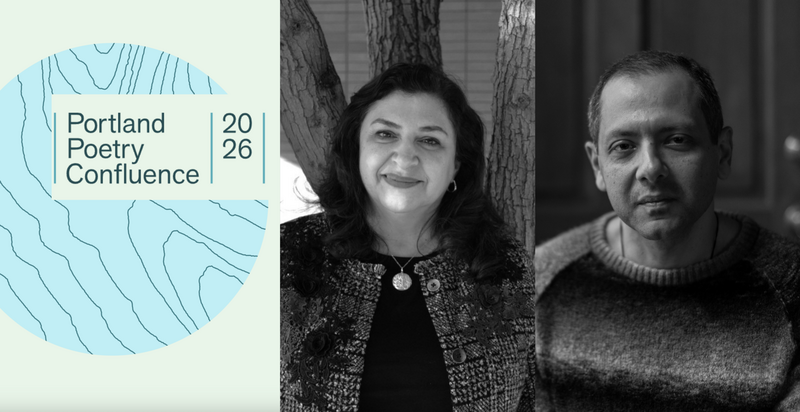
Today’s episode, recorded live at the 2nd annual Portland Poetry Confluence, is a conversation between two National Book Award winners, Lena Khalaf Tuffaha in poetry and Omar El Akkad in prose. We use the essay “Notes on Craft: Writing in the Hour of Genocide,” by Palestinian poet and performance artist Fargo Tbakhi, as a frame under which to look at writing at a time of great political urgency within their respective genres. Questions of audience and address, silence and silencing, gestures on the page and gestures in the world, and how to continue to make art at a time when everything is moving decidedly the wrong way. Today’s conversation was conceived by Literary Portland for Palestine and raised money for two Palestinian families supported by Creators for Gaza.
If you enjoyed today’s conversation consider supporting the Portland Poetry Confluence and Creators for Gaza in your holiday giving. And consider joining the Between the Covers community as a listener-supporter. One of many potential benefits and rewards of doing so is access to the bonus audio archive with contributions from Omar El Akkad, Isabella Hammad, Dionne Brand, Christina Sharpe, and Layli Long Soldier among many others. Find out more at the show’s Patreon page.
Lastly, here is the conversation-specific BookShop for today’s episode (and for your general book needs don’t miss Milkweed Editions’ own Bookshop).
Transcript
David Naimon: Today's episode is brought to you by Exhibit G: Poems, Essays, and Photographs of Gaza by Fady Joudah. From a National Book Award finalist comes this collection that offers a Palestinian representation of the unwavering resilience and prevailing life force of a people-in-place enduring genocide. Writing from the split perspective of a Palestinian-American physician caring for the sick while watching the destruction of Gaza from the United States, Joudah presses his reader to comprehend the experience of both the individual and the whole. Centering dignity, tenderness, and resilience with photographs from the Gaza soup kitchen, Exhibit G insists on Gaza as a living community rather than the abstraction of suffering. This is poetry of the highest order, says Omar El Akkad, and a stunning reminder of what words can do, Exhibit G is available now at milkweed.org. Today's episode is also brought to you by the Portland Poetry Confluence. The Portland Poetry Confluence was created in 2025 to bring together poets and audiences from the Pacific Northwest and beyond. The organizing committee works with local partner organizations, including reading series, publishers, and other arts collectives, to create an annual festival, entirely free of charge and open to all. If you'd like to learn more about this independent festival, you can sign up for the Confluence mailing list or donate to help support its mission at portlandpoetryconfluence.org. Today's conversation, recorded at the second annual Portland Poetry Confluence, is deeply tied to the divestment ask that we, Literary Portland for Palestine, made of the Portland Book Festival over the course of the last year. Given both that we were invited to be part of the Portland Poetry Confluence Festival and that the conversation between Omar and Lena is as much about questions of being both a writer on the page and a writer in the world during a time of great political urgency, I wanted to think out loud a little before we begin to talk. Not about politics or belief systems or ideas in the world, but about how the way we gesture on the page and gesture within the world also conveys a politics too. This comes up a lot on the show, whether Leanne Betasamosake Simpson's observations in Theory of Water about observing the way snow centers as a model for organizing, or Adrienne Maree Brown's notion of an imagination battle, that if we don't actively imagine the world we want to live in, we will live in a world imagined by others. To Bayo Akomolafe's trickster philosophies around how to avoid reconstituting the very thing we are "against," to Chana Miéville's notion of an apophatic Marxism, a politics that allows for not knowing and all that can't be known. But I'm thinking most, perhaps unsurprisingly to longtime listeners, about Ursula K. Le Guin. The last episode of the show was a live recording of the launch of the reissue of Ursula K. Le Guin: Conversations on Writing. And in it, Lidia Yuknavitch and I talk about what Lidia characterizes as Ursula's lateral thinking. And I characterize that horizontal thinking as seeing oneself as a small part of a much larger whole, of a systems thinking, where part of what you do and part of what she did, often very quietly, was to nurture that ecosystem in her everyday small choices, whether publishing with small feminist micropresses and anarchist presses or giving countless interviews at what she described as the terminally funky studios of Portland's community radio station, KBOO. I wanted to say all of this as a preface to talking about the occasion of today's episode and to reflect on some of what we've learned about gestures and politics over the course of this divestment campaign. Because I do think the way you organize yourself as an organization tends to produce certain gestures that come from the structure and from the form, but nonetheless create a certain politics over and above what an organization purports to believe. All this to say, when we did our open letter last summer asking the Portland Book Festival to divest from Wells Fargo as presenting sponsor, given their profiteering off of Gaza, let alone the surveillance of our citizens at home via ICE, or their notorious funding of fossil fuel extraction projects around the world, we were told by organizers more experienced than us not to expect any success that we had to be admitted to by the organization itself, that it would be important to declare one's victories because of that. And to be fair, when I met with them before the festival last year, they said quite matter-of-factly that they would never acknowledge or speak to the divestment ask publicly, but would hire a PR firm. Around that time, I had the Palestinian-Australian writer Randa Abdel-Fattah on the show, whose novel Discipline coincidentally centers an open letter in its plot. And we do some parsing of my experience with the festival in that episode, if you're curious about it. But when the alt-weeklies here in town at various times reached out to our group to interview us for articles, Literary Arts would always refuse to comment or engage, and the reporters themselves seemed taken aback, saying things to us like, "Well, that's certainly a choice." And writers who were deeply enmeshed in the Literary Arts universe, interpersonally and otherwise, who because of that didn't sign the open letter, talked with them and said, "Just face the writing community and say we are listening to you." All to no avail. And I myself am curious about the political valence of this gesture, or a lack thereof. And I think of it alongside another thing that happened this year in Portland. Literary Arts moved two years ago to the industrial inner east side of Portland, an area that is transitional and where Portland's unhoused community is quite visible, partially because there are services for those living outside in the area. As part of wanting to be a good neighbor, they reached out to organizations that support and advocate for those living outside and invited them for presentations and more. Last fall, an amendment came up before city council to divert some of the money the city was using for homeless sweeps toward rental assistance and food aid. A recent ProPublica report found that there had been a 40% increase in mortality from these city homeless camp sweeps. These organizations they had reached out to before moving were surprised to find that Literary Arts testified on behalf of the money staying with the sweeps. Writers from Literary Portland for Palestine and others posted about it. And Literary Arts reached out to the people who did to say, privately, that the testimony did not represent the organization itself. So if you want, you can take down your post. These posters were happy to update their posts if Literary Arts first clarified publicly that the testimony was not representative of the organization. The organizations who work with the unhoused similarly simply wanted them to publicly correct the record. Literary Arts was not willing to do this, and as far as I know, this testimony remains as their public position. Perhaps these two events are not related, but I'm intrigued by this gesture in both instances, where I can only make educated guesses around why. Literary Arts is a vertically structured organization that wants to grow, that has ambitions, that wants to be world-class, where the head admitted to me he spends considerably more time facing the donors than the writers. And my sense is that the writers are supposed to be the product, and any issues we have should be handled behind the curtain, not within the public square. But two things he said to me near the end of our time together have stuck with me, perhaps as clues. One thing he said was, "This has been a huge betrayal of trust." And the other, which he said multiple times, is, "I want to assure you of your significance," or "I want to reassure you of your significance." Perhaps if I had been an employee of Literary Arts, or I had deep interpersonal relationships with staff, perhaps this would feel less strange, but I think it would have still struck me as odd. Thinking back to my discussion with Lidia of Le Guin as a lateral thinker, a person who saw herself as a small part of a large whole, but nonetheless someone committed to the health of the whole, the only way I could make sense of these statements is if Literary Arts didn't see themselves as one important part of the literary ecosystem, but rather as the ecosystem itself, that rather than trust being something earned through interaction, but instead by the very fact that I was a writer, I had already entrusted them to speak for me. And by speaking out, I had broken that trust. Otherwise, I can't see how they could envision that they could bestow or remove whatever significance I had or have in the literary ecosystem here. For the truth is, any significance I do have has no intersection with Literary Arts. And that isn't a complaint. I want them to succeed. I want them to bring the rest of the literary world to Portland, everyone from Anne Carson to Ta-Nehisi Coates. I've been mainly a very happy attendee at their events, and the city culture would be greatly diminished if they weren't thriving. But to finally bring this full circle, they are an important part of the ecosystem, but they aren't the whole, nor do they speak for it. And I'd argue that the lifeblood of Portland's literary scene thrives and flourishes in other places, largely because the heart can't reside in a vertical donor-facing structure, where the writers need to be managed rather than addressed. I think of Le Guin when she received the National Book Foundation Medal for Distinguished Contribution to American Letters, an event sponsored by Amazon, with Amazon publishing execs sitting at the table right below her. And when she gave this blistering, unforgettable speech that went viral, lambasting the likes of Amazon quite pointedly, she wasn't betraying a trust, nor was she attacking the National Book Awards, but their sponsor. But she was shifting the locus of significance away from the awards and away from the corporations and back into the hands of writers. She wasn't bestowing significance upon them. She wasn't reassuring them that they were significant. She was demonstrating the truth that they always were and will be. The group that emerged out of the open letter, Literary Portland for Palestine, has been an incredible group to organize with. You'd likely recognize many of the writers' names who are in it, and some of the small presses and publishing enterprises represented within it. I've never done activism with writers before, and while we never talk about our writing as part of it, it feels utterly different. It feels great to organize like this as writers and publishers. And I really couldn't recommend it more. It changes something. It ties us together in an unspoken way. Lastly, I want to speak to how impressed I am with the model of the Portland Poetry Confluence, which, rather than bringing the rest of the nation to Portland, feels like it rises from a literary source within the region. And I do think part of why you feel the pulse of the city and the bioregion within the festival itself is how they gesture: the horizontal way they create the events where they invite different groups not only to sponsor but to curate a 75-minute slot in the two-day schedule, whether Lidia Yuknavitch's Corporeal Writing Center or Street Roots, the newspaper for the unhoused, or Wave Books or Fonograf Editions or the Incite Queer Reading Series, rather than providing the opportunity to engage with a giant, ambitious ship passing through town by attaching like a limpet to its hull for a wild ride, the Confluence event itself grows from all these organizationally curated segments, one to the next, each small part creating the whole. And that is how today's event arose. We, Literary Portland for Palestine, were invited to curate an event. Some of us worked on dreaming what that might be, and others on how to tie it to a material ask on behalf of Gaza, something we're trying to do with each and every event we do. But it is all a labor of love within our group and between the groups and with the space held so lovingly and competently by the Confluence at large. It is a gesture, lateral, systems-oriented, that I think allows for confluence, for connection, for community. Here's our event, first thing on a Saturday morning, in the biggest space in the building, perhaps seating 150 people, in what is called the Atrium in Southeast Portland: a conversation called Writing in the Hour of Genocide with none other than Lena Khalaf Tuffaha and Omar El Akkad.
[Music]
David Naimon: Hi, everybody. I'm David Naimon. I'm host of the podcast Between the Covers, and I'm a member of Literary Portland for Palestine. First, I just want to thank the Portland Poetry Confluence for allowing our group to sponsor today's event. We're a group that started with a divestment ask from Literary Arts around the Portland Book Festival, which we're happy to say for the first time in 10 years does not have Wells Fargo or Bank of America as a sponsor. [applause] Today's event is also a fundraiser for Gaza. We are partnering with Creators for Gaza. They have a table over here to the side of the room. They're a SWANA-led mutual aid network connecting artists to Palestinian families who are surviving or evacuating genocide. And out of their 40-plus campaigns, they've asked us to center two families. And I'll be talking more about those two families toward the end of our talk today. But you do have a QR code on your seat. There's also information at their Creators for Gaza table. So hold on to that and also check in with them because they also have opportunities to volunteer or participate in their group in other ways. So a brief introduction of our two guests. Our two speakers today both have three books. Lena Khalaf Tuffaha has three books of poetry. She's a poet, essayist, and translator. Her latest book, Something About Living, was winner of the Arab American Book Award and the 2024 National Book Award for Poetry. And Omar El Akkad, a novelist and journalist, has three books also. [laughter]
Omar El Akkad: So far from poetry.
DN: His first two books were novels. His third book is venture into nonfiction, One Day Everyone Will Have Always Been Against This, won the Palestine Book Award and the 2025 National Book Award for Nonfiction. So let's give a nice welcome to Lena and Omar. [applause] So the title of our talk is Writing in the Hour of Genocide, which we borrowed from an essay by the Palestinian poet and performance artist Fargo Tbakhi, his essay Notes on Craft. And we decided together we would use the thinking he's already done as a way to structure what we're going to talk about today. And the first line in Fargo's essay Notes on Craft: "What does Palestine require of us as writers writing in English from within the imperial core in this moment of genocide?" As part of answering that for himself, he's looking a lot at theater, and he brings up the Brazilian anti-fascist theater maker, Augusto Boal, speaking of theater, who said, "The poetics of Aristotle is the poetics of oppression. The world is known, perfect, or about to be perfected, and all its values are imposed on the spectators who passively delegate power to the characters to act and think in their place. In so doing, the spectators purge themselves of their tragic flaw, that is, of something capable of changing society. A catharsis of the revolutionary impetus is produced." Fargo says right after this, "Palestine requires that we abandon this catharsis in our art making." I feel like both of you abandon catharsis through thinking about this question of address, how to address, and also of audience, who we are addressing. And I was hoping we could start there with both of you talking about some of the considerations you have about addressing your readership and the imagined readership you are addressing.
Lena Khalaf Tuffaha: Thanks for that question, first of all. I think that concept of audience has evolved a lot for me, especially over the last three years. There's no way around, if you write anything beyond the privacy of your journal, you are in a conversation with an audience. Can't really avoid that. And your awareness of and understanding of that audience necessarily is going to be part of the work you make. For me, my understanding to a great degree of that audience was that it was a kind of diverse American audience with varying degrees of awareness of my existence as a human being who is Palestinian. I am so much less interested in that audience now. And I say that without any rancor, but my tolerance for my ability to address or anything that comes after address, explain, perform, show, is minimal to zero. So my concept of an audience is very different, and it's making how I approach writing more challenging. And some of that is because addressing an American audience as a Palestinian is immediately problematic, right? This is the center of the genocide industry. This is the settler colony funding the settler colony. This is the place that has made an acceleration of genocide, and I want to be really clear and intentional about that. The last three years have been an acceleration of genocide, not a new event. So this is the place, this meaning the culture, not just the military-industrial complex, not just the politicians. No, the culture. This is the culture that has made the acceleration of the genocide of my people possible and thriving. So what are any of us doing? Making art for that audience? What does that even mean? And so I really am in a period of taking stock and trying to navigate any desire to express or engage and how to move and how to be a writer or an artist given those undeniable terms.
OEA: Yeah, absolutely. Thank you for doing this, by the way. It's a pleasure to be here with you both. At the start of the tour for this book, I was off to Europe, and I went to see an immigration lawyer before I left because I was worried about what the hell was going to happen when I was coming back. And I'm sitting talking to this guy, and he says, "I don't know what the hell to do for you. You're a U.S. citizen. I'm an immigration lawyer." And I was like, "Don't worry about it. Just give me your cell phone number in case who the hell knows what's going to happen." But during that conversation, he said something that stuck with me. At one point, he said, "If something goes wrong, like if you get kink in the secondary or if things go sideways, what's going to help you more than me or any of this is that you sound like you're one of us." And he was right. He was absolutely right. Which brings me to this notion of audience. When I started writing what ended up being this book, I was keeping a running diary of atrocity. I felt like a lot of the things I was seeing, and I was seeing the worst things imaginable every single day, was going to be thrown in the memory hole, and that I'd be told that none of this happened, and it wasn't that bad. So I had no intention of putting it out into the world. Even after my editor suggested that I do this more formally towards a manuscript, I didn't think there was a chance in hell that Penguin would publish this book. So I wasn't writing with a sense of this specific audience or this market demographic or any of that, right? What I have found, and this is the thing that is my version of this struggling, I think, is that overwhelmingly the book has had the most traction in terms of maybe altering slightly someone's view of anything at all with people who are almost the textbook definition of that centrist liberal that I spend a lot of the books raging at because I have become this person and have been rewarded endlessly over the course of my life for becoming this person. So it's a strange situation where I was in London a few days ago and I was doing an interview with a Palestinian journalist, and she said something like, "You spend so much of your time raging against this centrist, progressive, and yet the book appears to be addressed to that person. Why is that?" I said, "Well, it's twofold. One is that I know how to sound close to that person. It's the reason I sound the way I do. It's the reason that immigration lawyer picked up on that. The other is I don't know how to do anything else." So you're in this very strange place where you can see that it has some kind of effect, but at the same time, the very reason it has any kind of effect is because of how much you've shed of yourself to become acceptable to this part of the world in the first place. So I'm left in this strange nowhere space where I have to decide whether to be very, very pragmatic about changing a particular kind of mind or try to figure out who the hell I am if I can't be this person anymore.
DN: I want to explore a possible difference between the two of you, but I'm not entirely sure it is one. I'm wondering if perhaps the use of the same word isn't revealing a difference, but maybe obscuring that you actually have an agreement, though you use the word differently. So the word is witness. Fargo and Augusto Boal in Notes on Craft, they talk about the problem of catharsis being that it makes witnesses of us and nothing else. And I know, Lena, you've talked a lot about being against the notion of witness for any number of reasons, making a voyeur of us, absolving us. Omar, you have a chapter on witness, and you distinguish it from seeing, where seeing in your formulation is the passive reception of already narrativized images, whereas witness is requiring more of an active engagement with those images and a moral reckoning with those images. So in thinking about "Is this a difference between Lena and Omar or not?" I thought of the essay by Sarah Aziza called The Work of the Witness. She's not looking at the English version of the word witness, which comes from prosecution and trials. She's looking at the Arabic version. And this is what she says in that essay: "In this, our language, the verb to witness is the source of the much-maligned word shaheed, which means literally, witnesser, but is often translated as martyr. It carries connotations not only of seeing, but of presence and proximity. To be a witness is to make contact, to be touched, and to bear the marks of this touch. They allege the word martyr glorifies death for death’s sake. But in this context, it should be read as honoring the truth these brutalized bodies speak. Their flesh, marked by colonial violence, makes visible the wild injustice they endured. Which is to say, their martyrdom tells us the truth about our world." I read this as an opening for us to explore witness and/or shaheed in relationship to writing in each of your words.
OEA: I think this is the problem with doing interviews with you. [laughter] You just hold on for dear life. [laughter] First time I ever did an interview with you was for the podcast and I was in Edinburgh and it was three in the morning my time, and we spent two hours with exactly this sort of thing, and I was non-functional for about two days afterwards. [laughter] He really is the best at what he does, and I mean that as a criticism [laughter] because it's very difficult to keep up. It was very difficult for me to think of witness within the Arabic continent, shaheed, because, yes, of course, it has the aspect of martyr, but also, at least from my upbringing in the part of the world I grew up in, there's a declarative aspect to it, [foreign language]. If I was to declare that I was a Muslim, I would say, I would say, [foreign language] There's a declaration attached to it. So in my thinking of it, and this may just be me, within that context is more active. I think living in this part of the world has caused me to think of almost anything associated with that world only in terms of orientation, and I don't think that's enough. I have to think of distance as well. So, you know, one of the most legitimate criticisms, there have been plenty of legitimate criticisms of this book, but one of the most legitimate, one against which I have no defense, is how squishy I get about the idea of armed resistance, for example. It's true, absolutely true. Ever since the book has come out, I've had to sit with a certain set of things that I've come to realize since then I should have realized earlier. For example, that A, I have exactly zero right to tell anybody how to resist their occupation. B, by virtue of how my tax money is spent, I'm one of the most violent human beings on earth. C, I don't know that there's a single thing I believe, no matter how strongly I believe it, that wouldn't change in an instant if it was my family wiped off the face of the earth. All of these things are functions of distance. I was in Belfast two days ago talking about stuff like this. Nobody in the room found anything remotely profound or revolutionary about what I had to say because the distance is very different. When I talk about soldiers rushing into your house and occupying your space, their relationship with that in terms of distance is very, very different. So this, I think, is where we get caught up in the usefulness of the word. I think in the book I describe witness as the most necessary and pathetic aspect of literature. A lot of that has to do with distance, which is how you end up in a situation where you can have a very well-meaning liberal in this country who is very empathetic, but also the distance is so great that they will get far more offended at being called out at a dinner party than those brown kids being slaughtered on the other side of the planet. It's too far away. So that's the only way I've been trying to make sense of it, but it may be the case that it is, in this context, completely ineffectual regardless.
LKT: So in the Arabic tradition of multiplicity, allow me to complicate the meaning further. I have a poem, I think in Kaan and Her Sisters, that is built around that word, and there's a line in it that says, "The distance between martyr and tombstone is just one vowel." Shahid is the Arabic word for tombstone. It just adds the alif vowel to the same root, shahada. So all of that comes in together. And that's important because I think we also have a kind of distance from death in the privileged world most of us inhabit. That's a good thing. I want more people to have a distance from imminent death, but I think whole sections of the globe who are on the receiving end of our power don't have that. Whole parts of this society don't have that. It's just, you know, your degree of access to power and privilege. So you can have these kind of rarefied conversations or approaches where things like death and tombstones and the intensity of violence in your life is just not really daily and up close. It changes how you engage with a lot of things, including language. So the challenge for me with witness and the idea of witness in what I'll call the modern Western literary tradition, just to put a mark around it, is that it's distinct from something I grew up with in the Arab world. For example, like my literary heroes were writers like Ghassan Kanafani. From him, we get the idea of al-muthakaf al-mushtabik. So there are a variety of opportunities to translate that. Here's one: You could say the engaged intellectual. Mushtabik comes from the root shabaka, which means to connect. But that also, in a certain political context, means someone who's actively a revolutionary, in the 1970s connotation of revolutionary. So it brings in what is quaintly referred to in America as violent resistance. Make of that what you will. But the intellect and writing and thinking and making art in the world in which I was raised and grew up in was not separated quaintly or in any other way from political life and political realities because that just wasn't how anybody had the luxury of living. So this is, I think, part of the root for me of my impatience with the idea of witness because it puts you in a living room in front of a television a lot of the time. You know, you don't have any skin in the game. You can witness and then go to brunch. I'm being a little over the top in my metaphors, but I'm doing that to make a point about, as you said, distance or proximity. So I think that the minute we use the word witness in English, we're bringing in an understanding and a tradition of standing politely alongside, not wanting to upset anything. I want us to interrogate why, if you are seeing something horrific happen, would the good and kind and decent thing to do be to stand alongside? Why? And we don't just have to talk about Palestine. Cornell comes to mind. This is an important conversation to have on all fronts. So I just want to name that that's some of the trouble I have with this conception of witnessing.
DN: Well, just to continue with maybe a different version of witness where you can't go to brunch. This is another thing that Sarah Aziza says in her essay about witness. "We—those outside of Palestine, watching events through a screen—ought to think of ourselves in relation to the legacy of the shaheed. Our work as witnesses is to be marked; we should not leave it unscathed. We must make an effort to stay with what we see, allowing ourselves to be cut. This wound is essential. Into this wound, imagination may pour—not to invade the other’s subjectivity, but to awaken awe at the depth, privacy, and singularity of each life. There, we might glimpse, if sidelong, how much of Gaza’s suffering we will never know. This is where real witness must begin: in mystery." Thinking about witnessing that cuts and imagination pouring into a wound, I connected, and I don't know if Augusto Boal, would agree, because I'm reading into his notion, but I love his idea of the tragic flaw in the quote that I read, being the part of us capable of changing society. So maybe it is something about the wounded part that is actually the part that's being erased through catharsis. But I feel like both of your works cut. I wanted to hear you both talk about writing in your specific forms, the strengths and liabilities of each of your forms, because we can look at Fargo and Boal in Notes on Craft, and Fargo's really working against an inheritance that he's receiving in the history of theater. So he has to become aware of this inheritance that he wants to counteract. So I'm curious if there's something like that in personal essay or in poetry and/or specific wellsprings that you're pulling forth from that are part of that lineage.
OEA: Unfortunately, I always have thoughts. They're just not very good most of the time. But I mean, this notion of what you're working in, the medium but also the context, is, I think, worth interrogating because one of the safest and most comforting things you can do in an abstract sense is always believe in an even playing field or an even starting point. That's simply not the case, right? Years ago, I was on a jury, a short story jury, and this story came in, and it was about a character named Noof, and it was a beautiful story. It was so spectacularly done. I had to fight for this thing because the other judges were reading something else. So at one point, for example, there's a line about how her mother gave her a name that rhymes with fear. Unless you know what Tchof means, this makes no sense, right? And so I bring this up because I think that there is a baseline level of comfort in this part of the world, which is not even at all. I don't want to imply that it is, but you are on the launching side of the missiles. Within that context, there are certain modes of movement through the craft that seem to make perfect sense in and of themselves, but when interrogated, crumble a little bit. I'm talking, for example, about this whole show, don't tell. Fantastic advice if we're on an even playing field. Hemingway can write The Sun Also Rises and not worry about somebody not getting the reference because the Bible is not an obscure text, and there's an established lineage, and we're in the canon, right? Whereas the author of that short story, Noor Naga—who, if you haven't read her work, please do. She's spectacular—did that, and it was though it was not there. This is what I'm struggling with right now, because even in the context of this discussion, which we're having here, which is very, very different from most of the stuff I do in this country, we still have this shadow space hanging around us where we're explaining through this stuff. In fact, we're doing the exact opposite of show, don't tell. We have to tell to establish a certain understanding which is intertwined with the idea of saying, "Hey, these people, this culture, this lineage that exists out here is still human enough to consider." That's work. In the act of doing that work, you are countering the advice that you're getting at virtually every MFA program in this country. I think at the very least we should acknowledge that as a starting point, which is why in the book I quote Marwa Helal, the poet, with that line, right? "They will say: show, don't tell, but that assumes most people can see." When that assumption doesn't work, you've got to figure out another way, another angle of attack.
LKT: So to build off of what you're saying, I think in some ways I turn to poetry because it feels like it has some more possibilities than maybe some other genres. Although the conversation about genre breaks down pretty quickly for me. I started writing short stories and just felt like too restrained and probably didn't write very good short stories, for being honest. I thought the possibility of poetry, because even in the American context, the lineage is so varied. Like a June Jordan poem is very different than X, Y, and Z. So I felt some more space to move. That being said, you're still sending to editors with certain proclivities and traditions. So one of the things I have found myself working against, and this definitely came up in MFA program, and I had to wrestle with it, is working against the idea of epiphany. There is a desire for epiphany in a poem, a kind of turning point, not just the volta, but specifically an epiphany, like this revelation or this new truth that you're going to have by having kind of walk through the rooms of the poem. And I'm more interested in a kind of breakage. I think the poem is a phenomenal site. I say this genuinely with love, to break things, to discomfort, like the idea of a productive discomfort. I think poetry is really capable of that if we let it be. So I've really tried, especially in the most recent book, and I don't think I did it consciously in retrospect now. I understand that that's maybe what I was experimenting with. I try to create opportunities for that. One of the ways I have tried to do that is by, when it makes sense and when it works, creating moments where not everybody has equal access in the poem. Because that's how real life is. You might come upon a word in a language you don't know. You can Google it. There are ways. It's really up to how much effort you want to put in. Or you can live with a moment of being outside, which you might not otherwise have. That's the experience that's worthwhile. The momentary exclusion. All of these seemingly small things that create a sense of breakage or breakdown, I think poetry is especially suited to that. So that's me trying to work against this idea of universalizing epiphany.
DN: Well, when I was emailing both of you about possible ways we could go with this conversation, one of the things that I suggested that you both seem particularly interested to talk about was silence. I actually don't know in what ways you do want to talk about silence, but I have two questions that I want to ask about it. The second one, will be about the employment of silence within your work. But the first one is more about writing in an atmosphere of silencing. I'm just going to establish, this is just going to be a tiny amount of some of the silencing. I mean, one of the wars is against a Palestinian archive, whether in 1948, the Israelis stealing tens of thousands of books from Palestinian homes and libraries and cataloging them as abandoned property. Or in 1982, the Palestinian Research Center archive in Beirut looted by Israeli forces. Or in the second month of the Gaza genocide, Israel bombing the Central Archive in Gaza, which held 150 years of archival material about Palestinian life and culture. Lena, you've talked about the co-opting and stealing of Palestinian lifeways, dance, food, and music, and then it getting kitchified by Israeli culture, obviously the erasing or depopulating of towns and villages. But here in America, particularly in the last three years, but not just the last three years, it's just more obvious to the average person now than it was over the decades. I mean, we're seeing just countless moments of graduations where people are panicked and running to cover up the microphone of some student who's valedictorian, reading even what seems like the most innocuous statement on behalf of Palestinian life and dignity, people being deported, professors fired for teaching the Palestinian narrative. Here at the Portland Book Festival, there were any number of instances. And I think of one big writer here in town who was about to go on stage to be interviewed by an OPB journalist and turned to them and said, "I just want to let you know that before our talk, I'm going to read a statement around the divestment ask." And the journalist turned and very matter-of-factly just said, "Oh, that's fine. That's super easy to cut out." Similarly, Omar was in conversation with Karen Russell, who until recently was a Portland resident. It wasn't a red line for the book festival to cut out her political speech deep within that conversation when she tied the themes of her own book to the divestment ask around Palestine, which didn't end up in the radio broadcast, but has since been returned to the podcast due to pressure from outside of the organization. Most notably, I think of something that I mentioned when Lena was here for our first event in January, is that when Fady Joudah and Lena were two finalists for the National Book Award in Poetry, they're invited on NPR, two books that were written during and about the genocide. And every time they used the word genocide, it was edited out of their speech while they were there for the very purpose of speaking about their own work about it. I bring all of this up because of how normalized it is, how little shame there is in any of this happening. Not because of these particular instances being standout, but these instances are just innumerable. I wonder, and I imagine, this produces the risk of self-censorship. That's probably partly why it exists; people who are scared to take risks, who won't even write the thing that they might have written otherwise. And I know that you, Lena, have curated the work of others under the phrase "Against Silence." So this question around silence, about perhaps defending ourselves from silencing ourselves preemptively, but also just writing in a climate where so much is being silenced and the consequences of speech have increased considerably. I was hoping you could speak about that and your own thoughts and strategies for each of you.
LKT: Thank you. I'm reminded of, I think it was November of '23, when the poet Mosab Abu Toha was still living in Gaza and was abducted by Israeli occupation forces as he and his family were trying to evacuate. All of that has to be coordinated to get permission. So, this was definitely an intentional act. At the time, I and other Palestinian poets had sent some work into a journal that was going to be published, and Mosab was one of the poets, so we were all obviously writing about or toward that moment. And news broke of the abduction, so I wrote a little blurb about it. And then the editor wrote back and sent me her edits of my blurb describing what happened to Mosab. The editor in Los Angeles doesn't know anything about Mosab or Gaza or Palestine, sent her edits back to me. They began with something like, "On October 7th, Hamas attacked." And so we all, the group of us, said, "Well, we don't want to publish our work anymore because that's ridiculous. I have no idea what the October 7th reference or Hamas has anything to do with what's happening to Mosab at this moment. Why are you making that implication?" And what proceeded to take place was weeks of some of the most, for me, disgusting conversation I've ever had to be part of, in which I had to actually seriously explain to this person why that was violent and ridiculous and what she was enabling. It took bringing in people above her to make her stop. And that was in some of the most intense and graphic moments of the genocide, while Mosab and his family are enduring what they endured. So silence shows up in a lot of ways. It shows up in erasure. It also shows up in having framing and language imposed upon you that takes away your voice. It shows up in where you get to start and stop history. I say this without criticism. It's just an important clarifying point. The book I wrote that happened to be published in 2024 was not about the genocide. Those poems, many of you know when you write a manuscript, it takes years and then you send it in and it takes more years to make a book. Those poems were written years and years before. But even that framing belies a kind of silence about Palestinians and Palestinian writing and Palestinian art, that we are now understood because of and in the context of this loud genocide, when many of us have been writing just about our lives and our experiences and making art of the world around us, as all other artists do, for years. So I think we live in a kind of imposed silence, by definition, in the West. So a very simple and basic strategy against that is the act of making any art, just that act of trying to do anything on your own terms. It becomes immediately politicized and categorized in a variety of handy ways, and that can be tiring and it can be draining, but that is the first step against silence, is that choice to exist in the fullness of yourself and to make art. For me, it certainly felt that way. I spent years before I wrote poems working in community organizing and specifically the small value I had to add was to work with reporters. So I would talk to producers or editors and try to help them understand how to be more just in their coverage or introduce them to real-life Palestinians who could talk about their lives. I'm glad I did that work, and it was an honor and a privilege to do it, and it was also devastating work that made me feel gutted and not fully human after years and years and years because it forces you to do something unnatural. The American machine loves that performance. And so I had to turn away from that and choose art for my sanity and for my well-being. That's how I came to writing poetry. So for me, even though that work was outward-facing and about speaking out, I felt like I lived in a bubble of silence the entire time I was doing it because none of it, no matter what I did, was on my terms. Art is a space where I had, I thought until recently, a little bit more control and could make more noise.
OEA: Yeah, absolutely. I was doing this event last year just outside Boston, this bookstore. And it happened to be this community that I guess is an incredibly pro-Zionist community because the owner of the bookshop was showing me the notes she was getting, and there was a lot of this, like, "I hope you get raped by Hamas" type stuff. It was really, really just vicious. At the end of that event, at the signing line, this young woman came to the desk, and she was more visibly terrified than almost any human being I'd ever met in person. She was a graduate student, and earlier, I think that week, one of her colleagues had been snatched up by agents into this unmarked van because this was the young woman who wrote the op-ed about boycotts, about supporting BDS. This woman who had come to this event was convinced that she was next. She was certain of it. I couldn't help but think that this was the primary function of what was done. That this is always the primary function, was the ripple effect rather than the individual. How many people have you scared into silence with this one act? The difficult thing about silence is that it's very hard to build contours around it and come up with a measurable space. You don't know who's not doing what. You don't know who's decided to not speak. I think particularly in this country, there is this beautiful middle space in the eyes of the very same systems that are responsible for this carnage, and it's a middle space where there is a superficial support for and celebration of the act of the free exchange of ideas, where we sit and we talk and we debate and we do the thing, so long as it's completely severed from any material change. And you've seen this, right? You've seen this as part of the campaigns that you were involved in and that I very tangentially was involved in. I was talking once to the director of this literary organization. This is someone I respect, and I think is a good guy. In the year leading up to this conversation, because of the kind of book I wrote, I've had the privilege of being in space with a lot of activists, people who are doing the work that I'm too scared or too ineffectual to do myself. One of the metaphors you hear when you're in that space over and over and over again is this idea of throwing sand in the gears, throwing your body in the gears, bringing the gears to a halt, right? Bringing the machine to a halt. Then I'm talking to this person who, again, runs a fairly large organization. This is a multimillion-dollar organization and agitating for some kind of change. At one point he says, "Well, now's not a good time because there's just too much sand in the gears." I thought, "Oh, that's really interesting. In your perception of the metaphor, the machine is working for you." The sand in the gears is a bad thing, right? I think we've created this context where the superficial support for free speech and the free exchange of ideas is to be celebrated. But as soon as somebody makes a material demand, that's for billionaires to do. That's for corporations. That's for someone who's not you. And that becomes unsustainable over time. Because eventually, not only does it fall apart on its own, but then you get people like the far right who capitalize on it and say, "Well, if there's a chasm between the performance and the reality, I'm just going to give you the reality. We don't have to bother with this side of things." I think in large parts, that's where we are right now. We are watching that resurgence because this other model that pretends to be a thing while in fact enacting none of the principles of the thing is fundamentally unsustainable over time.
DN: So my other question about silence is the uses of silence. I think of Sarah Aziza when she asserts real witness begins in mystery, and I wonder if it's maybe the flip side of Said's notion of permission to narrate, perhaps the permission to not be legible. Maybe one good example would be Fady Joudah's last collection, which has no pronounceable word as the title of the collection. It's a symbol, and it's not a symbol that is familiar to people. So this question of withholding within our own work or working against legibility or other ways of employing silence as a tool, I'm curious about if either of you use silence in some way in your own artistic practice.
OEA: I mean, it's a trite thing to say, but most of the work is silence. Most of the work is you're sitting alone in a room and you're trying to essentially do what any act of literature is, which is to take in the world and spit out words, right? To take in living and spit out some description of what it means to be on this earth, right? But then on top of that, because of this great distance and this great privilege to be living on the launching side of the missiles, the thing that you are taking in, which again, I say without hyperbole, is the most horrific thing I've seen in my life, day after day after day after day, you are also taking in silence. The reason that we know most of what we know about the killing fields in Gaza is because of Palestinian journalists, at least 200 of whom have been murdered for doing their jobs, doing their jobs in accordance with the way that all journalists, myself included, were told is the way you're supposed to do your job. You're supposed to see and tell. They told and they were murdered for it. That is a kind of silence, right? And so you are left in a place where, at least in my sense, it's not just silence, it's various spheres of silence. There's the self-imposed, there's a distance so great as to be indistinguishable from silence, and then there's the silence of not being understood. The silence of having to do the legwork to meet the basic threshold of humanity, whereby it is no longer the case that this is just something happening in the abstract to some people that are subhuman, to a place that is subhuman, to a culture that is subhuman. All of that is work through silence. Then there's the mechanical side of it, right? In this book I wrote, there are two Arabic phrases that are written in Arabic, and those took six months to typeset, because I would send them the thing, and they'd send me the PDF back.
LKT: In the technologically advanced West, it's so hard. [laughter]
OEA: I don't know if this was your experience, but it was backwards and broken up.
LKT: And disconnected.
OEA: Yeah, disconnected.
LKT: We're just from outer space. It's just not possible to do.
OEA: So finally, I told my agent, I was like, "Does nobody at Penguin Random House speak Arabic?" [laughter] And she laughed in my face.
LKT: Do you guys have the keyboard? You can do it on the iPhone. It's not hard.
OEA: I took a screenshot in the end. I ended up sending them an image. That's a kind of silence, right? [laughs] And I don't know what to do with any of that.
LKT: Do you remember sustained silent reading? Do you guys have that in school? Do you ever feel like you just want to subject the entirety of the American public? "Sit down, we have SSR for the next year. Shush. [laughter] No talking, just read. Just hear the books, be quiet." [laughs] That's the punishing in me, the teacher. [laughs] Right? Wouldn't that be fun? I think we should bring that back. I want to mention Marwa Helal, because you did, who invented this poetic form that so many people have used and written into, which was a kind of invitation both to silence and to be loud. She calls it the Arabic. You write a poem in the English language from right to left because that's how Arabic is written. There is an Arabic letter in it, which is a key to some part of the meaning. It is a delicious thing to engage in. She did this years ago, and I have lost track of the number of us poets who have borrowed the form from her with gratitude. But I think silence can be a really inventive and generative space. I think a lot of our best artists go into that space to figure out how to make things new and how to feel whole again, whether it's coming up with a form or rejecting something or whatever. But I think those spaces are very generative. And so I just thought of her when you were talking. But I think silence is also about refusing to engage and missing, quite frankly, just being really honest about it, just missing opportunities intentionally. That's important because when enough of us do that, you devalue it and you take its power away. And I always try to make that invitation to say, "It's okay to risk something. It's okay to lose something. It's okay to not review a book, not take a fellowship, not X, not Y," because you are making it possible for others to do the same and eventually devaluing a thing that has had so much power over the imagination of writers or artists and moving the power maybe closer to where it should be. So that can be an effective use of silence too.
DN: Yeah. Well, maybe as an extension of this, I'm curious about if you have ways to check in on yourselves or certain barometers that you're in integrity with yourself around your own art. I think of the essay Hala Alyan wrote, "Why Must Palestinians Audition for Your Empathy?" But I wonder if there are ways to check in to make sure you aren't auditioning and, in the same light, aren't self-censoring. You've mentioned, Lena, the weirdness of having a book come out that, in your own words, wasn't receiving a ton of attention, and then received an enormous amount of attention because of something terrible happening. Then retroactively, by me and others, then viewed through the lens of genocide when it was written before it. Both of your books have been immensely successful, an incredibly heartening thing, but I might also wonder if it makes you wonder, "How am I being metabolized?" Or, "How is my work being metabolized?" That it is showing up in such a big way in the world at large. Then in the end, what keeps you on the rails on your own terms? Is there something you do to assess that you're staying on the rails on your own terms?
LKT: I mean, I think you have to be rooted in community. You have to answer to your own community, first and foremost. Your community can't only be other writers writing in the United States. I love that community, but a discipline I believe in for myself has been working in translation. Meeting and getting to know and building genuine relationships with living Palestinian poets. I feel like it's an incredible privilege to have the trust to translate their work and on their terms. So, like, their choices may be individual poet would make that I wouldn't. You know, not imposing a kind of image of what a Palestinian poet writing in Gaza should be saying or how they should feel or what audience they should aspire to. That's not my business or my place. As a translator, I feel I'm in service of the work first and foremost and of the writer who made the work, and working with living poets is a very different exercise. When I feel most despair, turning to that practice is really life-affirming because we just have to engage in our real humanity. We're all very deeply imperfect, like super normal, often boring people. [laughs] That's so refreshing instead of these, like, avatars of Palestinian-ness or whatever. So I love that, and it has introduced me to a whole wide range of literature that I wouldn't otherwise know about living here. But it also just locates me in a community. It makes me one of, instead of a representative or a spokesperson, which is an awful thing to be ever. So I have found that practice really enriching. It puts me in the role of student and listener, which is the best position to be in, I think, to make any kind of art in the future.
OEA: Yeah, absolutely. I agree completely. I think this notion of moving outside the framework of what's acceptable, not just politically, but also in terms of craft, of how we do the work, the second you move outside of what is the loudest country on earth, you are immediately forced to contend with this notion that the terms of engagement here are simultaneously so deranged and yet so normalized. And again, I spent 24 hours in Belfast, and it was enough to see that. Exactly. I went to Jordan last year, and I was at this investigative journalism conference, and one of the things I had been conditioned to accept from a very young age living in that part of the world was this notion that in almost every professional field, any field of any kind, you look up to the West. This is what you're striving for, and God knows it's what I've done for most of my life and have been rewarded for. This book exists as a result of that. I go there this time, every journalist I talk to there has a similar sentiment, which is, "We got nothing to learn from them. They can come here and learn what journalism is." We have our debt to show them. And I think sometimes you need that reset because it's not just the case that it's being reinforced through repetition when I live here. Every conversation I have to think to myself, "Is this within the acceptable range of where we are?" But it's not just that. It's reward as well. There is immense reward. Punishment is obviously there as well, but it's also limited because nobody knows or cares who the hell I am. And also, the medium we work in is not film and TV, and all of those things are limiting that side of the equation. But whatever form you're in, if you play by the rules of that container of what's acceptable, there is immense reward on the other side of that, relative to whatever field you're in. Simply coming to terms with that and acknowledging it in the first place, I think, is at least a prerequisite. I don't know what lives beyond that because I'm still starting that journey, and part of it is just shedding so much of who I have been for so much of my life. I don't know who the hell that guy is on the other side of that yet.
LKT: I just wanted to pick up on something you said, if I may. The other part of that "the West is best" sort of upbringing that a lot of us had, whether it's in terms of academics or professional whatever, is this idea that, okay, despite everything bad, fundamentally there's free speech here. Fundamentally, this is a functioning democracy. I'll just leave that where it is. [laughter] So one of the changes I note also, like being in places like Amman, is people in other countries where they are dealing with more overt and clearly visible restrictions, we'll call them that, are now able to see the connection between them and the people who live in the theoretical functioning democracy. Like, "No, you guys don't have rights either. You're just told you do." Oh, wow. I would like all of us to have rights everywhere, but there's a kind of relief in that bubble being burst a little bit, that more people, not all, but more people certainly who I have encountered are able to say, "No, but, you know, you don't really have rights in the United States unless you're one very specific kind of person." Certainly not women, not Black people, not Native people, and so the list goes on, or you have rights by varying degrees. That more holistic understanding and knocking the West off that pedestal, I think, is helpful to all of us everywhere. Like, let's have a more honest, complete conversation about what's happening. So that changes the terms under which we write together and individually, I imagine, and the places we feel safe and comfortable engaging. You might think you have a certain comfort or shelter here, even though it's very nuanced, but maybe you don't really. So maybe you also can go other places where the shelter is also nuanced and arbitrary, but you can take the risk of connecting with larger swaths of humanity and remembering parts of yourself that you had to shed to be here. Deepening that understanding, I think, opens up possibilities.
DN: I was curious, thinking of this question about checking in on yourself and integrity and barometers, Omar, I wonder if one way your book succeeds in that way is how much you implicate yourself within the work, which I feel like is part of its power. You're going through your own seduction around Western liberal humanism and then disentangling what it really means as it exists in the world. Both of you placing yourself as in your multiple identities, but also as American taxpayers who are slotted into certain positions within society, regardless of what brought your families here in the first place. At the same time, it seems like with you, Lena, that maybe you're starting to reorient yourself away from not only the American audience, but maybe the American identification in terms of your diasporic Palestinian identity in terms of address. I don't even know if this is a question, but I do wonder if placing yourself to some degree in the position of the American reader was part of what allowed the American reader to go on the journey with you, and maybe something you wouldn't have even needed to have done to a North Irish readership. Like, maybe this book didn't need to make that move in other places.
OEA: Yeah, I mean, there's almost certainly a case to be made that there's a far better version of this book that doesn't engage along those lines, right? Because what an incredible privilege to be sitting again on the launching side of the missiles and centering myself, and how sad this all makes me and all the rest of it, right? I'm killing those kids. This is happening right now. Every day. Every day. You see a father saying, "Please don't pull me out of the rubble because his daughter's still under there with him." What the fuck does it care that it makes me sad, right? I couldn't write a different book because I couldn't address these issues without addressing my own complicity in them. That is both in a sort of abstract and fun-to-engage-with-in-a-literary-way sense, but also in a very real sense. My tax money's doing this. And so if you're going to engage with that, you have at least some obligation to engage with it holistically and honestly. But this again brings me back to this notion of why I think this book has gotten so much traction and probably far more traction than it deserves, which has to do with this Trojan horse component. The very thing that I'm complicit in, by virtue of becoming the kind of person who is complicit in it in the first place, makes me able to close the distance between someone, between myself and what I have to say, and someone in this country who has had the privilege to never think about any of this stuff in the first place. I got a letter a few months ago from a grandmother in rural Wyoming saying, "I read the book and it caused me to think about Israel and Palestine. I hadn't done that before." I was like, "Yeah, of course you hadn't fucking done that before. You live in rural Wyoming." It's a strange and feels like a really duplicitous place to be. I think I'm under some obligation to try and engage with that honestly, but also with the fact that the thing that makes it duplicitous is also what's giving it its effect. That I honestly don't know what to do with yet.
LKT: I think my angle might be a little different. There's a way in which we forget that English isn't just a U.S. American language. It's a language that really belongs to the world. More non-white American people around the world speak English than the white people who live here do. It's the language of many, many places. That doesn't just mean people speak it. It means they shape it. They introduce their vocabulary and their culture and their ideas to it. And it is transformed by that. So I think, given that, I can still write in this language wholly as myself. I think it's the U.S. nation-state piece that is the problematic. I've been really grateful to get some feedback from readers on the book, and it is rarely ever about genocide, and so humbly that's very gratifying as a writer to feel like when people have an opportunity to engage with the book, they find something in there that is about themselves and maybe also a little bit about my experience and often a critique of systems that we are both, we are all part of and participating in. And that's, I think, what my work tends to be about. The lens that I do that through is the lens of language. So I'm grateful when that can happen. The challenge is now trying to think about language and writing while the ground is shifting beneath us. Because it is. And so I don't want to be dismissive of any readership. I just think we don't have to define ourselves so narrowly in terms of nation-state identification, and we can make choices about the systems that we still believe in.
DN: Well, I want to ask you both about writing when everything is going the wrong direction. I'm thinking of Fargo again who, along with the Palestinian poet George Abraham, just put on a play called Eve, which is a Palestinian riff on Milton's Paradise Lost. Here are two things that they wrote about it as it was being performed. "How do our communities keep going in the aftermath of failed revolutionary struggle?" And "To think through how we keep going, amidst and in spite of the ongoingness. We thought and worked together to stay alive, to find the ongoingness, too, of steadfast refusal, of failures inside revolutions that never end, of ropes and movements and getting stuck." I think, I mean, as you mentioned, it's not just Palestine. You mentioned the Cornell gang rape situation. I mean, Roe v. Wade and just generally women's autonomy over their own bodies, climate change, and any number of other things that are going rapidly, if not backwards, in the wrong trajectory. So it's a grim question, but it feels like an important one in all of our writing and art-making. We're hurtling in the wrong way and also making art in the face of it.
OEA: This, even by my standards, is a pretty half-formed thought, and I'm trying to think through it with you right now rather than present it as a completed thing. But the thing that I've been struggling with in that respect is this idea that across the board, in the areas you've mentioned and a million other areas, these data centers that are operating a technology that is one of the largest acts of intellectual property theft in human history, there seems to be a commonality in all of this of pushing the average individual who is not a billionaire, who does not have the resources of a corporation, further and further downstream. What I mean by downstream is you and me sitting here trying to pull individual pieces of garbage out of the river. Meanwhile, upstream, there's a factory that is spewing more trash into this thing every second than we could remove in a million lifetimes. We are told that here's our only proper location of agency. This is what we are meant to do. We are meant to pull out these individual pieces of trash. That if we even think about marching up towards the factory, that is a dangerous thing and we'll be met with all of the violent forces that are available to these industries, right? I was reading an essay recently that made the case that one of the reasons we spend a lot of time talking about this idea of cancel culture and whether you separate the art from the artists and so on and so forth is because we've been conditioned and reduced to the role of purely consumer to such an extent that we feel that this is maybe the only area where we have any agency at all. And this is doubly difficult to contend with in the realm of something like writing or literature because literature is a lot of the time a downstream thing. I'm sitting down and telling you about how pretty the rocks are in this part of the riverbed and so on and so forth. And how I manage to make any sense of that as an act that is in any way related with marching up on that factory and getting it to shut off the fucking trash that it is. That I don't know what to do with yet. I don't know if there's a form that I haven't figured out or if it's beyond my capacity, but I do know that across the board, we have been forced over and over again further downstream and to think that our only agency is down here to pick up individual pieces of trash. The quintessential example is every nightly news at the end of every one of these programs where they talk about the kid who sold lemonade to pay for his grandmother's cancer treatment, and it's a good news story, and you're like, "No, this is not a good news story. This is fucking dystopian," right? It's that sort of thing. I think what I'm trying to do, and what I probably don't have the talent to do, is figure out a way to move from the act of writing as I think about it, which is very much sort of downstream, into a recognition that there is a way we march upstream, but only if we all do it together. That I haven't quite figured out yet.
DN: Unfortunately, I've let the time get away from me, Lena. If you have some brief comments you want to say.
LKT: I'll keep it really short. It's a yes, and. Write and. Make art and. You do have. I'm done with this. I don't have the talent [unintelligible].
DN: [laughter] Me too.
LKT: Like everybody, from where you are, there's something you can risk. There is a pain that will be painful that you can endure. Minneapolis comes to mind. Everybody has skin in the game, and so each person from their location, writer or not, artist or not, can endure some portion of the collective pain so we all survive together. It doesn't really feel like there are other choices, to oversimplify, but in the interest of time.
DN: Well, some final comments, and to follow up on your "yes, and," Fargo, in his essay Notes on Craft, says, "For Boal, theatre was not revolution, but it was a rehearsal for the revolution, meant to gather communities together in that rehearsal. Creative work readies us for material work, by offering a space to try out strategies, think through contradictions, remind us of our own agency." And there's always this illusion when you read a book that's an important book about something important to you or you hear a conversation like you're hearing today that you've done something. But what you're doing potentially is rehearsing the potential of doing something. There is an opportunity for you to do something at the end of this conversation, to not mistake the conversation for the doing, but as part of it. We're raising money for two families, Riaf, whose family's fruit and vegetables stand and home, their only source of income, was bombed. Her and her mother evacuated to Egypt, and they're raising money to reunite the rest of their family trapped in northern Gaza. Rawa, who, like all the students in Gaza, doesn't have a classroom, electricity or internet or a safe place to study, and whose brother is raising money for her to pursue her dream of going to dental school. You have QR codes at your chairs, which you can donate to Creators for Gaza with Venmo. Their table is to the side of the room where you can find out more resources about the organization, volunteer, or, if you don't have the QR code, go there. Our featured guests today have their books at the back of the room, so please check out their books and the other books at the festival. Let's give a final warm round of applause for Lena Khalaf Tuffaha and Omar El Akkad. [applause]
[Music]
DN: Today's program was recorded at the second annual Portland Poetry Confluence and at the volunteer-powered, non-commercial, listener-sponsored, full-strength, makeshift home office of me, David Naimon. If you enjoyed today's conversation, consider supporting Creators for Gaza and the Portland Poetry Confluence in your holiday giving. Also consider transforming yourself from a listener to a listener-supporter by joining the Between the Covers community. Every supporter can join our brainstorm of future guests, and every listener-supporter receives the supplementary resources with each and every conversation, of things I discovered while preparing, things referenced during it, and places to explore once you're done listening. In addition, you can choose from a variety of other things as well, including the Bonus Audio Archive with a wide variety of contributions from past guests, whether Layli Long Soldier reading her long poem King, Omar El Akkad reading Jorie Graham, Isabella Hammad reading Walid Daqqa, Roger Reeves reading Ghassan Kanafani, Ted Chiang reading an essay on Silicon Valley's fear of super-intelligent AI, or long-form translator conversations such as those with the translators of Hélène Cixous, Jenny Erpenbeck, and Mariana Enriquez, craft talks by Marlon James and Jeannie Vanasco, songs by Adrienne Maree Brown and Leanne Betasamosake Simpson, and much more. Or perhaps you want to subscribe as a Milkweed early reader, receiving 12 books over the course of a year before they're available to the general public. You can check it all out, these options and much more, at patreon.com/betweenthecovers. Or if you prefer a one-time donation, you can do so by PayPal at milkweed.org/podcastsupport. Today's episode is brought to you in part by Zineb Mekouar's Remember the Bees, a novel, part of Milkweed Editions' Seedbank series. Set in an ancient Moroccan apiary, a young boy's inheritance of bees is endangered by climate change, family secrets, and the silence surrounding grief. Widely acclaimed by French institutions as the winner of the 2025 Prix Folio, this remarkable novel is translated by Maren Baudet-Lackner with an introduction by Deborah Magpie Earling. Remember the Bees is a deeply empathetic story, a revelatory parable about inheritance, loss, and the fragile bonds that hold families and communities together. Bookseller Stephen Sparks of Point Reyes Books calls this series one of the most exciting and visionary projects in contemporary publishing. Remember the Bees, published by Milkweed Editions, is available everywhere books are sold. I'd like to thank the Milkweed team, particularly Claire Barnes and Craig Popelars, for everything they're doing to make the partnership a reality. Finally, I'd like to thank past Between the Covers guest, poet, musician, composer, performer, and much more, Alicia Jo Rabins, for making the intro and outro for the show. You can check out more about her work, her writing, her teaching, her music, her film, at aliciajo.com.