

Fiction
Zahid Rafiq : The World With Its Mouth Open
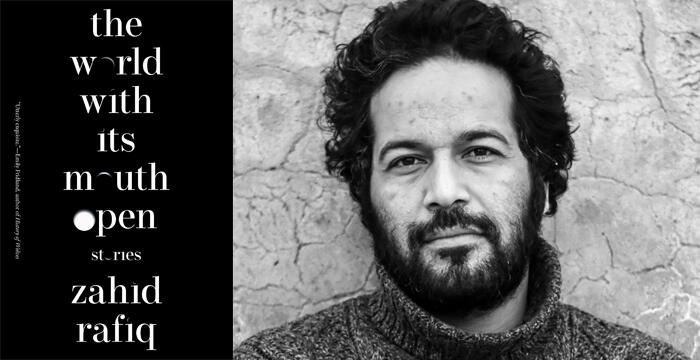
Today’s guest Zahid Rafiq discusses his debut short story collection The World With Its Mouth Open, eleven remarkable stories set in modern-day Kashmir. Prior to writing fiction Rafiq was a journalist and we explore the ways the stories he tells now, and the stories he wrote then, differ and overlap, We look at how fiction can contain the unsaid, the unknown even; how it can create space for silence, and, unlike journalism, tell the stories behind the stories. We explore the relationship of art and politics, especially when writing stories about ordinary lives and ordinary days, stories often described as quiet and understated, when they are, at the same time, set in one of the most contested and militarized places on earth.
For the bonus audio archive Zahid contributes a reading from the writings of one of the most important writers for him, Franz Kafka. He reads from the chapter “Waiting for Klamm” from his novel The Castle. To learn how to subscribe to the bonus audio archive and about all the other potential rewards and benefits of joining the Between the Covers community as a listener-supporter head over to the show’s Patreon page.
Finally, here is the BookShop for today’s conversation.
Transcript
David Naimon: Today's episode is brought to you by Sandra Gail Lambert’s My Withered Legs and Other Essays; a collection which Sonya Huber calls, "More than merely timely, these essays offer the gift of stability, radical perspective, and a reminder of activist lineages and how we survive: together." A collection of personal essays that reflects upon becoming a writer alongside discussions of disability, queerness, and aging. Throughout the book, Lambert engages with topics of ageism and ableism through storytelling rich with wit and contemplation. “Spend time with Lambert, whose wit and buoyant charm might just shift your perspective,” Brinda S. Narayan writes. My Withered Legs and Other Essays is out from the University of Georgia Press. Today's episode is also brought to you by Paraic O'Donnell's The Naming of the Birds, the next installment following the acclaimed bestseller, The House on Vesper Sands. The series has been called by the Wall Street Journal, “an enchantment, transforming a chronicle of sordid crimes into an enjoyably eerie ghost story,” and by The Star Tribune, “A tour de force that dexterously blends the drama of Dickens, the sensationalism of Wilkie Collins, and the mystery of Conan Doyle.” Following the antics of Inspector Cutter and Sergeant Bliss as they solve their strangest and most personal case yet, The Naming of the Birds is hypnotic and twisty, ensnaring readers until the final pages where they are left questioning what matters most, solving a case or serving justice. The Naming of the Birds is out January 7th from Tin House and available for pre-order now. Sometimes I read a new book and I think, “If this isn't the best book of poetry or if this isn't the best novel I read this year, this is going to be one incredible year.” That definitely happened with Nick of Time by Rosmarie Waldrop and Love Child's Hotbed of Occasional Poetry by Nikky Finney, two collections that felt criminally overlooked when they came out. It is especially surprising, and particularly rare when this happens with a debut writer. The last time that happened for me was reading Morgan Talty's Night of the Living Rez, where, while reading it and encountering this new singular voice for the first time, I was thinking to myself, “This surely will be the standout story collection of the year.” So it feels like a great way to open the New Year, a year that many of us anticipate with no small amount of apprehension, to start the year in the darkness of winter with one of those books like Morgan's, from a new writer whose book The World With Its Mouth Open was the highlight story collection I read in 2024, and a book that finds the beauty in the everyday, even though set in circumstances of great precarity, in a world writhed with violence. If that weren't enough, Zahid Rafiq, as you'll soon see for yourself, was an utter delight to talk to from our respective homes in Portland, Oregon and Srinagar, Kashmir. For the bonus audio, Zahid chose to read for us a passage from The Castle by Franz Kafka from the chapter Waiting for Klamm, which resonates particularly well with today's conversation. This joins many other incredible contributions to the bonus audio, whether Rosmarie Waldrop reading Edmond Jabès or Nikky Finney reading from Lorraine Hansberry's Diaries, or Isabella Hammad reading from Walid Daqqa's Writings from Prison, or Danez Smith's 30-minute poetry extravaganza, where after each and every poem they read, they design a writing prompt for us. Other possibilities for those who join the Between the Covers community as a listener-supporter include the Jewish Currents current bundle of magazines, a largesse of books from the great independent press, The 3rd Thing, or the Tin House Early Reader subscription, receiving 12 books over the course of a year, months before they're available to the general public. But whatever you choose, every listener-supporter is invited to join our brainstorm of who to bring on the show in the future. Every supporter gets the resources with every episode, a robust assembly of things I discovered while preparing, or things we referenced during the conversation, as well as places to consider exploring once you're done listening. You can find out about all this and more at the show's Patreon page at patreon.com/betweenthecovers. Kafka once wrote, “What am I doing here in this endless winter?” I'd answer, “We're here to create lights however small, and gathering them together to create warmth.” There's no better conversation for this than today's conversation with Zahid Rafiq.
[Music]
David Naimon: Good morning, and welcome to Between the Covers. I'm David Naimon, your host. Today's guest, writer Zahid Rafiq, completed his BA at Kashmir University, studied journalism as a Fulbright scholar at the University of California, Berkeley and worked as a journalist for 10 years in Kashmir where he is from and from where he's speaking from today. Writing for Indian Express, the Hindu, Tehelka magazine, and for many international publications including The New York Times, Christian Science Monitor, the BBC, Vice, Al Jazeera, Foreign Policy, and others. In recent years, Rafiq completed his MFA in fiction at Cornell University and has been a teaching fellow in the Humanities at Bard College, teaching online from Kashmir since 2022. Zahid Rafiq is here today to talk about his debut story collection from Tin House entitled The World With Its Mouth Open. Novelist Omar El Akkad says of Rafiq's book, “The World With Its Mouth Open is both restrained and revelatory. In eleven meticulously crafted stories, Zahid Rafiq details the human mechanics of modern-day Kashmiri life. There is so much of the world here, rendered in small intimate moments of grief, violence, humor, and wanting, every sentence taut as a tendon. Rafiq is a writer of considerable talent, and this collection marks the beginning of what will be a marvelous literary career.” Sindya Bhanoo adds, “Tenderly and exquisitely rendered, these eleven powerful stories track everyday lives, Rafiq reminds us that Kashmir is not a news item, but a home to real people, a place thrumming with life. There is instability and violence, but amidst this shopkeepers still negotiate with good humor, children play, the elderly count their final days, women contend with societal pressures, and families simply try to survive. A powerful debut by a talented writer.” Terry Hong for Shelf Awareness adds, “Victims reliant on others to record and remember their lives--and deaths--are many here; that indirect exposition seems to be Rafiq's clever reminder of an inevitable interconnectedness, even among strangers. His characters have doctor appointments, get fired, fall in love, help and hurt each other. Rafiq writes succinctly, almost curtly, encouraging readers to piece together elliptical details to deduce the rewarding narrative. Hauntingly astute, Rafiq is a storyteller to watch--and closely read.” Finally, MacArthur Genius' grant recipient Manuel Muñoz says, “A born storyteller doesn’t flinch from the beauty or the terror of the everyday. The World With Its Mouth Open is shot through with wonder and awe at how the humble story truly opens up the entire world. A fearless, outstanding collection.” Welcome to Between the Covers, Zahid Rafiq.
Zahid Rafiq: Thank you so much, David. Thank you so much for this wonderful introduction, and thank you for having me here. Listening to you speak about me almost felt like you were speaking about somebody else. [laughter] That's good.
DN: Well, before we talk about the stories themselves, I was hoping to talk about your philosophy of storytelling and your aesthetics a little bit. When we zoomed between Portland and Kashmir a couple of weeks ago to meet each other, one word you used a lot in many different unrelated contexts was "unknowing" or "not knowing." It came up when you were talking about interviewers who wanted you to have a clear or straightforward explanation. You brought it up with regards to teaching your writing students and also in many other ways. It seems like you used it, this notion of unknowing or not knowing, not as an absence of knowledge, or not only as an absence of knowledge, but more like a sought after presence, a quality you pursued within your writing, and perhaps in your life as a whole. I'm paraphrasing you here from memory, but you said something roughly like that you don't go to Kafka repeatedly because you understand him or in order to understand him. You don't keep returning to a tree because you understand the tree. You return to the tree to sit underneath its canopy to collect its leaves because of something else other than this acquisition of knowledge. As I say these words, I know that I'm not saying them as wonderfully as you said them to me back then. But there was a motif in our conversation that kept returning to a certain value of knowing that one doesn't know. I would love to hear more about this as a philosophy, if it indeed is one, and also about it as a possible frame from which to write fiction.
ZR: Thank you, David. Thank you so much. I've been thinking about it like not knowing and the pretence of knowing because I went for a while pretending to know but the truth was I didn't know. So the way I think about it sometimes is that I meet people and people say things to me and I have no way of knowing if what they've said is true or not true. I meet somebody on the street and they say for example that they've lost their bus fare, they need money, or one thing or another. And there is no way to know, I can't follow them, I can't go and investigate into the matter. I can't investigate into everything. I can't investigate into the truth of another person. There is a relationship that is built as much on knowing as on not knowing. This idea that to know another person, that we know another person by reading stories, we know other people, I think the truth sometimes might even be that we will have to live with the limitation of not knowing another person. Whatever it is, the way we relate to another person, another thing, another whatever, it might not be so much through knowing as through not knowing, we will have to live with that fate. We can't get to the bottom or we can't get to know. We can't say, “Let me first verify if it is true that you're actually hungry and I'll give you food,” or “Let me know if what you're saying is actually--” there is no way to know. So the question of how do we relate to a statement somebody has said, do we trust, do we not trust, do we believe, do we not believe? That becomes a much more grayer zone. That is one of the ways I think about not knowing and also not knowing oneself because it takes almost a lifetime to know. I don't know if one knows. I think the more you go on living, the less you know in a way. The more you are content to actually just let go and you say, “Let it go. Let me just take the day. There are problems that I cannot solve. There are things that are not in my control. There are things I do not know, I cannot know,” so this not knowing is a big thing, especially also for places like these from where I write, from where I live, from where I've lived all my life. There is this huge thing that there are these places of power, these places that call the shots that decide things and they happen elsewhere. We only get to see very light shadows, figures through the mist, figures through the fog and we are always piecing together, especially also as a journalist, I have this experience that one was always piecing together facts. One was always piecing together other people's words and yet one was deeply aware that somewhere someone knows but we don't know and the people know even less than I know and yet everything is so certain, everyone feels certain but actually no. I don't know if anybody knows but there are some people who know some things but we don't know even what they know. We're just piecing together the things. We just go after day after day, what's happening in that war, or what is happening to that conflict day after day. We don't even know what has been decided. Who has decided what? So this unknowing occurs on various levels, in various ways. Yeah, in the everyday, in beyond every day. In all of those ways, I think about it. It does, I think, inform the stories.
DN: Well, we have a question for you about that in the spirit of the question I just asked you from the writer Emily Fridlund. Emily's debut story collection, Catapult, won the Mary Macarthur Prize. She's a teacher of writing at Cornell, where you studied and her novel, History of Wolves, was a finalist for the 2017 Booker Prize, the Dublin Literary Award, and winner of the American Academy of Arts and Letters Sue Kaufman Prize for debut fiction. Past Between the Covers guest Ben Marcus says this about Fridlund's novel, beginning with a quote from it, "'Winter collapsed on us that year. It knelt down, exhausted, and stayed.' So much is accomplished here, not least a kind of trust that this writer will make everything count, including the kind of data that is usually left for dead in a story. What is literary authority, after all, but the ability to regularly, without apparent effort, make the most of every sentence, build feeling in every line and do it in such a way that is tough, tight, funny, and often brilliantly disruptive?" Here's the question for you from Emily.
Emily Fridlund: In an astounding mid-collection story Bare Feet, one of your characters goes on an agonizing wild goose chase. The narrator is a man who has returned to Kashmir after living years abroad and he has been sent by a ghost he does not recognize to deliver a message to the dead man’s family. As the narrator searches fruitlessly through war-ravaged streets and grief-stricken homes, the narrator says of the strangers he meets as he goes, bitterly, helplessly, almost longingly, "They are all asking something, and I can't understand what. But I know that it can't be asked in words, the loose change of words that seems no longer of any value in this country." Every time I read one of your stories ahead, I'm struck again by the way you seem to do precisely this in your fiction, ask what can't be asked in words. It is both striking and moving to me how precisely these stories draw the complex and ever-changing shapes of what I can only describe as negative space, that which, for many reasons, can't be seen, acknowledged, understood, or expressed. Yet, despite your commitment to making space on the page for what can't be asked in words, I'm also struck by how these narrative gaps in your storytelling never undermine the integrity or precision of your emotional landscapes. In other words, where other writers might risk vagueness in this refusal to name, your stories instead seem sharpened and freighted and deepened by it. It is something that must be accommodated, deferred to, engaged with, grappled with. One particularly salient example of this is the way in your first story, The Bridge, you describe a moving encounter between a pregnant woman and a suicidal man without ever using the words "pregnant" or "suicidal" to describe their current experiences. But there are many examples of this in your book, from a girl crying from an unknown source of pain in her bath, to a salesman trying to return a mannequin whose face expresses mysterious "agony, sorrow." I'd love to hear your thoughts on this in general, Zahid. If words might be so devalued, as the poet/narrator in Bare Feet suggests, by war, by anguish, by history, by death, what does that mean for you as a writer whose tools are words? What do you think about the relationship between saying and not saying in your work? Is there an approach you take or a practice you use, a feeling you rely on in deciding what to articulate and what to leave out? Is there an example of a story in which you struggled to draw that line or a time when you wrote more on second thought or pulled back? Is there anything you can share with those of us who are writers about the challenge of drawing as close as possible in words, our only tools to be unspoken or unspeakable? Thank you.
ZR: Thank you so much, Emily. I think no matter what I answer, my answer cannot even touch like the grace of the question Emily asked there. Emily is amazing, she's wonderful, her book is wonderful, and she's a wonderful person and a great teacher at the same time. So words, yeah, that's all one has in writing, in a way, that is true. Yet it reminds me of that poem, I guess, by Zbigniew Herbert. I don't remember the lines, but I remember I can paraphrase it. He says something, it begins like this, that the war has begun and all the able-bodied men have gone off to fight, and he has been given the job of writing the chronicle of victory or defeat but I guess in that case, it's defeat or probably in some cases, it is defeat. One uses words but they are very weak. There are moments when they gather together. In the world where there is so much brutality, so much injustice, so much poverty, so much of the horror and the terror, words really, I don't think count very much to be honest, but one writes because there are people who sing, there are people who draw, there is a child who scribbles on the walls, and the children must scribble on the walls. It will be a terrible world without even that scribbling. But at the same time, one feels there are moments, times when one feels it does not account for anything. All the words together, all the drawings together, everything, all of it together does not count together for the dead body of a little child who has been killed before its time. All of it put together might not equal that. That is a feeling that returns persistently, consistently that one sits down and works with, works against, works within. It's also that story that Emily mentioned, the one in a way most closely informed by my years as a journalist, of going from house to house to house for years. These were houses struck by tragedy or something terrible had befallen. Sometimes 10 years ago, sometimes 20 years ago, and sometimes that afternoon. Sometimes I knocked at the door, and a woman opened the door, and she was weeping. Then I began to ask her about somebody who had died, probably her son, her brother. When I left, I could sense that she was no longer the same woman who had opened the door for me. Somehow for my own reasons of writing a story, I had pulled her back. I had pulled her back. I had made her open the wounds. I had made her speak. So it was all that, what I had seen, what I had been through. But at the same time, what I did not want in that story was I did not want a story. I did not want anybody saying what had happened to them. It was the exact opposite in a way of the journalism that in the journalism, I would go and I would come back with a story. In this story, the only thing I did not want to do was to write the story. I just wanted to leave it empty. I just wanted to not say what had happened to them. I did not want them to say what had happened to them. I just wanted to go through it all without having to say what had happened. Because I had written so many times what had happened that it would have been yet another time of writing what would have happened. Instead, I really wanted to not write what had happened. I don't know if that answers the question, but that and then maybe there are also my limitations as a writer that I probably cannot move. I realized at some point that a good way of writing literary fiction is putting a character in and not knowing where the character can go or the character being unable to move. The moment you have a character who can't move through a narrative, you have a great recipe for literary fiction. It was an easy formula in a way. [laughter] There is all the sadness, all the terror, everything terrible that is on one side and the other side is my own limitations as a writer that I really do not have the force of like a narrator or a character who really runs through life, who can really stomp through life. My characters are people who are really at the fringes of their own lives, who want to arrive, who want to get to the place where they can have the steering wheel in their hands. But they just can't arrive at the steering wheel of their lives so they are at the fringes of their own lives and they're aware they have agency, they have dignity, all of it, but at the same time, they are also lost. They are also lost within this haze of what is life. It is a haze because I really am lost in it myself. In the haze of my own life, I keep trying to get back every Monday. By Friday, I am back. I'm lost again. It is not merely like I try to, it is how it is for me. The writing is really an extension of who I am.
DN: I really love this idea of you writing a story that doesn't tell the story or leaves a certain emptiness. I love the lines of Emily's about your work where she said, “I'm struck by how these narrative gaps in your storytelling never undermine the integrity or precision of your emotional landscapes. In other words, where other writers might risk vagueness in this refusal to name, your stories instead seem sharpened and freighted and deepened by it. It is something that must be accommodated, deferred to, engaged with, grappled with.” I also think of something that past guest, Hélène Cixous, has said about dreams that also makes me think of your writing, where she says, “But dreams are secret; their power is in resisting interpretation. What I call writing is very close to weaving the tapestry of dreams. What dreams give you is marvelous: You’re surprised all the time—and you feel at once that the dream has something to say to you, and that you don’t understand. But not understanding is part of understanding. Every time somebody tells you, ‘I understand,’ you may be sure they don’t. There’s nothing to understand.” I don't think your stories are dreamlike exactly and I don't want to give the impression that they are mysterious or cryptic as I think they're very grounded in the world, but so much of the grounded world feels animated by mysterious, irreducible things, irreducible real things, like questions of mortality or of beauty. Perhaps it is these things that what Emily calls your narrative gaps are actually accommodating. When looking at your style, we see a common theme, I think, emerge in people trying to describe it. A theme that suggests something large and small at the same time. Descriptions like “restrained and revelatory” or “gorgeously restrained” or “quietly shattering”. There's a sense of something abundant, and yet pulled back. I wondered if you had any thoughts, more thoughts about this emptiness that you've alluded to in your stories that, in a strange way, makes them feel very full.
ZR: Very like what Emily says, because partly the narrative gaps, the emptiness, is a conscious choice at the same time. I think what could have come in that space of absence was a presence that has been repeated so often that it wouldn't mean much, at least to me. For me, I was like, “I don't want that.” I wanted it almost to hurt. There was a certain degree of, which I think everyone goes through a certain degree of hurting that you go through while writing. I didn't want to make it easy for myself. The absences were part of that. Absences were not making it easy. We're not saying something that could have given consolation, that could have given the consolation even of the familiar. I would rather have an emptiness and live with the doubt if this makes sense, if this makes any sense at all for me, for anybody. If this is even a story, because when I started writing stories, my first question was, “Is this a story or what is a story?” Because the more I started writing them, the question was, the first was not, “Is this good or is this any bad?” The question was, “Is this one?” Because what is one? And have I written one? So I think there were times when I felt this is not one. Then I told myself, “If this is not one, then let it not be one. But I'm going to just write another one, I guess, of whatever it is that has been done here.” [laughter] The absence is, in my head, a very clear reality, a very clear reality that I don't know, that I meet somebody and I'm absolutely aware that I don't know what they're going through, that they're smiling, they're laughing, but I have no idea what is really happening, what has really happened to them. In life, I might often take the shallower approach and just keep moving. But when I turn to writing, I cannot ignore the fact that I think writing in that sense for me is to deal more seriously with life. I think that's why I would say the gaps, the emptiness is.
DN: Well, thinking about your question of “Is this a story and I'm going to write another one regardless of whether it's a story,” as a writer in Kashmir but one who studied in the United States, I was curious in a couple of ways about your experience becoming a fiction writer. First, just to extend for a moment the theme of unknowing, when I told you how uncontainable the enthusiasm was at Tin House for your book, where I told you that I have no idea what your experience was with the press, but from my vantage point, up and down the Tin House staff, everybody was mesmerized and excited about your collection. You responded that the editing experience was really great, and part of what was great for you was when they would say, "We don't understand this, but we don't need to." And similarly, when talking about your time at Cornell, working under Helena Maria Viramontes and Emily among others, you said the experience was really good because of their willingness to engage with your work by following where you wanted it to go versus how they wanted it to go. My first question about your studies here in the US is a curiosity about what your notion of the story was like before coming here and how it has or hasn't changed over the course of your studies here. How much did you come with certain notions of storytelling, whether they are South Asian notions of storytelling or not? And how much did those persist or change, did you come to Cornell with a certain notion of story shape, mode, or voice and leave with another one? Or did the people in the US come to accommodate a strong sense of how you wanted to tell your stories or non-stories in the end?
ZR: Cornell was amazing. I think Emily, Helena, John, everybody, they were amazing. Emily really, I think, helped me see my own stories better. Helena was amazing, her feedback was great. But I had my own ideas of storytelling because by the time I went to Cornell, I had already lived a certain portion of my life. It was informed by life and by reading lots of things, because everybody arrives there groping in the dark, one is always in some sense in a certain degree of darkness, even if you put all the bulbs on. So they did not try to change. I don't think I also change unless I change. So I can take all the feedback, but the change must come from within me. My ideas of storytelling are in the process of changing because I hope they are changing. I really wouldn't want to write a novel that is a novel form of the short story collection. I hope I can strive further and farther somewhere. I can plunge deeper and I don't know how. So in a way, it's like you somehow want to believe that you're gathering something, but what is that something you don't know? But you believe that reading other people's works, thinking, feeling, and writing, that you are growing, you are changing, you are able to get deeper toward sometimes a moment, sometimes a character, sometimes other things in fiction. But in America, I think everybody does not live in the same century, for example, that we here in a lot of ways live in early 20th century and the fiction that is in America, a lot of it is, I can't read it, I can't get there, I can't enter it, it's very insular to me, because the conversations happening there in lots of fiction that comes from the West, lots of fiction from lots of places, lots of fiction from various writers, I wouldn't say places necessarily, but lots of writers, some writers speak about a different world, and I feel I, being from here, am not part of those conversations, where I come from, God is still at the center. There is God at the center of everything. You may go right, you may go left, but there is God. That is a world I encounter more in books that are older, where the writer is running away and running into God. In that sense, I'm informed by the world I live in, the world as I experience it, the world as I see it, and also books that speak to me of world like that, speak to me of making sense of that world in some ways. MFA was for me a wonderful time I got to get away from journalism. It was the first time in my life when I was paid to do writing fiction. This was the first time and I'm so glad to have gotten it and it was a great time that I could spend with Emily, Helena, talk about writing, talk about books, talk about literature, but beyond that, I was on my own just as I'm on my own now. Yeah, that's how it was in America and now also.
DN: Well, in Booklist’s starred review of this collection, they said it was for readers of Arundhati Roy and Salman Rushdie which is obviously flattering given how skilled and accomplished and celebrated those writers are. But I don't think of their styles or aesthetics as being similar to yours and it made me curious what writers you yourself see yourself writing within the aura of you mentioned the writing that you have trouble entering, you're not part of the conversation. What are some of the writers that orbit your own life and orbit your own thinking or that you gaze towards with admiration?
ZR: Yeah, among the contemporaries I think, the living writers. I think Coetzee has been very important to me. Coetzee, for that clarity, for the precision of the sentence, for clarity, for speaking of the large things in very minute details. There is Coetzee, there is Naipaul, there is Toni Morrison, and then Dostoevsky is important for me. Kafka is very important. I go back to reading him all the time. I go back to reading books at random pages and start reading them. There's Chekhov, there is Tolstoy. I think older people make more sense to me somehow. They speak to me more clearly because their questions are still, for me, like, how does one live? How does one live with everything that is around us? And I think those are my questions as well. A lot of poetry, a lot of poets, [inaudible], I've been reading Cavafy. Lots of these writers are important. I think one of the earliest ones was Camus. When I read The Myth of Sisyphus and The Outsider, The Stranger, it was an amazing moment. I think I will always remember that moment. When I finished it, it was as if I had always felt something was wrong. But I didn't have the language to say, "What was it that I felt?" And I couldn't go around asking other people, “Do you feel that something is wrong about the world?” and not the world, do you feel that there seems to be another world behind this world, behind the screen of the world, that sometimes the curtain parts and you see this world and it's a strange world, it doesn't make so much sense as this world with its top layer? When I read Camus, it was like a revelation for me when I was younger and I was exhilarated at the same time. I remember that moment. That was a profound moment for me to feel that everything I had felt was actually real. Here is this person who's just expressed it with utmost grace and beauty and profundity. There were writers, like when I read A House for Mr Biswas by Naipaul, when I read all of Kafka pretty much, or when I read Dostoevsky, yeah, there were these moments that somebody had at the same time emptied me and at the same time filled me up. I think those are people who really speak to me, really spoke to me. Yet I would hope that I don't end up copying them. I don't want to copy them. The problem with copying these people is that you can only be a copy. Somebody like Kafka, there is nothing much he left behind. It's like he went into something and he exhausted the whole thing. So all you can now do is write what is called a Kafka's book. But it is almost like a shadow of it. It's seeing something through it. But in itself, whatever it was that Kafka was dealing with, he emptied it out. He did not leave much there for anyone else to do. He finished it out. [laughter] That's the same for Dostoevsky. They go and they finish up the thing. The idiom, they go for the metaphor, they go for the problem, the trouble, whatever it is that they're going for, they go to its very root. There is not much to do. Now you can describe the leaves, you can describe the other things you can do, many things. But they've actually gone for the very foundation of it. While I allow that, I wouldn't want to sit on Kafka's branch and say something. I would like to find my own little something to dig up and see what lies at the bottom of it.
DN: Well, you may have already answered my next question, a second question about your MFA experience, but I'm going to ask it anyways in the hopes that maybe there's more or maybe there's another answer. As I prepared for today, part of what I did was listen to a lot of podcasts about the history of Kashmir and it was definitely the case that the more that I learned, the less that I felt that I knew. That on the one hand it felt quite complicated and the more I explored, the more complicated it seemed, but at the same time on another level, I think on a fundamental one it seemed very simple. That despite or perhaps because of the long-standing competing desires and interests of India, Pakistan, and China, Kashmiris have never been asked what they want, that they've never been allowed to declare a preference in a meaningful political way, even though they were promised this vote in 1947 by Nehru. Multiple wars have been fought since then by outside forces rather than giving the people themselves a say. Similarly, I learned that Kashmir is the most militarized place on earth, with something like 600,000 Indian troops and 200,000 to 300,000 Pakistani. Your stories aren't directly about any of this, but I feel this in the stories nevertheless, characters going about their days are often walking past bunkers with the tips of rifles pointing out, for instance, a detail mentioned in passing. There's a great sense of precarity and the ever-presence of death and the dead haunting these stories. Perhaps similarly to the class you've taught called Return of the Dead: Ghosts in Literatures of Violence. Here in the United States, there's been a discourse for maybe 15 or 20 years about the difficulties for MFA students who are people of color in these spaces that are often white-dominated spaces, which most of these workshop spaces are, there have even been some deep reexaminations of the workshop model in this light as well. But I would imagine that coming from a place that's as particular and as particularly unknown to Westerners as Kashmir, with many elements of life that probably don't immediately transfer to the average American life, that that might invite an added level of fraughtness or an increased likelihood that your peers might stumble when trying to give you useful feedback. I was curious about the workshop experience in that regard, where I imagine you might not have had people in class with you who could readily immediately imagine themselves into the Kashmiri situation of daily life there in one of the most contested places on earth. Or maybe an inverse question would also be what did you learn about us in the process of being workshopped and having your stories workshopped by Americans?
ZR: MFA for me was really a good experience because I didn't expect very much. I think I would have written this book with or without the MFA and it would pretty much have been more or less the same book in many ways. But there are these moments which were amazing. For example, I remember asking Emily a question one day and we were on call because it was the COVID during the COVID period. I said, “Emily, I've been trying to work on my story and I was wondering if I'm editing it. I'm revising it,” and she said, “Yeah.” My question was, “Every time I do it, do I do it word by word, each sentence after each sentence?” She was like, “As opposed to what?” and I said, “I was wondering you guys have something that's why the program exists like you give me something that I don't have to do it like this.” [laughter] And she was smiling and she said, "Oh, I wish there was something, but it's just like that. It's sentence after sentence after sentence." I think the one thing I learned during my MFA was when I started writing these stories, also I've been a journalist, so a draft, two drafts, three revisions, and then you send it to the editor and the editor sends it back, that was my experience. Also, I'm not the most hardworking guy you would see. So I was hoping that I would write these stories as first drafts, that that's what it would be. Then I thought, “Okay, let me give myself a second draft. Okay, let me give myself a third revision, a fourth revision.” If I had known that I'd have to revise a story a hundred times, each story, I think I would have been so scared of doing it. But then it happened so naturally and I would go return to it sometimes with despair, sometimes with hope, sometimes with both of them together. What I saw at Cornell was other people revising, working, working at their stories. I was like, “Okay, that means there is clearly no other way if the Americans don't have a shortcut for it, because they're great at having shortcuts. So if they haven't found one, they don't have a machine yet so that means there can't be anyone for somebody like me. So the best way is to go about it line by line again.” [laughter] I think MFA was like that. People were very kind actually. Sometimes I thought people read the story very differently, but I totally accept that because I had left that room of interpretation, it allowed it to be read by someone other way. But by large, very generous, I think. Sometimes too generous, because there is a certain degree of politeness that is part of the MFA programs. But it was a good experience. I'm sure there are lots of people whose experience is not the same as mine so I only speak for my experience. Also, these are, as you said, spaces that are dominated by certain discourses, certain people. But I came from here for a couple of years. I was so focused on my own thing really, that I wasn't seeking an entry into anything, I was only seeking an entry into my own work, into my own voice, and I was willing to take if someone helped me along in my own journey, not in telling me where else I could go, what I could do with it, or if somebody had told me, for example, like, “Make a linked collection of these stories.” I would never do that, because if I had to write a linked short story collection, I would write a linked short story collection. If I had to write a novel, I would have written a novel. I had precisely written a short story collection because that is all I was good for when I started writing it. I had ideas, but I did not have a large central idea, I realized that. I had lots of small ideas, small feelings, characters. When I started writing them, they presented themselves, they came out of me in the form of stories. That was their true expression. What I really was after, what I really am after is to speak some kind of truth, some kind of small, big, vague, ambiguous, but truth. I was willing to take the advice that propelled me toward that truth, toward my truth. Other than that, I was not very focused on going much anywhere. For example, while speaking of MFA, there was a time when I started to send it to journals and my work to journals. The journals wouldn't accept and I realized that every time I went into sending the stories out, it was falling into a rabbit hole, which led to anxiety, which led to doubt, not the good kind of anxiety, not the good kind of doubt. It was a bad kind. It was like it was somehow falling into bad faith. It was judging my story through some other people whom I didn't know, whose priorities, whose ways and means of understanding are privileged in a work I didn't understand. I realized that if I go on that path, it's not a good path for me. So I understood that the best path for me was to keep working on my story irrespective of whether it got published, whether it did not get published, who published it, who did not publish it. I just wanted to write this book that was real for me. Its fate was getting written. That was what was most important to me. For that, MFA was great for me.
DN: Well, we have some questions for you from me and also from others about your journey from journalism to fiction. But before we hear them, I was hoping we could hear the opening to your short story In Small Boxes, which is told, unlike most of your stories, in first person, from the perspective of a journalist.
[Zahid Rafiq reads from The World With Its Mouth Open]
DN: We’ve been listening to Zahid Rafiq read from his story collection, The World With Its Mouth Open. Our next question for you from another is from someone who, like you, was a journalist before he was a fiction writer, Omar El Akkad, the author of two award-winning critically acclaimed novels American War and What Strange Paradise. Before these books, he was a journalist with dispatches from the war in Afghanistan, the military trials in Guantanamo, the Arab Spring in Egypt, and the Black Lives Matter movement in Ferguson. His first book of creative nonfiction comes out next year. It's called One Day, Everyone Will Have Always Been Against This, a book which past Between the Covers guest, Rabih Alameddine says, “Is this the most urgent book you can read right now? Yes, it is. Is this the most moral book you can read right now? It sure is. Is this the most eye-opening book right now? Yep. Is this the most needed book for our times? Absolutely.” Here's a question for you from Omar.
Omar El Akkad: Hi Zahid. My name is Omar El Akkad. I'm a writer based in Portland, Oregon. A few months ago, I had the good fortune of receiving an advanced copy of your collection and one of the many things I loved about it was, for lack of better phrasing, this undercurrent of something almost serene that seemed to walk hand-in-hand with the calamitous. I kept coming across these characters for whom something as intense as surviving a massacre could still exist on the same spectrum of discomfort as, say, pain in the legs from sitting too long. I found this really fascinating and really beautifully done, especially in the context of some of your earlier work, some of your earlier journalism, which I think particularly in the West would be defined as conflict reporting, which I've always thought of as carrying this caveat that the subjects of conflict reporting are people for whom intense violence suffering is the only mode of living. Then I read these short stories, and they're full of these meticulous human details, and this incredible subtlety, and this incredible complexity, which I think is mirrored in your journalism, but is presented here in an entirely different way. I suppose the question I had is about whether this movement into fiction felt freeing at all, to be able to write these characters and the small mechanics of their lives without this daunting gaze that assumes certain people are only made to suffer. I'm wondering how it felt to move into the world of fiction, having done the kind of journalism that you've done previously and done so well. Thank you so much.
ZR: Thank you so much, Omar. Thank you so much for reading my book. Thank you for the kind words, the generous words. It was freeing. It was liberating. As a journalist, I was writing stories, but there was always this question of what in journalistic language we call the peg. What is the peg? Why this story now? It's almost as if there is a nail hanging by the wall which is a peg and we need to hang this thing by it. I always saw there was so much that didn't have a peg. It was just there because it was there. It was life, and I wanted to write about that life. When I was doing journalism, for example, toward the later part of my work as a journalist when I was a freelancer, I would often go out of Srinagar into the countryside of South Kashmir to the North, and in autumn, it would be early autumn, it would be beautiful there would be walnut trees and the dappled shade of walnut trees, I would be driving on these roads and the fields were empty and open and it was beautiful. I was going for a story where somebody had been killed, something had happened, something terrible had happened. I realized that I had started taking the longest route possible to delay my own arrival at those places so I was always taking the longer routes. I wanted to write about the walnut tree because I felt the walnut tree was part of the same story somehow of this landscape, not just a physical landscape but a landscape in which everything was happening and I wanted to write about all of these things, the people I wrote about. The things I remembered of them were not necessarily the things that made into the stories. The stories I did to the best of my ability to say what had happened to say what they were saying but at the same time, I remember people's faces, just faces, or the exact moment of people breaking down, or something else that was on the wall, something that was on the chair, something certain way the shoes were, that were not part of that story. Yet I felt that this actually belonged more intimately, more closely to what the story was for somebody who was living here, who had to live all his life here, whose fate it was not merely to report on these stories, but to live, to be born, to die here. It seemed whole. I wanted to enter that whole without a reason, without the reason that here is a story because something has happened. So when I started writing fiction, slowly, and it didn't happen at first, slowly toward the later half of my stories, I felt a certain freeing in myself. I wasn't asking myself repeatedly, “Why am I writing this story? What has this got to do with what is happening? What has it got to do with everything around me?” Slowly I could write about people in their own life, their life being dictated by the larger circumstances in ways that they themselves were unaware of. I wanted to go as close as possible to how one inhabits one's own life, to attempt to go there, to attempt to go outside of me toward the shores of someone else's being and that was liberating. In that sense, fiction is liberating.
DN: Well, even though here you're contrasting journalism to fiction writing, I agree with Omar that there's also, I think, a mirroring effect between how you wrote your journalism and how you write your stories. I'm going to try to characterize it, my experience of it, and then I want to hear what you think about it. You've said before that, “In journalism in a war, the focus is eventually on numbers. One body, two bodies. But in my fiction, the whole point is to focus on the human being. To ask, what it means to live, to die, what it means to waver in between?” But I would argue that your journalism was not typical of the journalism you describe here in that quote. It didn't focus on numbers and the quantifiable but sought out the humans behind the numbers. I think of a narrative writing workshop that was given within the journalism department of the Central University of Kashmir where you were one of the teachers. The description of this three-day workshop went as follows: “The importance of Narrative writing can be traced in a statement of Professor Norman Sims, Co-editor Literary Journalism: ‘At a time when journalism seems crowded with celebrities, literary journalism pays respect to ordinary lives’.” I'm returning now to the description of the course. “No one as such would want to do anything about the ordinariness of one’s own life or of the life in one’s surroundings unless the stories of ordinariness have some bait to attract attention; and that bait is the creative expression with which these stories are narrated. There is certain chemistry between the written creative expression and the element of human interest immersed in one’s past: in nostalgia, in the memories of moments one cannot forget. Narrative writing brings the unheard and inconspicuous ordinary people—who somewhere form a necessary support to the life at large—to the centre of public focus. Creative people develop lasting relationships with real-life characters of their stories.” To me this feels like it connects your journalism and your fiction, where both focus on the human and the ordinary in some respects, but that they contextualize it differently. For instance, in your New York Times article about the hundreds of people blinded by pellet guns shot by the police in the crowds, your story doesn't center the statistics, but rather foregrounds the story of you visiting a 21-year-old who was blinded in both eyes. In your journalism, that story of this one person comes to represent a larger political reality. But in your fiction, the menace of life is more like the climate or the atmosphere rather than the subject. In one story, there's the discovery of a body as a couple has the foundation dug for their new house. In another, the protagonist is visited by a ghost. But we also learn that everyone is haunted by a dead family member, even though the story doesn't explicitly say why those family members are dead. Or a story set in a graveyard where we learn that really on almost every day you can see someone now being buried. These don't get contextualized, at least not politically, and sometimes not at all. Death, mortality, hauntings are all maybe more like metaphysical forces, maybe like some of these Russian writers you mentioned earlier, but at the same time, it feels like it's another lens into the same thing as the way you approached your journalism. I wondered if that felt right to you or whether you wanted to push back against this characterization.
ZR: No, it's exactly right. Yeah, I don't know where you picked up that Central University workshop from. I had forgotten I ever did that. [laughter] But yeah, you're right. I think I was always a fiction writer writing journalism. It was also part of where I came from. It was my class. I wanted to be a writer, but I just didn't know how one became a writer. The times I was growing up, journalism was the writing. That's the reason I went in. I've been very lucky. I think I went there because there was a lot to learn. I was very lucky to have teachers who are also my friends. Somebody when I went as an intern to work at The Indian Express, the guy who headed the bureau, Muzamil, he became a mentor. Lots of the ideas that I was exposed to early on about writing about the ordinary person, writing about people came from him really. They resonated inside me because I knew, “Oh, that's what I want to do and that's where I want to go.” He immediately saw I'm not going to write the number story. I don't have it in me to ever break a story. I never in my life broke a story. I just didn't know how to have small talk with the officials. I just couldn't do small talk. I just couldn't wish them on their birthday. I just couldn't do it. I liked some people, I disliked some people. Just as in life and the people I liked, I became friends with them, the people I disliked, I never met them again. He immediately realized and he's a fantastic journalist. It was him, it was another friend who was older to me, Hilal, another friend, Javed, all of these people who when I went out into the city, from my home, I met these people and they were older to me, 10 years, 8 years, 12 years. They had seen the worst phase of the war by then, they had lived through it, they had seen a lot of it. Lots of my exposure to books comes from it. They recommended books, for example, Camus was recommended by a friend, something else was recommended by some-- So it was a kind of growing up within this atmosphere, this climate so it's true, absolutely, that I never really wrote the number stories. I really pursued the human being, the human element of these stories. But then I was again always a fiction writer. I was always a fiction writer since I was like 17. I'm glad I didn't write fiction then. I tried, but I didn't write it then because I think I really wasn't ready. I could have hurried, I could have done lots of things, but yeah, so my journalism was more like the eye of a fiction writer, looking for detail, looking for other things, feeling, and it wasn't even conscious. That is who I was, that is who was going to the house was a certain kind of person, with a certain kind of sensibility. If you asked me, for example, what is the population of Srinagar, I swear I have read it at least 100 times, because I can't not know it. Yet, every time I forget it, I just don't know numbers. I just am not wired that way to remember numbers. But I remember faces, I remember somebody's voice, I remember somebody's face, I remember what somebody was wearing 15 years ago when I met them, the only time I met them. I think there was always that pursuit of the human as you called it.
DN: If I think about the absence of a political context in your fiction, I might think of Kafka as a kindred example, work that can feel fable-like and political at the same time, and yet you don't necessarily know or need to know about Kafka's positioning as a German-speaking Jew in Prague and how that manifests or doesn't manifest politically within his stories to engage with them. But if I think further about your journalism, it also feels like it touches on the Kafka-esque even when the details are included. For instance, one of your pieces is called No One Killed Three Civilians in Kashmir, which sounds like it could be a Kafka title. Sustained with this journalism fiction spectrum, we have a series of questions for you, three discrete questions from another journalist-turned-novelist, Mirza Waheed. Like you, he's from Kashmir, though he's now based in London. He was a journalist in Delhi for four years, came to the UK over 20 years ago to join BBC's Urdu Service in London, and has since made his name as a celebrated novelist. His critically acclaimed and bestselling debut The Collaborator follows a young man amidst the Kashmiri conflicts of the early 90s and was named the best book of the year by many publications from the UK to India. The Sunday Telegraph says of his second book, The Book of Gold Leaves, “Waheed’s new novel returns to 1990s Kashmir. If The Collaborator was journalistic in its zeal to explain Kashmir . . . [here] what keeps you reading is the story. He relies on family dynamics to drive the action . . . it’s ultimately how the novel accounts for the moral toll of war.” Kamila Shamsie describes his latest novel, Tell Her Everything, as “a powerful, profound, and important novel that explores how small men become party to huge crimes.” Here's a question for you from Mirza, or three questions for you from Mirza.
Mirza Waheed: Hi, hello, Zahid, this is Mirza Waheed. I love the stories in your book. What a joy it was to read The World With Its Mouth Open. Many, many congratulations. I have a couple of small questions and perhaps I want to start with what one of the characters in the story In Small Boxes says. "Truth is hard," Mr. Hussain said, "offers no solace. I prefer beauty myself, but you, a journalist in this war, how long can you hide in beauty?" So I wanted to ask what brought this on given what this character Mr. Hussain says goes to the heart of what we do as writers and this question of what a writer does with their words has perhaps become all the more pressing in these times. It is of course essentially about that age-old problem. I say problem because it has been made so particularly in the West, “Oh, you can't really mix literature and politics,” and so on. This question of art and politics, how do you do one without the other? Or perhaps, if you like, you could talk about the place of politics in literature and art and how you navigate that particular delicate problem, as I said. The other question, comment I have is about the story The Bridge which I completely adored. Nusrat meets Raja after a gap of many years, then he goes missing as she waits for him and then she's unable to find him. She waits at the street where she encountered him for the first time after such a long time. What brought about this story, in particular the figures of Nusrat and Rajaji, they're both lonely people, as far as I understood the story. They're lost but they're also trying to keep hold of some idea of their being. I found the social isolation of these characters quite remarkable and unforgettable and that their losses perhaps also echoed in how the story ends. I guess I wanted to ask was that a deliberative decision or is that how the story arrived and happened when you were writing it? And if we have time and also wanted to ask about the story of Crows, that teacher in the story, his violence, I mean he is physically violent but his violence is verbal. I was struck by the violence of his words. He offers no hope and it felt to me that he feels he must transfer all his hopelessness to others, in this case students entrusted to his care. It's an unforgettable image. Also, an image that one kind of remembers from childhood. You know, when you think when you're a child and you think, "Why is that particular teacher mean?" So the question is perhaps a more direct one, which is, was this teacher based on a real figure? I asked this because he gives me a chill. Thank you.
ZR: Thank you, Waheed. Thank you so much. Thank you for reading the book. Thank you for the questions. Thank you for the generous words. The first question about art and politics. From where I write, for example, from where Waheed writes, from where lots of people write, there is no way simply to separate the two. Or maybe I cannot imagine. It is probably not within my imagination because I did sometimes think, “Let me avoid all of it.” Yet in very small detail, a word would enter and slowly it would bring another word with it. I was on a trajectory where even if the people were talking something else, the street they were walking on was very political. The air they were breathing was informed by politics and history. But I didn't want to go there. I didn't want to write it. Because I had been writing it for so long. I had been writing this not graph for so long that Kashmir is contested territory, all of that, that this has happened. I just didn't want to write it. I wanted to-- like we walk on the street here. We go out. We have a good time and yet the air we breathe, we look far enough, we remain quiet for a moment and we are with violence. There is a lot of violence that has happened. There is a lot of violence that seems to be hanging about us. There is a doom that hangs about. You look far away or if I look far away, it is darkness, it's a void. So, I wanted to bring in that void, but as the void, as the many shapes that void can take, as the many feelings that void can take. Like this book, I don't think it is without politics, but I tried to not let the politics take over, the politics that is apparent. What I was really interested in also was what does one do now? Or what has really happened? For example, the other story he mentioned, Nusrat and Rajaji, they live within the same climate. But Nusrat is a woman who is pregnant. She has had two miscarriages. She is precariously pregnant. Yet she is willing to risk it one more time because she wants to bring life. She wants to have a child. She really wants it. She really wants a child and she's going to go for it, and there is Rajaji and there are these suggestions almost that Rajaji wants to end his life. It is a meeting between these two people and it could be anywhere but it's here, it's precisely here in Srinagar that they meet. The contours of their meeting, the possibilities of their meeting are defined by where they are of the reality of this place. Their loneliness is a private loan, because it's a community. Everyone is together. People live like 4 people, 10 people, 8 people in a house, everybody is hanging out with everybody else. Yet there is a quietness, a solitude, a certain fate that has befallen you and you alone and the way it has befallen you, you have to live with it. You can talk about it with somebody, you talk about it, you talk about it a second time, a third time, and then you can't keep talking about it all the time, then you have to live with it and the living with it, the living of one's own life creates a kind of a boundary within which one lives. That is the kind of seclusion. One lives within the seclusion of being oneself, even though one doesn't, one is not invested in finding out who one is. “What is my real self,” one doesn't ask those. Yet one lives within that seclusion. These were two people who knew each other at a certain time and now when they meet again, they are those people and yet they are not those people and what they have become, they cannot tell each other what they have become or what has happened. Yet there is this moment of connection and it can't be a complete connection. It's almost a cross connection. You call somebody and somebody else picks up. It is a meeting with a stranger and acquaintance. For a brief moment, they are by your side, but you can't tell them. What would it do if you told them your troubles? You can tell, but that's another story probably. In this one, they don't tell each other. It is just the company, just the presence of two people who keep on for a moment, keep on for a while with each other and they know that it's not like they'll get together and the problem will be solved. They must live within their own boxes, within their own emptinesses. I guess that's where that story came from. Yeah, I wanted to write about the guy but I realized that somebody else was looking at this guy and it was the woman and that's when the woman came in. And then the woman took over the story. She really took it over. It was she. She was important. It was her life that was the center. It was she who slowly began to fill it up. I don't know if those answer the questions. The third one about the teacher, he's violent. But that's what he thinks of the world. He thinks the world is a violent place. If I prepare these kids with a certain degree of why, it's like inoculation. If I inoculate them with a certain degree of violence, if I inject them with the virus early on, I might arm them with what they need to fight with the world and he doesn't know any better. This violence that is in him is the violence that is around, is the violence that has been meted out to him, and he's angry, and he is bitter, and even his hope, he has hope, but I think even that hope has taken the form of violence. It is also not just him, it is the boy's family who want to escape their circumstance, who want their kid to become something, but there is such violence about this becoming. There is violence about becoming. Even when one takes on the reins of one's own life, there is a certain degree of violence one inflicts on oneself to become something or what one thinks is one is becoming something. It is a certain time, a person and that person deals exclusively in violence, but also kindness. There is a moment when he's aware that the boy has been beaten up. He's thirsty. He throws him the bottle of water. It is the love of a broken man, a bitter man, a man who has been offered no hope really in a way. Somebody said to me once recently, this guy is amazing and he asked me, he said, “Do you know what is the love of a butcher?” And I said, "No," he said, "The love of the butcher is the slaughtering of lambs."
DN: Yeah.
ZR: It's like that. In fact, I think if anybody loves the lambs the most, it is the butcher. Or maybe not. I must always say maybe not because I don't know half the time what I'm speaking about. [laughter] So I don't want to say all these things and then think that I should have added maybe not. To some degree, I think to return to this guy, yeah, there is violence, but there is also love. But sometimes and often, as Philip Roth says, everybody has a home and that's where the problem begins. It's like that.
DN: Yeah. Well, there's a paragraph in the story In Small Boxes that I imagine as being close to your heart. Perhaps a wistful remembering of some of the positive ways of your previous life as a journalist. Even though I know this might not be true at all, that my imagining of what you feel about this could be completely wrong. But here's that paragraph: “Day after day, I wrote about the city's decrepit roads, its clogged drains, and the menace of its stray dogs, and sometimes when the senior reporters had the day off, or if the day was too bloody, I, too, was asked to write about the killings and the gunfights. In all these stories I tried to slip in a beautiful line or two. These lines, however, never made it to the page the next morning. The stories reduced to a skeletal form that robbed them of every trace of me. Eventually, I stopped reading my own stories and then the newspaper altogether, but I went on loving the job for the spontaneous life, for the loitering and the sitting at the tea shops, for the unending discussions amid the smoke from the cigarettes that seemed to be part of the profession itself, and for the way it kept me away from home, late into the night, which to me felt an immense freedom.” In thinking of this passage, I wanted to stay with a couple elements of Waheed's questions. That line he quoted from, from the same story, with Mr. Hussain addressing our journalist protagonist which goes, "Truth is hard," Mr. Hussain said, "offers no solace. I prefer beauty myself, but you, a journalist in this war, how long can you hide in beauty?" Having moved from journalism to fiction, I don't think you are hiding in beauty. Besides the writer and journalist protagonist, most of the people in these stories are definitely not explicitly engaged with the political, but rather getting through their days. You have a class you teach that looks amazing to me called Bewilderment of the Naive, where the description says, “What does it mean to be naive? Who is naive? What does the world do with naive people? Why and how does it tend to turn the naive into ‘worldly'? What do we lose when we become worldly? What do we lose if we remain naive? In this course we shall look at the world through the eyes of naive people. From a young man turning away from a riotous city to a child’s uninitiated view of racism to a man lost in the labyrinth of law, we shall try to see what lies within this naiveté.” I wouldn't consider your protagonist naive. We usually don't know their thoughts or lack thereof in this realm. We don't know whether they're engaged politically in an overt way or not. The absence of it being in the story, I don't presume it's absent necessarily in their lives. The person trying to build a house or another leaving flowers on a grave or another acquiring a mannequin for their shop or simply someone buying food, I don't get the sense one way or the other of the relationship to questions of truth in this journalistic sense. The epigraph to this book from Kafka, “How about if I sleep a little bit longer and forget all this nonsense?" I don't know if the characters feel this sentiment exactly, but it does feel like in their centering of the small and of the daily, that they are often trying to nurture or to coax forth some small beauty. Similar to when Omar speaks of the sereneness of your stories and how the pain in one's leg is almost on the same level as the pain from a massacre, it also feels true about beauty too. The small beauties feel as large as any large ones could be. I guess I wondered if this sparked any further thoughts for you about Mr. Hussain or about naiveté or about what your characters are and aren't thinking and doing.
ZR: I feel sometimes, for example, the naiveté is also relative, that you have an awareness. Some of these characters have an awareness of where they are. They're not naive in that sense. But certainly without their knowing, things have flipped or they have entered another zone. In that zone, they carry a previous sense of space. The moment they are in this new zone, they are rendered naive. They no longer know where they have entered. They have just taken a right turn or a left turn or they've just left home, they've ordered some new thing. That naiveté is not, I might be wrong, but the way I think, it's not a fixed position. One can be reduced to a position of naiveté, the moment the context changes. For example, the story you mentioned about the people who are building a house and they find the hand while they are digging, it's more like the laborer, the young laborer. He is a little bit naive in what he seems to ask for without understanding that they have different reasons for choosing the way they are choosing, the couple who is building the house. They seem to be doing very well until this other man comes with the architect, who they do not understand. It is in his presence that they suddenly feel naive, because the game almost has been changed. Something has changed. We don't understand what has changed. But something has changed by his very presence. The moment he enters, he has changed something. A new knowledge has entered. A knowledge that is not understood in the story, not understandable to any of them. They are certainly in the presence of something that is mysterious to them. In that moment, they do appear naive. Naiveté in that sense is not a fixed thing. One can be reduced to a certain degree of naiveté, one can arrive at a certain degree of naiveté, you almost move between worlds. There are several worlds. You open doors and you are in another world. You certainly get a report that you're sick and it's like a door has opened and now you have entered another world and what you carry from behind is not going to be of much use here. Here are going to be different gods, different angels, different demons. Your relationship to everything has certainly changed. All of those doors exist. In that sense, naiveté, for me in these stories, and about Mr. Hussain, sometimes I do feel I'm hiding in beauty. I do often feel I'm hiding in beauty sometimes, at least. But what would require me to not hide in beauty within fiction will be a deeper plunge. It would be, for example, jumping and calculating how far I can jump, how farther can I go before I turn back. To have the courage to go farther beyond the calculation of if I can make my way back, that would be a refusal to hide beauty. That would be risking it. The courage to make a mess of the work. That would be, I think, a real risk here. The challenges here are different. Journalism has its own challenges, fiction has its own. But with fiction, I think, to make it move beyond beauty, to go else, to go farther, to go farther, where beauty and terrible exist at the same time, they are almost the same. In the same instant, they look terror and beauty both, to go that far, to go close to what is absolutely terrible as a writer, to not return, to not find the place of safety, I guess that would be here risking it. As long as one doesn't do that, as long as I don't do that, I feel I will be hiding in beauty.
DN: Well, the other thing I wanted to stay with is Waheed's noticing of the social isolation of the characters; characters who are lonely and lost, but in his words trying to keep hold of some idea of their being. How their being lost is echoed in the ending of the stories as well. Because I noticed all of this too. When he was saying it, I noticed that this was true for me also. Perhaps this is what Kirkus meant when they described these stories as "like elegies for the living." I found myself frequently, even though it isn't stated as such, connecting the 80-year history of Kashmiris never being given a chance to determine their own fate and also things like the law that gives immunity and impunity to Indian soldiers, actions within Kashmir where none have ever been successfully prosecuted for any abuse. Where there really ultimately doesn't seem to be a means through the system to either seek a sense of true self-expression and liberation or to seek justice for injustices that occur. I see this echoed in the shortened horizons for these characters and also the precarity of their lives. Whether the opening story, The Bridge, which is one of my favorites, the woman seeking medicines to prevent miscarriage, her first miscarriage having been blamed on her barren aunt's evil eye and the envy of her sister-in-law, the second one accompanied with lots of prayers, and here she's pregnant again a third time years later, and you can feel the precarity of her life if she doesn't fulfill her role as a mother, or at least that's what I read into it. I heard you speaking about her just having a more simple desire to be a mother. But it felt like there was also the anxiety of what happens if she doesn't become a mother and her anxiety when she meets someone by chance that she hasn't seen in many years, who then accompanies her shopping, being worried, being seen out in the world with a man who wasn’t her husband, or Salim in another story, looking to be a salesman, where his father no longer works, his brother has been killed, and he himself is uneducated and having trouble finding anyone who will trust him. There's also the sense of the potential that if you end up on the wrong end of community gossip across many of these stories that your life could maybe derail in some way. Perhaps the one that I least knew the meaning of, I didn't need to know the meaning of this, but Mr. Hussain is outraged because someone has printed his obituary in the paper with the contact info, address, and phone number of him and his family within it. Obviously, it feels menacing, but to what degree I have no idea. I have no idea if this is a simple blunder or a mode of delivering a real threat and what possible threats are on the table by this act. But thinking of all these characters trying to build a life, like Waheed, I think about how they echo against the endings of all of these stories to the point that I suspect you must have a philosophy around story endings, or at least a strong preference and predilection when it comes to how you want your stories to end. They remind me of Chekhov's endings in some ways. They definitely don't end in epiphanies or resolutions or even a change for the character. One story ends with the line, “Branches of trees sway in the dust. Birds fly in dirty puddles. My feet walk on their own, and beside me a dark mass moves in its own quiet way.” Another ends, “I ran past him through the dark corridor, past the latched door, past the yard, and stumbling over rotting fruit, past the pear tree, and ran and ran through the mist that blurred away everything.” Reading these, it doesn't spoil the stories to read these, because these endings, they have more to do with mood, I think, than narrative or event or change, and perhaps this is tied into your own wondering, “Are these stories?” But talk to us about your endings, because I sense a connection between all of your endings, and I feel like your endings reflect something back about what you think about your characters and their life situations.
ZR: Yeah, endings, endings. It's like a mix of limitations and philosophy. With Emily, we would speak, we would meet, we would talk, and she would say, “Zahid, we're always talking about endings. Story after story, they were the endings. There was the problem of the endings,” because the stories wanted to go on in a way, or they could go on. By the time they were really about to end, they had finally become themselves. They now were themselves. I really did not want to add my endings. I was really hoping, really trying, really struggling for the story to give me its own ending, even if that was not an ending, but itself. I wanted it to be itself. Even if the beginning was mine, the ending must be its own. With dogs that happened especially with many of these, I had few endings in mind, a couple of endings. But every time I started writing them, it felt contrived. It felt it was me. It was me trying to end it and I didn't want to end it. I wanted it to end itself. Even if there was no ending, I would rather have it stop when it was itself. I would want it to stop at itself rather than me coming in the end and joining the ends, joining the loose ends, trying to make sense of it, or trying to say something. The thing about change, there are so many people, so many times, so many experiences, we don't change. People don't, one wants to change, one wants so terribly to change, and yet one cannot change. One returns to being oneself. In that sense, these people are themselves. They are in the process of changing. I felt that to make them, to change them would be an act of me putting my hand in there, me making things change. I hope there is change. I think there are very small changes in there. But it's not me. It's not me who is saying, “Let me show that this character has changed or something has changed about them.” If something has changed, it's something so slight that it's almost just the light falling through the leaves, the light reflecting through a certain glass. It is just that bit and that is what it is. The rest, people will have to live with themselves. People have to live with themselves. You want to change so badly and yet you can't change. You make promises to yourself every night that I'll be a better person tomorrow morning and you wake up already grumpy and you woke up whining and petty. You wake up petty again in the morning and there is no way to remove that pettiness. [laughter] It is the sadness of having to live with pettiness.
DN: Yeah.
ZR: I wanted to say something else, something you talked about the death and everything. I remember I wanted to mention this that when I started writing these stories, it was very funny because these characters were dying on me. They were just dying at every page and I just thought, “I can't do this, they can't die.” I just wanted something to happen, somebody to go through something, and my mind was saying, “Then this guy dies. Now this guy's going to die. This guy is going to die like this.” I was like, “I don't want them to die.” In a way, it was really a struggle to keep them alive. It was really a hard thing to bring them to the end of the page and say, “I'm not going to let you die. I don't want you to die. You can't all die on me. Because what am I going to write a collection about if you're all going to die on me on every page?” [laughter] That was the kind of death one was dealing with, the kind of life being snuffed out.
DN: Yeah. Well, you might think by what you just said and also by my description of how these stories end, that the stories are hopeless, or that perhaps like the sadistic teacher in the story that brings chills to Waheed, that you like the teacher, in Waheed's words, not only offers no hope, but transfers the hopelessness onto his reader the way he does to his students. But the endings, while they don't necessarily suggest change, they paradoxically seem to always be suggesting possibility. I think that is true about your stories at large. I was trying to puzzle through how these narrowed horizons for your characters, and also the ubiquity of death, at least on the margins or as a climate of a lot of these stories, could also be stories of possibility. In meditating on this, I thought about something another past guest said, the Chilean poet and visual artist Cecilia Vicuña, a poet who's lived in exile since the 1970s, and she calls her art "Arte Precario" or "precarious art" and in a video for the Tate Modern, she says she calls it "precarious" because “it disappears. Because it's fragile. Because it's vulnerable. Whether it is a twig, a stone, a piece of metal, a piece of plastic, everything to me feels alive with history. With decay. With the potential and possibility of dying, of dissolving, and for me that is its beauty.” Somehow I think of your stories in this light too, almost like precarious art or the ways in which you portray, in her words, "the potential and possibility of dying, of dissolving, and for me that is its beauty," that it is somehow tied to this question of how you portray and in what ways you portray precarity and the possibility of death with possibilities that aren't death, that possibilities are, that are other things. Because I don't read your stories and come away feeling hopeless. But if I were to describe the lives of these characters as a list, not as a story, I might think that there was hopelessness.
ZR: There is a hopelessness, but they're not succumbing to it. Very little moment, for example, in the story Crows, when the boy is beaten and he's on his way back, he's very quiet. That silence is almost a resistance because in a way, all of this is somehow in a way making sense to him. It might not make sense to the teacher. There is another story probably for him. He has to fight his own battles to arrive at something. But in this story, it is the boy who is beginning to understand the meaning of the experience, who is beginning to see or feel. He's more feeling it, he's more feeling, he's feeling quiet. The other boy keeps telling him that to have a conversation, to agree, to commit to one thing or another, don't come to the teacher, tell your family, but that boy is quiet, he does not respond. I think that silence, that moment of repose, that is in some sense resistance, that is in some sense a reluctance to fall for an easy answer. The question is hard, and the answer is not within hand. The boy is for a moment quiet, and he doesn't know the answer yet. In the absence of an answer, he refuses to give one. That sometimes is a very big resistance, that is a moment of hope.
DN: Well, I wanted to ask you both about point of view and about writing the other. When you write a poet character or a journalist character, you've chosen the first-person point of view. But most often, especially when writing people not like you, for instance, a pregnant woman, you not only choose a third person, but a somewhat distant one in the sense that, for instance, when she's on the phone, we're not given access to the voice on the other end of the line. Talk to us about writing the other for you and any considerations around voice and point of view when you are writing across a larger difference versus a character you might more readily and more simply identify with.
ZR: I love writing the other. The third person, the limited perspective on the third person, how to deal with that opacity. They're both true in very different ways. The first person is true in a very different way. But the characters for Salim is written in third person and the woman is written in third person. Those are the people in some ways and I want them to be other people and I want to see how close I can get to that otherness or can I see something of that? Can I find within myself who I don't know? Can I find within myself somebody else? Not me, not somebody who is talking about the things I talk about. So I loved writing them both in very different ways. I'm always tempted to write in the third person. I love that distance because it seems so much more true to approach, and to arrive there if I am able to breach, if I am able to make the distance to, that feels something, something real. It is liberating to begin with that I'm not writing myself. It's like a liberation from myself because partly, writing is for me also an exercise to be free of myself. I'm tired of being myself all the time, always myself. So to be able to write somebody else, I wish I can do that more consistently and go farther with that. Yet how distant will that be? How much of the other will that be? That's always an argument, of course, that it might just be me making a different face. But it feels truer in that moment. I always think about that because I am deeply invested in character in going beyond. I wanted to read something I read recently. I love Cortázar, one of the writers I really love is Julio Cortázar. He says this amazing thing about characters. He says, “The novel that interests us is not one that places characters in a situation, but rather one that puts the situation in the characters. By means of this the latter cease to be characters and become people. There is a kind of extrapolation through which they jump out at us, or we at them. Kafka’s K. has the same name as his reader, or vice versa.” I love this idea of putting the situation in the character and going farther.
DN: Well, as we near the end, I was hoping we could hear the opening of another story, one where you make an even bigger leap into the minds of DOGS. I really love this story, by the way. Would you be willing to read the opening to DOGS?
ZR: Sure.
[Zahid Rafiq reads from The World With Its Mouth Open]
DN: I could follow these dogs for a long time. I love the story. I was curious, maybe as the last question, what is next for you after this book if you know? Do you have something in progress or something in mind? And if you do, do you have something you could share about it?
ZR: I'm trying to write a novel and I think I'm gathering something for it inside, no dates, no numbers, nothing. Just something inside, something that's amorphous but sometimes I ask myself, “Am I lying? Is this the consolation I'm giving myself that I'm gathering amorphous material while going about the city?” But I hope that it is a piece of writing I'm thinking about, I'm trying to write, and I hope I can go farther in it than I have gone in this one. That one I'm really sure about, that one I really want to do, to go farther than I had been able to go in this one. Because I look at this one, and I'm too aware of its limitations, and too aware of the flaws. It's all that to me, it's like this. There are moments that are good, that are beautiful, but largely, I think what remains with me of this book are the things I couldn't do a good job at, and the things I couldn't do justice to. That's, I guess, what I take from this one. I hope to go into another book where I can somehow try to do a better job at that.
DN: Well, I feel like this book goes much farther than you can see at the moment, perhaps, because you're so close to it. I think it's really a remarkable achievement.
ZR: Thank you so much.
DN: Thank you for being on the show today, Zahid.
ZR: Thank you for having me, David. It was wonderful speaking to you. I was worried that it's a conversation that's long, that's almost for two hours and I was hoping you were going to do more of the talking because I was afraid what am I going to say. [laughter] But I think this was wonderful. It was amazing.
DN: Yeah, for me too.
ZR: Thank you.
DN: Thank you. We've been talking today to Zahid Rafiq about his debut collection from Tin House, The World With Its Mouth Open. You've been listening to Between the Covers. I'm David Naimon, your host. Today's program was recorded at the volunteer-powered, non-commercial, listener-sponsored, full-strength, makeshift home office of me, David Naimon. For the bonus audio archive, Zahid Rafiq contributes a reading from Franz Kafka's The Castle. The bonus audio is only one possible thing to choose from if you enjoyed today's conversation and join the Between the Covers community as a listener-supporter to help keep this quixotic endeavor going into the future. Every supporter can join our brainstorm of future guests, and every listener/supporter receives the supplementary resources with each conversation, of things I discovered while preparing for the conversation, things referenced during it, and places to explore once you're done listening. Additionally, there are a variety of other potential gifts and rewards, not just the bonus audio archive, which includes supplementary contributions from past guests, readings, craft talks, long-form conversations with translators, but also the Tin House Early Reader subscription, getting 12 books over the course of a year months before they're available to the general public, rare collectibles from past guests, a bundle of books selected and curated by me and sent to you, the Jewish Currents Magazine Bundle, A bundle of books from the independent press, The 3rd Thing, and much more. You can find out more at patreon.com/betweenthecovers. Or if you prefer a one-time donation, you can do so via PayPal at tinhouse.com/support. I'd like to thank the Tin House team: Elizabeth DeMeo and Alyssa Ogie in the Book Division, Beth Steidle in the Art Department, Becky Kraemer and Isabel Lemus Kristensen in Publicity, and Lance Cleland, the Director of the summer and winter Tin House Writers Workshops. Finally, I'd like to thank past Between the Covers guest, poet, musician, composer, performer, and much more, Alicia Jo Rabins, for making the intro and outro for the show. You can find out more about her work, her writing, her music, her film at aliciajo.com.