A Confluence in Gloria Steinem’s Living Room with Sangamithra Iyer and Madhur Anand
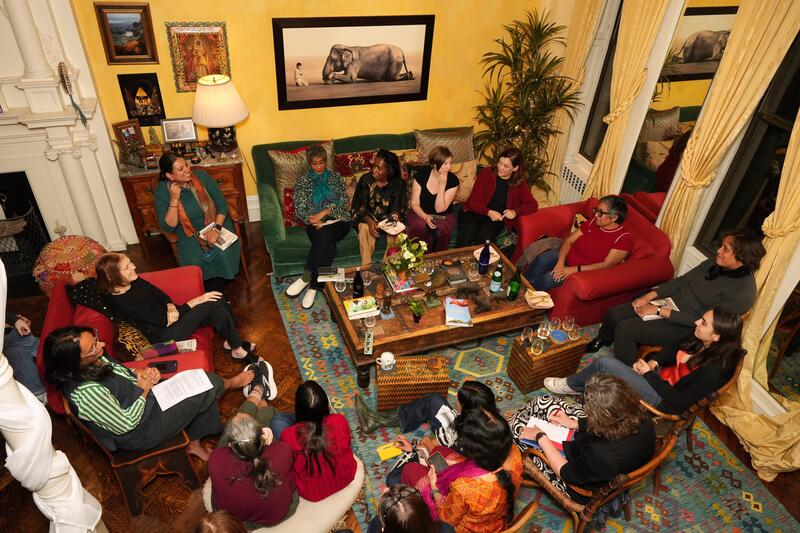
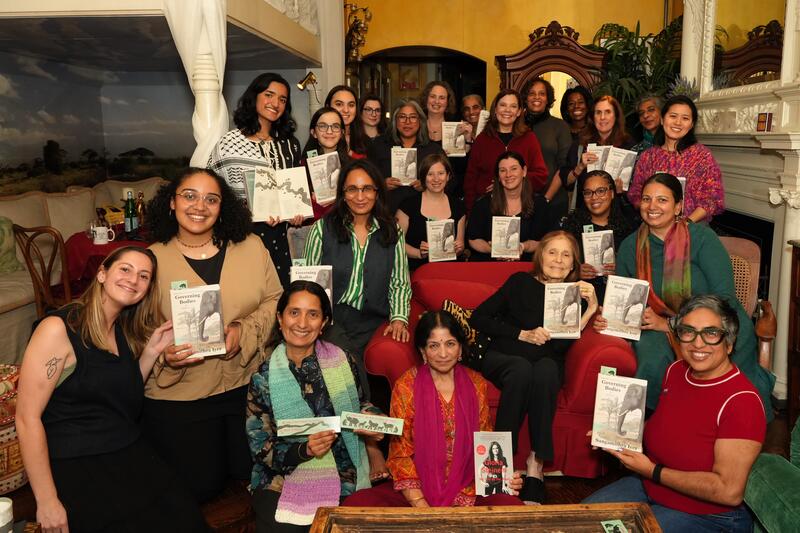
Last fall, I received an amazing invitation from Defne Egbo, a fellow at Gloria’s Foundation, to be part of her Between The Lines literary salon that uplifts the work of emerging authors. On a brisk evening in December, we assembled a confluence of amazing women in a wide range of fields—art, literature, science, education, engineering, policy, planning, media, animal care, social work, and more— in Gloria Steinem’s living room in Manhattan. “Between the Lines, was born out of my own desire to bring online book conversations in person and really ground them around one special book and author,” Defne shared with the crowd. “What was once an idea months ago, has now turned to this beautiful gathering and watershed, to borrow your word.”
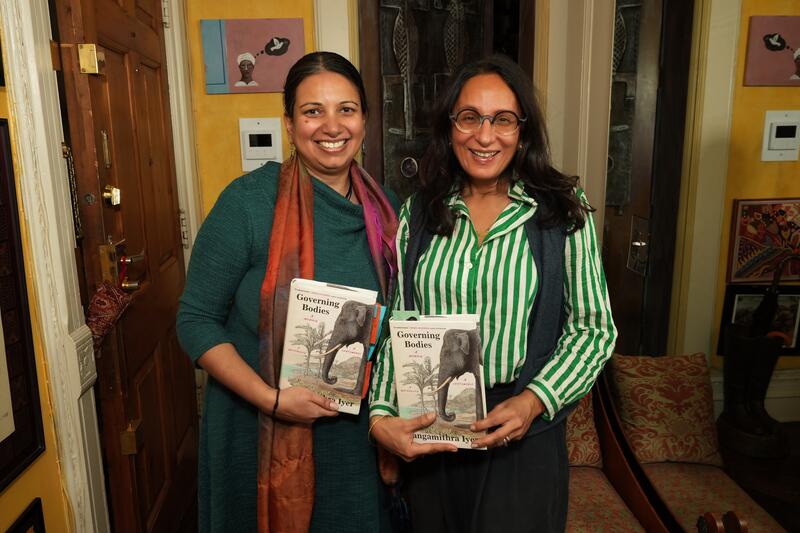
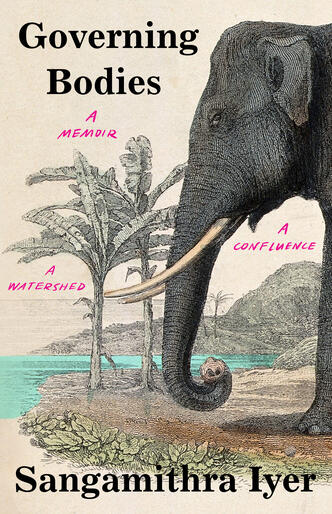
We were there to discuss my debut, Governing Bodies: A Memoir, A Confluence, A Watershed. Before I headed on the road for my book tour, I re-visited Gloria Steinem’s memoir: My Life on The Road and took many lessons from it. One was that it’s always better to do public speaking with a friend. It was kismet that I was able to be in conversation that evening with Madhur Anand, a brilliant writer and scientist who brings together science and literature in magnificent ways. Her masterful memoir, This Red Line Goes Straight To Your Heart, winner of the Governor’s General award in Canada, probes the partition of India and its legacy across generations and continents. Her charmingly clever debut novel To Place a Rabbit explores translation, science, and art. She has also published two books of poetry: A New Index for Predicting Catastrophes and Parasitic Oscillations. Madhur is a theoretical ecologist and professor of ecology in the School of Environmental Sciences at the University of Guelph. There are many synergies and confluences in our work linking science and art, and art and life.
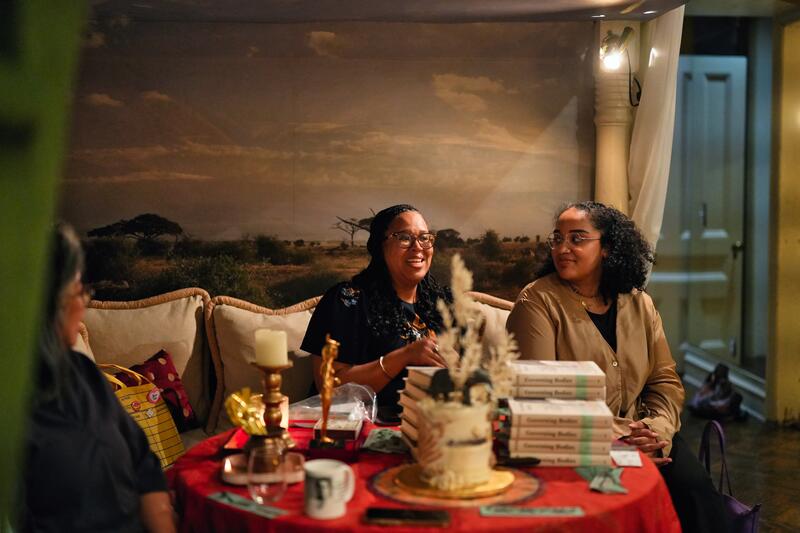
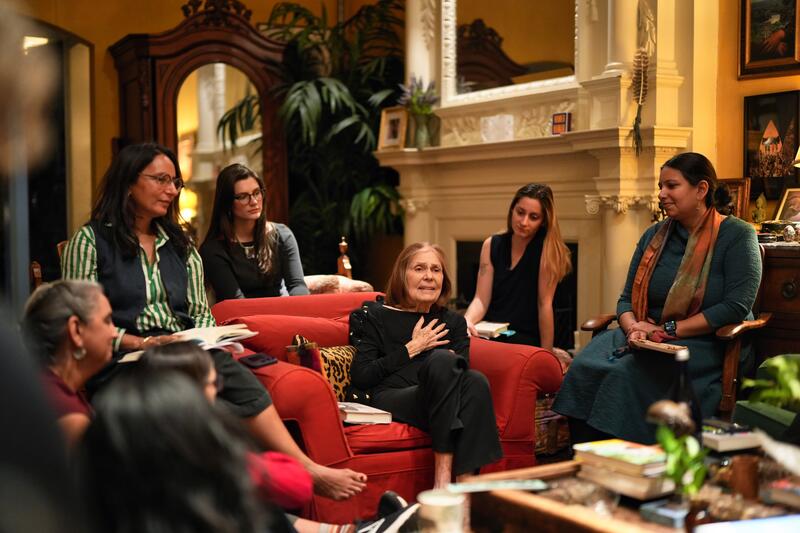
The first thing we noticed when we entered Gloria Steinem’s home was all the elephants. Elephant art was everywhere—paintings, photos, sculptures. Elephants graced matchbook covers in the bathroom. I had brought an elephant decorated vegan cake —baked by Marisa Miller Wolfson—which matched the elephant on my book cover. It was promptly transferred to an elephant adorned plate. “Elephants are a totem,” Gloria told me. They are matrilineal, intelligent, caring.
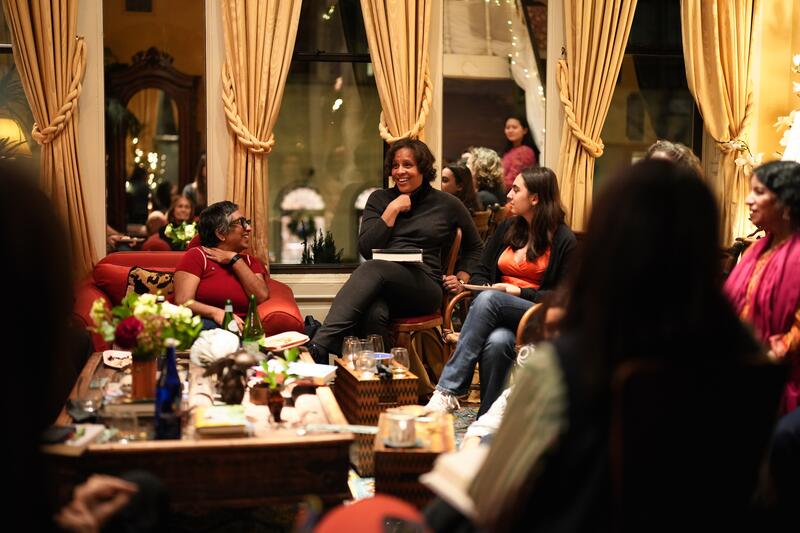
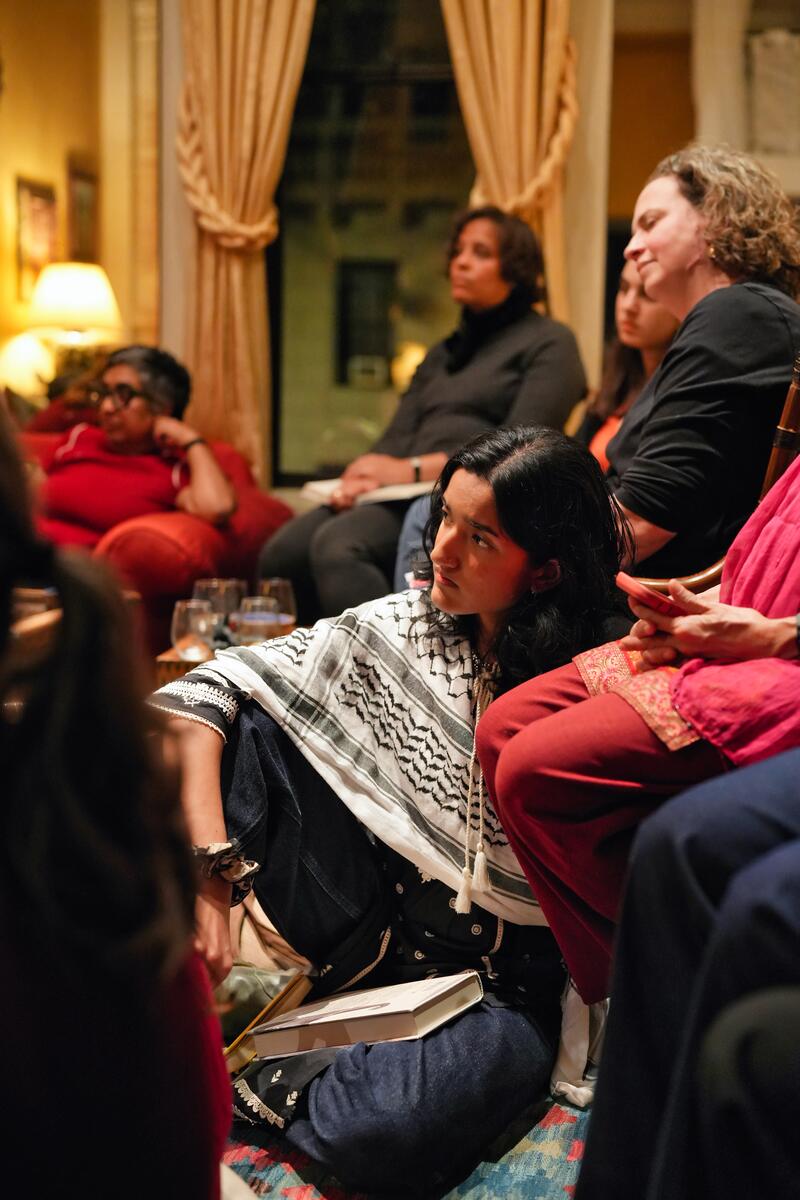
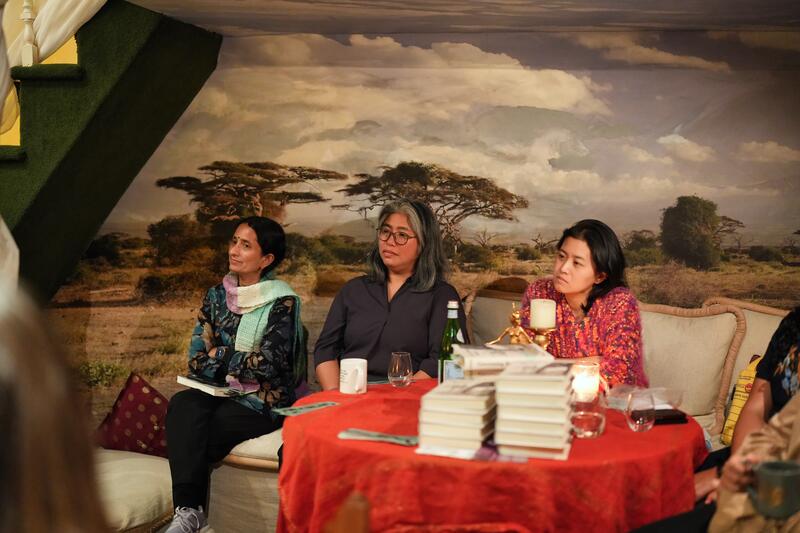
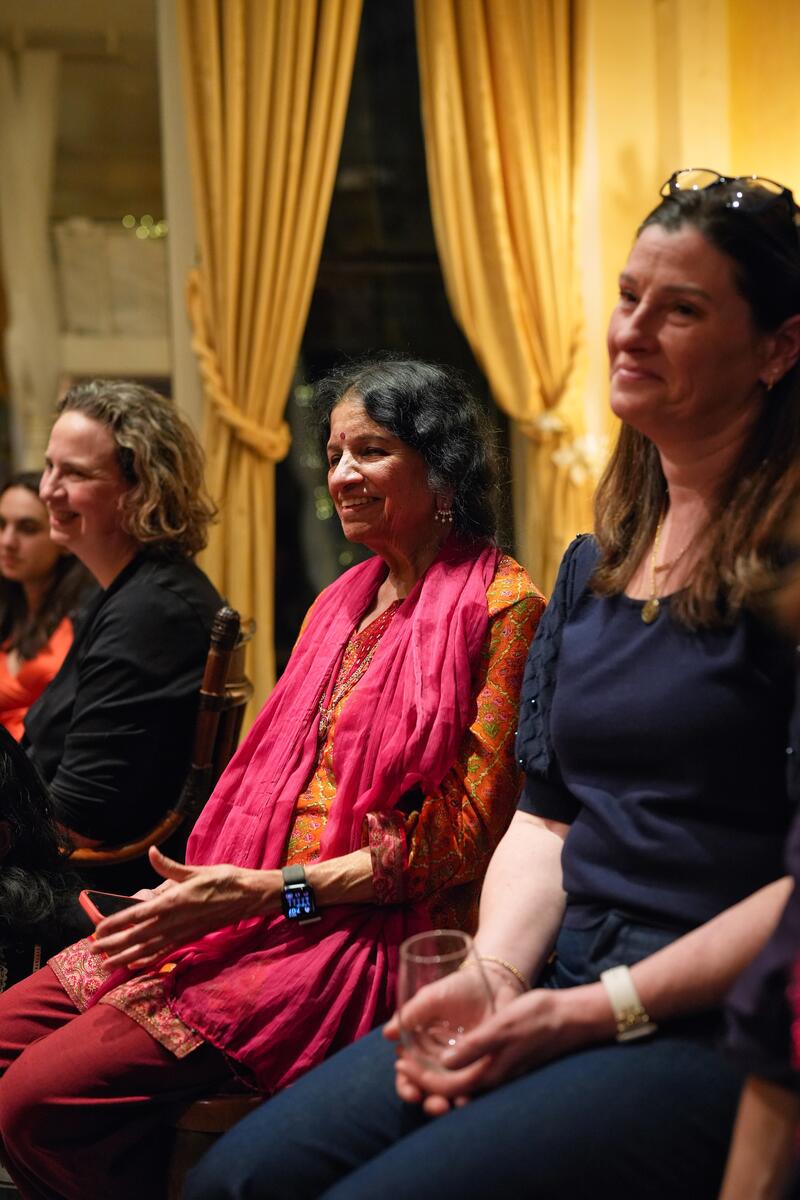
Another lesson, I took from Gloria’s memoir is that public speaking is also about public listening. We gathered in a circle in her pachyderm themed living room to participate in a talking circle. Gloria kicked off the event discussing the concept of talking circles, and Madhur and I started discussing my book, and the ripples of our conversation widened. The following is an edited transcript of our talking circle and the beautiful confluence of voices in the room.
The following is an edited transcript of our taking circle and the beautiful confluence of voices in the room. All photos were taken by Gia McKenna —Sangamithra Iyer.
Gloria Steinem:
Well, I remember long ago— and I’m talking long ago because I’m very old —when we first started having talking circles here, and we thought we had invented it, and we invited Wilma Mankiller, who was then Chief of the Cherokee Nation, to come to one of our talking circles, feeling we were inviting her to something new. And she listened to us for an hour or so, and she said, ‘Well, you know, when we do this, we have a talking stick that we pass around so that people know who is talking.’ We have reinvented an ancient and great tradition. It’s important that it’s a circle. It’s not a hierarchy. It’s all inclusive, it’s not predictable. We never quite know what’s going to happen. And because each one of you is here, it’s unique.
Sangamithra Iyer:
I’m overjoyed. Defne, the highlight of my fall was to get your email. It is such an honor to meet you, Gloria, and for us to have this sacred talking circle in your living room. One of the threads in my book is about tracing lineages—not just familial— but of ideas and thoughts. I’m so grateful for your work creating space and language and making visible these lineages that we’ve all benefited from.
I really loved your memoir My Life on the Road, and I read it recently as I prepared for my book tour. I appreciated what you said about public speaking, in that it is also an opportunity for public listening.
Outside of this room, it can feel very harsh and divided, but inside of this room, it’s so connected. I believe in the magic of bringing everyone here together.
The subtitle of my book Governing Bodies is “A Memoir, A Confluence, A Watershed.” It is a confluence of many things—science and art, prose and poetry, personal and planetary grief. It is a watershed because it is the basin that holds all these different streams—family history, the memory of water, the rights of animals.
My book is structured like the Triveni Sangam in India, the confluence of three rivers. The first part is written to my paternal grandfather, who I never met, who was a civil engineer like me, who was working for the British in Burma and quit to join the Freedom Movement in India. He was very inspired by Gandhian ideals and how to live your ethics. And he moved to a place called Kallakurichi. The book is in part a search for Kallakurichi, which is both a real and imagined place. And what Kallakurichi means keeps evolving throughout the book. The second part is dedicated to my father, whose death in 2003 prompted this search for these lineages. And the third part, and all the parts, really are written to you, my dear readers, and is about how we carry these knowledges of the past to navigating this world that we’re living in now with these compounding crises.
Madhur Anand:
I consider this a gift of a book in many ways. I have been working for many years at the intersection of art, science, and creativity. Your book is a gift to those of us who are seeking a new path, a new way to live, a new way forward— something that, for whatever reason, does not fit the status quo, the norms, the monopolies, the singleton ways, the specialization, the professionalization of everything. And at that confluence is art and science. We certainly do not want to give up science and reason, and we do not want to give up what art is to us and what it represents in our world as humans. And so, this book is a gift because there are not many people writing at this confluence. Because it is really a difficult thing to do. It is difficult to hold in balance, in harmony, those two sides. You do have to live several lives, right? So, there is a rigor and discipline involved, but there is also a deep passion and dedication involved as well. I learned a lot from this book about everything [laughs]- and I too had to learn a lot about everything to write my own books. It is also a gift for second generation immigrants of South Asian origin. It is a gift to the whole generation. What you do when you write a work of art out of your history, your personal history, is that it then becomes more universal. Then it becomes a gift to all of us, and everybody will use that gift in a different way.
I am so delighted to hear the etymology of your name, friend of confluences. I’ll offer the etymology of my name, Madhur, which is sweet like honey. But I always say I think that is how my parents wanted me to be, but I’m not really like that. It’s a little bittersweet.
You wrote a very nice review of This Red Line Goes Straight to Your Heart. And what you said was that the best kind of memoir is where the narrator’s history and the story of the world cannot be partitioned. And that’s what you yourself went on to do and achieved with this book. And it is so delightfully porous between the biotic and the abiotic worlds, between the past and the present, the past and the future, and between species. And I referred to this duality when I was interviewing my own mother. There was this term that she used, aap beeti and jag beeti, which loosely translates to ‘the story of myself’ and the ‘story of the world’, or ‘the story as I tell it’, and ‘the story as it is told by the world’. When my mother uttered that phrase to me, it was almost like she was uttering her wish for me to be sure that I knew both of those ways of telling stories. There are things that we bring to the world, but then there are things that the world gives to us and brings to us. I wanted you to talk a little bit more about that notion and how you went about achieving that in Governing Bodies.
Sangamithra Iyer:
I was just texting you about aap beeti and jag beeti, and how it reminds me of akam and puram in ancient Tamil poetry, which is ‘inness’ and ‘outness.’ I knew I was writing a personal story, but I knew I wanted to write about all these other things and that they were all connected, which was something I was certain about, even though I didn’t know how to do that yet. Early in the writing process, in conversations with various editors or agents, they would say ‘ Wow! There’s a lot going on in here,’ or ‘you are being too ambitious for your first book.’ or they just liked the family part or just the animal part. And I’m thankful for that younger self who just took the time to do this right and give space to all these parts. And then when I discovered the ancient Tamil poets, I realized they were giving language for this inness and outness and this connectedness. Many of our ancient languages have so much knowledge of the world embedded in the language itself. The Tamil Sangam poets had an ecological grammar. When we talk about linking science and poetry, it was so entwined with them. Their understanding of the world 2000 years ago, is what scientists are barely acknowledging now, like how animals have grief.
I love this notion of connecting the personal with the planetary but had to figure out how to hold it all. I wanted to share another story about when I first met Madhur, and we were talking about all these connections. She asked me, ‘Do you know the word apophenia?’ I said, ‘No, what’s that?’ And she told me it’s this tendency to find patterns and connections among seemingly random things. I said, ‘Oh, I love that.’ She said, it’s not often used in a good context. [Laughs]. It could be a symptom that you are delusional.
But in her memoir, she writes about apophenia, and she explains its use in another context. It’s the governing principle of poetry. I’m a trained engineer, but in the process of writing this book I realized I was a poet. I realized what poetry offered to connect that inness and outness—my story and the story of the world.
Madhur Anand:
I’m so thrilled that you discovered poetry in the process and it really is what allows you to hold like my mother would say, “the sea in an earthen pot.” The book holds so much! And I was a little bit jealous, because I was telling my teenage daughter, about this book. I told her that it’s about your ancestry, your grandfather and family history. And also about engineering, art ,science, waterways and water, and your passion of travelling to Africa and volunteering there in chimpanzee rescue camps. She immediately said: ‘oh, I want to read that book.’ And that’s high praise.
I absolutely love these two guiding questions that you lay out early in the book. “How can we learn about and from other animals without harming them, and how do we repair the harm we have already caused species?” As an ecologist, this is what we’re constantly confronting. I have reached a point in my own career where I just feel like the science is not enough for answering those questions, because we technically know how. Do you agree? What pathways do you see forward for these questions from your research and your experience working as an activist?
Sangamithra Iyer:
Those are the questions I carry every day, and many in this room are approaching them from different fields. I’m also thinking of Gloria’s story [from My Life on The Road] which became a lesson and mantra for organizing: “Always ask the turtle.” How can we invoke other animals’ perspectives, to really understand what they need when we’re doing our work.
Early in my career as an engineer, I was disillusioned. I wanted to be an environmental engineer, but I felt the work I was doing was too downstream. I was working on superfund cleanup sites or slope stability for landfills. I was disheartened that we weren’t solving the problem at the source. And when my father passed away, and he had a great fondness for animals, it was like this synergy—I was asked to write an article about chimpanzees for this magazine, Satya, named after satyagraha, for which my grandfather quit his engineering career to join. At that time, I was learning how to be a writer, how to be an advocate. And then when I returned to [engineering after Satya closed] to a job in public service, I was trying to figure out how to be that advocate from within an agency, which is not necessarily the same approach as the articles I would write. I had to reframe doing the right thing to be like, ‘oh, it’s also cheaper or faster,’ or these other ways to get it done. I later left this job to finish working on this book—I highly recommend a midlife sabbatical. I felt in this book, I was able to bring all the parts of me to these questions.
I’ve now returned to public service and engineering. I work on stormwater planning in the city, and I’m seeing how this work is showing up in interesting ways. In this book, I’m unearthing all these buried streams of history. And my job right now is to literally unearth streams in New York City.
Madhur Anand:
Tell us the term for that.
Sangamithra Iyer:
Daylighting
Madhur Anand:
I love that word, I am trying to use it in a poem.
Sangamithra Iyer:
I love that! Send me the poem. Now, I’ve gotten a greater appreciation for the work we do as engineers. We restored these waterways and drainage corridors in Staten Island. And there’s one, Richmond Creek,—twenty-five years ago, it was one of the most polluted water bodies in the city. We did a lot of work to clean that up. While we addressed a very local flooding and drainage problem in New York City, what ended up also happening is that we restored an ancient migration pathway of the American glass eel. And these glass eels, they’re amazing. They are born orphans in the Sargasso Sea, and they hitch a ride up the Atlantic in a warm current, and then after a full moon, they know to leave the salt of the sea to exit into a freshwater creek in Staten Island. And they know that because their ancestors used to come here. I’m feeling re-energized by things like that. It is not just one of these fields, it’s the mixing of them is where the answers are to these questions.
Madhur Anand:
I actually Googled daylighting and looked it up, and there’s a map at the University of Waterloo. There’s a project that shows all the streams that have been daylighted. And there are not very many. I was really surprised at how few there were, because I thought there must be thousands of underwater streams in the world, or in Canada.
Sangamithra Iyer:
There’s a famous daylighting project in Seoul, [Cheonggye Cheon] and it goes right through the heart of the city. And it just gives me hope to see in these dense urban areas, they found a way to bring water back.
Madhur Anand:
You say: “When reading or writing and I feel like I’m nearing some sort of epiphany, my nose starts to tingle”. This is so strange to me! For me it’s not a physical sensation like that, for me it’s like I’m on a psychedelic drug (which I’ve never done! I always tell people I don’t need to do drugs – my brain is interesting enough in there!) so what do you think is going on?
Sangamithra Iyer:
I feel like there’s a tingle and some nervous gut energy. I’m getting excited and thinking too fast to get it all on the page.
Madhur Anand:
Like falling in love?
Sangamithra Iyer:
I don’t think so.
Madhur Anand:
Butterflies in your stomach?
Sangamithra Iyer:
Yes, but not in the same way. The Tamil word for truth is the same word as the word for body. Mei.
So that’s something I was thinking about—what truth is in our body? When we’re talking about how we hold all these things, the vessel that is holding all these things is our bodies. My grandfather was a water diviner, and I wanted to try to learn that. Another writer found an essay I wrote and sent it to her dad. Her dad wanted to teach me how to dowse. And during the pandemic, we had these zoom sessions, and the way he talked about water divining is how I feel about writing. What I was doing intuitively was divining the currents in this book.
Leslie Tucker:
Can you tell us what water divining is?
Sangamithra Iyer:
It’s a practice where some people—with a stick or a rod— can trace where water is in the earth. Sanjay, who was my water divining tutor, says you can divine a lot of things. You could divine sites of tragedy. I think there’s something with divining and premonition, because all the people in my family had these dreams that predicted the future. And similarly, I moderated a different author talk [with Jason Allen-Paisant and his book The Possibility of Tenderness,] and I learned all his forebearers had plants talk to them in their dreams. There’s something when you’re close to the earth, you can tap into that knowledge.
Gloria Steinem:
People could know where there was water, where you could dig a well. I mean, they seem to be special people, who knew that.
Sangamithra Iyer:
There are animals who can sense that too. I think elephants can.
Leslie Tucker:
In Australia, the Aboriginal people have this instrument, and it makes them hear where the water is, and the Aboriginal paintings are all about where water is—they are maps.
Sangamithra Iyer:
It’s the most important knowledge.
Minal Hajratwala:
My great-great-grandfather, our family name, Hajratwala, comes from a talent that he supposedly had, which was to be a seer in water. He had a special tray and filled it with water. And if you lost something, you would go to him and ask him, and he would look in the tray, and he would tell you where to find it.
Mikelle Adgate:
Going back to some things just a moment ago, about the proximity to nature, to plants to animals. I’m wondering if you can talk a little bit about the juxtaposition of your work being in very urbanized, industrialized waterways, a very urban context where it might not naturally occur for people to have access to plants and green space or walkable space. How in your writing practice or in your life practice, do you marry those two things, when sometimes it can feel very foreign? So many New Yorkers are very disconnected from the waterways around our city.
Sangamithra Iyer:
I had a dream for creating a strategic plan for animal protection in NYC. I wanted to call it “Planimal”
I’m really energized by the work I’m doing now in terms of carving out a space for water. Because when we carve out a space for water, we carve out a space for plants, and when we carve out a space for plants, we’re bringing back all these animals. I write about Italo Calvino’s Invisible Cities, and I’m also very interested in invisible animal cities and all the creatures that we share the city with. I’m fascinated by these stories of urban coexistence.
Mia MacDonald:
The book is like poetry and there’s a lot of weaving in, and I wonder if you might just tell us a little bit more about the weaving. Mikelle’s question also made me wonder, how do you define a multi-species community?
Sangamithra Iyer:
With the weaving, it took time. It goes back to apophenia and the ability to see patterns. There are strengths that I took from engineering. We make topographic maps with contours, and I was able to see all the contours in this book. There are a lot of variations on a theme. There are many words that do a lot of labor, and so they connect all these things. My friend Sunu Chandy introduced me to this concept called micro-inclusion, and it’s the opposite of a microaggression. It is all the little things we can do to include people. Now, I’m thinking about the micro-inclusions in the text to allow all the things that you don’t think should be included. There are little micro-inclusions for the reader to teach them how to read the book, to do some of that weaving. It is amassing material and over time, seeing the connections. I don’t know an easier way to do it, and I think the way I did it was the only way I could do it.
Gloria Steinem:
Could you write another book called micro-inclusion with examples? That would help us and sensitize us.
Sangamithra Iyer:
Ooh!
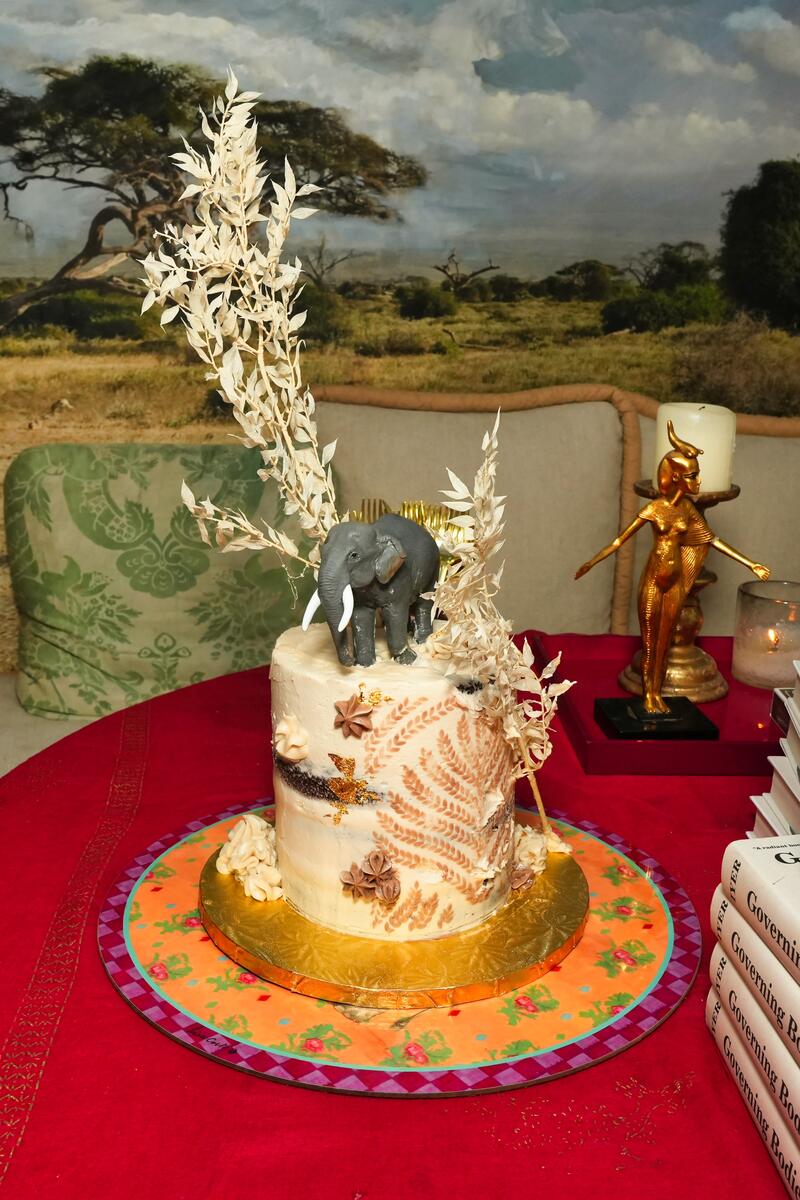
[Interlude for distribution of elephant adorned vegan cake.]
Sangamithra Iyer:
I wanted to also respond to the multi-species community question. I was in the library, and what I love to do is read acknowledgements, and that often leads me to all these connections. I was reading a book about bonobos, and that led me to learn more about a Japanese researcher, Kinji Imanishi, who thought primatology in the West was really focused on things like head size and tail size. But he was really interested in culture. He felt that most of science was focused on differences, and if you’re only looking for differences, that’s all you’re going to see. He was interested in connection, and how we’re all connected. He introduced me to this word, shizengaku. He writes: “Shizenkaku does not fit within the general scheme of academic disciplines. It seems that the word nature is used more than ever before, but there has never been a time in history when people have had such a small realization of what nature really is,” and that was in 1940! He goes on to say, “We must teach students that nature is not matter. It is a living thing. It is colossal maternal body, a giant, the behemoth within which we, all along with all other myriad creatures, have always been nourished.” I’m thinking about that and what that means. I’m also thinking of Gloria’s dear friend Wilma and her line “every day is a good day” because every day you are alive you are connected to every living being.
Gloria Steinem:
Wilma Mankiller was the chief of the Cherokee Nation.
Madhur Anand:
That’s a nice thing to remember every day.
Emily Bass:
I love this book so much. Among other things, it’s a source of wisdom about how to live with grief which feels incredibly timely and sort of excruciating. The levels of interconnected grief right now for me are probably more elevated than they have been at other times in my life. What do you hope your readers understand about living with interconnected grief?
Sangamithra Iyer:
There’s a governing current of grief in the book, but there’s a flip side of it too. It’s also a book about love. The beauty of grief is that you become porous to the world? How do we tap into that interconnectedness? How do we carry it all? I had a lot of questions about what poetry is, because I realized ‘Oh, I’m a poet!’ What does it mean?’ There’s a James Baldwin reference about how he defined poetry. And it wasn’t limited to poets, but it was how they could recreate an experience to give it back to you, to make it bearable. “And if you could bear it, then, you could begin to change it,” he said.
When we are living in this world, and the amount of pain is so oppressive, I didn’t want the reaction to be to shut down or to turn away. How do we keep forging ahead? I often invoke a Mary Oliver poem, which begins, “Here is a story to break your heart/Are you willing?” This is both a warning and an invitation, and Oliver is talking about breaking hearts open, so they “can never be closed to the rest of the world.” So that heart opening is my hope, and we have to do it together. I introduce another word in the book, kalyanamitra, which is a spiritual friend or coworker. And this Burmese water activist introduced me to the term. And the theory is that when you have two people meditating side by side, it’s more powerful. And I called my acknowledgements my kalyanamitra, everyone who is on this journey with me. Even if we’re all doing it on our own, we’re doing it together, and the work is amplified.
Delores Conners:
I was just going to share an appreciation. I teach seventh grade. I teach science, civics and language arts.
Gloria Steinem:
Where were you when I was in the seventh grade? [Laughter]
Delores Conners:
To be able to hold this book in all those spaces is amazing, whether it’s the poetry of writing or the scientific piece of water as we talk about organelles, or the civics piece. You [Madhur] mentioned Asian students feeling a sense of pride in a piece of text. And when I showed the book, I showed your picture and you can see some students really spark, and it is quite beautiful. It is a gift that we have an education on how these disciplines can come together to learn in a very sweet and soft way. We have questions about the world. We have questions about literature, and we can do that through your piece.
Leslie Tucker:
I want to say something about what Emily just said about grief. Your book is super light. It doesn’t feel heavy, and that is a miracle. I mean, we’re all living in a period that is extremely heavy. The writing in this book is like currents. It’s like light and airy, and it breezes by, and you think to yourself, how could I be reading this so easily, about grief, about things that other people might think, “Oh, she wants me to not eat meat. Now, what should I do? I’m going to close the book,” But you don’t feel that. It’s more of an invitation. I would say it’s like a kite, and you take people along, and we’re all holding hands, That’s the miracle of this book.
Lauren Wang:
My question for you is, when we think of governance, it’s hard, it’s fixed, it’s rigid, and it’s very siloed. I’m not just talking about government, really. Any kind of leadership in the mainstream tends to fall into that set of norms. So, given that your book is a kite and we’re all holding hands, inviting each other along, what do you hope that readers will take away from Governing Bodies to transform governance?
Sangamithra Iyer:
I go back to this woman, NiNi, who is a water activist, and she’s my kalyanamitra in Burma, working on water supply issues there in a much harsher environment. But she talks about water governance, and it sounds so simple. She says, “all we need is participation and understanding.” That’s her advice. I agree, there is something important in bringing down these silos and working together. I want to have more conversations about how we build these relationships and do this work together.
Gloria Steinem:
Would it help if we valued laughter more? People say laughter is the only emotion you can’t compel. You know, you can make somebody afraid. You can even make somebody think they’re in love, if they’re dependent for long enough, but you can’t make them laugh. It’s like proof of freedom.
Sangamithra Iyer:
Yes. There’s an Orwell line: “Every joke is a tiny revolution.”
Wendy Sperduto:
I work with a lot of people, and I manage a lot of people, and I felt for a long time, as a woman, I was too funny, that I was too approachable, and that others would see that as a weakness. Now as I get older, I embrace it. I try to be authentic in myself.
Madhur Anand:
There’s a small thread in the book as well. There is some talk about gender in the workplace that adds to the gift of the book. You are writing about being an engineer, and that it is traditionally a male dominated profession.
Wendy Sperduto:
I loved that in the book, I was there with her on a construction site, and I felt like I was standing next to her as she was telling the story. And how you created these relationships with these men on the site. And it was so personal and so wonderful.
Raji Iyer:
Sangu talks about my sister in law in the book. She is amazing. She says, eight hours for sleep, eight hours for herself and eight hours for others. She lives by that. And she always says, the problem is, you’re always worried about what other people think. Do what you want to do. Why are you worried about others? You always worry about, what will this one say? What will- in my language—what will four people say? [Laughs]
Sangamithra Iyer:
This is my Jaya Aunty, who is the only child of Kallakurichi who is still alive, and her wisdom is sprinkled throughout this book.
Lauren Wang:
You talked early on about language from cultures that have very strong ecological vocabulary. And I’m someone that’s very interested in the future and building towards where we’re headed. And I’m curious, really a question for the room. We have grief being disconnected to the land, disconnected to each other, and at the same time, we can call upon thirty incredible women to show up in this space. Thank you so much for hosting us, Gloria, to have conversations like this. We’re so well positioned in dense urban places like this to build out some new type of ecological vocabulary, emotional vocabulary, human vocabulary. And I’m curious if others have thought about that. What are the strengths that we can be leaning into to build that vision of the kite?
Leslie Tucker:
All these compound words that you have in the book, you create new language every time. The chimps create new language, and then we do it, and then you’re doing it all the time in the book. And maybe that’s a part of it, that you have to be together to create these new words.
Sangamithra Iyer:
Leslie is my writing partner, and we’ve developed our own language in shorthand, from what we read and write. When we’re all together, that kind of stuff happens. There is this book I was reading recently, Marginlands [by Arati Kumar-Rao]. She writes about a community that spends most of the year in dry conditions. A community that only gets 40 days of rain each year, but their knowledge of clouds is so vast there are 40 different words for clouds. And that is fascinating. Is that science? Is that poetry? How do you acquire that kind of knowledge? Another book I’m reading is called Language City [by Ross Perlin], which is about Queens being the last vestige of many languages, and how much we’re losing when we lose languages. I am interested in these other projects about language and how we can revive them, and all they carry.
Emily Bass:
I work in HIV AIDS and global health justice, and it’s all going terribly wrong, and one of the things happening is that all the information we used to have about what was happening has been shut down. And I’m a writer, and people are passing me things. When thinking about governance and alternate forms of governance, there’s this network of people that are still on the inside that pass me things, and so it’s flowing to me, and then I put it up. That came to mind because we are talking about both language and governance.
Gloria Steinem:
Like information there is no other outlet for?
Emily Bass:
It’s information the government does not want to share but is information that used to be public. I am not Edward Snowden. [Laughter]. There is this information flow and this commitment to continuing to share the language. As we think about alternate forms of governance in this moment, there’s something about language. Maybe they can’t be daylit.
Sangamithra Iyer:
Earlier this year, there was this censorship of words from the Trump administration, and I was really worried about that—words like climate, environmental justice…
Audience:
Women!
Sangamithra Iyer:
Women! My friend Iselin and I were worried of this anticipatory obedience. These are words we worked hard for to have, and the importance of not giving up those words.
Anjali Singh:
The importance of disobedience.
Gloria Steinem:
Anybody else see an old movie called Fahrenheit 451? And the rebellion is because all the books are burned, that each person memorizes one entire book. And that’s the final scene of everybody walking in a circle on a big field saying their book. It’s very touching.
Minal Hajratwala:
I think about that question a lot, Lauren. Especially in New York, we’re often in these rooms where amazing people are, and we may or may not carry on beyond one gathering. I think about how we use these occasions to make progress. I also feel like it’s not necessarily about finding something new. It might be the work of recovery that you’re talking about, the daylighting of the streams, or what you were sharing at the beginning, Gloria, about Wilma Mankiller, saying, actually, you didn’t invent this talking circle. Maybe we don’t even need to invent anything right now. We just need to remember, and having these intergenerational gatherings is also very important, because people have been through things and will need to go through more things in the future. And being able to share the strategies and knowledge that already are in this room or any room.
Beth Gould:
I agree. Gloria, you have such a history of effective organizing, and here we are talking about continuing a movement. And I wonder if you have any thoughts or advice, about what we’re talking about?
Gloria Steinem:
My main advice in this era of screens is that we do still need to meet like this in circles. You know that we do understand each other with all five senses in a way that doesn’t happen on the printed page, much as I love the printed page. And so, you know, that’s what this living room is for. But it is all five senses that is beyond the other ways we communicate.
Minal Hajratwala:
The five senses are so important, because as you write, we are also animals. We are not trying to be AI machines.
Lauren Wang:
As an urban planner, sometimes I wonder, what if we designed for cities that smelled good? [Laughter]
Streams. Flowers. Hot take, I think Chinatown smells good because it’s familiar.
Madhur Anand:
Do you want to read the sevenfold of truth?
Sangamithra Iyer:
Truth or satya is a guiding force in the book, and I echo all these folks that are leading us back to truth, whether it’s Tolstoy who says, “first, don’t lie to myself.” however far I am from the path I want.
Or my Jaya Aunty saying fear not the path of truth for the lack of people walking on it. And I think Gloria, you have the best line about truth, right? Truth will set you free, but —
Gloria Steinem:
First it will piss you off. [Laughter]
Sangamithra Iyer:
When I was writing, I was thinking about holding multiple truths. And I came across this Jain concept of the seven folds of truth.
In some ways, it is.
In some ways, it is not.
In some ways, it is, and it is not.
In some ways it is, and it is indescribable.
In some ways it is not, and it is indescribable.
In some ways it is, it is not, and it is indescribable.
In some ways, it is indescribable.
I was using this to probe these subjects that have multiple truths in this era where we feel very divided.
Leslie Tucker:
How did you know when you had finished your book?
Sangamithra Iyer:
I’ve been getting this question a lot, because it took a long time to write the book. I knew when it wasn’t done. I really wanted to care for all these stories and know that all the pieces were ready, because I didn’t want it to go out with something not ready, and then it compromises all the other parts. But Leslie gave me a great word, undeniable. That is this litmus test of when it’s done, when I’ve said what I needed to say, how I wanted to say it, and it is undeniable.
Sangamithra Iyer
Sangamithra Iyer is an environmental planner, engineer, and writer. She is the recipient of a Whiting Creative Nonfiction Grant, a Café Royal Foundation Literature Grant and the Diamonstein-Spielvogel Fellowship at the New York Public Library.
A CLMP Firecracker Award Winner
An Orion Magazine Reading Recommendation
A South Asia Institute, Harvard University Reading Recommendation
A beautifully rendered debut memoir of family, legacy, conservation, the natural world—and those who inhabit it.