An Evening to Celebrate Governing Bodies with Sangamithra Iyer, Nigar Alam, and Sruthi Narayanan
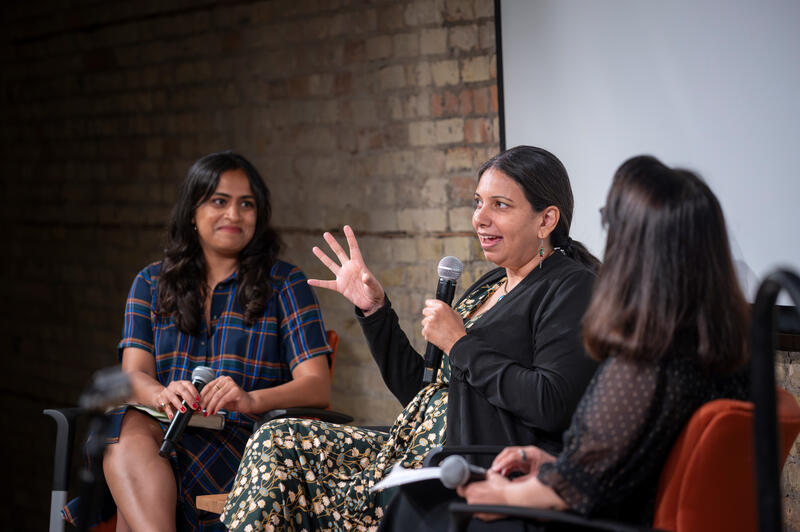
Milkweed Editions and SEWA-AIFW hosted writer Sangamithra Iyer in conversation with local writers Nigar Alam & Sruthi Narayanan for an evening of reflection on family history, language, and water. A CLMP Firecracker Award Winner, Iyer’s memoir Governing Bodies takes the form of three meandering rivers, written as letters to her grandfather, father, and readers. She reflects on her career as a civil engineer and animal rights activist, and explores her own experiences as a woman of color and citizen of the world. Governing Bodies is a lyrical story of lineages and an urgently needed reckoning with the ways bodies are both controlled and liberated.
With deep appreciation and praise of Iyer’s work, Nigar Alam & Sruthi Narayanan guided an engaging conversation on the power of language to shape our lineage, the water bodies we hold close, and the intersection of social justice and animal rights. A reception followed, with vegan cupcakes (a result of Iyer’s exploration of the vegan scene in Minneapolis), and free donuts provided by FRGMT coffee. We present an excerpt of the event, transcribed below.
This event was hosted in partnership with SEWA-AIFW, a local nonprofit that meets the unrecognized and unmet needs of communities in the Twin Cities and Refugee community in Minnesota. SEWA means, “to serve” in Hindi, and was created to serve and promote “Total Family Wellness” for individuals in Minnesota through specific programs.
All such events, including this one, are made possible by a number of supporters, including the voters of Minnesota through a Minnesota State Arts Board Operating Support grant, thanks to a legislative appropriation from the Arts and Cultural Heritage Fund. Other supporters include the Minnesota Humanities Center, through a Cultural Heritage Grant, and the Aloft Hotel, just across Washington Avenue, which generously houses our visiting authors. Thanks as well to the supporters in our community.
I write in my book a little bit about a search for my ancestral homeland, a place called Kallakurichi. I write that it’s kind of an idea, a moral philosophy, a refuge, and a refusal. I feel that Minneapolis, also in my imagining, is a kind of Kallakurichi. I’m very, very happy to have this conversation with my two fellow writers, local writers here in Minnesota, Sruthi Narayanan, and Nigar Alam. I’m excited for our discussion in a bit.
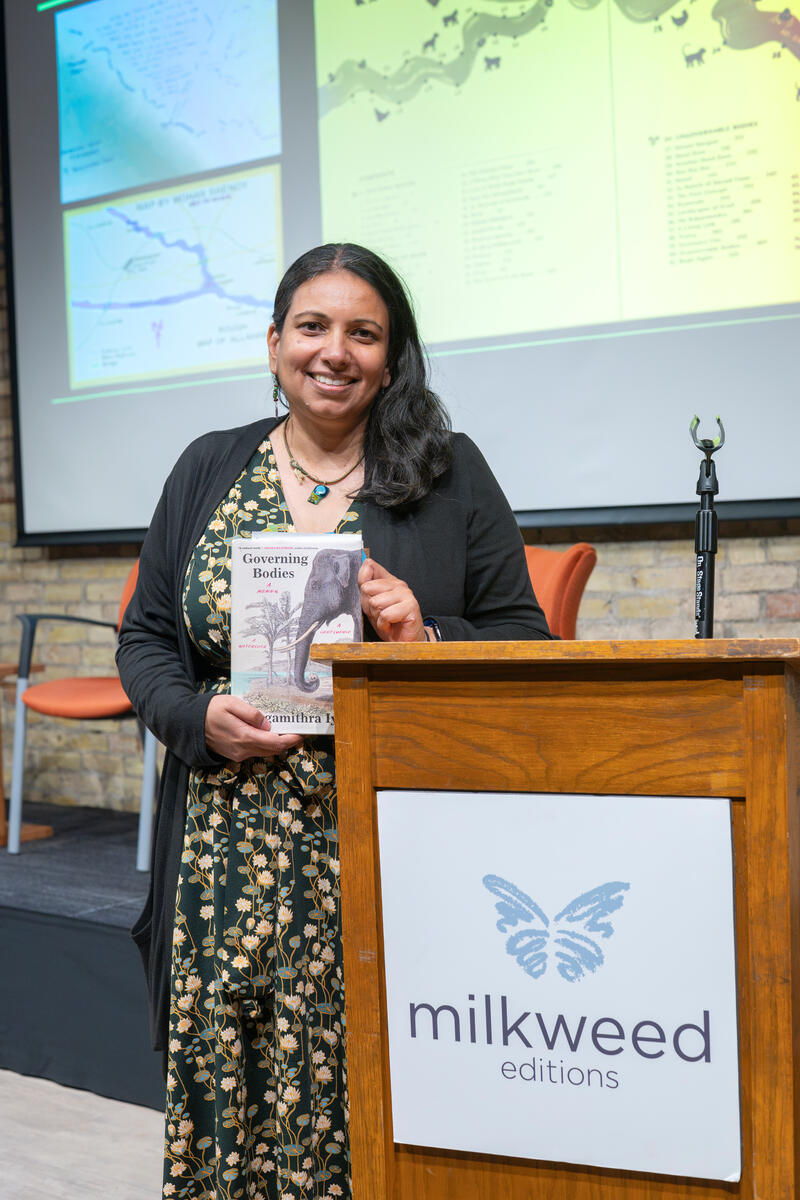
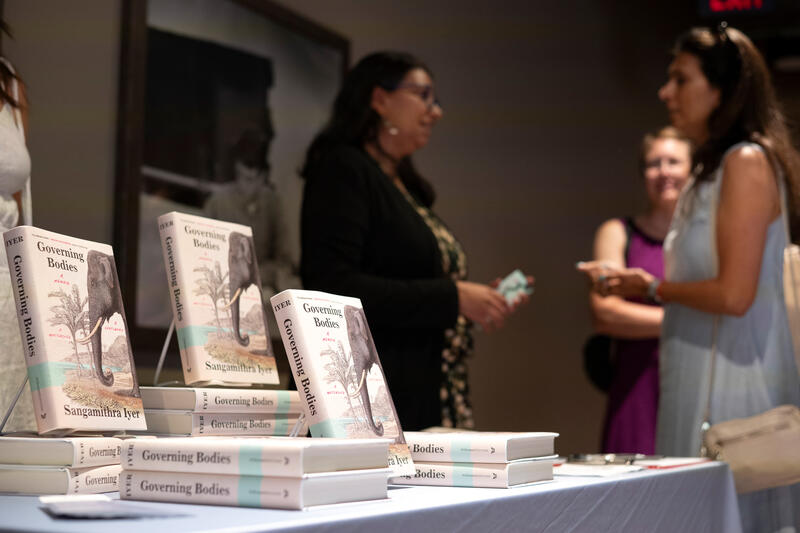
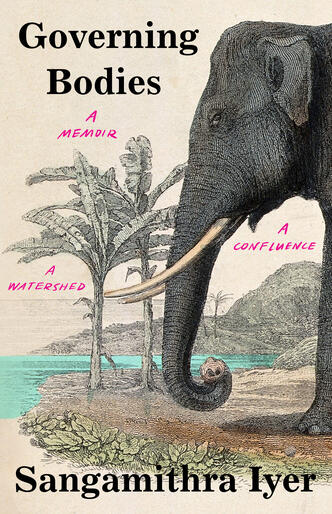
This is my book, Governing Bodies. I consider it to be a lyrical reckoning of the ways bodies, whether human, animal, water, are controlled and liberated. When I was trying to describe my book, I had a friend of mine who was sort of raving about the book to all his friends. I asked him how he describes the book. And he would say, first, “I would say, it’s a book about water. And then I would ramble for a bit. And then I would say, it’s a book about everything.” So I wanted to steal that from him.
I have this sort of, you know, multi-pronged subtitle, A Memoir, A Confluence, A Watershed. It’s a book that sits at the confluence of many things, science and art, prose and poetry, and very personal and planetary grief. I think of it as a watershed, as this basin that can hold all the streams coursing through it, whether it be family history, the rights of animals, and the memory of water. One of the things I really love about doing book events is [talking about] the watersheds in the rooms that I’m in. I’m also hopeful tonight we’ll have opportunities for connection and confluence among ourselves.
Like tributaries to the same river, our stories are entwined.
So I open this book with this declaration. “What you must understand is that when I tell you a story about my body, I cannot separate it from a story about water. And a story about water is also a story about family. And a story about family is rooted in the earth. And when I tell you about the earth, I must tell you about elephants and chimpanzees, cows and chickens, coral and trees, monkeys and bees. What harms one body harms all bodies. Like tributaries to the same river, our stories are entwined.” This book is shaped like the Triveni Sangam in India, which is that lower left picture of the confluence of the Ganges, the Yamana, and the invisible Saraswati River. Sangam is a confluence. The Triveni Sangam is the confluence of three rivers. It was the structure of the book that came after many, many years. But it’s kind of like the perfect structure. First I want to give credit to my niece, Lavanya Manickam, who designed this gorgeous table of contents. I’m so grateful for Milkweed for working with her on this. It was really meaningful that we were able to do this. And it just adds so much to the book, I think.
The book is comprised of three parts, these three letters, these three rivers. The first is written to my paternal grandfather, my Thapa, who was a civil engineer like I am, who was stationed in Burma working for the British Empire and then later quit to join the freedom movement in India. And moved to this place called Kallakurichi. I think part of the book is a search for Kallakurichi. And what Kallakurichi is keeps evolving and changing over time. The second part is addressed to my late father, whose passing in 2003 really prompted many of the questions and the journeys in this book. I think it’s from him I sort of inherited this love of animals and this love of words. And the third part, and really all the parts, are written to you, my dear reader. I think it is about how we all sit in this time of multiple compounding planetary crises, many of which have multiplied since the completion of this book. And trying to have connection on how we navigate these times. I’m just going to read a little bit from the beginning, which is addressed to my grandfather and then we’ll have a conversation.
The Irrawaddy River in Burma is named after the mythical, multitrunked, white elephant Airavata, derived from the Sanskrit word Iravat, one who is produced from water.
Our family history is also a story produced from water. If I were to trace your engineering career, Thatha, I’d follow it down the Irrawaddy River. If I were to trace mine, I’d follow it from streams in the Catskill Mountains through aqueducts and tunnels to New York City’s pipes and faucets. My experience is also in the Yosemite Valley–Sierra Nevada snowmelt that gravity carries to San Francisco. It is on rooftops and in rain barrels in Cameroon; in buckets in the Sanaga River.
Our lifetimes do not overlap, yet these lines of Alfred, Lord Tennyson’s “The Brook” are passed down in our family from you, my grandfather, to my father Adi, your youngest child, to me, his youngest daughter.
And out again, I curve and flow
to join the brimming river,
for men may come and men may go,
but I go on forever.
I know you became a water diviner in India after leaving Burma. I love that word, divining. If I can locate water, I think, I can trace it to you, to my father, and perhaps to me. But what am I really searching for? This desire to dowse is a desire to restore some lost ancestral knowledge, some intergenerational memory.
I studied groundwater hydrology in graduate school and over- saw the drilling of wells. It may sound strange that I would resort to a tree branch to locate water, uncover family history, or divine truths. But you are a civil engineer turned water diviner too. Maybe you are the only one who understands. I picture myself holding the arms of a Y-shaped tree branch and feeling the force of water pulling me in one direction. Where will it take me?
Can the divining rod guide me to all of your engineering posts in Burma, from the Irrawaddy’s source at the confluence in Myitsone down to the small lighthouse island where the Tavoy River empties into the Andaman Sea? Can the divining rod let me feel the blood rushing through your body, the passion and conviction of your decision to quit the British, rid yourself of material wealth, and pursue a life of service aligned with your ethics back in Tamil Nadu? Does it lead me to that bend in the Gomukhi River where my father was born? Or to where I leave his ashes swirling in the Ganga?
Even without that ancestral rod, perhaps I have been divining water all these years as an engineer and activist. I follow the flow from source water reservoirs to the outfalls of wastewater treatment plants. I sketch the drainage patterns of rainwater in a forest of chimpanzees. Water is my guide along the plastic-choked Yamuna, carrying the blood of chickens and the excrement of no-longer-sacred cows.
Water bodies, like our animal bodies, are poisoned and controlled. If I follow these rivers, can I divine how our bodies can carry these histories and still be liberated? This is my story produced from water, my body of work.
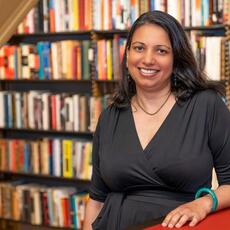
Sangamithra Iyer
Sangamithra Iyer is an environmental planner, engineer, and writer. She is the recipient of a Whiting Creative Nonfiction Grant, a Café Royal Foundation Literature Grant and the Diamonstein-Spielvogel Fellowship at the New York Public Library.
A CLMP Firecracker Award Winner
An Orion Magazine Reading Recommendation
A South Asia Institute, Harvard University Reading Recommendation
A beautifully rendered debut memoir of family, legacy, conservation, the natural world—and those who inhabit it.