
Bread, Borders, and Belonging: a Conversation with PEN America
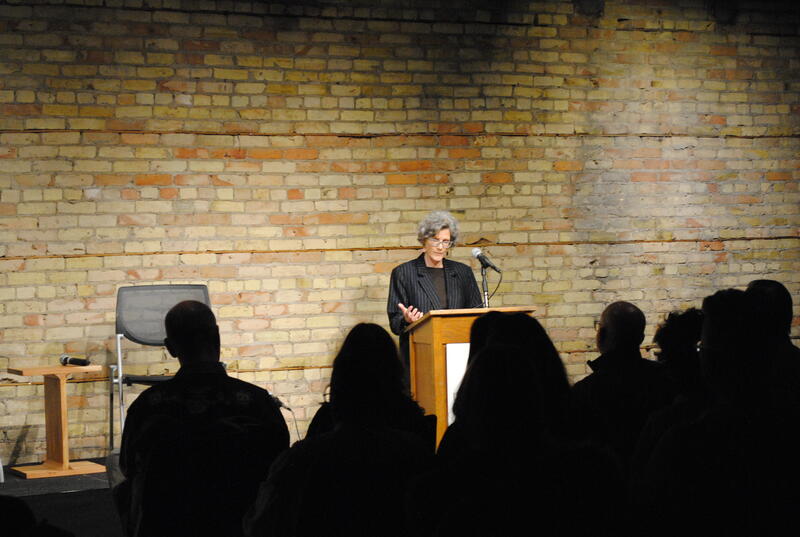
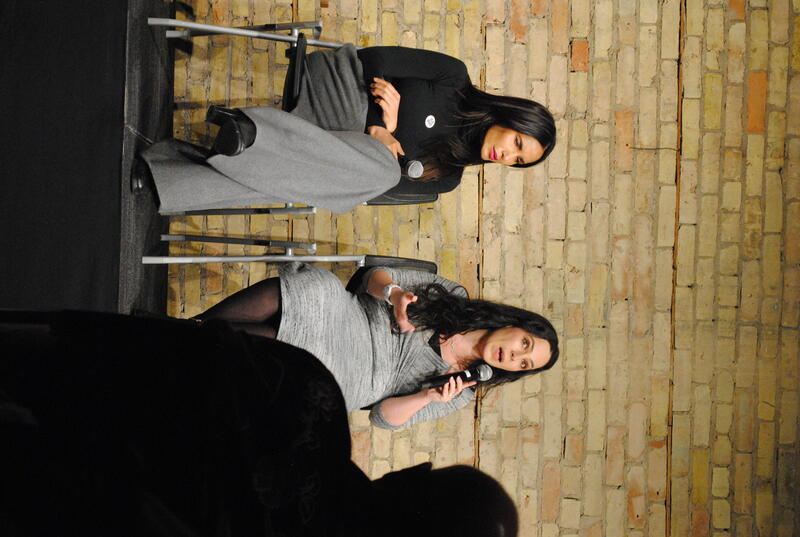
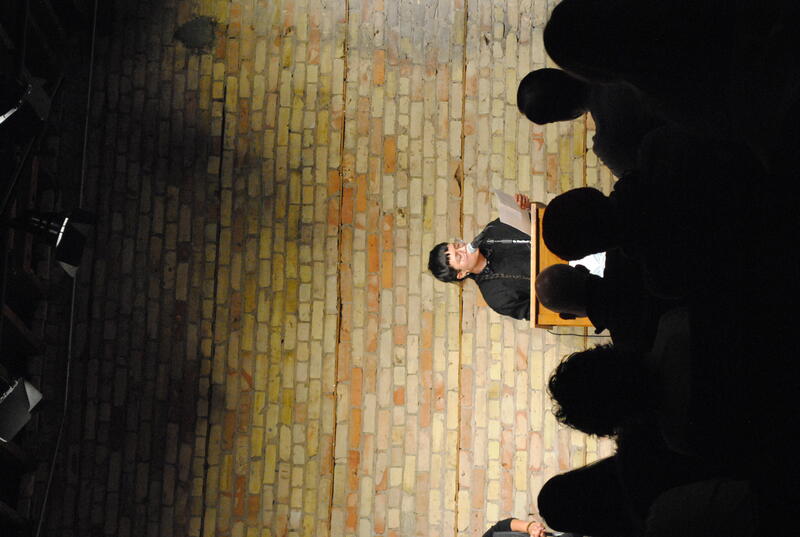
Following a night of poetry with Minnesota Writers Respond, PEN America and Milkweed Editions presented “On Bread, Borders, and Belonging,” offering a pulse-check on the tensions in the Twin Cities during Operation Metro Surge. Panelists included PEN America President Dinaw Mengestu, PEN International president Burhan Sönmez, Emmy-nominated Taste the Nation host Padma Lakshmi, and Out of the Sierra author Victoria Blanco, guided in conversation by Clarisse Rosaz Shariyf. Opening the event was children’s author Monica Rojas with a reading of Nana and Abuela, while poet Ollie Schminkey closed with a poem on Minnesotan solidarity and kinship.
“It was not on my 2026 bingo card that we would come to Minnesota, yet here we are. In the face of extraordinary pressures over the last few months, Minnesota writers have helped their community grieve, mobilize, and have reminded us and maybe especially the lawyers amongst us, that storytelling is not incidental to justice. It is central to it.”–Liesl Gerntholtz
Before Clarisse Rosaz Shariyf guided these four writers in conversation, Liesl Gerntholtz, leader of the PEN/Barbey Freedom to Write center, took a moment to address the urgency in visiting Minnesota in light of Operation Metro Surge. “We bring emergency assistance to endangered writers in places like Ukraine, Russia, Iran, and Palestine,” she begins. “It was not on my 2026 bingo card that we would come to Minnesota, yet here we are. In the face of extraordinary pressures over the last few months, Minnesota writers have helped their community grieve, mobilize, and have reminded us and maybe especially the lawyers amongst us, that storytelling is not incidental to justice. It is central to it.”
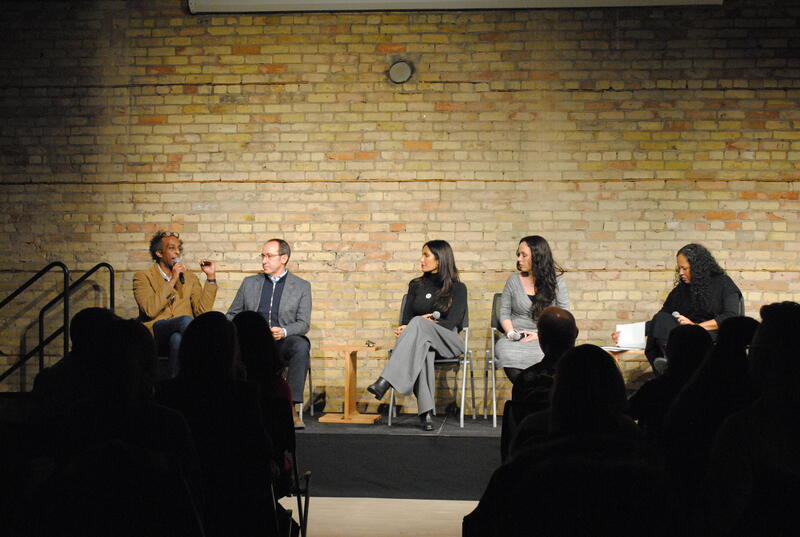
Following a reading of Monica Rojas’ Nana and Abuela, these four writers revealed what happens when border restrictions extend far beyond the physical border, and how food can connect through conflict. For a partial transcript of their conversation, continue reading below. To stay updated on upcoming PEN America events, please visit their website.
Clarisse Rosaz Shariyf: What feels different for you at this moment? What is an exceptional yet painful moment for writers right now?
“I am from El Paso, Texas and Ciudad Juarez. I come from a family that’s been in the borderlands for five generations. For it to be present in such a violent manner these last few weeks has been surreal, quite honestly. This moment that has felt very local to me now suddenly feels more connected to Minneapolis and St. Paul—almost as if the border has extended.” –Victoria Blanco
Dinaw Mengestu: So many things feel different. Just looking narrowly at writers in the literary community, the idea or ability to speak is not equal right now. If you are a writer who is an immigrant, you do not have the same freedom of expression as U.S. citizens. That means you can’t say or talk about the most important thing you want to talk about. What does it mean to be a writer who might not be able to speak freely? It’s a difficult thing. It requires us to recognize those of us who are not in a position that maybe don’t recognize the challenges and risks they face. We’re all trying to understand how we support one another. How do we look at the world around us, still try to write honestly toward it and not turn away from it, all while knowing we have members who can’t turn away from it? You can expand it and enlarge it, at the entire community and everything that happens here. We know we stand outside it, but we’ve come here to be supportive of the significant work going on here at the same time.
Victoria Blanco: For me, this moment has felt new and strangely familiar. I am from El Paso, Texas and Ciudad Juarez. I come from a family that’s been in the borderlands for five generations. The stories of CBP violence run through my family for just as long. In moving to Minneapolis fifteen years ago and choosing to settle here and be part of this vibrant arts community, I thought I left behind the border in that visceral way. For it to be present in such a violent manner these last few weeks has been surreal, quite honestly. My creative work focuses on the borderlands and while I have thought of myself as a writer of place, very specifically from that region, this moment that has felt very local to me now suddenly feels more connected to Minneapolis and St. Paul—almost as if the border has extended. With the conversation now, I feel even greater kinship with the community here.
“I get told often to stay in my lane and write about food, but food, to me, is political. I cannot divorce my work from those principles. There’s really no country in the world that has been shaped and evolved by an influx of migration through generations.” –Padma Lakshmi
Padma Lakshmi: Watching what has been happening here, I want to say first: we see you, we feel you, we are inspired by you and your community, to stand up, literally, to fascism. You remind us of the best that America can be. As someone who has written mostly about food and my work centered around immigration and immigrant food, I get told often to stay in my lane and write about food, but food, to me, is political. I cannot divorce my work from those principles. There’s really no country in the world that has been shaped and evolved by an influx of migration through generations. If you ask me, it is the reason for America’s success. As an immigrant, I’ve been here for fifty years. I came when I was four. I always thought the coolest thing about this country was that fact: in spite of the questionable foreign policy decisions that’ve been made over the generations, the one higher salient principle of America to allow everyone to come, thrive, and call themselves Americans based on a shared value system that is reflected by our constitution rather than any one ethnicity is, to me, a very special and utopian idea. It is the thing that has maintained any moral high ground we may have as a nation overseas. It has been devastating to see that fact diminished and vandalized by one elite group of people in power who think that they get to decide who calls themselves American, and that it isn’t all of us collectively who share in being American and share with our neighbors what it means to be American. So I want to thank you, Minneapolis, for reminding us what it means and what it feels like to fight and protect and preserve that every day with your bodies and voices. I just got here earlier today and I’ve worked with the ACLU for the last decade on immigration. I went to their offices to speak with three local women who have been assaulted, peppersprayed, intimidated, and followed home. I was incredibly moved by their humanity. For me it was just an act of listening to feel what they felt on the ground here. I am constantly moved by all of you. Thank you for reminding the rest of the country and the world how it’s done everyday.
Burhan Sönmez: At PEN International, we have centers in 139 countries. Every year we have a map watching the hotspots of our usual suspects—like my country Turkey, Russia. The worrying thing now is that the western world, previously known as the cradle of democracy, is now on the map. Instead of shrinking, it is spreading to more and more countries. There are two effects here. One is the rise of rightwing populist politics everywhere. The second side of this development is not only a lot of change in the country, this global movement taught international institutions not to care about it—the United Nations, the European Union. When we look at the period between the two world wars, all international discussions were about: how can we create a world order that ensured peace for everyone?
Clarisse Rosaz Shariyf: Victoria, you are a teacher. What are you hearing from students right now?
Victoria Blanco: We’ve discussed it since the first day of the semester. My students overall are struggling. We’re all reacting moment by moment. The crises in January were hour by hour. The need to be able to react took precedence over writing for all of us during January. One of my tasks as a professor this semester was to guide them through the practice of witnessing on paper, using our class to be able to take some time to write, document, and reflect. It was the work of narrative making in-the-moment. It’s so much harder, in the moment, rather than in retrospect. We’re all in the middle of it.
Clarisse Rosaz Shariyf: Were your students able to come to class?
Victoria Blanco: The policy was to certainly offer it, but the majority of my students have come in person. We’ve marked exits so there’s only one way in, one way out. Doors are locked. There’s a lot of community support in terms of coming together as a class, and leaving together, but we all come. It has served as a respite, truly.
“Our job is to give writers the feeling that they will not be left alone, they will not be forgotten. When you are in a torture center, what makes you powerful is that you know that there are people that know your name and place.” -Burhan Sönmez
Clarisse Rosaz Shariyf: Burhan, you’ve experienced state repression as a young lawyer in Turkey. Your activism almost cost your life. When governments begin attacking writers and activists, what are the first signs that we shouldn’t ignore?
Burhan Sönmez: You know, people like me, there’s something good about being born into a hard world. I was born in Turkey. I’ve been through everything. We’ve never seen a good year throughout my life. [Laughs] Evil becomes normalized. It’s collective madness. Hating immigrants, hating black people, LGBTQ groups or women, it all becomes normal. There is this quote from a tenth century Iranian poet: ‘hell is not where you suffer, it is where no one knows that you are suffering.’ Our job is to give writers the feeling that they will not be left alone, they will not be forgotten. When you are in a torture center, what makes you powerful is that you know that there are people that know your name and place. What you are experiencing is very similar to something that happened in my country. Being in the United States in the twenty-first century, you are facing the same thing that once happened in my country. We want some places to stand as an example to us, and I don’t mean the government—governments are evil everywhere.
Clarisse Rosaz Shariyf: In the United States, we hear from PEN America members that they are hesitating over an invitation for a festival. They are wondering if they should do author talks. Do you feel unsafe as a writer right now in this country?
Dinaw Mengestu: No, I don’t. I have to be aware of the position of privilege that I have, a position that allows me to feel insulated. I think of the people who really are at risk, a much larger, more significant category. There’s a reason why the government began by attacking our ability to speak on political issues. Not because they care, but if they can create a climate of fear within one community, it’s easy to spread it from there, to take away their rights, which makes it easier to take it away from everybody else. It means we all learn to, perhaps quietly, become skeptical and cautious of what we say. When we get to a moment like this, we become more paralyzed by the process that began months ago, perhaps without being aware of the silencing that they’ve been doing for so long. Maybe it’s not necessarily me that’s at risk, but what if I say something that puts [my family] at risk? That anxiety can ripple and spread throughout the community, which leaves us all more vulnerable where we are right now, when you’d want everyone to be out protesting. A group of writers at a protest today were saying how frustrated they were that the rest of America wasn’t out there when it was shown what was happening here. Where was the rest of the country? Why weren’t we all out in the streets? We certainly took solace in what was happening. We saw all the people out here doing work. We have already begun the process of becoming silent. It began with the insidious process of taking some rights from some people. Then it grows and amplifies. Next thing you know, we find ourselves more hesitant to do what we know we should be doing.
Clarisse Rosaz Shariyf: On this notion of fear, I wanted to ask you, Padma, about your meeting at the ACLU. Could you talk about your activism in immigrant rights? How has it been to marry your writing about food, and your platform?
Padma Lakshmi: I always wrote about immigrant food even before I knew it was a pattern. It’s been ten years now that I’ve been working with the ACLU. I started just before the first Trump presidency, never imagining that we would be where we are today. It was atrocious then, the baby steps with the muslim ban. After rallying at ACLU events, I traveled to the southern border and crossed on foot just to experience what it’s like. It’s dehumanizing, to say the least. I remember seeing a pile, almost like a pile of snow, but dirty. It was a pile of sneakers. It was horrifying. All I could think was ‘whose sneakers were these? What shoes are they wearing now?’ After these experiences, I wanted to find a way to, as a film-maker, merge my professional life with advocacy for immigrant rights. That’s how Taste the Nation came about—as a play on Face the Nation. Its spy cover is as a food show, but it’s a trojan horse. It wasn’t designed for people who think like me. It was designed for red states, to give a spoonful of entertainment and lifestyle television as a travel-food show. Really, it’s about immigrant communities. American food is the most exciting food in the world because it’s a microcosm of the world with all its waves of immigrants. I hope that through my work, I can get further with my advocacy. Things are getting worse, not better. It’s become harder to look my sixteen year old in the face and to say something that is both true and hopeful, but you guys give us hope. It’s why I’m here: to learn and listen. I keep thinking, ‘what else can I do?’ I think we’re all feeling that.
Victoria Blanco: I appreciate your presence here, all three of you. There’s still a lot of fear in the community. I’m connected to Latine families here that are only starting to think about leaving their homes. These are children that have been missing school, families that haven’t been able to work, and continue to need rent assistance, and daily food delivered. Mutual aid is keeping this city running. In writing about the Latine community, I’ve been in conversation with a lot of writers. To the question of fear, there’s a sense of responsibility right now in not telling stories that become too personal, in terms of protection and surveillance. I come from a very surveilled community in El Paso, Texas: the facial recognition, drones, helicopters, and the tracking of people and following them home. When I wrote my essay for Lithub, I had to think carefully about what to say. I intentionally focused on my son because it was the safest choice as a writer. There are stories I can’t share at this time, for the very real protection of people.
“No amount of cataloguing we do is enough, but we need an archive. We need to protect and preserve what’s happened here, because there’s no guarantee we’ll have access to it.” –Dinaw Mengestu
Clarisse Rosaz Shariyf: For Dinaw and Burhan: What do you feel PEN America and PEN International can do right now?
Dinaw Mengestu: Many things need to be done. Obviously, it is what we do: gather stories. No amount of cataloguing we do is enough, but we need an archive. We need an archive of what this government is trying so hard to do: erase, erase, erase. We need to protect and preserve what’s happened here, because there’s no guarantee we’ll have access to it. We also need to know that this doesn’t end just because the surge ends, right? There’s a lot of long-term care, work, recording, and listening that needs to be done, because how do you go back to believing your country? That experience is going to linger. Work has to happen in these communities, in learning how to really communicate amongst themselves and becoming agents of their own healing, because it’s not necessarily going to come from the outside. It needs to be a dialogue in the private spaces that have been damaged by this.
Burhan Sönmez: At PEN International, we’re not doing one specific thing, because of all that we have going on already. For example, we have the Women’s Writers Committee. We founded Writers For Peace during the cold war of Yugoslavia. We have subcommittees, one of which is the Young Writers Committee. We do all these things, but we need young people. They do not need our advice. We are not smarter than them. They only need support and opportunity.
Before letting us loose in the night, Ollie Schminkey leaves us with both poetry and promise. “Land of ‘this is your home, no matter where you come from,” they read, “land of ‘you belong here, and we will prove it.’”
For more information on PEN America and PEN International’s visits through the Twin Cities, please read more about their journey here.

Milkweed Editions & PEN America present Bread, Borders & Belonging
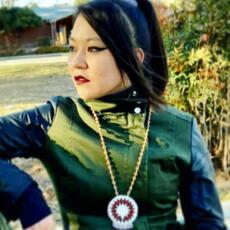
Brianna Reed
From the Navajo Nation, Brianna Reed is the Diné author of multi-genre works that have appeared in Leonardo Fine Arts magazine, The Tribal College Journal, The Yellow Medicine Review, and Into the Unknown Together: A Climate Sci-Fi Anthology. By gaining her BFA in Nonfiction through the Institute of American Indian Arts, she has earned opportunities to present work across the nation, in Mexico, the Fine Arts Work Center of Cape Cod, and now through the Milkweed Editions fellowship. Now pursuing her MFA in Fiction through IAIA, she has also entered her third year penning her column, “The Moccasin Millennial” with…