Jake Skeets in Conversation with Bookseller Calvin Crosby
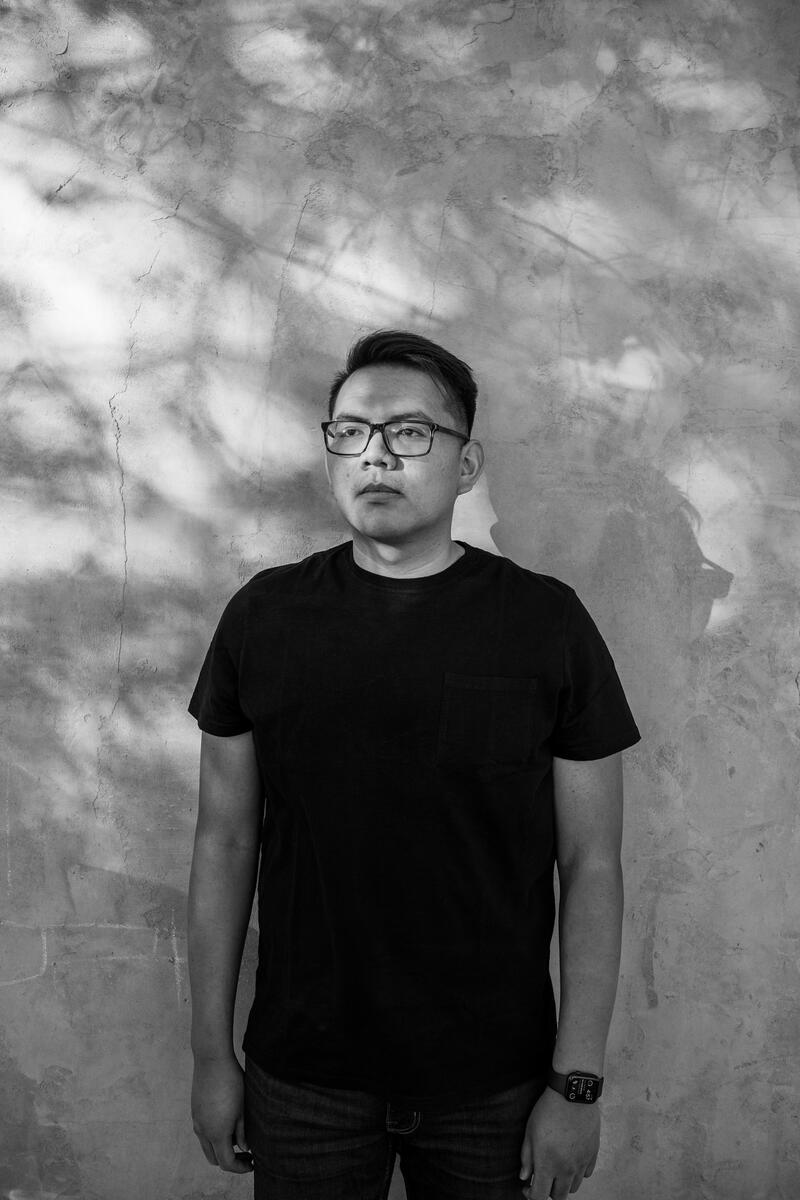
Jake Skeets—Navajo Nation Poet Laureate, Whiting Award winner, and author of the Kate Tufts Discovery Award–winning Eyes Bottle Dark with a Mouthful of Flowers—returns with Horses, a powerful and long-awaited second collection. Opening with the haunting image of two hundred horses lost on Navajo land, the book moves through questions of climate change, belonging, and survival, while holding space for beauty, imagination, and joy.
Known for his groundbreaking queer, Indigenous poetics, Skeets continues to explore the deep connections between land, language, and identity, crafting poems that are at once intimate and expansive. Horses is a fierce and lyrical work that further establishes him as one of the most important poetic voices writing today.
In a recent conversation with bookseller Calvin Crosby of The King’s English Bookshop in Salt Lake City, UT, Skeets reflects on the creative journey behind Horses, the influence of Diné storytelling traditions, and what it means to write from—and for—community. The discussion offers a deeper look into the ideas and experiences shaping this remarkable new collection.
Calvin Crosby: Today, it’s an honor to have a conversation with Jake Skeets. Jake Skeets has become one of the most compelling voices in contemporary Indigenous poetry. A Diné poet from the Navajo Nation and the current Navajo Nation Poet Laureate, Skeets writes work deeply rooted in land, memory, and community, weaving together personal history, Diné culture, and the landscapes of the Southwest. His new collection, Horses, has already drawn praise from former U.S. Poet Laureate Joy Harjo, who calls his poetry “powerful and necessary.” In this conversation, Skeets reflects on the journey behind Horses, the influence of Diné traditions, and what it means to serve as a poetic voice for his nation.
Jake Skeets: Let me first introduce myself in Navajo: ‘Tsi’naajinii nishłí, Tábąąhá báshíshchíín. Táchii’nii dashicheii Tódík’ózhí dashinalí.” It’s nice to be here, and it’s great to talk about Horses. I finished this book back in 2023, so the fact that it’s finally coming out in 2026 says something about the revision process and the amount of time I spent really shaping it for readers. In some ways, it feels like an older book to me now, but I’m so happy to return to it and rediscover it alongside readers and audiences.
Calvin Crosby: It’s such an honor to be having this conversation. For readers who are just encountering Horses for the first time, how would you describe the heart of this collection and where it comes from in your life?
Jake Skeets: For me, this book feels more like a debut than my first book did. At the heart of the collection is a personal meditation and exploration of where I come from, which is the Navajo Nation.
My first book, Eyes Bottle Dark with a Mouthful of Flowers, was written entirely during my MFA program, so a lot of hands and perspectives helped shape it. With Horses, I wrote in a very different way. I worked mostly on my own. I didn’t have second readers or workshop participants. No one saw a draft of the manuscript until my agents, and I only sent it to one other poet, Sherwin Bitsui.
It also came out of a time of real transition in my life. I started writing it during the pandemic in 2020. Then I moved to Oklahoma, and from there I took a residency in Oxford, Mississippi. My life was changing every year, and I think the book carries that movement with it. It’s also an exploration of what it means to be a poet. I really wanted to test my ability on the page with just myself and the voices of the poets I was reading as guides and companions.
Calvin Crosby: It really does show up in the book. I want to sidebar for just a second, because my Cherokee heritage is based in Oklahoma. Isn’t the landscape there just stunning?
Jake Skeets: Yes, absolutely.
Calvin Crosby: The skies in Oklahoma are incredible. I also paint, and after coming back from there, I found myself using pinks and lavenders in my work when I’m usually drawn to earth tones. That sky just permeated everything.
Jake Skeets: Mm-hmm.
Calvin Crosby: Connecting to the land again—when did you realize the poems you were writing belonged together as a collection? And what helped shape them into the book Horses?
Jake Skeets: My process, in terms of composing a book, moves through two phases, though I don’t want to make it sound neat or linear, because it isn’t. The first stage is just writing—exploration, really. A lot of my process is rooted in creative research or artistic research. I might travel back home, drive across the Navajo Nation, notice the landscape and how it moves around me. I might spend time in archives, read newspaper articles, or read other poets. I’m trying to understand what’s happening around me.
The poems come together slowly. I’ll write down lines, fragments, quotes, images. I have a file in my phone called “Glimmers,” a term I borrowed from Pam Houston. It’s the idea that when you’re out in the world living your life, you get these flashes—moments of language or image—and you gather them. Later, they may become an essay or a story, or in my case, a poem.
Then, after I’ve done that for long enough, I begin to see threads or patterns emerge. That becomes the second stage, where I start composing the book out of those fragments. Usually, some trigger pushes me into that stage.
With Horses, that trigger was coming across an article about nearly 200 horses found dead on the Navajo Nation in a dried-up stock pond. What stayed with me was the photograph. The horses were arranged in a circle, and that image really struck me. From there, I began to see that I had been writing toward questions of climate, weather, landscape, and crisis all along. It just took that photograph to make it clear to me.
Calvin Crosby: That’s powerful. The imagery is incredible. I’m going to combine two questions here, because of what you just said. Let’s talk about Diné culture, tradition, and landscape, and how all of that enters your work. Even reading the book in English, you can feel the rhythm of your language, the desert, the atmosphere. How does that come about for you?
Jake Skeets: In terms of Diné living culture, storytelling is a huge part of Navajo tradition, both in an ancestral sense and in a contemporary one. Whenever I go back home, I always say that the best storytellers are my parents, my aunts, and my uncles. When we gather for a meal, they go on with stories and memories and gossip and updates, and the way they put their words together is so elegant. I take in the music of that language whenever I’m with my family.
For this book, I was especially drawn to two things that feel informed by Diné culture or tradition. The first is numbers. The book opens with a 12-part poem called “Horses,” and it’s followed by a section of 12 poems. Throughout the collection, there are poems in two parts, four parts, triptychs. Numbers like 2, 4, 6, and 12 show up consistently.
The last poem in the collection is a sestina. To write it, I used a word count to determine the six most repeated words in the book, and those became the end words of the sestina: words like morning, light, wind, field, and time. Those are the concerns I was returning to all along.
The other important image is morning—morning time, first light, waking. That’s what kept me moving through the collection.
Calvin Crosby: That explains the hope in the book, and the sense of rest it offers. In this moment, having a place where you can savor words and let your heart rest for a moment—this book does that. I want to ask about Joy Harjo. How did that connection begin, and what does it feel like to have her speak so highly of your work?
Jake Skeets: I call Joy Harjo my literary auntie. When I first met her, I was an undergraduate at the University of New Mexico. She was there doing a reading with Tanaya Winder. I asked a question about what it was like to deal with white audiences, because at the time I was in workshop and encountered a lot of ways of reading poetry that I didn’t necessarily agree with.
After the reading, I bought her book with what little money I had, and she signed it, “It’s all about listening.” Then I went outside and started reading it on the steps. She came out with her family, saw me, called my name, and asked, “Do you want a burger?” Of course, I said yes.
We walked to Frontier Restaurant, and she bought me a burger. She was talking about her writing, and eventually we figured out that she knew one of my aunts back home, which is probably why my last name caught her attention in the first place. Since then, we’ve stayed in touch, and that’s why I call her my literary auntie.
Her work was one of the mentor texts for this book, especially She Had Some Horses. I borrow the word “horses” from that book, and I continue to be interested in repetition as a formal device. So, when it came time to ask for blurbs, I emailed Joy. She wrote a beautiful, generous paragraph for the book.
Calvin Crosby: That’s magic. You’re currently serving as Navajo Nation Poet Laureate. What does that role mean to you, and how has it shaped the way you think about your work as a poet?
Jake Skeets: It means a great deal. I’m teaching now at the University of Oklahoma, and when we brought Joy Harjo to campus last spring, she offered me some advice after I had just received the poet laureateship. She encouraged me to involve students and community as much as possible.
A poet laureate for a Native nation is a little different from a poet laureate for a city or a state. It’s not just civic in the usual sense. It’s rooted in self-determination and sovereignty. For me, being poet laureate has affirmed that I’m on the right path. As a writer, there’s always doubt. You’re always asking if you’re doing enough or doing it well. So, to receive this recognition from my own nation is a profound affirmation.
It also gives me an opportunity to practice reciprocity. I don’t want to be someone who comes onto the Navajo Nation, extracts stories, and leaves. I want to give back. I want my work as a poet to be rooted in community.
That’s led me to start a public arts initiative called Hootsó. It will serve as an umbrella for community projects, the first of which is the Saad Prize, a literary award and incubator. There will be a flagship prize for a poet, but also awards for college students, high school students, and storytellers—Diné people working in oral traditions or spoken word. If you go to any fair or gathering on the Navajo Nation, there is always someone telling a story. I wanted to honor that as poetry too.
For me, this role is about giving back in the ways I know how—through language, through community connections, and by helping create a platform for the people coming after me.
Calvin Crosby: Your timing is incredible, because I’m thinking about writers like Stacie Denetsosie and Kinsale Drake. And I have to say, at The King’s English Bookshop—which is, ironically, the most colonial name for a bookstore, especially as a Cherokee bookseller—we hosted Kinsale Drake and had 80 Native people in the store. The time is right to keep showing up for new voices. You’re helping build that foundation already. What is your hope for aspiring young Diné writers, poets, and storytellers who come to your work?
Jake Skeets: I hope they see that our culture and tradition are elegant. There is real glamour there, real sophistication. So often Native people grow up surrounded by racism that tells us coming from a reservation or a Native nation is somehow lesser than dominant cultures and traditions.
That pressure can be especially strong in poetry and literature, where the norms are often Eurocentric—the sonnet, the sestina, those familiar forms. But what I wanted to do in this book was highlight the ways we can learn from our own traditions, from our own narrative structures, and build poetry from there.
I hope younger writers see that they do not have to rely on creation stories alone in order to be culturally relevant. Those stories are always there if you want them, but for me, I wanted to take as little as possible and instead work with the elegant, glamorous parts of Diné thought and life as craft choices.
I also hope they see that writing is not easy work. It can be romanticized from the outside, but it is labor. It’s strange labor, because you’re often doing it in your head, alone, and then carrying it into public spaces and audiences. That takes a lot from a person. For Diné people especially, being in public in that way can carry particular kinds of risks.
And I hope the book shows that we can write about grief and joy and hope and crisis all at once. We do not have to choose one feeling over another. Grief and joy often arrive together. It’s the dominant culture that teaches us to separate them so sharply. But they can exist hand in hand. And just because they do, that does not mean hope disappears. That is where the morning comes in for me—dawning, return, possibility.
Calvin Crosby: Wow. That’s all I can say. What a joy it has been to have this conversation with you, and to spend time with this book. Horses by Jake Skeets—please pick it up from your local independent bookstore. Thank you.
Jake Skeets: Thank you.
Calvin Crosby: I’m especially excited because we have a grant that will help us put books into southeastern Utah and around the Nation there, and I’m thrilled to think of your book reaching readers in those communities. That moment of being seen—of finding your voice reflected back to you—matters so much. Your voice is going to go very far for those readers, for young people, and for adults too.
Jake Skeets: Thank you. I really appreciate that.
Calvin Crosby: Thank you again for the questions. Conversations like this matter.
Jake Skeets: They do. Up to this point, only a few people have read the book, so now that it’s finally making its way into more readers’ hands, I’m excited to talk about it. I’ve been cherishing it for a long time. Now that publication day is here, I’m excited to be in front of audiences and have these conversations. That’s what I’ve been looking forward to.
Jake Skeets
Jake Skeets is the author of Eyes Bottle Dark with a Mouthful of Flowers, winner of the National Poetry Series, American Book Award, and Kate Tufts Discovery Award, and Horses, which was named one of Literary Hub’s Most Anticipated Books of 2026.
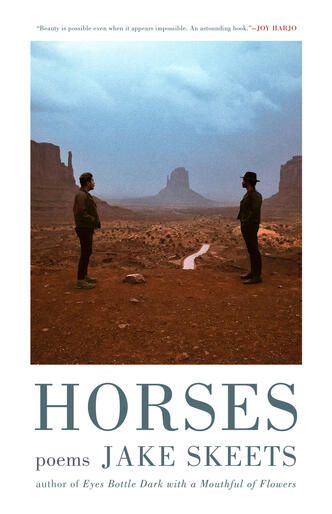
Longlisted for the 2026 National Book Awards
“Beauty is possible even when it appears impossible. An astounding book.” —Joy Harjo, author of Washing My Mother’s Body
“For now, go out and dream of joy, we know the labor of feeling it.”
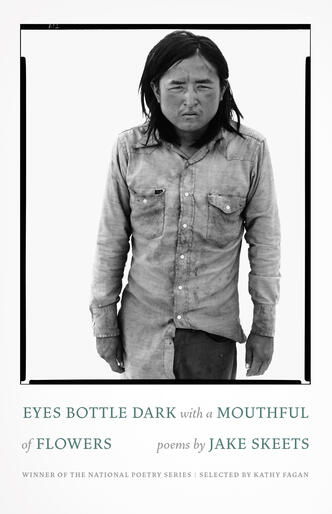
This National Poetry Series winner is an unflinching portrait of the actual west—full of beauty as well as brutality, where boys tentatively learn to become, and to love, men.