
The Shape of Minnesotan Writers: Minnesota Writers Respond
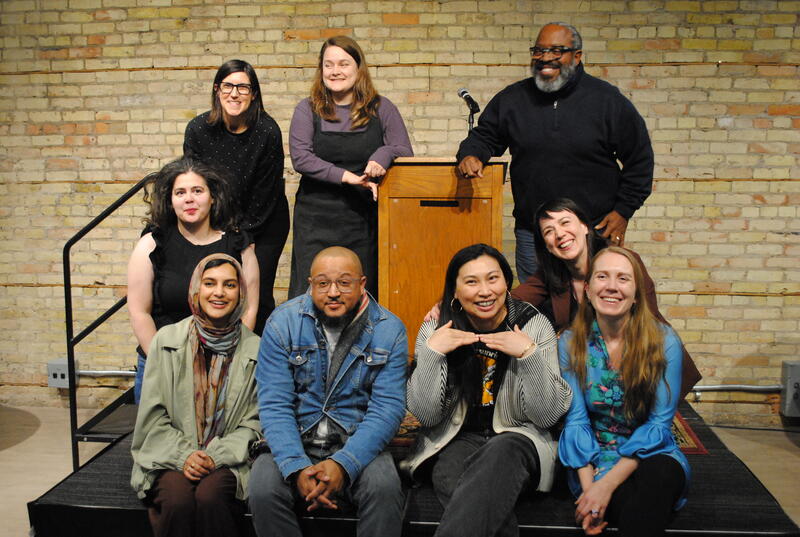
On Thursday, February 26th, local author Jessica Nordell partnered with Milkweed Editions and The Loft Literary Center on a benefit reading for the Immigrant Law Center of Minnesota responding to the current, ongoing tensions within the Twin Cities and our surrounding communities. They were joined by writers Curtis Sittenfeld, Sarah Ghazal Ali, Michael Kleber-Diggs, Chaun Webster, Saymoukda Duangphouxay Vongsay, Claire Wahmanholm, Halee Kirkwood, Lara Mimosa Montes, and Jessica Nordell for a night of collective healing. All proceeds benefitted the Immigrant Law Center of Minnesota.
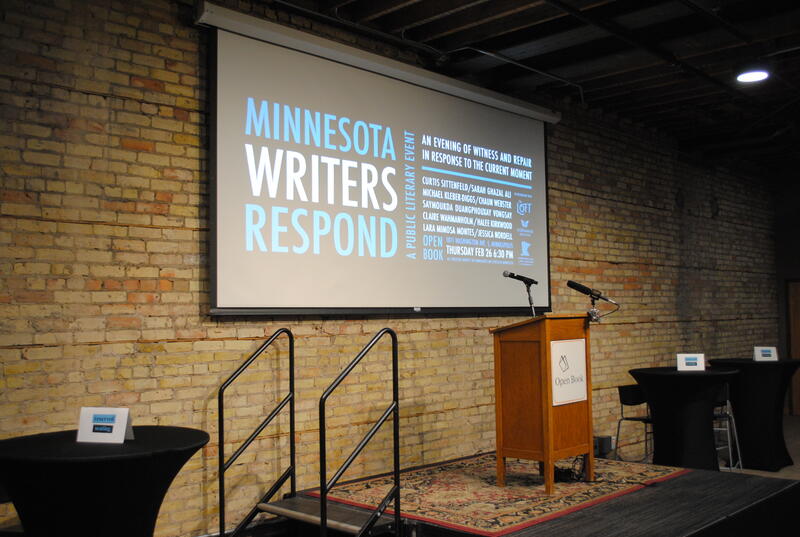
All around us, at first, were a chorus of voices. In asking Minnesota Writers from across the landscape to respond, The Loft Literary Center and Milkweed Editions have signaled a clarion call for everyone else to join in, too. Like many listeners, myself included, we braced pens in our hands and turned to fresh pages. So when Arleta Little asked, “I wonder if you might add your voice, too?” we laughed off our collective nerves and began to sing. One by one, she sang us into gospel with We Shall Overcome. “Our writers,” She explained afterward, “have been our representative voices echoing throughout our state, country, and world.”
Minnesotan writers put one word after another like beads on a string, following the artistic legacy of the people of this land. With each word, Minnesotan writers render the present legible, putting form to chaos. –Jessica Nordell
Jessica Nordell, coordinator of Minnesota Writers Respond, too, acknowledged the role that Minnesotan writers have played in understanding the current moment within America. “Minnesotan writers put one word after another like beads on a string, following the artistic legacy of the people of this land. With each word, Minnesotan writers render the present legible, putting form to chaos. These writers tonight are here to bring form from that chaos.”
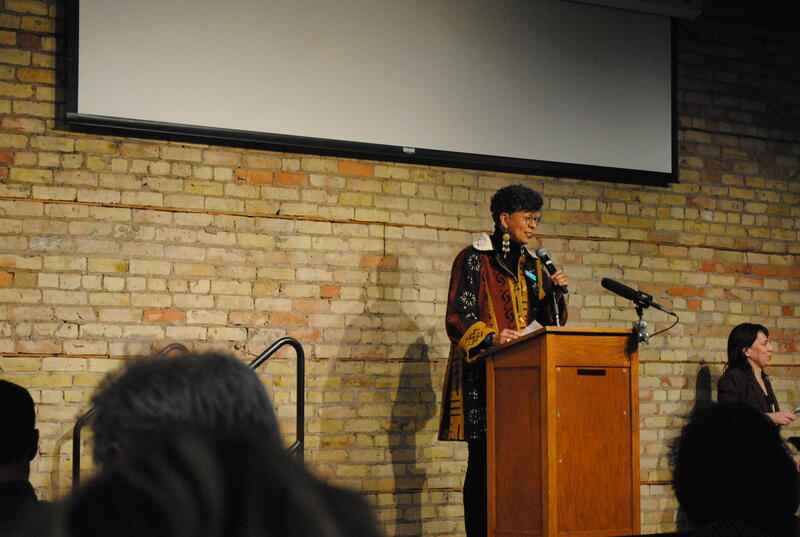
Helping bring form to chaos were nine writers who, in their own ways, added to the endless definition of what being a Minnesota writer embodies. Chaun Webster, the first of this collective, answered with a poem the shape of his child. “My youngest has a habit of reordering time when she speaks. The past, present, and future shudder in her sentences.” He recalled the whistles shrieking in neighborhoods, of sudden emergency plans spurring them to action. As an ICE altercation erupts doors from his own, he recalls his child’s penchant for travel, twisting the past into the present. “Is tomorrow’s execution,” he posed, “yesterday’s abduction?”
Halee Kirkwood, James Welch prize-winner, answered this question as an Ojibwe writer, questioning what they might become. “Today, I am woke Instacart.” For them, a Minnesotan writer is defined not by what they write, but by what they hold: memorized emergency contacts, omnipresent whistles, and handwritten driving instructions. They described carrying groceries from countless trips, lifting heavy tortilla sacks, and shouldering the inherent distrust laced in every public outing. “I am just trying to hold,” they admitted toward the end, “as many people as I can.”
Curtis Sittenfeld, herself a Minnesotan resident since 2018, laughed before her reading. “What does being Minnesotan mean?” She rattled off the telltale signs of becoming Minnesotan: “Thinking thirty degrees isn’t cold, pretending to be nice, saying ‘oofda’ ironically at first.” Both lighthearted and somber, she described the rapid-response community trainings that have sprouted through the cities. “We were told to focus on ‘communities, families, and neighbors’ when speaking with media.” After she disarmed us with more punches of humor, she offered a knowing smile. “I’m here because I believe in keeping our communities and families whole.”
We’re called citizens before, sometimes neighbors if status is unknown, then civilians after, passive and done unto. Most suffering begins with someone you know. –Sarah Ghazal Ali
Next, Sarah Ghazal Ali rose from the crowd, a slip of color blooming in her mauve paisley headscarf—the promise of an early spring in a brutal winter. For her, a Minnesotan writer, like any other label, is an object of impermanence. Like all labels, it can be stripped when left neglected. “We’re called citizens before, sometimes neighbors if status is unknown, then civilians after, passive and done unto. Most suffering” she told us, “begins with someone you know.”
Lara Mimosa Montes filled the shape of Minnesota with the unheard and unseen by bringing voices into the present with her bilingual reading of Dolores Dorantes and Rodrigo Flores’ Intervenir/Intervene. Switching through Spanish and English, she braided together hidden stories that took place across the Twin Cities: “No entiendo nada, amor, I don’t feel your body / mis manos no siento tu cuerpo, vida. My life doesn’t feel your body, love.”
‘Be mine,’ we say, without even knowing each other’s names. The hearts we carry are all shaped the same. –Claire Wahmanholm
Claire Wahmanholm, author of Meltwater, aimed for the vulnerability inherent in writing in-the-moment. “You think you can be in the room, watching everything happen, and suddenly it changes.” For her, though, she is a Minnesotan writer in the shape of a school neighborhood patroller-turned-Valentine. “Our neon vests are boring, identical, and bright enough to be seen from space. We constellate. ‘Be mine,’ we say, without even knowing each other’s names. The hearts we carry are all shaped the same.”
Jessica Nordell, in turn, drew us to the edge of the midwestern wilderness on the cusp of hunting season. “This time of year, I am reminded of white-tail season,” she began. “Deer understand nothing of delayed gratification,” she reads, eliciting a laugh. “Deer, too, have knowledge. It is pouring from his head, down the side. What good is experience” she asks us, “that sinks into soil for centuries?” She closed with a lesson in Latin, breaking down the meaning of “video” into “I see” statements. “Who enforces the border of a body?” she imparted.
For playwright Saymoukda Duangphouxay Vongsay, Minnesotan writers can be karma incarnate. They were Laotian husbands buoying their wives across the Mekong, long before Minnesota became home. “Last month, footage of [my cousin’s] apprehension by ICE went all over social media,” she shared, “hands behind his back, grey sweats, rocking a twenty-four-karat gold chain with a buddha pendant the size of his heart.” She reflected on her father’s experiences migrating to America. “[my dad] tells stories about when people couldn’t wait for karma, they became it. When former communist soldiers escaped to refugee camps, hoping to blend in with those they betrayed—the people didn’t forget. The people who became the karma survived.”
For all it had suffered, our bodies stayed whole. –Michael Kleber-Diggs
Closing the night, Max Ritvo Poetry Prize winner Michael Kleber-Diggs left another shape of Minnesotans—this time filling it with silence and memories. “After you left, the weight of your absence became a black hole.” For him, Minnesotans are the shape of fathers, of sons capturing what it means to miss those taken by brutality. Despite the heaviness in this final reading, he offered a small moment of respite, in knowing that we can heal beyond this moment, too. “For all it had suffered,” he promised, “our bodies stayed whole.”
For upcoming events, videos, and more from Minnesota Writers Respond, please visit their Instagram for the latest information.
Michael Kleber-Diggs
Michael Kleber-Diggs’s debut collection of poems, Worldly Things, won the 2020 Max Ritvo Poetry Prize. He was born and raised in Kansas and now lives in St. Paul, Minnesota. His work has appeared in Lit Hub, the Rumpus, Rain Taxi, McSweeney’s Internet Tendency, Water~Stone Review, Midway Review, North Dakota Quarterly and a few anthologies. Michael teaches poetry and creative non-fiction through the Minnesota Prison Writers Workshop.
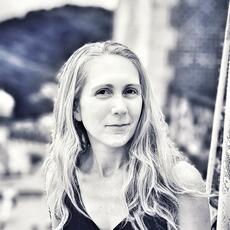
Claire Wahmanholm
Claire Wahmanholm is the author of Wilder, Redmouth, and, most recently, Meltwater, which was a finalist for the Kingsley Tufts Poetry Award, the Minnesota Book Award, and was a National Book Award Science + Literature selection. A McKnight Writing Fellow and the winner of the Montreal International Poetry Prize, she lives in the Twin Cities.
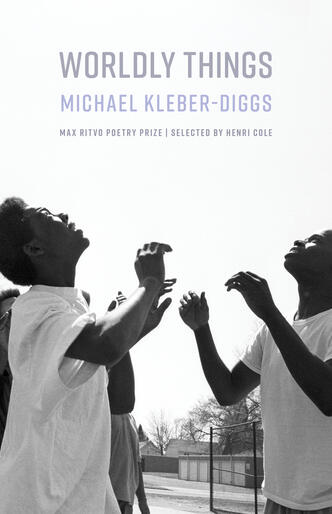
Winner of the Max Ritvo Poetry Prize, the poems of Worldly Things offer needed guidance on ways forward—toward radical kindness and a socially responsible poetics.
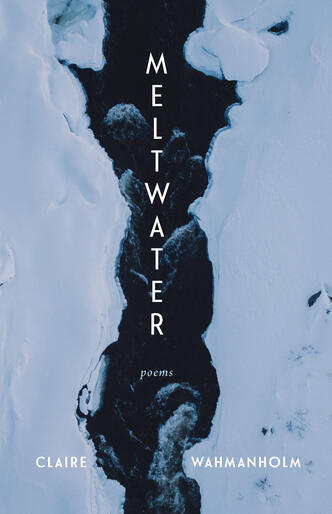
A haunting collection that inhabits a disquieting future where fear is the governing body, “the organ and the tissue / and the cell, the membrane and the organelle.”

Minnesota Writers Respond: A Public Literary Event
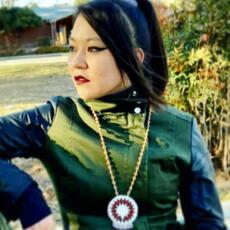
Brianna Reed
From the Navajo Nation, Brianna Reed is the Diné author of multi-genre works that have appeared in Leonardo Fine Arts magazine, The Tribal College Journal, The Yellow Medicine Review, and Into the Unknown Together: A Climate Sci-Fi Anthology. By gaining her BFA in Nonfiction through the Institute of American Indian Arts, she has earned opportunities to present work across the nation, in Mexico, the Fine Arts Work Center of Cape Cod, and now through the Milkweed Editions fellowship. Now pursuing her MFA in Fiction through IAIA, she has also entered her third year penning her column, “The Moccasin Millennial” with…