Reading Sinkhole: Six Books on Loss, Land and Memory
We all carry stories about where we come from. Our family histories are tied to particular places—the houses, towns, fields, and landscapes where generations of people have lived and worked. Sometimes those connections are easy to see; sometimes they emerge slowly, through stories, photographs, memories, and the things that have been left behind. For me, loss brought these connections into focus and made me look more closely at the relationship between family history and place.
In my book Sinkhole: A Personal History of Loss and Land, I explore my father’s death by suicide, which led me back into my family’s history and, eventually, to Pittsburg, Kansas, where three generations of my family had lived. As I spent time there, I began to see the landscape differently—to notice how family stories, environmental history, and the traces of coal mining were layered into the place. What began as a story about loss became a way of thinking about inheritance: what we carry from the people who came before us, and what a place can hold onto long after they are gone.
As I worked on Sinkhole, I became interested in books that explore some of the same questions I was grappling with—the relationship between family history and place, the ways memory changes over time, and how a personal story can open into a larger social or historical one. The books gathered here weren’t all books I read while writing Sinkhole, but they are books I see in conversation with the memoir and with the questions that continue to interest me: How do family stories change over time? What does a landscape hold onto, and what does it ask us to remember? And how do we make sense of loss when there isn’t a clear ending to the story?
These books approach those questions in very different ways. Some are memoirs; others move between natural history, cultural history, and personal experience. What connects them for me is their attention to place—to the physical landscapes where our lives unfold and the histories that are embedded there.
Robert Macfarlane, Underland
Robert Macfarlane’s Underland takes us below the surface of the earth—to caves, mines, burial sites, and other hidden landscapes. He writes about what we put underground and what remains there: geological time, human remains, toxic waste, ancient art, and traces of human history.
Macfarlane takes a highly lyrical approach to the landscapes beneath our feet, exploring the ways humans have used the underground “to shelter what is precious, to yield what is valuable, and to dispose of what is harmful.” I was especially drawn to the way he considers the relationship between the landscape we can see and everything that exists beneath it—the histories, materials, and traces that remain hidden from view. That idea is central to Sinkhole. In and around Pittsburg, Kansas, the ground itself carries the history of coal mining and extraction. A landscape can look ordinary until you know what lies beneath it. Underland is, in part, a book about learning to look down, and about what becomes visible when we do.
Sarah Smarsh, Heartland: A Memoir of Working Hard and Being Broke in the Richest Country on Earth
In Heartland, Sarah Smarsh writes about her family and her childhood in rural Kansas while also looking at the economic forces that shaped their lives. Smarsh comes from a long line of Kansans: she is a fifth-generation wheat farmer on her father’s side, while her mother’s family history includes generations of teen mothers. She grew up on a farm about thirty miles west of Wichita, raised largely by her grandmother. From this family history and place, she writes about work, money, education, poverty, and the complicated meanings attached to the idea of the American heartland.
I was struck by the way Smarsh uses the lives of Midwestern working people to examine class and the economic forces that shape their lives. Farmers, construction workers, mothers, grandparents, and other working people emerge as complicated individuals, while their experiences also point to larger questions about money, work, opportunity, and inequality. These are questions I touch on in Sinkhole as well, particularly in thinking about the economic history of Pittsburg and the ways class and work shape our relationships to a place.
J. Drew Lanham, The Home Place: Memoirs of a Colored Man’s Love Affair with Nature
J. Drew Lanham’s The Home Place is about returning to the land his family has lived on for generations in rural South Carolina. He writes about family history, race, birds, land, and memory, moving between the personal history of his family and the larger history of the land they inhabit. Lanham is a fifth-generation African American farmer, and the history of the “Home Place” cannot be separated from the history of slavery and the racial violence and inequalities that shaped who could own and work the land.
What I love about this book is the way Lanham writes about coming to know a landscape through repeated encounters with it. A place becomes familiar not because it stays the same, but because we learn its changes: the birds that return, the trees that fall, the people who disappear.
Race is also central to Lanham’s experience of place and belonging. I did think about whiteness in Sinkhole, particularly in relation to my own family’s history, but The Home Place has made me think more deeply about the racial dynamics surrounding my own story—about who has been able to claim belonging in particular places, whose histories are preserved, and whose relationships to land are shaped by forces beyond individual family history.
Kathleen Finneran, The Tender Land
Kathleen Finneran’s The Tender Land begins with the suicide of her younger brother, who was fifteen when he died. The book is about grief and the lasting effects of that loss, but it is also filled with love and attention to the life of the person who is gone. Finneran writes about her family and the difficulty of making sense of a death that cannot be easily explained or resolved.
The book’s attention to what suicide leaves behind is especially powerful. The loss does not end with the death; it becomes part of the family’s ongoing life, shaping memories, relationships, and the stories they tell about the person who is gone. The questions surrounding the death may change over time, but they do not necessarily disappear. Sinkhole also tries to stay with this complicated aftermath—what happens to a family after a suicide, how we live with what we cannot fully understand.
Rebecca Solnit, The Faraway Nearby
The Faraway Nearby is a gorgeous and unusual book. Solnit begins with her mother’s illness but resists telling that story in a straightforward way. Instead, she follows unexpected connections among family stories, fairy tales, landscape, travel, and memory.
I love the way the book accumulates these stories and ideas, creating layers of meaning as it moves. Solnit writes about the ways we protect ourselves from pain, and how those protections can sometimes separate us from our own lives and from one another. Stories become a way of exploring those connections—between people, between past and present, and between our individual experiences and the larger world.
The book begins with one hundred pounds of apricots that Solnit’s mother gives her. Solnit spreads them out on a sheet on her bedroom floor so they won’t crush one another, watching them change as they ripen. From this simple, almost domestic scene, she begins to tell the complicated story of her relationship with her mother, including her mother’s criticism and rejection and, later, her descent into Alzheimer’s. The apricots become a way into thinking about time, aging, memory, and the difficulty of caring for someone with whom a relationship has always been complicated. As Solnit writes, “Time itself is our tragedy,” and the book keeps returning to the ways we try—and fail—to hold on to what is passing.
Kristen Radtke, Imagine Wanting Only This
When Kristen Radtke was in college, the sudden death of a beloved uncle and a visit to an abandoned mining town after his funeral sparked her fascination with ruins and with the people and places left behind. Imagine Wanting Only This is a moving and thought-provoking graphic memoir about impermanence, memory, and our desire to understand what remains after people and places have changed or disappeared.
Radtke travels through ruins both physical and metaphorical, considering what happens to a place as it decays and how we decide what those places mean. A landscape can become picturesque, abandoned, or simply blighted, depending on how we look at it.
A ruin is also a kind of container for memory. What does a place remember? What can the remains of a landscape tell us about the people who once lived there? These questions give the book much of its power.
Juliet Patterson
Juliet Patterson is the author of Sinkhole, as well as two collections of poems, Threnody and The Truant Lover, a finalist for the Lambda Award. Her poems and essays have appeared widely.
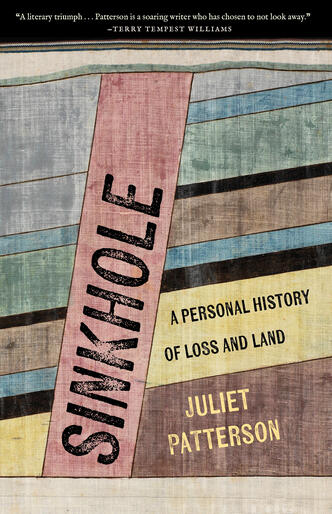
A sublimely elegant, fractured reckoning with the legacy and inheritance of suicide in one American family.